Begin
15 pages · ~30 min
Project Management Case Studies: Patterns & Tradeoffs
Project management case studies that build skills in recognizing patterns and making tradeoffs, designed for project managers and team leaders.
A digital instructor presents all 15 pages. Hold “Ask” at any point and ask out loud — the answer comes from this course. No sign-up needed.
What you’ll learn
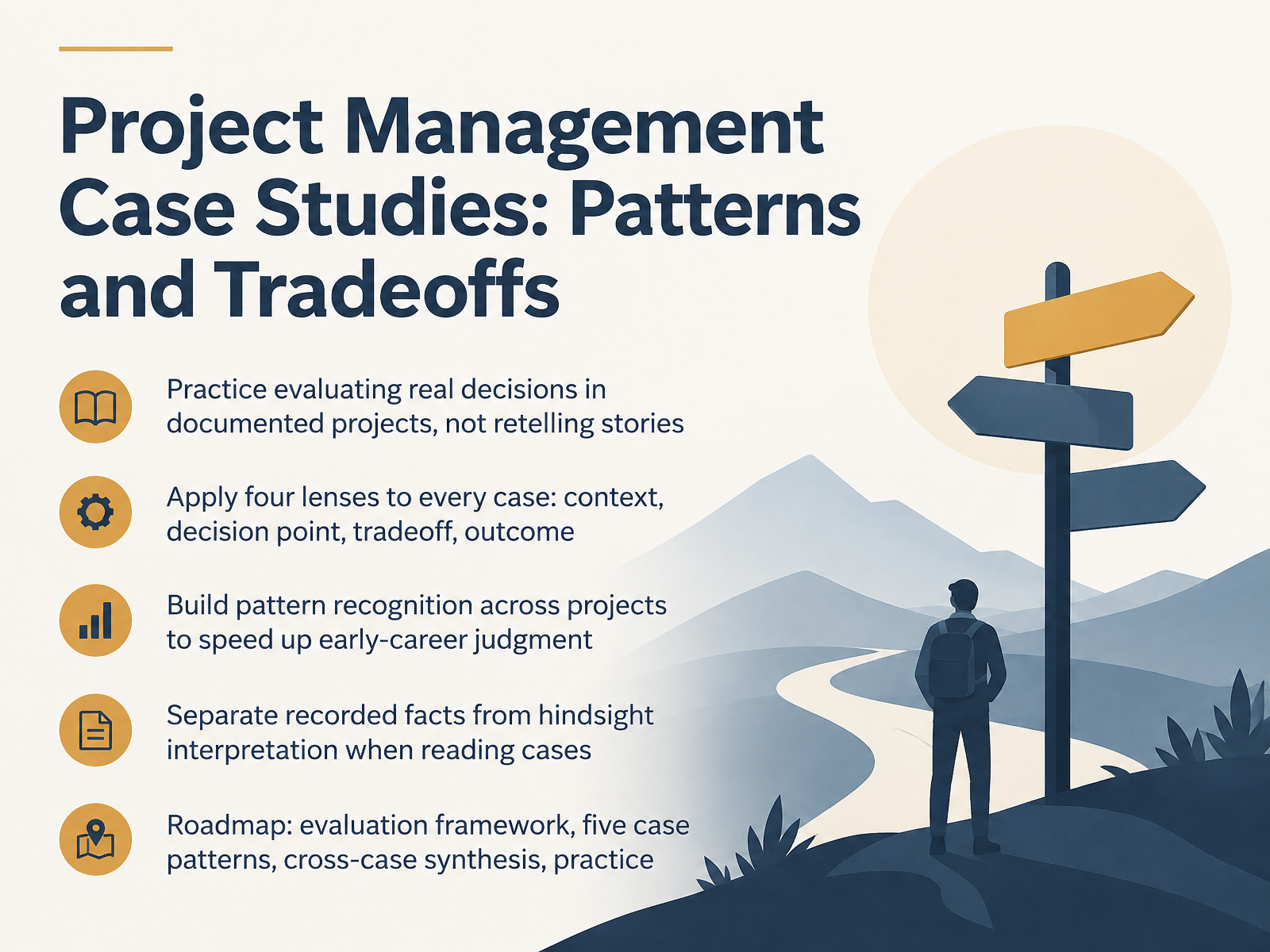
- 01Project Management Case Studies: Patterns and TradeoffsWelcome. Over the next few slides, we're going to practice evaluating real decisions in documented projects, rather than just retelling stories. Our goal is to build judgment you can use early in your career. Every case gets four lenses: context, decision point, tradeoff, and outcome. You'll also notice patterns repeating across projects, and those patterns help you reason faster when information is incomplete. One discipline matters throughout: separate what was recorded at the time from interpretations added later. Let's start by treating cases as evidence, not anecdote.doi.orgdoi.orgdoi.org+21 min
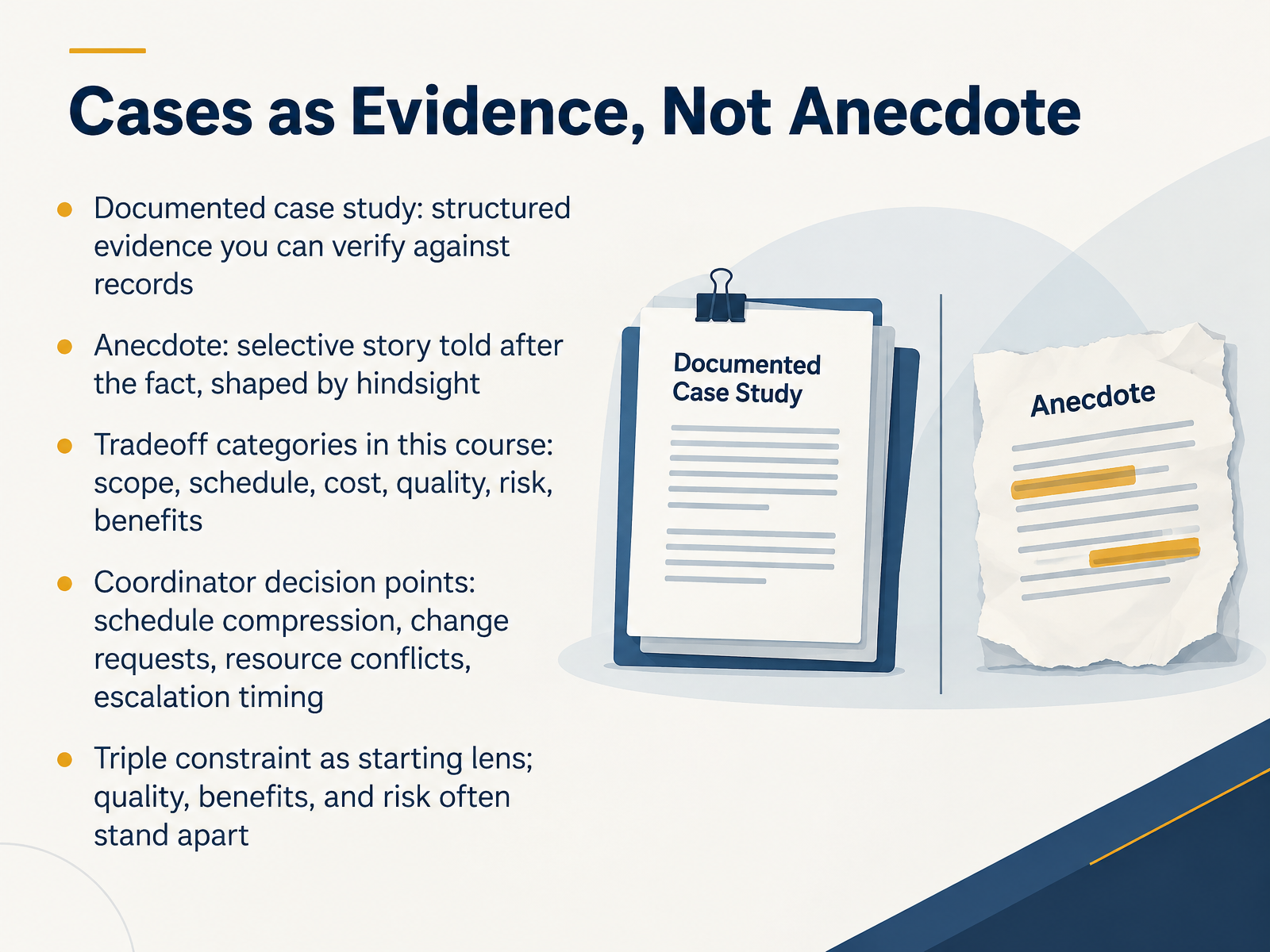
- 02Cases as Evidence, Not AnecdoteLet's start by distinguishing two kinds of input to a project decision. A documented case study is structured evidence you can check against records. An anecdote is a selective story told after the fact, shaped by hindsight. Both feel persuasive in a meeting, but only one lets you test the reasoning. In Wilton's comparison of two outsourced New Zealand projects, similar contractors and time frames led to opposite outcomes, and the difference shows up in the records, not in the telling. So as we work through cases, we'll name the tradeoff plainly, across scope, schedule, cost, quality, risk, and benefits. As a coordinator, you'll meet this at schedule compression, change requests, resource conflicts, and escalation timing. The triple constraint is a useful starting lens, but quality, benefits, and risk often stand apart, so treat them as separate constraints. Here's the takeaway. Before you accept a case, ask what evidence sits behind the story. Next, we'll apply that discipline in the Five-Step Case Evaluation Framework.
 doi.orgdoi.orgdoi.org+22 min
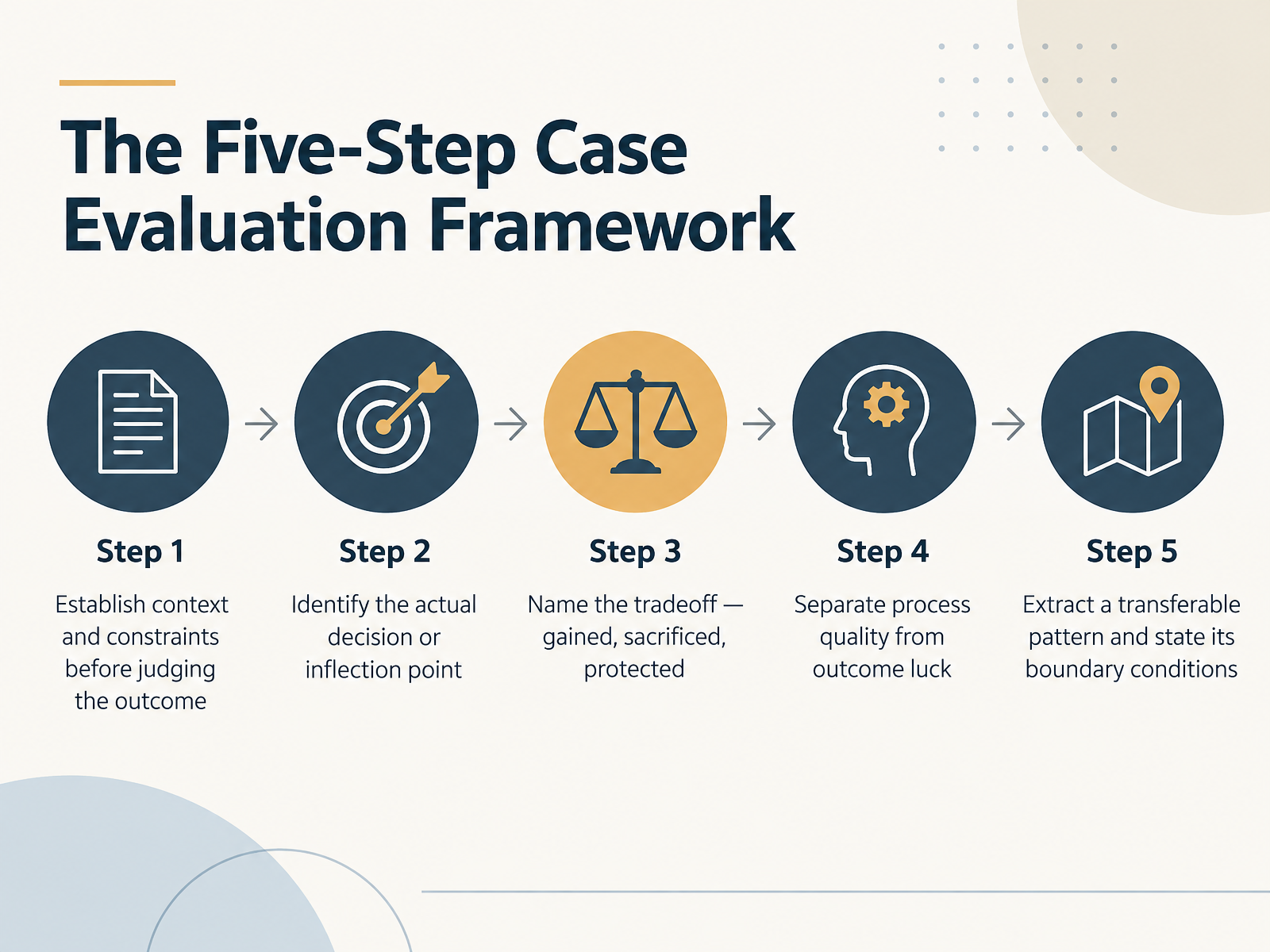
- 03The Five-Step Case Evaluation FrameworkHere is a five-step framework you can use to evaluate any documented case. First, establish the context and constraints before you judge the outcome. What was the budget, the timeline, and the information available at the time? Second, identify the actual decision or inflection point. Third, name the tradeoff plainly. What was gained, what was sacrificed, and what was protected? Fourth, separate process quality from outcome luck. A good process can still end badly, and a mediocre process can succeed by chance. Fifth, extract a transferable pattern and state its boundary conditions. In other words, say where the lesson applies and where it does not. A quick workplace comparison: a project that ships on time because of a heroic last-minute push is not necessarily a model to repeat. The framework asks you to look at each decision point separately. One concrete takeaway: before you judge a case, write down what the team knew at the moment of decision, not what you know now. Next, we will look at how to judge decisions without hindsight distortion.
 pmc.ncbi.nlm.nih.govemerald.comdoi.org+22 min
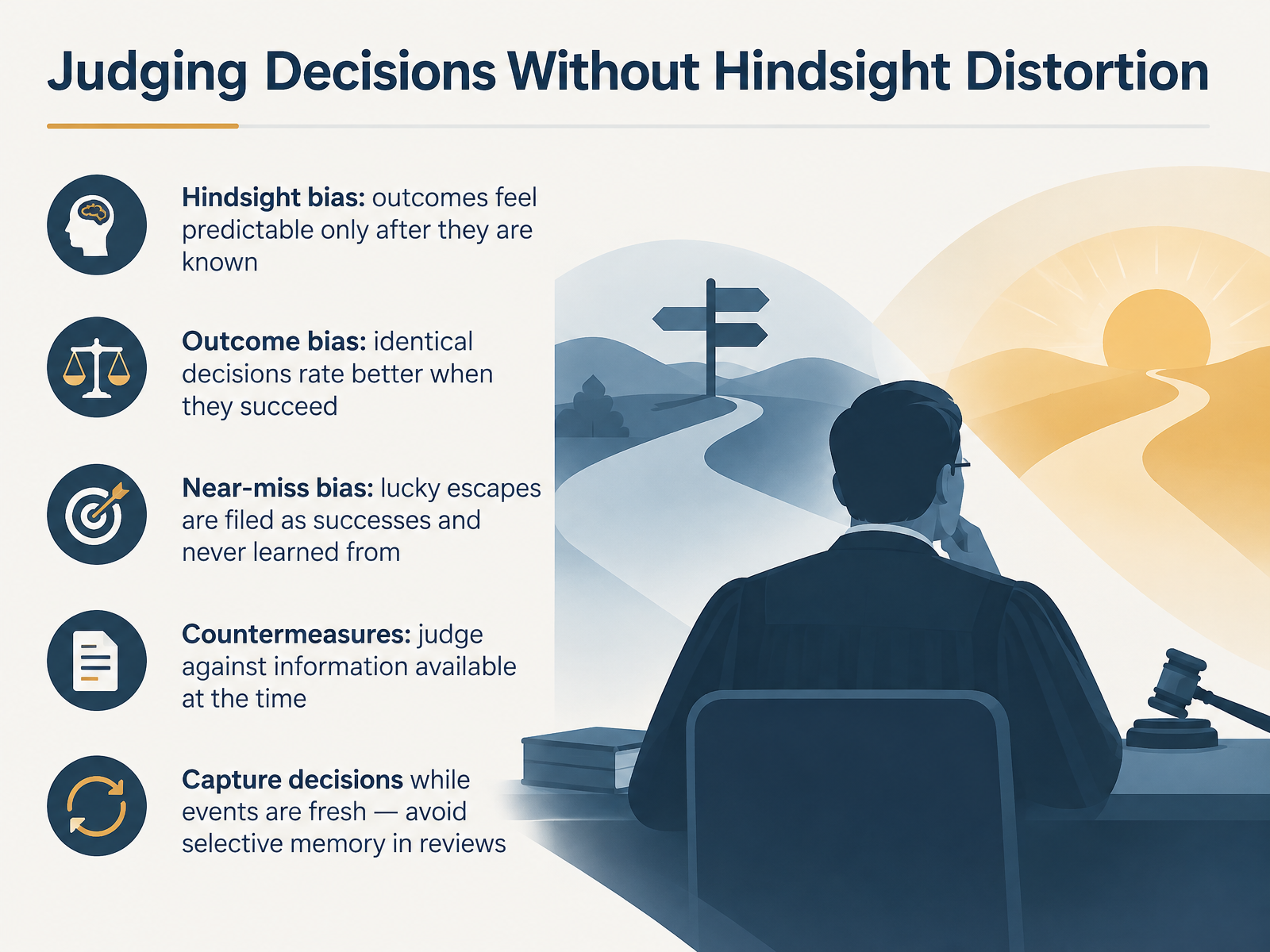
- 04Judging Decisions Without Hindsight DistortionLet's look at how we judge decisions once the outcome is known. Hindsight bias makes an outcome feel predictable only after it happens. Outcome bias is closely related: the same decision gets rated better when it succeeds than when it fails. And near-miss bias means a lucky escape gets filed as a success, so nobody learns from it. The countermeasure is to judge decisions against the information people actually had at the time. Then capture decisions while events are fresh, because memory in reviews is selective and rarely neutral. Here's a quick test. If a project succeeds but the process was shaky, would your review still flag the risk? Hold that question as we move into our first pattern: schedule pressure and scope creep.
 pmc.ncbi.nlm.nih.govemerald.comdoi.org+21 min
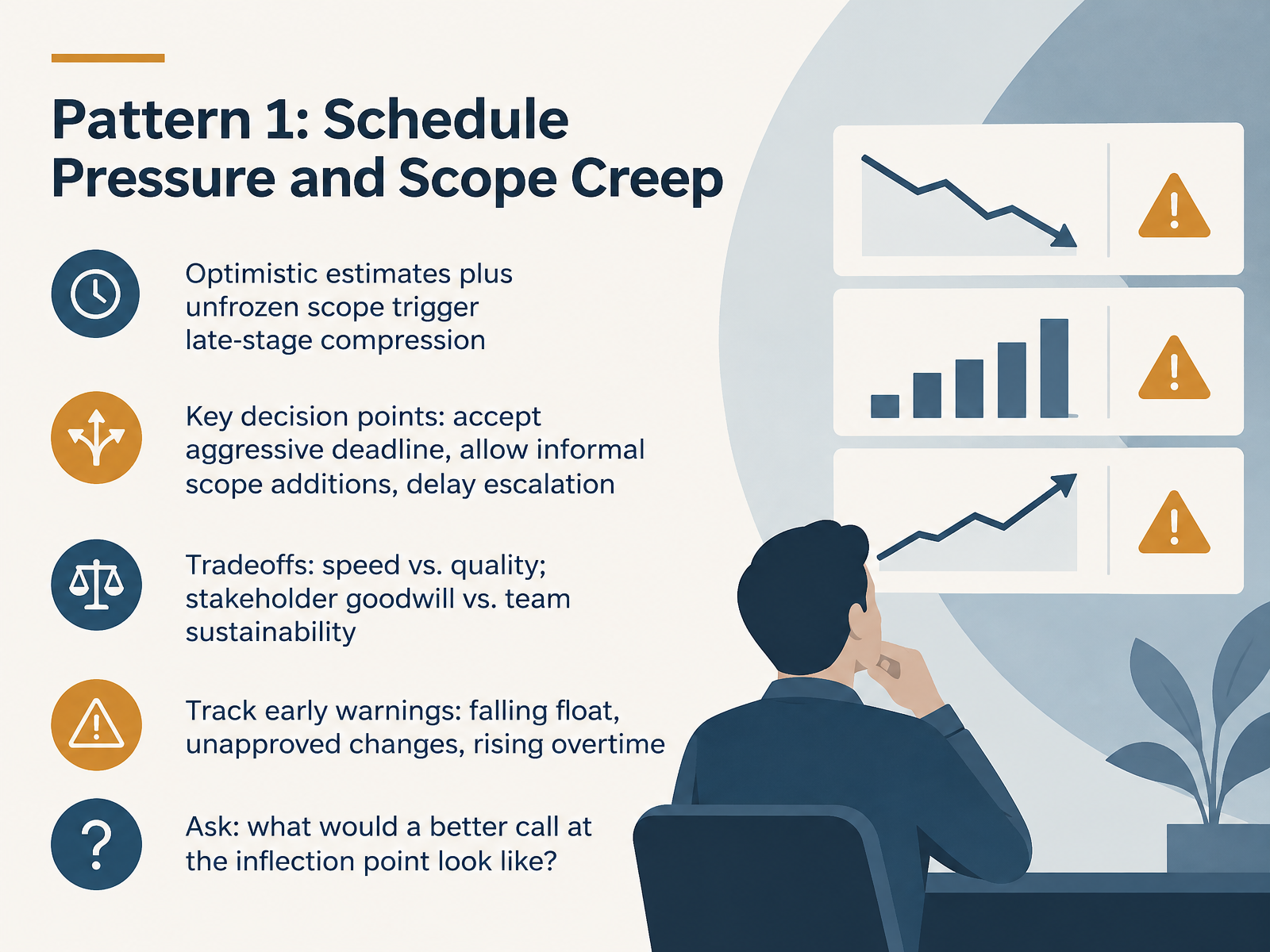
- 05Pattern 1: Schedule Pressure and Scope CreepLet's look at the first recurring pattern: schedule pressure paired with scope creep. It usually starts quietly. Estimates are optimistic, and the scope is never truly frozen. Those two conditions together invite late-stage compression, where the team is asked to go faster just as the work is most complex. Watch for three decision points. Accepting an aggressive deadline without adjusting scope. Allowing informal additions to slip in without approval. And delaying escalation until the problem is visible to everyone. Each involves a tradeoff: speed against quality, and stakeholder goodwill against team sustainability. The documented cases show this plainly. At Denver International Airport, a fixed timeframe plus an unfrozen automated baggage design produced years of delay. In a UK council e-procurement project, the lack of early warning triggers let overruns grow before anyone acted. So track early warnings: falling float, unapproved changes, rising overtime. Pause here. What would a better call at the inflection point look like? Next, we'll apply this to two documented cases in Case Clinic: The Chunnel and Denver Baggage System.
 pmi.orgdoi.orgmaxwideman.com+22 min
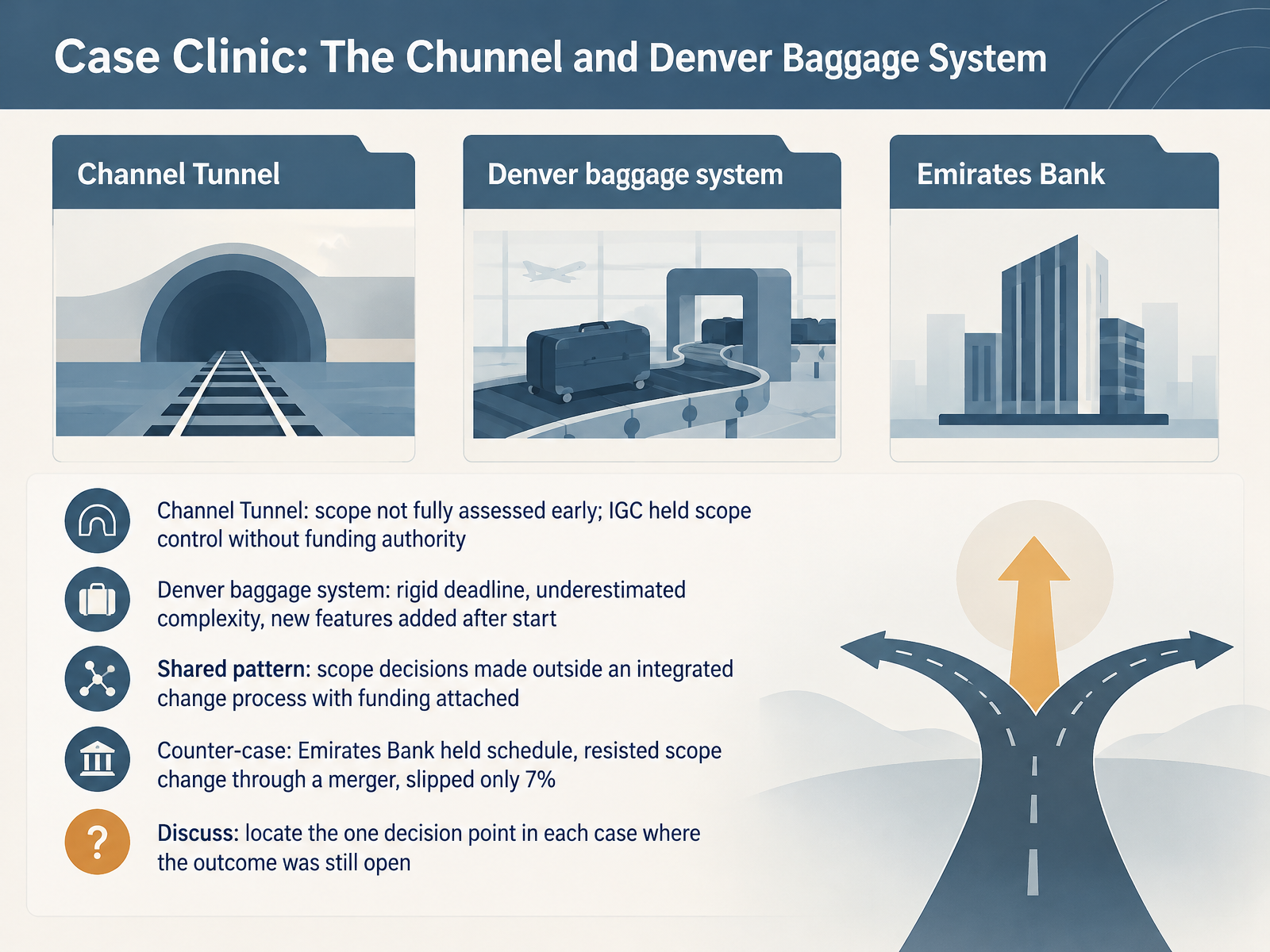
- 06Case Clinic: The Chunnel and Denver Baggage SystemNow let's compare two well-documented cases. In the Channel Tunnel, the scope was not fully assessed early. The Intergovernmental Commission held scope control, but had no authority to approve funding for that scope. So change happened without an integrated process. In Denver's baggage system, the deadline was rigid and complexity was underestimated. New features were added after the start, again outside a change process with funding attached. The shared pattern is clear: scope decisions were made separately from money and approval. Now consider the counter-case. Emirates Bank held its schedule and resisted scope change through a merger, slipping only seven percent. Here's your discussion point. Find the one decision in each case where the outcome was still open. Where could a coordinator have inserted a funded change gate? Keep that question in mind as we move to pattern two: stakeholder conflict and change requests.
 pmi.orgdoi.orgmaxwideman.com+22 min
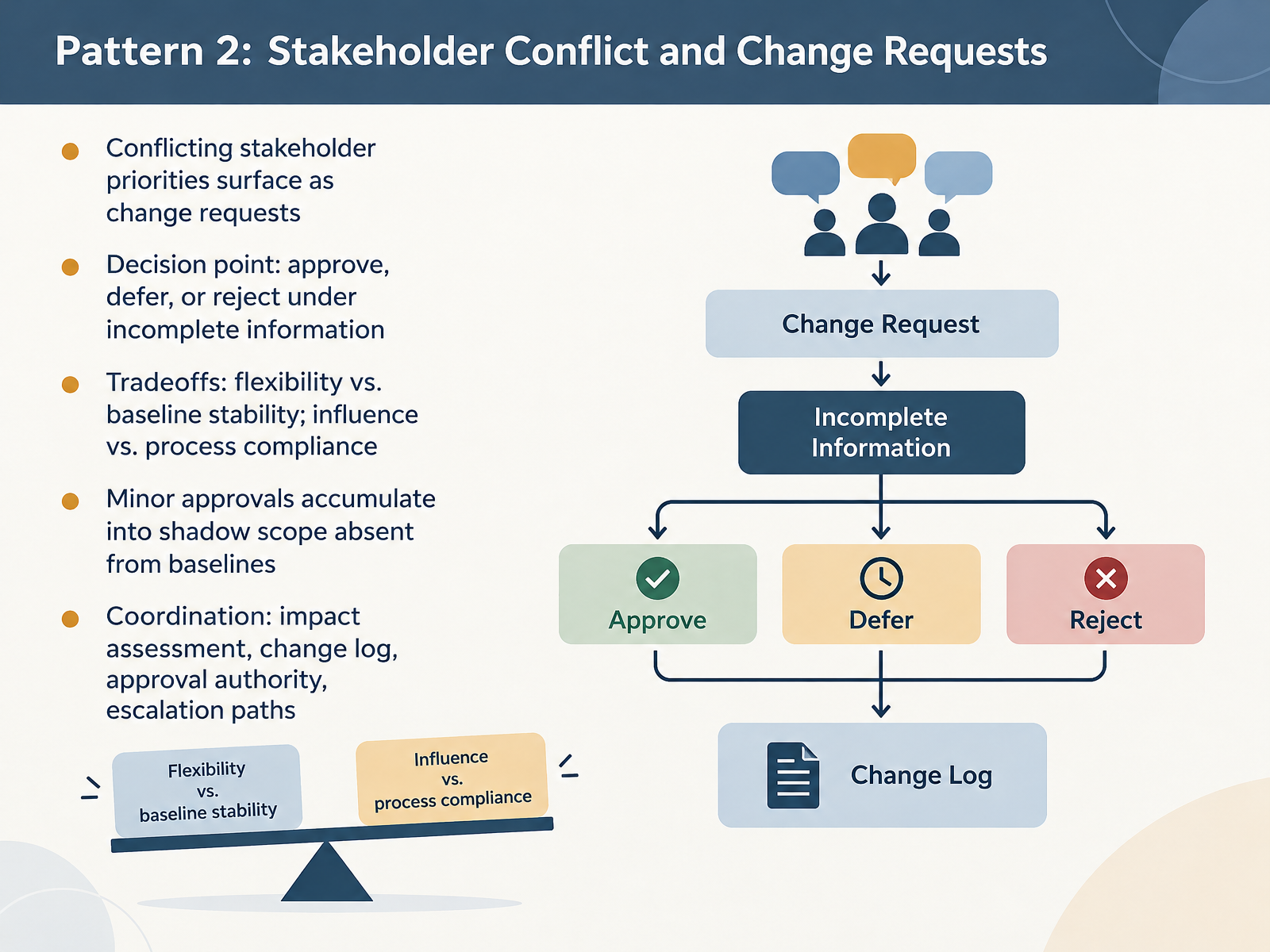
- 07Pattern 2: Stakeholder Conflict and Change RequestsLet's look at the second pattern, stakeholder conflict showing up as change requests. When two stakeholders want different things, that tension often arrives as a request to change scope, and you face a decision point: approve, defer, or reject, usually with incomplete information. Name the tradeoffs plainly. Flexibility versus baseline stability. Influence versus process compliance. A case study from Pinnacle Insurance shows how minor approvals accumulate into shadow scope, absent from the baselines, until the project is far over budget. The safeguard is coordination: a proper impact assessment, a change log, clear approval authority, and escalation paths. So here is a question to carry forward: which small request in your project deserves a full impact assessment before you say yes? Next, we'll walk through that Pinnacle case in the Case Clinic: Death by a Thousand Changes.
 arxiv.orgdoi.orgproceedings.systemdynamics.org+22 min
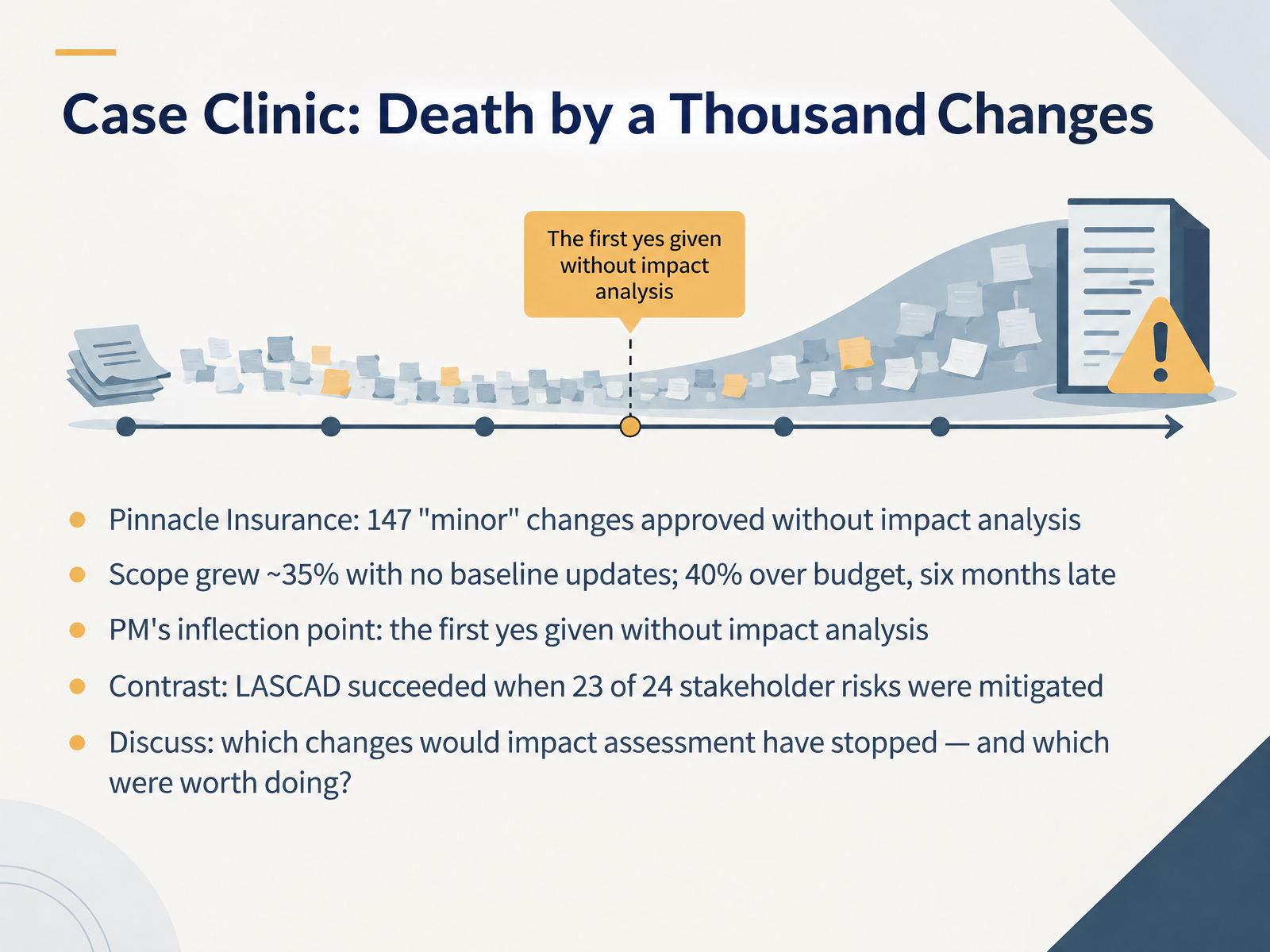
- 08Case Clinic: Death by a Thousand ChangesLet's look at a case that shows how small decisions add up. At Pinnacle Insurance, the project manager approved one hundred forty seven minor changes without any impact analysis. Each one seemed harmless on its own. Together, they expanded scope by about thirty five percent with no baseline updates. The project ended forty percent over budget and six months late. Her inflection point was the very first yes she gave without impact analysis. That single approval set a precedent. Now contrast that with LASCAD, where twenty three of twenty four identified stakeholder risks were mitigated, and the project succeeded. So here is a question to discuss. Which of those changes would a proper impact assessment have stopped, and which were genuinely worth doing? Either way, the lesson is to make the small yes a deliberate decision, not a reflex. Next, we move to Pattern three, resource constraints and resourcing tradeoffs.
 arxiv.orgdoi.orgproceedings.systemdynamics.org+22 min
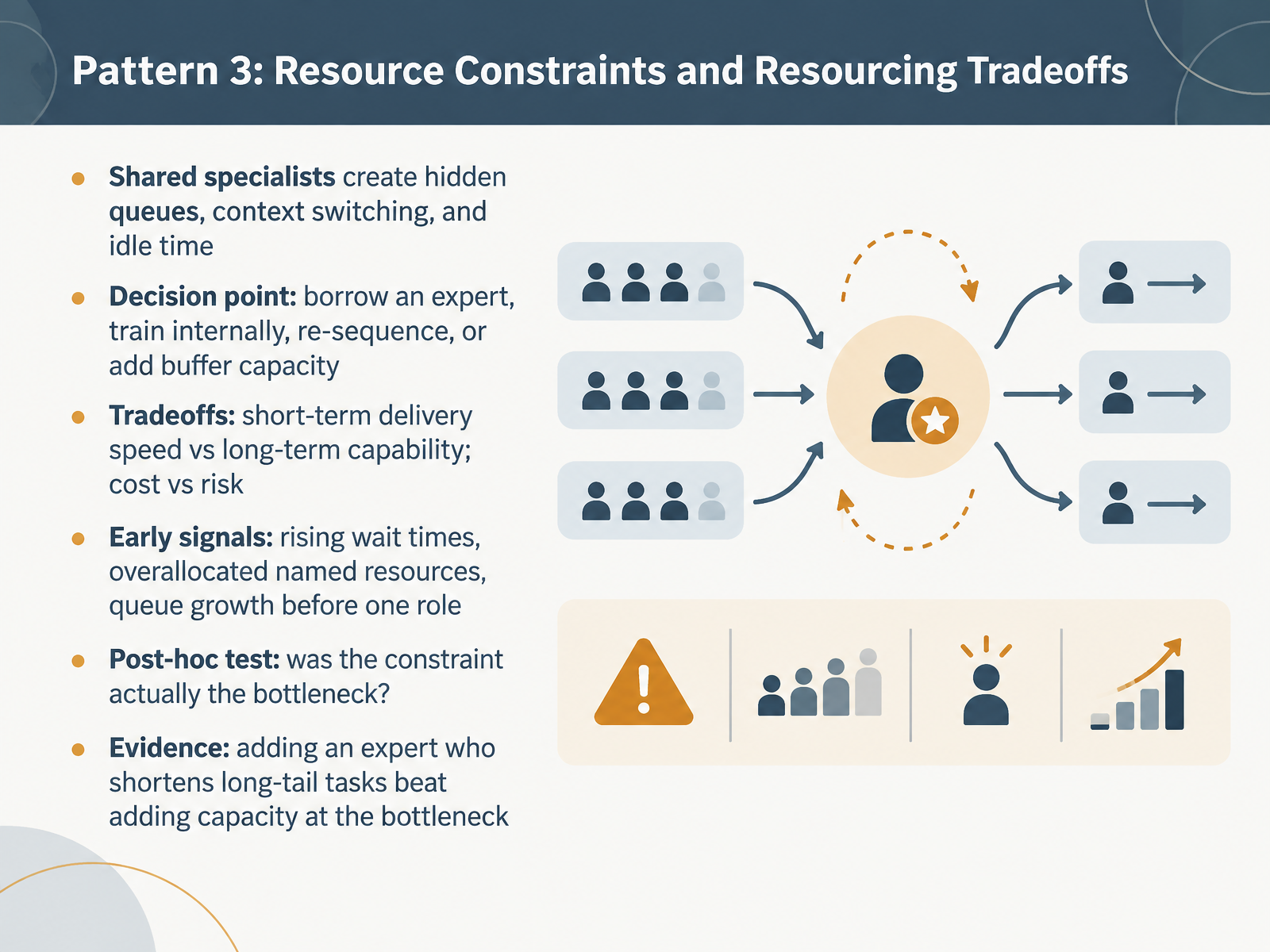
- 09Pattern 3: Resource Constraints and Resourcing TradeoffsNext, let's look at resource constraints and the tradeoffs they create. When specialists are shared across projects, the queues are often hidden. You see context switching, idle time, and people waiting for a single expert. So the decision point is real. You can borrow an expert, train internally, re-sequence the work, or add buffer capacity. Each choice trades short-term delivery speed against long-term capability, and cost against risk. Watch for early signals. Rising wait times, overallocated named resources, and a queue building up before one role. Then test your assumption after the fact. Was that constraint actually the bottleneck? In one documented case, adding an expert who shortened long-tail tasks beat adding capacity at the bottleneck. As you review your own resource plan, ask which shared specialist is quietly creating your longest queue. Let's bring that question to the case clinic on shared specialists and bottlenecks.
 2 min
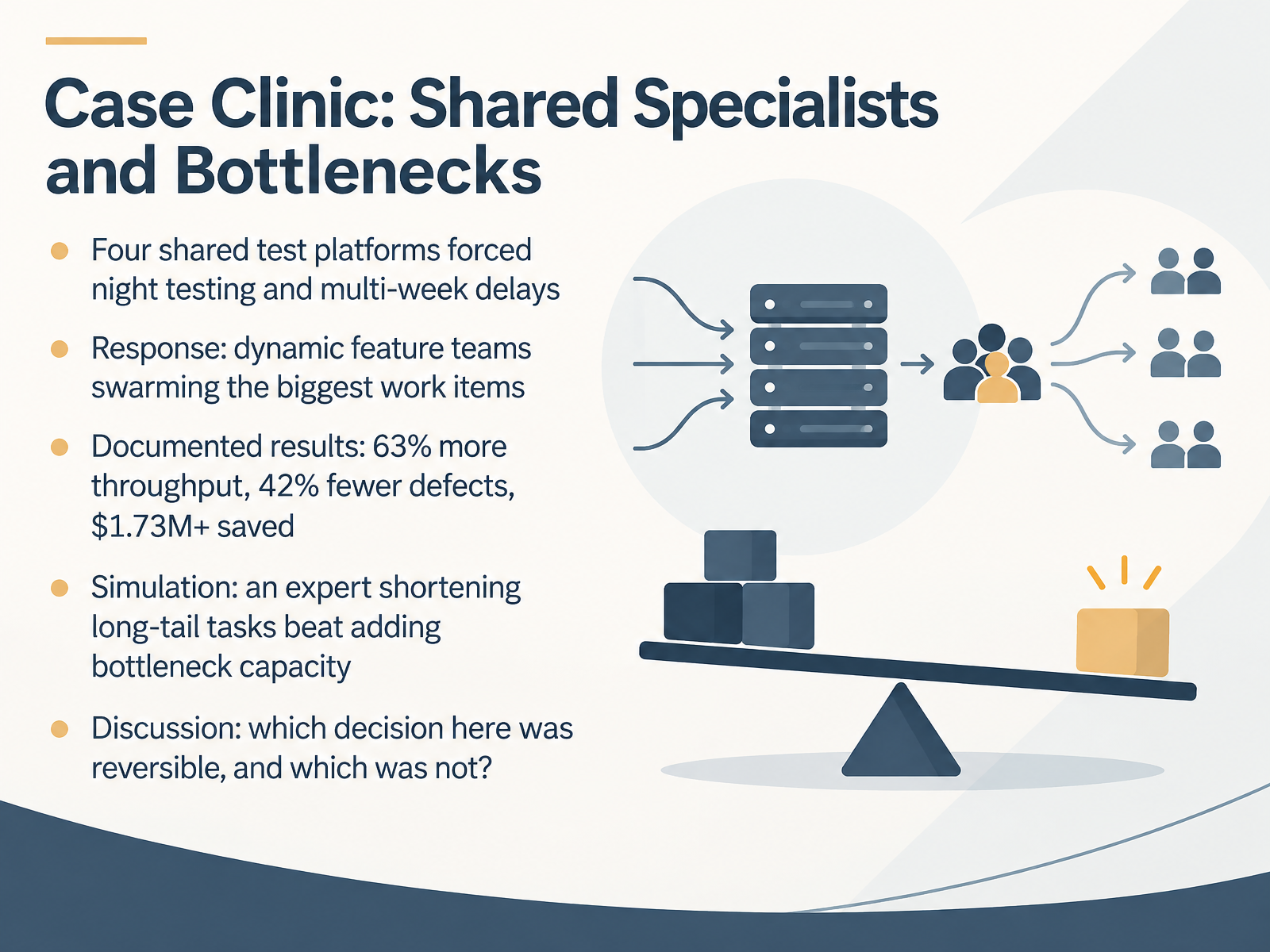
- 10Case Clinic: Shared Specialists and BottlenecksLet's walk through a case clinic on shared specialists and bottlenecks. In this documented project, developers shared only four test platforms, so testing often had to happen at night, and integration could stretch across several weeks. The response was dynamic feature teams that swarmed the biggest work items, pulling in the specialists they needed. The documented results were a sixty-three percent increase in throughput, a forty-two percent decrease in defects, and more than one point seven three million dollars in savings. Here is the tradeoff worth noting. A simulation found that using an expert to shorten long-tail tasks beat simply adding capacity at the bottleneck. So which decision here was reversible, and which was not? Keep that question in mind as we move into the next segment on risk response and escalation timing, and how pattern four applies to these choices.
 1 min
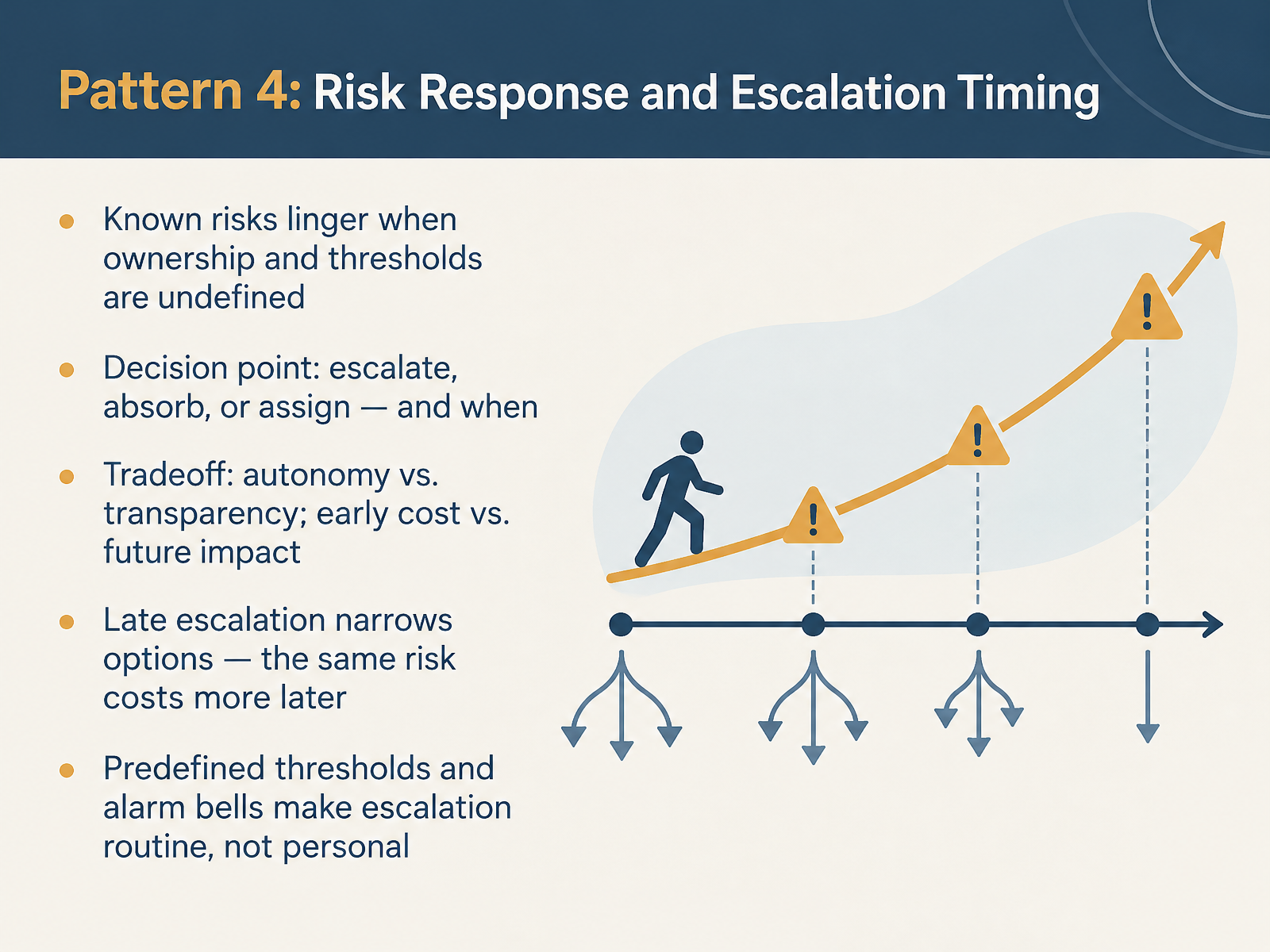
- 11Pattern 4: Risk Response and Escalation TimingLet's look at pattern four, risk response and escalation timing. Known risks often linger when ownership is unclear and no threshold tells you when to act. So the real decision point is this: do you escalate, absorb, or assign the risk, and when? There is a tradeoff here between team autonomy and transparency, and between paying an early cost now versus a larger impact later. Late escalation narrows your options; the same risk usually costs more once it has had time to grow. Predefined thresholds and alarm bells make escalation routine rather than personal. A useful habit is to write the threshold and the owner before the risk appears. As you review your own project, ask which known risk is still waiting for a named owner and a clear trigger? That's a good question to carry into our next session, Case Clinic: Warnings That Were Already on Record.
 1 min
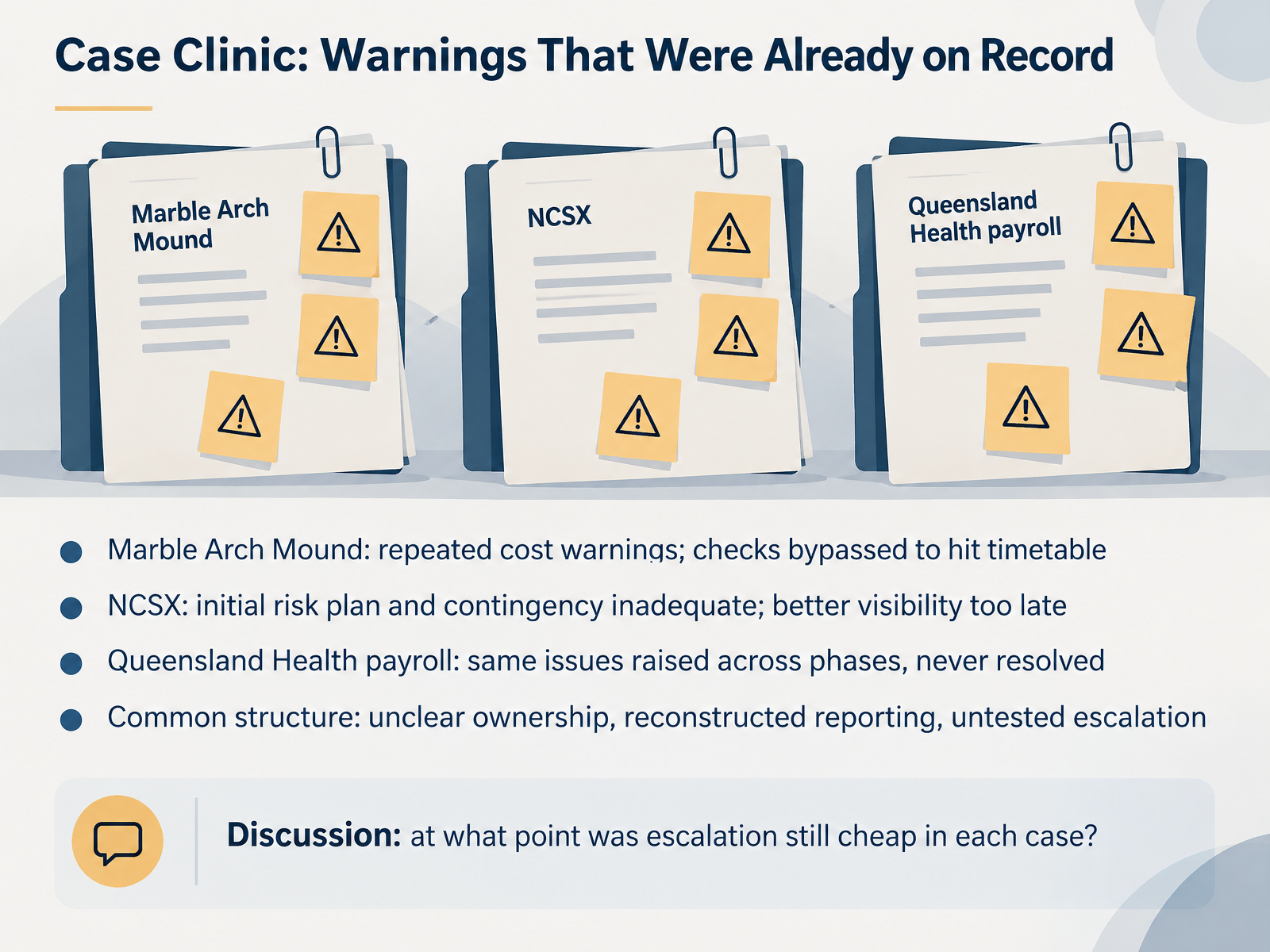
- 12Case Clinic: Warnings That Were Already on RecordLet's walk through three documented cases where the warnings were already on record. At Marble Arch Mound, experienced officers and suppliers repeatedly warned about cost, yet checks and balances were bypassed to protect the timetable. On NCSX, the initial risk plan and contingency proved inadequate, and better visibility of risk arrived too late. With Queensland Health payroll, the same issues were raised across phases and never resolved. Notice the common structure: unclear ownership, reporting that was reconstructed after the fact, and escalation routes that were never tested. So here is your question. In each case, at what point was escalation still cheap? Early, probably, when a single honest threshold trigger could have forced a conversation. That is your takeaway: make escalation cheap while the evidence is still fresh. Next, we move to Pattern 5: Quality, Rework, and Technical Debt.
 2 min
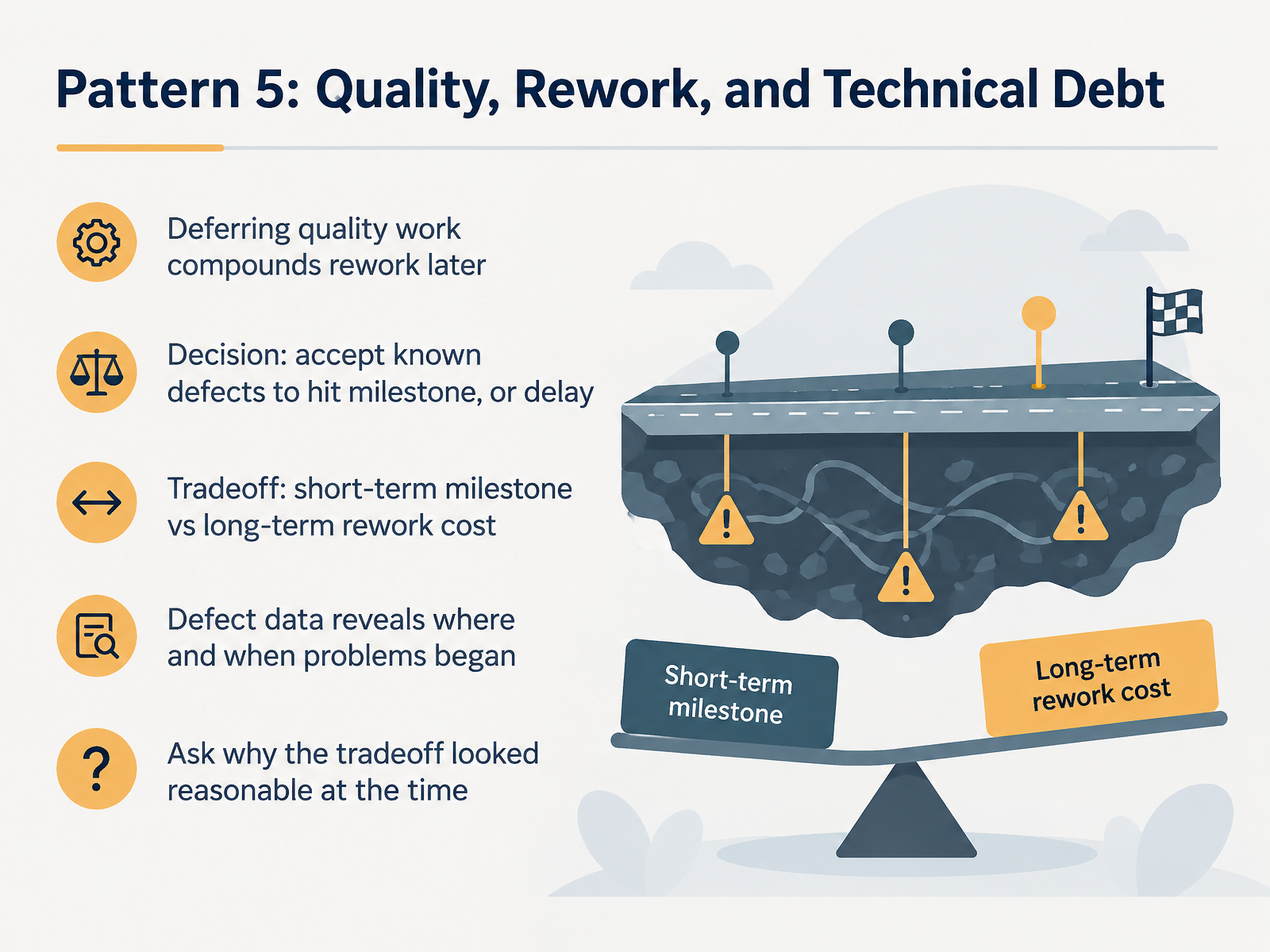
- 13Pattern 5: Quality, Rework, and Technical DebtLet's look at pattern five: quality, rework, and technical debt. Deferring quality work rarely removes the cost. It usually compounds it later as rework. Picture this decision. You can accept known defects to hit a milestone, or delay and fix them now. Name the tradeoff plainly: a short-term milestone against long-term rework cost. Documented projects show the consequence. In one highways megaproject, workmanship and supervision issues carried the largest rework costs. Defect data also tells you where and when problems began. So instead of only asking who signed off, ask why the tradeoff looked reasonable at the time. Your takeaway: capture the reasoning behind quality deferrals, then check the defect record later. Next, we'll apply this in the case clinic on the compounding cost of deferred quality.
 2 min
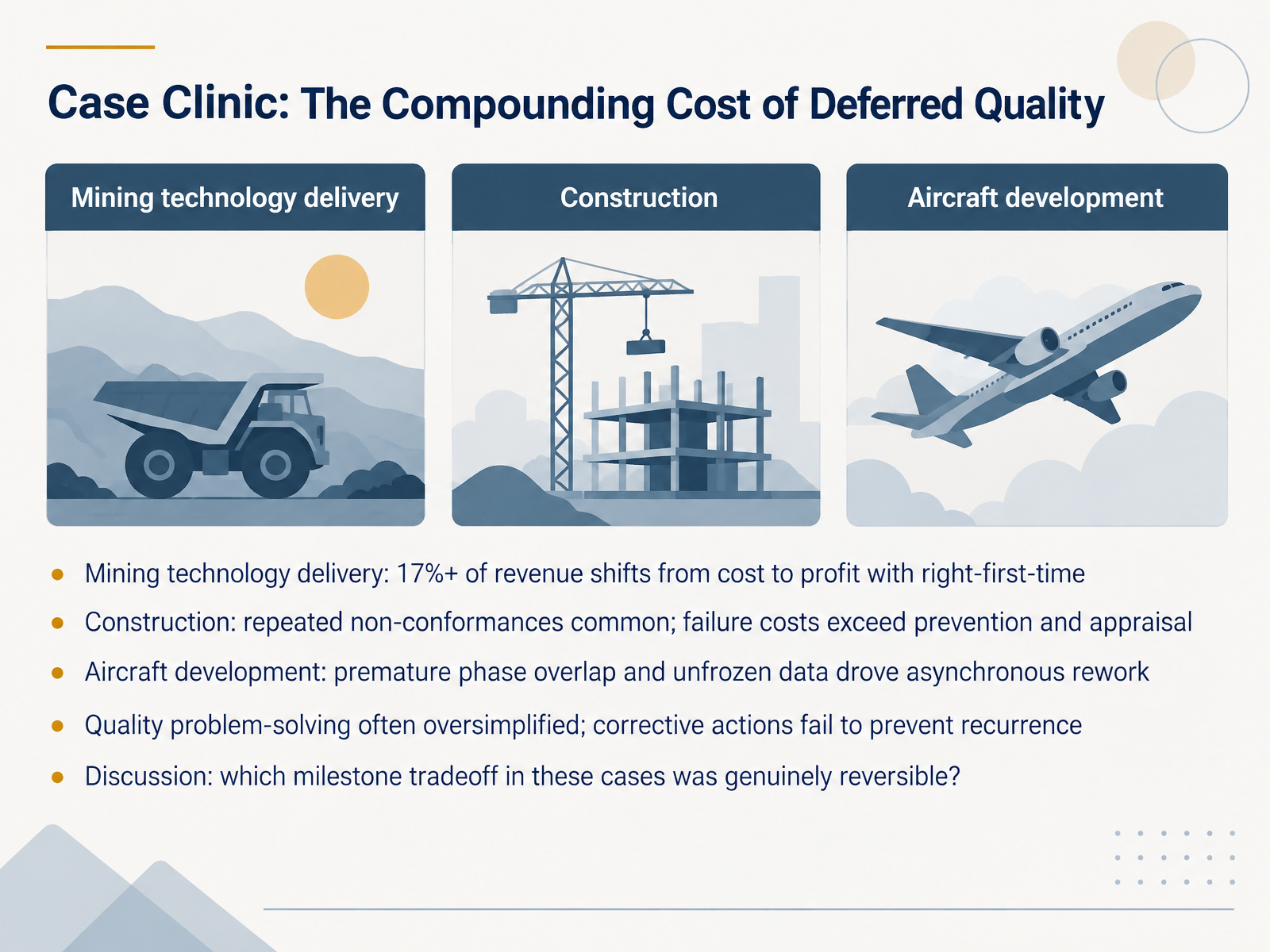
- 14Case Clinic: The Compounding Cost of Deferred QualityLet's bring these patterns together in a case clinic on deferred quality. In the mining technology delivery case, more than seventeen percent of project revenue could move from cost to profit by doing things right the first time. In construction, the cost of failure consistently exceeded prevention and appraisal, with repeated non-conformances common. In the aircraft development case, premature phase overlap and unfrozen data drove asynchronous rework. And across these projects, quality problem-solving was often oversimplified, so corrective actions failed to prevent recurrence. So here is our discussion question: which milestone tradeoff in these cases was genuinely reversible? Think about which deferrals you could have undone cheaply, and which ones locked in compounding cost. Pause on that judgment before we move on.
Comparing Patterns and Applying the Framework to Your Own Decisions.
 2 min
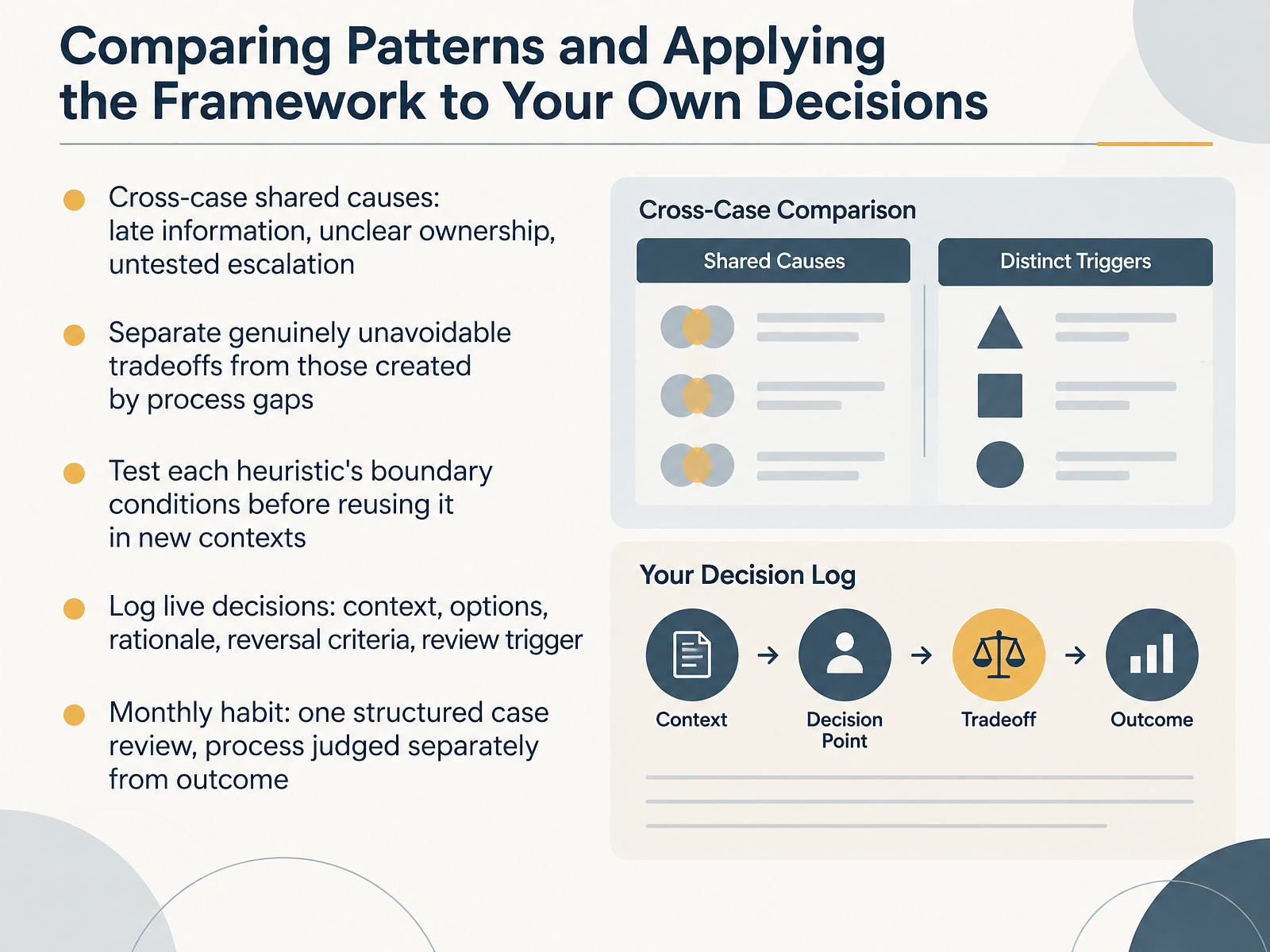
- 15Comparing Patterns and Applying the Framework to Your Own DecisionsLet's close by bringing these cases together and turning the framework back on your own work. Across the cases, the shared causes repeat: information arriving late, ownership left unclear, and escalation paths that were never tested under real pressure. Your first move is to separate tradeoffs that are genuinely unavoidable from those created by process gaps. Then, before you reuse any heuristic, test its boundary conditions in the new context. Make it a habit to log live decisions with context, options, rationale, reversal criteria, and a review trigger. Finally, hold one structured case review each month, and judge the process separately from the outcome. Thank you for working through this course, and good luck applying it to your next decision.
 1 min
Take the deck with you
Download this course as a file — free, no sign-up needed.
- PDF handoutEvery slide page, ready to print or share.16 pages · 3.3 MBDownload
- Narrated PowerPointThe deck that presents itself — every slide carries the digital human's narration video.16 pages · 14.1 MBDownload
- PowerPoint slidesThe full deck as a .pptx — open it in PowerPoint, Keynote, or Google Slides.16 pages · 3.2 MBDownload
Free to use in your own training — please keep the PersonWise credit page at the end.
Have your own deck? Turn it into a course
Sources consulted
Web sources consulted while building this course.
- TRIANGLES, TRADEOFFS AND SUCCESS: A CRITICAL EXAMINATION OF SOME TRADITIONAL PROJECT MANAGEMENT PARADIGMS — doi.org
- A Tale of Two Projects: why IT projects fail (and why they sometimes actually succeed) — doi.org
- Time, cost and quality trade-off in project management: a case study — doi.org
- A new hybrid approach for selecting a project management methodology — pmi.org
- Project strategy: A template for analyzing real life projects — doi.org
- Why postmortems fail — pmc.ncbi.nlm.nih.gov
- Using the benefits of hindsight ‐ the role of post‐project analysis | The Learning Organization: An International Journal | Emerald Publishing — emerald.com
- Hindsight bias, outcome knowledge and adaptive learning — doi.org
- Outcomes Affect Evaluations of Decision Quality — rips-irsp.com
- Developing a Multidimensional Conception of Project Evaluation to Improve Projects — doi.org
- The Chunnel Project — pmi.org
- Are you biting off more than you can chew? A case study on causes and effects of overscoping in large-scale software engineering — doi.org
- Two Case Studies: #1: The case of the never ending scope creep #2: The case of the unidentified risks — maxwideman.com
- Time is of the Essence… — wsdot.wa.gov
- Successfully Turning Around a Failing E-procurement Project: Lessons from a UK Borough Council — ink.library.smu.edu.sg
- Lessons from the Failure and Subsequent Success of a Complex Healthcare Sector IT Project — arxiv.org
- How NOT to Manage a Project: Conflict Management Lessons Learned from a DOD Case Study — doi.org
- Fluor Change Impact Assessment: Analyzing Project Changes and Disruption — proceedings.systemdynamics.org
- Towards an understanding of the causes and effects of software requirements change: two case studies — doi.org
- 4.2.5: Case Study- Death by a Thousand Changes - Engineering LibreTexts — eng.libretexts.org