IT Operations Platform Selection and Architecture
Begin
14 pages · ~28 min
IT Operations Platform Selection and Architecture
Course on selecting, architecting, and balancing tradeoffs for an IT Operations Management platform. Designed for IT professionals seeking practical decision-making skills.
What you’ll learn
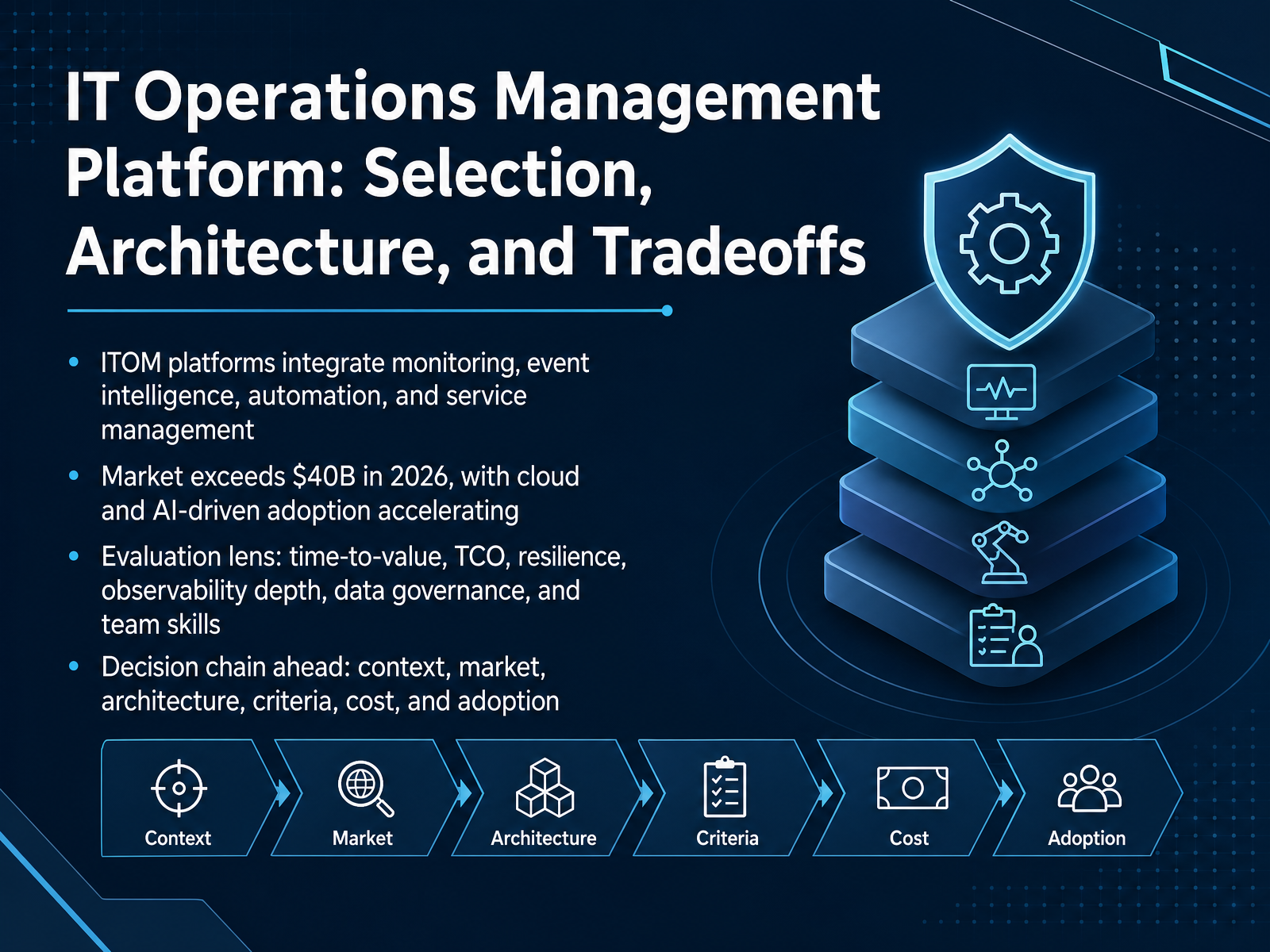
- 01IT Operations Management Platform: Selection, Architecture, and TradeoffsWelcome. This session is about selecting and architecting an IT operations management platform that actually serves your operating reality. We are talking about the integrated layer that brings together monitoring, event intelligence, automation, and service management. The market is moving fast, exceeding forty billion dollars this year, with cloud and AI-driven adoption accelerating. But market size is not your problem. Your problem is making the right architectural bet for your organization. Over the next several minutes, we will walk through the decision chain: the context driving change, the vendor landscape, architectural options, evaluation criteria, true costs, and adoption realities. We will evaluate through a practical lens that matters to you: time-to-value, total cost of ownership, resilience, observability depth, data governance, and the actual skills on your team. You are making a high-stakes decision with long-term consequences. Our goal is to make sure you make it with clear eyes and a structured approach. Let's begin by framing why this is a leadership decision, not just a technology procurement.grandviewresearch.commordorintelligence.comresearchandmarkets.com+21 min
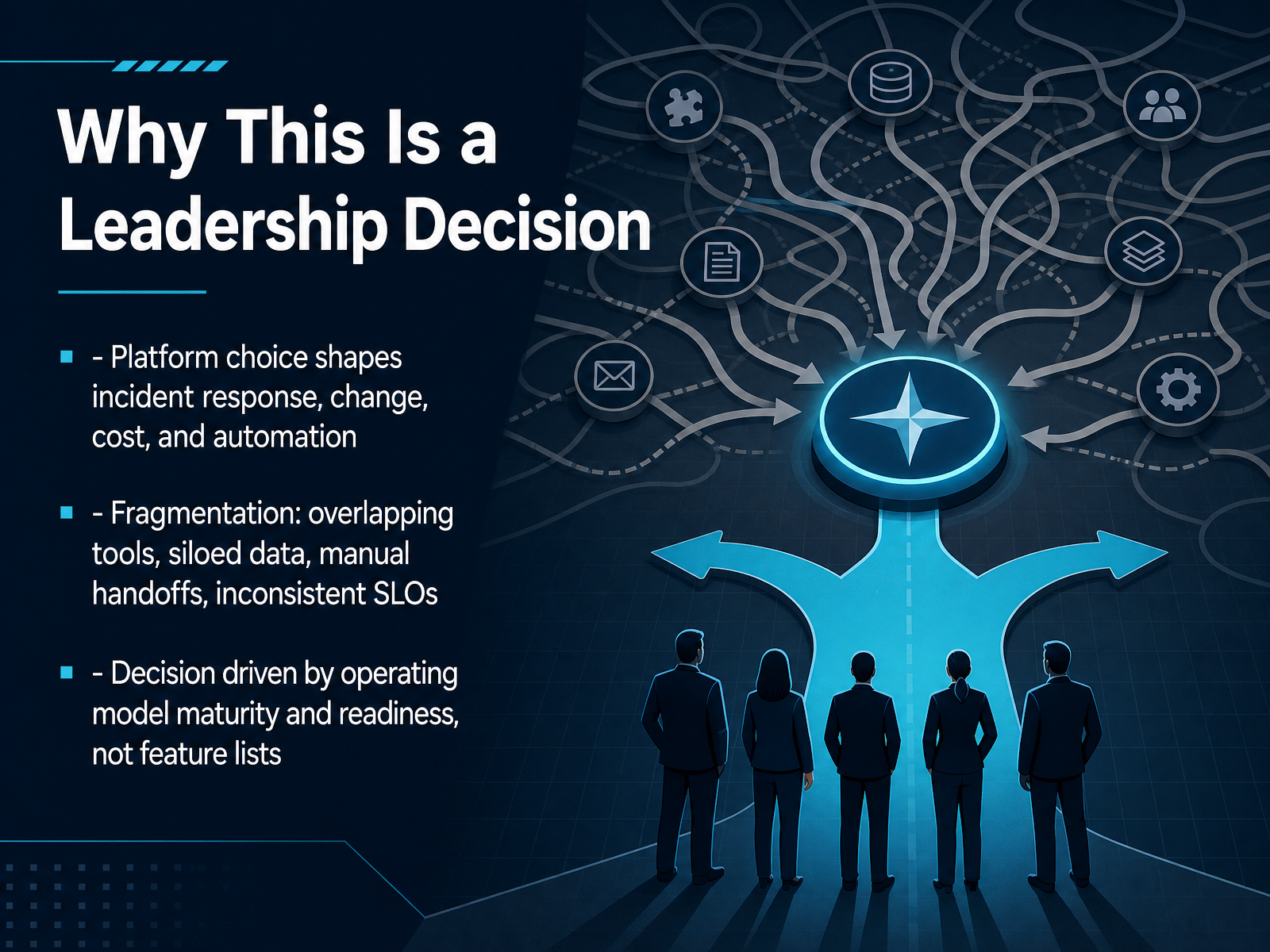
- 02Why This Is a Leadership DecisionLet’s talk about why this selection belongs in your leadership agenda, not just in a procurement queue. The platform you choose will shape incident response, change execution, cost, and automation for years. A fragmented toolchain is more than an inconvenience. It means overlapping tools, siloed data, manual handoffs, and inconsistent service-level objectives. When your tooling can’t keep pace with incident demand, that fragmentation becomes the root cause of your longest outages. That’s why your decision must be driven by operating model maturity and readiness—not by feature lists. A capable platform adopted by an unprepared organization still fails. An adequate platform matched to a mature operating model delivers measurable resilience. So frame this choice around your current data foundation, your CMDB health, and whether your teams are organized around applications or infrastructure. The feature matrix is a tie-breaker. Your operating reality is the decision. Next, let’s define what actually counts as an operations management platform.
 ciopages.comresearch.isg-one.comviewpointanalysis.com+21 min
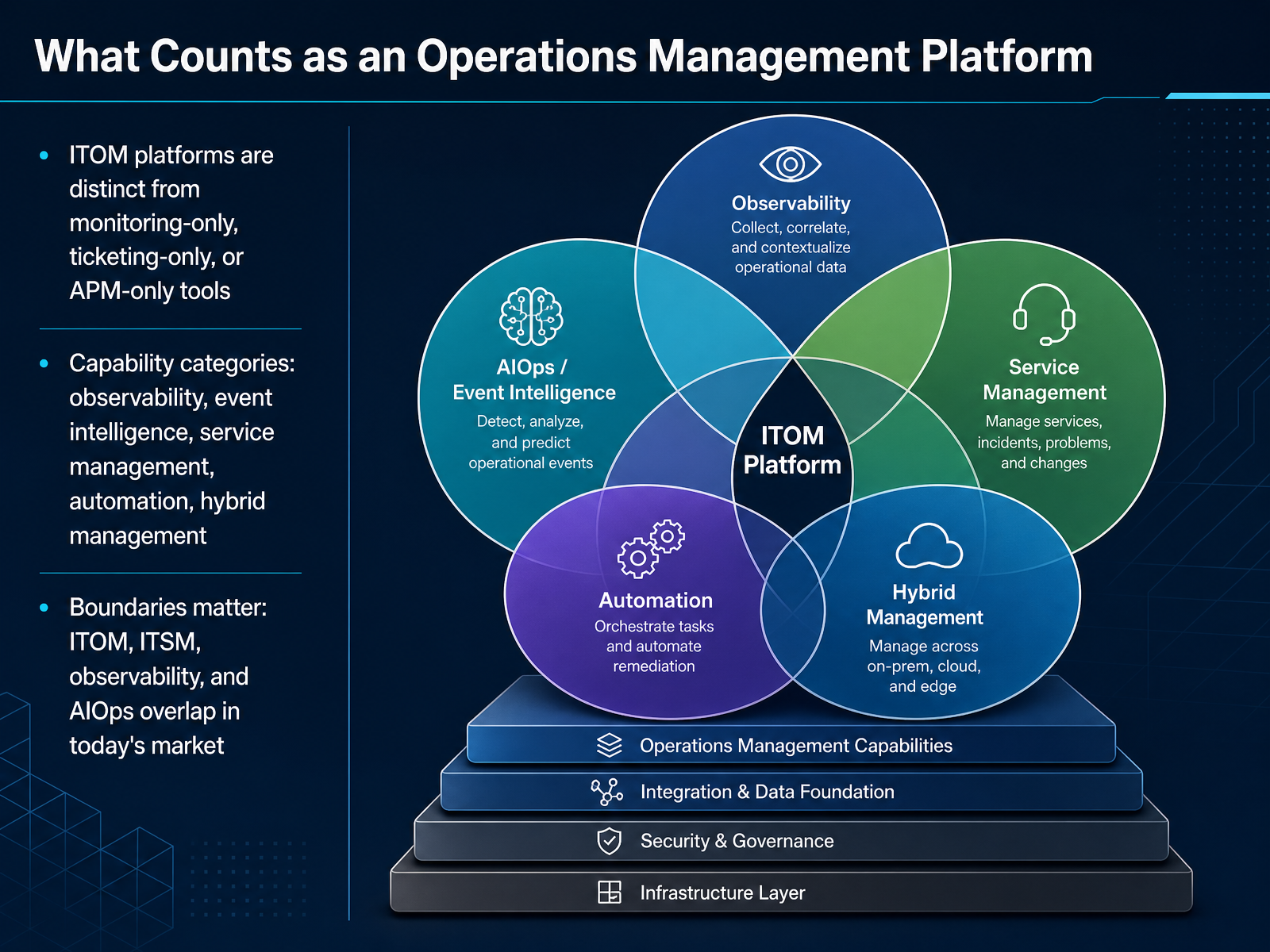
 - 03What Counts as an Operations Management PlatformLet’s clarify what actually counts as an IT operations management platform, because the market blurs these lines constantly. A true ITOM platform is distinct from monitoring-only dashboards, ticketing systems, or application performance tools. It spans five capability categories: observability to see what is happening, event intelligence to filter the noise, service management to track work, automation to take action, and hybrid management to cover both on-premises and cloud. That combination matters on a high-stakes day. When your tooling can’t keep pace with incident demand, operators juggle screens while business services degrade. Boundaries matter because ITOM, ITSM, observability, and AIOps overlap heavily in today’s vendor landscape. A product can present itself as all four, even when its real depth sits in only one. Your job is to define which category anchors your requirement, then push vendors to prove depth beyond their anchor. Next, we’ll map the market landscape and platform archetypes so you can match your operational reality.
 grandviewresearch.commordorintelligence.comresearchandmarkets.com+22 min
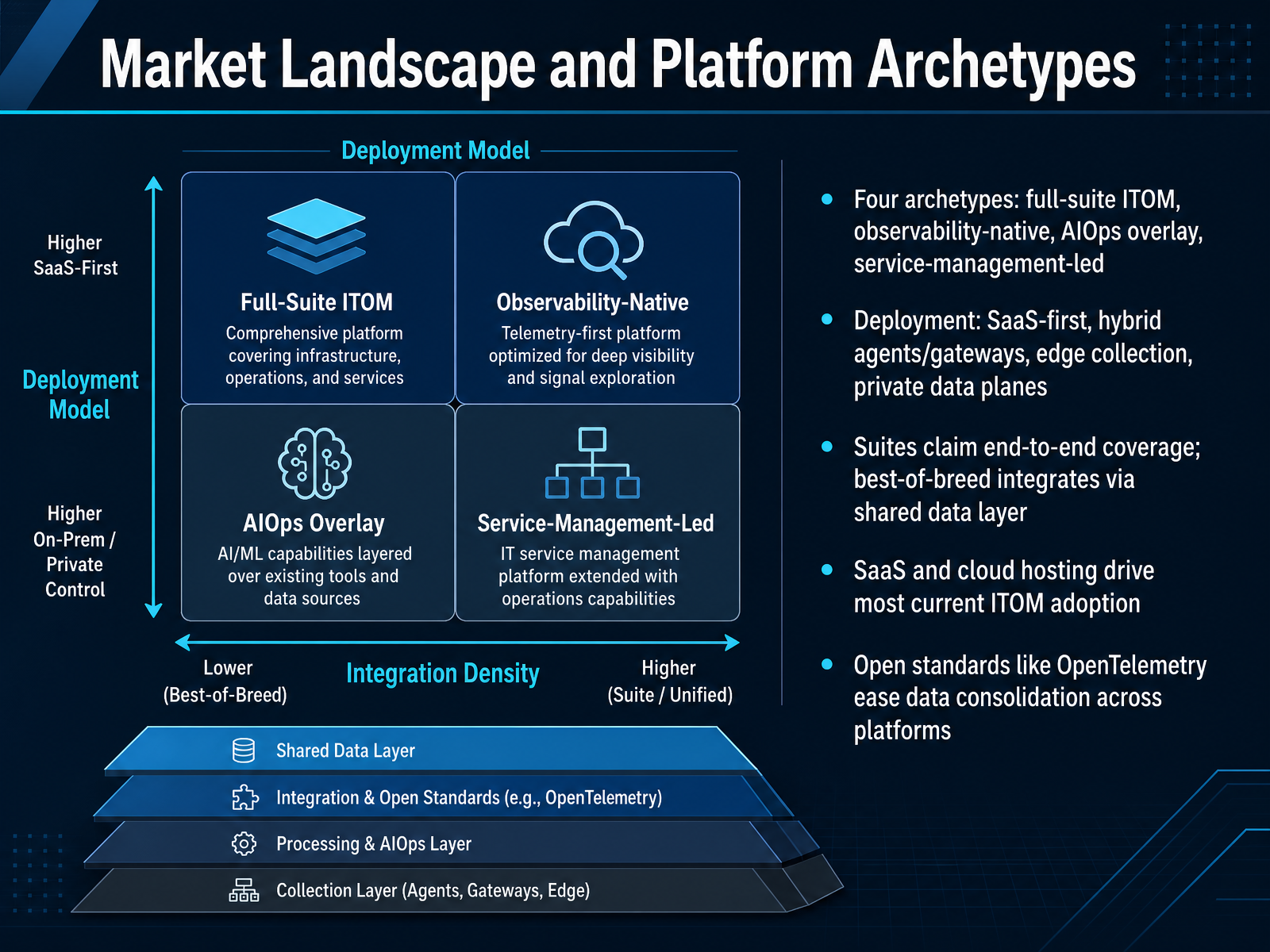
 - 04Market Landscape and Platform ArchetypesLet's map the market. Four platform archetypes dominate procurement discussions. Full-suite ITOM platforms like ServiceNow or BMC anchor everything to the CMDB. Observability-native platforms such as Dynatrace or Datadog build topology automatically from telemetry. AIOps overlays like BigPanda sit above your existing tools to correlate alerts. Then service-management-led platforms extend from ITSM into operations. Deployment has largely settled on SaaS-first, which captured over sixty percent of revenue. Hybrid agents and gateways persist where data residency or latency demands local processing. Edge collection extends the visibility envelope. The major suites claim end-to-end coverage, but best-of-breed integration through a shared data layer offers comparable outcomes. Open standards like OpenTelemetry ease data consolidation across disparate systems. The critical decision driver here is architectural: consolidate versus overlay, CMDB-led versus auto-discovered graph. Weigh that against your tool estate before evaluating features. Next, we will examine the core platform and telemetry architecture choices that follow.
 grandviewresearch.commordorintelligence.comresearchandmarkets.com+22 min
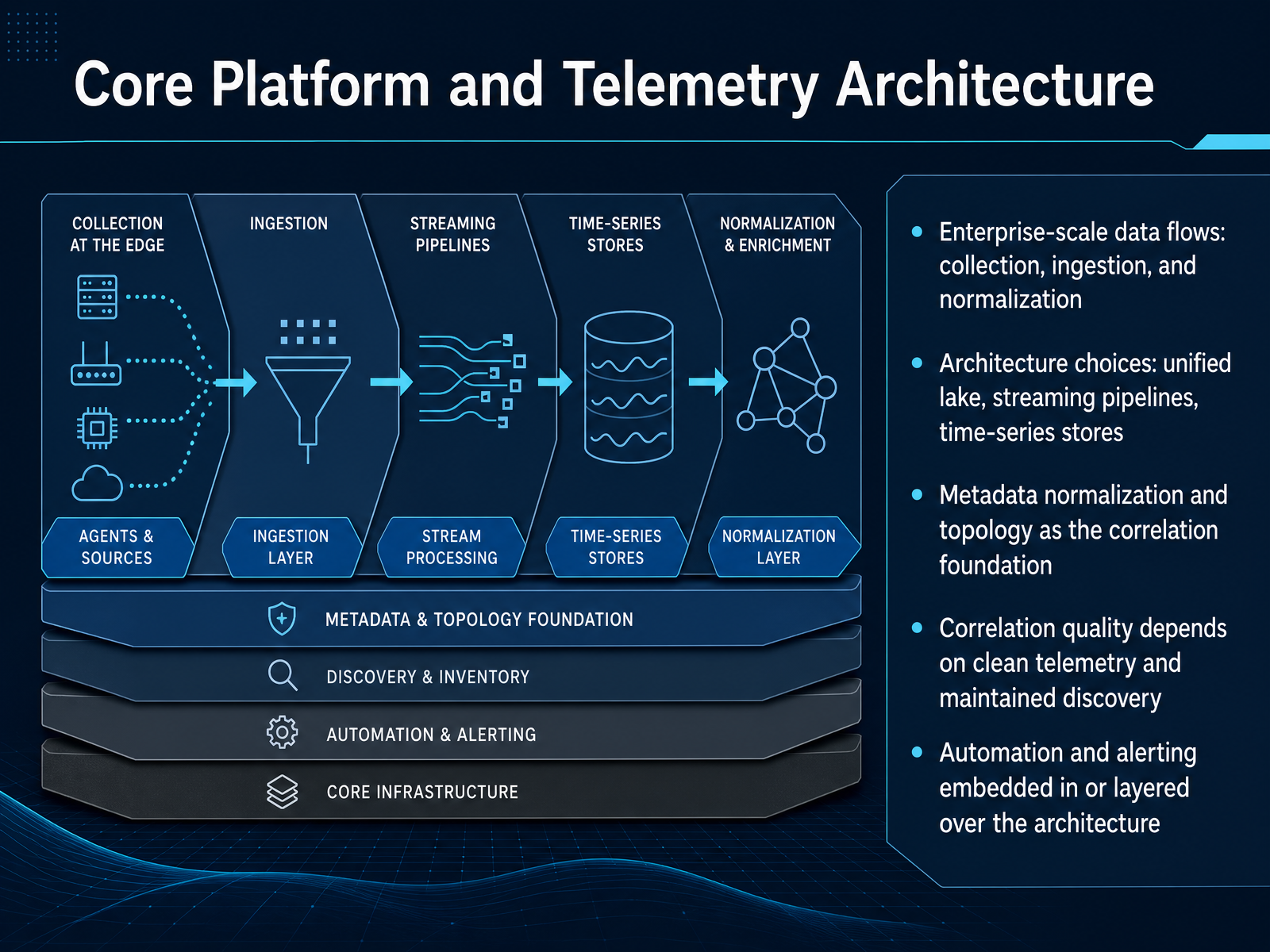
 - 05Core Platform and Telemetry ArchitectureNow let's talk about the core architecture — where collection, ingestion, and normalization happen at enterprise scale. Your first architectural fork: do you consolidate onto a unified lake, or do you run streaming pipelines into a time-series store? The answer hinges on whether your telemetry is mostly structured metrics or high-cardinality logs and traces. But regardless of the store, normalization is where correlation is won or lost. Metadata and topology become the foundation — they're what let the platform group alerts into incidents instead of drowning you in noise. And that correlation quality is only as good as your data hygiene. Clean telemetry, maintained discovery, current CMDB — these are non-negotiable. When you're evaluating, test with your own messy event streams, not the vendor's tidy demo. Watch what happens when you feed the platform a stale service map. Then consider automation — is it embedded in the platform, or layered on top? Both are viable, but they change your governance model. A unified platform gives you tighter control; an overlay preserves your existing tools but adds integration complexity. Choose with your operating model in mind, and always budget for the data foundation — it's phase one that determines everything else. Next, we'll weigh architecture tradeoffs and scaling limits.
 ciopages.comresearch.isg-one.comviewpointanalysis.com+21 min
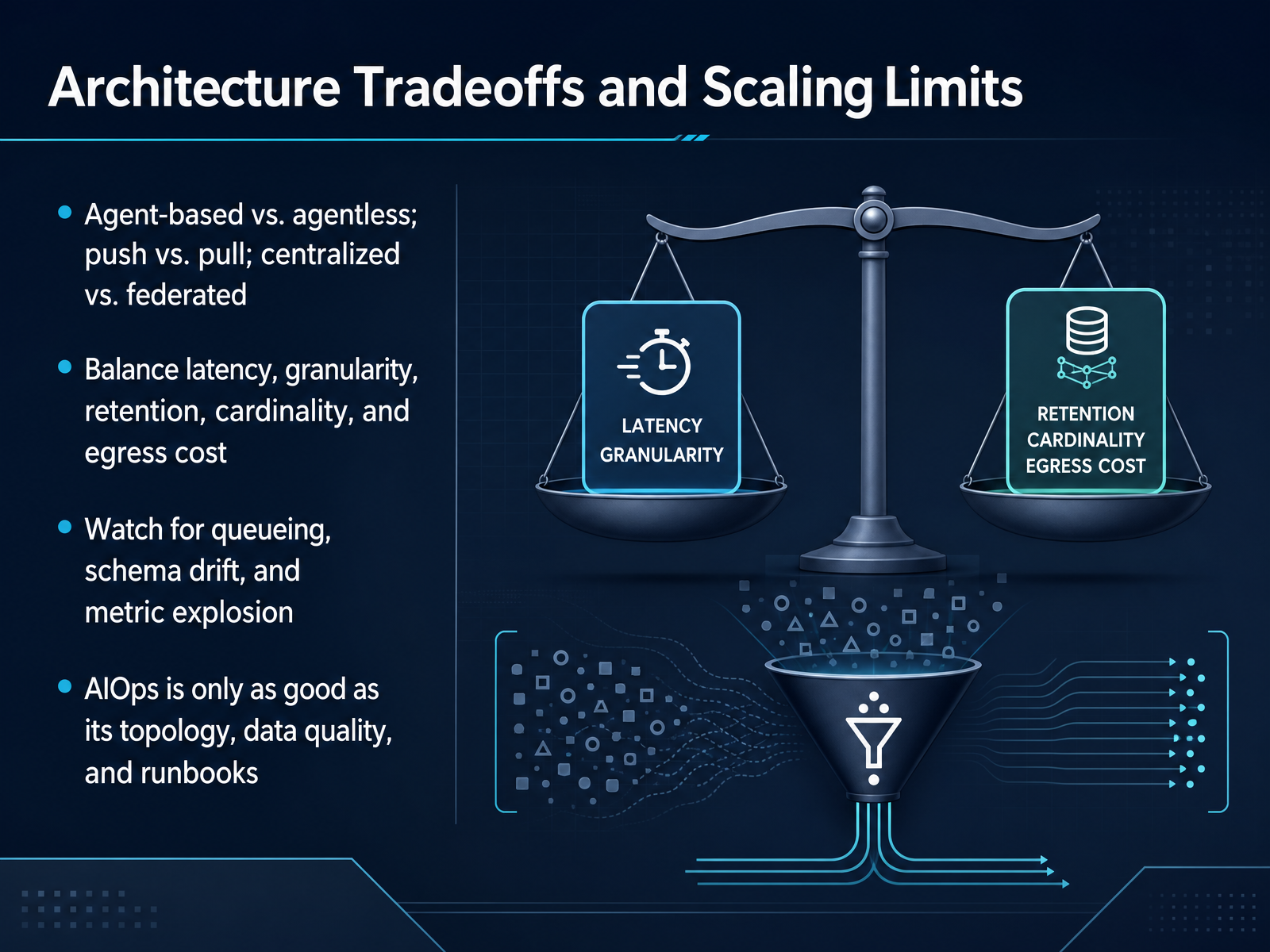
 - 06Architecture Tradeoffs and Scaling LimitsNow let's move to architecture. This is where the platform decision starts to bind. The first fork is data collection. Agent-based versus agentless. Push versus pull. Agents give you deeper context and lower latency. Agentless is simpler to deploy but can miss ephemeral workloads. There is no universally correct answer. The right choice depends on the fidelity you need for the services that matter most. A second fork is where processing happens. Centralized architectures are simpler to manage. Federated models keep data close to the source and reduce egress cost. As you scale, watch for queueing, schema drift, and metric explosion. Each degrades correlation quality when you need it most. Retention and cardinality are cost drivers. High-cardinality data is essential for root cause but expensive to store. Balance granularity against your actual incident patterns. And remember, AIOps quality follows topology and data quality, not the reverse. A maintained CMDB and clean telemetry matter more than the sophistication of the correlation engine. If the data foundation is poor, the AI will give you confident wrong answers. Start with the data collection decision. It locks in more of your architecture than any other choice. Next, we will examine the selection criteria that separate the viable platforms from the expensive ones.
 ciopages.comresearch.isg-one.comviewpointanalysis.com+22 min
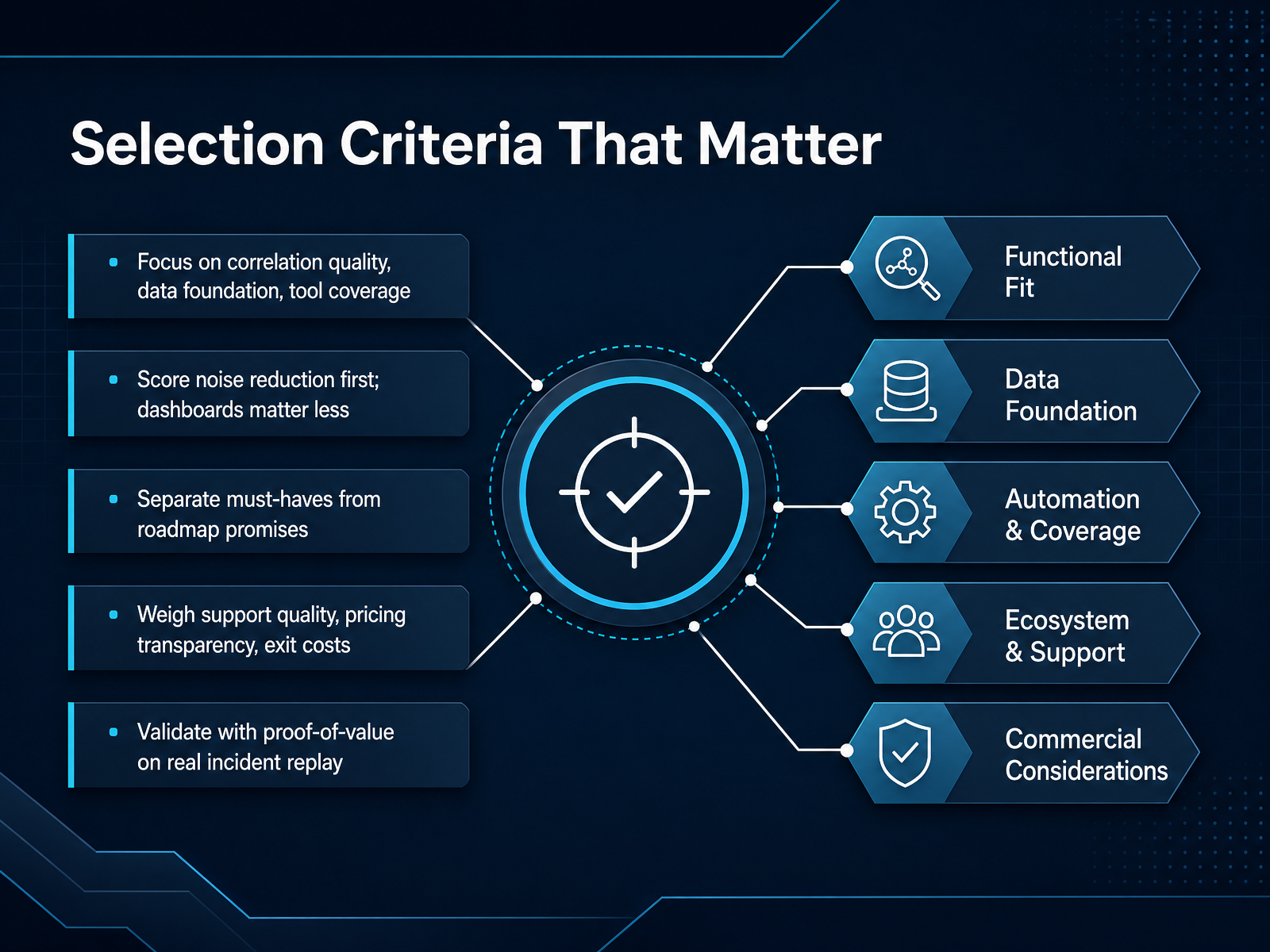
 - 07Selection Criteria That MatterNow let's talk about selection criteria that actually matter. When you evaluate platforms, focus on correlation quality, the integrity of the data foundation, and tool coverage. These are what turn an alert storm into a single, actionable incident. Score noise reduction first. Dashboards are seductive, but they matter far less when your tooling can't keep pace with incident demand. Separate your must-haves from roadmap promises. A feature that exists in a pitch deck but not in production is a liability, not a capability. Weigh support quality, pricing transparency, and exit costs just as heavily as functionality. The real cost shows up over three years, and it compounds. Finally, validate everything with a proof of value. Replay a real incident stream from your own tools. Measure the noise reduction ratio: raw alerts in versus actionable incidents out. And check if the platform surfaces the same root cause your post-mortem identified, or a confident wrong one. Don't score the demo. Score the storm. That discipline will guide your scoring of what comes next.
 ciopages.comresearch.isg-one.comviewpointanalysis.com+21 min
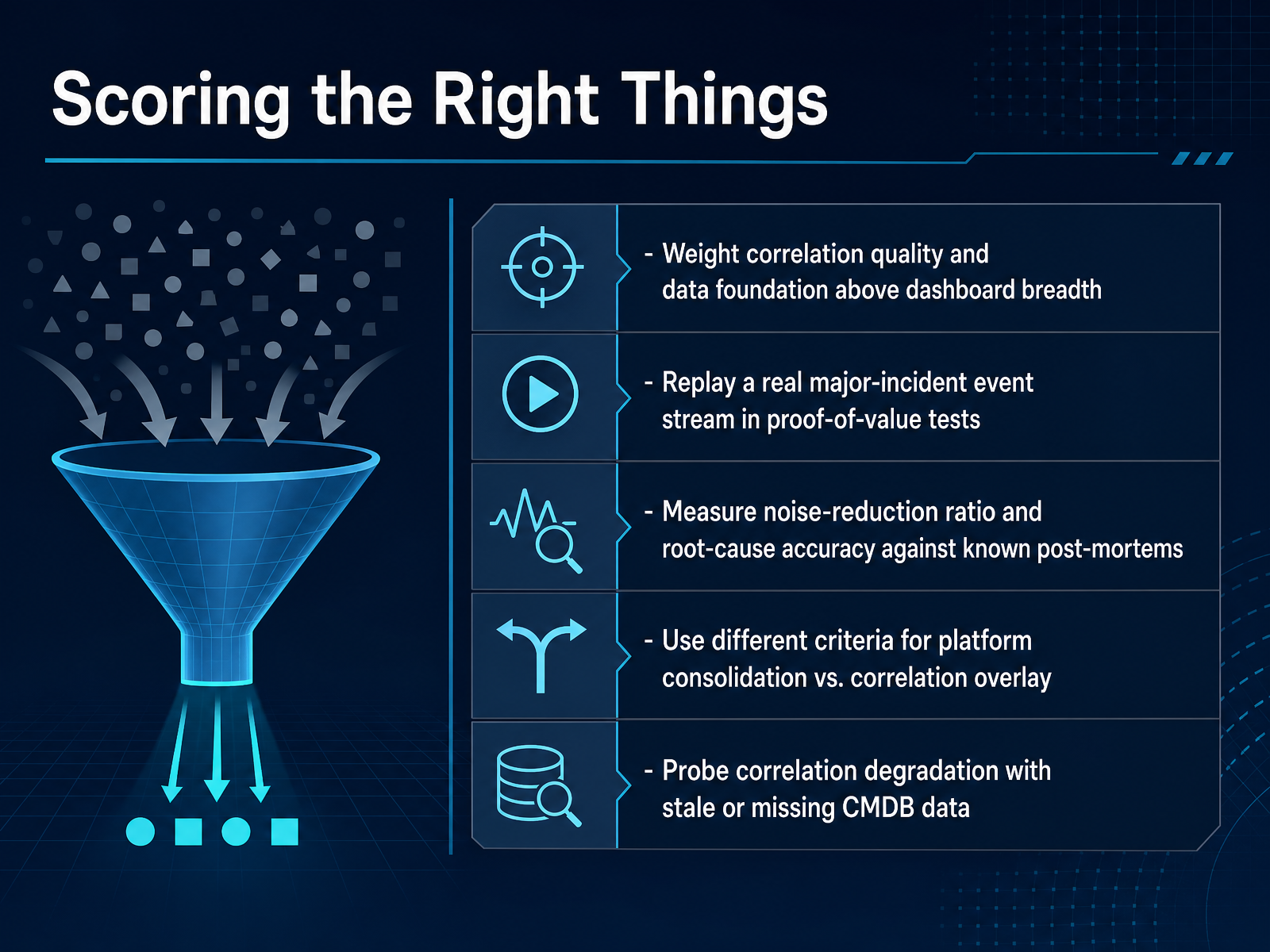
 - 08Scoring the Right ThingsNow let's talk about scoring the right things, because most evaluation frameworks misfire from the start. Weight correlation quality and the data foundation beneath it above dashboard breadth. That is the corrective for older RFPs that over-index on pretty interfaces. In practice, give event correlation and noise reduction the highest weight, around twenty-five percent, then discovery, topology, and CMDB health at twenty percent. Everything else is effectively a tie-breaker. During proof-of-value tests, do not accept a scripted vendor demo. Replay a real major-incident event stream from your own tools. Measure the noise-reduction ratio: how many raw alerts collapse into actionable incidents. Then compare the platform's root-cause output against what your post-mortem already told you. The question is whether it surfaces the real cause or a confident wrong one. Your scoring criteria must also reflect your architecture path. Use different criteria for platform consolidation versus a correlation overlay. A consolidation play demands depth of instrumentation and broad tool coverage. An overlay demands integration breadth and transparent grouping logic. Finally, probe correlation degradation deliberately. Feed the platform a service with stale or missing CMDB data and watch what happens. The vendor that stays useful on messy data leads your shortlist. Next, we will cover integration, data governance, and security.
 ciopages.comresearch.isg-one.comviewpointanalysis.com+22 min
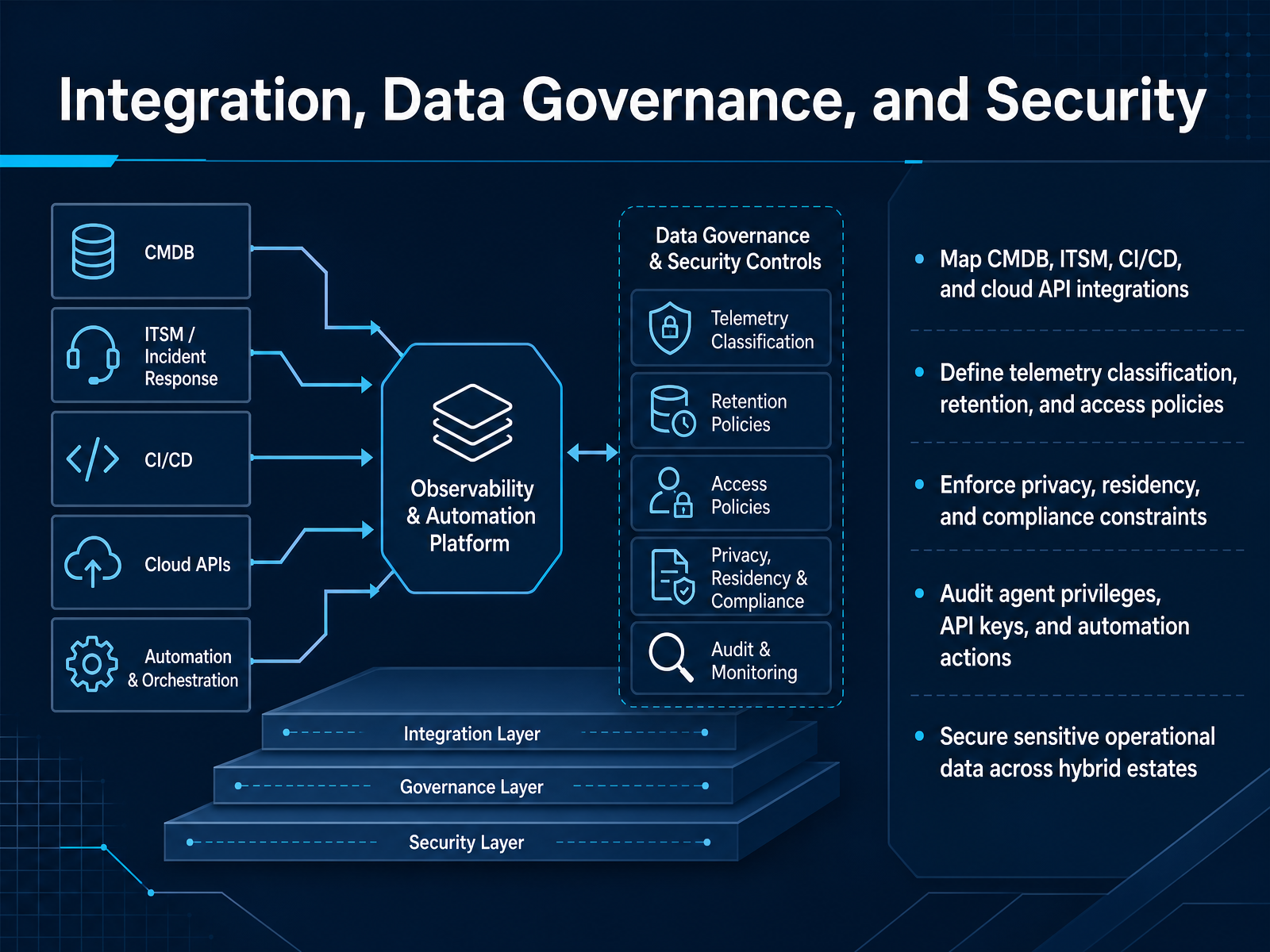
 - 09Integration, Data Governance, and SecurityIntegration, data governance, and security are where platform decisions succeed or fail. Before committing, map the integrations that matter: your CMDB, ITSM, CI/CD pipelines, and cloud APIs. The quality of those integrations is more important than their count. Then define telemetry classification, retention, and access policies. Know what data you are collecting, how long you are keeping it, and who can query it. Privacy, residency, and compliance constraints are non-negotiable. If your platform cannot keep sensitive operational data within required geographies, it will be unusable for parts of your estate. Audit agent privileges, API keys, and automation actions. Governance is not just about user roles; it is about what automated workflows are allowed to do. Your security model has to span hybrid environments, from on-premises to multiple clouds. When your platform cannot meet these governance standards, incidents only worsen, and audit findings follow. As you move toward final selection, weigh total cost of ownership and commercial models next.
 ciopages.comresearch.isg-one.comviewpointanalysis.com+21 min
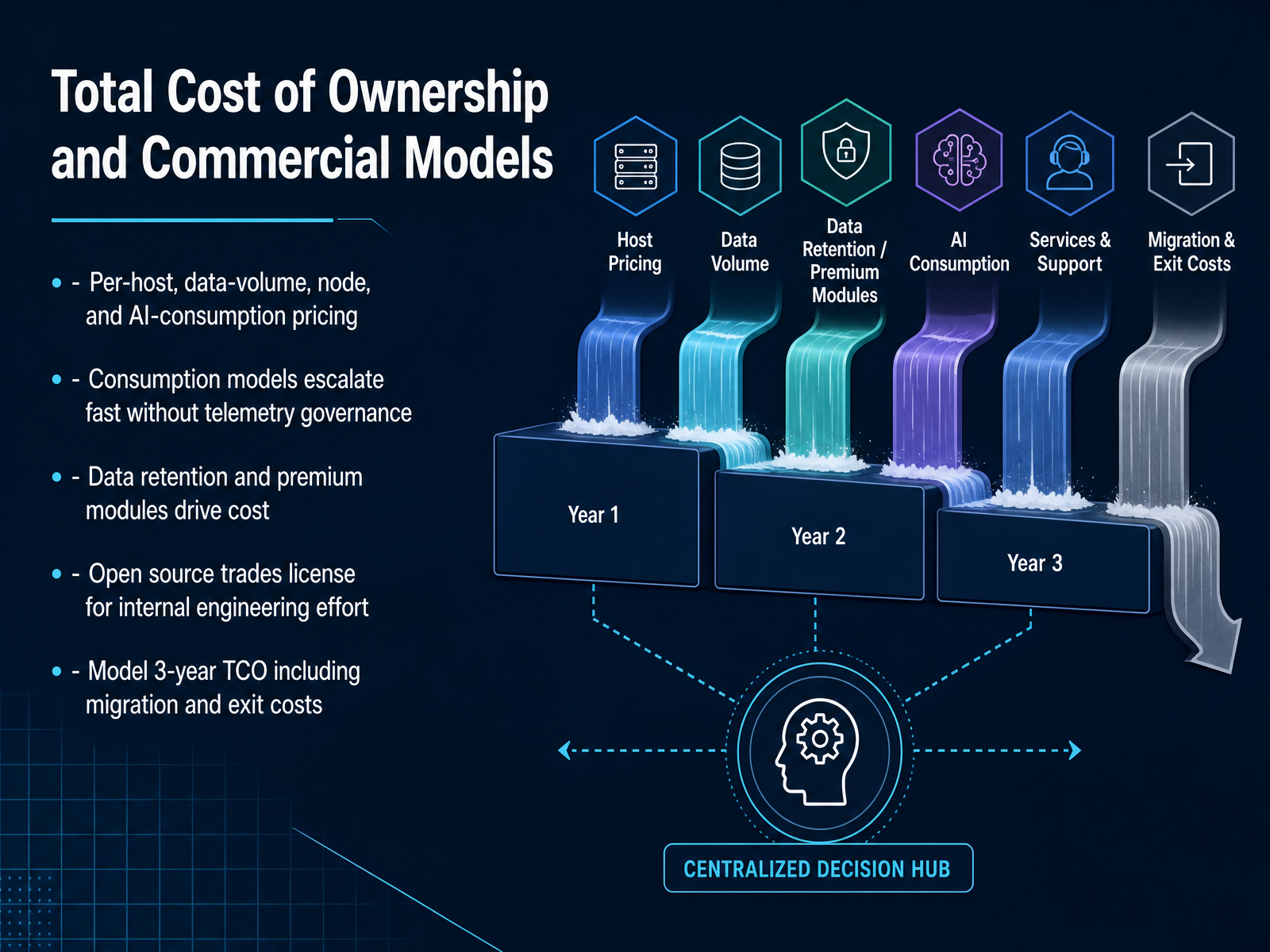
 - 10Total Cost of Ownership and Commercial ModelsLet's talk about the real cost of these platforms. The unit of measure drives everything—per-host, per-node, per-gigabyte, or even per-AI-consumption. A headline rate means little if the meter runs faster than your budget. Consumption models escalate quickly when telemetry isn't governed. Data retention and premium modules add another layer on top. Open source trades licensing fees for internal engineering effort, and that effort is a real cost too. So model a three-year total cost of ownership. Include migration costs and the cost to exit if you ever leave. The license is often less than half the story. When you model the true three-year figure, the cheapest option on paper frequently changes places. Now, let's look at how you structure the operating model and drive adoption.
 ciopages.comitsmnegotiations.comitsmnegotiations.com+21 min
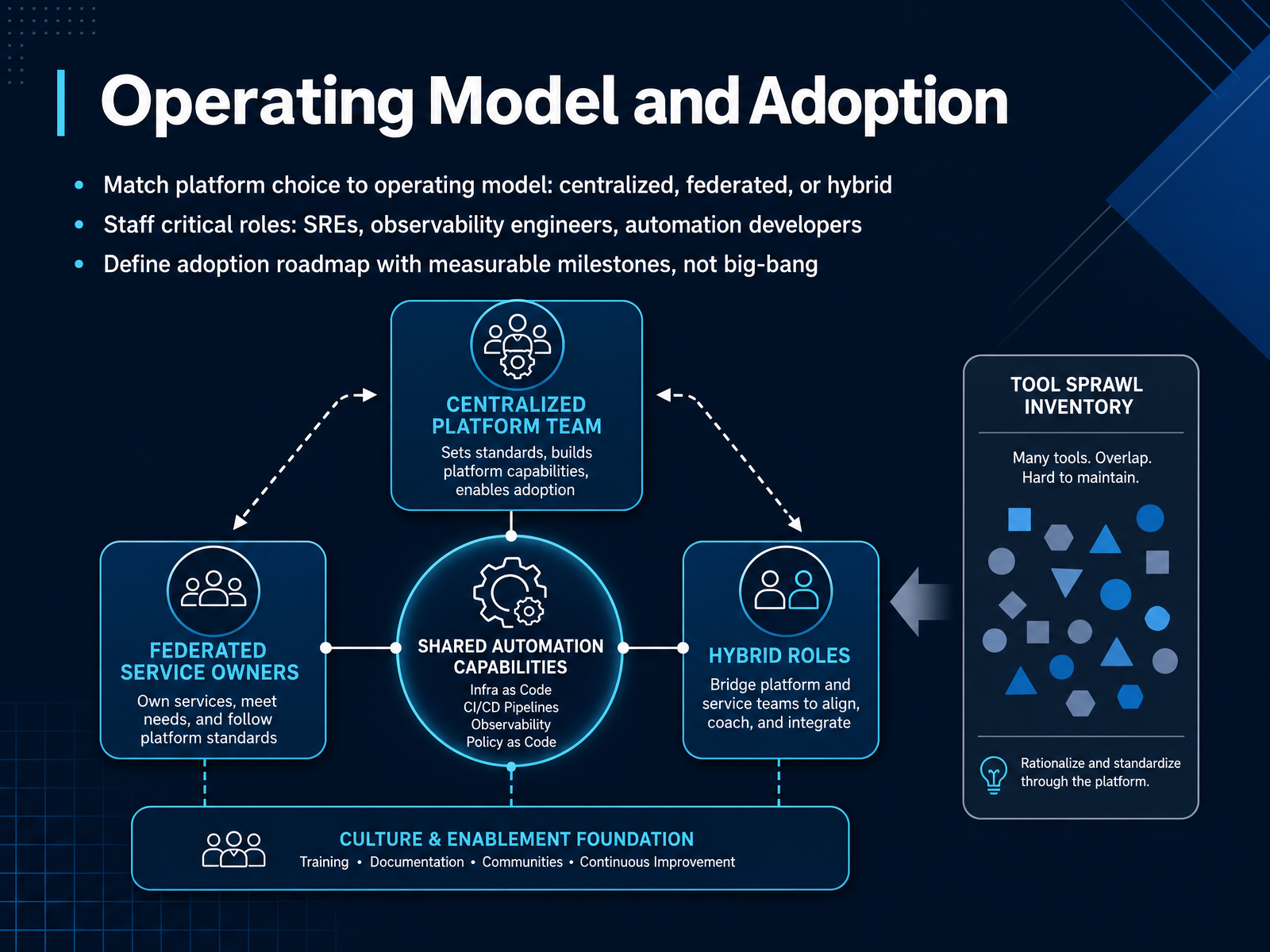
 - 11Operating Model and AdoptionEven the best platform fails if the operating model doesn’t support it. The first decision is structure. Centralized teams bring consistency and tight control, but they can bottleneck. Federated teams put ownership in the business units, which improves speed but risks fragmentation. Most enterprises settle on a hybrid, but you must choose deliberately rather than by default.
Next, staff to the operating model, not the org chart. You need site reliability engineers who enforce service-level objectives, observability engineers who treat telemetry as a product, and automation developers who build remediation, not just dashboards. Your tooling is only as good as the data foundation these roles maintain.
Finally, avoid the big-bang rollout. Define an adoption roadmap with measurable milestones. Start by replaying a past major incident through the new platform to validate noise reduction. Then expand service by service. Fund the data cleanup upfront; that is where most failures originate.
This platform decision cascades directly into how you evaluate artificial intelligence for operations. That is our next topic.
 ciopages.comresearch.isg-one.comviewpointanalysis.com+22 min
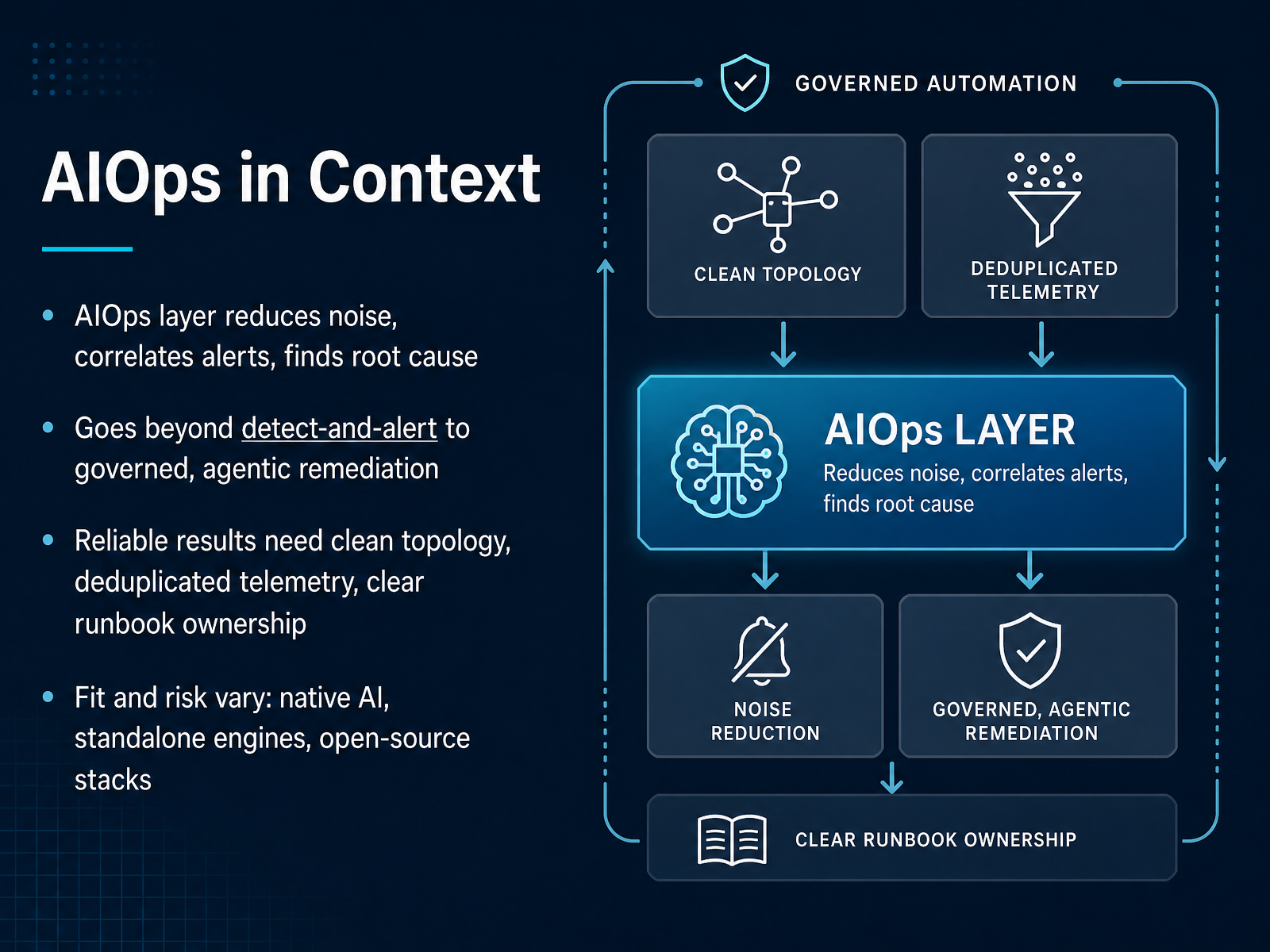
 - 12AIOps in ContextNow we place AIOps in context. The AIOps layer is not another monitoring tool. It is the operational intelligence layer that reduces noise, correlates alerts, and identifies probable root cause across your estate. In 2026, the best platforms extend beyond detect and alert. They move into governed, agentic remediation, where the system itself investigates, proposes a fix, and in advanced cases executes it under audit control. But here is the reality check. Reliable AI results depend on your foundations. Clean topology, deduplicated telemetry, and clear runbook ownership are non-negotiable. Without those, the AI layer amplifies chaos instead of containing it. Fit and risk vary sharply. Native AI engines from major observability vendors deliver rapid value if you are already standardized on that stack. Standalone correlation engines shine when you run many monitoring tools and want a layer above them. Open-source stacks offer cost control but demand stronger engineering ownership. Assess the autonomy your organization will actually approve before you select. This is a governance decision as much as a technical one.
 research.isg-one.commy.idc.comcoralogix.com+21 min
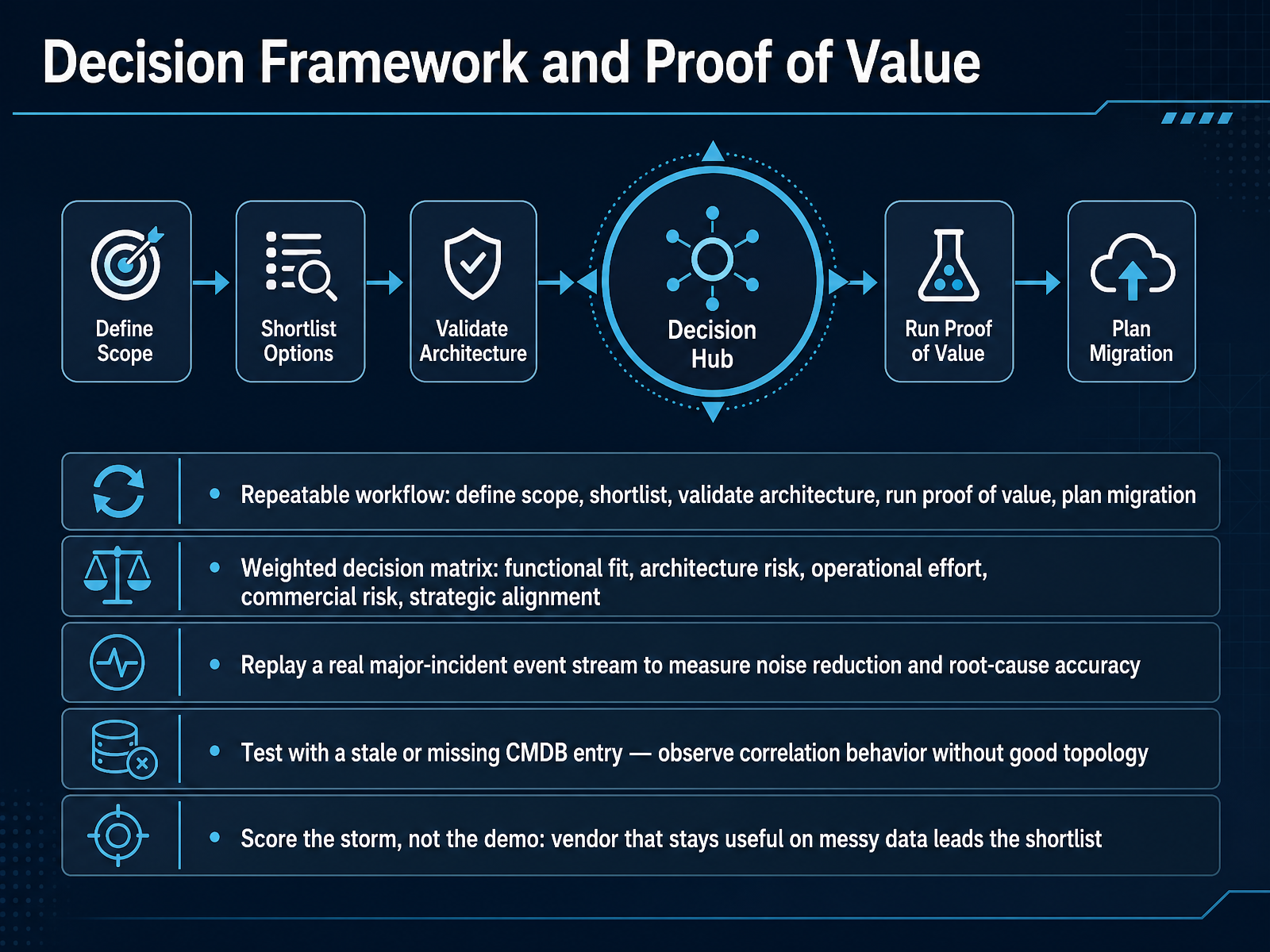
 - 13Decision Framework and Proof of ValueLet's turn that analysis into a decision. You need a repeatable workflow: define the scope, build a shortlist, validate the architecture, run a proof of value, and plan the migration. A weighted decision matrix keeps it objective. Score functional fit, architecture risk, operational effort, commercial risk, and strategic alignment. During the proof of value, replay a real major incident event stream. Measure two things: the raw alerts that collapse into actionable incidents, and whether the platform surfaces the root cause you already know from your post-mortem. Then deliberately feed it a service with a stale or missing CMDB entry. Watch what correlation does without good topology. That is the test that matters. Don't score the demo, score the storm. The vendor that stays useful on messy data leads your shortlist. Next, let's look at the next steps for operations leaders.
 ciopages.comresearch.isg-one.comviewpointanalysis.com+22 min
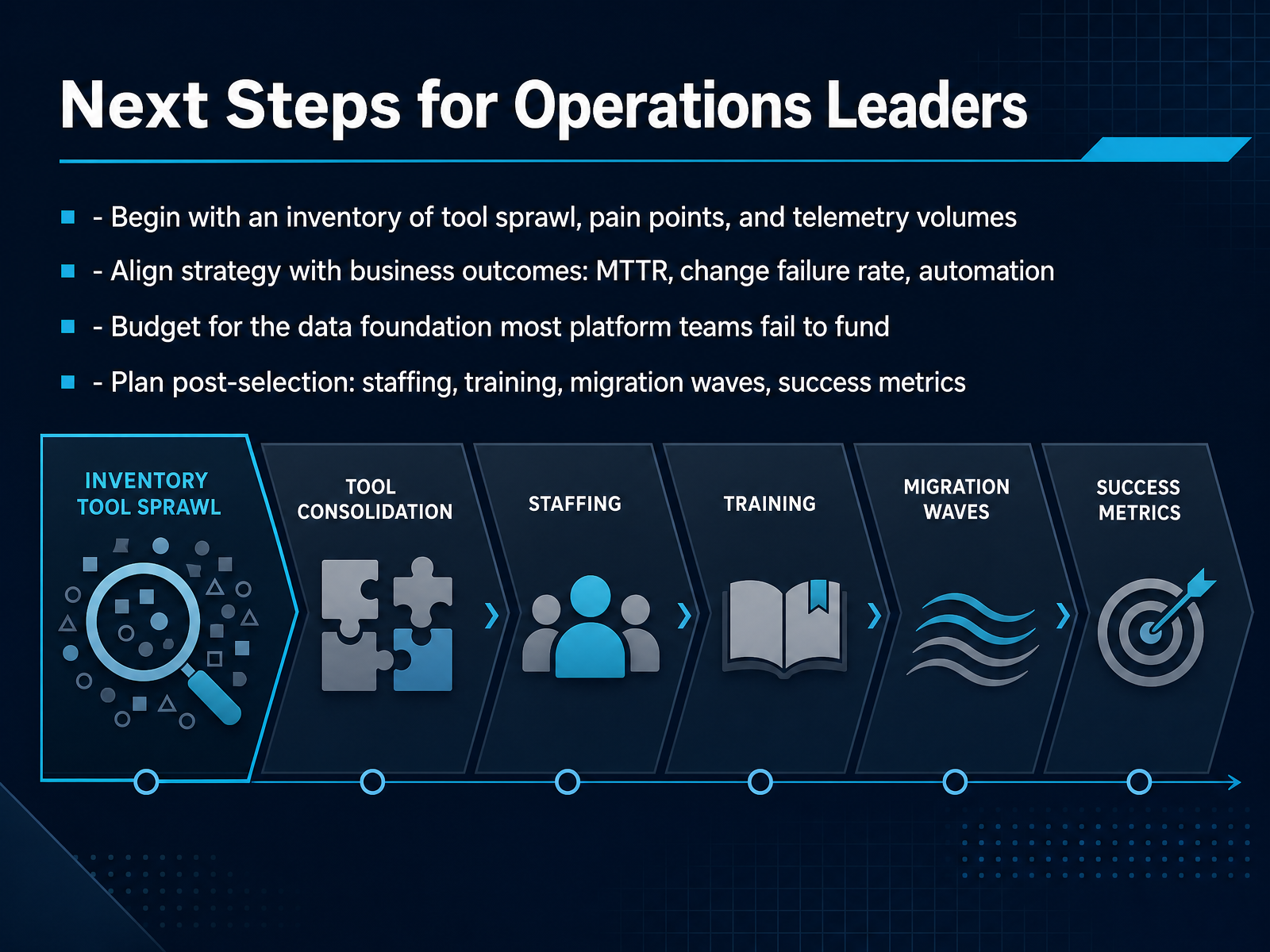
 - 14Next Steps for Operations LeadersYou have worked through the selection criteria, the architectural forks, and the cost models. Now the work shifts from choosing a platform to building the case and executing. Start with a hard inventory. Document your tool sprawl, your team's pain points, and your actual telemetry volumes. You cannot fix what you have not measured. Next, anchor the entire initiative to business outcomes. Frame the investment around mean time to repair, change failure rate, and where automation will return real hours to your engineers. Then, budget for the data foundation. Most platform teams fail because they fund the software but not the discovery, the CMDB hygiene, and the deduplication work that makes correlation possible. Finally, plan for life after selection. Staffing, training, migration waves, and success metrics need to be defined before you sign. A platform is the start, not the finish. Thank you for engaging with this material. You now have the framework to make a defensible, architectural decision. Go build the case and lead your operations transformation.
 ciopages.comresearch.isg-one.comviewpointanalysis.com+22 min
Take the deck with you
Download this course as a file — free, no sign-up needed.
- PDF handoutEvery slide page, ready to print or share.15 pages · 3.6 MBDownload
- Narrated PowerPointThe deck that presents itself — every slide carries the digital human's narration video.15 pages · 17.0 MBDownload
- PowerPoint slidesThe full deck as a .pptx — open it in PowerPoint, Keynote, or Google Slides.15 pages · 3.5 MBDownload
Free to use in your own training — please keep the PersonWise credit page at the end.
Have your own deck? Turn it into a course
Sources consulted
Web sources consulted while building this course.
- IT Operations Management Software Market (2024 - 2030) — grandviewresearch.com
- IT Operations Management Market Growth Report 2031 — mordorintelligence.com
- IT Operations Management Market Outlook 2026-2034: Market Share, and Growth Analysis by Service Type, Organization Size, End-User, Service Model — researchandmarkets.com
- Information Technology (IT) Operations Management Software Global Market Report 2026 — giiresearch.com
- IT Operations Management Market Demand, Share & Growth by 2034 — theinsightpartners.com
- Buyer's Guide: IT Operations Management (ITOM) | CIOPages Buyer Guide — ciopages.com
- ISG Buyers Guide for IT Operations Management Classifies and Rates Software Providers — research.isg-one.com
- How to Select IT Operations Software — viewpointanalysis.com
- ITSM Vendor Evaluation: Criteria + RFP Tem… | SMC Consulting (EN) — smcconsulting.be
- ITSM Tool RFP: Template, Questions & Vendor Checklist ... — sifthub.io
- The 2026 ITSM Platform Cost Comparison · ITSM Negotiations — itsmnegotiations.com
- Calculate ITSM Total Cost of Ownership | ITSM Negotiations — itsmnegotiations.com
- ServiceNow ITOM Pricing Benchmarks: Node-Based Cost Data — vendorbenchmark.com
- ServiceNow ITOM Cost & Pricing Breakdown In 2026 — devtechnosys.com
- AIOps Platforms Buyers Guide 2026 Executive Summary — research.isg-one.com
- IDC MarketScape: Worldwide AIOps 2026 Vendor Assessment — my.idc.com
- AIOps Tools And Platforms Compared (2026) — coralogix.com
- 10 best AIOps tools for 2026, ranked and reviewed - Guideflow Blog — guideflow.com
- AIOps Software Options 2026: A Buyer Guide — viewpointanalysis.com