Begin
14 pages · ~28 min
Biological Catalysts: Mechanism and Function
This training explains how biological catalysts function, helping learners understand enzyme mechanisms and their role in accelerating biochemical reactions.
A digital instructor presents all 14 pages. Hold “Ask” at any point and ask out loud — the answer comes from this course. No sign-up needed.
What you’ll learn
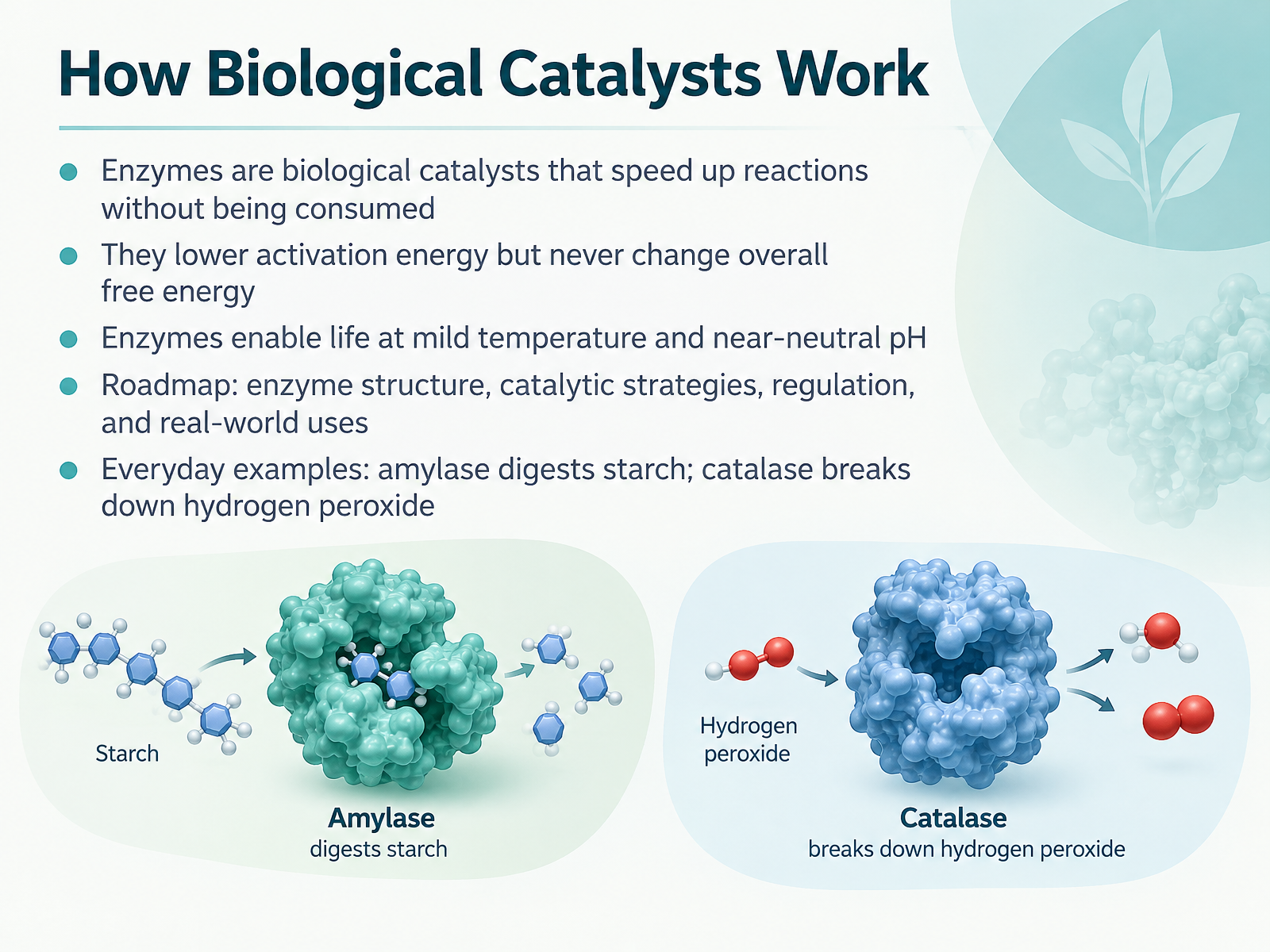
- 01How Biological Catalysts WorkWelcome. Today we're going to explore how biological catalysts work, and by the end, you'll have a clear picture of the molecules that quietly keep life running. So, what is an enzyme? An enzyme is a biological catalyst. That simply means it speeds up a chemical reaction without being used up in the process. Think of it like a reusable tool. Now, here is a key idea. Enzymes lower the activation energy, the energy needed to get a reaction started. But they never change the overall free energy, so they don't make impossible reactions happen. They just help reactions happen faster under mild conditions, like your body's temperature and near-neutral pH. You've already met enzymes in daily life. Amylase in your saliva helps digest starch. Catalase breaks down hydrogen peroxide into water and oxygen. Over the next few slides, we'll look at enzyme structure, catalytic strategies, how enzymes are regulated, and some real-world uses. Let's begin with why reactions need a push in the first place.acs.orgbiobeat.nigms.nih.govopenstax.org+21 min
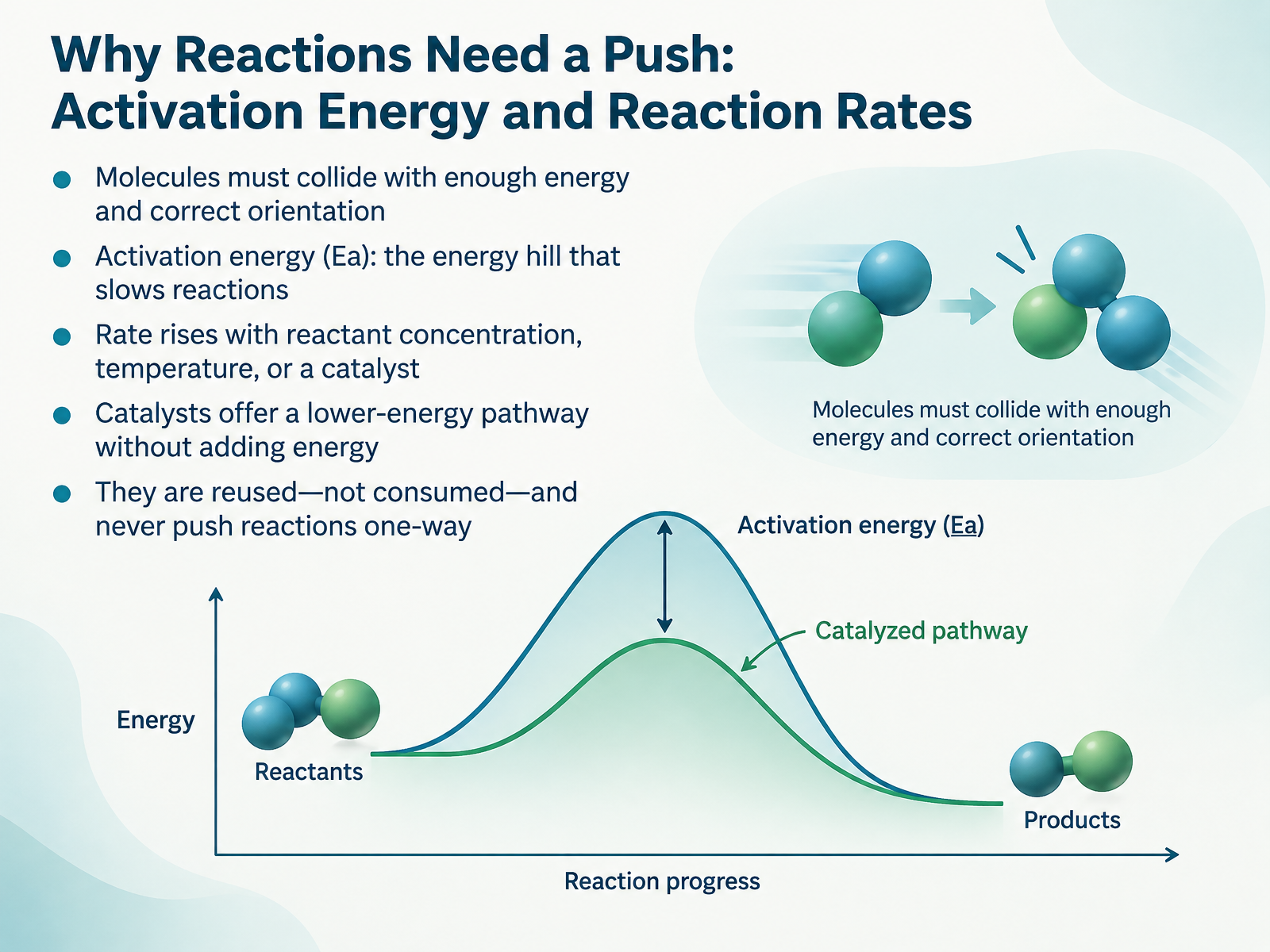
- 02Why Reactions Need a Push: Activation Energy and Reaction RatesLet's look at why chemical reactions need a push. For a reaction to happen, molecules have to collide. And they need two things. Enough energy, and the right orientation. Imagine two people trying to high-five while running past each other. They need to meet at the right angle, with enough momentum. That energy barrier has a name. It's called activation energy, or E a. Think of it as a hill you have to climb before the reaction can roll forward. A higher hill means a slower reaction. So how do we speed things up? You can raise the concentration of reactants, so collisions become more frequent. You can raise the temperature, so molecules move faster and collide harder. Or you can add a catalyst. Here's the key point. A catalyst doesn't add energy. Instead, it offers a lower-energy pathway, like finding a tunnel through that hill. And afterward, the catalyst is reused, not consumed. It also never decides the direction of a reaction. It just helps the reaction reach its own natural endpoint faster. Next, let's see this in action by comparing energy profiles, with and without a catalyst.
 acs.orgbiobeat.nigms.nih.govopenstax.org+22 min
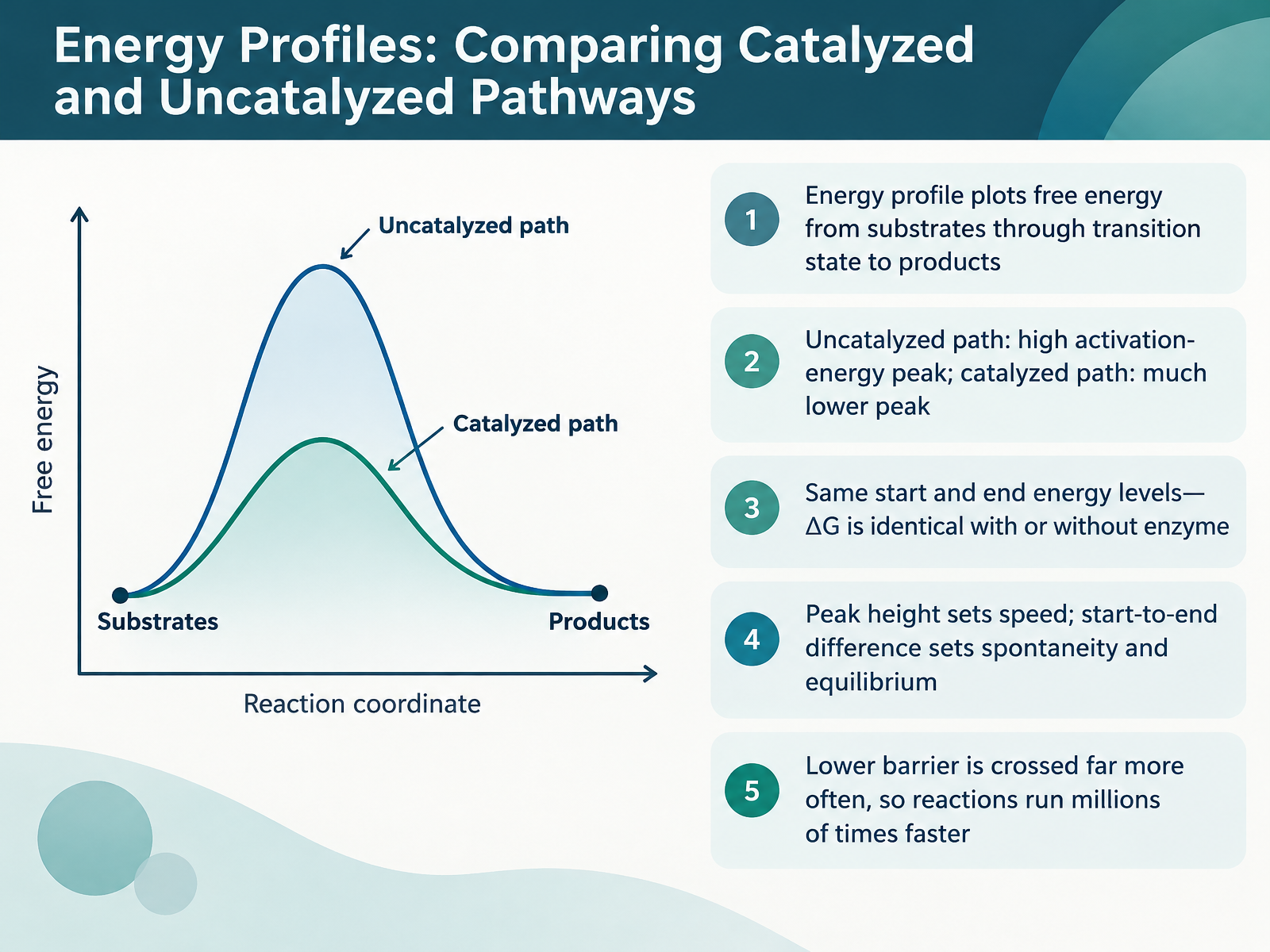
- 03Energy Profiles: Comparing Catalyzed and Uncatalyzed PathwaysNow let's look at energy profiles, the picture that shows what a catalyst actually changes. Picture a graph. Free energy runs up the side. On the left, you start with the substrates. On the right, you end with the products. In between, there's a hill. The top of that hill is the transition state, and climbing it costs energy. That cost is the activation energy. Without an enzyme, the peak is high. With an enzyme, the peak is much lower. Here's the key point. The starting energy and the ending energy are exactly the same either way. So the overall change in free energy is identical with or without an enzyme. What differs is the height of the barrier. And that height sets the speed. A lower barrier gets crossed far more often, so reactions can run millions of times faster. Think of a mountain pass. Same destination, just an easier route. Next, we'll see what gives enzymes the shape to do this work: enzyme structure, active sites, and the shape that does the work.
 acs.orgbiobeat.nigms.nih.govopenstax.org+22 min
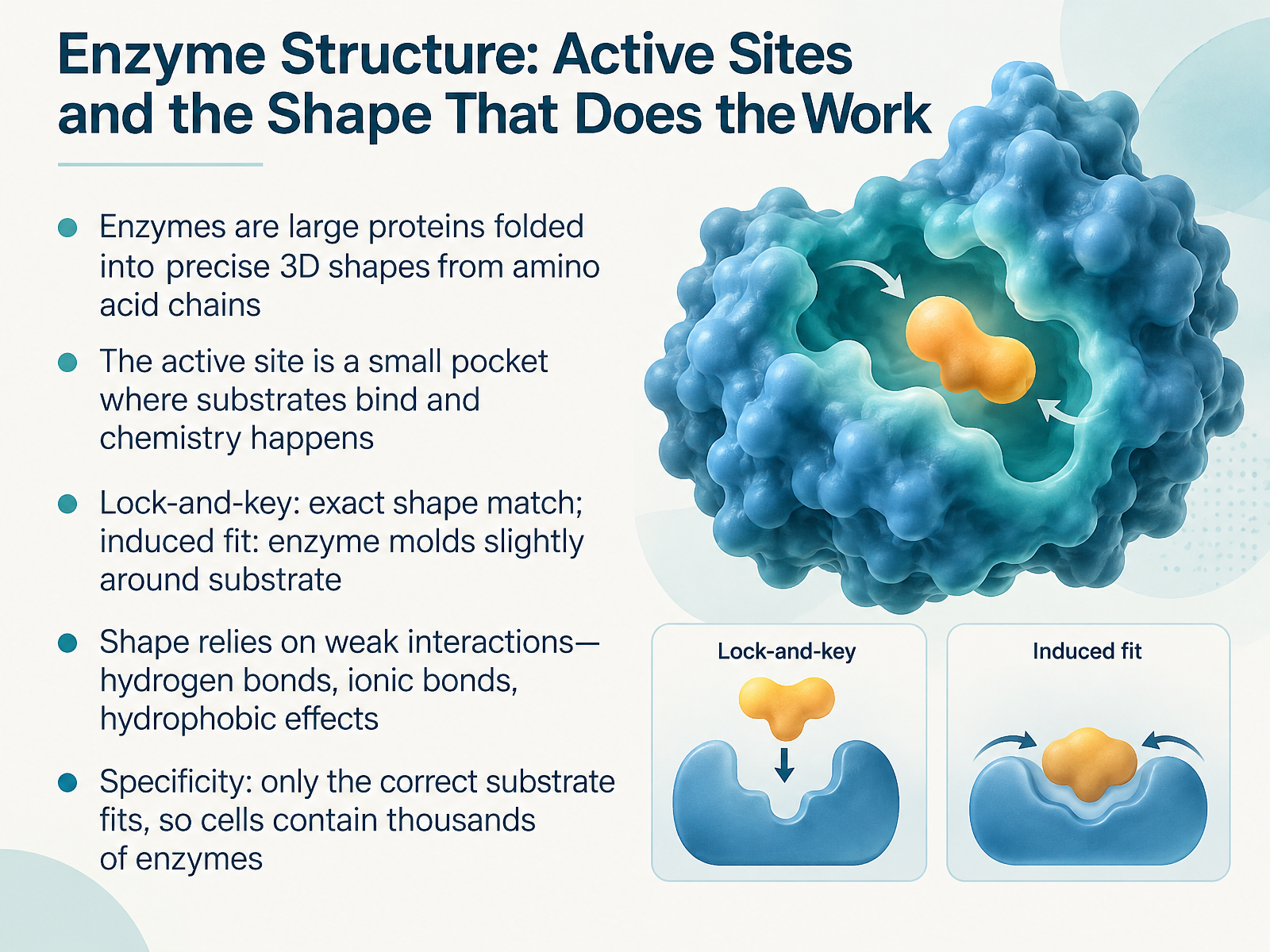
- 04Enzyme Structure: Active Sites and the Shape That Does the WorkNow let's look at where the work actually happens inside an enzyme. Most enzymes are large proteins, built from long chains of amino acids. And those chains fold into a precise three-dimensional shape. Within that shape is a small pocket called the active site. That's where the substrate, the molecule the enzyme acts on, binds, and where the chemistry happens. Picture a key sliding into a lock. That's the classic lock-and-key idea, an exact shape match. But there's a refinement called induced fit. Here, the enzyme molds slightly around the substrate, like a rubber glove stretching to fit your hand. That shape depends on many weak interactions, such as hydrogen bonds and ionic bonds, so it's delicate. And because only the right substrate fits, cells make thousands of different enzymes, each specialized for its own job. Next, we'll follow the substrate all the way to product.
 acs.orgbiobeat.nigms.nih.govopenstax.org+22 min
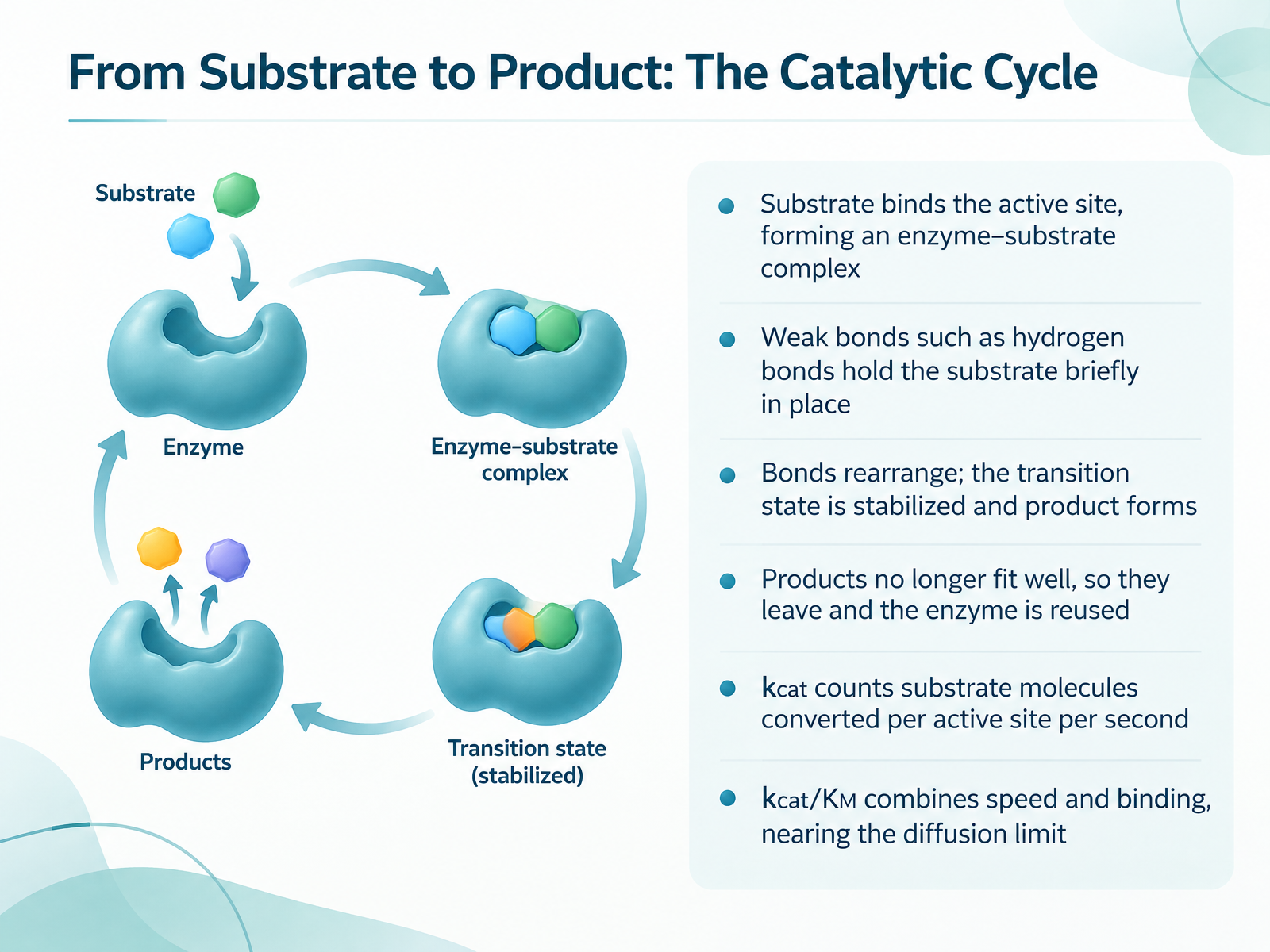
- 05From Substrate to Product: The Catalytic CycleNow let's follow a single substrate through one full catalytic cycle. The substrate first binds to a pocket on the enzyme called the active site, forming an enzyme substrate complex. Weak bonds, such as hydrogen bonds, hold it briefly in place. Then bonds rearrange. The enzyme stabilizes an unstable in between form called the transition state, and the product forms. Products no longer fit well, so they leave, and the enzyme is free to be reused. Scientists measure speed with k cat, the number of substrate molecules one active site converts per second. They also combine speed and binding in k cat over K M. The fastest enzymes approach a limit set by how quickly molecules diffuse through water. Up next, we'll see the specific tricks enzymes use to lower that energy barrier.
 acs.orgbiobeat.nigms.nih.govopenstax.org+21 min
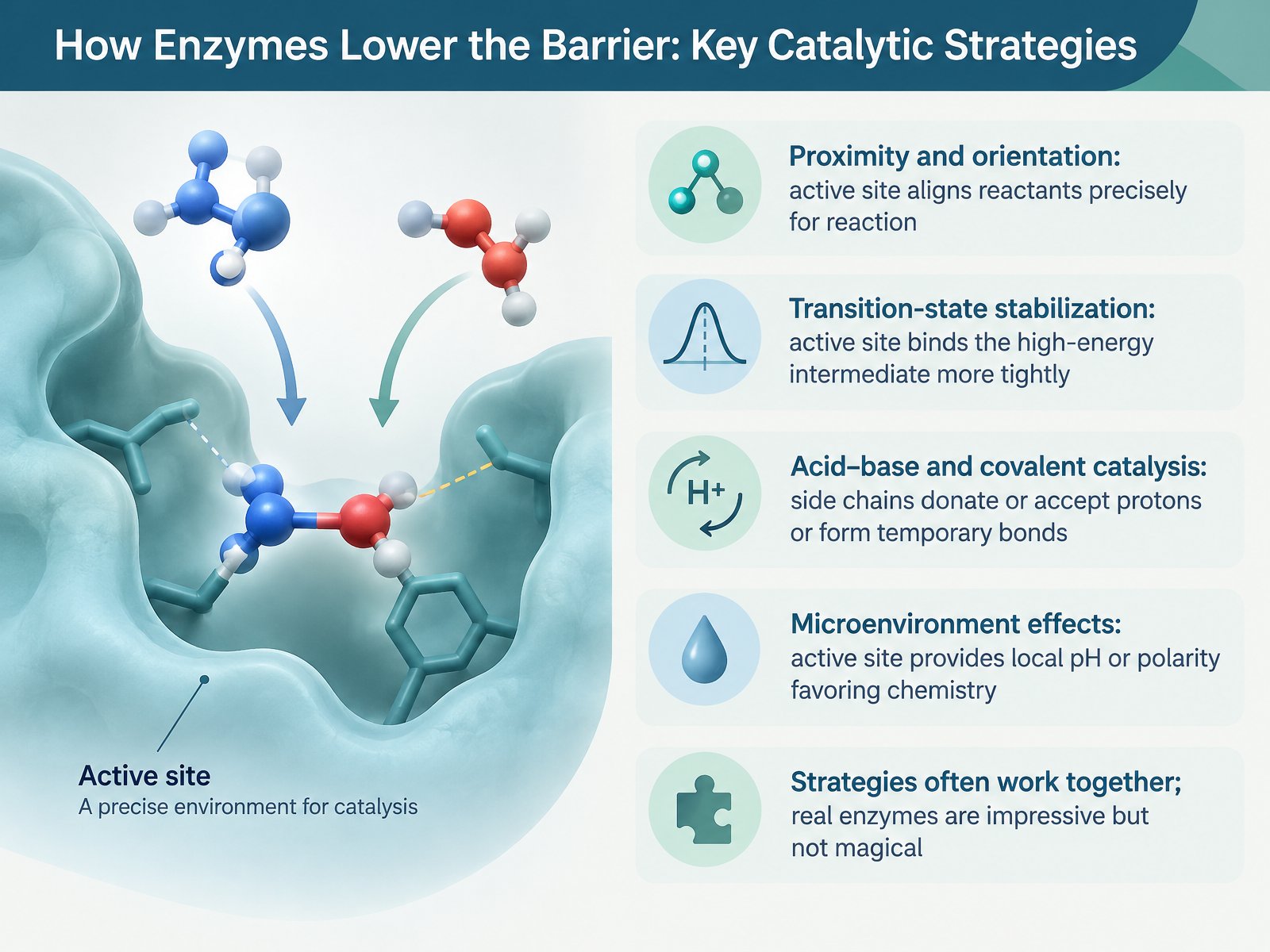
- 06How Enzymes Lower the Barrier: Key Catalytic StrategiesNow let's look at how enzymes actually lower that energy barrier. There are several strategies, and most enzymes use more than one at once. First, proximity and orientation. The active site is a pocket that brings reactants close together and lines them up precisely, so they meet in exactly the right position. A bit like threading a needle, the closer and more aligned, the easier the reaction. Second, transition-state stabilization. Every reaction passes through a high-energy in-between state called the transition state. The active site binds that state more tightly than the starting materials, which lowers the barrier and speeds things up. Third, acid-base and covalent catalysis. Side chains in the active site can donate or accept protons, or briefly form a temporary bond with the substrate, giving the reaction a shortcut. Fourth, microenvironment effects. The active site can create its own local conditions, a specific pH or a less watery, less polar space, that favor the chemistry. And importantly, these strategies often work together. Real enzymes are impressive, sometimes speeding reactions enormously, but they are not magic. They simply use precise binding and chemistry. Next, we move beyond proteins to RNA enzymes and engineered catalysts.
 biochem.siu.eduonlinelibrary.wiley.compeople.uleth.ca+22 min
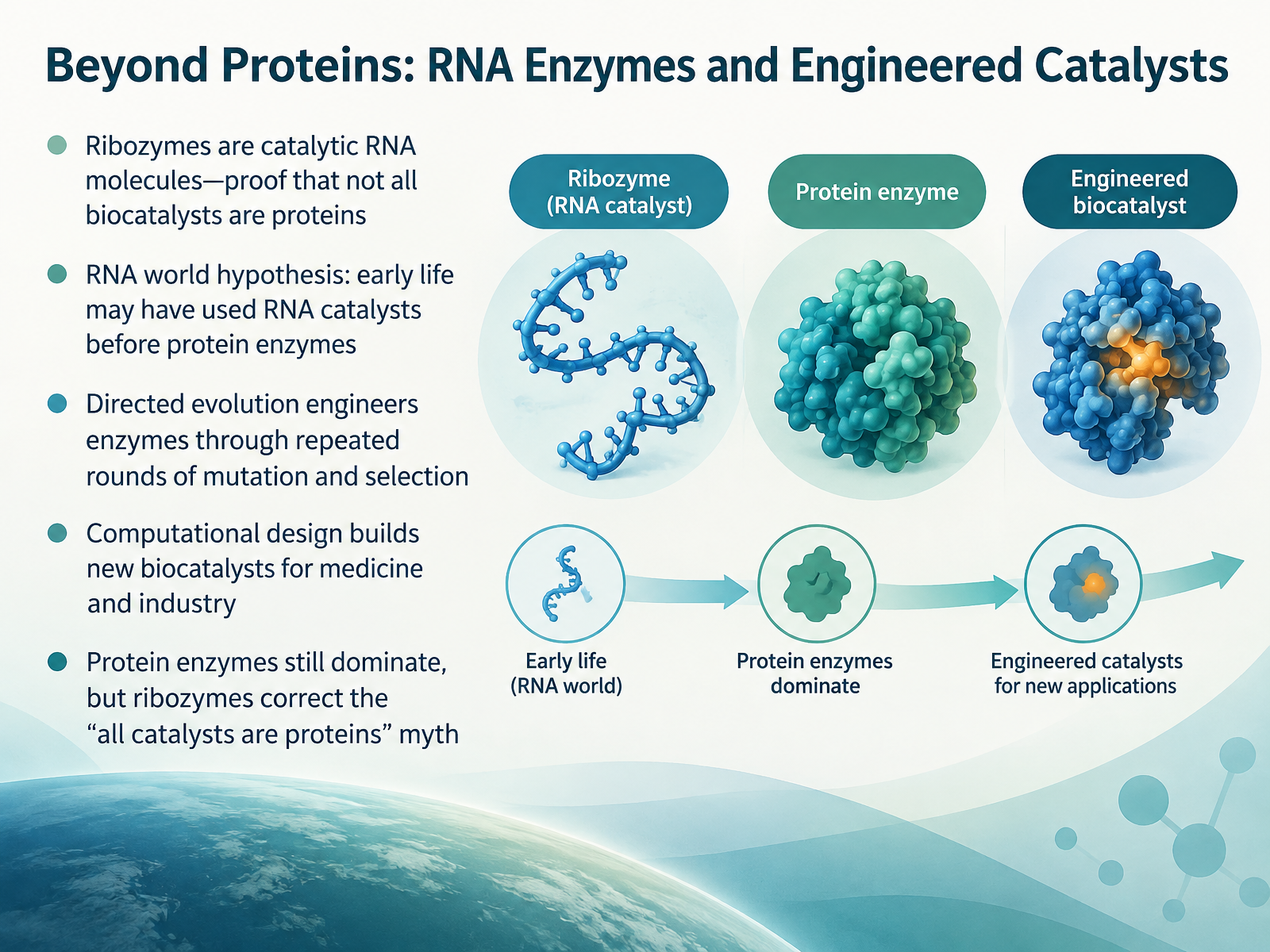
- 07Beyond Proteins: RNA Enzymes and Engineered CatalystsNow let's expand the definition. Are all biological catalysts proteins? No. Ribozymes are catalytic RNA molecules. That's real proof that catalysts don't have to be proteins. This idea supports the RNA world hypothesis. In simple terms, early life may have relied on RNA catalysts before protein enzymes existed. Today, scientists also build new biocatalysts. Directed evolution works like repeated rounds of mutation and selection. Computational design uses computers to propose brand new catalyst structures. Protein enzymes still dominate in cells, but ribozymes correct the myth that all catalysts are proteins. Next, we'll look at factors that shape enzyme activity, temperature and pH.
 acs.orgbiobeat.nigms.nih.govopenstax.org+21 min
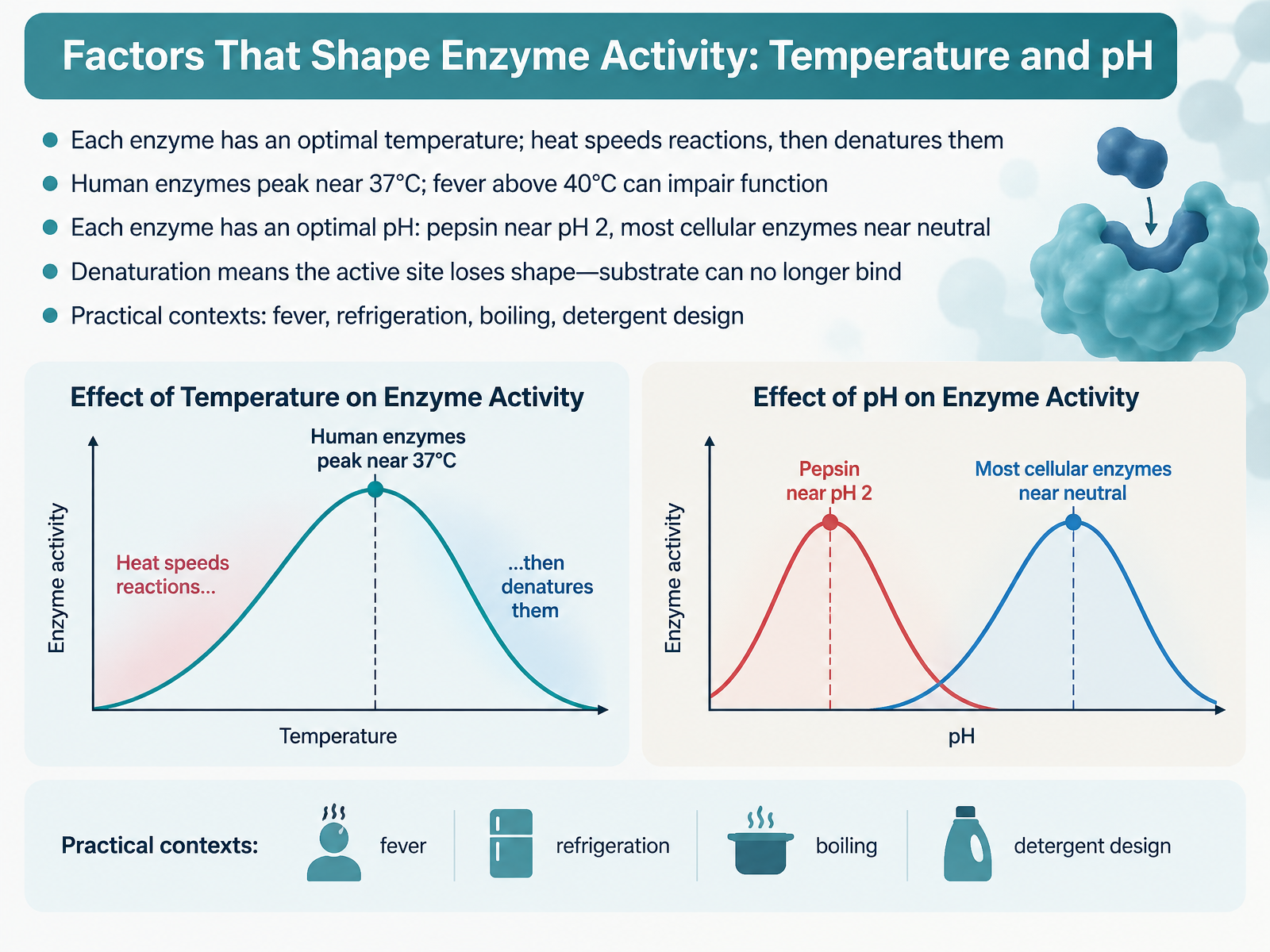
- 08Factors That Shape Enzyme Activity: Temperature and pHNow let's look at how temperature and pH shape enzyme activity. Every enzyme has an optimal temperature, where it works fastest. A little warmth speeds things up, because molecules move faster and collide more often, like more customers reaching a counter. But push the heat too high, and the enzyme denatures. That simply means it loses its shape, so the substrate no longer fits its active site. Most human enzymes peak near thirty seven degrees Celsius. A fever above forty degrees can start to impair them, which is one reason high fevers feel so rough. pH matters too. Each enzyme has an optimal pH. Pepsin, a stomach enzyme, works best near pH two, very acidic. Most enzymes inside your cells work near neutral, around pH seven. Step too far outside the optimal range, and the active site changes shape again, so the substrate cannot bind. You meet these ideas every day, in fever, in refrigeration that slows enzymes, and in boiling water that denatures them. So remember the key point. Each enzyme has its comfort zone, and outside it, function drops. Next, we turn to substrate and enzyme concentration, and the saturation curve known as the Michaelis Menten picture.
 monash.eduold-ib.bioninja.com.ausavemyexams.com+22 min
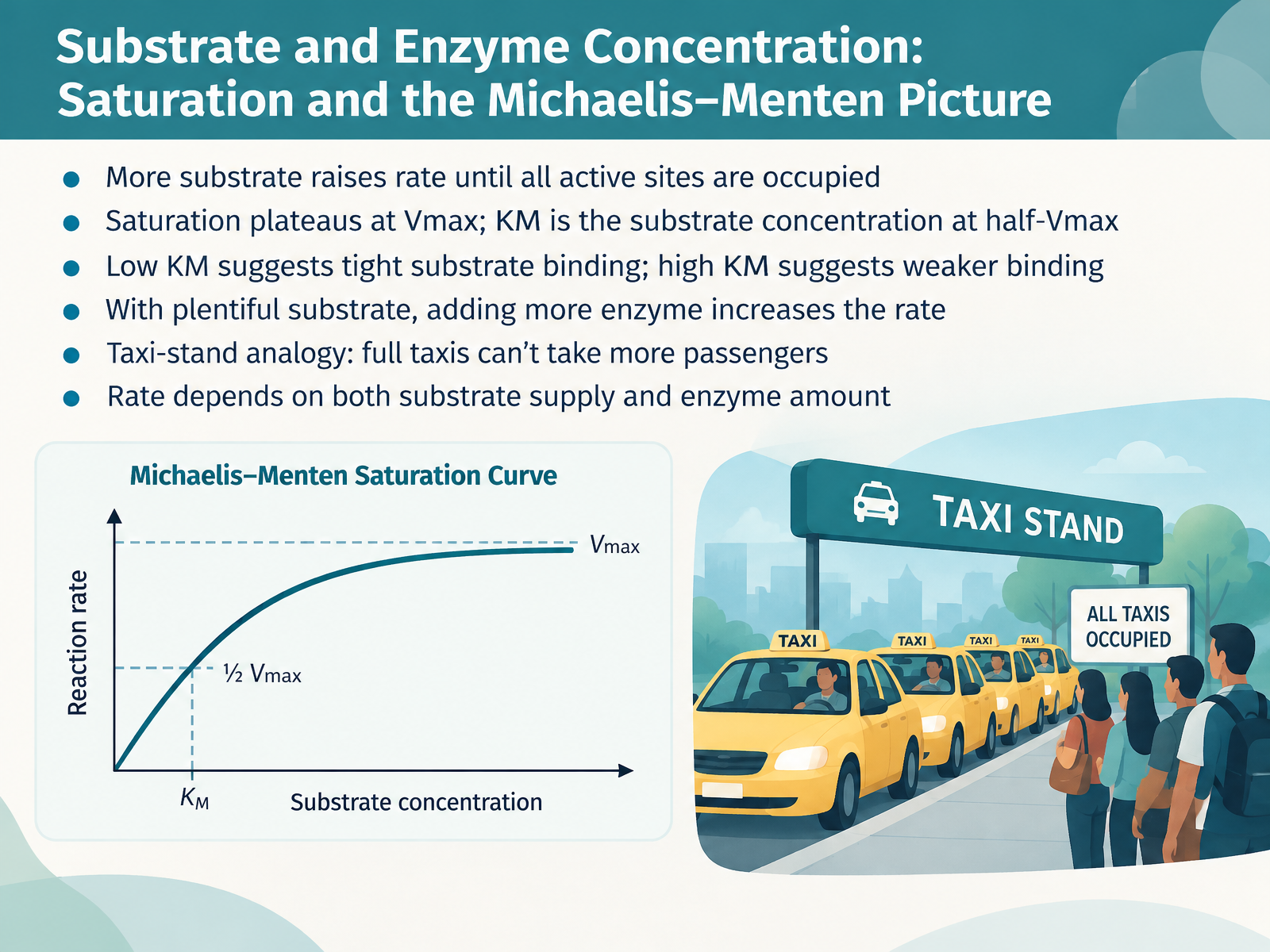
- 09Substrate and Enzyme Concentration: Saturation and the Michaelis–Menten PictureNow let's look at how concentration changes the speed of the reaction. Picture a busy taxi stand. Each taxi is an enzyme, and each passenger is a substrate. When passengers arrive, taxis fill up and drive away. Add more passengers, and the rate rises. But once every taxi is full, extra passengers just wait. That's saturation. The reaction rate levels off at a maximum, called V max. Now, here's a useful number. K M is the substrate concentration at half of V max. A low K M means the enzyme binds substrate tightly. A high K M means binding is weaker, so you need more substrate to reach the same speed. And if substrate is plentiful and taxis are the bottleneck, adding more enzyme, more taxis, increases the rate. So the rate depends on both substrate supply and enzyme amount. Next, let's see how cells control these enzymes. Control and Regulation: How Cells Decide When Enzymes Work.
 monash.eduold-ib.bioninja.com.ausavemyexams.com+22 min
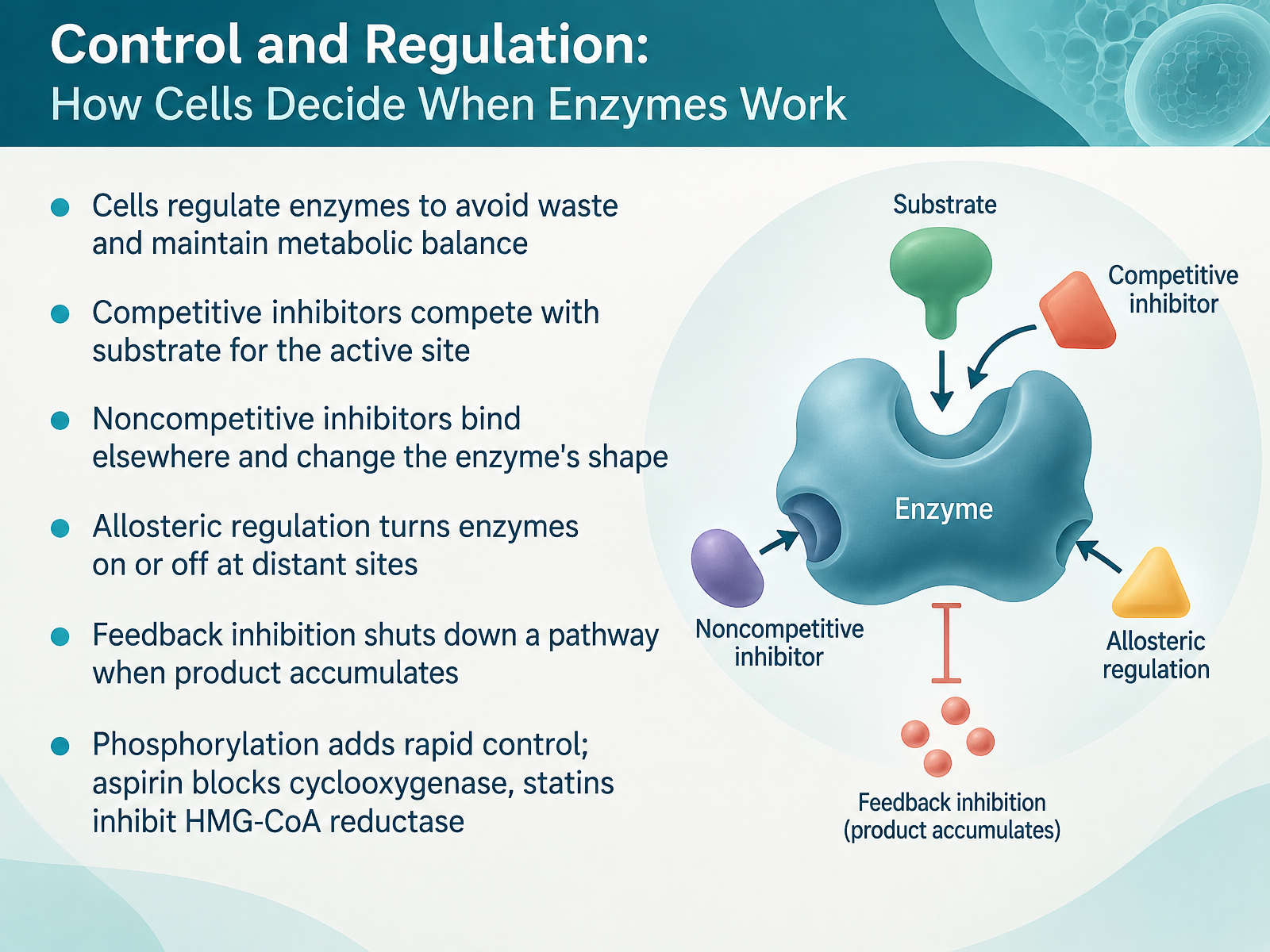
- 10Control and Regulation: How Cells Decide When Enzymes WorkNow let's look at control. Cells regulate enzymes to avoid waste and keep metabolism balanced. One way is competitive inhibition. Here, an inhibitor competes with the substrate for the active site. Think of a wrong key that fits the lock but doesn't turn it. Noncompetitive inhibitors bind somewhere else and change the enzyme's shape, so the substrate no longer fits well. Allosteric regulation works at a distant site too, turning enzymes on or off. Feedback inhibition is a neat self-control: when product builds up, it shuts down the pathway that made it. Phosphorylation adds fast control by attaching phosphate groups. And medicines use these ideas. Aspirin blocks cyclooxygenase, and statins inhibit H M G CoA reductase. Next, we'll explore cofactors, coenzymes, and the helpers enzymes need.
 acs.orgbiobeat.nigms.nih.govopenstax.org+22 min
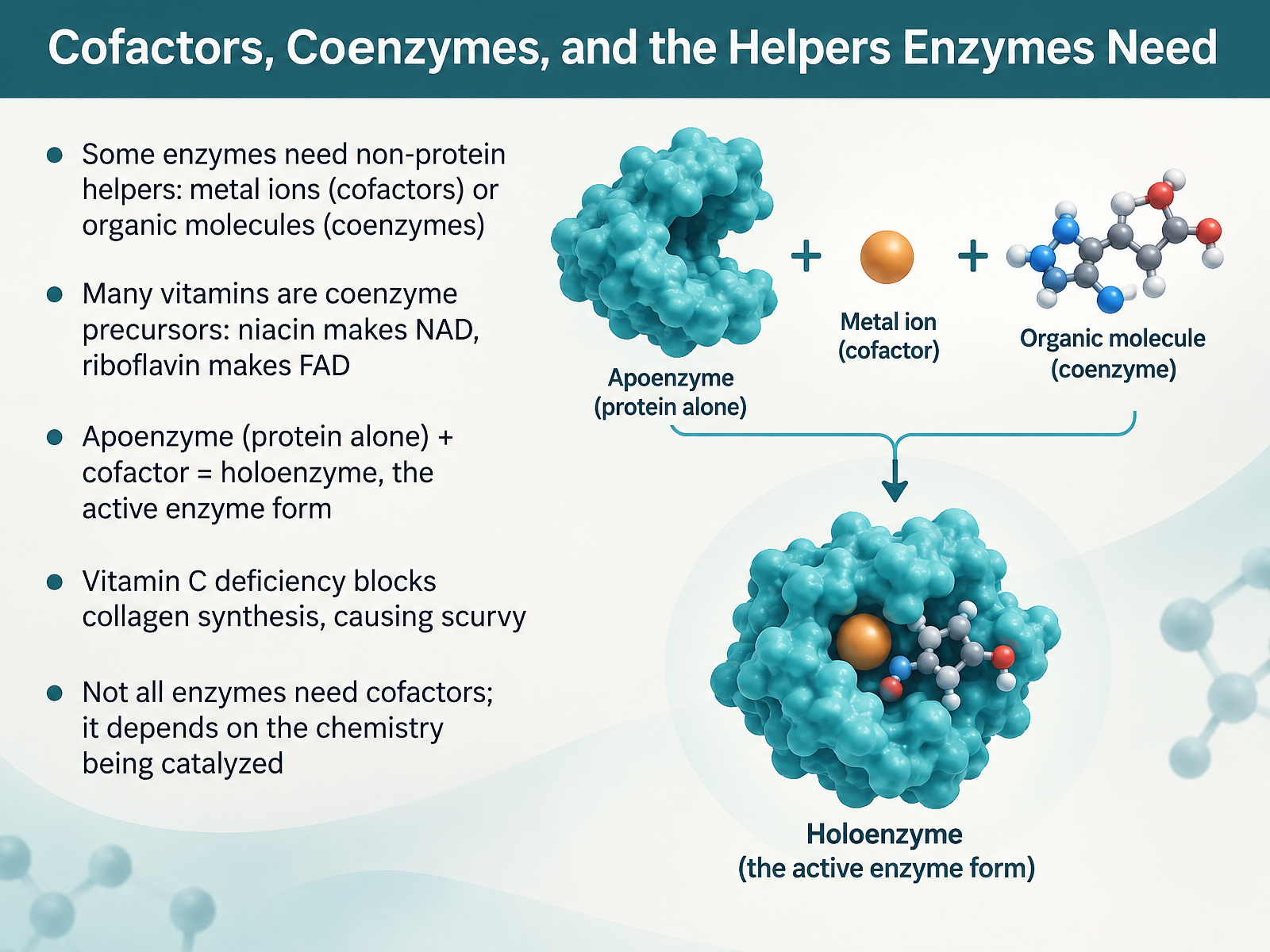
- 11Cofactors, Coenzymes, and the Helpers Enzymes NeedNow let's talk about the helpers some enzymes need. Not every enzyme works alone. Some rely on a partner, a small non-protein molecule called a cofactor. If that partner is a metal ion, like zinc or magnesium, we simply call it a cofactor. If it's an organic molecule, we call it a coenzyme. Here's a connection worth remembering. Many vitamins are coenzyme precursors. Your body turns niacin into NAD, and riboflavin into FAD. Both help enzymes move electrons. Now for two handy terms. The protein part alone is the apoenzyme. Add its cofactor, and you get the holoenzyme, the active form. Without the helper, the enzyme can't do its job. Vitamin C shows why this matters. It's needed for collagen synthesis, so a deficiency weakens connective tissue and causes scurvy. But keep one point in mind. Not all enzymes need cofactors. It depends on the chemistry being catalyzed. Next, let's look at enzymes in medicine and diagnostics.
 ncbi.nlm.nih.govncert.nic.inncbi.nlm.nih.gov+22 min
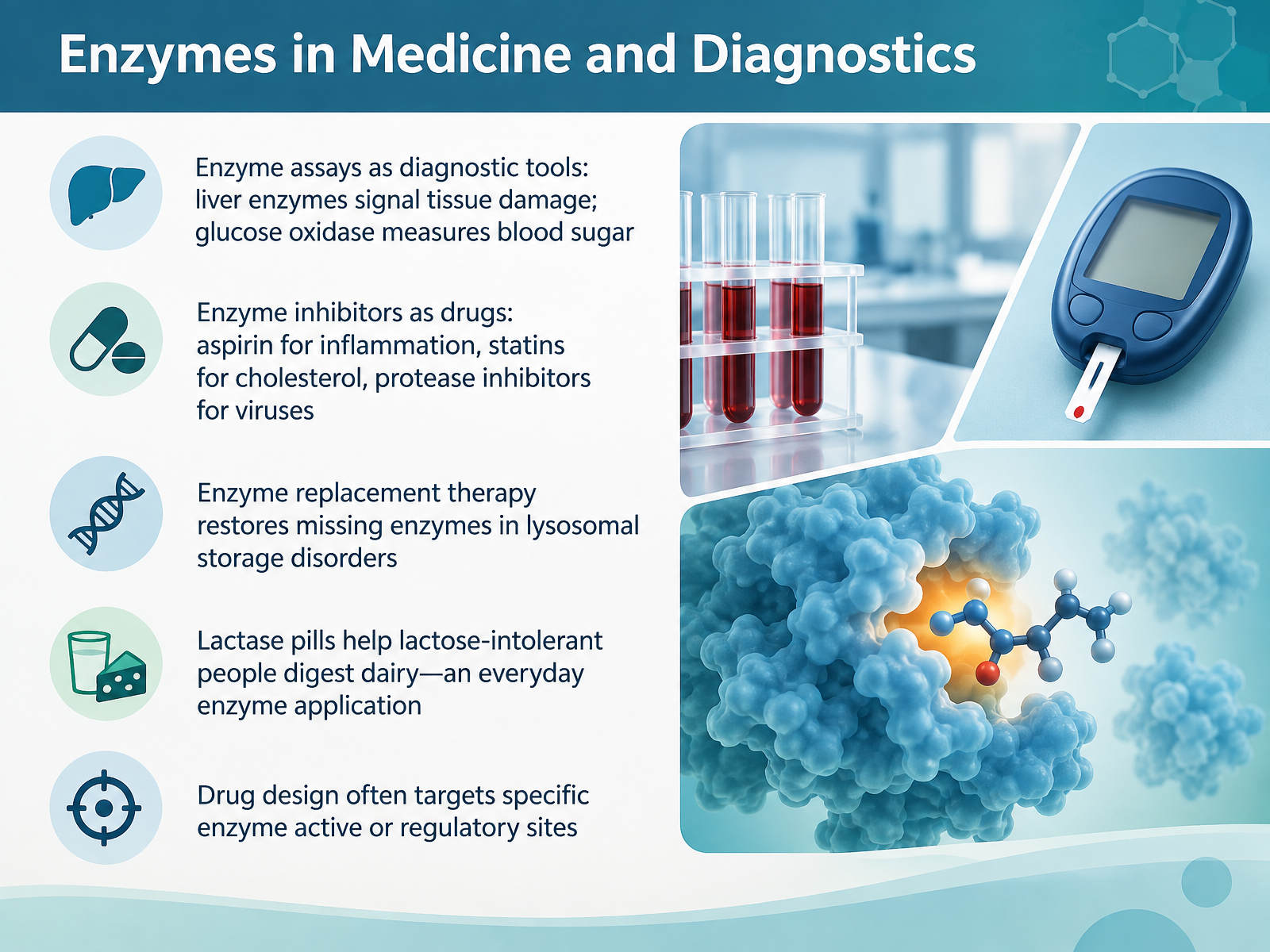
- 12Enzymes in Medicine and DiagnosticsNow let's see how enzymes work in medicine and diagnostics. An enzyme assay is simply a lab test that measures how active a particular enzyme is. For example, liver enzymes in your blood can signal tissue damage. And glucose oxidase helps measure blood sugar. Enzyme inhibitors are molecules that slow an enzyme down. Aspirin reduces inflammation, statins lower cholesterol, and protease inhibitors fight viruses. Enzyme replacement therapy restores a missing enzyme, which helps people with lysosomal storage disorders. And you may know lactase pills, which help lactose intolerant people digest dairy. Drug design often targets a specific enzyme's active site or its regulatory site. So next time you take a medicine, remember, it may be designed around an enzyme. Next, we'll look at enzymes in industry and everyday products.
 acs.orgbiobeat.nigms.nih.govopenstax.org+21 min
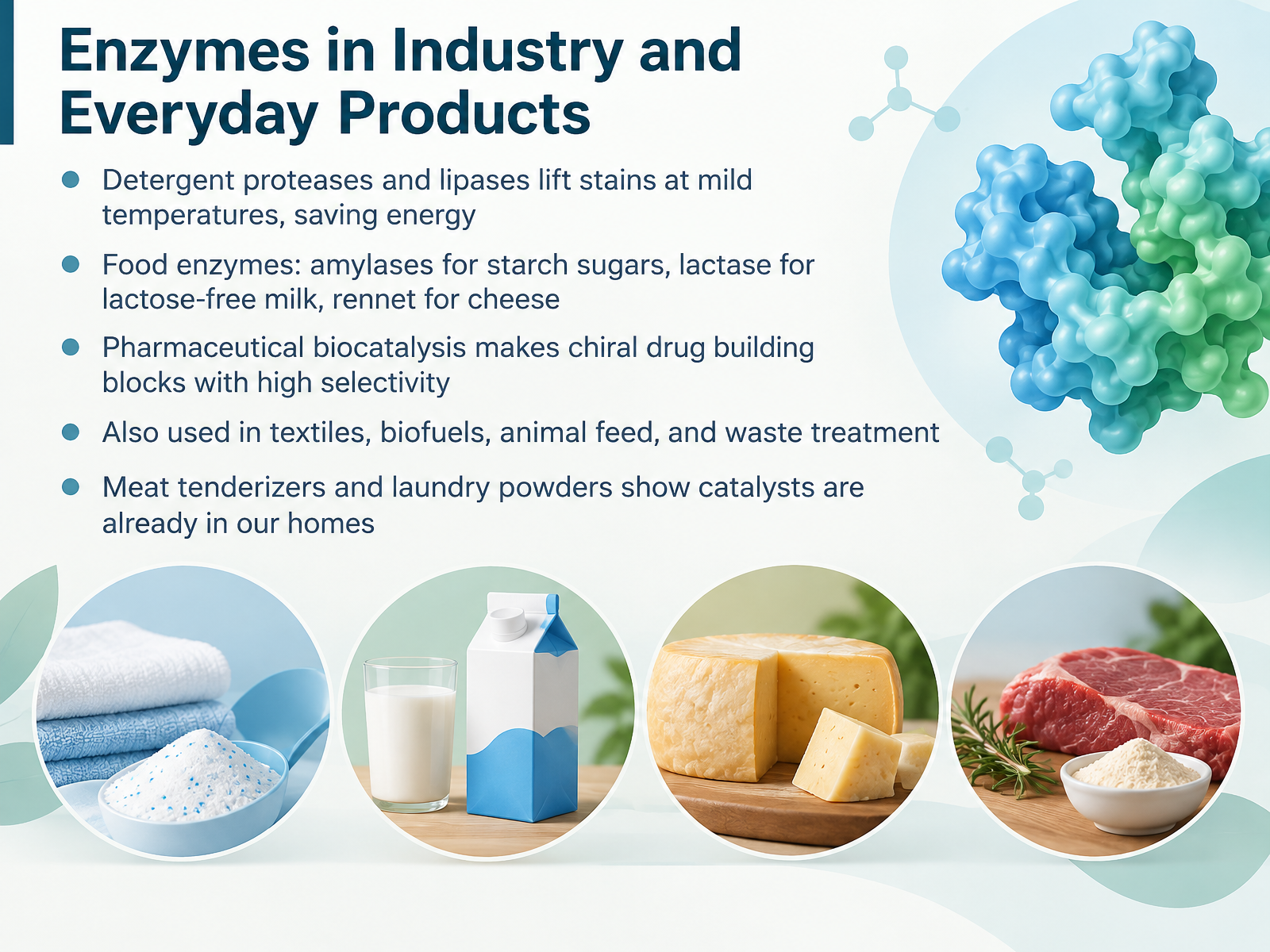
- 13Enzymes in Industry and Everyday ProductsNow let's see where these biological catalysts show up in daily life. Start with your laundry. Detergent proteases break down protein stains, and lipases break down fats and oils. They work at mild temperatures, so you can wash cooler and save energy. In food, amylases turn starch into sugars, lactase makes lactose-free milk, and rennet helps milk become cheese. In medicine, enzymes build chiral drug molecules, meaning mirror-image versions that are hard to make with ordinary chemistry. Enzymes also serve textiles, biofuels, animal feed, and waste treatment. And yes, meat tenderizers and laundry powders show catalysts are already in our homes. So remember this takeaway. Enzymes are not just lab curiosities. They are working quietly in products you use every day. Next, we will review the key takeaways.
 2 min
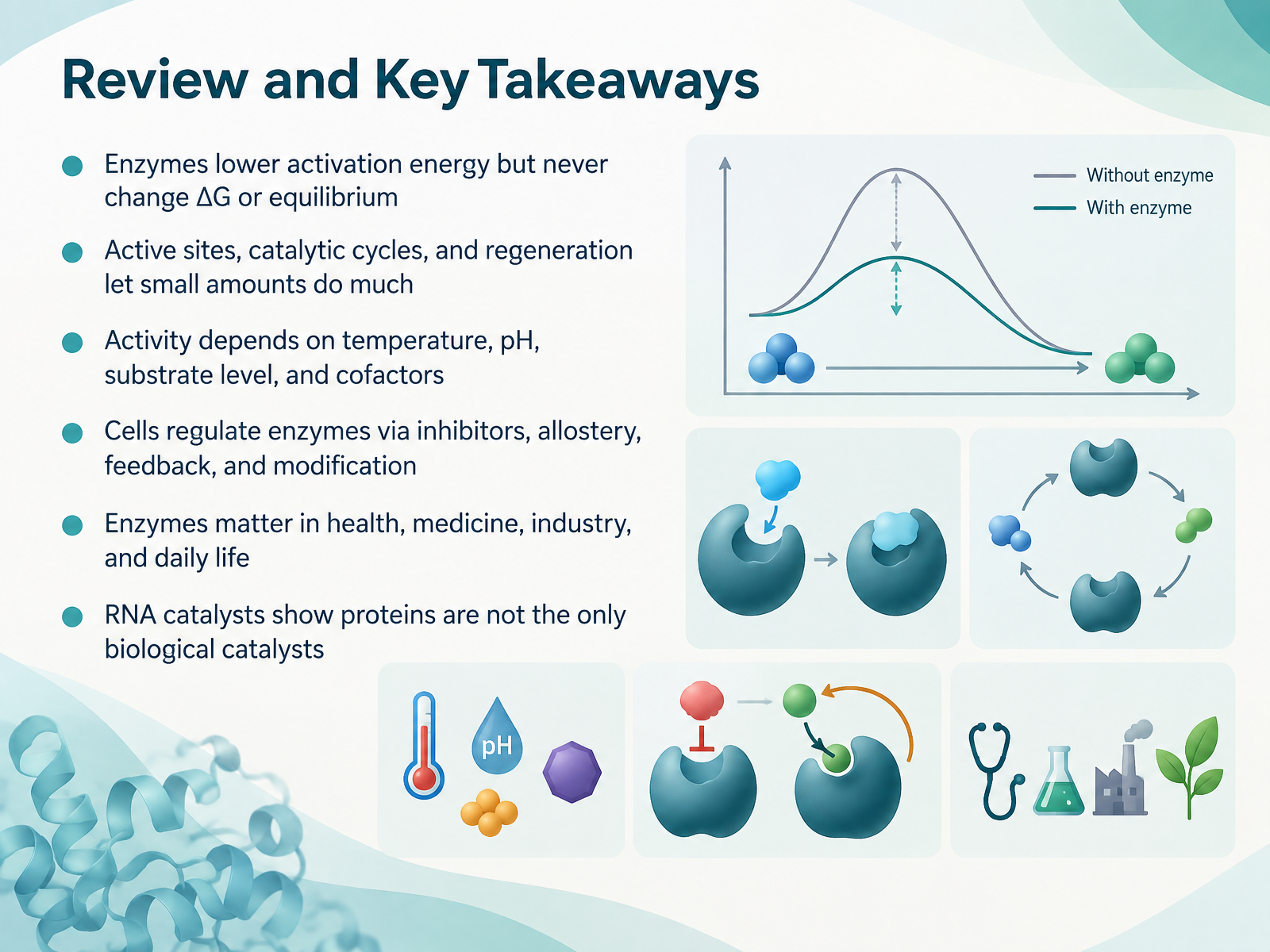
- 14Review and Key TakeawaysLet's bring it all together. Enzymes are biological catalysts. They lower activation energy, but they never change the overall free energy change or the equilibrium of a reaction. A substrate fits into the active site, the enzyme helps bonds break or form, and then it releases the product and regenerates, ready to work again. That recycling is why a small amount of enzyme can do so much. Activity depends on temperature, pH, substrate level, and cofactors, which are helper molecules, many derived from vitamins. Cells regulate enzymes with inhibitors, allostery, feedback, and chemical modification. And enzymes matter in health, medicine, industry, and daily life, from digestion to laundry detergents. Remember, RNA can catalyze reactions too, so proteins are not the only biological catalysts. You have built a solid foundation here. Thank you for learning with me, and keep asking how the small machines of life get things done.
 acs.orgbiobeat.nigms.nih.govopenstax.org+22 min
Take the deck with you
Download this course as a file — free, no sign-up needed.
- PDF handoutEvery slide page, ready to print or share.15 pages · 3.6 MBDownload
- Narrated PowerPointThe deck that presents itself — every slide carries the digital human's narration video.15 pages · 24.4 MBDownload
- PowerPoint slidesThe full deck as a .pptx — open it in PowerPoint, Keynote, or Google Slides.15 pages · 3.6 MBDownload
Free to use in your own training — please keep the PersonWise credit page at the end.
Have your own deck? Turn it into a course
Sources consulted
Web sources consulted while building this course.
- Enzymes: Moving at the Speed of Life - American Chemical Society — acs.org
- Science Snippet: Examining Enzymes — biobeat.nigms.nih.gov
- 6.5 Enzymes - Biology 2e | OpenStax — openstax.org
- 8.1 Energy, Matter, and Enzymes - Microbiology | OpenStax — openstax.org
- 3.10: Chemical Reactions in Living Things - Biology LibreTexts — bio.libretexts.org
- Microsoft Word - Enzymatic catalysis — biochem.siu.edu
- How enzymes harness highly unfavorable proton transfer reactions — onlinelibrary.wiley.com
- Chapter 15: Enyzmatic Catalysis — people.uleth.ca
- Exploitation of binding energy for catalysis and design — pmc.ncbi.nlm.nih.gov
- An alternative view of enzyme catalysis — doi.org
- Factors affecting enzyme activity — monash.edu
- Enzyme Activity | BioNinja — old-ib.bioninja.com.au
- Factors Affecting Enzyme Activity - AP Biology Study Guide — savemyexams.com
- Biochemistry Module For Medical Students Lecture 7 : Enzymes II Factors Affecting Enzyme Activity & Enzyme Regulation. — kmc.uobaghdad.edu.iq
- Factors Affecting Enzyme Activity | EasyBiologyClass — easybiologyclass.com
- Table 2.1, Examples of Coenzymes and Vitamins - The Cell - NCBI Bookshelf — ncbi.nlm.nih.gov
- Enzymes and Bioenergetics — ncert.nic.in
- Biochemistry, Nutrients — ncbi.nlm.nih.gov
- Vitamins, Cofactors, Coenzymes and Prosthetic Groups — web.vscht.cz
- Roles of Vitamins as Coenzymes — link.springer.com