Begin
14 pages · ~28 min
Light: Wave or Particle?
This training explores wave-particle duality, examining whether light behaves as a wave or a particle. Learners will understand the evidence behind both models and why light exhibits both natures.
A digital instructor presents all 14 pages. Hold “Ask” at any point and ask out loud — the answer comes from this course. No sign-up needed.
What you’ll learn
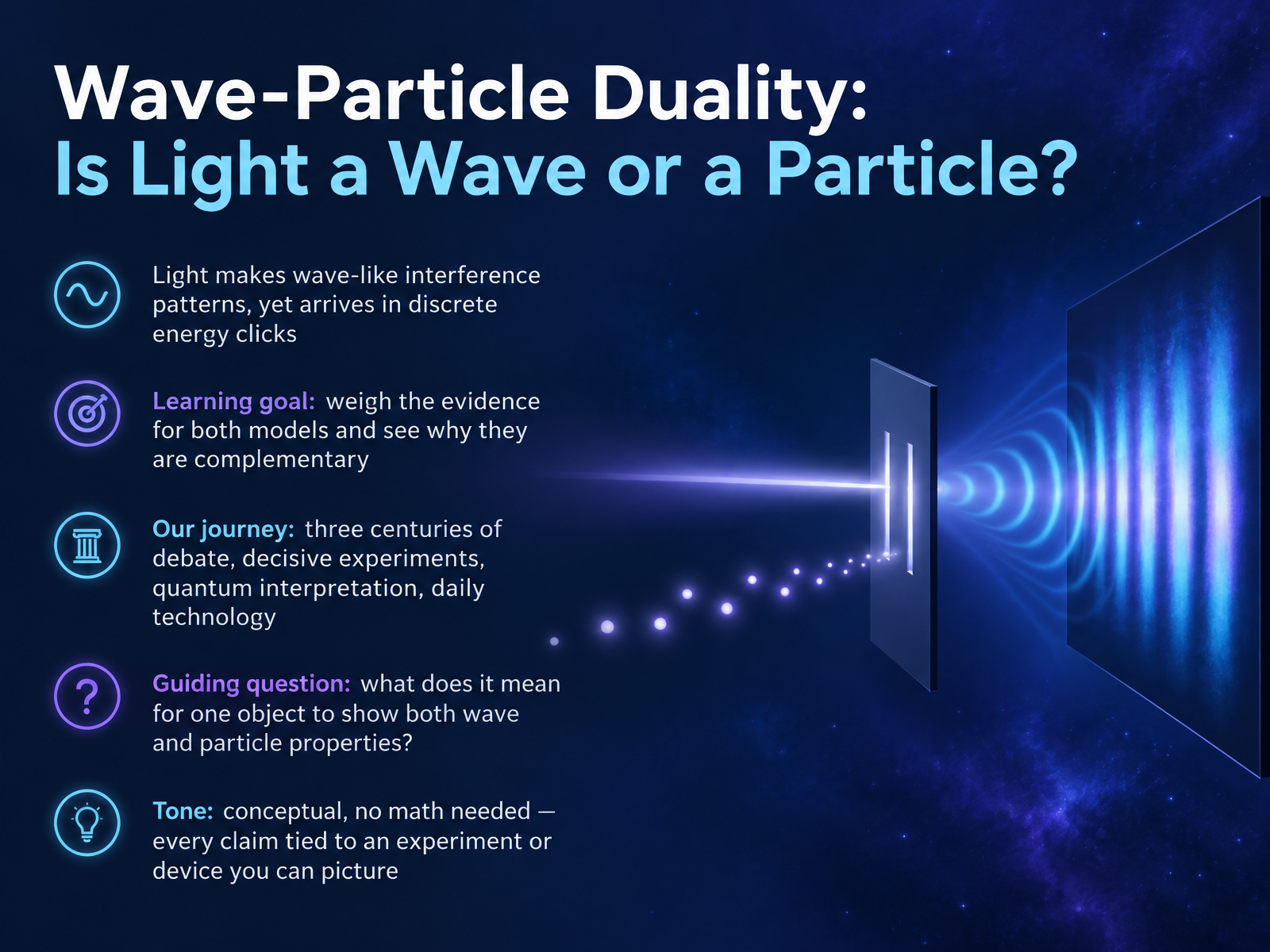
- 01Wave-Particle Duality: Is Light a Wave or a Particle?Welcome, and thanks for joining me. Today we're chasing one of the oldest questions in science: is light a wave, or is it a particle? Here's the puzzle that keeps physicists curious. Light creates wave-like interference patterns, much like ripples crossing on a pond. Yet when we measure it carefully, it arrives in discrete clicks of energy, like tiny pellets. Both descriptions are backed by real experiments. So our goal is simple. We'll weigh the evidence for each model, and see why they turn out to be complementary rather than competing. Along the way, we'll cover three centuries of debate, the experiments that settled the argument, the quantum interpretation, and the everyday technology built on it, like solar panels and camera sensors. And we'll keep one guiding question in mind. What does it mean for a single object to show both wave and particle properties? No math needed here. Every claim will tie back to an experiment or a device you can picture. Let's begin by building two mental models, one for waves and one for particles.open.eduaps.orgyoutube.com+22 min
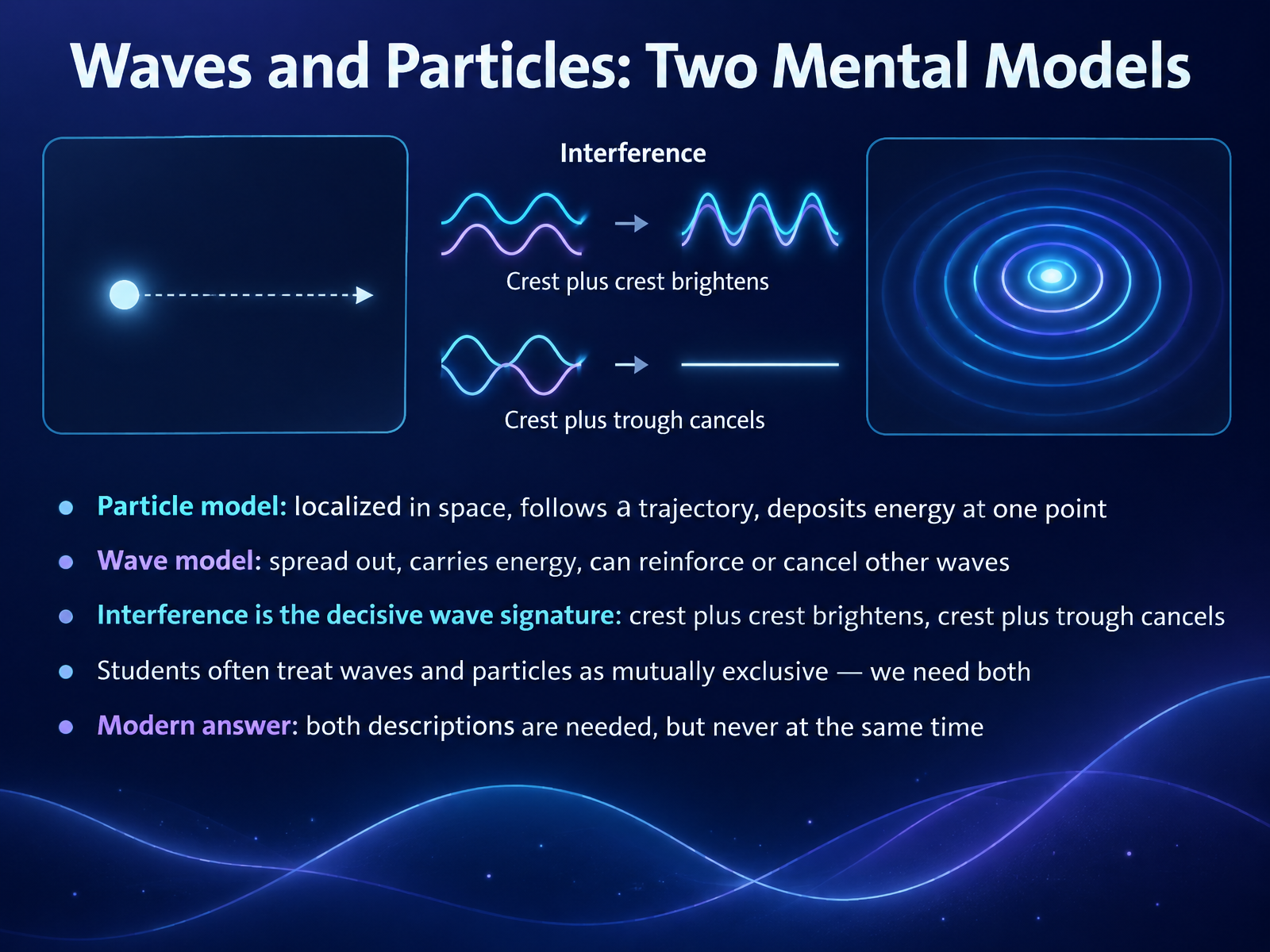
- 02Waves and Particles: Two Mental ModelsBefore we ask what light really is, let's get clear on the two pictures we use to describe it. First, the particle model. A particle sits in one place, follows a path, and deposits its energy at a single point. Think of a marble rolling across a table and striking one spot. Now the wave model. A wave is spread out. It carries energy across space, the way ripples spread across a pond. And crucially, waves can interfere. Crest plus crest makes a brighter crest. Crest plus trough cancels out. That interference is the decisive signature of a wave. Here's a common sticking point. Many students assume waves and particles are mutually exclusive, that something must be one or the other. But science needs both descriptions. So is light a wave or a particle? The modern answer is both are needed, but never at the same time. How did we get here? Let's look at the history next.
 spark.iop.orgphys.libretexts.orgkids.britannica.com+21 min
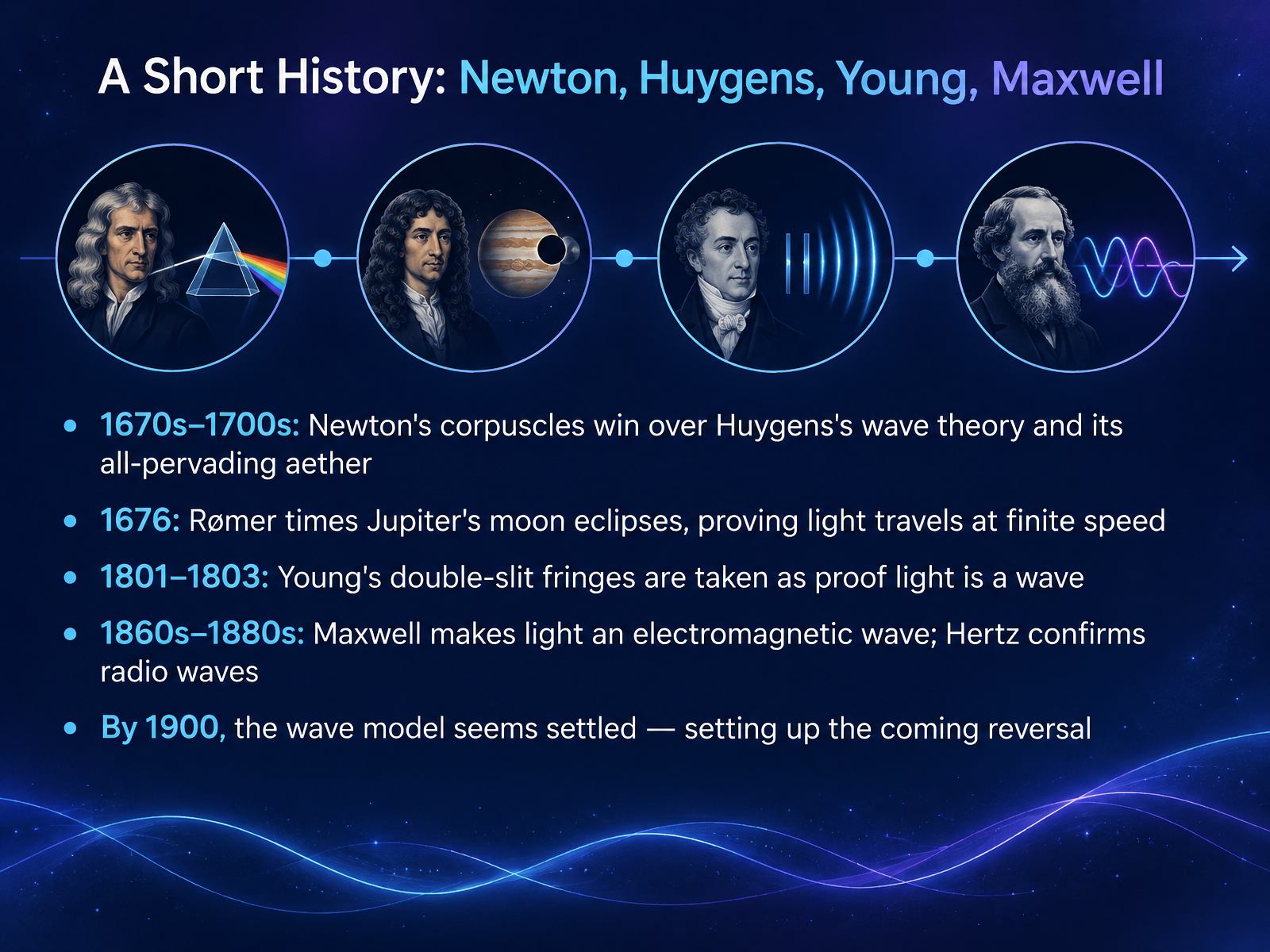
- 03A Short History: Newton, Huygens, Young, MaxwellSo to see how we got here, let's trace the argument. In the sixteen hundreds, Newton argued light was made of tiny particles he called corpuscles. Huygens countered that light was a wave, rippling through an invisible medium called the aether. Newton's reputation won, and particles dominated for a century. But in sixteen seventy-six, Rømer timed eclipses of Jupiter's moons and showed light travels at a finite speed, not instantly. Then, around eighteen oh one, Thomas Young passed light through two narrow slits and saw stripes of light and dark. Interference. That only made sense if light were a wave. Later, Maxwell showed light is an electromagnetic wave, and Hertz confirmed radio waves. By nineteen hundred, the wave picture looked settled. And that is exactly when it would start to crack. Next, let's look at the wave case in detail, interference and diffraction.
 sciencelearn.org.nzosa.magnet.fsu.eduaps.org+22 min
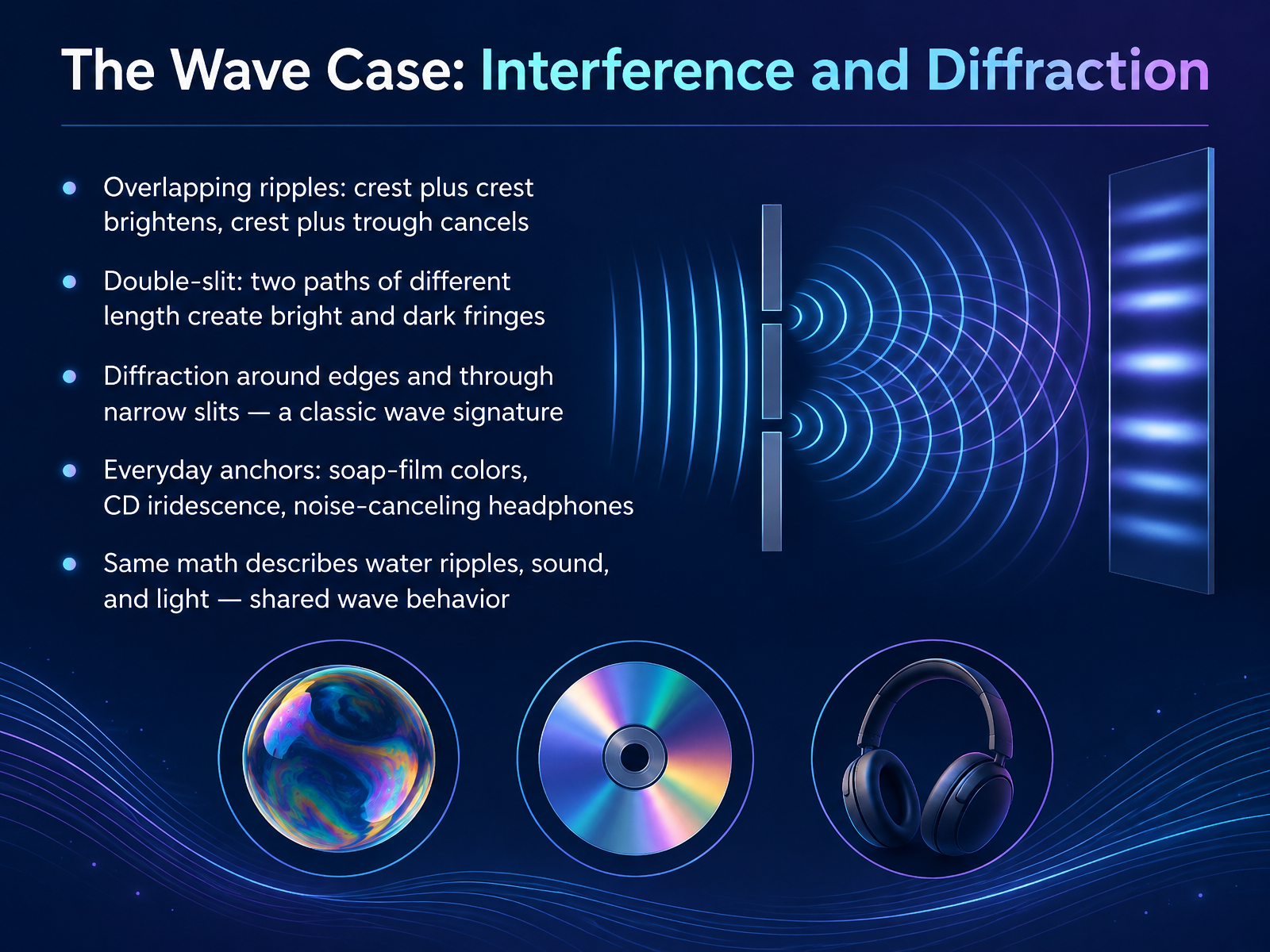
- 04The Wave Case: Interference and DiffractionSo let's build the case for light as a wave. Picture two stones dropped into a still pond. Where two crests meet, the water rises higher. Where a crest meets a trough, they cancel out. That's interference, and light does the same thing. In the famous double-slit experiment, first run by Thomas Young in eighteen oh one, light passes through two narrow openings. The two paths travel slightly different distances, so the waves arrive in step in some places and out of step in others. The result on the screen is a pattern of bright and dark fringes. Light also bends around edges and spreads through narrow slits. That's diffraction, a classic wave signature. You can see wave effects at home too, in the shimmering colors of a soap film, the rainbow glare of a CD, and even noise-canceling headphones, which create a mirror-image sound wave to cancel unwanted noise. And here's the striking part. The same mathematics describes water ripples, sound, and light. But if light is so clearly a wave, why did Einstein later insist it comes in particles? Let's look at the particle case next.
 sciencelearn.org.nzosa.magnet.fsu.eduaps.org+21 min
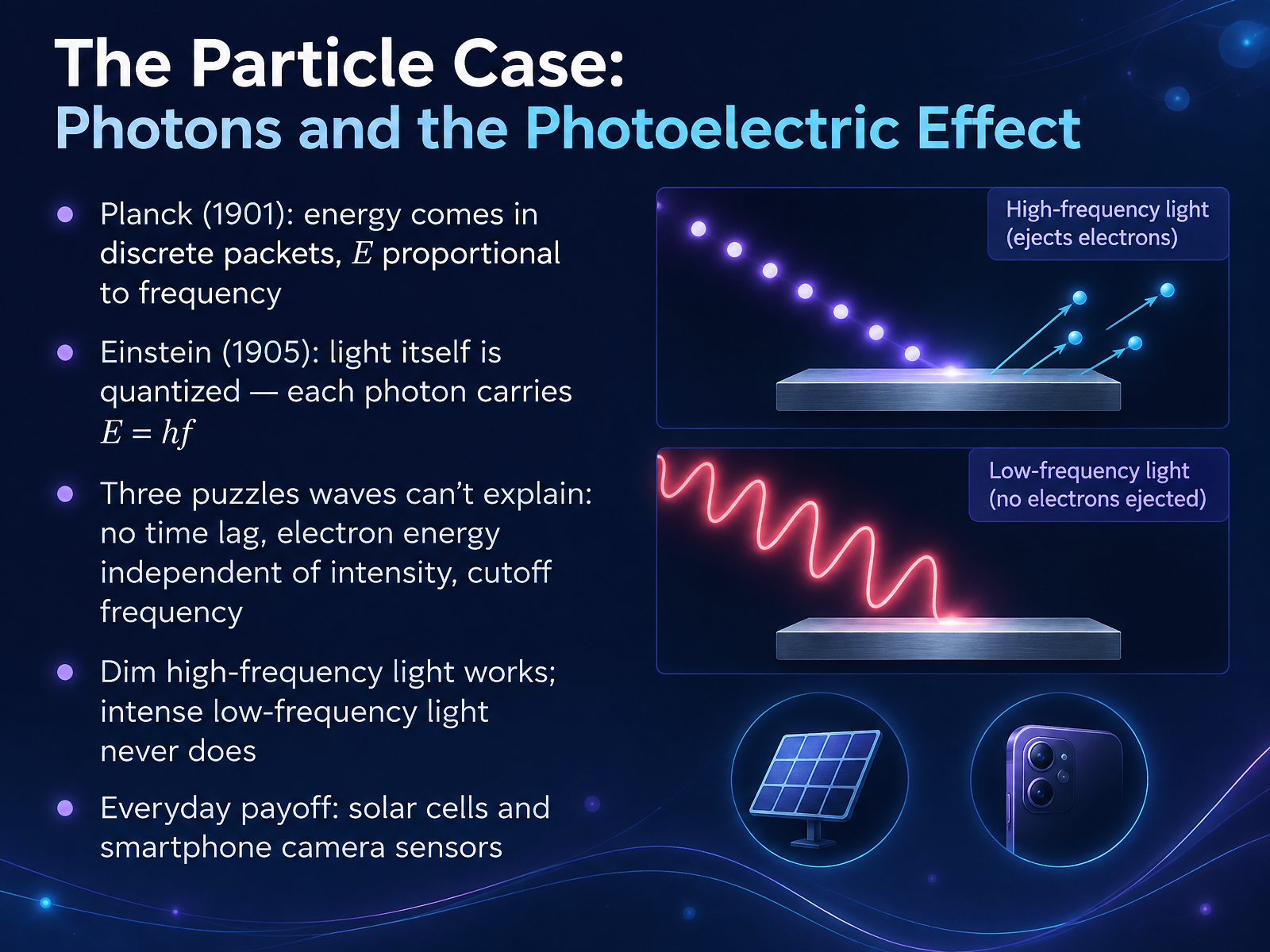
- 05The Particle Case: Photons and the Photoelectric EffectSo let's look at the particle case. In nineteen oh one, Max Planck found that energy comes in discrete packets, and the energy of each packet is proportional to its frequency. A few years later, Einstein took that idea further. He said light itself is quantized. Each packet, now called a photon, carries an energy equal to h times f, where h is Planck's constant and f is the frequency. Now here's the puzzle. Waves can't explain three things about the photoelectric effect. First, electrons pop out instantly, with no time lag. Second, the energy of the electrons doesn't depend on how bright the light is. And third, below a certain cutoff frequency, no electrons come out at all, no matter how intense the light. Picture it this way. Dim violet light can free electrons, but intense red light never does. Why? Because each photon interacts one on one with one electron, all or nothing. And this everyday payoff is real. The photoelectric effect is how solar cells and smartphone camera sensors turn light into electrical signals. Now, if photons carry energy, do they also carry momentum? Let's find out next, in Light as Bullets: Compton Scattering and Photon Momentum.
 openstax.orgchem-textbook.ucalgary.caweb.pdx.edu+22 min
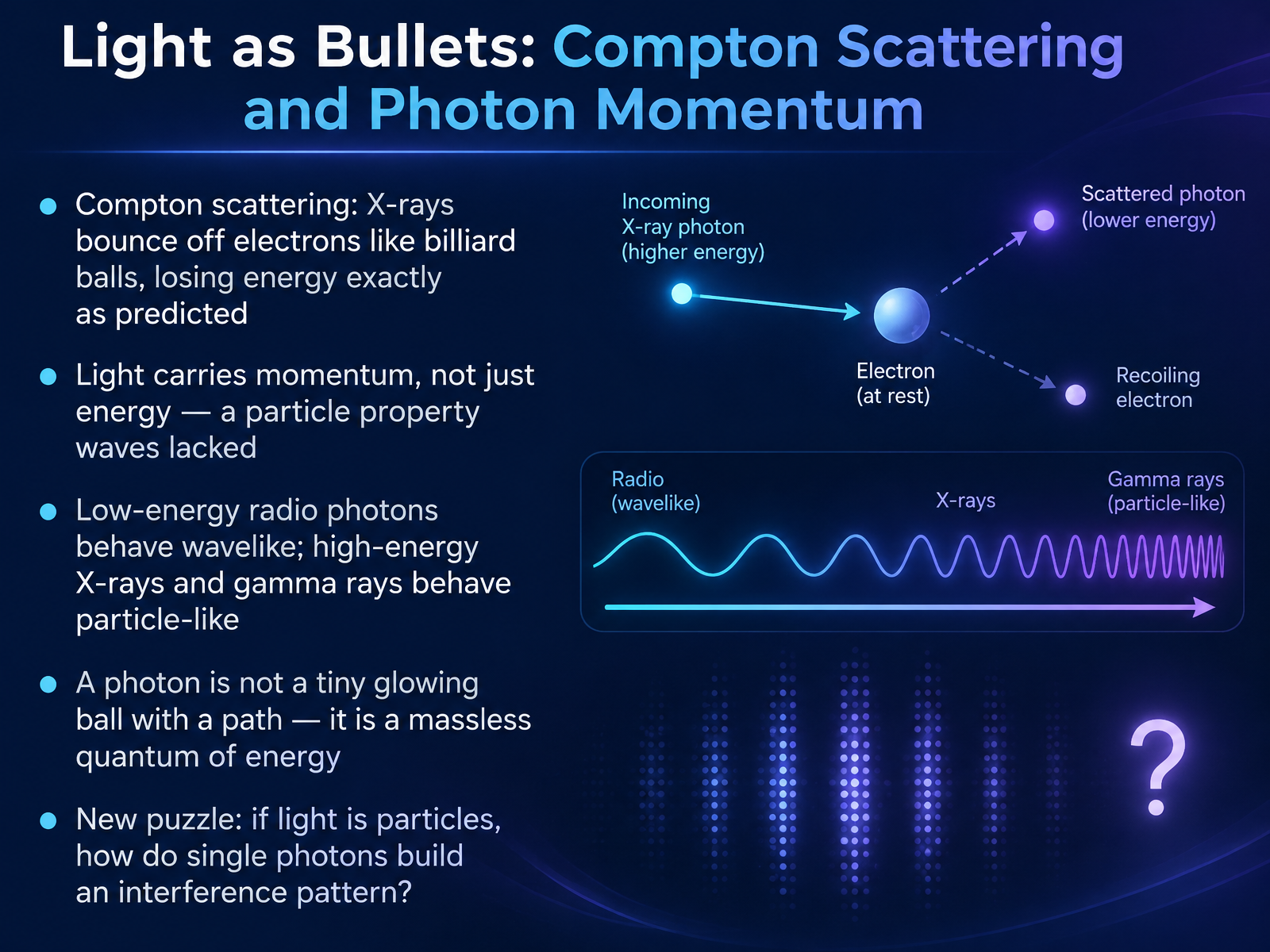
- 06Light as Bullets: Compton Scattering and Photon MomentumNow let's push the photon idea further, with an experiment called Compton scattering. Picture an X-ray photon striking an electron, and the two bouncing apart like billiard balls. The photon comes away with less energy, and the numbers matched the predictions exactly. That showed light carries momentum, a kind of push that particles have, not just energy. Here's a useful pattern: low-energy radio photons behave mostly like waves, while high-energy X-rays and gamma rays behave mostly like particles. And one more thing. A photon is not a tiny glowing ball with a path. It's a massless quantum, a single indivisible packet of energy. So now a new puzzle. If light really is particles, how do single photons build up an interference pattern? That's where we go next, in One Photon at a Time: The Central Experiment.
 open.eduaps.orgyoutube.com+21 min
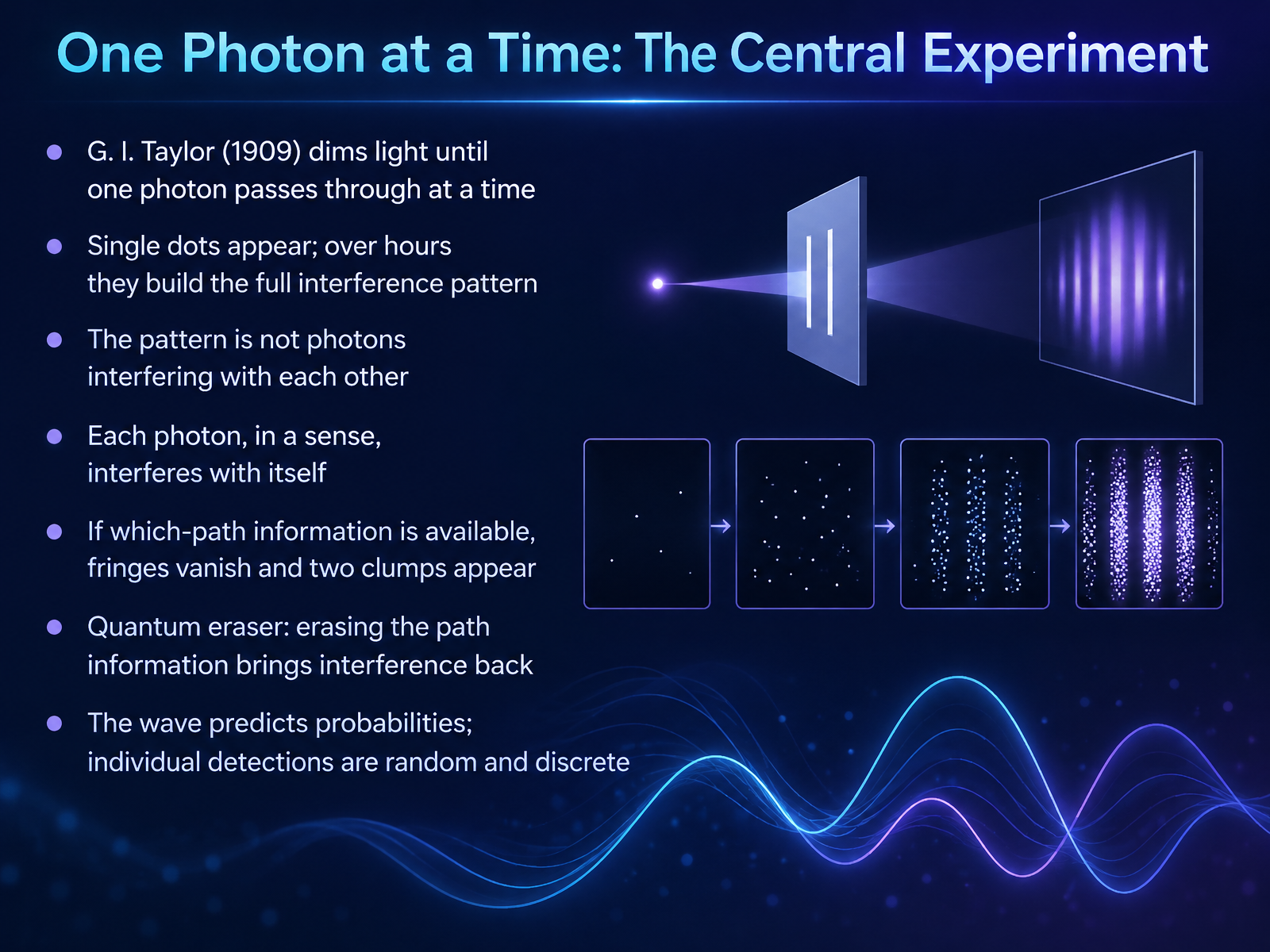
- 07One Photon at a Time: The Central ExperimentNow let's look at the experiment that pulls all of this together. Back in 1909, G. I. Taylor dimmed a light source until, on average, only one photon at a time passed through the double slit. A photon, remember, is a single packet of light. What did he see? Not a smooth wave, but single dots, one detection at a time. And over hours, those dots built up the full interference pattern. Here's the puzzle. With only one photon in the apparatus, there is nothing for it to interfere with. So in a sense, each photon interferes with itself. And it gets stranger. If which-path information is available, meaning we could tell which slit it went through, the fringes vanish and two clumps appear. Erase that information, and interference comes back. So the wave predicts probabilities, while individual detections stay random and discrete. Next, why going through both slits is misleading.
 open.eduaps.orgyoutube.com+22 min
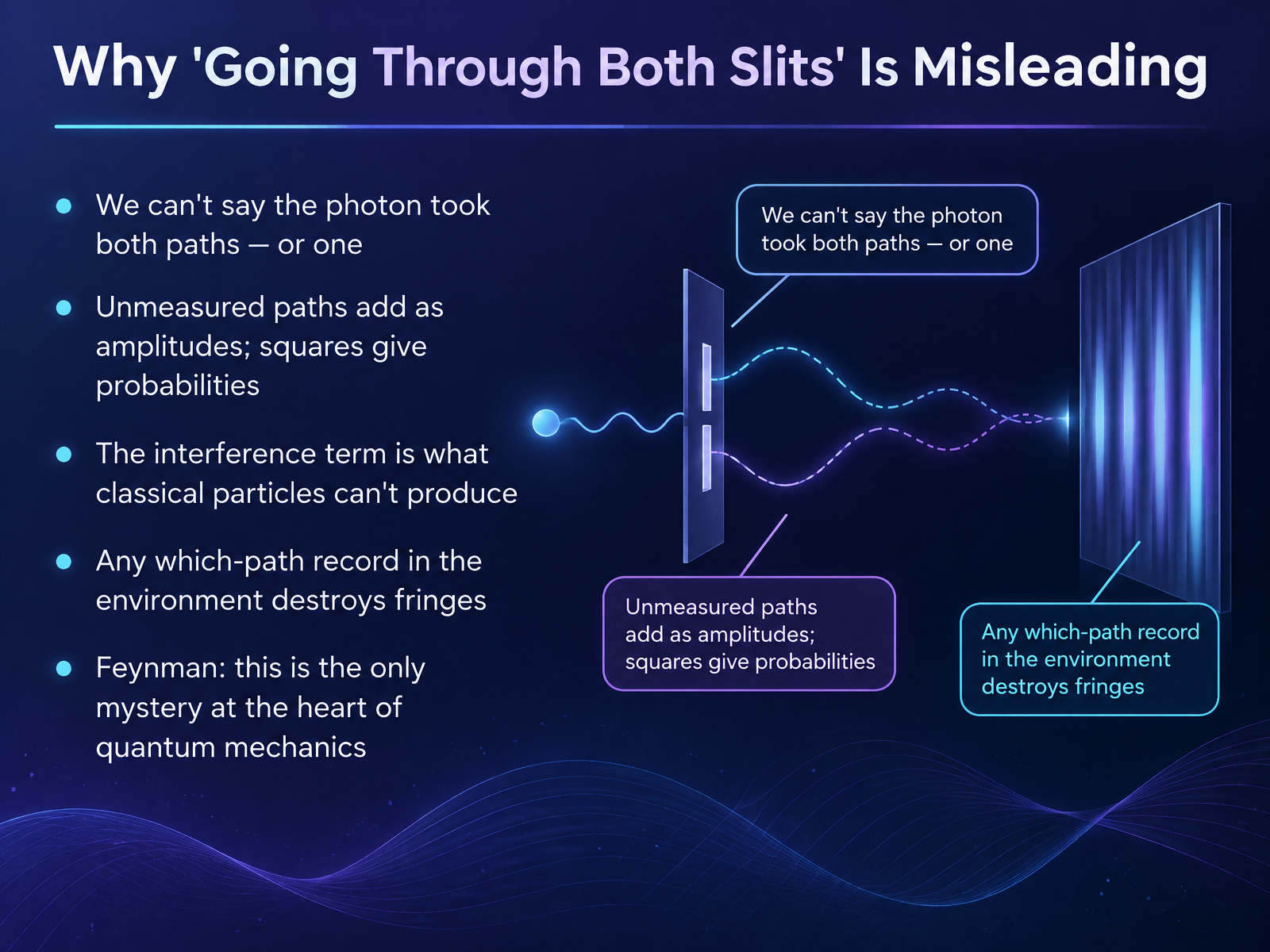
- 08Why 'Going Through Both Slits' Is MisleadingNow let's clear up a tempting but misleading picture, the idea that the photon somehow went through both slits at once. We honestly can't say it took both paths, or just one. What actually happens is subtler. Each unmeasured path contributes an amplitude, a kind of quantum wave, and those amplitudes add together first. Only when we square that combined amplitude do we get a probability, a real chance of finding the photon at a spot on the screen. That squaring produces an extra piece, the interference term, and that term is exactly what ordinary classical particles can never produce. Throw a handful of marbles through two openings and you just get two overlapping piles. But there is a catch. The moment any record exists in the environment that could tell us which slit was used, even in principle, the fringes wash out. Feynman called this the only mystery at the heart of quantum mechanics. So the honest lesson is this. Going through both slits is shorthand. The real story is interference between unmeasured possibilities, and measurement erases it. This leads us to Bohr's deeper idea, which is complementarity, both descriptions, never at once.
 spark.iop.orgphys.libretexts.orgkids.britannica.com+22 min
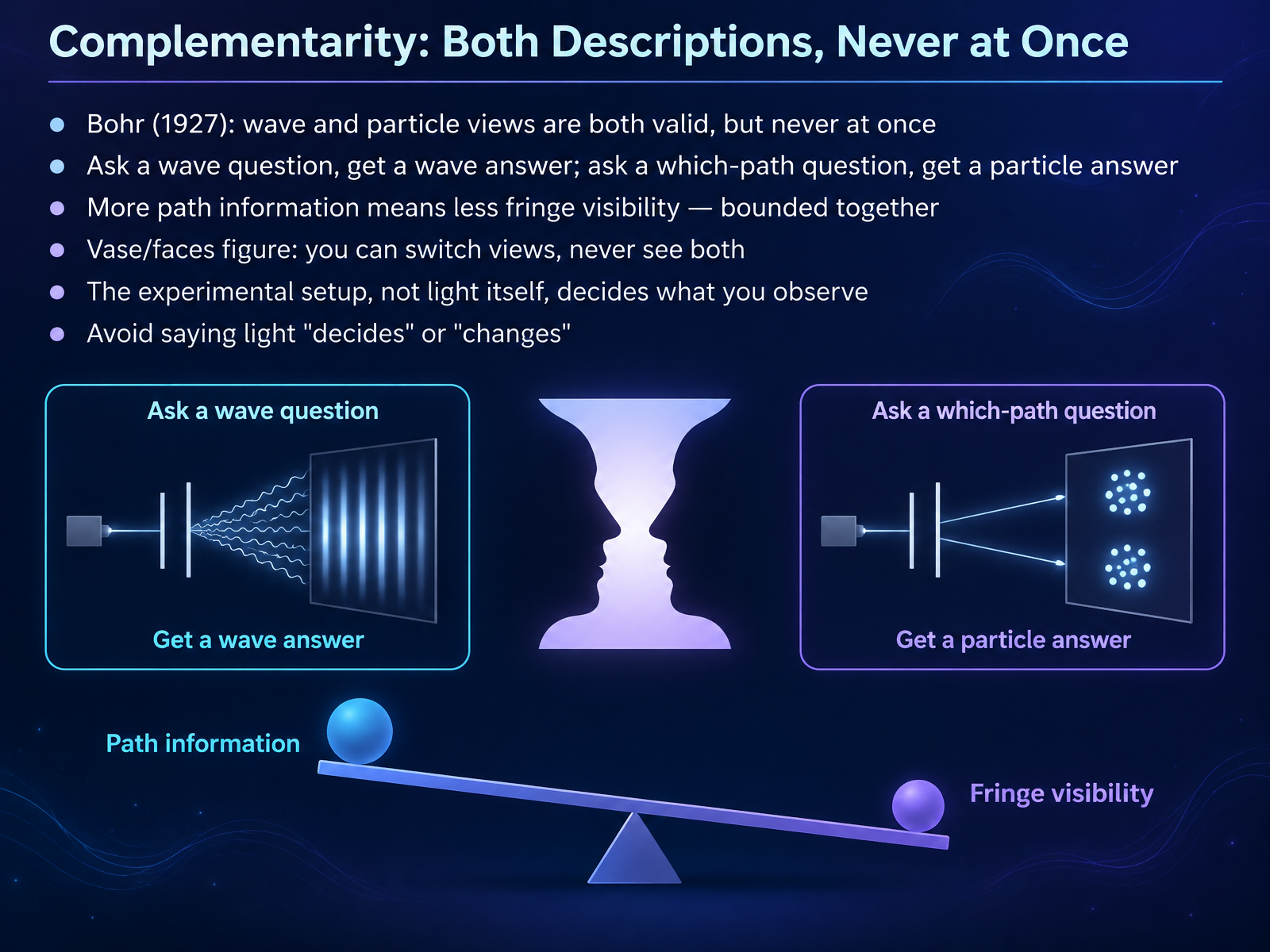
- 09Complementarity: Both Descriptions, Never at OnceNow here's the idea that ties all of this together: complementarity. In 1927, Niels Bohr proposed that the wave view and the particle view are both valid, but you never get both at once. Think of it as a conversation. Ask a wave question, and you get a wave answer. Ask a which-path question, and you get a particle answer. And these two are linked like a seesaw. The more path information you have, the less visible the interference fringes become. They're bounded together. There's a lovely analogy for this. It's the classic vase and faces picture. You can switch between seeing a vase or two faces, but you can never see both at the same time. That's complementarity. The image is both, but your view is one or the other. And here's the key point. It's the experimental setup, not light itself, that decides what you observe. So we should avoid saying light decides or changes. It doesn't. The question we ask shapes the answer we get. Keep that in mind as we move on to Quantum Interpretations in Brief.
 spark.iop.orgphys.libretexts.orgkids.britannica.com+22 min
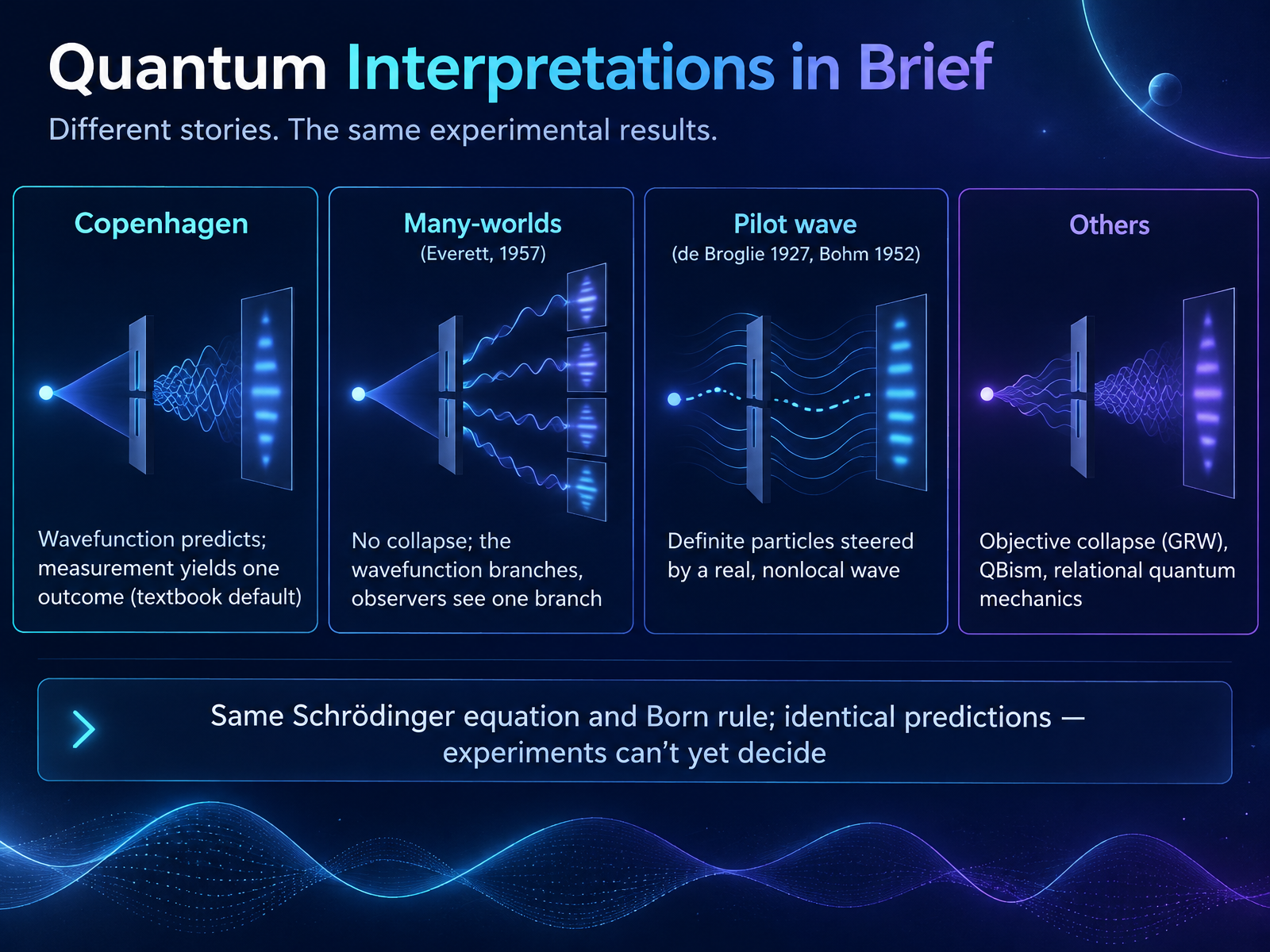
- 10Quantum Interpretations in BriefSo if the math works so well, why are there still arguments? Because the math tells us what we will see, not what is really happening behind the scenes. These competing stories are called interpretations. The textbook default is Copenhagen. Think of the wavefunction as a weather forecast: it gives probabilities, and measurement delivers one actual result, one day of rain rather than a spread of days. Then there is many-worlds, from Hugh Everett in 1957. No collapse at all. The wavefunction simply branches, and each version of you sees one outcome, like a library where every possible ending gets its own book. Pilot wave theory, from de Broglie in 1927 and Bohm in 1952, says particles are always real, sitting at definite positions, steered by a real wave. And there are more: objective collapse theories, QBism, relational quantum mechanics. Here is the surprising part. They all share the same Schrödinger equation and the Born rule, the rule for calculating probabilities. Identical predictions. No experiment can yet decide between them. So the honest answer is that we do not know. And that is not a failure. It is an open question, still worth exploring. Next, we take duality beyond light, to electrons, atoms, and nanoparticles.
 2 min
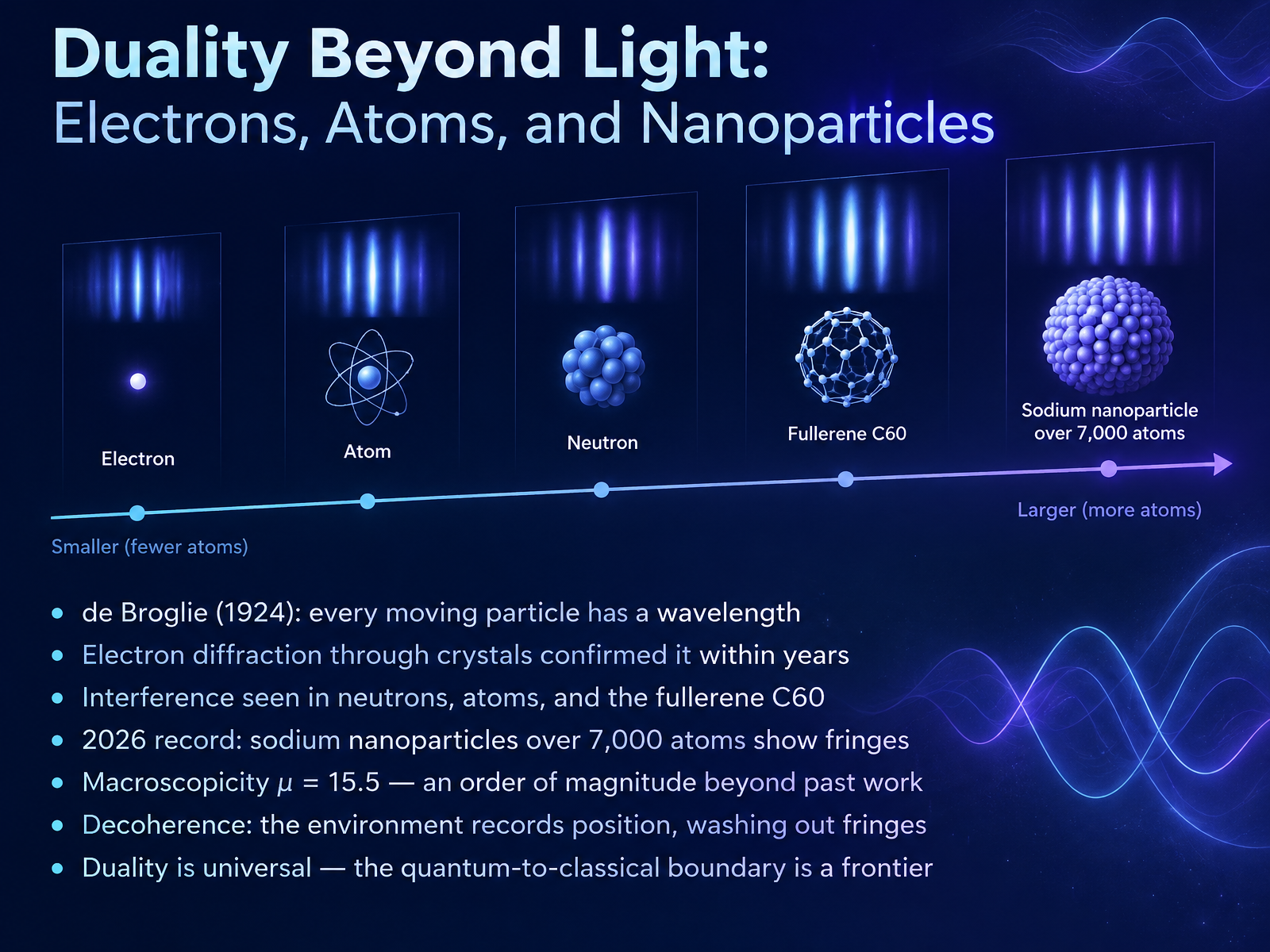
- 11Duality Beyond Light: Electrons, Atoms, and NanoparticlesSo far we have been talking about light. But here is the wonderful twist. In 1924, Louis de Broglie proposed that every moving particle has a wavelength, not just photons. Within a few years, electrons fired through crystals formed diffraction patterns, just like waves. Since then, interference has been seen with neutrons, with whole atoms, and even with the fullerene molecule, a soccer-ball shape made of sixty carbon atoms. And the record keeps moving. In 2026, researchers showed interference fringes from sodium nanoparticles containing more than seven thousand atoms. A measure called macroscopicity, which tracks how far a quantum state reaches into the everyday world, hit fifteen point five, roughly ten times beyond earlier work. So why don't we see this with coffee cups? Because of decoherence. The environment records where the object is, and the fringes wash out. Duality is universal. The boundary between quantum and classical is simply a frontier we are still pushing. Next, let's see how both pictures power real technologies in Duality at Work: Technologies Built on Both Pictures.
 spark.iop.orgphys.libretexts.orgkids.britannica.com+22 min
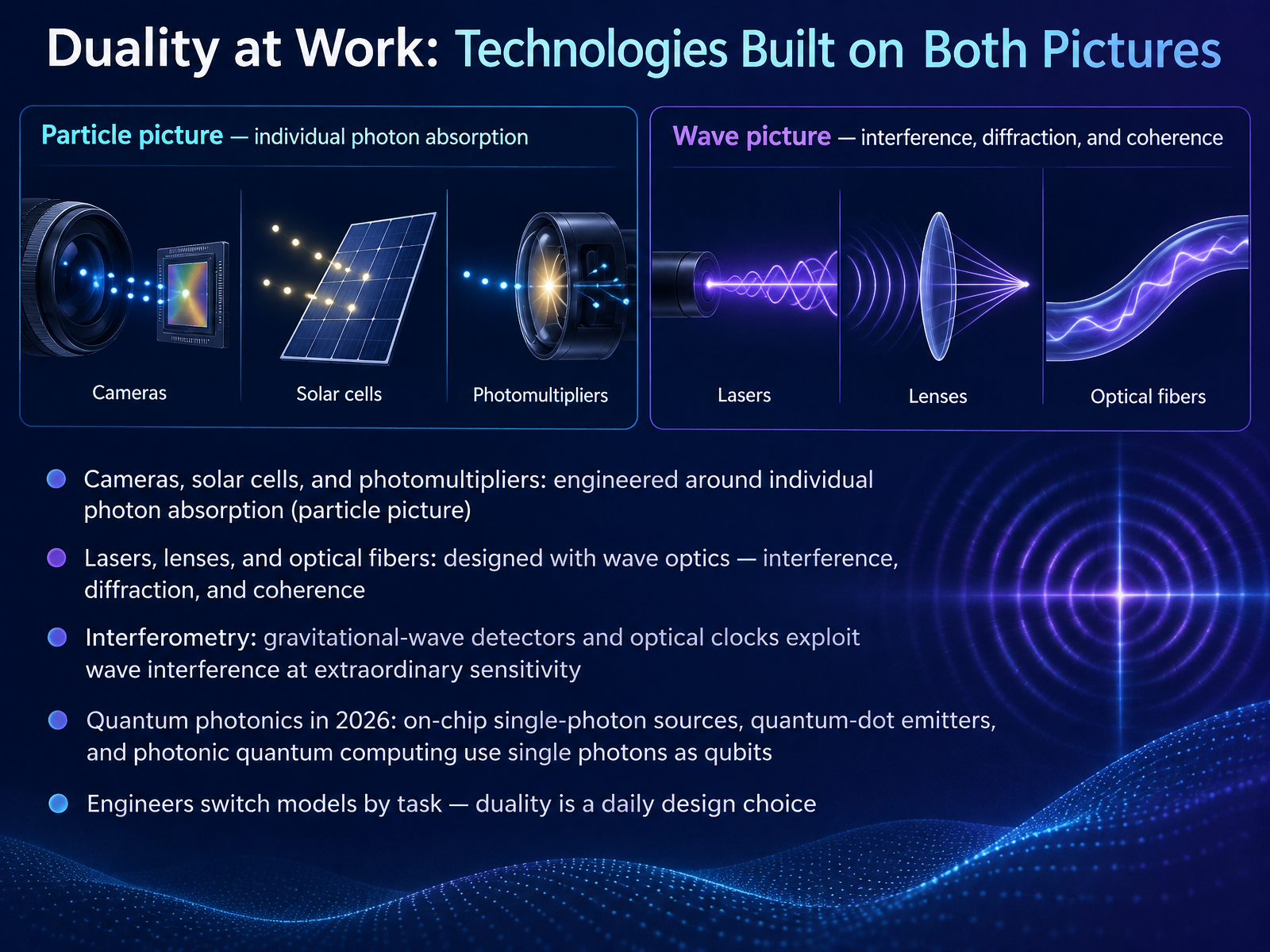
- 12Duality at Work: Technologies Built on Both PicturesSo how does this duality show up in real technology? Constantly, and mostly by design. Take cameras, solar cells, and photomultipliers. These are built around the particle picture, because each one depends on a single photon being absorbed and handing its energy to an electron. Solar panels are the everyday version of the photoelectric effect. Now flip to lasers, lenses, and optical fibers. Those are designed with wave optics, using interference, diffraction, and coherence. And interferometry pushes that further, which is how gravitational-wave detectors and optical clocks reach extraordinary sensitivity. In twenty twenty-six, quantum photonics is another fast-moving example. On-chip single-photon sources, quantum-dot emitters, and photonic quantum computing all use individual photons as qubits, the basic units of quantum information. Here is the takeaway. Engineers switch between the two models by task. Duality is not a puzzle they solve once. It is a daily design choice. Let us pull this together and check a few common misconceptions next.
 open.eduaps.orgyoutube.com+21 min
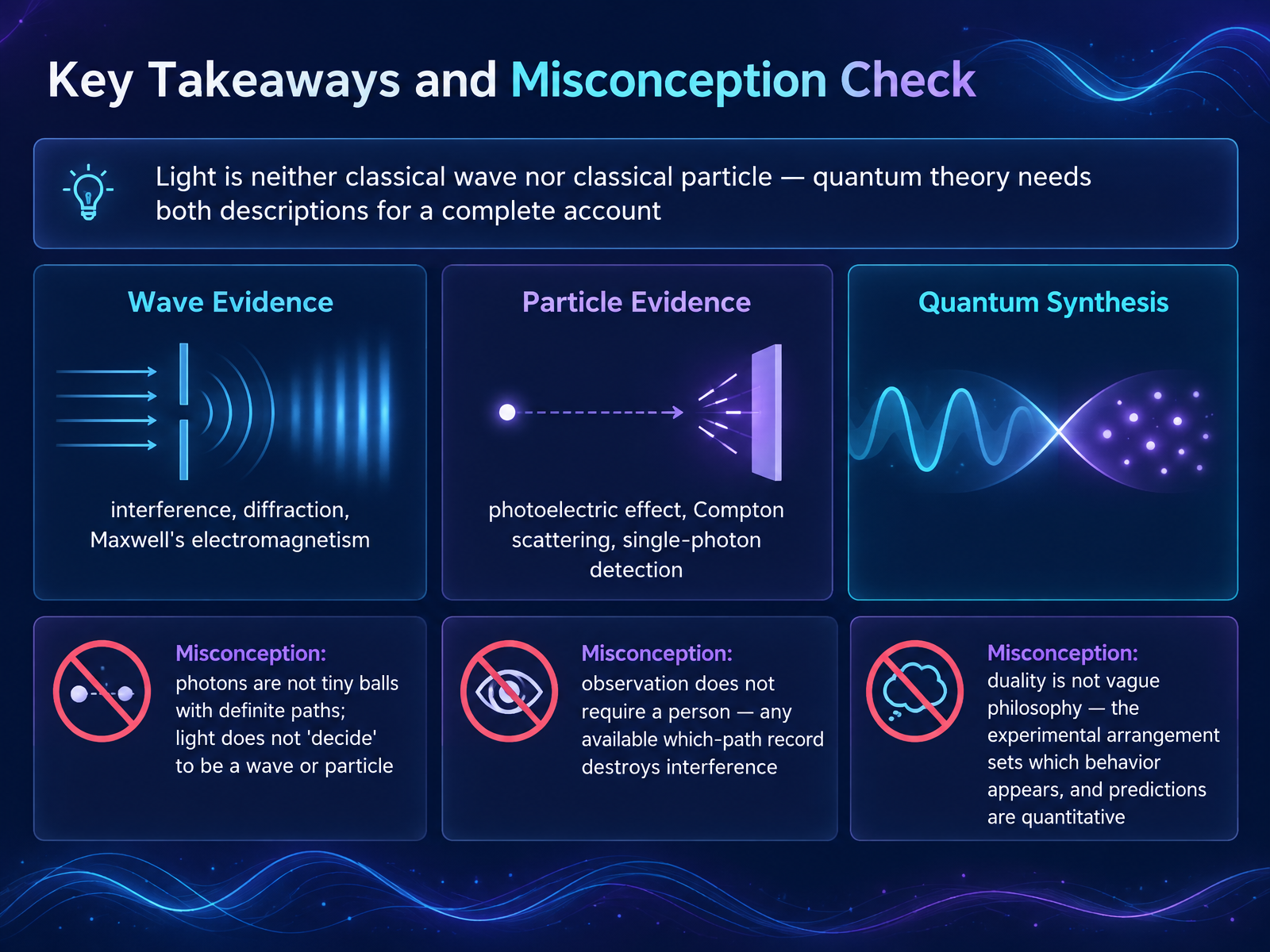
- 13Key Takeaways and Misconception CheckLet's bring this together and clear up a few common misunderstandings. First, light is neither a classical wave nor a classical particle. Quantum theory needs both descriptions for a complete account. The wave evidence includes interference, diffraction, and Maxwell's electromagnetism. The particle evidence includes the photoelectric effect, Compton scattering, and single-photon detection. Now the misconceptions. Photons are not tiny balls with definite paths, and light does not decide to be a wave or a particle. Also, observation does not require a person. Any available which-path record destroys interference. And duality is not vague philosophy. The experimental arrangement sets which behavior appears, and predictions are quantitative. So the takeaway is this: ask what the setup allows, and the math gives a precise answer. Next, let's reflect, discuss, and explore further.
 spark.iop.orgphys.libretexts.orgkids.britannica.com+21 min
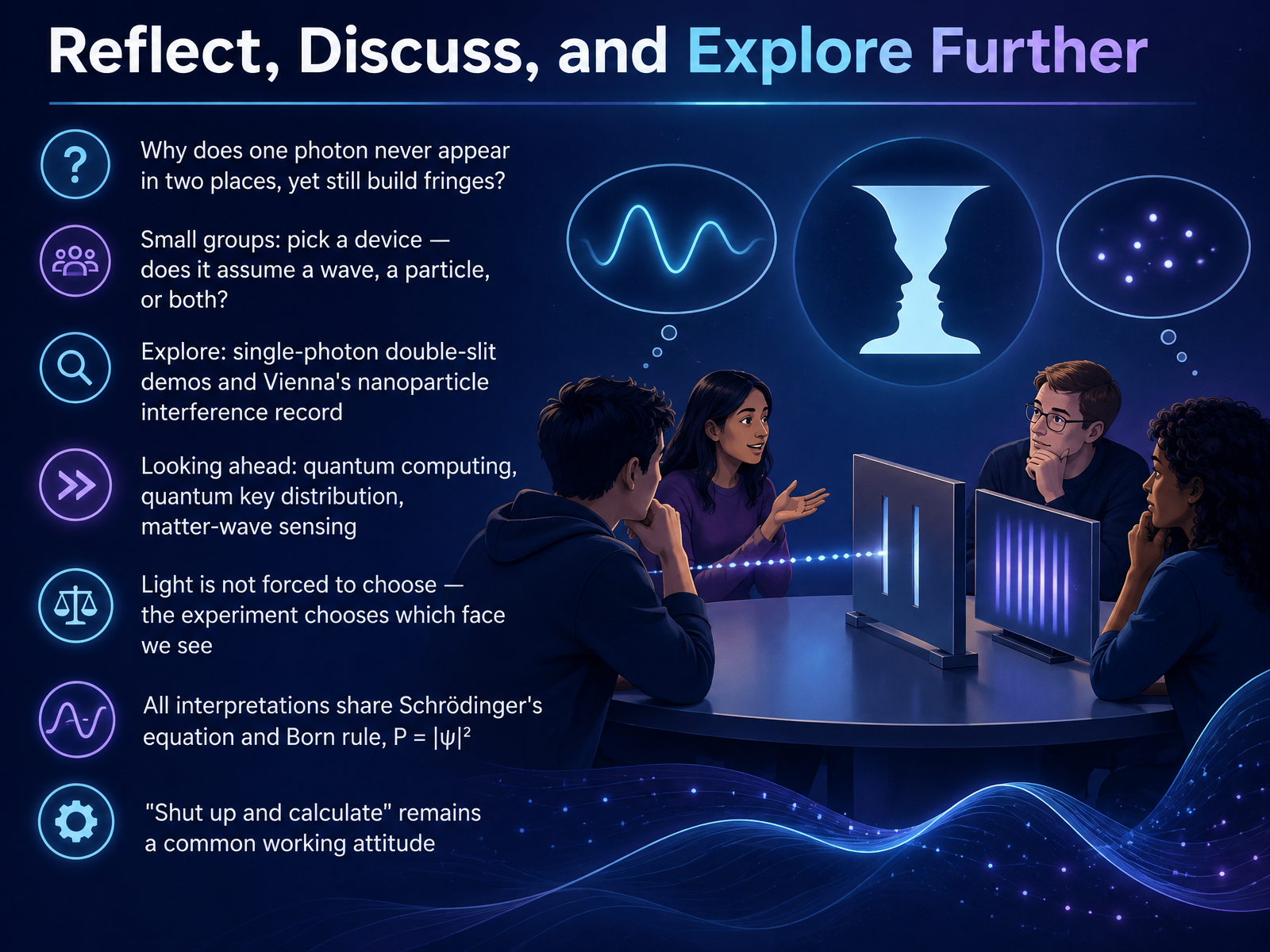
- 14Reflect, Discuss, and Explore FurtherSo let's bring this journey to a close. Here's a question worth sitting with. Why does a single photon never appear in two places at once, yet many photons still build up those interference fringes? If you're in a small group, pick a familiar device, maybe a camera lens or a solar panel, and ask: does it assume a wave, a particle, or both? And if you want to explore further, look into single-photon double-slit demonstrations, or the Vienna experiments where nanoparticles of thousands of atoms still interfere. Looking ahead, this work feeds quantum computing, quantum key distribution, and matter-wave sensing. The big takeaway is that light isn't forced to choose. The experiment chooses which face we see. And every interpretation, Copenhagen, many worlds, pilot wave, shares the same math: Schrödinger's equation, and the Born rule, where probability equals the absolute square of the wavefunction. Many scientists simply say, shut up and calculate. That's fine. Curiosity is still welcome. Thank you for joining me. Keep asking. Keep wondering.
 2 min
Take the deck with you
Download this course as a file — free, no sign-up needed.
- PDF handoutEvery slide page, ready to print or share.15 pages · 3.6 MBDownload
- Narrated PowerPointThe deck that presents itself — every slide carries the digital human's narration video.15 pages · 13.7 MBDownload
- PowerPoint slidesThe full deck as a .pptx — open it in PowerPoint, Keynote, or Google Slides.15 pages · 3.6 MBDownload
Free to use in your own training — please keep the PersonWise credit page at the end.
Have your own deck? Turn it into a course
Sources consulted
Web sources consulted while building this course.
- Light: Wave-particle duality | OpenLearn - Open University — open.edu
- Particle-Wave Duality — aps.org
- Wave Particle Duality Explained | Perimeter Institute for Theoretical Physics — youtube.com
- 5 Concepts Can Help You Understand Quantum Mechanics and Technology — Without Math! | NIST — nist.gov
- Electromagnetic Spectrum — imagine.gsfc.nasa.gov
- Electrons behaving as waves | IOPSpark — spark.iop.org
- 13.3: Complementarity and Copenhagen Interpretation - Physics LibreTexts — phys.libretexts.org
- complementarity principle - Scholars | Britannica Kids | Encyclopedia — kids.britannica.com
- The Copenhagen Interpretation – Niels Bohr Institute - University of Copenhagen — nbi.ku.dk
- Complementarity — where it appears · Illustrated Physics — illustrated-physics.com
- Light ideas and technology – timeline — sciencelearn.org.nz
- Optical Society of America: Exploring the Science of Light - Optics Timeline — osa.magnet.fsu.edu
- This Month in Physics History — aps.org
- Classical light - MacTutor History of Mathematics — mathshistory.st-andrews.ac.uk
- The Nature of Light — doi.org
- 6.2 Photoelectric Effect - University Physics Volume 3 | OpenStax — openstax.org
- The Photoelectric Effect - UCalgary Chemistry Textbook — chem-textbook.ucalgary.ca
- Photoelectric Effect — web.pdx.edu
- Photoelectric Effect – University Physics Volume 3 — pressbooks.online.ucf.edu
- How do photoelectric cells work? - Explain that Stuff — explainthatstuff.com