Begin
14 pages · ~28 min
Cybersecurity Risk Assessment
This training teaches professionals to identify, analyze, and mitigate cybersecurity risks using structured assessment frameworks and practical mitigation strategies.
A digital instructor presents all 14 pages. Hold “Ask” at any point and ask out loud — the answer comes from this course. No sign-up needed.
What you’ll learn
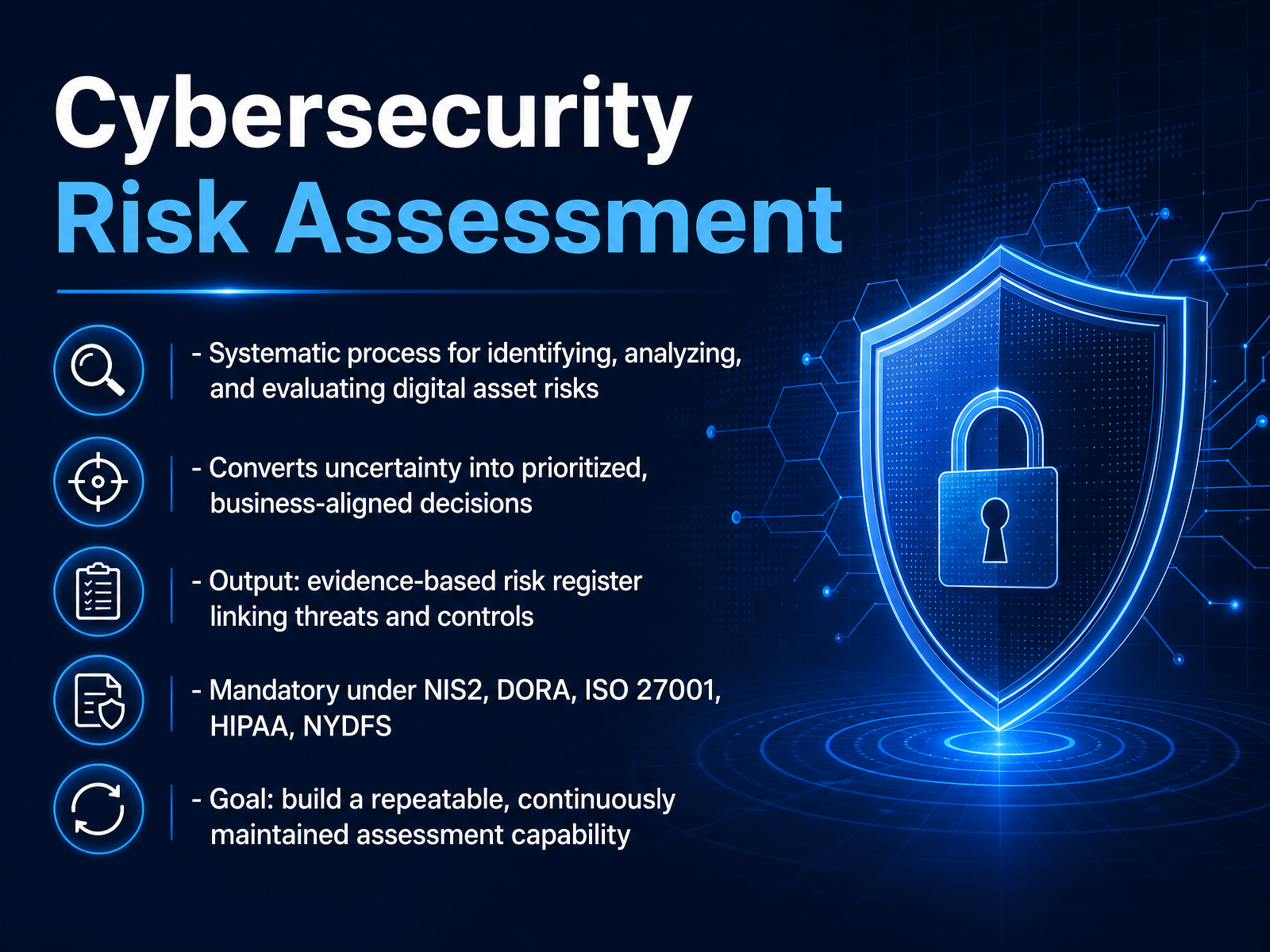
- 01Cybersecurity Risk AssessmentWelcome. This course is about building a cybersecurity risk assessment program that actually supports your decisions and your compliance obligations, not just a document on a shelf. A risk assessment is a systematic process. It identifies digital assets, analyzes what could threaten them, and evaluates the impact if those threats succeed. Think of it as converting uncertainty into something you can act on. The output is an evidence based risk register. It links specific threats to specific assets and to the controls you currently have or need. That register becomes the basis for prioritized, business aligned decisions. And for many of you, this is not optional. NIS2, DORA, ISO 27001, HIPAA, and NYDFS all require a defensible, repeatable risk assessment process. So the goal here is simple. By the end, you should be able to build and maintain an assessment capability that produces clear, current, and actionable risk information. Let's start with the core concepts and terminology that every assessment depends on.sans.orgmicrosoft.comtenable.com+21 min
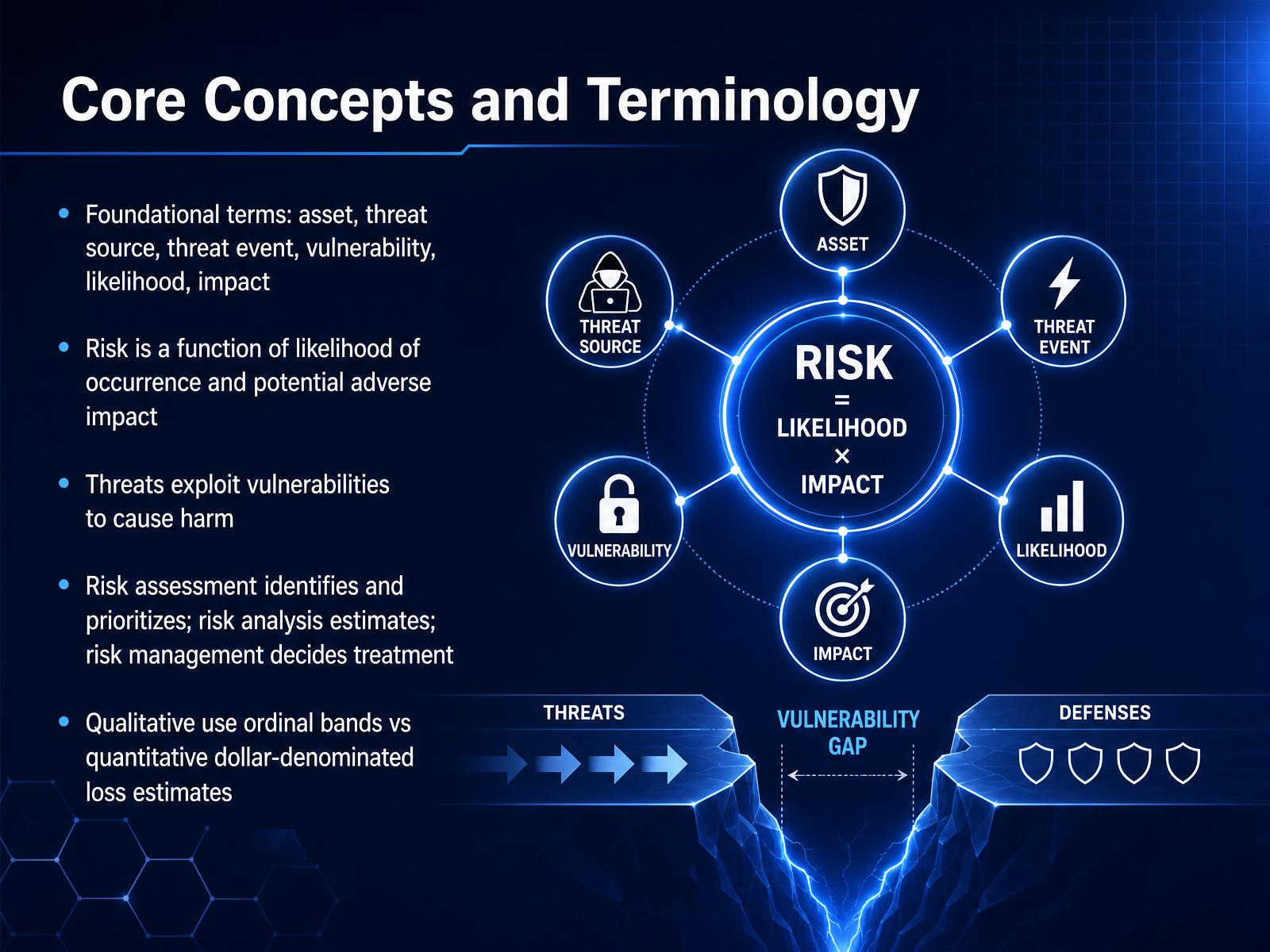
- 02Core Concepts and TerminologyLet's get precise about our terms before we go any further. In our context, an asset is anything of value, from a database to a manufacturing line. A threat source is the actor or circumstance with the potential to cause harm. When that source acts, we call it a threat event. A vulnerability is a weakness the threat can exploit. Likelihood is the probability of an event occurring, and impact is the magnitude of harm that results. So, risk is a function of likelihood and impact. We calculate it by combining the chance of something happening with the damage it would cause. Threats exploit vulnerabilities to compromise confidentiality, integrity, or availability. And remember the distinct roles here. Risk assessment identifies and prioritizes risks. Risk analysis estimates their magnitude. Risk management decides what treatment to apply, such as mitigating, transferring, or accepting. We can assess risk qualitatively, using bands like high, medium, or low, or quantitatively, using dollar-denominated loss estimates. With this foundation, next we move to Risk Assessment Frameworks and Standards.
 csrc.nist.govnvlpubs.nist.govgovinfo.gov+22 min
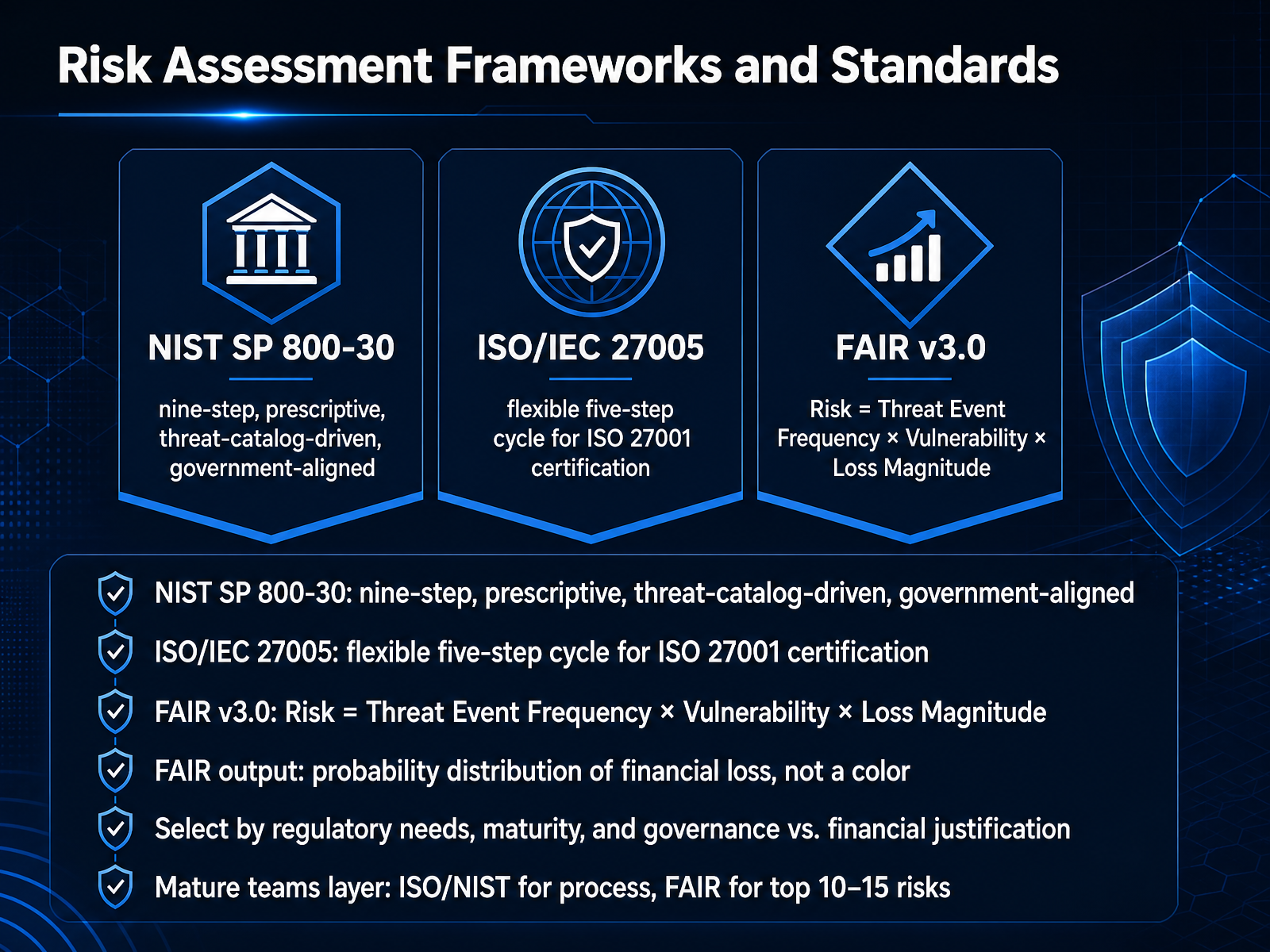
 - 03Risk Assessment Frameworks and StandardsLet's look at the frameworks most security teams rely on to structure their assessments. First is NIST SP 800-30. It's a nine-step, prescriptive process with a detailed threat catalog. It's the standard choice for government-aligned environments and teams that need a repeatable, audit-ready method. Next is ISO twenty-seven thousand and five. It uses a flexible five-step cycle and maps directly to ISO twenty-seven thousand and one certification. Choose this when certification is the driver. Third is FAIR, version three point zero. FAIR quantifies risk as Threat Event Frequency times Vulnerability times Loss Magnitude. The output is a probability distribution of financial loss, not a color on a heat map. For example, you might report a range like two hundred thousand to one point four million dollars at ninety percent confidence. That's the language your CFO and board need for budget decisions. Select your primary framework based on regulatory needs, team maturity, and whether you need governance process or financial justification. Mature teams don't pick just one. They layer ISO or NIST for process and apply FAIR to the top ten to fifteen risks. Now, before we can assess anything, we have to define what we're assessing. Let's talk about scoping and asset identification.
 codehyper.com.auvcso.ainflo.tech+22 min
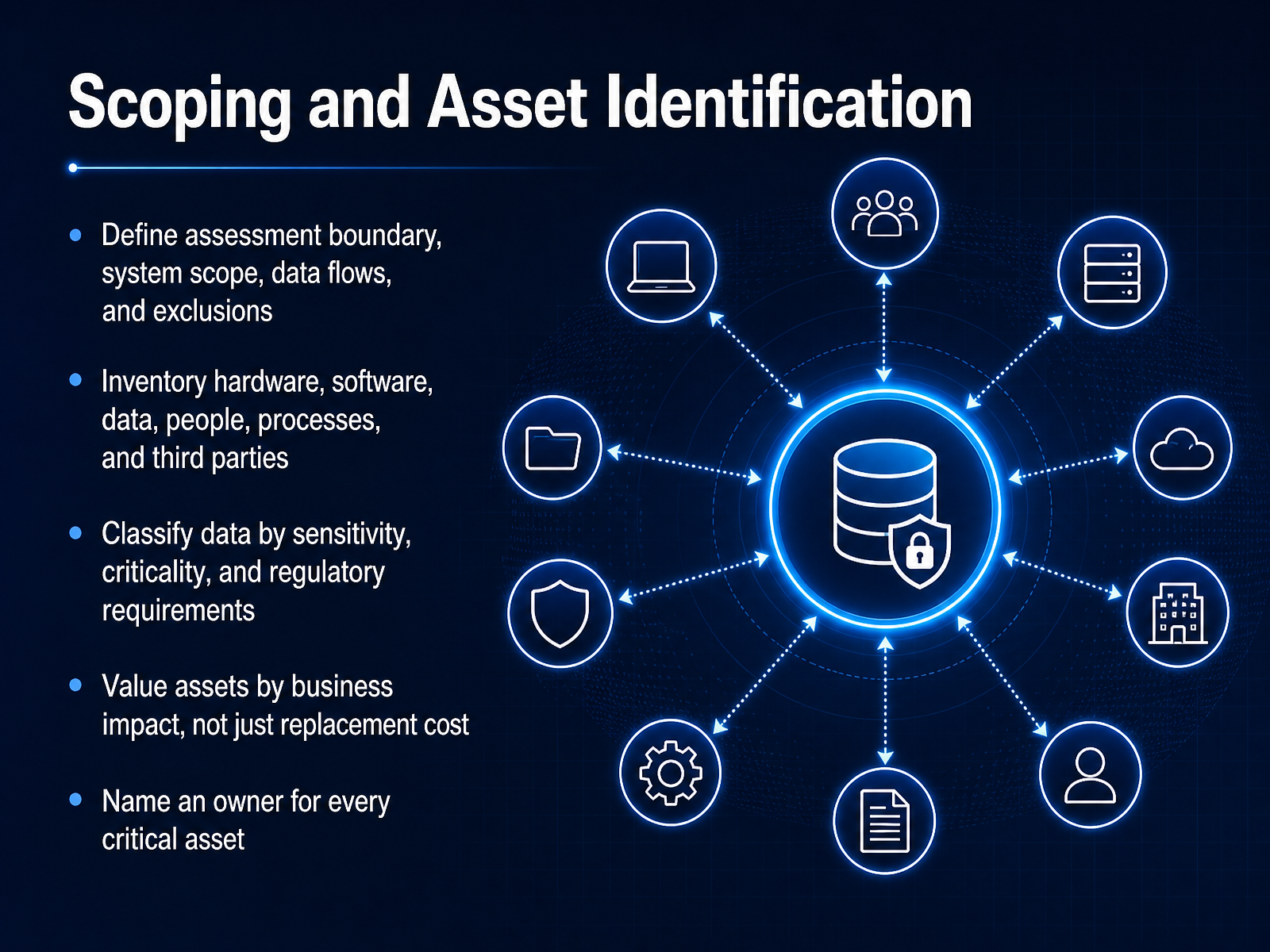
 - 04Scoping and Asset IdentificationScoping is where a credible risk assessment begins. Without clear boundaries, you are not assessing your environment; you are guessing. Start by defining the assessment boundary and system scope. Identify what is included, what is excluded, and map the critical data flows between systems. Then build a complete asset inventory. That means hardware, software, data, people, processes, and third parties. Anyone of those can be your weakest link. Once you have the inventory, classify the data. Sort it by sensitivity, criticality, and any regulatory requirements that apply. And remember how you value assets matters. Base that value on business impact, not just the cost to replace the hardware. A server is cheap to replace, but the customer data on it could trigger a major breach notification. Finally, assign an owner to every critical asset. Somebody must be accountable for the risk it carries. If no one owns it, no one is managing it. Let's move on to identifying the threats and vulnerabilities that put those assets at risk.
 csrc.nist.govnccoe.nist.govcyber.gc.ca+21 min
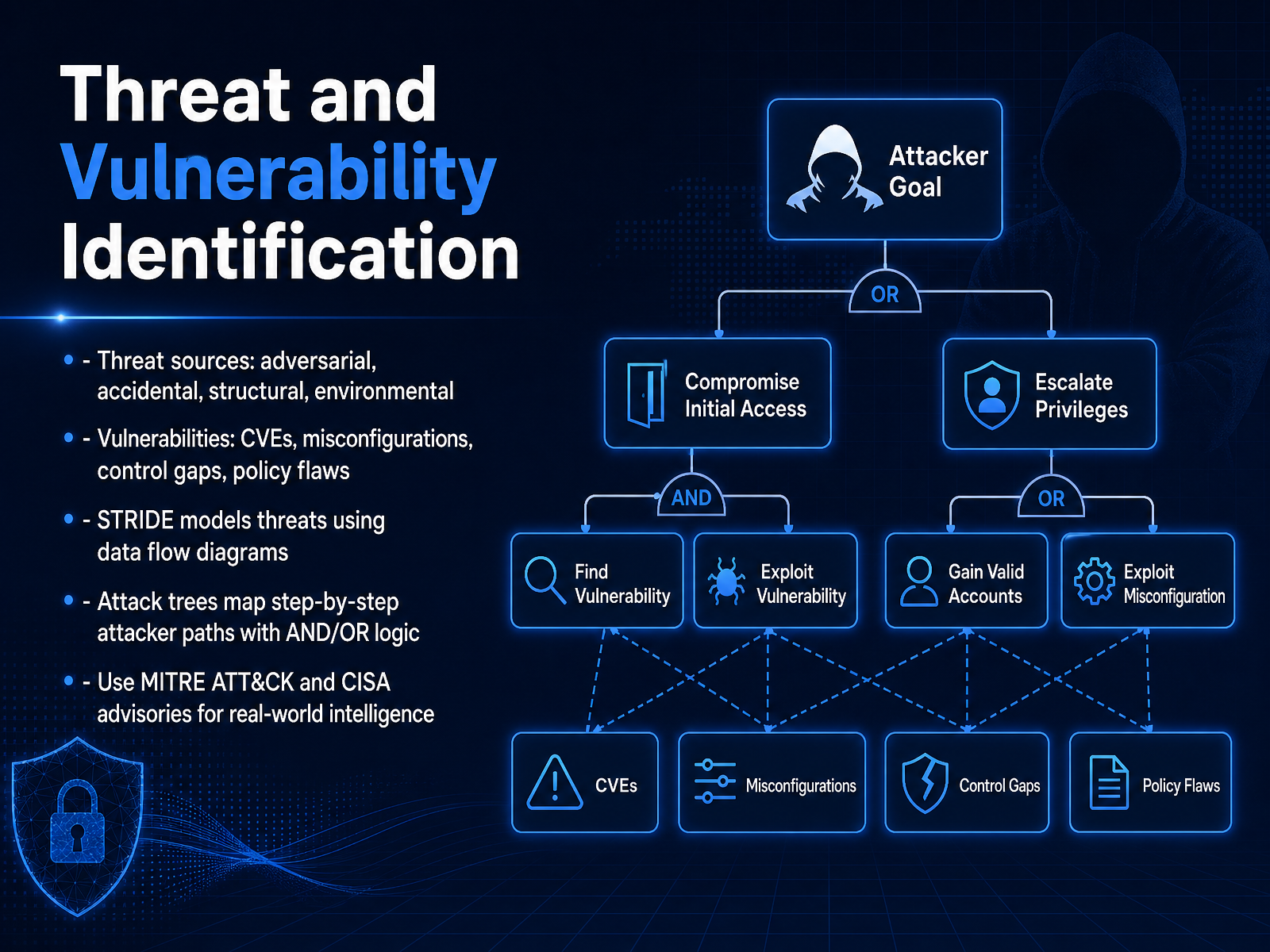
 - 05Threat and Vulnerability IdentificationNext, we examine threat and vulnerability identification. We start by categorizing threat sources into four areas: adversarial, accidental, structural, and environmental. Vulnerabilities can include CVEs, which are known exploits, along with misconfigurations, control gaps, and policy flaws. To structure our analysis, we use threat modeling. STRIDE is a mature method that evaluates system design using data flow diagrams. It stands for Spoofing, Tampering, Repudiation, Information disclosure, Denial of service, and Elevation of privilege. It prompts us to ask specific questions about how a system can be violated. Attack trees are another tool. They map step-by-step attacker paths toward a goal, using AND and OR logic to show dependencies between actions. For real-world context, we ground these models with operational intelligence from MITRE ATT&CK and CISA advisories. These sources inform us on how adversaries actually operate. By combining these structured models with current threat intelligence, we move from abstract risk to concrete attack scenarios. Next, we will move to analyzing likelihood and impact.
 2 min
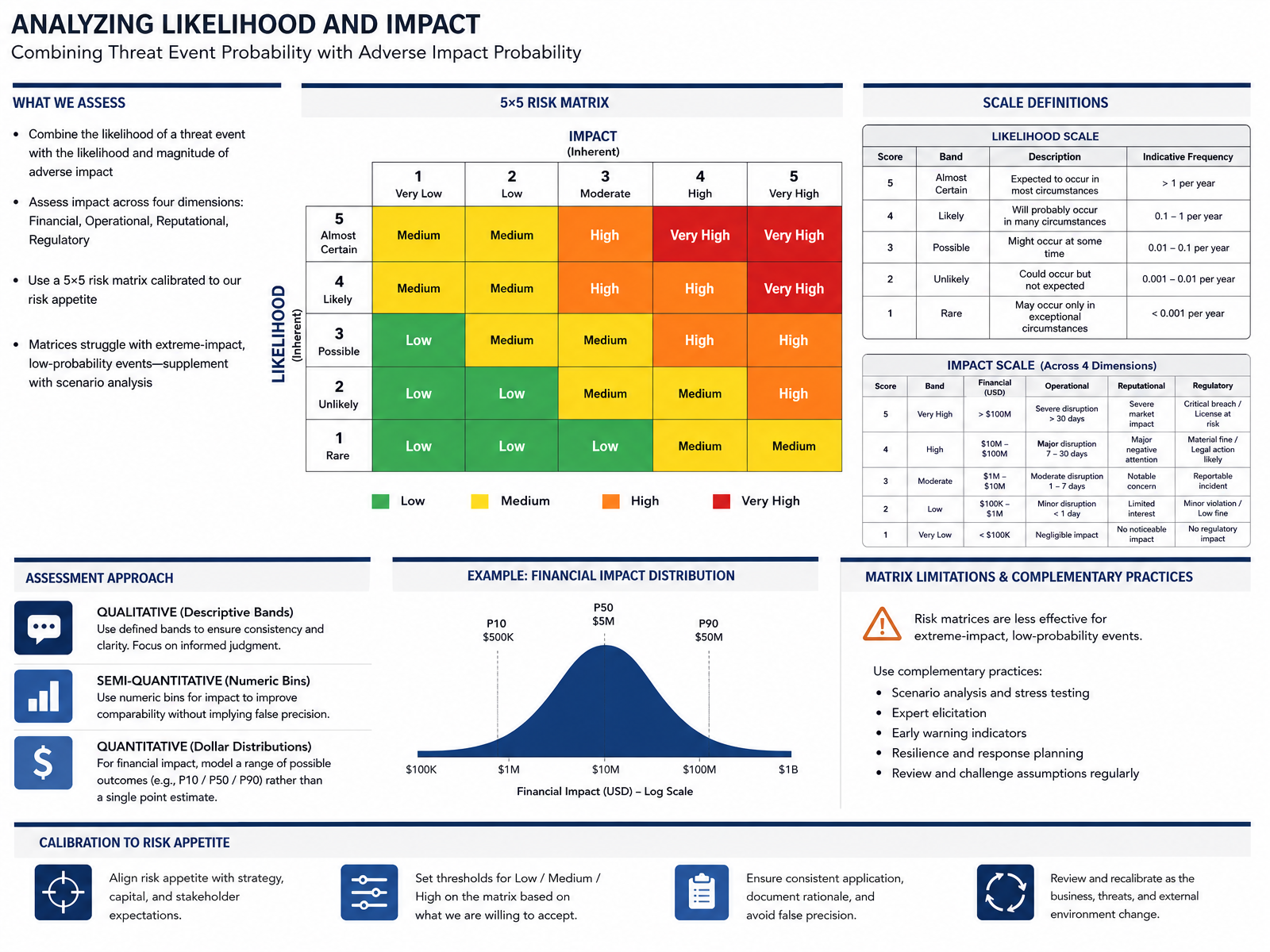
2 min - 06Analyzing Likelihood and ImpactNow, let's combine what we know about threats with our assessment of consequence. This is likelihood and impact analysis. First, we assess the probability that a threat event will occur, and then the probability that it will cause adverse impact if it does. We need to consider impact across four core dimensions. Financial cost. Operational disruption. Reputational damage. And regulatory exposure. A data breach, for example, may have a moderate financial cost but a severe regulatory penalty. We score this using three methods. Qualitative analysis uses descriptive bands, like low, medium, or high. Semi-quantitative analysis assigns numeric values to those bands, often on a one to five scale. Quantitative analysis uses mathematical models to produce dollar-based probability distributions. Most organizations use a five by five risk matrix as a screening tool. This plots likelihood against impact to generate a risk score. It is critical that the scales are clearly defined and calibrated to your organization’s risk appetite. Avoid false precision. A score of fifteen is not meaningfully different from a score of sixteen. Also, remember the matrix has limits. It struggles to represent extreme-impact, low-probability events, which require separate analysis. Next, we will move into risk evaluation and prioritization.
 2 min
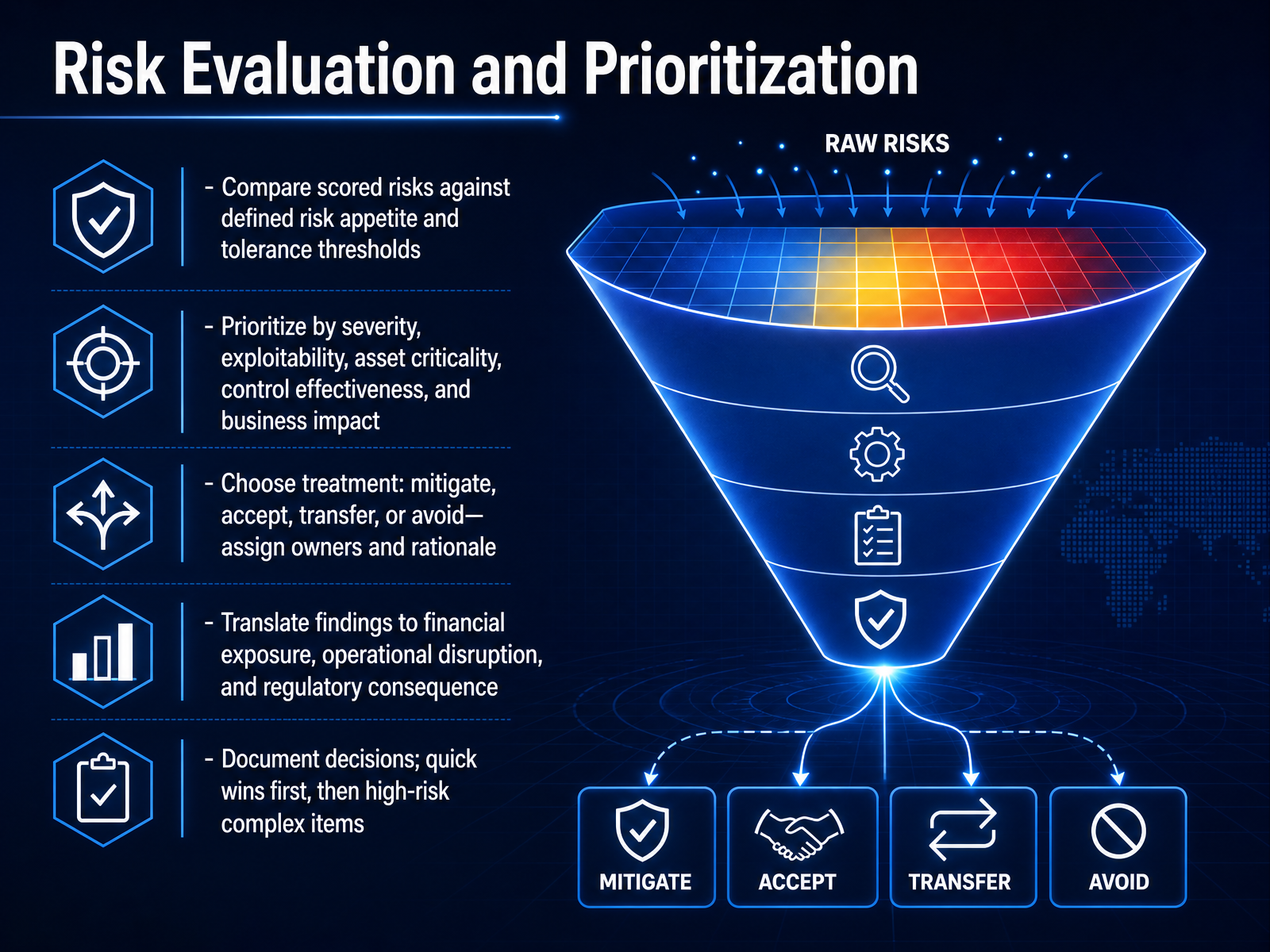
2 min - 07Risk Evaluation and PrioritizationNow we move to evaluation and prioritization. This is where scored risks meet your actual risk appetite and tolerance thresholds. A risk is not just a number. It is a decision point. Compare each scored risk against the limits your board has defined. If it sits above tolerance, it demands action. If it sits within appetite, you may still choose to act. Then prioritize. Use severity, exploitability, asset criticality, control effectiveness, and business impact. Not every high score is equal. A severe risk on a customer facing system may outweigh a moderate risk on an internal tool. For each risk, choose a treatment. Mitigate. Accept. Transfer. Or avoid. Assign a named owner and record the rationale. No anonymous risks. Then translate the findings. Express exposure in financial terms, operational disruption, and regulatory consequence. That is the language executives need. Document every decision. Execute quick wins first. Then sequence the complex high risk items. This keeps momentum and shows measurable progress. Coming up next, we will look at reporting and documentation.
 1 min
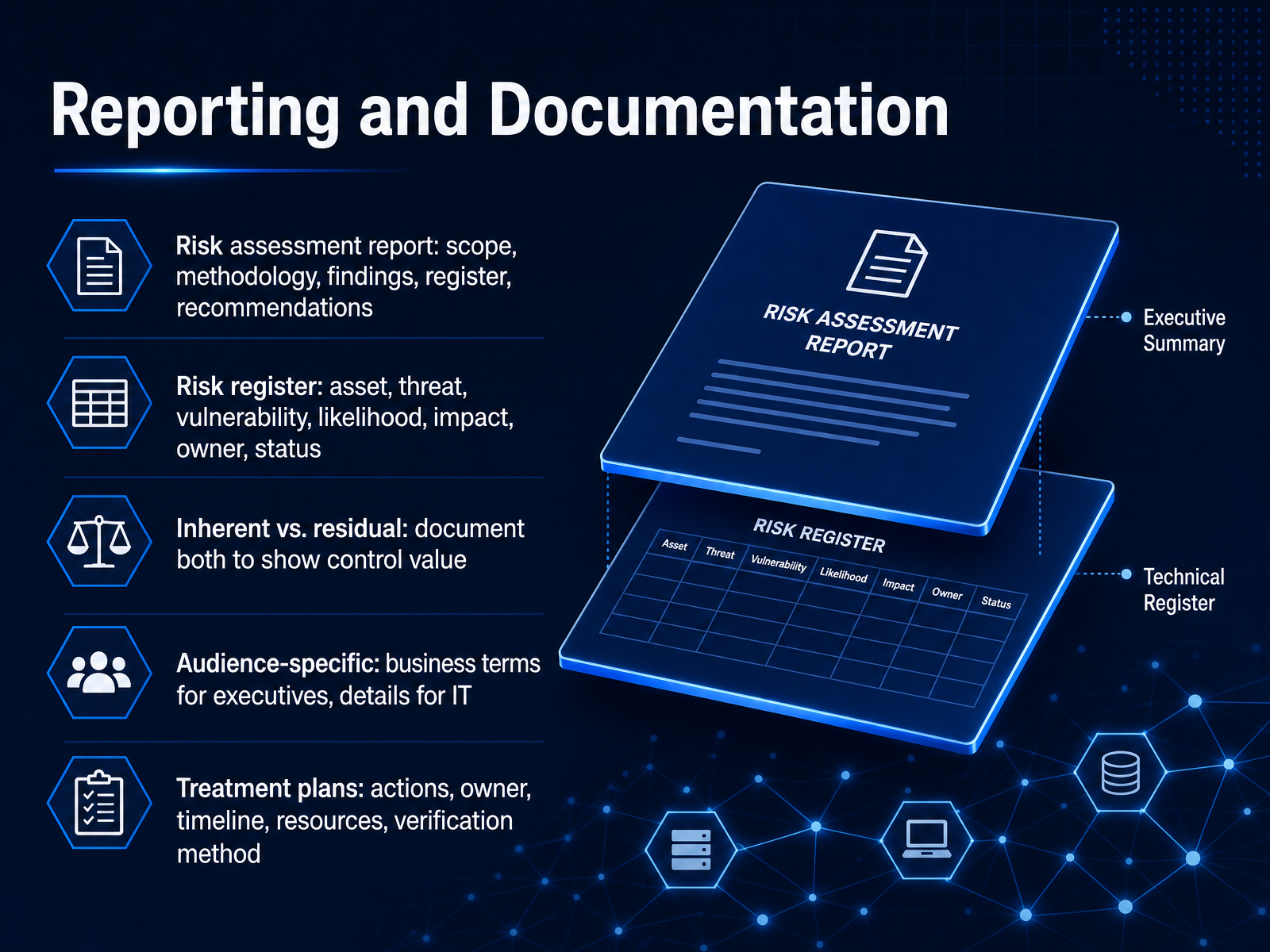
1 min - 08Reporting and DocumentationReporting is where the assessment becomes actionable. The report must include scope, methodology, findings, the risk register, and prioritized recommendations. The register itself is a living record. For each entry, capture the asset, the threat, the vulnerability, likelihood, impact, a named owner, and current status. Document both inherent and residual risk. This contrast shows the actual value of your controls. When you present this data, tailor the message to the audience. Executives need business terms and financial impact. Technical teams need specific vulnerabilities and remediation details. Finally, formalize treatment plans. Each plan requires defined actions, a single owner, a timeline, required resources, and a method for verifying effectiveness. Without that structure, mitigation stalls. Next, we will shift from documentation to ongoing vigilance with continuous monitoring and review.
 2 min
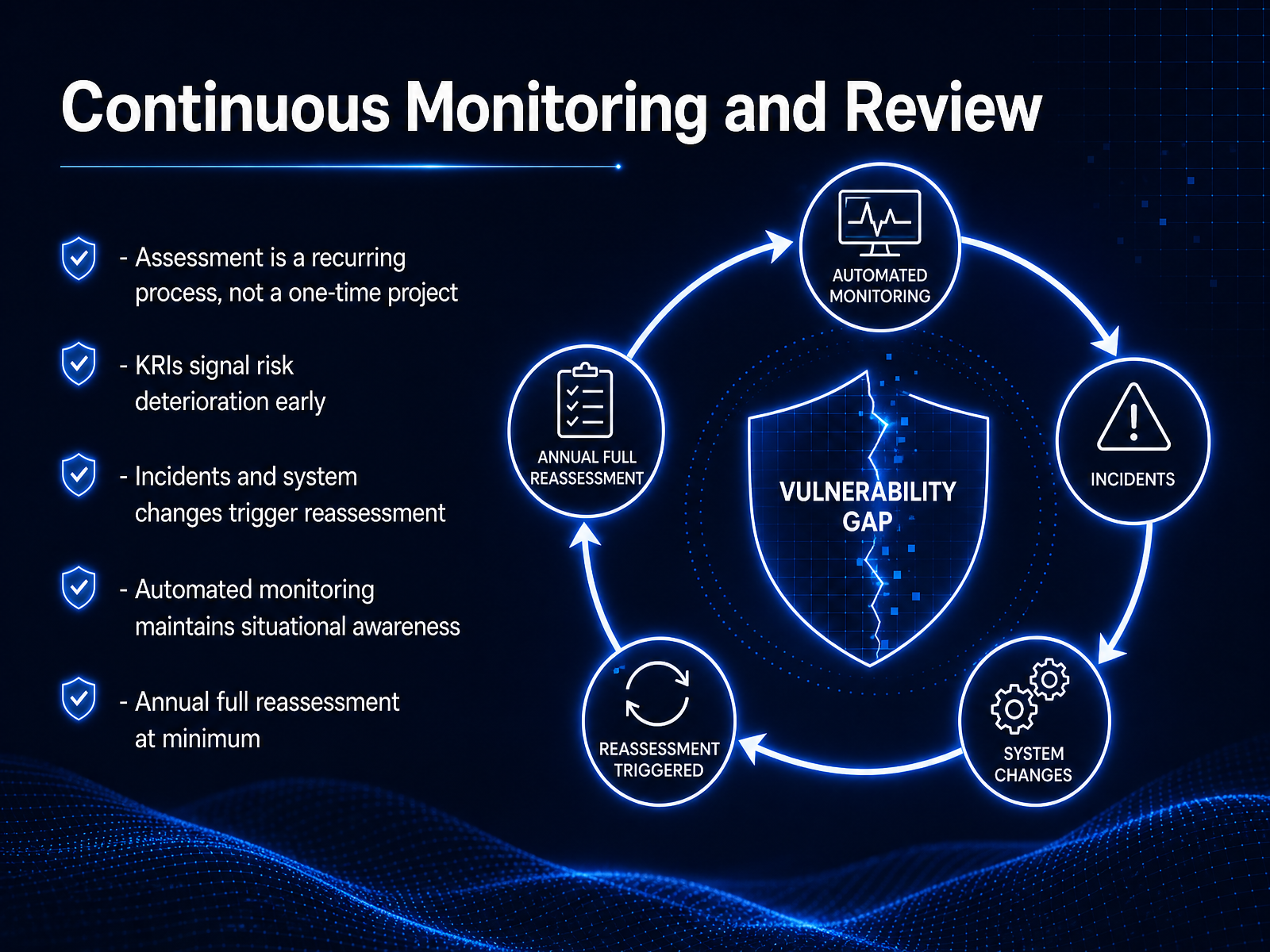
2 min - 09Continuous Monitoring and ReviewNow let's talk about keeping that assessment alive. A risk assessment is not a one-time project. It is a recurring process. Your controls operate in a changing environment, so you need continuous monitoring to confirm they still work as intended. Key Risk Indicators, or K R I s, are your early warning system. They signal when risk is starting to degrade, before a small issue becomes a major breach. Certain events should also trigger an immediate reassessment, such as a security incident or a significant system change. For example, if you deploy a new application or modify network ports, you need to re-evaluate the risk. Automated monitoring helps maintain situational awareness around the clock, catching misconfigurations and unauthorized changes that manual reviews might miss. At a minimum, you should still conduct a full, comprehensive reassessment annually. This ensures that your original risk decisions remain valid and that your security posture has not drifted. To put these concepts into practice, let's review the specific tools and technologies that can support this continuous cycle.
 2 min
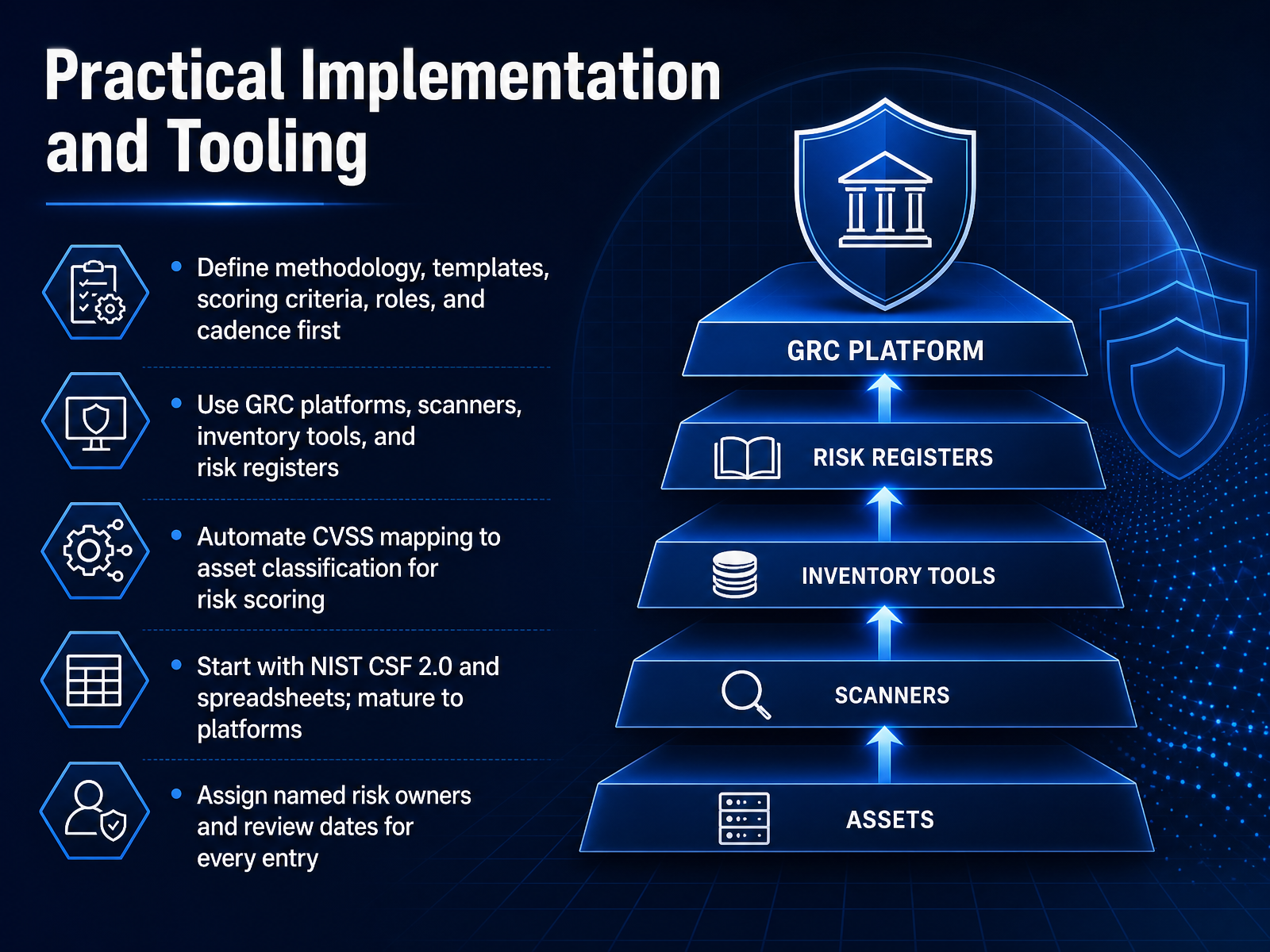
2 min - 10Practical Implementation and ToolingNow let's talk about how to put this into practice. Implementation matters as much as the assessment itself. Start by defining your methodology, templates, scoring criteria, roles, and cadence before you touch any tooling. If you don't have a repeatable process, every assessment will produce inconsistent results. Next, build your tool stack around that process. GRC platforms, scanners, inventory tools, and risk registers are the core components. Begin with NIST CSF 2.0 and spreadsheets. Spreadsheets force you to learn the discipline before a platform hides the complexity. Automate CVSS mapping to asset classification for risk scoring. That means a critical vulnerability on a tier one asset scores higher than the same vulnerability on an isolated test server. And for every entry in your register, assign a named risk owner and a review date. No blank owner columns. No open-ended risks. That person is accountable for the treatment decision and the next review. Coming up next, we'll examine the common pitfalls and lessons learned from real assessments.
 2 min
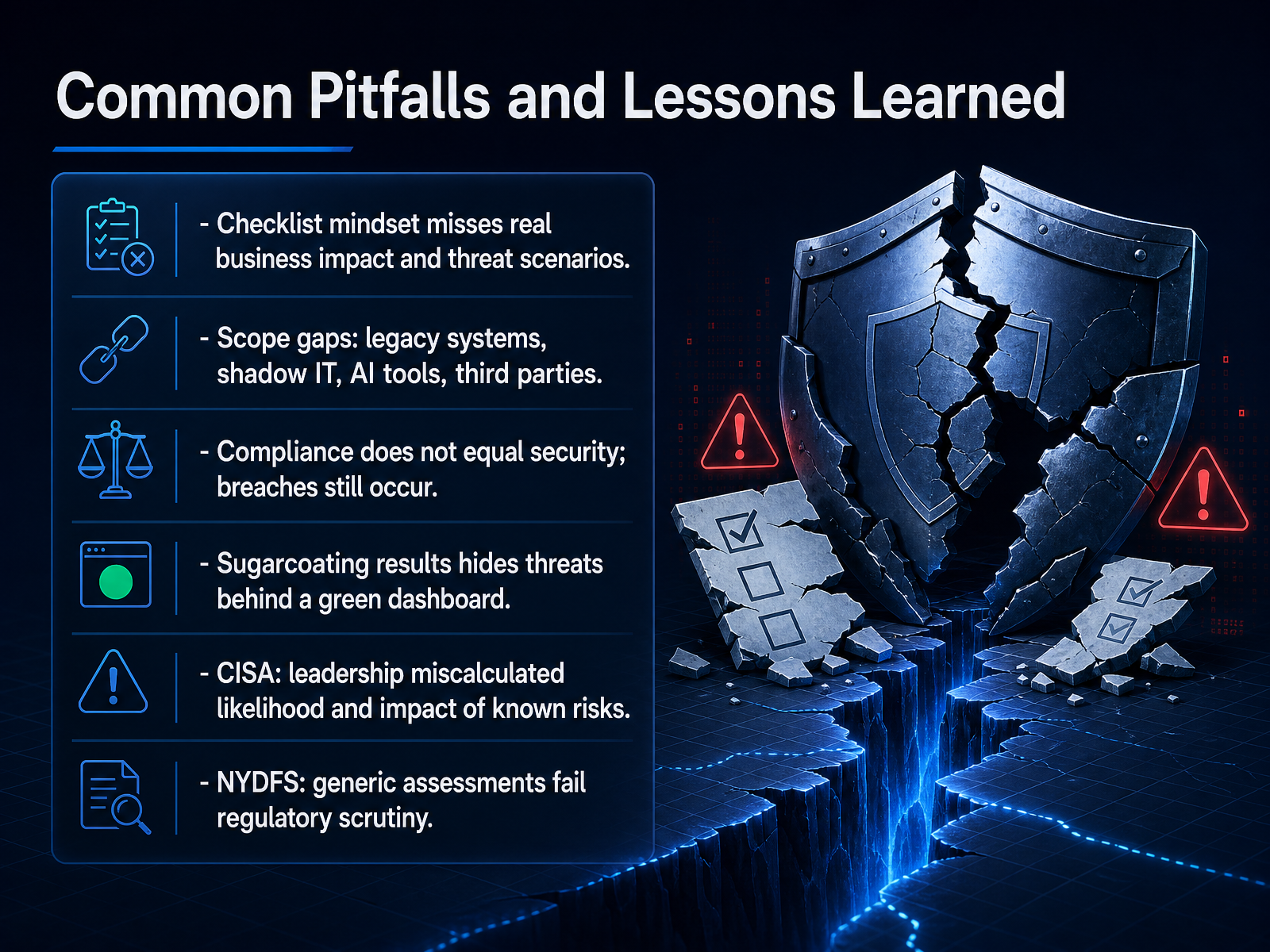
2 min - 11Common Pitfalls and Lessons LearnedThis slide addresses the most common reasons cyber risk assessments fail. The first is the checklist mindset. Assessments that only verify controls miss how threats actually impact your business. Instead, risk must be tied to critical assets and operational consequences. Next, scope gaps are a frequent weakness. Legacy systems, shadow IT, new AI tooling, and third-party vendor portals often fall outside the assessment boundary, leaving attackers an unmonitored entry point. Also remember that compliance is not security. Organizations can be fully compliant and still suffer significant breaches. We must also avoid sugarcoating the results. A risk register that shows everything as green hides the true threat picture behind a dashboard. CISA's red team assessments found that leadership often miscalculated the likelihood and impact of known risks. Similarly, the New York Department of Financial Services has penalized firms for generic assessments that failed regulatory scrutiny. The operations lesson is to keep the assessment honest and comprehensive. Next, we will discuss executive and board communication.
 1 min
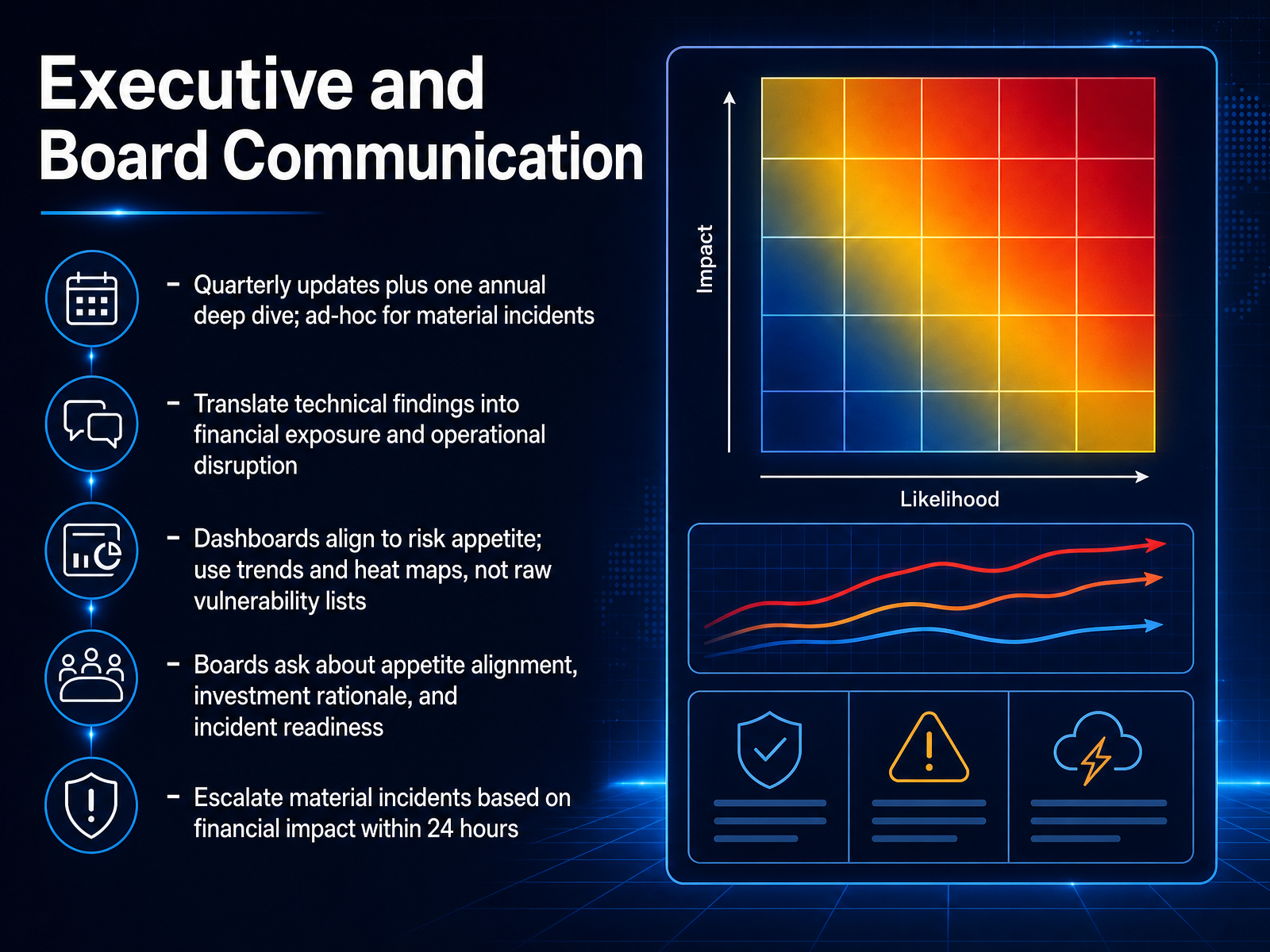
1 min - 12Executive and Board CommunicationMoving to board communication, the goal here is to translate risk into governance language. The cadence should be clear: quarterly business updates, one annual deep dive, and ad-hoc briefings for material events. When you report, do not lead with a list of vulnerabilities. Lead with financial exposure, operational disruption, and the status of your top risk scenarios. Your dashboards should show heat maps and trends aligned to the board's approved risk appetite. That lets directors see quickly whether risk is moving toward or away from the tolerance line. Boards will ask three core questions: Are we aligned to appetite, is the investment rationale sound, and are we ready for an incident. Plan for those questions in every session. Finally, escalation is time-bound. If an incident crosses the materiality threshold based on financial impact, you commit to board notification within twenty-four hours. That is the standard for SEC alignment and for maintaining trust. Let's apply this to a real operational scenario in our next section, Case Study: A Red Team Assessment.
 2 min
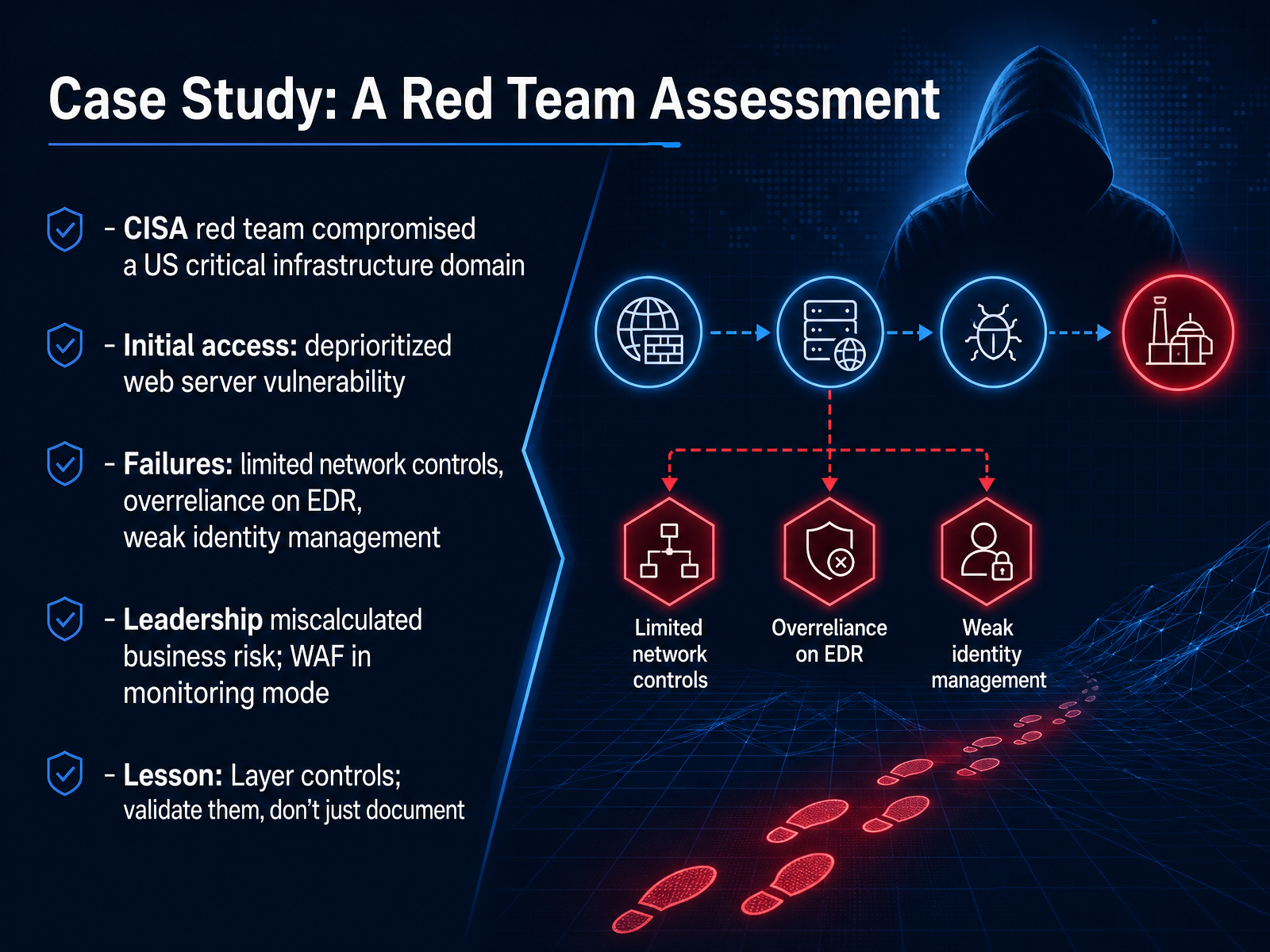
2 min - 13Case Study: A Red Team AssessmentLet's move from theory to a real operational failure. This case study is based on a CISA red team assessment of a U.S. critical infrastructure organization. Initial access came through a known web server vulnerability that leadership had deprioritized. The security team had flagged the risk. Leadership accepted it, then miscalculated the business impact. A web application firewall was deployed as a compensating control, but it was left in monitoring mode. That meant it saw the exploit and allowed it through. Once inside, the red team found limited network controls. The organization relied too heavily on endpoint detection and response, but the EDR missed payloads, and network layer protections were weak. Identity management was also fragmented, especially across Linux hosts, which slowed detection of lateral movement. The core lesson is not about buying more tools. It is about layering controls and validating that they actually work. Documentation is not the same as verification. If a control is only watching, it is not defending. That leads directly into the next slide, where we will outline a practical action plan and summarize the course.
 1 min
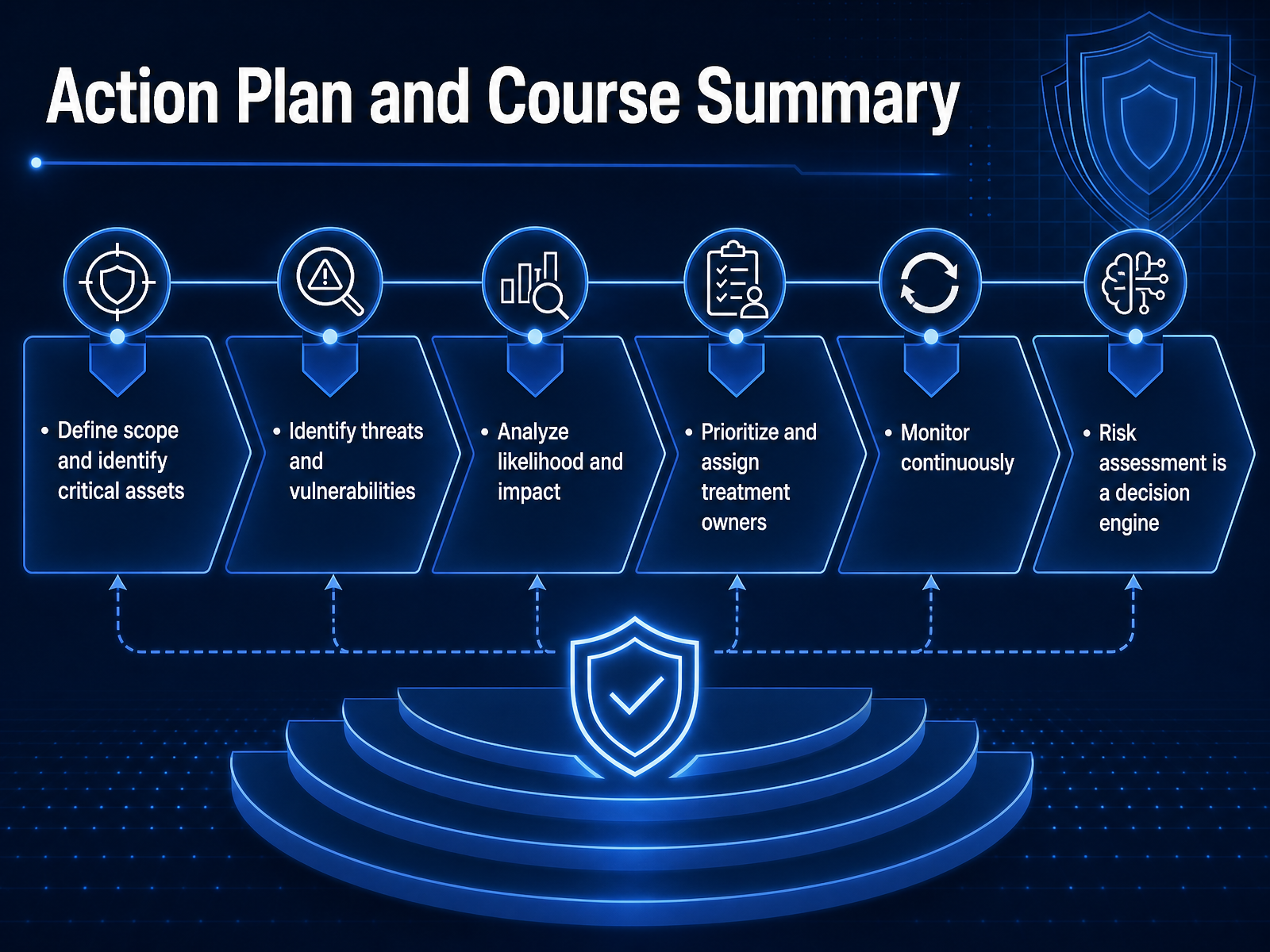
1 min - 14Action Plan and Course SummaryThis is where the process becomes a repeatable decision engine, not a one time exercise. Start by defining the scope and identifying the critical assets that keep your operations running. Then map the specific threats and vulnerabilities around those assets. Once you understand that exposure, analyze the likelihood and business impact of each risk. Use that analysis to prioritize treatment, and assign a named owner to every action. Remember, an unowned risk is an unmanaged risk. Then monitor continuously. Technology, threats, and business processes change, so reassess when a significant change or incident occurs. Ultimately, a risk assessment is not a compliance artifact. It is the mechanism that tells you where to focus budget and effort for the greatest reduction in operational risk. Thank you for taking this course. Use this framework as a working tool, and keep the risk conversation alive inside your organization.
 sans.orgmicrosoft.comtenable.com+22 min
Take the deck with you
Download this course as a file — free, no sign-up needed.
- PDF handoutEvery slide page, ready to print or share.15 pages · 4.0 MBDownload
- Narrated PowerPointThe deck that presents itself — every slide carries the digital human's narration video.15 pages · 15.7 MBDownload
- PowerPoint slidesThe full deck as a .pptx — open it in PowerPoint, Keynote, or Google Slides.15 pages · 3.9 MBDownload
Free to use in your own training — please keep the PersonWise credit page at the end.
Have your own deck? Turn it into a course
Sources consulted
Web sources consulted while building this course.
- Cybersecurity Risk Assessment | SANS Institute — sans.org
- What Is a Cybersecurity Risk Assessment? | Microsoft Security — microsoft.com
- What is a cybersecurity risk assessment? | Tenable® — tenable.com
- Bridging the gaps in cyber risk assessment: a comprehensive systematic review of standards, frameworks and quantification methods | The Geneva Papers on Risk and Insurance - Issues and Practice | Springer Nature Link — link.springer.com
- What Is a Cybersecurity Risk Assessment? — paloaltonetworks.com
- SP 800-30 Rev. 1, Guide for Conducting Risk Assessments — csrc.nist.gov
- [PDF] Guide for Conducting Risk Assessments — nvlpubs.nist.gov
- NIST SP 800-30 Revision 1, Guide for Conducting Risk Assessments — govinfo.gov
- risk - Glossary | CSRC - NIST Computer Security Resource Center — csrc.nist.gov
- Guide for Conducting Risk Assessments | NIST — nist.gov
- Risk Assessment Methodology: Complete Guide for 2026 — codehyper.com.au
- Security Risk Assessment: Complete Guide | vCSO.ai — vcso.ai
- Cybersecurity Risk Assessment — CRA Guide — nflo.tech
- IT Risk Management Framework: The Definitive Guide for 2026 - Integrated GRC Platform for Compliance, Risk & Security Governance — compyl.com
- Cybersecurity Risk Assessment Frameworks: 2026 Guide — nexeris.us
- Data Classification Practices: SP 1800-39 ipd | CSRC — csrc.nist.gov
- Implementing Data Classification Practices — nccoe.nist.gov
- Using information technology asset management (ITAM) to enhance cyber security - ITSM.10.004 — cyber.gc.ca
- FFIEC IT Examination Handbook InfoBase - III.A.1 Data Identification and Classification — ithandbook.ffiec.gov
- Federal Zero Trust Data Security Guide — resources.data.gov