Begin
14 pages · ~28 min
Free Will and Determinism
This training explores free will and determinism, examining whether human choices are genuinely free or predetermined. Ideal for learners in philosophy, ethics, and related fields.
A digital instructor presents all 14 pages. Hold “Ask” at any point and ask out loud — the answer comes from this course. No sign-up needed.
What you’ll learn
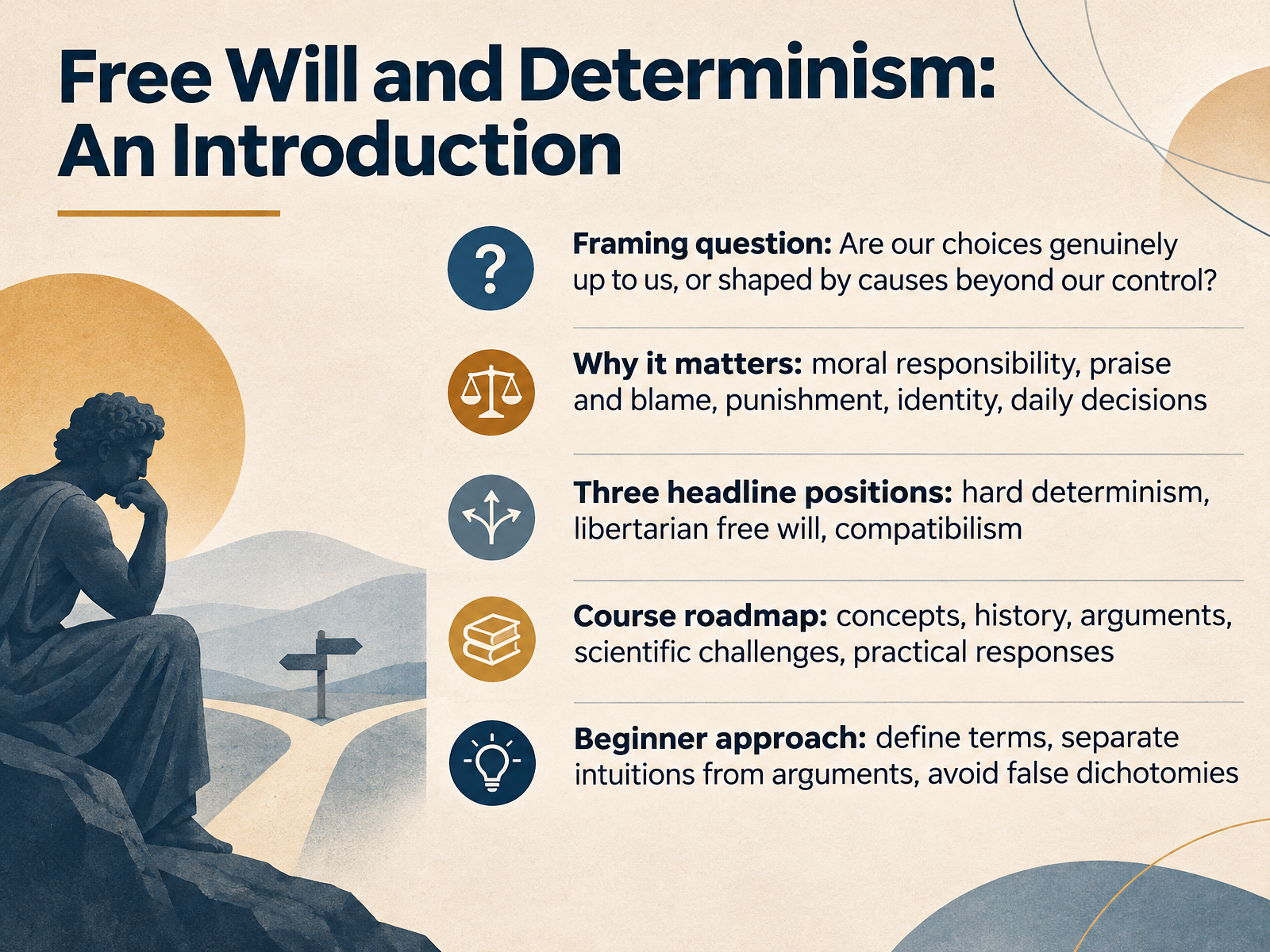
- 01Free Will and Determinism: An IntroductionWelcome. Today we begin a course on free will and determinism, a question that touches moral responsibility, praise and blame, punishment, and your daily choices. Here is our framing question: are our choices genuinely up to us, or shaped by causes beyond our control? We will treat three headline positions with equal charity. Hard determinism says no free choice exists. Libertarian free will says some choices escape external causes. Compatibilism says freedom and determinism can coexist. Consider a simple example: you decide to order tea instead of coffee. Was that decision truly yours, or the product of habit, biology, and circumstance? Over these slides we will define terms, trace the history, weigh arguments and scientific challenges, and consider practical responses. Our beginner approach is to define each term first, separate intuitions from arguments, and avoid false dichotomies. Where would you place yourself on this spectrum? Carry that question forward, and next we turn to core concepts: causation, determinism, and freedom.openstax.orgthecrashcourse.compeped.org+22 min
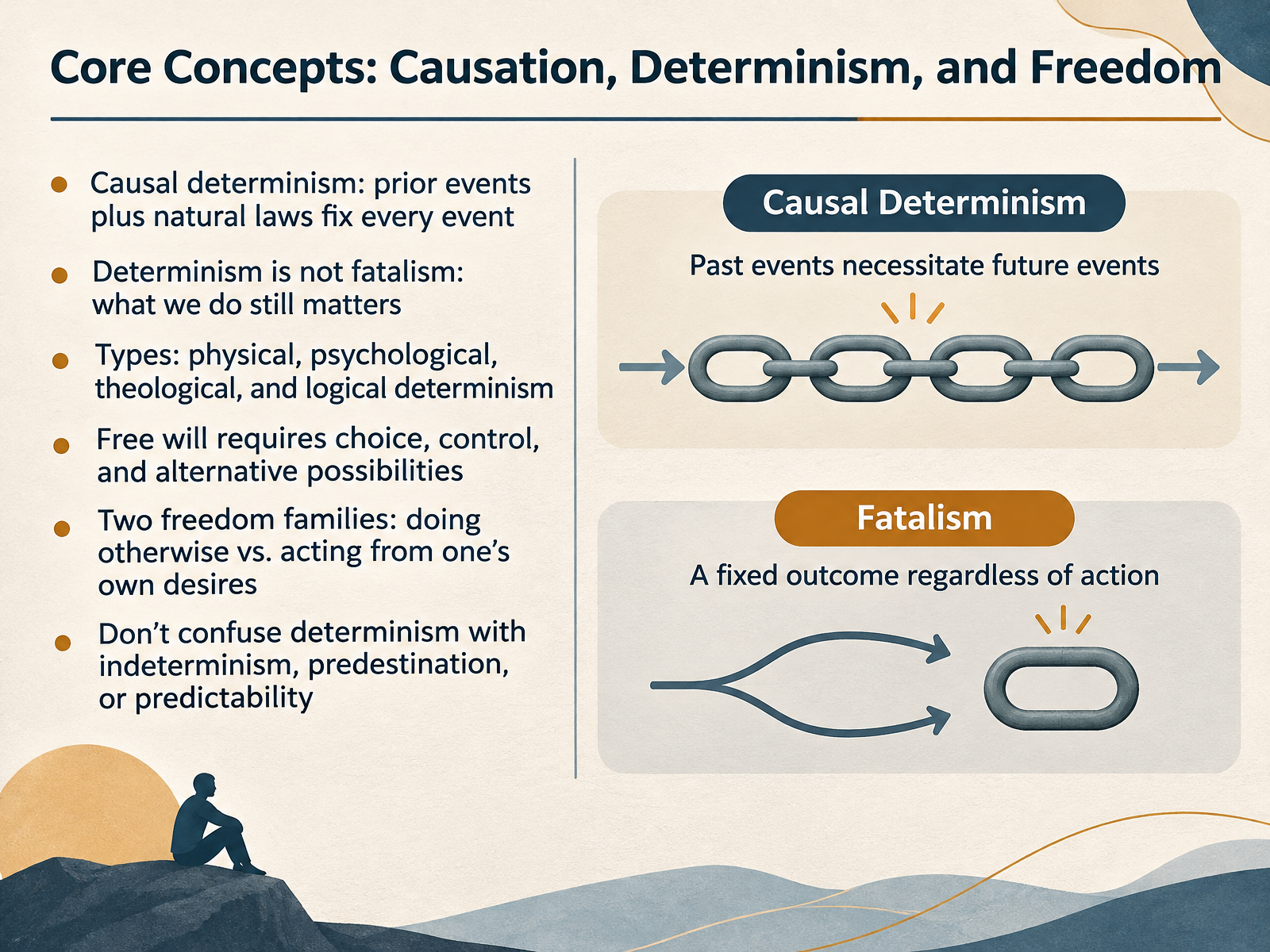
- 02Core Concepts: Causation, Determinism, and FreedomLet's begin with three ideas that frame the whole debate. Causal determinism says that prior events, together with the laws of nature, fix every event. Consider a billiard ball: its position, the cue's angle, the laws of motion, and the outcome follows. But determinism is not fatalism. Fatalism says events happen no matter what you do. Determinism says your choices are part of what brings events about, so what you do still matters. Determinism comes in types: physical, psychological, theological, and logical. Now, free will requires choice, control, and alternative possibilities. Two families of freedom: the ability to do otherwise, and the ability to act from your own desires. And please don't confuse determinism with indeterminism, predestination, or predictability. In one sentence: determinism concerns how events are fixed by prior conditions, while fatalism concerns whether anything we do makes a difference. Where would you place yourself on this spectrum? In the next section, we turn to the classical roots of the debate.
 plato.stanford.eduplato.stanford.eduverywellmind.com+22 min
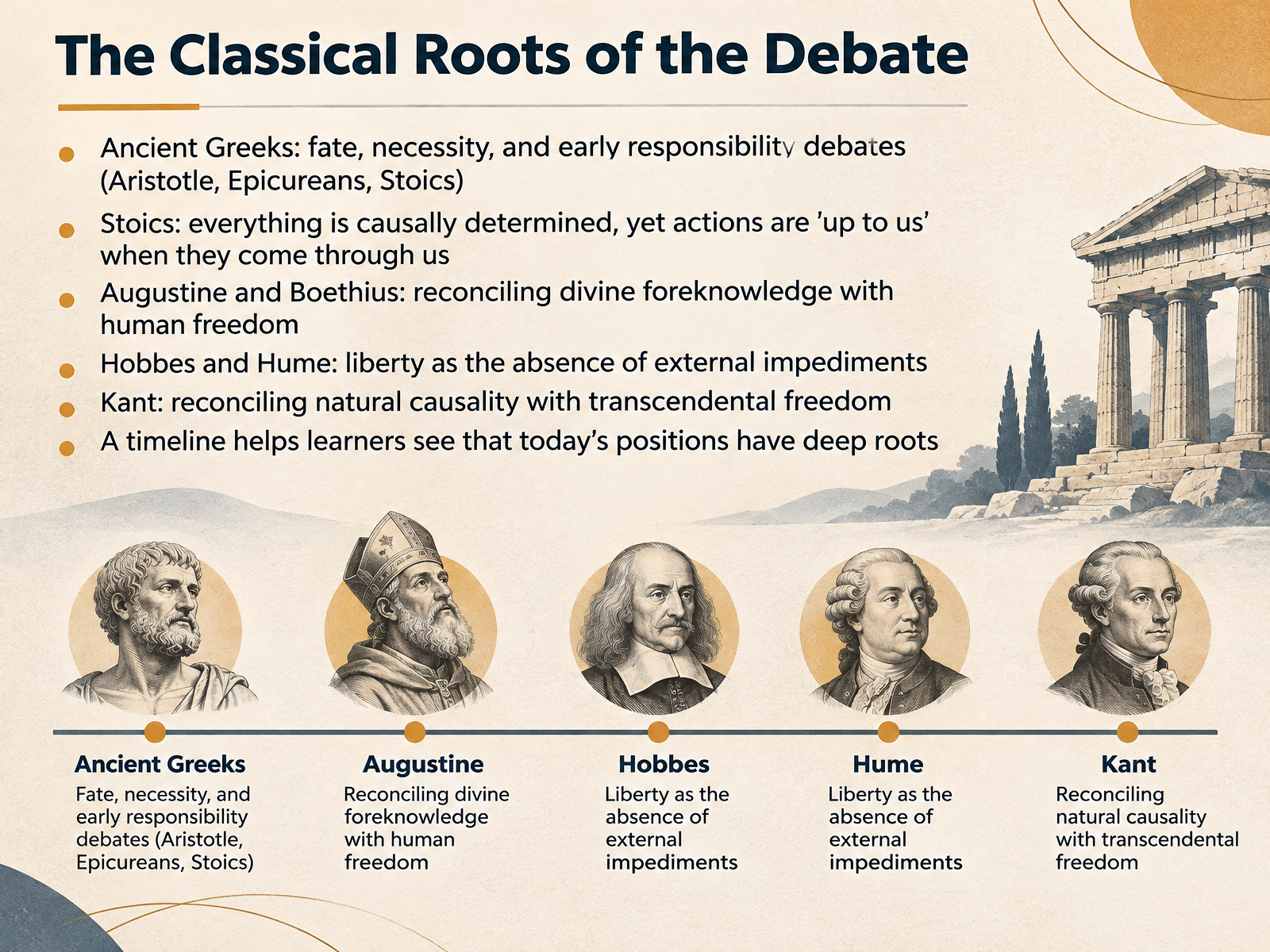
- 03The Classical Roots of the DebateNow let's trace where these questions began. From Aristotle onward, ancient Greek thinkers asked when we are responsible for what we do, and what makes deliberation worthwhile. The Epicureans and Stoics joined the debate, often worried about fate and necessity. The Stoics held that everything is causally determined, yet actions are up to us when they come through us. Augustine and Boethius then asked how divine foreknowledge could leave room for human freedom. Much later, Hobbes and Hume defined liberty as the absence of external impediments preventing us from doing what we want. Kant tried a bold reconciliation: determinism governs nature, while a transcendental, non-empirical freedom belongs to the moral self. Consider how each answer reflects its era, and where you would place yourself on this long spectrum. Carry this question forward: if the past shapes us, what kind of freedom is still worth defending? Next, we examine hard determinism, which answers no freedom, no responsibility.
 plato.stanford.eduargumenta.orgplato.stanford.edu+22 min
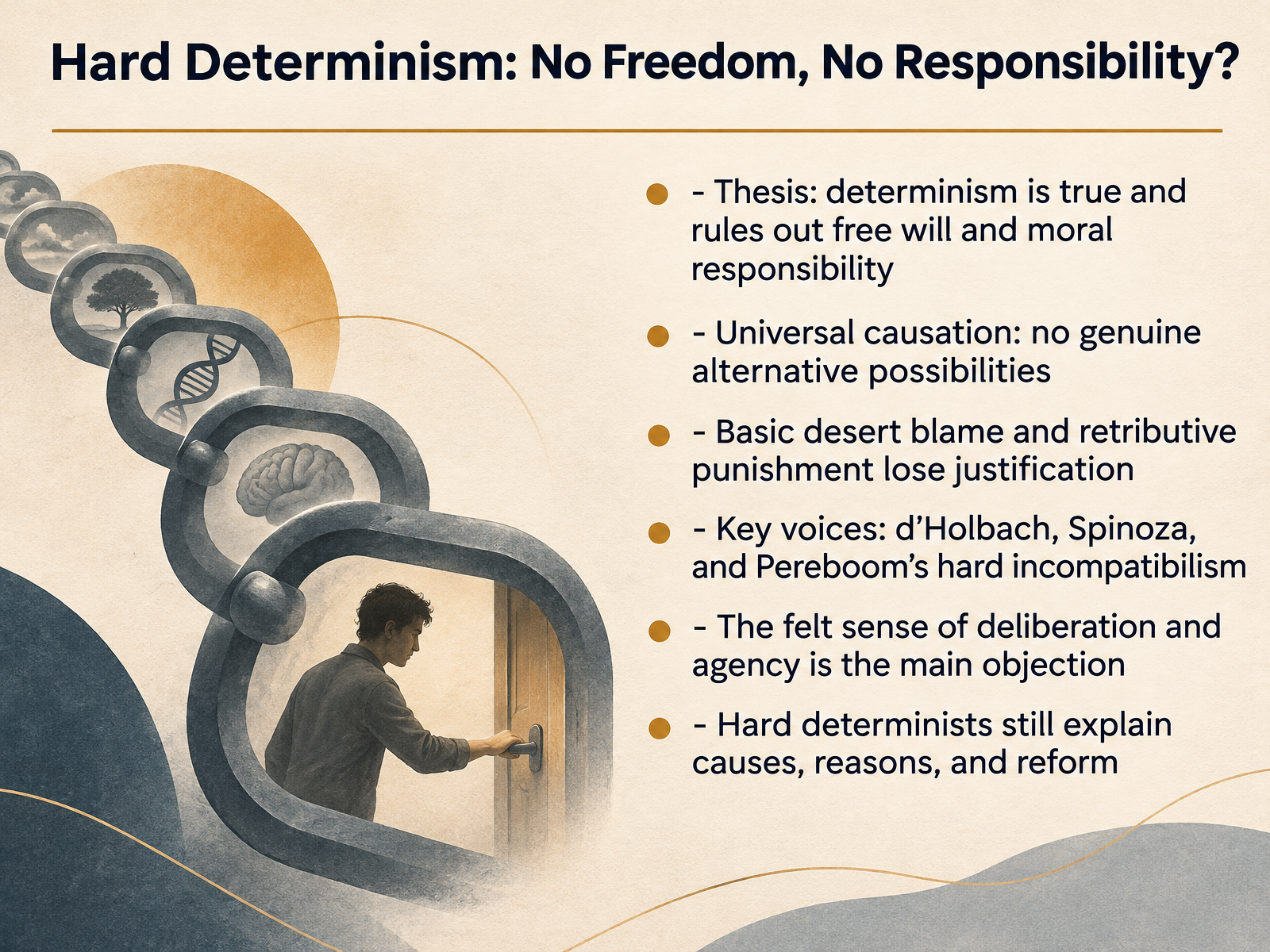
- 04Hard Determinism: No Freedom, No Responsibility?Now let's turn to hard determinism, the view that determinism is true and that it rules out free will and moral responsibility. Determinism, remember, is the thesis that every event, including every choice you make, is the inevitable result of earlier events and the laws of nature. Hard determinists add that this leaves no genuine alternative possibilities, so you could never have done otherwise. Consider a student deciding to cheat on an exam. The hard determinist says that decision was fixed by prior causes, long before the student sat down. And with basic desert removed, the idea that someone simply deserves blame, or retributive punishment, loses its justification. Key voices include d'Holbach, Spinoza, and Pereboom's hard incompatibilism. The main objection is the felt sense of deliberation, the experience that you are genuinely weighing options. Hard determinists reply that causes, reasons, and reform still matter, even without desert. So pause here and ask yourself, where would you place yourself on this spectrum? Carry this question forward: could we have done otherwise? That leads us to libertarian free will.
 plato.stanford.eduplato.stanford.eduhuman.libretexts.org+22 min
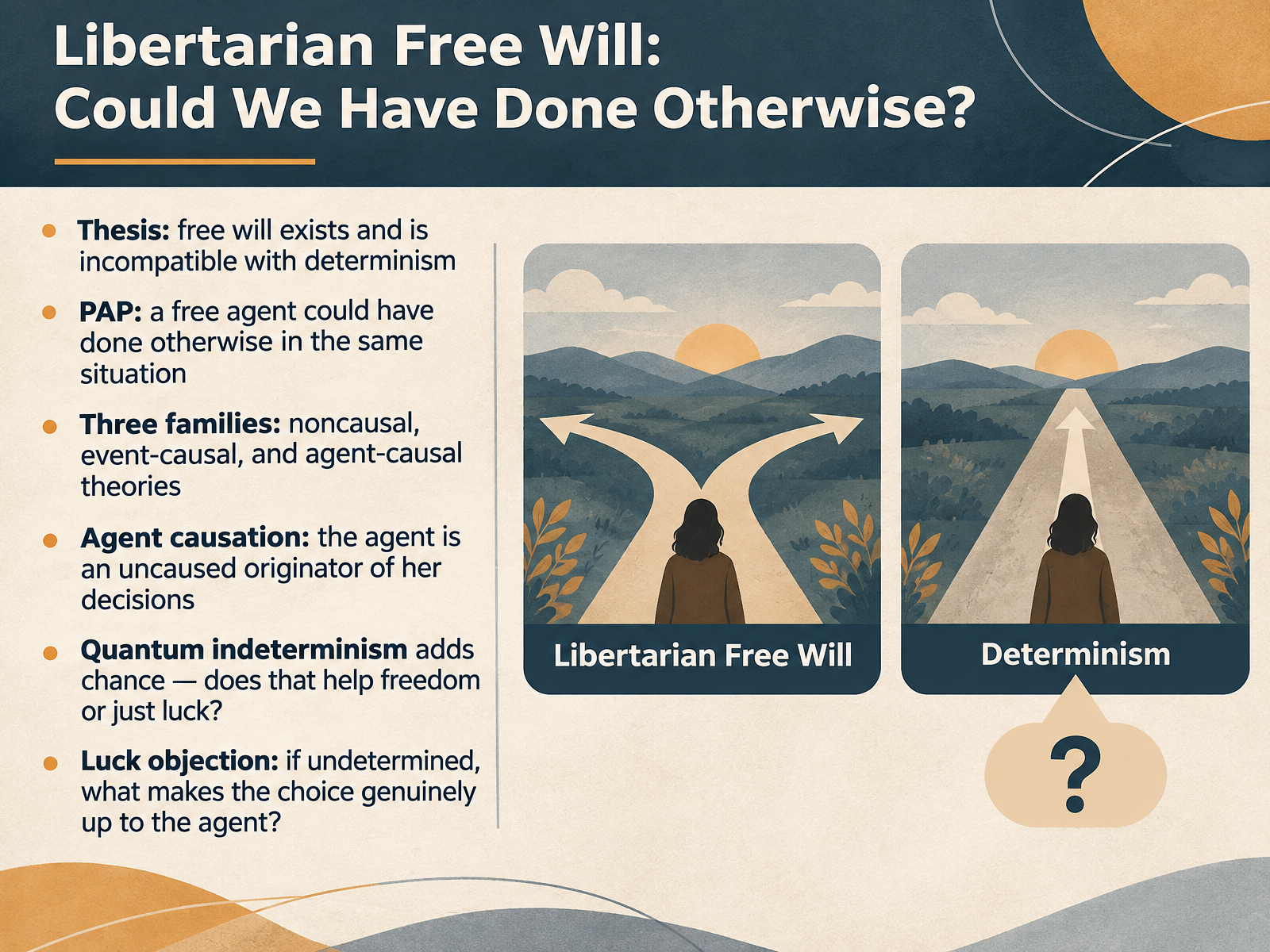
- 05Libertarian Free Will: Could We Have Done Otherwise?Now let's look at libertarian free will. This is the view that free will exists, and that it is incompatible with determinism, meaning it cannot coexist with the idea that prior events fully fix what you do. Its core principle is the principle of alternative possibilities: a free agent could have done otherwise in the exact same situation. For example, you chose tea this morning, but on this view, you truly could have chosen coffee. Libertarians come in three families: noncausal, event-causal, and agent-causal theories. Agent causation says the agent herself is an uncaused originator of her decisions. Here is the worry: if a choice is undetermined, is it really yours, or just luck? Where would you place yourself on this spectrum? Carry this question forward: what makes a choice genuinely up to you? Next, we turn to compatibilism: freedom within a determined world.
 plato.stanford.edu2 min
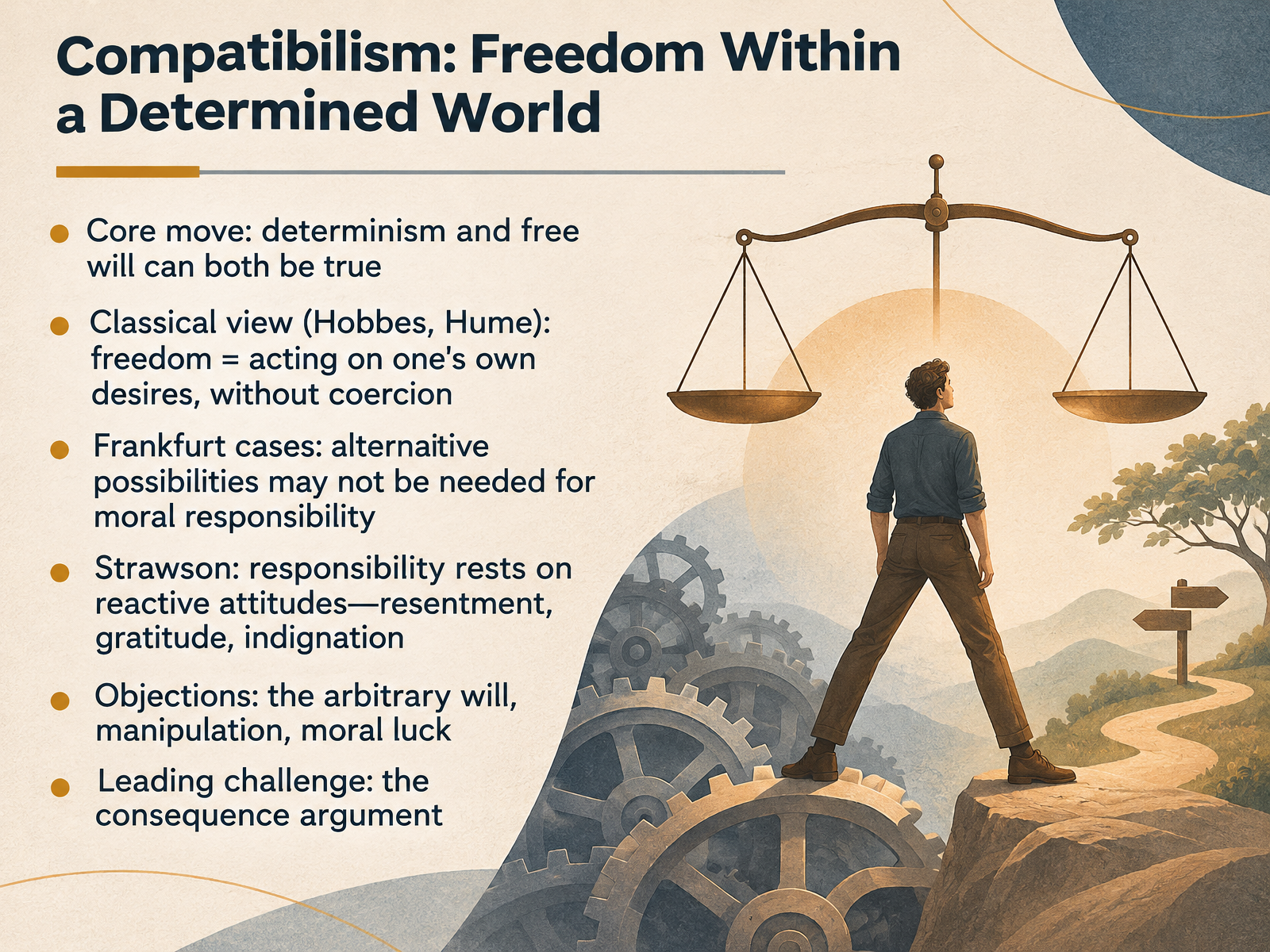
- 06Compatibilism: Freedom Within a Determined WorldNow let's look at a middle path. Compatibilism holds that determinism and free will can both be true. The classical version, associated with Hobbes and Hume, defines freedom as acting on your own desires, without coercion. Consider a student who chooses to study because she wants to learn. Nobody forces her, so the choice seems free, even if her desires have causes. Then Frankfurt cases suggest that alternative possibilities may not be needed for moral responsibility. Strawson adds that responsibility rests on reactive attitudes, such as resentment, gratitude, and indignation. These attitudes arise within our relationships, not from a metaphysical verdict. Still, objections remain: the arbitrary will, manipulation, and moral luck. The leading challenge is the consequence argument. Where would you place yourself on this spectrum? Carry that question forward, as we turn to the consequence argument and manipulation arguments.
 plato.stanford.edu2 min
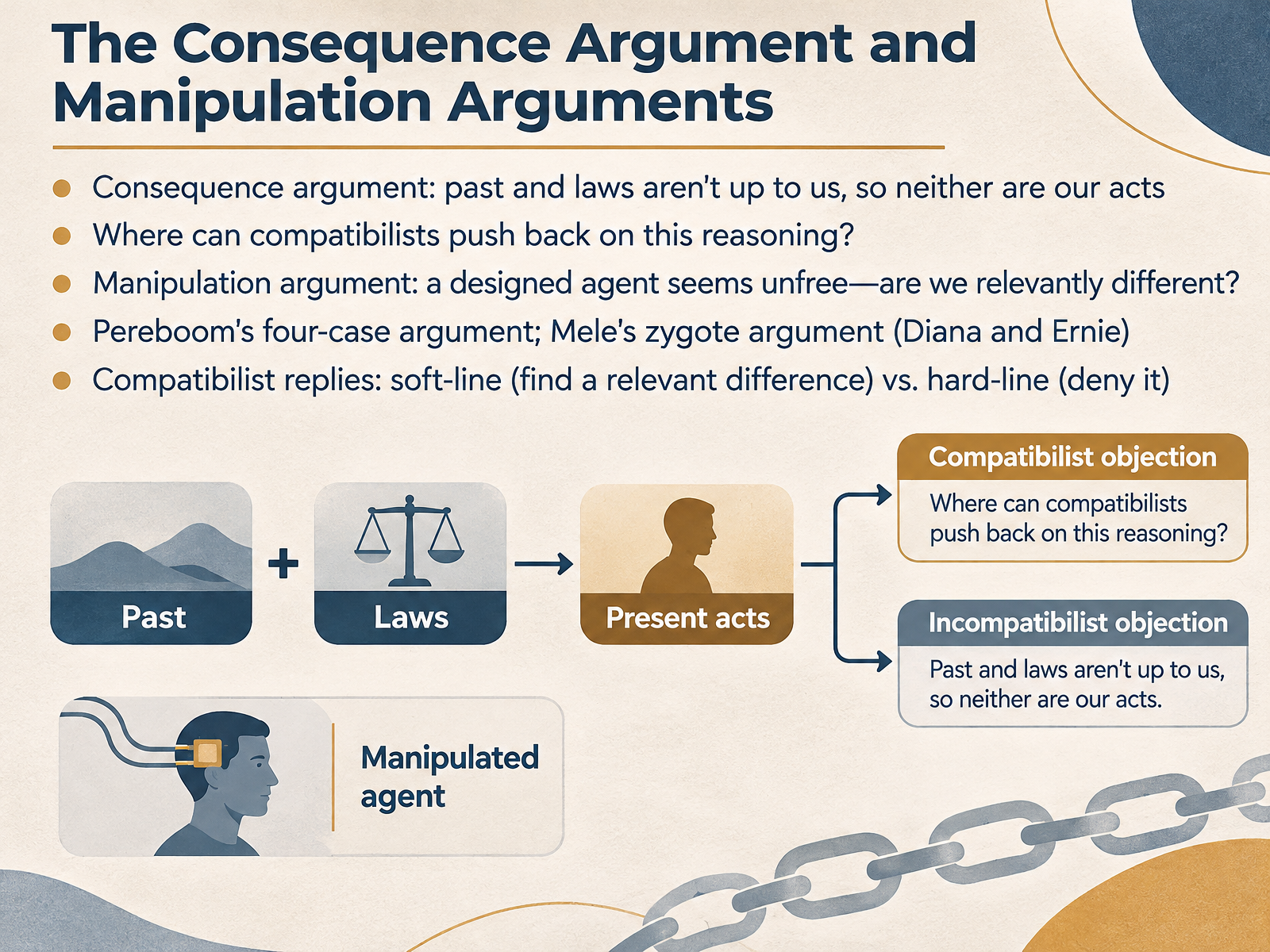
- 07The Consequence Argument and Manipulation ArgumentsNext, two arguments that push hard against compatibilism. The Consequence Argument says our acts follow from the remote past and the laws of nature. The past is not up to us, the laws are not up to us, so neither are our acts. Compatibilists push back by questioning that reasoning, often by redefining what it means to be able to do otherwise. Then the Manipulation Argument: an agent designed by another seems unfree, yet we are not relevantly different. Pereboom offers four cases, and Mele offers the zygote story of Diana and Ernie. Compatibilists reply two ways: the soft-line finds a relevant difference, while the hard-line denies one exists. Where would you place yourself on that spectrum? Carry this into the next section, Science and the Will: What Neuroscience Suggests.
 plato.stanford.eduplato.stanford.eduopenstax.org1 min
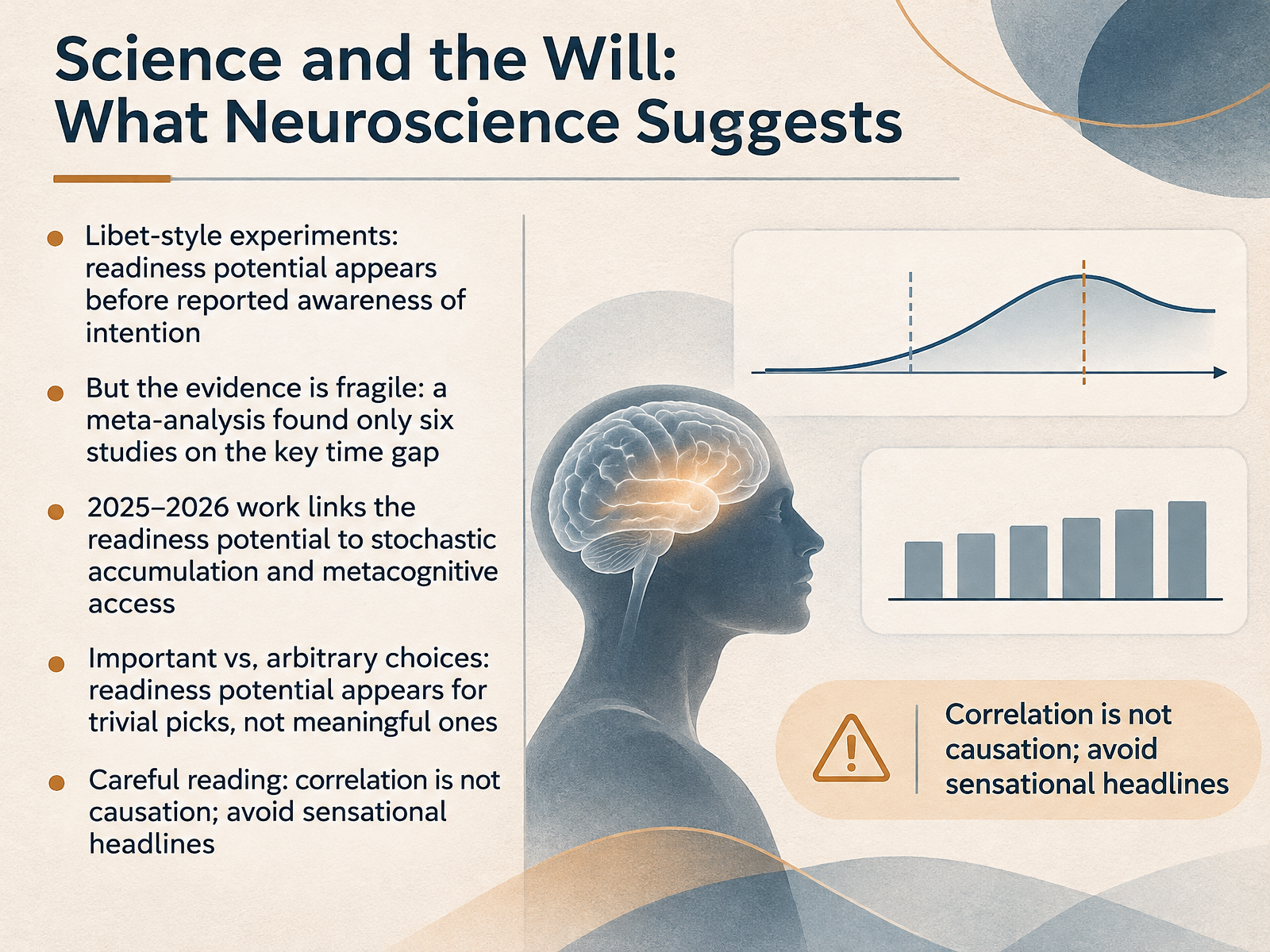
- 08Science and the Will: What Neuroscience SuggestsLet's turn now to what neuroscience suggests about the will. You may have heard of Libet-style experiments. In these studies, a readiness potential, a measurable pattern of brain activity, appears before people report being aware of their intention to move. That sounds dramatic. But consider the evidence. A meta-analysis, a study that pools results across many experiments, found only six studies measuring that key time gap. That is a fragile foundation for a sweeping conclusion. More recent work reinterprets the readiness potential as stochastic accumulation, meaning the brain gradually builds noisy signals until they cross a threshold. And a striking finding: the readiness potential shows up for trivial, arbitrary picks, like choosing a balloon, but not for meaningful choices, like where a real donation goes. So correlation is not causation, and sensational headlines deserve your skepticism. Pause here and put it in one sentence: brain activity before awareness is a real clue, but it does not settle the question of freedom. Where would you place yourself on that spectrum? Carry this question forward: if our brains decide trivial things automatically, what happens with the choices that matter? That leads us to psychology, situationism, and automaticity.
 2 min
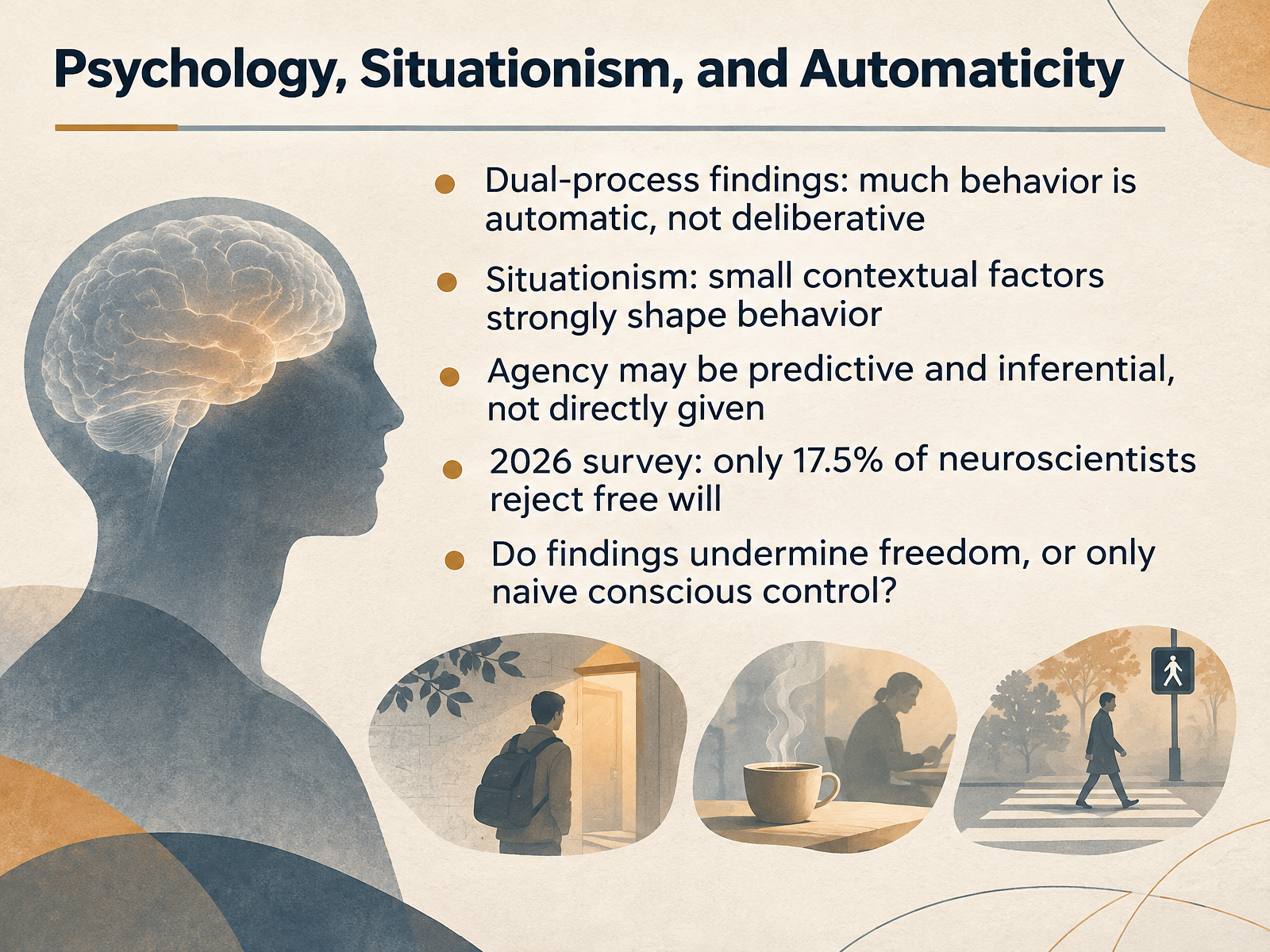
- 09Psychology, Situationism, and AutomaticityLet's turn now to what psychology and neuroscience actually suggest about how decisions get made. Dual-process findings show that much of our behavior is automatic rather than deliberative. When you drive a familiar route and arrive with little memory of the trip, that is automaticity at work. Situationism adds that small contextual factors, like whether you are rushed or whether a stranger is watching, can strongly shape what you do. Some researchers now describe agency as predictive and inferential, a feeling built from cues, not something directly given to us. And in a twenty twenty-six survey, only seventeen point five percent of neuroscientists rejected free will. So consider the real question here. Do these findings undermine freedom, or only naive conscious control? Where would you place yourself on that spectrum? Carry that question into our next topic, Practical Stakes: Responsibility, Punishment, and Everyday Life.
 2 min
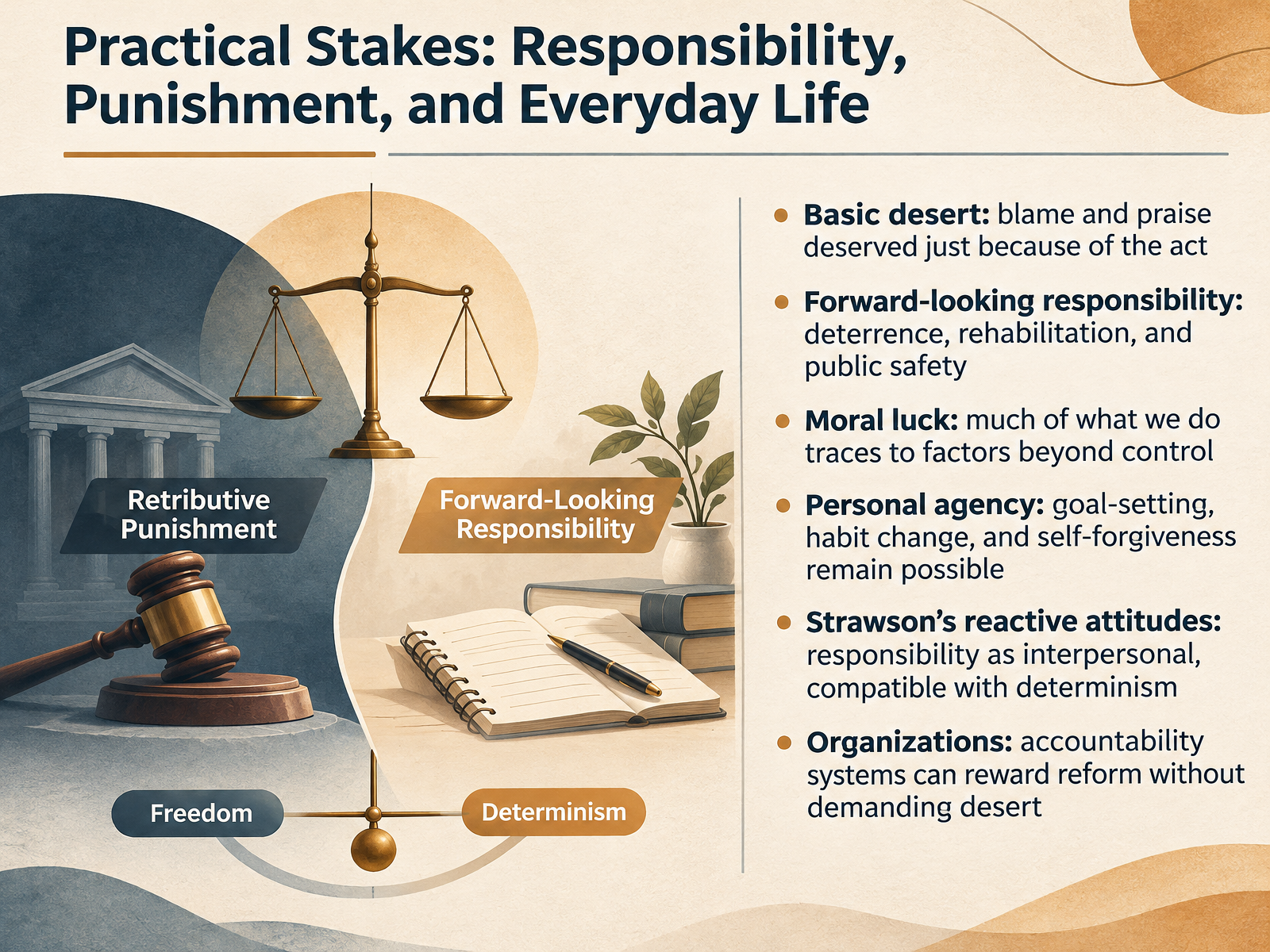
- 10Practical Stakes: Responsibility, Punishment, and Everyday LifeLet's turn to why this debate matters in practice. Basic desert means you deserve blame or praise just because of the act itself. Forward-looking responsibility instead asks what response will deter harm, support rehabilitation, or protect the public. Moral luck reminds us that much of what we do traces to factors beyond our control. Still, personal agency remains possible through goal setting and habit change. Strawson's reactive attitudes describe responsibility as interpersonal, as our responses of resentment and gratitude, and he argues these can survive determinism. Organizations can design accountability systems that reward reform without demanding pure desert. So, where would you place yourself on this spectrum? Carry that question into our next session as a case workshop, where we analyze real-world responsibility cases.
 plato.stanford.eduplato.stanford.edu1 min
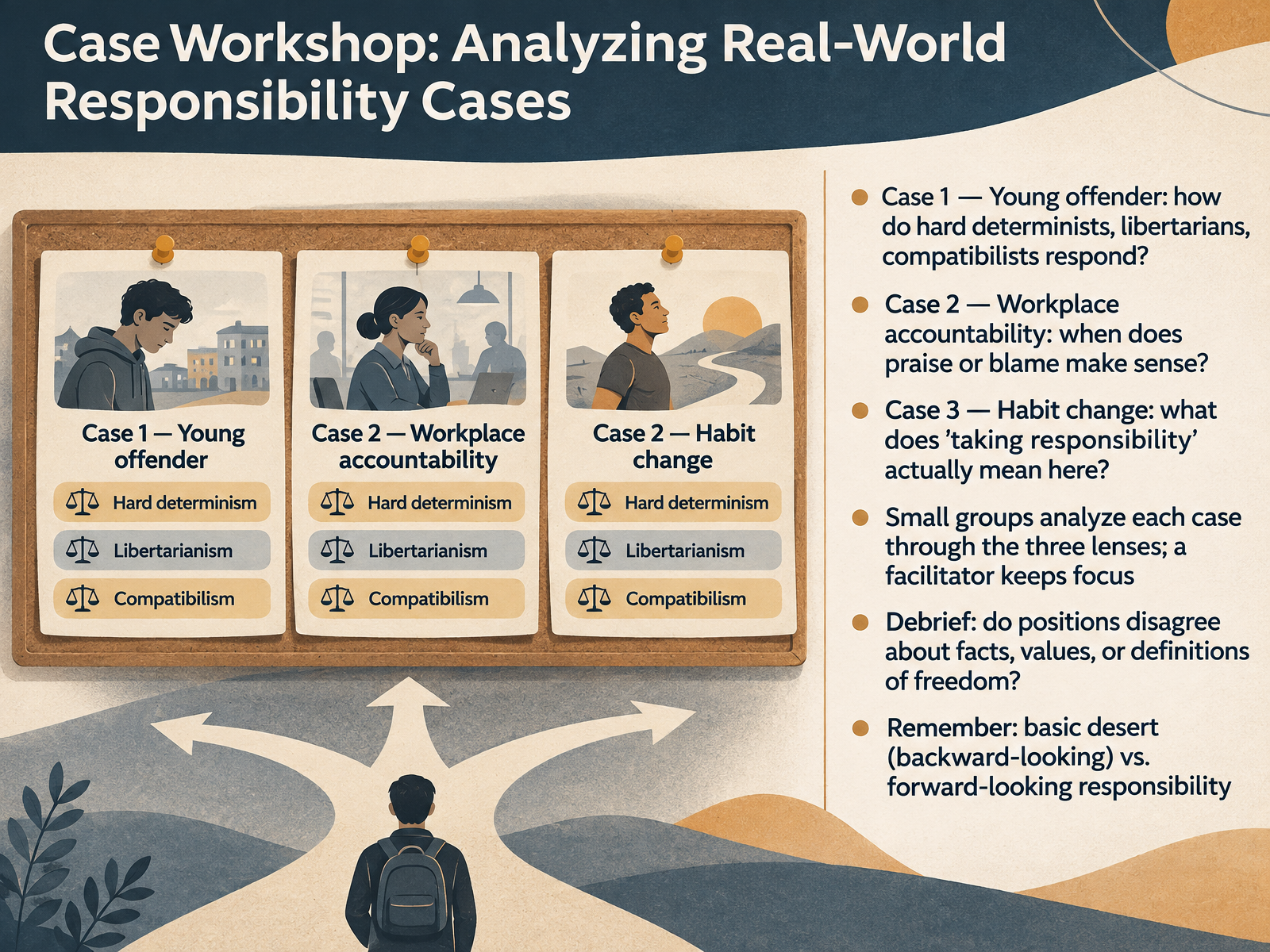
- 11Case Workshop: Analyzing Real-World Responsibility CasesNow let's put these three lenses to work on concrete cases. In small groups, analyze three scenarios through hard determinist, libertarian, and compatibilist eyes. First, a young offender: does each view support blame, rehabilitation, or both? Second, workplace accountability, where you ask when praise or blame actually makes sense. Third, habit change, where you ask what taking responsibility really means. A facilitator keeps each group focused. In the debrief, ask whether the positions disagree about facts, about values, or simply about the definition of freedom. Hold onto one distinction: basic desert looks backward, while forward-looking responsibility asks what we should do next. Where would you place yourself on this spectrum? Carry that question into the next session, where you will form your own view. That brings us to the Discussion Lab: Forming Your Own View.
 plato.stanford.eduplato.stanford.edu2 min
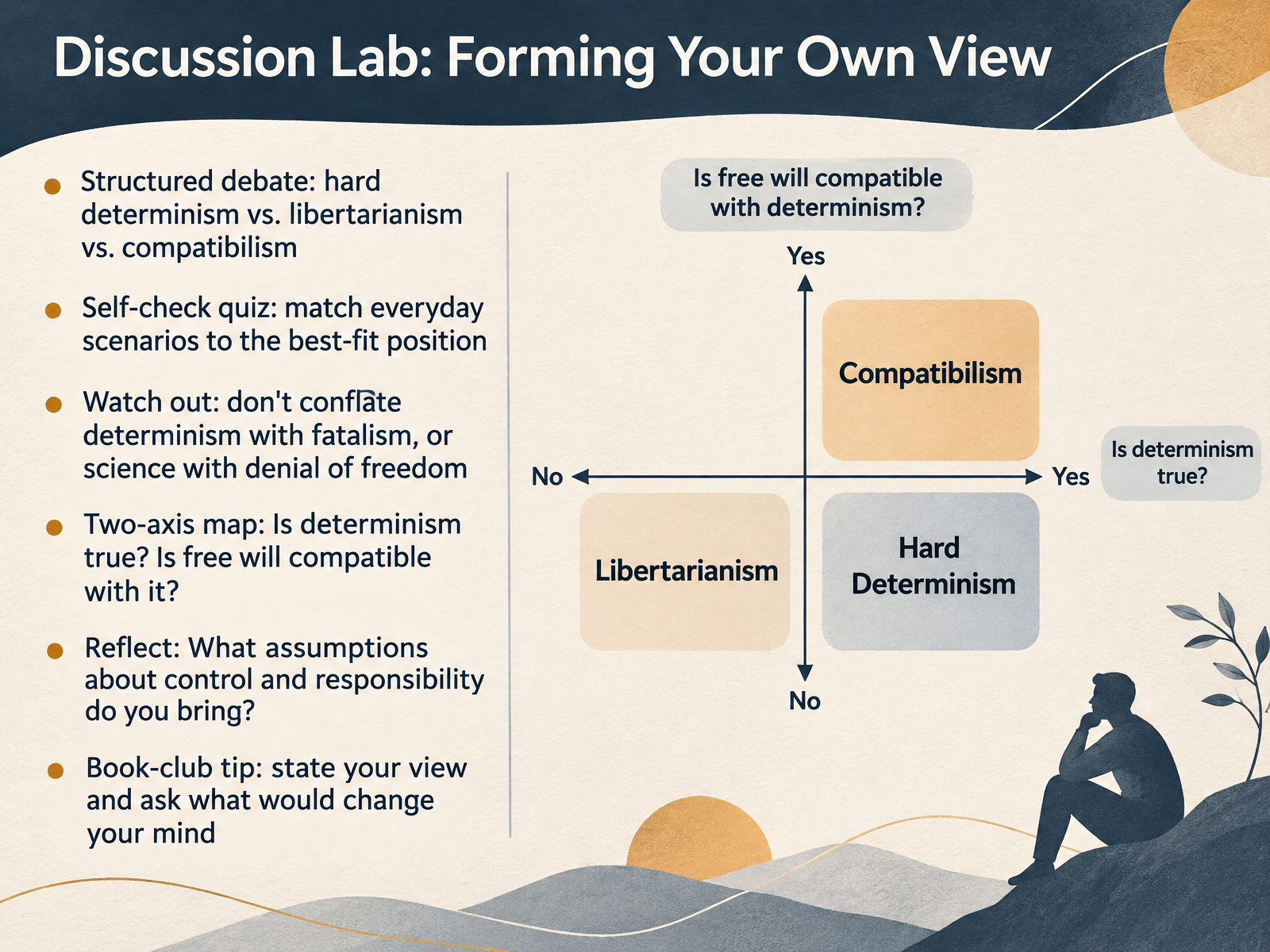
- 12Discussion Lab: Forming Your Own ViewNow let us put these ideas to work, in a discussion lab where you form your own view. Here is one structure. Stage a debate between hard determinism, libertarianism, and compatibilism, and give each position an equal hearing. Then try a self-check quiz. Match everyday scenarios, like a friend breaking a promise or a driver choosing to stop, to the position that fits best. Watch out for two common slips. Do not conflate determinism with fatalism, since fatalism says outcomes are fixed no matter what you do. And do not treat science as proof that freedom is an illusion. A useful tool is a two-axis map. Ask first, is determinism true? Then ask, is free will compatible with it? That places every position on one map. So carry this question forward. Which assumptions about control and responsibility do you bring to the debate? Now let us turn to reading paths for beginners.
 1 min
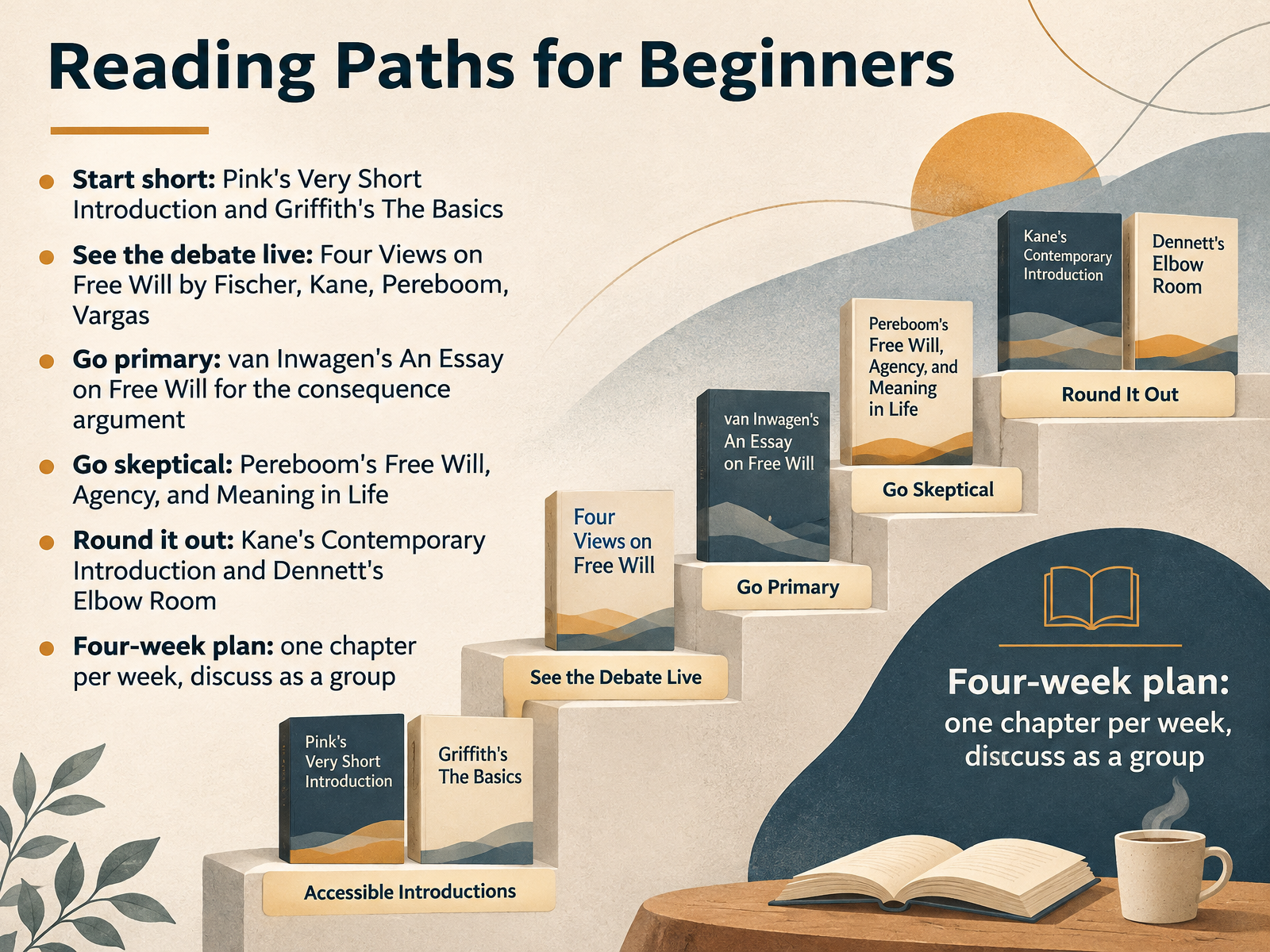
- 13Reading Paths for BeginnersSo where should you actually begin reading? Start short. Thomas Pink's Very Short Introduction and Meghan Griffith's Free Will: The Basics each define the core terms without overwhelming you. To see the debate live, try Four Views on Free Will by Fischer, Kane, Pereboom, and Vargas, where each philosopher answers the others directly. When you want a primary source, go to van Inwagen's An Essay on Free Will for the consequence argument. For the skeptical case, read Pereboom's Free Will, Agency, and Meaning in Life. Round it out with Kane's Contemporary Introduction and Dennett's Elbow Room. Here is a four week plan: one chapter per week, discussed as a group. Which book will you open first? Next, we will map your next steps and continuing study.
 2 min
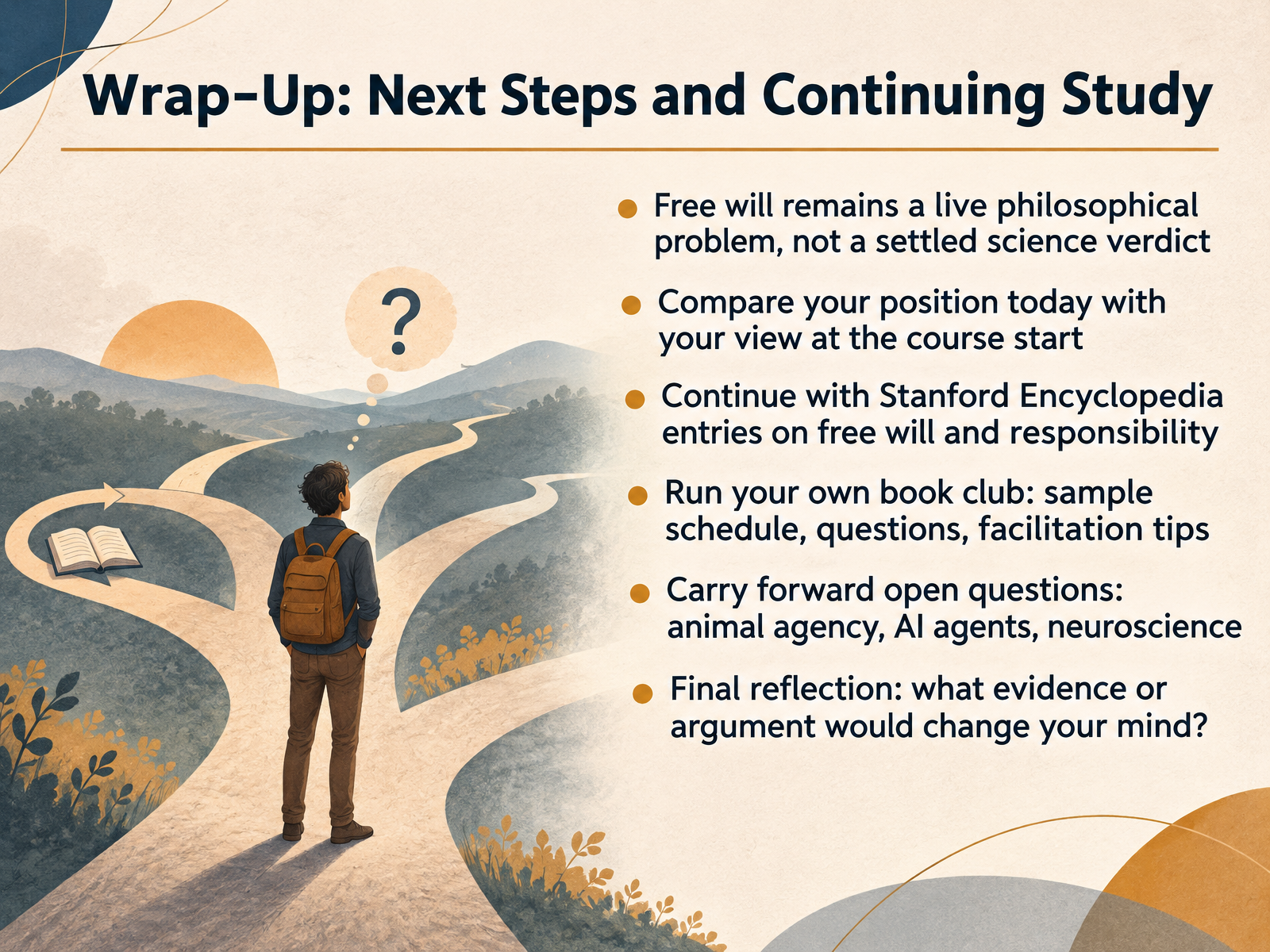
- 14Wrap-Up: Next Steps and Continuing StudyLet's bring this course to a close. First, remember that free will remains a live philosophical problem, not a settled science verdict. Second, compare your position today with your view at the course start. You may find your reasons have shifted, even if your label has not. For continuing study, the Stanford Encyclopedia entries on free will and moral responsibility are reliable, free, and regularly updated. You could also run your own book club. Pick one book, such as Four Views on Free Will, and meet weekly. Invite each member to state a position, then defend it against one objection. Where would you place yourself on the animal and A I question? Neither is resolved. Finally, keep one final reflection with you. What evidence or argument would change your mind? That question keeps inquiry honest. Thank you for thinking with me. Keep reading, keep questioning, and stay open to revision.
 2 min
Take the deck with you
Download this course as a file — free, no sign-up needed.
- PDF handoutEvery slide page, ready to print or share.15 pages · 5.6 MBDownload
- Narrated PowerPointThe deck that presents itself — every slide carries the digital human's narration video.15 pages · 14.5 MBDownload
- PowerPoint slidesThe full deck as a .pptx — open it in PowerPoint, Keynote, or Google Slides.15 pages · 5.5 MBDownload
Free to use in your own training — please keep the PersonWise credit page at the end.
Have your own deck? Turn it into a course
Sources consulted
Web sources consulted while building this course.
- 6.4 Free Will - Introduction to Philosophy | OpenStax — openstax.org
- Determinism vs Free Will: Crash Course Philosophy #24 — thecrashcourse.com
- Start Here: Free Will and Determinism - Philosophical Investigations — peped.org
- Existence of Free Will – A Brief Introduction to Philosophy — pressbooks.openeducationalberta.ca
- Free Will | Psychology Today — psychologytoday.com
- Causal Determinism (Stanford Encyclopedia of Philosophy) — plato.stanford.edu
- Fatalism (Stanford Encyclopedia of Philosophy) — plato.stanford.edu
- What Is Fatalism? — verywellmind.com
- Fatalism - Oxford Reference — oxfordreference.com
- fatalism vs. determinism | Dictionary.com — dictionary.com
- Ancient Theories of Freedom and Determinism (Stanford Encyclopedia of Philosophy) — plato.stanford.edu
- The History and Philosophy of Free Will: An Introduction — argumenta.org
- Free Will (Stanford Encyclopedia of Philosophy) — plato.stanford.edu
- The Routledge Companion to Free Will | Kevin Timpe, Meghan Griffith, G — taylorfrancis.com
- A brief history of the concept of free will: issues that are and are not germane to legal reasoning — onlinelibrary.wiley.com
- Skepticism About Moral Responsibility (Stanford Encyclopedia of Philosophy) — plato.stanford.edu
- Arguments for Incompatibilism (Stanford Encyclopedia of Philosophy) — plato.stanford.edu
- 4: Free Will, Determinism, and Responsibility — human.libretexts.org
- Hard determinism — en.wikipedia.org
- Traditional and Experimental Approaches to Free Will and Moral Responsibility — doi.org