Begin
14 pages · ~28 min
Negotiation Essentials
Learn key negotiation concepts and techniques, understand their purpose in professional settings, and apply them through practical examples to improve outcomes.
A digital instructor presents all 14 pages. Hold “Ask” at any point and ask out loud — the answer comes from this course. No sign-up needed.
What you’ll learn
- 01Negotiation Skills: Concepts, Purpose, and ExamplesWelcome. This course is designed to sharpen your negotiation skills, whether you are leading a sales cycle, managing a project, or aligning stakeholders. We will move past the idea that negotiation is a battle of wills. Instead, we will treat it as a structured, collaborative process. The goal is to solve problems and reach an agreement that both sides can accept and sustain. You will see that this is not a rare event. It is a daily capability for managers, account teams, and project leads. We will start by building a solid foundation. You will learn to identify underlying interests, create value beyond price, and define your walk-away point. We will also cover the zone of possible agreement, often called ZOPA, and why preparation is your strongest asset. To make this practical, we will use real business examples. And finally, you will build a thirty-day practice plan to apply these skills immediately. Let's begin by exploring why negotiation is a strategic business capability.pon.harvard.eduonline.hbs.eduindeed.com+21 min
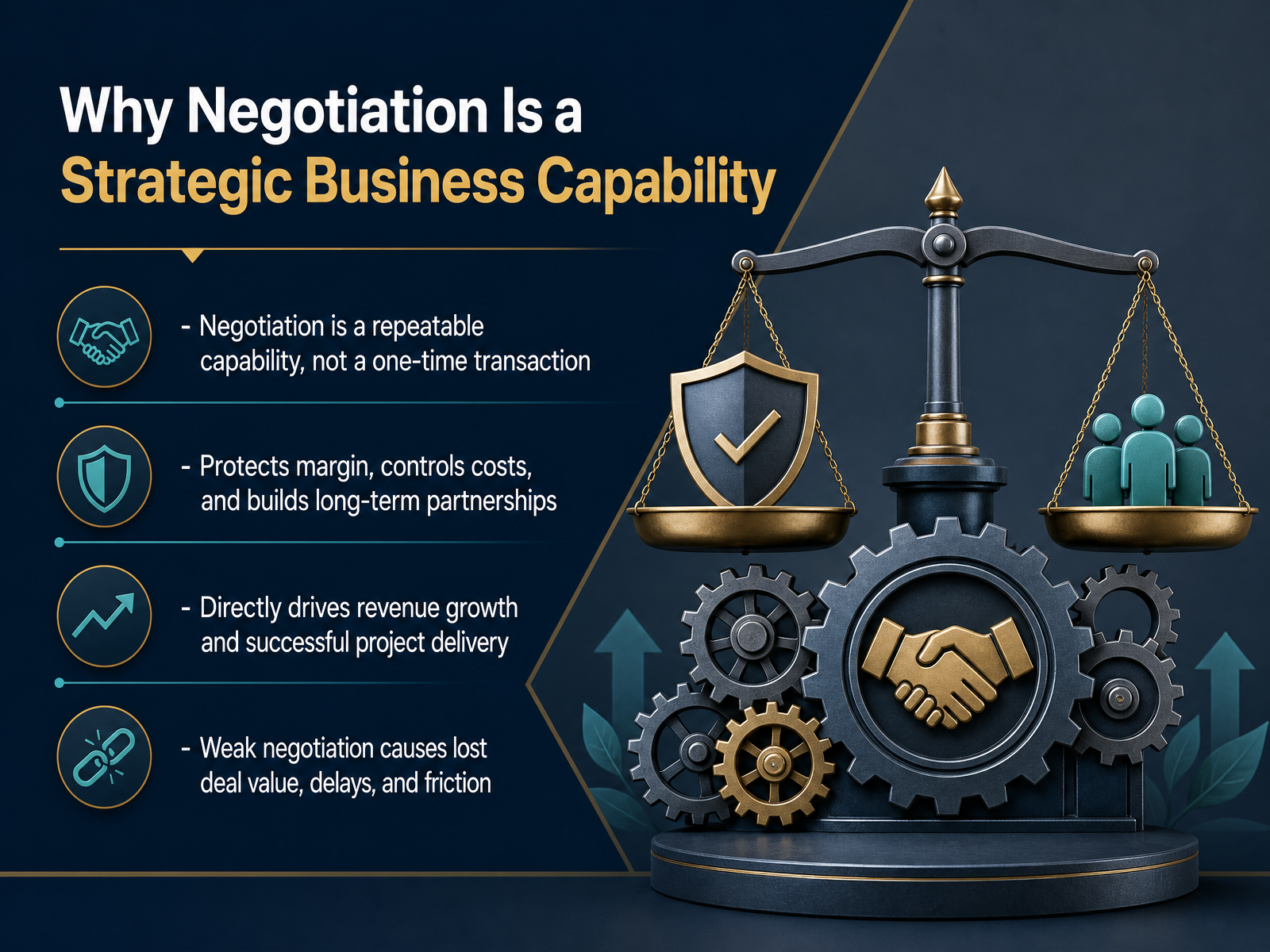
- 02Why Negotiation Is a Strategic Business CapabilitySo why do we treat negotiation as a strategic business capability, not just a soft skill? Because when it's done well, it directly protects your margin and controls costs on every single deal. Research shows organizations can lose up to sixty percent of their deal value through poor negotiation and implementation. That is a massive amount of revenue leaking out of your business. On the flip side, top negotiators consistently achieve three times more value for their organizations. This isn't about winning a one-time argument. It's a repeatable process that builds long-term partnerships and drives successful project delivery. When negotiation is weak, you see the symptoms everywhere: lost deal value, stalled timelines, and friction between teams. When it's strong, it becomes a competitive advantage that shows up directly on the bottom line. Next, let's break down the core concepts of positions, interests, and how to create value.
 gprjournals.orghbr.orginfo.vantagepartners.com+21 min
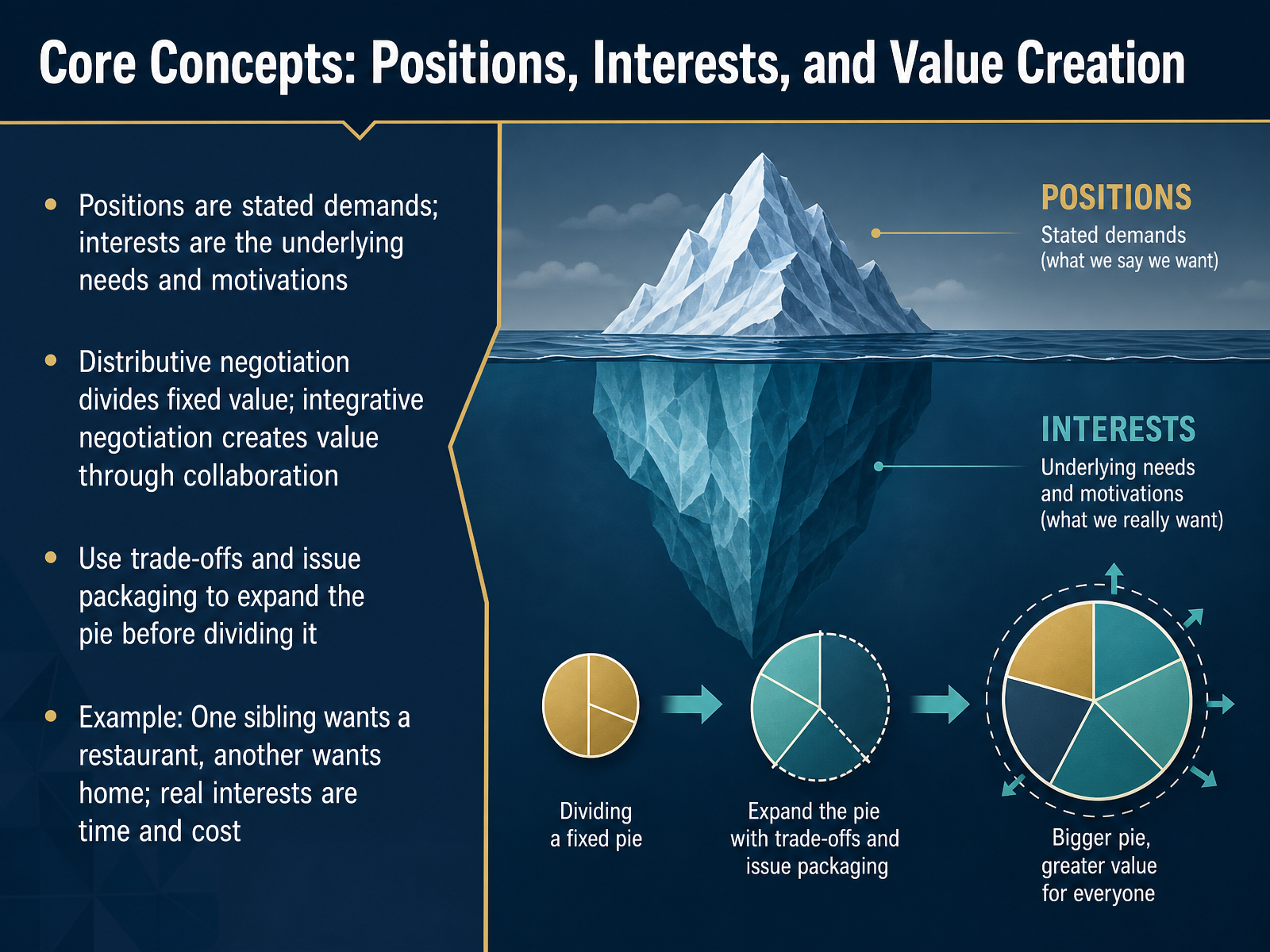
 - 03Core Concepts: Positions, Interests, and Value CreationNow let's get into the core mechanics. When a client pushes back on price, you're usually hearing a position, a stated demand. Behind that demand is an interest, the real need or motivation. Your job is to uncover it. Think of it this way. Distributive negotiation assumes a fixed pie. You're just fighting over slices. Integrative negotiation is different. You work together to make the pie bigger before you divide it. You do that by using trade-offs and issue packaging. For example, consider two siblings. One insists on a restaurant. The other insists on eating at home. Those are their positions. But look closer. The restaurant advocate is short on time. The one who wants to stay home is worried about cost. Those are their real interests. Once you see that, an affordable restaurant solves the problem. So, before you make your next concession, ask yourself, what do we both really need here? That question sets up our next topic, how to prepare with your BATNA, ZOPA, and reservation points.
 pon.harvard.edupon.harvard.edupublishing.insead.edu+21 min
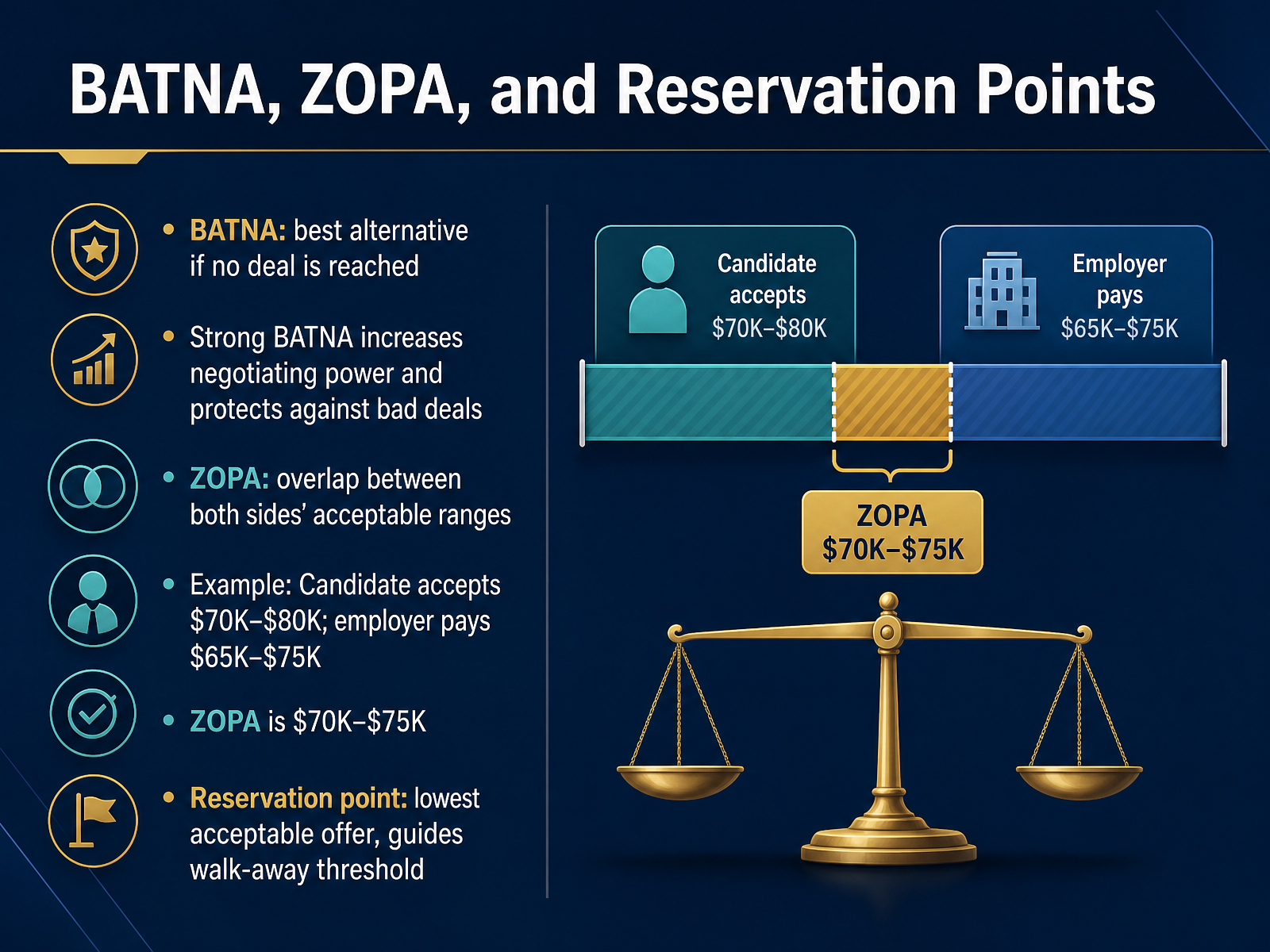
 - 04BATNA, ZOPA, and Reservation PointsNow let’s look at the preparation tools that tell you when to keep negotiating and when to walk away. Start with your BATNA, your best alternative to a negotiated agreement. It is the course of action you will take if no deal is reached. A strong BATNA does two things. It increases your negotiating power, and it protects you from accepting a bad deal. If a client pushes back hard on price, you can hold your position when you know you have another viable option. Next is the reservation point. This is your walk-away threshold, the lowest offer you would accept. It is set by your BATNA. Then consider the ZOPA, the zone of possible agreement. This is the overlap between both sides' acceptable ranges. For example, a candidate may accept between seventy thousand and eighty thousand dollars. The employer is willing to pay between sixty five thousand and seventy five thousand dollars. The ZOPA is seventy thousand to seventy five thousand. Deals only happen inside that overlap. Know your BATNA, know your limit, and know the zone. Up next, we will focus on preparation, the highest-leverage negotiation skill.
 pon.harvard.edugphjournal.orgredcliffetraining.com+22 min
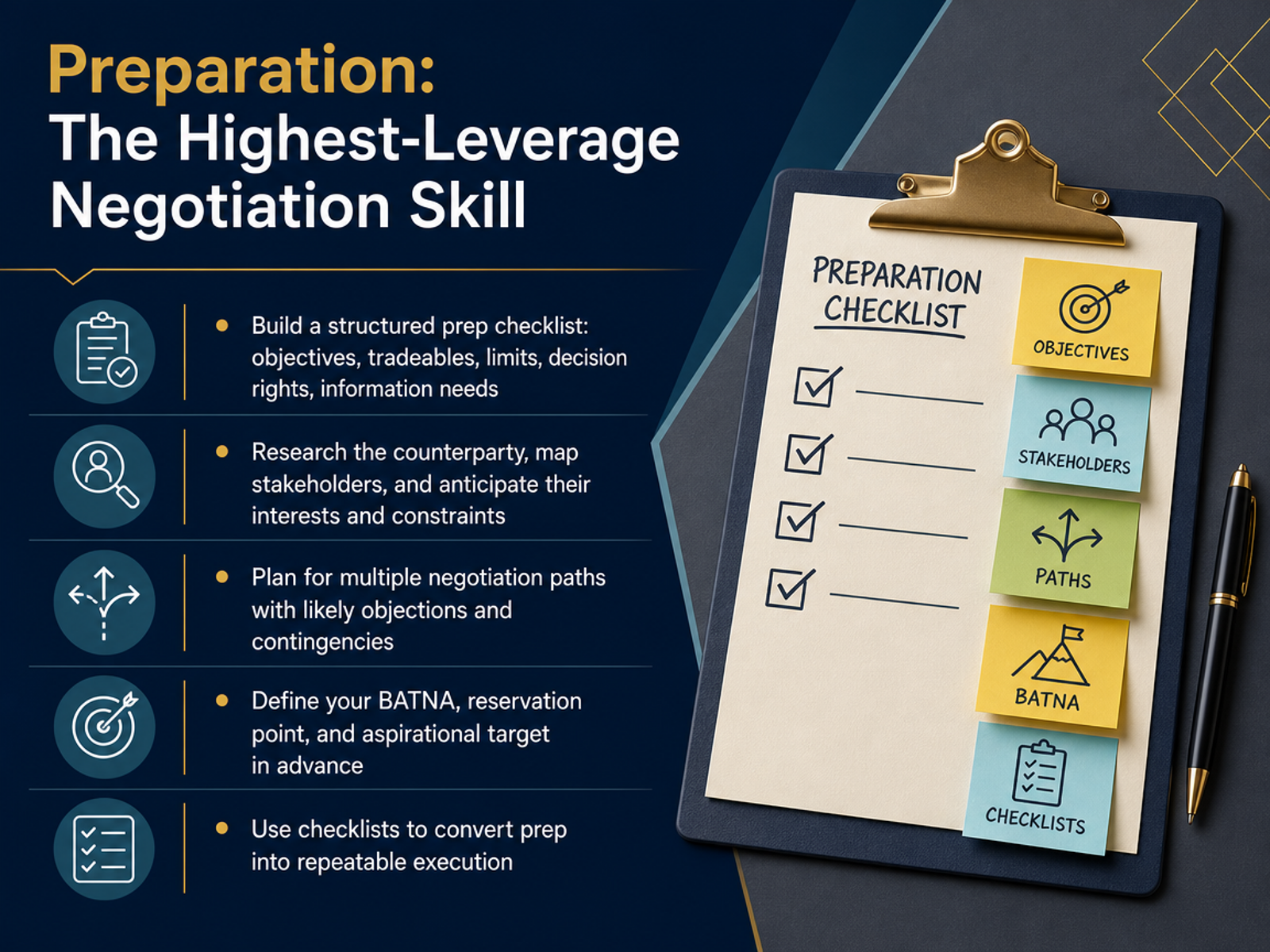
 - 05Preparation: The Highest-Leverage Negotiation SkillPreparation is the most reliable source of leverage you can control. Before any important conversation, build a structured checklist. Capture your objectives, what you can trade, your limits, who holds decision rights, and what information you still need. Then research the other party. Map their stakeholders and anticipate their interests and constraints. For example, a procurement lead may care most about total cost of ownership, while an operations lead may focus on implementation speed. Plan for multiple paths. List the likely objections and prepare your responses in advance. You should also define three numbers before you sit down. First, your BATNA, your best alternative if this deal fails. Second, your reservation point, the line you will not cross. Third, your aspirational target, the ambitious but justifiable outcome you want. These are not guesses. They are decisions you make with a clear head. Finally, use a repeatable checklist. This turns preparation into execution and keeps your team consistent from one negotiation to the next. That discipline carries directly into the next topic: Tactics That Work, Anchoring, Asking, and Concession Management.
 pon.harvard.edu1 min
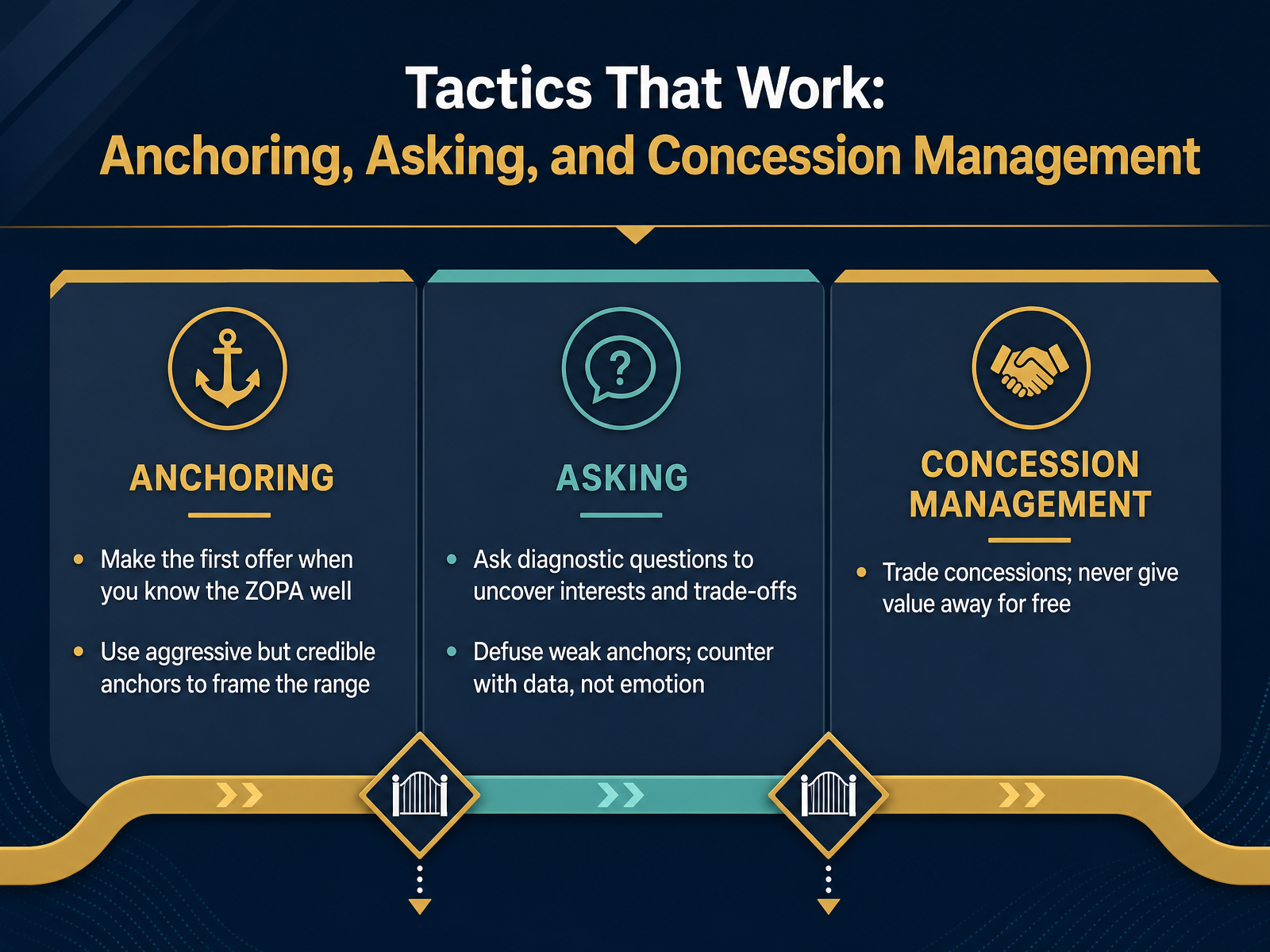
 - 06Tactics That Work: Anchoring, Asking, and Concession ManagementLet's focus on the tactics that move a deal forward. First, consider anchoring. When you know the zone of possible agreement well, make the first offer. An aggressive but credible anchor frames the entire range and gives you the advantage. If the other side anchors first, don't accept it implicitly. Defuse it. Use data and objective standards, not emotion, to counter their number. Second, ask more than you tell. Diagnostic questions uncover the real interests and trade-offs behind their position. You are looking for what they value most, so you can offer that in exchange for what you need. Third, practice concession management. Never give value away for free. Every concession you make should be traded for something in return. If you move on price, ask for better terms, volume, or timing. This keeps the negotiation balanced and communicates that your flexibility has a cost. Remember, the goal is not just to close, but to close a deal that protects your interests. Up next, we will cover the communication skills that make these tactics work in a live conversation.
 2 min
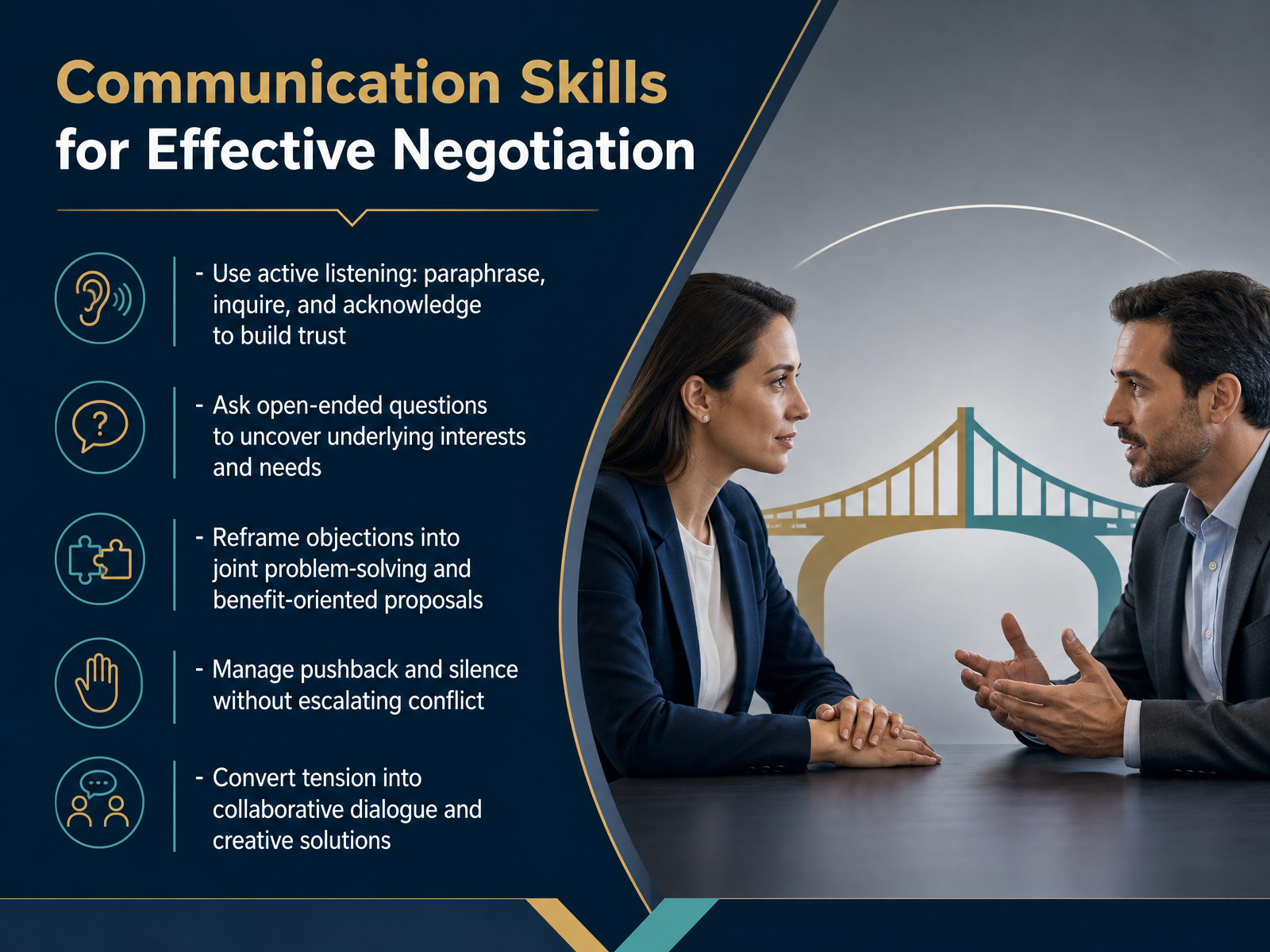
2 min - 07Communication Skills for Effective NegotiationNow let's focus on the communication skills that make negotiation work. Active listening is your first tool. When a client pushes back, paraphrase what you heard. Ask a clarifying question. Then acknowledge their concern. That simple sequence reduces defensiveness and builds trust. Pair that with open-ended questions. Instead of asking, is price the problem, ask, what makes this offer difficult to work with right now. You will uncover the real interest behind the position. When you hear an objection, reframe it. Move from no to a joint question. If they say the timeline is impossible, respond with, how can we adjust the timeline so both teams can deliver. That keeps the conversation collaborative. Silence matters too. When you receive pushback, pause. Do not rush to fill the gap or defend the offer. A measured pause invites the other side to explain more. Finally, treat tension as information. It usually points to an unmet need. Name it calmly, then direct the discussion toward a shared solution. These skills give you control without making the other side lose face. Next, we will examine common pitfalls and cognitive biases that can derail even well-prepared negotiators.
 1 min
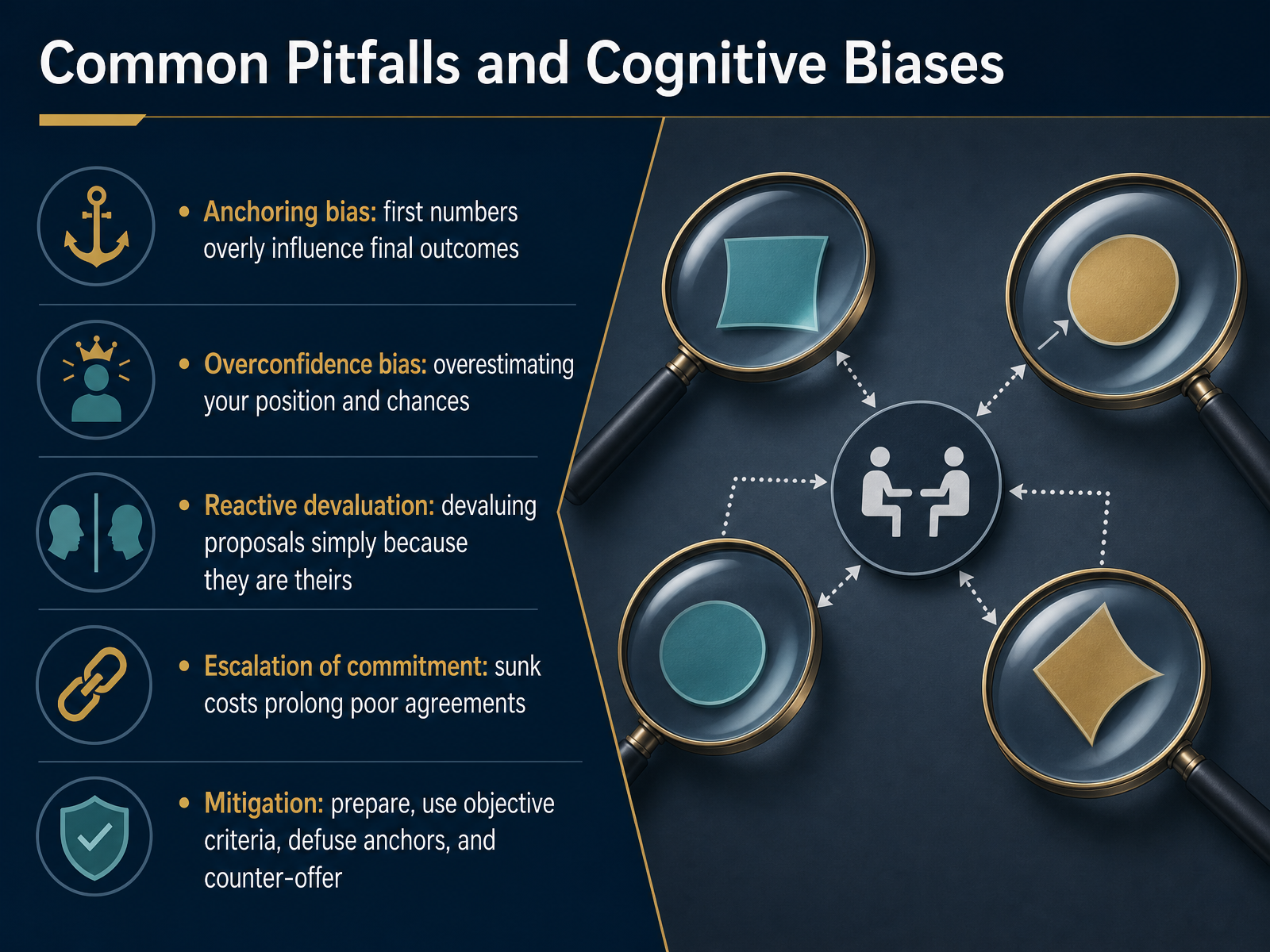
1 min - 08Common Pitfalls and Cognitive BiasesLet's turn to the hidden traps that can quietly weaken your position. First, anchoring bias. The first number on the table tends to carry too much weight, even when it is unreasonable. Before you respond, defuse that anchor clearly. Say something like, "We are too far apart on price." Only then, present your counter. Next, overconfidence bias. Be careful not to overestimate your alternatives or your odds. Preparation with objective data helps you stay grounded. Reactive devaluation is another common trap. You may find yourself rejecting a good proposal simply because it came from the other side. Pause and evaluate the content, not the source. Finally, watch for escalation of commitment. Past investment can make you cling to a bad deal. Remember that sunk costs are gone. Focus only on the path forward. To counter these biases, prepare your range in advance, rely on objective benchmarks, and defuse anchors before making your counter offer. Now, let's see these concepts in action in a complex sales negotiation.
 1 min
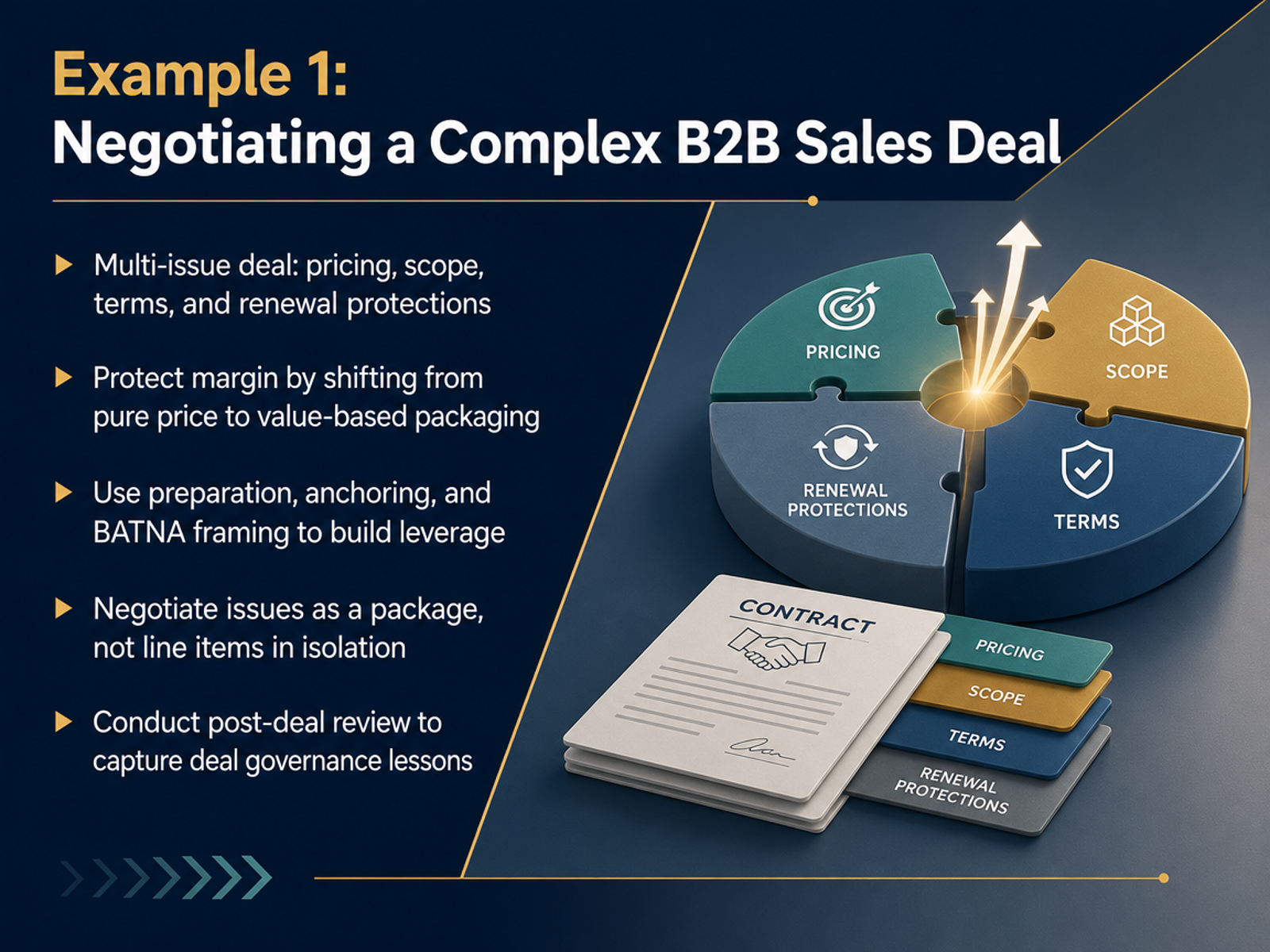
1 min - 09Example 1: Negotiating a Complex B2B Sales DealNow, let's apply these concepts to a complex B2B sales deal. Picture a negotiation that covers pricing, scope, terms, and renewal protections. When a client pushes back hard on price, your first job is to protect your margin. Shift the conversation away from a single number and toward value-based packaging. Anchor the discussion with a strong, well-prepared opening position, and use your BATNA as quiet leverage. Knowing your best alternative gives you the confidence to hold firm. Also, resist the urge to negotiate line items in isolation. Discuss the issues as one integrated package, so you can make tradeoffs that work for both sides. Finally, once the deal is done, do not just file it away. Conduct a quick post-deal review to capture what worked and what did not, and turn those lessons into governance for the next negotiation. Next, we'll look at a different scenario: vendor selection and procurement cost reduction.
 pon.harvard.edugphjournal.orgredcliffetraining.com+22 min
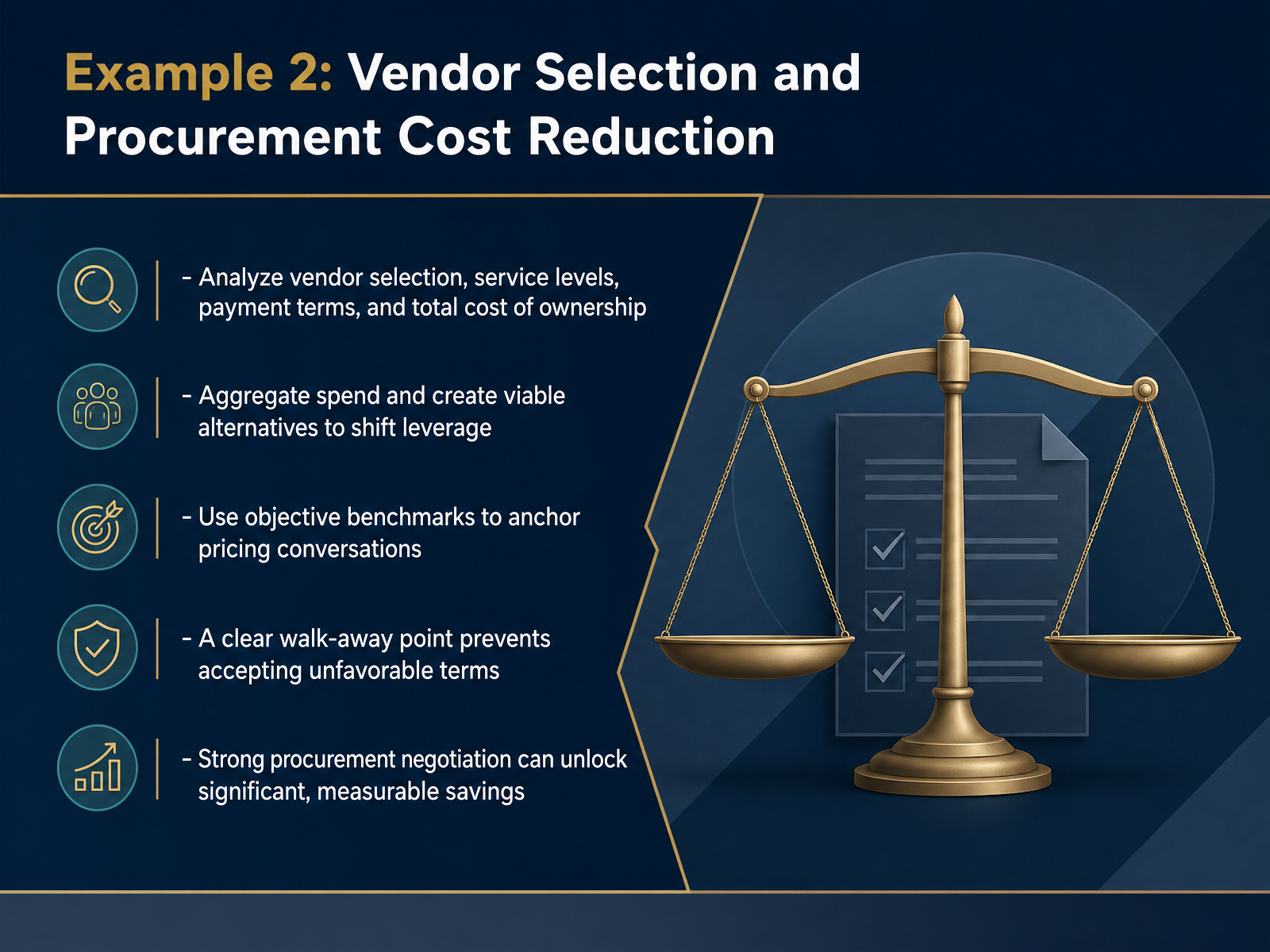
 - 10Example 2: Vendor Selection and Procurement Cost ReductionNow let’s apply this to vendor selection and procurement cost reduction. Start by analyzing the full picture. Look beyond the quoted price. Consider service levels, payment terms, and total cost of ownership. When a vendor seems expensive on the surface, a lower total cost over the life of the contract often changes the math. Second, aggregate your spend. Instead of negotiating line by line, bundle similar purchases across teams. That shift gives you real leverage. At the same time, always build a viable alternative. Knowing you can walk to another vendor changes the conversation. Third, anchor pricing with objective benchmarks. Use market data, not just opinions, to frame what is fair. And before talks begin, define your walk-away point. If the terms cross that line, you stop. That clarity prevents accepting a bad deal under pressure. Strong procurement negotiation creates measurable savings. A disciplined process turns discounts into durable value. Next, we move to example three: internal stakeholders and cross-team resource negotiation.
 gprjournals.orghbr.orginfo.vantagepartners.com+22 min
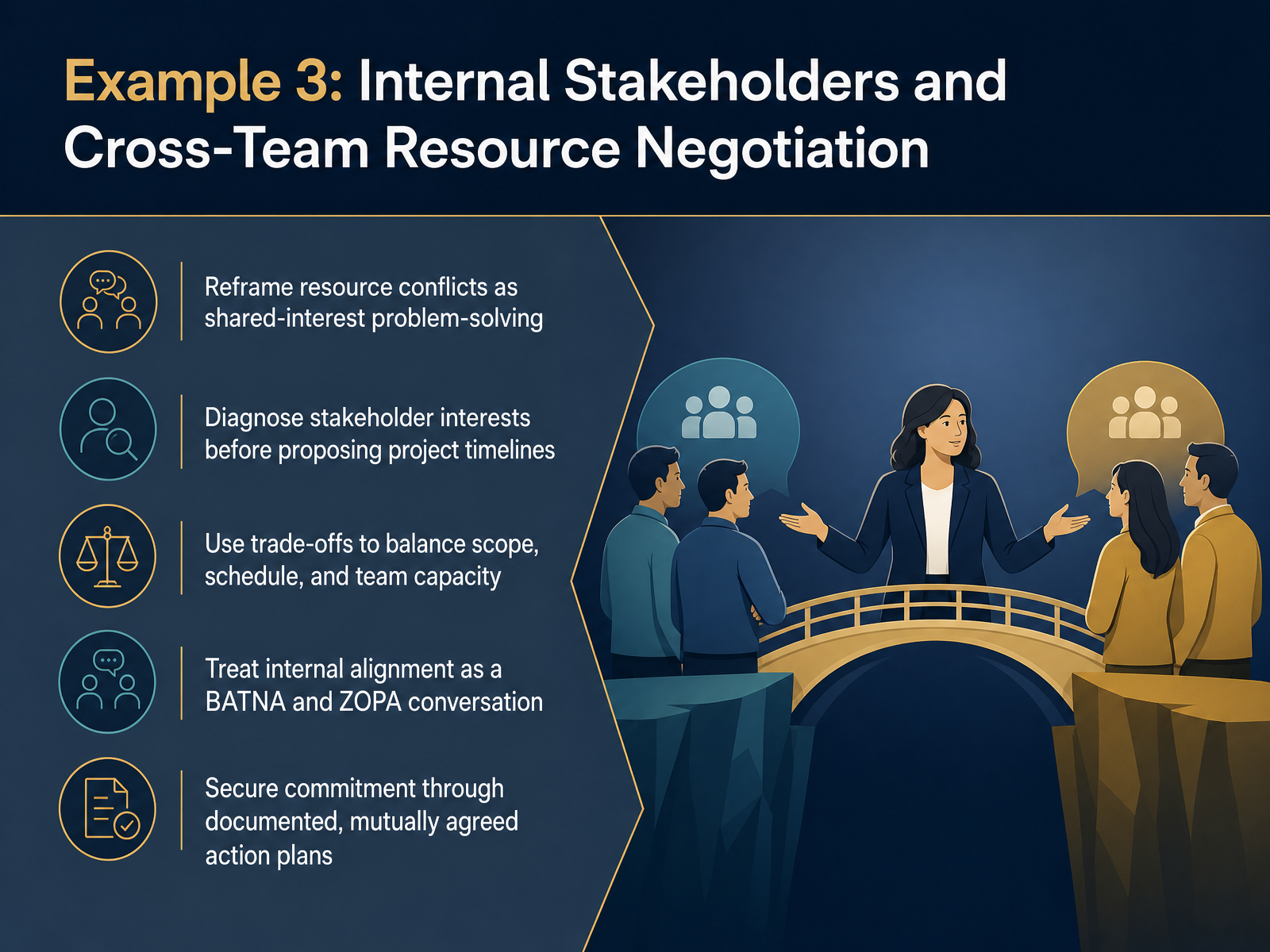
 - 11Example 3: Internal Stakeholders and Cross-Team Resource NegotiationInternal negotiations often feel harder than external ones, because you're negotiating with people you'll work with again tomorrow. Start by reframing a resource conflict as a shared problem to solve, not a contest to win. Before you propose a timeline, diagnose what each stakeholder actually needs. The head of engineering might care about team morale, while the product lead is focused on a hard launch date. Once those interests are on the table, use trade-offs to balance scope, schedule, and capacity. Think of internal alignment as a BATNA conversation. If this cross-team plan falls through, what is everyone's fallback? That shared alternative often defines the zone of possible agreement. When you reach alignment, don't leave it to memory. Document the decision and the specific actions each owner committed to. A clear written action plan turns a good conversation into reliable execution. Next, we'll move into putting it together with a four-step negotiation framework.
 pon.harvard.eduonline.hbs.eduindeed.com+21 min
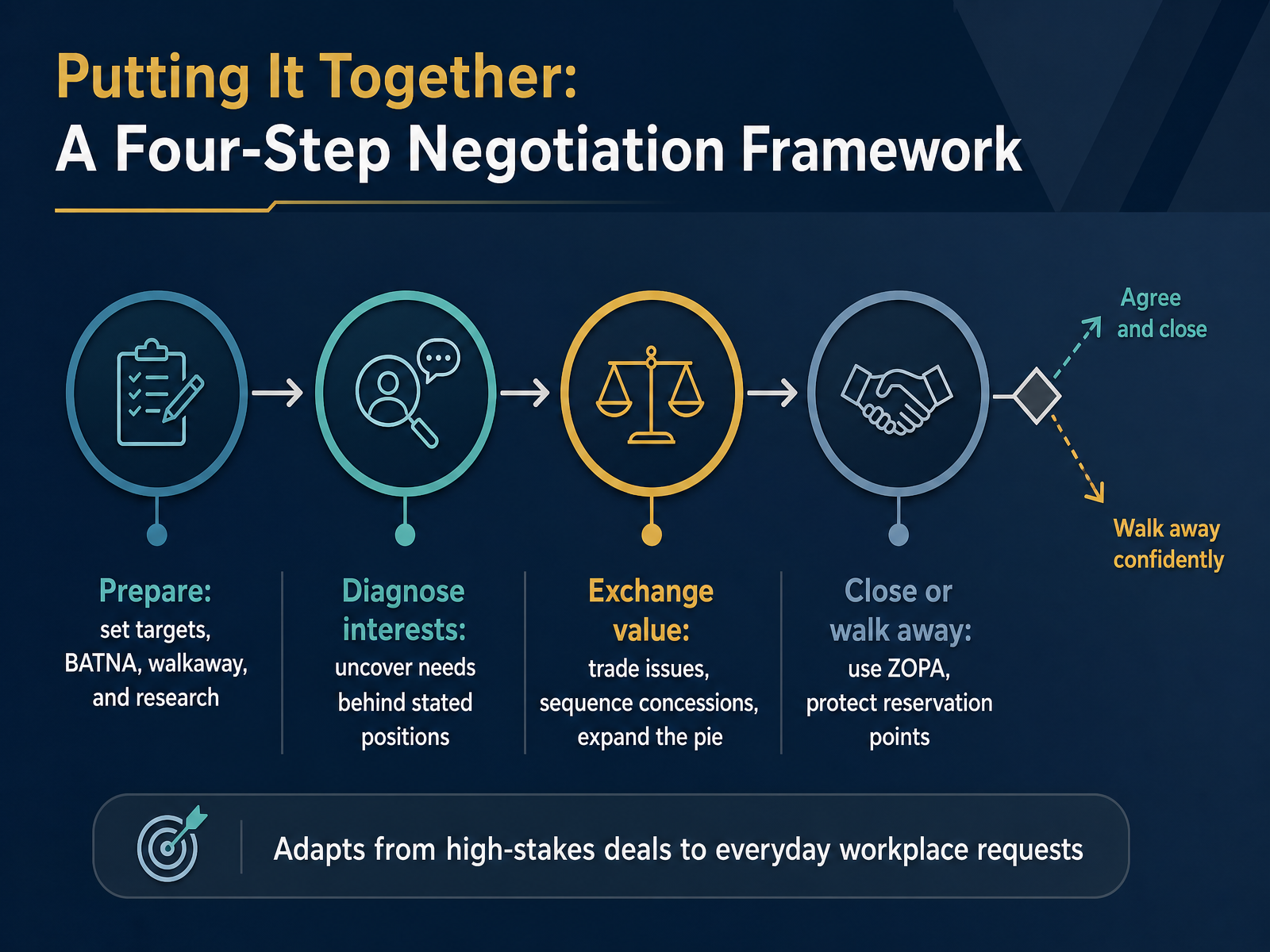
 - 12Putting It Together: A Four-Step Negotiation FrameworkLet’s bring these ideas together into one repeatable framework. Think of this as your pre-negotiation operating rhythm. First, prepare. Set your target, clarify your BATNA, and define your walkaway before any conversation starts. Research the other side’s market, constraints, and likely priorities. Second, diagnose interests. When a client pushes back on price, resist reacting. Ask what is driving the demand. Often the real need is speed, security, or simplicity. Third, exchange value. Trade on differences, not just price. Sequence concessions carefully, and never give something away without receiving something of comparable value in return. Look for issues where one side cares more, so you can expand the pie. Fourth, close or walk away. Use your reservation point and your estimate of the other side’s reservation point to see whether a zone of possible agreement exists. If it does, move toward agreement. If it does not, protect your position and use your BATNA. This framework works from high-stakes deals to everyday workplace requests. Next, let’s turn to your own style.
 pon.harvard.edupon.harvard.edugphjournal.org+22 min
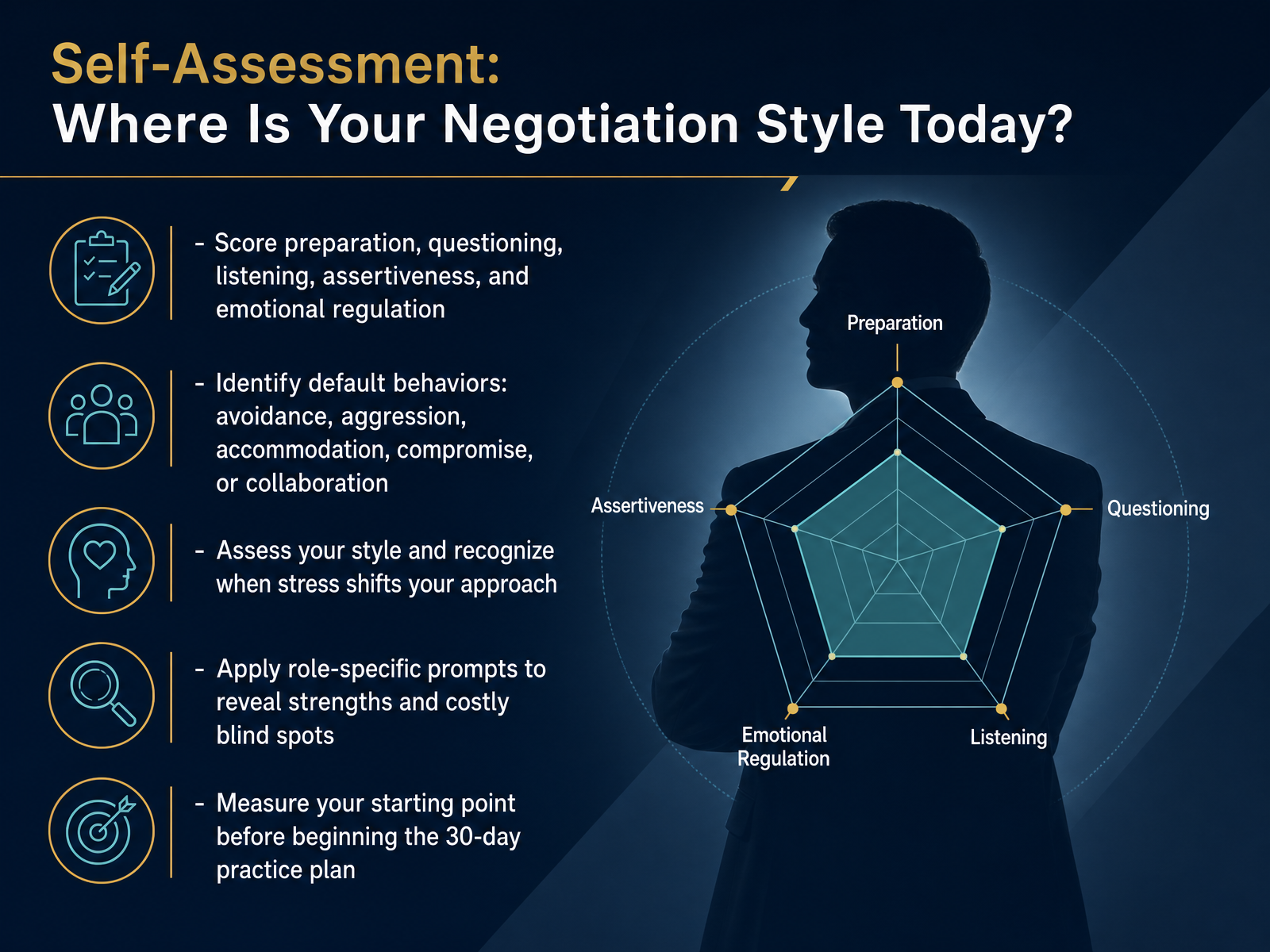
 - 13Self-Assessment: Where Is Your Negotiation Style Today?This slide is about getting clear on where you stand today. Before you try to improve, you need an honest baseline. Score yourself on preparation, questioning, listening, assertiveness, and emotional regulation. Then look at your default behavior. Do you avoid hard conversations? Do you push too hard? Do you accommodate too quickly? Or do you consistently work toward collaboration? Stress often shifts your style. You may be collaborative in calm moments and aggressive or avoidant under pressure. Name that shift. Apply role-specific prompts to your daily work. When a client pushes back on price, what do you actually do? When a stakeholder resists a timeline, where do you bend? Those details reveal strengths and costly blind spots. Measure your starting point now, before you move into structured practice. Next, we will turn that baseline into action with your thirty-day negotiation practice plan.
 1 min
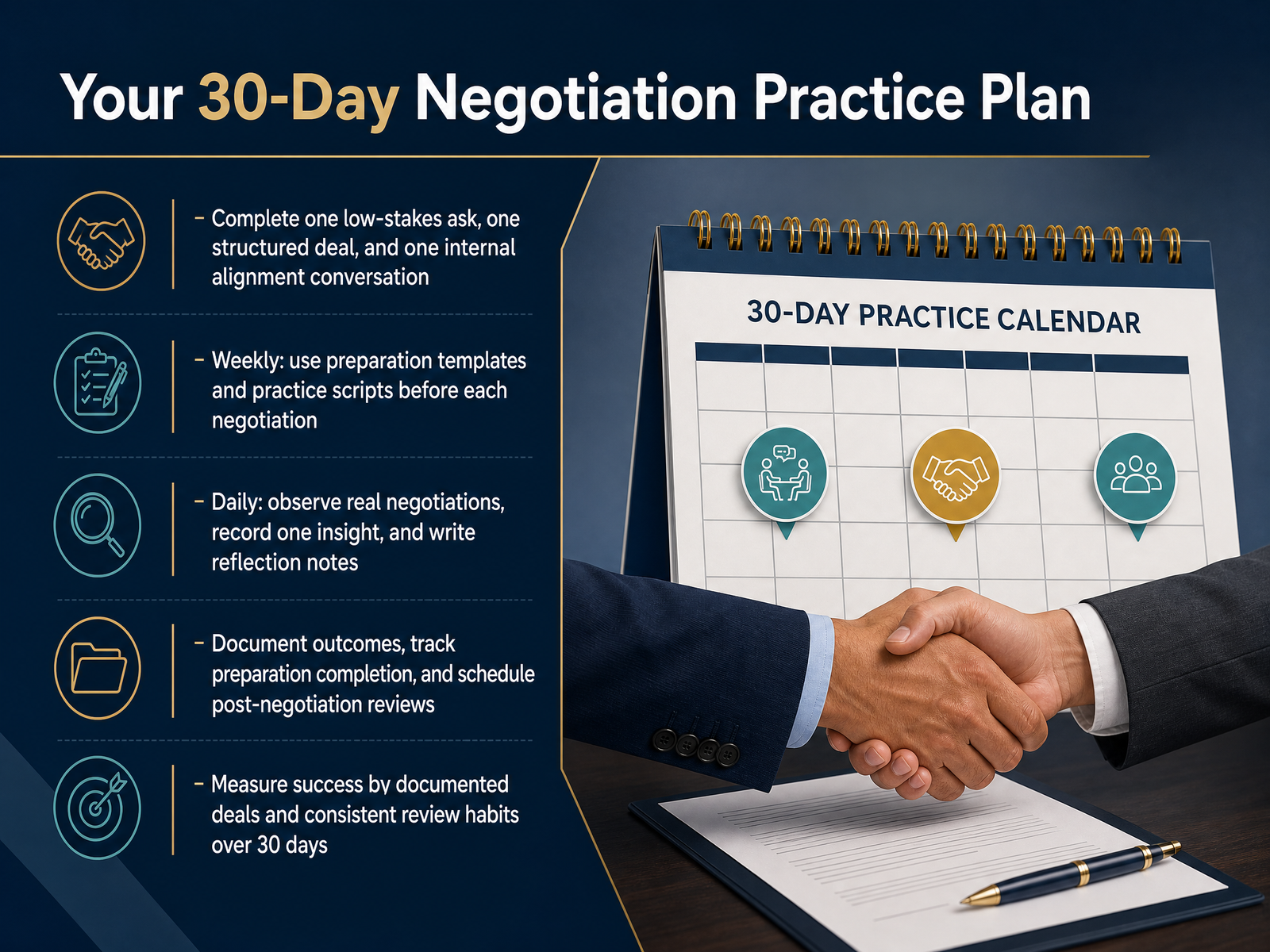
1 min - 14Your 30-Day Negotiation Practice PlanLet's turn these concepts into a repeatable practice plan. Over the next thirty days, commit to three distinct conversations. First, complete one low-stakes ask. This might be requesting a deadline extension or a minor scope adjustment. Second, prepare for one structured deal, such as a vendor contract or a pricing discussion. Third, lead one internal alignment conversation with a peer or manager. Each week, use your preparation templates and practice scripts before you speak. Preparation is what separates reactive negotiators from deliberate ones. Every day, observe a real negotiation around you. Note one insight and write a brief reflection. It only takes a few minutes, but it builds your pattern recognition. Track your outcomes in writing. Record what worked, what stalled, and what you will adjust. Also schedule a post-negotiation review, even if it is just fifteen minutes with yourself. Finally, measure success by two things: documented deals and consistent review habits. After thirty days, you should see a clear improvement in your confidence and your results. Thank you for completing this course. Now, step into your next negotiation with a plan and a clear head. You are ready.
 2 min
2 min
Take the deck with you
Download this course as a file — free, no sign-up needed.
- PDF handoutEvery slide page, ready to print or share.15 pages · 3.6 MBDownload
- Narrated PowerPointThe deck that presents itself — every slide carries the digital human's narration video.15 pages · 13.7 MBDownload
- PowerPoint slidesThe full deck as a .pptx — open it in PowerPoint, Keynote, or Google Slides.15 pages · 3.5 MBDownload
Free to use in your own training — please keep the PersonWise credit page at the end.
Have your own deck? Turn it into a course
Sources consulted
Web sources consulted while building this course.
- What are Negotiation Skills? - PON - Program on Negotiation at Harvard Law School — pon.harvard.edu
- 6 Negotiation Skills All Professionals Can Benefit From — online.hbs.edu
- 12 Important Negotiation Skills (With Definition and Tips) — indeed.com
- What Are Sales Negotiation Skills? Strategies, Tips & Tools | Apollo — apollo.io
- Five things every project manager should know about negotiation — pmi.org
- Negotiation Practices and Operational Performance of Independent Offices and Commissions in Kenya | Journal of Procurement and Supply Chain Management — gprjournals.org
- Why Big Companies Struggle to Negotiate Great Deals — hbr.org
- 2026 Customer-Supplier Negotiation Study — info.vantagepartners.com
- Intersection of negotiation and sustainability in business: review and future research - ScienceDirect — sciencedirect.com
- Driving a Bargain: Negotiation Skill and Price — sosyura.com
- Principled Negotiation: Focus on Interests to Create Value — pon.harvard.edu
- Negotiation Tactics, BATNA and Examples for Creating Value in Business Negotiations - PON - Program on Negotiation at Harvard Law School — pon.harvard.edu
- Boost M6700 (A): Buyer-Seller Negotiation - Confidential Instructions for John Payne — publishing.insead.edu
- Rethinking Negotiation — hbr.org
- Resolving conflict, creating value - PON - Program on Negotiation at Harvard Law School — pon.harvard.edu
- How to Find the ZOPA in Business Negotiations — pon.harvard.edu
- Deal-Making in Private Equity: Lessons from a Brazilian Tech Company and Private Equity Firm Negotiation | GPH-International Journal of Computer Science and Engineering — gphjournal.org
- BATNA and ZOPA (5 Vital M&A Negotiation Principles) — redcliffetraining.com
- A Top International Negotiation Case Study in Business: The Microsoft-Nokia Deal - PON - Program on Negotiation at Harvard Law School — pon.harvard.edu
- A Negotiation Preparation Checklist - PON — pon.harvard.edu