Begin
15 pages · ~30 min
Customer Success Onboarding Framework
This training covers the customer success onboarding process, including its stages, roles, and deliverables, for customer success professionals seeking to structure effective client onboarding.
A digital instructor presents all 15 pages. Hold “Ask” at any point and ask out loud — the answer comes from this course. No sign-up needed.
What you’ll learn
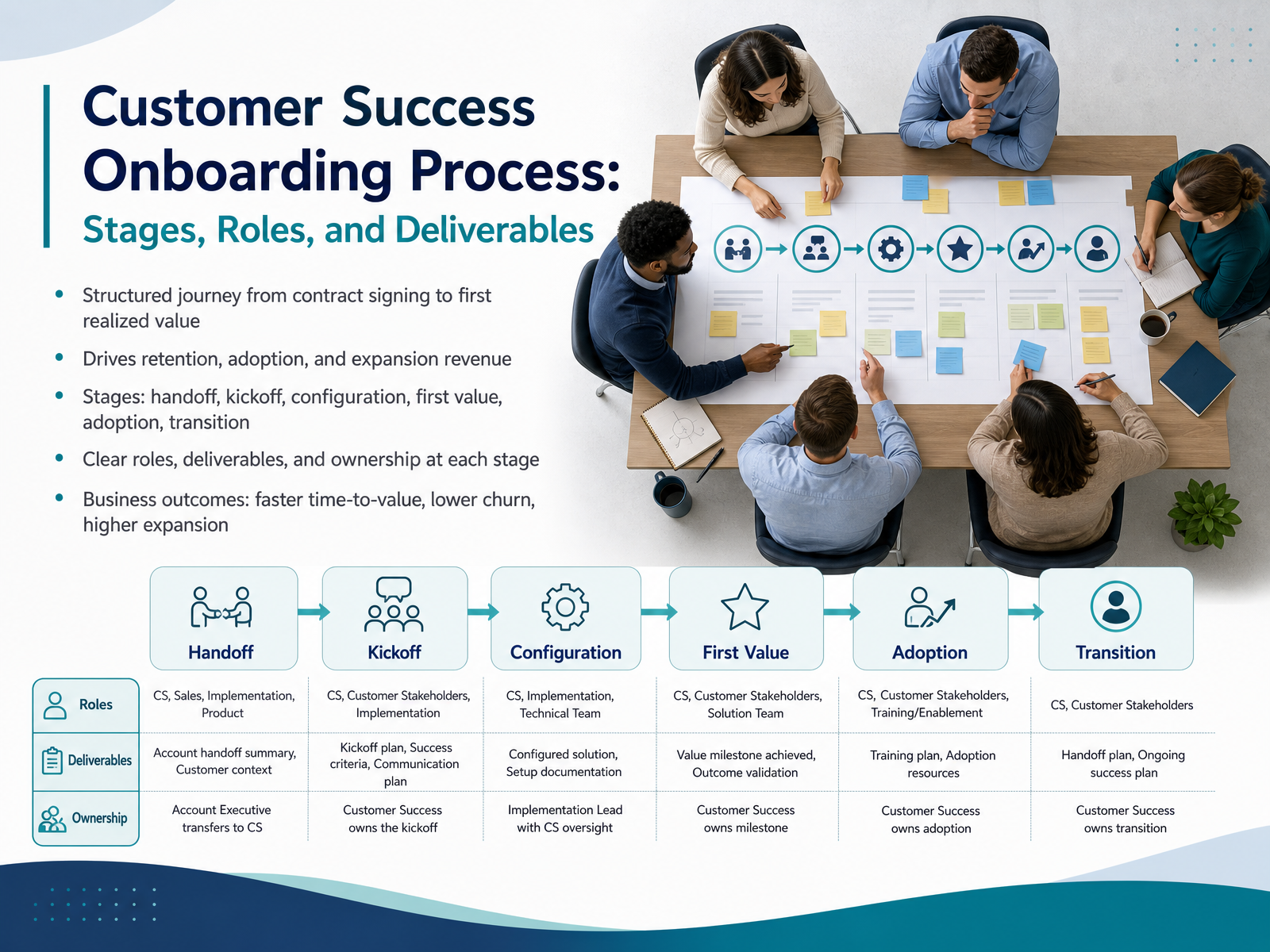
- 01Customer Success Onboarding Process: Stages, Roles, and DeliverablesWelcome. Today, we're going to walk through the customer success onboarding process, from the moment a contract is signed to the first realized value. This is a structured journey, and it's what drives retention, adoption, and expansion revenue. We'll break it into six clear stages: handoff, kickoff, configuration, first value, adoption, and transition. For each one, we'll define the roles and the deliverables, so ownership is always clear. The goal here is practical. We want faster time-to-value, lower churn, and higher expansion. Think of this as our shared playbook, a repeatable path we can follow with every new customer. Let's get started. First, let's look at why this process is a strategic revenue lever for us.rocketlane.comonboarding-hub.comkompassify.com+21 min
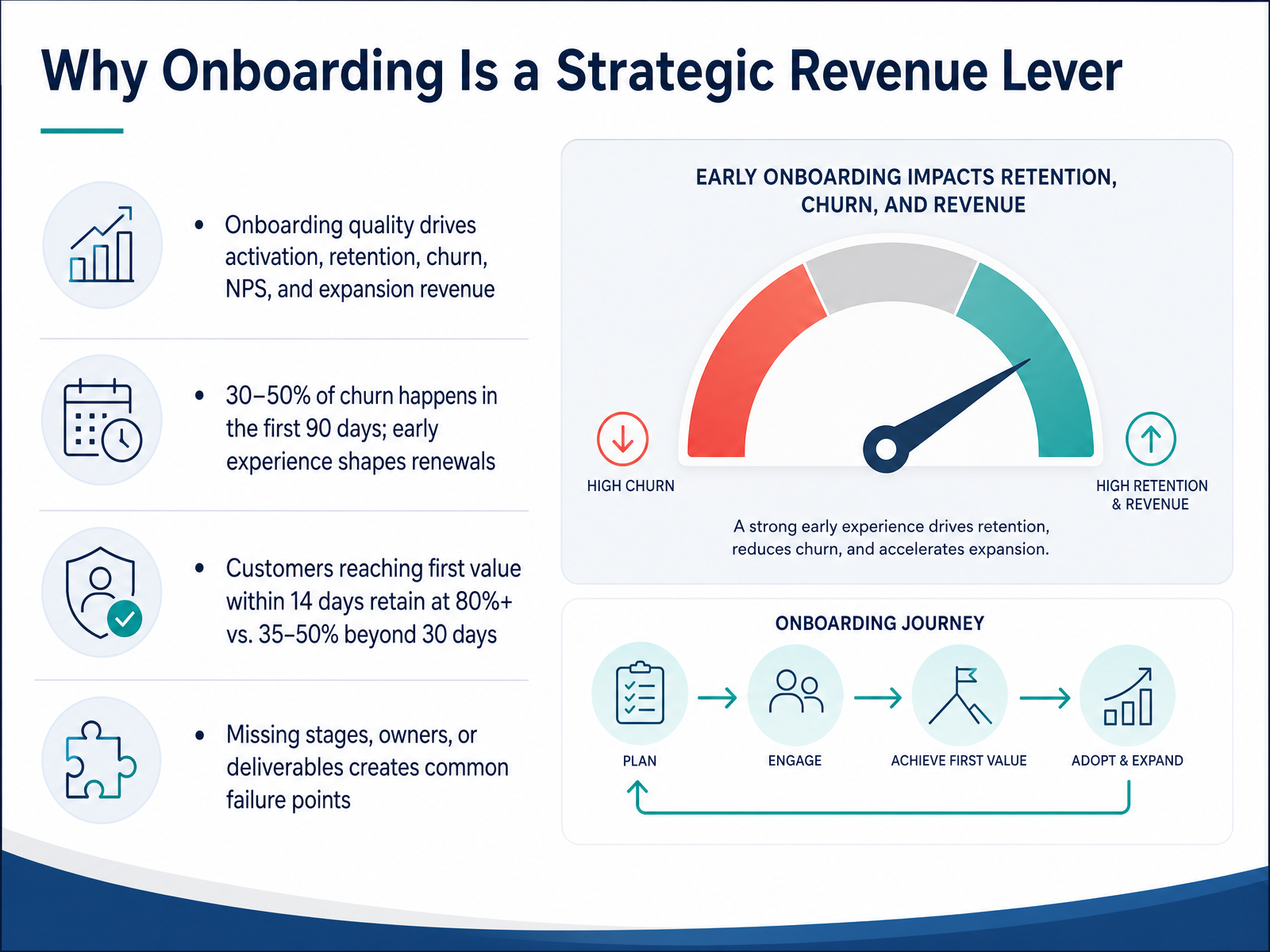
- 02Why Onboarding Is a Strategic Revenue LeverLet's talk about why onboarding is a strategic revenue lever, not just a checklist. The data is clear: onboarding quality directly drives activation, retention, churn, NPS, and expansion revenue. Consider this: thirty to fifty percent of all churn happens in the first ninety days. The early experience literally shapes every renewal you'll see. There's a striking benchmark we rely on. Customers who reach first value within fourteen days retain at eighty percent or higher. Customers who miss that window and go beyond thirty days? Retention drops to between thirty-five and fifty percent. That's a massive swing based on speed alone. So what goes wrong? When we miss stages, when we don't assign clear owners, or when we skip key deliverables, we create predictable failure points. The fix is having a clear, repeatable process. Let's move on and break down the core concepts and operating principles that make this work.
 customerexperience.iogetperspective.aionramp.us+22 min
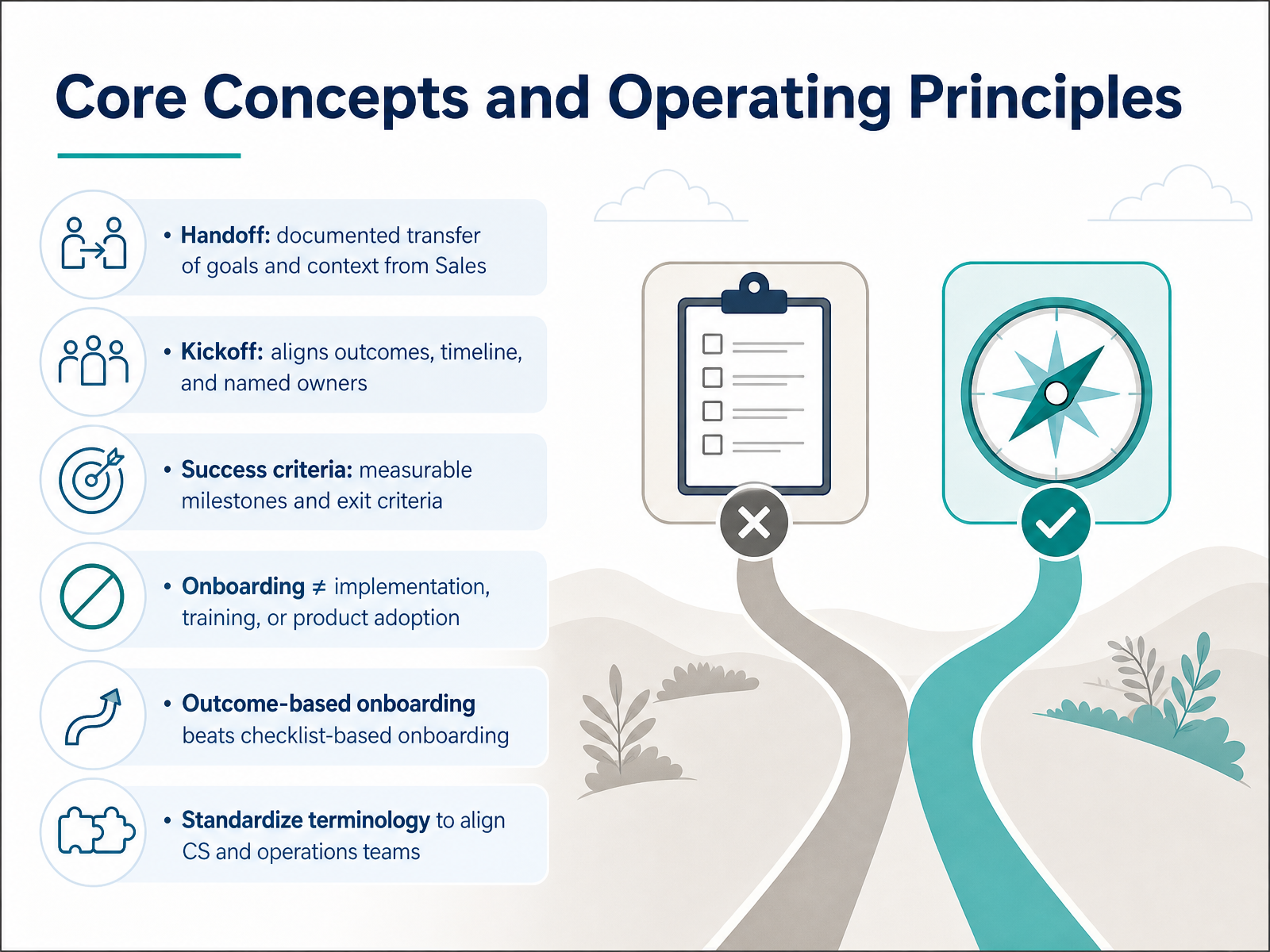
 - 03Core Concepts and Operating PrinciplesLet's lock in a few core concepts before we walk the full journey. First, the handoff. This is a documented transfer of goals and context from Sales to Customer Success. It is not a forwarded email thread. Next, the kickoff. This is where we align on outcomes, timeline, and named owners on both sides. It turns a signed contract into a shared roadmap. Then, success criteria. These are the measurable milestones and exit criteria that tell us a stage is truly done, not just checked off. Here is a key distinction: onboarding is not implementation, and it is not just training or product adoption. Those are pieces of it, but onboarding is the full path to first value. That is why we focus on outcome-based onboarding, not checklist-based onboarding. We still use checklists, but they serve the outcome, not the other way around. And finally, we standardize our terminology across Customer Success and Operations. When we all say handoff, kickoff, and milestone, we mean the same thing. That shared language is what makes the process repeatable. Now, let's see how this all comes together in the end-to-end journey.
 blog.hubspot.comorbix.studiovaluecase.com+22 min
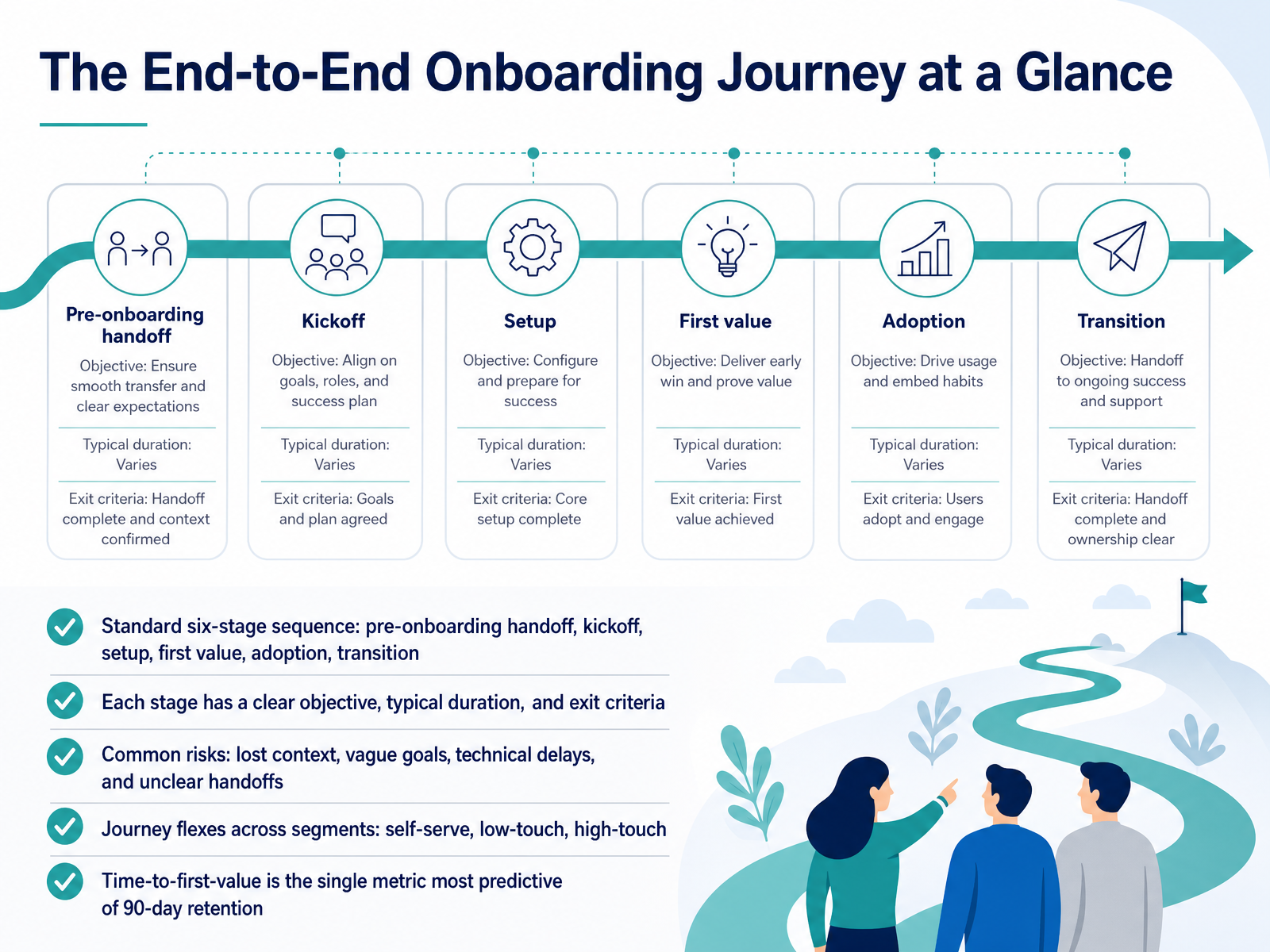
 - 04The End-to-End Onboarding Journey at a GlanceLet’s zoom out and look at the whole onboarding journey at a glance. We follow a standard six-stage sequence: pre-onboarding handoff, kickoff, setup, first value, adoption, and finally, transition. Each stage has a clear objective, a typical duration, and exit criteria, so we always know when we’re done and who owns what. Along the way, we watch for common risks like lost context from sales, vague goals, technical delays, or unclear handoffs between teams. The journey flexes by segment—self-serve, low-touch, and high-touch accounts each follow a slightly different path. But one metric stays constant across all of them: time-to-first-value. It is the single most predictive indicator of 90-day retention. So, whenever you’re designing or reviewing a playbook, keep that number front and center. Now, let’s get into the mechanics, starting with stage one: the sales-to-customer success handoff.
 blog.hubspot.comorbix.studiovaluecase.com+21 min
 - 05Stage 1: Sales-to-Customer Success HandoffLet’s talk about Stage 1: the Sales-to-Customer Success handoff. This is the highest-risk handoff in the entire relationship. If context gets lost here, everything downstream slows down—especially time-to-value. That’s the gap between signing and that first real win. The fix is to make the handoff disciplined. First, capture the essentials: the customer’s goals, pain points, commitments made during sales, the stakeholder list, and any technical requirements. Don’t let these live in someone’s memory or a random email chain. Define which fields are mandatory before a deal can even move to CS. And then, before you schedule the kickoff, hold a formal handoff review. That’s your check to make sure nothing important was missed. One more thing: when sales promises something—a feature timeline, extra support, a specific rollout date—flag it as a task with an owner, not a footnote in a contract. That commitment now has someone accountable for delivering it. Get this stage right, and you’ve protected the customer’s momentum and your team’s credibility. Next, we’ll move into Stage 2: the kickoff and aligning on the success plan.
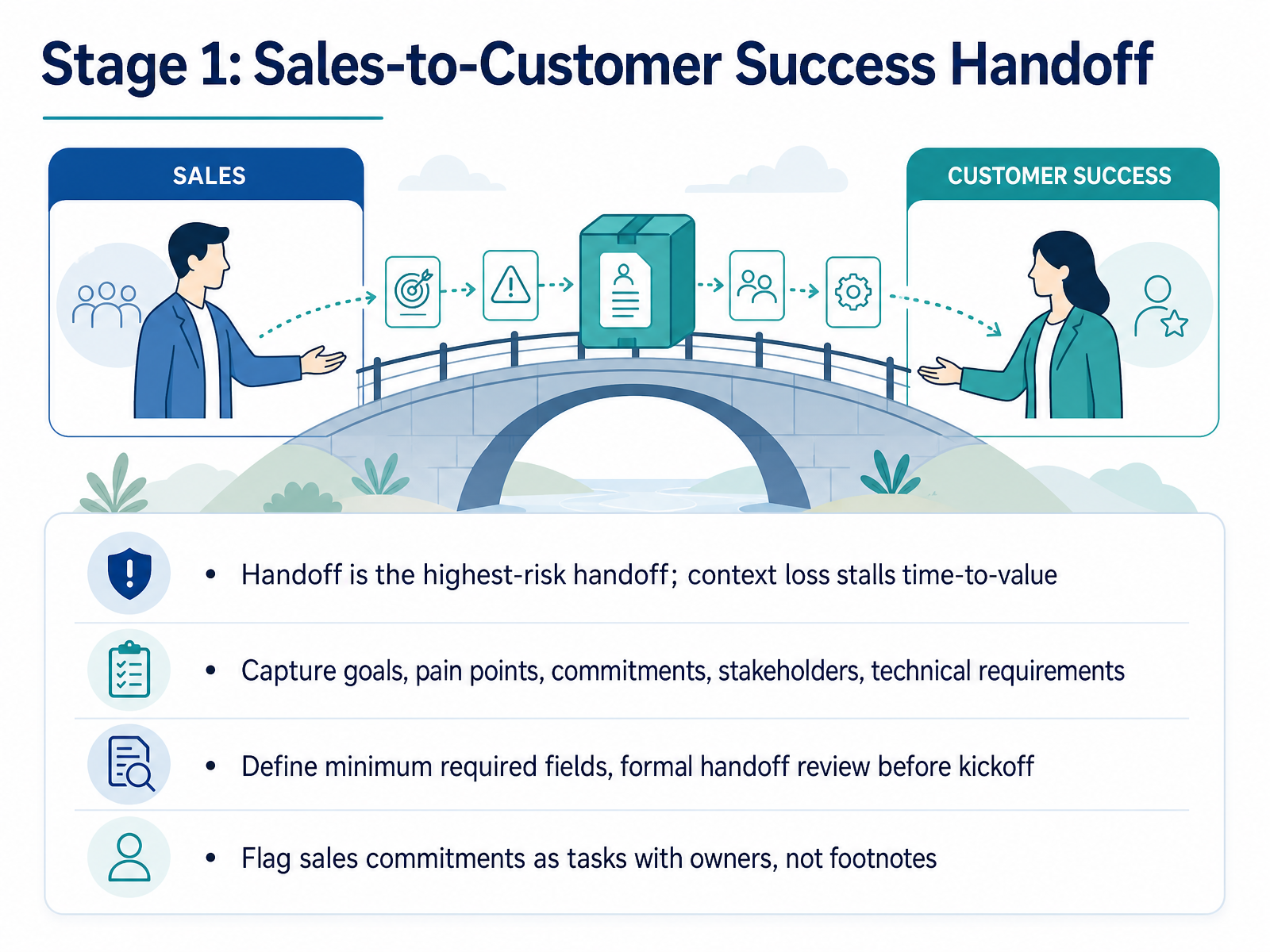 blog.hubspot.comorbix.studiovaluecase.com+21 min
 - 06Stage 2: Kickoff and Success Plan AlignmentNow we move into Stage 2: Kickoff and Success Plan Alignment. This is where we turn the signed deal into a shared game plan. Start by aligning on the outcome, the target date, and who owns what. For example, if the customer wants to reduce ticket volume by 30 percent in six months, you need to name the person on their side who owns that metric. Next, build a one-page success plan. Keep it simple: milestones, cadence, and owners. You don’t need a 20-page deck; you need a clear, shared roadmap. Then, confirm the real buying group. The person who signed may not be the daily user, so ask around and engage the stakeholders who actually feel the pain. Finally, lead with the customer’s outcome, not a feature tour. Show them how your solution moves their metric, not just what buttons to click. In short: align on outcome, document the plan, map the influencers, and keep the focus on value. That way, when we move to Stage 3, Setup, Configuration, and Data Collection, we already know what success looks like.
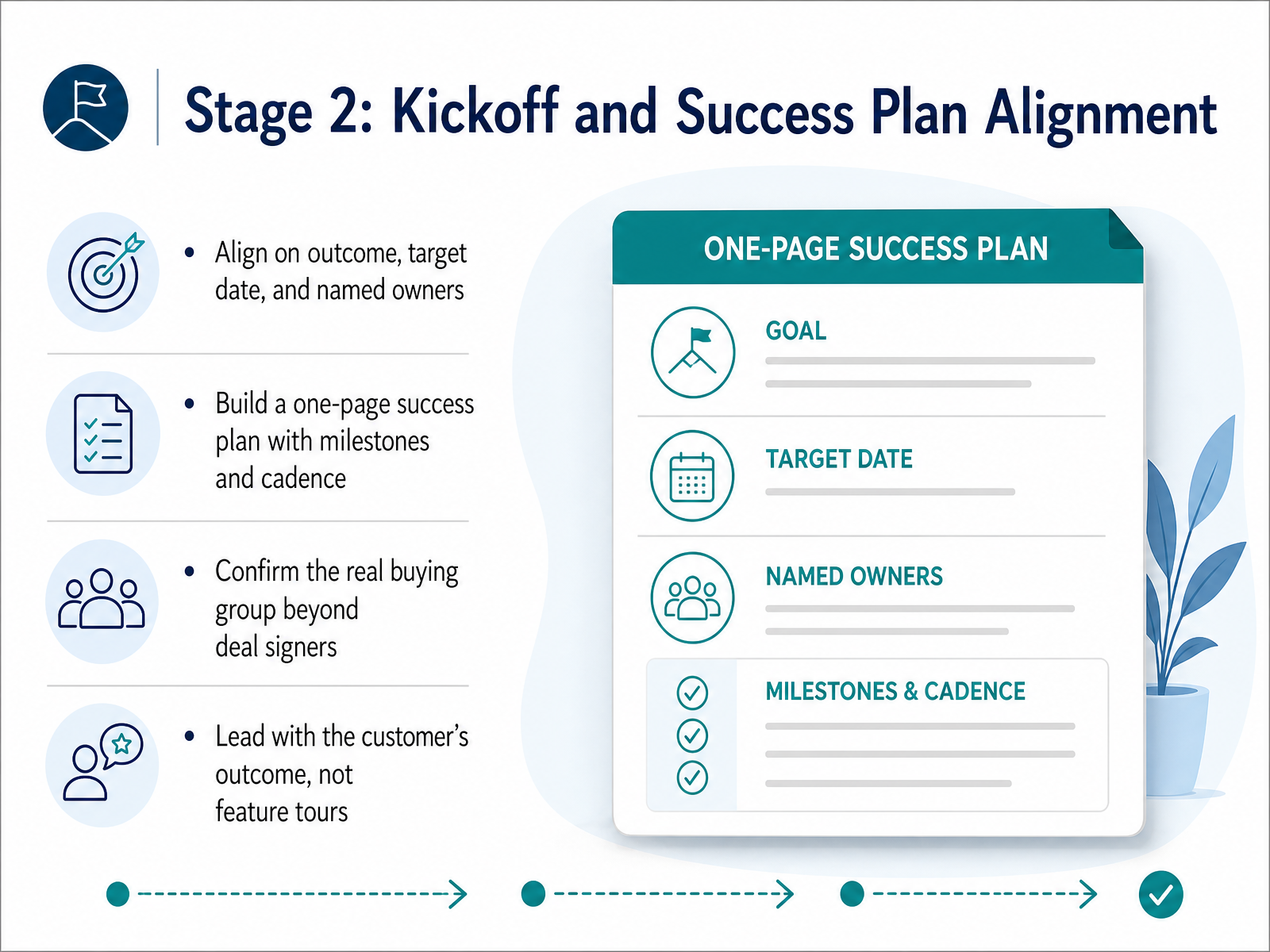 1 min
1 min - 07Stage 3: Setup, Configuration, and Data CollectionLet’s talk about Stage three: Setup, configuration, and data collection. This is where timelines often stall, and it’s usually not because of the product. It’s the integrations, the data imports, and the security reviews. So here’s the rule of thumb: start customer-side dependencies in parallel from day one. Don’t wait for your internal work to finish before asking them for their inputs. Use structured intake forms that are pre-filled from the CRM and sales notes. That saves everyone a round of back-and-forth emails. And most importantly, assign a named owner for every dependency. Never just say “the client team.” That’s a recipe for confusion. Name a person, give them a deadline, and confirm they know what they own. When configuration is handled this way, you keep momentum instead of losing a week to waiting. And remember, once setup is done, you’re ready to move into the next phase: securing first value and enabling the end users.
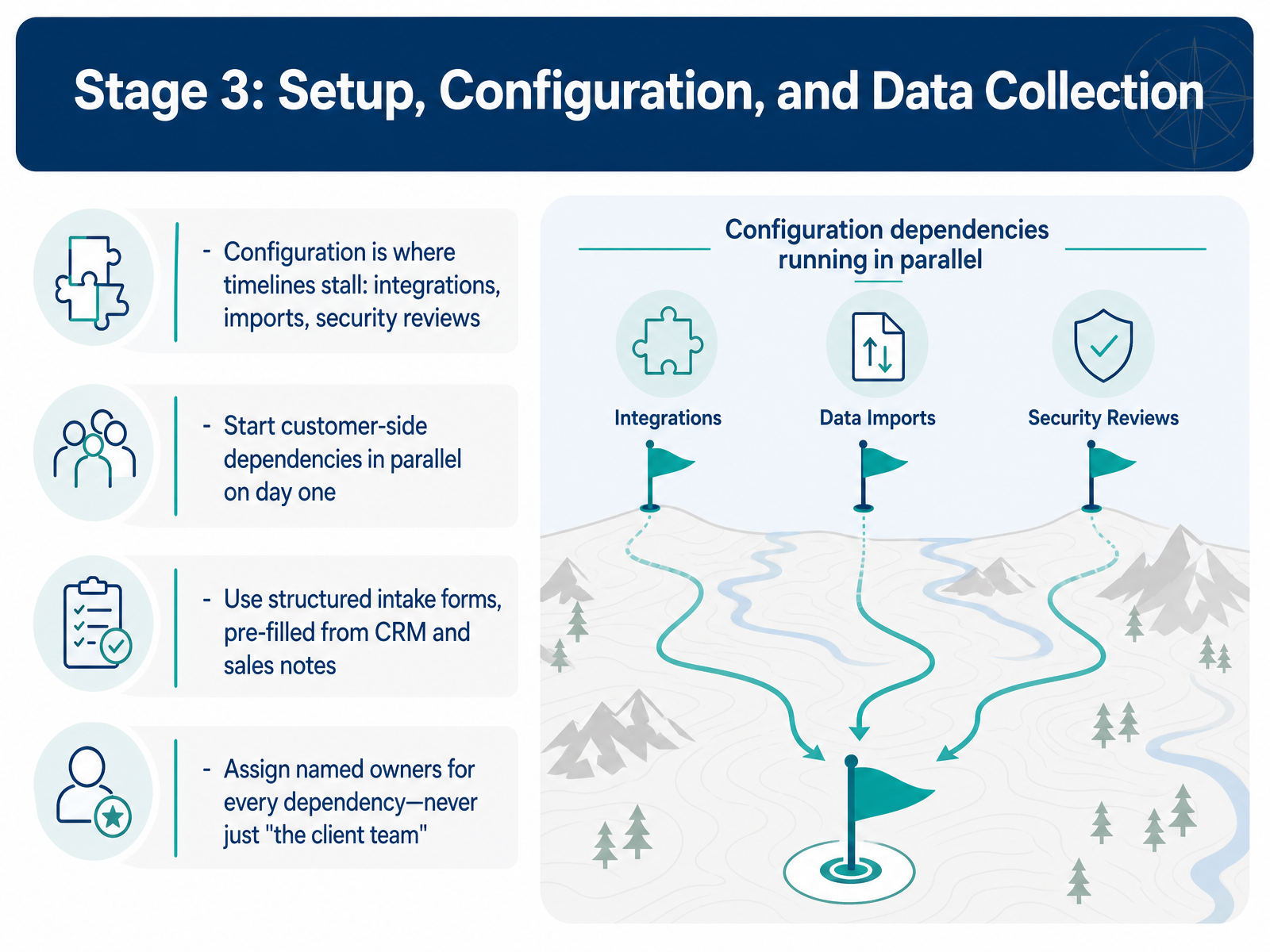 1 min
1 min - 08Stage 4: First Value and End User EnablementStage four is all about reaching that first real moment of value. And it’s important to remember that onboarding ends at an outcome, not at a training session. So define that aha moment precisely. For example, ask: when does the customer see their own data dashboards for the first time? That’s the outcome to target. Next, enable users in the product itself, not just through live calls. Champions rarely have time to train everyone, so build self-serve guidance right into the workflow. Keep checklists short, five to seven steps at most, to avoid overwhelming the customer. And finally, confirm that first value explicitly with the customer. Don’t rely on internal updates or assumptions. A quick check-in like, “Did you see the report we talked about?” works wonders. Now, once that value is confirmed, we move into stage five, where we focus on adoption and the handoff to ongoing success.
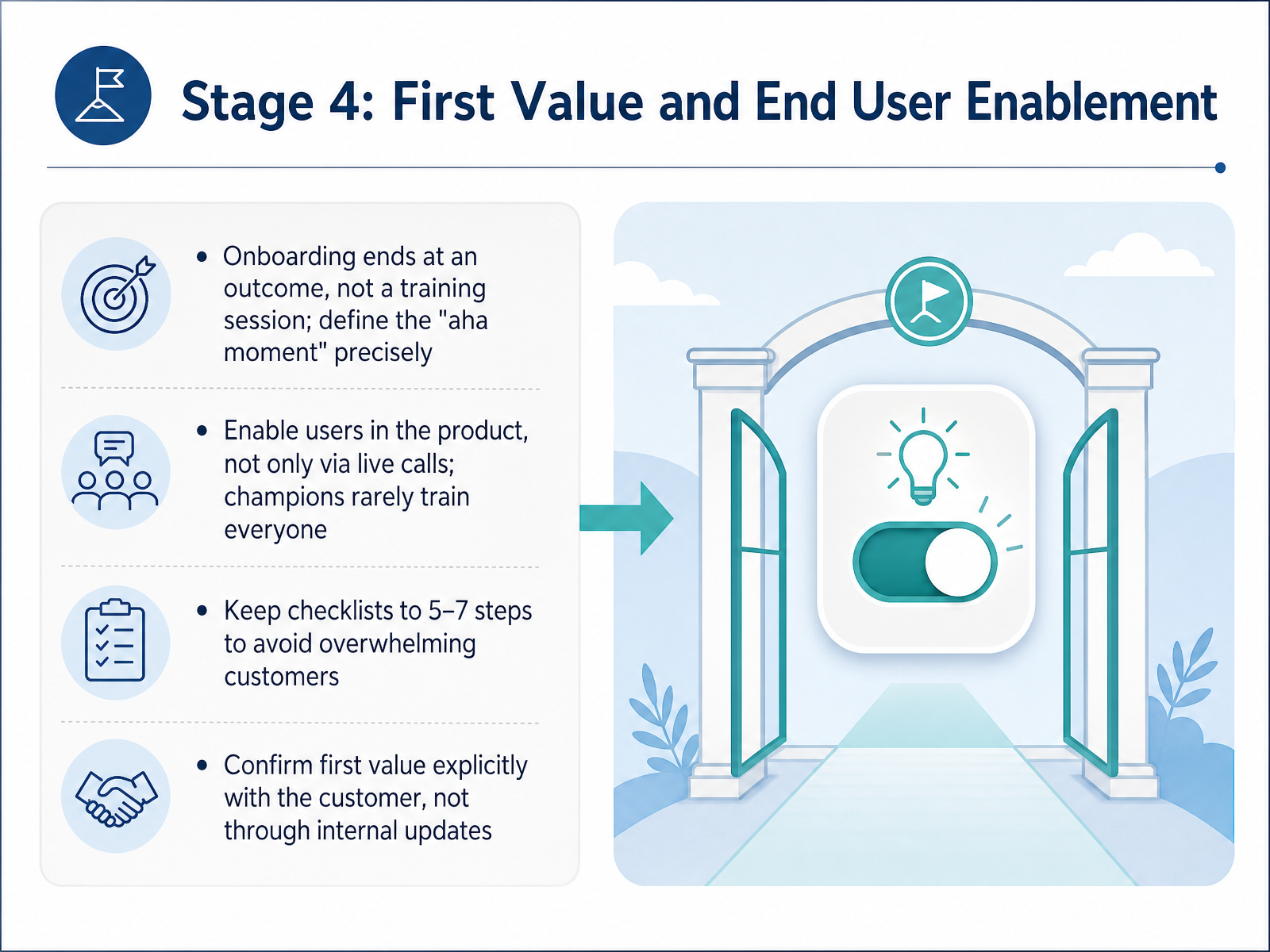 1 min
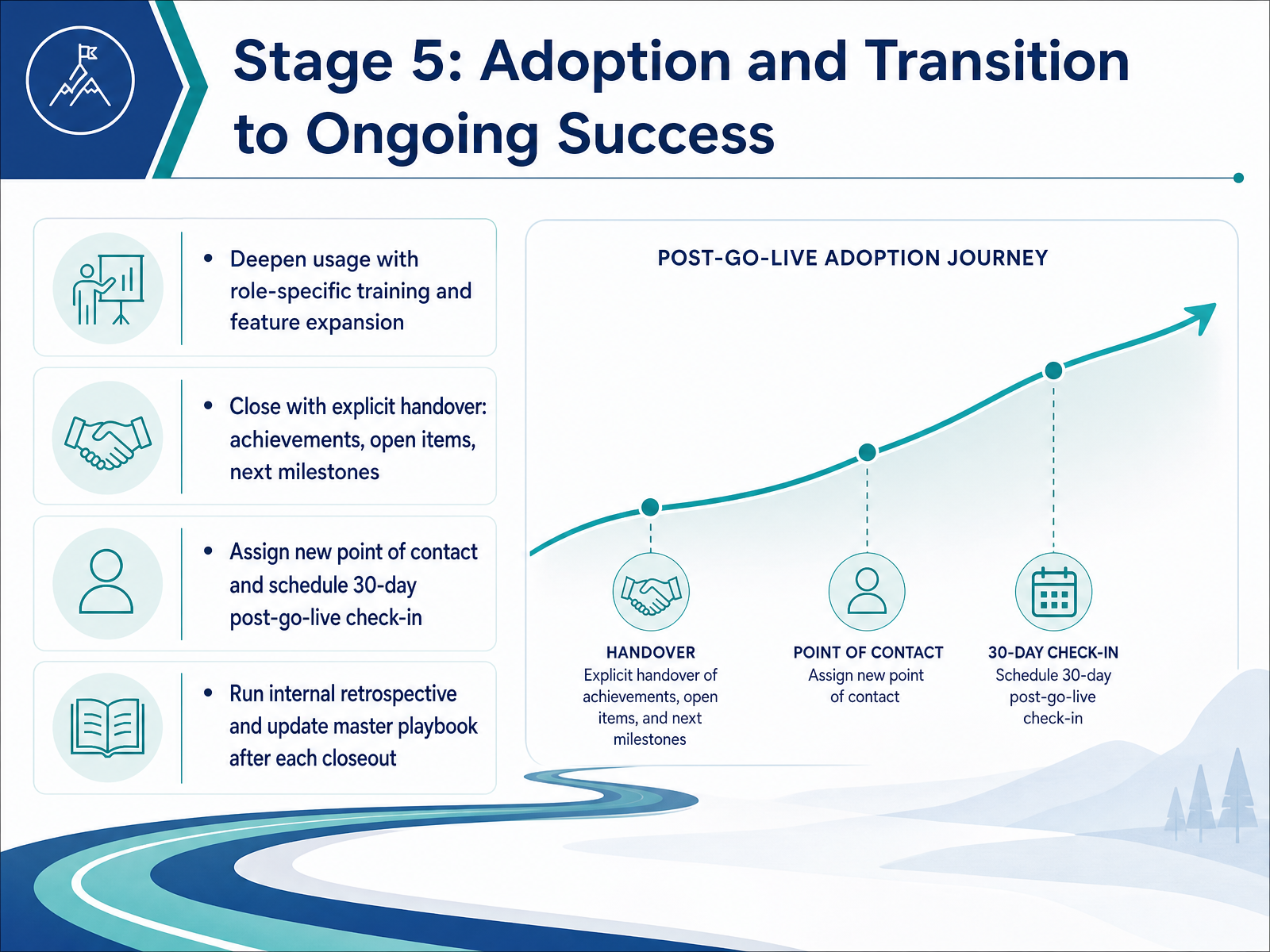
1 min - 09Stage 5: Adoption and Transition to Ongoing SuccessStage five is all about deepening adoption and making a clean transition to ongoing success. By now, you've helped the customer get up and running. Your next move is to expand their usage with role-specific training and feature rollout. That means showing different teams how to use the product in their daily work, not just giving them the same generic demo. After that, you close the stage with an explicit handover. Summarize what you've achieved together, list any open items, and confirm the next milestones. Then you assign a new point of contact and schedule a thirty-day post-go-live check-in so nothing falls through the cracks. Finally, run an internal retrospective with your team. Update the master playbook based on what worked and what didn't, so every future onboarding gets a little smoother. Remember, the goal is not just a happy customer at go-live, but a customer who is set up for long-term growth. And next, we'll look at the roles and responsibilities across the entire process.
 1 min
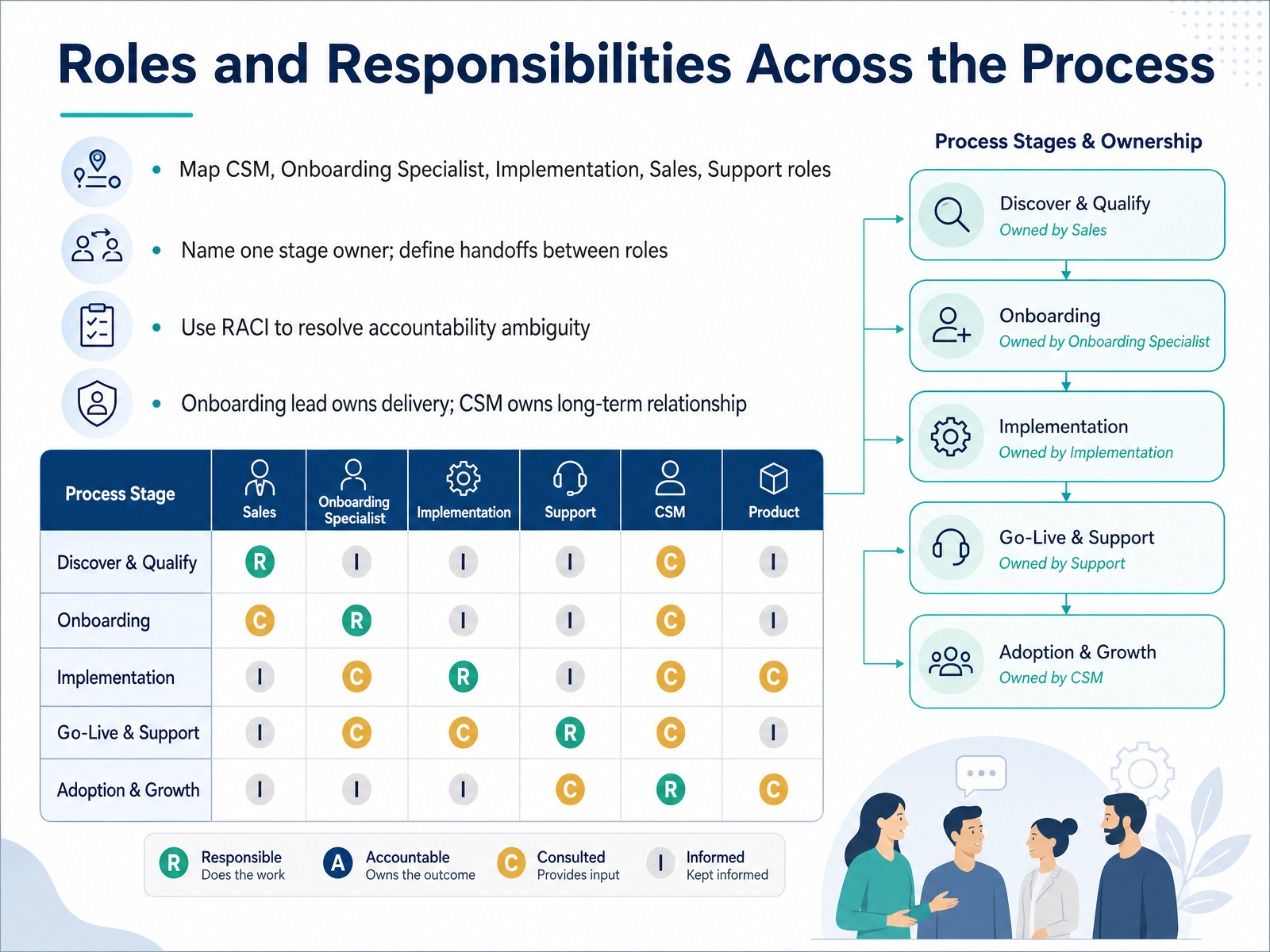
1 min - 10Roles and Responsibilities Across the ProcessNow let’s map out who does what. Every stage needs one clear owner. Name that owner before the work begins, and define the handoffs between roles. You’ll have the CSM, the Onboarding Specialist, Implementation, Sales, and Support all touching the account. The trick is making sure only one person owns each stage. We recommend using a RACI matrix to settle accountability. It removes the guesswork. The onboarding lead owns delivery from kickoff to go-live. The CSM owns the long-term relationship after that handoff. Sales hands off the context. Implementation builds the setup. Support steps in for troubleshooting. When everyone knows their lane, the customer feels the difference. Next, we’ll look at the key deliverables for each stage.
 blog.hubspot.comorbix.studiovaluecase.com+21 min
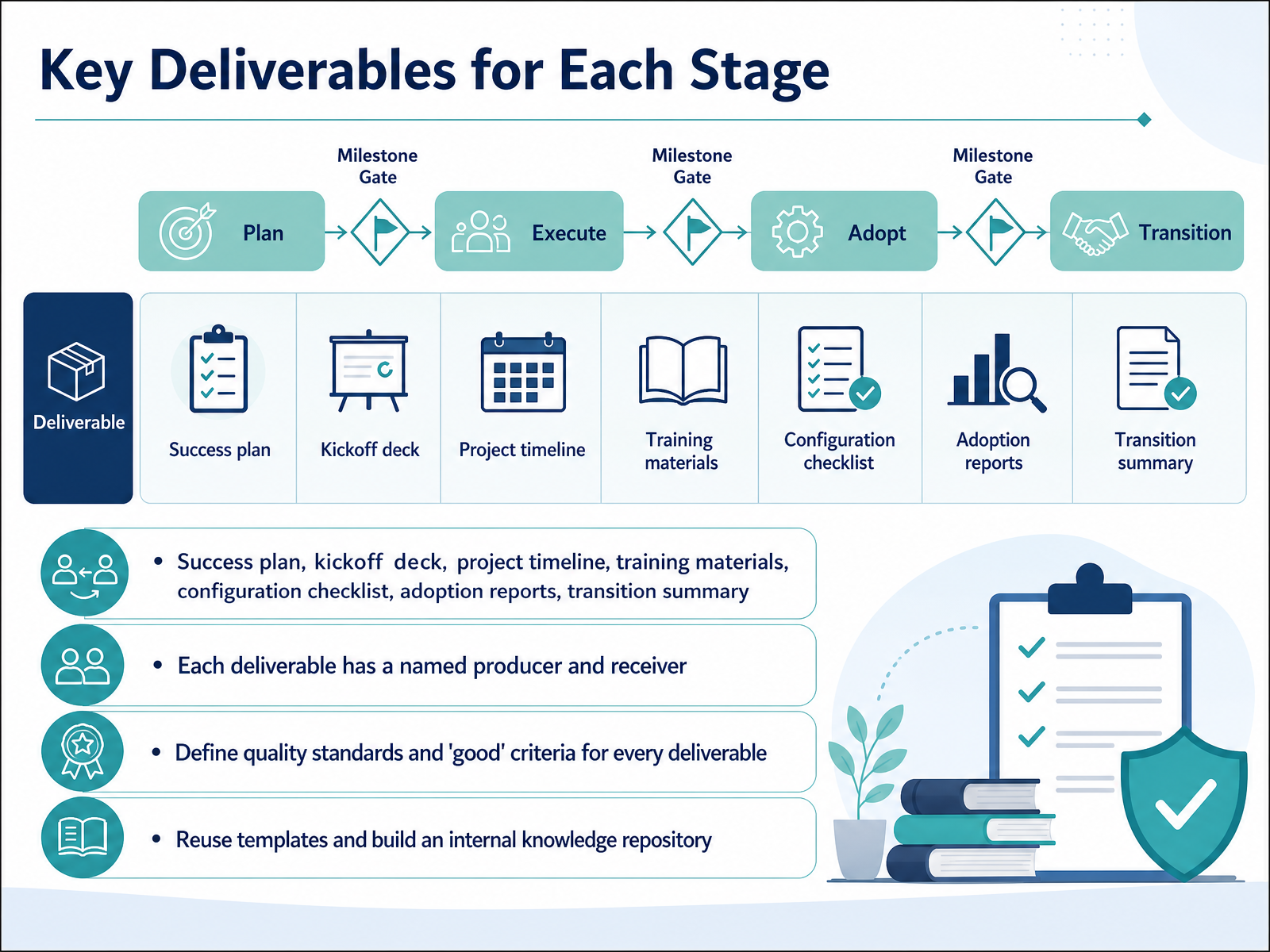
 - 11Key Deliverables for Each StageNow let's talk about the key deliverables for each stage of onboarding. Every stage closes with a tangible output: a success plan, the kickoff deck, your project timeline, training materials, the configuration checklist, adoption reports, and finally, the transition summary. Each one has a named producer and a named receiver. That part matters. If we don't know who owns it and who receives it, handoffs get fuzzy. So, before we create anything, we define what good looks like. We set quality standards and clear criteria for every single document. That way, there's no guesswork. And to keep this repeatable, we reuse templates. Every completed deliverable feeds into an internal knowledge repository, so the next team starts with a head start instead of a blank page. Keep that in mind as we move ahead to our metrics, milestones, and exit criteria.
 2 min
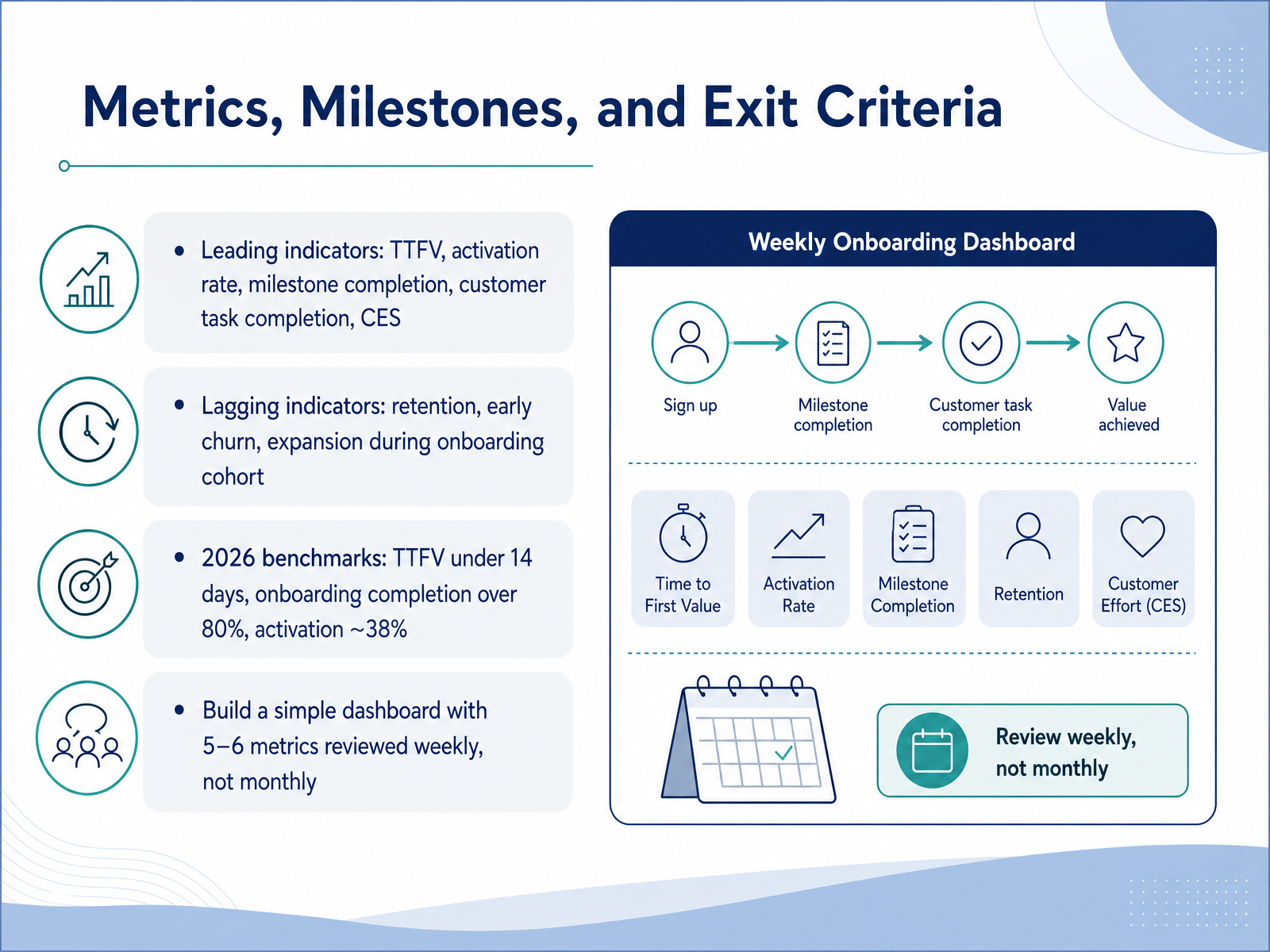
2 min - 12Metrics, Milestones, and Exit CriteriaNow let's talk about how we know onboarding is actually working. We track leading indicators like time to first value, activation rate, milestone completion, customer task completion, and customer effort score. These tell us early if we’re on track. Then we look at lagging indicators: retention, early churn, and expansion within the onboarding cohort. For 2026, our benchmarks are clear: time to first value under fourteen days, onboarding completion over eighty percent, and activation around thirty-eight percent. Instead of drowning in data, build one simple dashboard with five or six key metrics, and review it weekly, not monthly. That regular rhythm keeps us proactive, not reactive. Now, let's look at how we operationalize the entire process.
 customerexperience.iogetperspective.aionramp.us+22 min
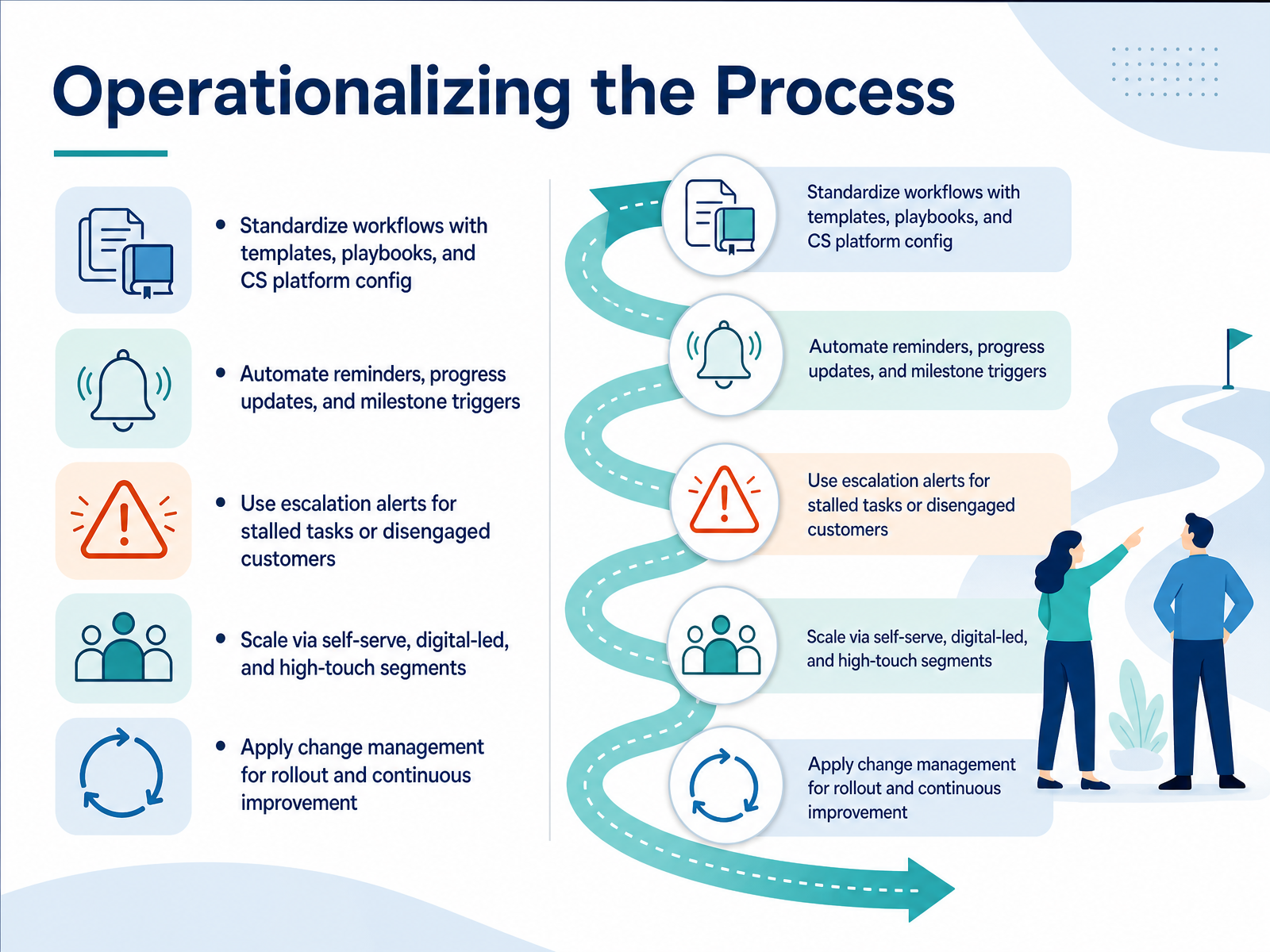
 - 13Operationalizing the ProcessNow let's talk about operationalizing the entire process. This is where we make the onboarding flow repeatable, measurable, and scalable. We start by standardizing our workflows with templates, playbooks, and proper configuration in our customer success platform. This ensures every customer gets the same high-quality experience, whether they're the first or the fiftieth you onboard this month. Next, we lean on automation. Set up reminders, progress updates, and milestone triggers so nothing slips through the cracks. When tasks stall or a customer starts to disengage, your system should flag it with an alert, letting you step in before it becomes a problem. As you grow, you'll want to scale by segment. Self-serve for smaller accounts, digital-led for the middle tier, and high-touch for your enterprise clients. Finally, apply a change management framework when rolling this out. Train your team, gather feedback, and iterate. Continuous improvement is what keeps this process fresh and effective. Up next, let's look at common pitfalls and how to avoid them, so you can steer clear of the most frequent mistakes from day one.
 onramp.ussuccessifier.comprojetly.ai+21 min
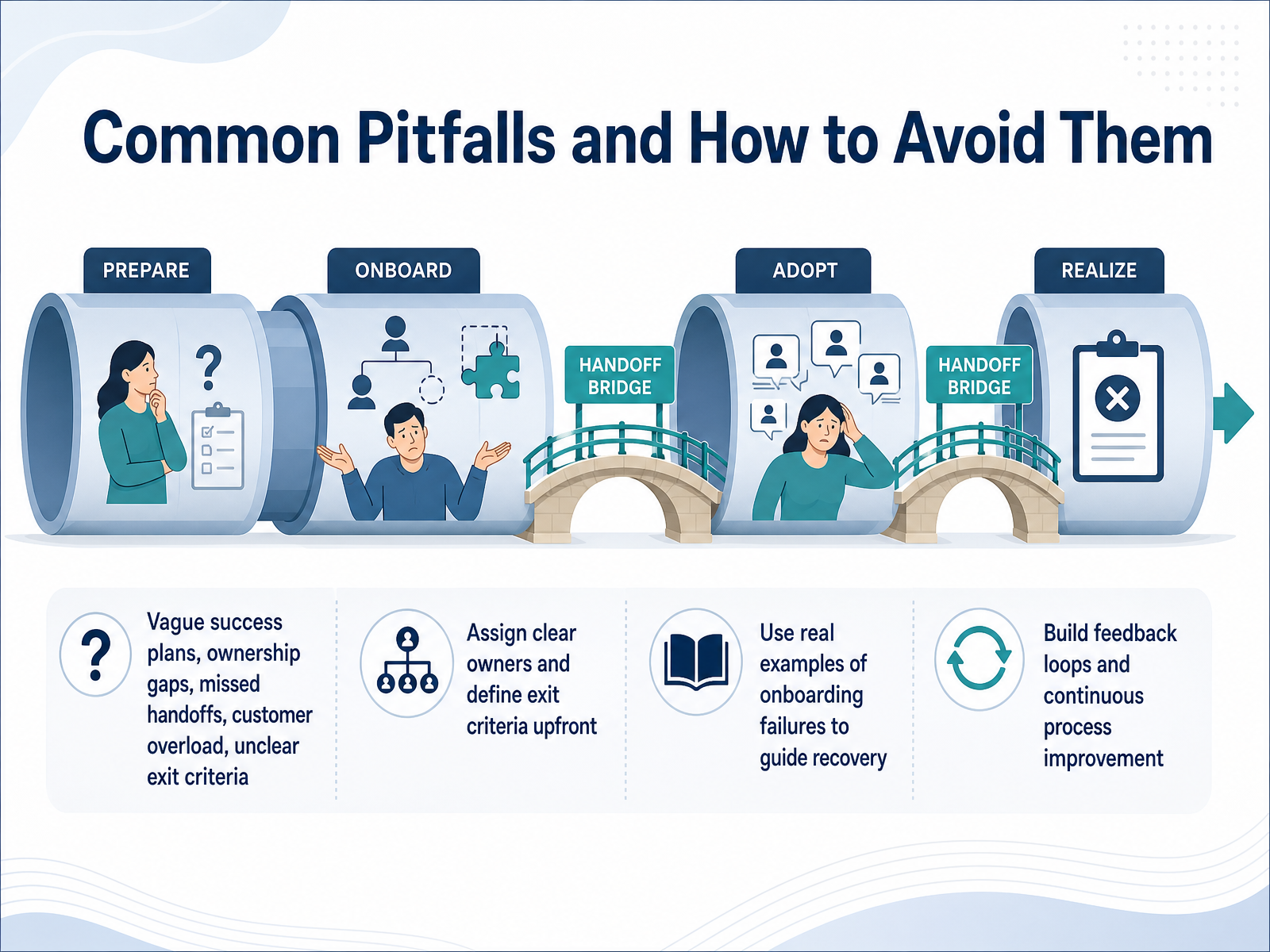
 - 14Common Pitfalls and How to Avoid ThemNow let's talk about the common pitfalls we see during onboarding, and more importantly, how to avoid them. The biggest ones are vague success plans, ownership gaps, missed handoffs, customer overload, and unclear exit criteria. The fix starts with two simple rules. Assign a clear owner for every single task, and define your exit criteria before the process even begins. For example, if a customer's success plan doesn't state who follows up after the kickoff, that follow-up simply won't happen. And when things do go wrong, don't hide it. Use real examples of onboarding failures as training material. They guide your team on how to recover and what to watch for next time. Finally, build feedback loops into the flow itself. Ask your customers and your team what felt confusing or redundant, then refine the process. Onboarding is never perfect on the first try, but it gets better every cycle if you keep learning. Now, let's look at how to put this entire framework into practice.
 1 min
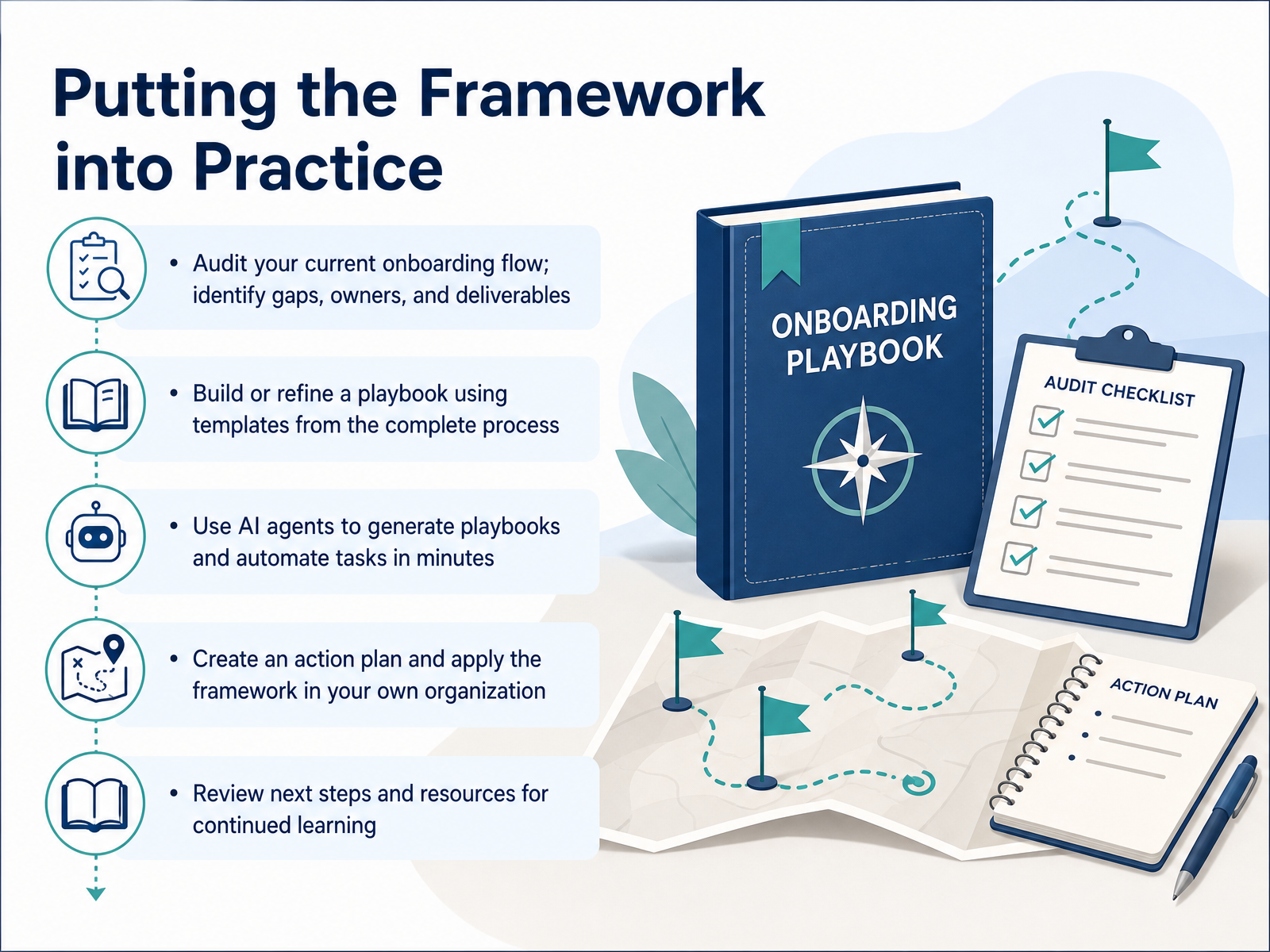
1 min - 15Putting the Framework into PracticeSo we've walked through the full journey together. Now, let's make it real for you. Start by auditing your current onboarding flow. Map out each stage, and ask two questions for every step: who owns it, and what do they deliver? You'll quickly spot the gaps. Next, build or refine your playbook. Use the templates from this course as your starting point, then tailor them to your segments and tiers. Don't start from a blank page. And here's where it gets exciting: use AI agents to do the heavy lifting. Tools like OnRamp or Successifier can generate structured playbooks from a simple description in minutes. They can automate task creation, send nudges, and flag risks before momentum is lost. Your team stays in control, but they stop doing manual work. Finally, create your action plan. Pick one onboarding stage that needs the most improvement, and apply the framework this week. Review the next steps and resources in your portal for continued learning. Thank you for being here. You now have a clear, repeatable path to onboarding excellence. Go apply it, and make your customers successful faster. Good luck.
 onramp.ussuccessifier.comprojetly.ai+22 min
Take the deck with you
Download this course as a file — free, no sign-up needed.
- PDF handoutEvery slide page, ready to print or share.16 pages · 3.8 MBDownload
- Narrated PowerPointThe deck that presents itself — every slide carries the digital human's narration video.16 pages · 16.0 MBDownload
- PowerPoint slidesThe full deck as a .pptx — open it in PowerPoint, Keynote, or Google Slides.16 pages · 3.7 MBDownload
Free to use in your own training — please keep the PersonWise credit page at the end.
Have your own deck? Turn it into a course
Sources consulted
Web sources consulted while building this course.
- Customer Onboarding Process: Flow, Steps & Template (2026) — rocketlane.com
- Customer Onboarding Best Practices (2026) | OnboardingHub — onboarding-hub.com
- Customer Onboarding: The 6-Stage Process, Checklist & Metrics (2026) — kompassify.com
- Customer Onboarding Best Practices: 10 That Actually Work in 2026 — onboard.io
- Customer Onboarding Best Practices 2026: A Leader's Guide | EasyFlow Blog — teameasyflow.com
- Customer Onboarding Metrics: Time to Value and KPIs — customerexperience.io
- The 2026 Customer Onboarding Benchmark Report: Activation Rates by Industry | Blog | Perspective AI — getperspective.ai
- The Driving Retention, — onramp.us
- Time-to-Value: The New SaaS Retention Battleground — saasmag.com
- Time to Value: The Key to Driving User Retention — amplitude.com
- 10 B2B customer onboarding best practices to accelerate time-to-value — blog.hubspot.com
- B2B Customer Onboarding Best Practices: The Complete Guide 2026 — orbix.studio
- The 5 Stages of Customer Onboarding (Framework & Examples) — valuecase.com
- Customer Onboarding Journey for B2B SaaS | Van Data Team — vandatateam.com
- B2B Customer Onboarding: How to Cut Time to First Value — smarte.pro
- AI Customer Onboarding Automation with OnRamp — onramp.us
- Product — AI Customer Success Platform Features | Successifier — successifier.com
- https://projetly.ai/customer-onboarding-software — projetly.ai
- OnRamp | Customer Portal Software — get.onramp.us
- AI Customer Success Playbook Generator | RationalGo App Builder | RationalGo — rationalgo.ai