Begin
18 pages · ~36 min
Forces and Motion Physics
An introductory physics course exploring forces, motion, and their real-world applications for learners new to the subject.
A digital instructor presents all 18 pages. Hold “Ask” at any point and ask out loud — the answer comes from this course. No sign-up needed.
What you’ll learn
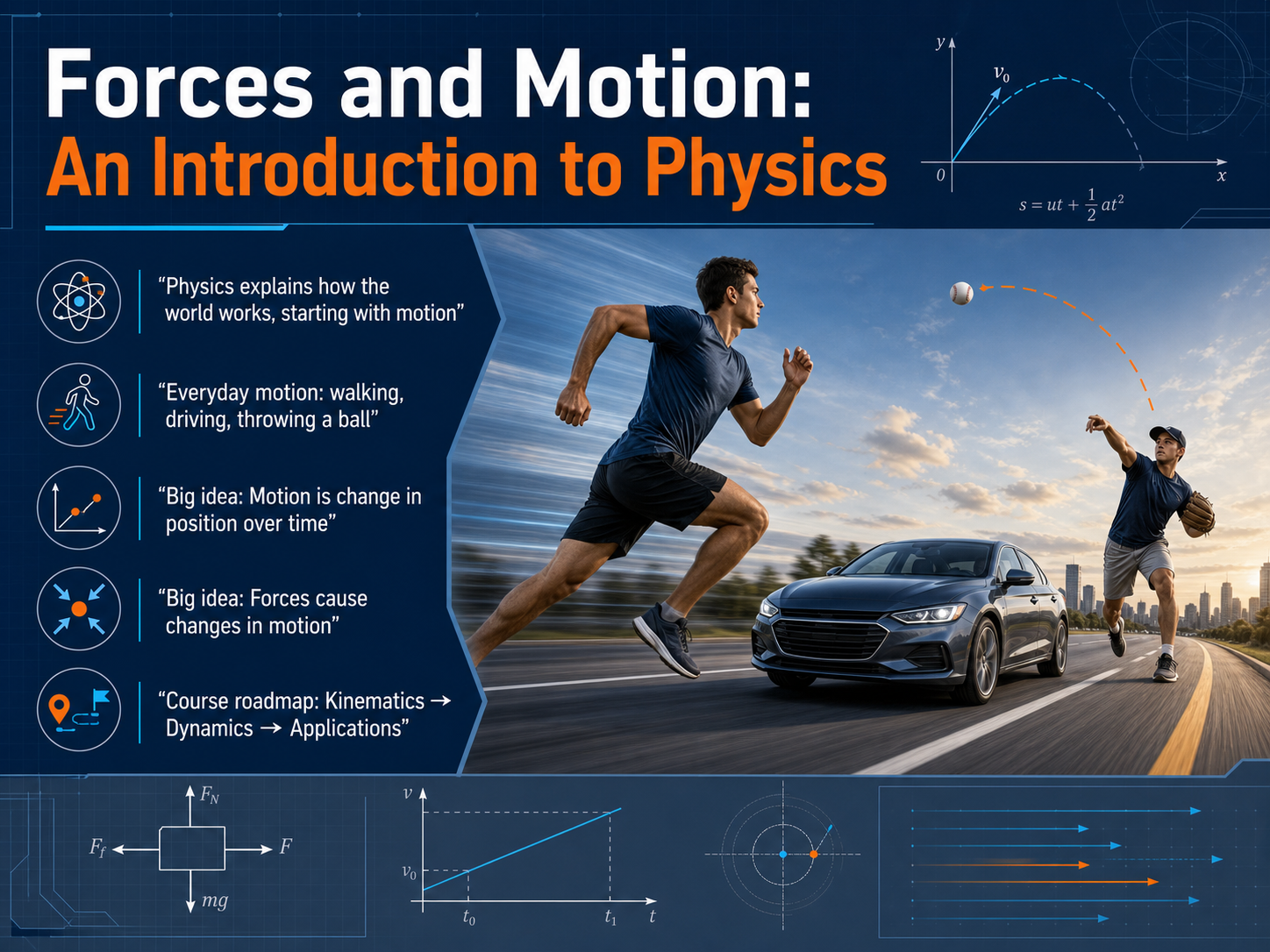
- 01Forces and Motion: An Introduction to PhysicsWelcome to Forces and Motion: An Introduction to Physics. I'm so glad you're here. Physics is really the study of how our world works, and we're going to start with something very familiar: motion. Think about walking across a room, driving a car, or even throwing a ball to a friend. These everyday actions are all examples of motion, and physics gives us the tools to describe them clearly. Our first big idea is that motion is simply a change in position over time. The second big idea is that forces are what cause those changes in motion. A push or a pull is a force, and it's the reason things start moving, speed up, slow down, or change direction. We'll build this understanding step by step. Our journey begins with kinematics, the language we use to describe motion. Then we'll move into dynamics, where we connect forces to that motion. Finally, we'll apply these ideas to real-world systems. Let's get started by taking a closer look at how we describe an object's location. That leads us right into our next topic: Position, Distance, and Displacement.2 min
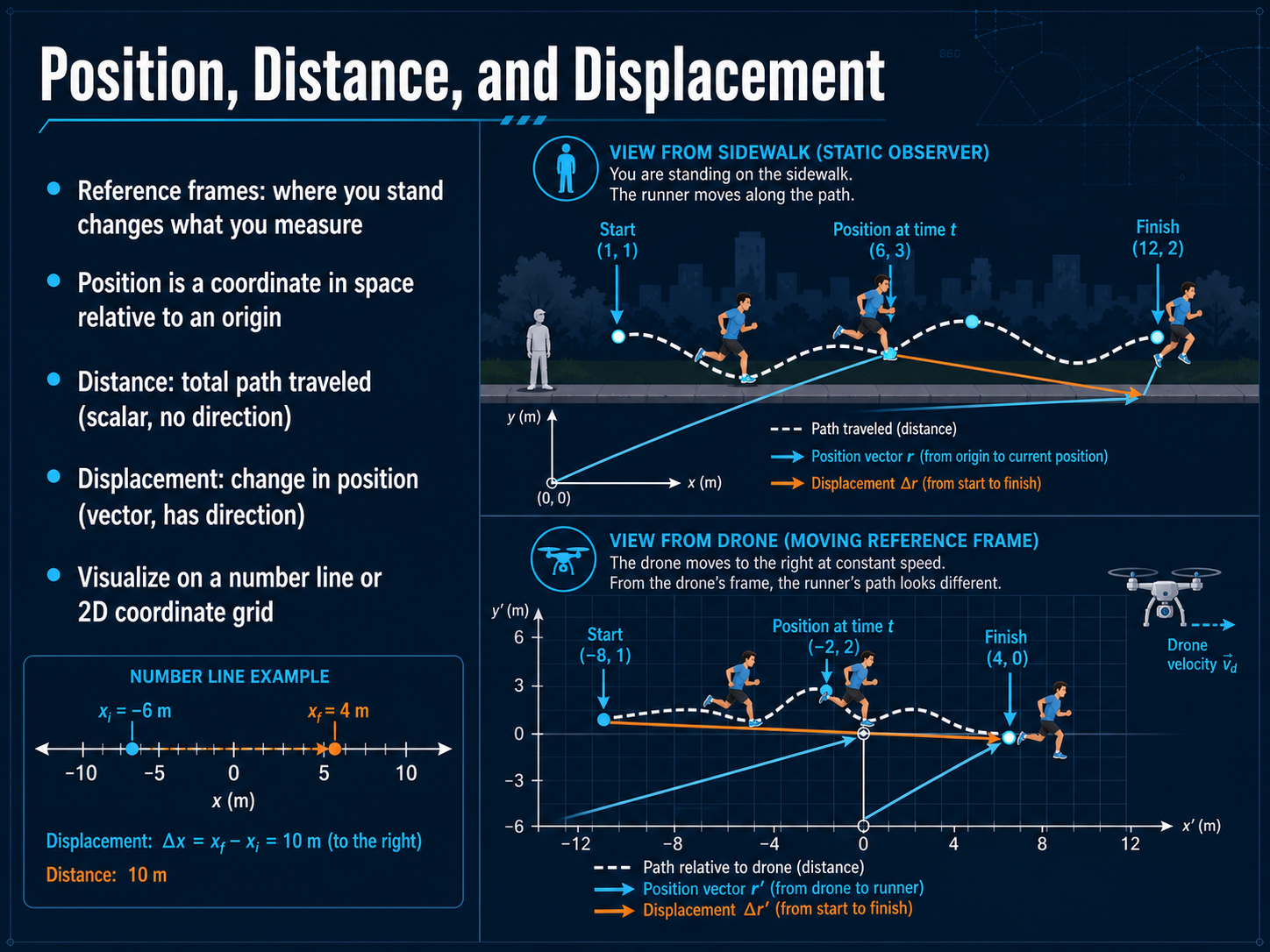
- 02Position, Distance, and DisplacementNow, let's build our foundation by looking at how we describe where something is. Imagine you're standing on a sidewalk, watching a friend walk down the street. Where you’re standing is what we call a reference frame. It’s your point of view, and it changes what you measure. If you move, your measurements change too. To be precise, we give location a number. Position is simply a coordinate in space, measured from a starting point we call the origin. Now, as your friend walks, two different ideas emerge. Think about the path they take. Distance is the total ground they cover. It’s a scalar, meaning it has a size, but no direction. If they walk around the block, the distance is the full length of the sidewalk. Displacement is different. Displacement is the change in position. It’s a vector, so it has both a size and a direction. It only cares about the straight line from their start point to their end point. If they end up just across the street, their displacement is small, even if they walked a long way. We can visualize this easily on a number line or a grid. Next, we’ll take these ideas and add time, to explore speed and velocity.
 2 min
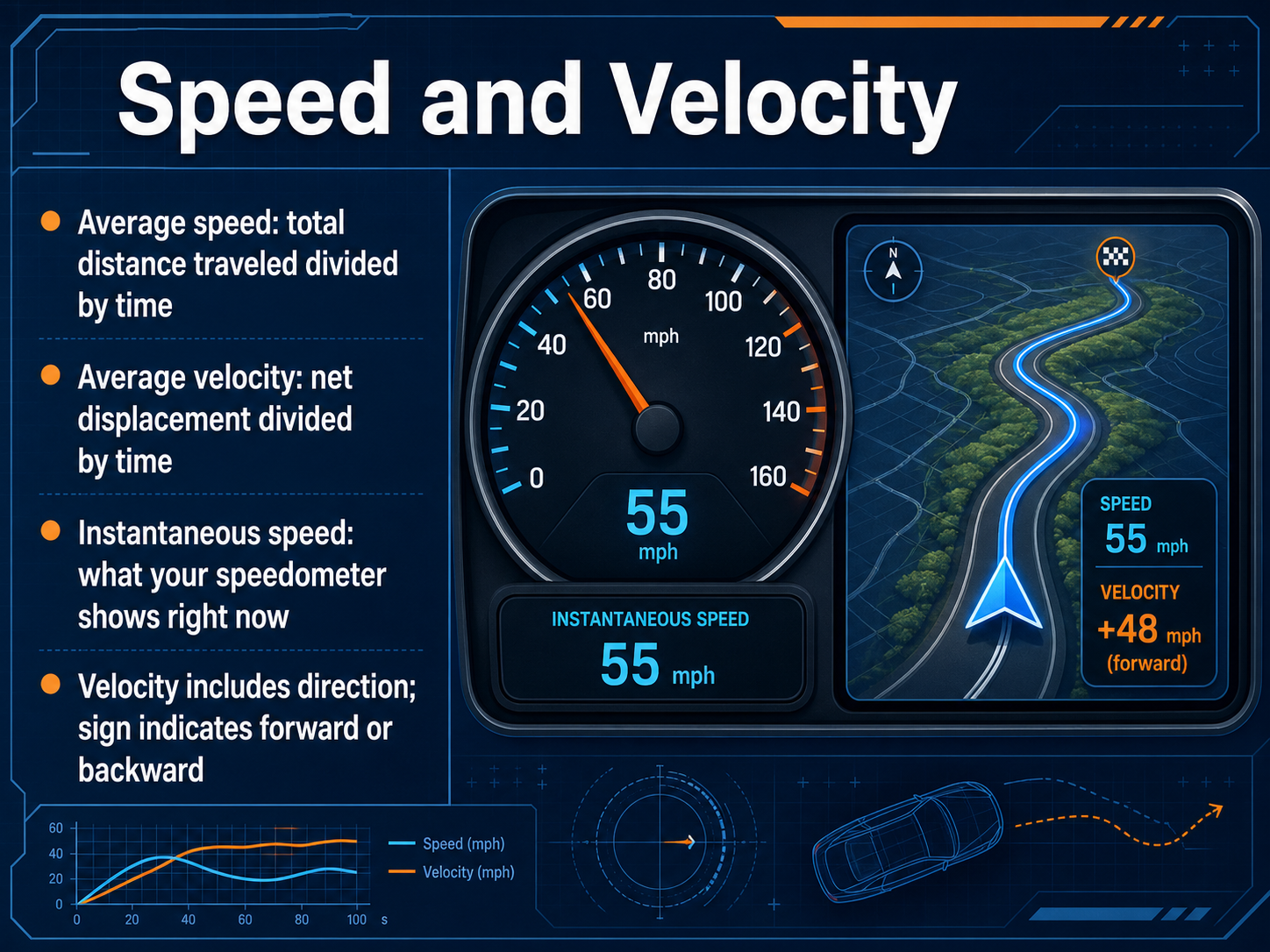
2 min - 03Speed and VelocityLet's clarify two words we often use interchangeably: speed and velocity. In physics, they have distinct meanings. Average speed is simply the total distance you travel divided by the time it takes. Think of a car trip: you might drive 150 miles in 3 hours. Your average speed is 50 miles per hour, even if you stopped for coffee. Average velocity, on the other hand, is your net displacement divided by time. Displacement is the straight-line change from your start point to your end point. So if you drive 150 miles but end up only 90 miles from where you started, your average velocity is lower. Now, instantaneous speed is what your speedometer shows right this second. It is the speed at a single moment. The key difference is that velocity always includes direction. We often use a plus or minus sign to show forward or backward motion along a line. So, a velocity of negative 20 meters per second means you are moving backward at 20 meters per second. Now that we have speed and velocity clear, let's move on to the idea that changes them: acceleration.
 2 min
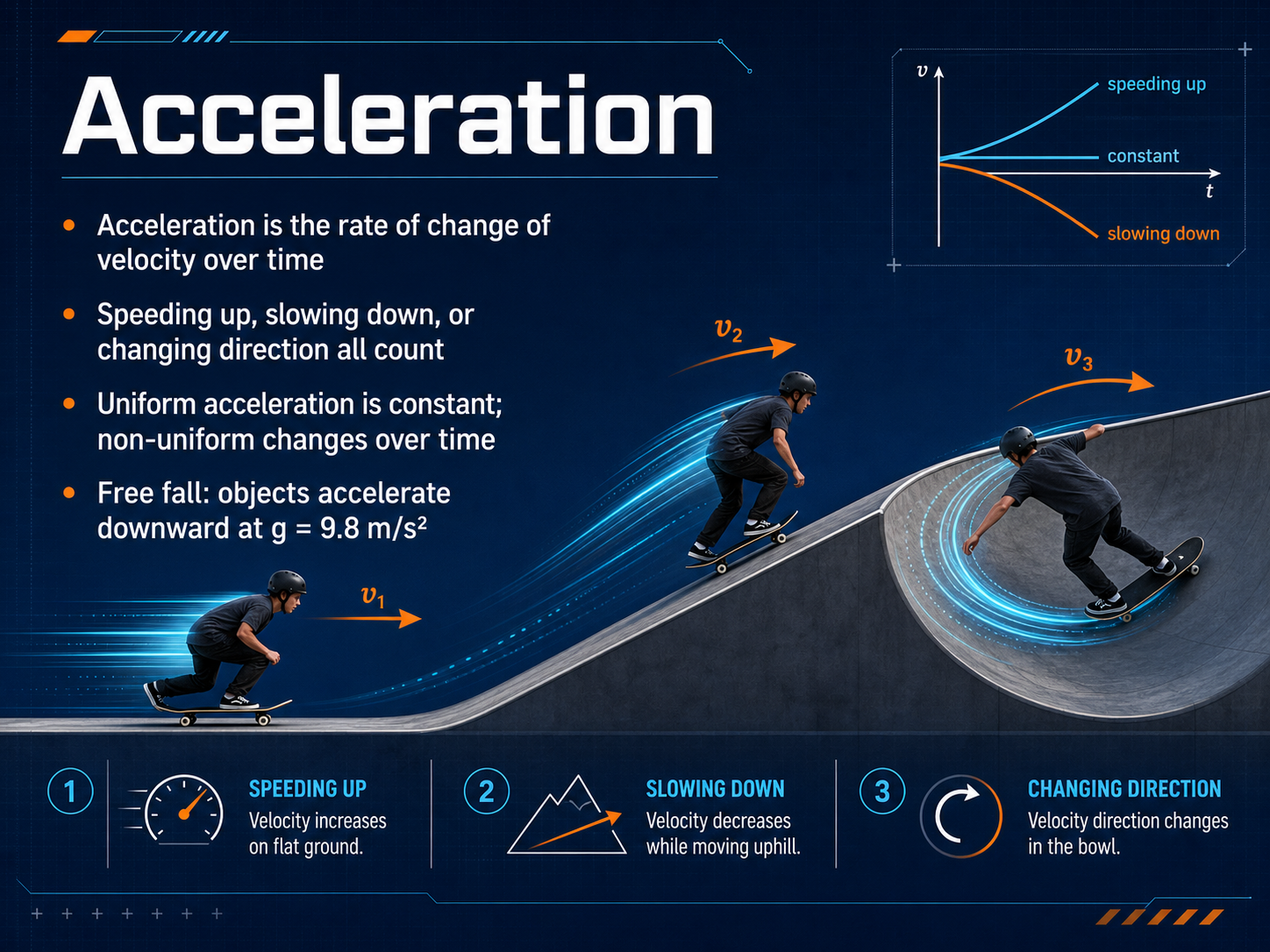
2 min - 04AccelerationNow, let's build on that idea of velocity and talk about acceleration. Acceleration is simply the rate of change of velocity over time. Think of it as how quickly your speed or direction is changing. It's not just about speeding up, though. Slowing down, which we sometimes call deceleration, and even changing direction, like turning a corner, all count as acceleration because your velocity is changing. You can have uniform acceleration, where the change is constant, like a car steadily gaining speed on a highway on-ramp. Or, acceleration can be non-uniform, changing over time, like a car navigating stop-and-go city traffic. A special, important case of uniform acceleration is free fall. Near the Earth's surface and ignoring air resistance, all objects accelerate downward at a constant rate. We call this acceleration due to gravity 'g', and its value is about nine point eight meters per second squared. That means every second an object falls, its downward speed increases by another nine point eight meters per second. Next, we'll put these ideas into practice with some acceleration calculations and real-world examples.
 openstax.orgopenstax.orggeeksforgeeks.org+21 min
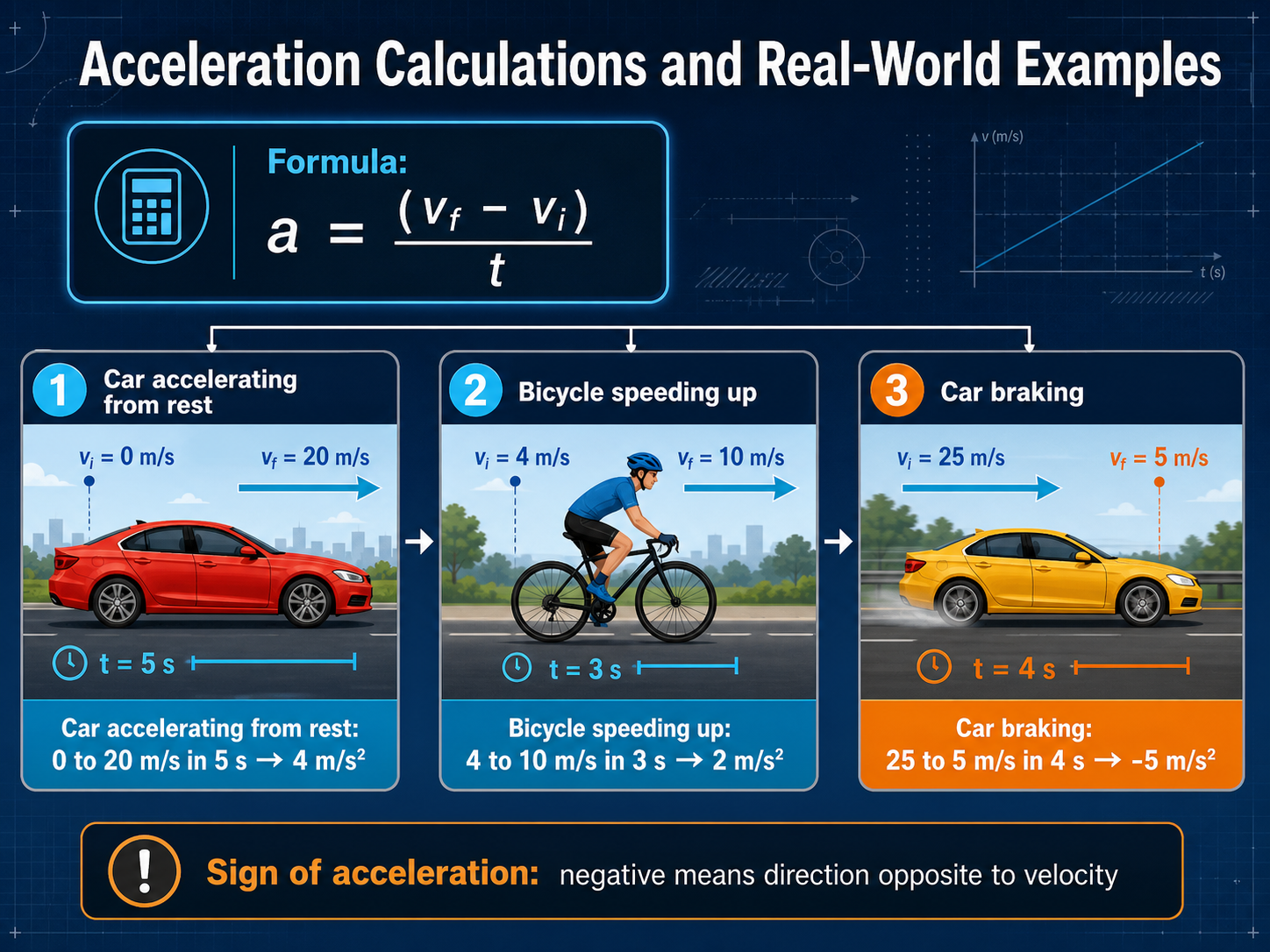
 - 05Acceleration Calculations and Real-World ExamplesNow, let's put the definition of acceleration into practice with a simple formula. Average acceleration, often written as 'a-bar', equals the change in velocity divided by the change in time. We write this as final velocity, v f, minus initial velocity, v i, all over time, t. Let's see this in action. Imagine a car accelerating from rest. That means its initial velocity is zero. It reaches twenty meters per second in five seconds. Plugging in the numbers, we get four meters per second squared. This means the car's speed increases by four meters per second, every single second. Next, think about a bicycle. It speeds up from four meters per second to ten meters per second in three seconds. The calculation gives us an acceleration of two meters per second squared. Now, what about slowing down? If a car brakes and goes from twenty-five meters per second down to five meters per second in four seconds, we get a negative acceleration of negative five meters per second squared. That negative sign is crucial. It doesn't just mean 'slowing down' in a general sense. It specifically tells us the acceleration is pointing in the opposite direction to the velocity. So, if you're moving forward and hit the brakes, your acceleration is backward. This is also called deceleration. Understanding this sign is a key step toward our next big idea: 'What Is a Force?'. Let's go find out.
 openstax.orgopenstax.orggeeksforgeeks.org+22 min
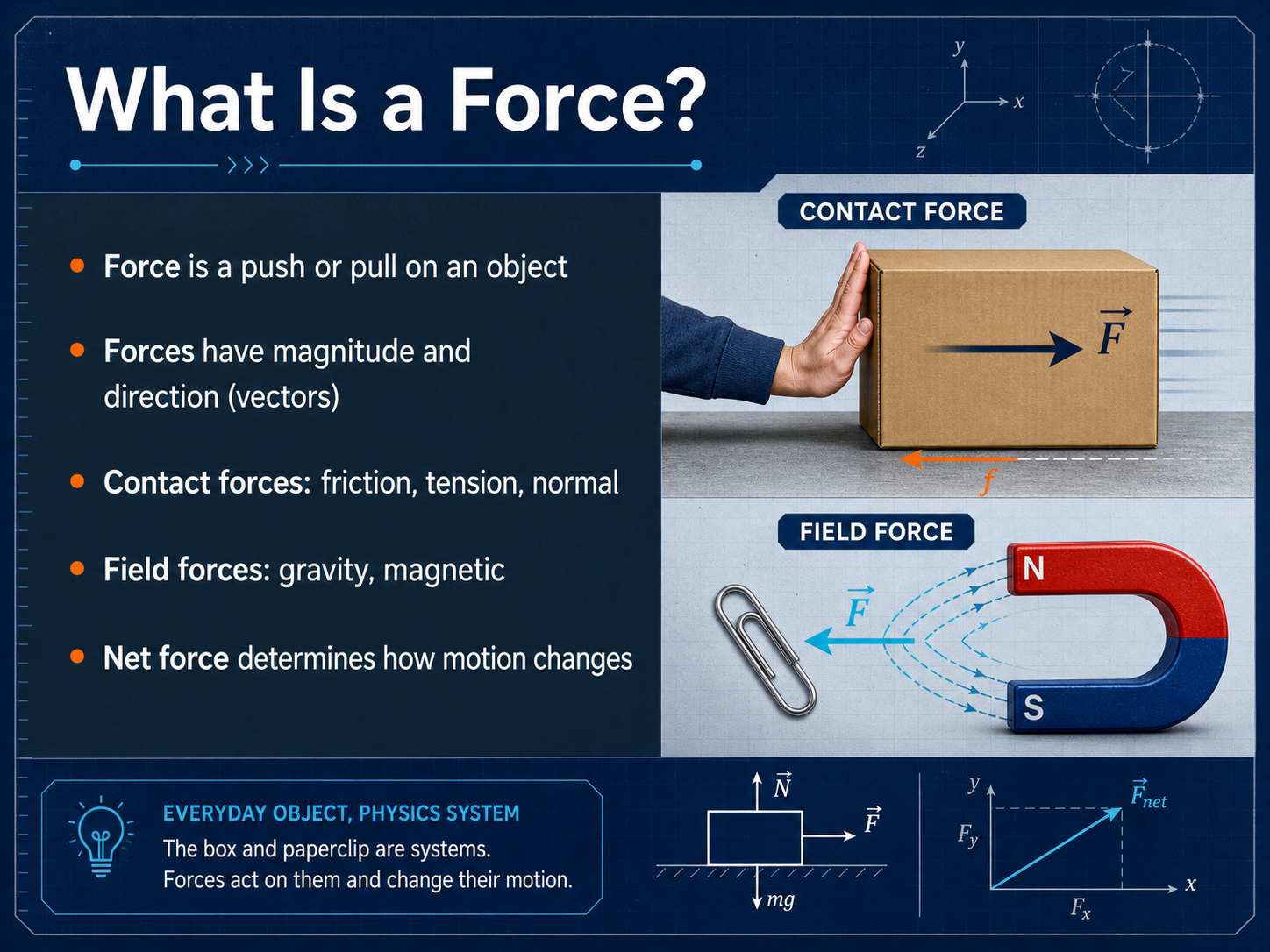
 - 06What Is a Force?Now, let's get to the heart of the matter: what is a force? Simply put, a force is a push or a pull. When you close a door, you apply a push. When you open a drawer, you apply a pull. But forces are more than just a simple shove. Every force has two key properties: magnitude, which is how strong the push or pull is, and direction. Because they have both strength and direction, we describe them as vectors. Think of it like giving directions; you wouldn't just say 'walk three blocks,' you'd say 'walk three blocks north.' Forces work the same way. We can group forces into two main families. First, there are contact forces. These happen when objects are physically touching. Friction is a contact force that resists sliding. Tension is the pulling force in a rope or cable. And the normal force is the support force from a surface, like the push of a chair keeping you seated. The second family is field forces. These can act at a distance, without touching. Gravity is the classic example, pulling objects toward the Earth. Another is magnetic force, which can attract or repel a paperclip from a distance. So, what happens when multiple forces act on an object? The combination of all these forces is called the net force. It's the net force, the overall result, that determines if and how an object's motion will change. If the net force is zero, the motion stays the same. If it's not zero, the object accelerates. This idea of net force sets the stage perfectly for our next big idea: Newton's First Law of Motion, often called the Law of Inertia.
 2 min
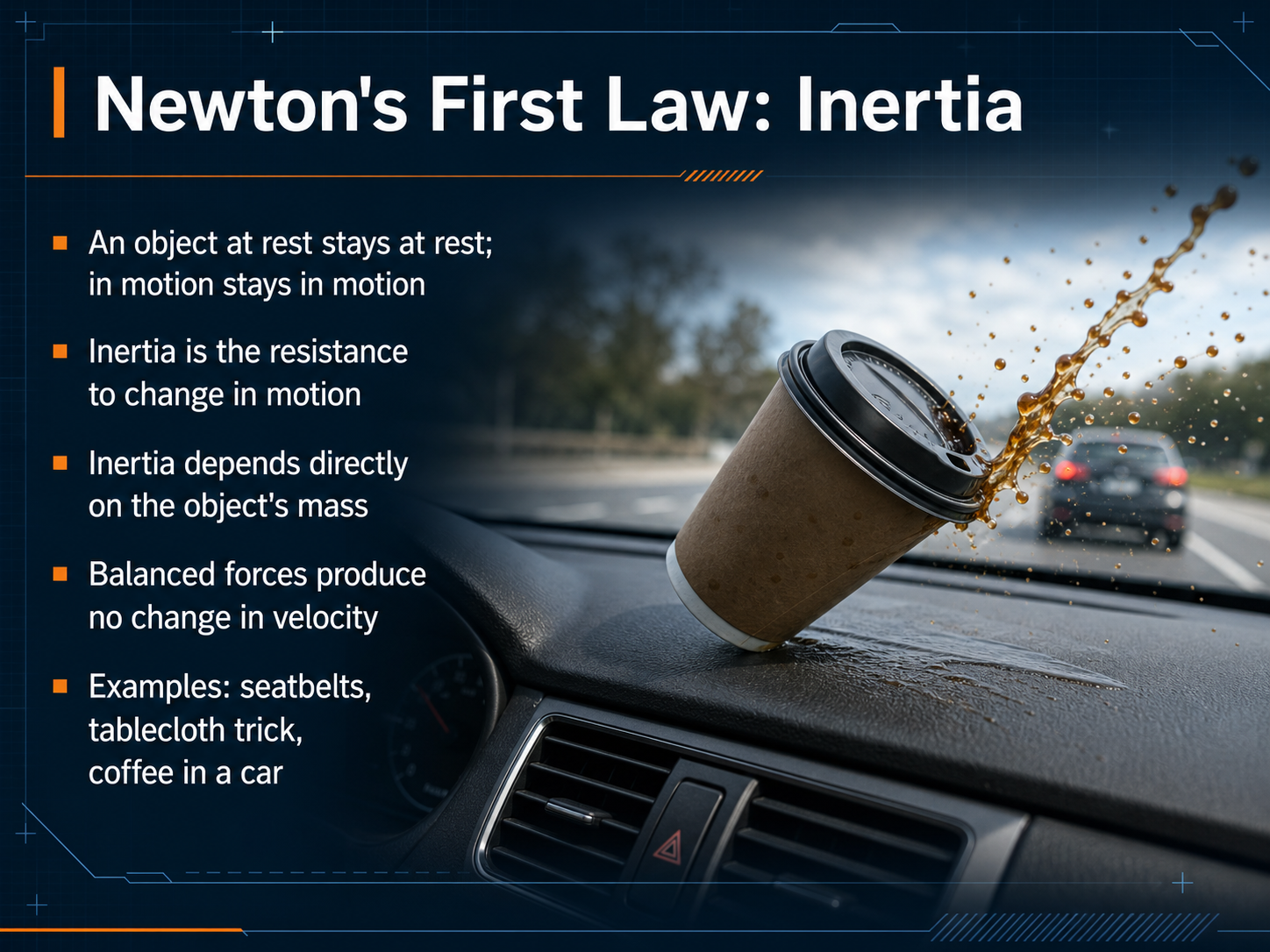
2 min - 07Newton's First Law: InertiaNow, let's put these ideas together into Newton's first law, often called the law of inertia. It states that an object at rest stays at rest, and an object in motion stays in motion with the same speed and direction, unless acted upon by an unbalanced force. Inertia is simply the resistance an object has to any change in its motion. This resistance depends directly on the object's mass. A heavier object has more inertia, so it's harder to speed up, slow down, or turn. Think about pushing an empty shopping cart versus a full one. The full cart has more mass, so it resists your push much more. When forces are balanced, meaning they cancel out completely, the object's velocity does not change. This is why you feel a sudden lurch forward in a car during a hard stop. Your body was in motion, and without a seatbelt to provide that unbalanced stopping force, it continues moving forward. The classic tablecloth trick also shows this perfectly. A quick pull of the cloth applies a force for such a short time that the dishes, due to their inertia, barely move. Inertia explains why you need to be careful with a coffee cup in a car. A sudden turn can cause the coffee to continue in its original straight-line motion, right out of the cup. So, mass is the measure of an object's inertia, dictating how much it resists changes to its motion. Next, we'll build on this foundation to explore the precise relationship between force, mass, and acceleration with Newton's second law.
 2 min
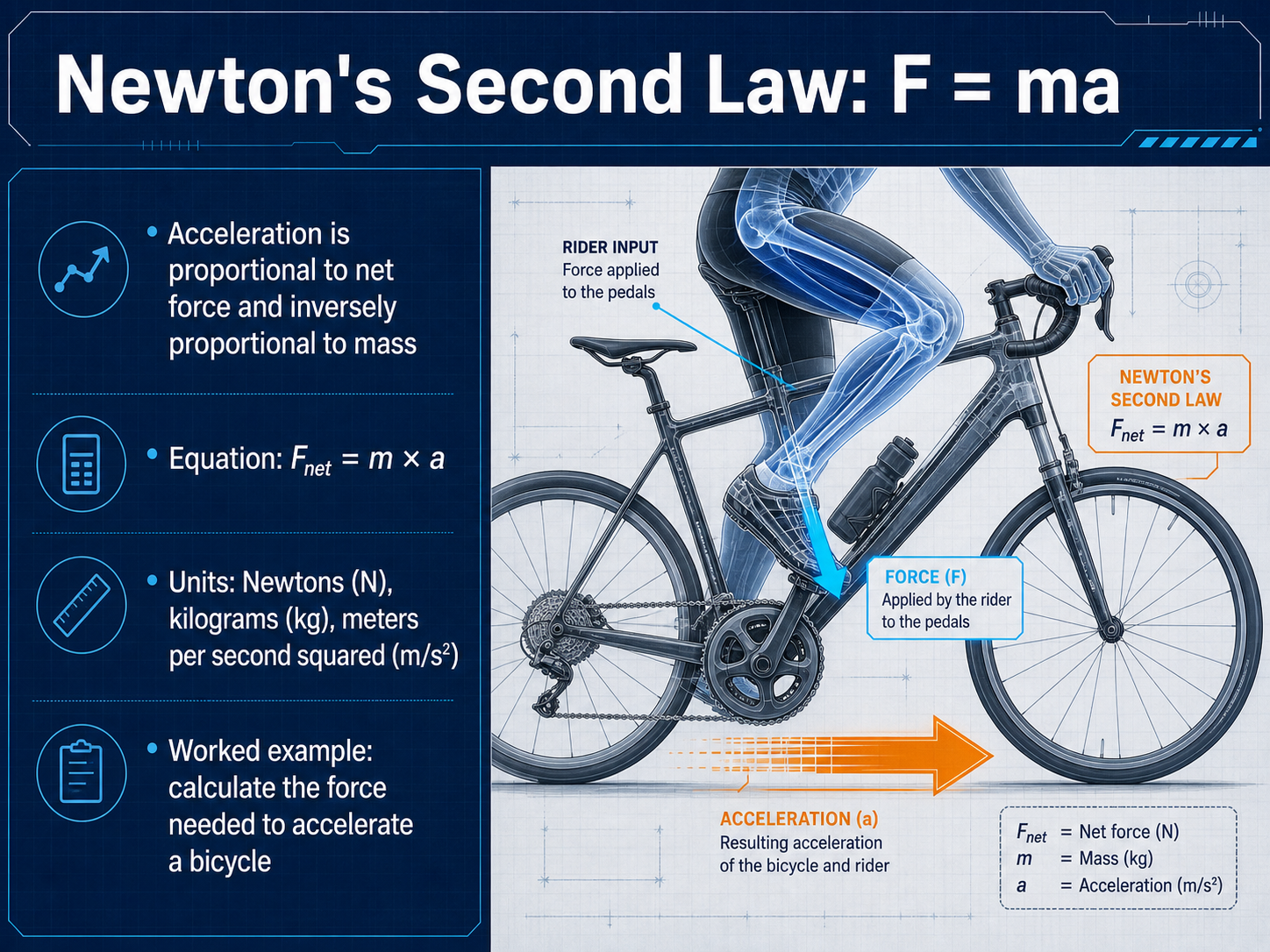
2 min - 08Newton's Second Law: F = maNow that we understand force itself, let's see how force causes motion. This is Newton's second law, often written as F equals m a. Force equals mass times acceleration. What does that really mean? It means the harder you push on something, the faster it speeds up. Acceleration is directly proportional to the net force. But it's also inversely proportional to mass. Think about pushing a shopping cart versus pushing a car. The same push gives you a lot more acceleration on the lighter cart. Let's look at the equation: F net equals m multiplied by a. Force is measured in Newtons, mass in kilograms, and acceleration in meters per second squared. Let's run a quick example. Imagine you're riding a bicycle. You and the bike together have a mass of 80 kilograms. You want to accelerate at 2 meters per second squared. We plug the numbers into our equation. Force equals 80 kilograms times 2 meters per second squared. That gives us 160 Newtons. So your legs need to push the pedals with a net force of 160 Newtons to get that acceleration. Now, let's flip the logic. If you push on an object and it accelerates, you can calculate the force. If you know the force and the acceleration, you can find the mass. This simple equation is a powerful tool for understanding the world. Next, we'll explore Newton's third law: action and reaction.
 2 min
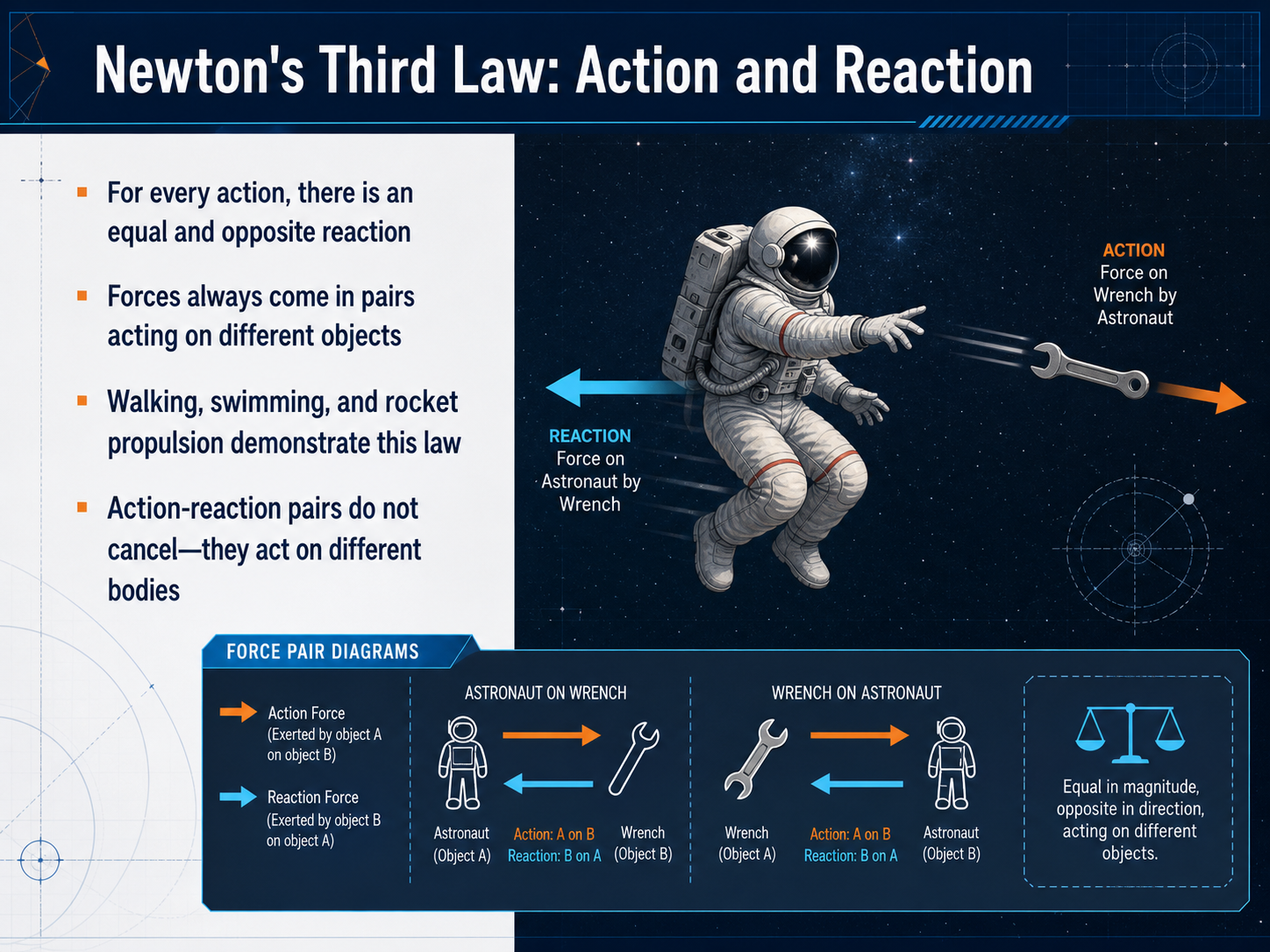
2 min - 09Newton's Third Law: Action and ReactionNow we arrive at Newton's third law, which often surprises people at first. It says: for every action, there is an equal and opposite reaction. What does that really mean? It means that forces always come in pairs, and those two forces act on different objects. Think about walking. Your foot pushes backward against the ground. The ground pushes you forward with the same amount of force. You move forward because that reaction force acts on you, not on the ground. Swimming works the same way. You push the water backward, and the water pushes you forward. Even a rocket lifting off follows this rule. Hot gases push down, and the rocket gets pushed up. Here is the key idea that many people get wrong. Action and reaction forces do not cancel out. They act on different bodies. Your foot pushes the ground, the ground pushes you. Two objects, two forces. They never balance each other on a single object. Keep that in mind, and you will avoid the most common mistake with this law. Next, let's see how these ideas connect to the forces we feel every day, starting with gravity and normal force.
 2 min
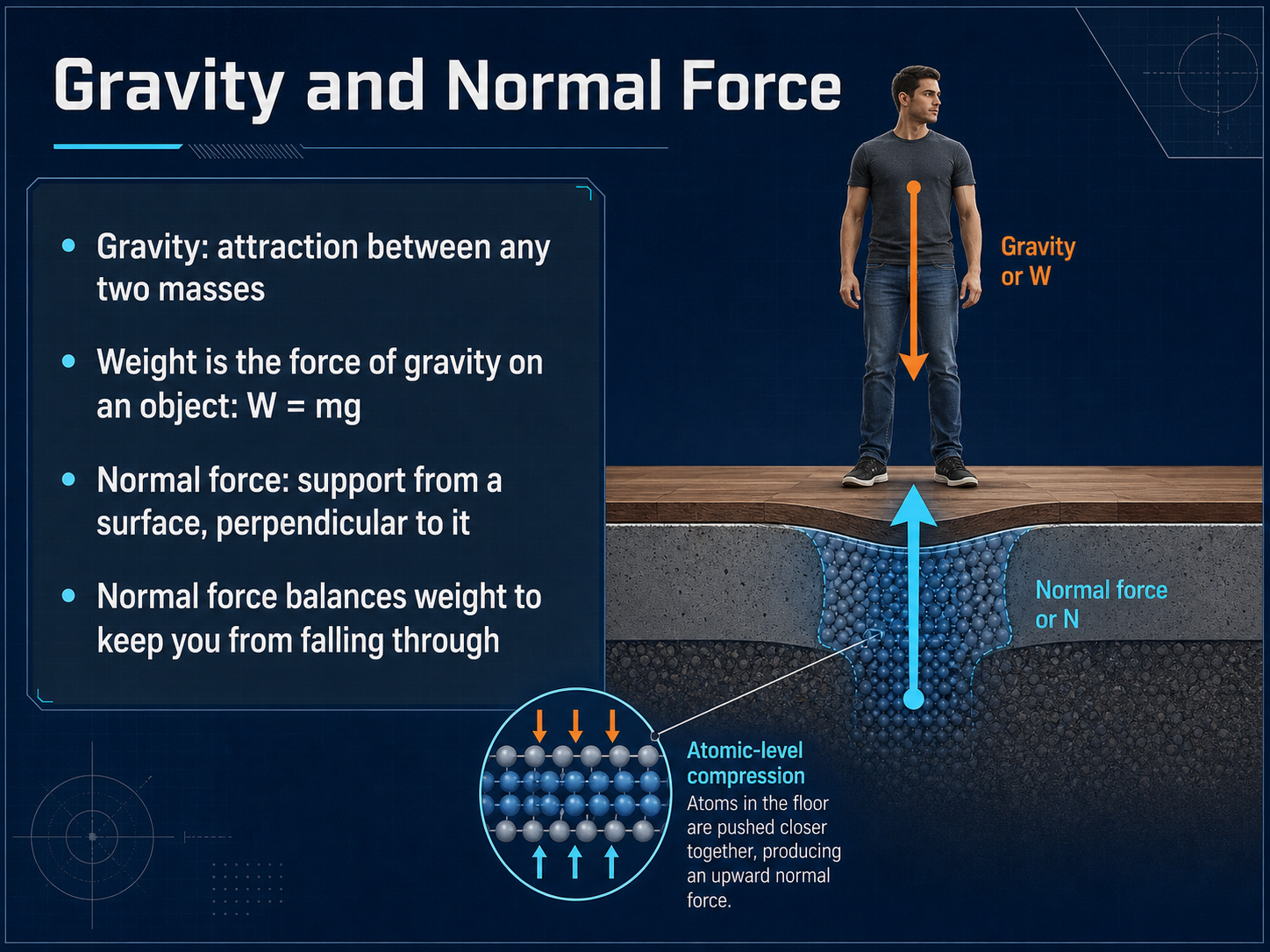
2 min - 10Gravity and Normal ForceNow, let's look at two forces you experience every single moment. First, gravity. Gravity is the attraction between any two masses. For us, it's the pull of the entire Earth on our bodies. We call this pull your weight. Scientists define weight with a simple formula: W equals m g. Here, 'W' is weight, 'm' is your mass, and 'g' is the acceleration due to gravity. So why don't you just fall straight through your chair to the center of the Earth? That's where the normal force comes in. A normal force is the support from a surface, and it always pushes perpendicular to that surface. Right now, the floor is pushing up on you with a normal force that exactly balances your weight. It's this perfect balance that keeps you from falling through. Next, we'll explore what happens when surfaces aren't perfectly smooth, as we look at friction, both static and kinetic.
 2 min
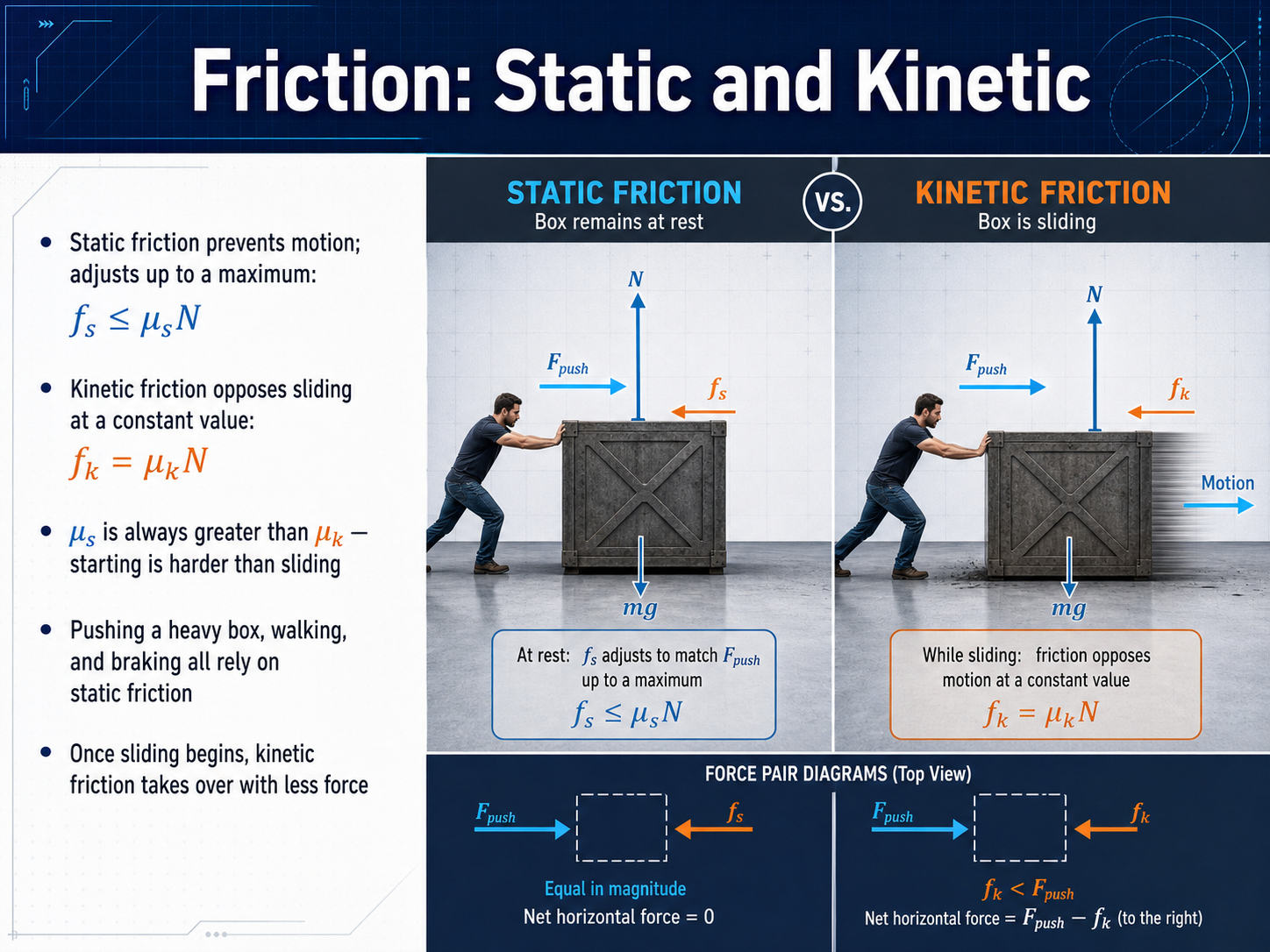
2 min - 11Friction: Static and KineticNow let's look at the two main types of friction you experience every day: static and kinetic. Static friction is the gripping force that prevents an object from moving. It adjusts itself to match whatever force you apply, up to a certain maximum. Think about pushing a heavy sofa across the carpet. At first, you push and it doesn't budge. That is static friction pushing back equally hard. When you finally push hard enough to overcome that maximum grip, the sofa begins to slide. That threshold is where static friction gives way to kinetic friction. Kinetic friction is the resistance between surfaces that are already sliding past each other. Unlike static friction, it stays at a roughly constant value while the motion continues. Here is a key insight: the coefficient of static friction is always greater than the coefficient of kinetic friction. This means it is genuinely harder to start something moving than it is to keep it sliding. You feel this every time you shove a heavy box—that initial push is the hardest. Walking, braking, and even holding a glass all rely on static friction. Without it, your feet would slip and cars would not stop. But once you start to skid, kinetic friction takes over with less force. That is why anti-lock brakes pulse the breaks to keep you in the static friction zone. As we explore further, our next slide will show how these forces play out in everyday systems like walking and driving.
 geeksforgeeks.orgrevisiongenie.comphysicsfundamentals.org+22 min
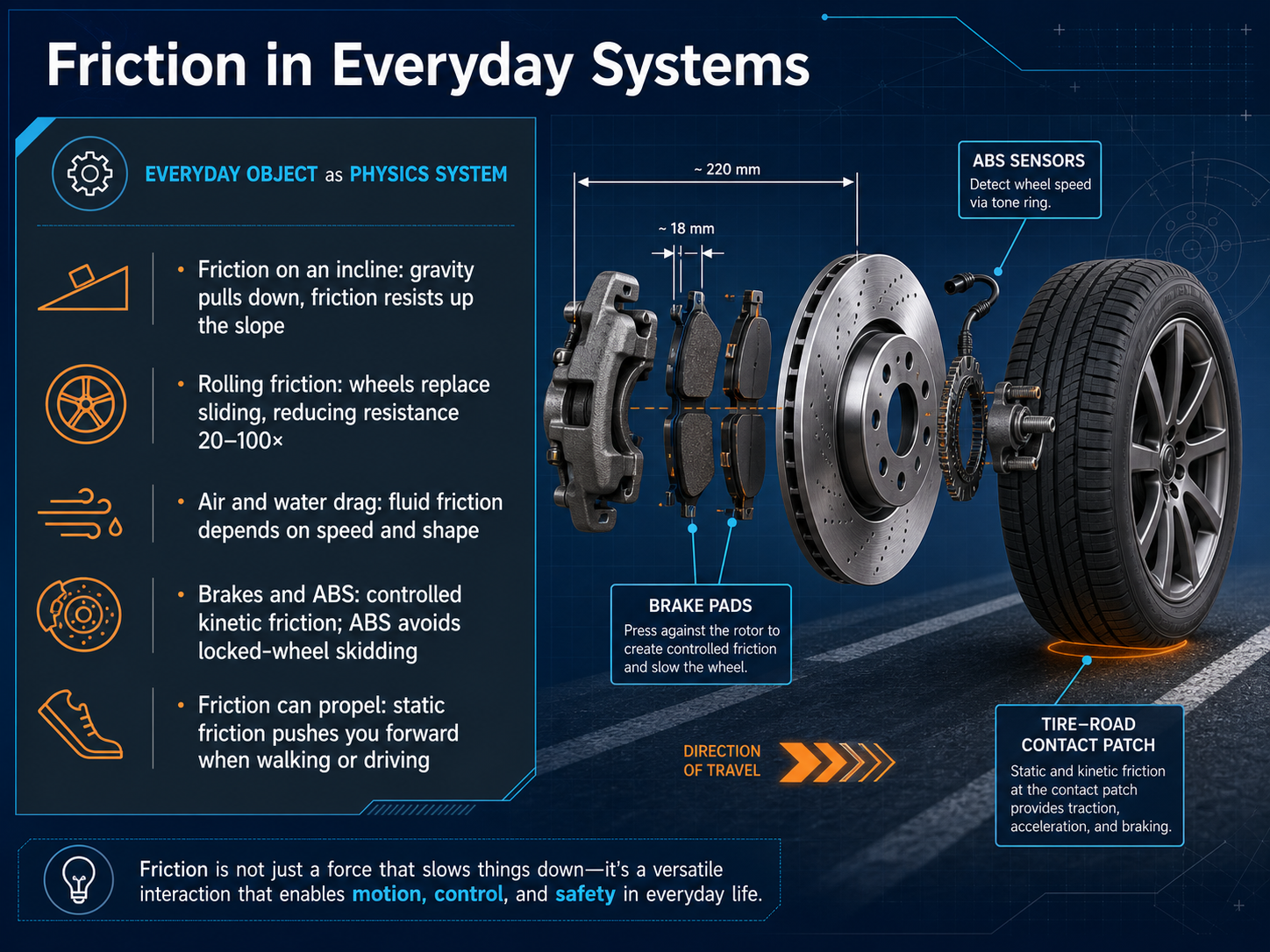
 - 12Friction in Everyday SystemsNow let's bring friction into everyday systems. Picture a box resting on a ramp. Gravity pulls it straight down, but part of that pull acts along the slope. Friction pushes back up the incline, resisting that slide. If the ramp gets too steep, gravity wins and the box starts moving. That threshold is where static friction gives way to kinetic friction. Wheels change everything. They replace sliding with rolling, cutting resistance by twenty to a hundred times. That clever swap is why carts, bikes, and cars move so efficiently. Fluids like air and water also push back. Air drag and water resistance depend on your speed and your shape. Faster motion or a blunter front means more drag. In a car, brakes use controlled kinetic friction to slow you down. But if the wheels lock, the tires skid, and you lose the stronger grip of static friction. Anti-lock braking systems, or ABS, pulse the brakes to keep the wheels just at the edge of slipping, so you stop faster and steer safely. And here's a fascinating twist: friction doesn't always oppose motion. When you walk, your foot pushes backward on the ground, and static friction pushes you forward. The same happens when a car drives. Without that grip, you'd spin in place. In the next slide, we'll explore tension and spring force, guided by Hooke's Law.
 geeksforgeeks.orgrevisiongenie.comphysicsfundamentals.org+22 min
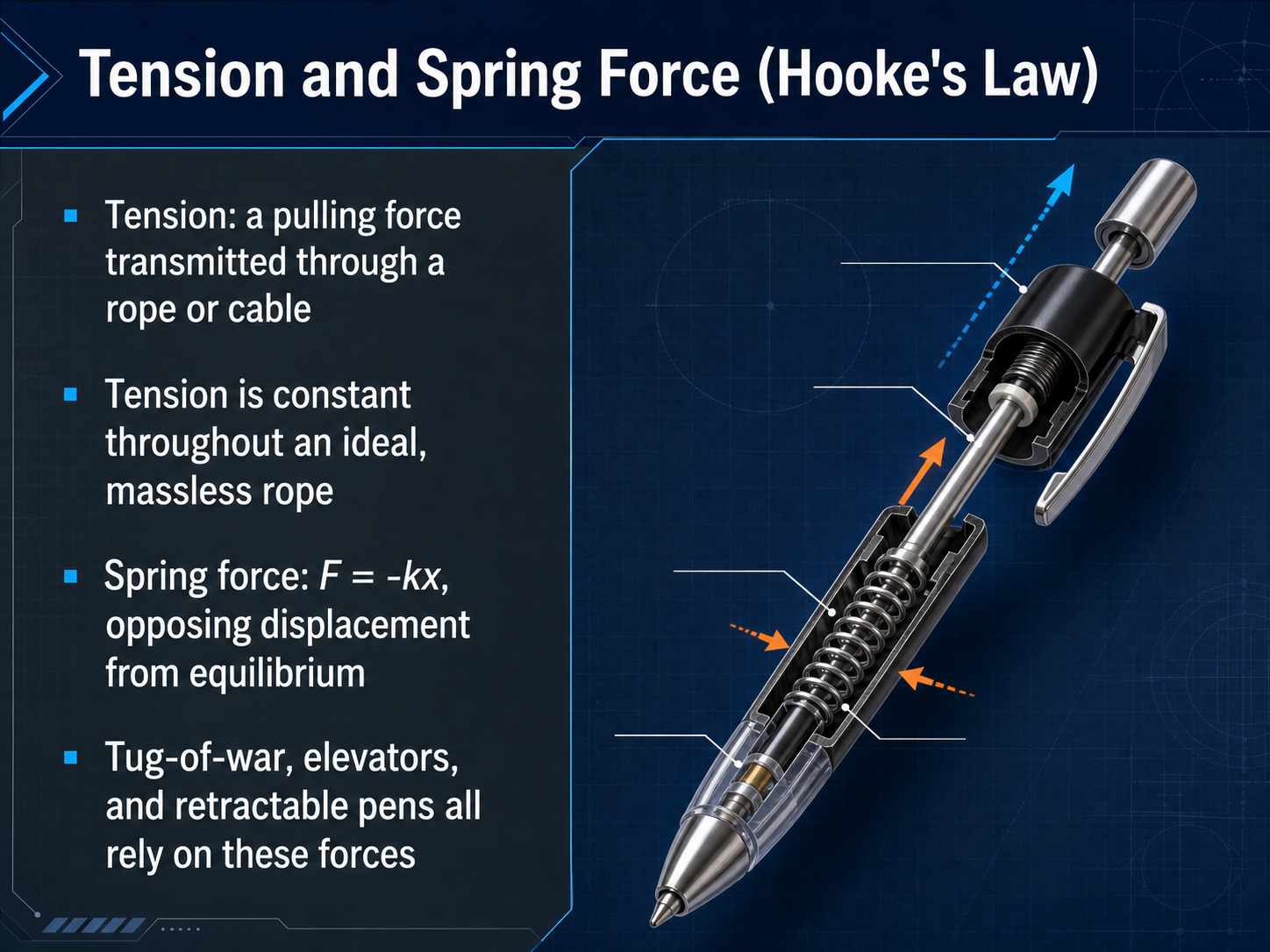
 - 13Tension and Spring Force (Hooke's Law)Now let's look at two pulling forces: tension and spring force. Tension is a pulling force transmitted through a rope, string, or cable. Imagine a tug-of-war. The rope is tight, pulling equally on both teams. That's tension at work. If we consider an ideal, massless rope, the tension is constant all the way through. That means the pull you feel at one end is exactly the same pull at the other end. Next, think about a spring. A spring force is different. It pulls back when you stretch it and pushes back when you compress it. We describe this with Hooke's Law: F equals negative k x. The 'k' tells us how stiff the spring is, and 'x' is how far the spring is stretched or compressed from its rest position. The negative sign simply means the force always opposes the displacement. You see this in a retractable pen, where a small spring pushes the tip back in. Elevators also rely on strong cables under tension to lift and lower the car safely. So tension and spring forces are everywhere, from playground games to the machinery that moves us. Up next, we'll bring these forces together and learn how to draw free-body diagrams.
 2 min
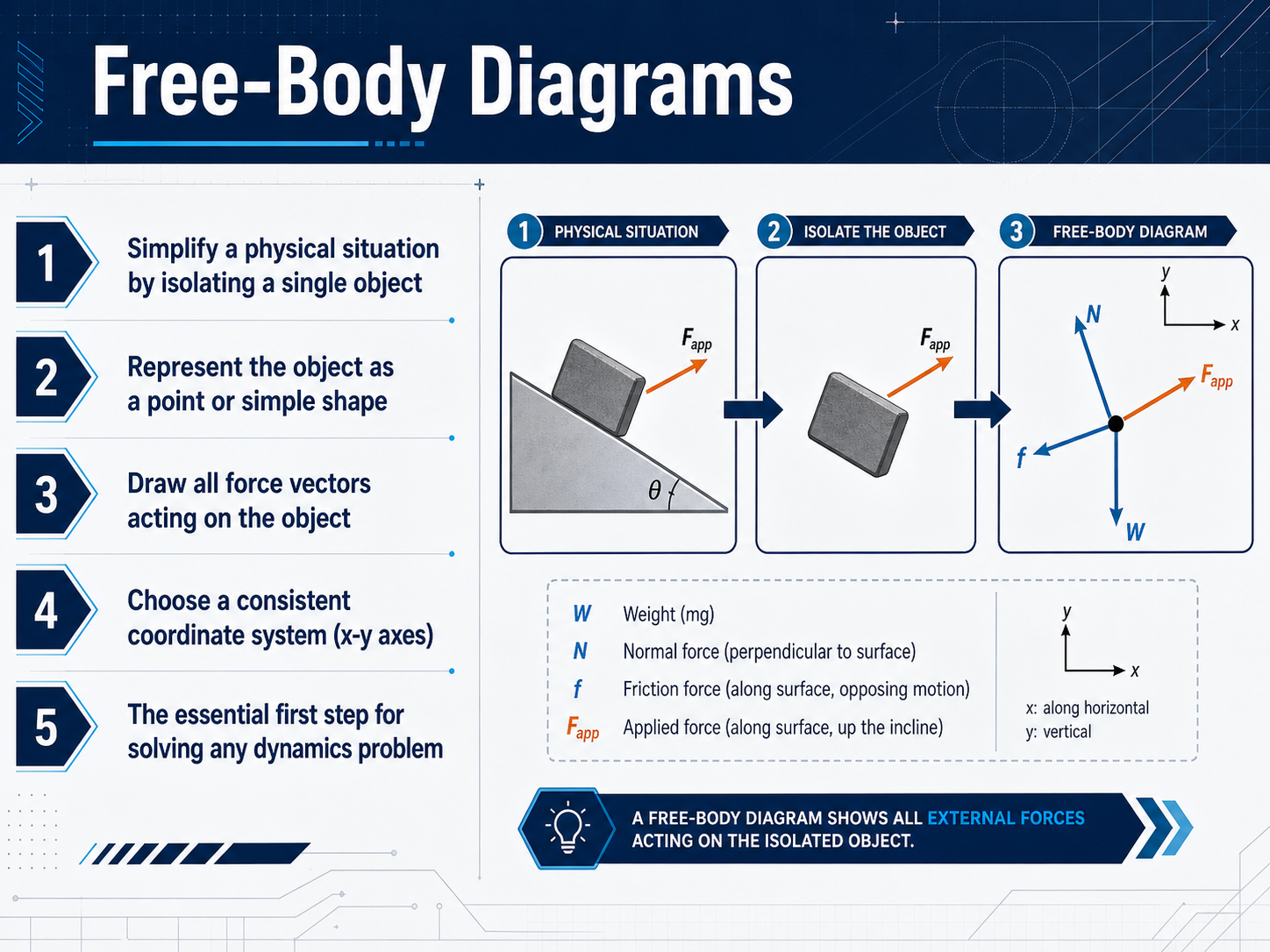
2 min - 14Free-Body DiagramsNow we have a powerful tool to bring clarity to any situation involving forces. It's called a free-body diagram. Think of it as a way to simplify a complex scene, like a book sitting on a table or a sled being pulled through the snow, by isolating just one object. First, we represent that single object as a simple point or a basic shape. Then, we draw every force vector acting on it. This means we draw arrows that start from the object, showing the push or pull of each force. Next, we choose a consistent coordinate system, our x and y axes, to give these forces a clear direction. This simple diagram is the essential first step for solving any dynamics problem. It turns a wordy description into a clear, visual map of all the forces at play. Let’s put this method to work by using it to analyze a car’s motion.
 1 min
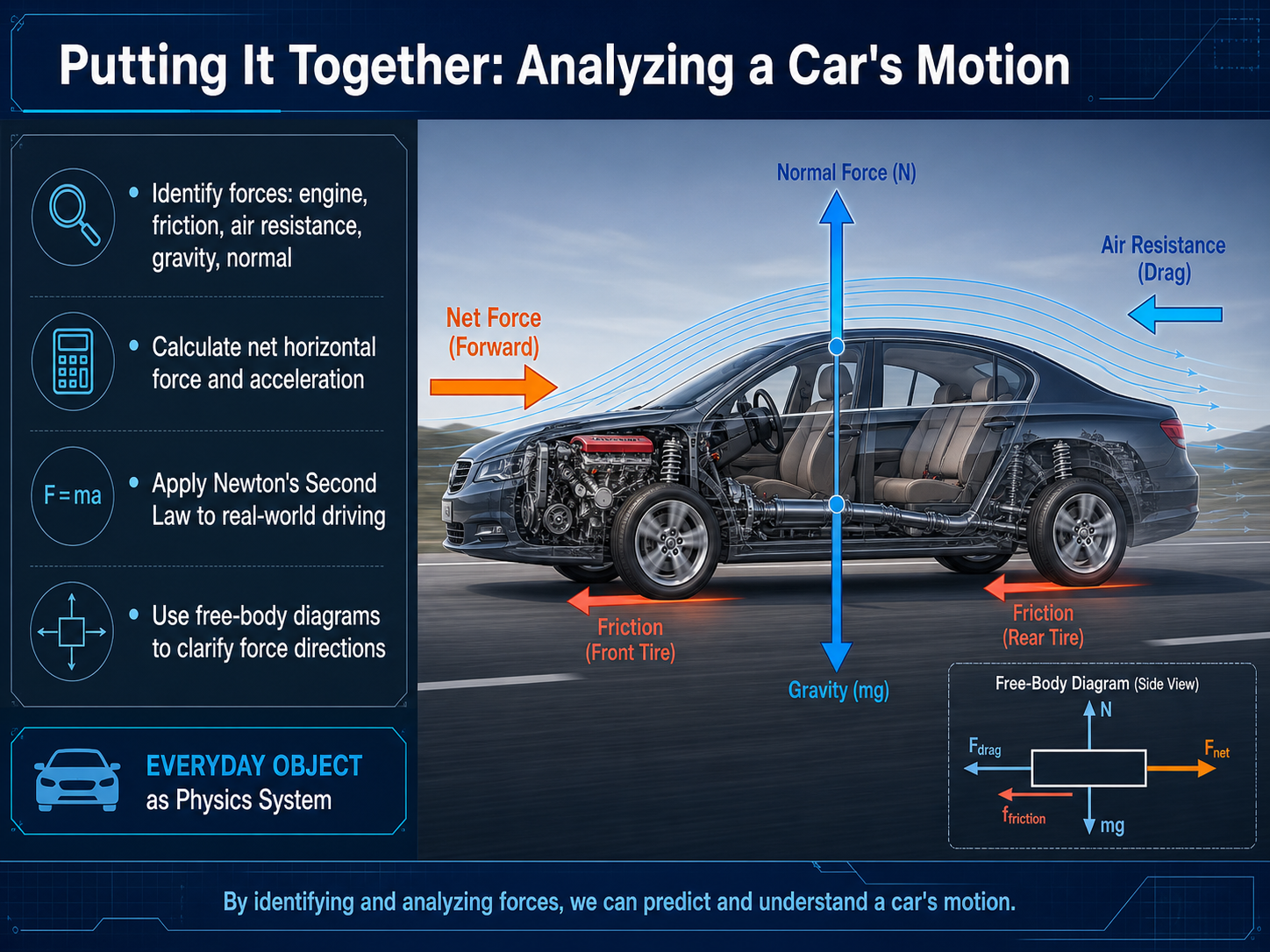
1 min - 15Putting It Together: Analyzing a Car's MotionNow that we're familiar with individual forces, let's see how they all work together in a familiar scenario: a car driving down the road. We can start by identifying the forces. The engine provides a forward driving force, while friction and air resistance push backward. Gravity pulls the car down, and the normal force from the road pushes straight up. To find out how the car's speed changes, we focus on the horizontal forces. If the forward force is larger than the friction and air resistance combined, we have a net positive force. By applying Newton's Second Law, we divide that net force by the car's mass to find the acceleration. A free-body diagram makes this crystal clear. We draw the car as a simple dot, with arrows showing the size and direction of each force. This visual tool helps us correctly sum only the forces that point left or right. Next, we'll apply these same ideas to objects that are launched into the air, as we explore projectile motion.
 2 min
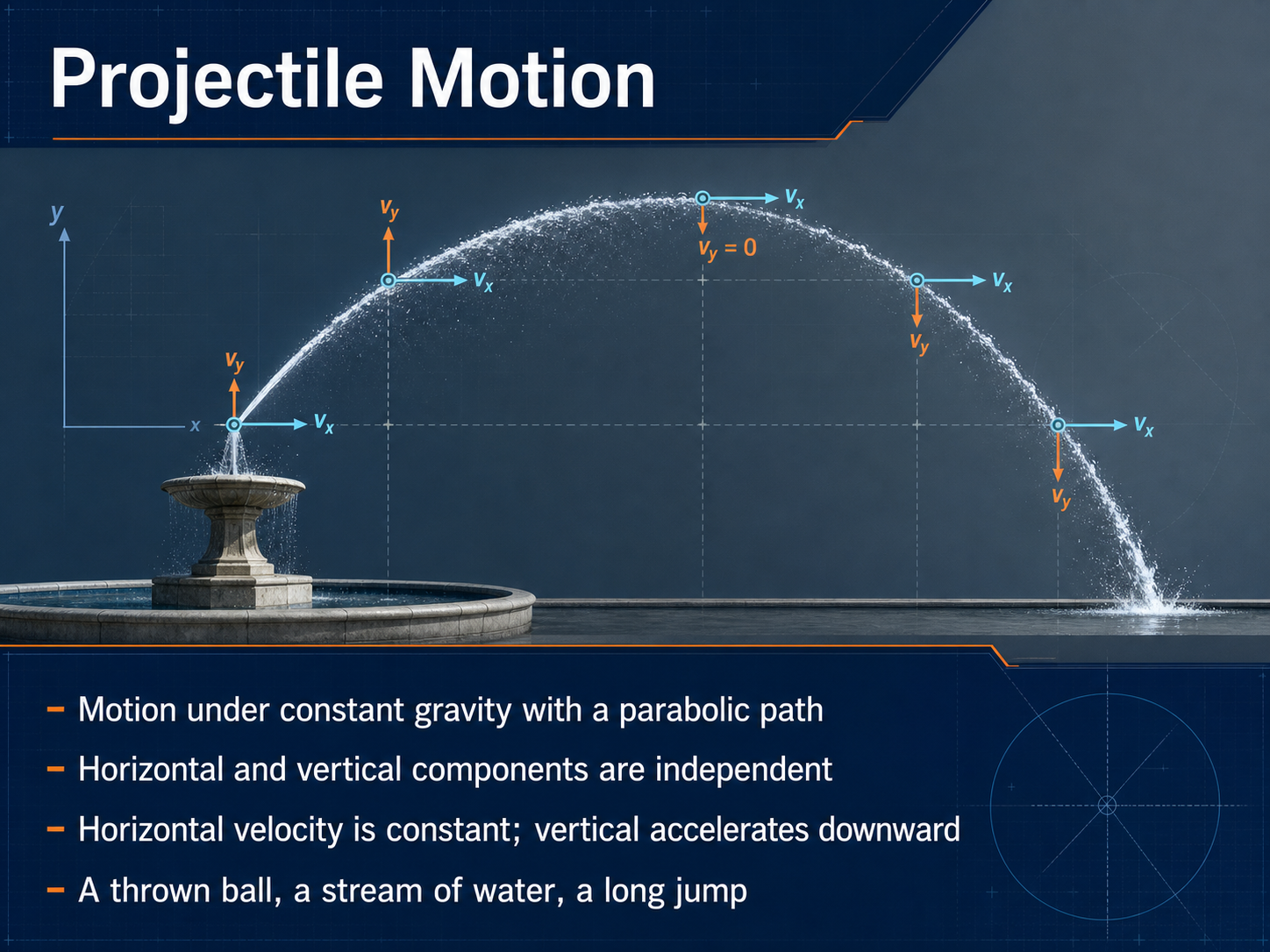
2 min - 16Projectile MotionNow let's bring these ideas together and look at projectile motion. Think about what happens when you throw a ball. Once it leaves your hand, it follows a smooth, curved path through the air—a parabola. We can understand this path by breaking the motion into two independent parts: horizontal and vertical. Horizontally, if we ignore air resistance, the velocity stays constant. The ball keeps moving sideways at the same speed because no force is pushing it forward or backward. Vertically, gravity is pulling down, so the ball accelerates downward just like in free fall. These two motions happen at the same time but don't interfere with each other. You see the same curved path in a stream of water from a hose or in an athlete's long jump. The key insight is that the horizontal and vertical components are independent, and only the vertical motion is affected by gravity. Next, we'll explore what happens when an object moves in a circle, introducing centripetal force.
 2 min
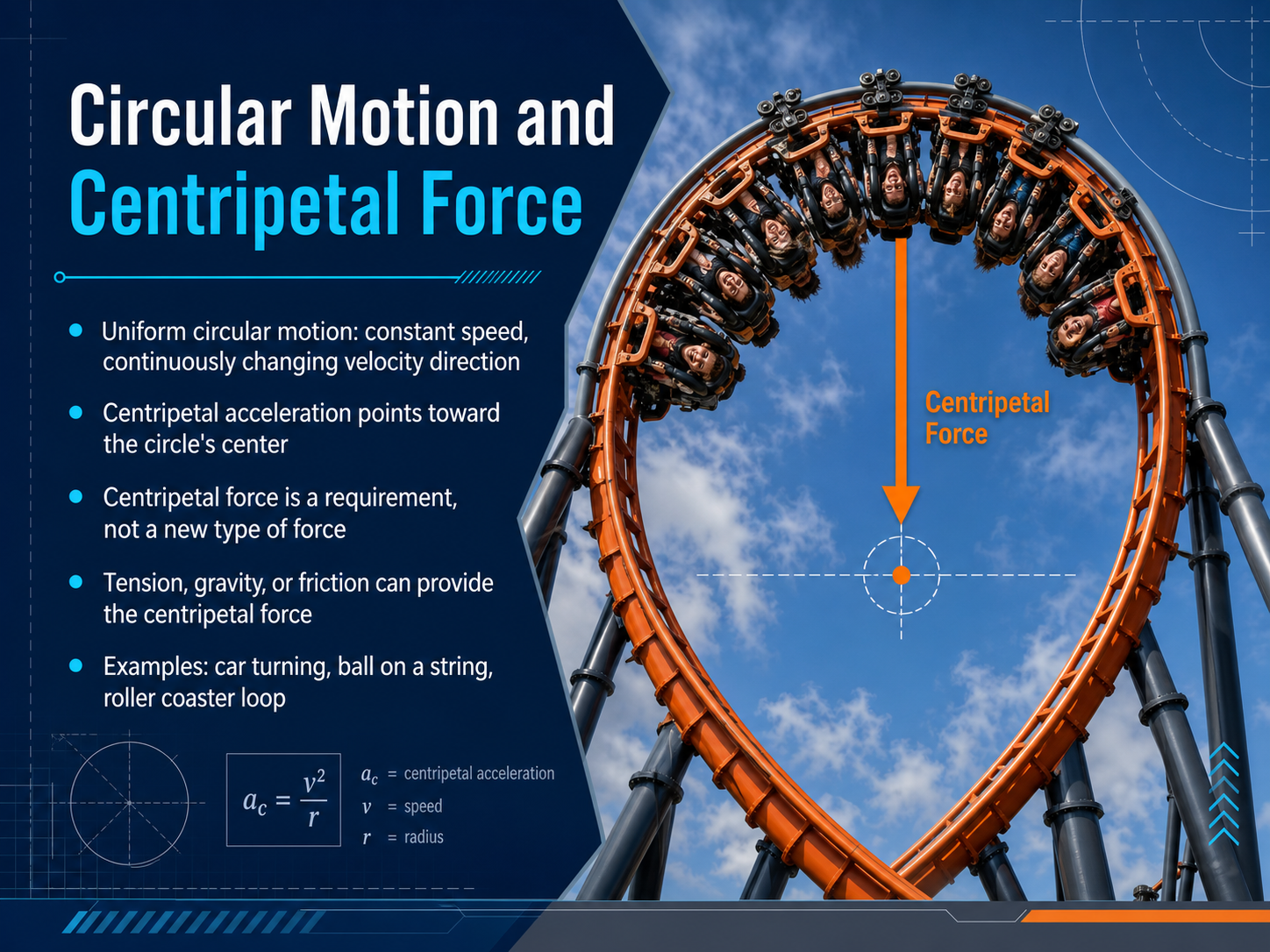
2 min - 17Circular Motion and Centripetal ForceNow let's look at motion in a circle. When an object moves in a circle at a constant speed, we call that uniform circular motion. Even though the speed is steady, the velocity is constantly changing because the direction is always turning. That change in velocity means there is an acceleration. This acceleration points directly toward the center of the circle. We call it centripetal acceleration. Something must be pushing or pulling the object toward the center to keep it on that curved path. That requirement is called a centripetal force. Centripetal force is not a new type of force. It's a role that other forces can play. For example, friction between the tires and the road provides the centripetal force when a car turns. Tension in a string pulls a ball inward as you swing it around. At the bottom of a roller coaster loop, the track pushes up on the car. That upward force is the centripetal force at that moment. So remember, any time you see circular motion, ask yourself which force is pointing toward the center. Up next, we'll wrap up with key takeaways and the next steps in physics.
 2 min
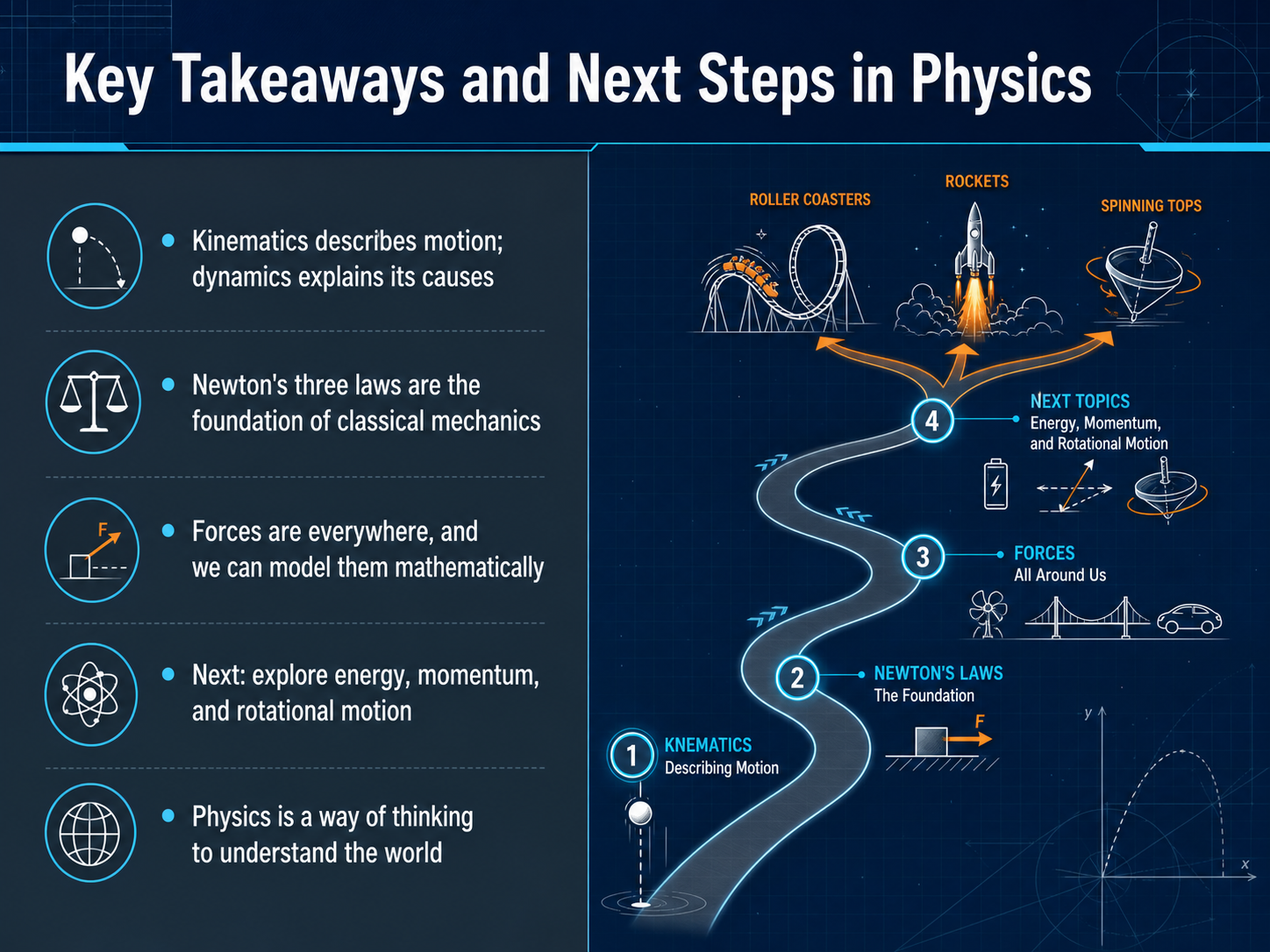
2 min - 18Key Takeaways and Next Steps in PhysicsWe have covered a lot of ground together, so let us take a moment to reflect on the big ideas. Kinematics gave us the tools to describe motion, while dynamics revealed the forces that cause it. At the heart of dynamics are Newton's three laws, the foundation that connects pushes, pulls, and changes in motion. We saw that forces are not just abstract ideas; they are present in every step you take and every object you push or pull, and we can describe them with clear mathematical models. Looking ahead, you are ready to explore energy, momentum, and rotational motion to see how these principles extend to even more complex systems. Physics is more than a collection of equations. It is a way of thinking, a lens that helps you understand the world around you. Thank you for bringing your curiosity to this lesson. I am excited for you to continue this journey of discovery.
 2 min
2 min
Take the deck with you
Download this course as a file — free, no sign-up needed.
- PDF handoutEvery slide page, ready to print or share.19 pages · 5.4 MBDownload
- Narrated PowerPointThe deck that presents itself — every slide carries the digital human's narration video.19 pages · 21.5 MBDownload
- PowerPoint slidesThe full deck as a .pptx — open it in PowerPoint, Keynote, or Google Slides.19 pages · 5.3 MBDownload
Free to use in your own training — please keep the PersonWise credit page at the end.
Have your own deck? Turn it into a course
Sources consulted
Web sources consulted while building this course.
- 3.3 Average and Instantaneous Acceleration - University Physics Volume 1 | OpenStax — openstax.org
- 2.4 Acceleration - College Physics for AP® Courses | OpenStax — openstax.org
- Average Acceleration Formula - GeeksforGeeks — geeksforgeeks.org
- 2.5: Acceleration - Physics LibreTexts — phys.libretexts.org
- 3.4: Average and Instantaneous Acceleration - Physics LibreTexts — phys.libretexts.org
- Static and Kinetic Friction - GeeksforGeeks — geeksforgeeks.org
- 20+ Examples of Friction in Daily Life - GCSE Guide | Revision Genie — revisiongenie.com
- Friction Force Explained: Types, Formula, and Real-World Examples — physicsfundamentals.org
- Static friction — byjus.com
- Examples of Frictional Force: The Complete List - 33Science — 33science.com