Learning and Development Software Selection
Begin
13 pages · ~26 min
Learning and Development Software Selection
This training guides L&D professionals through selecting learning software, defining requirements, and building effective workflows to support successful implementation.
What you’ll learn
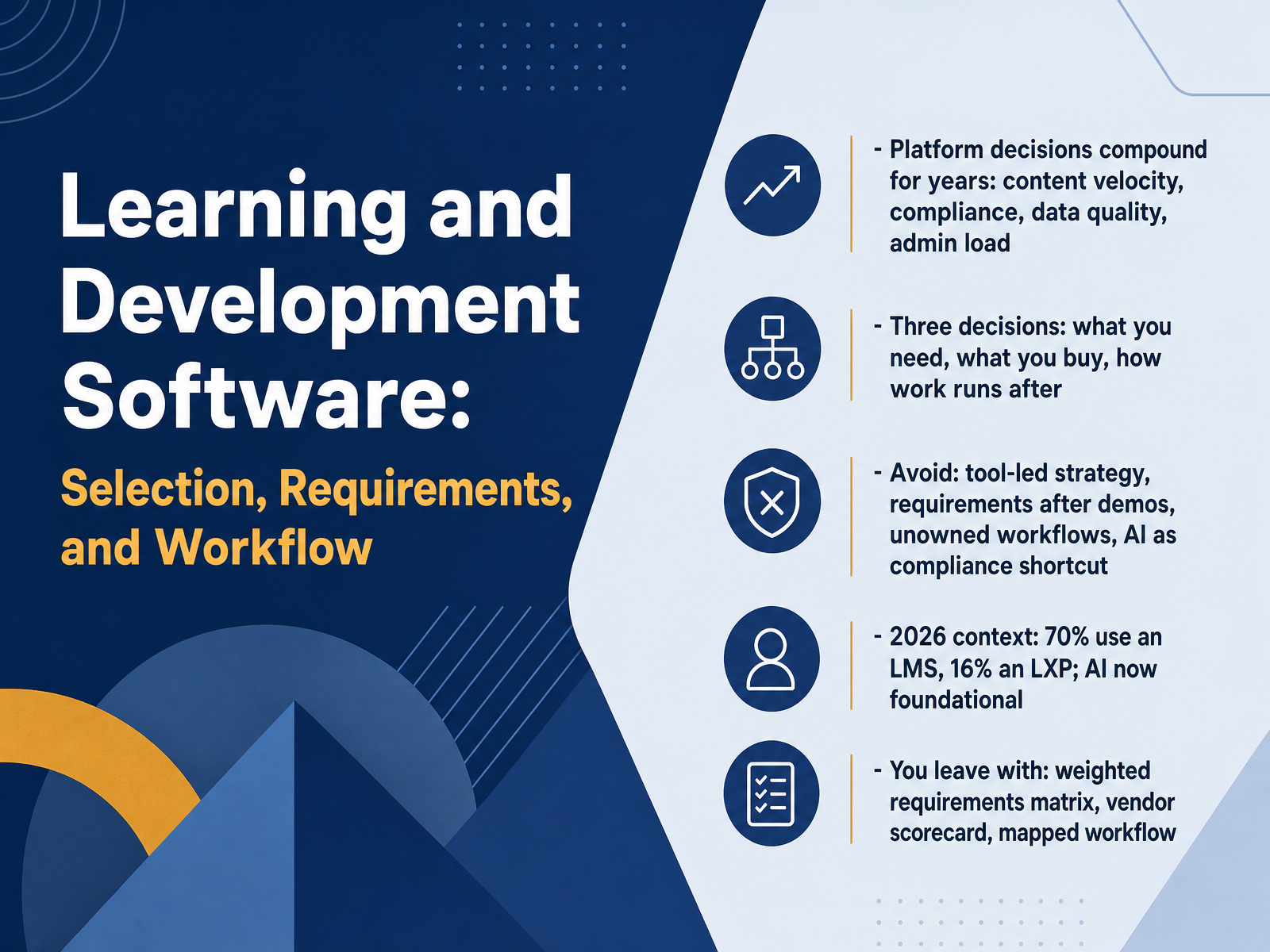
- 01Learning and Development Software: Selection, Requirements, and WorkflowWelcome. Over the next hour, we're going to work through how to select learning and development software without locking your organization into the wrong platform for the next five years. Platform decisions compound. They shape how fast you can produce content, how clean your compliance data stays, and how much administrative work lands on your team. So we'll frame three decisions that carry the most weight. First, what you actually need. Second, what you buy. And third, how the work runs after go-live. We'll also name the traps: tool-led strategy, writing requirements after the demos, workflows nobody owns, and treating AI as a shortcut to compliance. For context, in 2026, seventy percent of learning and development buyers still run a learning management system, while only sixteen percent run a learning experience platform. AI has moved from a feature to a foundation. By the end, you'll leave with three working artifacts: a weighted requirements matrix, a vendor scorecard, and a mapped workflow. Let's set the 2026 market baseline.lms-guide.combrandonhall.comsolganick.com+22 min
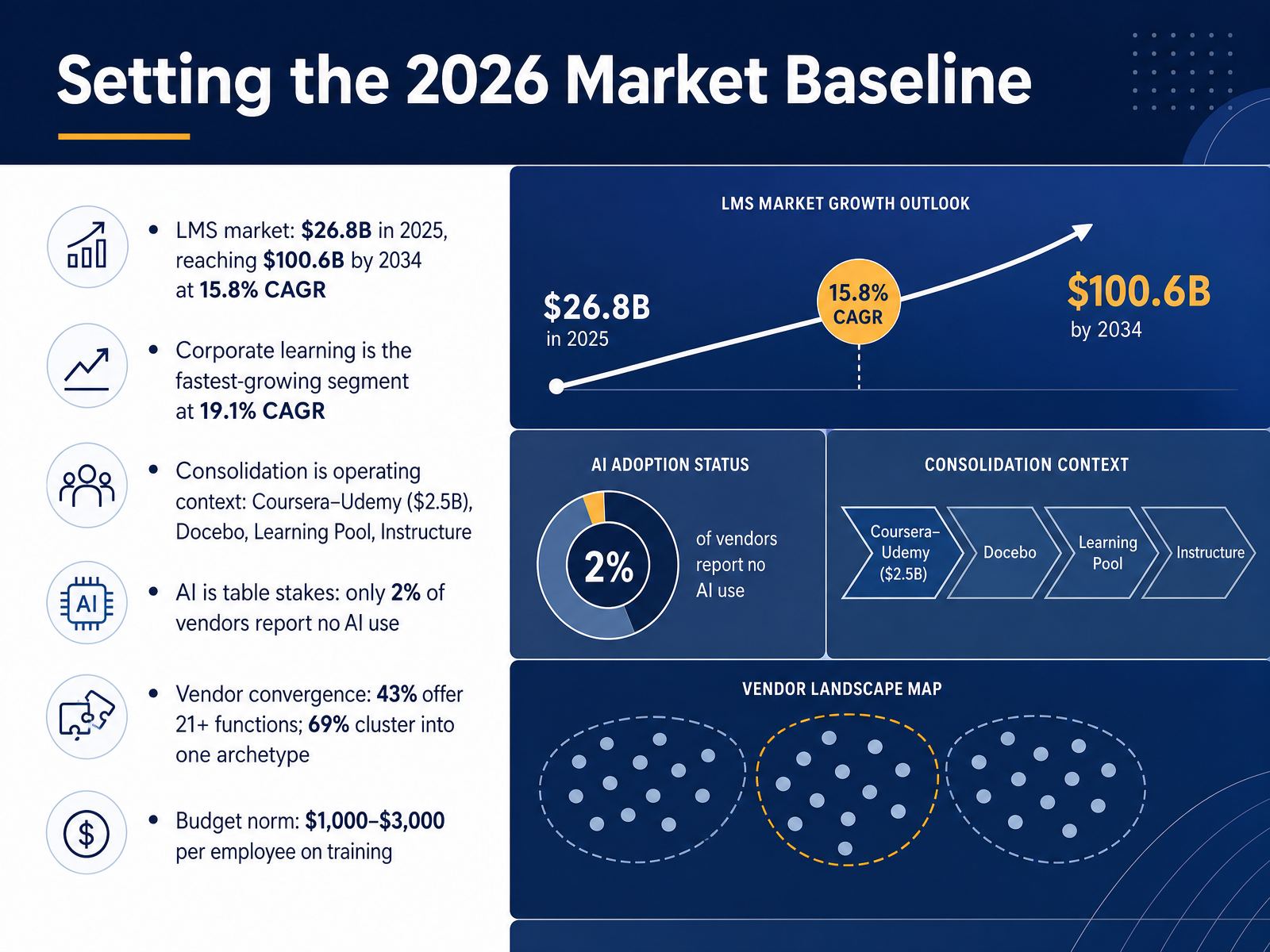
- 02Setting the 2026 Market BaselineBefore we evaluate vendors, let's establish the market baseline you're buying into. The learning management system market hit twenty-six point eight billion dollars in twenty twenty-five and is projected to reach one hundred point six billion by twenty thirty-four, at a compound annual growth rate of fifteen point eight percent. Corporate learning is the fastest-growing segment, at nineteen point one percent. Consolidation is now operating context, not a headline: Coursera's two point five billion dollar acquisition of Udemy, plus moves by Docebo, Learning Pool, and Instructure. AI is table stakes, with only two percent of vendors reporting no AI use. And vendors are converging, with forty-three percent offering twenty-one or more functions, and sixty-nine percent clustering into a single archetype. Your budget benchmark sits at one thousand to three thousand dollars per employee. Next, we'll map the categories: LMS, LXP, skills platforms, and the rest.
 lms-guide.combrandonhall.comsolganick.com+22 min
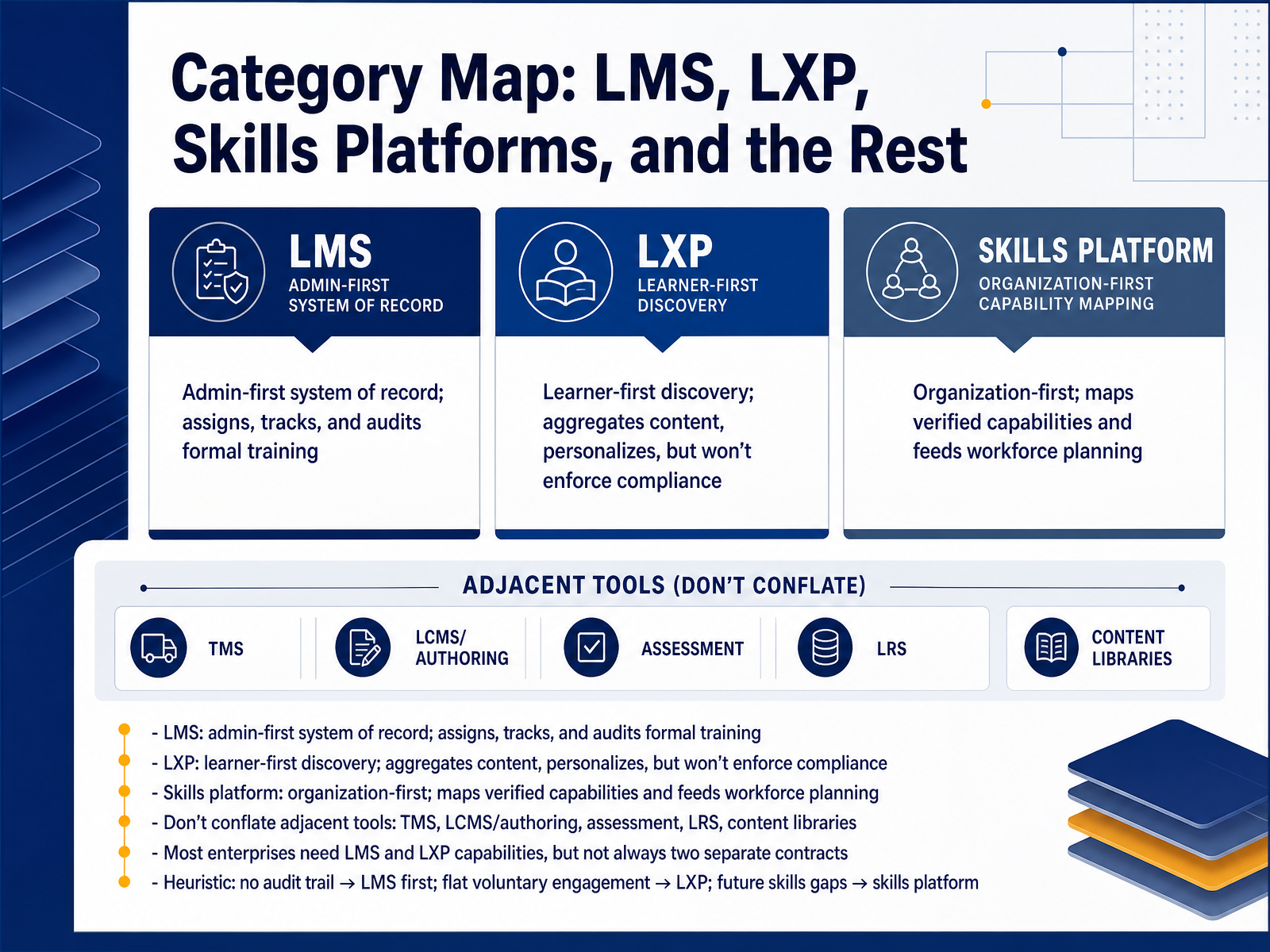
 - 03Category Map: LMS, LXP, Skills Platforms, and the RestLet's map the categories, because vendor marketing blends them on purpose. A learning management system, or LMS, is admin-first. It is your system of record. It assigns courses, tracks completions, and produces the audit trail compliance requires. A learning experience platform, or LXP, is learner-first. It aggregates content from many sources and personalizes discovery, but it will not enforce compliance, and an LXP cannot give you an audit-ready report. A skills platform is organization-first. It maps verified capabilities across the workforce and feeds planning, mobility, and hiring decisions. It does not primarily deliver training. Do not conflate the adjacent tools either: a training management system, an LCMS or authoring tool, assessment engines, a learning record store, and content libraries each solve a narrower problem. The practical heuristic: if you have no audit trail, start with an LMS. If compliance is covered but voluntary engagement is flat, add LXP capabilities. If leadership is asking which skills you will be short of, you need a skills platform. Most enterprises need LMS and LXP capabilities, but not always two separate contracts, so check whether one platform can carry both before you sign two. Next, we will look at suite versus best-of-breed, and the ecosystem you must plug into.
 hrtechsaas.comskillscaravan.combrandonhall.com+22 min
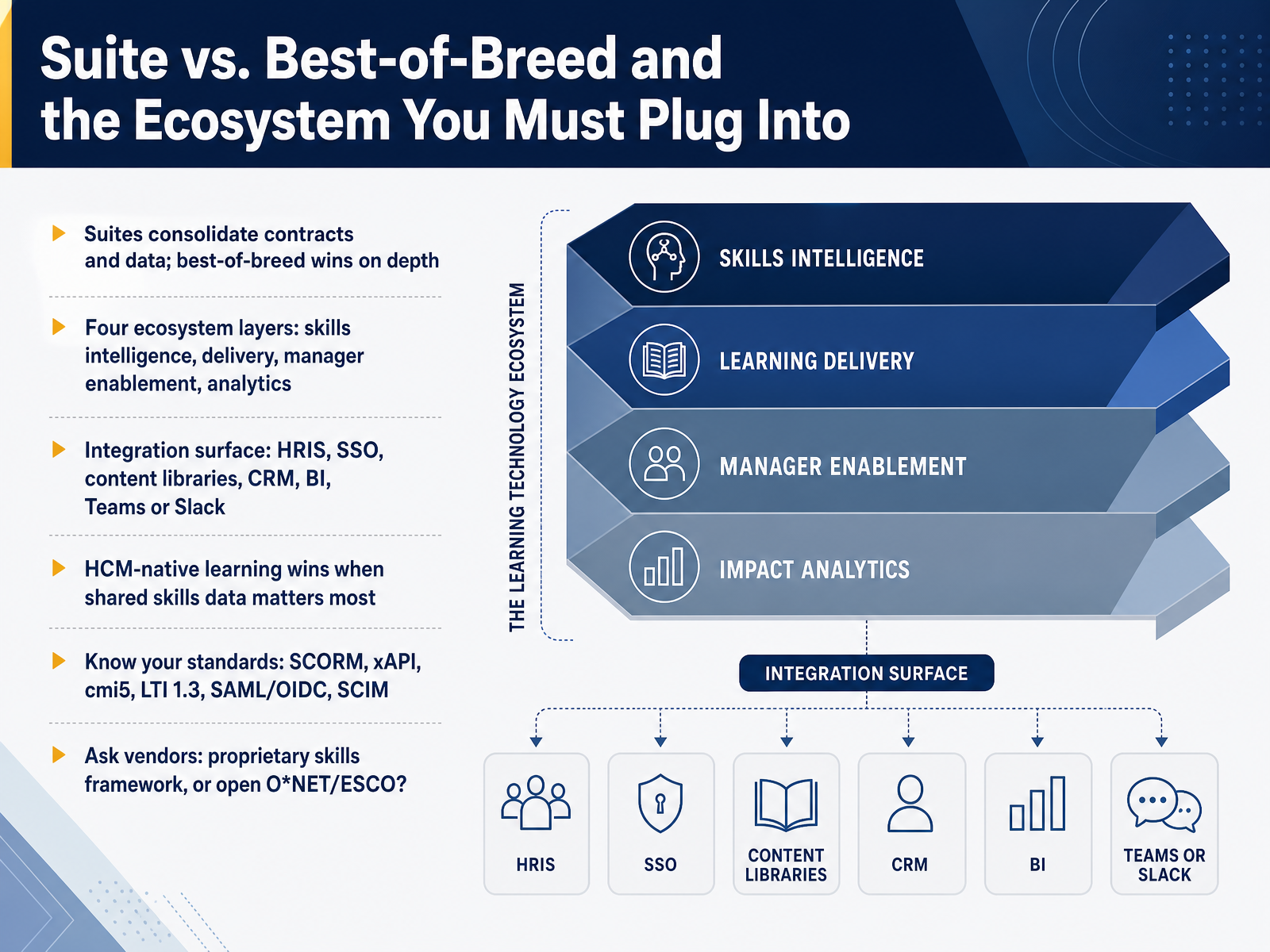
 - 04Suite vs. Best-of-Breed and the Ecosystem You Must Plug IntoNow let's talk about architecture. Suite or best-of-breed. Suites consolidate contracts and data, and they simplify vendor management. Best-of-breed wins on depth in a specific capability. Neither is automatically right. The question is which ecosystem layers you must plug into. There are four: skills intelligence, delivery, manager enablement, and analytics. Then comes the integration surface. Your HRIS, single sign-on, content libraries, CRM, business intelligence tools, and Teams or Slack. HCM-native learning wins when shared skills data matters most, because completions and skills flow natively into talent and performance. If that data has to travel between systems, you own the middleware. Know your standards before you shortlist. SCORM, xAPI, cmi5, LTI 1.3, SAML, OIDC, and SCIM. Each solves a different problem. And ask one sharp question of every vendor. Is your skills framework proprietary, or is it based on an open standard like O*NET or ESCO? That answer tells you how portable your skills data really is. Next, requirements gathering that survives contact with vendors.
 hrtechsaas.comskillscaravan.combrandonhall.com+22 min
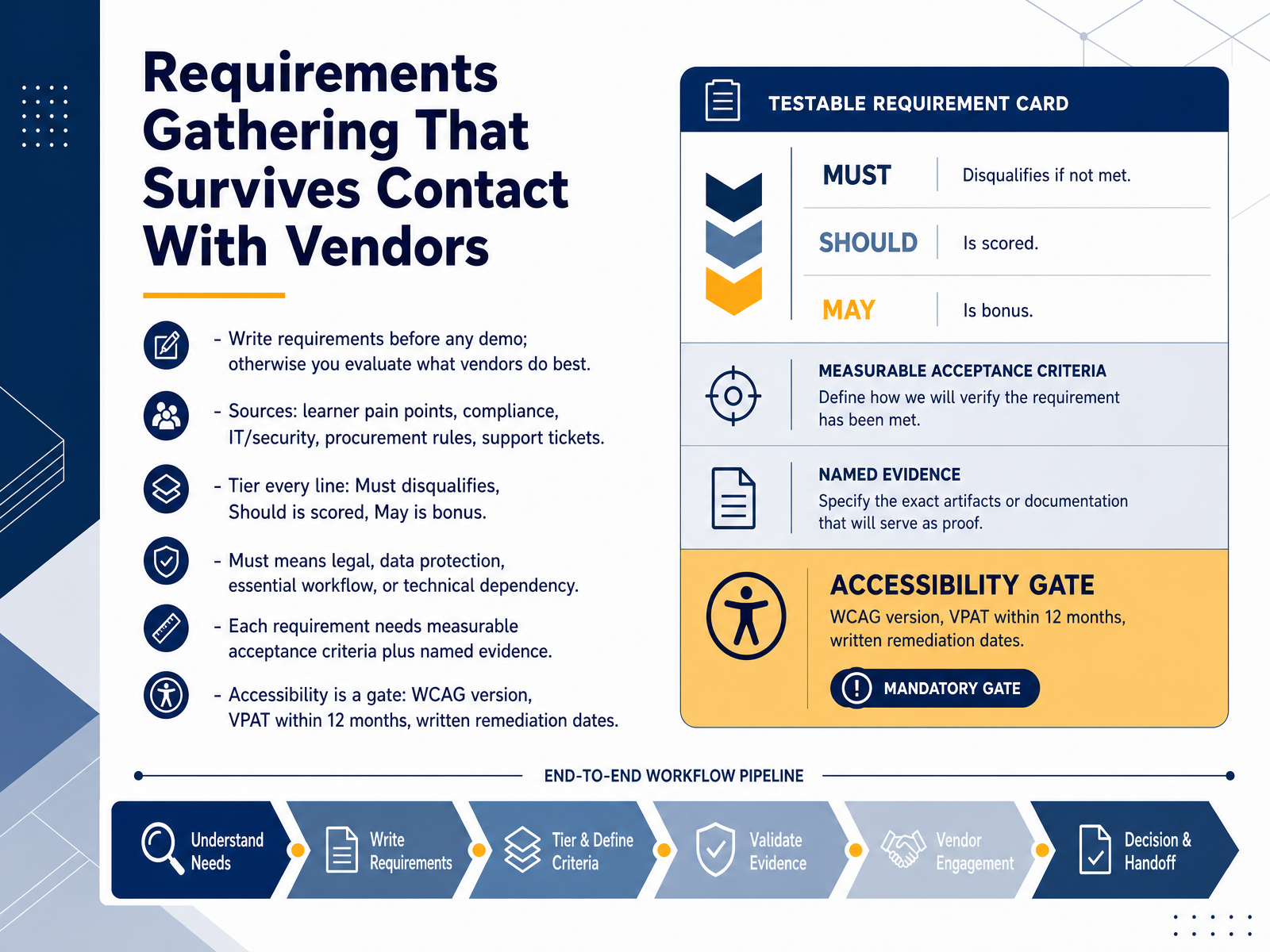
 - 05Requirements Gathering That Survives Contact With VendorsLet's talk about requirements gathering that actually survives contact with vendors. Write your requirements before you watch a single demo. Otherwise, you end up evaluating whatever each vendor happens to do best. Pull your raw material from real sources: learner pain points, compliance obligations, I T and security, procurement rules, and support tickets. Then tier every line. Must means unmet equals disqualified. Should is scored. May is a bonus. Reserve must for legal or data protection obligations, essential workflows, and technical dependencies. Everything else is a preference with a weight. Each requirement also needs a measurable acceptance criterion and named evidence, like a current SOC 2 report, not a logo. And treat accessibility as a gate. Specify the WCAG version, require a VPAT dated within twelve months, and ask for written remediation dates for any known gaps. Here's the takeaway. A requirement without evidence attached is not a requirement. It is a wish. Next, we'll look at longlist, weighted scoring, and demo design.
 aquilonlms.comlmspedia.orglmspedia.org+22 min
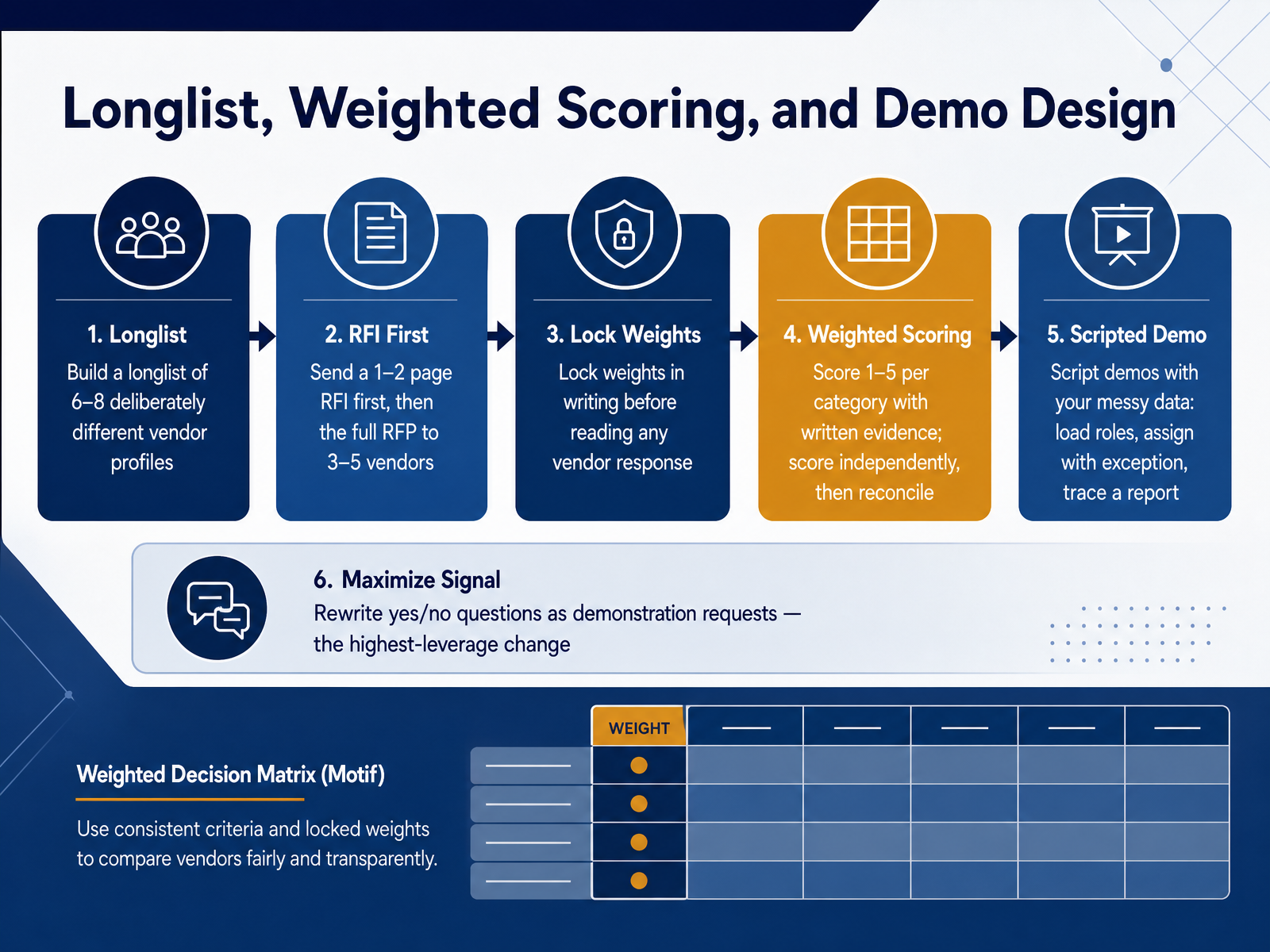
 - 06Longlist, Weighted Scoring, and Demo DesignNow let's talk about how you actually compare vendors. First, build a longlist of six to eight deliberately different vendor profiles. Not eight lookalikes, but a suite tied to your HRIS, a mobile-first field platform, a general-purpose tool with public pricing. Then send a short Request for Information, one to two pages, to a broad group. Only send the full Request for Proposal to three to five vendors. Before you read a single response, lock your category weights in writing. This prevents the classic bias of justifying the vendor you already liked. Score each category from one to five, and require written evidence for every number. Have evaluators score independently, then reconcile. Sharp disagreements are your most useful data. Finally, script your demos with your own messy data. Load real roles, assign with an exception, trace one report to its source record. And rewrite every yes or no question as a demonstration request. That is the highest-leverage change you can make. Next, we'll cover references, commercials, and exit terms.
 aquilonlms.comlmspedia.orglmspedia.org+22 min
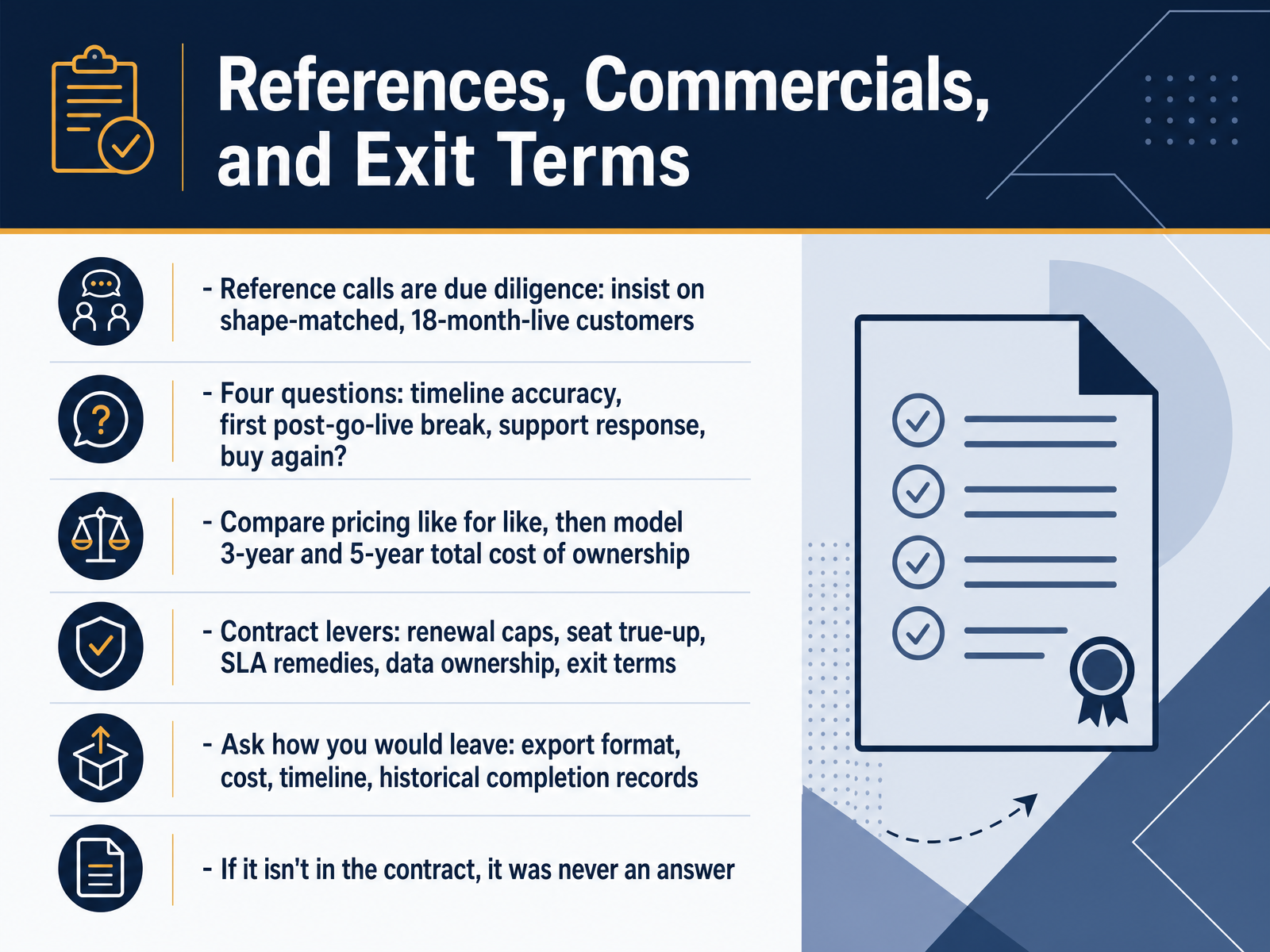
 - 07References, Commercials, and Exit TermsNow let's talk about references, commercials, and exit terms. Reference calls are due diligence, not marketing. Insist on shape-matched customers: similar headcount, similar industry, and live for at least eighteen months. A customer three months post-launch is still in the honeymoon. Ask four questions. How accurate was the quoted implementation timeline? What broke first after go-live? How does support respond when something goes wrong? And would you buy the platform again? Then compare pricing like for like, and model three-year and five-year total cost of ownership, not the year-one quote. Know your contract levers: renewal increase caps, seat true-up rules, service level agreement remedies, data ownership, and exit terms. And ask the question almost nobody asks. How would we leave? Confirm the export format, the cost, the timeline, and whether historical completion records come with you. Here is the test. If it isn't in the contract, it was never an answer. Next, we look at the workflow and operating model before implementation.
 aquilonlms.comlmspedia.orglmspedia.org+22 min
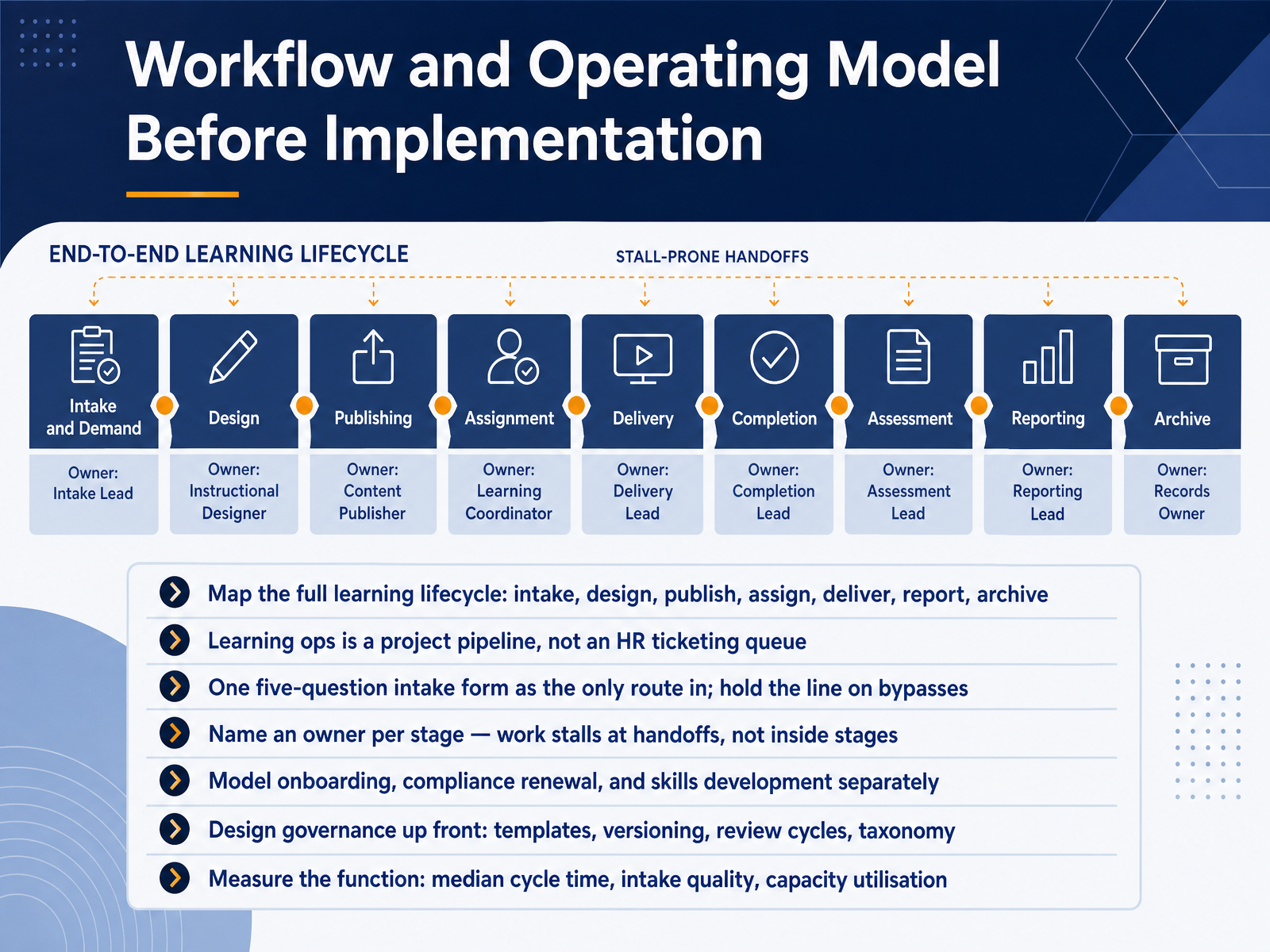
 - 08Workflow and Operating Model Before ImplementationBefore you implement anything, define the workflow and the operating model it runs on. Start by mapping the full learning lifecycle: intake, design, publish, assign, deliver, report, and archive. Treat learning operations as a project pipeline, not an HR ticketing queue. Those are different disciplines. HR operations handles high-volume transactions; learning operations manages variable-scope project work. One practical move: a single five-question intake form as the only route in, and hold the line when people try to bypass it. A bypassed form is worse than no form. Name an owner per stage, not per project. Work stalls at handoffs far more often than inside stages, and unowned handoffs stay invisible. Model onboarding, compliance renewal, and skills development as separate workflows, because a compliance refresh is not the same size of job as a leadership simulation. Then design governance up front: templates, versioning, review cycles, and a shared taxonomy. Finally, measure the function itself. Track median cycle time from request to launch, use the median rather than the average, intake quality, meaning the share of requests arriving with a stated business outcome, and capacity utilisation against strategic work. Next, we move into implementation, integration, and migration.
 cognota.comdisprz.aielementum.ai+22 min
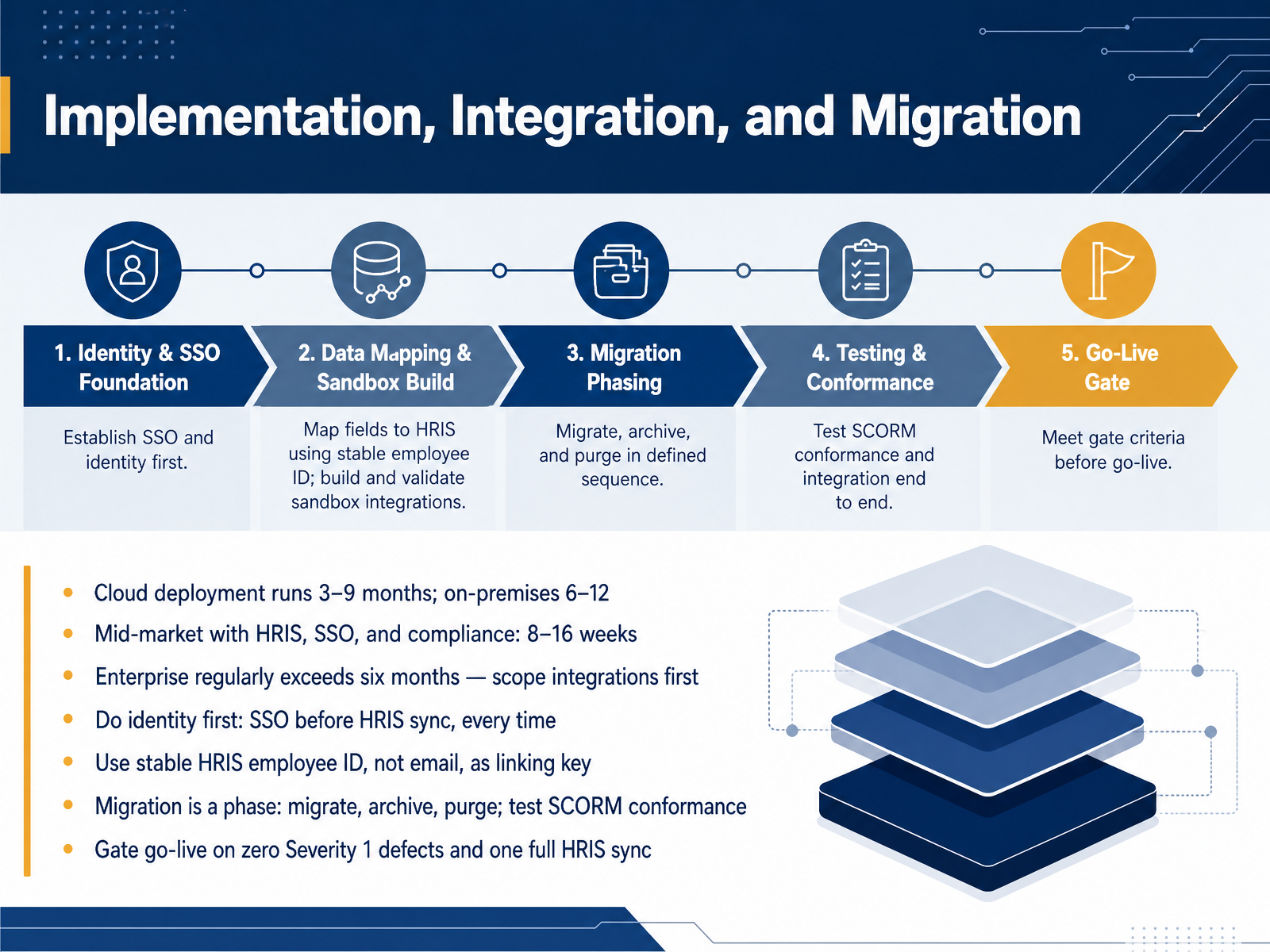
 - 09Implementation, Integration, and MigrationNow let us look at implementation, integration, and migration, because this is where timelines are won or lost. Cloud deployment typically runs three to nine months. On premises runs six to twelve. A mid market organization with HRIS, SSO, and compliance workflows should plan for eight to sixteen weeks. Enterprise implementations regularly exceed six months, so scope your integrations first. Always do identity first: SSO before HRIS sync, every time. The identity provider determines the unique key everything else joins on. Use the stable HRIS employee ID, not email, as your linking key, because emails change. Migration is its own phase: migrate, archive, then purge. Test SCORM conformance before you upload. And gate go live on zero Severity 1 defects and at least one full HRIS sync cycle. That discipline prevents duplicate records after go live. Next, we turn to Data, Analytics, and Measuring Value.
 elearningsolutionslab.comcognota.comdisprz.ai+21 min
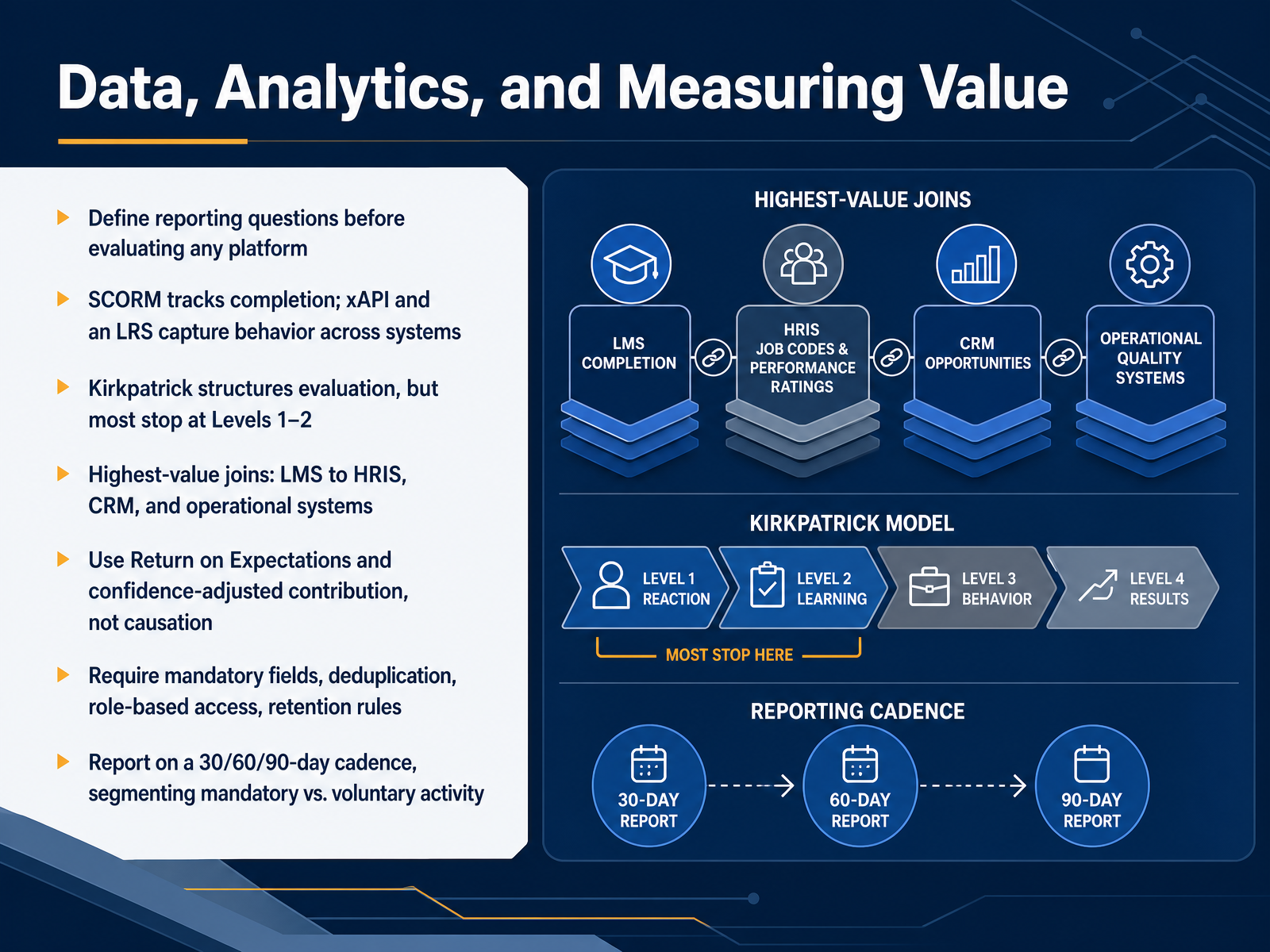
 - 10Data, Analytics, and Measuring ValueLet's talk about data, analytics, and measuring value. Before you evaluate any platform, define your reporting questions first. That order matters, because the questions determine what data you must capture. On standards, SCORM tracks completion and scores. xAPI, the Experience API, sends learning statements to a Learning Record Store, an LRS, so you capture behavior across mobile apps, simulations, and offline activity. The Kirkpatrick model still structures evaluation, but most organizations stop at Levels one and two. The highest-value joins are your LMS to HRIS, CRM, and operational systems. And when you report impact, use Return on Expectations and confidence-adjusted contribution, not claims of causation. Practically, require mandatory fields, deduplication, role-based access, and retention rules. Then report on a thirty, sixty, and ninety-day cadence, and segment mandatory activity from voluntary activity. That segmentation is what tells you whether people are actually choosing to learn. Next, we look at AI, Security, and Compliance in Platform Decisions.
 elearningsolutionslab.com2 min
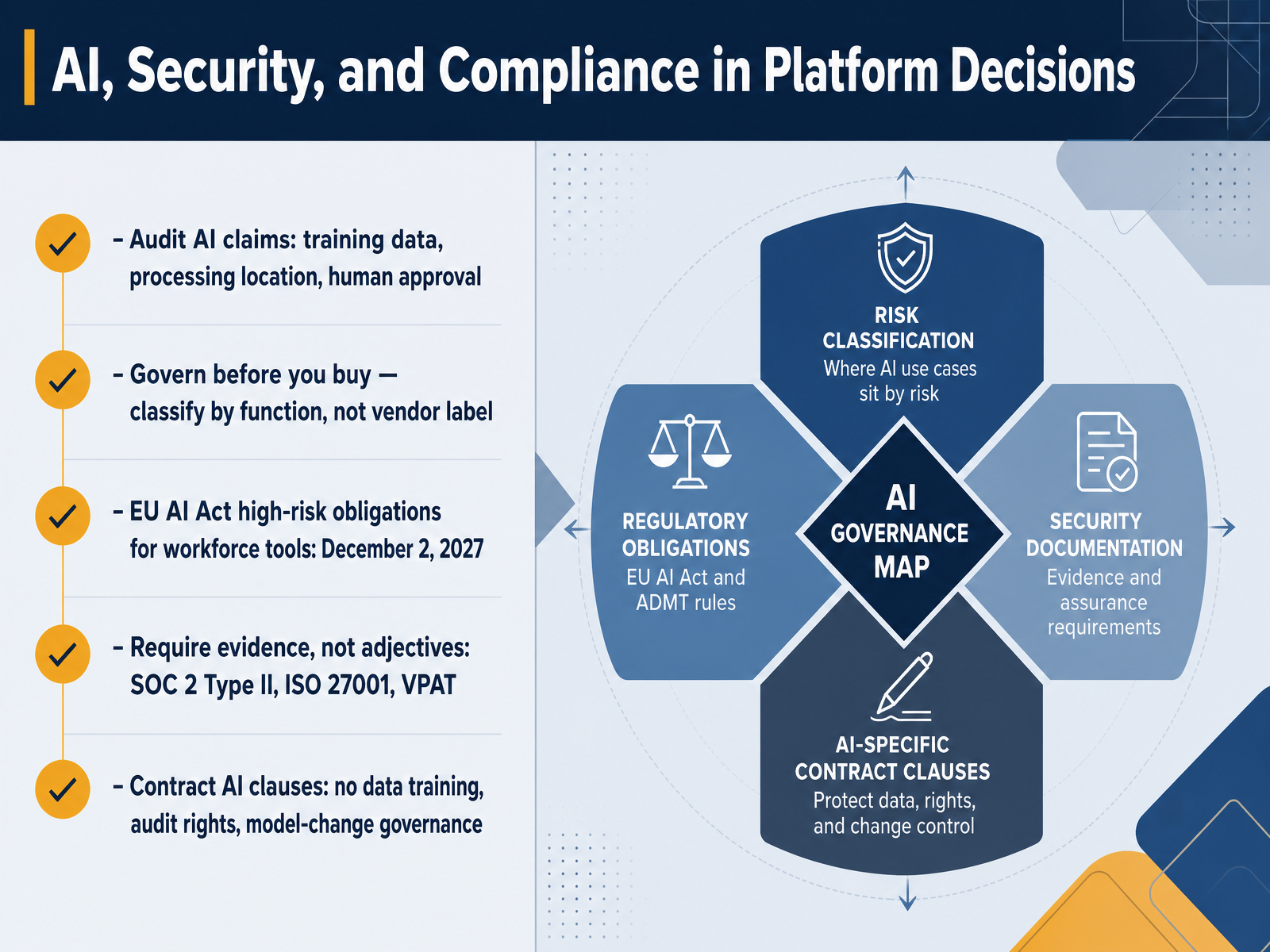
 - 11AI, Security, and Compliance in Platform DecisionsNow let's look at AI, security, and compliance in platform decisions. AI claims deserve scrutiny, not trust. Ask three questions: what data trained the model, where is that data processed, and does a human approve consequential outputs? Govern before you buy. Classify each tool by function, not by the vendor's label, because the same engine can be scheduling support or ranking candidates. Administrative tools carry one risk profile. Tools that score, filter, or recommend people carry another. If you operate in the European Union, high-risk obligations for workforce tools apply from December second, 2027, covering recruiting, performance management, and task allocation. So require evidence, not adjectives. Ask for a current SOC 2 Type Two report, ISO 27001 certification, and a VPAT or Accessibility Conformance Report. Then put AI terms in the contract: no customer data used to train models, audit rights, incident escalation timelines, and written notice before any model change. That gives you recourse when the tool evolves. Next, we move into adoption, support, and continuous optimization.
 touchclass.comelearningsolutionslab.com2 min
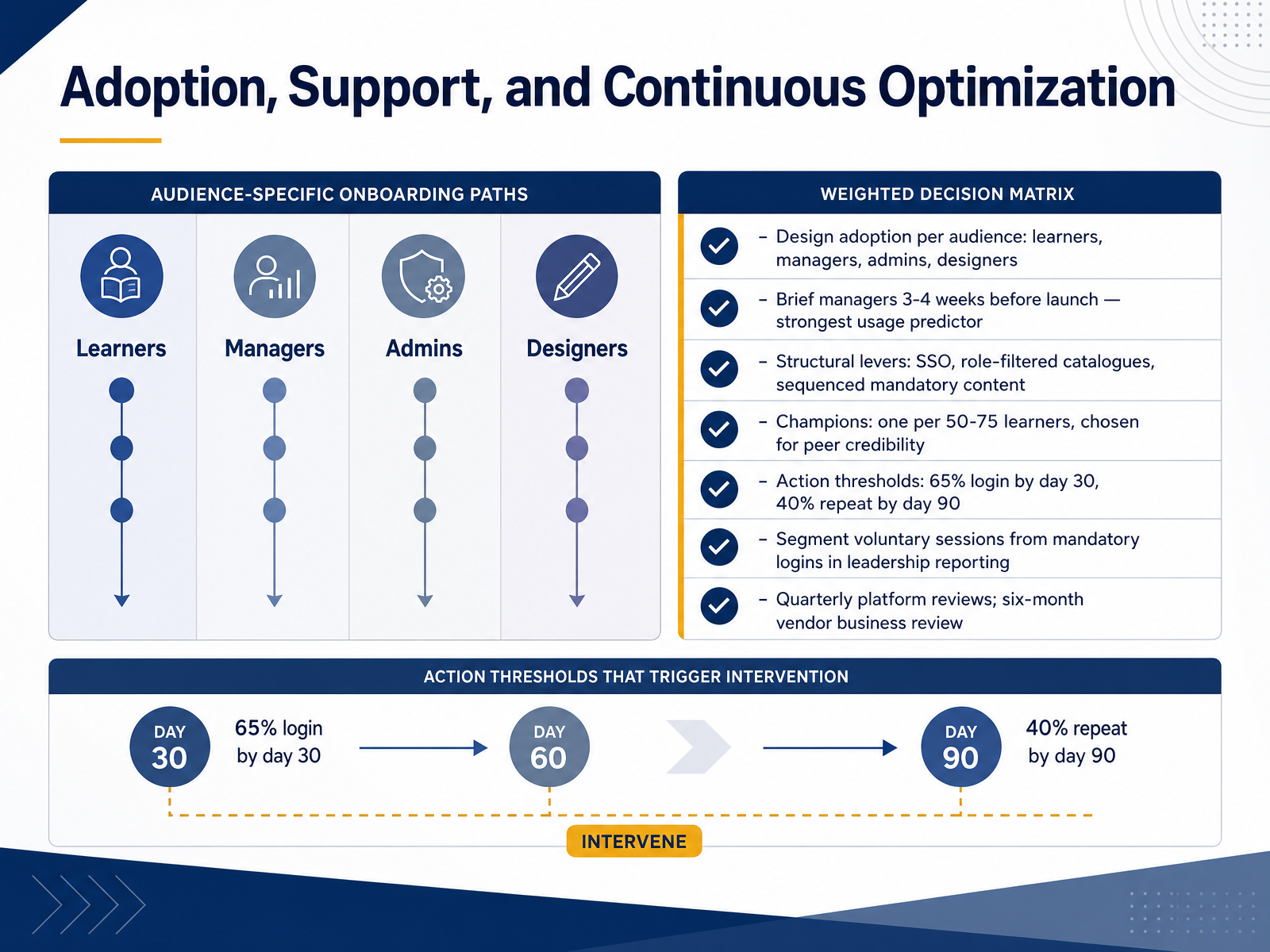
 - 12Adoption, Support, and Continuous OptimizationNow let's talk about what happens after go-live: adoption, support, and continuous optimization. Design adoption separately for each audience. Learners, managers, administrators, and designers need different messaging and different support. The strongest single predictor of usage is the manager briefing. Deliver it three to four weeks before launch, and confirm that managers can answer the question, why do I have to do this? Then work the structural levers. Single sign-on, which means one login across systems. Role-filtered catalogues, so a learner sees their content and not four hundred courses. And sequenced mandatory content, spread over sixty to ninety days rather than piled into the first month. Recruit champions at roughly one per fifty to seventy five learners, chosen for peer credibility rather than seniority. Set action thresholds in advance. Sixty five percent login by day thirty. Forty percent repeat usage by day ninety. In leadership reporting, segment voluntary sessions from mandatory logins, so the numbers show genuine engagement rather than compliance. Finally, keep two review rhythms. A quarterly platform review with your team, and a six month business review with your vendor. Let's put this into practice in the applied workshop, where we build your requirements, scorecard, and action plan.
 lms-guide.combrandonhall.comsolganick.com+22 min
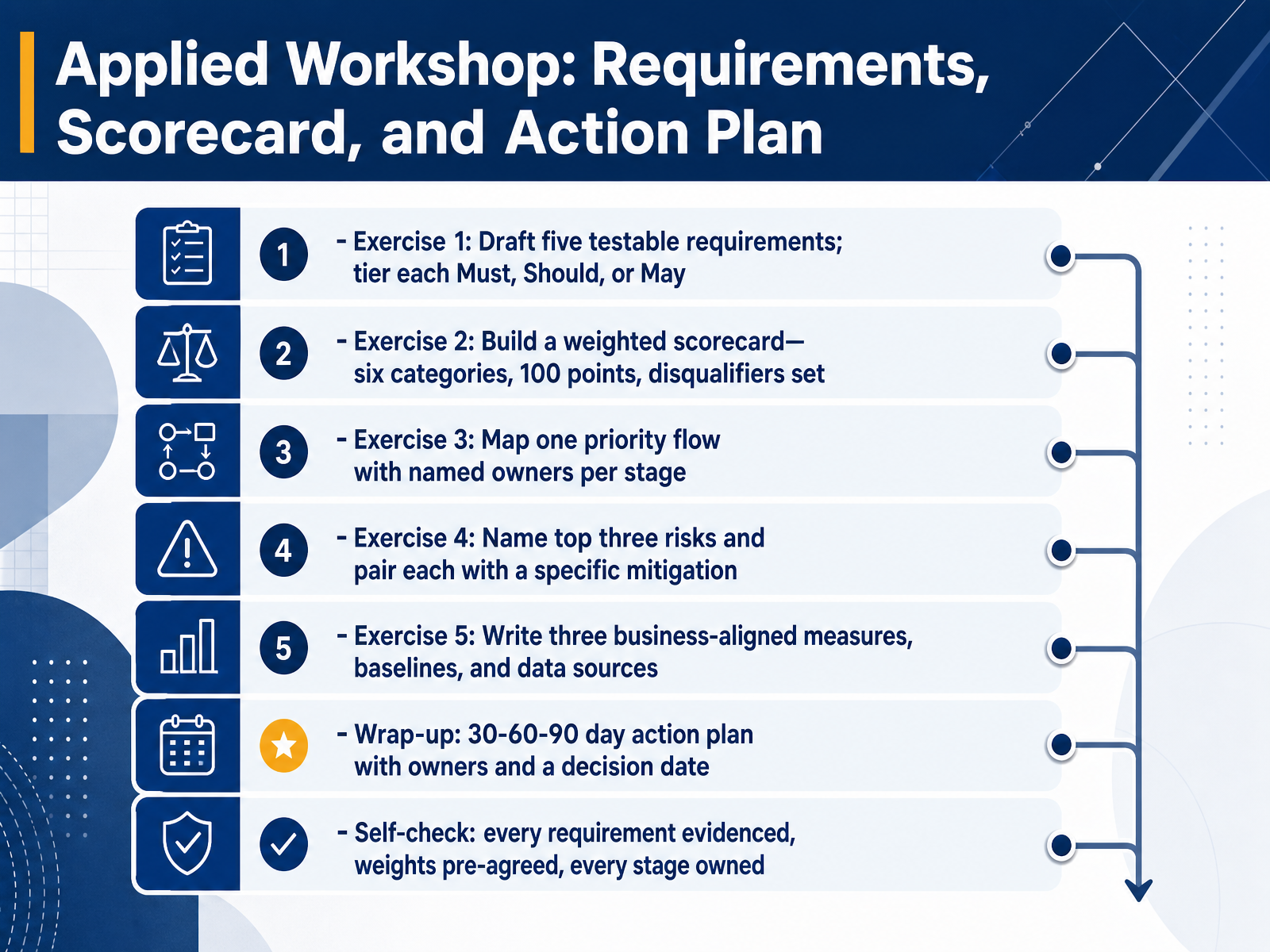
 - 13Applied Workshop: Requirements, Scorecard, and Action PlanSo let's close the loop and put the method to work. This final workshop has five exercises, and I suggest you run them with your actual shortlist, not a hypothetical one.
First, draft five testable requirements and tier each one Must, Should, or May. Remember, a Must means disqualification if unmet, so keep that tier honest.
Second, build a weighted scorecard: six categories, weights summing to one hundred points, with disqualifiers set before anyone scores.
Third, map one priority flow, such as onboarding a new hire, with a named owner at every stage.
Fourth, name your top three risks and pair each with a specific mitigation.
Fifth, write three business-aligned measures, each with a baseline and a data source you can actually access.
Then wrap up with a thirty, sixty, ninety day action plan, with owners and a decision date. Before you close, run the self-check: every requirement evidenced, weights pre-agreed, and every stage owned.
Thank you for working through this with me. You now have a defensible process, not just a preference. Hold the line on evidence and ownership, and you will make a decision you can defend for years. Good luck.
 aquilonlms.comlmspedia.orglmspedia.org+22 min
Take the deck with you
Download this course as a file — free, no sign-up needed.
- PDF handoutEvery slide page, ready to print or share.14 pages · 3.6 MBDownload
- Narrated PowerPointThe deck that presents itself — every slide carries the digital human's narration video.14 pages · 13.9 MBDownload
- PowerPoint slidesThe full deck as a .pptx — open it in PowerPoint, Keynote, or Google Slides.14 pages · 3.5 MBDownload
Free to use in your own training — please keep the PersonWise credit page at the end.
Have your own deck? Turn it into a course
Sources consulted
Web sources consulted while building this course.
- The State of LMS 2026: Annual Industry Report | LMS Guide — lms-guide.com
- LMS, LXP, or Learning Ecosystem: A Practical Technology ... — brandonhall.com
- Technology Services M&A Market Update - Q4 2025 & 2026 Forecast — solganick.com
- LMS Vs. LXP: What L&D Buyers Actually Use In 2026 - eLearning Industry — elearningindustry.com
- RedThread Research State of L&D 2026: High-Performing Organizations Are Rewriting How L&D Works — prnewswire.com
- LMS vs LXP vs Skills Platform: What's the Difference and Which Do You Need? — hrtechsaas.com
- LMS vs LXP vs Skills Platforms: What Modern Enterprises Actually Need in 2026 — skillscaravan.com
- Corporate Learning Technology: LMS, LXP, Skills & More — hrtechsaas.com
- LMS vs LXP is the wrong comparison: what capability ecosystem actually means — reskilling-trends.com
- An LMS Vendor Evaluation Scorecard You Can Actually Use — Aquilon LMS — aquilonlms.com
- LMS RFP Template Guide 2026: Steps & Best Practices - LMSPedia — lmspedia.org
- Free LMS RFP Template & Questionnaire 2026 - LMSpedia — lmspedia.org
- LMS RFP Template: 60 Requirements & Evaluation Guide | TouchClass — touchclass.com
- LMS RFP: building your shortlist in 2026 — beedeez.com
- Learning Operations for Enterprise L&D Teams - Cognota — cognota.com
- what is Learning Operations: The 4 Stage L&D Maturity Guide (2026) — disprz.ai
- How to Improve AI Employee Onboarding at Enterprise Scale | Elementum — elementum.ai
- Production-grade AI onboarding workflows for employees | Suhas Bhairav — suhasbhairav.com
- How to Build a Compliance Training Program (with AI): An 8-Step Guide | ELIL — elil.net
- LMS Integration: Types, Methods, Standards & Costs — elearningsolutionslab.com