Begin
14 pages · ~28 min
Momentum and Collisions
This training explains momentum and collisions for physics learners, covering key concepts and principles to help trainees analyze and solve related problems.
A digital instructor presents all 14 pages. Hold “Ask” at any point and ask out loud — the answer comes from this course. No sign-up needed.
What you’ll learn
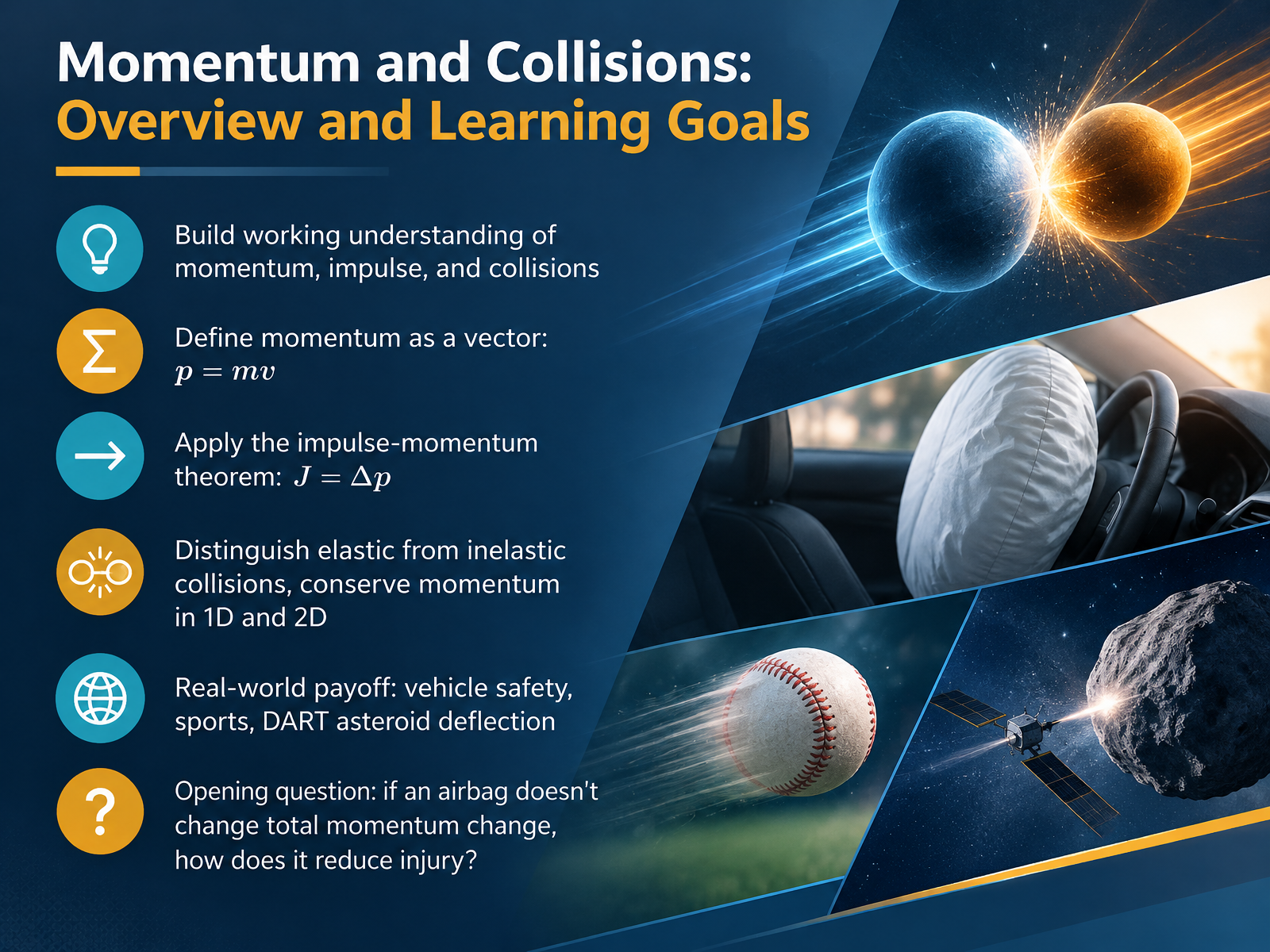
- 01Momentum and Collisions: Overview and Learning GoalsWelcome. Today we're building a working understanding of momentum, impulse, and collisions. Here's our first key idea: momentum is a vector, written p equals m v. Mass m is measured in kilograms, velocity v in meters per second, so momentum carries units of kilogram meters per second, and its direction matches the velocity. Next, we'll apply the impulse-momentum theorem, J equals delta p, where impulse is force acting over time. Then we'll distinguish elastic collisions, where kinetic energy is conserved, from inelastic collisions, where it is not, and conserve momentum in one and two dimensions. Why does this matter? Vehicle safety, sports, and NASA's DART asteroid deflection all depend on it. Here's our opening question: if an airbag doesn't change your total momentum change, how does it reduce injury? Hold that thought. Next, let's define our core vocabulary: momentum, impulse, and systems.farside.ph.utexas.edusfu.caphys.libretexts.org+21 min
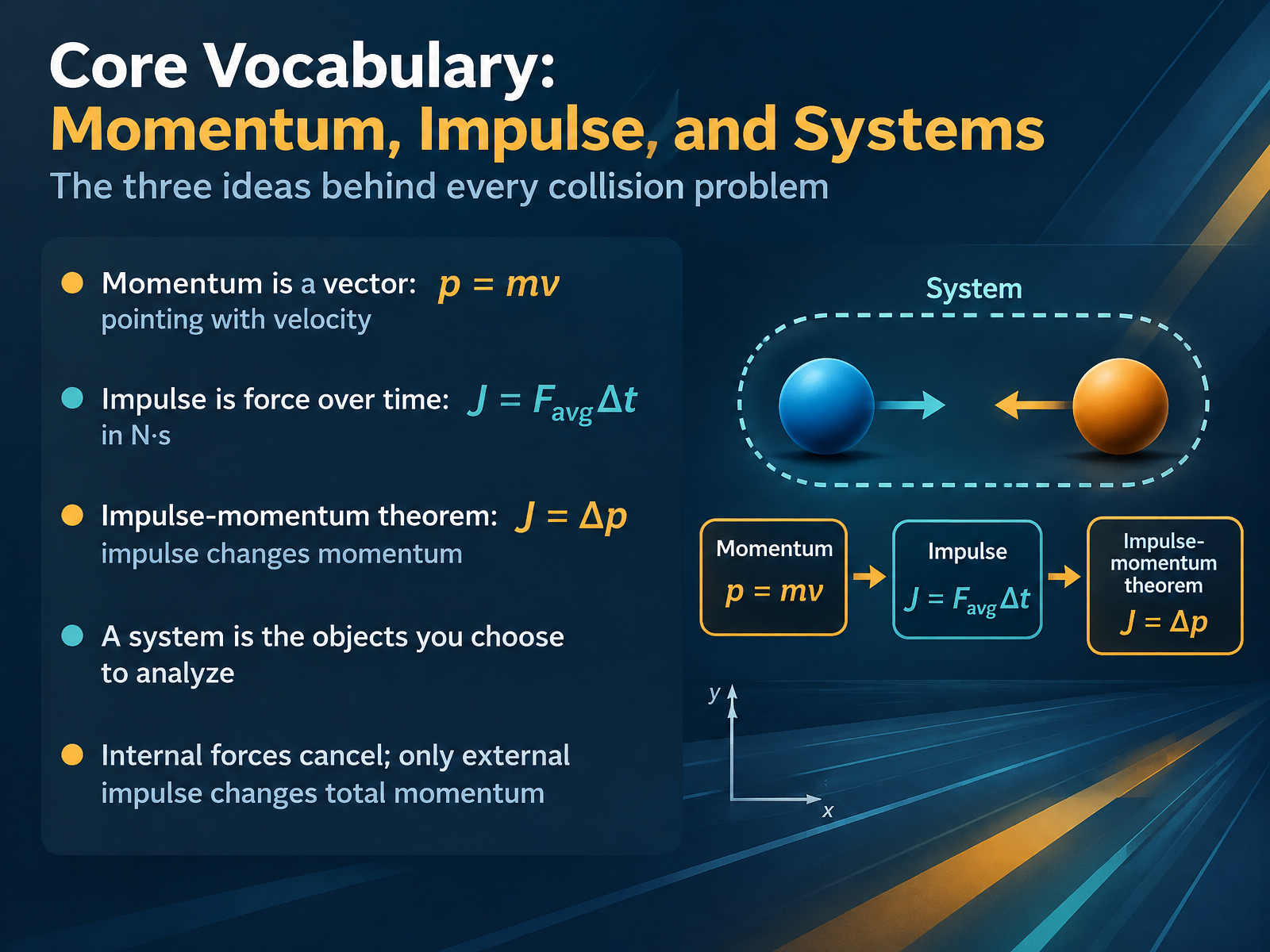
- 02Core Vocabulary: Momentum, Impulse, and SystemsLet's build the core vocabulary for every collision problem. First, momentum. Momentum is a vector, written p equals m times v, so it points with the velocity. Mass is in kilograms, velocity in meters per second, so momentum is in kilogram meters per second. Next, impulse. Impulse is force over time, written J equals F average times delta t, measured in newton seconds. Notice what changes when a large force acts briefly, or a small force acts for a long time. Same impulse. Now apply this to the impulse-momentum theorem. J equals delta p. Impulse changes momentum. It does not create momentum. Finally, a system is simply the objects you choose to analyze. Inside that system, internal forces cancel. Only an external impulse changes the total momentum. For educators, a common misconception is treating momentum as a scalar, or confusing impulse with momentum itself. So keep your sign conventions consistent. Coming up next, why momentum matters in safety, sports, and space.
 openstax.orgopenstax.orgphysicslearn.org+22 min
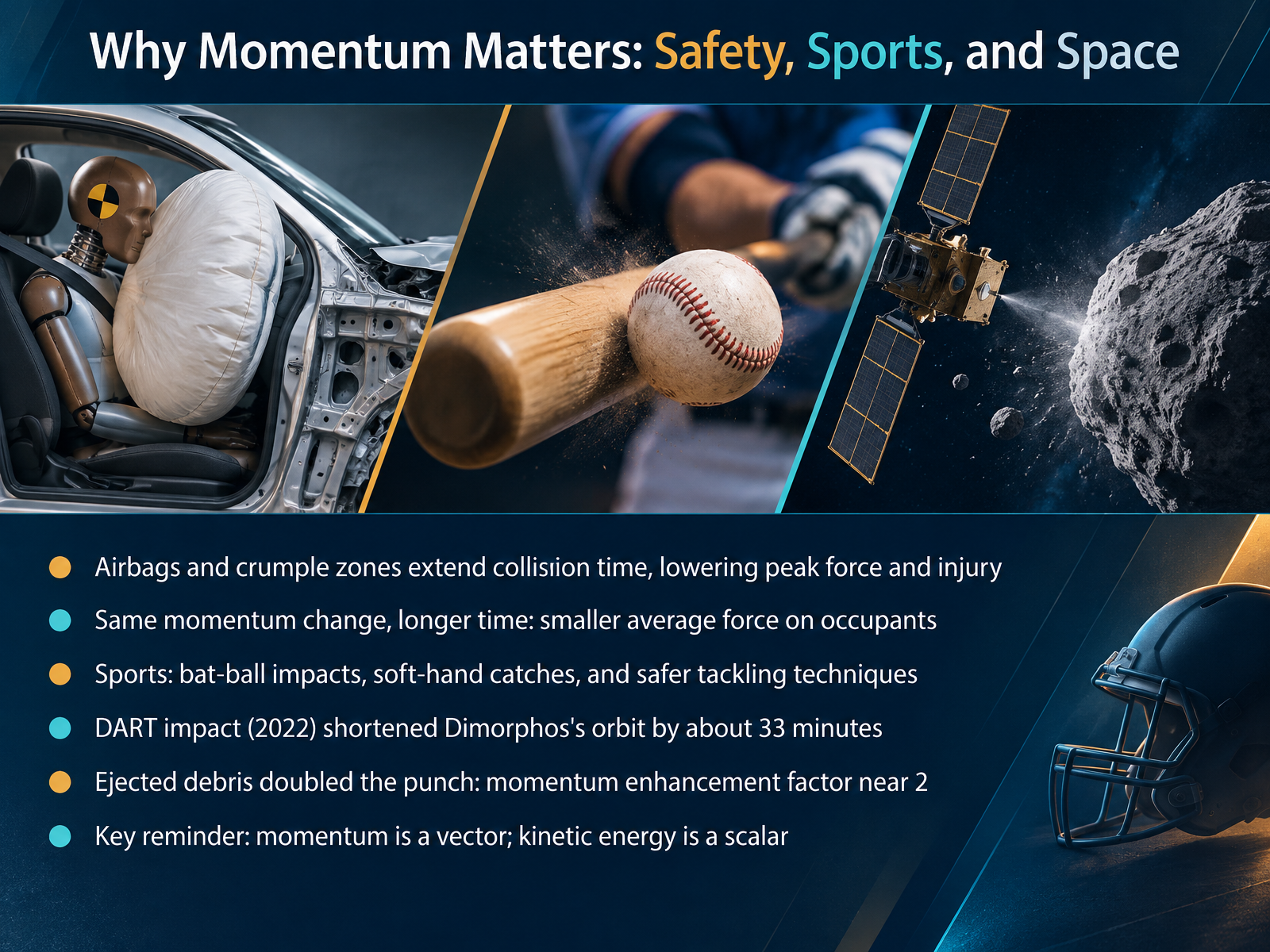
- 03Why Momentum Matters: Safety, Sports, and SpaceNow let's see why momentum matters in the real world. Start with car crashes. An airbag and a crumple zone stretch the collision time. The change in momentum is the same either way. But a longer time means a smaller average force on your body. Notice what changes when time increases. Force drops. The math is force equals change in momentum divided by time. Same idea in sports. A bat striking a ball, a soft-hand catch, or a safer tackle all spread the impact over more time. Now apply this to space. In 2022, NASA's DART spacecraft struck the asteroid moon Dimorphos. That impact shortened its orbit by about thirty three minutes. Here is the striking part. Ejected debris doubled the punch. The momentum enhancement factor was about two. So the debris carried away extra momentum, and that pushed the asteroid harder. One key reminder. Momentum is a vector, with both size and direction. Kinetic energy is a scalar, with size only. Keep that difference in mind. Now let's formalize this with the impulse momentum theorem.
 nasa.goviopscience.iop.orgnature.com+22 min
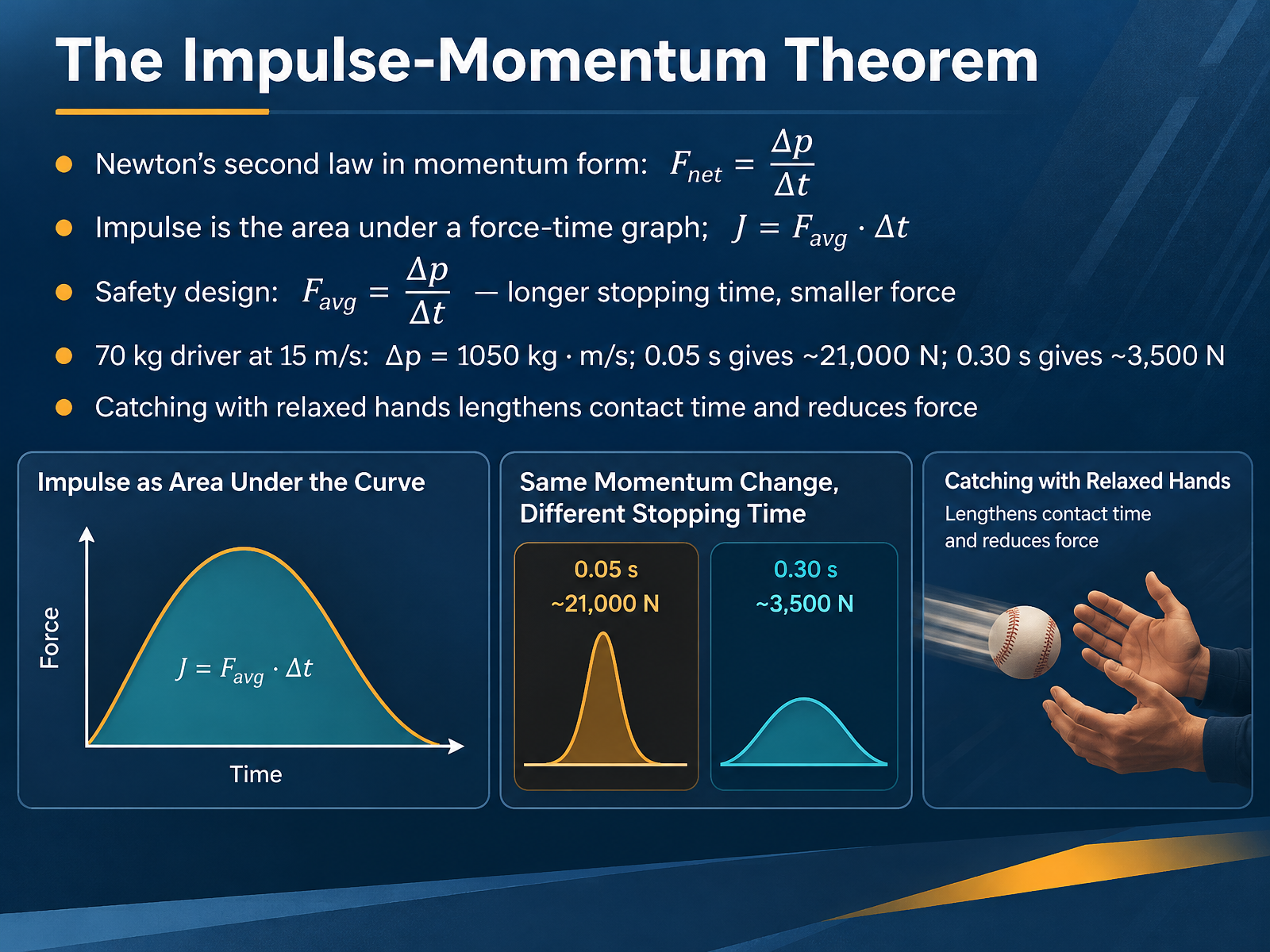
- 04The Impulse-Momentum TheoremNow let's connect force to momentum with the impulse-momentum theorem. Newton's second law in momentum form says the net force equals the change in momentum divided by the change in time. Rearrange it, and the impulse, written J and measured in newton seconds, equals the change in momentum. On a force-time graph, impulse is simply the area under the curve. Now apply this to safety design. Rearranged, the average force equals the momentum change divided by the stopping time. So if you stretch the stopping time, the force drops. Notice what changes for a seventy kilogram driver moving at fifteen meters per second. The momentum change is one thousand fifty kilogram meters per second, whether the stop is hard or soft. Stopping in zero point zero five seconds gives about twenty-one thousand newtons. Stretching that to zero point three seconds gives only about three thousand five hundred newtons, roughly one sixth of the force. That is why catching with relaxed hands, pulling them back as the ball arrives, hurts far less. Here is a common misconception for educators: safety devices do not reduce the momentum change, they only lengthen the time. Next, we examine elastic collisions, where momentum and kinetic energy are both conserved.
 openstax.orgopenstax.orgphysicslearn.org+22 min
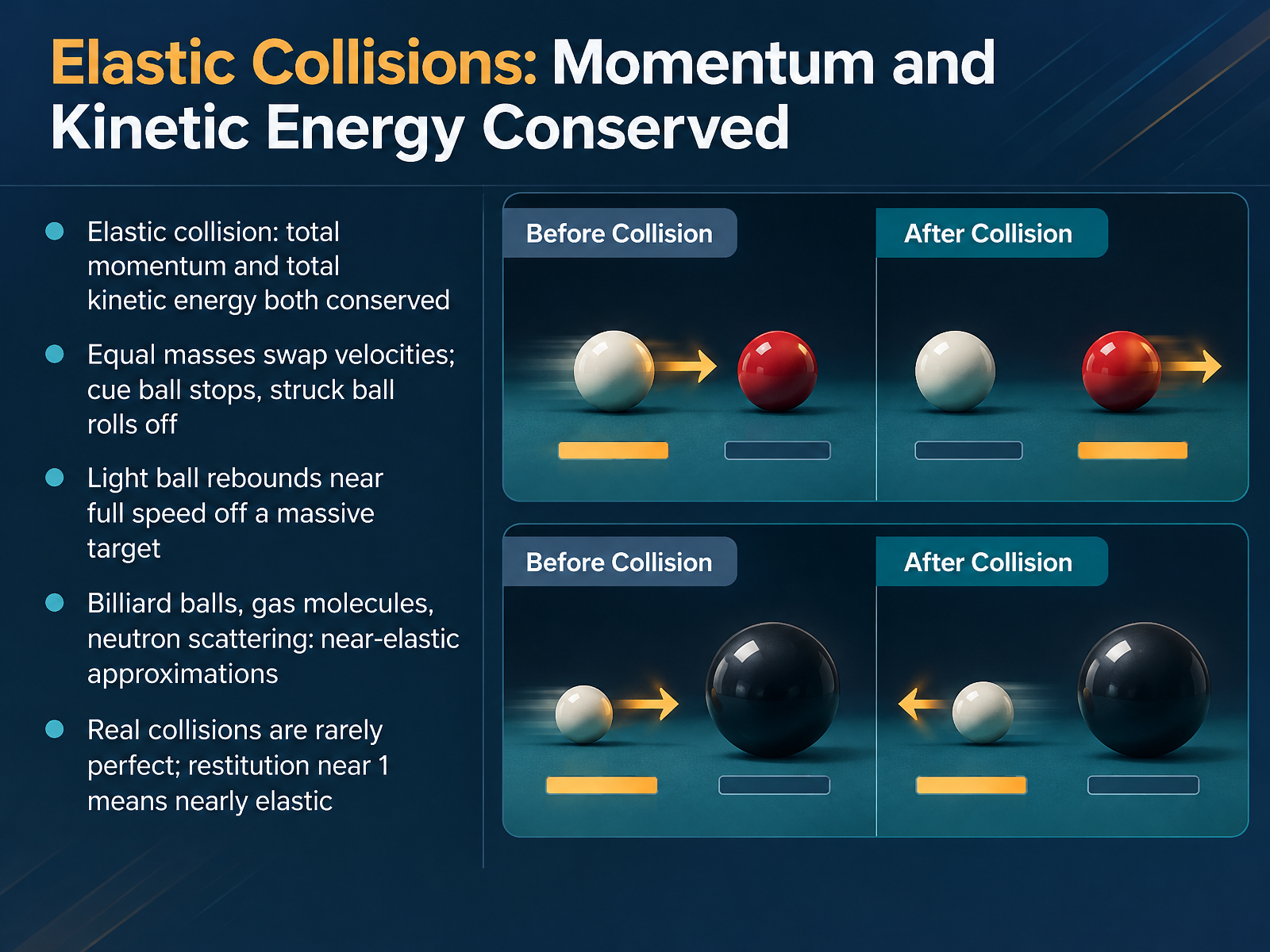
- 05Elastic Collisions: Momentum and Kinetic Energy ConservedNow let's look at elastic collisions. In an elastic collision, two things are conserved: total momentum, p equals m times v, measured in kilogram meters per second, and total kinetic energy, KE equals one half m v squared, measured in joules. Here is the cleanest case. When two equal masses collide head on, they swap velocities. In billiards, a cue ball strikes a resting ball, stops, and the struck ball rolls off at the cue ball's original speed. Now change the masses. A light ball rebounds off a massive target at nearly full speed. Think of a ping pong ball bouncing off a bowling ball. Billiard balls, gas molecules, and neutron scattering are all near elastic approximations. Real collisions are rarely perfect. Restitution near one means nearly elastic. What would you expect from a soft clay ball? It barely bounces. One note for educators: students often assume kinetic energy is always conserved, but that is only true for elastic collisions. Next, we turn to inelastic and perfectly inelastic collisions.
 teachengineering.orgteachengineering.orgflexbooks.ck12.org+22 min
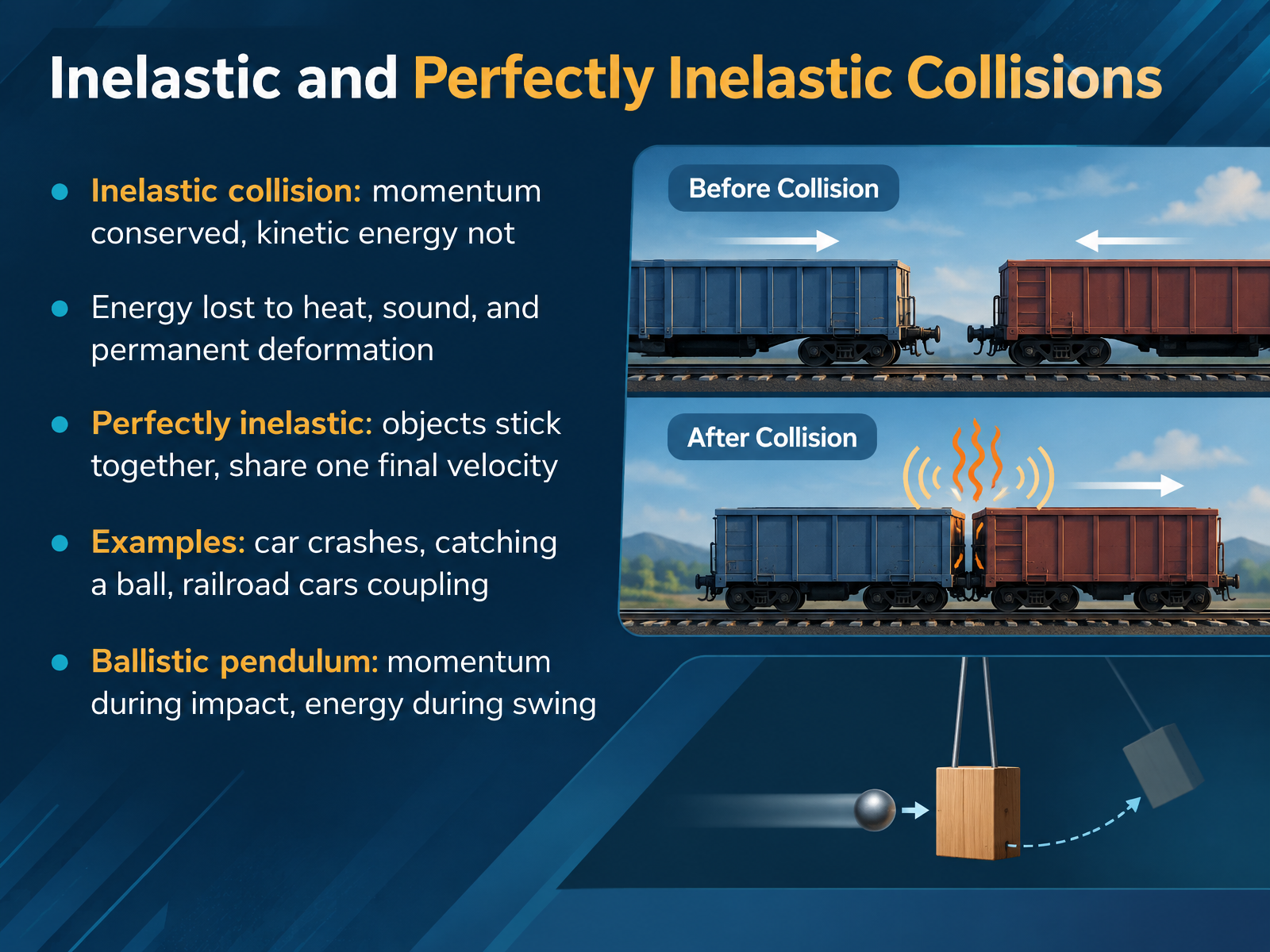
- 06Inelastic and Perfectly Inelastic CollisionsNow let's look at inelastic collisions. In an inelastic collision, momentum is conserved, but kinetic energy is not. Some kinetic energy leaves the motion and becomes heat, sound, or permanent deformation. What would you expect here? You see it every day. In a car crash, metal bends and sound fills the air. Kinetic energy drops, but total momentum before and after still matches. Now consider a perfectly inelastic collision. The objects stick together and share one final velocity. Think of railroad cars coupling, or catching a ball. A good worked example is the ballistic pendulum. A bullet embeds in a block, and the pair swings upward. During the impact, use momentum conservation. During the swing, use energy conservation. For educators, a common student misconception is treating kinetic energy as always conserved. It is not, unless the collision is elastic. So remember: momentum is reliable in every collision. Kinetic energy is not. Now we'll build on this with the ballistic pendulum, combining momentum and energy.
 farside.ph.utexas.edusfu.caphys.libretexts.org+22 min
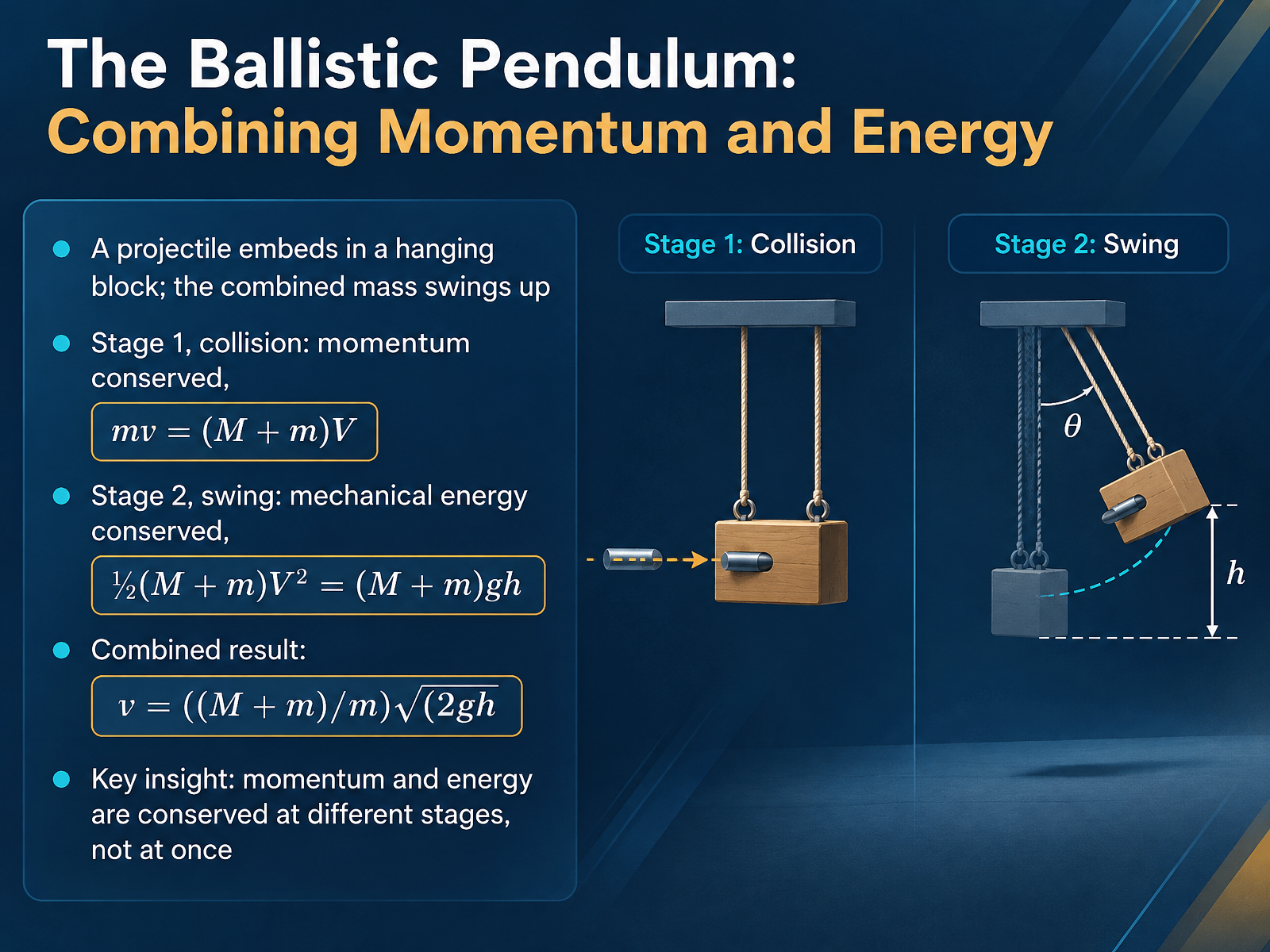
- 07The Ballistic Pendulum: Combining Momentum and EnergyNow let's combine momentum and energy in one classic device: the ballistic pendulum. A projectile embeds in a hanging block, and the combined mass swings upward. Treat this as two separate stages. Stage one is the collision. Here, momentum is conserved. Let m be the projectile mass, v its speed before impact, and M the block mass. Then m times v equals the quantity M plus m times capital V, the speed just after impact. Notice this collision is inelastic, so kinetic energy drops. Stage two is the swing. Now mechanical energy is conserved. One half times the combined mass times capital V squared equals the combined mass times g times h, where g is gravitational acceleration and h is the rise height. Solve both equations together, and the projectile speed is v equals the quantity M plus m divided by m, all times the square root of two times g times h. So momentum and energy are each conserved, but at different stages, not simultaneously. For educators, students often expect energy to be conserved during impact; it is not. Next, we examine conservation of momentum in one dimension.
 farside.ph.utexas.edusfu.caphys.libretexts.org+21 min
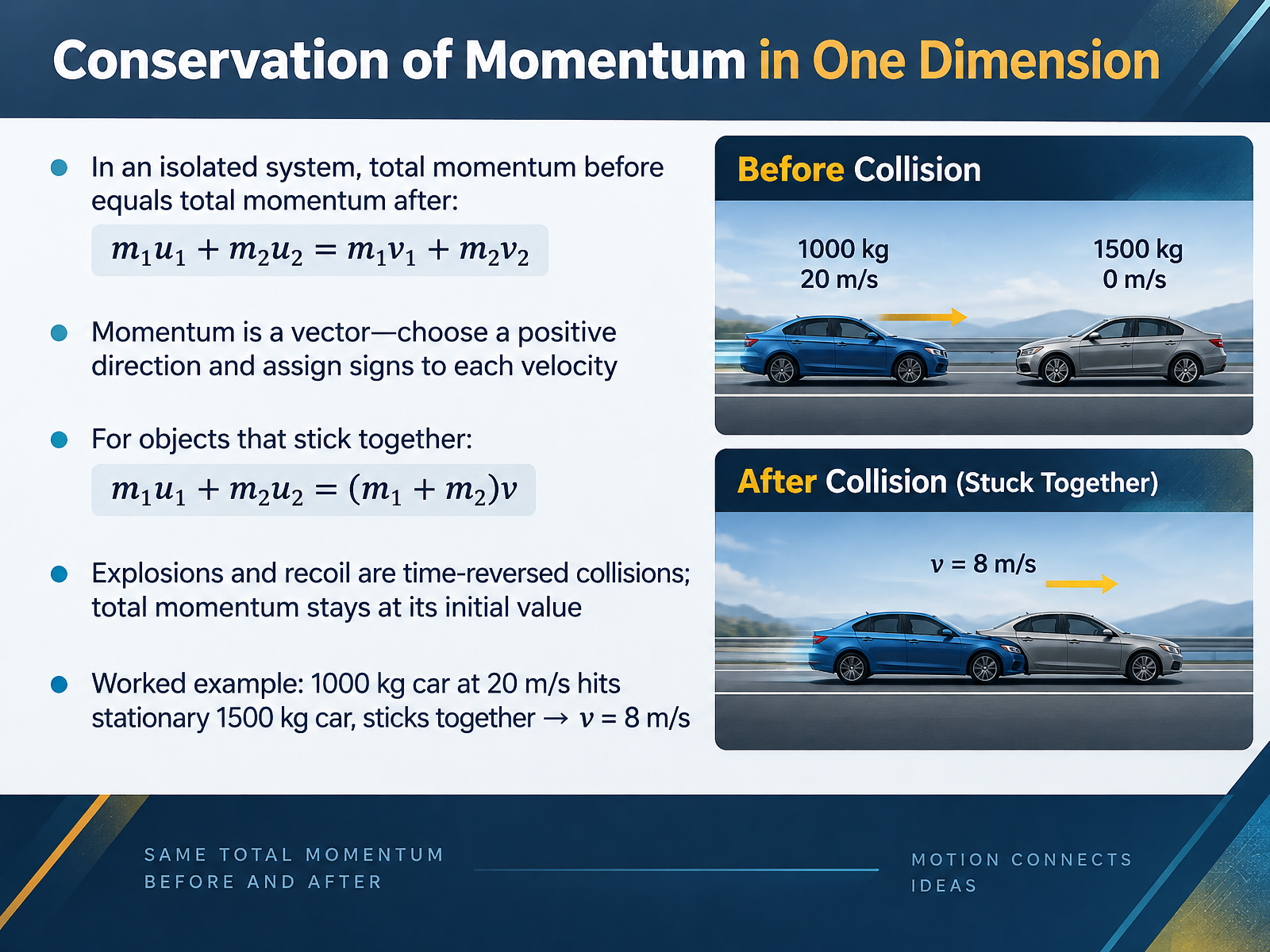
- 08Conservation of Momentum in One DimensionNow let's put momentum conservation to work in one dimension. In an isolated system, total momentum before a collision equals total momentum after. So m one u one plus m two u two equals m one v one plus m two v two. Here m is mass in kilograms, u is velocity before impact, and v is velocity after, both in meters per second. Momentum is a vector, so pick a positive direction first, then assign signs to every velocity. If two objects stick together, they share one final velocity, giving m one u one plus m two u two equals the sum of the masses times v. Explosions and recoil are just time reversed collisions. Total momentum starts at its initial value, often zero, and stays there. Try this example. A one thousand kilogram car at twenty meters per second hits a stationary fifteen hundred kilogram car and they stick. The initial momentum is twenty thousand kilogram meters per second. Divide by the combined mass of twenty five hundred kilograms, and the final velocity is eight meters per second, in the original direction. Notice what changes when masses differ. The common velocity is a mass weighted result, not a simple average. That is a common student misconception worth flagging. Next, we extend these ideas to Momentum in Two Dimensions.
 openstax.orgopenstax.orgphysicslearn.org+22 min
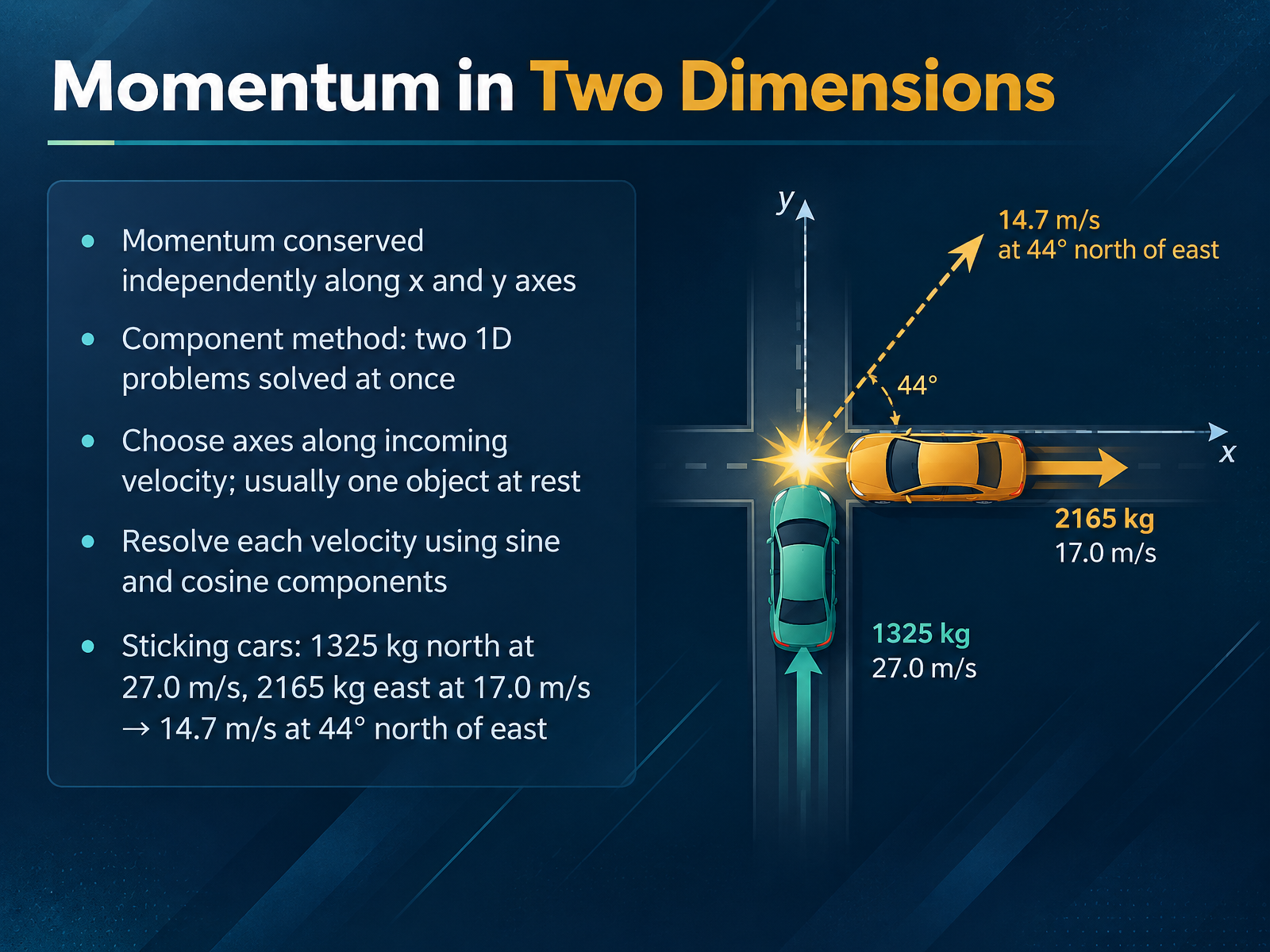
- 09Momentum in Two DimensionsNow let's extend momentum conservation into two dimensions. Here's the key idea. Momentum is conserved independently along the x axis and along the y axis. So the component method turns one two-dimensional problem into two one-dimensional problems solved at once. Choose your axes along the incoming velocity, and notice what happens when one object starts at rest. Then that object contributes zero momentum in both directions, which simplifies your equations fast. Resolve every velocity using sine and cosine components. Remember, one momentum unit is a kilogram meter per second. Now apply this to a rear-end style crash. A 1325 kilogram car moves north at 27.0 meters per second, and a 2165 kilogram car moves east at 17.0 meters per second. The cars stick together. What would you expect here? The northward momentum is 35,800, and the eastward momentum is 36,800 kilogram meters per second. Combine them with the Pythagorean theorem, and you get about 51,400. Divide by the total mass of 3490 kilograms. The wreckage slides at 14.7 meters per second at 44 degrees north of east. For educators, this is vector addition, and a common student misconception is adding speeds as scalars. Next, let's work through several of these problems together in the Two-Dimensional Problem Workshop.
 2 min
- 10Two-Dimensional Problem WorkshopNow let's put two-dimensional momentum conservation to work.
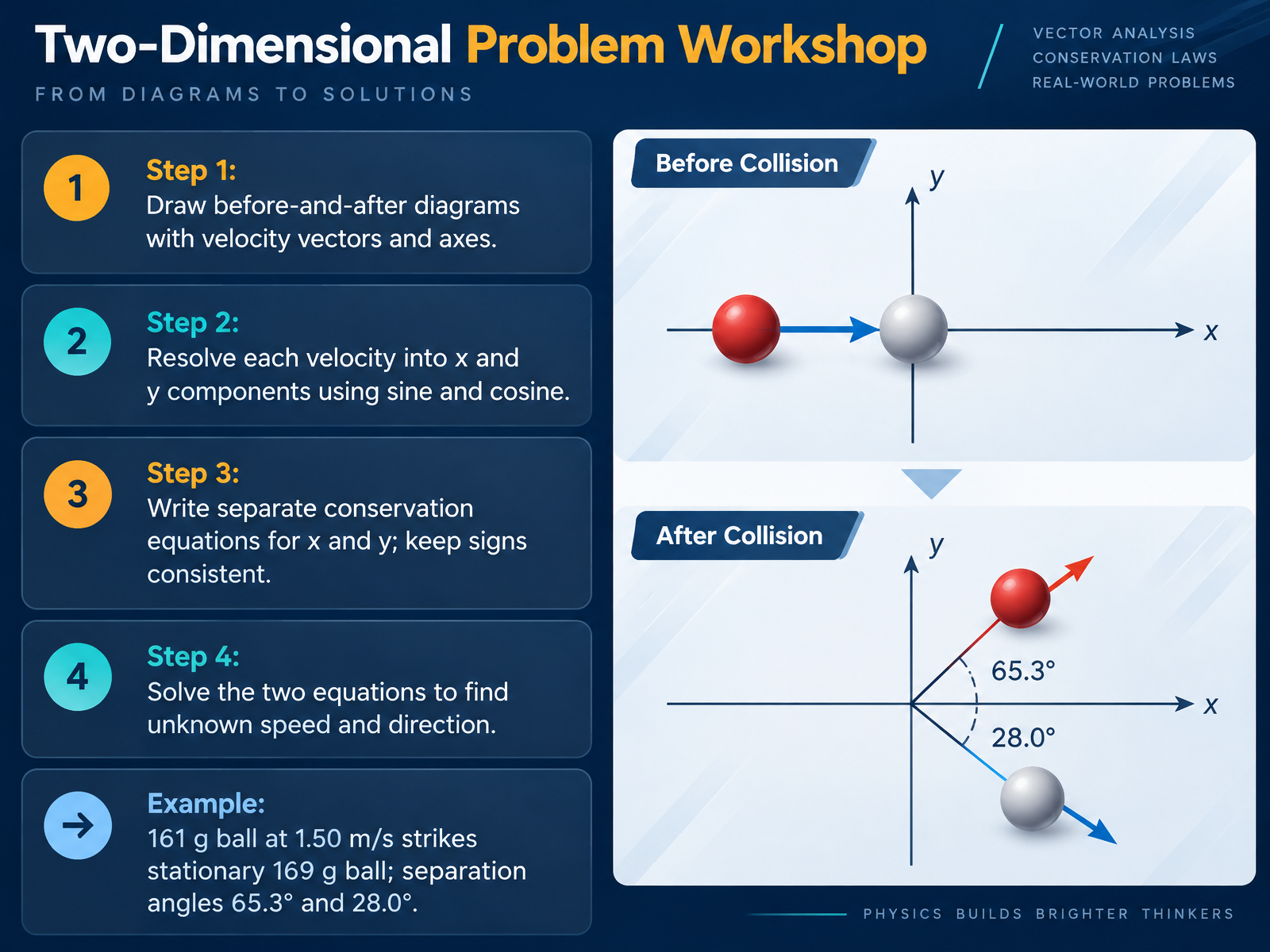
Here are the four steps that solve any of these problems.
Step one. Draw before and after diagrams. Mark your x and y axes, and sketch every velocity vector with its direction.
Step two. Resolve each velocity into components. Remember, the x velocity equals the speed times cosine of the angle, and the y velocity equals the speed times sine of the angle. Keep your angle measured from the x axis, and set signs carefully.
Step three. Write separate conservation equations for x and y. The x momentum before equals the x momentum after. The y momentum before equals the y momentum after. These are independent, so treat them as two one-dimensional problems running side by side.
Step four. Solve the pair of equations for the two unknowns, the speed and the direction.
Let's see this with the example. A 161 gram ball moving at 1.50 meters per second strikes a stationary 169 gram ball. After impact, the balls separate at angles of 65.3 degrees and 28.0 degrees. With only those angles unknown speeds become solvable. Try it yourself before I show the result.
One common misconception to name: learners often add speeds as scalars. Momentum is a vector, so you must add components, not magnitudes.
Next, we look at safety engineering, where impulse, force, and time change what a collision does to people and structures.
 2 min
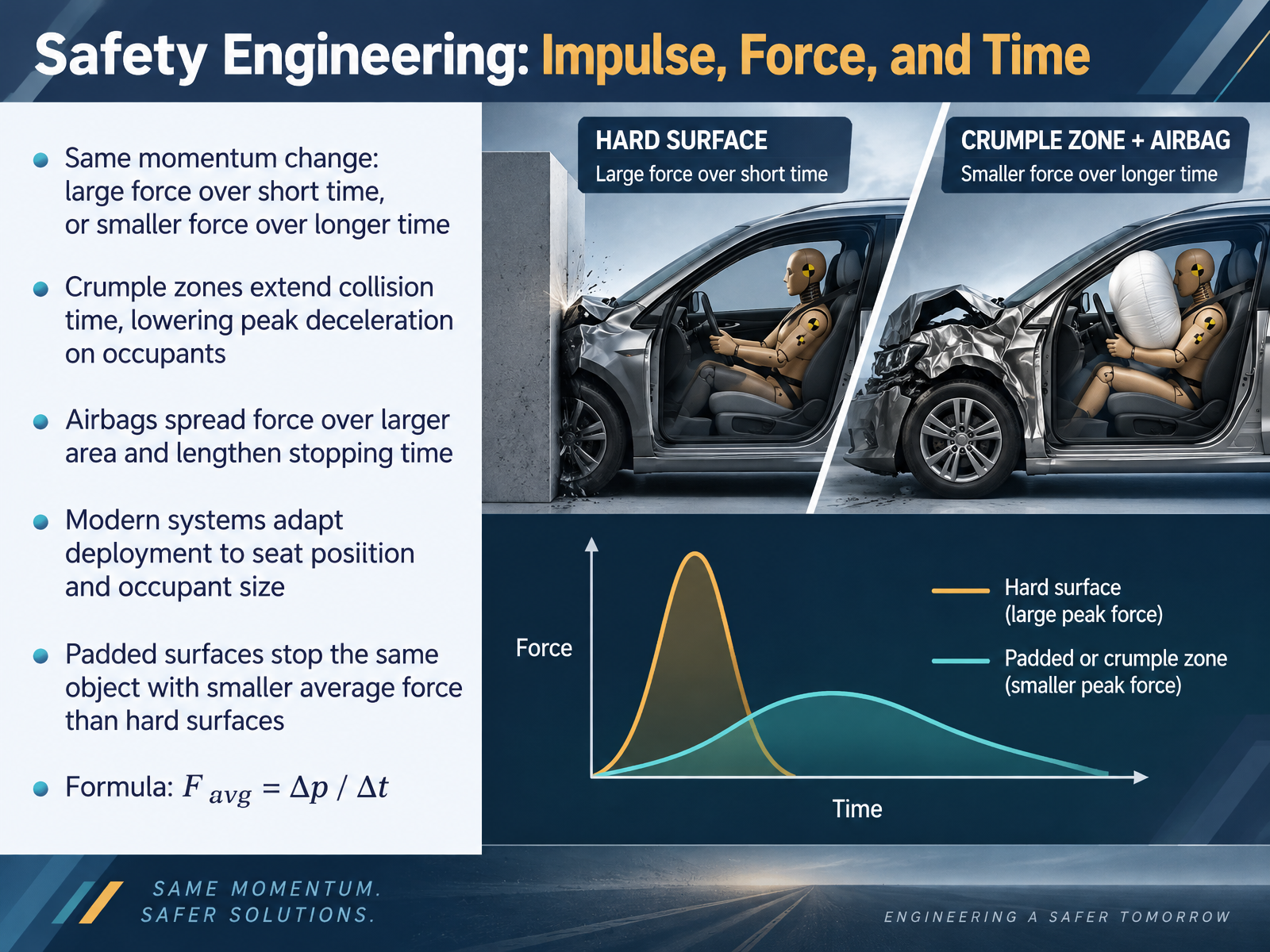
- 11Safety Engineering: Impulse, Force, and TimeNow let us apply impulse to safety engineering. When a car crashes, the occupants must lose the same momentum change, roughly mass times velocity, regardless of the safety systems. What changes is how long that momentum change takes. A large force over a short time hurts, while a smaller force over a longer time protects. Here is the key formula. The average force, F sub avg, equals the change in momentum, delta p, divided by the change in time, delta t. Since delta p stays fixed, increasing delta t lowers the average force. Crumple zones do exactly this. They extend the collision time and lower peak deceleration on occupants. Airbags spread force over a larger body area and lengthen stopping time further. Modern systems even adapt deployment to seat position and occupant size. And a padded surface stops the same object with less average force than a hard one. Notice how one equation explains all of them. For educators, this is Newton's second law in momentum form, and a common misconception is that safety devices reduce the momentum change. They do not. Next, we look at momentum transfer far from Earth in our case study on DART and momentum transfer in space.
 openstax.orgopenstax.orgphysicslearn.org+21 min
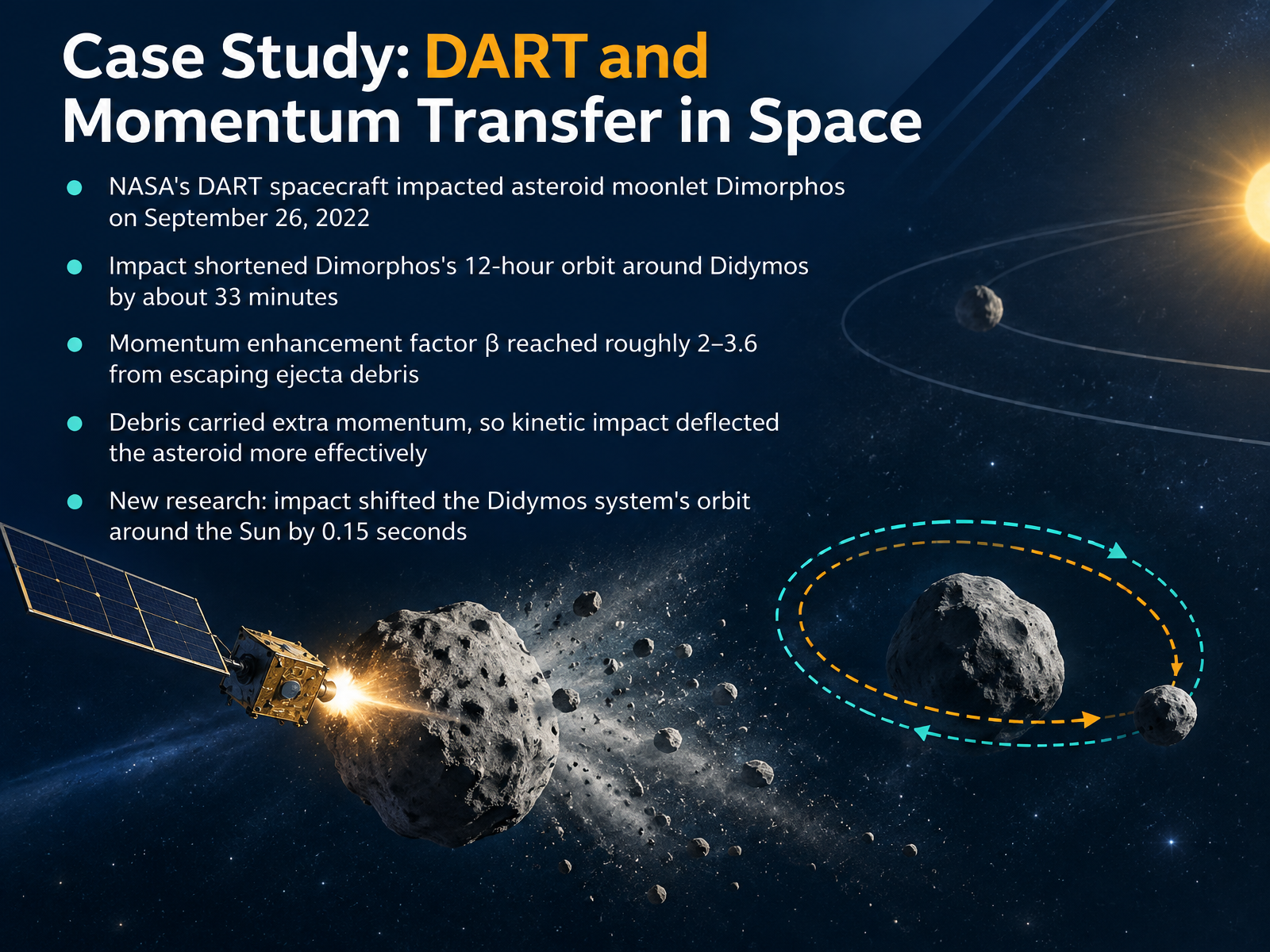
- 12Case Study: DART and Momentum Transfer in SpaceNow apply momentum transfer to a real mission. On September twenty-sixth, twenty twenty-two, NASA's DART spacecraft slammed into Dimorphos, a small moonlet orbiting the asteroid Didymos. DART stands for Double Asteroid Redirection Test. The impact shortened Dimorphos's twelve-hour orbit around Didymos by about thirty-three minutes. A perfectly inelastic collision alone would have changed that orbit by roughly seven minutes. What would you expect here? The extra change came from escaping debris. The momentum enhancement factor, written as beta, compares total momentum delivered to the momentum the spacecraft carried alone. For DART, beta reached roughly two to three point six. So the ejecta doubled or tripled the push. New research shows the impact even shifted the Didymos system's orbit around the Sun by zero point one five seconds, the first human-caused change to a celestial body's heliocentric path. For educators, note the common misconception that beta equals one in every collision. It does not, whenever ejecta carry momentum away. Next, let's build a repeatable approach: a five-step method for collision problems.
 nasa.goviopscience.iop.orgnature.com+22 min
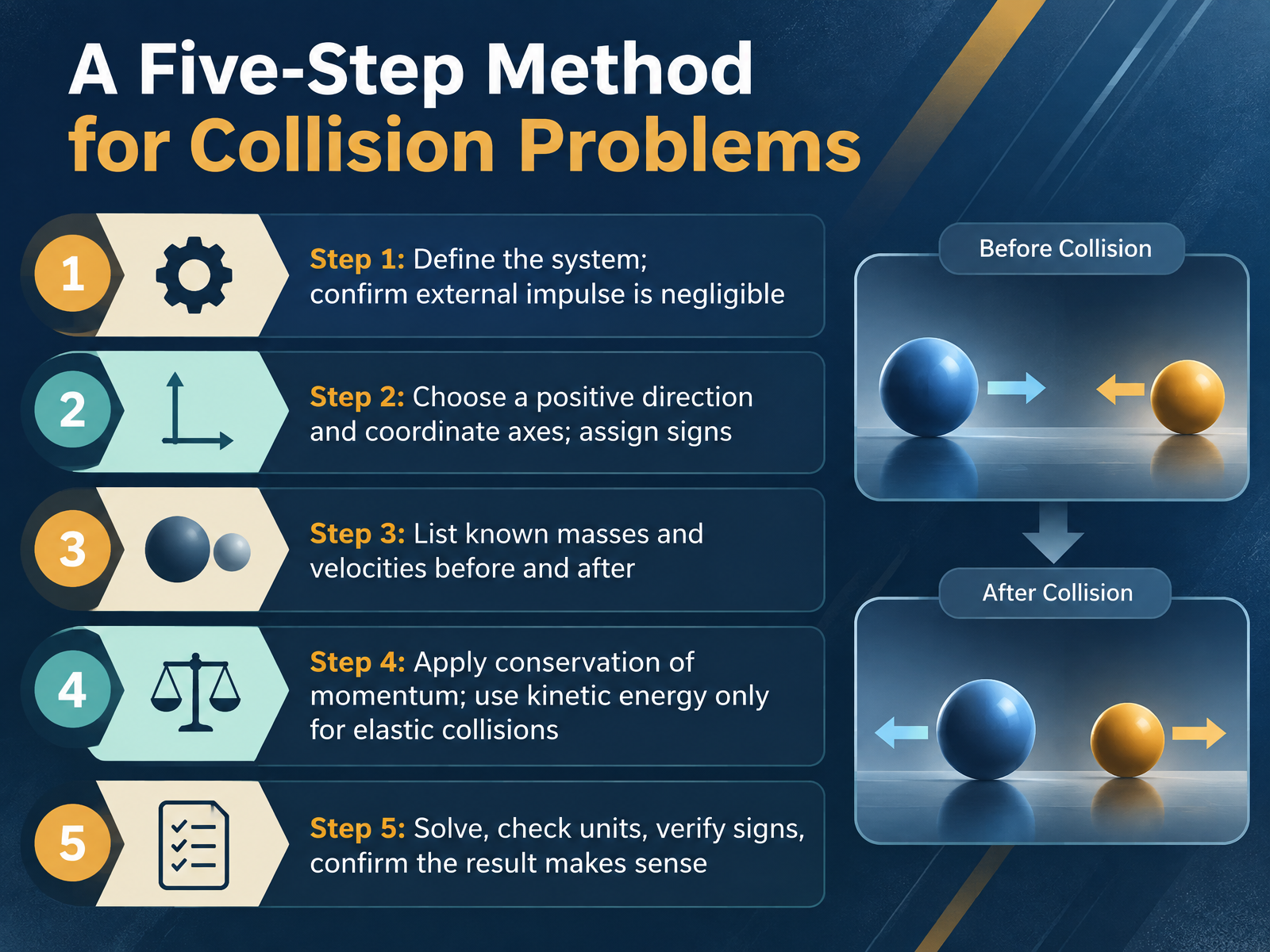
- 13A Five-Step Method for Collision ProblemsNow let's put it all together with a five-step method for collision problems. Step one. Define your system, then confirm the external impulse is negligible. If outside forces are small during the brief contact, total momentum is conserved. Step two. Choose a positive direction and coordinate axes, and assign a sign to every velocity. Remember, momentum is a vector, so direction matters. Step three. List the known masses and velocities, before and after. Use symbols m one, m two, u one and u two for velocities before, and v one and v two for velocities after, with units in kilograms and meters per second. Step four. Apply conservation of momentum. Write m one u one plus m two u two equals m one v one plus m two v two. Use kinetic energy only for elastic collisions, never for ones where objects stick together. Step five. Solve, check your units, verify your signs, and ask whether the result makes sense. For example, a truck losing momentum should slow down while the struck car speeds up. For educators, the common misconception here is treating each object's momentum as conserved, when only the total system momentum is. Next, we'll look at misconceptions, assessment, and next steps.
 2 min
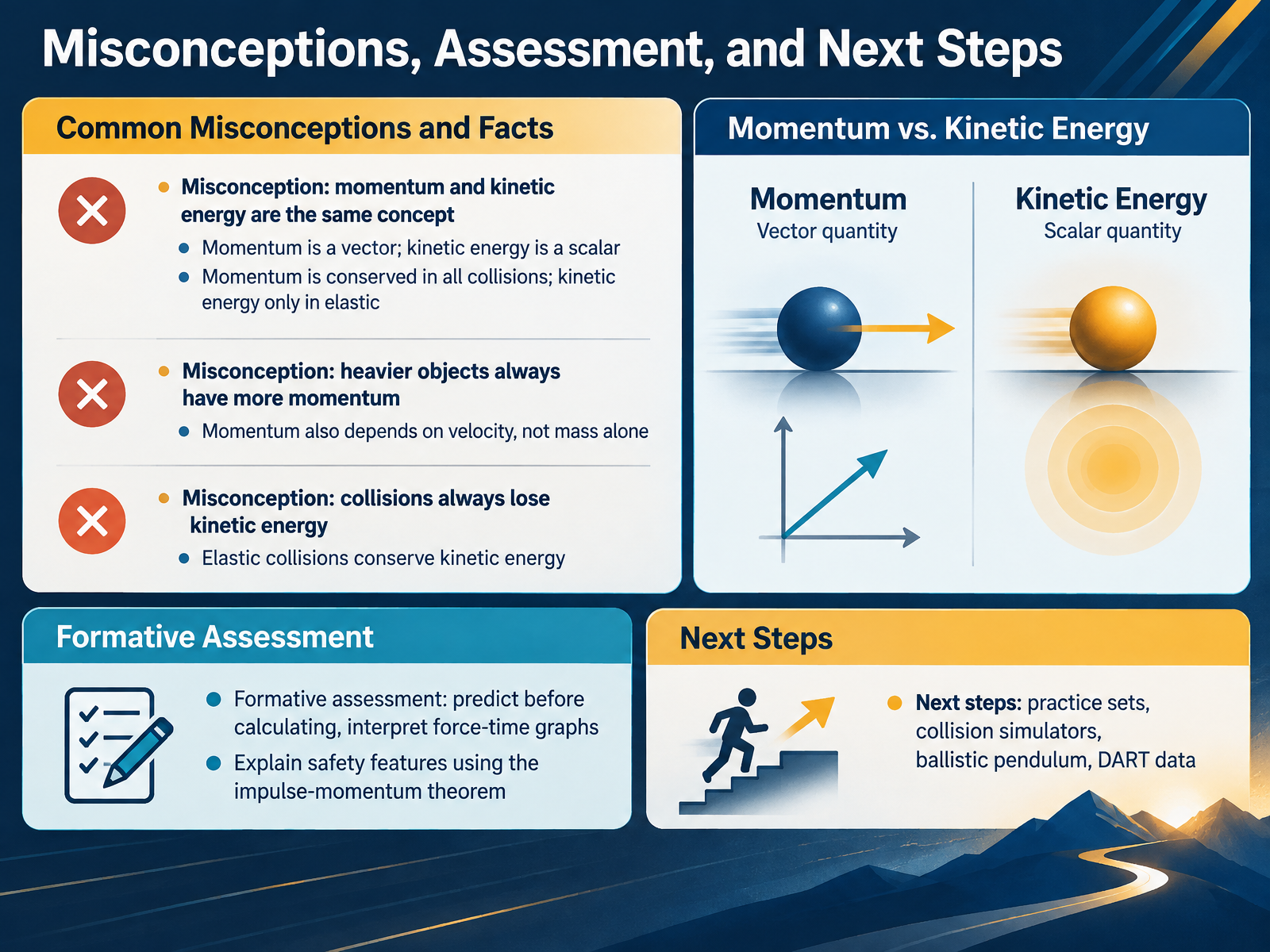
- 14Misconceptions, Assessment, and Next StepsLet's close by clearing up a few misconceptions and pointing you toward next steps. First, momentum and kinetic energy are not the same concept. Momentum is a vector, so direction matters. Kinetic energy is a scalar, so it does not. Next, momentum is conserved in all collisions, provided no external net force acts. Kinetic energy is conserved only in elastic collisions. Notice what changes when a collision is inelastic. Energy transforms into heat, sound, or deformation, but momentum still balances. Another misconception: heavier objects always have more momentum. Not true. Momentum equals mass times velocity, so a fast light object can outrun a slow heavy one. What would you expect here? Ask your students to predict before they calculate. Then interpret force-time graphs, where the area under the curve equals impulse, the change in momentum. Use that to explain crumple zones, airbags, and why bending your knees on landing protects you. For educators, the common student misconception is treating momentum as a scalar and treating energy and momentum as interchangeable. Your next steps: practice sets, collision simulators, the ballistic pendulum, and DART mission data. Thank you for your attention. Keep asking, keep predicting, and keep learning.
 2 min
Take the deck with you
Download this course as a file — free, no sign-up needed.
- PDF handoutEvery slide page, ready to print or share.15 pages · 3.9 MBDownload
- Narrated PowerPointThe deck that presents itself — every slide carries the digital human's narration video.15 pages · 18.5 MBDownload
- PowerPoint slidesThe full deck as a .pptx — open it in PowerPoint, Keynote, or Google Slides.15 pages · 3.9 MBDownload
Free to use in your own training — please keep the PersonWise credit page at the end.
Have your own deck? Turn it into a course
Sources consulted
Web sources consulted while building this course.
- Worked example 7.5: Ballistic pendulum — farside.ph.utexas.edu
- https://www.sfu.ca/phys/140/1081/solutions/Unit10_BallisticPendulum.pdf — sfu.ca
- 10.6: Sample problems and solutions - Physics LibreTexts — phys.libretexts.org
- 24.15 -- Ballistic pendulums — web.physics.ucsb.edu
- Ballistic Pendulum: Videos & Practice Problems - Pearson — pearson.com
- 8.1 Linear Momentum, Force, and Impulse - Physics | OpenStax — openstax.org
- 9.2 Impulse and Collisions - University Physics Volume 1 | OpenStax — openstax.org
- Impulse-Momentum Theorem Explained (AP Physics 1) — physicslearn.org
- 8.2 Impulse - College Physics for AP® Courses 2e | OpenStax — openstax.org
- Change in Momentum and Impulse: AP Physics 1 Topic 4.2 — physicslearn.org
- NASA’s DART Mission Changed Orbit of Asteroid Didymos Around Sun - NASA — nasa.gov
- 3D Reconstruction of DART Ejecta at Dimorphos Reveals an Anisotropic, Filamentary Structure - IOPscience — iopscience.iop.org
- Momentum transfer from the DART mission kinetic impact on asteroid Dimorphos | Nature — nature.com
- NASA’s DART Mission Changed Orbit of Asteroid Didymos Around Sun | NASA Jet Propulsion Laboratory (JPL) — jpl.nasa.gov
- Direct detection of an asteroid’s heliocentric deflection: The Didymos system after DART — exa.ai
- Collisions and Momentum: Bouncing Balls - Lesson - Teach Engineering — teachengineering.org
- Bouncing Balls: Collisions, Momentum & Math (for High School) - Activity - Teach Engineering — teachengineering.org
- Elastic and Inelastic Collisions — flexbooks.ck12.org
- Elastic collision | OpenLab Science — openlabscience.com
- Collisions — mathsisfun.com