Ethics and Responsible SEO Practices
Begin
13 pages · ~26 min
Ethics and Responsible SEO Practices
This training explains ethical and responsible SEO practices, helping marketers and content professionals apply transparent, sustainable strategies that avoid deceptive tactics.
What you’ll learn
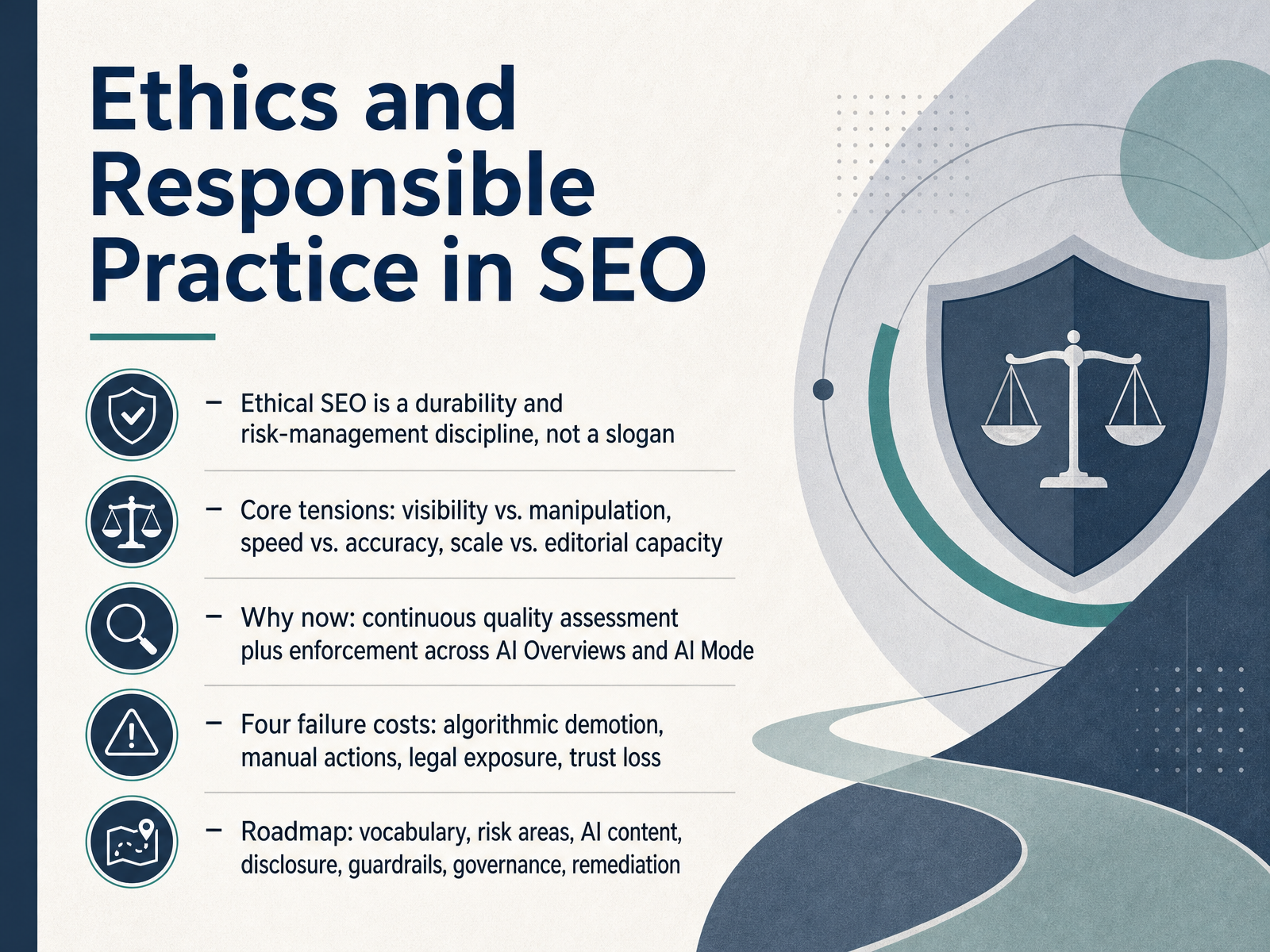
- 01Ethics and Responsible Practice in SEOWelcome. Over the next several slides, we're going to treat ethical SEO as what it actually is: a durability and risk-management discipline, not a slogan. You already know how optimization works, so our focus is on the tradeoffs. Visibility versus manipulation. Speed versus accuracy. Scale versus real editorial capacity. Here's why timing matters. Google now assesses quality continuously, and its spam policies apply to AI Overviews and AI Mode, not just traditional rankings. That means the same violation can cost you two surfaces at once. When judgment calls go wrong, there are four costs to weigh: algorithmic demotion, manual actions, legal exposure, and lost trust. Think about a client pushing for hundreds of pages before a launch. That is a decision point, not a moral one. Here's our roadmap. We'll build shared vocabulary, map the risk areas, cover AI content and disclosure, then set guardrails, governance, and remediation for when something breaks. Let's start with vocabulary, and the distinction between compliance and ethics.developers.google.cndevelopers.google.cndevelopers.google.com+22 min
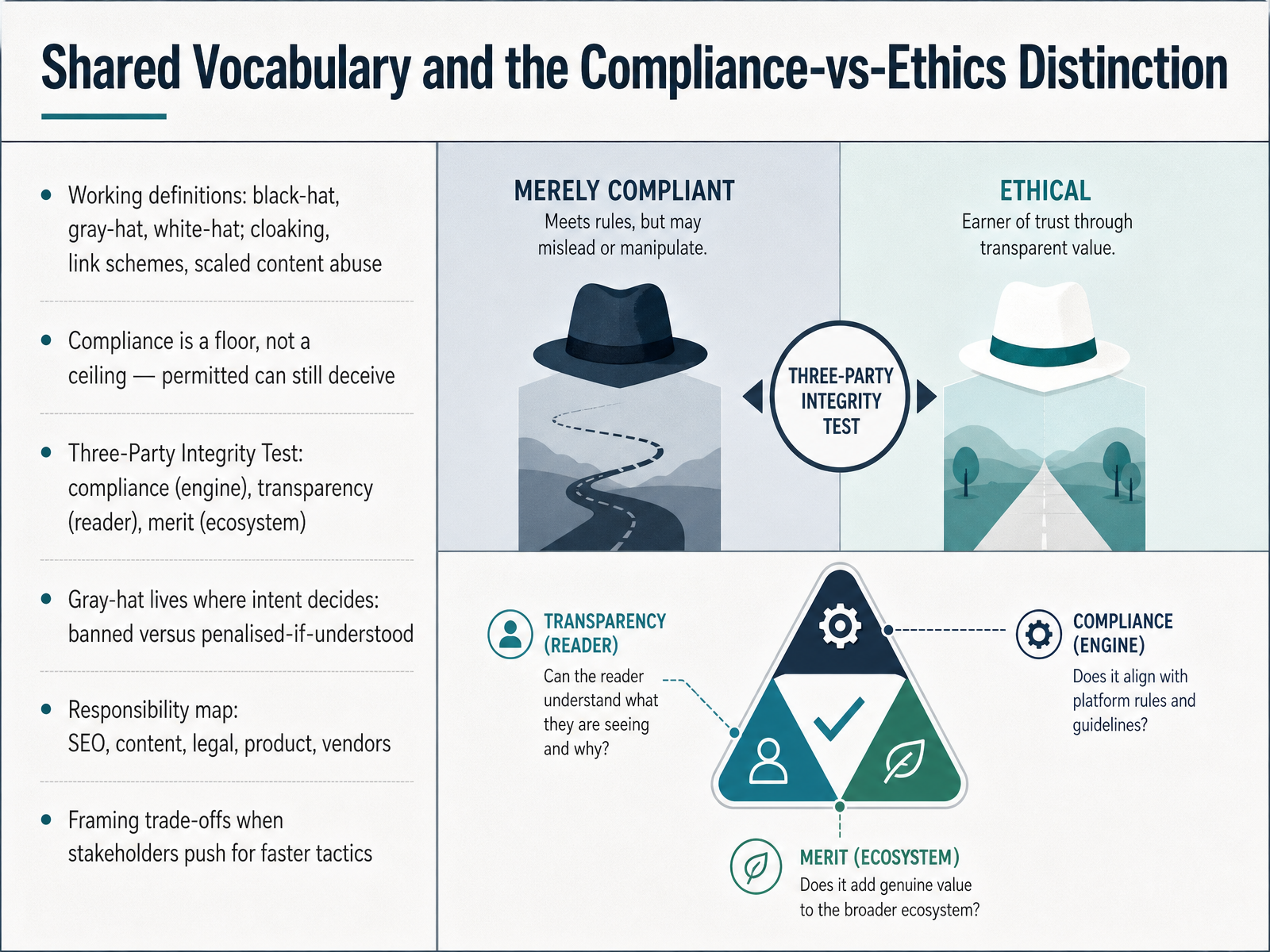
- 02Shared Vocabulary and the Compliance-vs-Ethics DistinctionLet's align on shared vocabulary first, because ethical debates usually stall on definitions. Black-hat SEO breaks search engine guidelines, like cloaking or link schemes. White-hat stays inside them. Gray-hat sits between. Google doesn't explicitly ban it, but would penalise it if it understood the intent. Intent decides which side you land on.
Compliance is a floor, not a ceiling. A tactic can be permitted and still deceive readers. So we use the Three-Party Integrity Test: compliance toward the engine, transparency toward the reader, and merit toward the ecosystem. A tactic has to pass all three.
Responsibility is shared. SEO owns tactics, content owns accuracy, legal owns disclosure rules, product owns the user experience, and vendors work under your standards. When a stakeholder pushes for faster tactics, frame the trade-off in terms of duration and risk, not morality. Say: this may rank quickly, but the exposure is permanent, and recovery takes months.
That vocabulary gives us a common language for the harder calls ahead. Next, we look at risk areas across the search ecosystem.
 authorityspecialist.comgatilab.comaamax.co+22 min
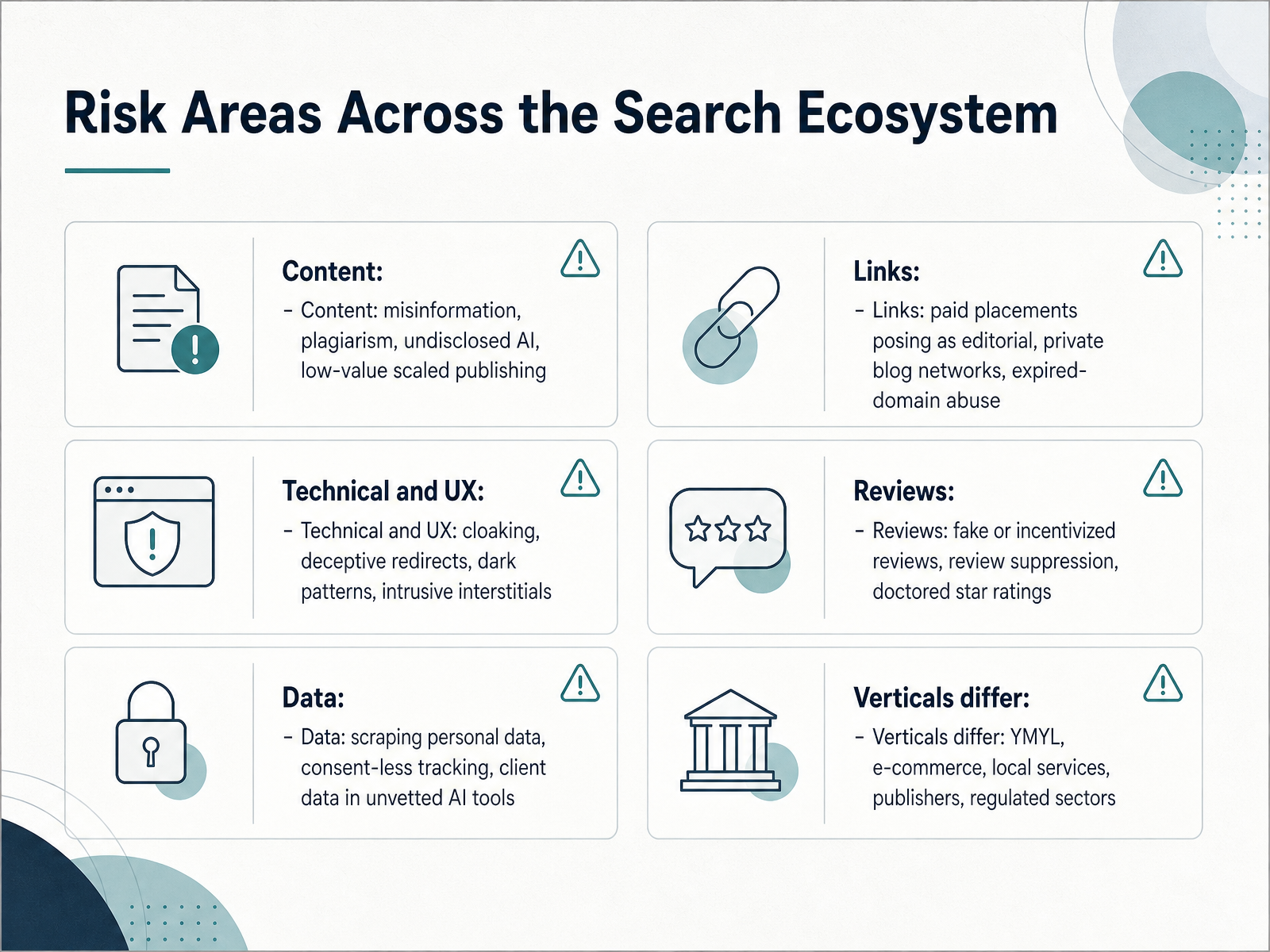
 - 03Risk Areas Across the Search EcosystemLet's map the risk areas across the search ecosystem, because ethics here is rarely one big decision. It's a series of small tradeoffs.
Start with content: misinformation, plagiarism, undisclosed AI, and low-value publishing at scale. Google's scaled content abuse policy targets pages built mainly to manipulate rankings, no matter how they were created. Intent and value matter more than the tool.
Links are next. Paid placements posing as editorial, private blog networks, and expired-domain abuse. Those arrangements transfer ranking risk to your client's domain.
Then technical and UX: cloaking, deceptive redirects, dark patterns, and intrusive interstitials. Regulators treat manipulative design as a consumer protection issue, not just a design choice.
Reviews carry real exposure. Fake or incentivized reviews, suppression, doctored ratings. Under the FTC's Consumer Review Rule, penalties can reach fifty-three thousand dollars per violation, and a single campaign can generate hundreds.
Data risks: scraping personal data, consent-less tracking, and client data pasted into unvetted AI tools.
Finally, verticals differ. YMYL, e-commerce, local services, publishers, and regulated sectors each carry different scrutiny. Match your controls to the stakes.
What Search Engines Actually Target in 2026.
 jdsupra.comftc.govkjk.com+22 min
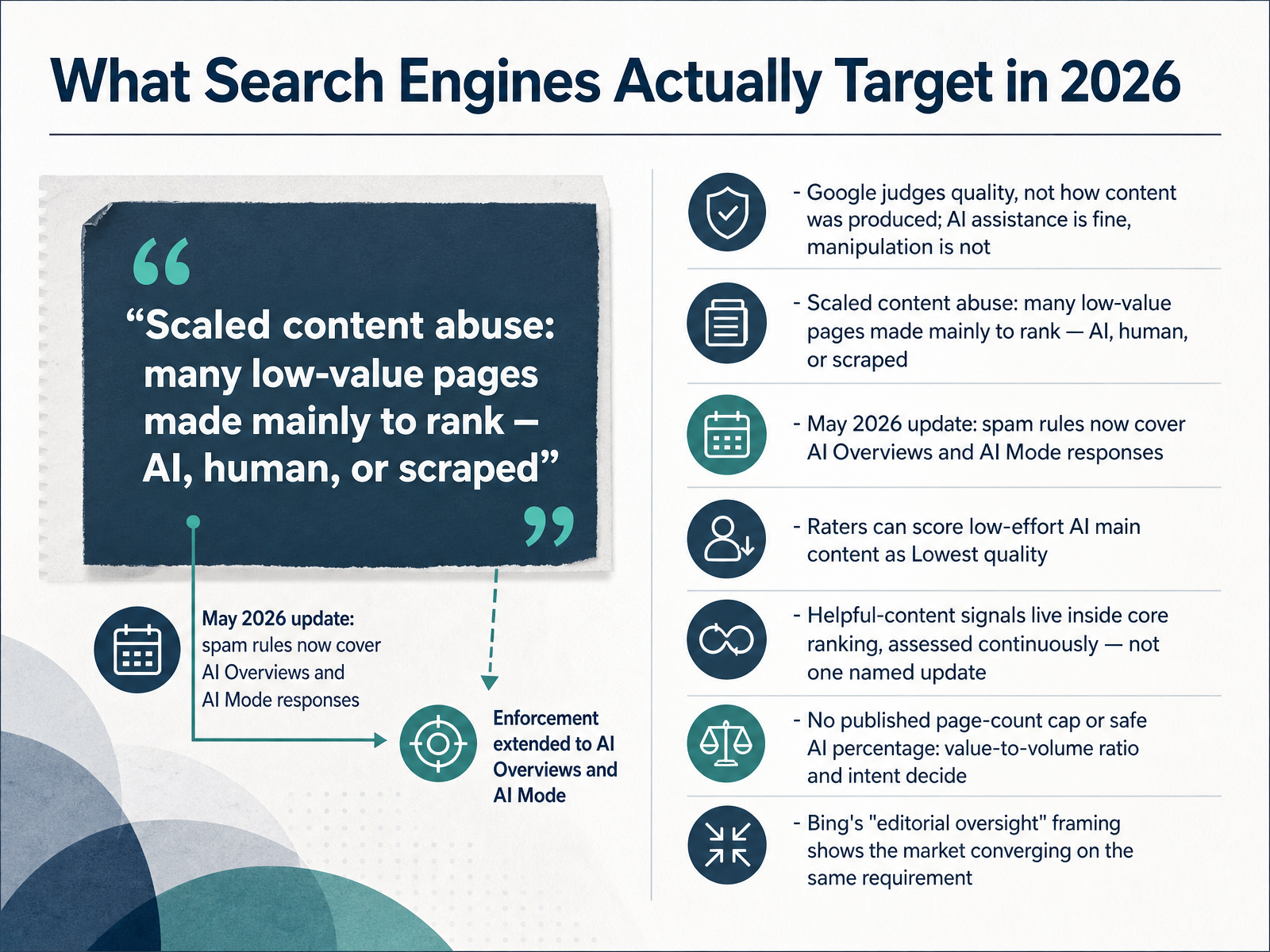
 - 04What Search Engines Actually Target in 2026Let's look at what search engines actually target now. Google judges quality, not how content was produced. AI assistance is fine. Manipulation is not. The clearest violation is scaled content abuse. That means many low value pages made mainly to rank. It applies whether the pages are AI generated, human written, or scraped. As of May 2026, the spam rules also cover AI Overviews and AI Mode responses. So a site can lose both its rankings and its chance to be cited in an AI answer from the same violation. Raters can now score low effort AI main content as Lowest quality. Note that helpful content signals live inside core ranking and are assessed continuously, not through one named update. There is no published page count cap and no safe AI percentage. What decides is the value to volume ratio and the intent behind each page. Bing's editorial oversight framing shows the market converging on the same requirement. So the practical takeaway is simple. Give every page a real reason to exist, and keep a human accountable for what ships. Next, we'll cover ethics in AI assisted content, and the operating rules that make this workable day to day.
 developers.google.cndevelopers.google.cndevelopers.google.com+22 min
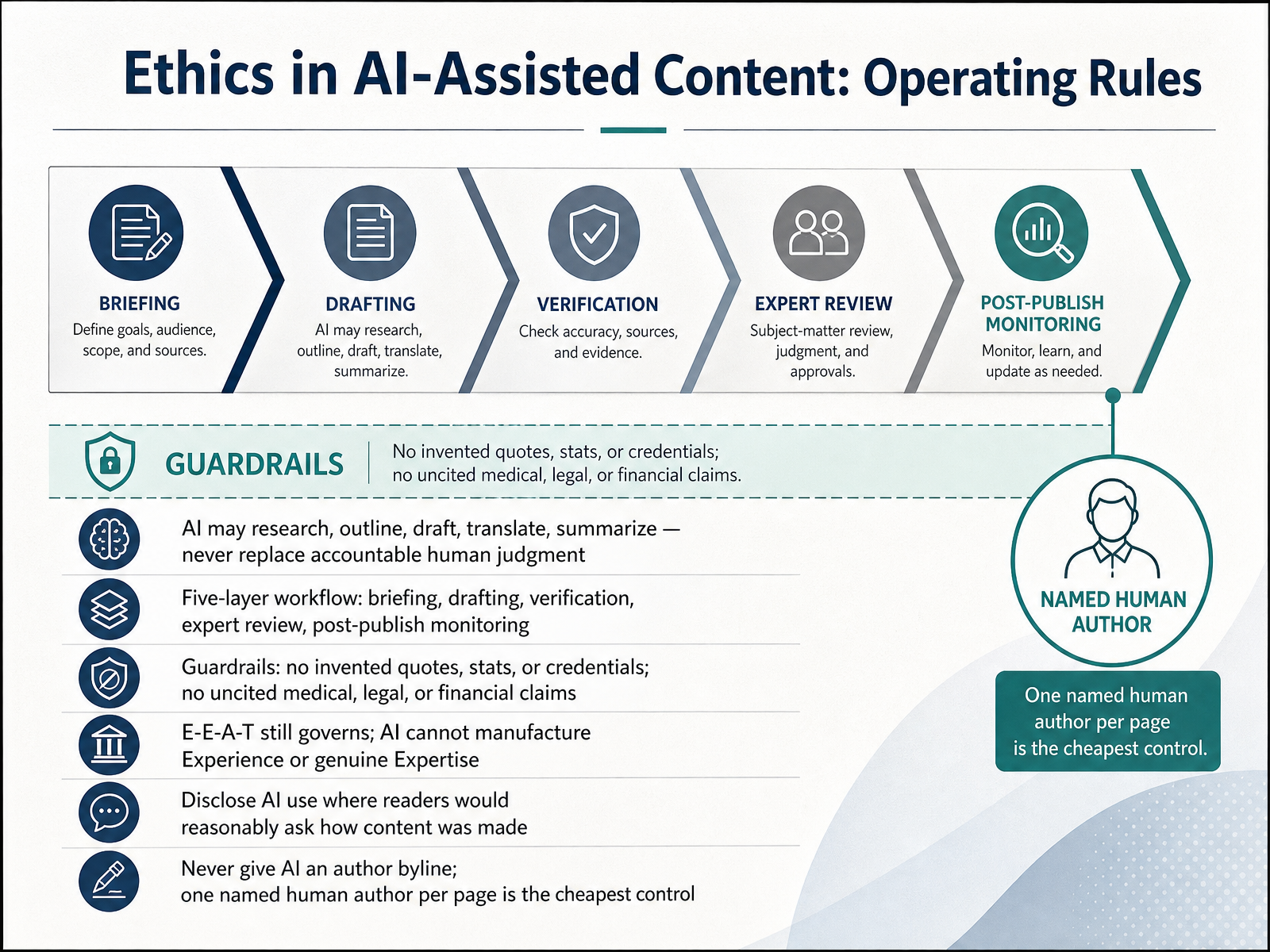
 - 05Ethics in AI-Assisted Content: Operating RulesNow let's set operating rules for AI-assisted content. The core principle: AI can research, outline, draft, translate, and summarize, but it never replaces accountable human judgment. Run a five-layer workflow: briefing, drafting, verification, expert review, and post-publish monitoring. Set guardrails too. No invented quotes, statistics, or credentials, and no uncited medical, legal, or financial claims. E-E-A-T still governs, and AI cannot manufacture real Experience or genuine Expertise. Disclose AI use where readers would reasonably ask how the content was made. And never give AI an author byline. One named human author per page is the cheapest control you have. If a page fails any line here, fix it before you publish. Next, we will look at transparency, disclosure, and user trust.
 developers.google.cndevelopers.google.cndevelopers.google.com+21 min
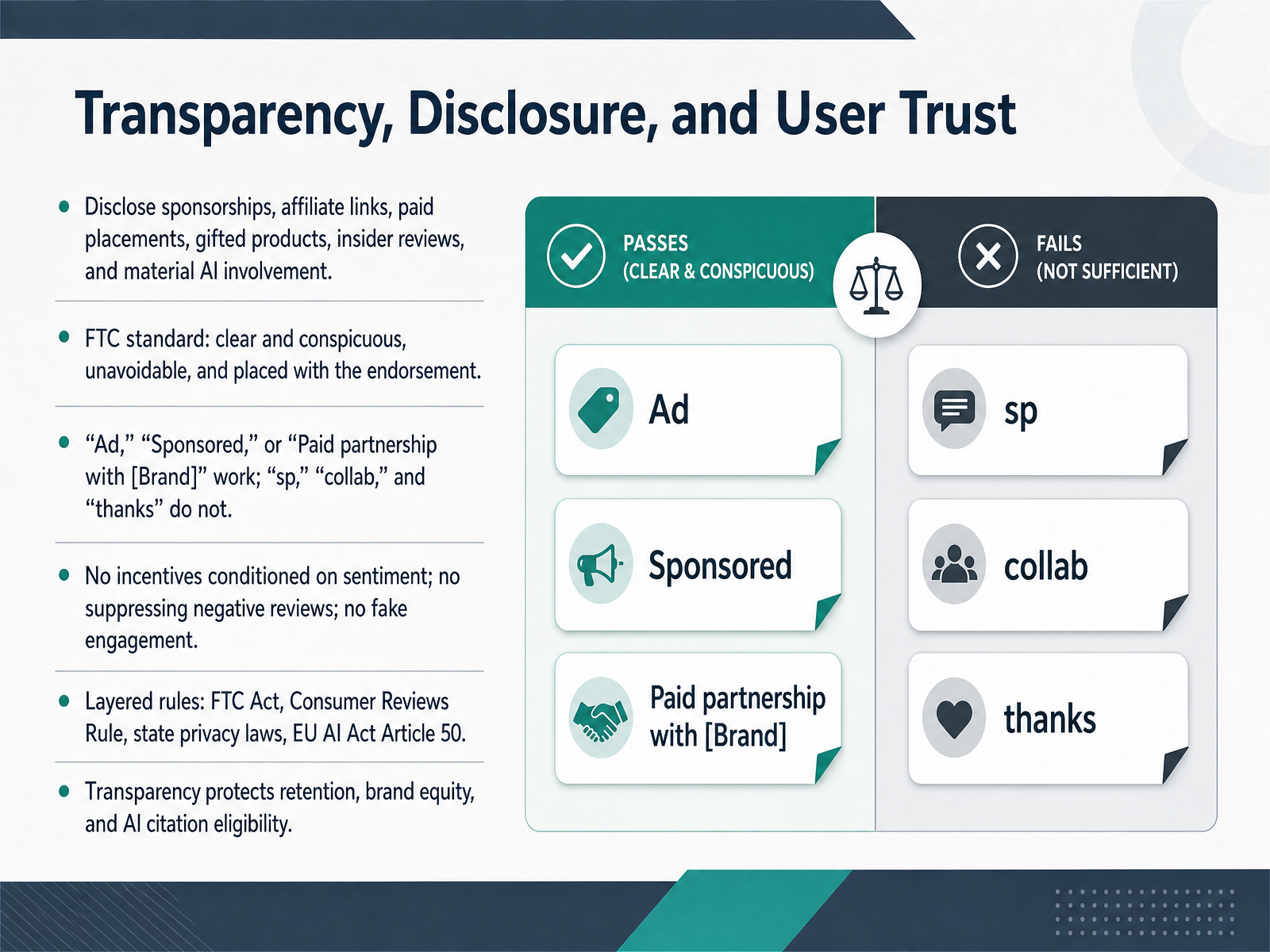
 - 06Transparency, Disclosure, and User TrustLet's move on to transparency, disclosure, and user trust. Under the F T C Endorsement Guides, any material connection must be disclosed clearly and conspicuously. That means it's hard to miss, easy to understand, and placed with the endorsement itself, not buried on a profile page or behind a More link. Sponsorships, affiliate links, paid placements, gifted products, insider reviews, and material AI involvement all count. Say "Ad," "Sponsored," or "Paid partnership with the brand." Avoid "sp," "collab," and vague thanks. You also can't condition an incentive on sentiment, suppress negative reviews, or buy fake engagement. These rules layer together: the F T C Act, the Consumer Reviews Rule, state privacy laws, and E U AI Act Article Fifty. Transparency protects retention, brand equity, and your eligibility for AI citation. Up next, review checklists and pre-publication guardrails.
 jdsupra.comftc.govkjk.com+22 min
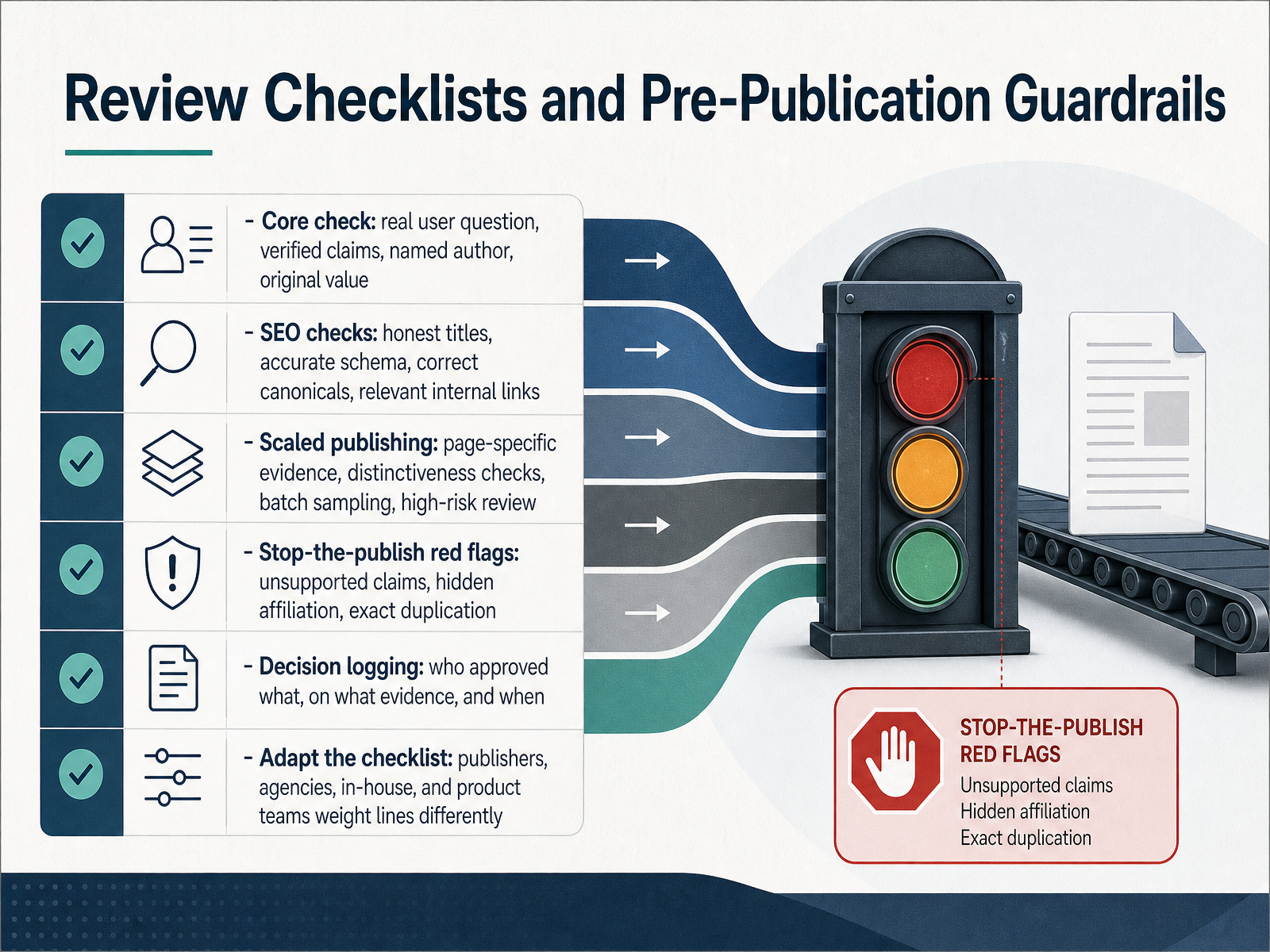
 - 07Review Checklists and Pre-Publication GuardrailsNow let's look at the guardrails that keep publishing decisions defensible. Start with four core checks: does the page answer a real user question, are the claims verified, is there a named author, and does it add original value. Then the SEO layer: honest titles, accurate schema, correct canonicals, and relevant internal links. At scale, the standard doesn't change. Each page still needs page-specific evidence. Run distinctiveness checks, sample every batch, and review all high-risk rows in full. Then set stop-the-publish red flags. Unsupported claims, hidden affiliations, exact duplication. If any of those appear, the page doesn't ship. Log every decision: who approved what, on what evidence, and when. Finally, adapt the checklist to your context. Publishers weight editorial review heavily. Agencies add client sign-off. In-house teams and product teams weigh technical accuracy and risk differently. The checklist is a guardrail, not a formality. Next, we'll look at governance, roles, and vendor accountability.
 developers.google.cndevelopers.google.cndevelopers.google.com+22 min
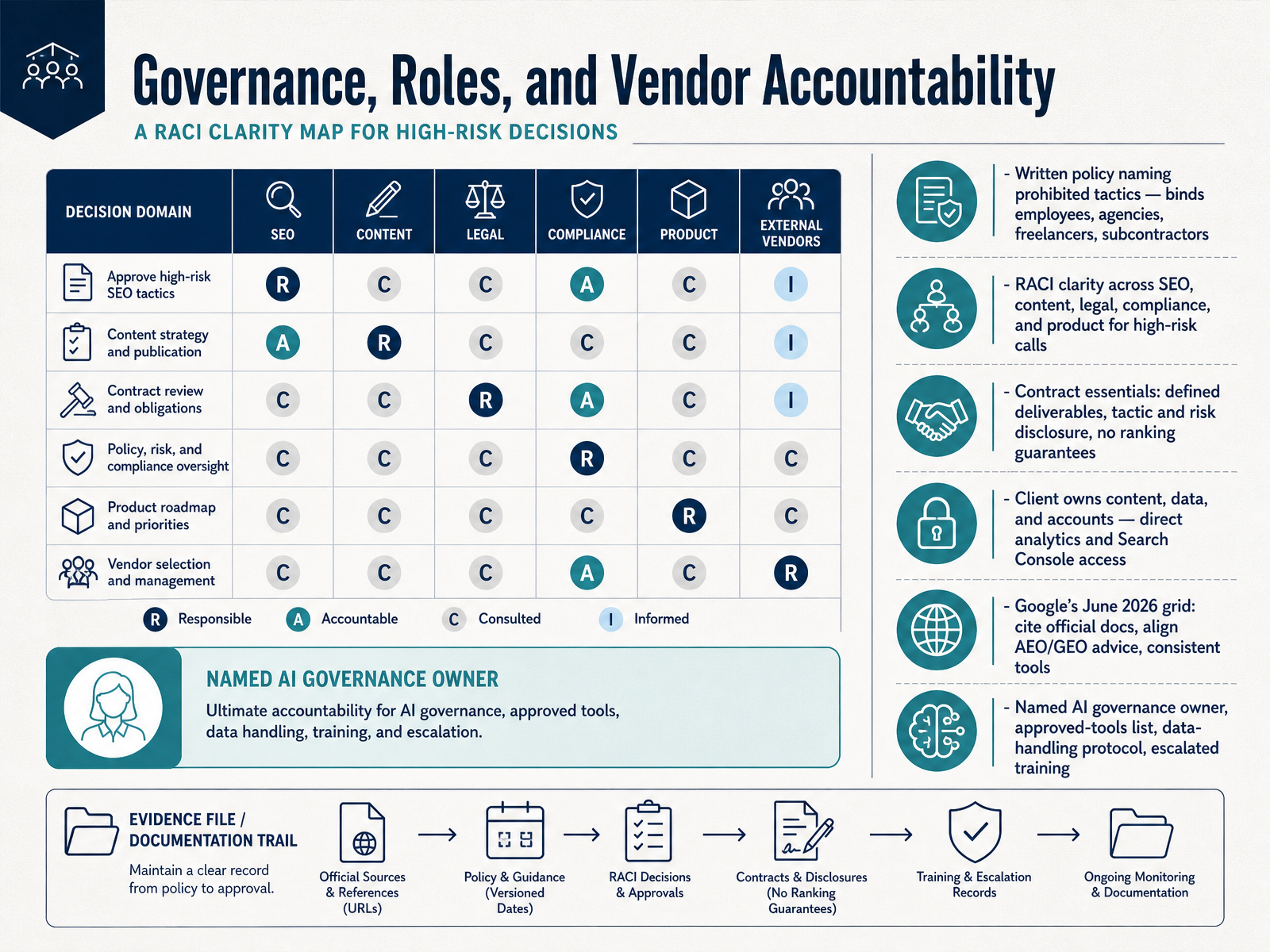
 - 08Governance, Roles, and Vendor AccountabilityLet's look at governance, roles, and vendor accountability. Ethics only holds up when it's written down and assigned. Start with a written policy naming prohibited tactics. That document binds employees, agencies, freelancers, and subcontractors, so a contractor under deadline pressure has no discretion to improvise. Next, use R A C I clarity across S E O, content, legal, compliance, and product for high-risk calls, so everyone knows who is responsible and who is consulted. Contracts carry four essentials: defined deliverables, full tactic and risk disclosure, no ranking guarantees, and client ownership of content, data, and accounts. That means direct analytics and Search Console access, not curated PDFs. Then follow Google's June twenty twenty-six evaluation grid. Cite official documentation, keep A E O and G E O advice aligned with Google's published guidance, and use consistent tools. Finally, name an A I governance owner, maintain an approved-tools list, define a data-handling protocol for client information, and escalate training when tools or regulations change. The takeaway is simple: documented roles turn good intentions into repeatable practice. Next, we move into measurement, monitoring, and early warning signals.
 authorityspecialist.comonyxrank.comaamax.co+22 min
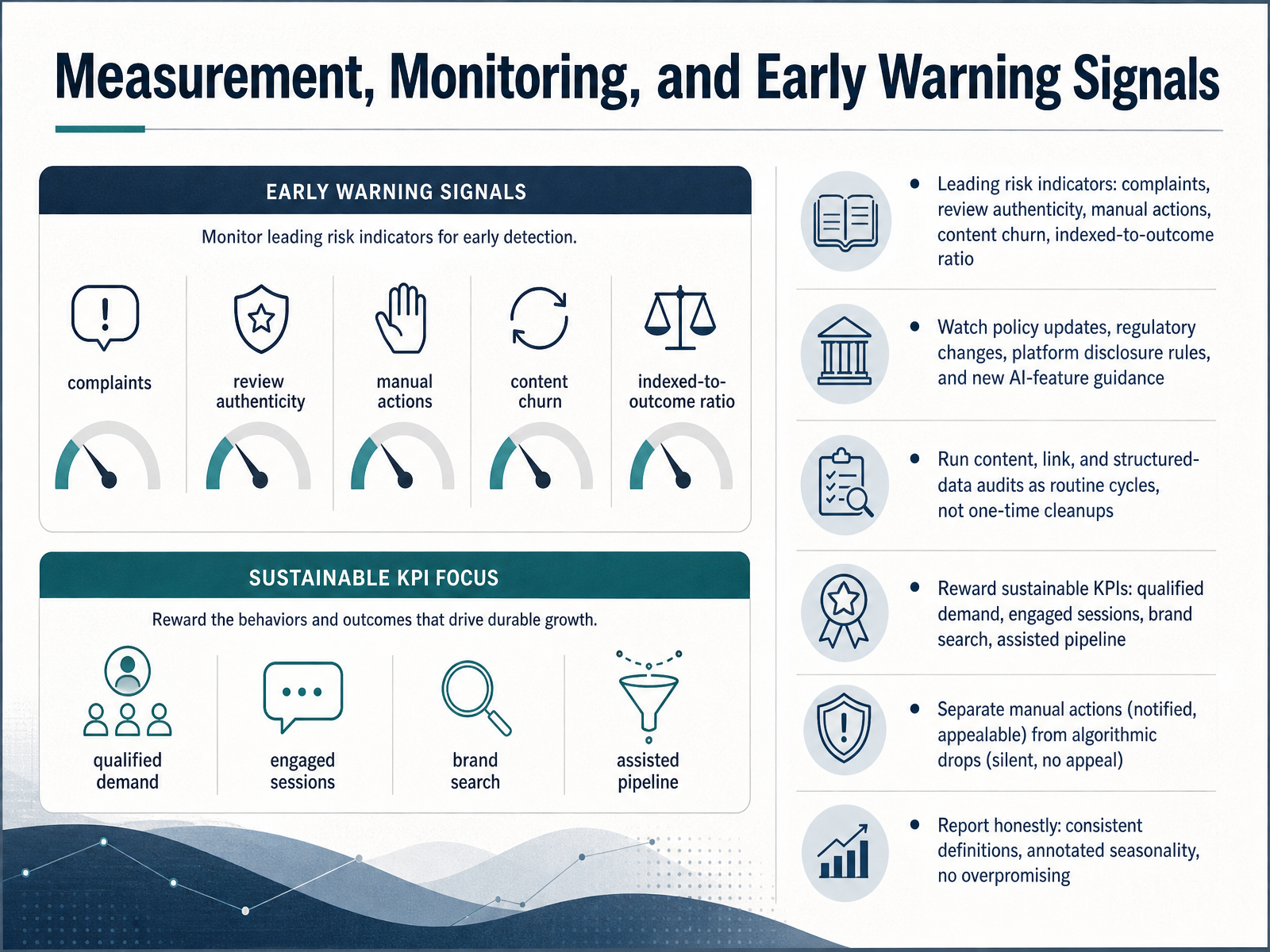
 - 09Measurement, Monitoring, and Early Warning SignalsNow let's talk about measurement and early warning signals. Ethics here means catching problems before they become penalties. Watch the leading indicators: complaint volume, review authenticity, manual actions in Search Console, content churn, and your indexed to outcome ratio, meaning pages indexed compared with pages producing real engagement. Keep a steady watch on policy updates, regulatory changes, platform disclosure rules, and new guidance for AI features. Run content, link, and structured data audits as routine cycles, not one time cleanups. So a quarterly backlink review, not a scramble after a traffic drop. Reward sustainable KPIs: qualified demand, engaged sessions, brand search, and assisted pipeline. Then separate the two failure types clearly. A manual action is notified and appealable. An algorithmic drop is silent, with no appeal, so recovery depends on signal improvement over time. Confusing them wastes quarters. Finally, report honestly. Use consistent definitions, annotate seasonality, and avoid overpromising. Next, we move into the remediation playbook: pause, correct, disclose, document.
 reportcard.comauthorityspecialist.comonyxrank.com+22 min
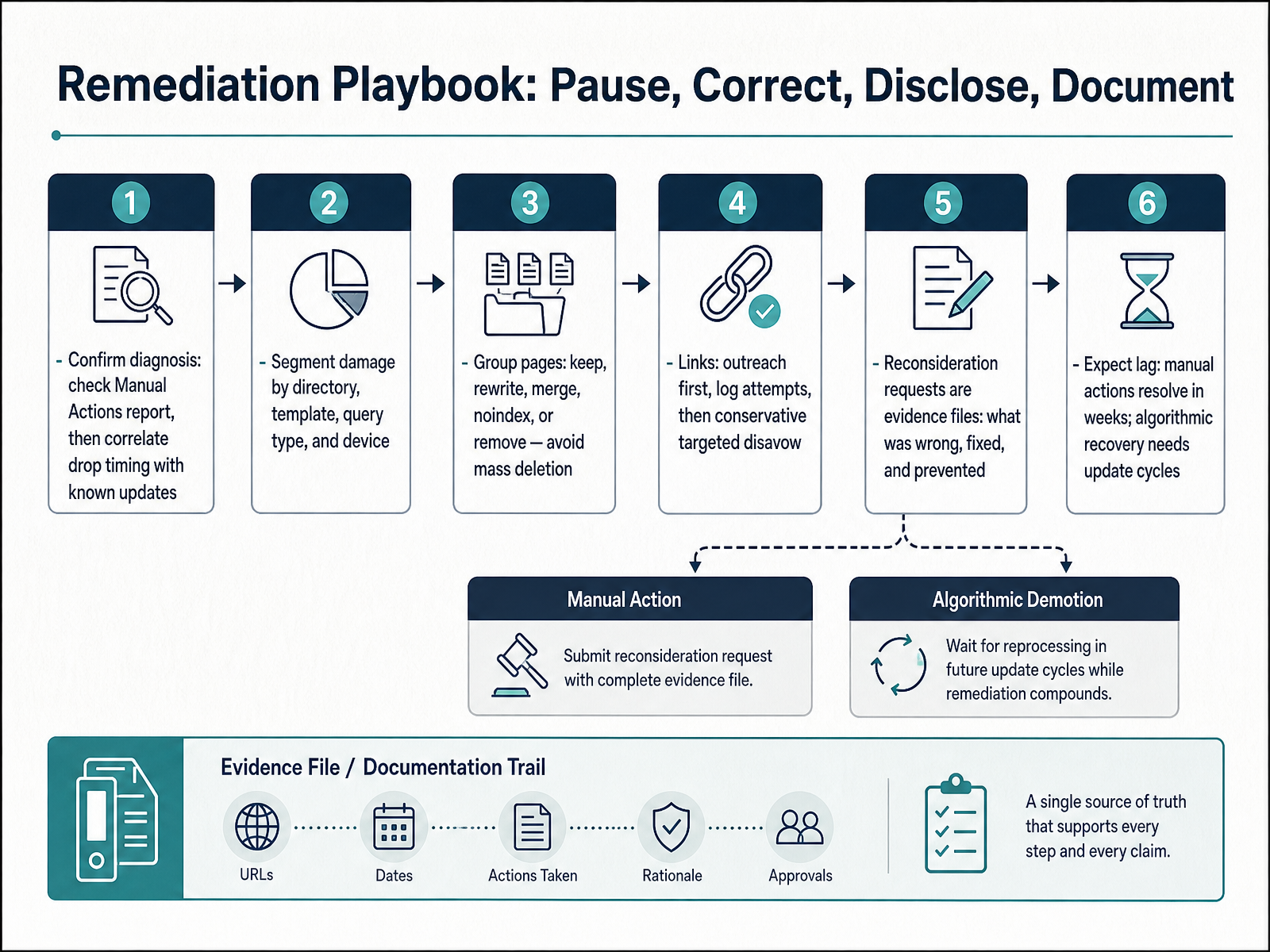
 - 10Remediation Playbook: Pause, Correct, Disclose, DocumentLet's walk through the remediation playbook, four moves you can run in order. Pause, correct, disclose, document. First, pause. Confirm the diagnosis before you touch anything. Check the Manual Actions report in Search Console, then correlate the drop timing with known updates. A manual action names the violation. An algorithmic drop does not. Next, correct, and segment before you cut. Break the damage down by directory, template, query type, and device. Then group pages into keep, rewrite, merge, noindex, or remove. Avoid mass deletion. It strips equity you will want later. For links, do outreach first, log every attempt, then disavow conservatively and targeted. Over-disavowing weakens legitimate authority. Disclose and document in one step. A reconsideration request is an evidence file: what was wrong, what you fixed, and what prevents recurrence. Specific numbers and outreach logs get approved. Finally, expect lag. Manual actions resolve in weeks. Algorithmic recovery needs update cycles, so plan in months, not days. Let's apply this next in scenario practice, agency and client dilemmas.
 reportcard.comauthorityspecialist.comonyxrank.com+22 min
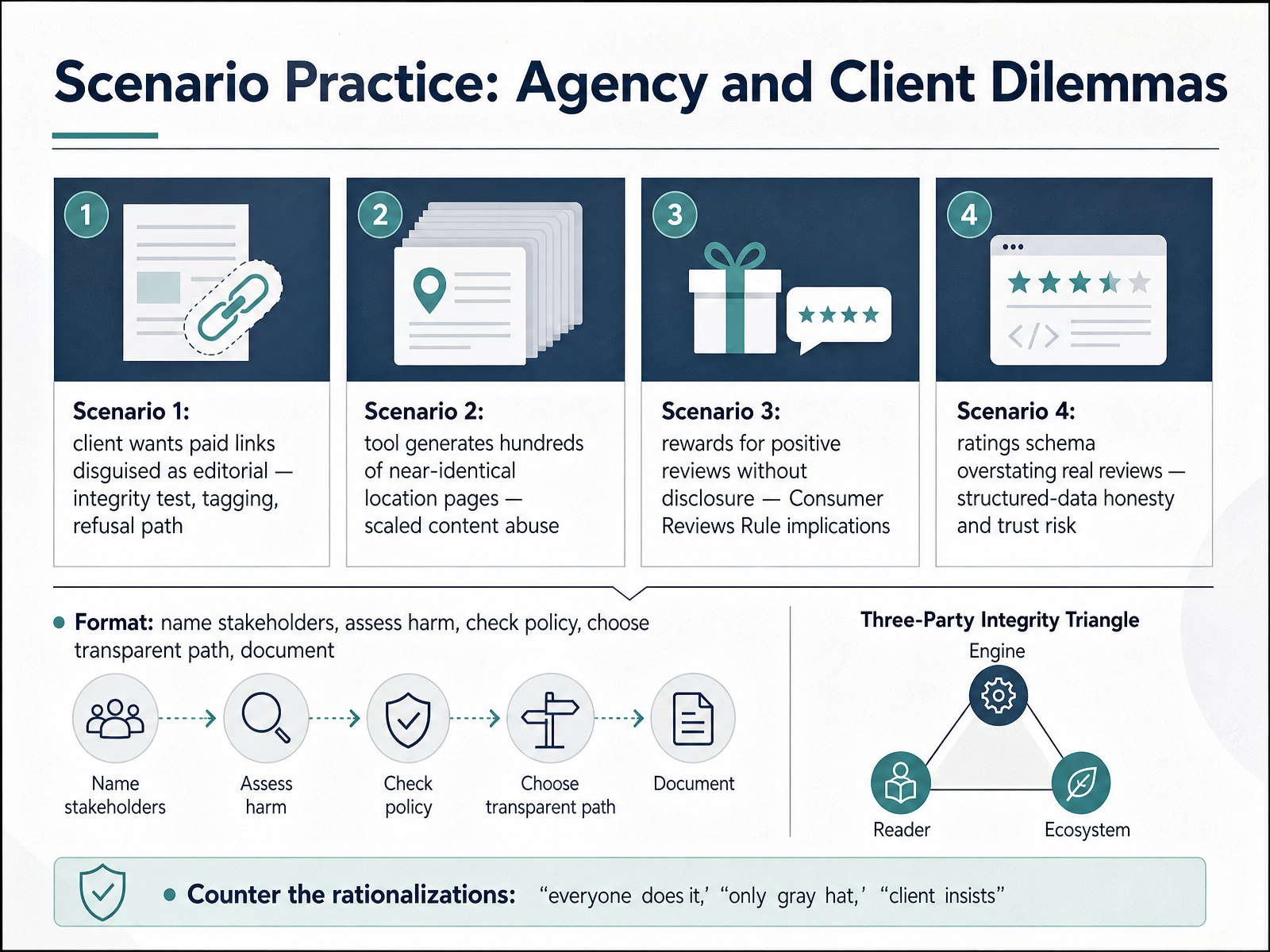
 - 11Scenario Practice: Agency and Client DilemmasLet's move into scenario practice. These are agency and client dilemmas you may have already faced. Scenario one. A client wants paid links disguised as editorial. Run the integrity test. Would a reader be misled if they knew the arrangement? If yes, that is a link scheme. Tag the placement honestly, or refuse and document the refusal path. Scenario two. A tool generates hundreds of near-identical location pages. That is scaled content abuse, regardless of whether AI or a human wrote them. The policy is purpose and value, not method. Scenario three. You reward customers for positive reviews without disclosure. That can trigger the Consumer Reviews Rule from the Federal Trade Commission, with civil penalties per violation. Scenario four. Your ratings schema overstates real reviews. Structured data must reflect genuine reviews. Otherwise you risk manual actions and lost trust. For each scenario, use one format. Name the stakeholders. Assess the harm. Check the policy. Choose the transparent path. Document the decision. Then counter the rationalizations. Everyone does it, it is only gray hat, the client insists. None of those change the policy or the consequence. Document your reasoning, so the choice is defensible later. Next, we look at scenario practice for AI content, disclosure, and product teams.
 jdsupra.comftc.govkjk.com+22 min
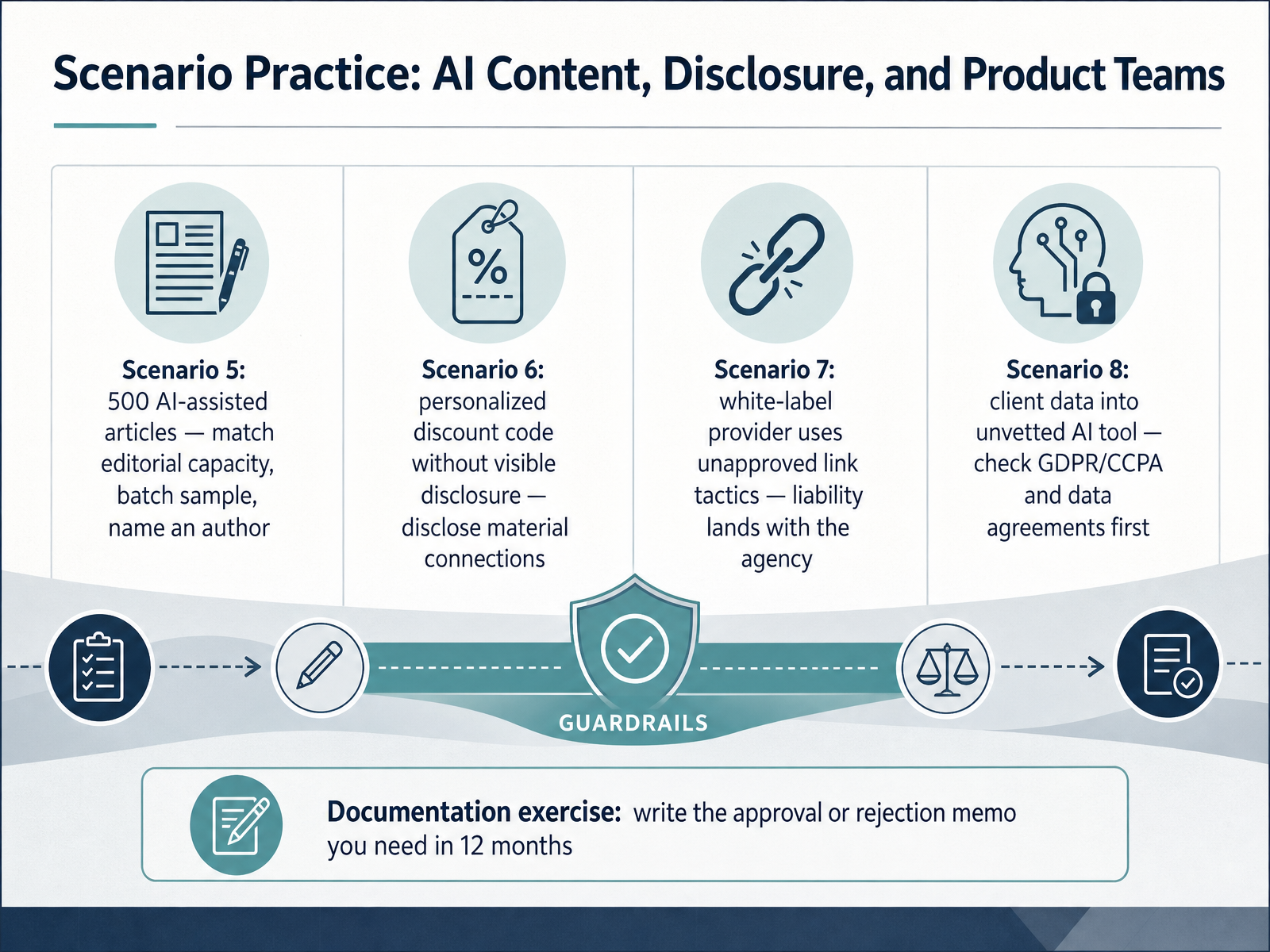
 - 12Scenario Practice: AI Content, Disclosure, and Product TeamsLet's put the guidance into practice with four short scenarios.
Scenario five: a team wants five hundred AI-assisted articles. The ethical path matches output to real editorial capacity, batches a sample for human review, and names a real author who takes responsibility. Five hundred articles with no reviewer is scaled content abuse under Google's spam policy, and in the quality rater guidelines, low-effort main content can earn a lowest rating.
Scenario six: an influencer shares a personalized discount code with no visible disclosure. The Federal Trade Commission treats codes tied to compensation as material connections, and personal relationships, payment, or free product all require clear and conspicuous disclosure. If a significant minority of viewers would not expect the connection, disclose it.
Scenario seven: a white-label provider uses unapproved link tactics. The liability lands with the agency. You hold the client relationship, so vet the provider, contract for compliance, and require reporting with live link URLs.
Scenario eight: client data goes into an unvetted AI tool. Check GDPR and CCPA obligations and confirm a data processing agreement before anyone pastes client material into a third-party model.
For the documentation exercise, write the approval or rejection memo you would need in twelve months. That memo should state the decision, the reasoning, the review steps, and who owns the risk. Next, we'll pull this into an action plan and takeaways.
 developers.google.cndevelopers.google.cndevelopers.google.com+22 min
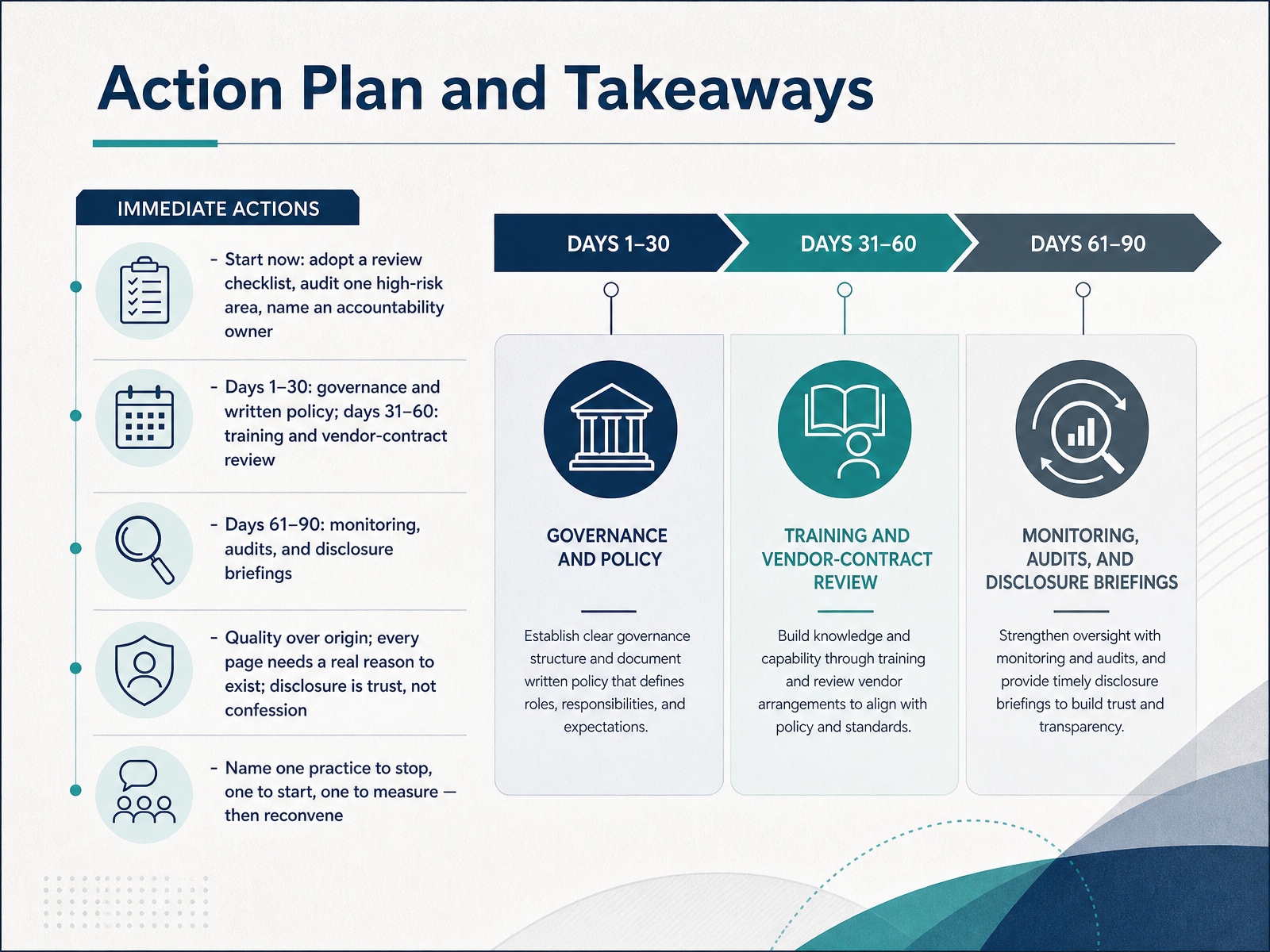
 - 13Action Plan and TakeawaysLet's close with the action plan. Start now, not next quarter. Adopt a review checklist, audit one high-risk area, and name a single accountability owner for ethics and disclosure in your search program. One name, not a committee. Days one to thirty, build governance and a written policy. Days thirty-one to sixty, train your team and review vendor contracts. Days sixty-one to ninety, move into monitoring, audits, and disclosure briefings. Keep the core principles in view. Quality over origin. Every page needs a real reason to exist. And disclosure is trust, not confession. You can practise this in one meeting. Name one practice to stop, one to start, and one to measure. Then reconvene and hold that line. That's the course. Thank you for your attention, and go make your search program one you can defend.
 developers.google.cndevelopers.google.cndevelopers.google.com+22 min
Take the deck with you
Download this course as a file — free, no sign-up needed.
- PDF handoutEvery slide page, ready to print or share.14 pages · 4.0 MBDownload
- Narrated PowerPointThe deck that presents itself — every slide carries the digital human's narration video.14 pages · 27.4 MBDownload
- PowerPoint slidesThe full deck as a .pptx — open it in PowerPoint, Keynote, or Google Slides.14 pages · 4.0 MBDownload
Free to use in your own training — please keep the PersonWise credit page at the end.
Have your own deck? Turn it into a course
Sources consulted
Web sources consulted while building this course.
- Google Search's Guidance on Generative AI Content on Your Website | Google Search Central | Documentation | Google for Developers — developers.google.cn
- A new resource for optimizing for generative AI in Google Search | Google Search Central Blog | Google for Developers — developers.google.cn
- Google Search's guidance about AI-generated content — developers.google.com
- Google's AI Content Guidelines Explained (2026) — layer3labs.io
- Google quality raters now assess whether content is AI-generated — searchengineland.com
- SEO Code of Ethics: Beyond White Hat in Regulated Verticals — authorityspecialist.com
- Ethical SEO: White-Hat Tactics That Work in 2026 — gatilab.com
- How Businesses Can Ensure Ethical SEO Practices | AAMAX — aamax.co
- The Ultimate SEO Checklist 2026: Balancing AI Visibility with Ethical Integrity | The Ethical Agency — ethical-agency.com
- SEO Ethics in 2026: Why Honest Tactics Still Win — motifo.com
- FTC’s 2026 Enforcement Approach To Fake Reviews Takes Shape: Takeaways For Companies | DLA Piper - JDSupra — jdsupra.com
- The Consumer Reviews and Testimonials Rule: Questions and Answers | Federal Trade Commission — ftc.gov
- FTC Consumer Review Rule Enforcement: What Businesses Need to Know - KJK | Kohrman Jackson Krantz — kjk.com
- Five Stars, Zero Tolerance: FTC Turns Up Enforcement Under Consumer Review Rule | Benesch, Friedlander, Coplan & Aronoff LLP — beneschlaw.com
- Dark patterns lead to enforcement spotlight: Key compliance… — reedsmith.com
- The SEO Agency Contract Clauses That Actually Determine Whether You Get Results in 2026 — OnyxRank — onyxrank.com
- How Agencies Ensure Ethical SEO Practices | AAMAX — aamax.co
- SEO Contract Template: What to Include (2026 Guide) — thestacc.com
- SEO Agency Legal Responsibility for Google Penalties | CopilotPost — copilotpost.ai
- Google Penalty Recovery in 2026: Step-by-Step Guide to Restoring Rankings | Report Card — reportcard.com