Begin
14 pages · ~28 min
Python Programming Roadmap
This roadmap guides aspiring Python developers through key priorities and milestones, with communication strategies to track progress and achieve programming goals.
A digital instructor presents all 14 pages. Hold “Ask” at any point and ask out loud — the answer comes from this course. No sign-up needed.
What you’ll learn
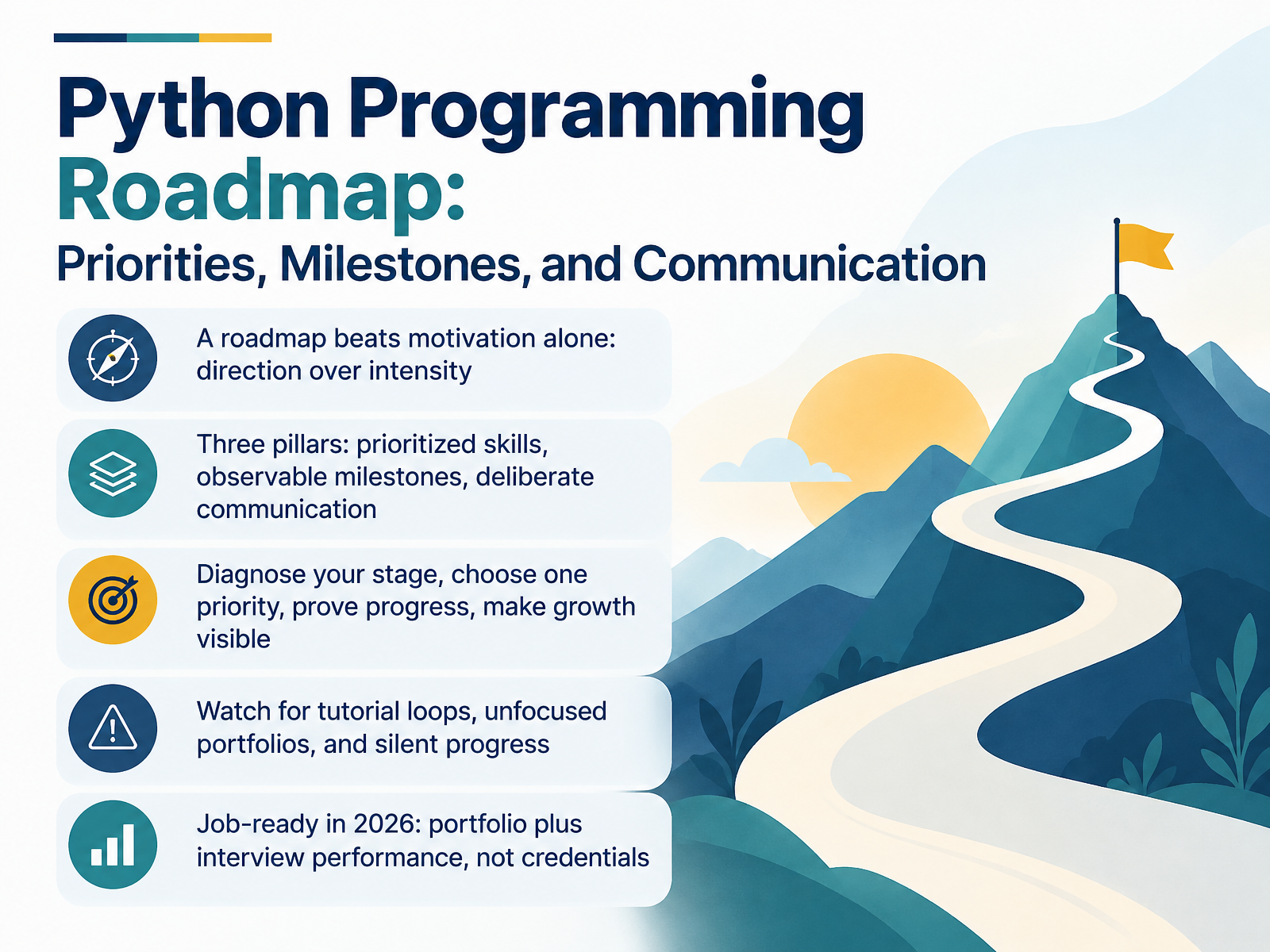
- 01Python Programming Roadmap: Priorities, Milestones, and CommunicationWelcome. I am glad you are here. Over the next several slides, we will work through a Python programming roadmap built around three things: priorities, milestones, and communication.
Here is the core idea on this first slide. A roadmap beats motivation alone. Motivation is intensity, and intensity fades. Direction is what carries you through a busy month, a full teaching load, or a demanding sprint at work. So our three pillars are prioritized skills, observable milestones, and deliberate communication.
In practice, that means four moves. Diagnose your stage. Choose one priority. Prove progress with something you can show. Then make that growth visible to the people who matter, whether that is a hiring manager, a mentee, or your own team.
Two things to watch for. First, the tutorial loop: watching more without building anything. Second, silent progress: doing real work that nobody, including you, can see. For example, one shipped script with a clear README teaches and proves more than five unfinished courses.
And one honest note for twenty twenty six. Job readiness comes from a portfolio plus interview performance, not credentials. So pick one small thing this week: write down your current stage, and name the single skill you will finish next. That is the whole game.
Next, let us look at who this roadmap is for. We will cover audience contexts and starting points.learnpython.academytalos.toolsscaler.com+22 min
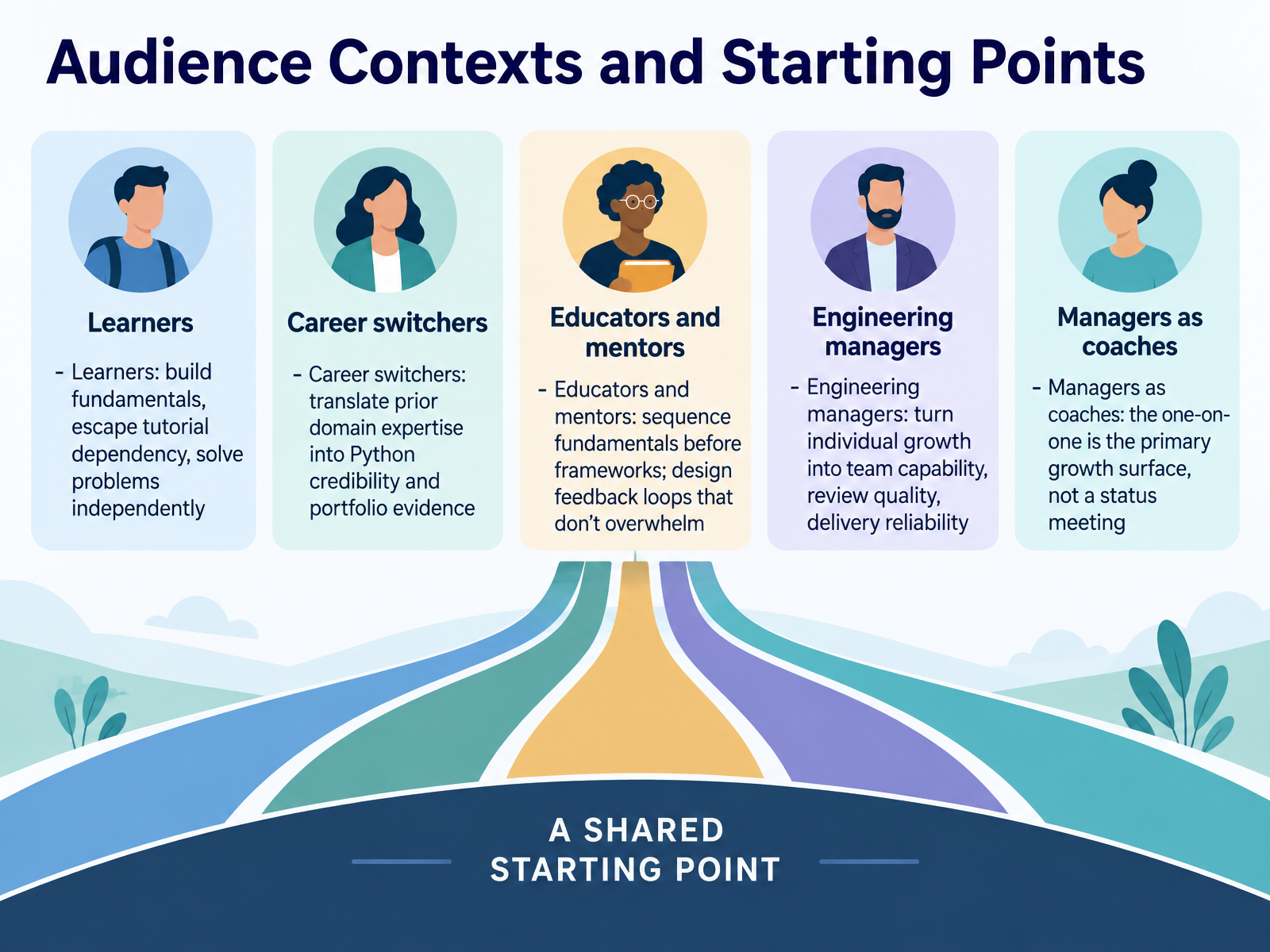
- 02Audience Contexts and Starting PointsLet's look at who is actually in this room, because your starting point shapes every decision that follows. First, learners. Your priority is fundamentals, and specifically escaping tutorial dependency. Concretely, close the tutorial and write a fifty-line script that solves a real problem, using strings, files, and exceptions. Next, career switchers. Your prior domain expertise is an asset, not a detour. A former accountant who builds a finance tracker and ships it to GitHub has translated that background into portfolio evidence, and that beats a generic to-do app. For educators and mentors: sequence fundamentals before frameworks, because learners who skip to FastAPI without comfort in functions and data structures stall later. Design feedback loops that do not overwhelm, for example one focused review per week rather than daily critique. Engineering managers, your job is turning individual growth into team capability, measured through review quality and delivery reliability. And if you manage as a coach, treat the one-on-one as your primary growth surface, not a status meeting. Ask what is getting in the way, then connect it to real upcoming work. So this week: identify which of these is you, and pick one concrete next action. That sets the stage for the next topic, the Priority Framework: What to Learn First and What to Defer.
 learnpython.academytalos.toolsscaler.com+22 min
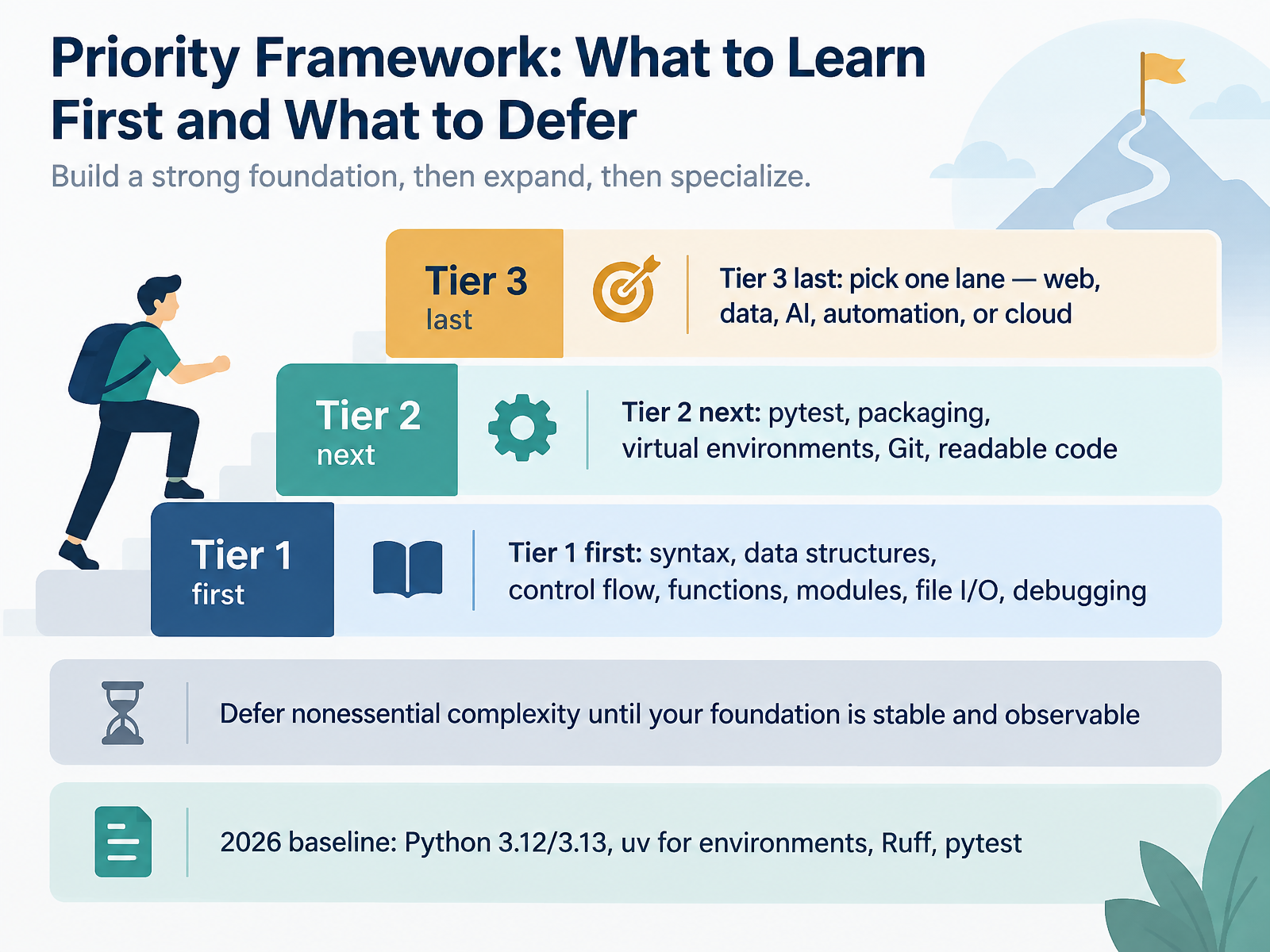
 - 03Priority Framework: What to Learn First and What to DeferLet's talk priorities. First, Tier 1 is your foundation: syntax, data structures, control flow, functions, modules, file input and output, and debugging. Do not rush this tier, because every later mistake traces back to a weak foundation. For example, if loops and dictionaries feel shaky, a simple file-processing script will fight you. Next, Tier 2 is professional practice: pytest for testing, packaging, virtual environments, Git, and readable code. These are the habits that separate people who can write Python from people who can ship it. By contrast, Tier 3 comes last. Pick one lane, web, data, AI, automation, or cloud, and finish it. Here is the tradeoff. Splitting across three lanes delays your first real project by months. So defer nonessential complexity until your foundation is stable and observable. A good signal is this: you can write a fifty-line script that solves a real problem without copying from a tutorial. For a twenty twenty-six baseline, use Python three point twelve or three point thirteen, uv for environments, Ruff for linting, and pytest for tests. Skip pip and venv unless a course forces them. This week, audit your current plan against these three tiers, and name the one lane you are choosing. Next, we go deeper into Core Python Fundamentals: The Phase Most People Rush.
 learnpython.academytalos.toolsscaler.com+22 min
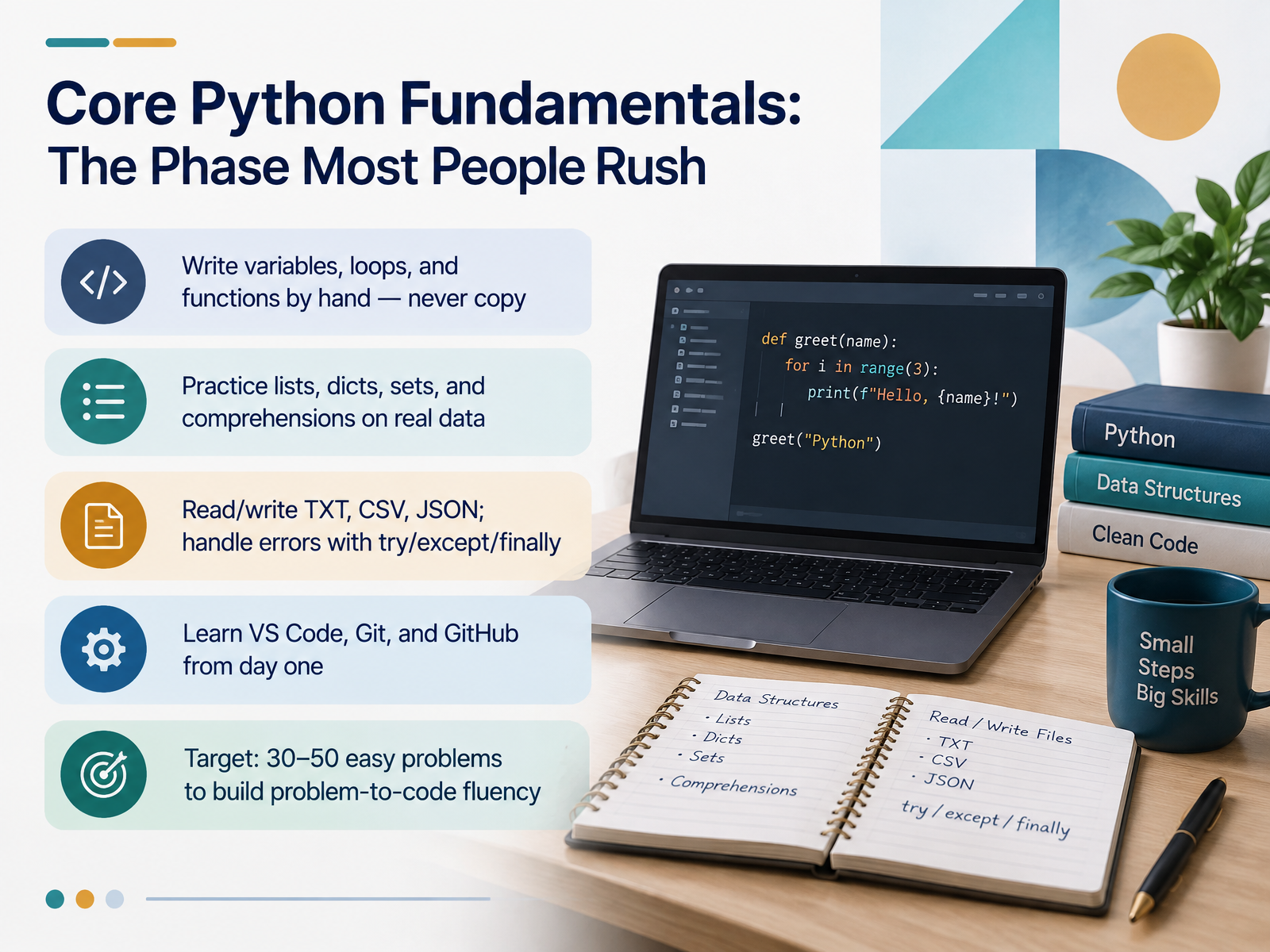
 - 04Core Python Fundamentals: The Phase Most People RushLet's talk about the phase most people rush. First, write variables, loops, and functions by hand. Copying code feels fast, but typing it yourself builds the mental muscle you need to solve problems without a tutorial open. Next, practice lists, dictionaries, sets, and comprehensions on real data, like a CSV of your own expenses. Comprehensions are a compact Python syntax for building a new collection from an existing one in a single line. Then, learn to read and write plain text, CSV, and JSON files, and handle errors with try, except, and finally. In practice, try runs the risky code, except catches the failure, and finally always runs cleanup. From day one, use VS Code, Git, and GitHub. Git tracks your code history, and GitHub hosts it publicly as your portfolio. Your target here is thirty to fifty easy problems. That is enough to build fluency from problem statement to working code. If you are a career switcher or teaching a team, treat these weeks as an investment, not a delay. Pick one small script this week and rewrite it from scratch tomorrow without looking.
 learnpython.academytalos.toolsscaler.com+22 min
 - 05Intermediate Python: Idioms, OOP, and Working with APIsLet's talk about the intermediate stage, where the plateau usually begins. At this point, you know the syntax, but the idioms aren't automatic yet. A list comprehension, for example, replaces a four-line loop with one readable line, and a context manager like "with open" guarantees your file closes even if an error interrupts your code. Generators matter for the same reason: when a file has a million rows, yielding one row at a time keeps memory flat instead of loading everything at once. Next, object-oriented programming. Classes, methods, and inheritance keep large programs manageable by grouping data and behavior, and letting subclasses reuse shared logic instead of copying it. Then there's the standard library that really matters. Collections gives you counters and default dictionaries, itertools handles combinations and lazy sequences, and pathlib makes file paths portable across operating systems. After that, consume real APIs with the requests library. You'll make HTTP calls, parse JSON, and then handle the parts tutorials skip: pagination, where results arrive page by page, and rate limits, which force you to slow down or back off. Finally, type hints. They aren't just decoration; they let tools catch mismatched arguments before runtime, make refactoring safer, and are effectively required by modern frameworks like FastAPI. For this week, pick one: convert a loop into a comprehension, or write one small script that calls a public API and handles a second page of results. That single exercise covers most of this slide. Next, we'll look at choosing a specialization lane in 2026.
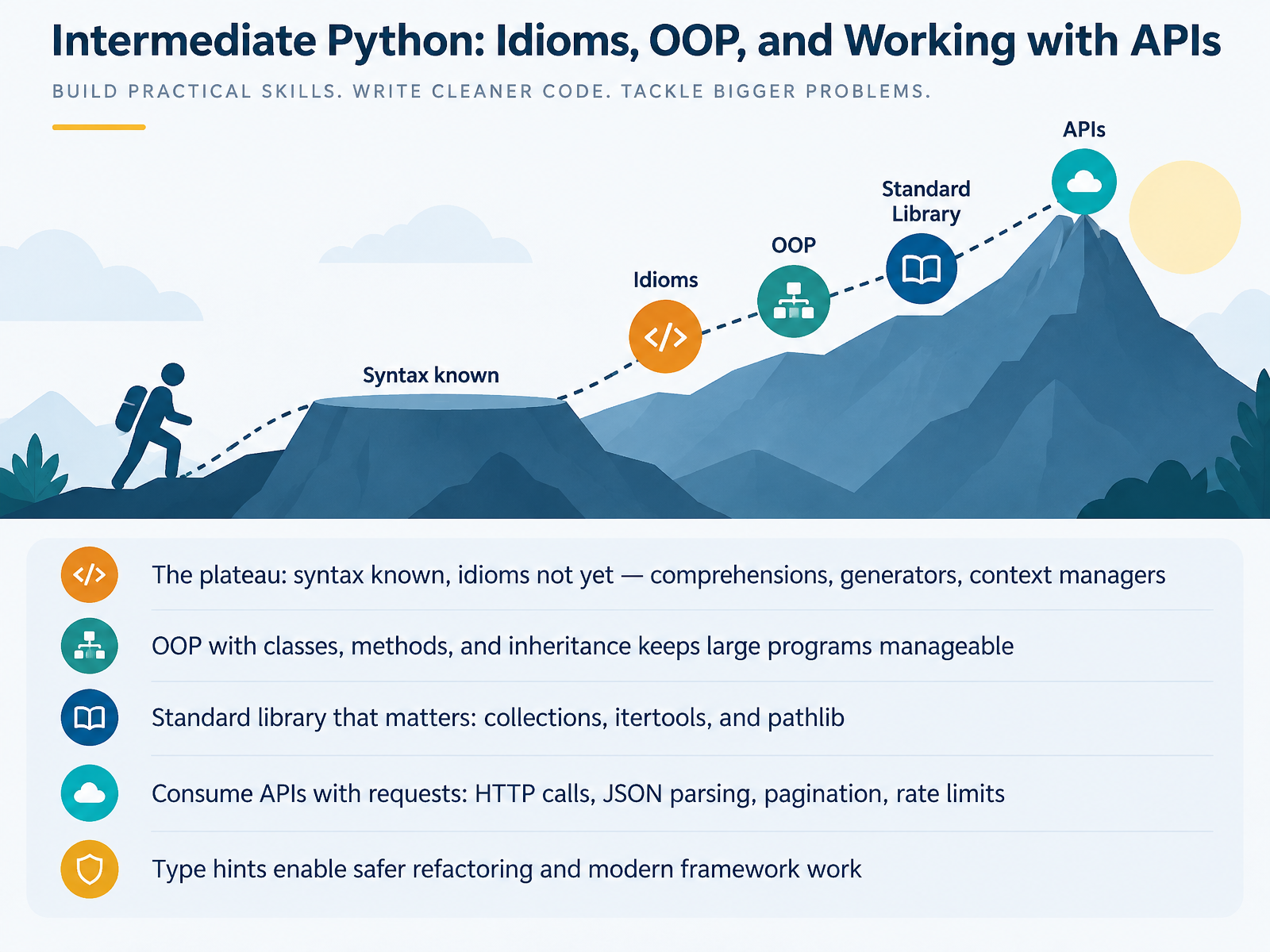 learnpython.academytalos.toolsscaler.com+22 min
 - 06Choosing a Specialization Lane in 2026Now let's talk about choosing a specialization lane. This is the fork in the road, so pick deliberately. First, backend and A P I work. FastAPI suits API-first services, Django fits full-stack apps where its built-in admin and O R M save weeks, and Flask works for small services. Next, data analysis. Start with NumPy and Pandas, since everything else builds on them, then add Matplotlib or Seaborn for charts, plus S Q L and Jupyter. Then, A I and large language model apps. LangChain is reasonable once async Python feels comfortable, and these roles often carry the top junior pay today. By contrast, automation and scripting offers the fastest entry and steady demand, but a lower mid-senior salary ceiling. The rule that matters: pick the work you actually want to do, not the stack blogs call complete. This week, name your lane, then ship one small project inside it. Next, we move into milestone design, from syntax to shipping.
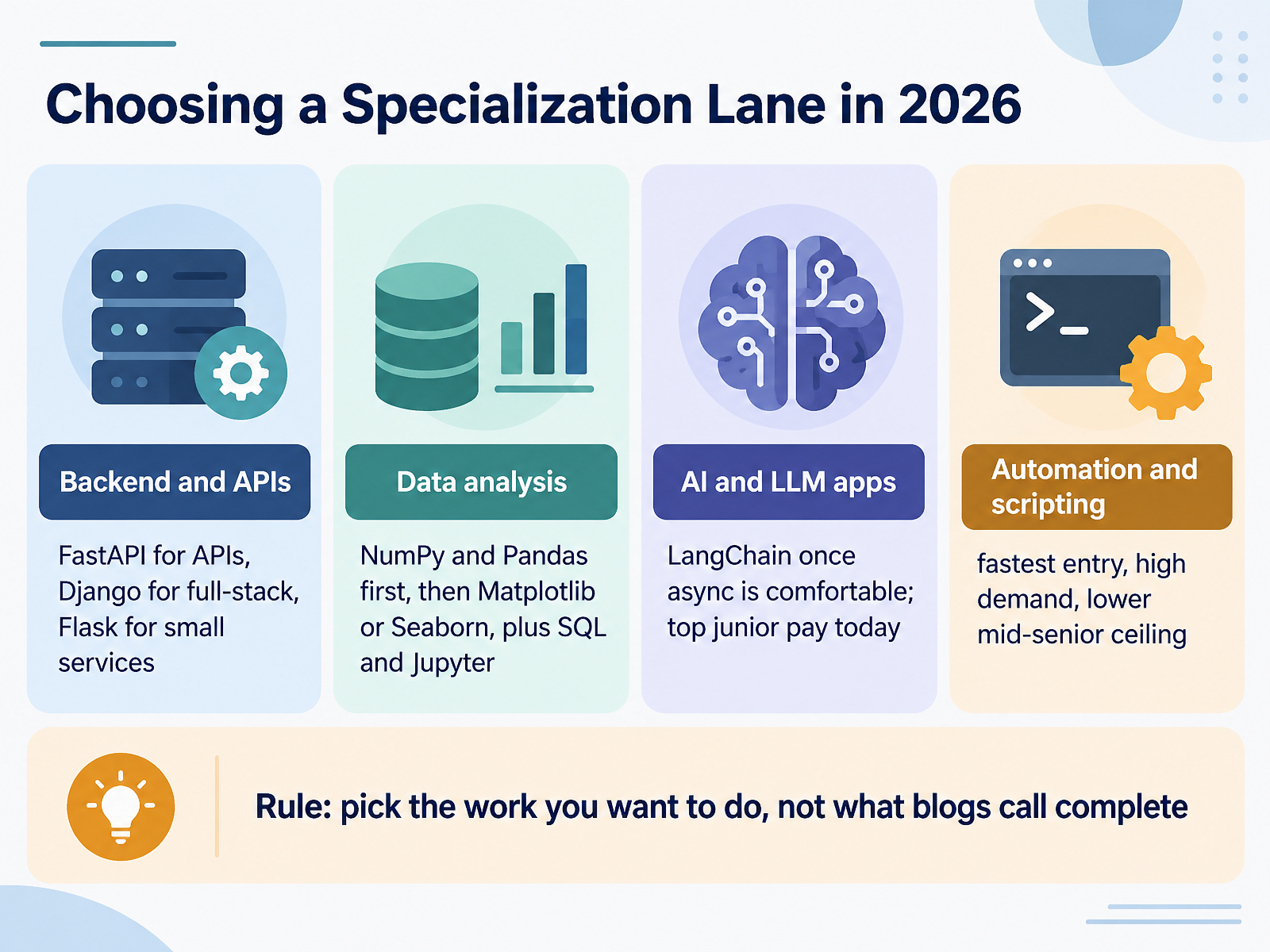 learnpython.academytalos.toolsscaler.com+22 min
 - 07Milestone Design: From Syntax to ShippingLet's move on to how you actually design milestones. First, milestone one: read, write, and debug small scripts with confidence. Concrete target here: a fifty-line script that solves a real problem, like a file cleaner. Next, milestone two: structure a multi-file project with modules, tests, and dependencies. This is where you learn that code organization matters more than clever one-liners. Then, milestone three: build and document a real tool, an API client, or a data workflow. Pick one lane, backend, data, or automation, and finish it. Finally, milestone four: ship, review, refactor, and explain your design tradeoffs out loud. Here is the part people resist. Evidence equals artifacts, not hours watched. A deployed project, passing tests, a clear README, and a short demo video. Those four things speak louder than any certificate. So this week, audit what you already have against these four artifacts, and fill the biggest gap first.
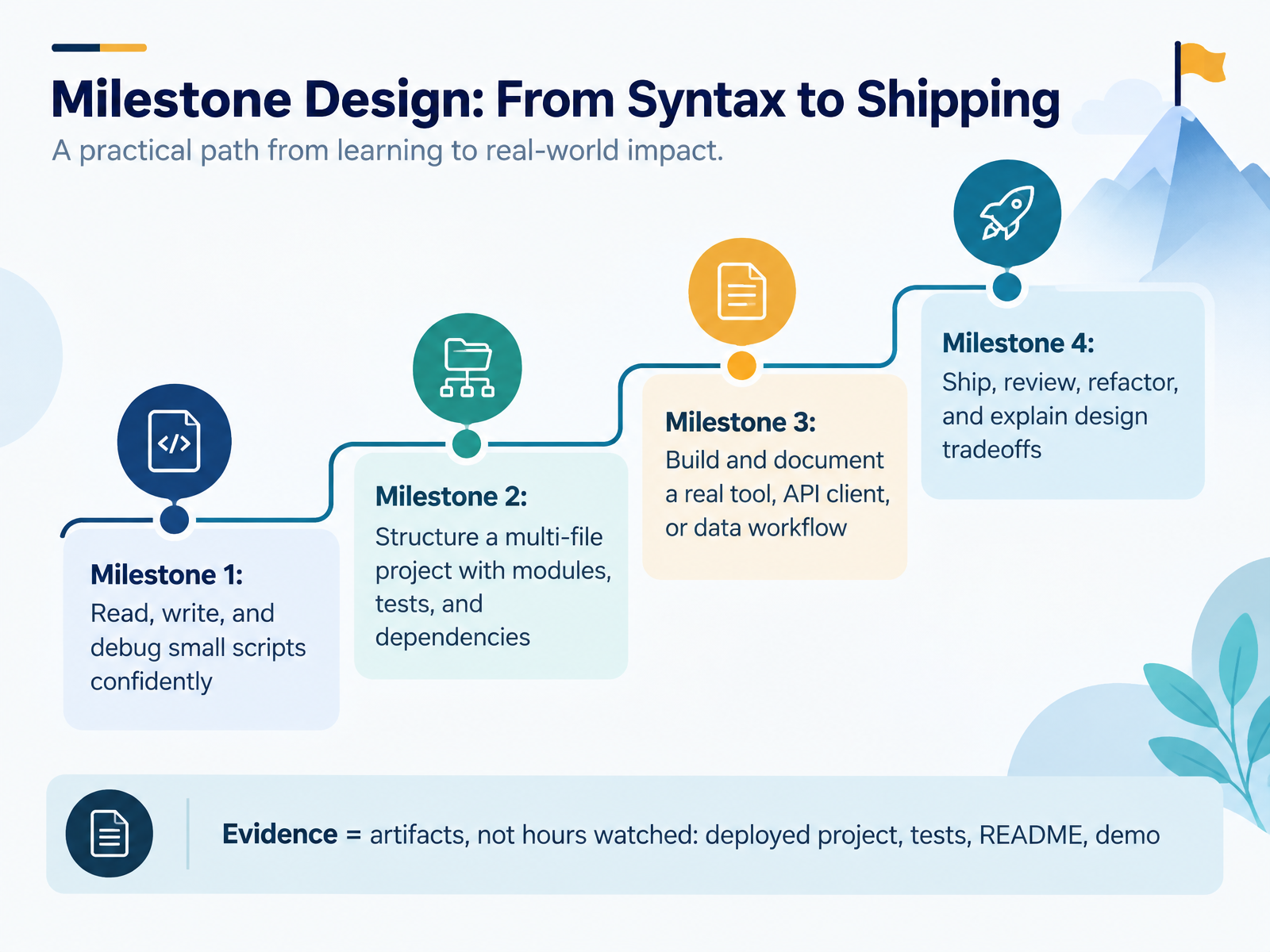 learnpython.academytalos.toolsscaler.com+21 min
 - 08Portfolio That Gets Read: Avoiding Tutorial Projects and SprawlNow let's talk about the portfolio that actually gets read. First, three to five well-documented projects will always beat fifteen shallow ones. When an interviewer opens your profile, they are looking for a real problem you solved, error handling, deployment, tests, and a clean readme. For each project, write down four things: the problem, your approach, the tradeoffs you made, and a measurable outcome. For example, say the API handles five hundred requests per minute, not just that it works. Next, remember that your GitHub profile itself signals credibility. Commit history, pull requests, and a readable structure all show how you work. By contrast, a wall of unfinished tutorial repos raises doubt. If you already have sprawl, here is your recovery plan. Keep the artifacts that show independence and depth, and drop everything else. This week, pick your three strongest projects and write one clear readme section covering problem, approach, tradeoffs, and outcome. With that in mind, let's move to the next topic: Communication That Makes Progress Visible.
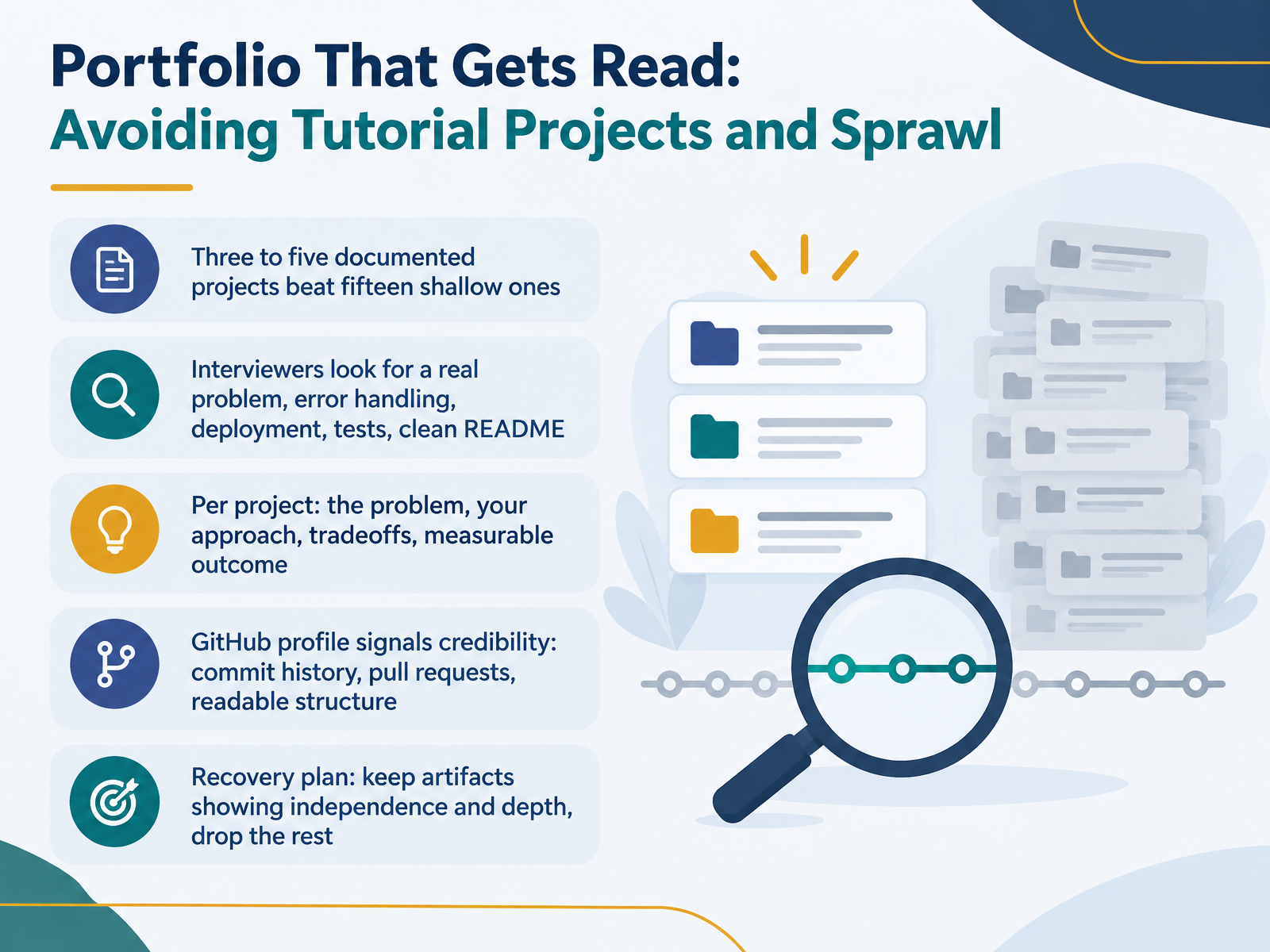 learnpython.academytalos.toolsscaler.com+22 min
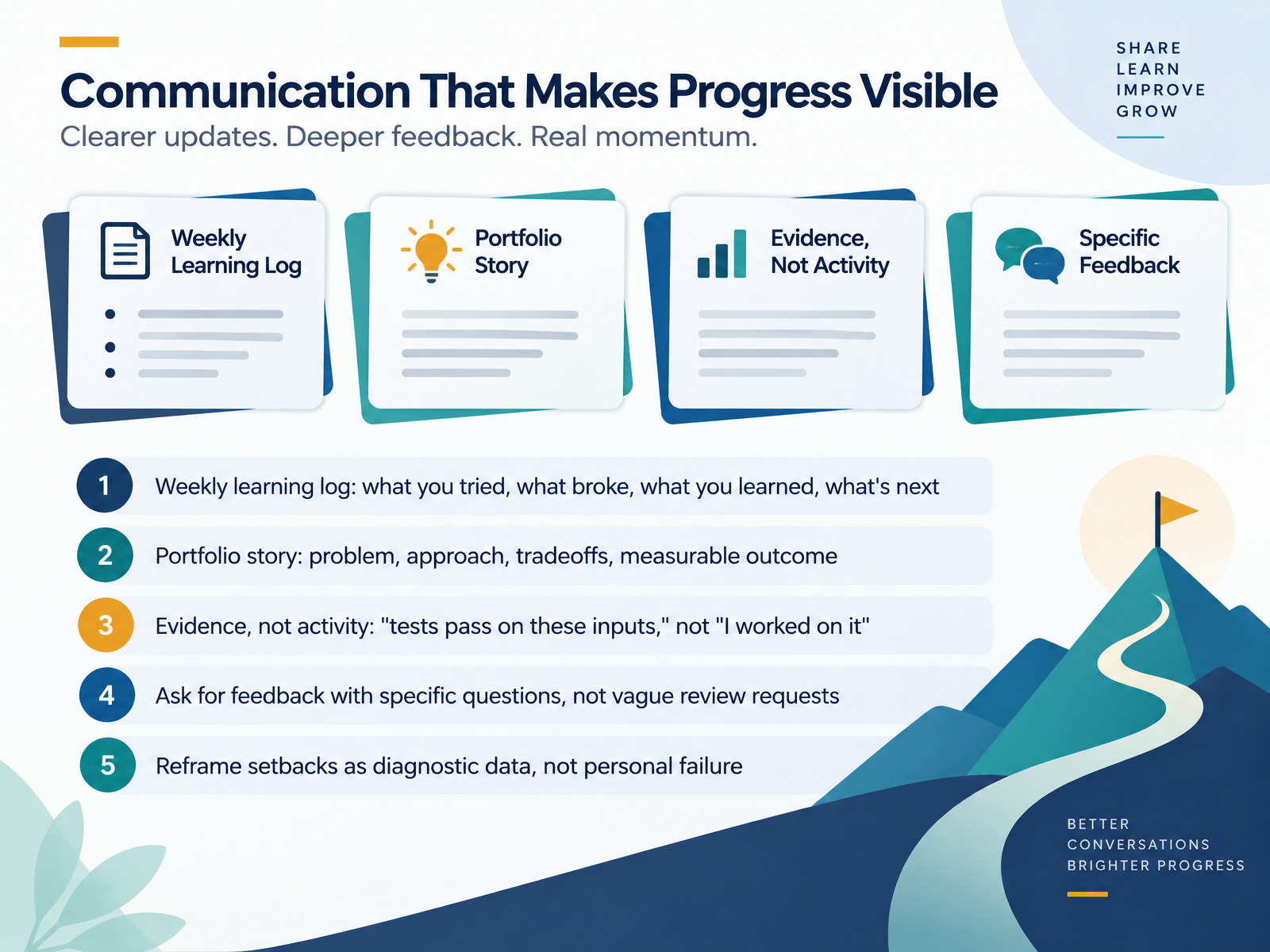
 - 09Communication That Makes Progress VisibleNext, let's talk about communication that makes your progress visible. Research on engineering mentorship keeps pointing to the same thing: evidence beats activity. So first, keep a weekly learning log. Write one line each on what you tried, what broke, what you learned, and what's next. Next, frame your portfolio as a story: the problem, your approach, the tradeoffs you accepted, and a measurable outcome. Notice the difference between saying you worked on something and saying the tests pass on these inputs. One is activity, the other is evidence. When you ask for feedback, ask specific questions, like whether your loop handles an empty list, not a vague request for a review. And when something breaks, treat it as diagnostic data, not personal failure. That keeps setbacks useful instead of discouraging. Try one of these this week: write your first log entry, or rewrite one resume bullet as evidence. That habit matters most when you start teaching and mentoring Python growth.
 juststeveking.comjobsglitch.comcareers.uw.edu+22 min
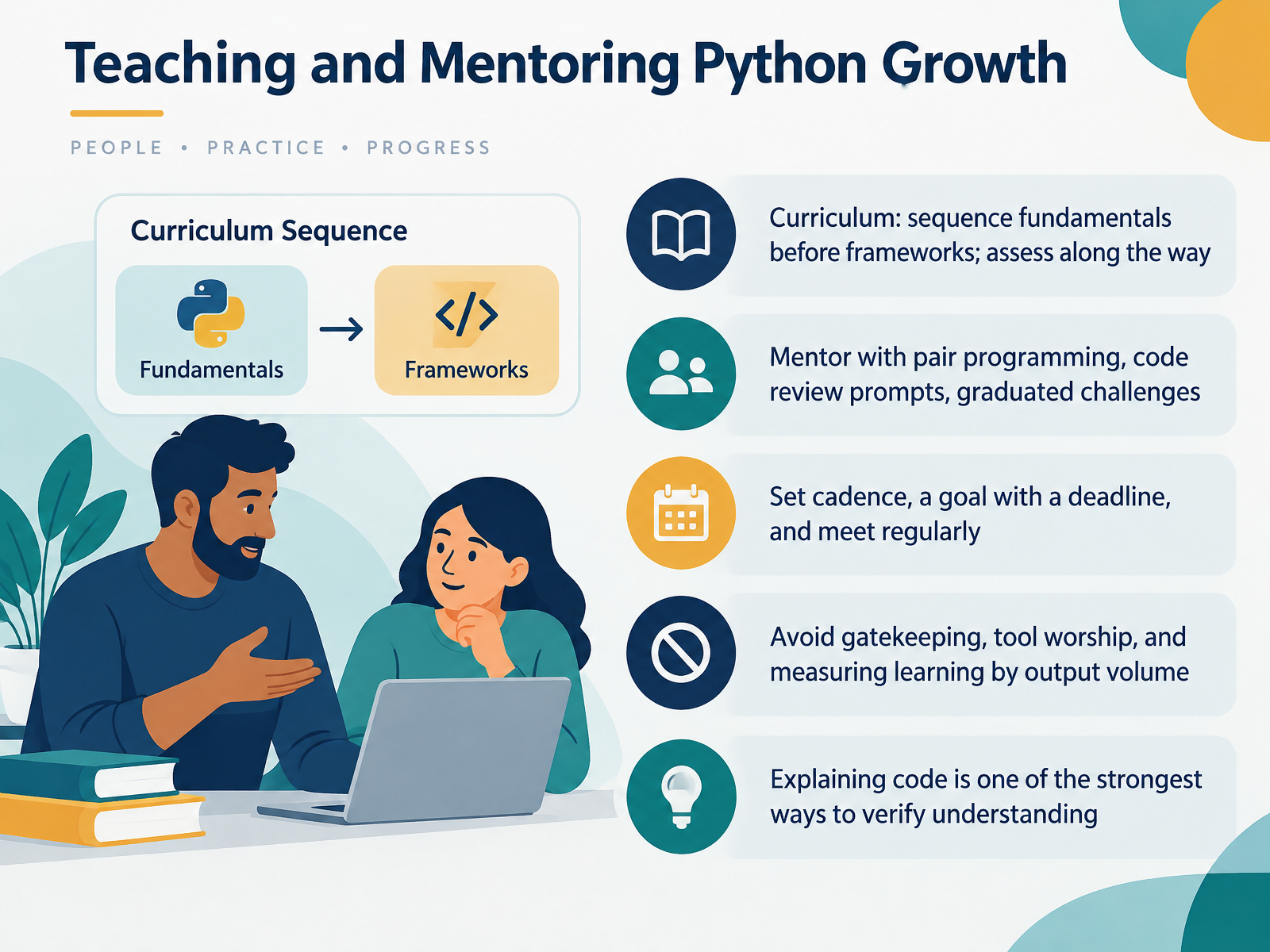
 - 10Teaching and Mentoring Python GrowthNext, let's talk about teaching and mentoring Python growth. First, sequence fundamentals before frameworks. Teach variables, functions, and error handling before reaching for Django or FastAPI, and assess understanding along the way rather than only at the end. Next, mentor through practice. Pair programming, code review prompts, and graduated challenges, where each task adds one new difficulty, all work well. Then set a cadence. Agree on a specific goal with a deadline, and meet regularly, because a plan without a schedule quietly disappears. By contrast, avoid gatekeeping, tool worship, and judging learning by output volume. Someone who ships a lot of code is not necessarily learning. Finally, ask learners to explain their code out loud. Explaining is one of the strongest ways to verify real understanding. This week, pick one mentee, set one goal with a date, and schedule the next check-in. That leads into managing Python growth on teams.
 juststeveking.comjobsglitch.comcareers.uw.edu+21 min
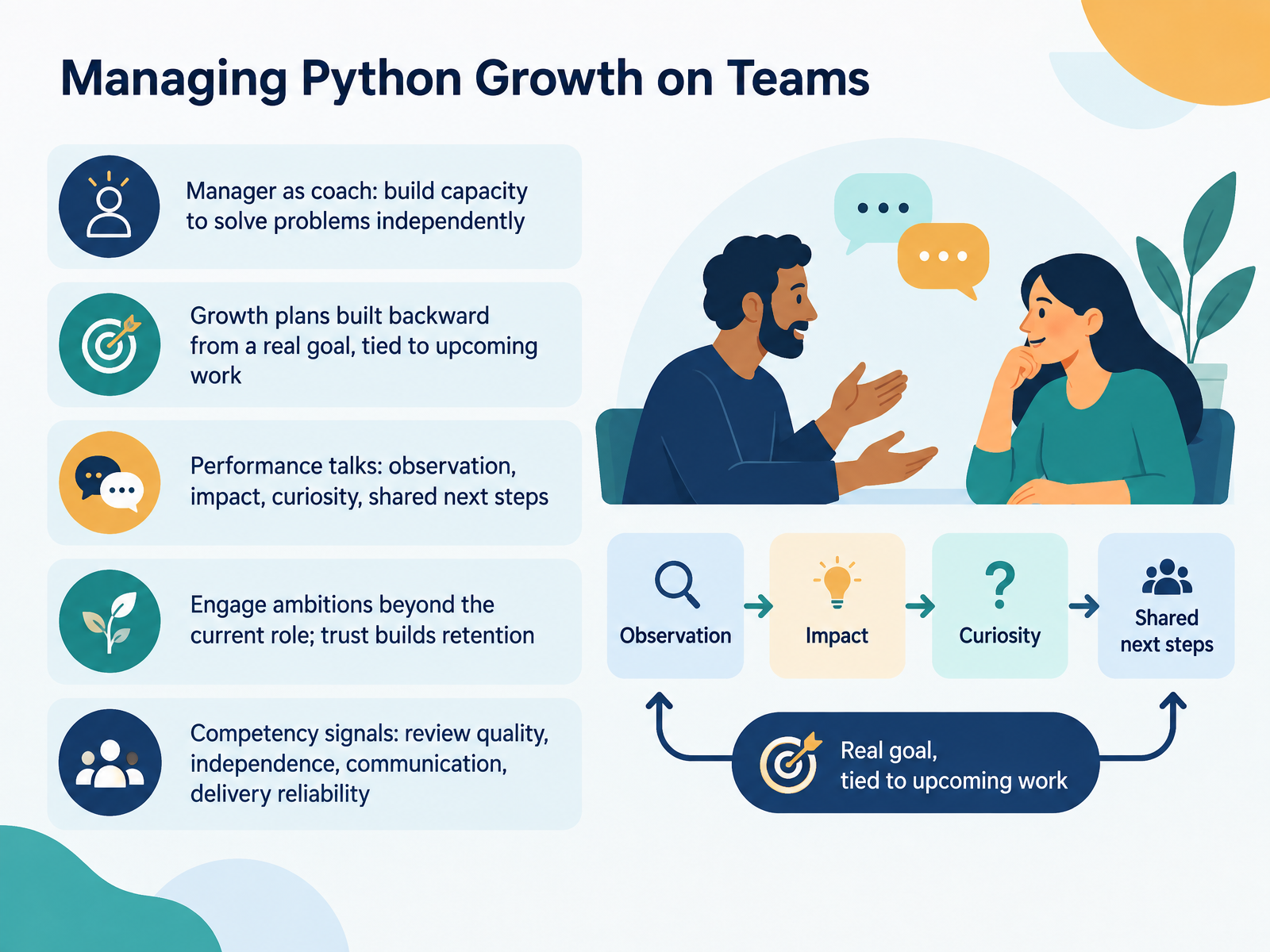
 - 11Managing Python Growth on TeamsLet's talk about managing Python growth on a team. First, a manager acts as a coach, building each person's capacity to solve problems independently. Instead of handing over answers, ask questions that help an engineer reason through a fix, because that develops judgment rather than dependency. Next, build growth plans backward from a real goal tied to upcoming work. If someone wants more technical leadership, give them ownership of a service that needs it, so growth stays concrete. In performance talks, lead with a specific observation, explain the impact, ask genuinely curious questions, and agree on shared next steps. Also engage ambitions beyond the current role, even if that means another team, because that trust builds retention. Finally, judge competency through signals: review quality, independence, communication, and delivery reliability. Next, we will look at common roadmap traps and how to correct them.
 juststeveking.comjobsglitch.comcareers.uw.edu+21 min
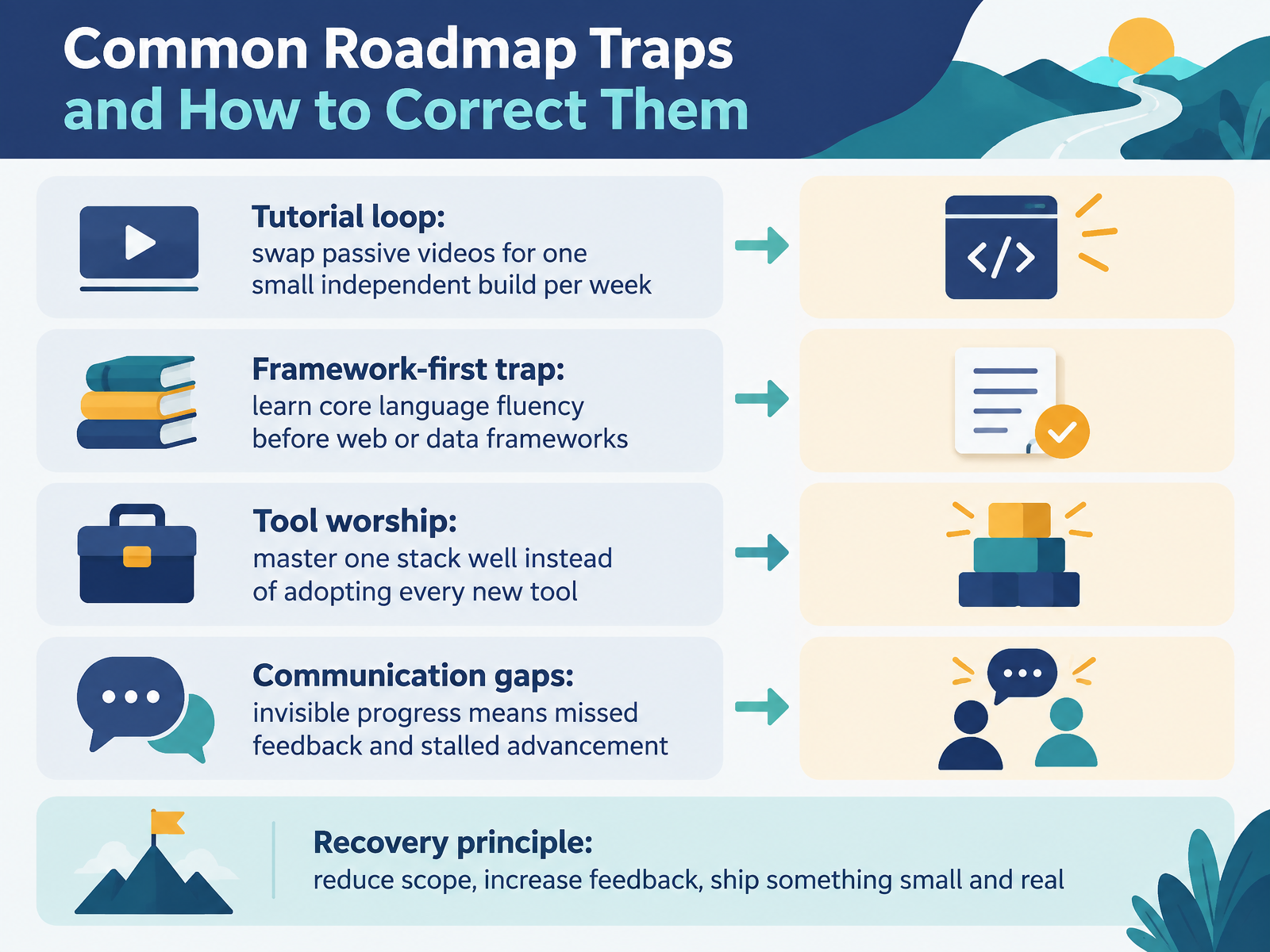
 - 12Common Roadmap Traps and How to Correct ThemNow let's talk about the traps that stall even well-planned study, and how to correct each one.
First, the tutorial loop. Watching videos feels productive, but it builds recognition, not skill. Swap passive videos for one small independent build each week. For example, after learning file handling, write a script that reads a CSV and prints summary statistics, without following along.
Next, the framework-first trap. People often jump straight into FastAPI or pandas before the language feels natural. Learn core fluency first: variables, functions, loops, and error handling. Frameworks become far easier once the basics are automatic.
Then, tool worship. New tools appear constantly, and chasing all of them spreads you thin. Master one stack well instead of adopting every new library. A learner who knows one framework deeply will out-perform someone with shallow exposure to five.
Finally, communication gaps. Invisible progress means missed feedback and stalled advancement. Share weekly updates, even small ones, so mentors and managers can steer you early.
The recovery principle ties it together. Reduce scope, increase feedback, and ship something small and real. If you feel stuck, shrink the goal until you can finish it this week.
Next, we'll walk through a 90-Day Action Plan Template.
 learnpython.academytalos.toolsscaler.com+22 min
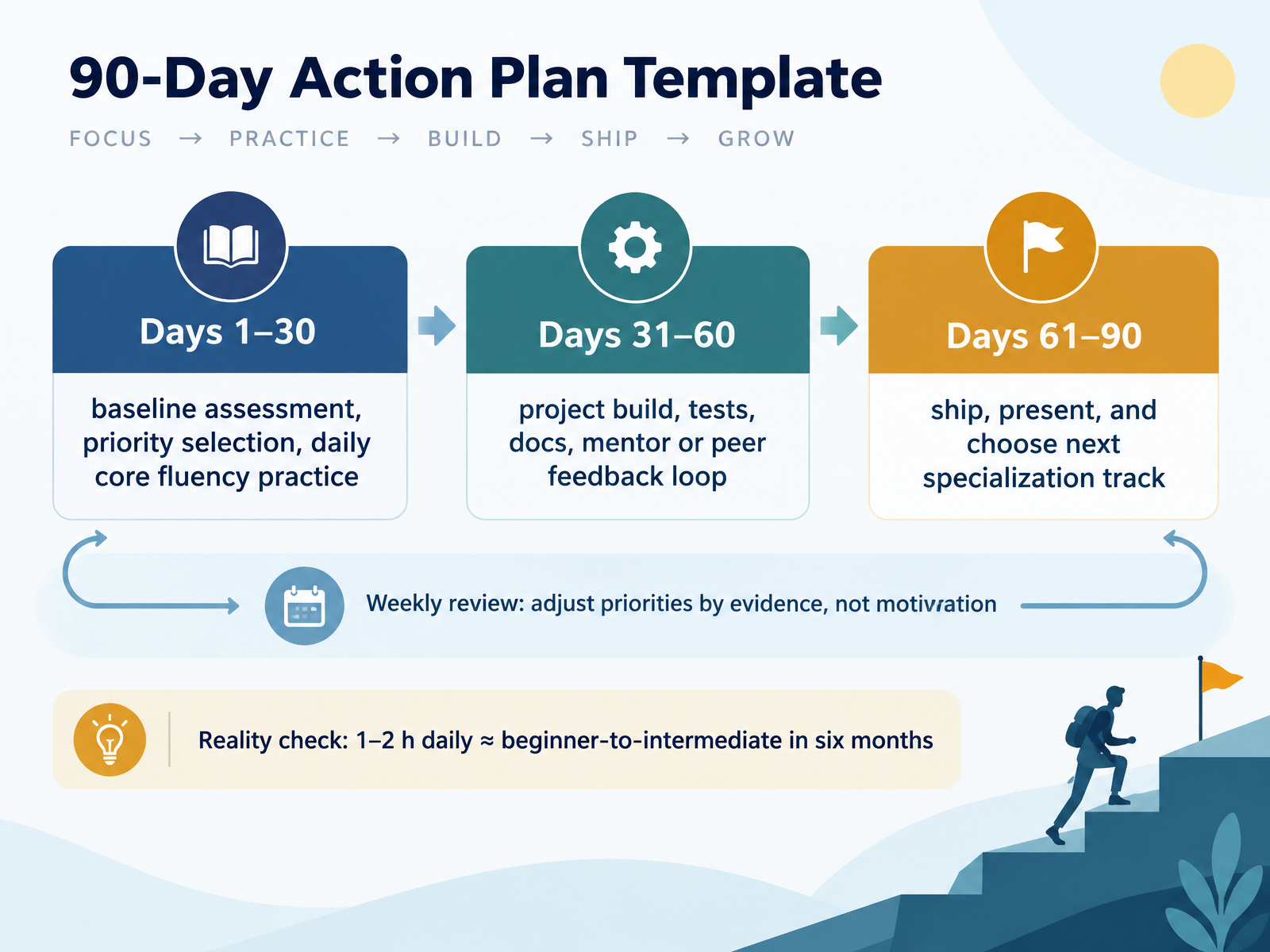
 - 1390-Day Action Plan TemplateLet's turn the roadmap into a ninety-day action plan you can start this week. For days one through thirty, run a baseline assessment: write down what you can already do, then pick one priority and practice core fluency daily. For example, thirty minutes a day on functions, files, and error handling. Next, days thirty-one through sixty are for building. Take one project, write tests, add documentation, and set up a feedback loop with a mentor or peer. Then days sixty-one through ninety: ship it, present it, and pick your next specialization track. Here is the honest part. Review weekly, and adjust your priorities by evidence, not motivation. Look at what you shipped and where you got stuck. A reality check: one to two hours daily gets you from beginner to intermediate in about six months. That is your template. Next, we will look at assessment, continuous improvement, and next steps.
 learnpython.academytalos.toolsscaler.com+22 min
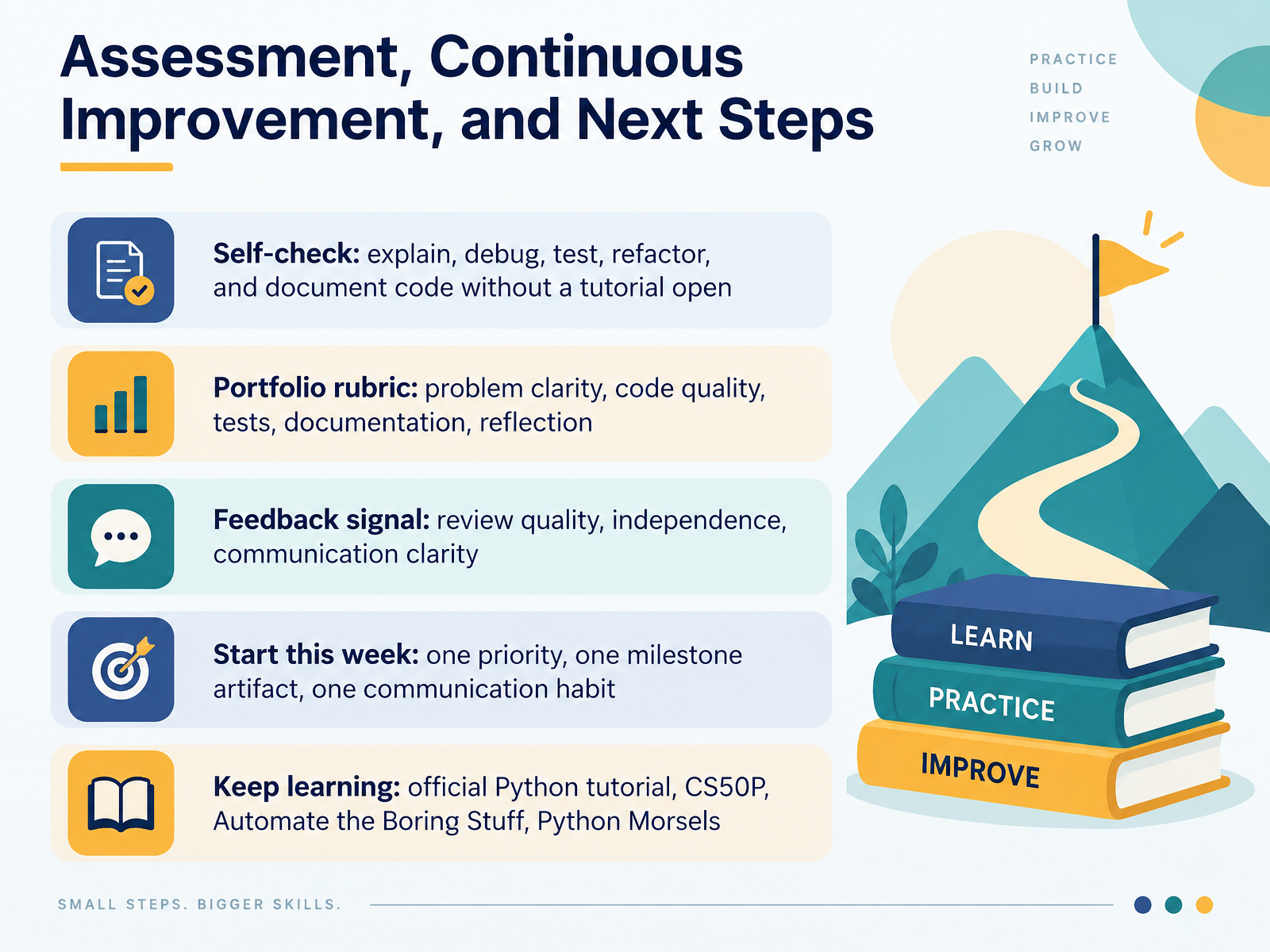
 - 14Assessment, Continuous Improvement, and Next StepsLet's close with how you keep improving on your own. First, run a self-check: can you explain, debug, test, refactor, and document a piece of code without a tutorial open? If a section stalls you, that is your next priority, not a failure. Next, build a small portfolio rubric: problem clarity, code quality, tests, documentation, and a short reflection. This mirrors what hiring managers actually review. Your feedback signal comes from others: review quality on your pull requests, how independently you solve problems, and how clearly you communicate tradeoffs. Then start this week with exactly three things, one priority to learn, one milestone artifact to finish, and one communication habit, like writing a clearer pull request description. Keep learning through the official Python tutorial, CS50P, Automate the Boring Stuff, and Python Morsels. That covers a full roadmap from fundamentals to job-ready habits. Thank you for working through this with me. Pick your three things today, and keep going. You have got this.
 learnpython.academytalos.toolsscaler.com+22 min
Take the deck with you
Download this course as a file — free, no sign-up needed.
- PDF handoutEvery slide page, ready to print or share.15 pages · 3.2 MBDownload
- Narrated PowerPointThe deck that presents itself — every slide carries the digital human's narration video.15 pages · 14.5 MBDownload
- PowerPoint slidesThe full deck as a .pptx — open it in PowerPoint, Keynote, or Google Slides.15 pages · 3.1 MBDownload
Free to use in your own training — please keep the PersonWise credit page at the end.
Have your own deck? Turn it into a course
Sources consulted
Web sources consulted while building this course.
- Python career switch — realistic plan from non-CS background to first dev job — learnpython.academy
- Free Python Developer Roadmap — Beginner to Pro — talos.tools
- Python Roadmap 2026: 6-Month Path to Master Core, AI & Web Dev - Scaler — scaler.com
- Python Developer Roadmap 2026: 6-Month, Step-by-Step Guide - Scaler — scaler.com
- Python Developer Roadmap 2026 — From Zero to Job-Ready (No Fluff, Real Sequence) - DEV Community — dev.to
- The Engineering Manager as Coach, Not Boss | JustSteveKing — juststeveking.com
- Engineering Manager - Solutions Engineering | Remote - JobsGlitch — jobsglitch.com
- Making the Most of Mentorship: 10 Tips From Slack’s Youny Kuang – Career & Internship Center | University of Washington — careers.uw.edu
- 🚀 We're Hiring — Engineering Manager - Python | Neha Yamba — linkedin.com
- 🚀 New Remote Opportunity: Engineering Manager (Python) — LATAM. — linkedin.com