Big Data in Business Analytics
Begin
14 pages · ~28 min
Big Data in Business Analytics
This training introduces business professionals to big data concepts, purposes, and real-world examples, enabling them to leverage big data analytics for informed decision-making.
What you’ll learn
- 01Big Data in Business Analytics: Concepts, Purpose, and ExamplesWelcome. If you are here, you already know data is plentiful. The question is whether it is working hard enough for your business. This session turns high-volume, high-velocity, high-variety data into actionable insight, not just impressive dashboards. We will connect core concepts like descriptive, predictive, and prescriptive analytics to measurable business value, whether that means lower risk, higher ROI, or faster decisions. We will also separate sustainable use cases from the hype that still surrounds big data, so you can invest where the evidence supports it. Our roadmap moves from core concepts into strategy, real-world applications, architecture, governance, and the change management needed to actually embed analytics into workflows. Expect practical examples from industries like retail, finance, and healthcare, grounded in what mature programs do well. By the end, you should have a sharper sense of where big data analytics pays off, and where it does not. Let us start with why this matters now, given how quickly the data landscape is shifting under us.ibm.comanalyticsinsight.nettechtarget.com+21 min
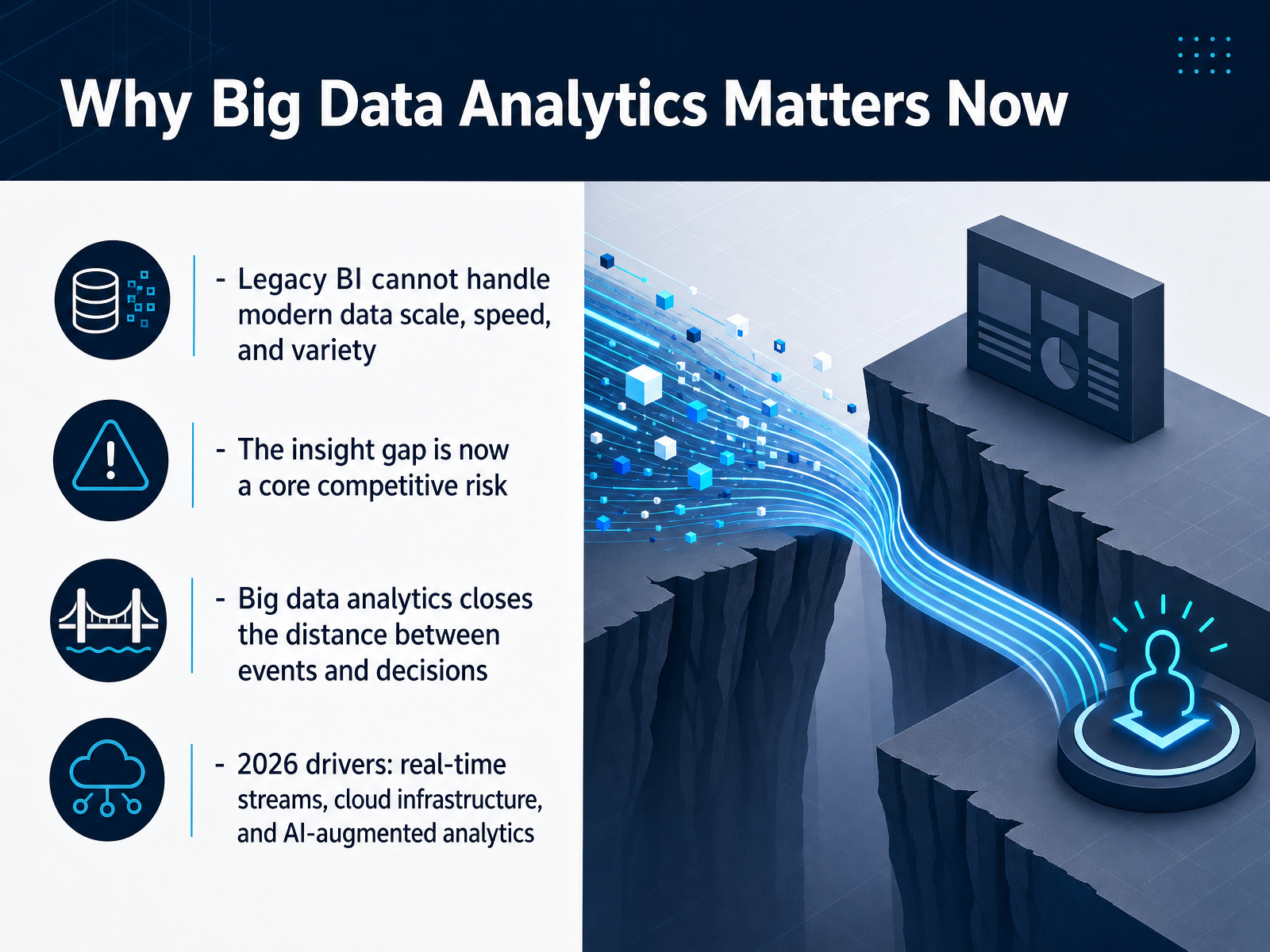
- 02Why Big Data Analytics Matters NowLet’s be direct about the stakes. Your legacy business intelligence platform was built for a world of monthly reports and structured spreadsheets. That world is gone. The volume, velocity, and variety of data now exceed what those systems were designed to handle, and that gap is no longer a technical nuisance. It is a core competitive risk. Every hour between an event and your decision is an hour your competitors can use to act. Big data analytics closes that distance by processing streams in real time and applying predictive models at scale. By 2026, the drivers are unmistakable: continuous data pipelines, cloud infrastructure that scales on demand, and AI-augmented analytics that surface signals before you even ask the question. The organizations that thrive are not the ones with the most data. They are the ones that compress the time from insight to action. Now let's ground this in the core concepts and terminology you will need to operationalize this capability.
 ibm.comanalyticsinsight.nettechtarget.com+21 min
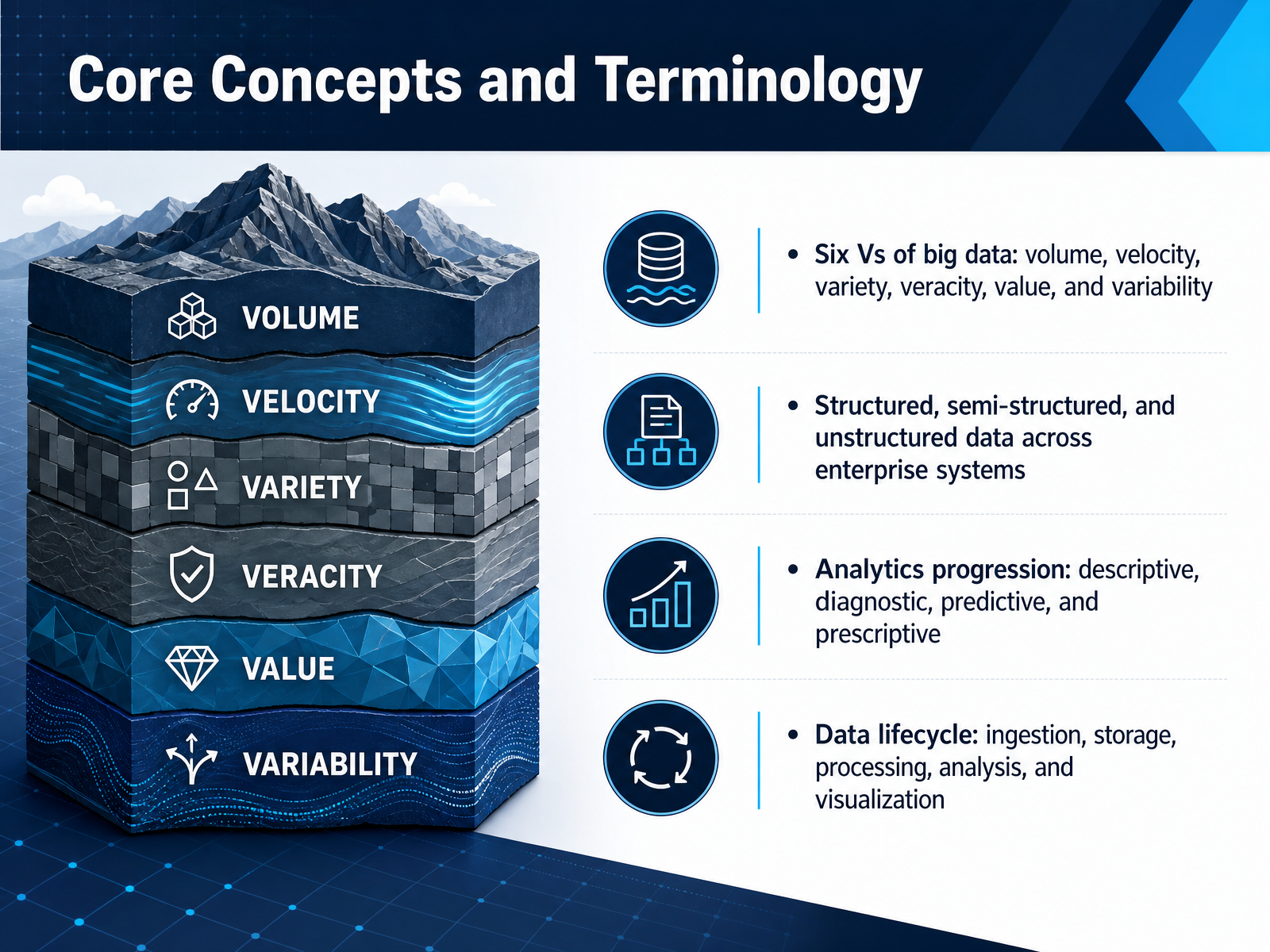
 - 03Core Concepts and TerminologyLet's anchor ourselves in the terminology that defines this space. When we talk about big data, we're really talking about the six V's. Volume is the sheer scale, velocity is the speed of generation, variety spans formats, veracity is the trustworthiness of the source, variability reflects changing data flows, and value is the ultimate payoff. This data arrives as structured records in your warehouses, or unstructured text and media, and everything in between. The analytics progression is where strategy takes shape: descriptive shows what happened, diagnostic explains why, predictive forecasts what's next, and prescriptive recommends the optimal action. This all operates across a lifecycle from ingestion to visualization, where governance and pipeline design determine your ROI. The closer your models align with this framework, the sharper your competitive edge. Up next, we move from this foundation into the analytics progression itself.
 ibm.comanalyticsinsight.nettechtarget.com+21 min
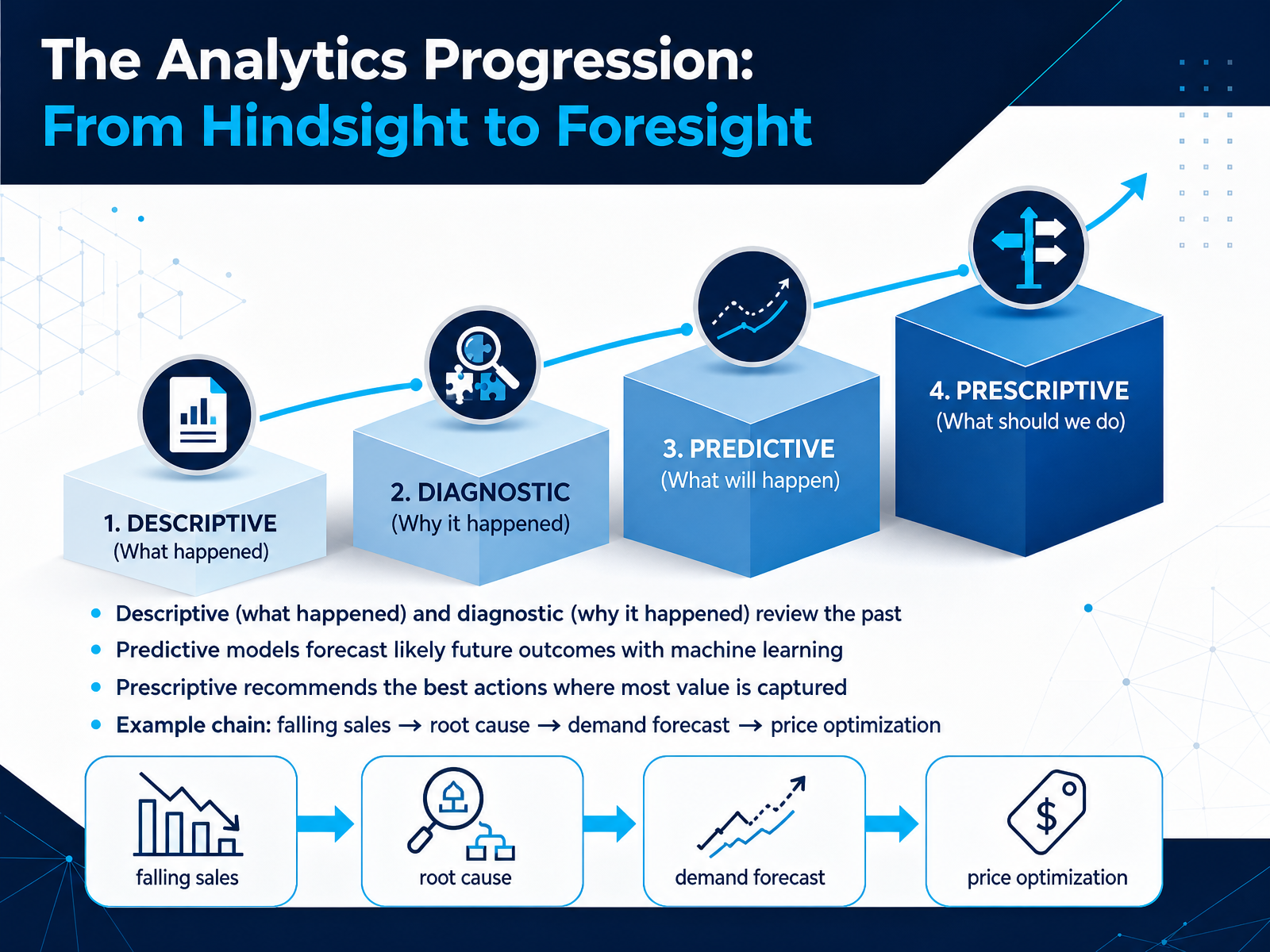
 - 04The Analytics Progression: From Hindsight to ForesightNow let’s walk through the analytics progression, because where you sit on this maturity curve determines how much strategic value you extract from your data. It starts with descriptive analytics — the “what happened” layer. That’s your dashboards, your KPI reports, the trailing indicators you review every month. But knowing what happened is only the entry ticket. Diagnostic analytics is the next step, digging into root cause to answer “why did it happen?” — whether that’s a channel shift, a pricing change, or an operational bottleneck. From there, predictive analytics shifts your posture from reactive to proactive. Using historical data and machine learning, you model probabilities of future outcomes. That’s your demand forecast, your churn risk score, your revenue projection. But prediction alone doesn’t capture value. That requires prescriptive analytics — the layer that recommends the best action given your constraints and objectives. Think of the full chain in practice. Sales drop. Descriptive analytics confirms the drop. Diagnostic isolates the cause — say, a competitor price shift. Predictive models quantify the expected revenue impact if you don’t respond. And prescriptive analytics tells you the optimal price adjustment to protect margin and share. That’s how you move from hindsight to foresight in a measurable way. With that foundation, let’s look at the strategic purpose these capabilities serve and how they connect to business value.
 ibm.comanalyticsinsight.nettechtarget.com+22 min
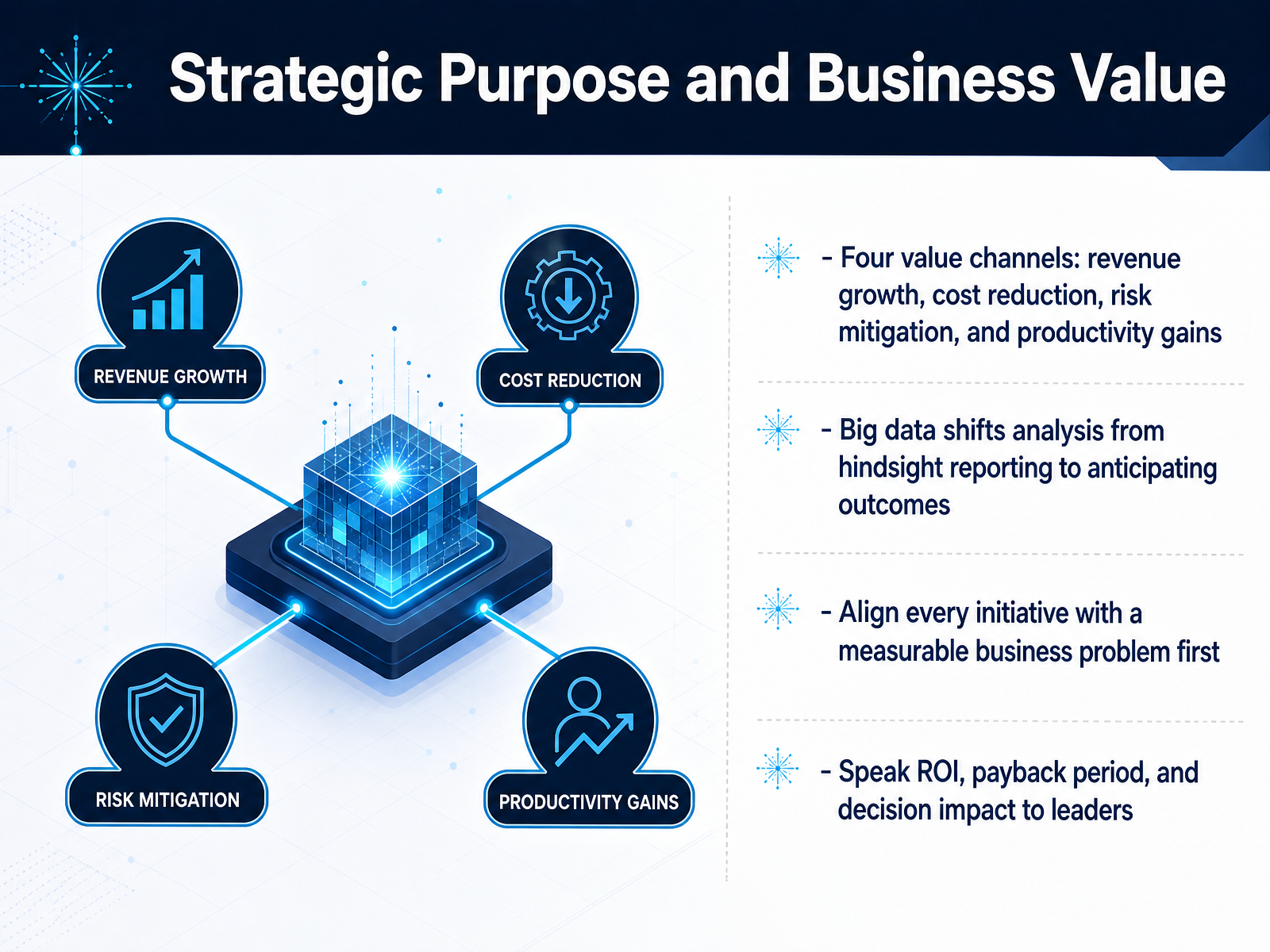
 - 05Strategic Purpose and Business ValueLet's talk about why big data actually matters. The strategic purpose of big data analytics isn't the volume of data you process. It's the value you extract across four distinct channels: revenue growth, cost reduction, risk mitigation, and productivity gains. Every initiative should map to at least one of these. Big data shifts your analysis from hindsight reporting to anticipating outcomes. You're no longer asking what happened. You're asking what will happen and what you should do about it. That's the difference between descriptive analytics and predictive or prescriptive modeling. But here's the discipline—align every initiative with a measurable business problem first. Data for data's sake doesn't fund itself. When you go to leadership, speak their language: ROI, payback period, decision impact. For example, a predictive maintenance model might reduce downtime by twenty-five percent. That's the figure that earns the budget. So before you build anything, define the problem, quantify the value, and let that drive your analytics portfolio. Next, we'll explore real-world applications by business function.
 ibm.comanalyticsinsight.nettechtarget.com+22 min
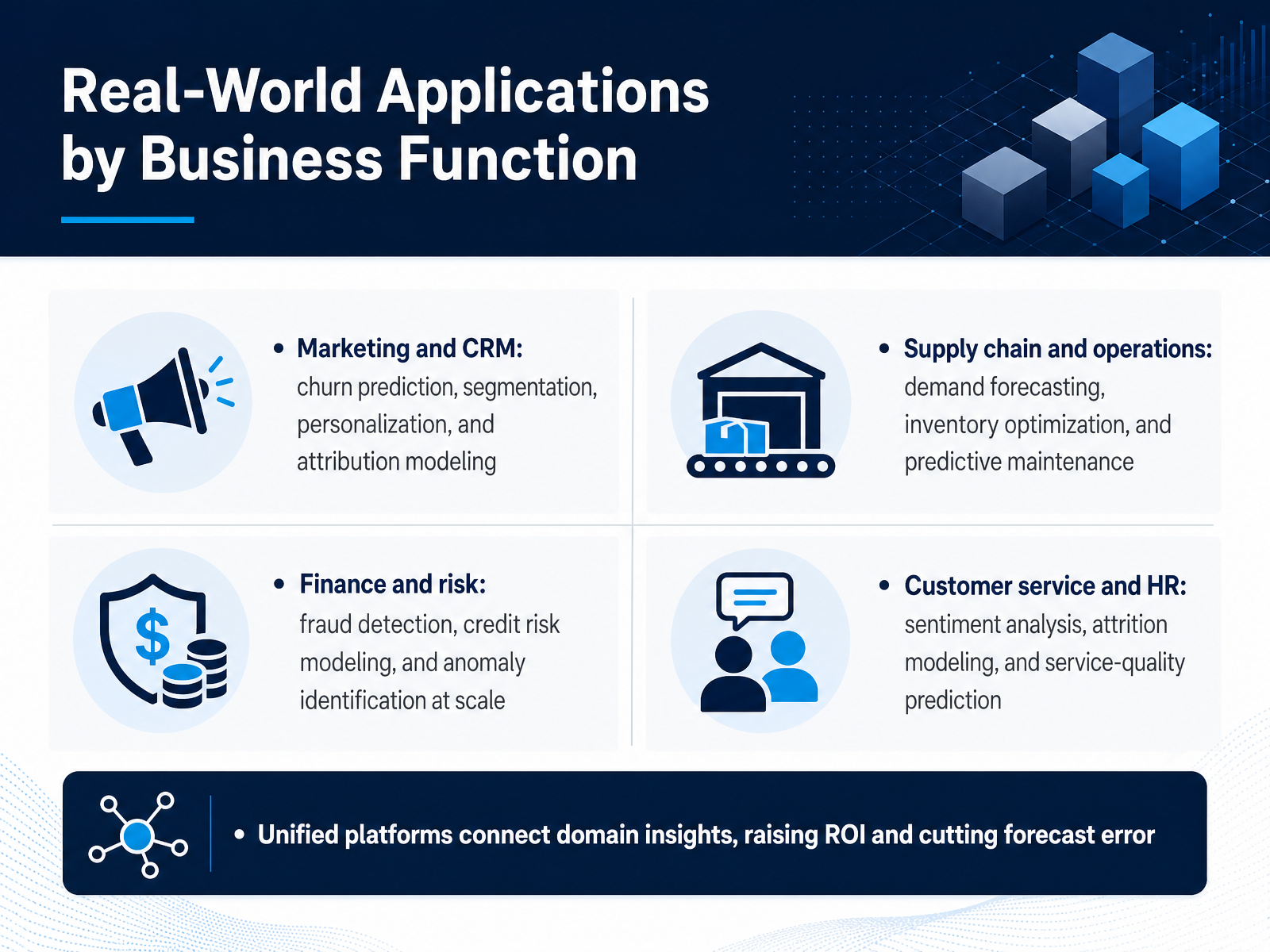
 - 06Real-World Applications by Business FunctionLet's ground these concepts in the functional trenches. In marketing, big data powers churn prediction, precision segmentation, and attribution modeling, and the ROI shift is real: cross-domain targeting can lift campaign ROI from fourteen percent to over forty-five percent. In supply chain, demand forecasting and predictive maintenance turn reactive operations into proactive ones, cutting forecast error dramatically and flagging disruptions weeks in advance. Finance relies on fraud detection, credit risk modeling, and anomaly identification at scale, where ensemble models now deliver F1 scores above ninety percent on classification tasks. Even customer service and HR use sentiment analysis and attrition modeling to predict service quality and retention issues before they escalate. The decisive factor is integration. When unified platforms connect these domain insights, you move beyond functional wins to enterprise-level performance, raising ROI while cutting forecast error across the board. The best analytics strategy is not the one with the most models, but the one that connects them. Now let's turn to how we get from these applications to actual decisions, starting with the tools and architecture that make it possible.
 doi.orgmdpi.comcloud.google.com+21 min
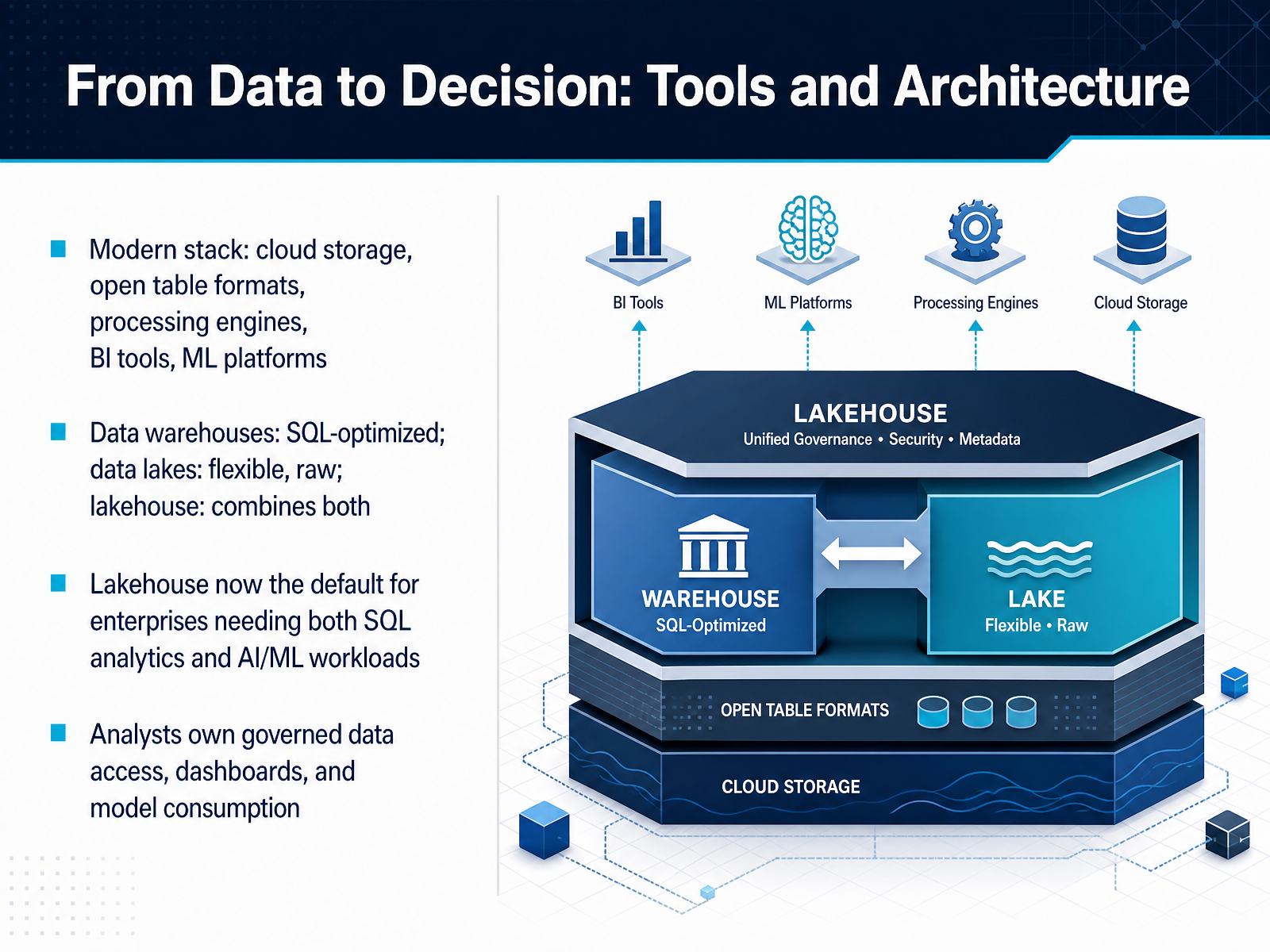
 - 07From Data to Decision: Tools and ArchitectureLet’s turn to the architecture that turns raw data into decisions. In 2026, the modern stack is a modular set of cloud-native layers: object storage, open table formats, processing engines, business intelligence tools, and machine learning platforms. The key architectural decision is where your data actually lives. A data warehouse is SQL-optimized and fast, but it locks you into proprietary storage. A data lake is flexible and cheap, but it lacks the transactional guarantees analytics demands. The lakehouse resolves that trade-off. It places open table formats like Iceberg or Delta Lake on low-cost object storage, giving you warehouse-grade SQL performance, ACID transactions, and direct access for AI and machine learning workloads on the same copy of data. That is why the lakehouse is now the default for enterprises running both BI and ML. For your role, the practical implication is clear. You own governed access to trusted datasets, you build the dashboards, and you consume model outputs. The architecture does the heavy lifting, so your focus stays on the decisions. Now, none of this works without governance, which brings us to data quality, ethics, and control.
 modern-datatools.commodern-datatools.compromethium.ai+21 min
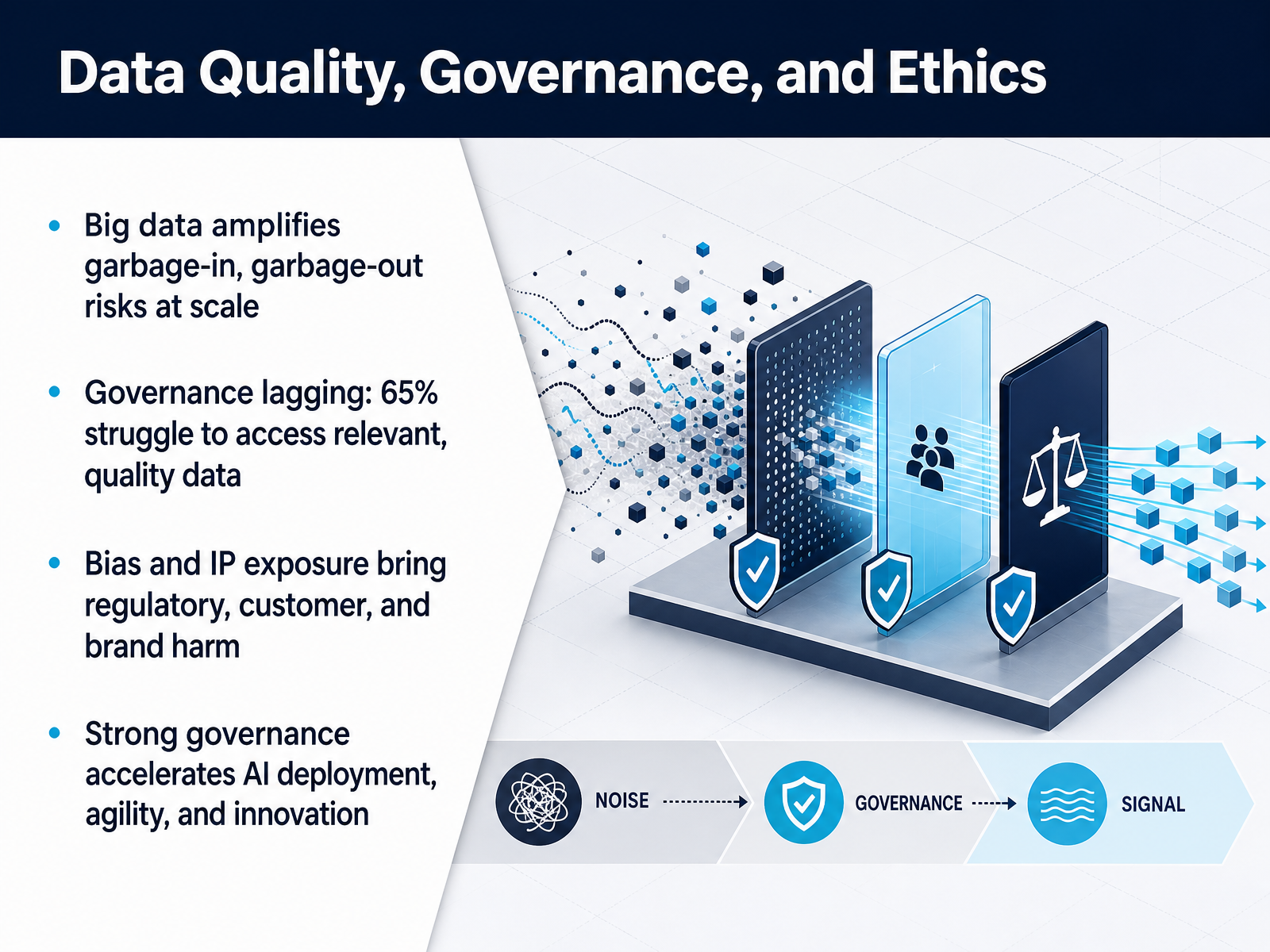
 - 08Data Quality, Governance, and EthicsNow let’s talk about data quality, governance, and ethics. Big data doesn’t just amplify good insights; it amplifies bad data too. The garbage-in, garbage-out principle hits harder at scale, and it’s a business risk, not just a technical one. Here’s the reality check: sixty-five percent of organizations still struggle to access relevant, high-quality data efficiently. That’s a direct constraint on your predictive models and your ROI. Governance is one step ahead of risk, but it’s often one step behind AI adoption. Bias and intellectual property exposure aren’t just compliance headaches; they bring regulatory penalties, customer churn, and brand damage. But here’s the strategic payoff: organizations with strong governance frameworks report faster AI deployment and greater agility. They turn governance from a bottleneck into an accelerator. The question isn’t whether to invest in governance, but whether you can afford to scale innovation without it. That discipline is what separates sustainable data-driven value from reckless experimentation. Next, we’ll look at the common pitfalls in these programs and how to avoid them.
 cisco.combcg.comisaca.org+21 min
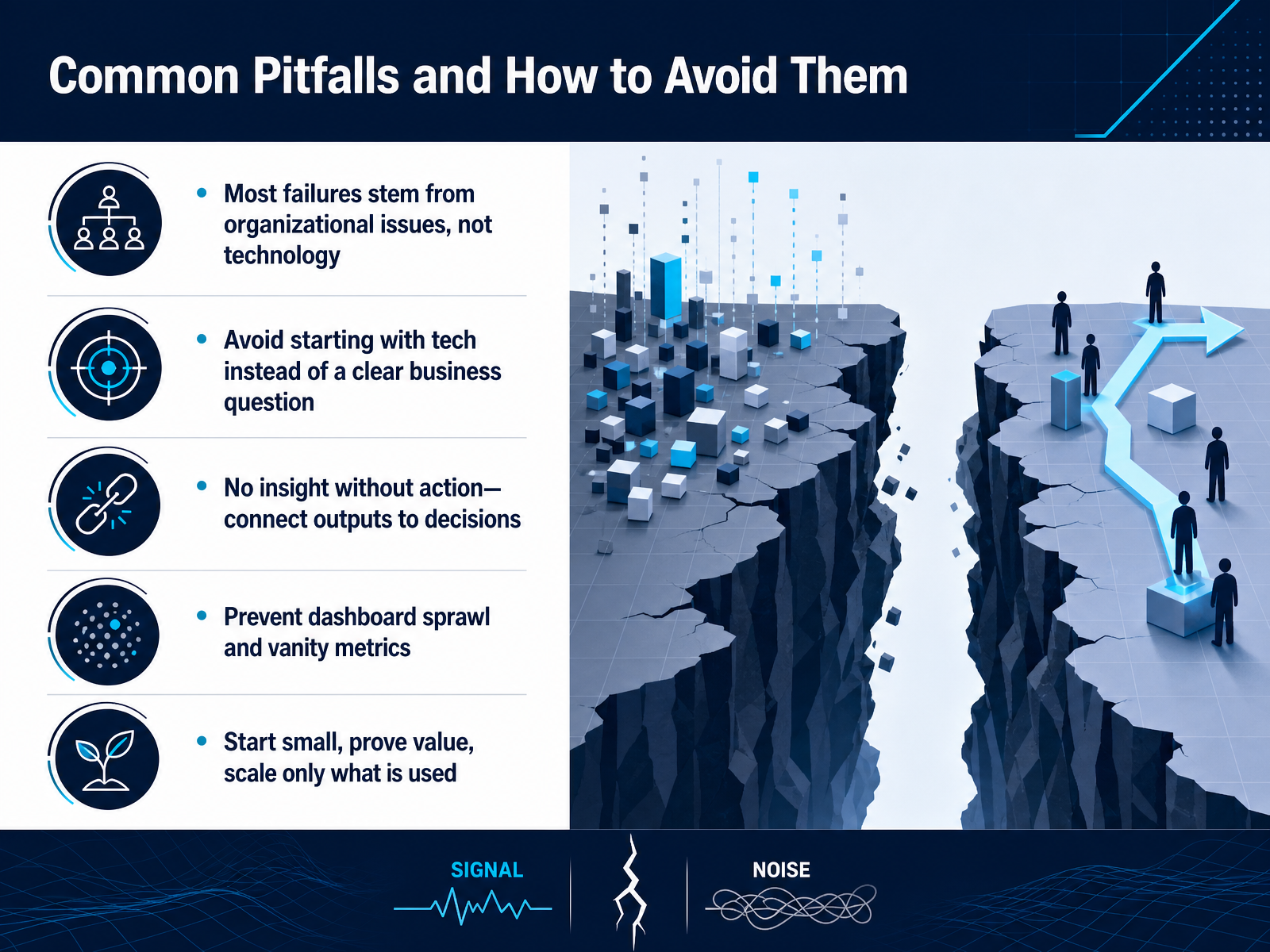
 - 09Common Pitfalls and How to Avoid ThemLet’s shift from strategy to the realities of execution. Most analytics initiatives fail, and the data is sobering: analysts consistently put the failure rate between sixty and eighty-five percent. But the root cause is rarely the technology. The overwhelming majority trace back to organizational issues. Misaligned objectives, management resistance, and cultural friction consistently outrank any technical deficiency. So, how do you protect your investment? First, never start with the technology. Begin with a precise, high-value business question, and let that question dictate your data pipeline and tool choices. Second, treat insights as a means to action, not an endpoint. If a model doesn’t feed into a specific decision with an accountable owner, its ROI is theoretical at best. Third, resist dashboard sprawl. Every metric you display should support a decision, not just decorate a screen. And finally, prove the concept at a manageable scale. Launch with one well-defined use case, demonstrate tangible business impact, and only then expand to the areas that are actively using your analytics. Follow these guardrails, and you position analytics as a driver of business outcomes, not an expensive cost center. Up next: what it takes to build an organization that puts data at the center of its decision-making.
 2 min
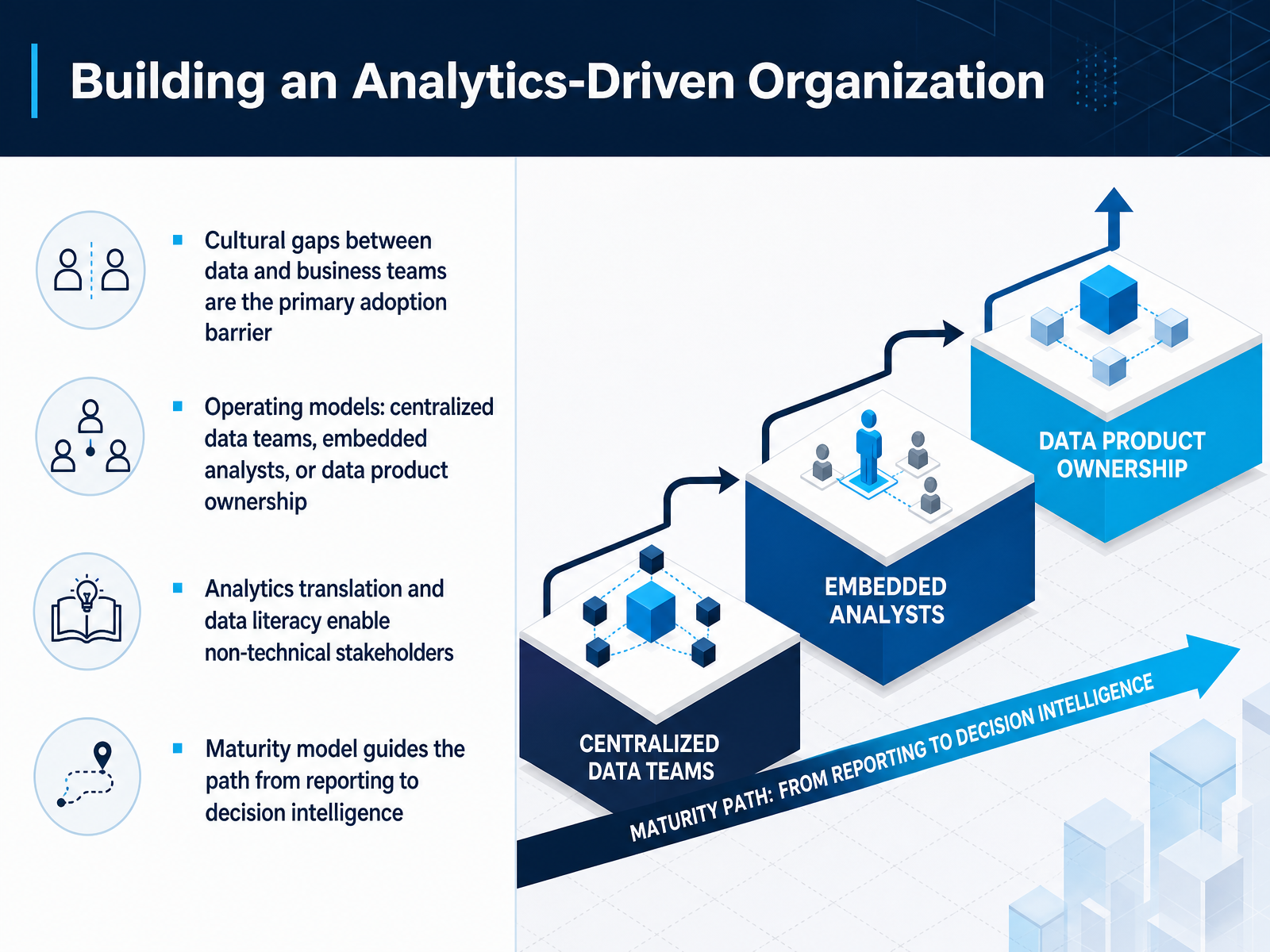
2 min - 10Building an Analytics-Driven OrganizationNow, let's address the hardest part: building the organization around analytics. The primary barrier isn't technology—it's the cultural gap between data teams and business stakeholders. To close it, you need an explicit operating model. The centralized model gives you control but risks the ivory tower problem where you build tools nobody uses. The embedded model places analysts directly within business units, which improves adoption but can fragment your standards. The product ownership model treats data assets as products with clear roadmaps and service levels. Whichever you choose, invest in analytics translation and data literacy. Your business stakeholders don't need to build models, but they must understand what predictive modeling can and cannot tell them. With those trained, you apply a maturity model. Most organizations start at descriptive reporting. The goal is to progress through diagnostic and predictive stages toward decision intelligence, where insights are embedded directly into workflow systems and trigger actions automatically. Culture doesn't change because you want it to. It changes because you restructure incentives and measure different outcomes. So start with one high-value decision domain, prove the business impact, and scale from there. That brings us to our next topic: decision intelligence and how it marks the shift from understanding the past to prescribing the next best action. Many organizations treat analytics as a reporting function rather than a decision function, and that is the fundamental change we need to make.
 2 min
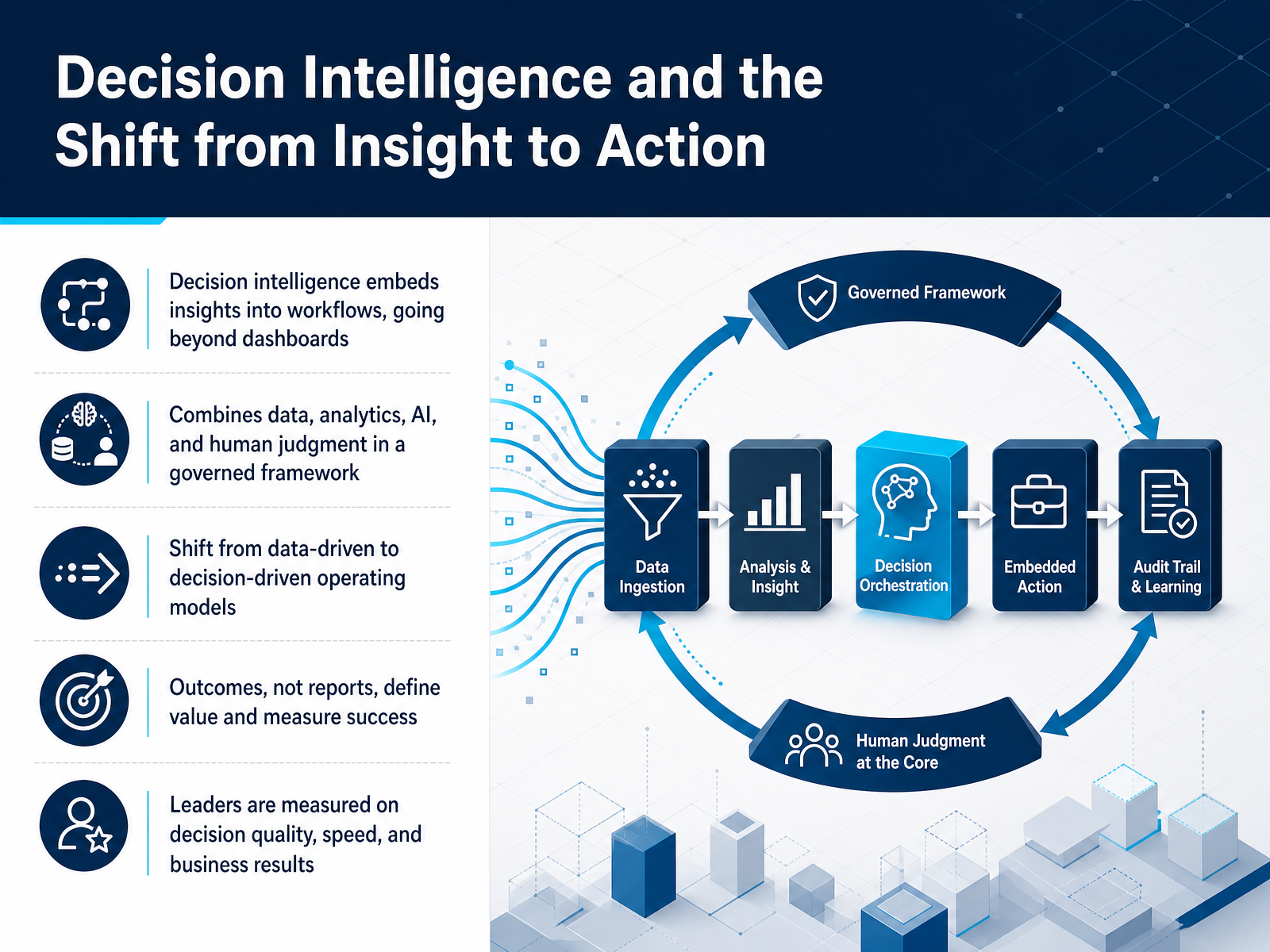
2 min - 11Decision Intelligence and the Shift from Insight to ActionNow let's talk about decision intelligence. This is where analytics stops being a rearview mirror and becomes the steering wheel. Decision intelligence embeds insights directly into workflows — it's not another dashboard to check. It combines data, analytics, AI, and human judgment inside a governed framework. That's a critical distinction. A dashboard tells you what happened. Decision intelligence tells you what to do next, and whether it worked. This marks a shift from data-driven to decision-driven operating models. The question is no longer, 'What does the data say?' but 'What decision are we making, and how do we make it better?' In this model, value is defined by outcomes, not reports. You're not measured on how many insights you generate. You're measured on decision quality, decision speed, and the business results those choices produce. Think of it this way: a model with ninety-five percent precision that business users ignore is worth less than one with eighty-five percent precision that drives consistent action. That's the difference between insight and impact. As we look ahead, generative AI and agentic analytics are making this shift even more pronounced, which we'll cover next.
 1 min
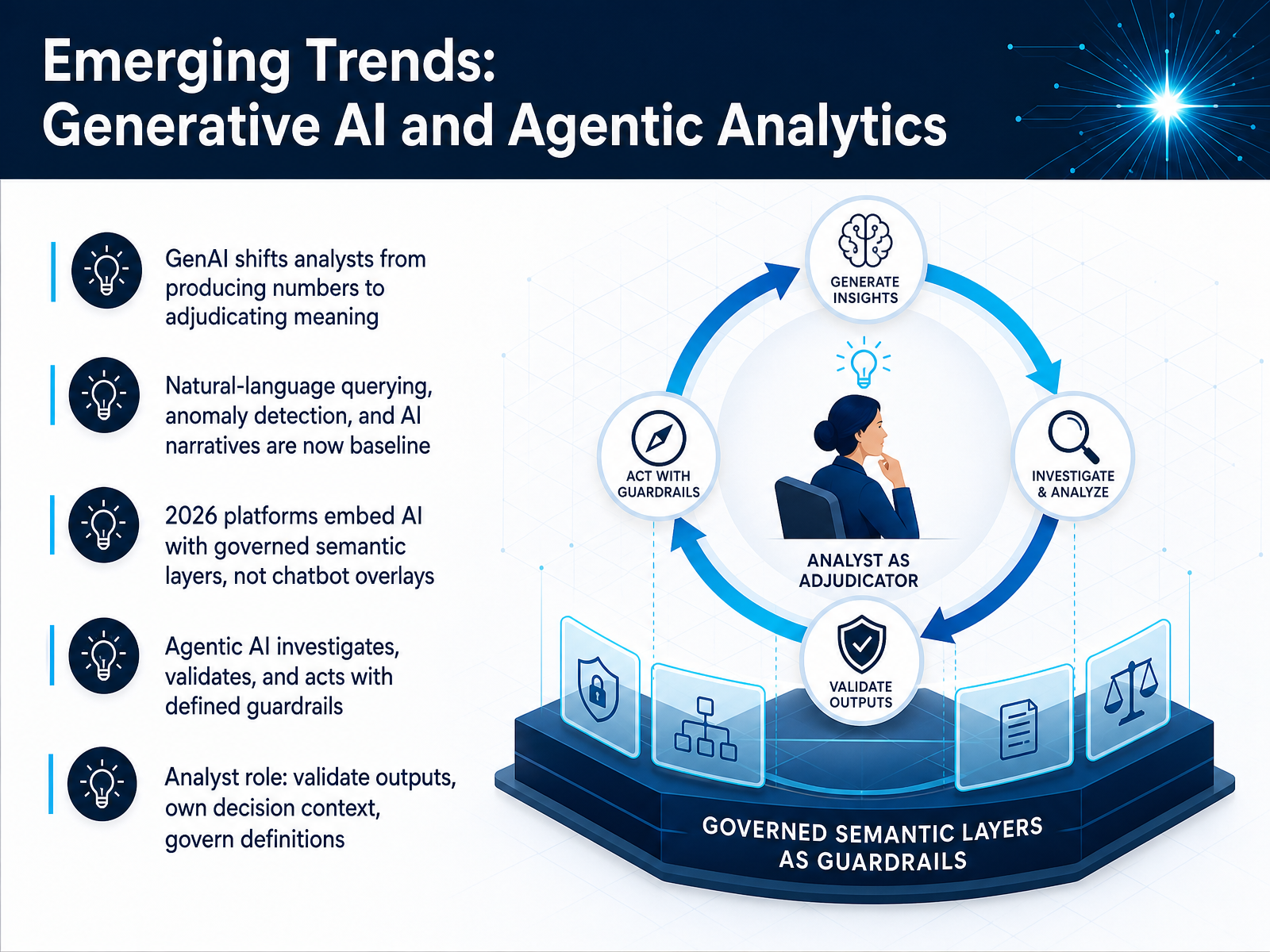
1 min - 12Emerging Trends: Generative AI and Agentic AnalyticsNow let's turn to the emerging frontier: generative AI and agentic analytics. The core shift here is that analysts move from producing numbers to adjudicating meaning. Natural-language querying, automated anomaly detection, and AI-generated narratives are now baseline expectations, not premium features. The real differentiator in 2026 is architecture. Leading platforms embed AI behind a governed semantic layer that standardizes metric definitions, rather than layering a chatbot over fragmented legacy systems. That separation is what lifts complex query accuracy from near zero to over seventy percent. And the next step is agentic AI. These systems don't just answer when asked—they investigate, validate, and act within defined guardrails. Your role as an analyst becomes owning the decision context and governing those definitions. Think of it as moving from being the person who pulls the numbers to being the person who decides which numbers matter. The organizations capturing the most value are those that treat the semantic layer as the contract between human judgment and machine autonomy. Next, we'll look at how to evaluate a big data use case for your organization.
 1 min
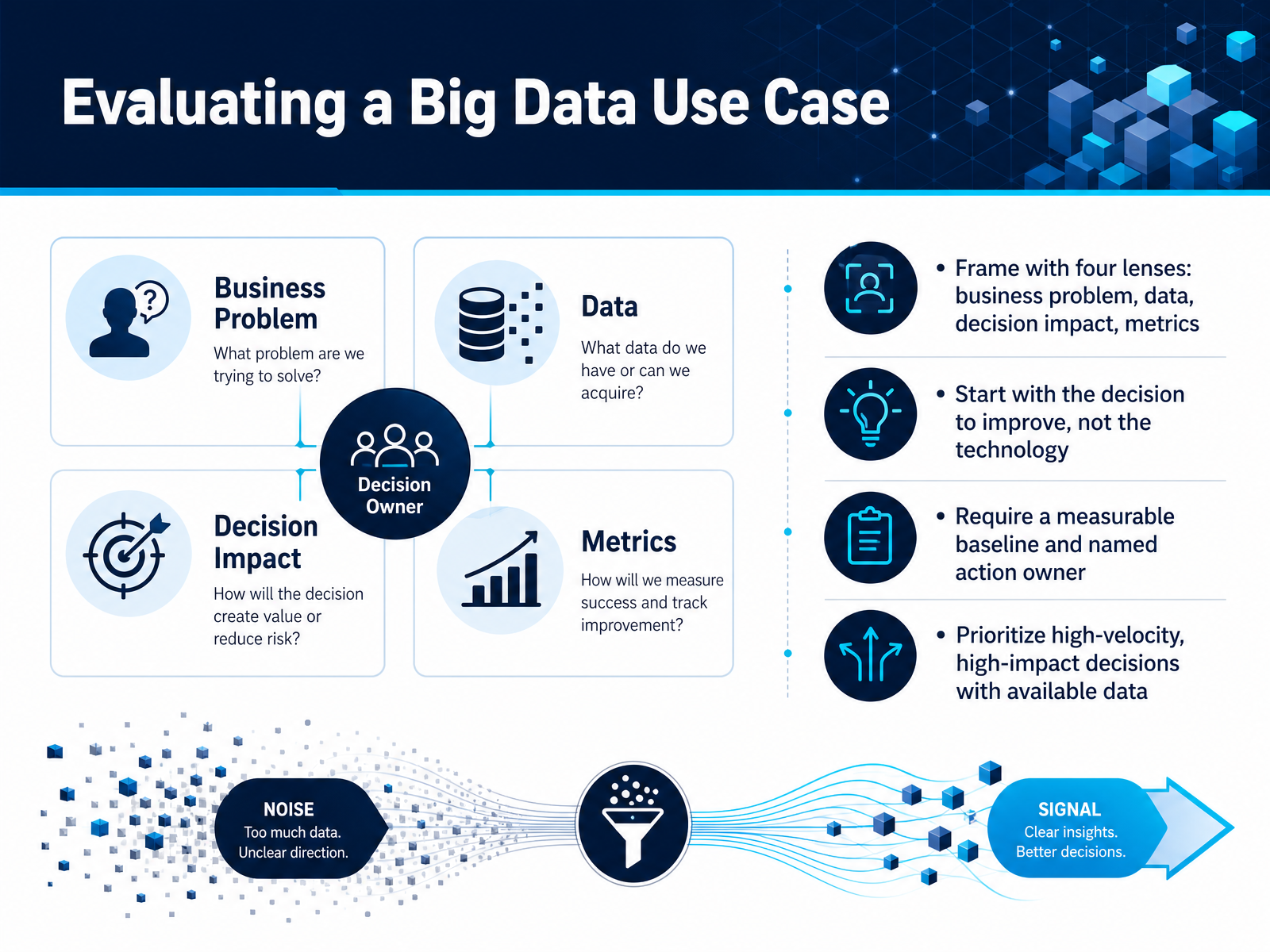
1 min - 13Evaluating a Big Data Use CaseSo, how do you prevent a big data initiative from becoming another failed project? Start with a disciplined evaluation framework. But that may sound abstract, so let's make it practical. Frame every use case through four lenses. First, the business problem. Second, the data available. Third, the decision impact. And fourth, the metrics that will prove value. Now, the most critical step comes first. Begin with the decision you want to improve, not the technology. If you cannot name the specific decision, you do not have a project; you have an experiment in search of a problem. Once the decision is clear, you need two non-negotiables. A measurable baseline that captures current performance, and a named owner who is accountable for acting on the insight. Without an owner, even a perfect model becomes shelfware because no one is responsible for changing the workflow. Finally, prioritize ruthlessly. Focus on decisions that are high velocity and high impact, and where the data is accessible today. This forces you to sequence investments for maximum ROI, building momentum instead of an expensive data lake that no one uses. In short, be an analyst about your analytics portfolio. When you evaluate opportunities with this discipline, you stop funding technology and start investing in outcomes.
 1 min
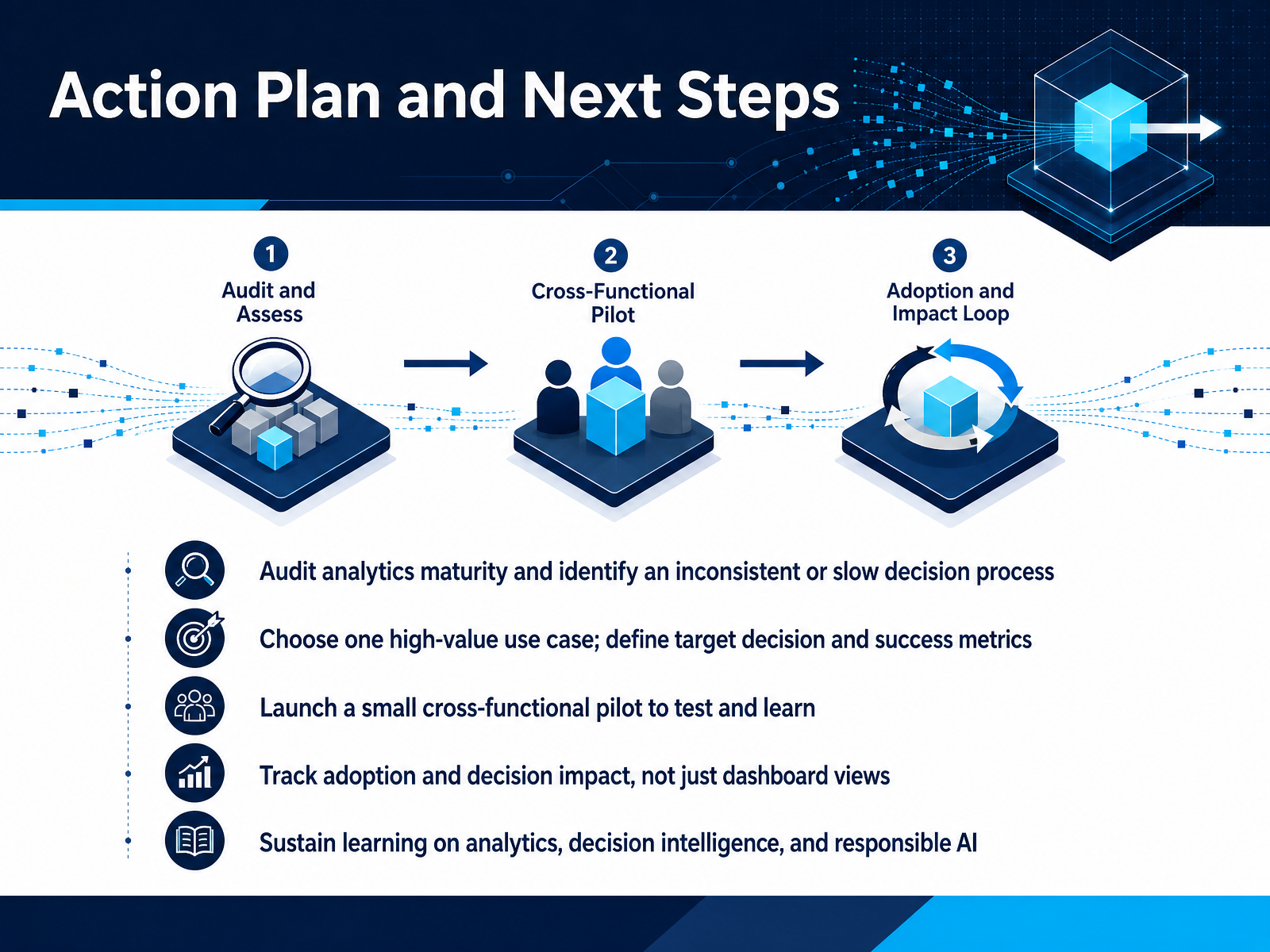
1 min - 14Action Plan and Next StepsSo here is how you turn this into action. Start by auditing your analytics maturity and find one decision that is slow, inconsistent, or buried in guesswork. Pick a single high-value use case. Define the target decision explicitly and set success metrics tied to revenue, cost, or risk. Launch a small cross-functional pilot. Keep the scope tight so you can test and learn quickly. Then track adoption and decision impact. Dashboard views do not count. What matters is whether the new insight changes behavior and outcomes. Finally, sustain the learning. Invest in decision intelligence, analytics capability, and responsible AI governance—not as projects, but as ongoing disciplines. The goal is not to build more reports. It is to make better, faster, and more defensible decisions. Start small, measure what matters, and scale what works. Thank you for your time, and go put this into practice.
 2 min
2 min
Take the deck with you
Download this course as a file — free, no sign-up needed.
- PDF handoutEvery slide page, ready to print or share.15 pages · 3.8 MBDownload
- Narrated PowerPointThe deck that presents itself — every slide carries the digital human's narration video.15 pages · 16.8 MBDownload
- PowerPoint slidesThe full deck as a .pptx — open it in PowerPoint, Keynote, or Google Slides.15 pages · 3.7 MBDownload
Free to use in your own training — please keep the PersonWise credit page at the end.
Have your own deck? Turn it into a course
Sources consulted
Web sources consulted while building this course.
- What is Big Data Analytics? — ibm.com
- Big Data Analytics Guide: Meaning, Types, Tools, Applications Explained — analyticsinsight.net
- Big Data Analytics and Business Intelligence: A Comparison | TechTarget — techtarget.com
- What Is Big Data Analytics? Definition, Benefits, and More — coursera.org
- Big Data Analytics for Business in 2026: Complete Guide — aisuperior.com
- AI-Driven Predictive Analytics for Supply Chain Resilience, Financial Risk Management, and Digital Marketing Strategy: A Unified Business Intelligence Framework — doi.org
- LLMs for Integrated Business Intelligence: A Big Data-Driven Framework Integrating Marketing Optimization, Financial Performance, and Audit Quality — mdpi.com
- How WPP operationalizes platform and data engineering for AI marketing | Google Cloud Blog — cloud.google.com
- AI-Driven Predictive Analytics for Supply Chain Resilience, Financial Risk Management, and Digital Marketing Strategy: A Unified Business Intelligence Framework | Journal of Business and Management Studies — al-kindipublisher.com
- Connecting retail demand planning to campaign and store execution | Databricks Blog — databricks.com
- Modern Data Stack 2026: Complete Guide to Tools & Architecture | Modern DataTools — modern-datatools.com
- How to Build a Modern Data Stack in 2026 | A Practitioner's Guide | Modern DataTools — modern-datatools.com
- Data Lakehouse Architecture: Complete Guide for Enterprise Teams 2026 — promethium.ai
- Data Warehouse Architecture in 2026: Lakehouse, Streaming, and the End of the Three-Tier Model — bigdataboutique.com
- Modern Data Architecture in 2026: Lakehouse, Fabric, Mesh — and Why It All Matters for AI — addepto.com
- Cisco 2026 Data and Privacy Benchmark Study — cisco.com
- Managing Data Risk in the Age of Agentic AI | BCG — bcg.com
- ISACA Now Blog 2026 Five Questions Leaders Should Answer Before Piloting Advanced AI or Quantum Enabled Systems — isaca.org
- Governing AI in 2026: — onetrust.com
- CDO Insights 2026: The AI Trust Gap for CDOs — informatica.com