Begin
14 pages · ~28 min
Personal Identity Over Time
This training explores personal identity and what makes you the same person over time. It helps learners examine continuity of self across change.
A digital instructor presents all 14 pages. Hold “Ask” at any point and ask out loud — the answer comes from this course. No sign-up needed.
What you’ll learn
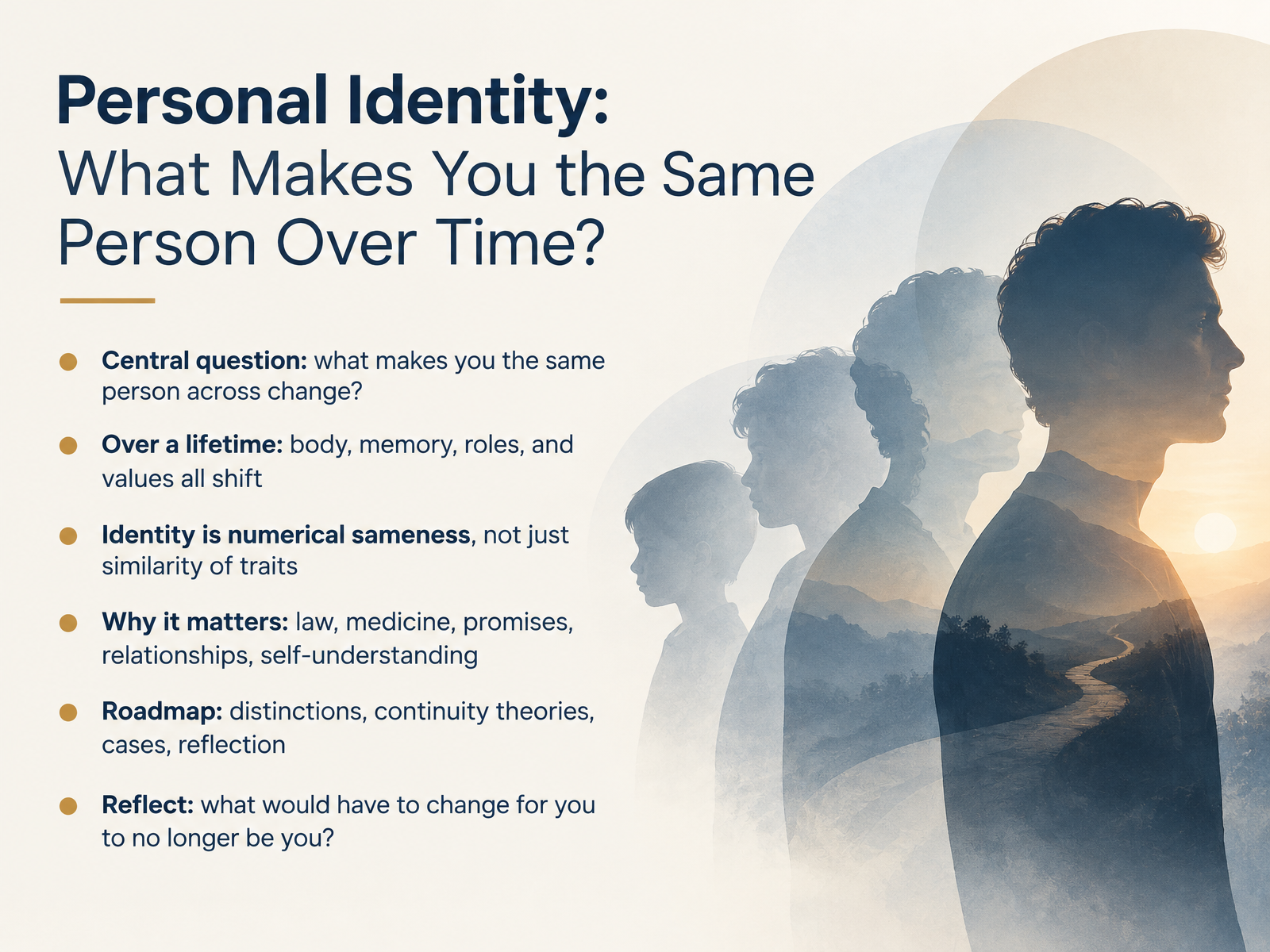
- 01Personal Identity: What Makes You the Same Person Over Time?Welcome. I'm glad you're here. Let's start with a question. Are you the same person you were ten years ago? Most of us say yes. And yet almost everything about you has changed. Your body, your memories, your roles, your values. So what makes you the same person across all that change? That is our central question. Now, here is one key distinction. Identity means numerical sameness, not just similarity of traits. You are one person, not a series of lookalikes, even if you feel very different from who you used to be. And this is not just abstract. It matters for law, for medicine, for promises, for relationships, and for how you understand yourself. Does that make it easy? Honestly, no. These questions are genuinely hard, and uncertainty is part of the inquiry, not a sign that you are failing to understand. Over the next slides we will look at key distinctions, continuity theories, puzzling cases, and time for reflection. But let me leave you with this. What would have to change for you to no longer be you? Next, let's explore why the question matters.plato.stanford.eduplato.stanford.eduplato.stanford.edu+22 min
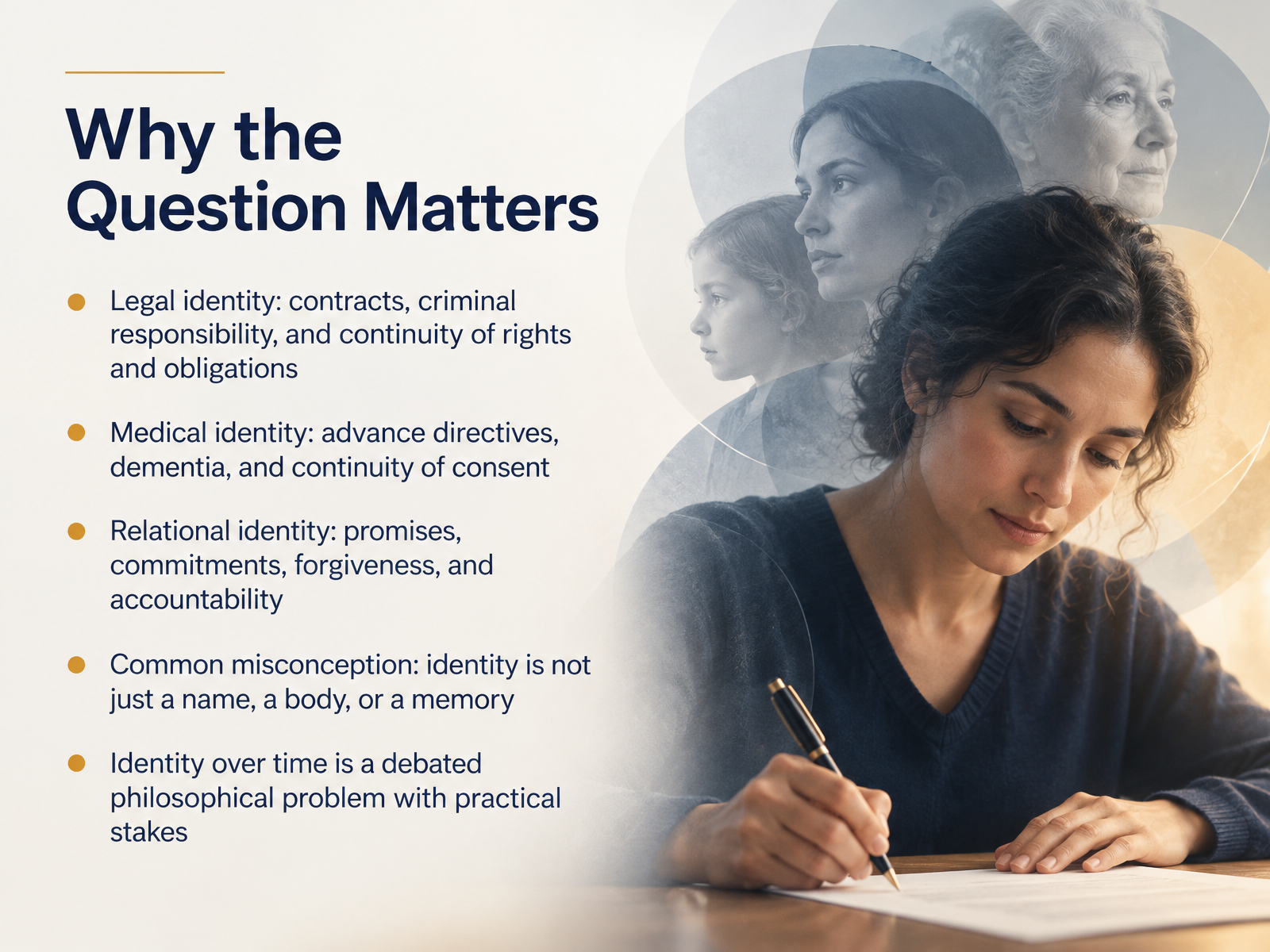
- 02Why the Question MattersLet's talk about why this question actually matters. Have you ever signed a contract, or made a promise you're still expected to keep years later? Think about what that assumes. It assumes you are still the same person who made that commitment.
In law, identity over time carries real weight. Contracts, criminal responsibility, and the continuity of your rights all depend on it. In medicine, it shows up with advance directives. If someone develops dementia and no longer remembers writing one, should we still honor what they asked for? In our relationships, it shapes promises, forgiveness, and accountability.
And here's a common misconception. Identity is not just a name, a body, or a memory. Those things can change, yet we still treat someone as the same person.
So identity over time is genuinely debated. We don't have one settled answer, and that uncertainty is part of the inquiry, not a failure to understand. But the stakes are practical, not just theoretical.
Next, let's lay out the core concepts and distinctions.
 plato.stanford.eduplato.stanford.eduplato.stanford.edu+21 min
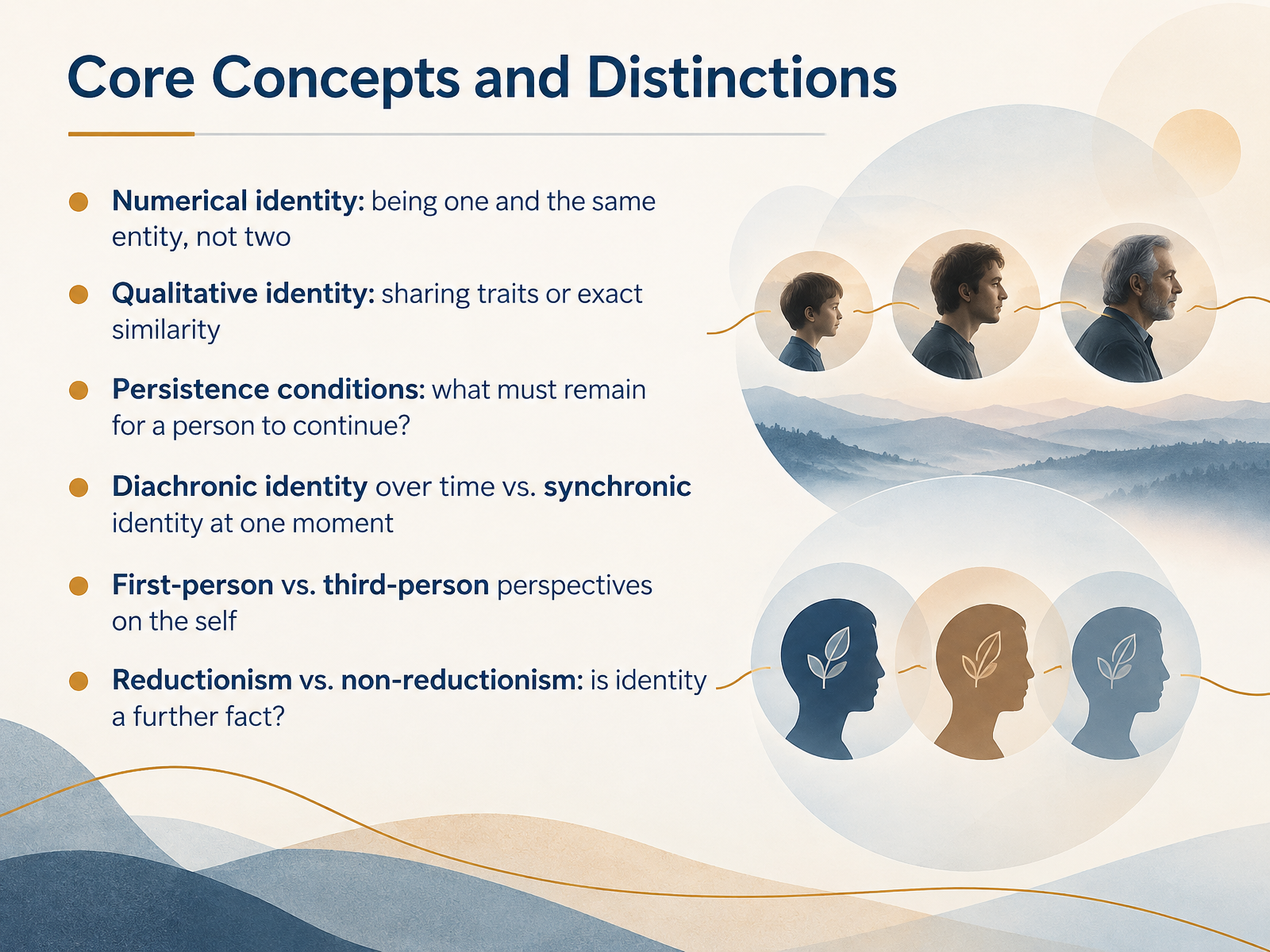
- 03Core Concepts and DistinctionsLet's slow down and get clear on some core terms. Here's a question to start with. Imagine two identical red cars sitting side by side. Same color, same model, same year. Are they the same car? In one sense, yes, they're exactly alike. In another sense, no, there are two cars, not one. That's the difference between qualitative identity, sharing traits, and numerical identity, being one and the same thing. Personal identity is about numerical identity. It asks what must remain for you to keep existing over time. We call that your persistence conditions. And notice a related split. Diachronic identity is identity across time. Synchronic identity holds at a single moment. There's also a difference in perspective. From the first person, you feel like you. From the third person, others track a body and a life story. Finally, reductionism says identity just consists in facts like memory or biology. Non-reductionism says it's a further fact, not reducible to anything else. These are genuinely hard questions, and uncertainty here isn't confusion. It's part of the inquiry. Next, we'll look at the psychological continuity view, which answers the persistence question with memory, belief, and character.
 plato.stanford.eduplato.stanford.eduplato.stanford.edu+22 min
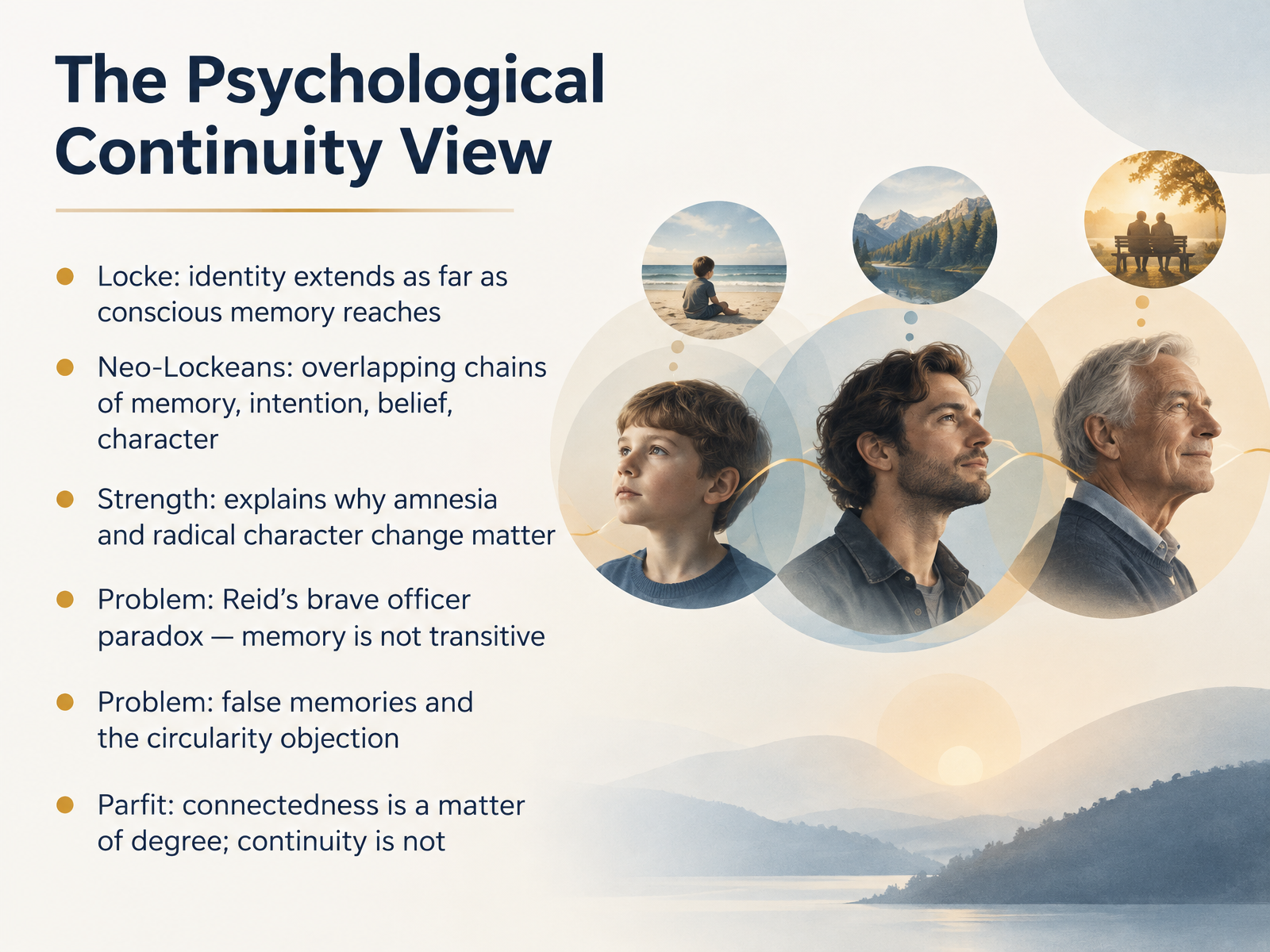
- 04The Psychological Continuity ViewNow, where does memory fit into all this? John Locke offered a bold answer. Personal identity extends as far as your conscious memory reaches. Remember a past experience, and you are the same person who had it.
Take that idea seriously. If you lose all memory of an act, Locke suggests you are no longer the person who did it. That is a striking claim.
Later thinkers, the Neo-Lockeans, expanded this. Identity isn't only memory. It's overlapping chains of memory, intention, belief, and character.
So what's the appeal? It explains why amnesia and radical character change matter to us. They seem to break who we are.
But there are puzzles. Consider Reid's brave officer. As a forty year old officer, he remembers being flogged as a boy. As an old general, he remembers taking the standard, but not the flogging. Memory doesn't carry through. Yet identity is supposed to be transitive. If the boy equals the officer, and the officer equals the general, the general should equal the boy.
And there's another worry. False memories, and the circularity objection. Memory might already presuppose identity, so it can't create it.
Derek Parfit offered a way out. Psychological connectedness comes in degrees. Continuity, not identity, is what matters. Sit with that, because it changes everything we'll ask next.
Let's now turn to the Bodily Continuity View.
 plato.stanford.eduplato.stanford.edulink.springer.com+22 min
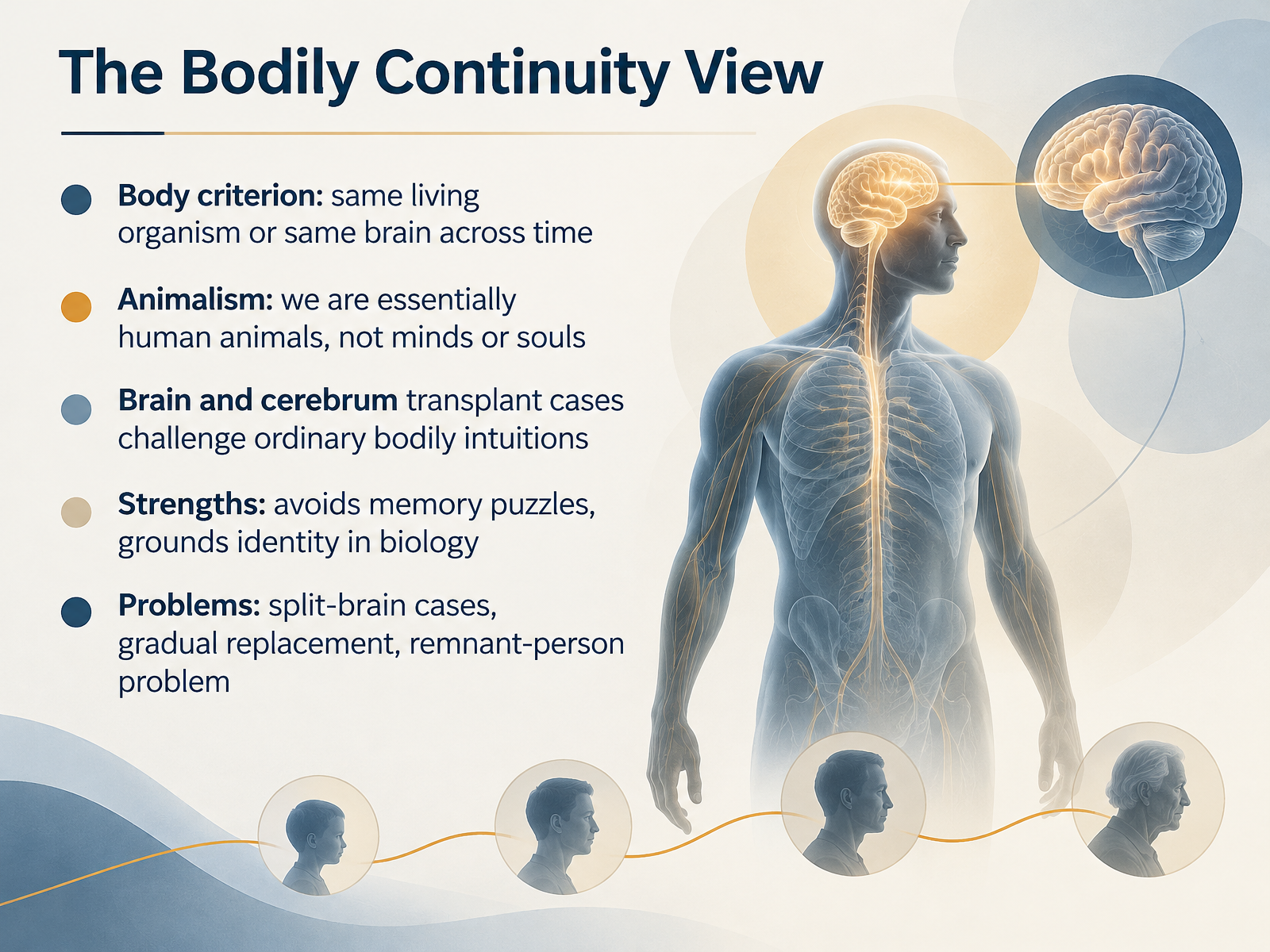
- 05The Bodily Continuity ViewLet's turn to the bodily continuity view. Here's the core question. What if you are not your memories, but your living body? On this view, you stay the same person as long as the same living organism, or the same brain, continues on. Philosophers call this animalism. It says we are essentially human animals, not minds or souls. Now, brain transplant cases really test this. If your brain went into another body, who wakes up? Most people say you do, which challenges our ordinary bodily intuitions. The strengths here are real. It avoids memory puzzles and grounds identity in biology. But problems remain, like split-brain cases, gradual cell replacement, and the remnant-person problem. These questions are genuinely hard, and that's fine. Uncertainty is part of the inquiry. Next, we'll explore thought experiments and puzzles.
 plato.stanford.edulink.springer.comrep.routledge.com+21 min
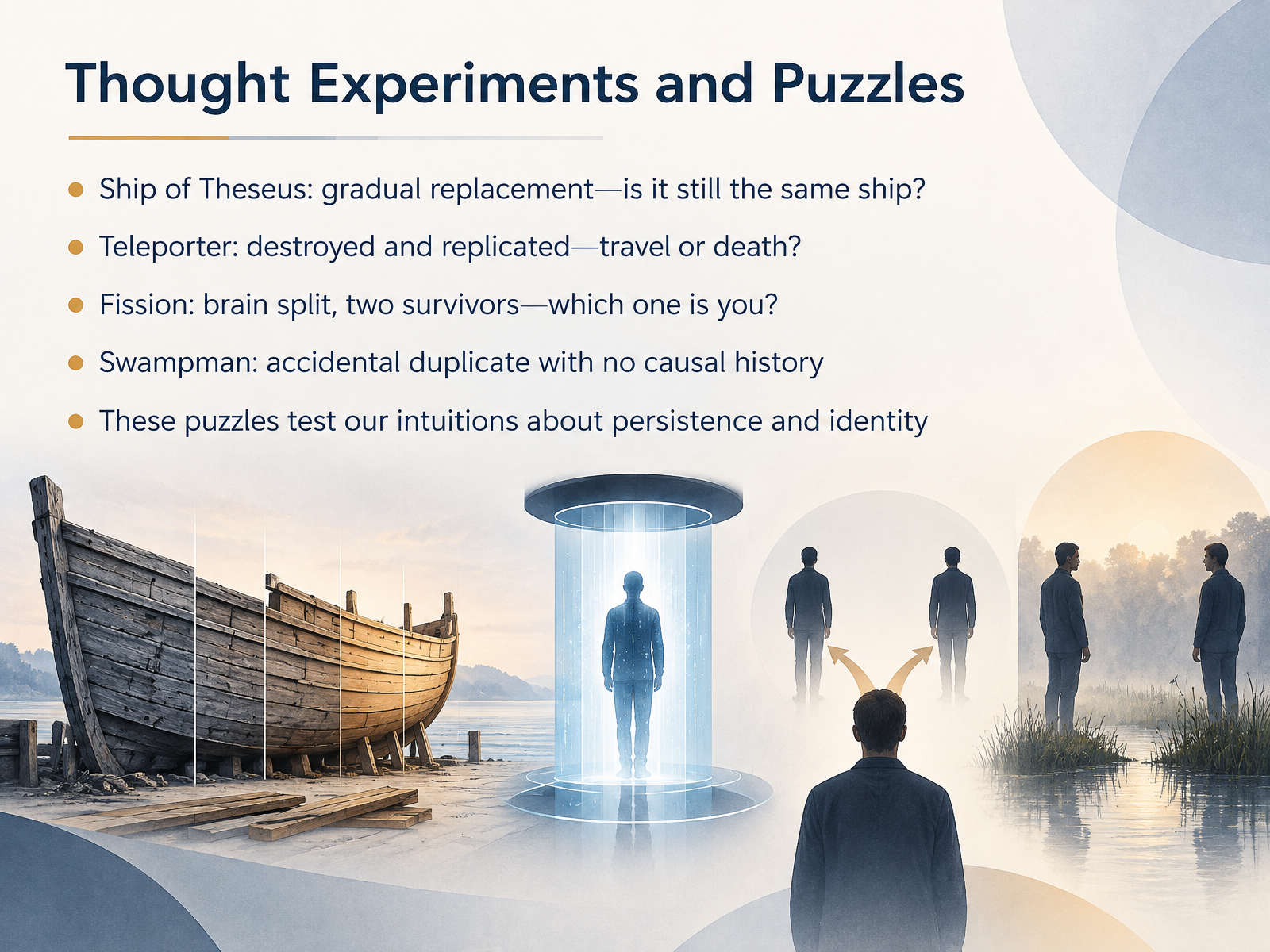
- 06Thought Experiments and PuzzlesLet's put those ideas to work with some puzzles. Have you ever wondered how much of you could change and still be you? Take the Ship of Theseus. Over the years, every plank is replaced. Is it still the same ship? Now the teleporter. It destroys your body and builds an exact copy on Mars. Is that travel, or death? Then fission. Your brain is split, and two survivors wake up, each with your memories. Which one is you? And Swampman, a perfect duplicate that appears by accident, with no causal history. These puzzles test our intuitions about persistence and identity. Notice how each one presses on the same question. What has to stay the same for you to stay you? And be honest. If you feel torn, that's not failure. It's the puzzle doing its job. Next, we turn to narrative identity and the self over time.
 plato.stanford.eduiep.utm.eduen.wikipedia.org+21 min
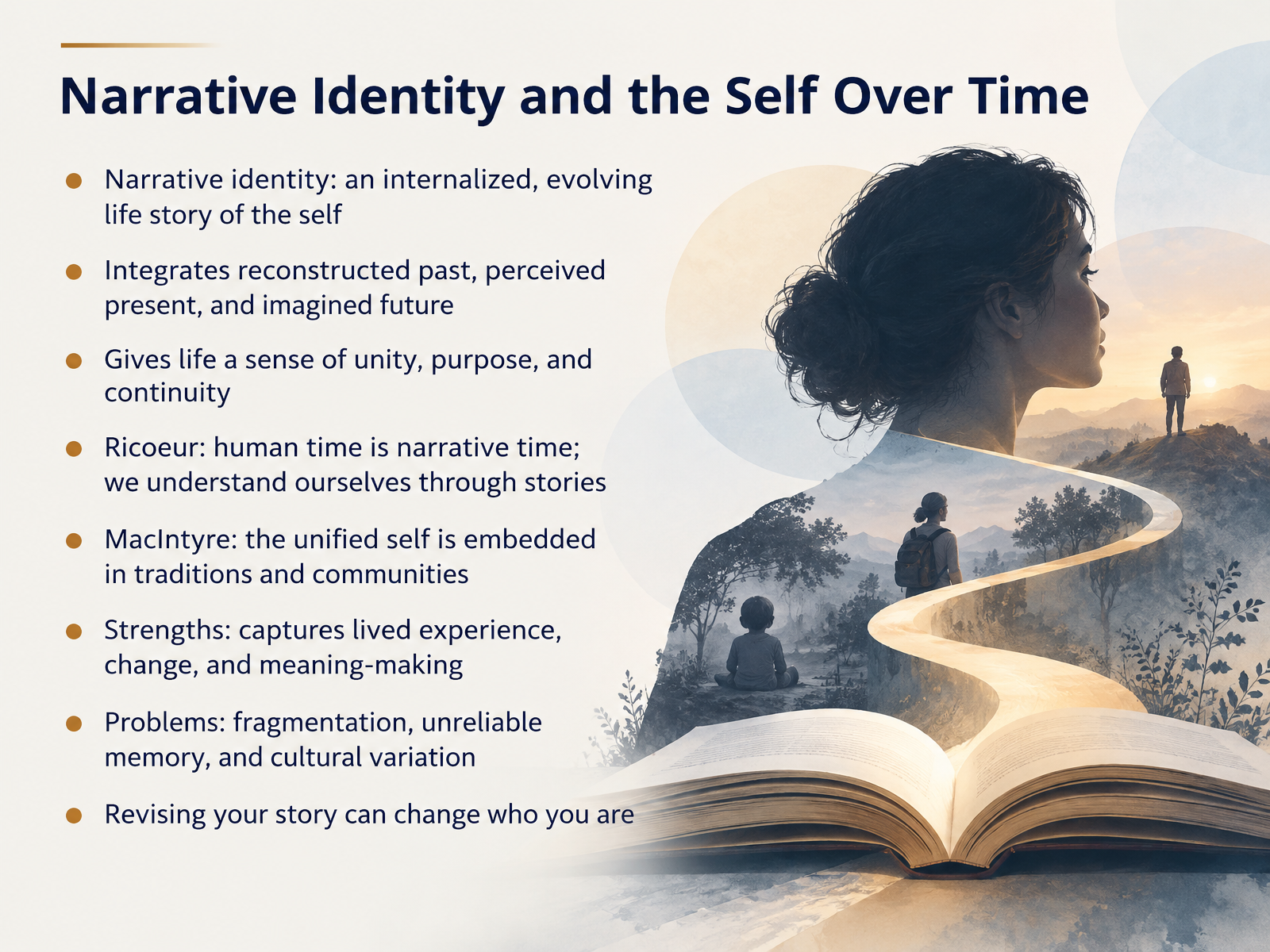
- 07Narrative Identity and the Self Over TimeLet me ask you something. When you think about who you are, do you think in facts, or in stories? Most of us answer with stories. That is the heart of narrative identity. It is an internalized, evolving life story of the self. It weaves together your reconstructed past, your perceived present, and your imagined future. And it gives your life a sense of unity, purpose, and continuity. The philosopher Paul Ricoeur put it this way. Human time is narrative time. We understand ourselves through stories. Alasdair MacIntyre adds that this unified self is embedded in traditions and communities. You are not writing your story alone. So what are the strengths here? Narrative identity captures lived experience, change, and meaning-making. But there are real problems too. Our stories can fragment. Memory is unreliable. Cultures tell stories differently. And here is a hopeful thought. Revising your story can change who you are. Your story is not fixed. It is something you can rewrite. Next, we look at identity, memory, and change in real life.
 journals.sagepub.comjbe-platform.com2 min
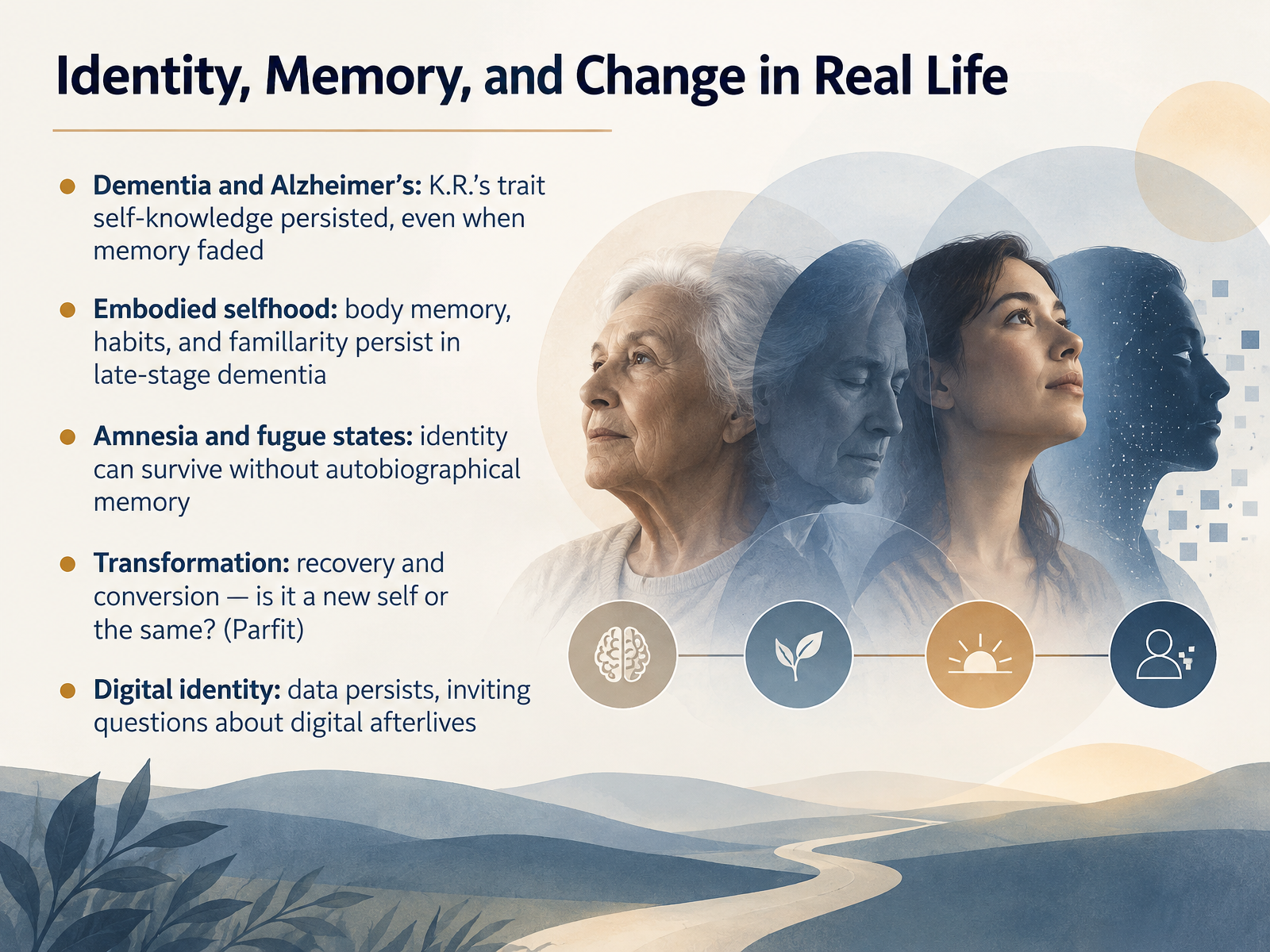
- 08Identity, Memory, and Change in Real LifeSo how do these puzzles play out in real life? Think of someone you love who is living with dementia. Are they still the same person? Consider K.R., a woman with advanced Alzheimer's. She could barely recall everyday facts, like what a clock looks like. Yet she still knew her own personality traits accurately. Interestingly, the self she described was her self before the illness. She couldn't update that picture.
And memory isn't the whole story. Even in late-stage dementia, body memory tends to persist. Habits, familiar places, a comforting melody, the warmth of a familiar hand. People with amnesia show something similar. Identity can survive without autobiographical memory.
What about dramatic transformation? Recovery, conversion, a total change in values? The philosopher Derek Parfit asked whether that is a new self or the same one. And now we have digital identity. Our data outlives our memories, which raises the question of digital afterlives.
Here's your takeaway. Identity comes in layers, not all or nothing. Some layers fade while others endure.
Let's turn to a case that puts these ideas to work: Case Study: Dementia, Consent, and Advance Directives.
 2 min
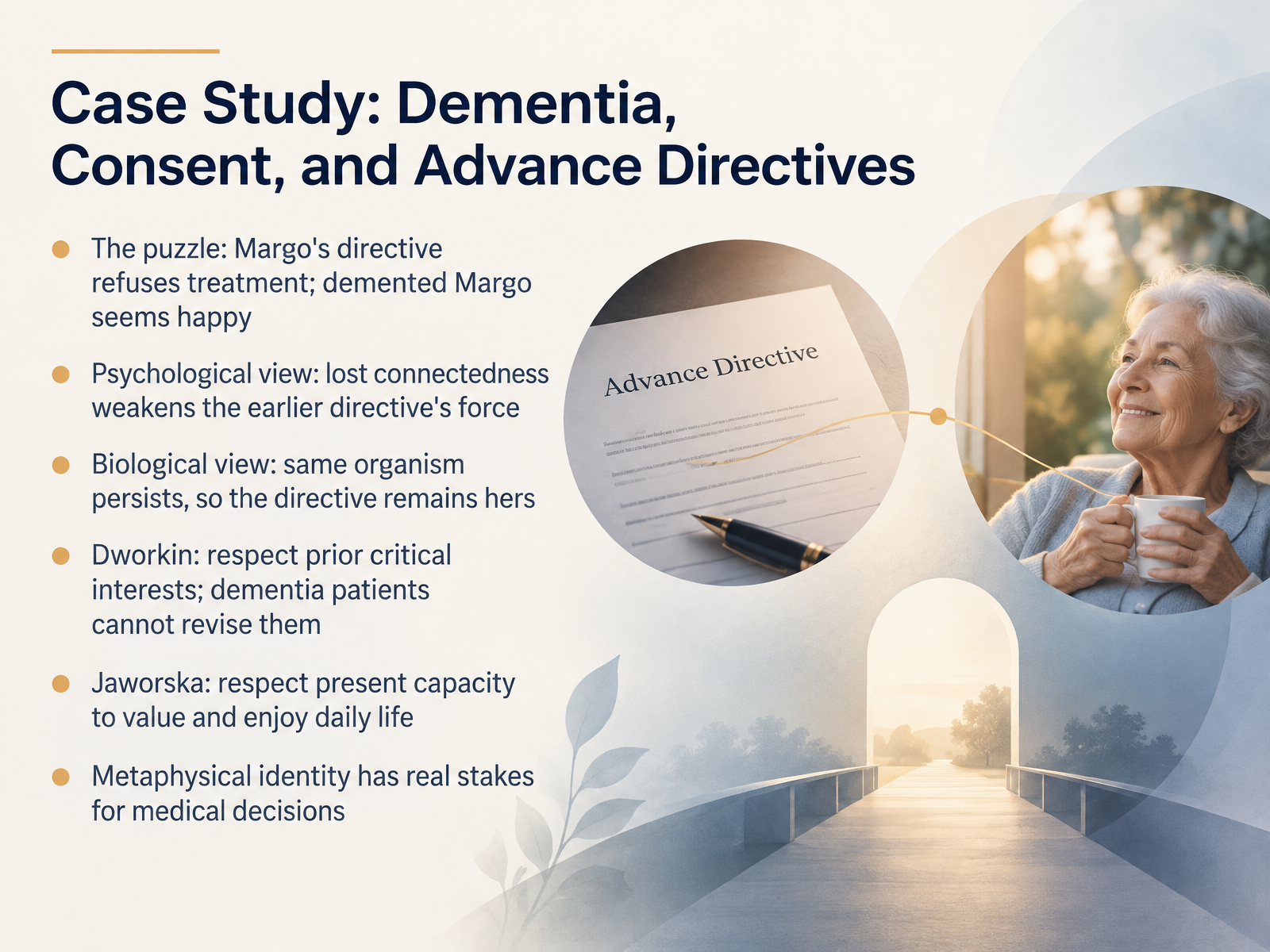
- 09Case Study: Dementia, Consent, and Advance DirectivesLet's look at a case that brings all of this down to real decisions. Imagine Margo. When she was fully competent, she wrote an advance directive. If she ever developed severe dementia, she wanted no life-saving treatment. Years later, she has dementia. She gets pneumonia. But here's the wrench in the works: she seems genuinely happy. She enjoys her mornings, her music, her visitors. So should her doctors follow the directive? The psychological view says the deep psychological connections are broken, so the earlier directive has less force. The biological view says the same organism persists, so it's still her directive. Ronald Dworkin argues we should respect Margo's prior critical interests, her considered judgments about her life as a whole, because she can no longer revise them. Agnieszka Jaworska pushes back. She says what matters is Margo's present capacity to value, to enjoy and find meaning in her daily life, and that shouldn't be dismissed. Notice what's at stake. This isn't abstract. Metaphysical identity shapes real medical decisions. Next, we'll see how these same questions play out in responsibility, amnesia, and identity.
 2 min
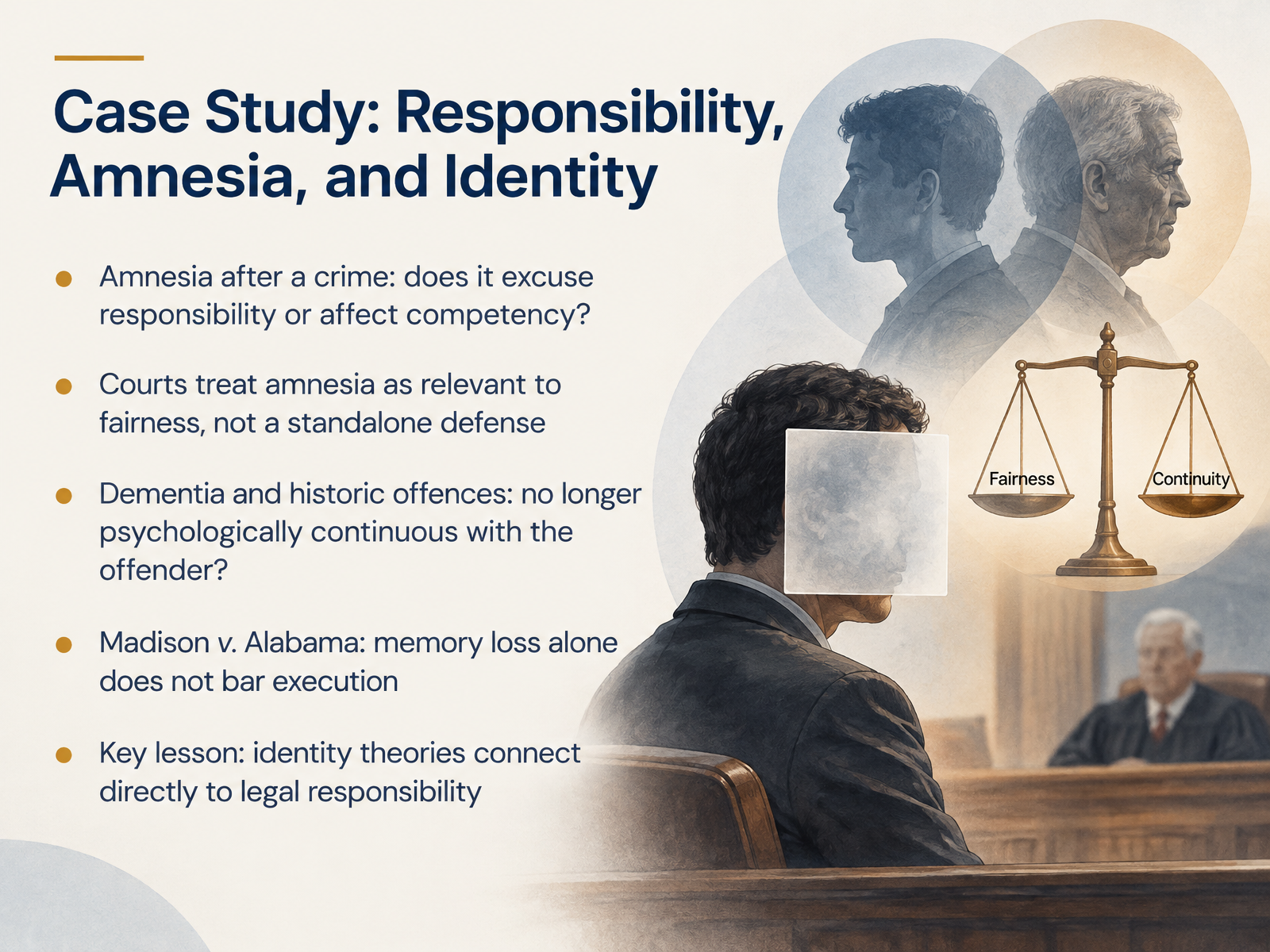
- 10Case Study: Responsibility, Amnesia, and IdentityNow, let's bring these ideas into the courtroom. Suppose someone commits a crime, then develops amnesia. Does that erase responsibility? Courts say no. Amnesia is not a standalone defense. It matters mainly for fairness. If you cannot remember the event, you may not be able to help your lawyer, identify witnesses, or challenge the evidence against you. Notice something important here. The crime may still have been fully intentional at the time. Losing the memory later does not rewrite that moment. But now think about dementia and historic offences. Here the question gets harder. If someone no longer remembers who they were, are they still psychologically continuous with the person who acted? Some argue no. If identity breaks, responsibility may weaken too. In Madison versus Alabama, the Supreme Court ruled that memory loss alone does not bar execution. Courts ask whether a person can rationally understand why they are being punished. So what is the key lesson? Our theories of identity connect directly to legal responsibility. How much continuity must remain before we still hold someone accountable?
 2 min
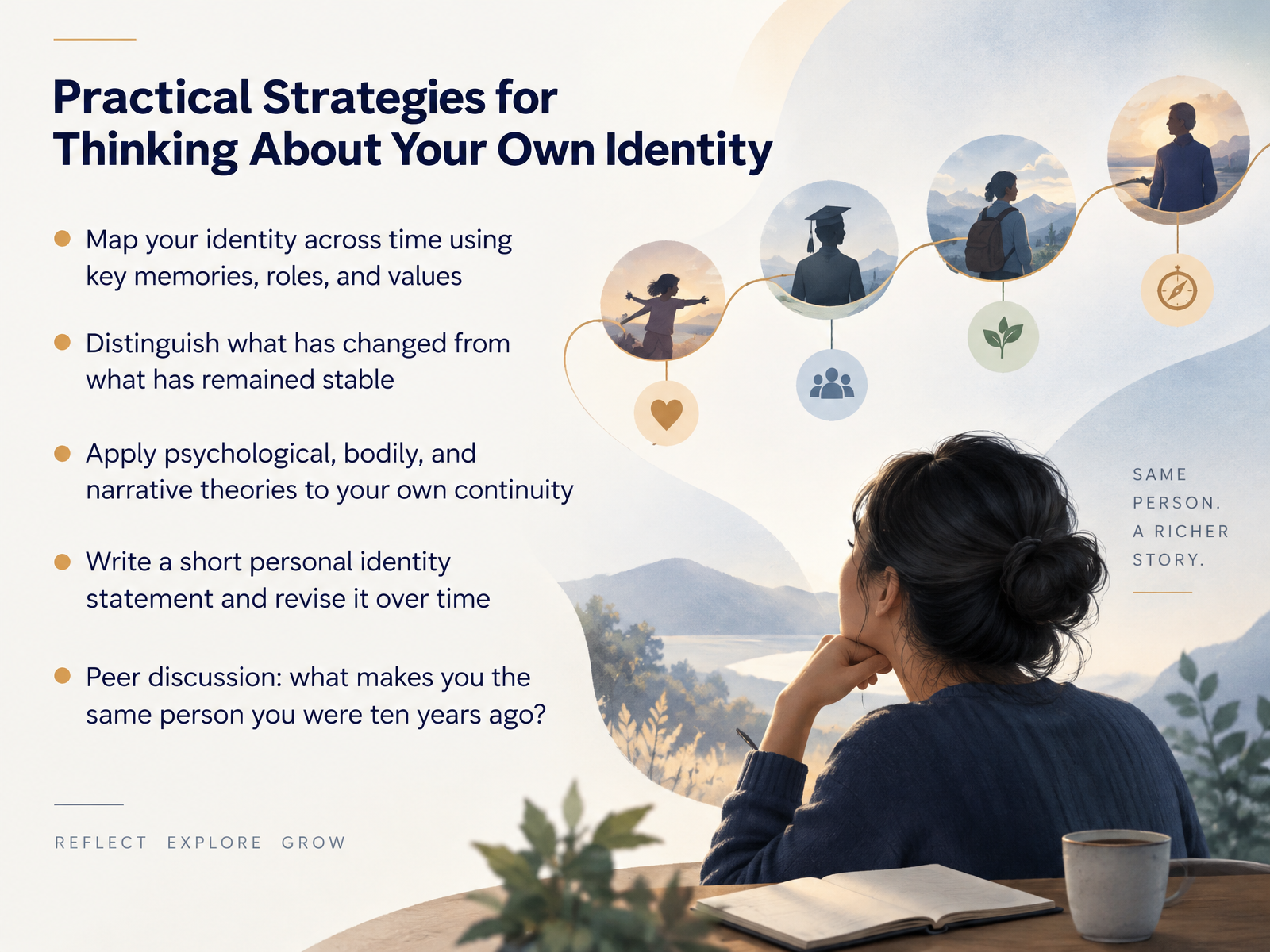
- 11Practical Strategies for Thinking About Your Own IdentitySo how do you actually use all this on yourself? Here are some practical strategies. First, map your identity across time. Write down a few key memories, the roles you play, and the values you hold. Which ones show up again and again? That repetition is a clue to what has stayed with you. Second, separate what has changed from what has remained stable. You might be a different person than you were ten years ago in habits or beliefs, yet still care about the same people. That is not a contradiction. It is what continuity often looks like. Third, try applying the theories directly to your own life. Ask what your body remembers, what your psychology keeps, and what your story ties together. Then write a short personal identity statement, just a few sentences, and revise it over time as you change. Finally, talk about it. In peer discussion, ask each other: what makes you the same person you were ten years ago? You may not agree on the answer, and that is fine. The point is not certainty. It is noticing your own reasoning. Next, let's compare these theories, looking at their strengths and weaknesses.
 journals.sagepub.comjbe-platform.com2 min
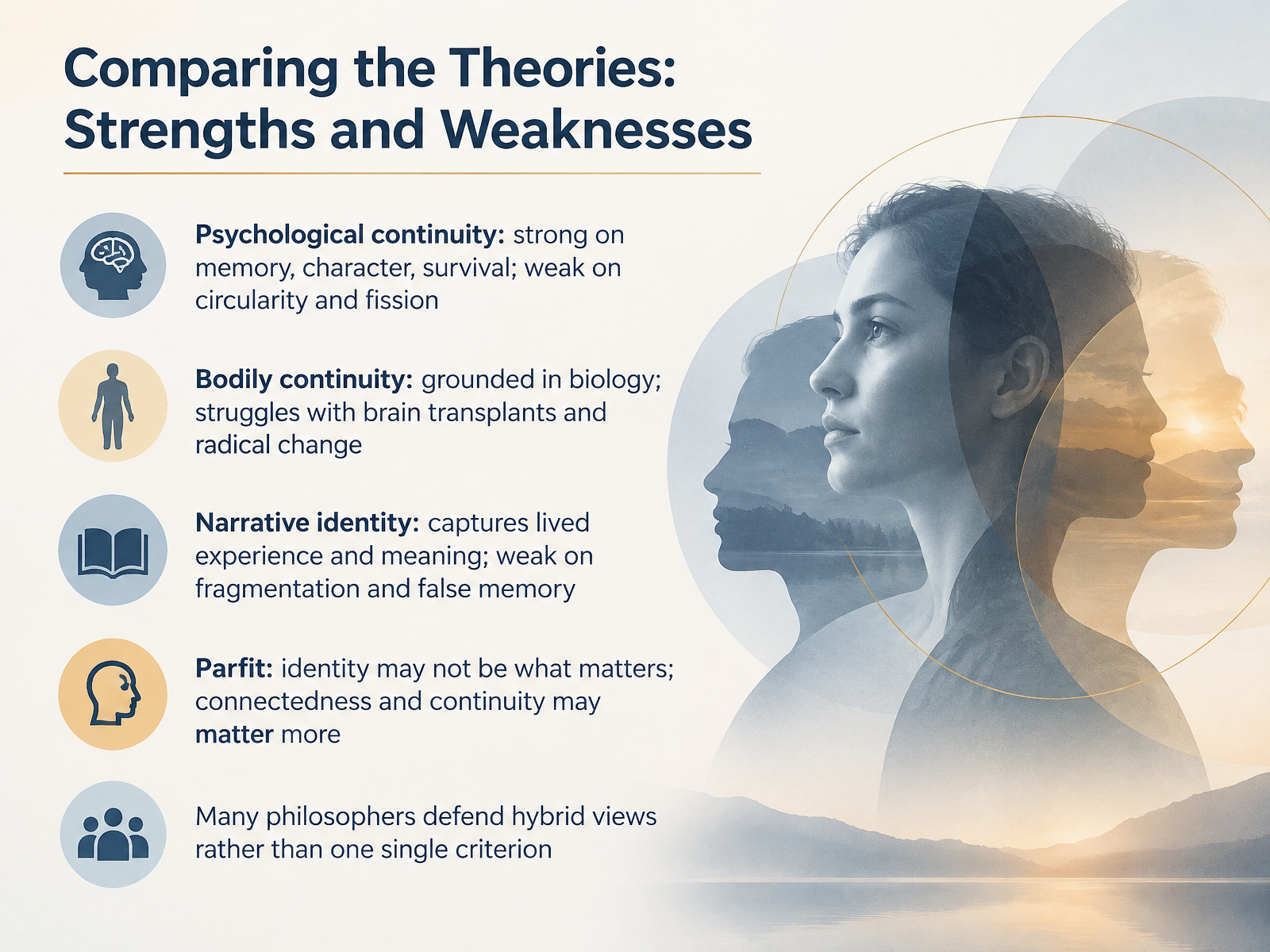
- 12Comparing the Theories: Strengths and WeaknessesSo let's step back and compare these theories. Which one actually holds up? Start with psychological continuity. Its strength is real. It captures memory, character, and what we care about in survival. But it struggles with two problems. One is circularity: explaining memory without already assuming a persisting self. The other is fission, where one person seems to branch into two. Bodily continuity is grounded in biology, which is a genuine advantage. But it strains with brain transplants and radical bodily change. Narrative identity captures lived experience and meaning. Its weakness? Fragmentation, and the worry that false memories can still build a coherent story. Now here's Parfit's bold move. Maybe identity is not what matters. Maybe connectedness and continuity matter more. And notice, many philosophers defend hybrid views. They combine criteria rather than betting everything on one. That uncertainty is not a failure. It is honest. Next, assessment and key takeaways.
 plato.stanford.eduplato.stanford.eduplato.stanford.edu+22 min
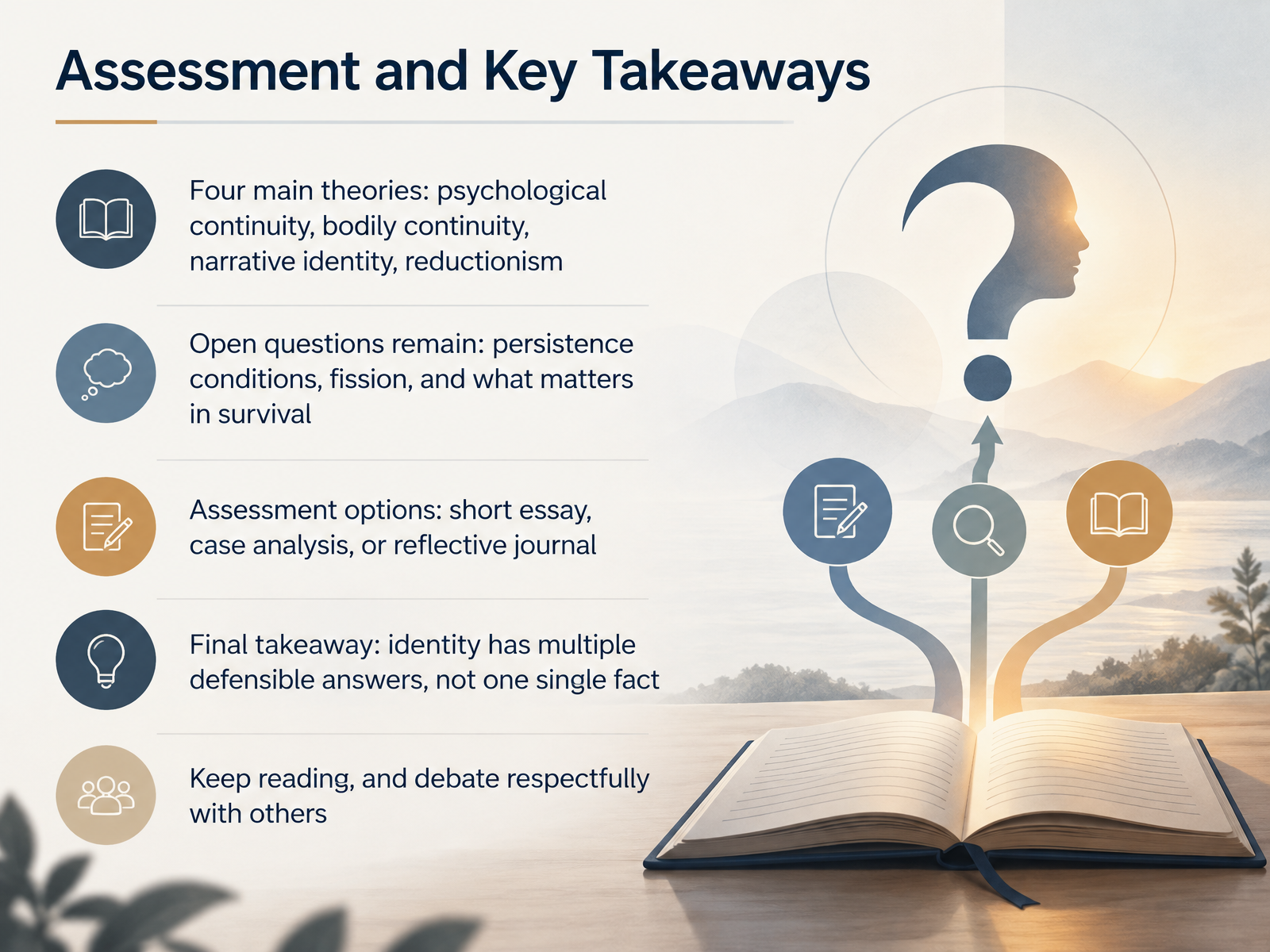
- 13Assessment and Key TakeawaysSo, how do you pull all of this together? First, keep the four main theories in view. Psychological continuity. Bodily continuity. Narrative identity. And reductionism. Each one answers the persistence question differently, and each has real strengths and real problems. Second, notice what stays open. The persistence conditions themselves, fission cases, and the deeper question of what actually matters in survival. Those debates are not settled. And that is not a failure on your part.
Now, how will you show your thinking? You have three options. A short essay. A case analysis. Or a reflective journal. Pick the one that fits how you reason best.
Here is the final takeaway. Identity has multiple defensible answers. Not one single fact you either get right or wrong. So keep reading, and debate respectfully with others. Next, we will look at further reading and next steps.
 plato.stanford.eduiep.utm.eduplato.stanford.edu+22 min
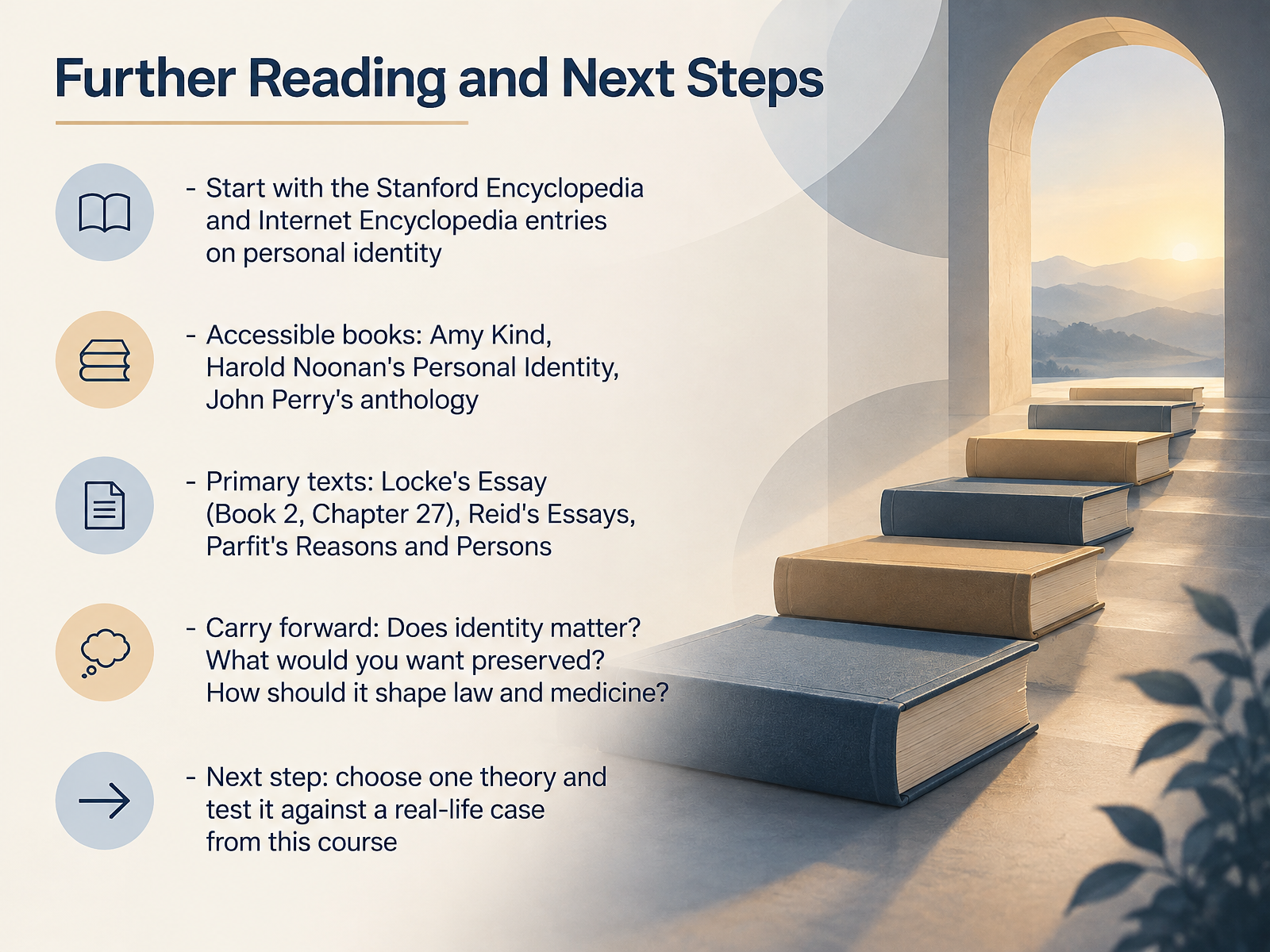
- 14Further Reading and Next StepsSo, where do you go from here? If you want a trustworthy starting point, begin with the Stanford Encyclopedia and the Internet Encyclopedia entries on personal identity. They are free, detailed, and regularly updated. For a friendlier path, try Amy Kind's Persons and Personal Identity, Harold Noonan's Personal Identity, or John Perry's anthology, which gathers Locke, Reid, Hume, and others in one place. If you feel ready for the primary texts, sit with Locke's Essay, Book Two, Chapter Twenty-Seven, Reid's Essays, and Parfit's Reasons and Persons. Here is your next step. Choose one theory we covered. Then test it against a real-life case from this course. Ask yourself: does identity actually matter? What would you want preserved? And how should these answers shape law and medicine? You will not settle every question today. But you can leave with a sharper one. Thank you for thinking carefully with me through this course. Keep asking, keep testing, and trust that uncertainty is part of the work.
 plato.stanford.eduiep.utm.eduplato.stanford.edu+12 min
Take the deck with you
Download this course as a file — free, no sign-up needed.
- PDF handoutEvery slide page, ready to print or share.15 pages · 3.8 MBDownload
- Narrated PowerPointThe deck that presents itself — every slide carries the digital human's narration video.15 pages · 14.8 MBDownload
- PowerPoint slidesThe full deck as a .pptx — open it in PowerPoint, Keynote, or Google Slides.15 pages · 3.8 MBDownload
Free to use in your own training — please keep the PersonWise credit page at the end.
Have your own deck? Turn it into a course
Sources consulted
Web sources consulted while building this course.
- Personal Identity (Stanford Encyclopedia of Philosophy) — plato.stanford.edu
- Identity Over Time (Stanford Encyclopedia of Philosophy) — plato.stanford.edu
- Identity (Stanford Encyclopedia of Philosophy) — plato.stanford.edu
- Personal Identity | Internet Encyclopedia of Philosophy — iep.utm.edu
- Identity (philosophy) — en.wikipedia.org
- Locke on Personal Identity (Stanford Encyclopedia of Philosophy) — plato.stanford.edu
- Reid on Memory and Personal Identity — plato.stanford.edu
- The Brave Officer Rides Again — link.springer.com
- John Locke on Personal Identity ** — pmc.ncbi.nlm.nih.gov
- Personal identity - Routledge Encyclopedia of Philosophy — rep.routledge.com
- Animalism (Stanford Encyclopedia of Philosophy) — plato.stanford.edu
- Thought experiments, sentience, and animalism | Synthese | Springer Nature Link — link.springer.com
- Personal identity - Routledge Encyclopedia of Philosophy — rep.routledge.com
- Head Transplants and Personal Identity: A Philosophical and ... — pmc.ncbi.nlm.nih.gov
- The remnant-person problem — eprints.whiterose.ac.uk
- Teletransportation paradox — en.wikipedia.org
- https://www.pure.ed.ac.uk/ws/files/20119607/counterpart_theory_and_occasional_identity.pdf — pure.ed.ac.uk
- The Unimportance of Identity — pdf.stafforini.com
- Narrative Identity - Dan P. McAdams, Kate C. McLean, 2013 — journals.sagepub.com
- Virtuous selves in vicious times: Alasdair MacIntyre on narrative identity | John Benjamins — jbe-platform.com