Building a Sales Enablement Team
Begin
13 pages · ~26 min
Building a Sales Enablement Team
This training guides sales leaders through a practical workflow for building a sales enablement team, covering key steps to structure, staff, and launch the function effectively.
What you’ll learn
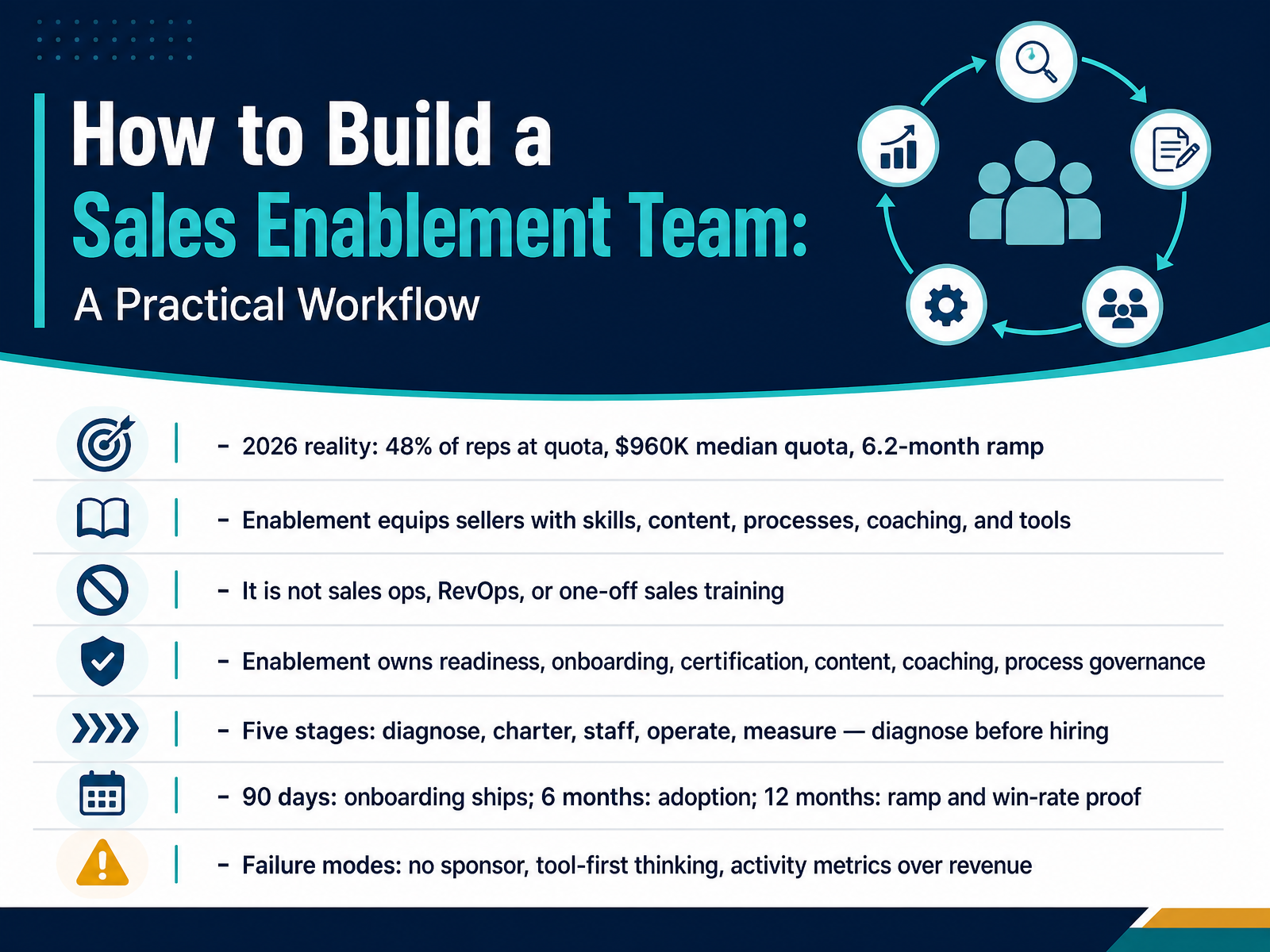
- 01How to Build a Sales Enablement Team: A Practical WorkflowWelcome. This course walks through how to build a sales enablement team, using a practical five-stage workflow you can apply as you hire and scale. Start with the 2026 reality. Forty-eight percent of reps are at quota, median quota is nine hundred sixty thousand dollars, and average ramp runs six point two months. That is the problem enablement exists to solve. Enablement equips sellers with skills, content, processes, coaching, and tools. It is not sales ops, not RevOps, and not a one-off training session. Enablement owns readiness: onboarding, certification, content, coaching, and process governance. The workflow has five stages. Diagnose, charter, staff, operate, and measure. Diagnose before you hire. In the first ninety days, ship onboarding. By six months, drive adoption. By twelve months, prove ramp and win rate movement. And watch three failure modes: no executive sponsor, tool-first thinking, and activity metrics tracked instead of revenue. Let's move to the business case, and why enablement investment is climbing now.pulserevops.comindex.sbigrowth.compulserevops.com+22 min
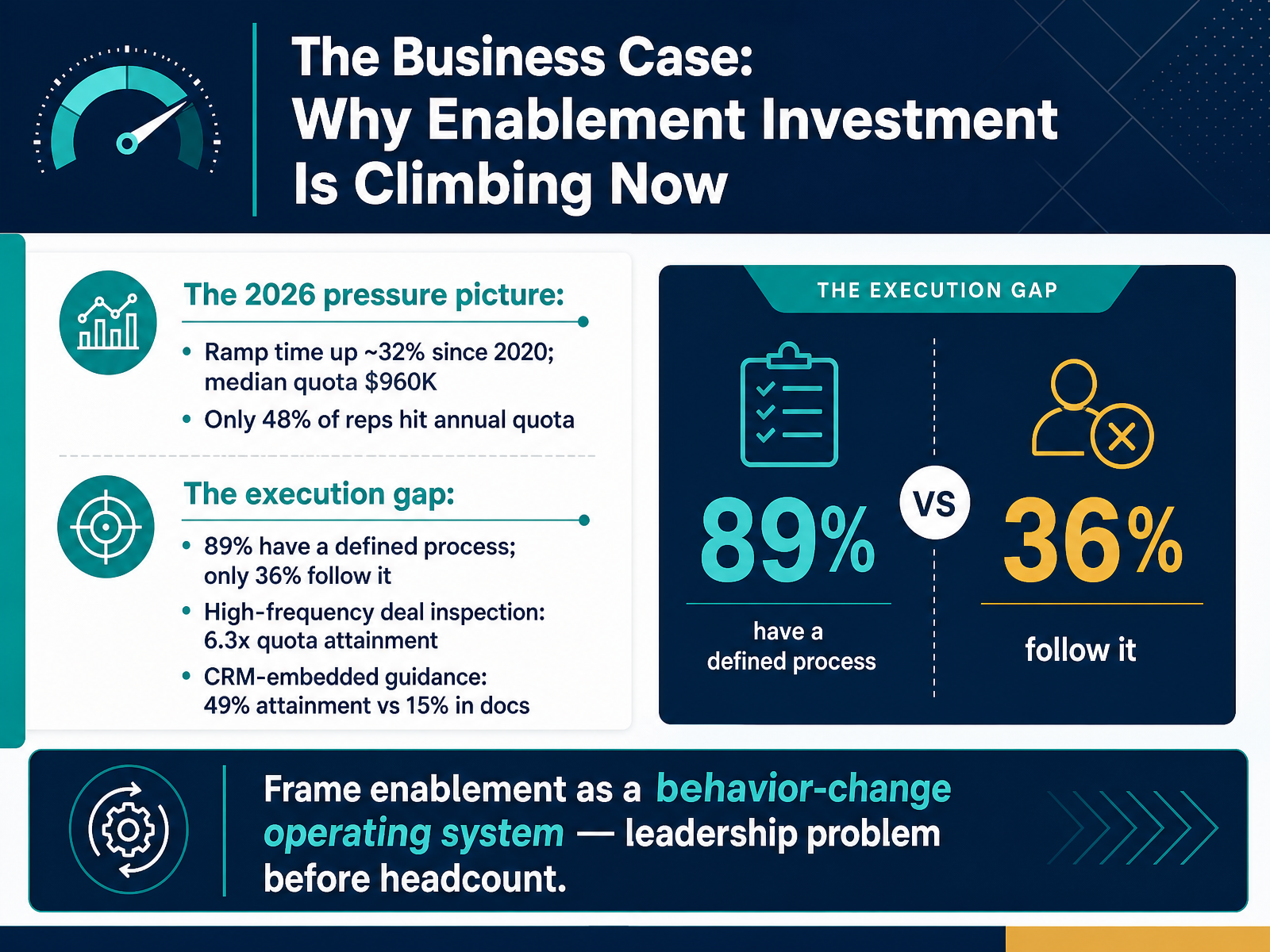
- 02The Business Case: Why Enablement Investment Is Climbing NowNow let's make the case for enablement investment. The pressure picture is clear. Ramp time is up roughly thirty-two percent since twenty-twenty, and the median quota now sits at nine hundred sixty thousand dollars. Only forty-eight percent of reps hit annual quota. So the bar went up while the time to clear it got longer. Now look at the execution gap, because that is where the money is. Eighty-nine percent of teams have a defined sales process, but only thirty-six percent see reps follow it. That fifty-three point gap is the problem. And the payoff for closing it is real. Teams that inspect deals against a defined process at high frequency attain quota at six point three times the rate of low-frequency teams. When guidance lives inside the CRM, teams hit forty-nine percent attainment, versus fifteen percent when it sits in docs and wikis. So treat enablement as a behavior-change operating system, not a content library. This is a leadership problem before it is a headcount problem. Next, we will diagnose before you build, using baseline metrics and stakeholder interviews.
 bridgegroupinc.comsloane-staffing.cominsidetrackjobs.com+22 min
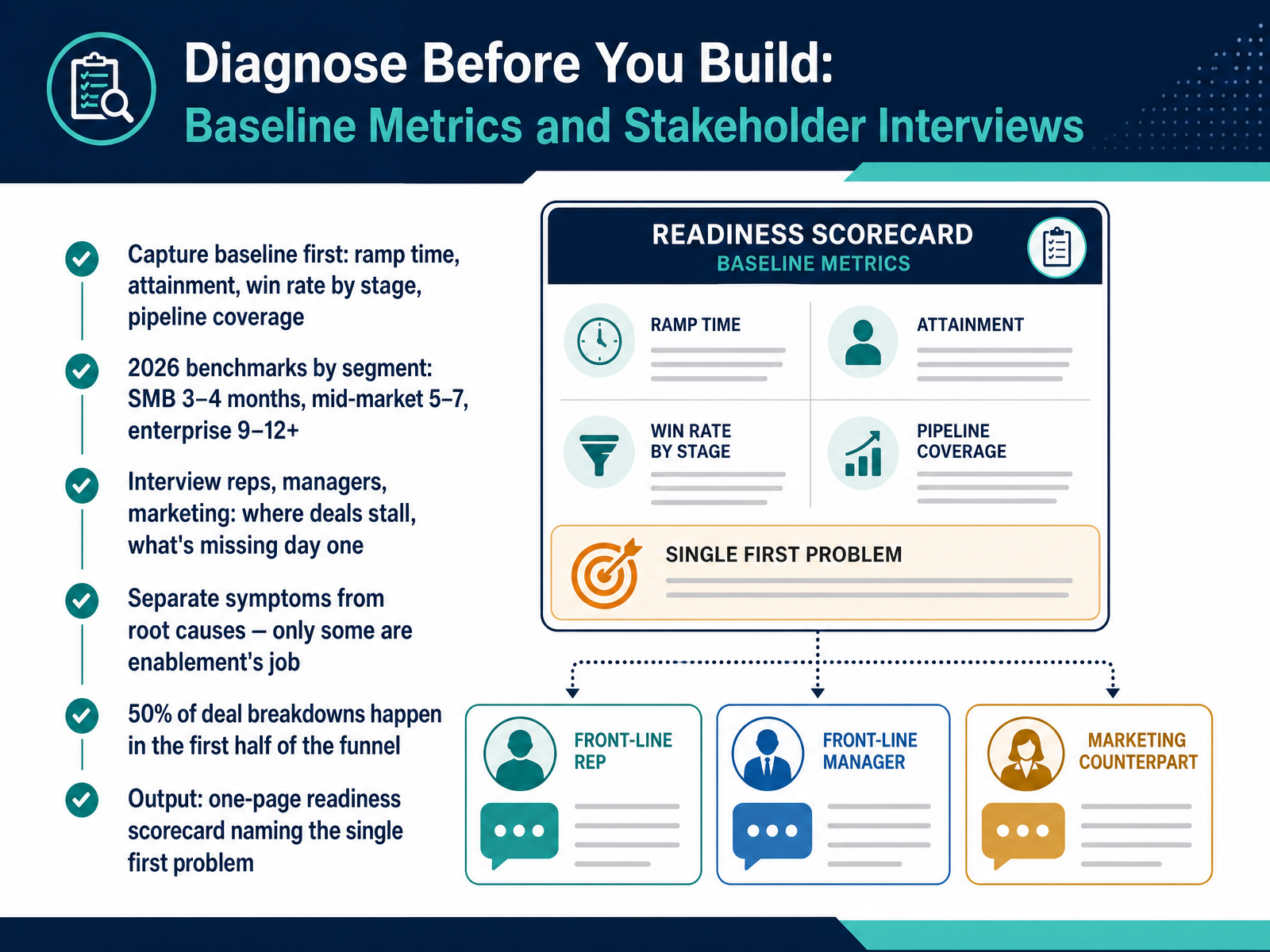
 - 03Diagnose Before You Build: Baseline Metrics and Stakeholder InterviewsBefore you hire anyone or buy any tool, diagnose. Start by capturing your baseline: ramp time, quota attainment, win rate by stage, and pipeline coverage. For 2026, use segment benchmarks as your starting assumption. SMB ramps in three to four months, mid-market in five to seven, and enterprise in nine to twelve or more. Then interview reps, managers, and marketing. Ask where deals actually stall and what was missing on day one. Separate symptoms from root causes, because only some of what you find is enablement's job. Here is the number that should shape your priorities: half of all deal breakdowns happen in the first half of the funnel, yet most enablement investment goes to later stages. So your output is one page. A readiness scorecard, and on it, the single first problem you will solve. Name one. Not five. That constraint is what makes the rest of this build work. Next, we charter the function, covering mandate, scope, and decision rights.
 bridgegroupinc.comsloane-staffing.cominsidetrackjobs.com+21 min
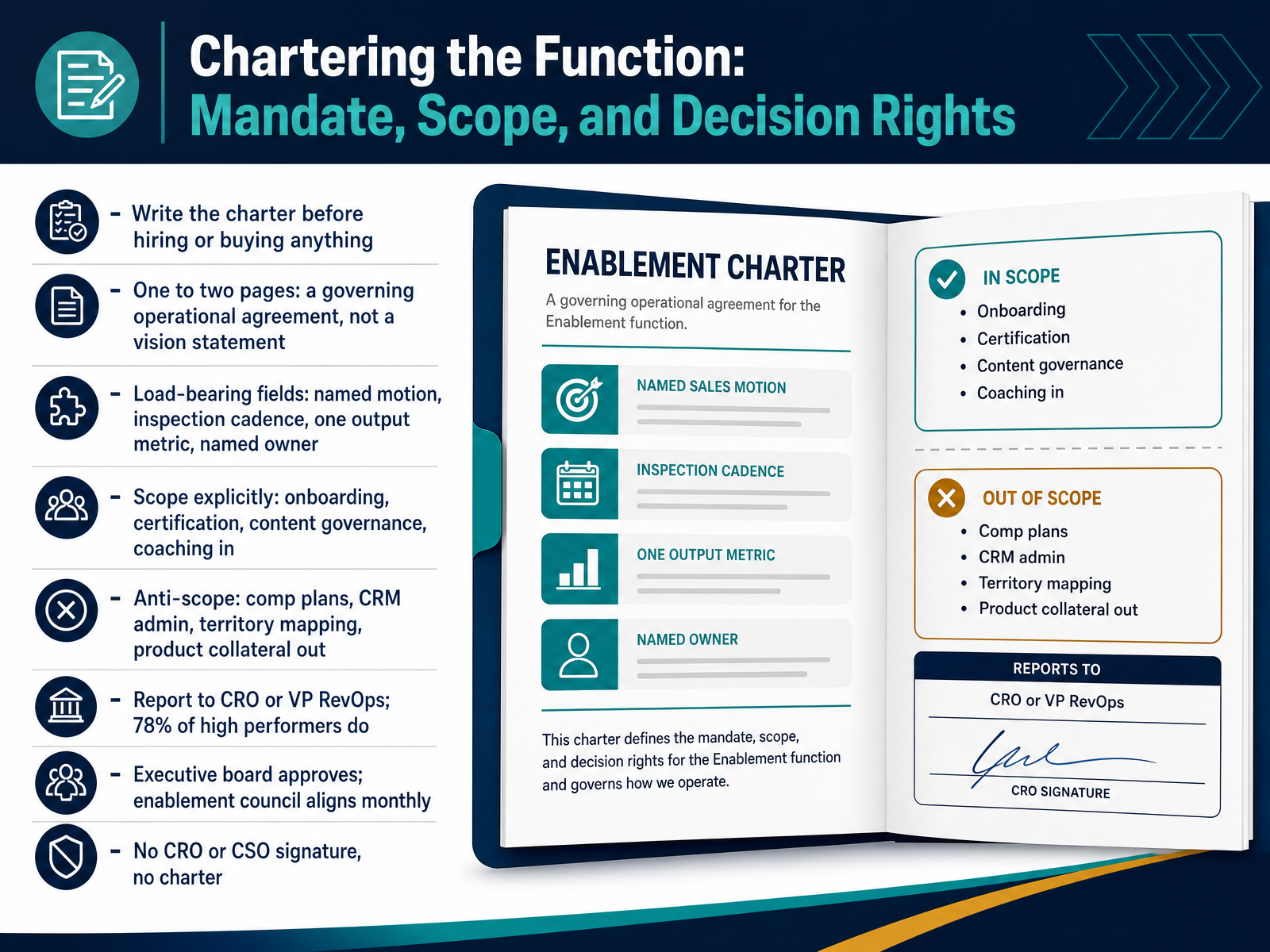
 - 04Chartering the Function: Mandate, Scope, and Decision RightsBefore you hire anyone or buy a single tool, write the charter. This is a governing operational agreement, one to two pages, not a vision statement. Four fields carry the weight. Name the motion: the deal standard reps run. Set the inspection cadence, weekly or monthly. Pick one output metric you are accountable for. And name the owner. Then draw the scope line in writing. Onboarding, certification, content governance, and coaching stay in. Comp plans, CRM admin, territory mapping, and product collateral stay out. That line is what lets you say no professionally. Chart the reporting line to the CRO or VP of Revenue Operations. Without a CRO or CSO signature, you have a suggestion, not a charter. The executive board approves it; the enablement council aligns monthly. Next, we look at designing the team, covering roles, skills, and hiring sequence.
 prospeo.iopulserevops.comthecroreport.com+21 min
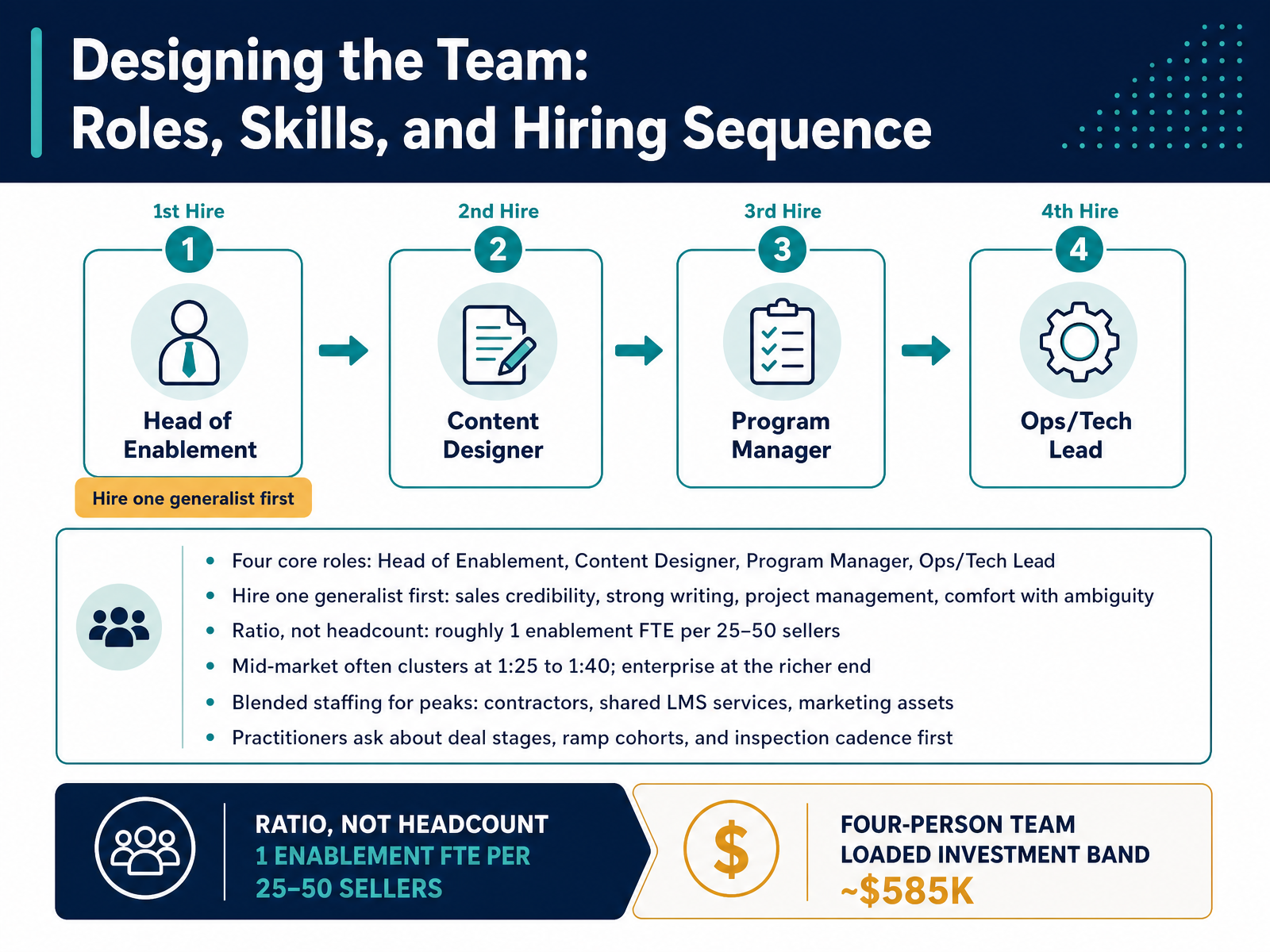
 - 05Designing the Team: Roles, Skills, and Hiring SequenceNow let's talk about how you actually build the team. Four core roles cover the work: a Head of Enablement to own strategy, a Content Designer, a Program Manager, and an Ops or Tech Lead who owns the systems. But don't hire all four at once. Your first hire should be a generalist. Look for sales credibility, strong writing, project management instincts, and comfort with ambiguity. That person builds the function before you specialize. On size, think ratio, not headcount. Plan roughly one enablement full-time employee per twenty-five to fifty sellers. Mid-market teams often cluster around one to twenty-five through one to forty. Enterprise sits at the richer end because ramps are longer and deals carry more risk. For peaks, blend in contractors, shared learning platform services, and marketing assets rather than adding permanent headcount. And when you interview practitioners, ask about deal stages, ramp cohorts, and inspection cadence first. Those answers tell you whether they build programs that reach real deals. Coming up next, Building the Enablement Operating Model.
 pulserevops.comindex.sbigrowth.compulserevops.com+22 min
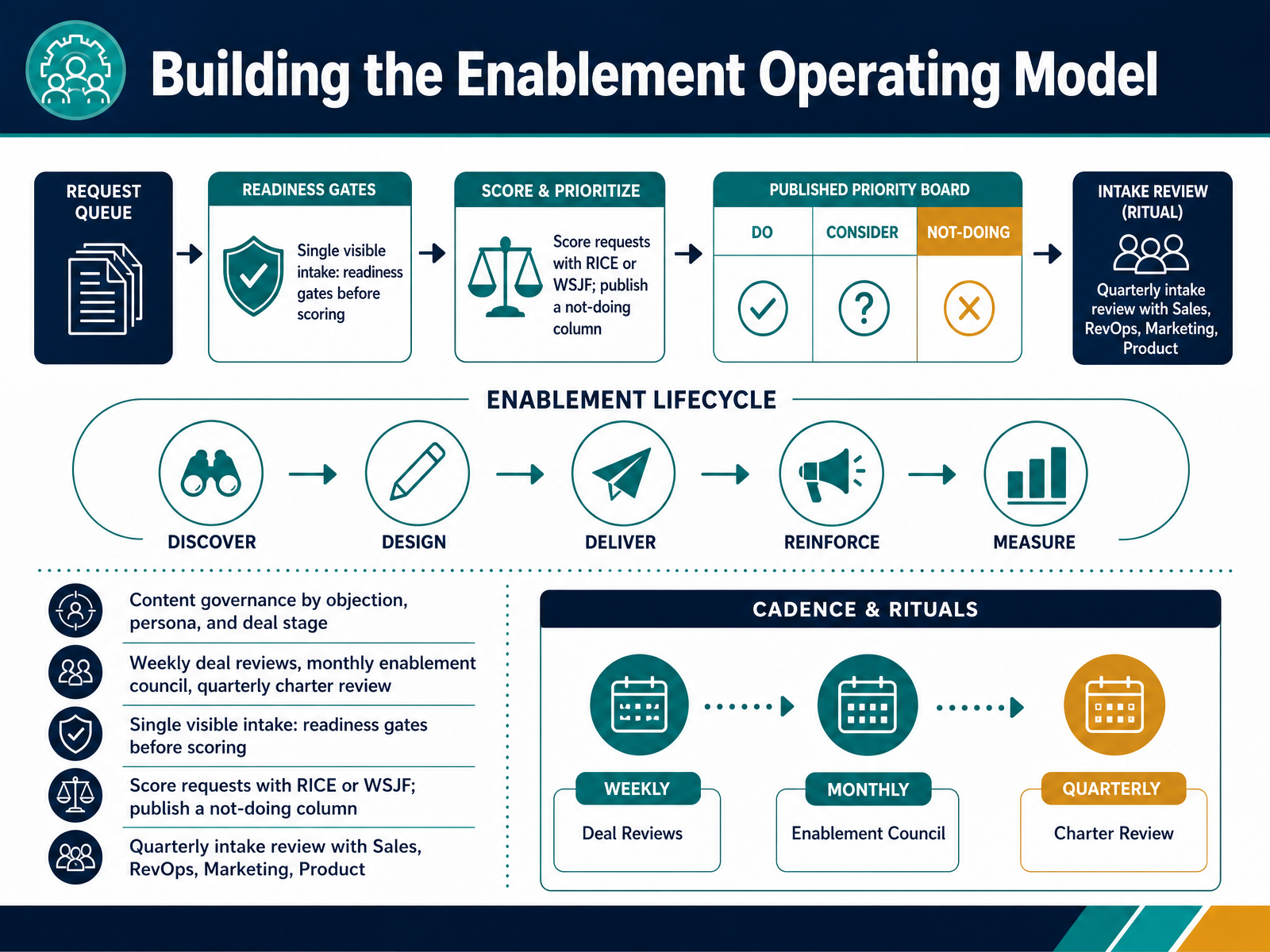
 - 06Building the Enablement Operating ModelLet's talk about the operating model that keeps enablement work moving in a predictable rhythm. Start with a single visible intake. Every request, from a rep or the chief revenue officer, enters the same channel. Before anything gets scored, it passes readiness gates. Is the problem defined, the audience named, the business goal clear, and is there evidence behind it? If not, it goes back for refinement. Then score what passes. RICE weighs reach, impact, confidence, and effort. WSJF weighs cost of delay against job size. Either works, as long as you apply it consistently. Publish a not-doing column next to the doing column, so trade-offs are visible, not implied. Review intake quarterly with Sales, RevOps, Marketing, and Product. Run each initiative through a lifecycle: discover, design, deliver, reinforce, measure. Govern content by objection, persona, and deal stage, so reps find the right asset fast. Finally, set your cadence: weekly deal reviews, a monthly enablement council, and a quarterly charter review. That rhythm is what turns a request queue into an operating model. Next, we'll look at onboarding and continuous readiness programs.
 federicopresicci.comprospeo.iovozah.com+22 min
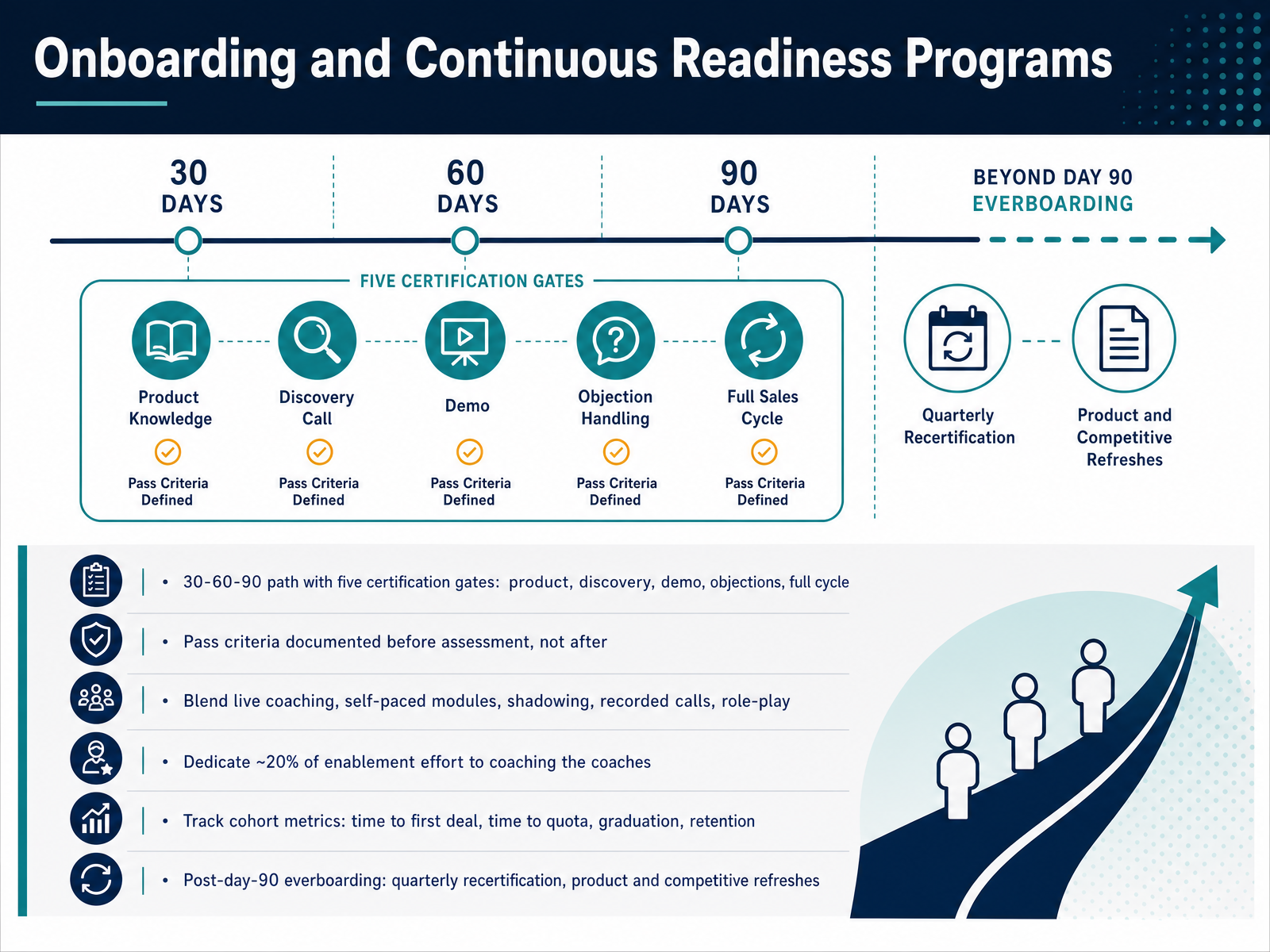
 - 07Onboarding and Continuous Readiness ProgramsNow let's talk about onboarding and continuous readiness. Build a 30-60-90 path with five certification gates: product, discovery, demo, objections, and full cycle. Document pass criteria before the assessment, not after. That single discipline turns certification into a fair, repeatable standard instead of a subjective call. Blend your formats. Use live coaching, self-paced modules, shadowing, recorded calls, and role-play. The mix matters, because reps forget most one-time training within weeks. Dedicate about 20 percent of enablement effort to coaching the coaches. Your front-line managers are the primary coaching channel, so that investment compounds across every rep they manage. Then track cohort metrics, not just individual ones: time to first deal, time to quota, graduation rate, and retention. Compare quarterly cohorts to see whether the program is actually improving. After day 90, shift to everboarding. Run quarterly recertification plus product and competitive refreshes, so readiness does not decay. Next, we move into enabling the sales process, messaging, and content.
 thecroreport.compulserevops.comthecroreport.com1 min
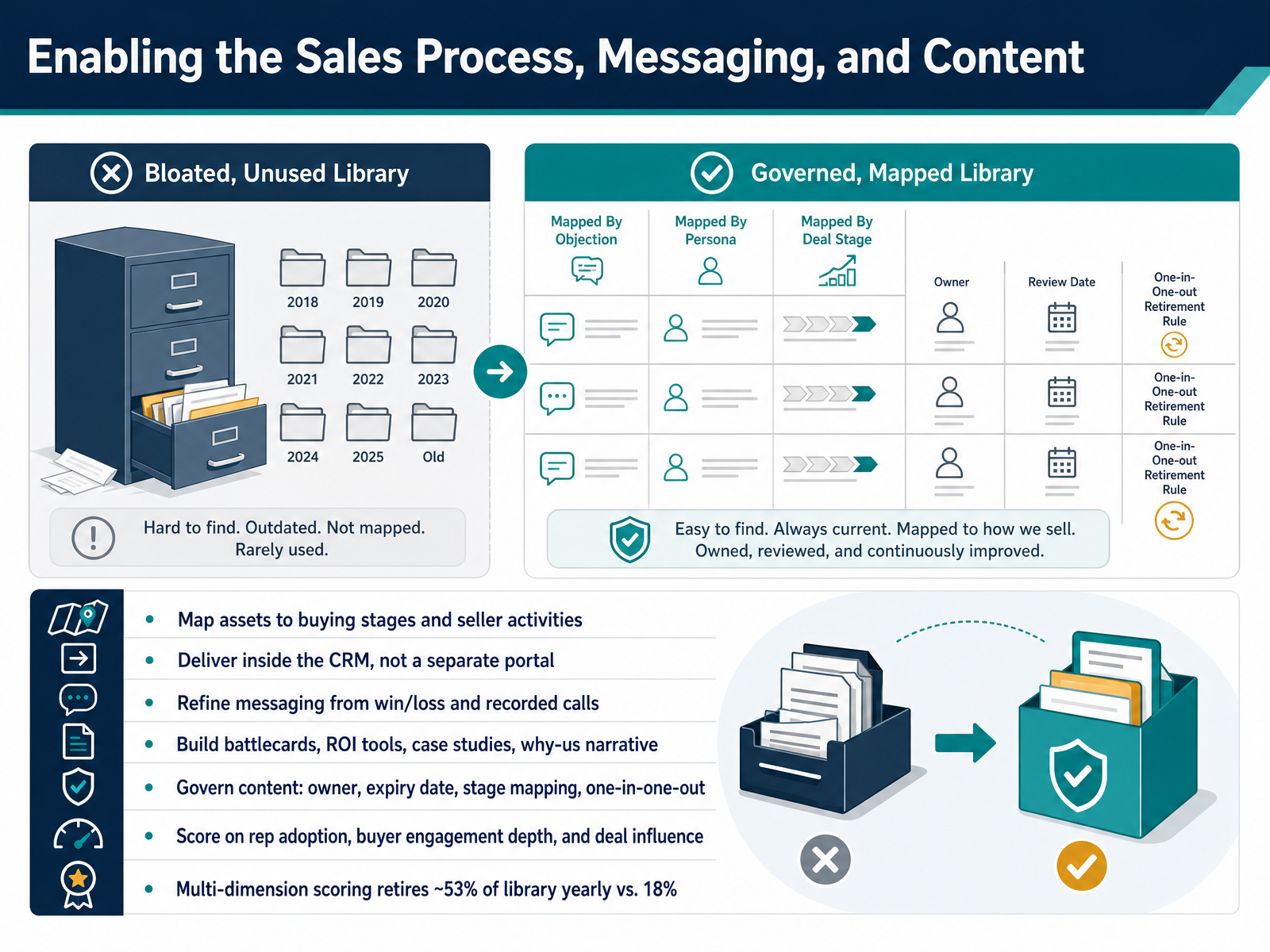
 - 08Enabling the Sales Process, Messaging, and ContentNow let's build the content engine. Treat every asset as something that either moves a deal or gets retired. First, map assets to buying stages and seller activities, so a rep knows what to send during discovery versus negotiation. Then deliver inside the CRM, not a separate portal. If a seller has to leave the opportunity record to find a deck, it won't get used. Refine messaging from win loss reviews and recorded calls, not opinion. Build the core set: battlecards, return on investment tools, case studies, and a clear why us narrative. Govern it tightly. Every asset gets an owner, an expiry date, a stage mapping, and a one in, one out rule. Then score on three things: rep adoption, buyer engagement depth, and deal influence. Multi dimension scoring retires roughly fifty three percent of your library each year, versus eighteen percent when you track usage alone. Smaller, cleaner, used more. Next, we move to technology and data foundations.
 bridgegroupinc.comsloane-staffing.cominsidetrackjobs.com+21 min
 - 09Technology and Data FoundationsLet's talk about the technology and data foundations that make enablement work. The first principle is to define your stack by function, not by vendor. You need something for the C R M, content, readiness, conversation intelligence, digital rooms, and analytics. Name the job first. Then pick the tool. Your minimum data model should answer six questions. How long until a new rep closes their first deal? What does ramped attainment look like? Which content actually gets used? Are coaching conversations happening? Are certifications current? And is any of it moving revenue? One ownership rule matters here. Revenue Operations owns the enablement dashboards. That way, the enablement team is not marking its own homework. On consolidation, start with your native C R M before buying specialists. If multiple tools do the same job, cut the overlap first. For twenty twenty-six, the AI uses worth adopting are in-context retrieval, full call analysis, and deal-material drafting. But set guardrails before you scale: approved prompts, clear source rules, human review, and tightly controlled C R M write permissions. Build the foundation deliberately. Next, we'll look at measuring impact and proving R O I.
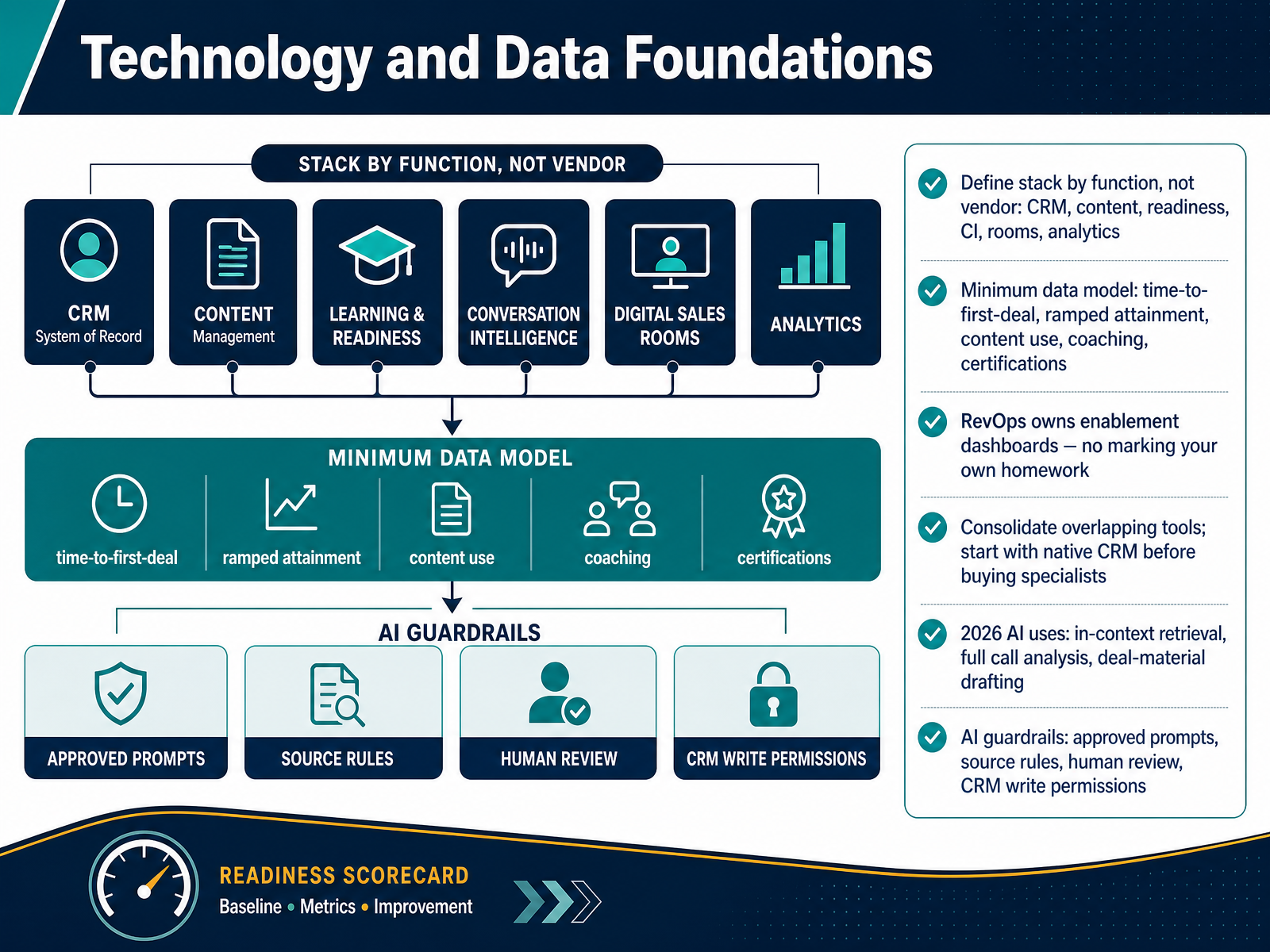 2 min
2 min - 10Measuring Impact and Proving ROINow let's talk about measuring impact and proving return on investment. The core principle is simple. Leading indicators move first. That means adoption, behavior, and proficiency. Lagging indicators confirm the outcome later, in pipeline, win rate, ramp time, and revenue. Link the two, and you have a credible story. The cleanest causal test is win rate on enabled versus non-enabled deals. But it only works if your CRM tags which deals went through the enablement motion. Two rules make that number defensible. Baseline before you launch, and agree the measurement window up front. Expect outcomes to need ninety to one hundred eighty days and two full sales cycles. Report in revenue language. Recovered quota capacity from faster ramp. Win-rate lift applied to pipeline value. And be willing to retire programs that show no coach-versus-uncoached comparison within two quarters. Next, we'll look at scaling, iterating, and avoiding common pitfalls.
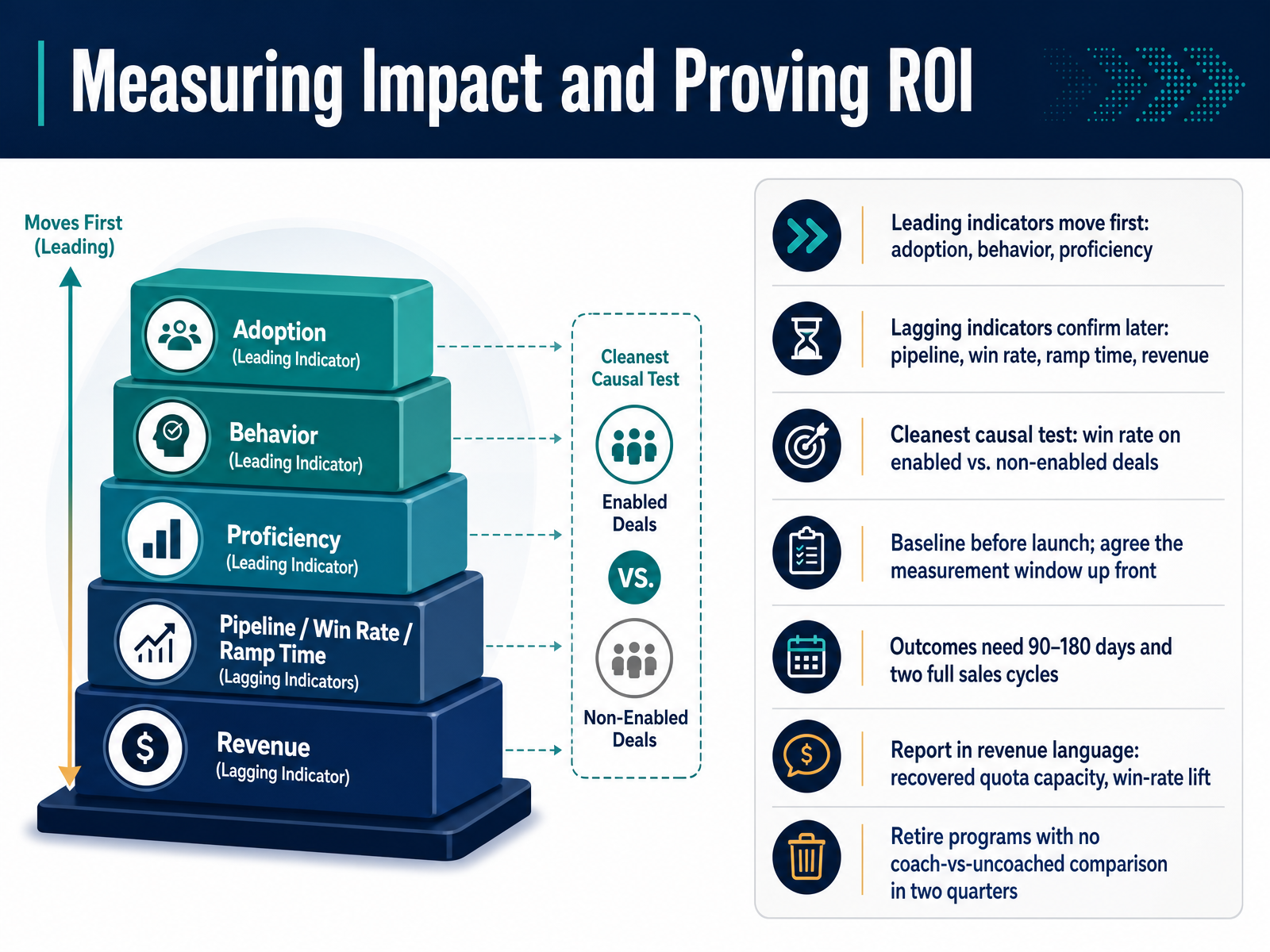 federicopresicci.com1 min
 - 11Scaling, Iterating, and Avoiding Common PitfallsNow let's talk about scaling, iterating, and avoiding the pitfalls that stall enablement teams. Use maturity stages as a decision tool: ad hoc, organized, scalable, and adaptive. Here's the 2026 reality. Only twelve percent of teams rate themselves adaptive, and most sit at organized. That tells you where the real work is. Scale through a hub-and-spoke model, and add specialists only after the fundamentals are staffed. Protect your inspection and coaching cadence, because maturity drifts backward without it. When initiatives fail, the post-mortem usually points to one of four missing pieces: a sponsor, clear scope, reinforcement, or a link to revenue. So here's your twelve-month plan. Get the charter done in thirty days. Publish the scorecard by ninety. Then iterate quarterly. Next, we'll put this into practice with building your own enablement charter and twelve-month plan.
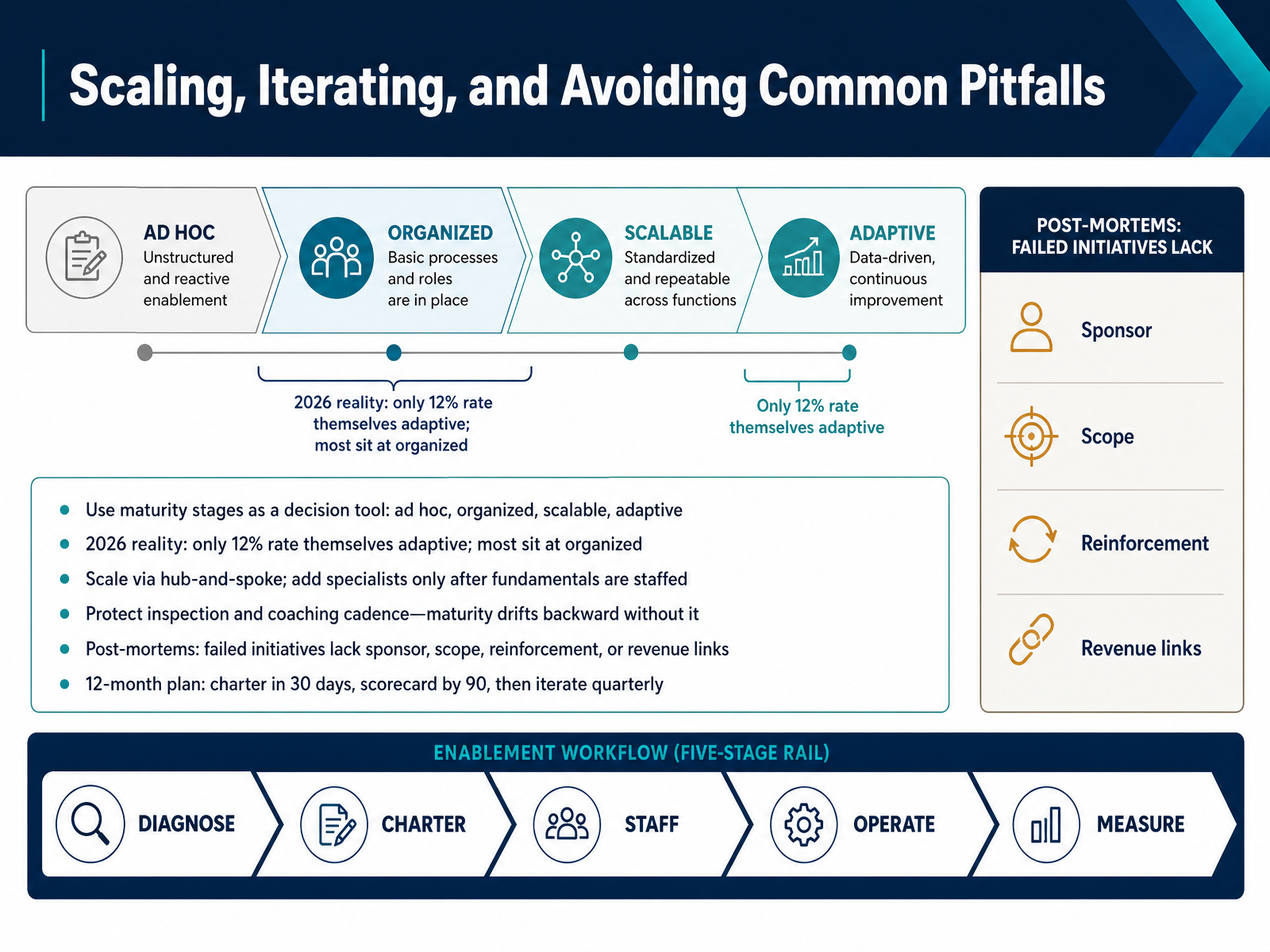 federicopresicci.comfedericopresicci.comprospeo.io+21 min
 - 12Practical Application: Building Your Own Enablement Charter and 12-Month PlanLet's turn all of this into something you can actually run. Here are five moves. First, draft a one-page charter. Put the mission, one named motion, the cadence you inspect it on, one metric, and one owner. One page, or it never gets read. Second, map your team against four core roles, and hire a generalist first. A generalist builds onboarding and battlecards in the same week. Specialists come later. Third, take two real requests and score them on reach, impact, confidence, and effort. Then write the not-doing column. That column is what protects your capacity. Fourth, sketch a thirty, sixty, ninety day onboarding plan with three or four pass or fail certification gates and clear thresholds. For example, a demo certification scored at ninety percent before any solo customer call. Fifth, commit out loud. Name the sponsor, the quarterly review date, and your first ninety-day win. Sponsor first, because a charter without executive backing is a suggestion, not a contract. That is your build order: charter, team, prioritization, onboarding, commitment. Next, we will check your understanding and consolidate the course.
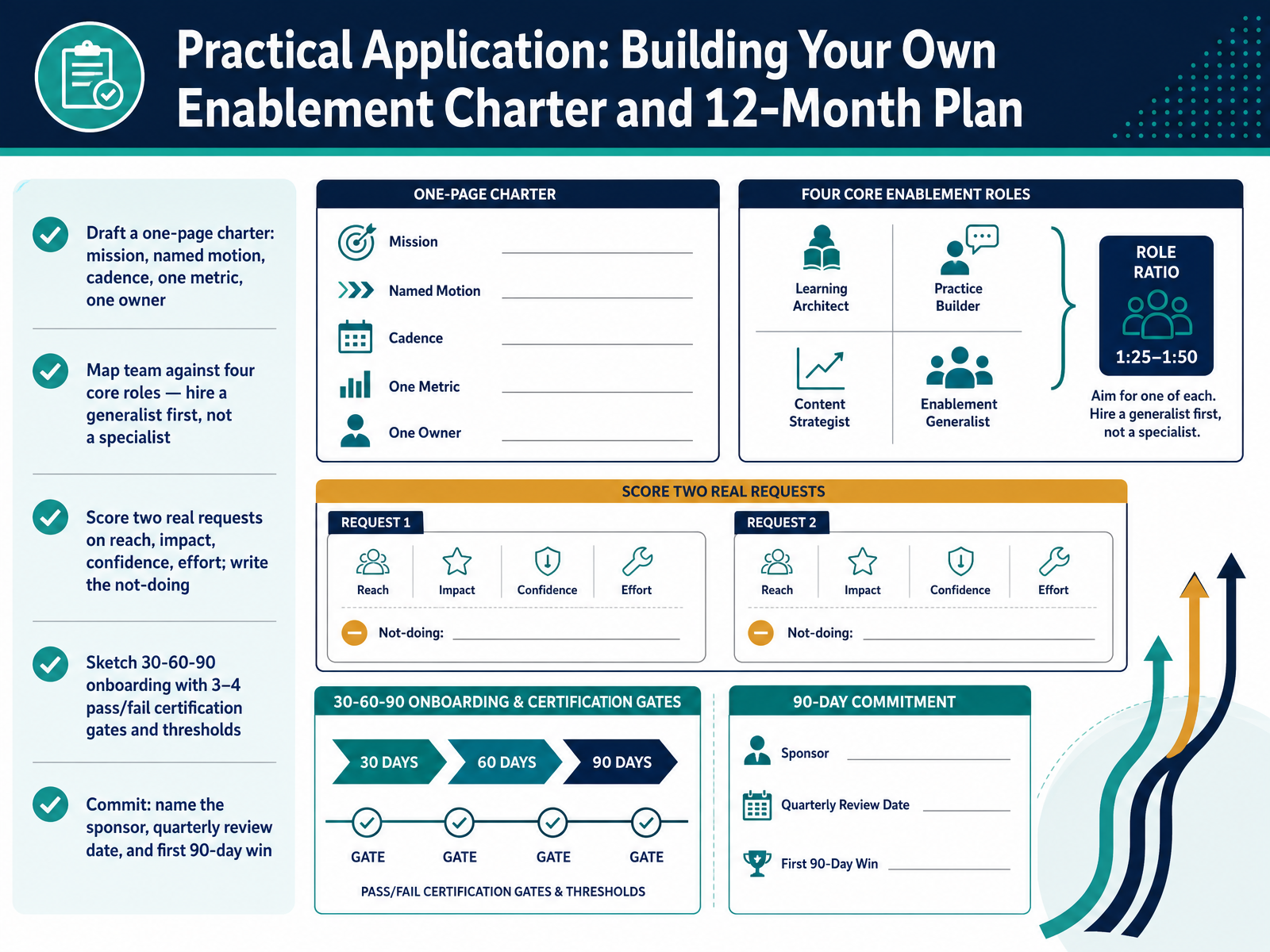 prospeo.iopulserevops.comthecroreport.com+22 min
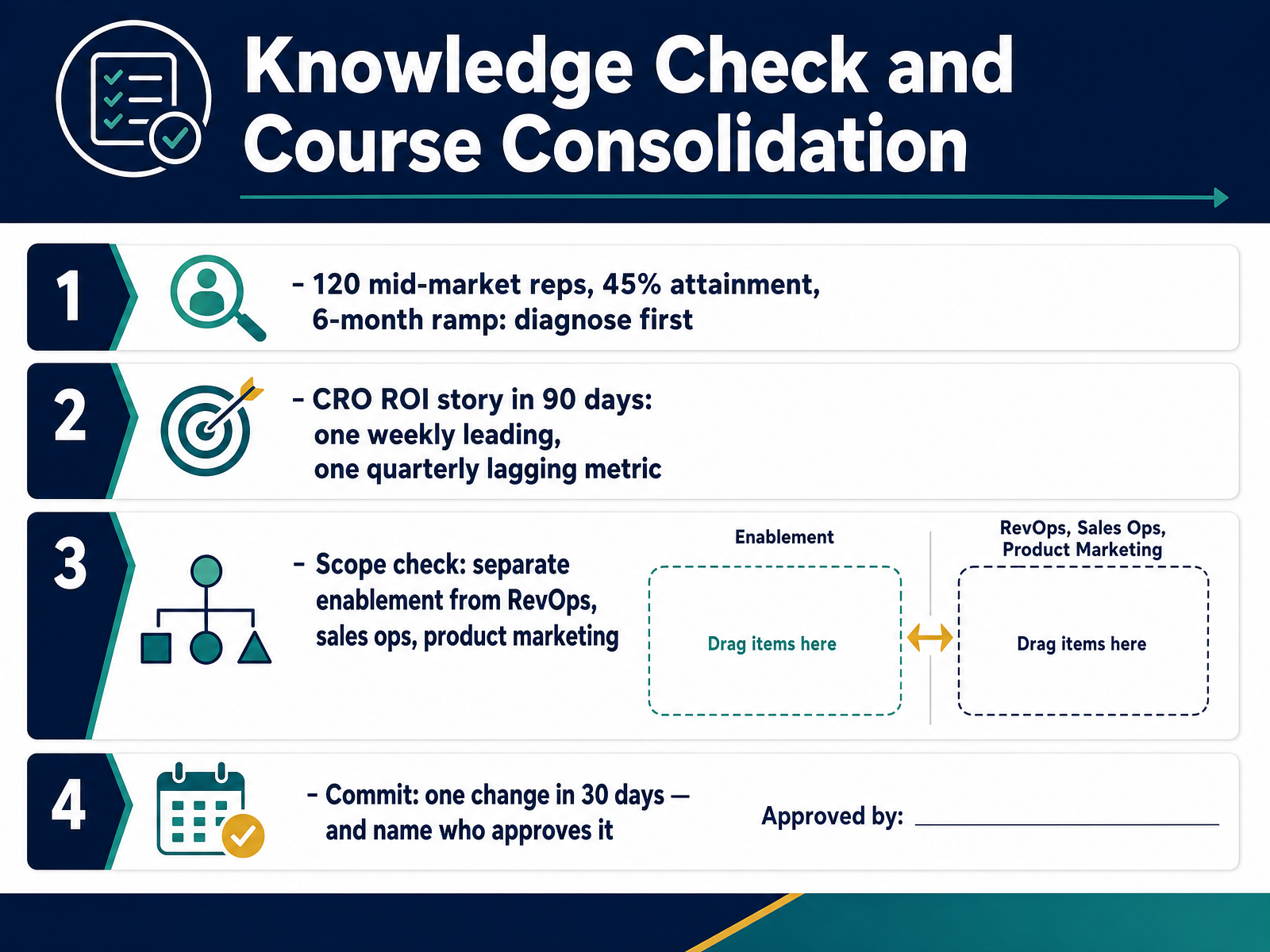
 - 13Knowledge Check and Course ConsolidationLet's consolidate before you go. Picture the scenario: a hundred and twenty mid-market reps, forty-five percent attainment, six-month ramp. That is not a training problem until you diagnose it. Do that first.
To build a CRO return-on-investment story in ninety days, pick one weekly leading metric and one quarterly lagging metric. Keep it to those two.
Next, run a scope check. Separate enablement from RevOps, sales ops, and product marketing, so it does not become the dumping ground.
Recall the core structure: four core roles, a generalist-first hire, and the one-to-forty ratio logic for mid-market. It is a planning heuristic, not a rule.
Finally, commit to one change inside thirty days, and name who approves it. Thank you for working through this course. You have the diagnosis, the metrics, and the scope. Now go make one decision concrete, and you will have earned the next one.
 pulserevops.comindex.sbigrowth.compulserevops.com+22 min
Take the deck with you
Download this course as a file — free, no sign-up needed.
- PDF handoutEvery slide page, ready to print or share.14 pages · 3.8 MBDownload
- Narrated PowerPointThe deck that presents itself — every slide carries the digital human's narration video.14 pages · 13.6 MBDownload
- PowerPoint slidesThe full deck as a .pptx — open it in PowerPoint, Keynote, or Google Slides.14 pages · 3.6 MBDownload
Free to use in your own training — please keep the PersonWise credit page at the end.
Have your own deck? Turn it into a course
Sources consulted
Web sources consulted while building this course.
- What is the 2027 benchmark for enablement-to-rep ratio in B2B…? — pulserevops.com
- Modern Enablement Benchmarks Report — index.sbigrowth.com
- How do you structure an enablement-ops org in 2027? — pulserevops.com
- How to Build a Sales Enablement Team in 2026 — prospeo.io
- What is Sales Enablement and what does the function own? — pulserevops.com
- AE Models, Motions & Metrics: 2026 Research Report — The Bridge Group — bridgegroupinc.com
- 2026 GTM Hiring Benchmarks: Time-to-Hire, Ramp & Turnover — Sloane Staffing — sloane-staffing.com
- Sales Hiring 2026: SDR to CRO Salary Data | InsideTrack — insidetrackjobs.com
- B2B SaaS Sales Capacity Planning 2026 — growthspreeofficial.com
- Sales Ramp Time: 2026 Benchmarks and the 4 Levers That Compress It | Lative — lative.ai
- Sales Enablement Charter: How to Build One in 2026 — prospeo.io
- How to build a sales enablement function from scratch in 60 · 2027 Operator Blueprint — Pulse Revenue Architecture — pulserevops.com
- Sales Enablement Strategy 2026: Building the Function | CRO Report — thecroreport.com
- Sales Enablement Charter: Inspect It, Don't File It — supered.io
- Sales Enablement Intake Process: Turning Requests Into ... — federicopresicci.com
- Sales Enablement Process: 7-Stage Framework (2026) — prospeo.io
- Sales Enablement Strategy 2026: 5-Component Framework | Vozah — vozah.com
- Sales Enablement in 2026: The Playbook | MAN Digital — man.digital
- The State of Sales Enablement Maturity Report 2026 — federicopresicci.com
- Sales Onboarding Ramp Time Benchmarks by Role | CRO Report — thecroreport.com