Technical Writing Proposal Analysis
Begin
14 pages · ~28 min
Technical Writing Proposal Analysis
Learn how to craft effective technical writing proposals by examining example patterns, strengths, and common pitfalls.
What you’ll learn
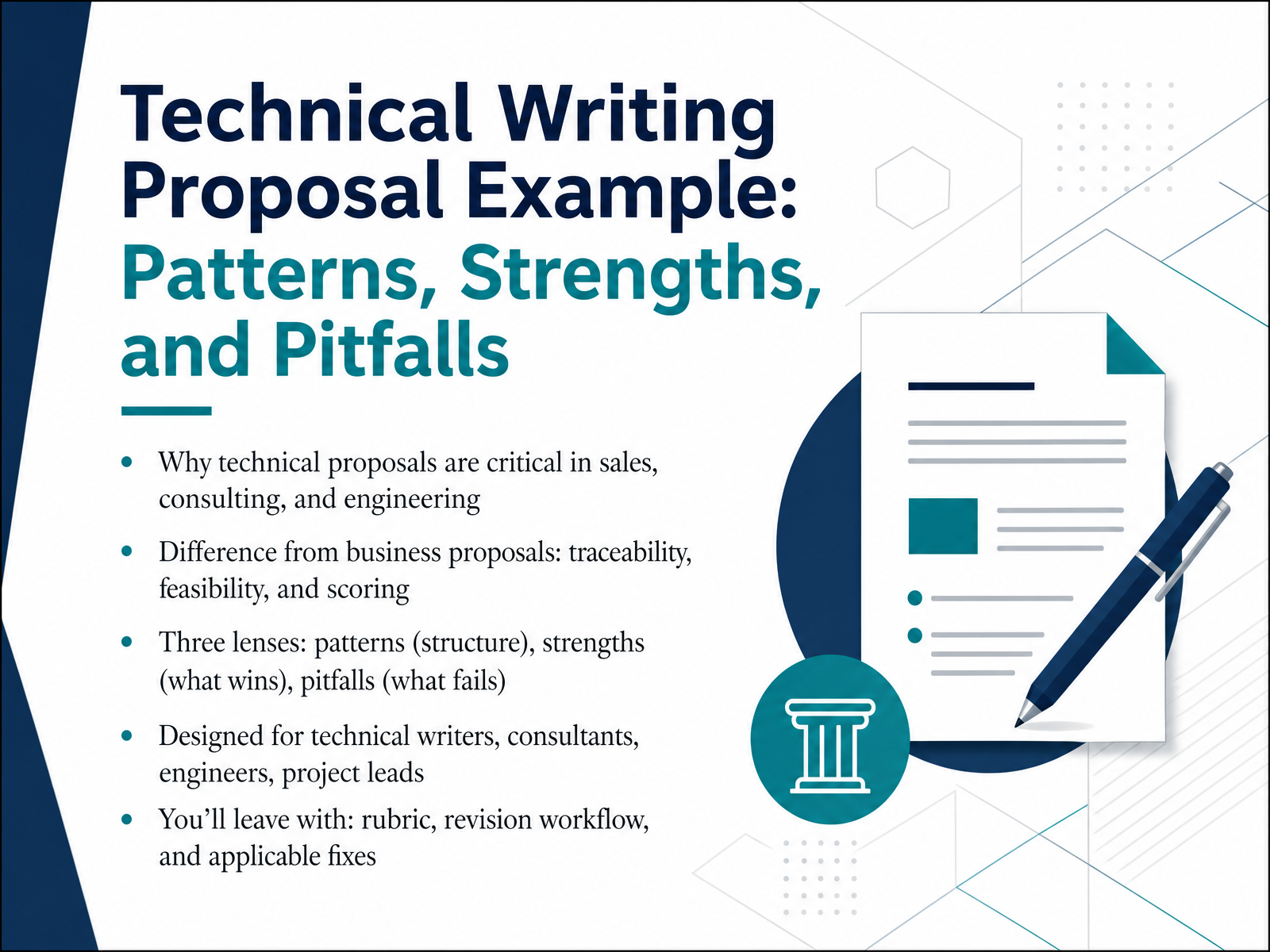
- 01Technical Writing Proposal Example: Patterns, Strengths, and PitfallsWelcome. This course is about technical writing proposals that actually win work. Whether you are a consultant, an engineer, or a project lead, you have likely seen strong solutions lose to average ones on paper. That is what we will fix. We will look at why technical proposals are critical in sales, consulting, and engineering. We will separate them from business proposals by focusing on traceability, feasibility, and scoring. Then, we will examine three lenses: patterns, which is structure; strengths, which is what wins; and pitfalls, which is what fails. This is designed for your role, so we will use concrete, workflow-focused examples throughout. By the end, you will leave with a usable rubric, a clear revision workflow, and fixes you can apply today. We start with a hard truth: most proposals fail before they are even read.autorfp.aiace-consulting.nettenderx.ai+21 min
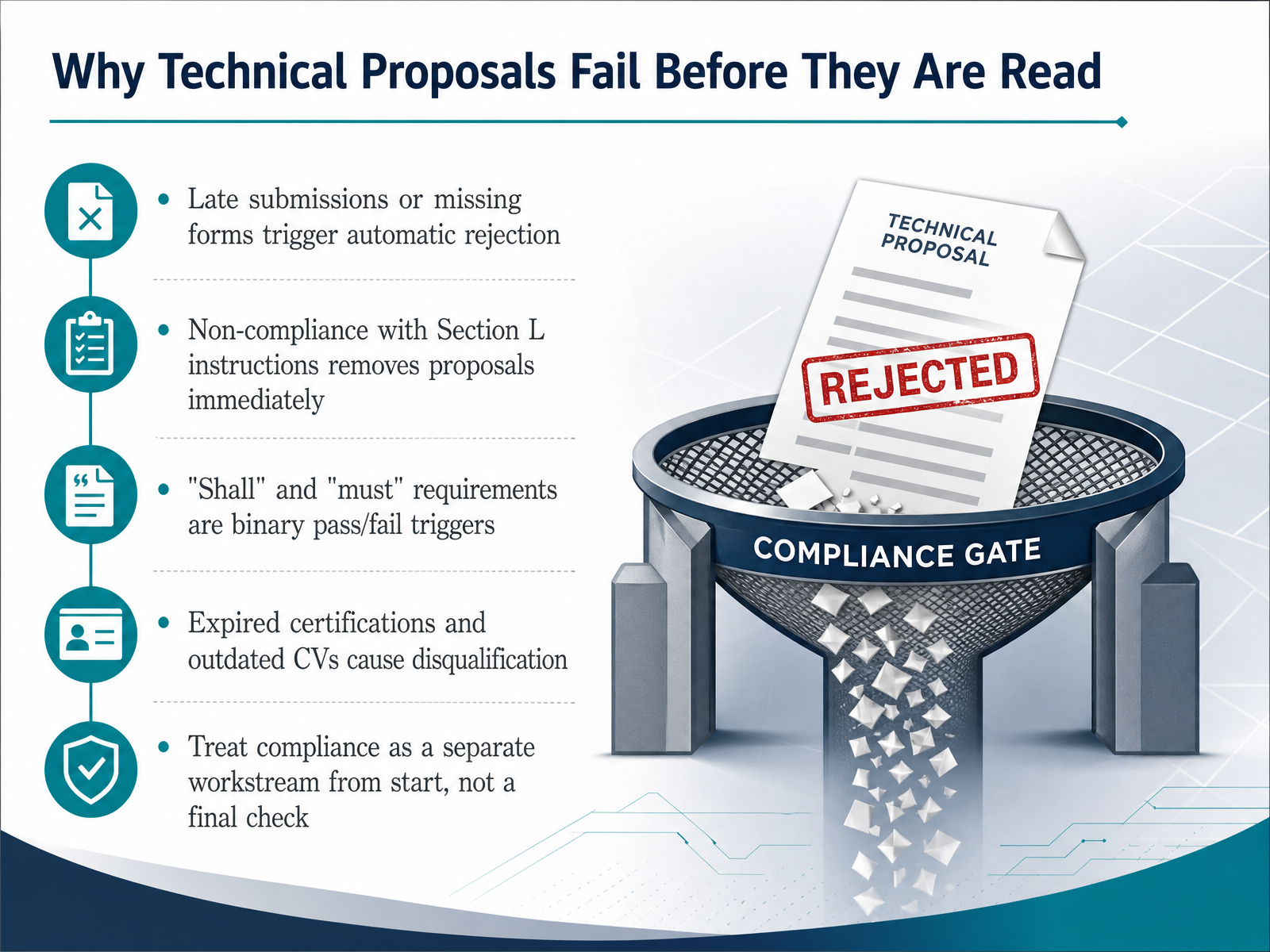
- 02Why Technical Proposals Fail Before They Are ReadLet’s look at why technical proposals fail before they’re even read. The hard truth is that many are eliminated for administrative reasons, not technical weakness. A late submission is automatically rejected, often by a portal that locks at the exact deadline. Even one minute late is too late. Then there’s non-compliance with the solicitation instructions, like the format rules in Section L. If you miss a required form or exceed a page limit, your proposal can be removed immediately, regardless of content quality. Pay attention to binary language. When a requirement says strictly that you shall include something or must hold a certification, that is a pass or fail trigger. There’s no partial credit. Expired certifications or outdated CVs are another common cause of disqualification. Evaluators verify credentials, and if the documentation doesn’t match current facts, the proposal can be thrown out. The key takeaway is this: treat compliance as a separate workstream from the very start, not as a final check during the last few hours. Build a compliance matrix, map every requirement, and verify it early. This protects your technical solution from being disqualified before anyone ever reads it. Now, let’s examine the anatomy of a proposal that actually wins.
 ace-consulting.netautorfp.aisummitstrategywins.com+22 min
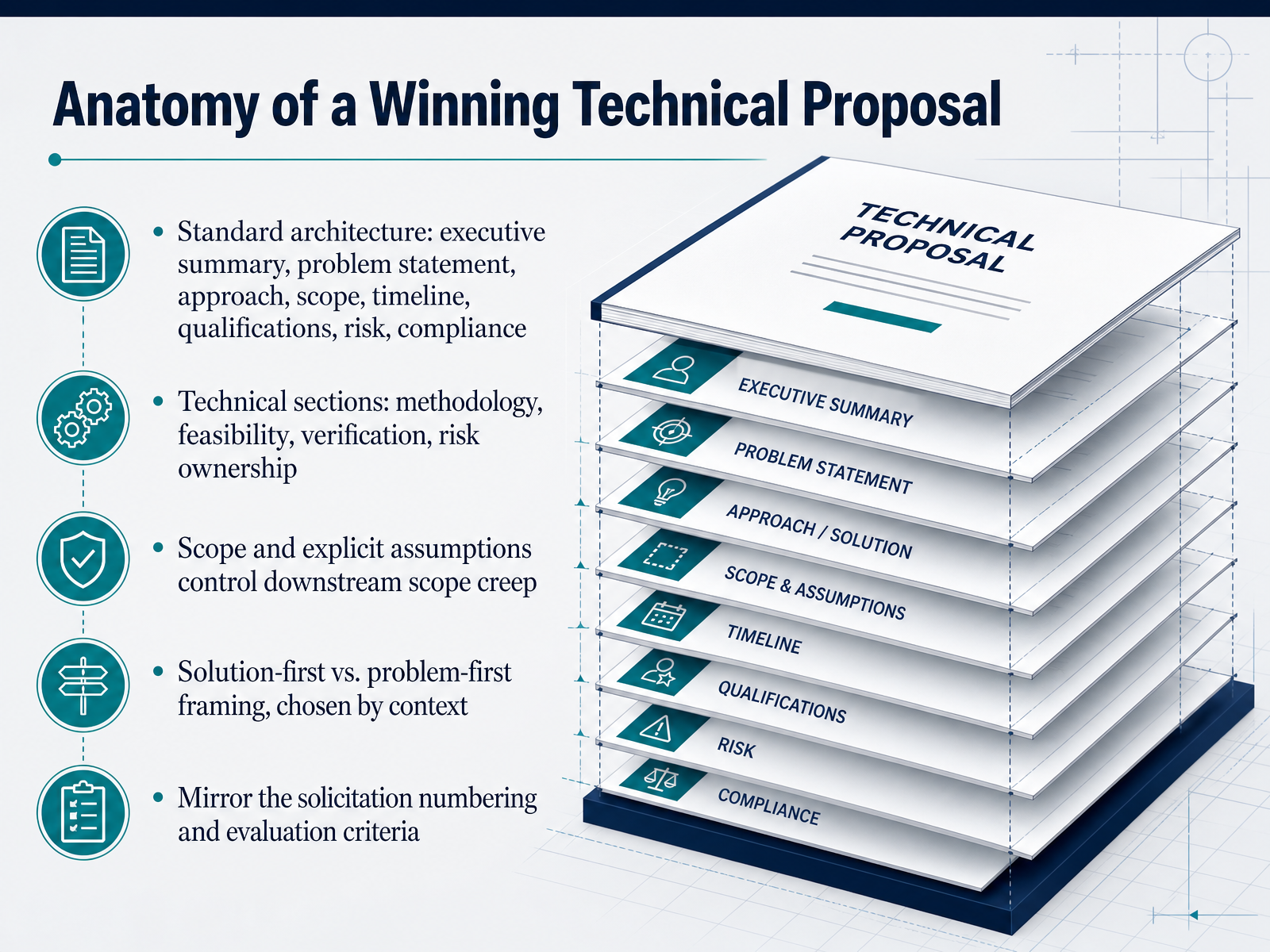
 - 03Anatomy of a Winning Technical ProposalLet's break down the anatomy of a winning technical proposal. Most follow a standard architecture: executive summary, problem statement, approach, scope, timeline, qualifications, risks, and compliance. This predictable format helps reviewers find what they need fast. Beyond that core, strong proposals add technical depth in methodology, feasibility, and verification. A clear strength is defining scope and assumptions explicitly, because that is what controls downstream scope creep. We also need to choose between solution-first or problem-first framing. Match that choice to your audience and the context. Now, a common pitfall is ignoring the solicitation itself. A winning proposal mirrors the solicitation's numbering and evaluation criteria. If the client scores sections in a specific order, structure your document to match. This makes it easy for evaluators to verify you have answered everything. Remember, the structure is your first test of stakeholder alignment. It shows you understand their process before you even explain your solution. Next, we will look at persuasive patterns that win technical bids.
 opentextbooks.concordia.caprojectmanagementformula.combidpacto.com+21 min
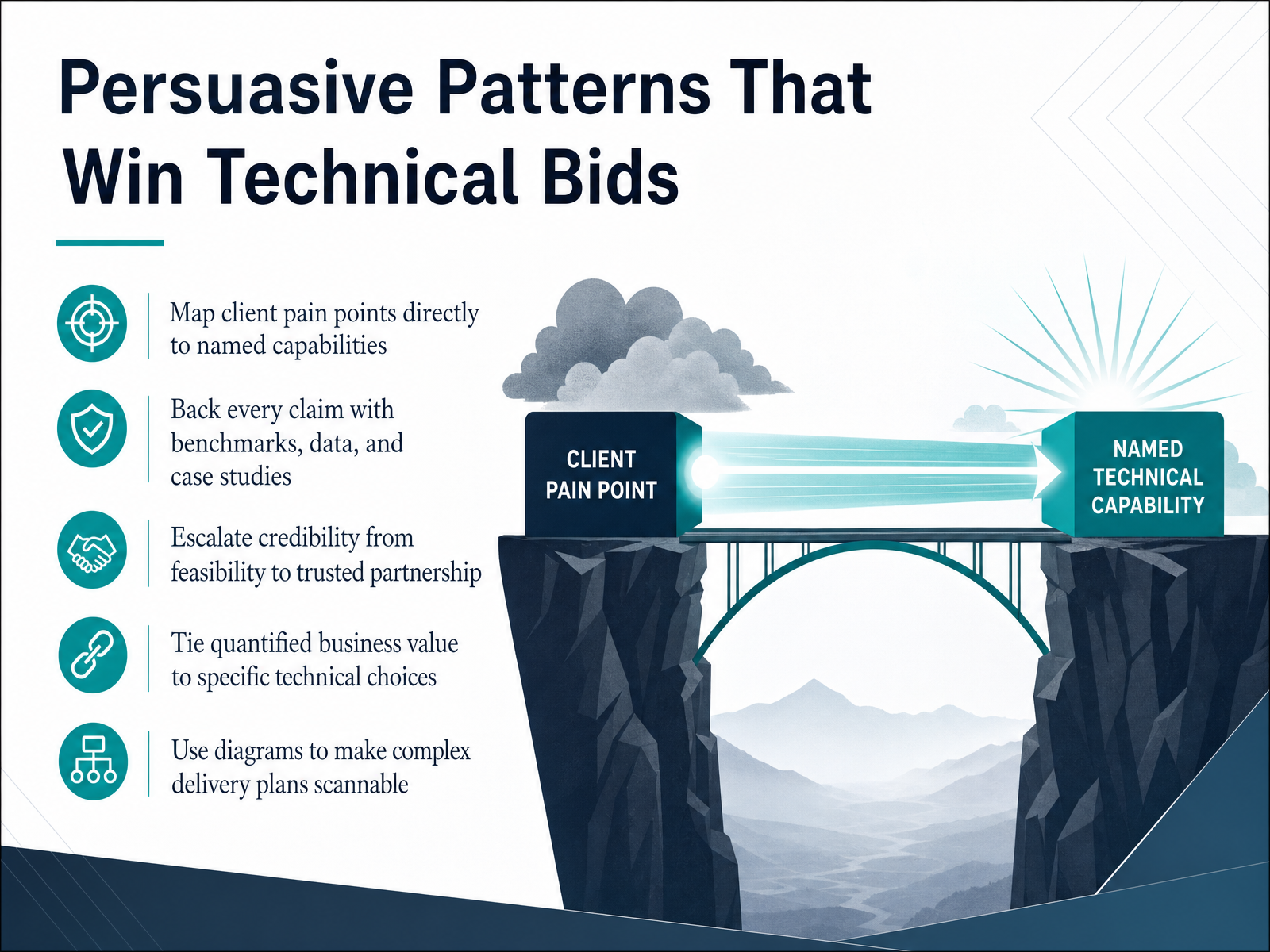
 - 04Persuasive Patterns That Win Technical BidsLet's turn to the patterns that actually win technical bids. First, map each client pain point directly to a named capability. Don't make them connect the dots; do it for them. So if their risk is downtime, name your redundancy architecture right there. Second, back every single claim. Benchmarks, data, case studies; a bold statement without evidence is just noise to an evaluator. Third, escalate your credibility. Start by proving feasibility, but move quickly to show you can be a trusted partner who solves the problem end to end. Fourth, tie quantified business value to specific technical choices. Don't say you'll improve efficiency; say that this specific refactoring cuts load times by thirty percent, which reduces operational costs. Finally, use diagrams for complex delivery plans. A solid workflow graphic is worth far more than a dense paragraph of text. So remember the core principle: every argument you make must move the evaluator from understanding your approach to trusting your execution. That trust is what separates a good submission from a winning one. Next, we will look at what high-quality proposals get right.
 autorfp.aiace-consulting.nettenderx.ai+21 min
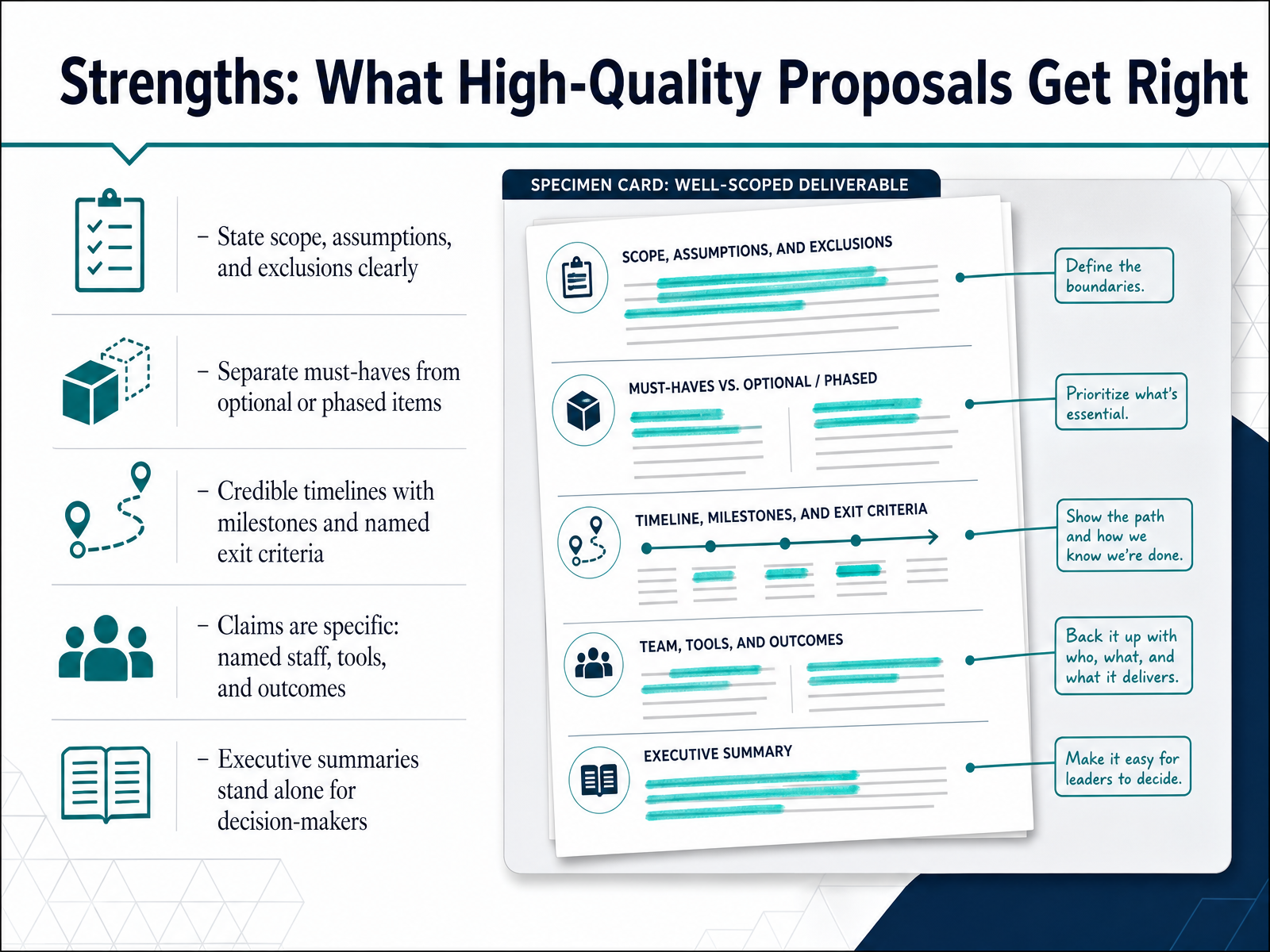
 - 05Strengths: What High-Quality Proposals Get RightNow let’s look at what separates a strong technical proposal from an average one. High-quality proposals state scope, assumptions, and exclusions clearly. This means the client knows exactly what is included and what is not, right from the start. They also separate must-haves from optional or phased items, so decision-makers can see what is essential and what can be deferred. Credible timelines are another marker of quality. They include milestones and named exit criteria, which show you have thought through the sequence of work and how you will know when each phase is complete. Claims in strong proposals are specific. They name the staff, tools, and outcomes. For example, instead of saying “we will deliver training,” a strong proposal says “our senior trainer will conduct three two-hour sessions on the new system.” Finally, executive summaries stand alone. A busy executive should be able to read that one or two pages and understand the problem, the solution, and the key differentiators without digging into the body. Keep these strengths in mind. In contrast, common pitfalls can quickly undermine even a well-researched proposal. Let’s examine those next.
 autorfp.aiace-consulting.nettenderx.ai+21 min
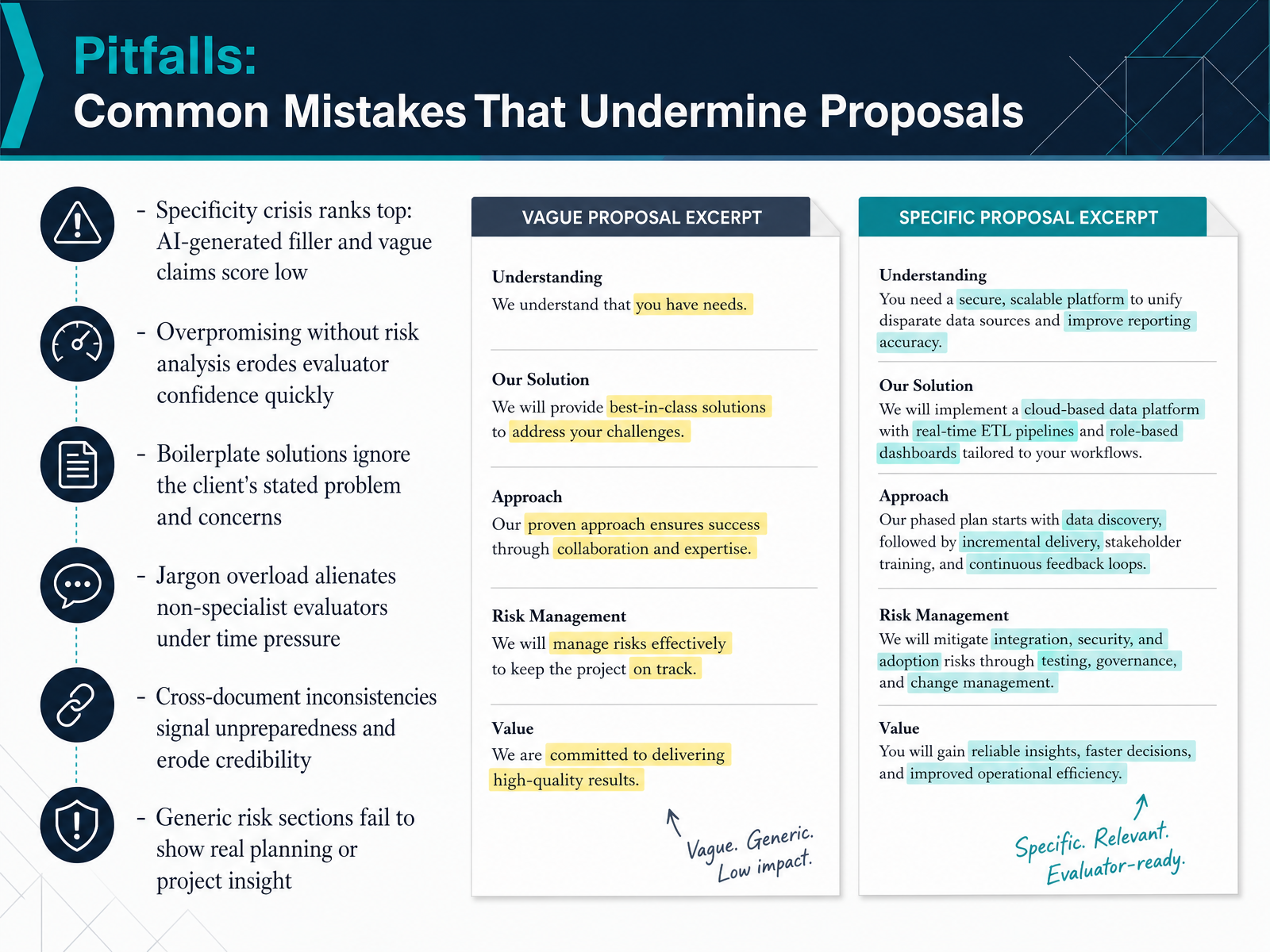
 - 06Pitfalls: Common Mistakes That Undermine ProposalsNow let's talk about the pitfalls that undermine even the strongest technical work. The first problem is a specificity crisis. Recent surveys show that vague, AI-generated filler is now the top reason proposals fail in review. Evaluators simply cannot award points they cannot verify. Second, overpromising without a risk analysis. Claims like 'we deliver on time' with no numbers or context erode trust quickly. A generic risk section that lists 'schedule delays' and says 'we will monitor closely' signals that no real planning has happened. Third, boilerplate solutions. Copy-pasted language that could describe any company on any project tells evaluators you did not read their request carefully. Fourth, jargon overload. Acronyms and technical depth may impress your peers, but they alienate non-specialist evaluators working under time pressure. Fifth, cross-document inconsistencies. When your staffing numbers in one volume do not match the management plan, it signals unpreparedness and kills credibility. Finally, remember the golden rule. Specificity is the difference between a claim and a proof point. Make every risk specific to this project and every claim backed by a number or a name. Fixing these patterns will put you ahead of most competitors. Next, we will decode a real technical writing proposal example to see these strengths and pitfalls in action.
 ace-consulting.netautorfp.aisummitstrategywins.com+22 min
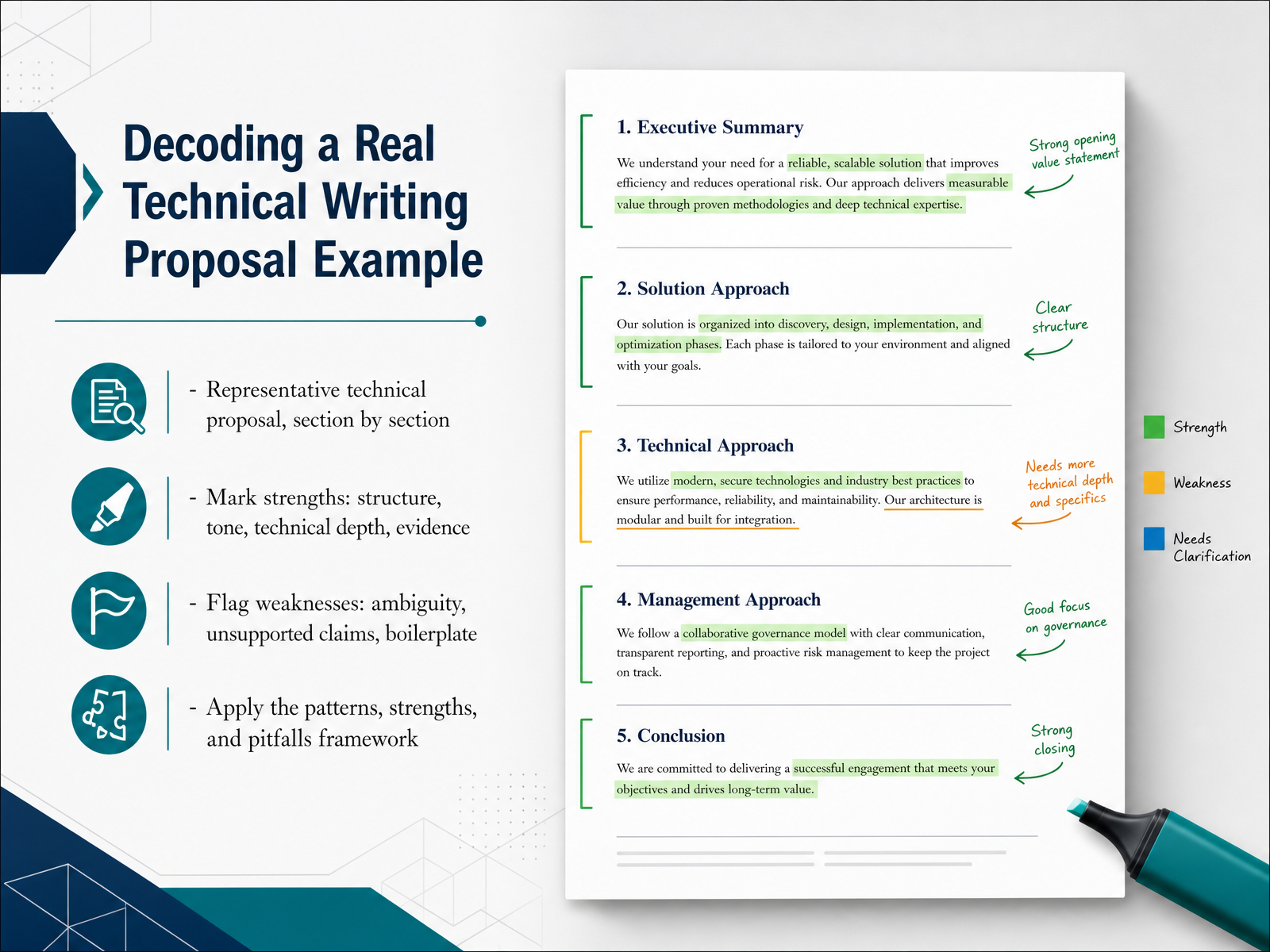
 - 07Decoding a Real Technical Writing Proposal ExampleNow let's decode a real technical writing proposal example, section by section. We'll mark clear strengths in structure, tone, technical depth, and evidence. We'll also flag weaknesses like ambiguity, unsupported claims, and boilerplate. Take the proposal overview, for instance. A strong one states the project objective and context upfront. A weak one leaves blank placeholders and vague assumptions. Look at the scope of services. Clear strengths list specific deliverables and responsibilities. A common pitfall is generic language like 'engineering analysis' without naming the actual tasks or standards. Watch for technical depth in the methodology. Strong proposals cite codes, tools, and analysis methods with concrete details. Weak ones say 'industry standard methods' and stop there. And check the evidence. Strong proposals include past project snapshots or measurable outcomes. Unsupported claims like 'we are uniquely qualified' without proof are a red flag. Finally, watch for boilerplate text that could apply to any project. If you can swap the client name and nothing changes, that's a problem. Apply this patterns, strengths, and pitfalls framework to every section. Mark what works, note what's vague, and revise with stakeholder alignment in mind. This analysis sets us up for audience-specific adjustments next.
 jotform.comlegalzoom.comproposify.com+21 min
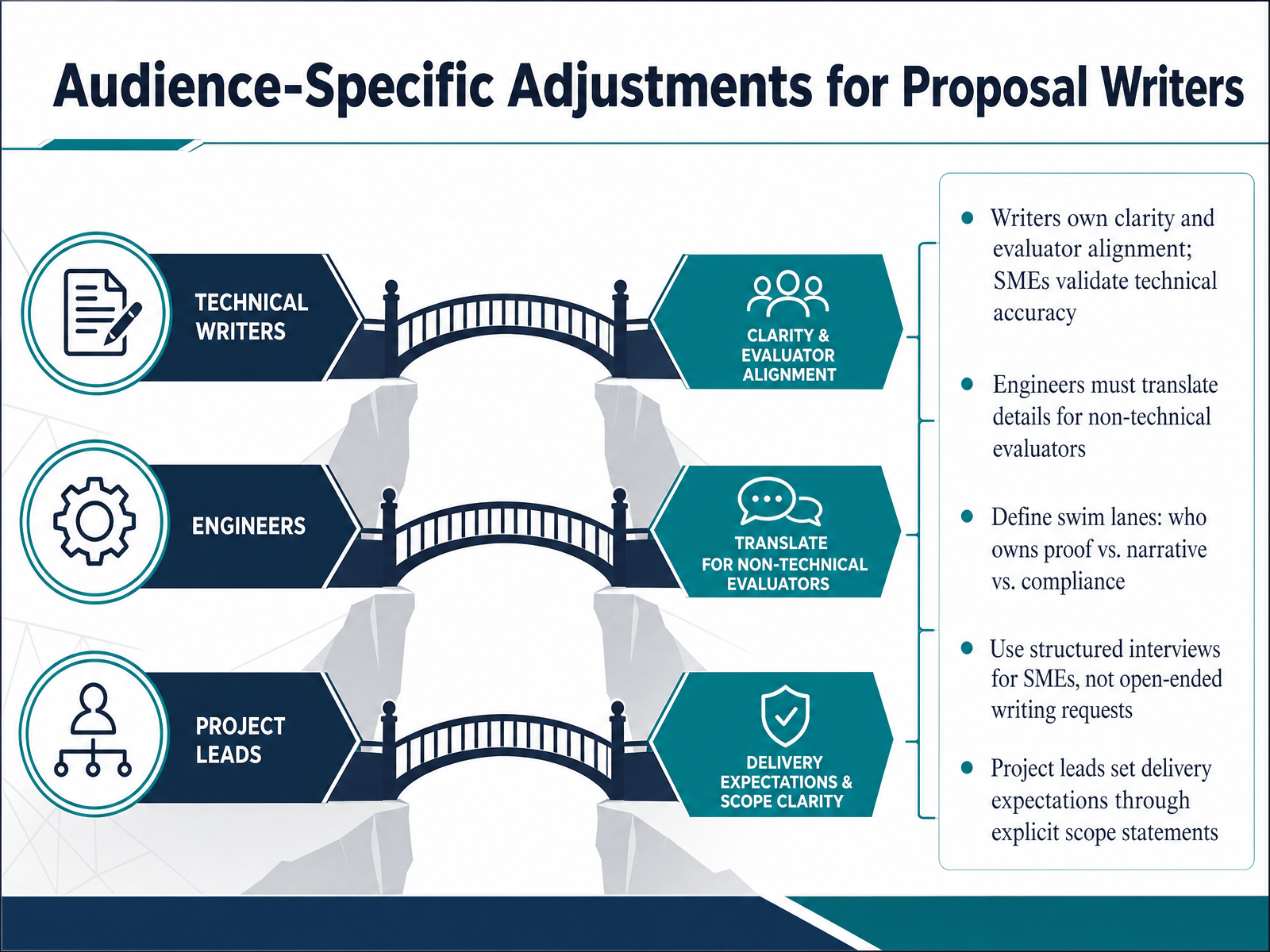
 - 08Audience-Specific Adjustments for Proposal WritersNow let's talk about how you adjust your approach for each audience. As a writer, you own clarity and evaluator alignment, but subject matter experts own technical accuracy. That is a key division of labor. You should never guess at a technical claim, and they should never guess at how to structure a persuasive narrative. A common pitfall is asking engineers for polished prose. Instead, use structured interviews with targeted questions. They validate facts while you shape the story. Define your swim lanes early. Who owns proof? Who owns narrative? Who owns compliance? If those lanes are ambiguous, deadlines slip and content gets duplicated or missed entirely. And project leads, your job is to set delivery expectations through a clear scope statement. This prevents scope creep and keeps the review cadence realistic. When roles are clear and expectations are explicit, your documentation lifecycle runs smoothly. Next, we'll look at a checklist and evaluation rubric to help you measure proposal quality against these standards.
 exceladoc.aisifthub.io2 min
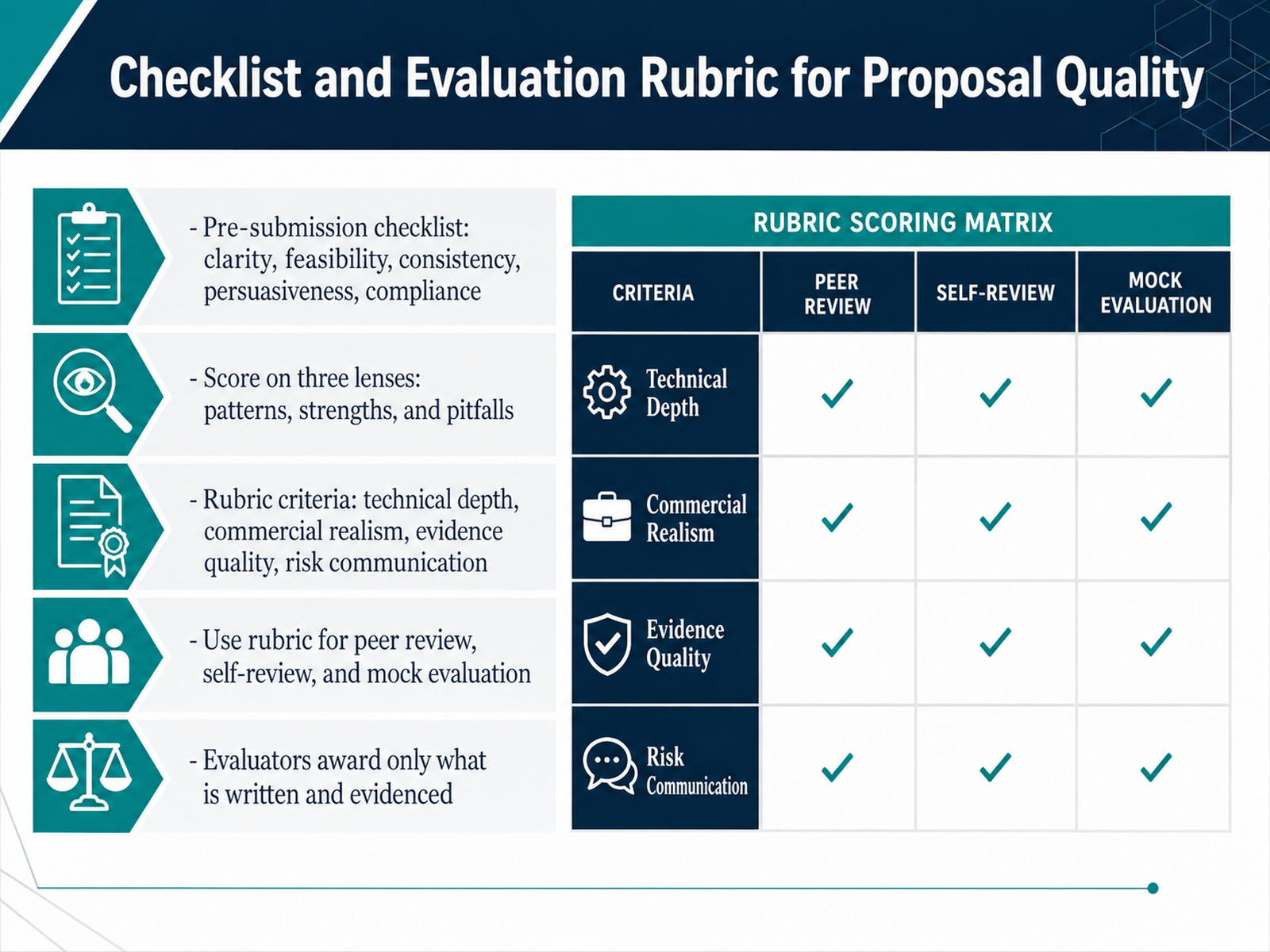
 - 09Checklist and Evaluation Rubric for Proposal QualityLet us now shift into quality control. This is where we turn our patterns and strengths into a measurable standard. A solid evaluation rubric does two things well. It forces consistency before submission, and it guides objective peer review. Start with a pre-submission checklist that asks if the proposal is clear, feasible, consistent, and persuasive. Compliance matters here too, even in internal documents. Then score your proposal against three lenses, the patterns we discussed, the strengths we cultivate, and the pitfalls to avoid. For the actual rubric criteria, assess technical depth, commercial realism, quality of evidence, and how well risks are communicated. Keep the rubric honest. Do not let a reviewer infer intent or potential. They must award points only for what is actually written and evidenced on the page. Use this rubric for self-review, peer review, and even a mock evaluation before the final version. From here, we will move into the practical workflow of revision, and how to guide that process from a rough draft to a polished submission.
 1 min
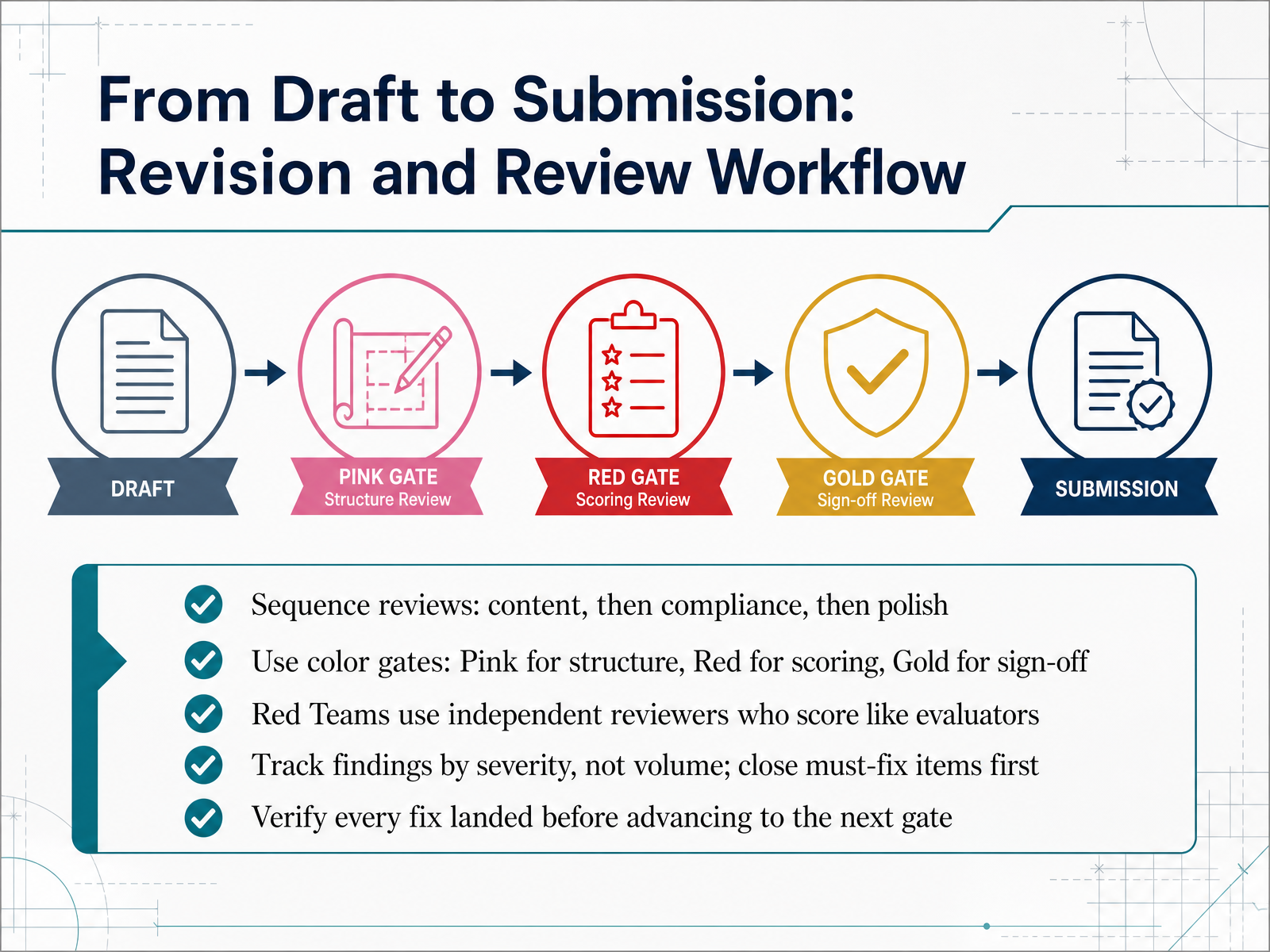
1 min - 10From Draft to Submission: Revision and Review WorkflowNow let’s walk through the revision and review workflow, from draft to submission. The key is sequencing: first, review for content; second, for compliance; and only last, for polish. That order protects your time. Use color gates to keep every stage clear. Pink means structure is sound. Red means scoring risk is low. Gold means executive sign-off is ready. For Red Teams, bring in independent reviewers who haven’t written the proposal. They score just like evaluators, so they catch what insiders miss. When findings come back, track them by severity, not volume. Close must-fix items first; defer cosmetic suggestions if needed. And before advancing to the next gate, verify every fix actually landed. Compare versions directly rather than trusting the status column. This discipline turns revision from a scramble into a controlled process.
 1 min
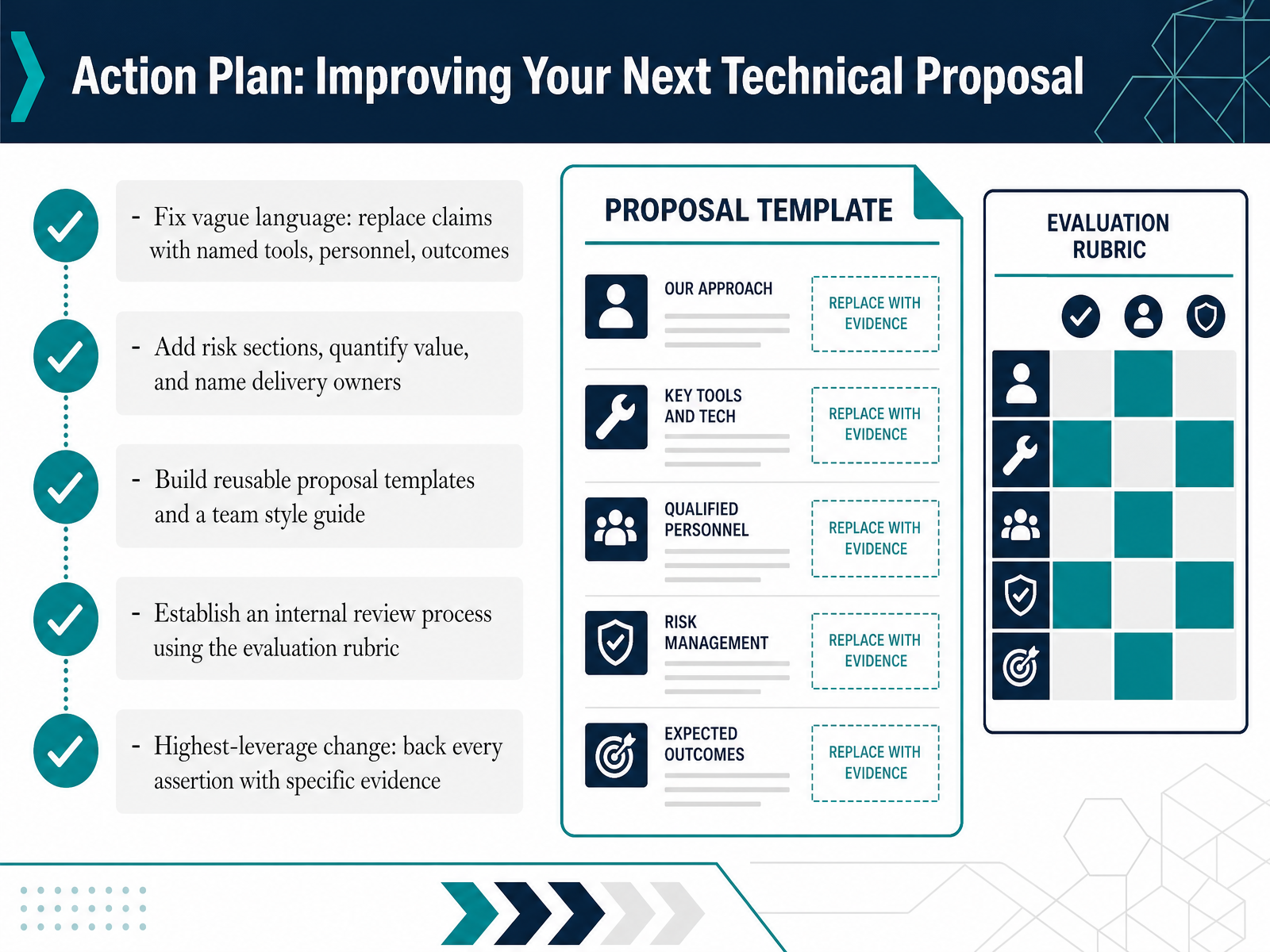
1 min - 11Action Plan: Improving Your Next Technical ProposalA clear strength of the patterns we've discussed is that they're actionable. Now let's turn those strengths into an action plan for your next proposal. Start by fixing vague language. Replace broad claims with named tools, specific personnel, and measurable outcomes. For example, don't say you have an experienced team; name the lead engineer and their ten years with your stack. Next, add risk sections. Quantify each risk's likelihood and impact, and name the owner who will manage it. This addresses a common pitfall we saw: risk sections without teeth. Then, build reusable templates and a team style guide. Templates standardized structure; a style guide ensures consistent terminology and formatting. You'll reduce rework during reviews and keep contributors aligned. Establish an internal review process using the evaluation rubric we covered. A structured review filter catches unsupported assertions before the client does. Finally, the highest-leverage change: back every assertion with specific evidence. Tie each claim to a project reference, a certification, or a data point. If you only do one thing, do that. We'll practice annotating a weak proposal section next, so you can apply these fixes hands-on.
 bidpacto.com2 min
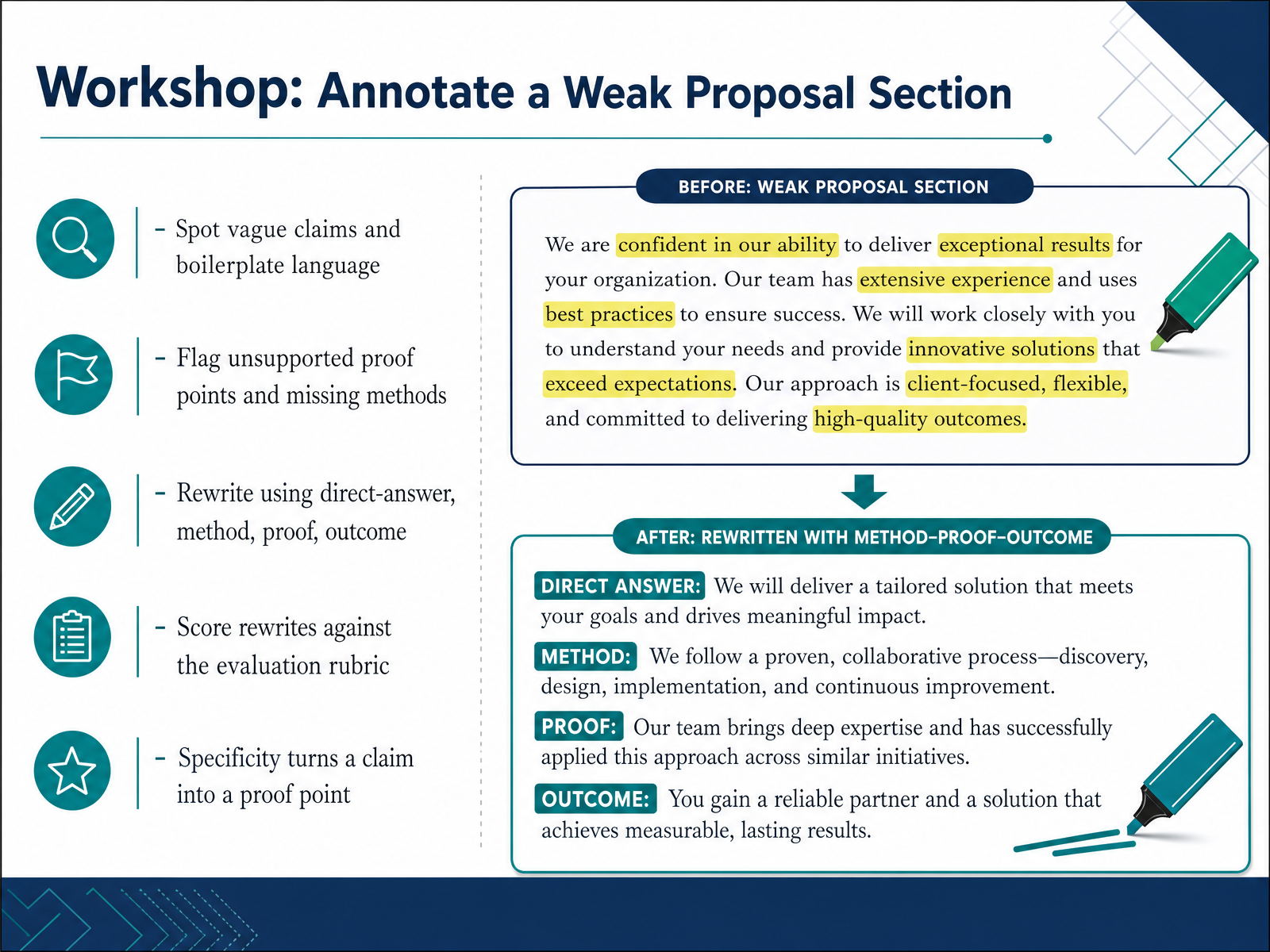
 - 12Workshop: Annotate a Weak Proposal SectionLet's put this into practice. We're going to annotate a weak proposal section together. Your first job is to spot vague claims and boilerplate language. Phrases like 'best-in-class solutions' or 'unwavering commitment' are red flags. Next, flag any unsupported proof points and missing methods. If we claim deep expertise in legacy system migration, but provide no contract name or record count, that's a liability. Now, the rewrite. Use the direct-answer, method, proof, outcome structure. State what you'll do, how you'll do it, show evidence you've done it before, and state the measurable result. Finally, we'll score our rewrites against the evaluation rubric we built earlier. Remember, specificity is what turns a simple claim into a verifiable proof point. When an evaluator reads your section, they need to be able to check a box or assign a specific score. If your sentence doesn't give them the evidence to do that, it needs to go back to the drawing board. Coming up, we'll build a mini compliance matrix to make sure nothing slips through the cracks.
 ace-consulting.netautorfp.aisummitstrategywins.com+22 min
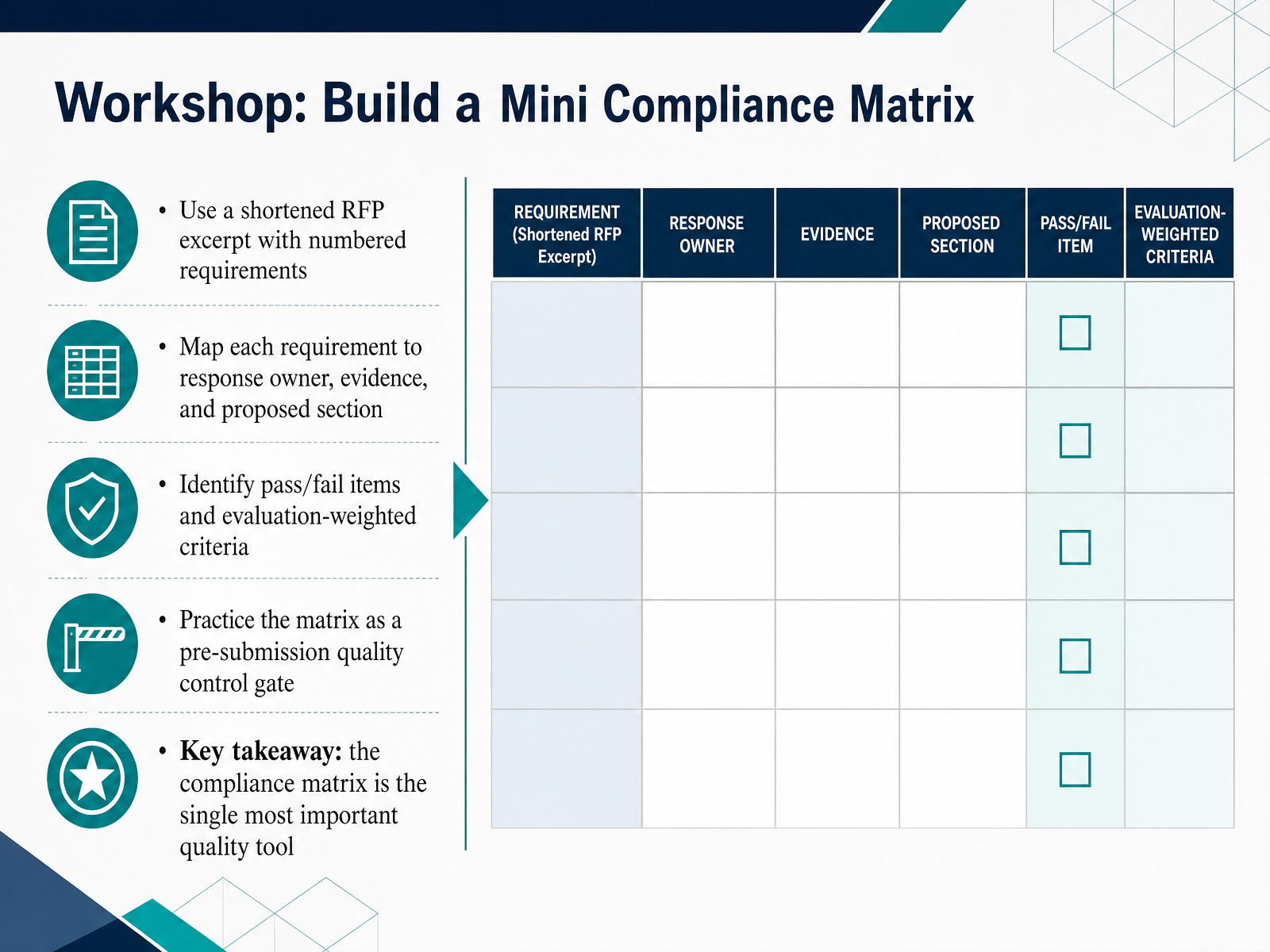
 - 13Workshop: Build a Mini Compliance MatrixLet's put this into practice with a short workshop exercise. We'll use a shortened RFP excerpt with numbered requirements. Your task is to build a mini compliance matrix. Start by mapping each requirement to three things: the response owner, the evidence that proves compliance, and the proposed proposal section where that answer lives. Next, identify which items are pass or fail, and which ones carry evaluation-weighted criteria. This distinction matters, because pass or fail items are gates, while weighted criteria are where you compete on quality. Then, use the matrix as a pre-submission quality control gate. That means checking for gaps before the document goes to review, not after. The key takeaway here is that the compliance matrix is the single most important quality tool you have. It aligns your team, proves coverage, and protects you from silent omissions. Now, let's close by moving from these patterns into your daily practice.
 opentextbooks.concordia.caprojectmanagementformula.combidpacto.com+21 min
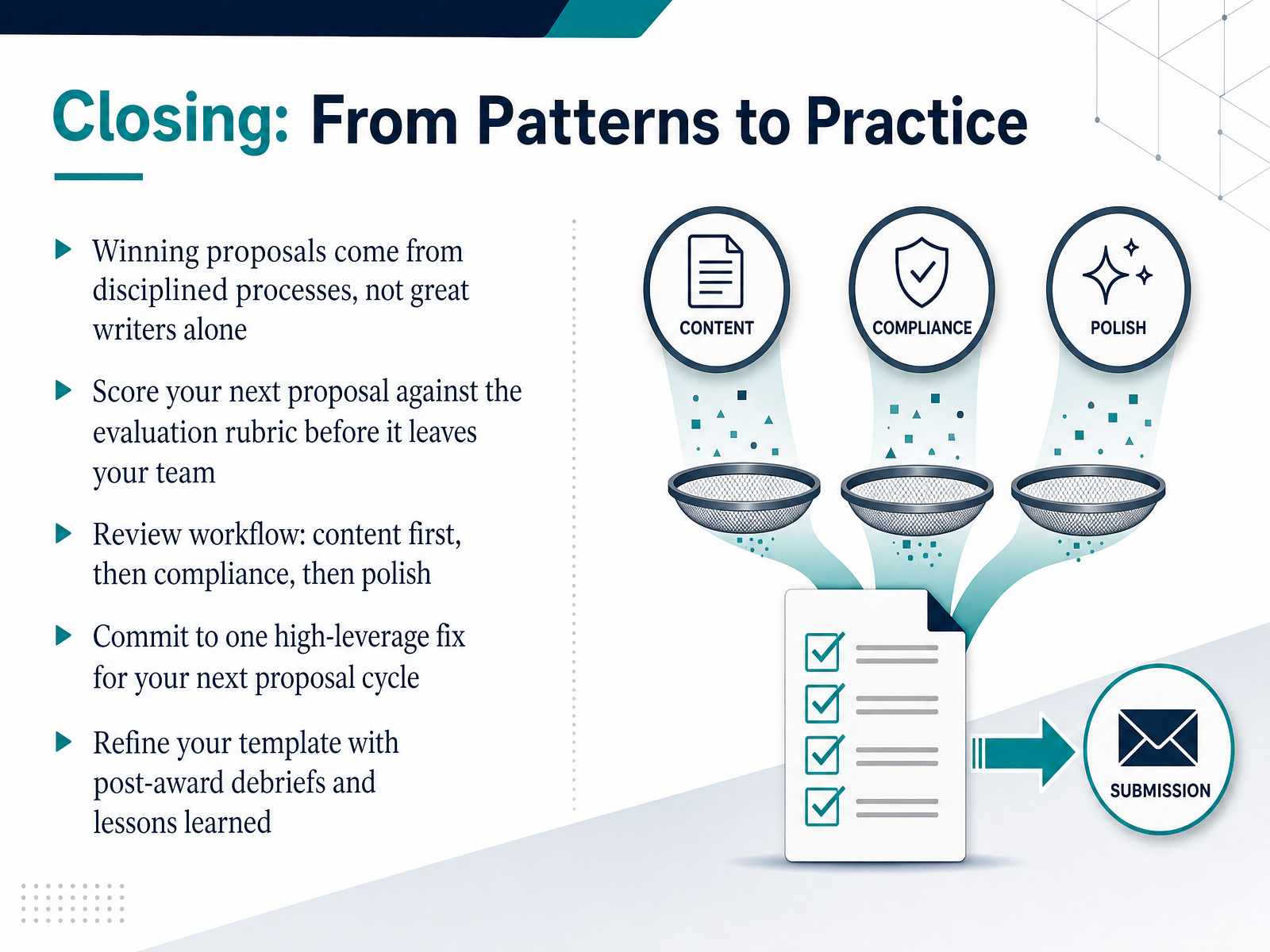
 - 14Closing: From Patterns to PracticeAs we close, keep this in mind. Winning proposals come from disciplined processes, not from great writers alone. Before your next submission, score your draft against the evaluation rubric. Do this while you still have time to fix what you find. Use a review workflow that puts content first, then compliance, and polish last. That ordering prevents wasted effort on final wording before the substance is sound. Commit to just one high-leverage fix for your next cycle. Maybe it is a sharper compliance matrix, or a truly independent review. Then, after the award decision, request the debrief. Even in a loss, the feedback tells you exactly what to improve. Feed those lessons back into your template and your content library. That is how documentation lifecycles mature. Each proposal gets faster, and each review gets sharper. Thank you for your time and attention. Now go apply these patterns, and build a proposal process that wins more than it loses.
 autorfp.aiace-consulting.nettenderx.ai+21 min
Take the deck with you
Download this course as a file — free, no sign-up needed.
- PDF handoutEvery slide page, ready to print or share.15 pages · 3.8 MBDownload
- Narrated PowerPointThe deck that presents itself — every slide carries the digital human's narration video.15 pages · 14.4 MBDownload
- PowerPoint slidesThe full deck as a .pptx — open it in PowerPoint, Keynote, or Google Slides.15 pages · 3.7 MBDownload
Free to use in your own training — please keep the PersonWise credit page at the end.
Have your own deck? Turn it into a course
Sources consulted
Web sources consulted while building this course.
- Technical Proposal: How to Write One That Wins in 2026 - AutoRFP.ai — autorfp.ai
- Winning Technical Proposals: Practical Tips and Proven — ace-consulting.net
- How to Write a Winning Technical Proposal | Tender X — tenderx.ai
- Proposal Writing Best Practices (2026) | ProposalCraft — proposalcraft.io
- RFP Technical Approach: How to Write the Highest-Scoring Section — hudson-bidwriters.com
- How to Review a Technical Approach (Without Being an Engineer) — summitstrategywins.com
- Why Proposal Reviews Fail and How to Fix Them | Lohfeld — lohfeldconsulting.com
- Most Common Reasons Proposals Get Disqualified (2026) | Flowcase — flowcase.com
- Chapter 13: Proposals – The Practical Guide to Technical Writing for Engineers and Computer Scientists — opentextbooks.concordia.ca
- Technical Proposal – Project Management Formula — projectmanagementformula.com
- AI Technical Proposal Writing Format & Templates | BidPacto — bidpacto.com
- templates/technical-proposal-template.md — github.com
- Technical Proposal Template — pandadoc.com
- Engineering Proposal Template (PDF) — jotform.com
- Engineering Proposal Template | LegalZoom — legalzoom.com
- Engineering Proposal Template — proposify.com
- app03_4B_Dec 2020(Rev C)_clean — cedd.gov.hk
- Greeting — smartsheet.com
- Proposal Team Roles & Responsibilities | ExcelaDoc — exceladoc.ai
- Proposal Team: Roles, Structure & How to Build One That Wins — sifthub.io