Simple Machines: Force & Advantage
Begin
14 pages · ~28 min
Simple Machines: Force & Advantage
Learn how simple machines multiply force, change distance, and provide mechanical advantage in this foundational physics training.
What you’ll learn
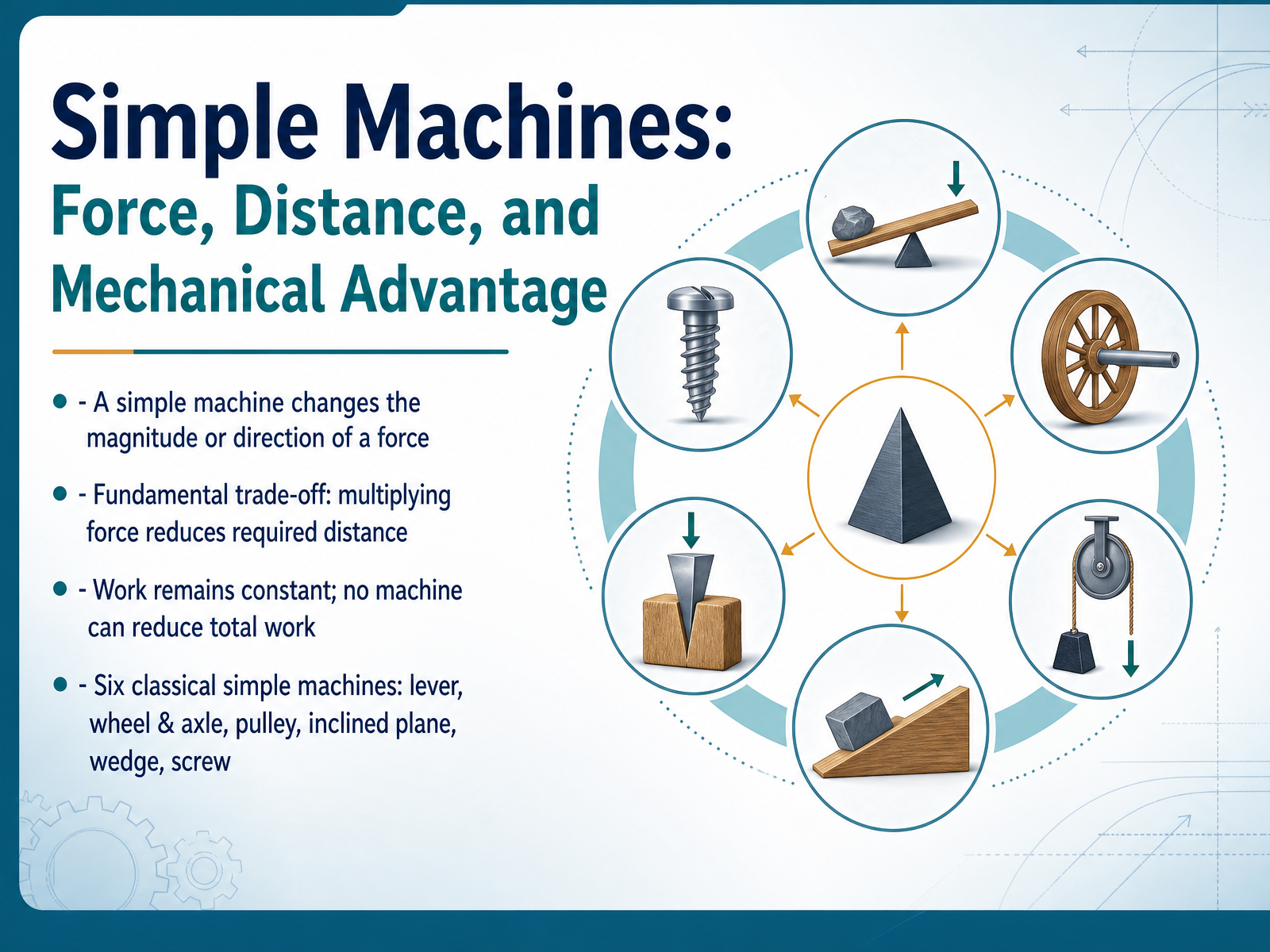
- 01Simple Machines: Force, Distance, and Mechanical AdvantageWelcome. In this lesson we're going to look at simple machines and how they change the relationship between force and distance. Think of a task you've done yourself: lifting something heavy, prying something open, or raising a load. A simple machine won't reduce the total work, but it lets you use less input force by applying that force over a longer distance. This trade-off is what we call mechanical advantage. It's the ratio of the output force you get, compared to the input force you apply. The Renaissance scientists identified six classic simple machines that all follow this rule: the lever, the wheel and axle, the pulley, the inclined plane, the wedge, and the screw. Each one changes either the size or the direction of the force, or both, and we'll explore them one by one. Let's start with the core principles behind work, force, and distance, because once you understand that foundation the machines themselves become very clear.phys.libretexts.orgopenstax.orgopenstax.org+22 min
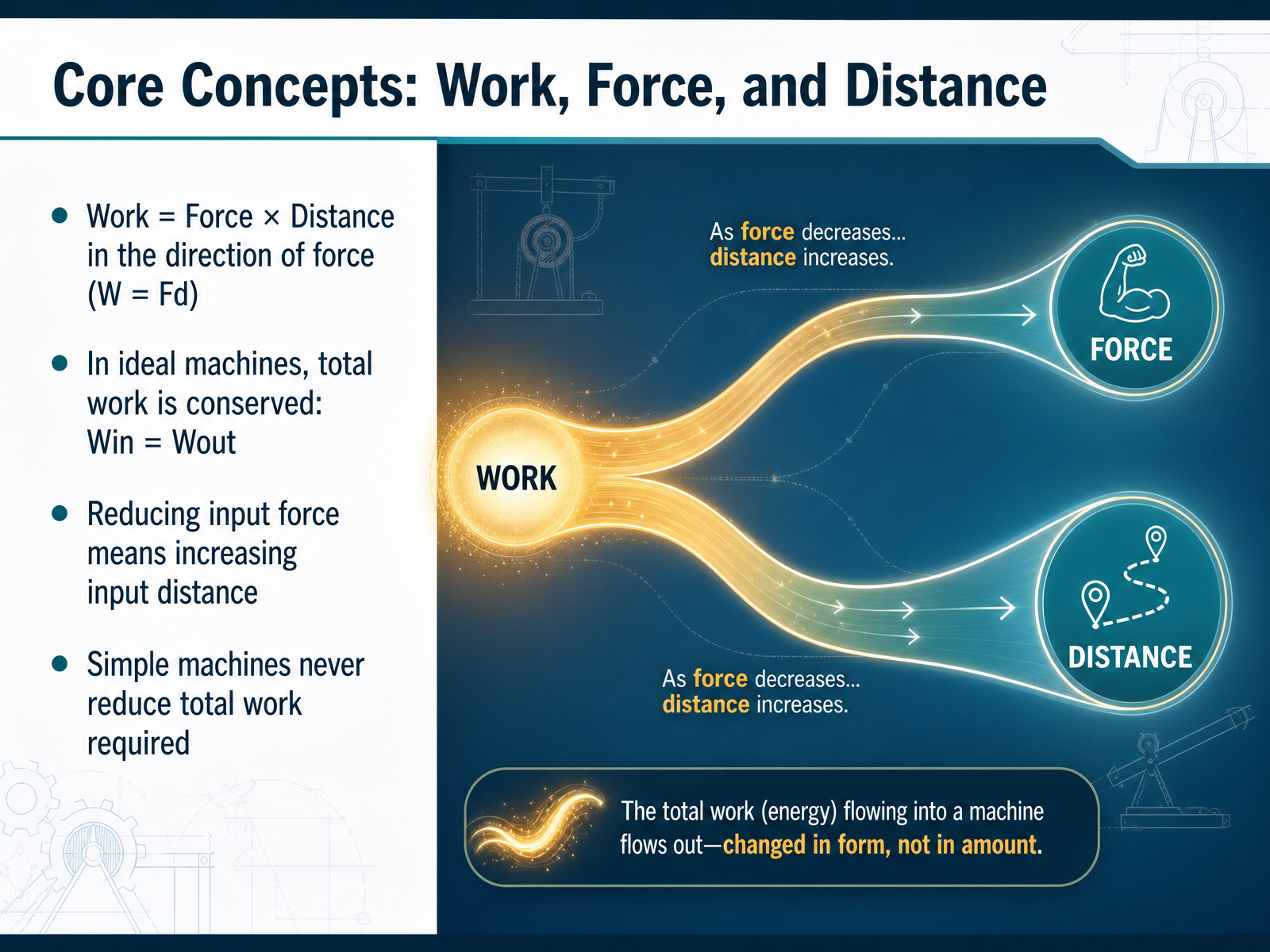
- 02Core Concepts: Work, Force, and DistanceLet’s break down the core idea behind every simple machine. It all starts with three terms: work, force, and distance. In physics, work equals force multiplied by distance in the direction of that force. Think of it like this: if you push a box straight across a floor, the work you do is your push force times how far the box moves. Now here’s the key rule. In an ideal machine with no friction, the total work you put in equals the total work you get out. Energy is conserved. That means if you want to cut your input force in half, you have to double the distance you apply that force. You can use less effort, but you have to push or pull over a longer path. A simple machine never reduces the total amount of work required. It just trades force for distance, or distance for force, to make the task fit your body better. So when you see a ramp or a lever making a job feel easier, remember: the work didn’t disappear. You simply spread it out over a longer distance. Coming up next, we’ll put numbers to this trade-off. The next slide covers mechanical advantage and how to calculate it.
 openstax.orgopenstax.orgtheexpertta.com+21 min
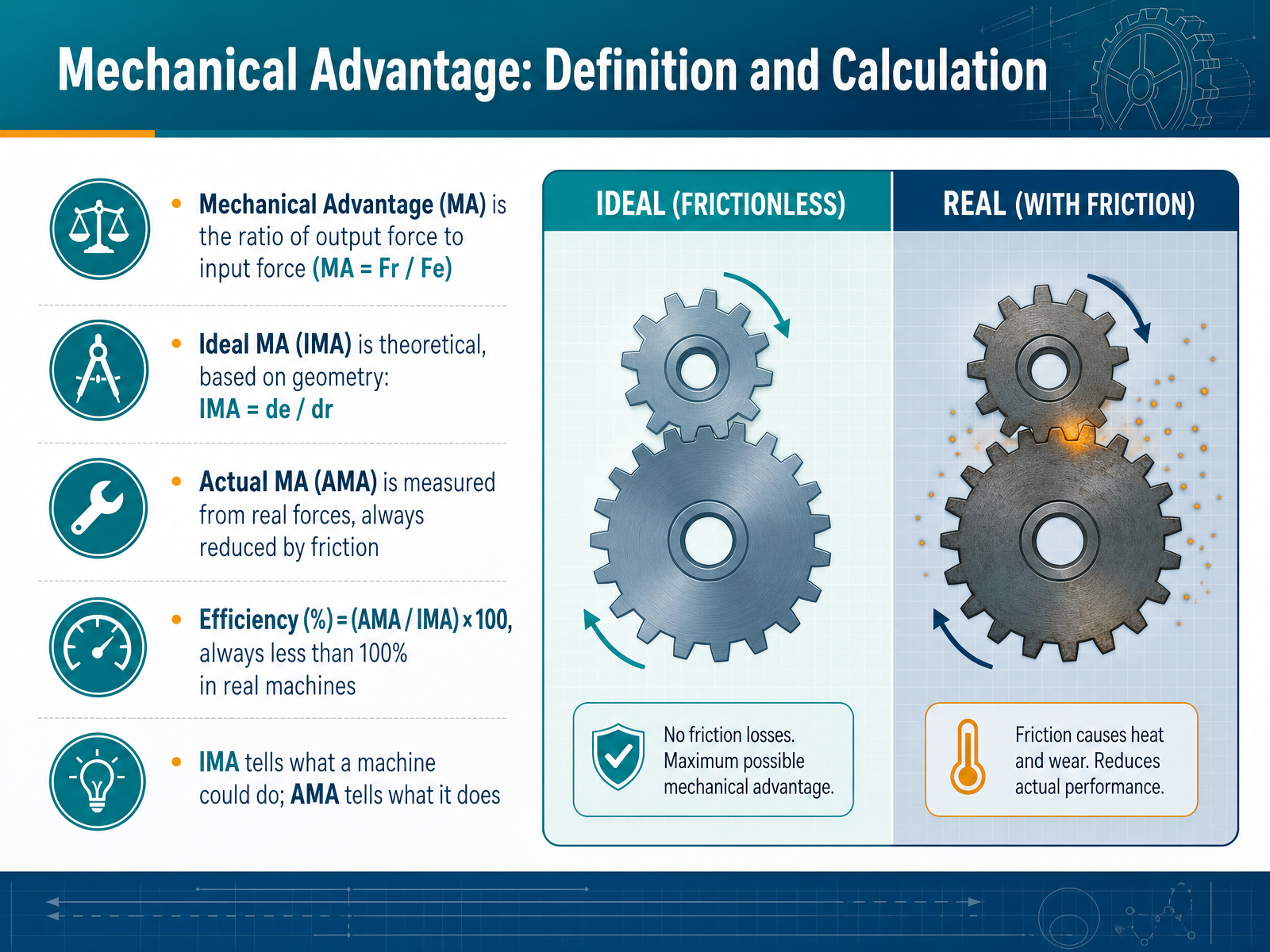
 - 03Mechanical Advantage: Definition and CalculationNow, let’s get precise about what mechanical advantage really means. Think of it as a ratio—a comparison of what you get out versus what you put in. The formal definition is the ratio of output force to input force. We write it as MA equals F subscript r over F subscript e. In simpler terms, it's the resistance force you overcome divided by the effort force you apply. But here’s where it gets practical. There are two types you need to know. First is the Ideal Mechanical Advantage, or IMA. This is the theoretical number, based purely on geometry. We calculate it using distances: IMA equals the effort distance divided by the resistance distance. It tells you what a machine could do in a perfect world with no friction. For example, if you move your hand five meters to raise a load one meter, the ideal MA is five. Second is the Actual Mechanical Advantage, or AMA. This is measured from real forces in the real world. The formula is AMA equals resistance force divided by effort force. Because every machine fights friction, the AMA is always less than the IMA. The gap between them tells us about efficiency. We calculate efficiency as a percentage: take AMA, divide it by IMA, and multiply by one hundred. A real machine is never one hundred percent efficient because energy is lost as heat. So remember: IMA tells what a machine could do, and AMA tells what it actually does. Next up, we'll apply these ideas to our first tool: levers and how they multiply force through a fulcrum.
 teachengineering.orgncvs2.books.nba.co.zaisbe.net+22 min
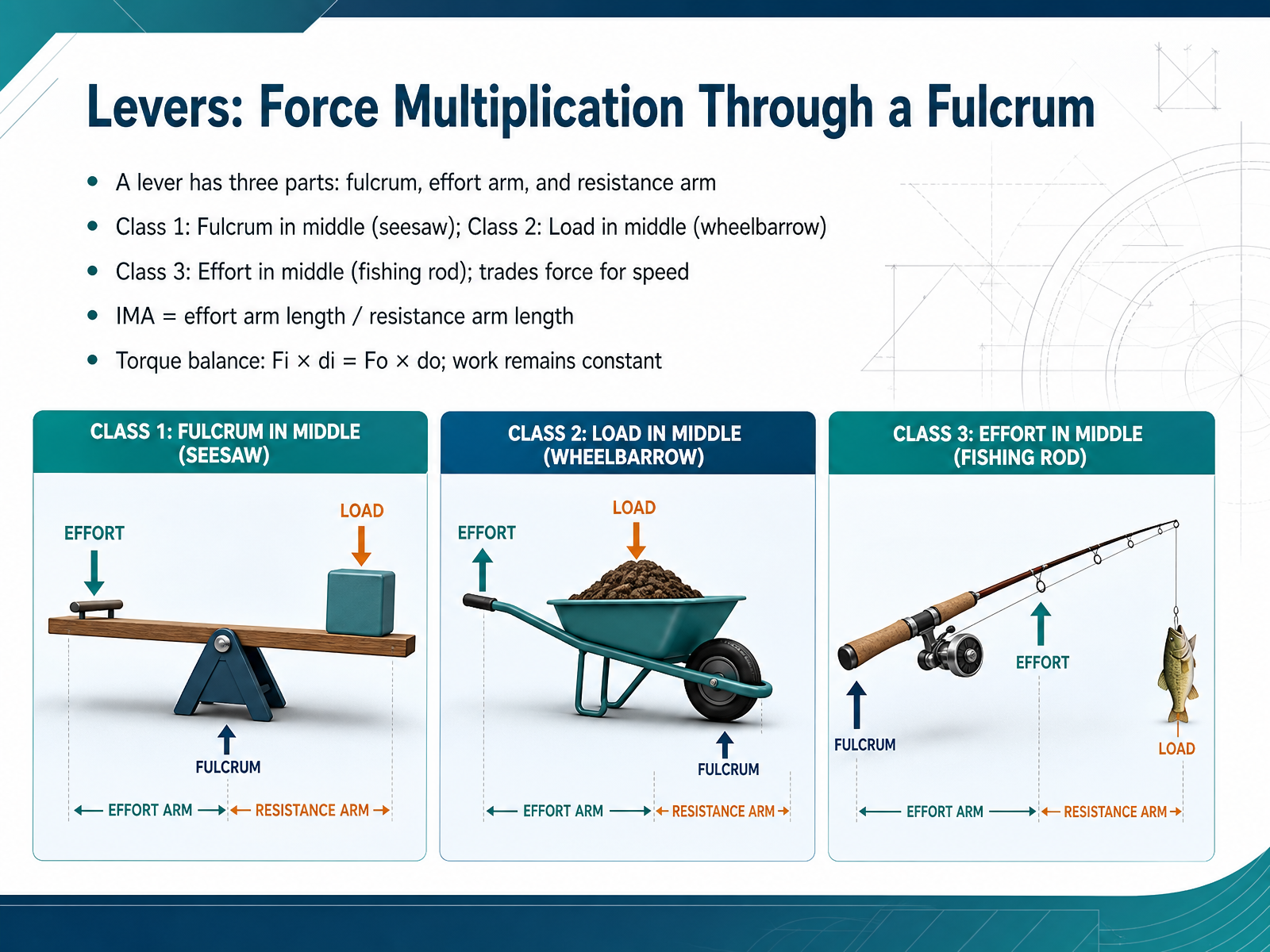
 - 04Levers: Force Multiplication Through a FulcrumNow let's look at levers and how they multiply force through a fulcrum. Every lever has three parts: the fulcrum, which is the pivot point; the effort arm, where you apply the input force; and the resistance arm, which acts on the load. There are three main classes of lever. In a Class one lever, the fulcrum sits in the middle, just like a seesaw. A Class two lever puts the load in the middle. Think of a wheelbarrow: the wheel is the fulcrum, the load is in the tray, and you lift at the handles. A Class three lever places your effort in the middle. A fishing rod is a perfect example. Here, you trade high force for greater speed and distance at the tip. The ideal mechanical advantage, or IMA, is simply the length of the effort arm divided by the length of the resistance arm. A ratio above one means you multiply force, while a ratio below one multiplies speed. This works because of torque balance. The input force times its distance from the fulcrum equals the output force times its distance. The total work stays constant, but the lever lets you choose between a powerful short move or a fast long move. Up next, we extend this trade-off concept to inclined planes, where you reduce effort by increasing distance.
 bbc.co.uken.wikipedia.orgstudy.com+22 min
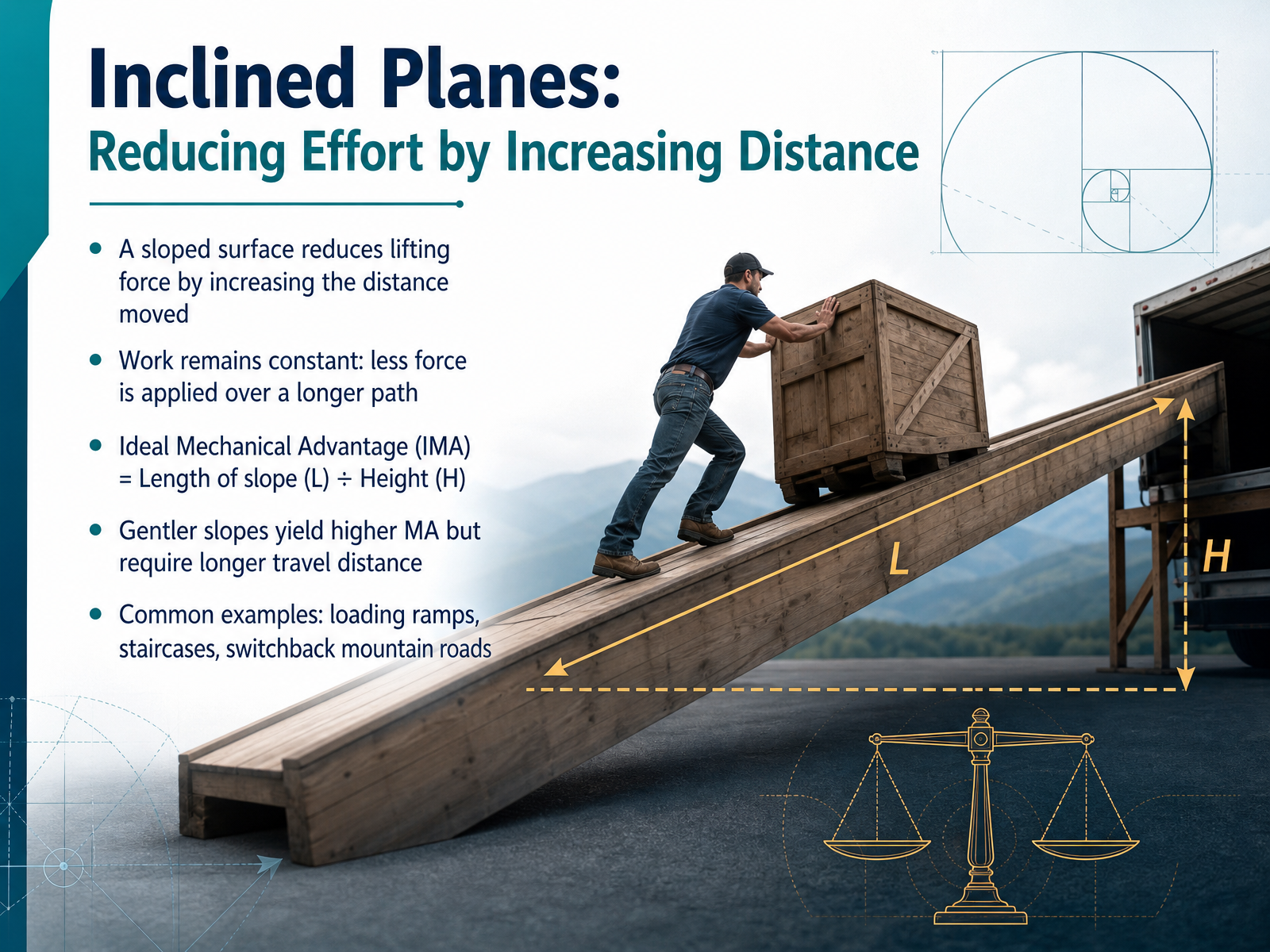
 - 05Inclined Planes: Reducing Effort by Increasing DistanceNow let’s look at one of the simplest tools you already use: the inclined plane, or as most of us call it, a ramp. Here’s the trick—instead of lifting a heavy load straight up, you push or roll it along a sloped surface. You trade a short, hard lift for a longer, easier push. The total work stays the same, because you’re applying less force over a greater distance. To measure this advantage, we use a ratio called Ideal Mechanical Advantage, or IMA. For a ramp, it’s simply the length of the slope divided by the height. The longer and gentler the ramp, the higher the mechanical advantage and the less force you need, but you travel farther to reach the same height. Think about loading a heavy box into a truck—you could deadlift it, or you could walk it up a long ramp with much less strain. Switchback roads do the same thing for vehicles, turning a steep climb into a gradual rise. Staircases work on this principle too. So whenever you see a ramp, you’re looking at a simple machine that trades distance for reduced effort. Next, we’ll apply this idea to wheels and axles, turning rotary motion into advantage.
 phys.libretexts.orgen.wikipedia.org1 min
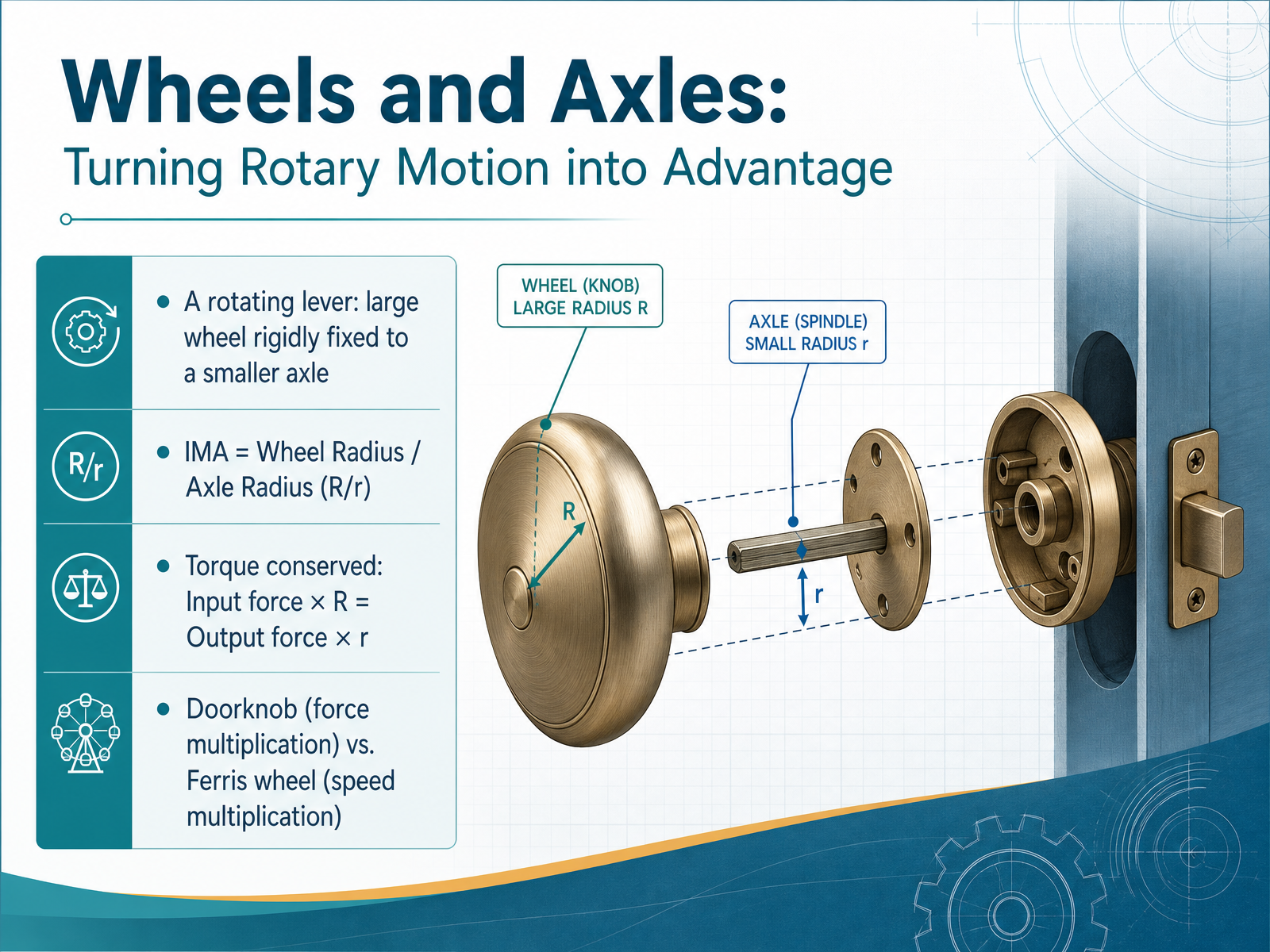
 - 06Wheels and Axles: Turning Rotary Motion into AdvantageNow let’s look at wheels and axles—and think of it as a rotating lever. A large wheel is rigidly fixed to a smaller axle, so they always turn together. The ideal mechanical advantage, or IMA, is simply the wheel radius divided by the axle radius. A bigger wheel and a smaller axle give you a larger force advantage. Here’s the key relationship: input force times the wheel radius equals output force times the axle radius—torque is conserved. If you apply a small force at the large wheel rim, you get a much larger force at the axle surface, but the axle turns a shorter distance per rotation. A doorknob is a perfect example of force multiplication: the wide knob is the wheel, and the thin spindle is the axle. On the other hand, a Ferris wheel works in reverse—the motor applies force to the small axle to get high speed and long travel at the big outer rim. So the same ratio can multiply force or multiply speed, depending on which side you drive. Up next, we’ll explore pulleys and how they redirect force to gain an advantage.
 1 min
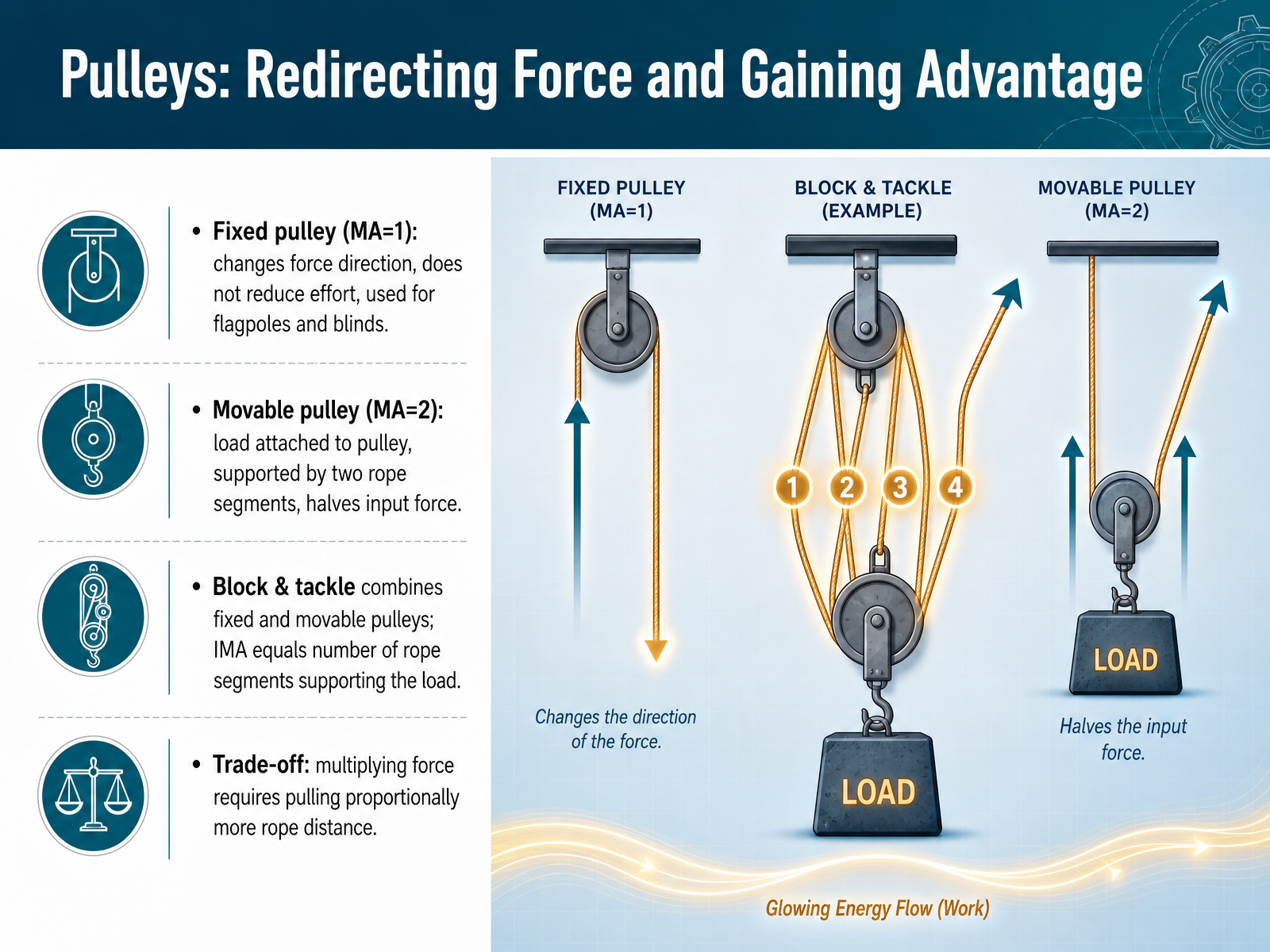
1 min - 07Pulleys: Redirecting Force and Gaining AdvantageNow we come to pulleys, which change how force and distance work together. Think first about a fixed pulley, like the one at the top of a flagpole. It changes the direction you pull, but it does not reduce the effort. Its mechanical advantage is one. Next, imagine a movable pulley attached directly to a load, with the rope anchored above. Two rope segments now support the load, so the tension splits. You pull with half the force, but you must pull twice as far. That gives a mechanical advantage of two. When you combine fixed and movable pulleys into a block and tackle, the advantage grows. Simply count the number of rope segments actually supporting the moving load. Four supporting segments mean a mechanical advantage of four, but you will pull four meters of rope for every meter the load rises. This trade off is the core rule: multiplying force always increases the distance you must pull. Up next, we will look at wedges and screws and see how they are special applications of inclined planes.
 1 min
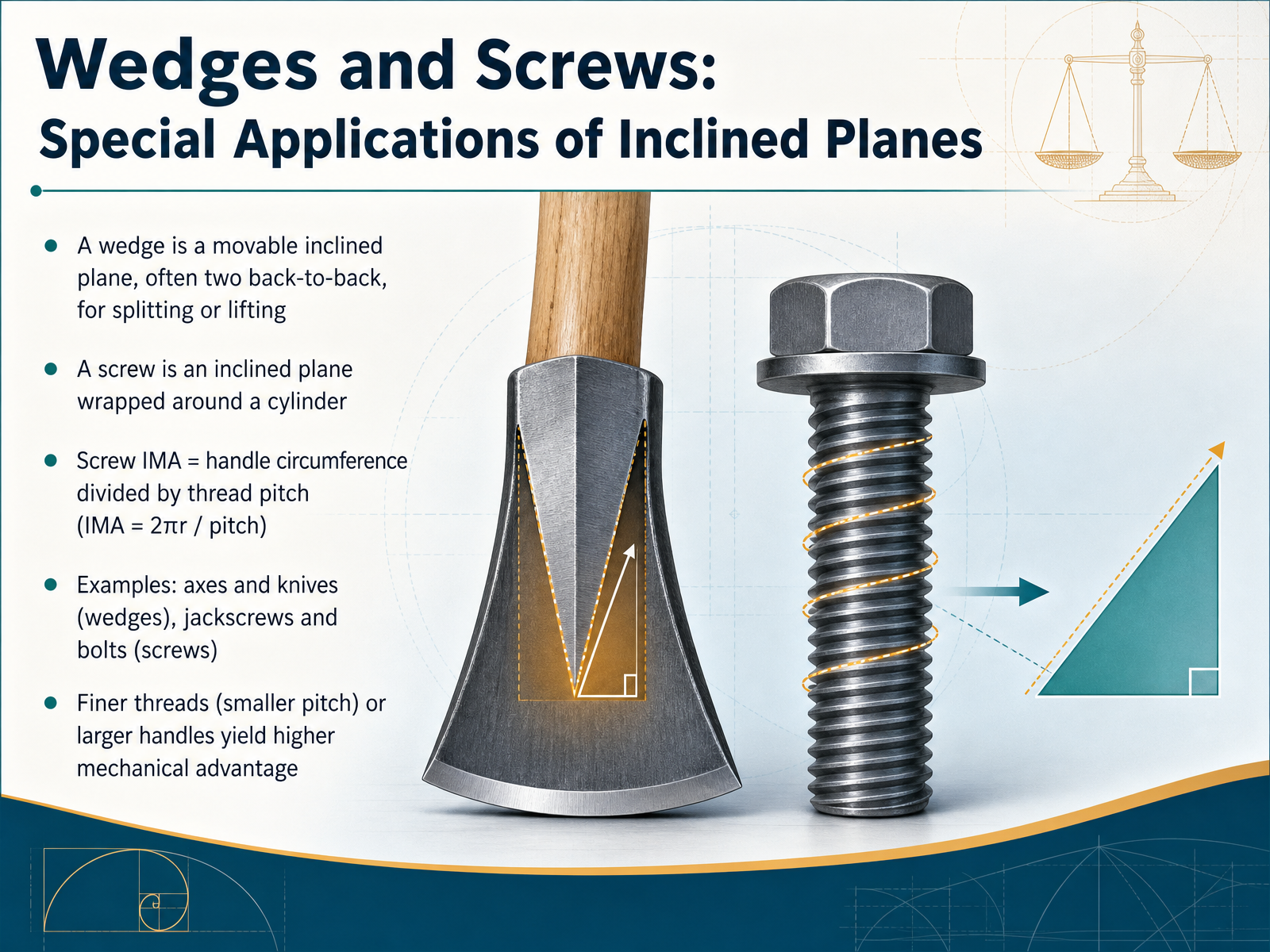
1 min - 08Wedges and Screws: Special Applications of Inclined PlanesNow let's look at two special versions of the inclined plane: wedges and screws. A wedge is really just a movable inclined plane—or two put back-to-back. Think of an axe or a knife. You apply a force over a longer distance down the blade, and it splits or cuts with a much larger force at the thin edge. A screw takes the same idea and wraps that inclined plane around a cylinder. The thread is the ramp, and the pitch is the distance between two threads. To find the ideal mechanical advantage for a screw, you divide the circumference of the handle sweep by the pitch. In numbers, that is two pi r divided by pitch. A larger handle or finer threads—meaning a smaller pitch—gives you a higher mechanical advantage. You trade a lot of handle turning for a very strong push along the screw. Examples include a jackscrew lifting a heavy load or a simple bolt pulling parts together. In each case, you sacrifice distance of motion for a powerful gain in force. Next, we'll see how these simple machines come together in compound machines, combining their advantages for real-world tasks.
 openstax.org2 min
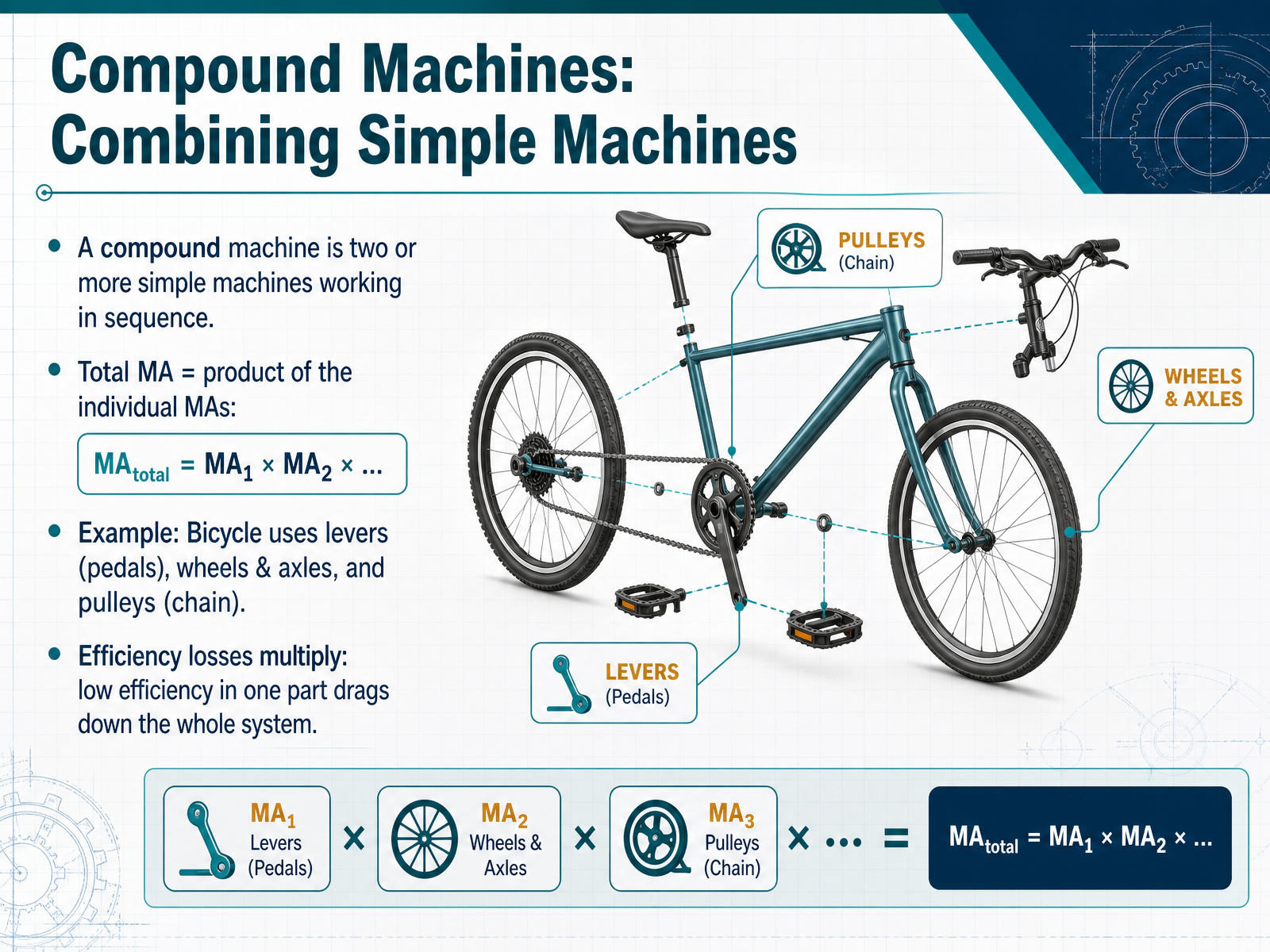
 - 09Compound Machines: Combining Simple MachinesNow let's step up one level to compound machines. Think of a compound machine as a team of two or more simple machines working in sequence. Their job? To pass force from one to the next, so the final output feels much lighter than your input. Here's the rule engineers use: the total mechanical advantage isn't the sum. You multiply the individual advantages together. So if a lever gives you a mechanical advantage of three, and the pulley it feeds gives you a mechanical advantage of two, the overall system advantage is three times two, which equals six. That means your effort gets magnified six times. The bicycle is a perfect real-world example. Your foot pushes a lever at the pedal, that lever turns a wheel and axle, and the chain acts as a pulley system connecting the gears to the rear wheel. But there's a catch: efficiency losses multiply too. If one part is a little rusty or poorly fitted, its low efficiency drags down the performance of the entire machine. In a chain of simple machines, every single link matters. Coming up next: we'll zoom out and look at the universal trade-off that governs all these machines: force versus distance.
 2 min
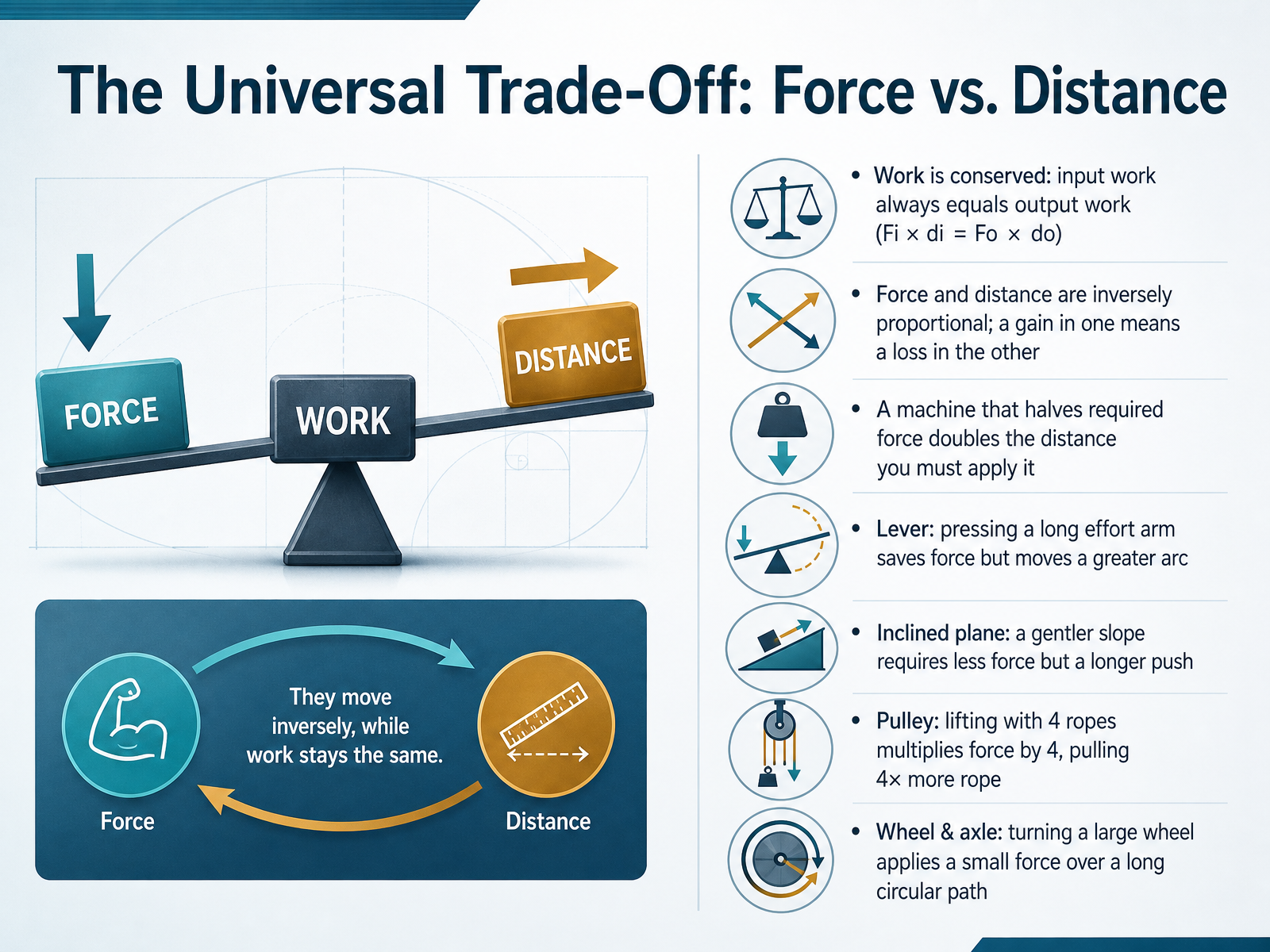
2 min - 10The Universal Trade-Off: Force vs. DistanceEvery simple machine operates on one central trade-off: force versus distance. You've probably noticed this without putting a name to it. The physics is simple: input work always equals output work. Since work is force multiplied by distance, if you want to use less force, you have to apply that force over a longer distance. There is no free lunch. A machine that cuts the required force in half instantly doubles the distance you need to move. Think of a long pry bar. Pressing down on the effort arm saves you force, but your hand travels in a much bigger arc than the load. With an inclined plane, a gentler slope lets you push with less effort, but you must push that box for a longer stretch. A four-rope pulley system multiplies your pulling force by four, meaning you only feel a quarter of the load's weight. In exchange, you pull four meters of rope for every single meter the load rises. Even a wheel and axle works the same way: you apply a small force over the large circular path of the wheel to generate big pulling force on the axle. This inverse relationship is called mechanical advantage. It is simply the ratio of output force to input force. Whenever a machine gives you a force bonus, remember that distance is the price you pay. Let's take this one step further and look at how friction steals some of that advantage in real machines.
 phys.libretexts.orgopenstax.orgopenstax.org+21 min
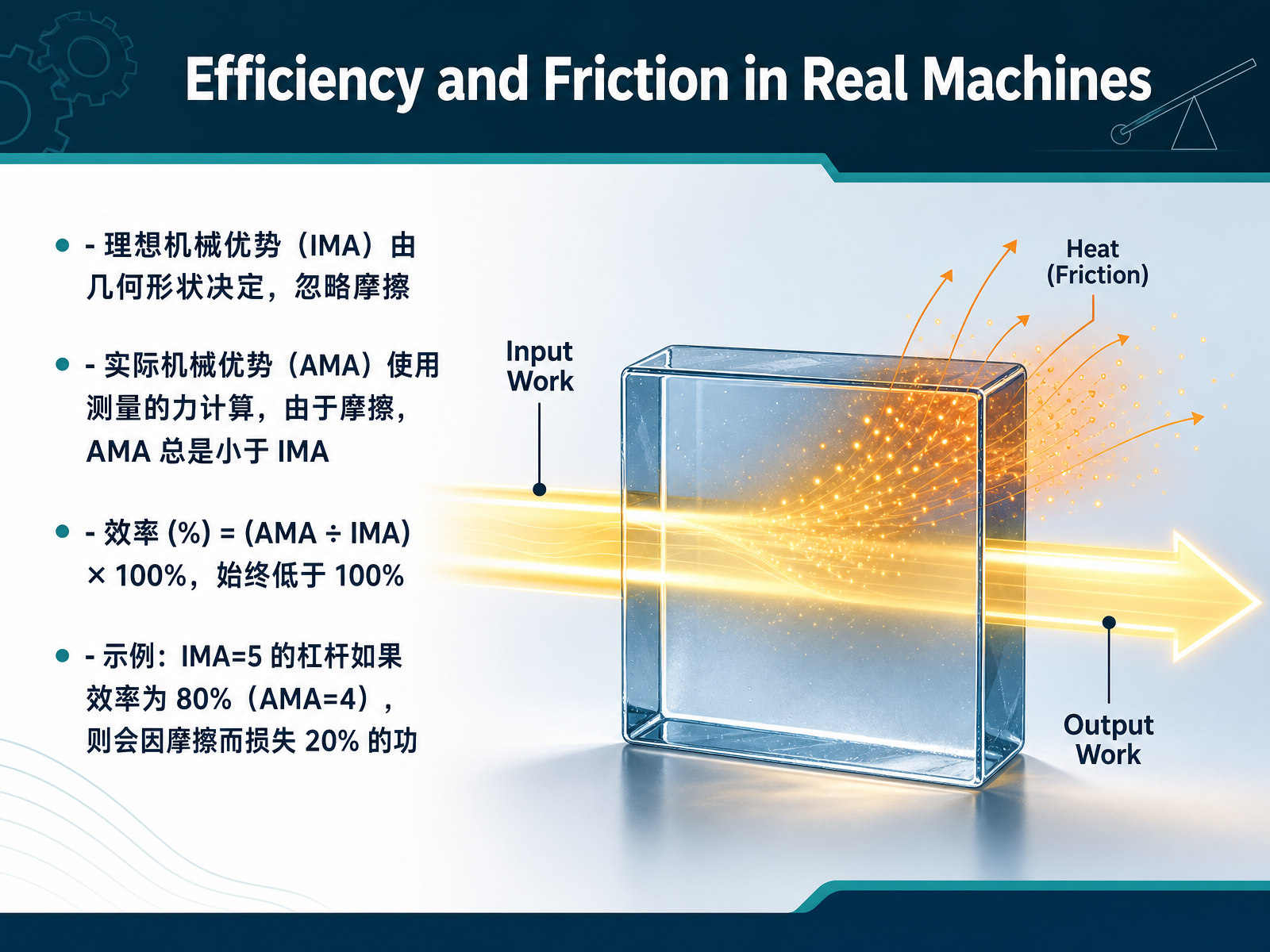
 - 11Efficiency and Friction in Real MachinesNow let's talk about why no machine is perfect. Up to this point, we considered ideal mechanical advantage, or IMA, which comes purely from the machine's geometry. It assumes no friction. But in the real world, friction is always there, stealing some of your effort and turning it into heat or sound. So we use a different number called actual mechanical advantage, or AMA. We calculate AMA using real measured forces—the resistance force divided by the effort force. Because of friction, AMA is always less than IMA. This gap between ideal and actual shows up directly in efficiency. Efficiency is just AMA divided by IMA, multiplied by one hundred percent. Let's take an example. Imagine a lever with an ideal mechanical advantage of five. If friction brings the actual advantage down to four, the efficiency is four divided by five, or eighty percent. That means twenty percent of your input work is lost to friction and never reaches the load. Thinking like a mechanic, this is why you lubricate parts and keep surfaces smooth—to close that gap and get more of your work to the job.
 teachengineering.orgncvs2.books.nba.co.zaisbe.net+22 min
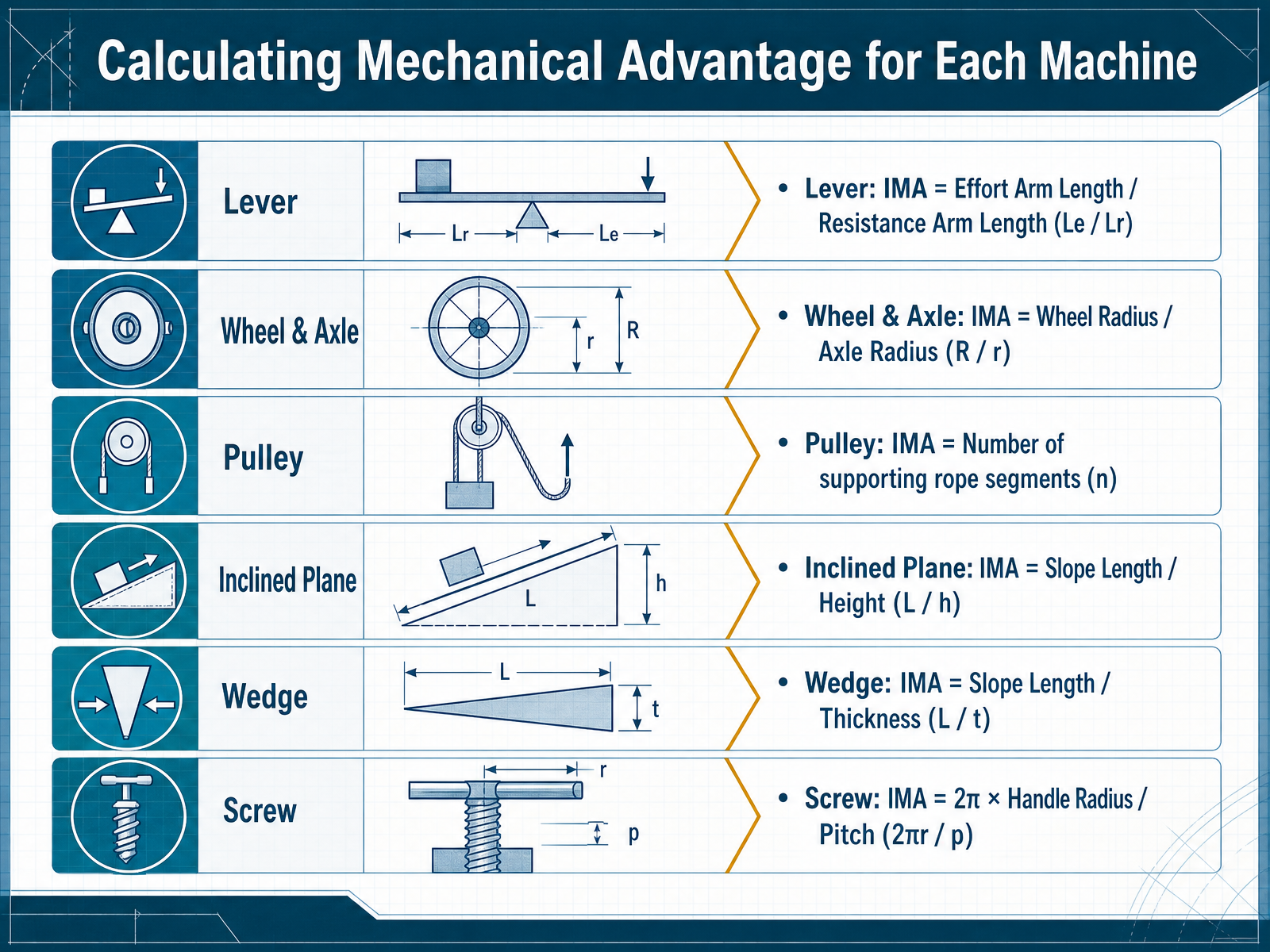
 - 12Calculating Mechanical Advantage for Each MachineNow let's pull it all together with the formulas we use to calculate mechanical advantage for each simple machine. Think of these as the cheat sheet you'd bring to the workshop. For a lever, the ideal mechanical advantage is the length of the effort arm divided by the length of the resistance arm. That's the distance from your hand to the fulcrum, over the distance from the load to the fulcrum. On a wheel and axle, we use the radius ratio. Mechanical advantage equals the radius of the wheel divided by the radius of the axle. So a big steering wheel on a thin column gives you a lot of leverage. For a pulley system, it's even simpler. Just count the number of rope segments that directly support the moving load. That count is your mechanical advantage. With an inclined plane, you take the full length of the slope and divide it by the vertical height. A long, gentle ramp has a much bigger advantage than a steep one. A wedge uses the same idea, but we divide the slope length by the thickness of the blunt end. Finally, a screw is an inclined plane wrapped around a cylinder. Its mechanical advantage is two pi times the handle radius, divided by the pitch, which is the distance between threads. These ratios all trade force for distance, and they're your tools for sizing up any job. Next, we'll take these formulas and use them to identify simple machines in everyday life.
 bbc.co.uken.wikipedia.orgstudy.com+22 min
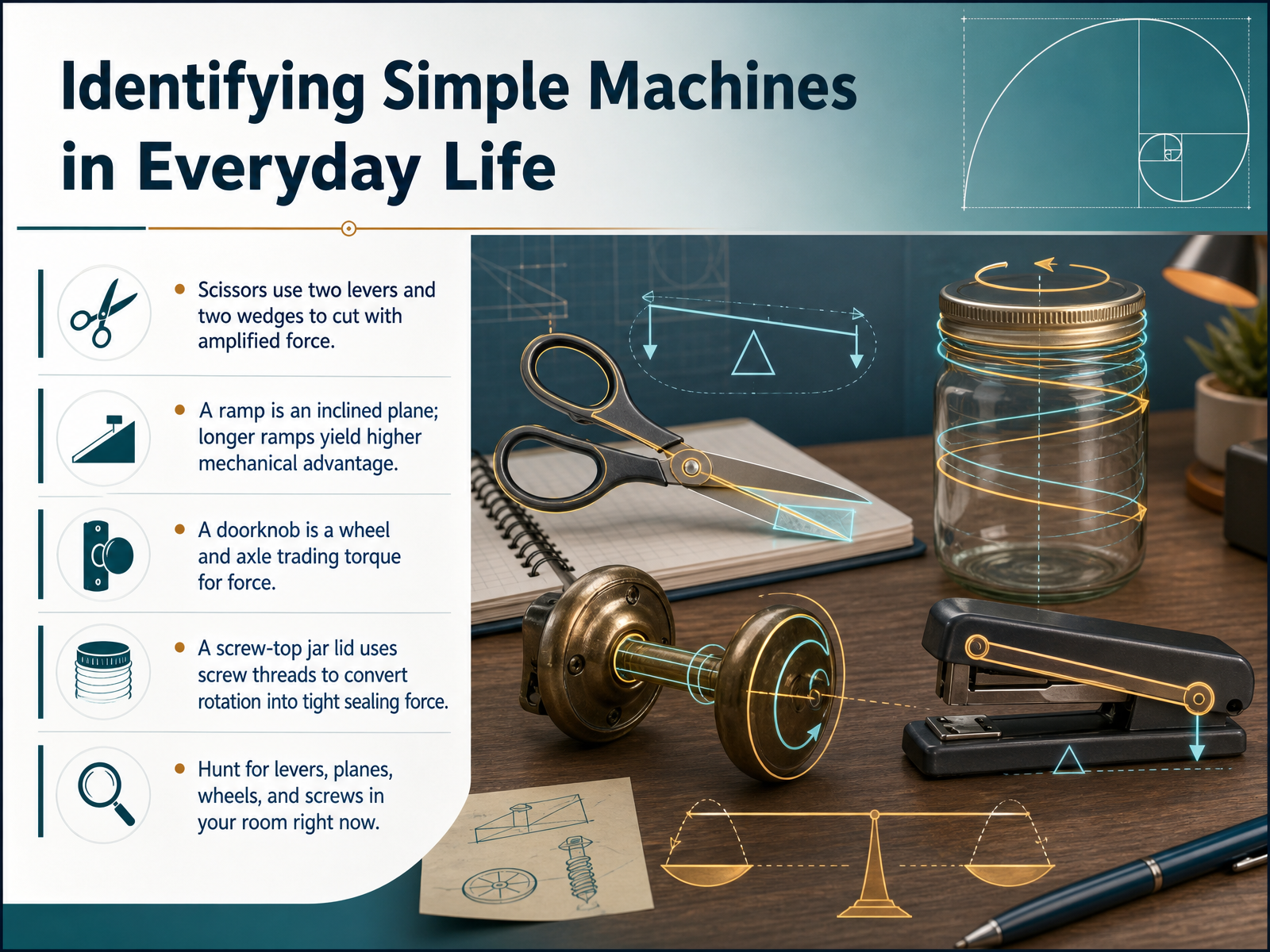
 - 13Identifying Simple Machines in Everyday LifeLook around the objects you use every day and you'll spot simple machines everywhere. Let's identify a few. Take scissors. They combine two levers and two wedges. The handles are levers that amplify your hand force, and the blades are wedges that concentrate that force to cut cleanly. A ramp is an inclined plane. Make the ramp longer for the same height, and you increase the mechanical advantage—you push with less force over a longer distance. A doorknob is a wheel and axle. You turn the large wheel with a small force over a large circle, and the axle delivers a higher torque to the latch. A screw-top jar lid uses screw threads. Those threads are essentially an inclined plane wrapped around the cap, converting your rotation into a strong sealing force. Your room is full of these helpers—levers, planes, wheels, and screws. Pause for a moment and see how many you can spot right now. Next, we'll pull everything together with a summary and a real-world selection guide.
 phys.libretexts.orgopenstax.orgopenstax.org+21 min
 - 14Summary and Real-World Selection GuideLet's bring it all together with a quick selection guide. If you need to multiply your force, reach for a lever, a ramp, or a pulley. These machines let you trade a longer input distance for a bigger output push. A wedge or a screw, on the other hand, mostly redirects your force into a splitting or clamping action. A wheel and axle can even multiply speed when the wheel drives the axle. To pick the right machine, ask yourself three things: How much output force do I need? How much input distance can I accept? And how much space do I have to work? Remember, no simple machine reduces the total work. You always trade force for distance, or distance for force. Work in equals work out. When you chain machines together into a compound machine, you multiply their individual mechanical advantages to handle complex, high-ratio tasks. Keep these trade-offs in mind, and you'll choose the right tool for the job every time. Thanks for sticking with it, and happy building.
 phys.libretexts.orgopenstax.orgopenstax.org+22 min
Take the deck with you
Download this course as a file — free, no sign-up needed.
- PDF handoutEvery slide page, ready to print or share.15 pages · 4.1 MBDownload
- Narrated PowerPointThe deck that presents itself — every slide carries the digital human's narration video.15 pages · 15.0 MBDownload
- PowerPoint slidesThe full deck as a .pptx — open it in PowerPoint, Keynote, or Google Slides.15 pages · 4.1 MBDownload
Free to use in your own training — please keep the PersonWise credit page at the end.
Have your own deck? Turn it into a course
Sources consulted
Web sources consulted while building this course.
- 25: Simple Machines — phys.libretexts.org
- 9.3 Simple Machines - Physics | OpenStax — openstax.org
- 9.5 Simple Machines - College Physics | OpenStax — openstax.org
- 8.4.3: Simple Machines - Physics LibreTexts — phys.libretexts.org
- Physics Machines Study Guide: Simple Machines & Efficiency | Notes — pearson.com
- Work, Energy, and Simple Machines — theexpertta.com
- Chapter 6.pmd — ncert.nic.in
- 7.2 Kinetic Energy and the Work-Energy Theorem - College Physics for AP® Courses | OpenStax — openstax.org
- Investigating Ideal and Actual Mechanical Advantage — teachengineering.org
- Unit 3: Mechanical advantage of simple machines — ncvs2.books.nba.co.za
- SIMPLE MACHINES are the basic — isbe.net
- Mechanical Advantage Calculator | Mech Codex — mechcodex.com
- 9.3 Simple Machines — texasgateway.org
- 2.27 Levers and linkages - BBC Bitesize — bbc.co.uk
- Lever — en.wikipedia.org
- How to Calculate the Mechanical Advantage of a Lever — study.com
- Levers — engineeringtoolbox.com
- Lever Calculator - Effort, Load and Mechanical Advantage — best-calculators.com
- 25.1: Inclined Plane - Physics LibreTexts — phys.libretexts.org
- Inclined plane — en.wikipedia.org