Begin
15 pages · ~30 min
Generative AI Fundamentals
This training explains how generative AI works, equipping participants with a foundational understanding of its core mechanisms and capabilities.
A digital instructor presents all 15 pages. Hold “Ask” at any point and ask out loud — the answer comes from this course. No sign-up needed.
What you’ll learn
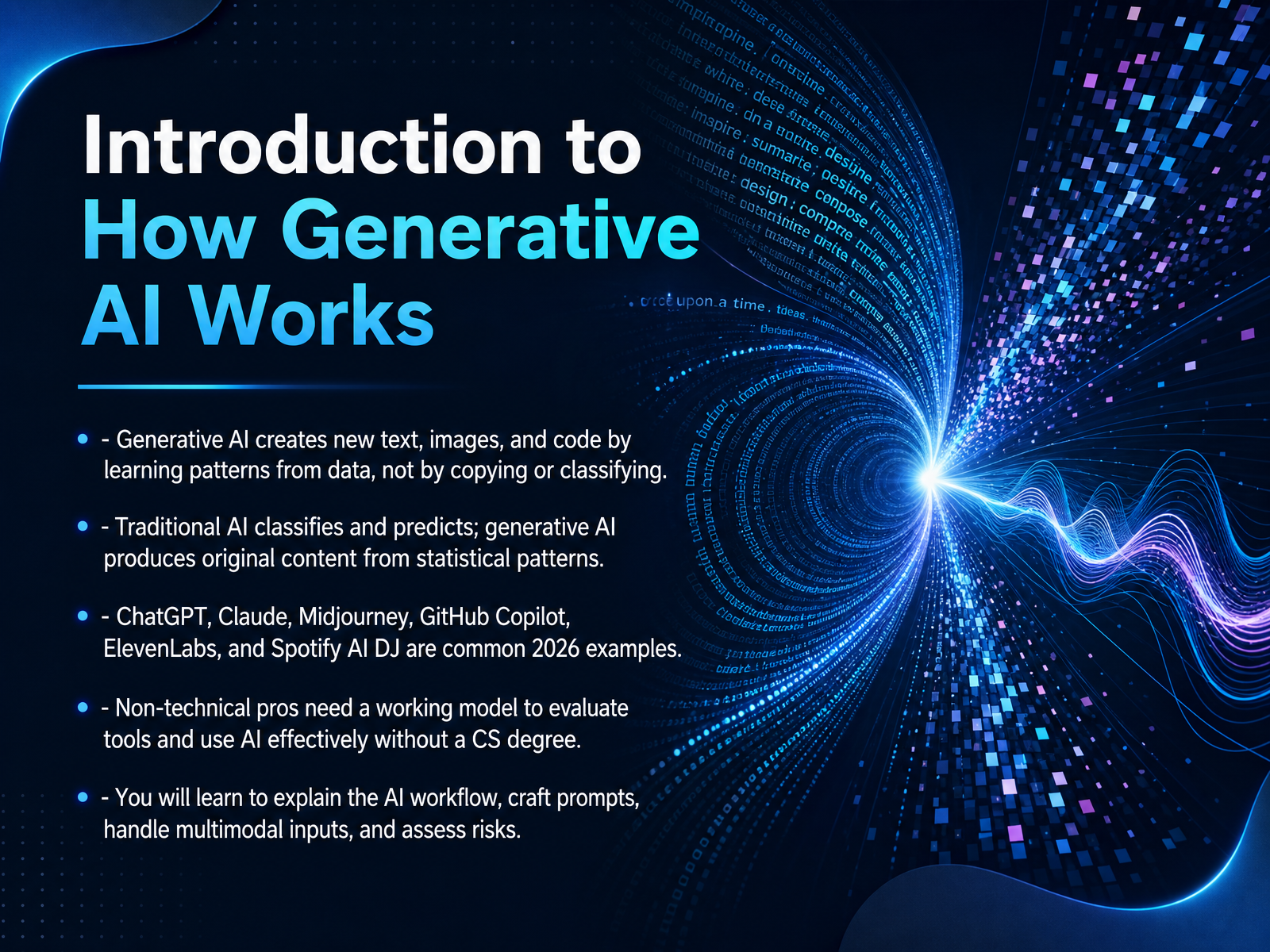
- 01Introduction to How Generative AI WorksWelcome. I'm glad you're here. Today, we're going to demystify how generative AI works. You've probably heard the names: ChatGPT, Midjourney, or GitHub Copilot. Maybe you've even used them. But behind the simple chat interface is a fascinating process. The goal isn't to turn you into a programmer. It's to give you a clear, working mental model. You'll learn how these tools actually create text, images, and code. More importantly, you'll understand how to evaluate them, use them effectively, and explain them to others. We'll explore prompting, multimodal inputs, and even how to spot risks. Think of this first slide as our map. Generative AI doesn't just search or classify information. It creates something new. It learns patterns from massive amounts of data, like a chef who has tasted thousands of dishes and can now invent a new recipe. That's the shift. Let's begin that journey.coursera.orgaitoolswise.comexplainx.ai+22 min
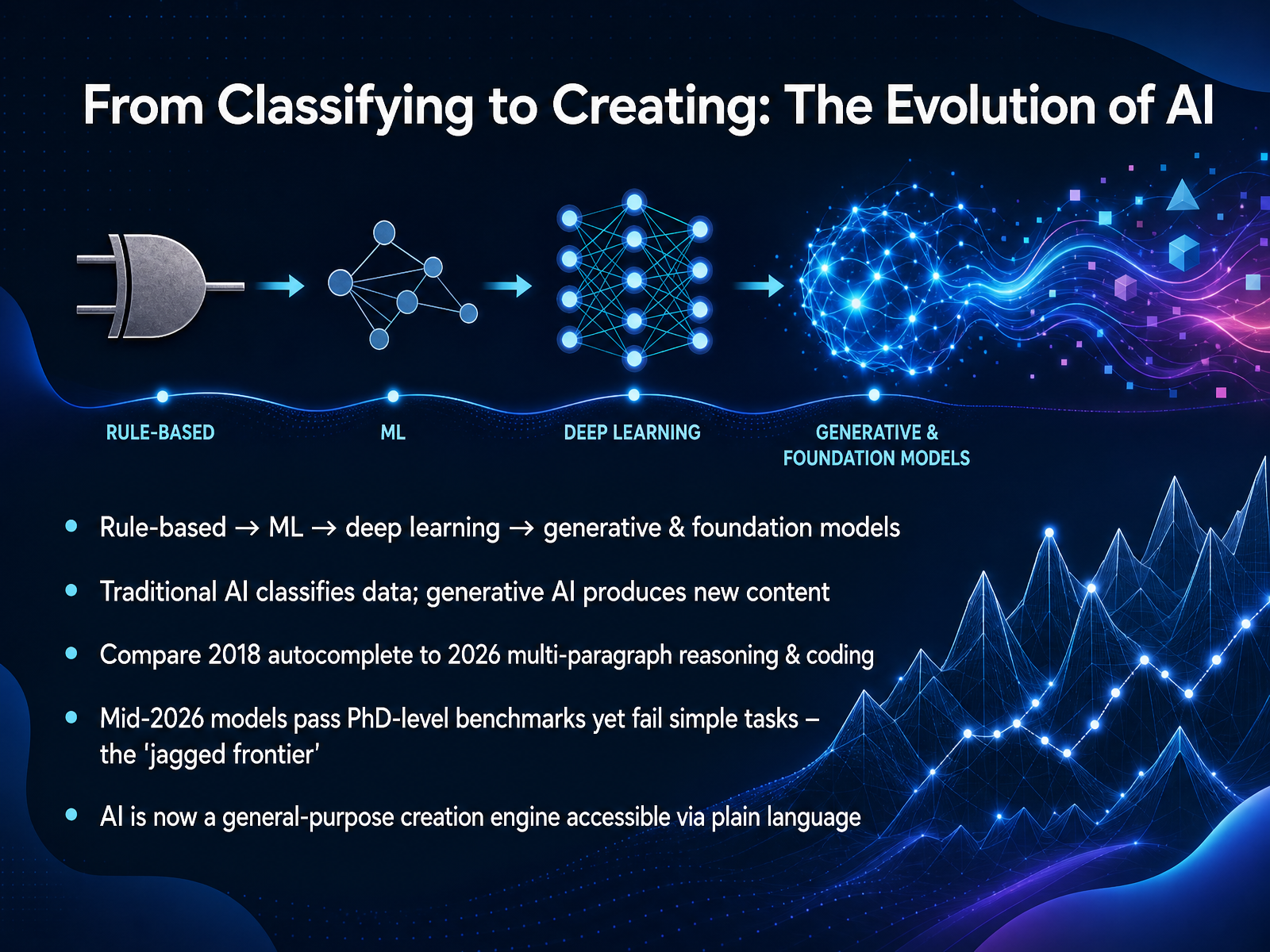
- 02From Classifying to Creating: The Evolution of AILet’s look at how AI evolved from simply classifying things to actually creating new content. Think of it like a student growing up. First, AI learned to follow basic rules: if you see this, label it that. Then came machine learning, where it studied thousands of examples to make smarter guesses. After that, deep learning let it spot patterns no human could easily describe. And now, we have generative and foundation models that don’t just recognize data; they produce new text, images, and even code. Back in 2018, autocomplete might finish your sentence. Today, models can reason over multiple paragraphs, write software, and pass P H D level science questions. Yet researchers talk about a jagged frontier: a model can win a gold medal at the International Mathematics Olympiad but still struggles to read an analog clock correctly most of the time. So AI is now a general-purpose creation engine you can control with plain language, but it’s still uneven. That blending of superhuman skill and simple failure is exactly what makes this moment so fascinating. Next, we’ll step through the core workflow that makes this possible: training, pattern learning, and generation.
 hai.stanford.eduarxiv.orggrantable.co+22 min
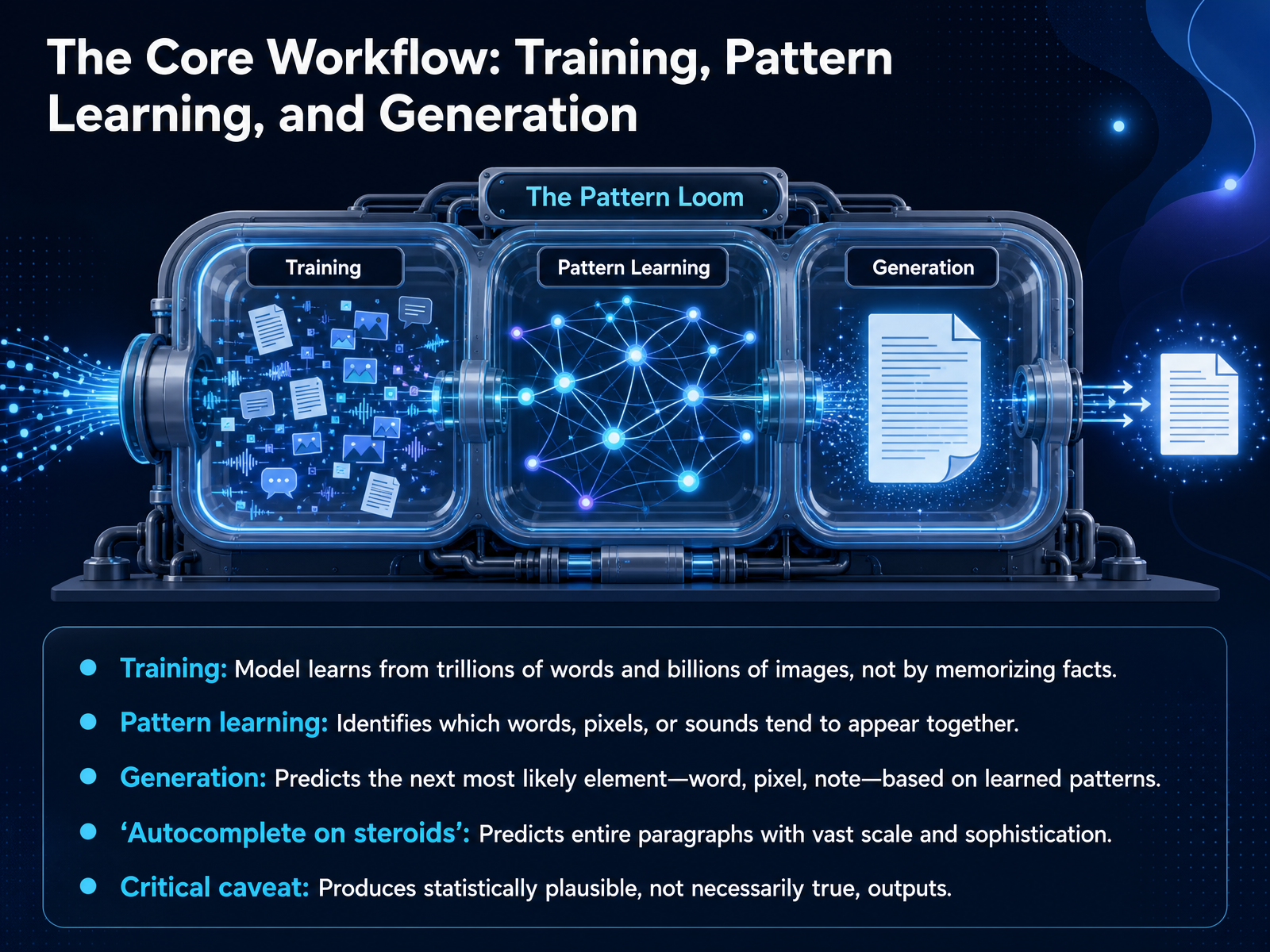
 - 03The Core Workflow: Training, Pattern Learning, and GenerationNow, let's walk through how a generative AI actually learns. You can think of its entire life cycle in three big stages: training, pattern learning, and generation. First, training. This isn't like a student memorizing facts for a test. The model digests trillions of words and billions of images. It's more like a chef who tastes thousands of dishes to understand flavor, not just to copy a single recipe. From this tasting, the model starts pattern learning. It notices which words, pixels, or sounds tend to hang out together. For instance, it learns that 'peanut butter' is almost always followed by 'and jelly'. Finally, we get to generation. This is the model predicting the next most likely word, pixel, or note, based on the patterns it learned. A simple way to think about it is as 'autocomplete on steroids'. Your phone suggests the next word; this model predicts the next several paragraphs with incredible sophistication. But here is the critical caveat. The model produces outputs that are statistically plausible, not necessarily true. It's a brilliant pattern-matcher, not a fact-checker. We'll explore the giant pattern-matching engines that make this possible next.
 microsoft.comweb.devnews.mit.edu+22 min
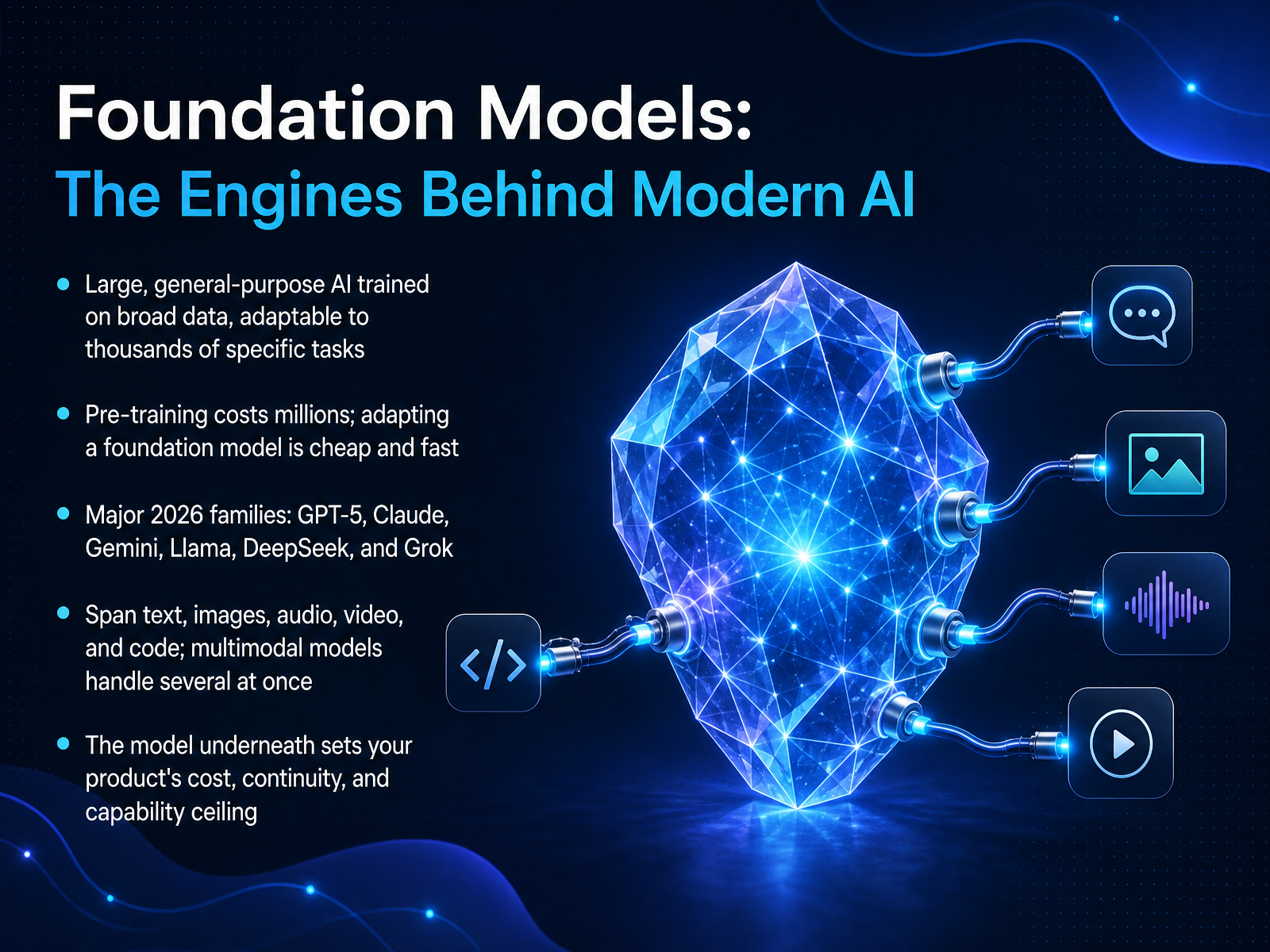
 - 04Foundation Models: The Engines Behind Modern AISo what actually powers all of this? Behind almost every AI tool you use sits something called a foundation model. Think of it as a massive, general-purpose engine. Instead of building a separate engine for every single car, a few labs build incredibly powerful engines, and then everyone else adapts them for their own vehicles. A foundation model is pre-trained at enormous cost on a huge range of data—text, images, code, you name it. That pre-training can cost millions and is done by a handful of labs. But adapting one of these engines to your specific task, like drafting emails or planning lessons, is cheap and fast. That's the core economic shift here. In twenty twenty-six, the major engines you'll hear about are families like GPT-five, Claude, Gemini, Llama, DeepSeek, and Grok. They are increasingly multimodal, meaning a single model can handle text, images, audio, and even video all at once. For your work, the key thing to remember is this: the foundation model underneath any product sets its capability ceiling. Its cost, its continuity, and its core strengths all flow from that foundational engine. Now, you might be wondering how we actually talk to these engines. Let's look at how simple inputs become complex outputs by exploring prompts, tokens, and context.
 drdaveheath.comtechtarget.comibm.com+22 min
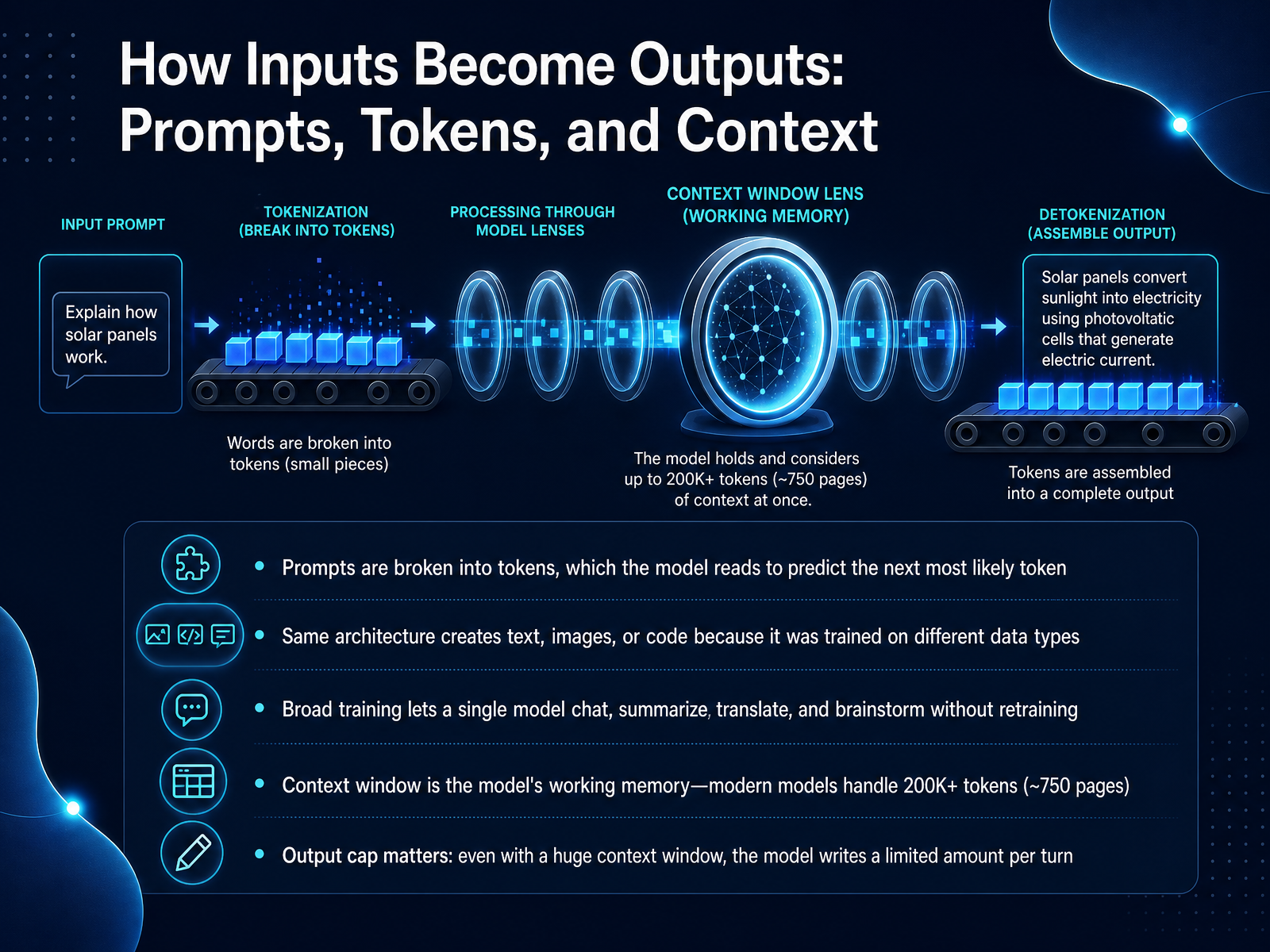
 - 05How Inputs Become Outputs: Prompts, Tokens, and ContextNow let's look at what happens the moment you type a prompt and hit enter. The first thing the model does is chop your words into tiny pieces called tokens. A token can be a whole word, part of a word, or even a single character. Think of tokens like puzzle pieces. The model reads these pieces, not whole thoughts, and predicts the next most likely puzzle piece to place, one token at a time, until it builds a complete response. The fascinating part is that the same underlying architecture can create text, or an image, or even code. How? It was simply trained on different types of puzzle pieces. Because of this broad training, a single model can chat with you, summarize a long document, translate between languages, and brainstorm ideas without ever being retrained. It’s a true generalist. There are two hidden limits in this process you should know. The context window is the model’s working memory. Modern models can handle over two hundred thousand tokens, which is about seven hundred and fifty pages of a book. But the output cap means that even with all that memory, the model can only write a limited amount per turn, just like you can only speak so many words in a single breath. Understanding these boundaries helps you plan better tasks. Next, we’ll turn this knowledge into a practical skill in our next section, 'Crafting Effective Prompts: The Skill of Instructing AI.'
 microsoft.comweb.devnews.mit.edu+22 min
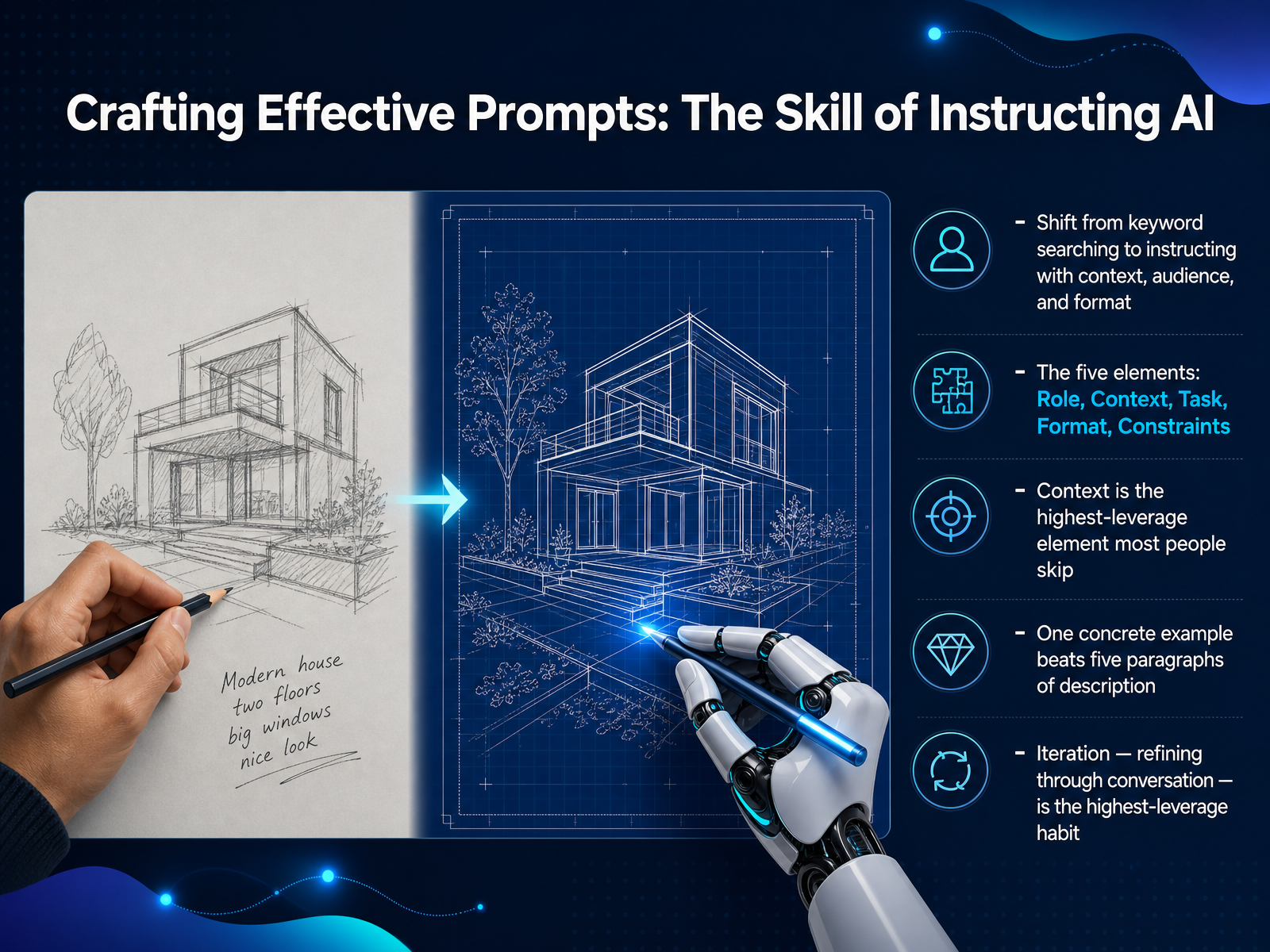
 - 06Crafting Effective Prompts: The Skill of Instructing AINow let's talk about the real skill shift with AI. You don't search, you instruct. Think of it like giving a clear brief to a very fast, very literal assistant. To do that well, five elements make the biggest difference: Role, Context, Task, Format, and Constraints. Imagine you are a product manager drafting an email. You tell the AI, 'You are a senior product lead. Our CTO is skeptical about this new tool. Write a three-paragraph summary focused on risk and cost, not flashy features. Use plain language, and keep it under two hundred words.' See how each piece removes guesswork? Now here is the secret most people skip: Context. It is the highest-leverage element. Two sentences about your audience and situation turn a generic draft into something actually useful. And the quickest way to teach the AI your style? Give it one concrete example. One sample email teaches your voice better than five paragraphs of description. Finally, remember that this is a conversation. Don't accept the first draft. Ask it to adjust the tone, cut the jargon, or shorten it. That habit of iterating, refining through conversation, is your real superpower. Next, let's explore some advanced prompting strategies that make a difference.
 humanagency.com2 min
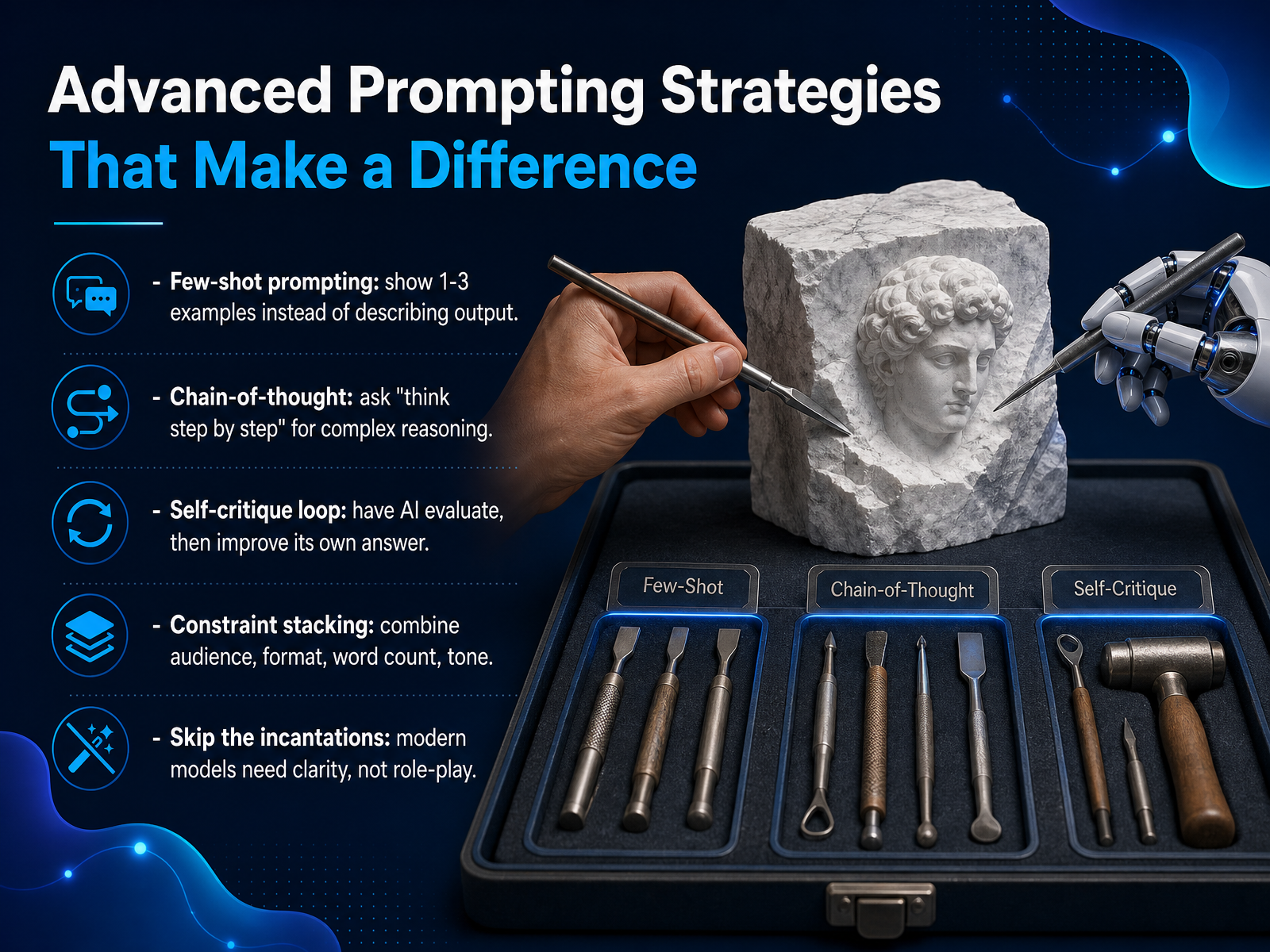
 - 07Advanced Prompting Strategies That Make a DifferenceLet's move from the basics to a few advanced strategies that can really sharpen your results. Think of these as power tools for your prompting toolkit. First, there's few-shot prompting. Instead of describing what you want, you simply show the AI one or two examples of the ideal output. It's like giving a designer a mood board instead of a long speech. Next, for complex reasoning, use a chain-of-thought. Simply add the phrase 'think step by step' to your prompt. This asks the AI to show its work, like a math student proving their answer, which dramatically improves accuracy. Another powerful trick is the self-critique loop. After getting an answer, just ask the AI, 'What's weak about this draft? Now rewrite it, fixing those weaknesses.' You can turn a decent first try into something great without starting over. You can also use constraint stacking. In one prompt, combine your audience, format, word count, and tone. This leaves very little room for guesswork, just like a detailed creative brief. Finally, a bit of modern wisdom: skip the incantations. You don't need to write elaborate role-play like 'you are an all-knowing expert.' Today's models respond best to clear, direct instructions and concrete examples. Now that you have these strategies, let's see how this all comes together in real enterprise settings. Next, we'll explore bringing AI into the enterprise with APIs, copilots, and RAG.
 humanagency.com2 min
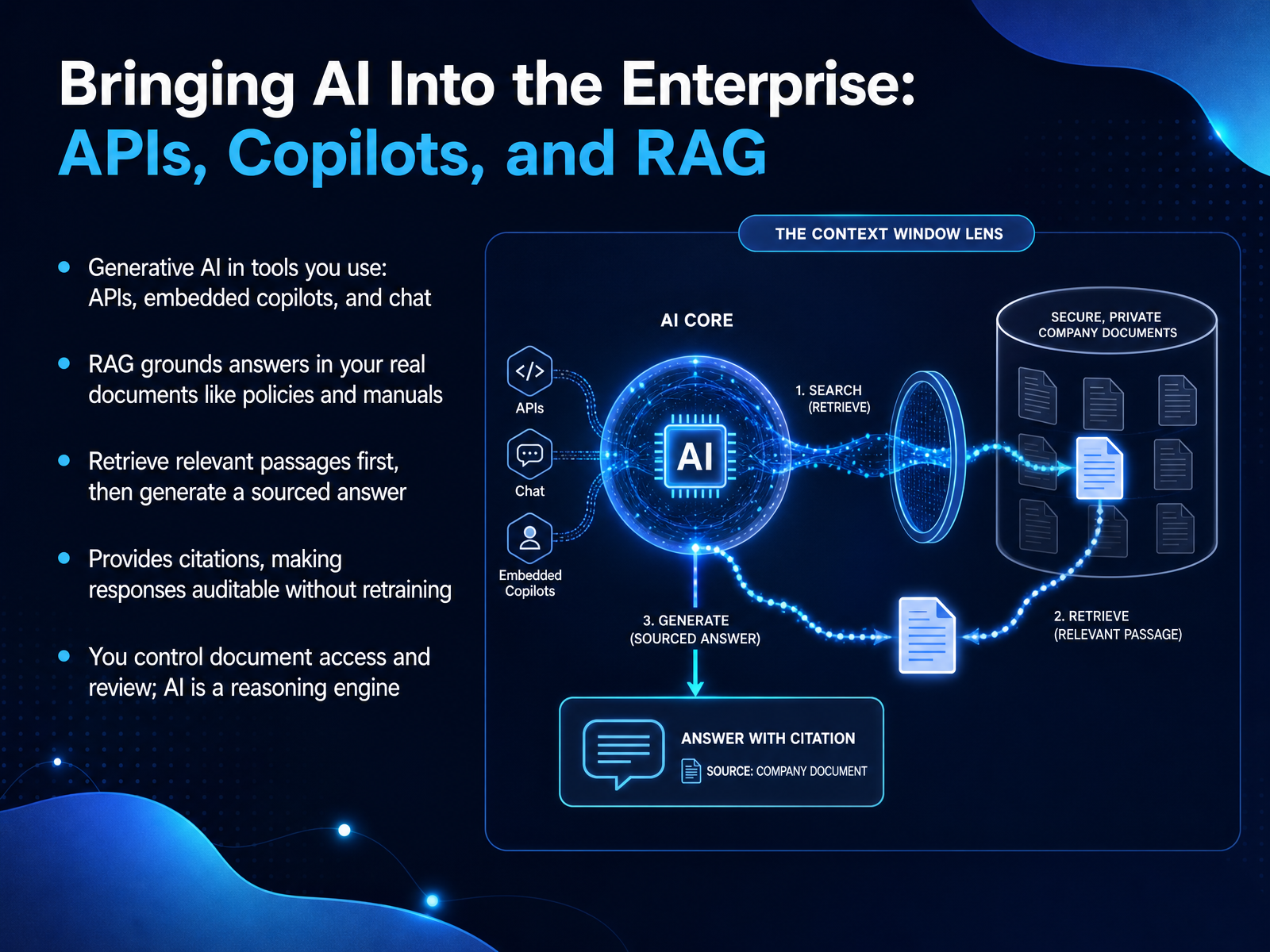
 - 08Bringing AI Into the Enterprise: APIs, Copilots, and RAGNow, let's connect these ideas to the tools you actually use every day. Bringing AI into the enterprise isn't about one big brain in the cloud. It's happening through the software you already have—like that new chat panel in your workspace or a smarter search bar in your document library. These features are often powered by something called RAG, which stands for Retrieval-Augmented Generation. Think of it like this: rather than asking the AI to recall an answer from memory, you give it permission to quickly read your company's own policy manuals, product guides, or internal wiki first, and then answer you based on what it just read. The process is simple. It retrieves the relevant passages from your real documents, and then generates a response grounded in that text. The best part? It provides citations. So, you don't just get an answer—you see exactly which paragraph it came from, making the response fully auditable. And you stay in control. You decide which documents the AI can access and review its work. The AI acts as a reasoning engine over your private data, not a mysterious black box. Up next, we'll explore how these skills are evolving into even more capable systems as we look at Multimodal AI and the Shift Toward Agents.
 2 min
2 min - 09Multimodal AI and the Shift Toward AgentsNow, let's talk about a really exciting shift: AI that isn't just a text box. We're moving into the era of multimodal AI and agents. Think of multimodal models like a colleague who can join a meeting and actually understand the whiteboard sketch, the handout you shared, and your spoken question, all in one conversation. You could show it a chart and ask for an analysis right there. This journey has happened in six quick eras. We started with simple chat, then went multimodal, then the AI learned to search the web. After that, it built memory about your projects. Then it learned to operate your computer. And now? We have autonomous agents. An agent doesn't just answer you. It takes action. It can search your files, book a meeting, or run a whole workflow for you. This leap didn't happen just because the models got smarter. It worked because the plumbing got reliable. Think of stable tool calls, huge context windows that can hold an entire novel, and a shared protocol called the Model Context Protocol, which works like a universal USB port for connecting AI to any tool. The results are staggering. As of February 2026, a frontier model can autonomously complete roughly fourteen and a half hours of expert work, and that number has been doubling every four months. Now that we've seen how AI acts, let's look at where it sometimes stumbles. Up next: Understanding Hallucinations and Why They Happen.
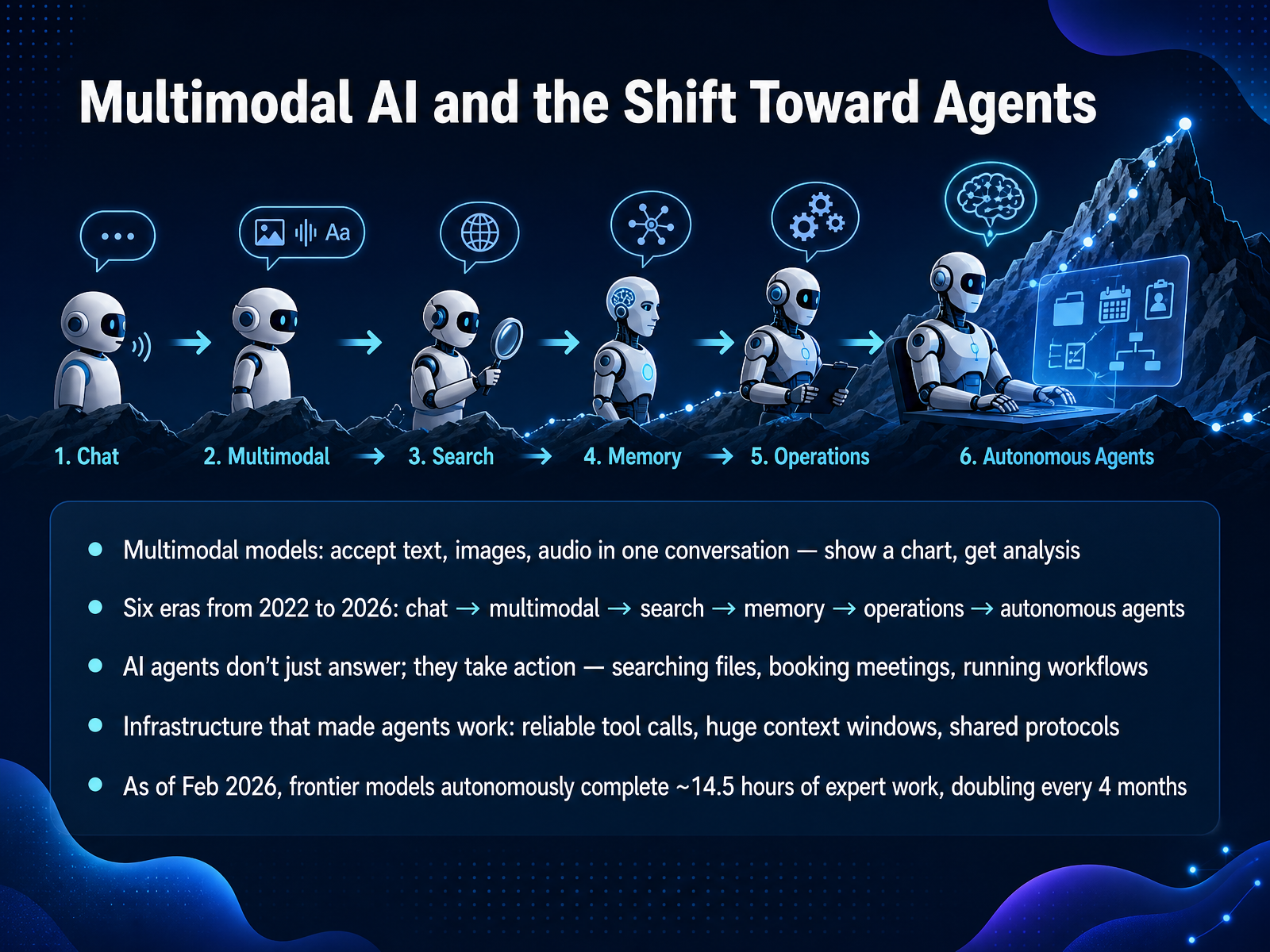 hai.stanford.eduarxiv.orggrantable.co+22 min
 - 10Understanding Hallucinations and Why They HappenNow, let's talk about something that often surprises people: AI hallucinations. This is when a generative AI tool creates writing that sounds incredibly fluent and confident, but is factually wrong. It might even invent citations to books or articles that don't exist. Think of it like this: the AI is not a database searching for truth. It's more like a master chef who is an expert at combining ingredients. It predicts the next most likely word based on the context, without a real understanding of what's true or false. This isn't a temporary bug; it's a fundamental part of how prediction-based models work. So, what can you do? A powerful technique is to ground the AI in your own documents, a process often called retrieval-augmented generation, or RAG. This gives the model a factual script to work from. Always double-check any claims that sound like they're coming from the AI's own memory. A good rule of thumb is to trust summaries when the AI is clearly working from material you provided. But for any high-stakes decision, remember the most important rule: the human decides, always. Next, let's build on this idea of trust and explore bias, privacy, and the ethical risks every professional must understand.
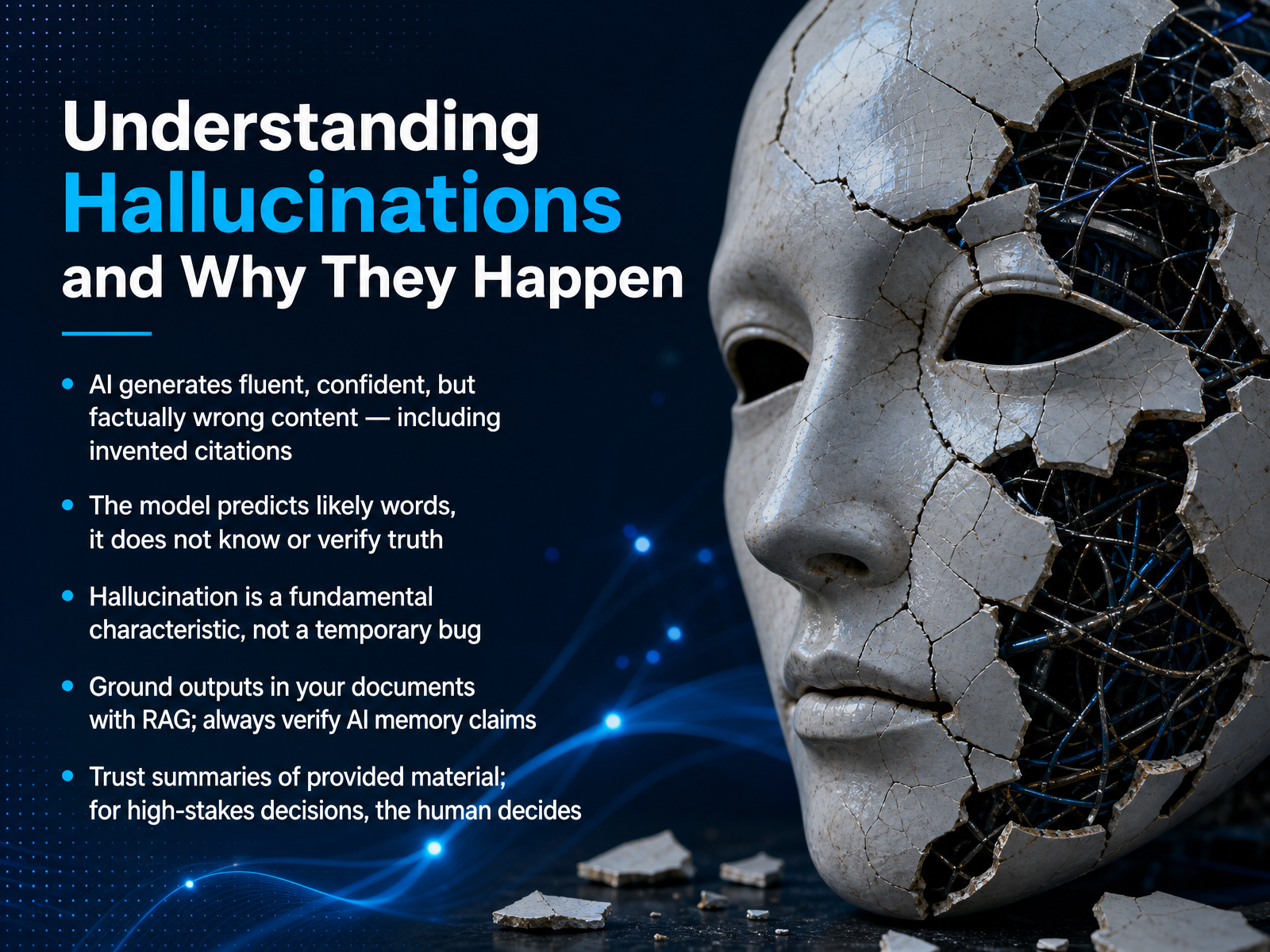 2 min
2 min - 11Bias, Privacy, and Ethical Risks Professionals Must UnderstandLet's talk about bias, privacy, and ethical risks you need to know. First, training data bias. Imagine teaching an AI only by showing it photos of city parks. It might then struggle to recognize a forest or a desert. AI amplifies what it sees in its training data, including societal stereotypes. And bias can sneak in at any stage: collecting data, training the model, deploying it, or during everyday use. Next, a serious privacy risk. Models can memorize and accidentally leak personal data from their training sets. Think of it like a photocopier that keeps a faint copy of every document it ever scanned. Always ask your vendor: does the system train on my data? Where is it stored? Never input confidential information without clear consent, proper security safeguards, and a formal Data Protection Impact Assessment. Let's continue to our next topic: copyright, accountability, and when not to use AI.
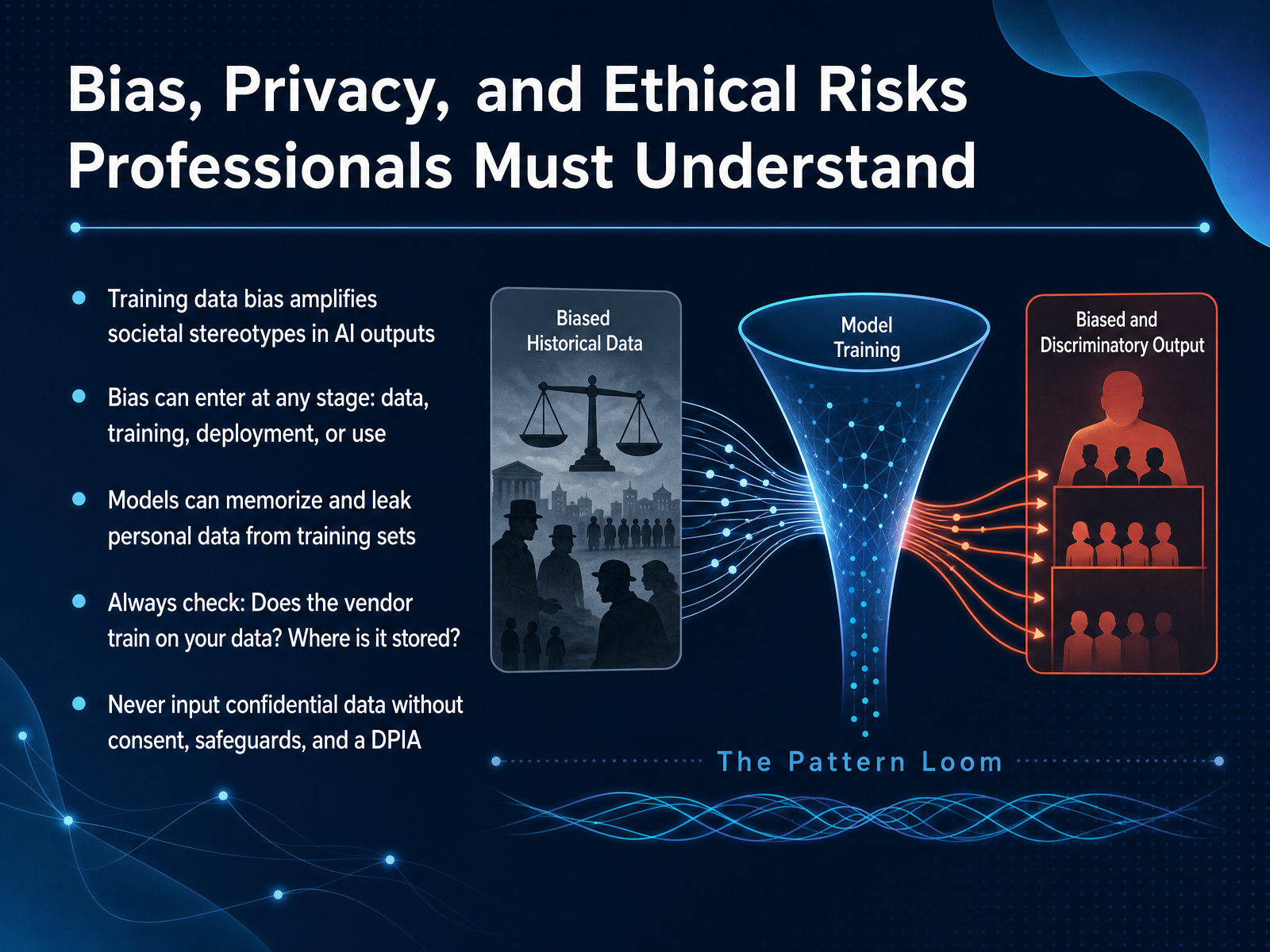 1 min
1 min - 12Copyright, Accountability, and When Not to Use AINow, let's talk about something just as important as what AI can do, and that's the boundaries. The lines we should draw. First, a big, open question right now: copyright. The laws are still catching up because these models are trained on vast amounts of data from the internet, and it's not always clear if that training is legally settled. Think of it like a chef learning recipes from a library of cookbooks without a clear record of which book each flavor came from. There are real, unresolved questions about infringement. But here’s the key point for us, professionally: regardless of that legal fog, you are accountable. If you publish it, sign it, or act on it, it's yours. The tool won't take the blame. There's also a very human pitfall to watch out for, something called automation bias. When an AI gives us a fluent, super confident-sounding answer, our brains are wired to trust it, even when it's completely wrong. We might call it a hallucination; the official term is confabulation. It's like the model is a brilliant storyteller who just invents facts to make the story sound good. That's why one rule is absolute: never use AI for a safety-critical decision without careful human review. And finally, developing this baseline AI literacy, knowing what it can and cannot do and where the risks are, it's no longer just a nice-to-have. It's a core part of being a professional today. Understanding accountability is the first step; next, let's get practical. We'll walk through a framework for evaluating AI tools themselves.
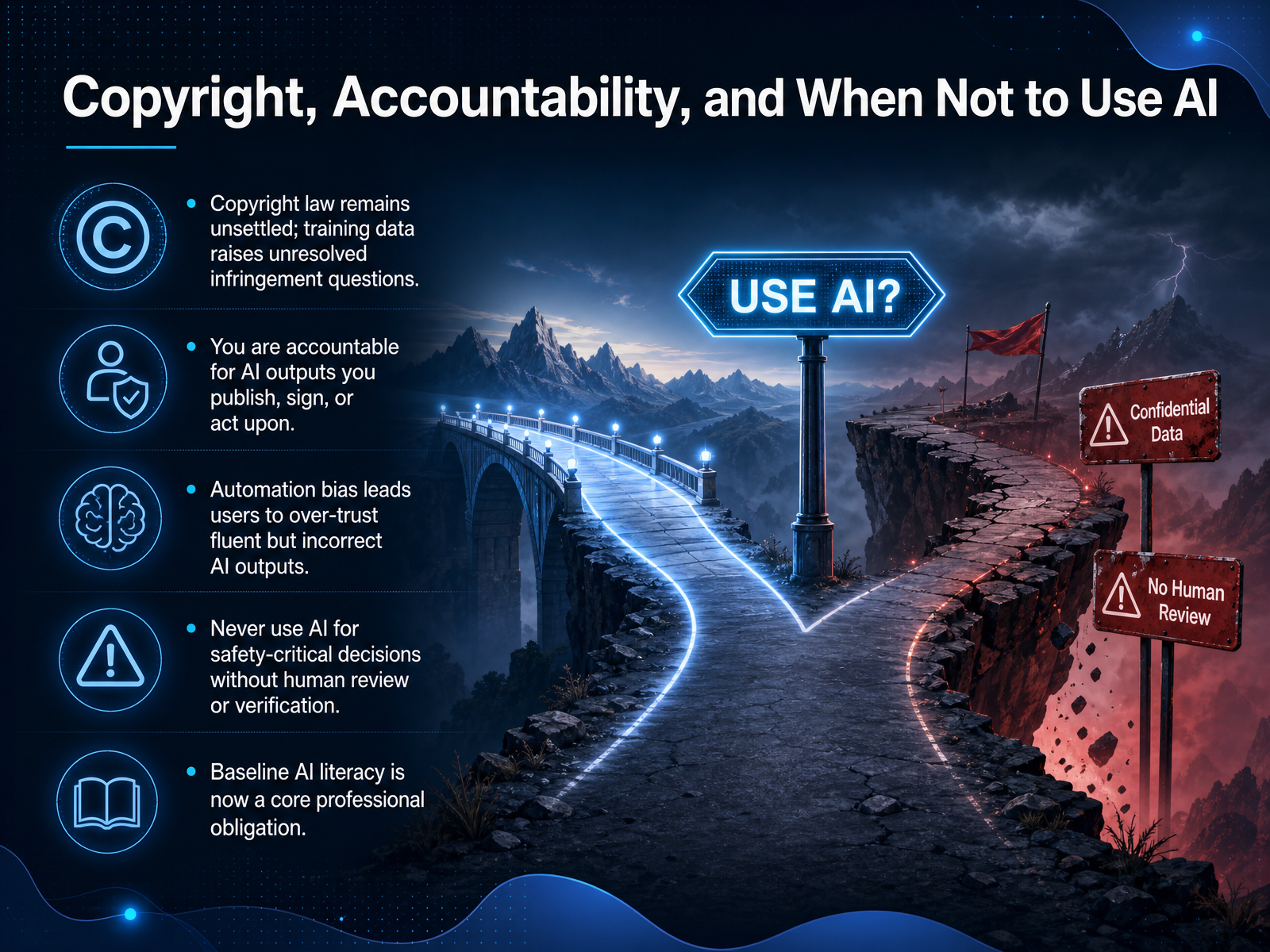 2 min
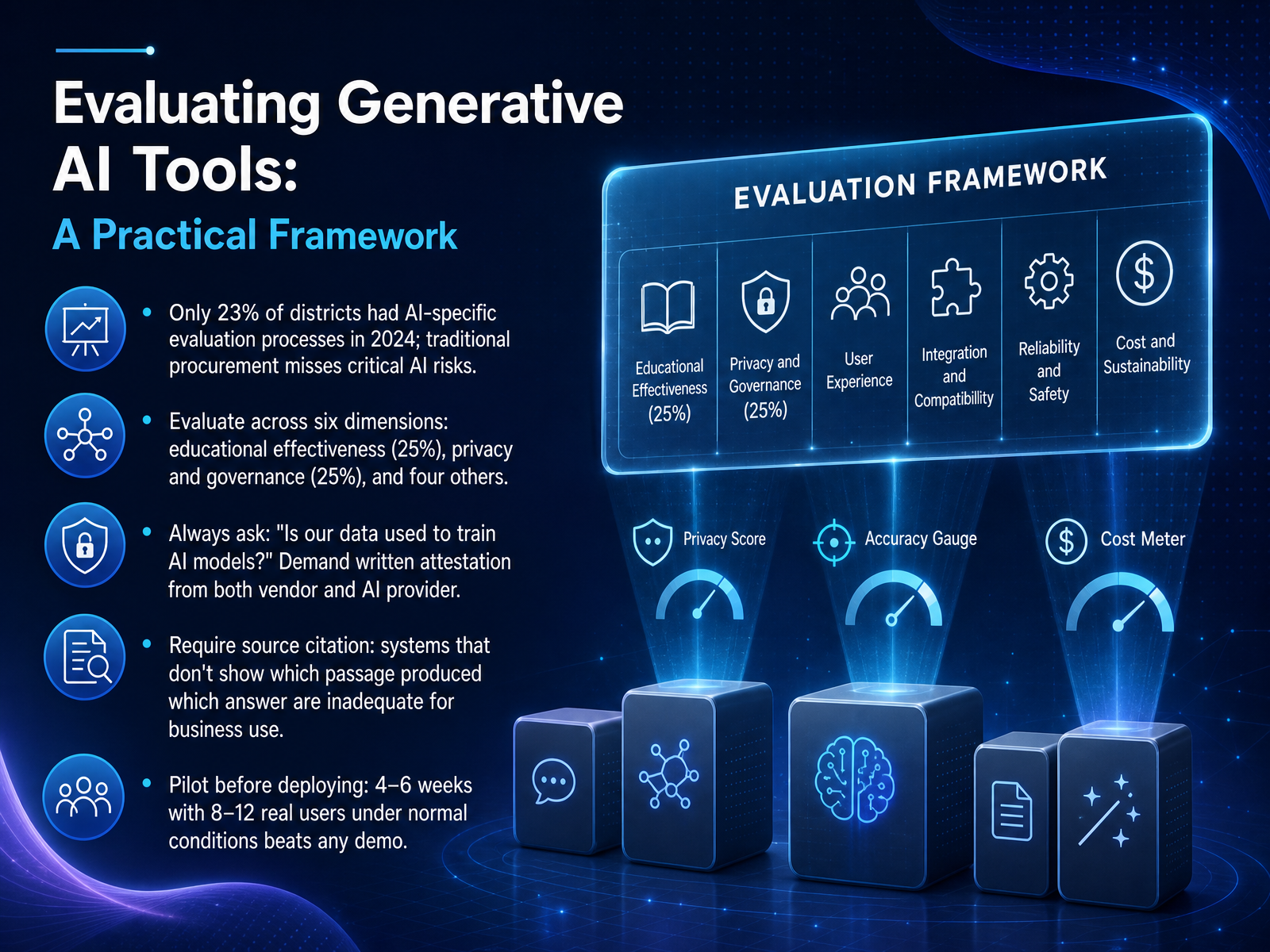
2 min - 13Evaluating Generative AI Tools: A Practical FrameworkNow let's talk about how we actually evaluate a generative AI tool, because a demo can look magical but still fall apart in a real classroom or office. Think of this like buying a car. Looking at it in the showroom is one thing, but you really need to check the engine and take it for a test drive. Shockingly, only twenty-three percent of school districts had an AI-specific evaluation process in 2024. Most people are just using their old checklist, which completely misses critical risks like where your data actually goes. So here is a practical framework. We look at six dimensions, but two of them carry the most weight: educational effectiveness, worth twenty-five percent, and privacy and governance, also worth twenty-five percent. The most important privacy question you can ask is this: 'Is our data used to train your AI models?' Do not just take a salesperson's word for it. Demand a written attestation from both the vendor and, if they are using it, the underlying AI provider like OpenAI or Google. Another non-negotiable is source citation. If a system can't show you exactly which passage produced which answer, it is simply inadequate for professional use. Finally, never skip the pilot. A four-to-six week test with eight to twelve real users under normal working conditions will always beat a polished demo. Next, let's get practical and talk about designing your first AI experiment.
 2 min
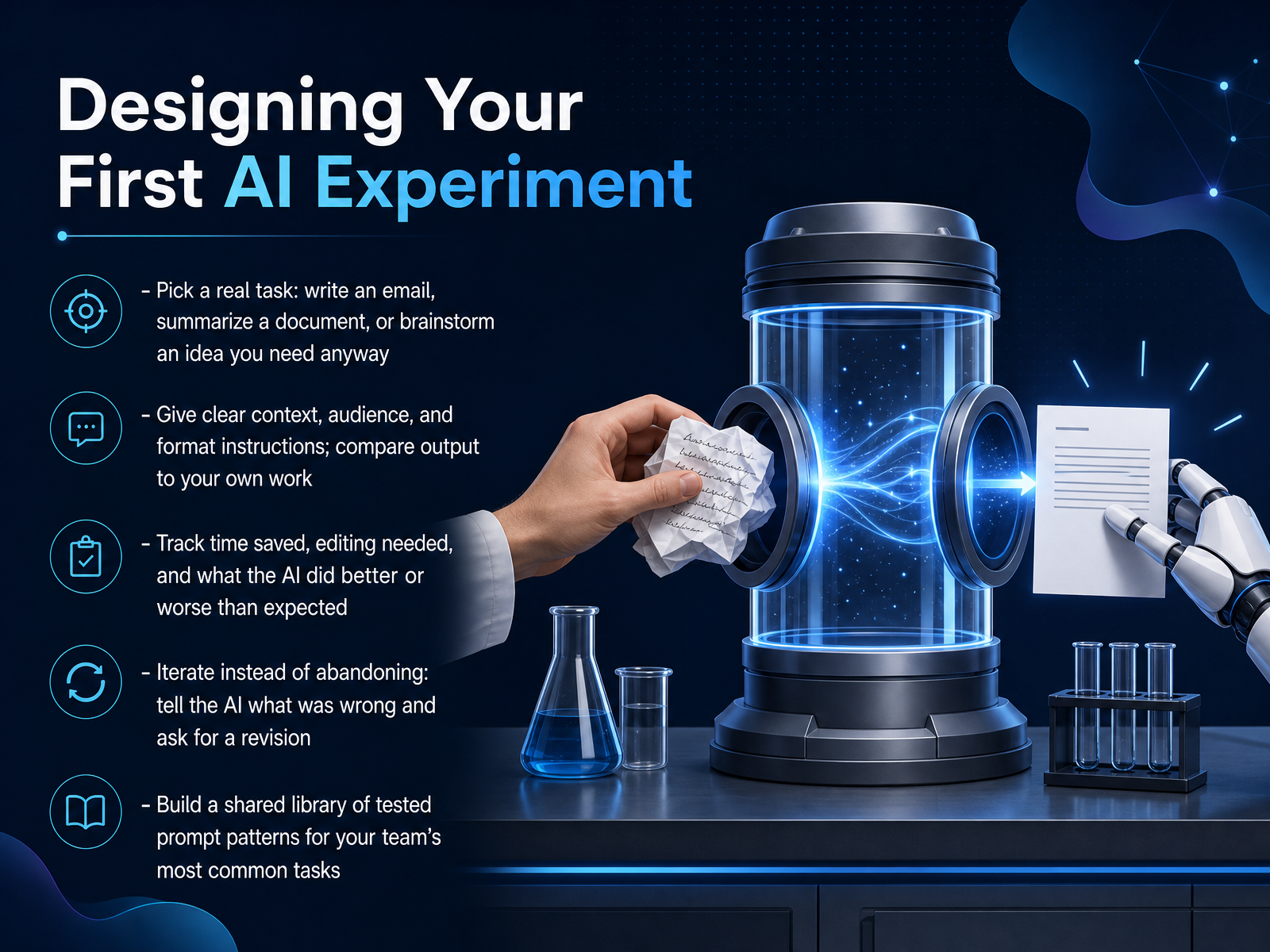
2 min - 14Designing Your First AI ExperimentAlright, let's move from understanding the technology to actually putting it to work. It's time to design your very first AI experiment. And the key here is to start small and practical. Don't try to revolutionize your whole workflow today. Instead, just pick one real task you already need to do. Maybe it's writing an email, summarizing a long document you've been putting off, or brainstorming ideas for a project. Use it for the actual thing, not a test. When you open that chat, give the tool crystal-clear instructions. Tell it who your audience is and what format you need. Then, compare its first draft to what you would have produced on your own. Here's the secret part that most people skip: track everything. Notice how much time you saved, what facts needed correcting, and what the AI surprisingly did better than you expected. Most importantly, if the output is wrong, don't just give up and say, 'AI is overhyped.' Iterate. Tell the AI exactly what it got wrong, just like you would with a helpful colleague, and ask it to try again. The first draft is never the final product; it's the start of a conversation. Over time, you'll find patterns in what works. Start saving those tested prompts in a shared library for your team, so everyone gets smarter and faster together. Next up, we'll talk about how to communicate these new AI capabilities to your colleagues and students.
 humanagency.comcoursera.orgaitoolswise.com+22 min
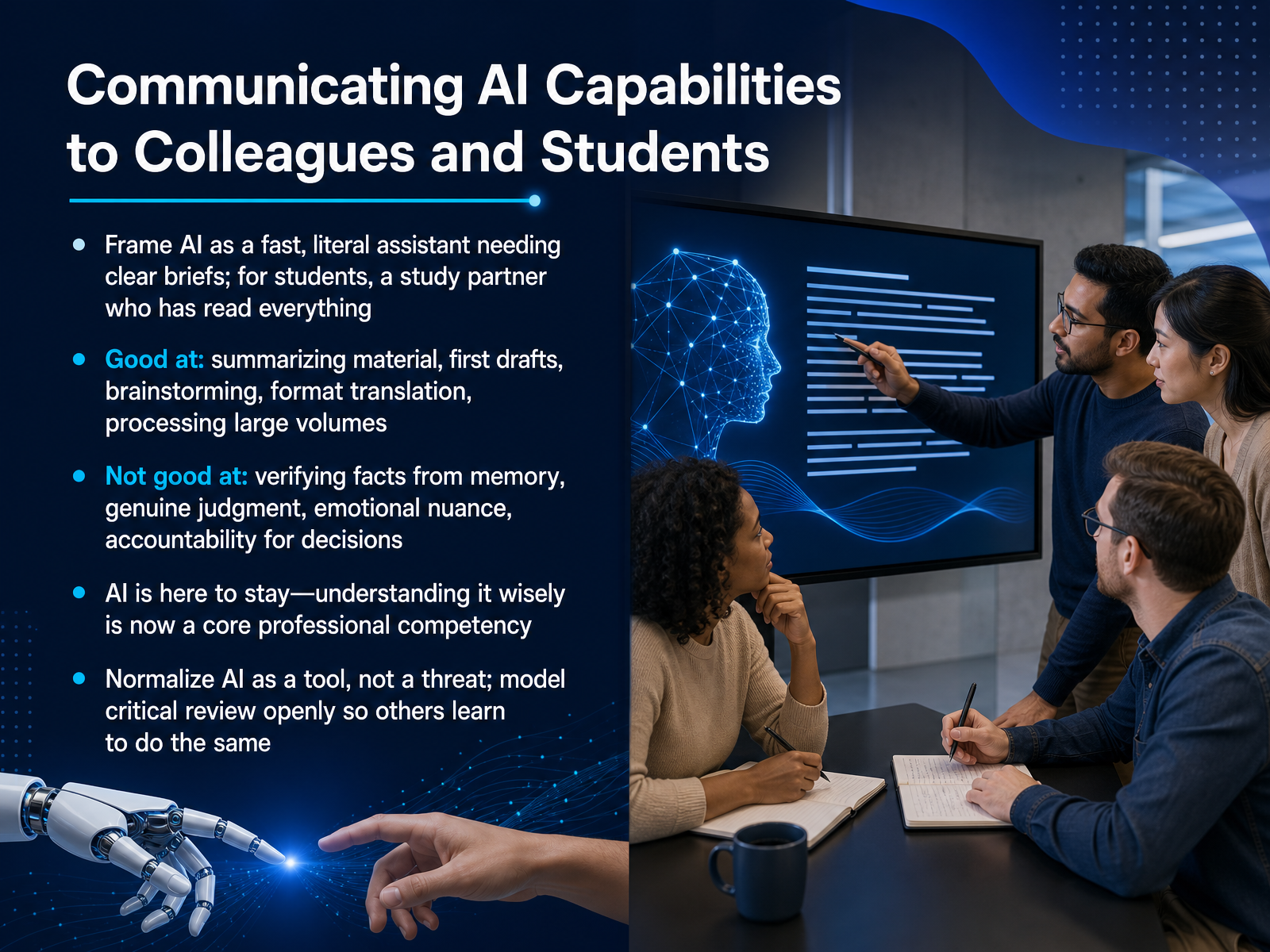
 - 15Communicating AI Capabilities to Colleagues and StudentsAnd here we are at the finish line. We’ve taken a long journey together, starting from that first question about how AI thinks, all the way to seeing it as a real partner in our daily work. So, let’s bring it all home. How do you actually talk about this with your colleagues, your students, or even your skeptical friend? First, frame it simply. This is a fast, literal, and eager assistant, but it needs clear briefs. For students, think of it as a study partner who has somehow read everything but still needs your direction to focus. Now, let’s be specific about what it’s good at. It excels at chewing through large volumes of material to give you a summary, getting you past the blank page with first drafts, brainstorming ideas you hadn’t considered, and translating formats, like turning meeting notes into a policy brief. But you must also be honest about what it is not good at. It cannot verify facts from memory like a reliable encyclopedia. It has no genuine life judgment, no emotional nuance, and it cannot be held accountable for a final decision. That part is always ours. The most important takeaway is this: AI is here to stay. Understanding it wisely is not a bonus anymore, it’s a new professional competency. So, let’s normalize it as exactly what it is: a powerful tool, not a threat. The best way to teach others is to model critical review openly. Show them how you fact-check the output and refine the tone, so they learn to do the same. Thank you for being so curious and for learning how to work wisely with this incredible new tool. Here’s to making your work a little easier and your thinking even sharper.
 coursera.orgaitoolswise.comexplainx.ai+22 min
Take the deck with you
Download this course as a file — free, no sign-up needed.
- PDF handoutEvery slide page, ready to print or share.16 pages · 4.8 MBDownload
- Narrated PowerPointThe deck that presents itself — every slide carries the digital human's narration video.16 pages · 19.9 MBDownload
- PowerPoint slidesThe full deck as a .pptx — open it in PowerPoint, Keynote, or Google Slides.16 pages · 4.8 MBDownload
Free to use in your own training — please keep the PersonWise credit page at the end.
Have your own deck? Turn it into a course
Sources consulted
Web sources consulted while building this course.
- What Is Generative AI? How It Works, Examples, Benefits ... - Coursera — coursera.org
- How to Explain Generative AI to Your Family Without Technical Jargon: Everyday Examples 2026 - AI Tools Wise — aitoolswise.com
- What Is Generative AI? Complete Beginner Guide 2026 - explainx.ai — explainx.ai
- What is Generative AI? | IBM — ibm.com
- What is Generative AI? A Complete Guide for Non-Technical Professionals | jawdat.ai — jawdat.ai
- The 2026 AI Index Report | Stanford HAI — hai.stanford.edu
- From GPT-3 to GPT-5: Mapping their capabilities, scope, limitations, and consequences — arxiv.org
- The Recent History of AI in Six Eras (2022–2026): What Changed and When — Grantable Blog — grantable.co
- AI Model Release Timeline 2023-2026 — Every Major Model Launch | GPT0X — gpt0x.com
- What Actually Changed in the AI Stack: Generative to Agentic | Tech10 — tech10.ai
- How Does Generative AI Work | Microsoft AI — microsoft.com
- Generative AI: Create new content | web.dev — web.dev
- Explained: Generative AI — news.mit.edu
- What is generative AI? Everything you need to know | Tom's Guide — tomsguide.com
- What is a foundation model? Plain-English guide for owners — drdaveheath.com
- Foundation Models Explained: Everything You Need to Know — techtarget.com
- What Are Foundation Models? - IBM — ibm.com
- Foundation Models Explained for Business – Digital X — digitalxlabs.io
- What is a foundation model? - Ada Lovelace Institute — adalovelaceinstitute.org
- How to Write Better AI Prompts: A Practical Guide for Non-Technical Teams | Human Agency — humanagency.com