Begin
16 pages · ~32 min
Introduction to Chemistry: Matter and Reactions
An introductory course covering the fundamentals of chemistry, including matter, its properties, and chemical reactions, designed for beginners.
A digital instructor presents all 16 pages. Hold “Ask” at any point and ask out loud — the answer comes from this course. No sign-up needed.
What you’ll learn
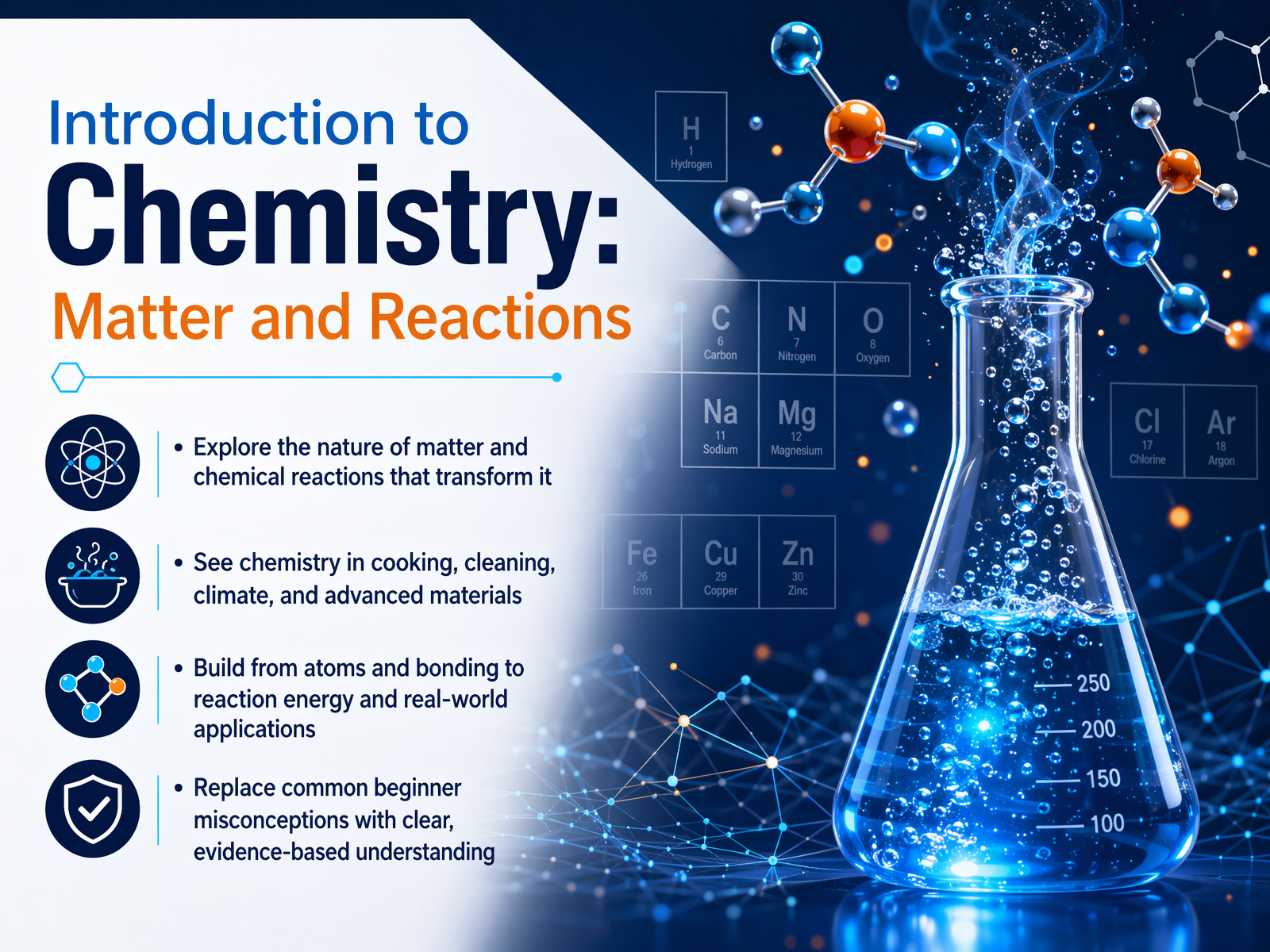
- 01Introduction to Chemistry: Matter and ReactionsWelcome to Introduction to Chemistry: Matter and Reactions. I'm glad you're here. In this course, we're going to explore the very nature of the stuff all around us—matter—and the fascinating transformations it undergoes in chemical reactions. You might think of chemistry as something that happens in a lab with bubbling beakers, but the truth is, it's an incredible, invisible dance happening in your kitchen, your body, and even the air you breathe. We'll start our journey by building a clear picture of atoms and how they bond together. From there, we'll uncover the energy that powers reactions and see how these principles are at work in everything from cooking and cleaning to climate and the creation of advanced new materials. In the process, we'll replace common beginner misconceptions with a clear, evidence-based understanding. Our goal is to make this science feel approachable and directly connected to your world. Now, let's build a solid foundation by diving into our first core concept: What is matter? We'll explore the particle model and physical states next.sciencetimes.comamericanchemistry.comagrilifetoday.tamu.edu+22 min
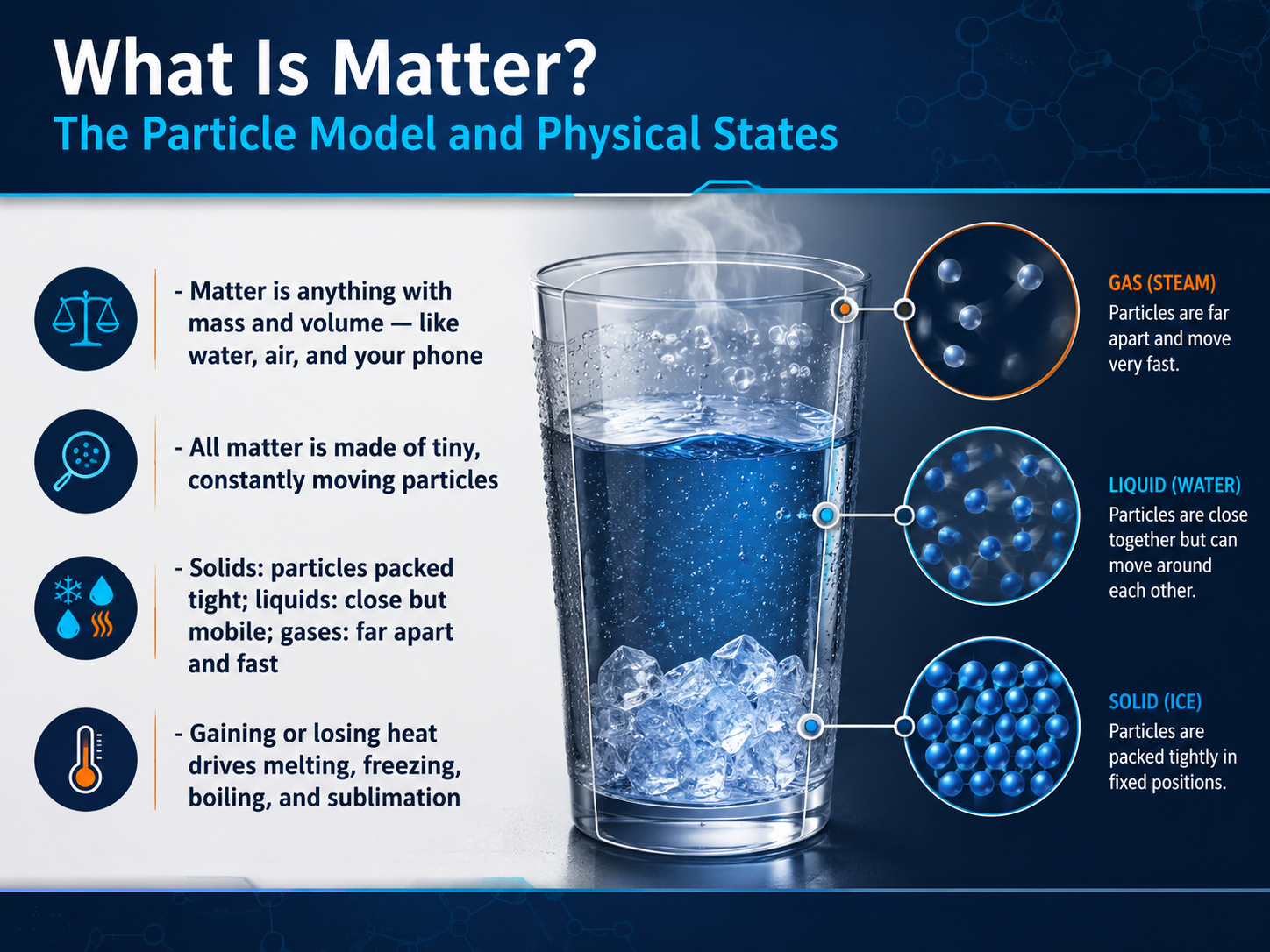
- 02What Is Matter? The Particle Model and Physical StatesNow, let's build our foundation by asking: what is matter, really? Simply put, matter is anything that has mass and takes up space, what we call volume. The water you drink, the air you breathe, even the phone in your hand, all of it qualifies. To understand how these things can change, we use the particle model. This model says all matter is made of incredibly tiny particles that are constantly moving. How they're arranged and how much they move determines the state you see. In a solid, like an ice cube, particles are packed tightly together in a fixed pattern, just vibrating in place. Give them some heat, and they gain energy. They start to move around more freely while staying close, becoming a liquid, that's melting. Heat the liquid even more, and those particles break free entirely, zooming around at high speed far apart from each other, and you have a gas through boiling. You can also see this in reverse. Cooling a gas causes condensation into a liquid, and further cooling freezes it into a solid. There's even a direct jump from solid to gas, called sublimation. Think of dry ice disappearing without ever becoming a puddle. So, the key takeaway is that changing the heat energy drives these transformations between solid, liquid, and gas by changing particle motion. Up next, we'll use this particle idea to explore 'Pure Substances and Mixtures: The Stuff Around Us.'
 2 min
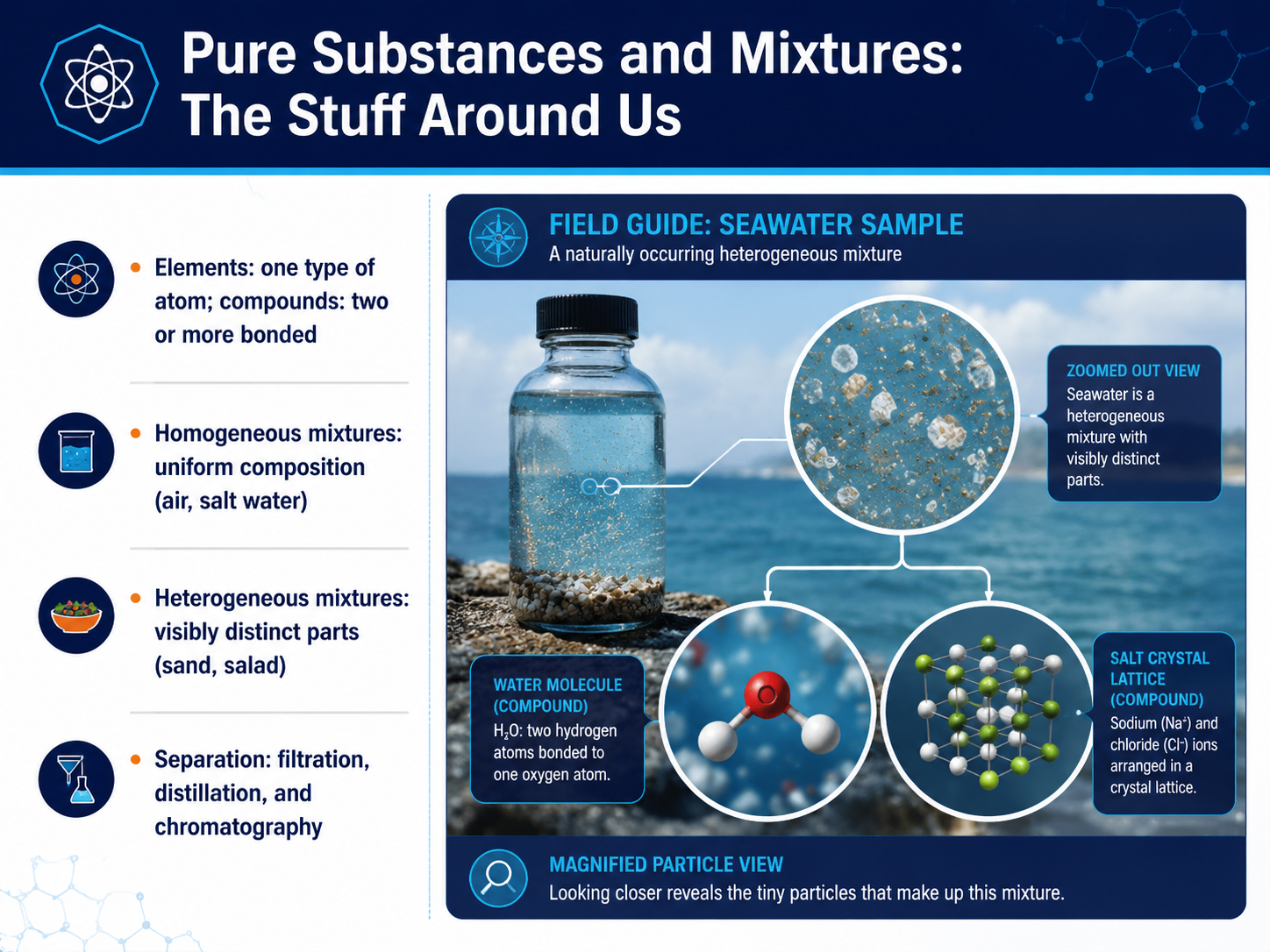
2 min - 03Pure Substances and Mixtures: The Stuff Around UsNow let's look at the actual stuff around us. Chemists group matter into pure substances and mixtures. A pure substance is either an element, made of just one type of atom, or a compound, where two or more different atoms are bonded together. Water is a compound, while the oxygen you breathe is an element. Mixtures, on the other hand, combine substances without bonding them. In a homogeneous mixture, everything looks uniform, like clean air or salt water. A heterogeneous mixture has visibly different parts, like a salad or a handful of beach sand. Because mixtures aren't chemically bonded, we can separate them using physical methods. Filtration catches solids from a liquid, distillation gently boils off a liquid to leave the other parts behind, and chromatography separates inks or dyes as they spread across a surface. You can think of these techniques as sorting tools, each one designed for a different kind of mixture. Next, we'll zoom inside the atom itself to explore its structure and how the periodic table organizes all these elements.
 2 min
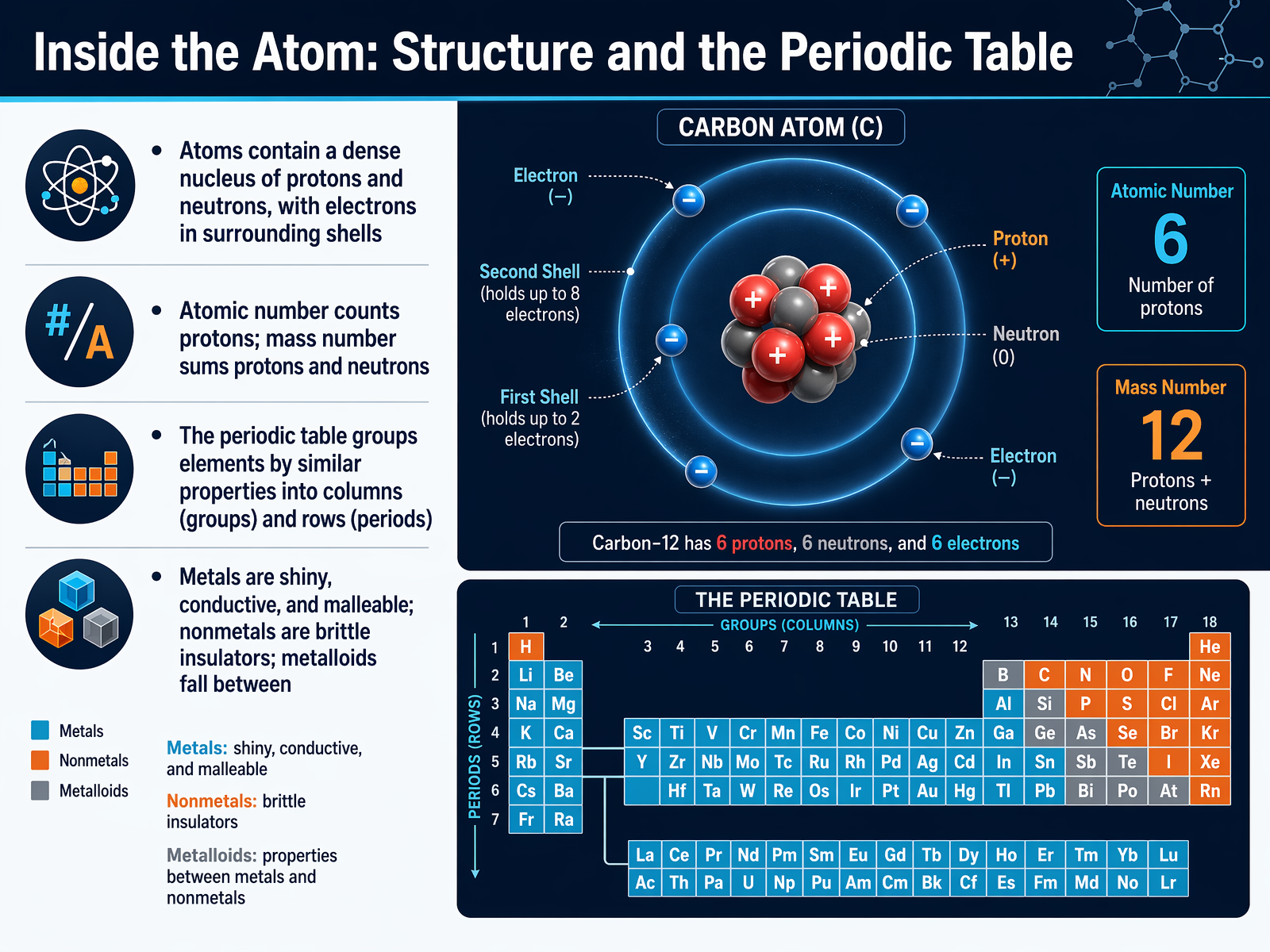
2 min - 04Inside the Atom: Structure and the Periodic TableLet's now step inside the atom itself to understand how the periodic table is organized. Picture a tiny, dense core called the nucleus, packed with protons and neutrons. Far outside this core, electrons move in layered regions we call shells. The identity of an element is defined by its atomic number, which is simply the count of protons. Add the protons and neutrons together, and you get the mass number. So, all atoms of gold have exactly 79 protons; that's what makes them gold. Now, the periodic table is a brilliant map that groups elements with similar personalities into vertical columns, or groups, and horizontal rows, called periods. Broadly, you can think of elements as falling into three categories. Most are metals, the shiny, conductive materials like copper wire that can be hammered into shape. On the opposite side, you have nonmetals, like the oxygen we breathe, which are often brittle insulators. Then, along the stair-step border, you'll find metalloids like silicon, which behave a bit like both. This internal structure directly sets the stage for how atoms bond. Next, we'll explore why atoms stick together in the first place, looking at ionic, covalent, and metallic bonds.
 2 min
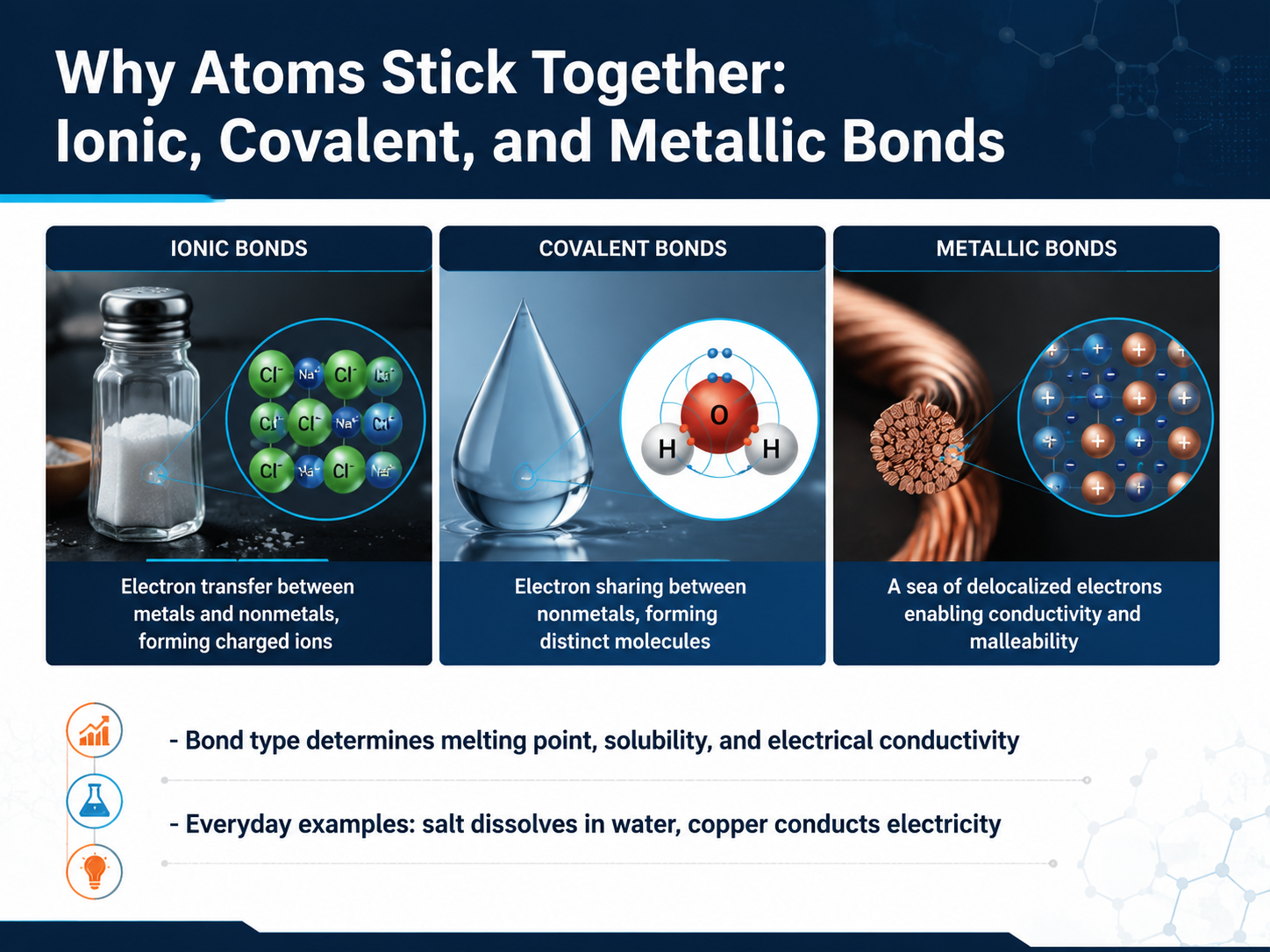
2 min - 05Why Atoms Stick Together: Ionic, Covalent, and Metallic BondsSo now we get to the real heart of chemistry—why atoms stick together in the first place. There are three main types of bonds, and each one gives a substance a completely different personality. First, ionic bonds. Think of table salt. A sodium atom transfers an electron to a chlorine atom, creating charged ions that attract like magnets. That’s why salt dissolves so easily in water. Next, covalent bonds. Instead of giving electrons away, atoms share them—like two people holding hands. This is common between nonmetals, and it creates distinct molecules, like the water you drink. Finally, metallic bonds. Picture a copper wire. The metal atoms sit in a sea of freely moving electrons. This electron sea is what makes metals bendable and so good at conducting electricity. The type of bond really controls everything—melting point, solubility, and electrical conductivity. Up next, we’ll see what happens when these bonds break and form in a chemical reaction, guided by one of nature’s most fundamental laws: the conservation of mass.
 2 min
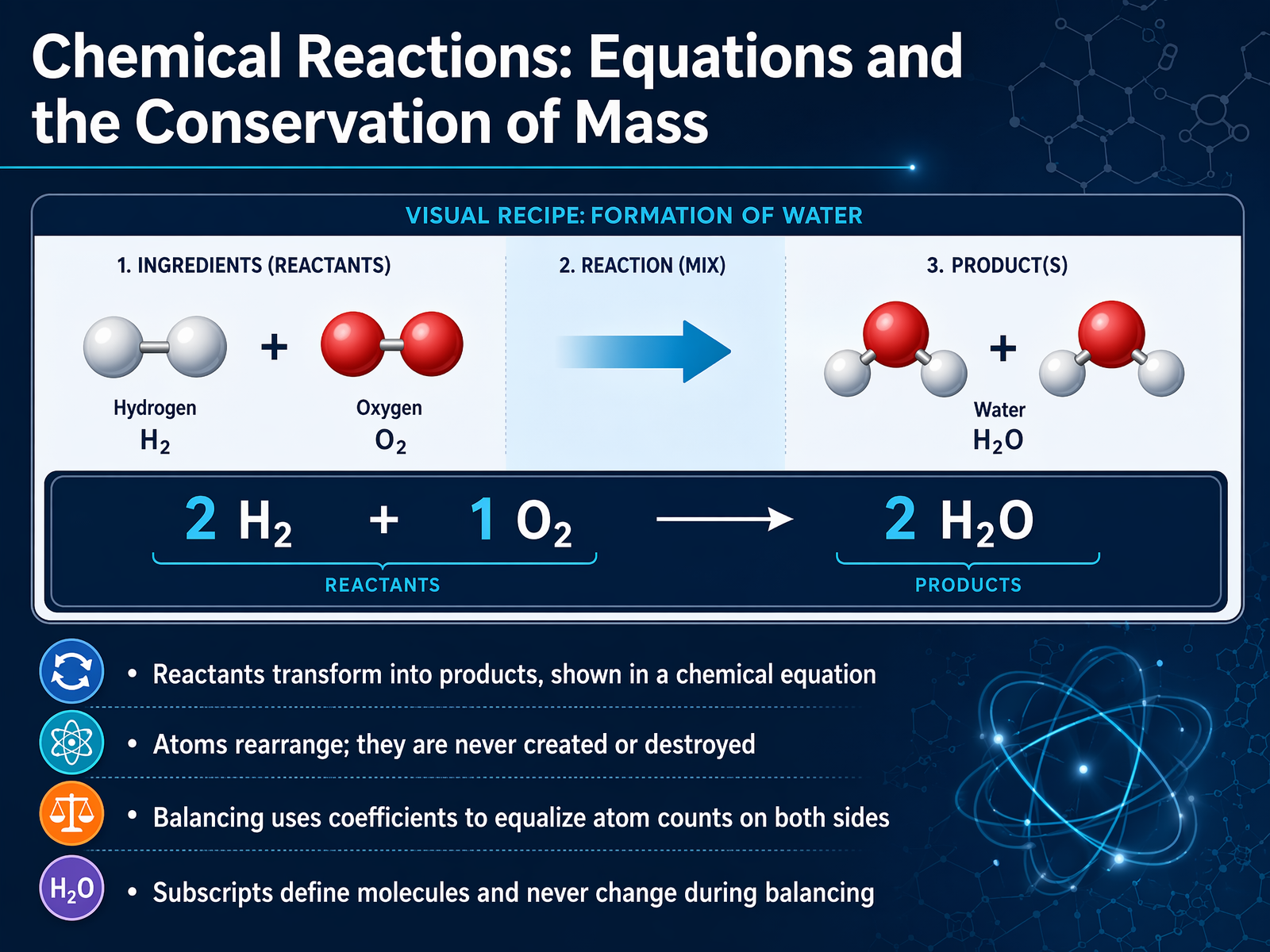
2 min - 06Chemical Reactions: Equations and the Conservation of MassNow let's look at how we write out these transformations, using chemical equations. Think of an equation like a recipe for a reaction. On the left side, you list your reactants, your starting ingredients. An arrow points to the right, where you list your products, the new substances that form. The arrow itself just means 'yields' or 'produces.' A huge idea sits behind this arrow, the conservation of mass. Atoms are simply rearranging to form new bonds. They are never created out of nothing, and they are never destroyed. So, whatever atoms you start with, you must have the exact same number and type at the end. To make sure our equation reflects this truth, we balance it. We place large numbers, called coefficients, in front of the molecules. This is like saying 'two of this molecule' or 'three of that one.' And here's a critical rule: you can change these coefficients, but you never, ever change the small subscripts within a chemical formula. Those subscripts define the molecule's very identity. Changing a subscript would mean you're inventing a completely different substance. Balancing an equation is simply a puzzle where you count atoms on each side and adjust the coefficients until everything is equal. Next, let's apply this idea to some specific reaction patterns, starting with common reaction types like synthesis, decomposition, and combustion.
 2 min
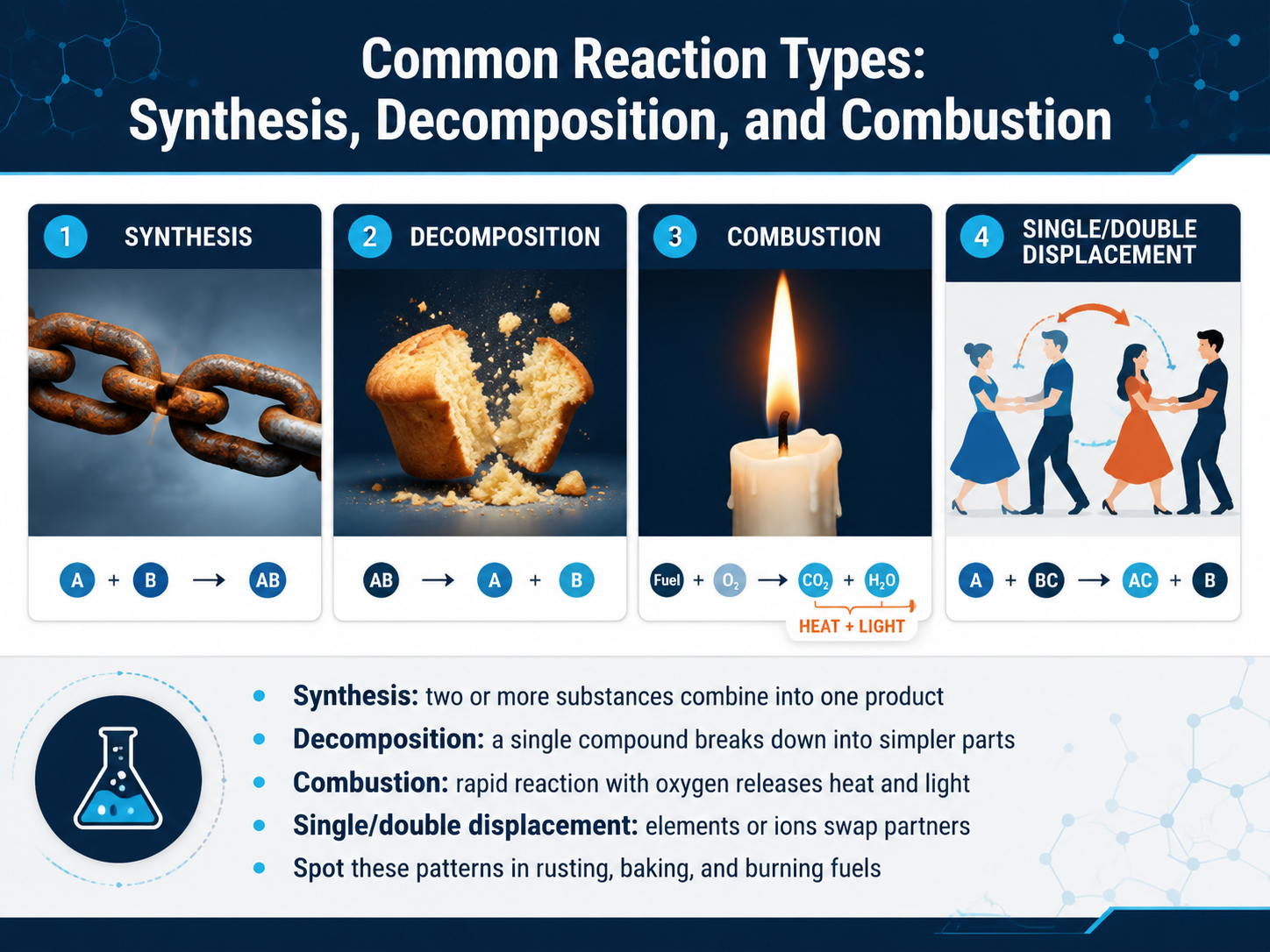
2 min - 07Common Reaction Types: Synthesis, Decomposition, and CombustionLet's look at patterns that help us predict how matter changes. Chemists group many reactions into a few common types. First, synthesis. That is when two or more substances combine into one product. Think of iron slowly combining with oxygen in the air to form rust. Next, decomposition. A single compound breaks down into simpler parts. When you heat sugar to make caramel, the sugar molecules decompose and recombine into new flavor compounds. Combustion is a rapid reaction with oxygen that releases heat and light. Burning a candle is a perfect example. The wax hydrocarbons react with oxygen to produce carbon dioxide, water, and energy. There are also single and double displacement reactions. In these, elements or ions swap partners. You can spot these patterns all around you. Rusting on a gate is synthesis. Baking soda reacting with vinegar and releasing carbon dioxide is a double displacement. And the flame on your stove is combustion. Once you recognize these types, you can start to see the hidden logic behind everyday transformations. Next, we will explore energy in chemical reactions, specifically the difference between exothermic and endothermic processes.
 sciencetimes.comamericanchemistry.comagrilifetoday.tamu.edu+22 min
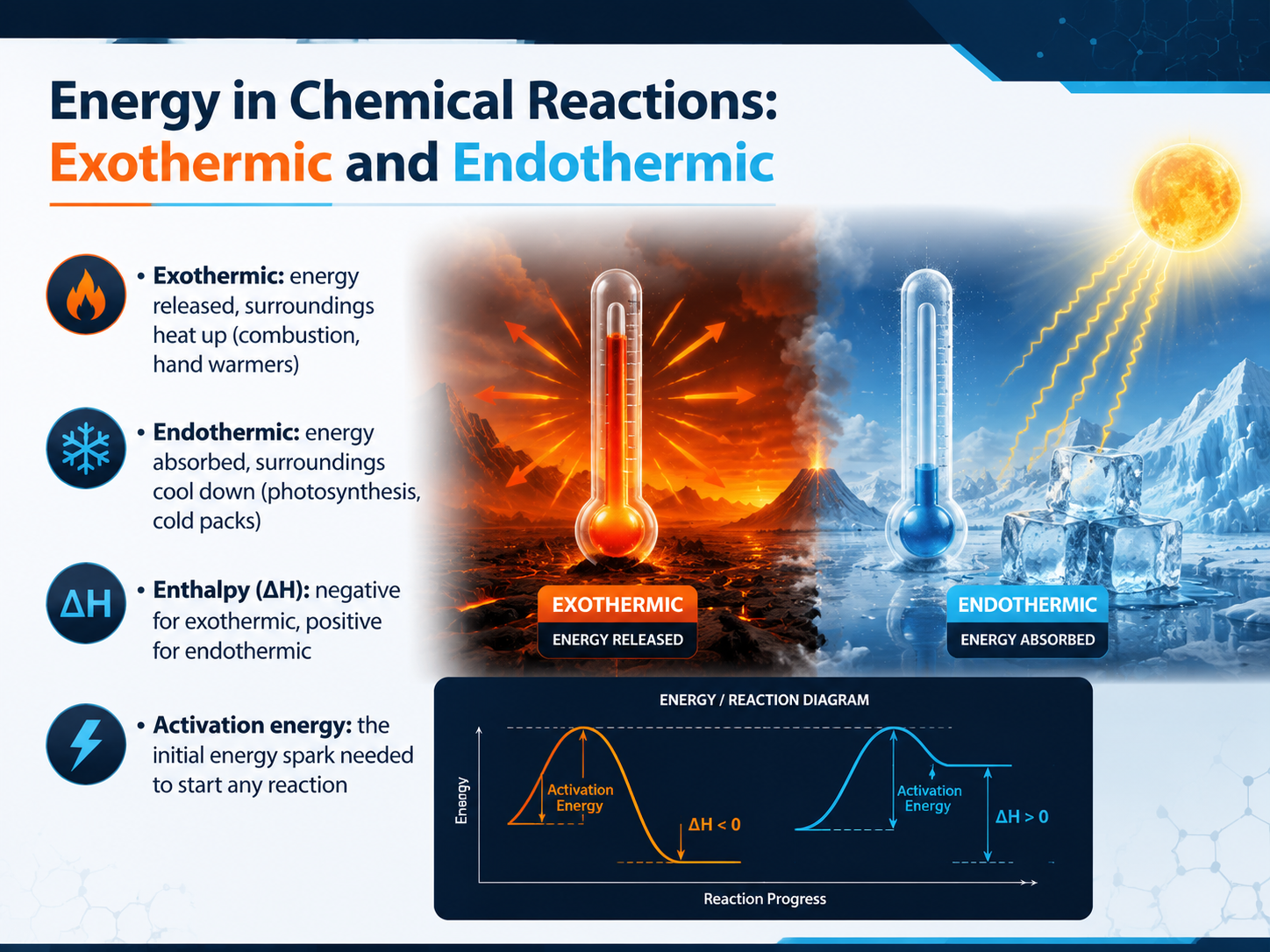
 - 08Energy in Chemical Reactions: Exothermic and EndothermicNow, let's talk about energy. Every chemical reaction either releases energy to its surroundings or absorbs energy from them. When a reaction gives off energy, we call it exothermic. You can feel this as heat, like the warmth from a crackling campfire or the cozy heat of a disposable hand warmer. These are releases of energy. In chemistry, we track this with a value called enthalpy, or delta H. For exothermic reactions, delta H is negative because the system is losing energy. On the flip side, some reactions must pull energy in to happen. These are endothermic reactions. They actually make their surroundings feel colder. A perfect example is the instant cold pack you might use for an injury. When you squeeze it, a reaction absorbs heat, and the pack gets icy. Photosynthesis is another great example, where plants absorb energy from sunlight. For these reactions, delta H is positive. But here's a crucial point: no reaction, not even one that gives off heat, starts on its own. It needs a little push, a tiny initial energy spark. That's called activation energy. Think of it like the lighter you need to start a gas stove. You provide that initial spark to get the reaction going. Next, we'll explore what determines how fast that reaction happens once it's started.
 sciencetimes.comamericanchemistry.comagrilifetoday.tamu.edu+22 min
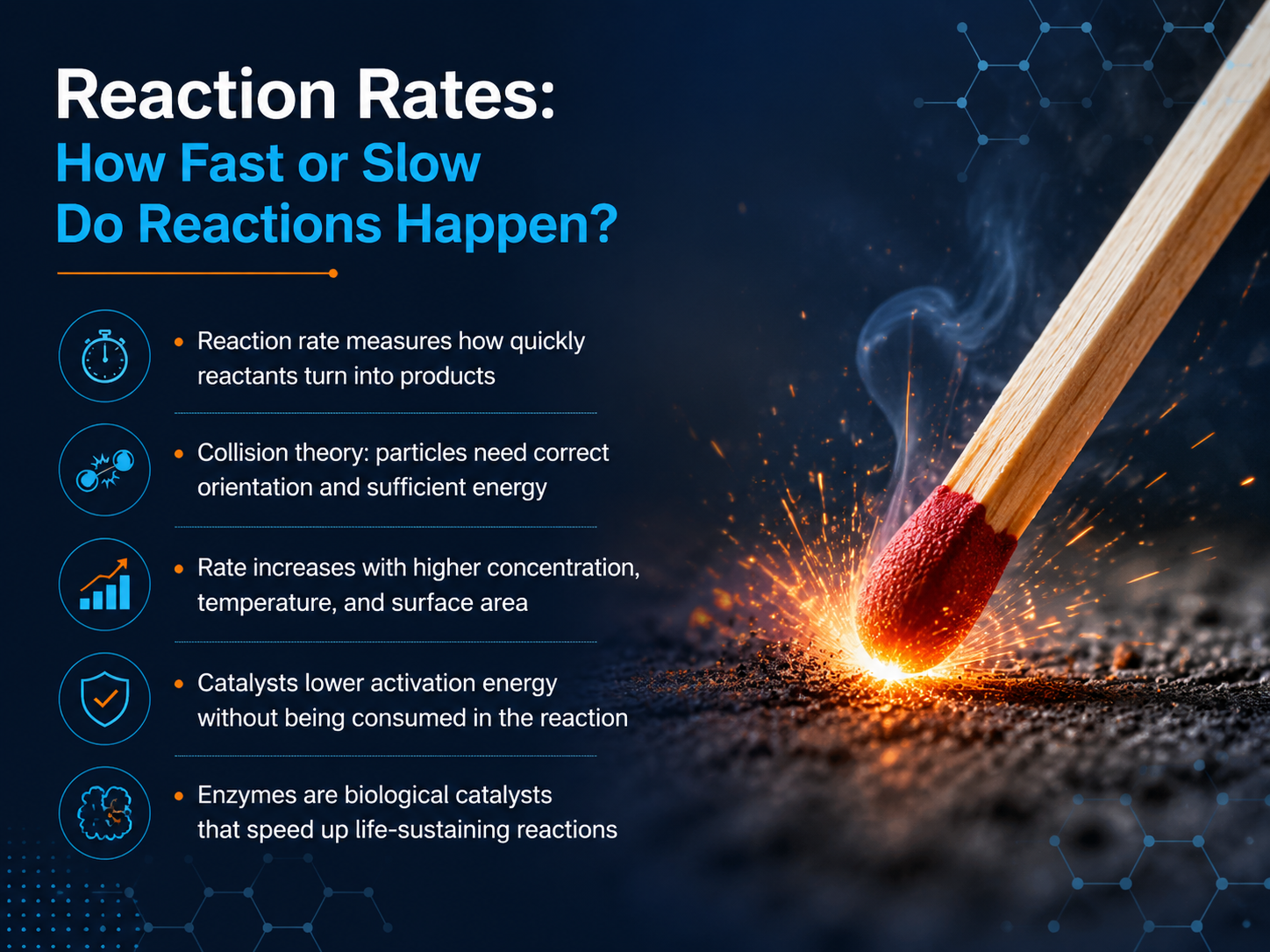
 - 09Reaction Rates: How Fast or Slow Do Reactions Happen?Now, let's explore how fast a reaction really happens. The reaction rate simply measures how quickly your starting materials, the reactants, are transformed into products. Think of it like a speedometer for chemistry. But why are some reactions lightning fast, while others take forever? The answer lies in collision theory. For a reaction to occur, the tiny particles must physically collide with the correct orientation and with enough energy to break their old bonds. Imagine trying to toss a key into a lock. If you don't line it up correctly or toss it too softly, the door won't open. You can speed up a reaction by increasing the concentration of reactants, which packs more particles into the same space. Raising the temperature also makes those particles move faster and collide more forcefully. Similarly, breaking a solid into smaller pieces increases its surface area, exposing more particles to collide. Chemists also use catalysts, which are special substances that lower the energy barrier needed for a reaction to start, without being used up themselves. In your own body, biological catalysts called enzymes work constantly to speed up the life-sustaining reactions that keep you alive. From digestion to energy production, enzymes make it all happen in a split second. Next, we'll apply these ideas to a special, everyday category of reactions: acids and bases, chemistry you can find from your kitchen all the way to the ocean.
 2 min
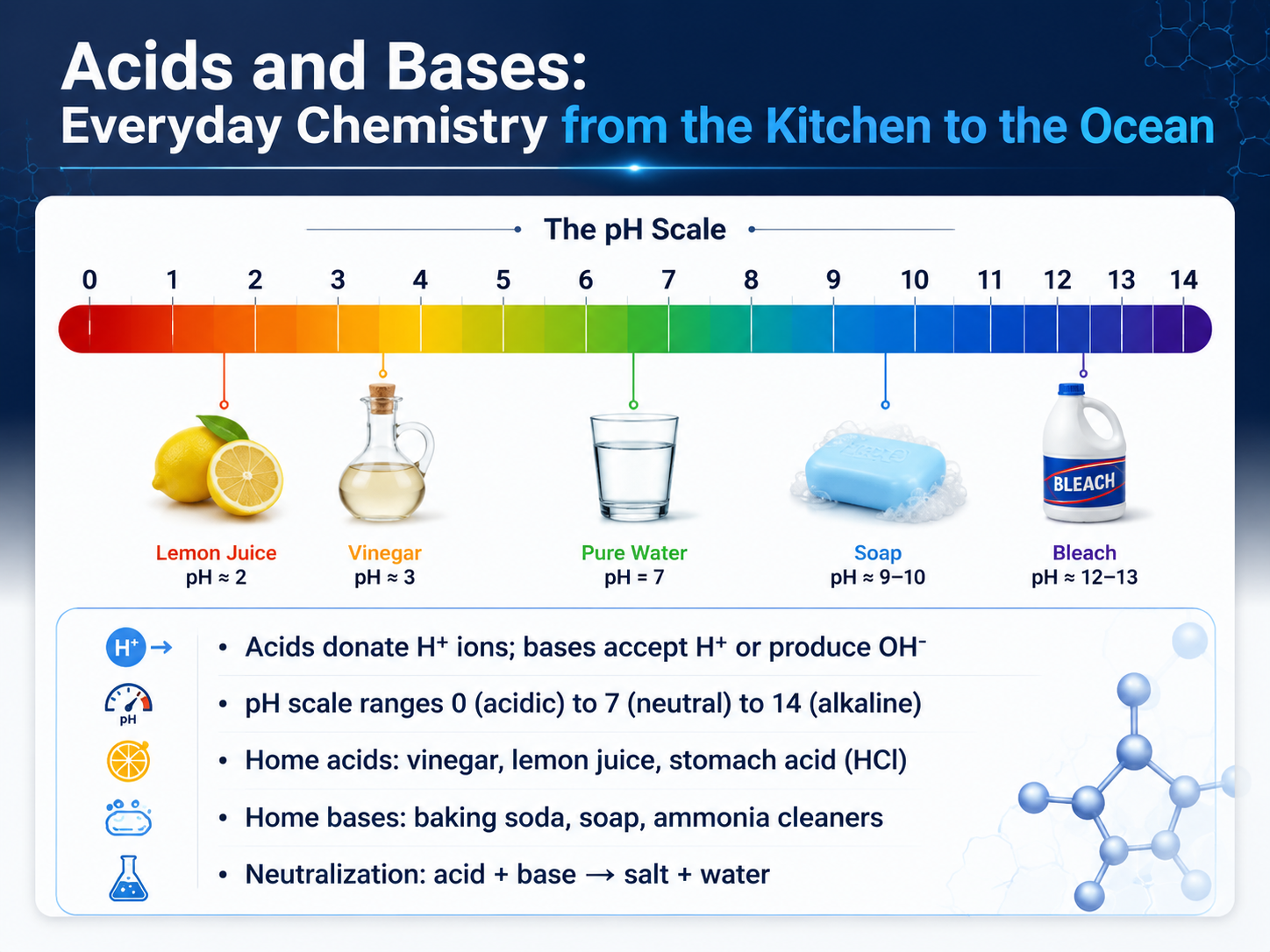
2 min - 10Acids and Bases: Everyday Chemistry from the Kitchen to the OceanNow let's turn to a specific type of chemical interaction that is happening all around you: acids and bases. Think of these as two key players in the chemistry of everyday life. The simplest way to understand them is by looking at what they do with hydrogen ions. An acid is a substance that donates hydrogen ions, often written as H plus. A base, on the other hand, either accepts those hydrogen ions or produces hydroxide ions, known as OH minus. To measure how acidic or basic something is, we use the pH scale. This scale runs from zero to fourteen. A pH of seven is neutral, like pure water. Values below seven are acidic, and values above seven are alkaline, which is another word for basic. You probably have examples of both in your home right now. In your kitchen, vinegar and lemon juice are common acids. Even your own stomach produces hydrochloric acid to help digest food. On the base side, you have baking soda sitting in the pantry, soap by the sink, and ammonia in some cleaning products. When you mix an acid and a base together, they cancel each other out in a process called neutralization. The reaction forms a salt and water. This is exactly what happens when you mix baking soda and vinegar to produce those fizzing bubbles of carbon dioxide. Understanding this simple balance helps you see the hidden chemistry in everything from cooking to cleaning. Next, we'll look at how chemists measure this balance with acid-base indicators and the pH scale.
 sciencetimes.comamericanchemistry.comagrilifetoday.tamu.edu+22 min
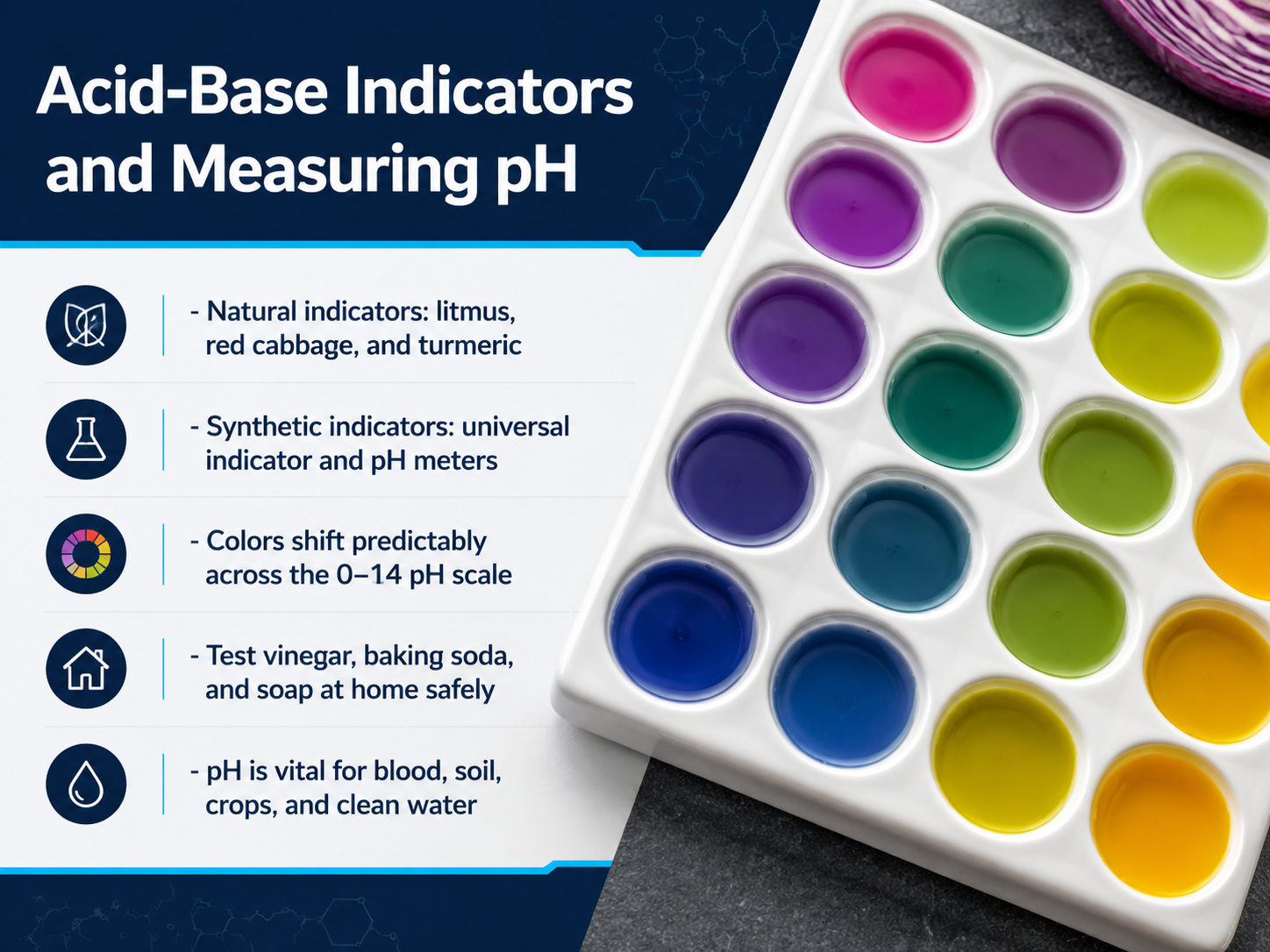
 - 11Acid-Base Indicators and Measuring pHNow let's see how we actually measure the strength of an acid or a base. It turns out nature gives us some colorful helpers. Have you ever seen litmus paper turn red or blue? That's a natural indicator. You can even use red cabbage juice or turmeric from your kitchen. They change color predictably depending on the pH. Scientists also use synthetic indicators like the universal indicator, which gives a rainbow of colors across the entire pH scale from zero to fourteen. For a precise number, we use a pH meter. You can try this safely at home. Test a little vinegar, a solution of baking soda, and some liquid soap. You'll see the colors shift right before your eyes. This isn't just a pretty experiment. Measuring pH is vital. Your blood maintains a very narrow pH range to keep you healthy. Farmers test soil pH to grow abundant crops. And we all depend on keeping our water sources clean and balanced. Coming up next, we'll explore a real-world consequence of shifting pH in our oceans, a story called ocean acidification.
 2 min
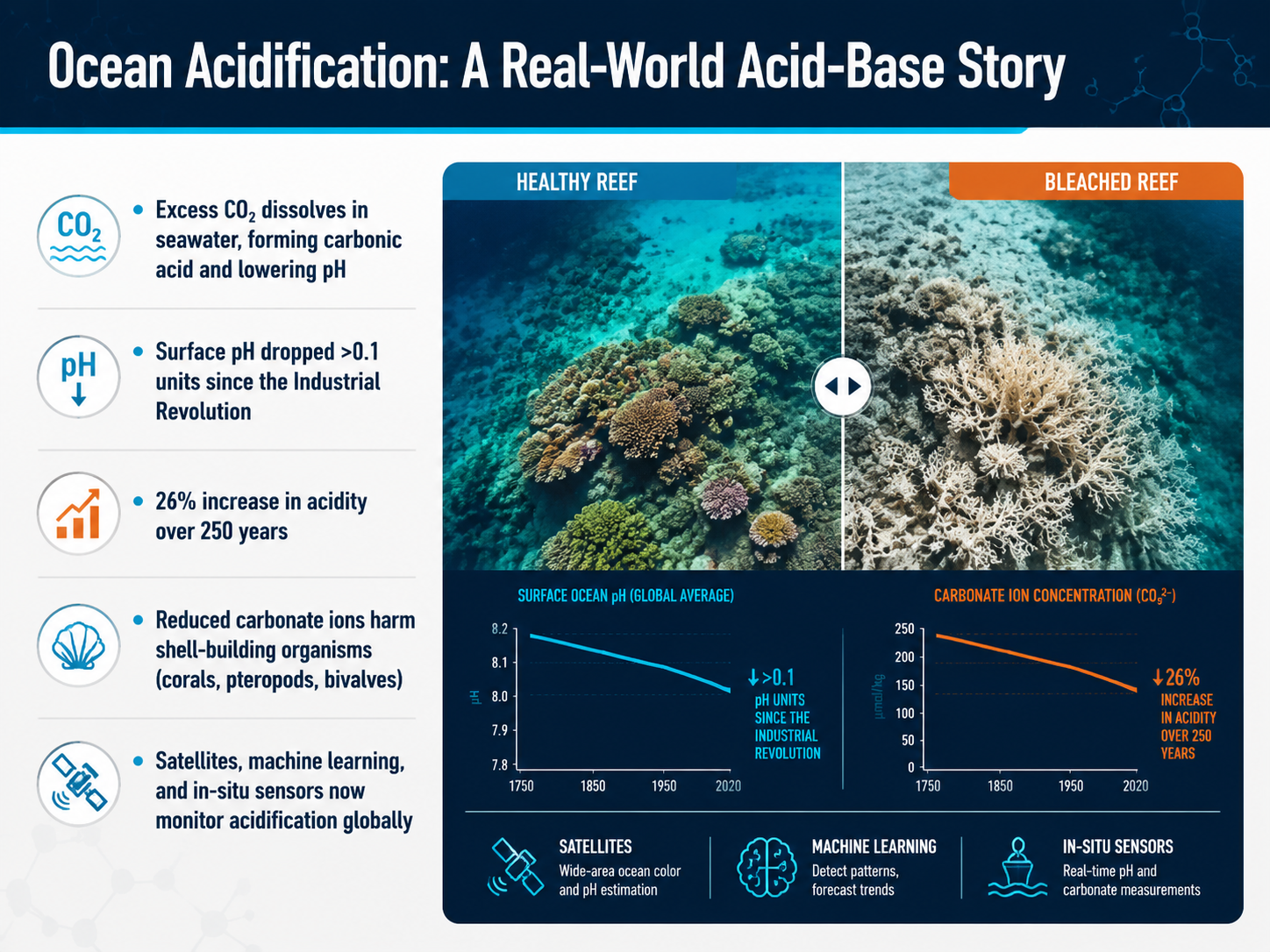
2 min - 12Ocean Acidification: A Real-World Acid-Base StoryNow let's bring acid-base chemistry to life with a story unfolding right now in our oceans. When we burn fossil fuels, about one quarter of the excess carbon dioxide ends up dissolved in seawater. There, it reacts to form carbonic acid, which gently but steadily lowers the ocean's pH. Since the Industrial Revolution, the surface ocean's pH has dropped by more than 0.1 units. That might sound small, but because the pH scale is logarithmic, it equals a 26 percent increase in acidity over 250 years. This shift reduces the carbonate ions that shell-building organisms need. Creatures like corals, delicate swimming snails called pteropods, and clams struggle to build and maintain their protective structures. The good news is that scientists are tracking these changes globally. They combine satellite data, machine learning, and in-situ sensors to monitor acidification with impressive detail, even down to weekly snapshots. So the principles of acid-base chemistry you are learning are the very same ones shaping the future of marine ecosystems. Next, we will see these principles in a more familiar setting: chemistry in the kitchen, covering cooking, baking, and cleaning.
 marine.copernicus.eunews-oceanacidification-icc.orgodu.edu+22 min
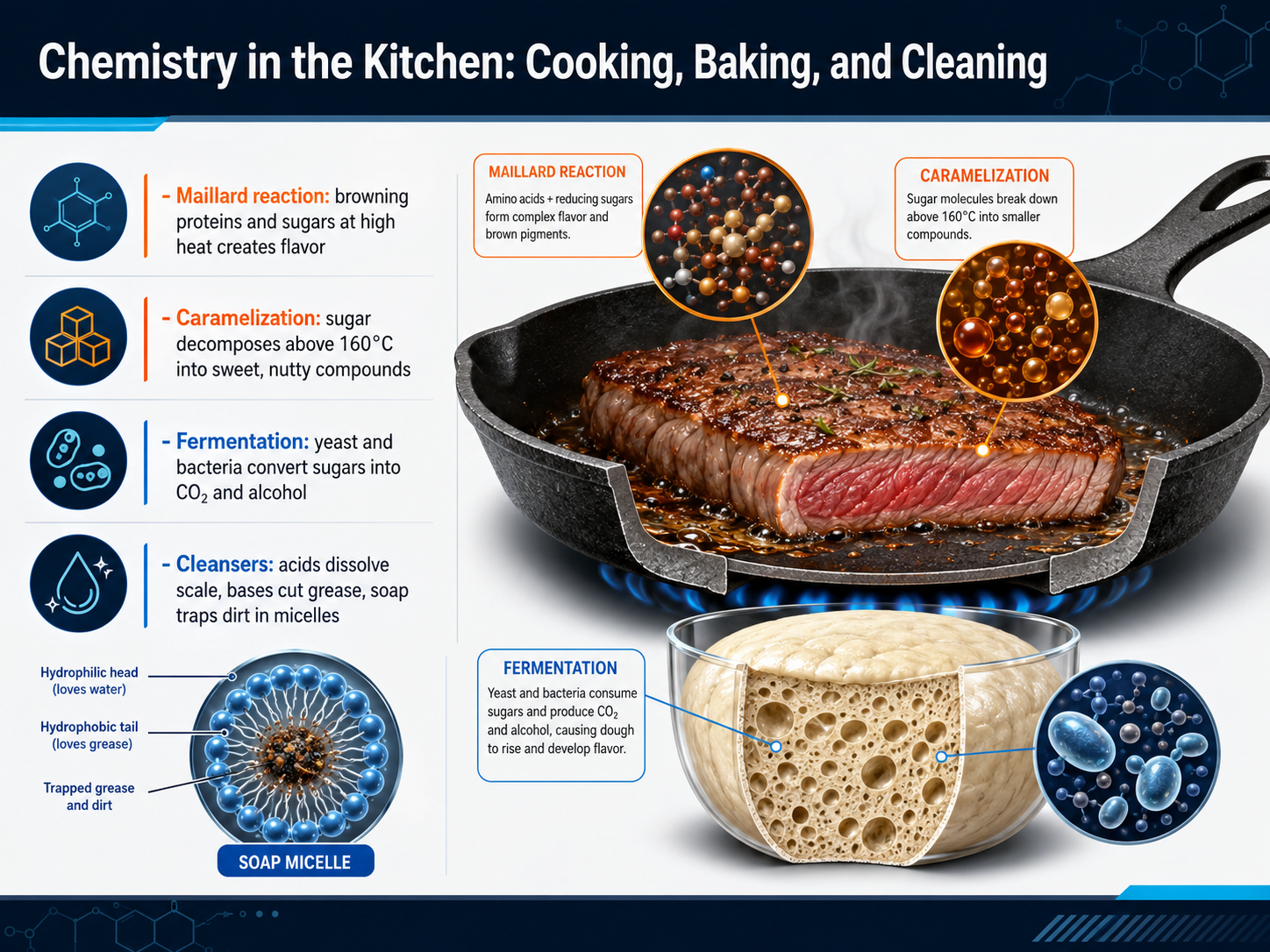
 - 13Chemistry in the Kitchen: Cooking, Baking, and CleaningNow, let's step into the most familiar laboratory of all: your kitchen. It's a place where remarkable chemical transformations happen every single day. When you sear a steak or toast a slice of bread, you're witnessing the Maillard reaction. This is a complex dance between amino acids and sugars at high heat, creating hundreds of new flavor compounds and that rich, brown crust. A different process, caramelization, happens when you heat sugar above about 160 degrees Celsius. The sugar molecules break apart and recombine into sweet, nutty, and slightly bitter compounds, giving caramelized onions and roasted coffee their deep flavors. Fermentation is another gift of chemistry. Tiny organisms like yeast and bacteria consume sugars and produce carbon dioxide and alcohol. That's what makes bread dough rise and gives yogurt its tangy taste. For cleaning, chemistry is equally powerful. Acidic cleaners, like vinegar, dissolve mineral deposits, while basic cleaners break down grease. Soap molecules have a clever dual structure; one end loves water and the other loves oil, allowing them to trap dirt in tiny spheres called micelles and rinse it all away. Next, we'll explore how these fundamental principles extend to power our world, in 'Chemistry and Energy: From Batteries to Photosynthesis.'
 sciencetimes.comamericanchemistry.comagrilifetoday.tamu.edu+22 min
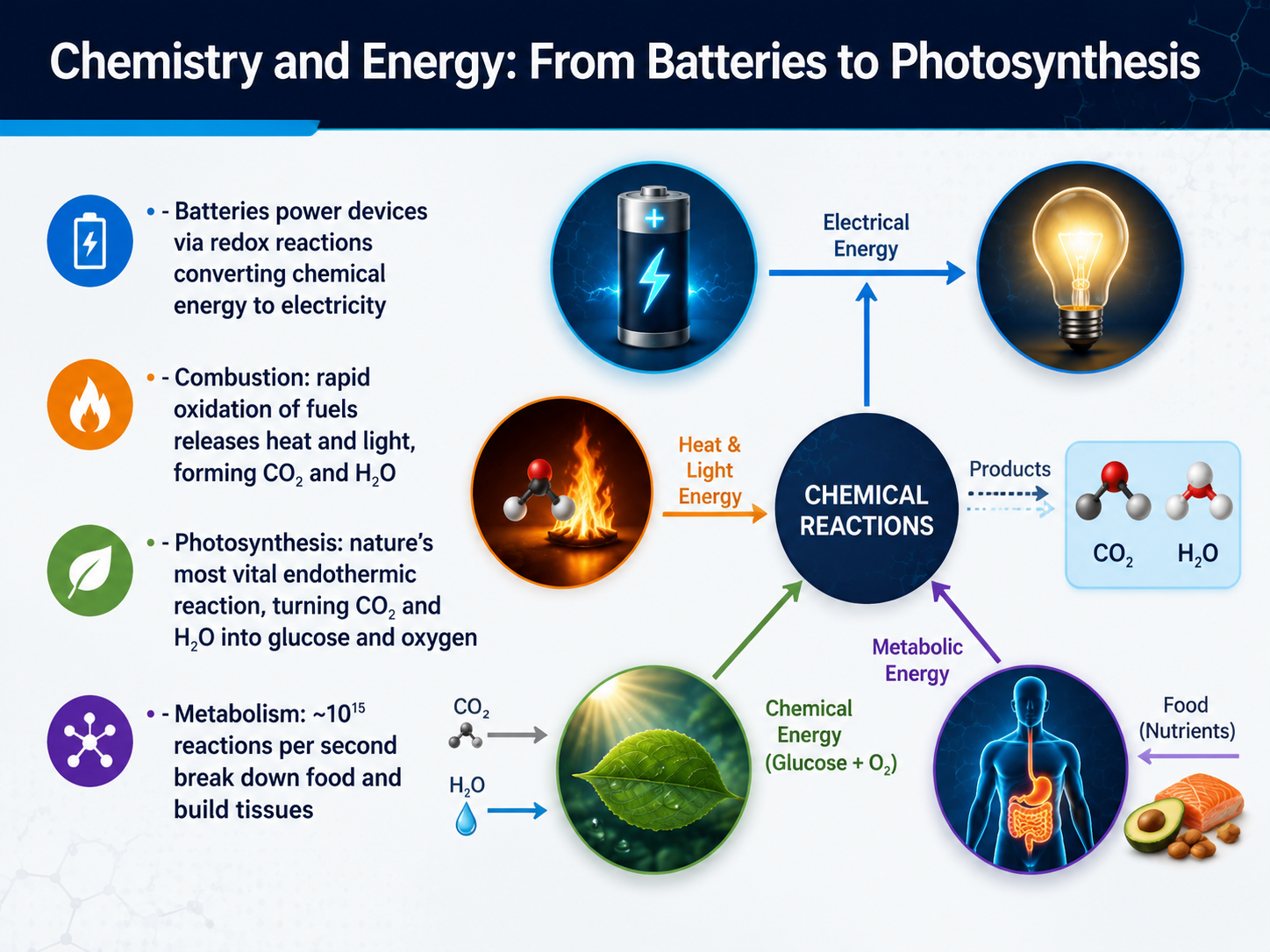
 - 14Chemistry and Energy: From Batteries to PhotosynthesisNow, let's connect what we've been learning to the flow of energy. Chemistry isn't just about matter changing form; it's about capturing and releasing power. Think about your phone. It powers on through a redox reaction, a silent transfer of electrons inside the battery converting chemical energy into electricity. We see a much more dramatic release of energy with combustion. When a fuel like candle wax burns, it's a rapid oxidation. The hydrocarbon molecules react with oxygen, bursting into heat and light, and leaving behind carbon dioxide and water vapor. On the flip side, life itself depends on absorbing energy. Photosynthesis is nature's most vital endothermic reaction. Inside a leaf, chlorophyll captures sunlight and uses that energy to rearrange simple carbon dioxide and water into glucose, the plant's food, and the oxygen we breathe. And within your own body right now, your metabolism is an unbelievably busy chemical factory. Every single second, you perform roughly ten to the fifteenth power reactions, breaking down food to build tissues and keep you thinking. This gives us a powerful view of energy in action. Next, we'll explore how we can design these chemical processes to be cleaner and more sustainable, in a field called Green Chemistry.
 sciencetimes.comamericanchemistry.comagrilifetoday.tamu.edu+22 min
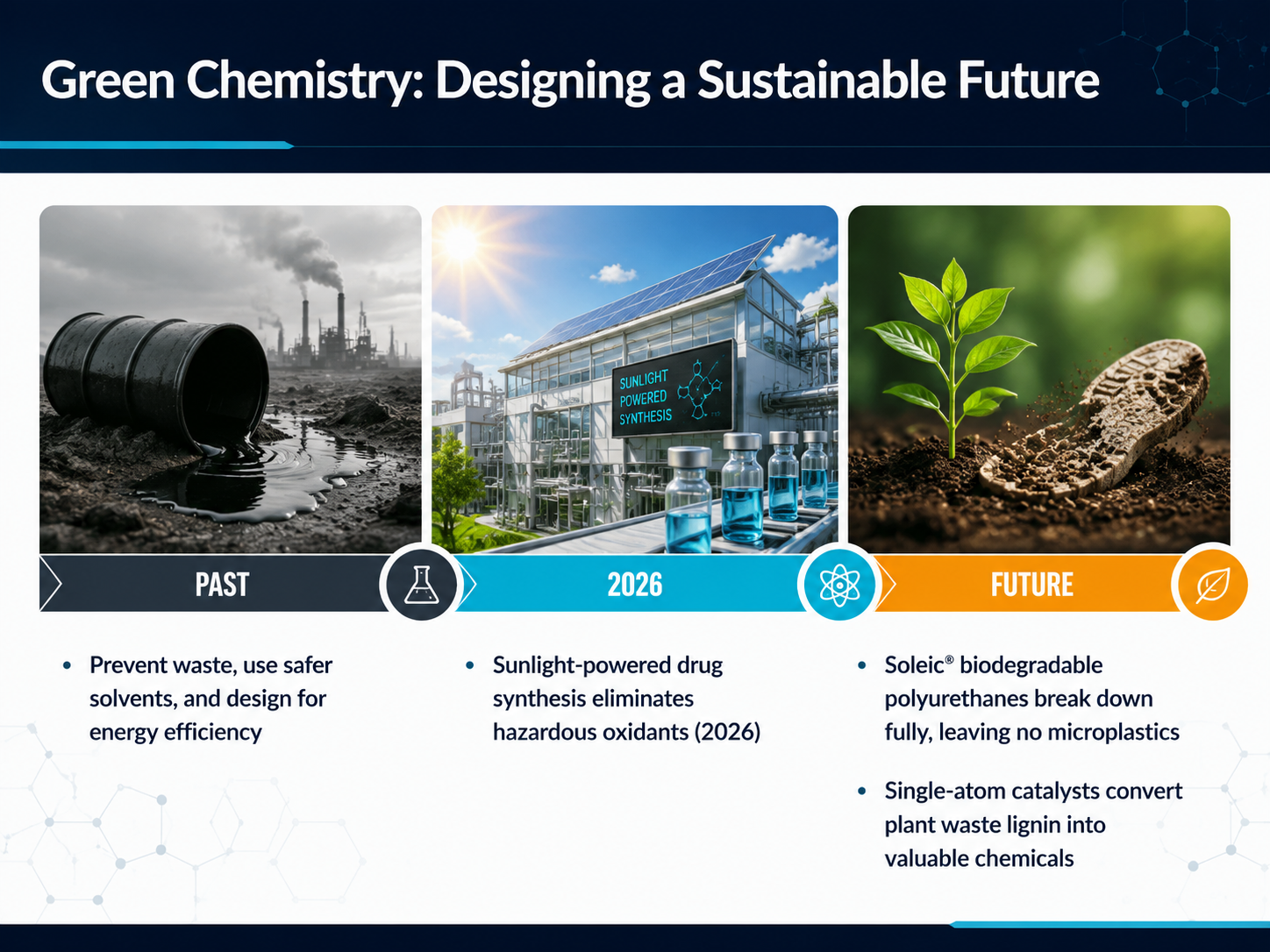
 - 15Green Chemistry: Designing a Sustainable FutureNow, let's explore how these principles come to life through green chemistry, a field dedicated to designing a sustainable future. The core ideas are simple but powerful: prevent waste from the start, use safer solvents, and design reactions that are energy efficient. One exciting example from this year, 2026, comes from the University of Osaka, where researchers developed a sunlight-powered method to synthesize a key pharmaceutical ingredient. Instead of storing a hazardous, explosive oxidant, they generate it on demand using light and oxygen, and use it instantly, making the process dramatically safer. Another breakthrough is Soleic, a plant-based polyurethane that won the ACS Green Chemistry Challenge Award. Unlike conventional plastics that fragment into persistent microplastics, Soleic materials are fully biodegradable, breaking down completely in compost, soil, or marine environments, leaving no harmful residues behind. Finally, imagine turning agricultural waste into treasure. Scientists have engineered single-atom catalysts that use isolated ruthenium atoms to convert lignin, a tough plant polymer, into valuable chemicals like phenol with near-complete conversion. This offers a sustainable path away from fossil fuels. These innovations show that chemistry isn't just about understanding reactions; it's about redesigning them to protect our planet. Up next, we'll pull all these threads together in 'Putting It All Together: Chemistry in Your Life and Beyond'.
 greeniupac2026.orgchemistryforsustainability.orgmember.changechemistry.org+22 min
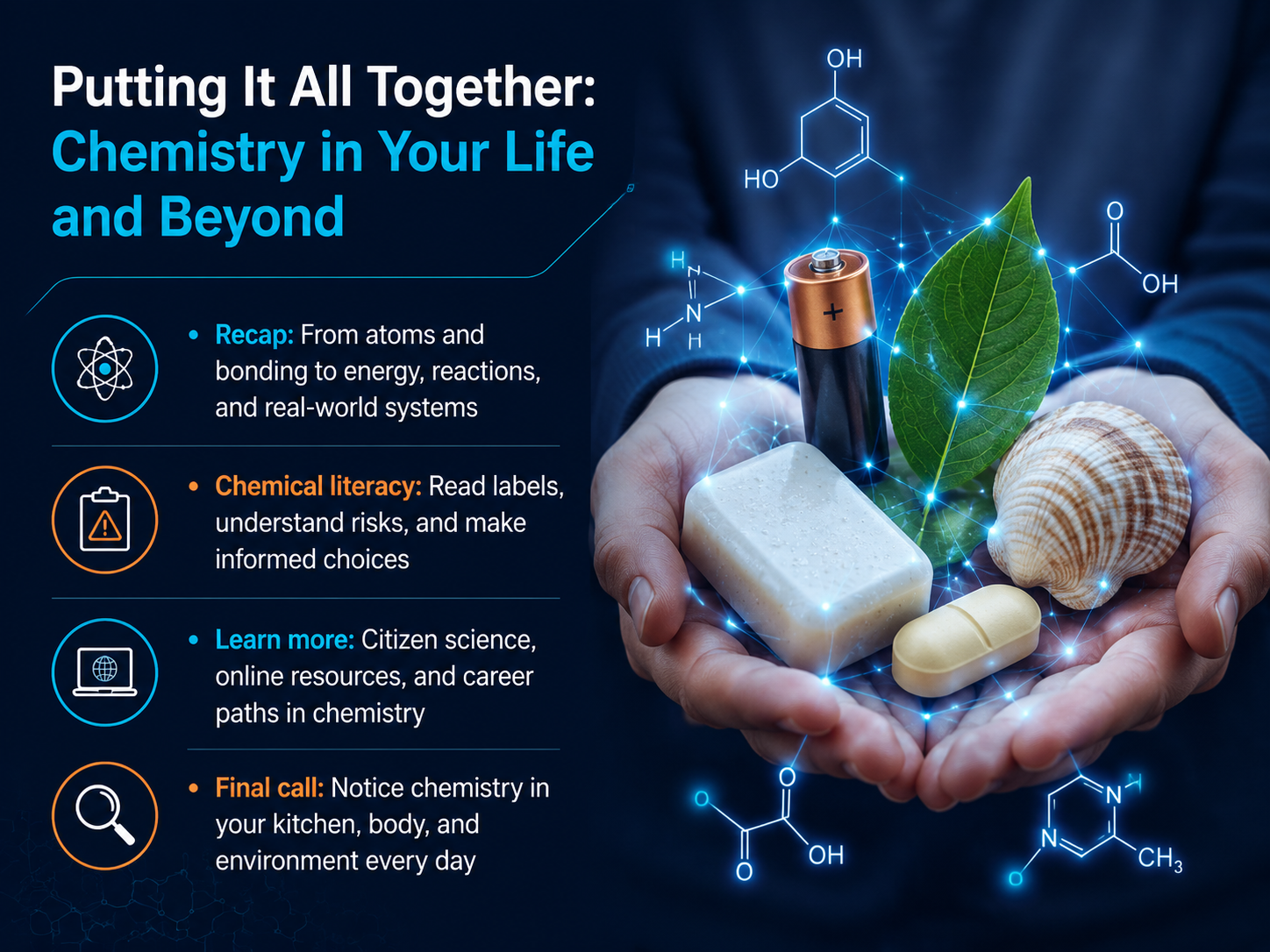
 - 16Putting It All Together: Chemistry in Your Life and BeyondWe have covered a lot of ground together, from the tiny world of atoms and bonding to the energy changes that power reactions. You have seen how these principles explain the rust on a gate, the browning of a seared steak, and the simple fizz of baking soda and vinegar. This chemical literacy is a powerful tool. It helps you read product labels with a critical eye, understand potential risks, and make informed choices for your health and your home. Notice the chemistry in your own kitchen, your body, and the environment around you. If your curiosity is sparked, there are wonderful paths to explore, from citizen science projects and online resources to exciting careers in green chemistry, where scientists are inventing biodegradable materials and turning plant waste into valuable fuels. Thank you for bringing your curiosity to this journey. The world is your living laboratory, so keep observing, keep questioning, and never stop noticing the invisible reactions that shape our visible world.
 sciencetimes.comamericanchemistry.comagrilifetoday.tamu.edu+22 min
Take the deck with you
Download this course as a file — free, no sign-up needed.
- PDF handoutEvery slide page, ready to print or share.17 pages · 4.7 MBDownload
- Narrated PowerPointThe deck that presents itself — every slide carries the digital human's narration video.17 pages · 19.8 MBDownload
- PowerPoint slidesThe full deck as a .pptx — open it in PowerPoint, Keynote, or Google Slides.17 pages · 4.6 MBDownload
Free to use in your own training — please keep the PersonWise credit page at the end.
Have your own deck? Turn it into a course
Sources consulted
Web sources consulted while building this course.
- 10 Surprising Everyday Chemical Reactions Happening Right Now Around You — sciencetimes.com
- Chemistry in Everyday Products, Uses & Real-World Examples — americanchemistry.com
- How food chemistry works in your kitchen every day - AgriLife Today — agrilifetoday.tamu.edu
- Chemistry in Everyday Life: Real-Life Applications & Examples — vedantu.com
- The Role of Chemical Reactions in Everyday Life - Science24 — science24.org
- Ocean Acidification | CMEMS — marine.copernicus.eu
- Entering the era of directly supporting society with observation-based ocean acidification data - Ocean Acidification — news-oceanacidification-icc.org
- Ocean Acidification: Another Planetary Boundary Crossed — odu.edu
- Turning the Tide - NOAA Ocean Acidification Program — oceanacidification.noaa.gov
- Surface Ocean CO2 Atlas Database Version 2026 (SOCATv2026) (NCEI Accession 0315110) — doi.org
- Welcome — greeniupac2026.org
- Green Chemistry: Unlocking the Next American Industrial Boom | Green Chemistry for sustainability — chemistryforsustainability.org
- Green Chemistry & Engineering 2026 - Change Chemistry — member.changechemistry.org
- Sunlight-powered chemistry reduces hazardous oxidant risk — phys.org
- Innovations in green chemical synthesis — doi.org