Solar System: Planets, Moons & Orbits
Begin
16 pages · ~32 min
Solar System: Planets, Moons & Orbits
Explore the solar system's planets, moons, and orbital mechanics in this introductory training for astronomy enthusiasts.
What you’ll learn
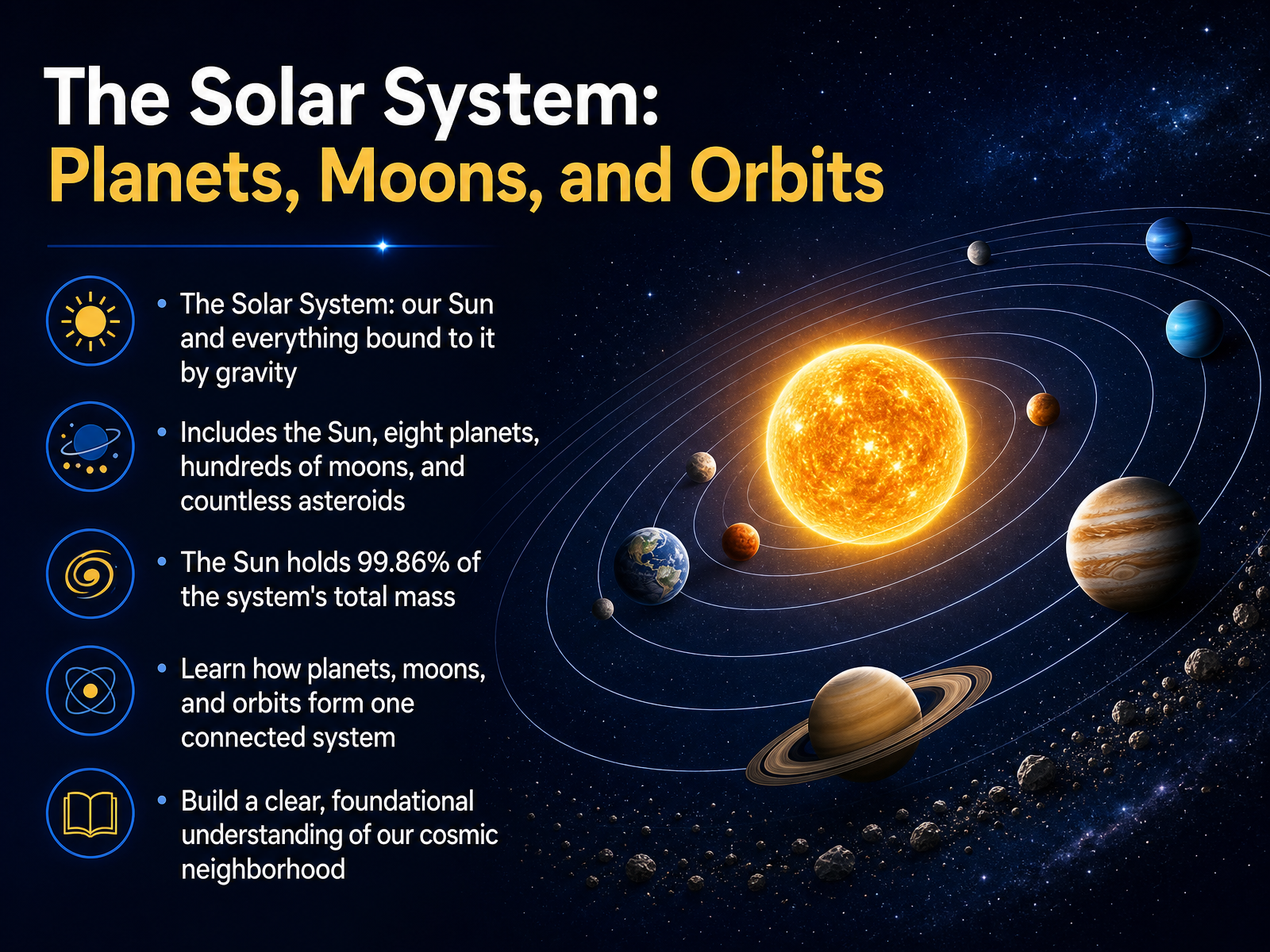
- 01The Solar System: Planets, Moons, and OrbitsWelcome aboard. Today, we're setting out on a virtual tour of our cosmic neighborhood—the solar system. The word 'solar' comes from the Latin word 'solis,' meaning Sun. So the solar system is simply the Sun and everything bound to it by gravity. Think of it as a huge, carefully organized family portrait. At the center sits our star, the Sun. It's enormous—so massive that it holds ninety-nine point eight six percent of all the matter in the entire system. Imagine it as the anchor, and its powerful gravity keeps everything else in place. Now, what else is in this family? There are eight major planets, each following its own path, or orbit, around the Sun. We also have hundreds of moons, countless asteroids, and icy comets, all moving like clockwork. By the end of this journey, you'll have a clear, foundational understanding of how the Sun, its planets, and their moons all fit together as one connected story. Let's begin with a quick tour of our cosmic neighborhood.science.nasa.govscience.nasa.govsolarsystem.nasa.gov+22 min
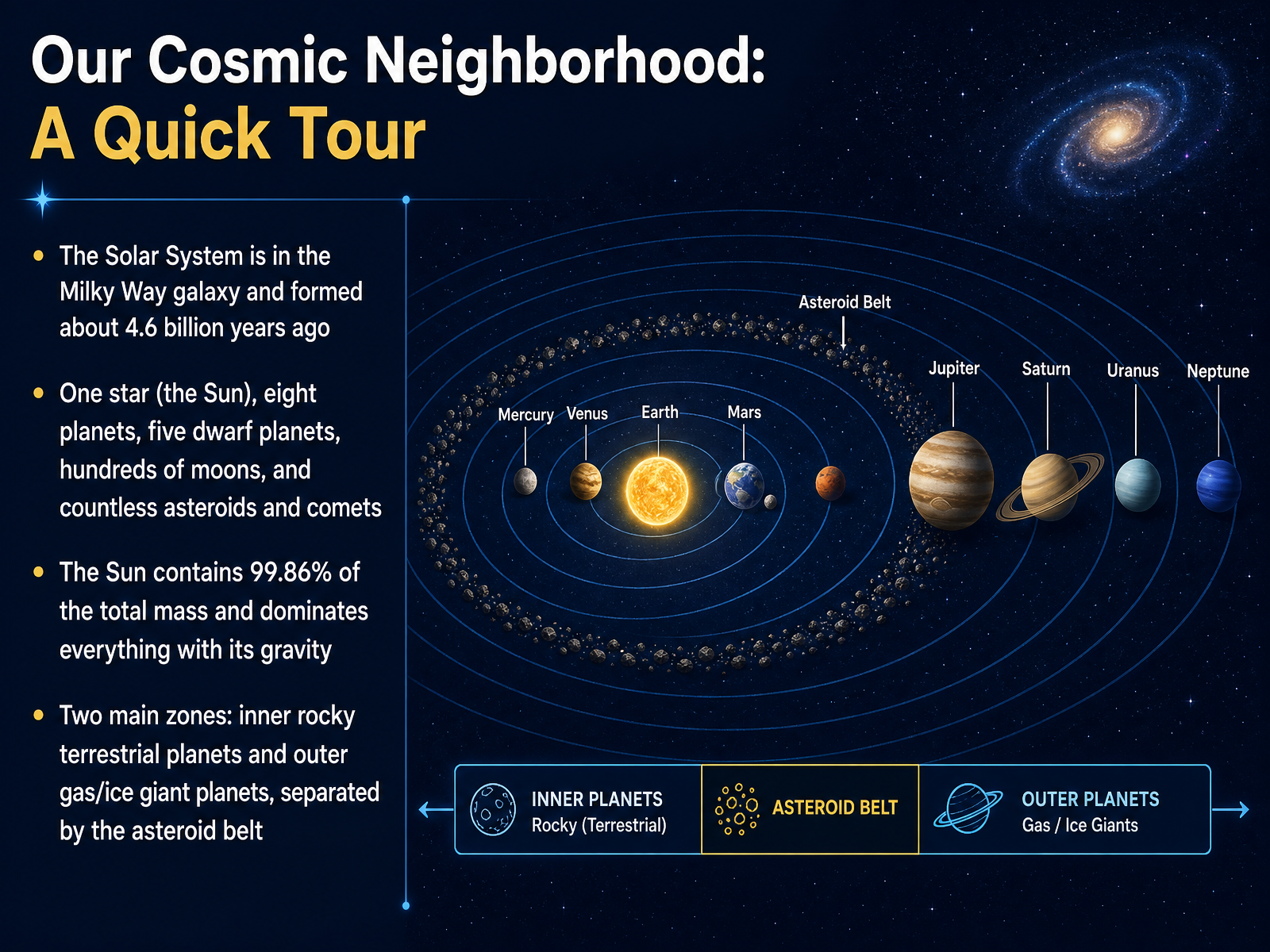
- 02Our Cosmic Neighborhood: A Quick TourLet's zoom out and take a quick tour of our cosmic neighborhood. Our solar system sits in a spiral arm of the Milky Way galaxy. It all began about four point six billion years ago from a giant cloud of gas and dust. At the heart of it is just one star—our Sun. Orbiting the Sun are eight planets, five officially named dwarf planets, hundreds of moons, and countless asteroids and comets. Now, here's a staggering fact: the Sun alone contains ninety-nine point eight six percent of everything in the solar system. Its gravity—that invisible pull—dominates and organizes everything else. The planets arrange themselves into two main zones. Close to the Sun, we have the inner, rocky terrestrial planets: Mercury, Venus, Earth, and Mars. Farther out, beyond a band of rubble called the asteroid belt, sit the giant planets: the gas giants Jupiter and Saturn, and the ice giants Uranus and Neptune. So, what keeps all these worlds moving in their precise, predictable paths? Next, we'll explore 'The Force That Holds It All Together: Gravity and Orbits.'
 science.nasa.govscience.nasa.govsolarsystem.nasa.gov+22 min
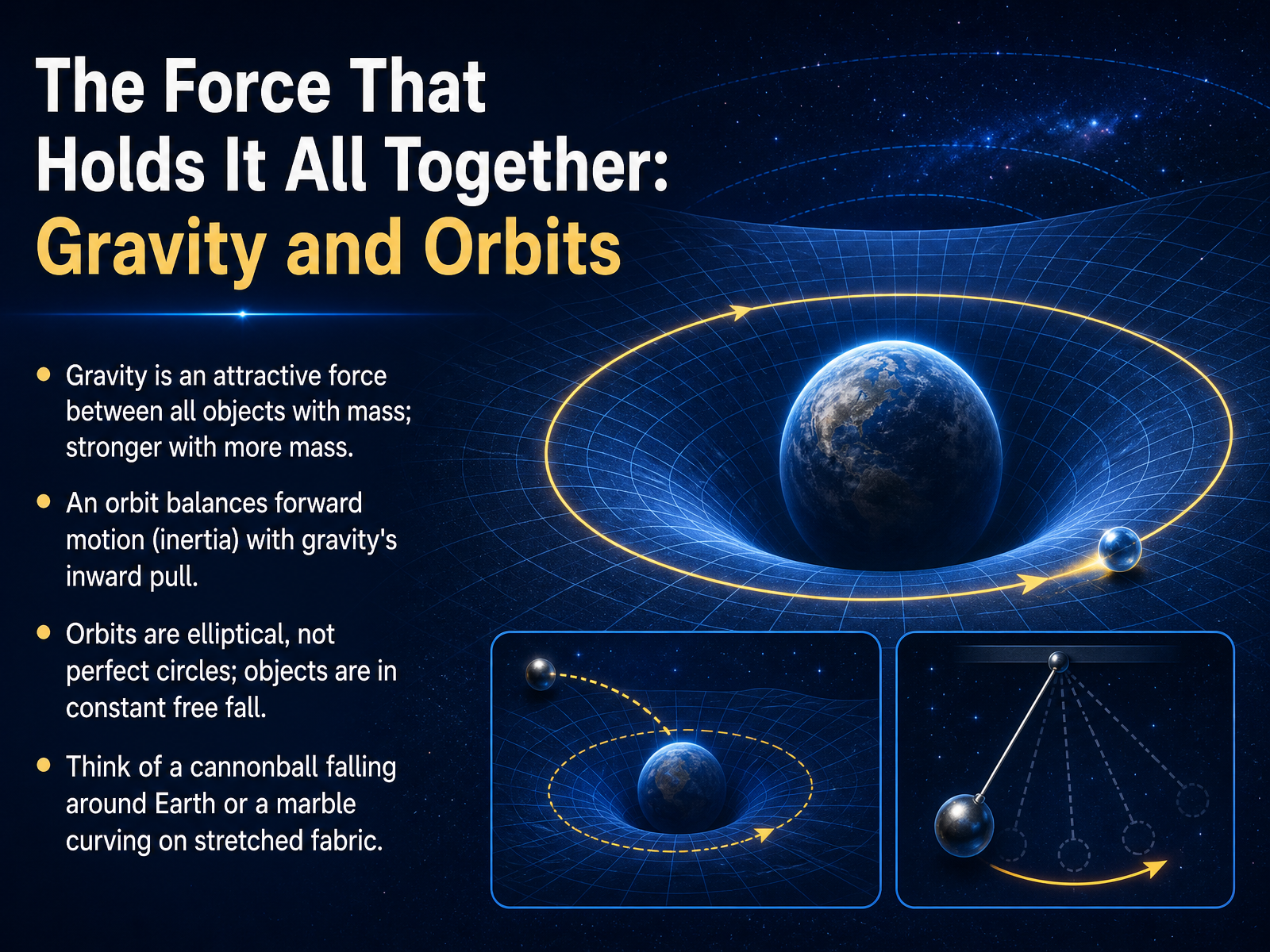
 - 03The Force That Holds It All Together: Gravity and OrbitsNow let's look at the invisible force behind all this motion: gravity. Gravity is a pull between any objects that have mass. The more mass something has, the stronger its pull. The Sun contains most of the mass in our solar system, so its gravity is the boss. It holds the planets in place, constantly pulling them inward. But the planets don't fall into the Sun. Why? Because they also have forward motion, which we call inertia. An orbit is simply a balance between that forward motion and gravity's inward pull. Think of it like a cannonball shot from a mountain. If it goes too slowly, gravity wins and it falls. If it goes at just the right speed, it falls around the Earth, never hitting the ground. Or imagine a heavy ball on a stretched fabric. It makes a dip, and a marble rolls around it in a curve. That's a small model of how planets orbit. One more thing: most orbits are not perfect circles. They are ellipses, or ovals. An object in orbit is actually in a constant state of free fall. Next, let's apply these rules as we meet the planets themselves: The Eight Worlds in Order.
 science.nasa.govspark.iop.orgjpl.nasa.gov+22 min
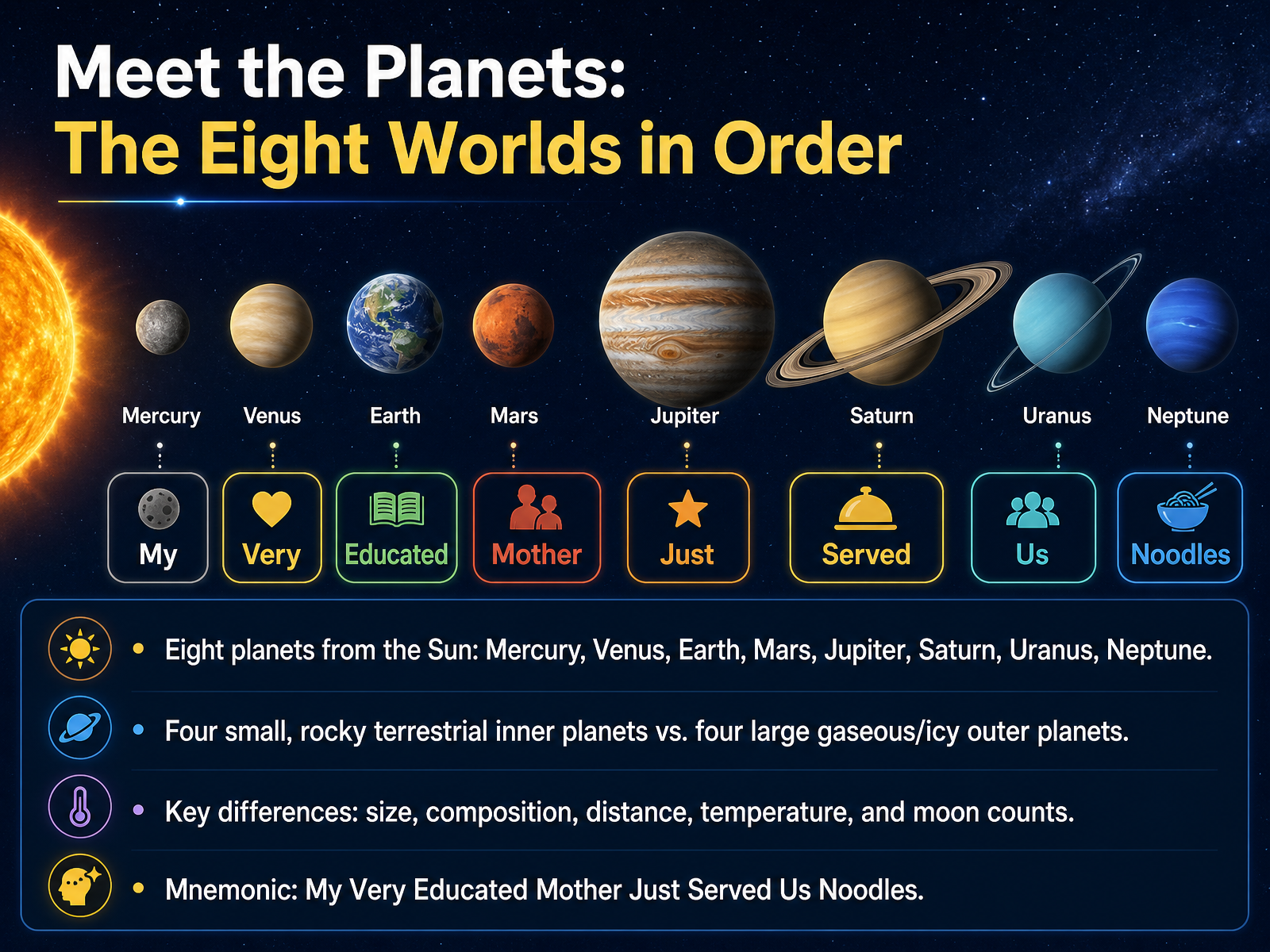
 - 04Meet the Planets: The Eight Worlds in OrderLet's line up our eight planets in order, stepping outward from the Sun. The sequence is Mercury, Venus, Earth, Mars, Jupiter, Saturn, Uranus, and Neptune. A fun way to remember that is: My Very Educated Mother Just Served Us Noodles. We group these worlds into two very different families. The four inner planets—Mercury, Venus, Earth, and Mars—are terrestrial planets. They are small, rocky, and have solid surfaces you could stand on. The four outer planets—Jupiter, Saturn, Uranus, and Neptune—are giants. They have no solid surface, just deep layers of gas or ice. As we move outward, distance brings dramatic changes. Temperatures plunge, and the planets grow much larger, especially Jupiter and Saturn. Moon counts also explode in the outer family, where powerful gravity captures dozens of companions. So, from tiny, scorched rocky worlds to immense, frozen gas giants, our orderly line of planets sets the stage perfectly for the next slide: The Sun: Our Local Star and System Anchor.
 science.nasa.govscience.nasa.govuniversetoday.com+21 min
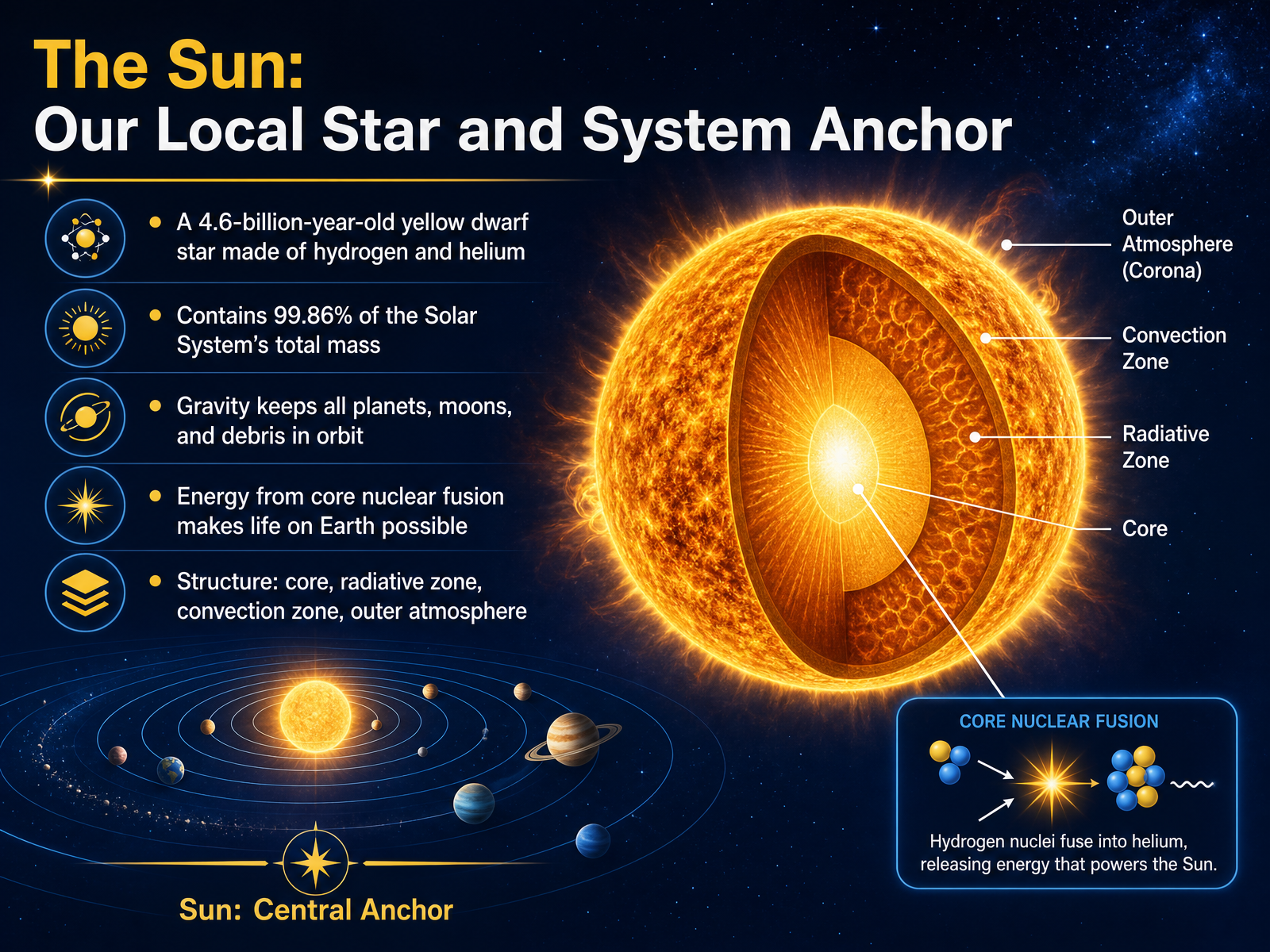
 - 05The Sun: Our Local Star and System AnchorNow, let’s turn to the very center of our solar system—the Sun. Picture a giant ball of hot gas, mostly hydrogen and helium, that has been shining for about four point six billion years. This is our local star, and it’s the anchor that holds everything together. It contains a staggering ninety-nine point eight six percent of all the mass in the entire solar system. Because it’s so massive, its gravity is incredibly strong. That gravity is the invisible leash that keeps all the planets, moons, and even tiny bits of space debris in their orbits. Deep inside the Sun’s core, a process called nuclear fusion crushes hydrogen atoms together to create helium. This releases a tremendous amount of energy, which travels outward through the radiative zone, then the convection zone, and finally escapes from the outer atmosphere. That journey of energy is what makes the Sun shine, and it’s the very reason life can exist on Earth. Next, we’ll leave the Sun and visit its closest neighbors—the inner rocky planets, Mercury and Venus.
 science.nasa.govscience.nasa.goven.wikipedia.org+22 min
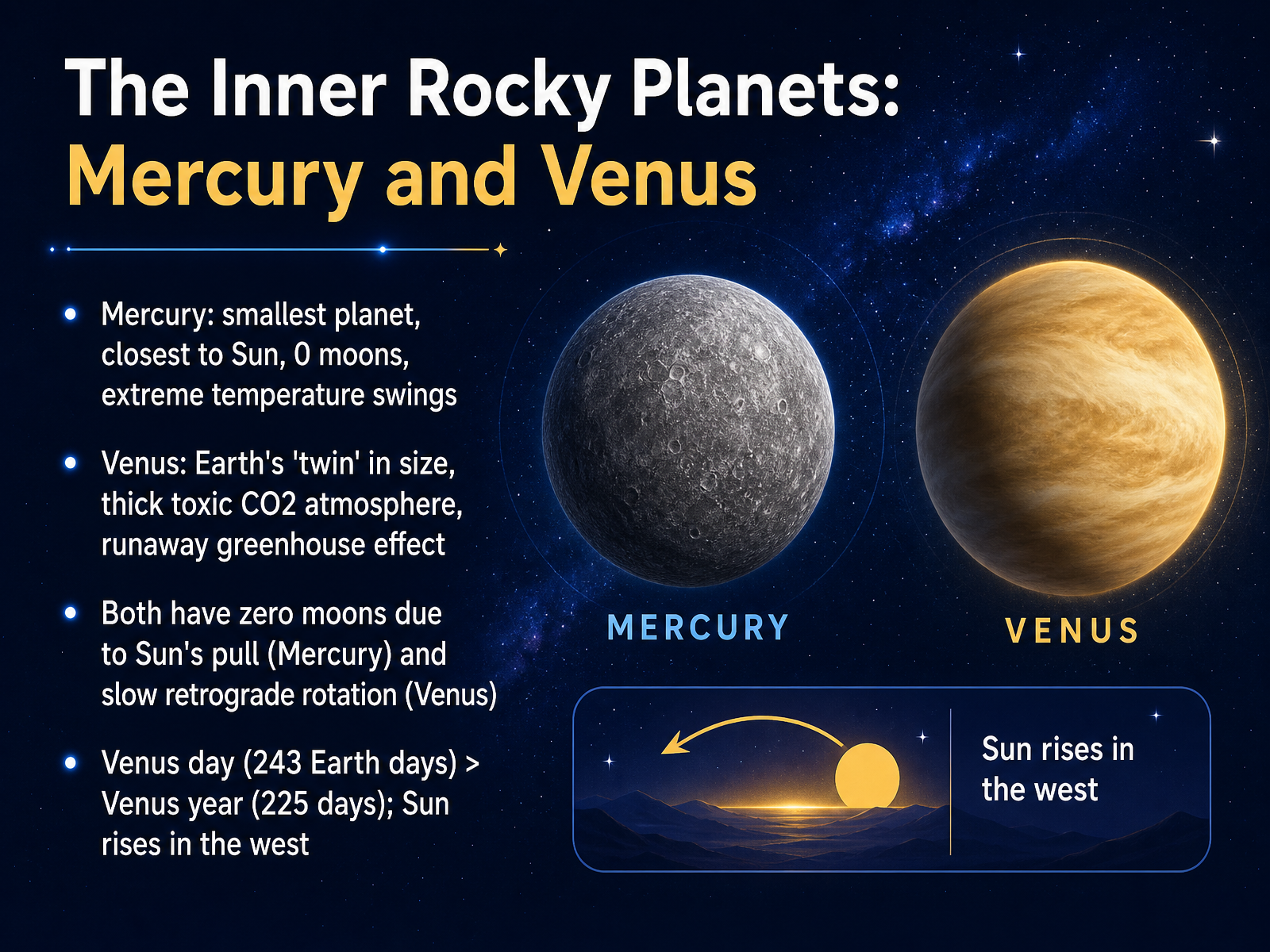
 - 06The Inner Rocky Planets: Mercury and VenusNow let's zoom in on the two inner rocky worlds closest to the Sun—Mercury and Venus. Mercury is the smallest planet in our solar system and sits right next to the Sun. It has zero moons, and its surface swings between extreme scorching heat during its long day and freezing cold at night. Why no moon? Because Mercury is so close to the Sun that our star's powerful gravity would pull any moon away. Next we have Venus, often called Earth's twin because it is nearly the same size. But that is where the similarity stops. Venus is wrapped in a thick, toxic carbon dioxide atmosphere that traps heat in a runaway greenhouse effect, making it the hottest planet in the solar system. Venus also has zero moons, but for a different reason. It spins incredibly slowly, and in the opposite direction to most planets. In fact, one day on Venus lasts 243 Earth days—longer than its entire 225-day year. If you stood on Venus, the Sun would rise in the west and set in the east. Both Mercury and Venus are moons-less, but their orbits tell two very different stories. Next, we will cross paths with our own home and its neighbor—the inner rocky planets Earth and Mars.
 ssd.jpl.nasa.govscience.nasa.govscience.nasa.gov+22 min
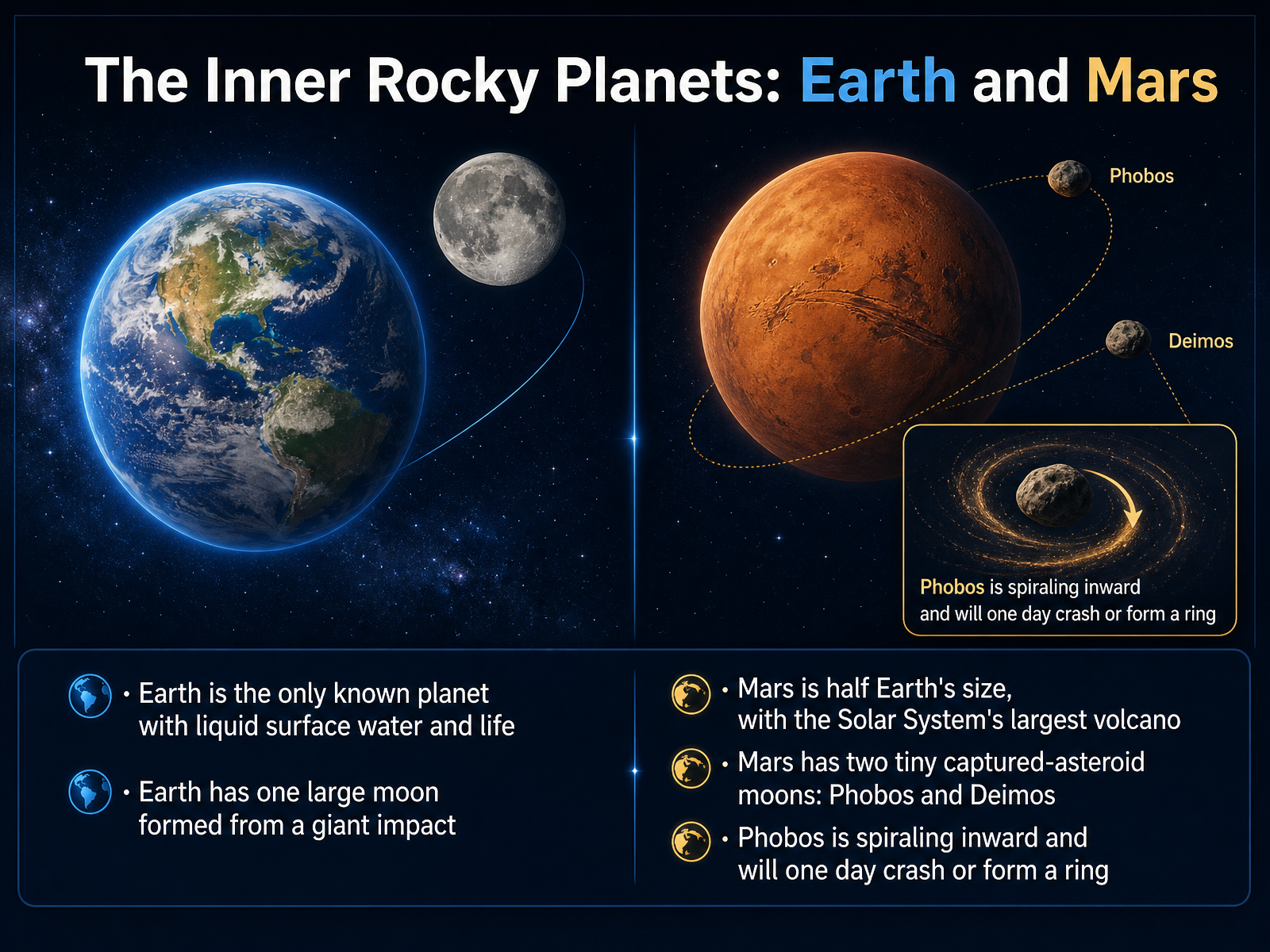
 - 07The Inner Rocky Planets: Earth and MarsNow, let's zoom in on the inner rocky worlds—specifically, Earth and Mars. Earth, our home, is the only planet we know of with liquid water on its surface and, remarkably, life. It has one large moon, born from a giant impact billions of years ago. Think of the moon as Earth's faithful companion. Next, Mars. It's about half the size of Earth, a dusty red world that boasts the Solar System's largest volcano, Olympus Mons. But what about their moons? Well, Mars has two tiny moons, Phobos and Deimos. They are not large, round moons like ours. They are likely captured asteroids, small and irregular. These two have very different futures. Deimos is slowly drifting outward, but Phobos is spiraling inward. In about fifty million years, it will either crash into Mars or be torn apart by gravity to form a ring of dust around the planet. Now, let's venture farther out to the realm of the giants. Next up: The Outer Giants, Jupiter and Saturn.
 ssd.jpl.nasa.govscience.nasa.govscience.nasa.gov+22 min
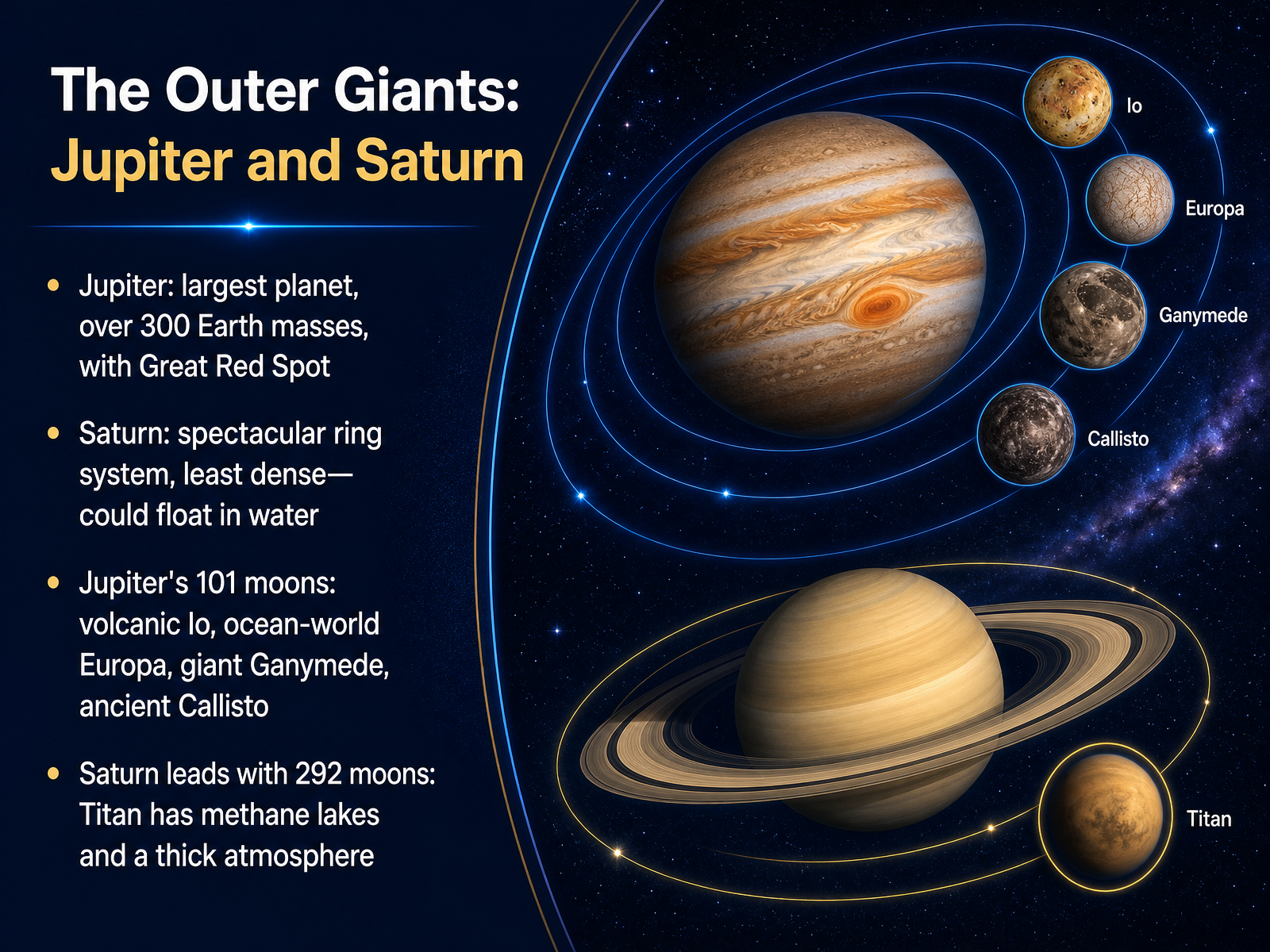
 - 08The Outer Giants: Jupiter and SaturnNow let's journey farther out to meet the outer giants, starting with Jupiter and Saturn. Jupiter is the largest planet in our solar system. It has more than three hundred times the mass of Earth. One of its most famous features is the Great Red Spot, a storm that has been raging for centuries. Saturn is the next giant, known for its spectacular ring system. It is also the least dense planet. In fact, Saturn is so light that it could float in water, if you could find a pool big enough. Both planets are like miniature solar systems because of their many moons. Jupiter has over one hundred known moons. Four of them are truly special. There is volcanic Io, the most volcanically active body we know of. There is ocean-world Europa, with a salty sea hidden under its icy crust. There is giant Ganymede, the largest moon in the entire solar system, even bigger than the planet Mercury. And there is ancient Callisto, a heavily cratered world with one of the oldest surfaces. Saturn currently leads the moon count with nearly three hundred confirmed moons. Its largest moon is Titan, which is bigger than Mercury. Titan is the only moon with a thick atmosphere and lakes of liquid methane on its surface. Now, let's move even farther from the sun to explore the other outer giants, Uranus and Neptune.
 science.nasa.gov2 min
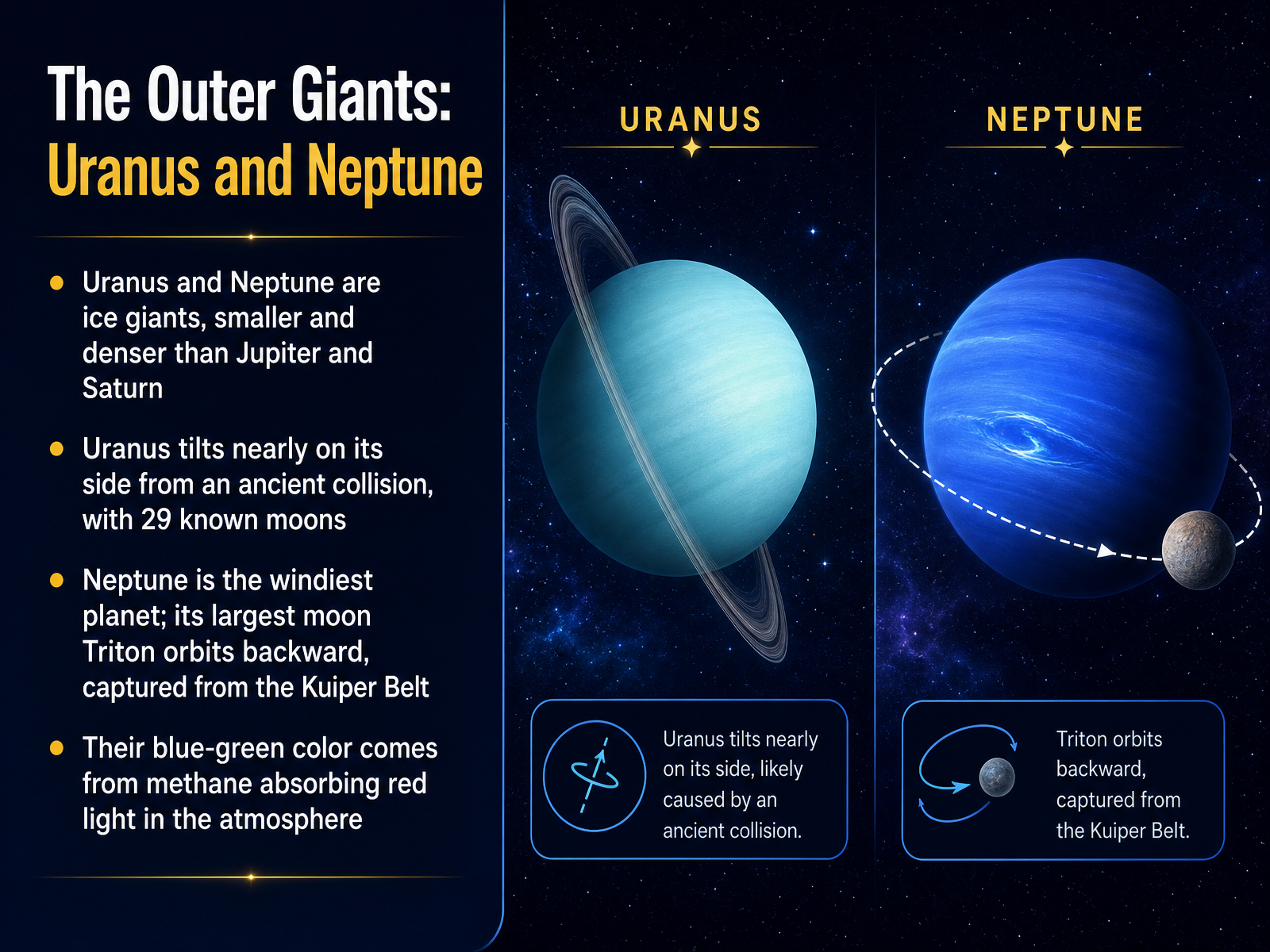
 - 09The Outer Giants: Uranus and NeptuneNow we visit the solar system's outer giants: Uranus and Neptune. These two are called ice giants. They are smaller and denser than the gas giants, Jupiter and Saturn. Uranus is a very odd planet. It tilts nearly on its side, likely because of a massive ancient collision. It has at least 29 known moons. Neptune is the windiest planet in our solar system. Its largest moon, Triton, orbits backward. This retrograde orbit tells us Triton was captured, perhaps from the distant Kuiper Belt. Both planets share a beautiful blue-green color. This comes from methane gas in their atmospheres, which absorbs red light. Next, let's explore these fascinating moons as worlds of their own.
 science.nasa.gov1 min
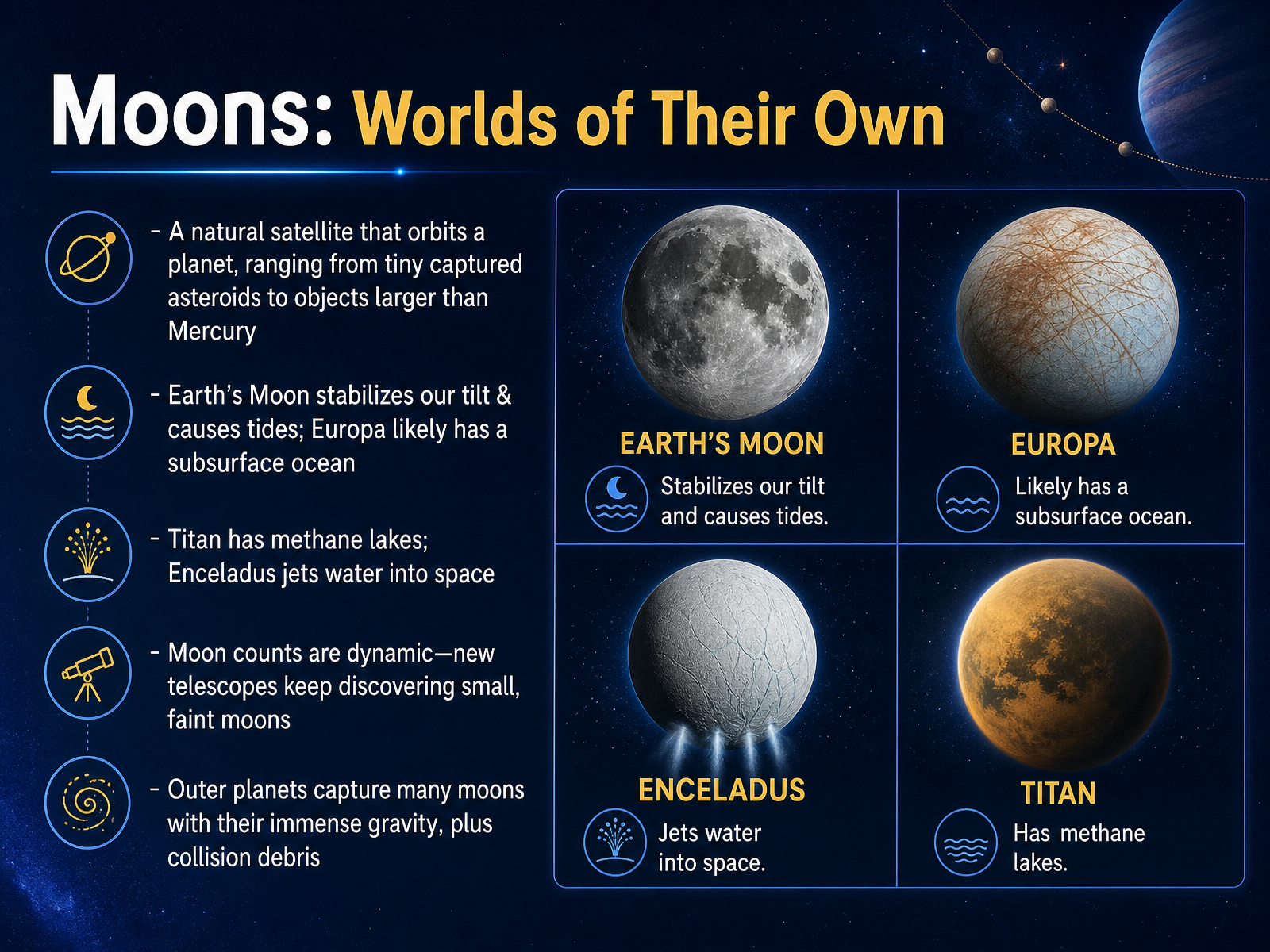
 - 10Moons: Worlds of Their OwnLet’s turn our attention now to moons — worlds of their own. A moon is a natural satellite that orbits a planet. They come in every size imaginable, from tiny captured asteroids only a few kilometers wide, all the way up to Ganymede. That’s Jupiter’s largest moon, and it’s actually bigger than the planet Mercury. Our own Moon is unusually large for a planet Earth’s size. Its gravity does more than light up the night sky — it stabilizes our planet’s tilt and creates the ocean tides we experience every day. Some moons hide incredible secrets. Europa, orbiting Jupiter, likely has a global saltwater ocean beneath its icy crust. Saturn’s moon Titan has vast lakes of liquid methane, and its moon Enceladus sprays jets of water vapor straight into space. The number of moons we know about is always changing. New telescopes keep discovering small, faint moons, especially around the outer planets. Those immense planets capture objects with their powerful gravity and even build new moons from collision debris. So a moon isn’t just a follower — it’s a dynamic world with its own story. Next, we’ll explore how orbits work — the balance of speed, distance, and time that keeps everything in motion.
 ssd.jpl.nasa.gov2 min
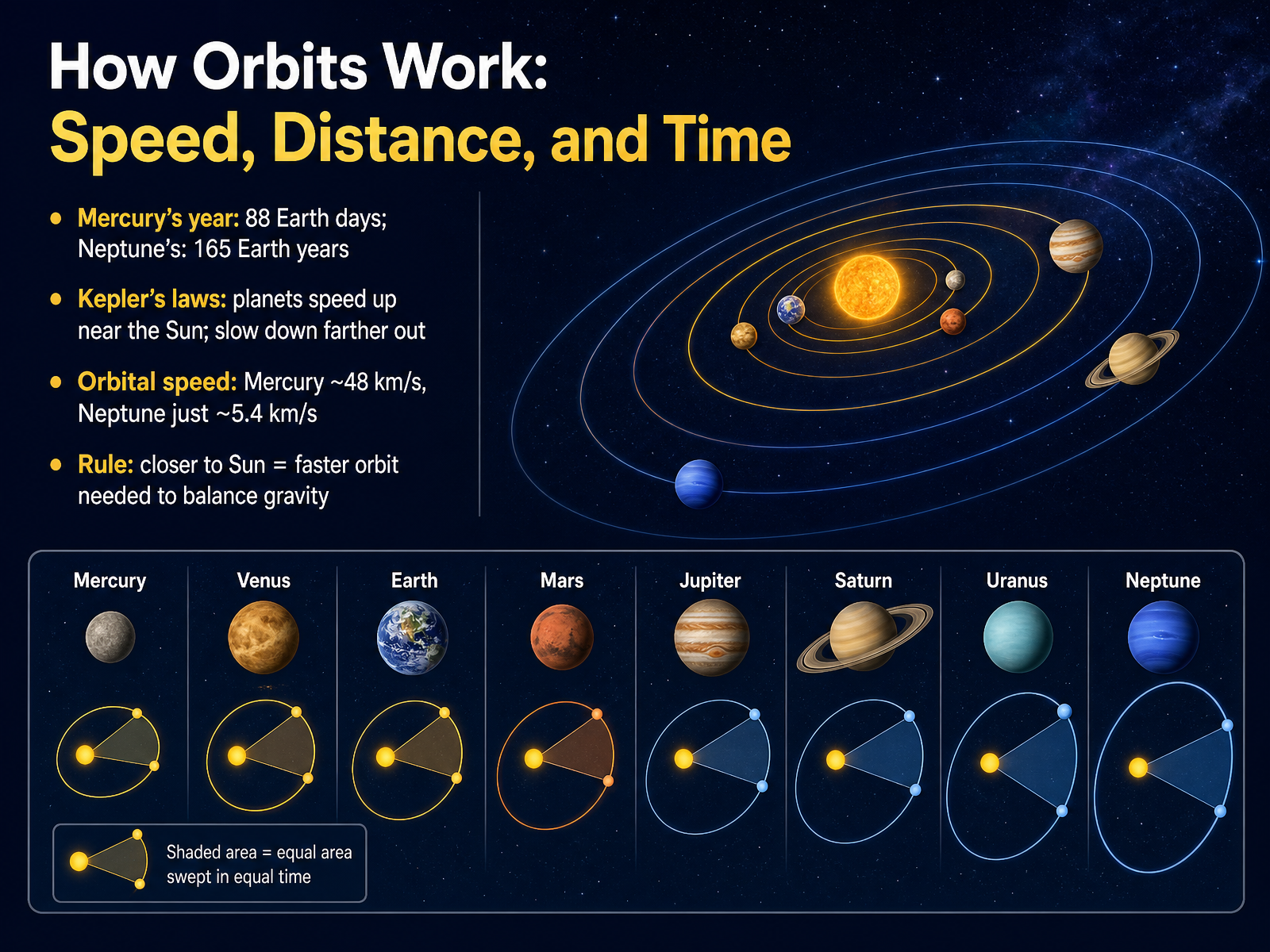
 - 11How Orbits Work: Speed, Distance, and TimeNow let's see how speed and distance shape a planet's year. Think of the sun's gravity as an invisible string. The closer a planet is, the faster it must move to keep from being pulled in. Mercury speeds along at nearly forty-eight kilometers per second. That's why its year is just eighty-eight Earth days. By contrast, distant Neptune drifts at only about five point four kilometers per second. Its slow, wide orbit stretches to one hundred sixty-five Earth years. We can thank Johannes Kepler for explaining this dance. His laws show that planets speed up when they swing closer to the sun and slow down farther out. The simple rule is: closer to the sun means a faster orbit to balance gravity. Up next, we'll explore the nested orbits of smaller worlds, including the asteroid belt, the Kuiper Belt, and beyond.
 1 min
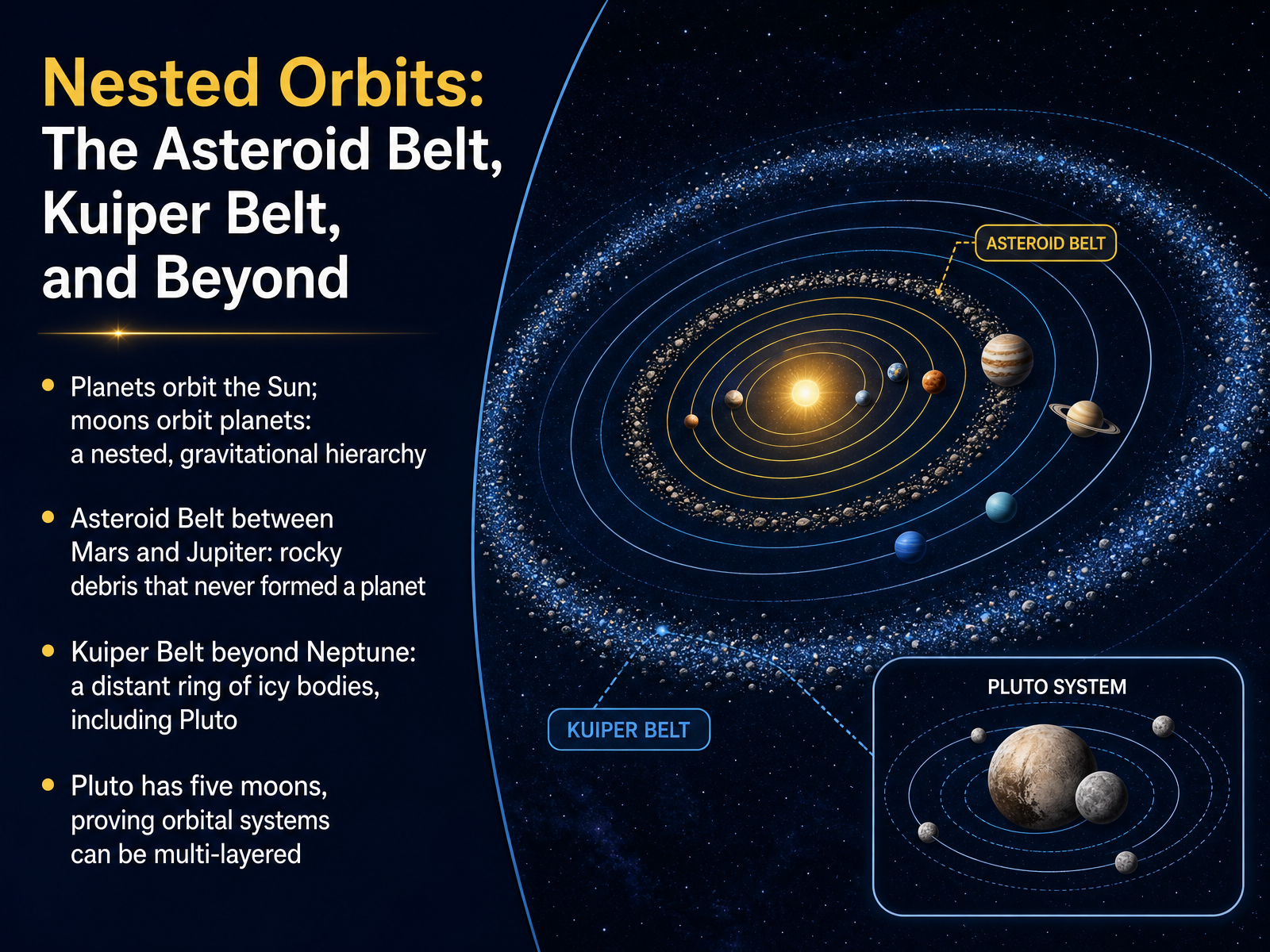
1 min - 12Nested Orbits: The Asteroid Belt, Kuiper Belt, and BeyondLet's zoom out now, beyond the neat orbits of the eight planets. The solar system isn't just a set of isolated paths—it’s more like a set of nested rings, all held in place by gravity. The sun’s gravity keeps the planets in orbit. The planets, in turn, keep their moons in orbit. It’s a gravitational hierarchy, one layer inside another.
Now, look at the space between Mars and Jupiter. Here, we find the asteroid belt—a wide ring of rocky debris. Think of these as leftover building blocks. They’re bits of the early solar system that never managed to come together to form another planet, partly because Jupiter’s powerful gravity kept stirring things up.
Then, far out beyond Neptune, there’s another, much colder ring called the Kuiper Belt. This region is filled with icy bodies. The most famous of these is Pluto. And here’s something truly wonderful: even though Pluto is a dwarf planet, smaller than our own moon, it has five moons of its own. One of them, Charon, is so large it actually makes Pluto wobble. This proves that orbital systems can be wonderfully multi-layered.
Now, let's bring this idea of orbits back home to Earth and explore something we all experience: seasons, tides, and eclipses—orbits in everyday life.
 science.nasa.govscience.nasa.govsolarsystem.nasa.gov+22 min
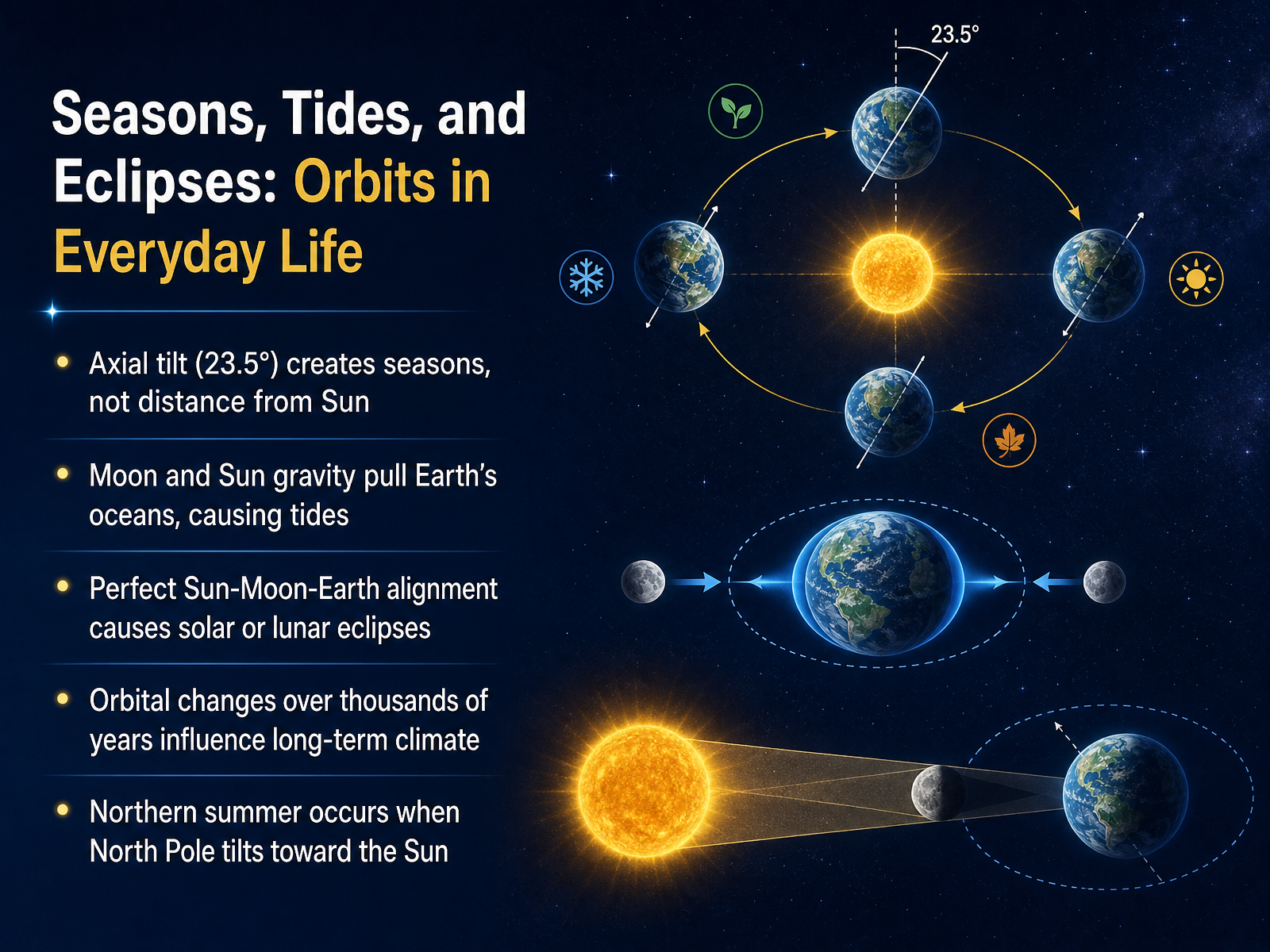
 - 13Seasons, Tides, and Eclipses: Orbits in Everyday LifeNow let's bring orbits right into our everyday lives—through seasons, tides, and eclipses. Many people think seasons happen because Earth gets closer to or farther from the Sun. But that's not the case. Seasons are actually caused by Earth's twenty-three-and-a-half-degree axial tilt. As Earth orbits the Sun, this tilt means different parts of the planet receive more direct sunlight at different times. When the North Pole tilts toward the Sun, it's summer in the Northern Hemisphere—not because we're closer, but because the sunlight is more concentrated. Next, think about tides. The Moon's gravity, and to a lesser extent the Sun's, pulls on Earth's oceans, creating a rhythmic rise and fall we see at the shore every day. When the Sun, Moon, and Earth line up perfectly in space, that's when we get eclipses—either solar or lunar, depending on the order. Over thousands of years, tiny shifts in Earth's orbit and tilt even influence long-term climate patterns. Orbits aren't just distant paths in the sky; they shape the world you experience right now. Speaking of how orbits shape our world, let's look at a very direct use of these principles: satellites and space exploration.
 2 min
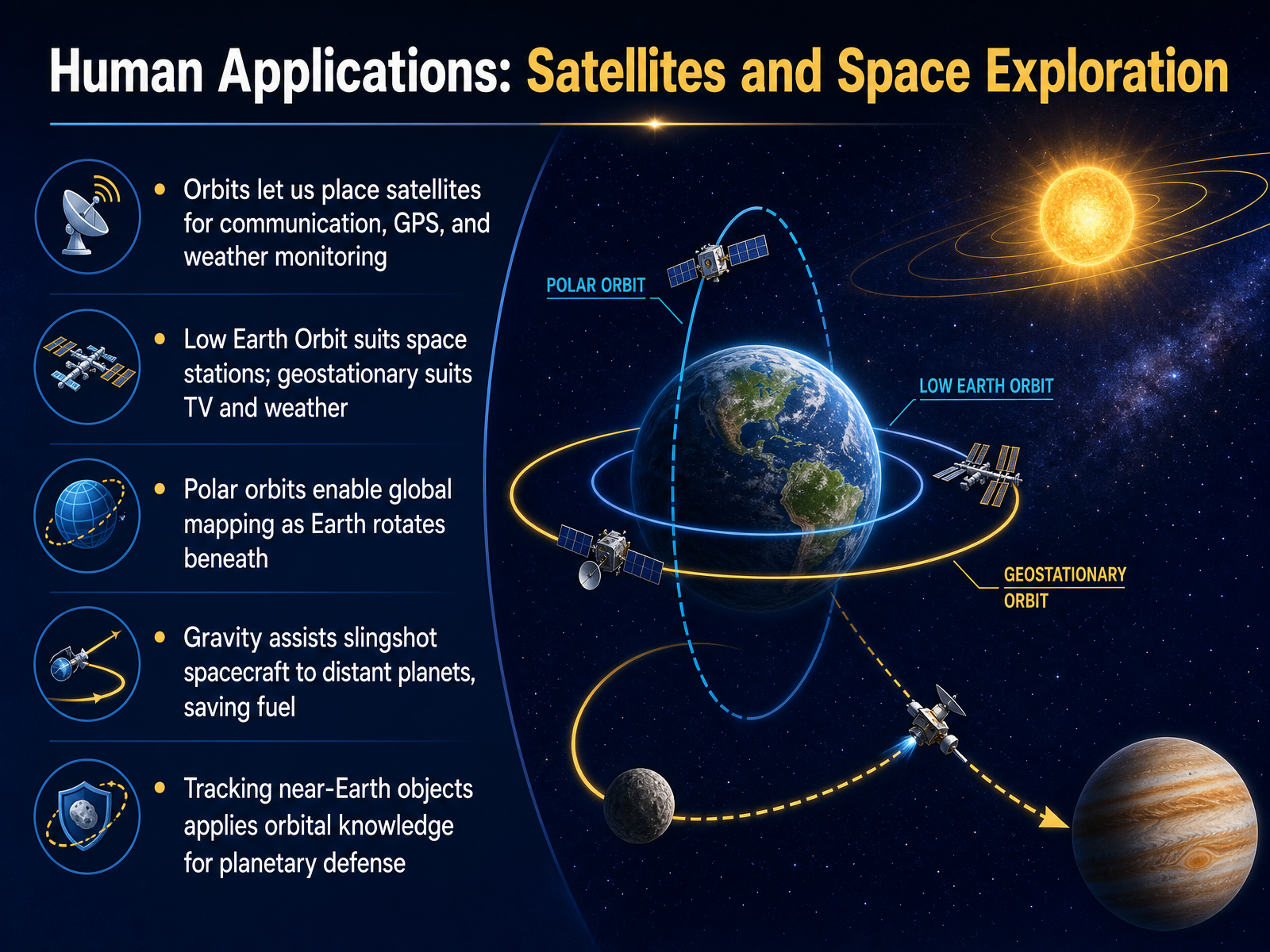
2 min - 14Human Applications: Satellites and Space ExplorationNow, we turn our attention to how we use our knowledge of orbits here on Earth. Imagine a carefully placed dance partner, always circling exactly where we need them. That describes our artificial satellites. By placing a satellite in a specific orbit, we can use it for crucial tasks like global communications, GPS navigation, and monitoring our planet’s weather. For instance, the International Space Station resides in what we call Low Earth Orbit, which is great for close-up observation. But a television broadcast satellite needs a fixed position in the sky, so we place it much higher, in a geostationary orbit, where it matches Earth’s rotation. Other satellites sweep over the poles in a polar orbit, allowing them to map the entire globe as Earth rotates beneath them, line by line. Our understanding of gravity also lets spacecraft borrow a planet’s momentum, like a slingshot, to reach the outer solar system while saving precious fuel. Finally, we apply this same orbital knowledge to track near-Earth objects, serving as a crucial early warning system for planetary defense. Next, we’ll bring all these ideas together in one connected system.
 science.nasa.govspark.iop.orgjpl.nasa.gov+22 min
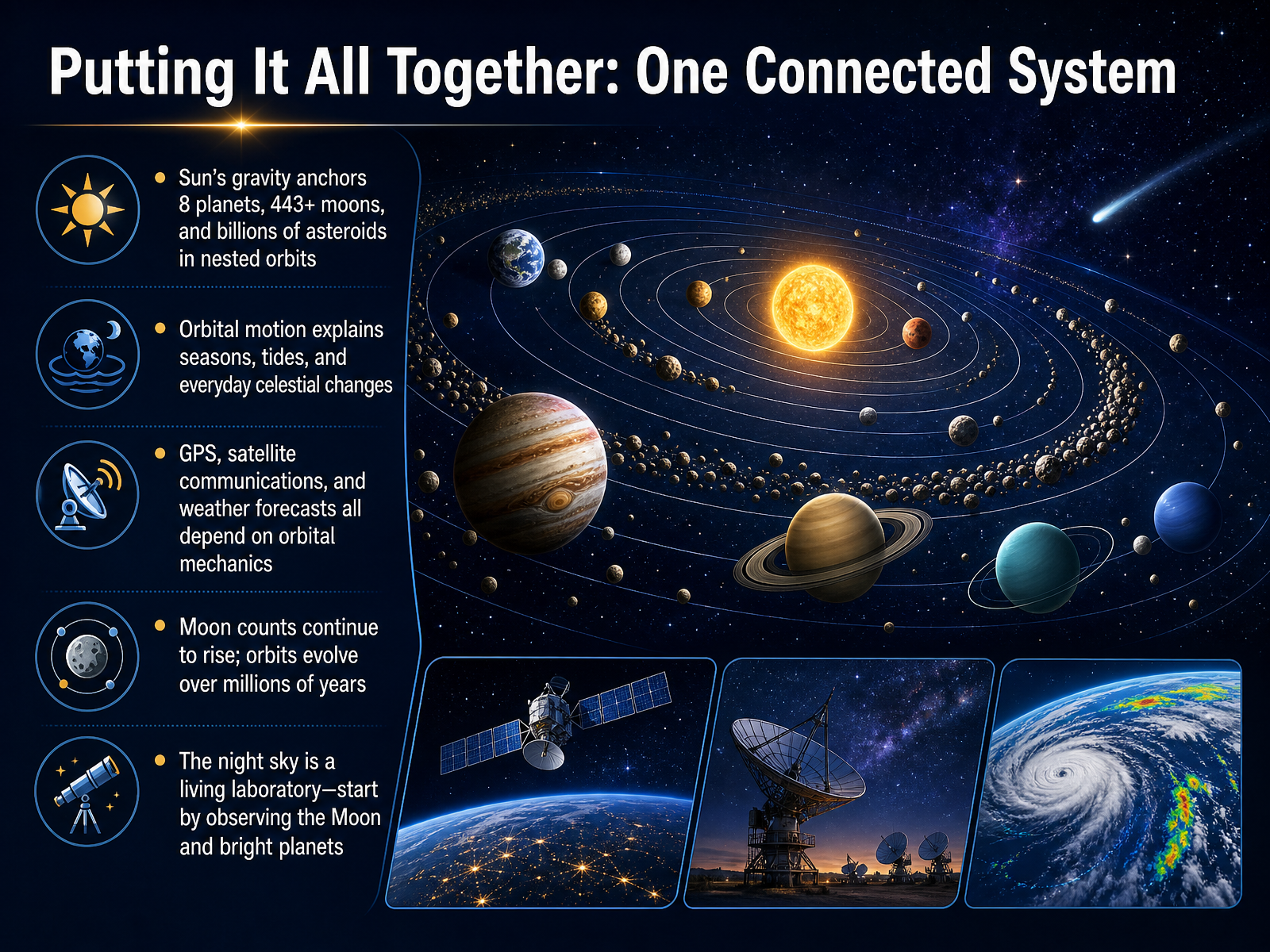
 - 15Putting It All Together: One Connected SystemNow let's step back and see how everything works together as one connected system. The Sun's gravity is the anchor, holding eight planets, over four hundred forty-three moons, and billions of asteroids in nested, predictable orbits. It's like a giant cosmic clockwork. This orbital motion shapes our everyday world. Earth's tilted axis and its path around the Sun give us seasons. The Moon's orbit pulls on our oceans, creating tides. Even the technology we rely on—like GPS, satellite communications, and weather forecasts—is built on precise orbital mechanics. And this system is still changing. Moon counts continue to rise as we discover more, and orbits slowly evolve over millions of years. So, the night sky is a living laboratory for you. Start simply: observe the Moon and bright planets. With what you've learned here, you'll see them as part of one grand, connected system. Next, let's look at resources and next steps in 'Keep Exploring'.
 science.nasa.govscience.nasa.govsolarsystem.nasa.gov+22 min
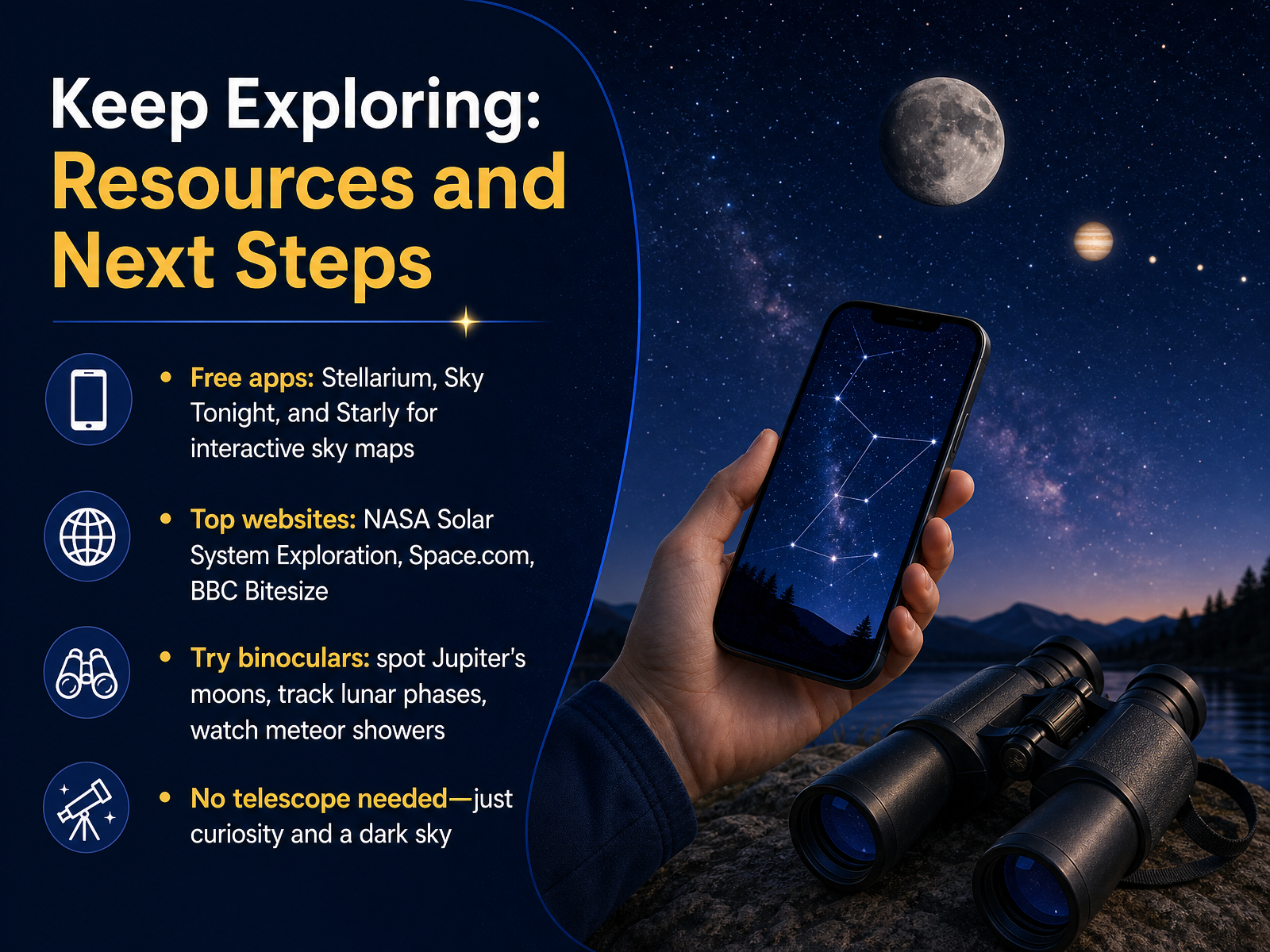
 - 16Keep Exploring: Resources and Next StepsAnd that brings us to the end of our cosmic tour. But your journey doesn’t stop here—it’s only the beginning. To keep exploring, try free apps like Stellarium and Sky Tonight. They turn your phone into an interactive map of the real sky above you. Websites like NASA’s Solar System Exploration and Space.com are treasure chests of images and discoveries. You don’t need any expensive equipment. A simple pair of binoculars can reveal Jupiter’s moons and details on the lunar surface. What you really need is just your curiosity and a dark sky. So step outside, look up, and let your exploration begin. Thank you for joining me.
 1 min
1 min
Take the deck with you
Download this course as a file — free, no sign-up needed.
- PDF handoutEvery slide page, ready to print or share.17 pages · 5.5 MBDownload
- Narrated PowerPointThe deck that presents itself — every slide carries the digital human's narration video.17 pages · 27.9 MBDownload
- PowerPoint slidesThe full deck as a .pptx — open it in PowerPoint, Keynote, or Google Slides.17 pages · 5.5 MBDownload
Free to use in your own training — please keep the PersonWise credit page at the end.
Have your own deck? Turn it into a course
Sources consulted
Web sources consulted while building this course.
- Solar System: Facts — science.nasa.gov
- Solar System Exploration — science.nasa.gov
- In Depth | Our Solar System – NASA Solar System Exploration — solarsystem.nasa.gov
- Solar system | Definition, Planets, Diagram, Videos, & Facts | Britannica — britannica.com
- What does the Solar System consist of? - BBC Bitesize — bbc.co.uk
- Chapter 3: Gravity & Mechanics - NASA Science — science.nasa.gov
- How do things stay in orbit? — spark.iop.org
- Modeling the Orbits of Planets – Science Lesson — jpl.nasa.gov
- Physics Tutorial - Circular and Satellite Motion - Satellite Motion - Circular Motion Principles for Satellites — physicsclassroom.com
- 3 Orbits and gravity — open.edu
- About the Planets — science.nasa.gov
- Planet Sizes and Locations in Our Solar System — science.nasa.gov
- The Inner and Outer Planets in Our Solar System — universetoday.com
- Solar system guide - Discover the order of planets and other amazing facts — space.com
- Solar System — en.wikipedia.org
- Our Sun: Facts — science.nasa.gov
- Chapter 1: The Solar System - NASA Science — science.nasa.gov
- Sun — en.wikipedia.org
- The Sun — nhm.ac.uk
- Planetary Physical Parameters — ssd.jpl.nasa.gov