Begin
16 pages · ~32 min
Introduction to Machine Learning
This training introduces machine learning concepts and applications for beginners seeking foundational knowledge in data-driven model development.
A digital instructor presents all 16 pages. Hold “Ask” at any point and ask out loud — the answer comes from this course. No sign-up needed.
What you’ll learn
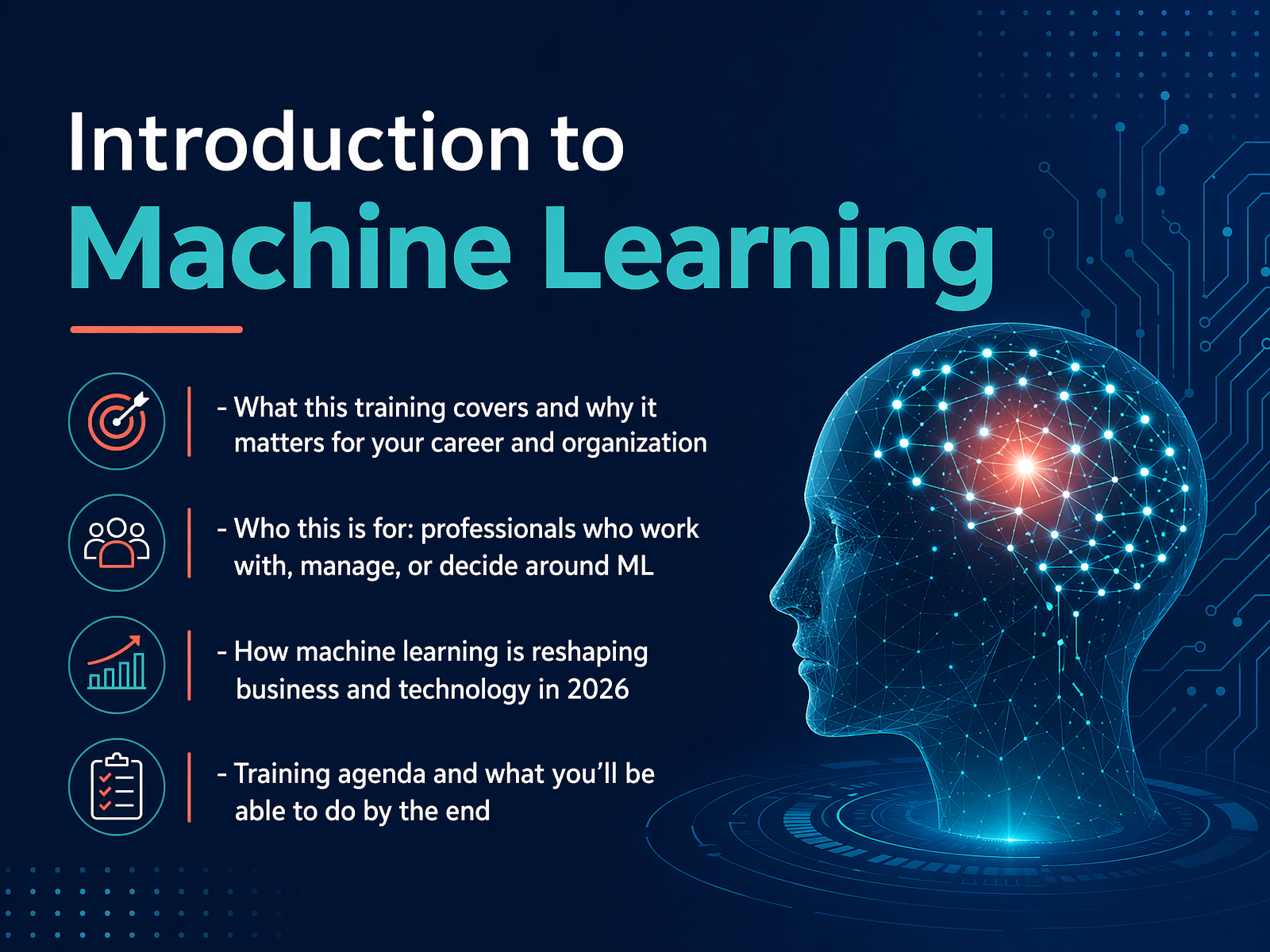
- 01Introduction to Machine LearningWelcome. I'm glad you're here. This course is your introduction to machine learning, designed to give you a clear, practical understanding of what ML really is and why it matters right now for your career and your organization. You might work directly with data, manage teams that use ML, or make decisions about where to invest. Wherever you sit, you'll leave here able to speak the language, ask smarter questions, and spot real opportunities. Consider this: by twenty twenty-six, nearly four out of five large companies have at least one AI workload in production. But only about one in three have scaled it enterprise-wide. That gap between adoption and real transformation is exactly where skilled professionals become invaluable. Across these sessions, we'll explore how machine learning reshapes business and technology today, walk through the core concepts, and connect them to real-world use cases. By the end, you'll be ready to map ML to your own challenges and communicate its value clearly. Let's get started by looking at the state of ML in the enterprise.deloitte.comassets.kpmg.comprosigns.io+22 min
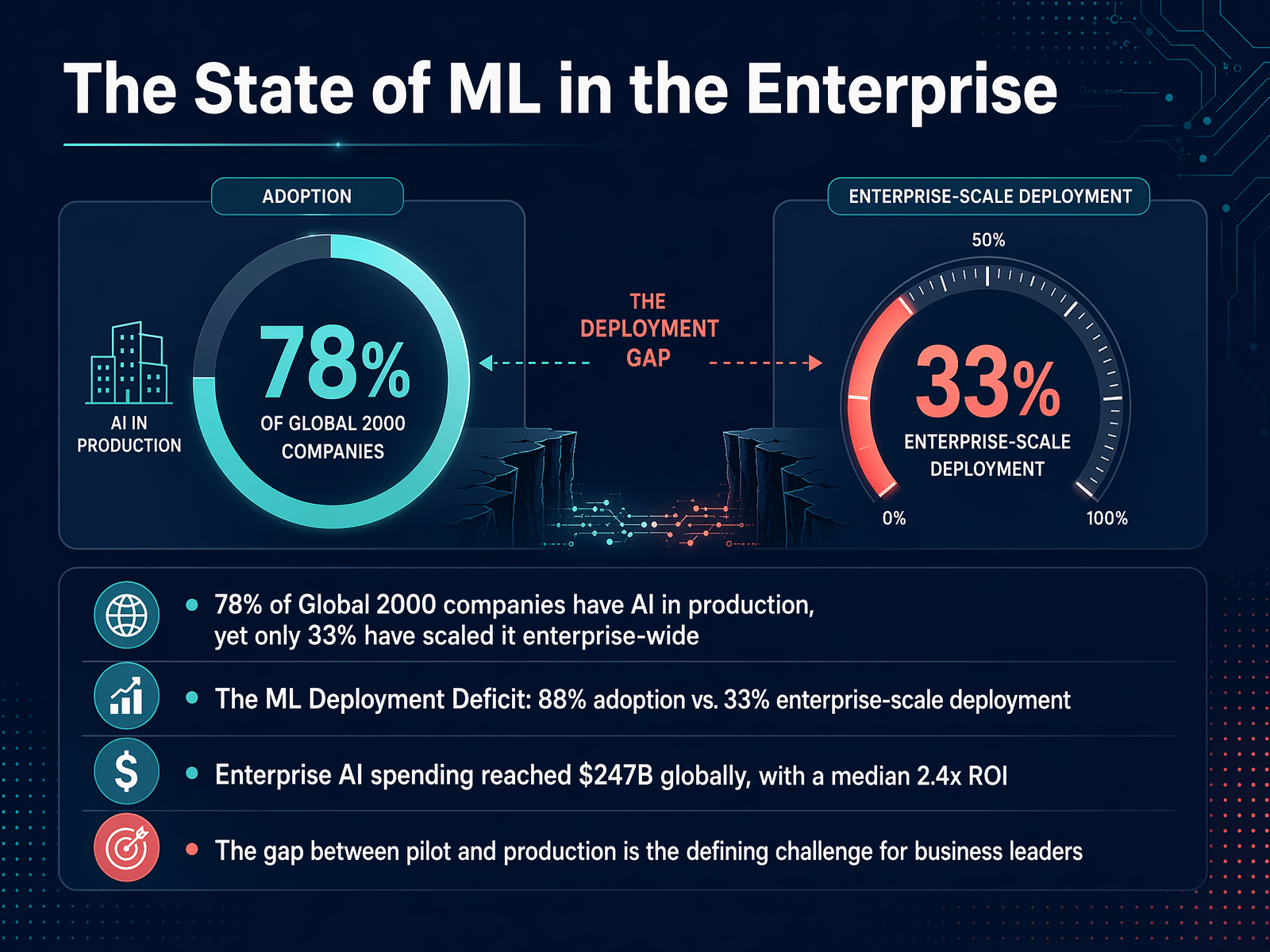
- 02The State of ML in the EnterpriseLet's look at where machine learning stands in the enterprise today. The numbers tell a fascinating story. 78 percent of Global 2000 companies now have AI workloads in production. That’s nearly double the figure from just two years ago. Yet here’s the twist: only about one third of organizations have scaled AI across the entire enterprise. This gap is so significant that analysts have a name for it—the ML Deployment Deficit. It means for every company that has scaled machine learning enterprise-wide, almost three others are still stuck in pilot mode. Global spending on enterprise AI has reached an estimated 247 billion dollars, and the median company reports a return of 2.4 times its investment. But the defining challenge for business leaders isn’t whether to adopt machine learning. It’s how to move from isolated experiments to production at scale. That’s exactly what we’ll explore. Next, let’s ground ourselves in the fundamentals. What is machine learning?
 deloitte.comassets.kpmg.comprosigns.io+21 min
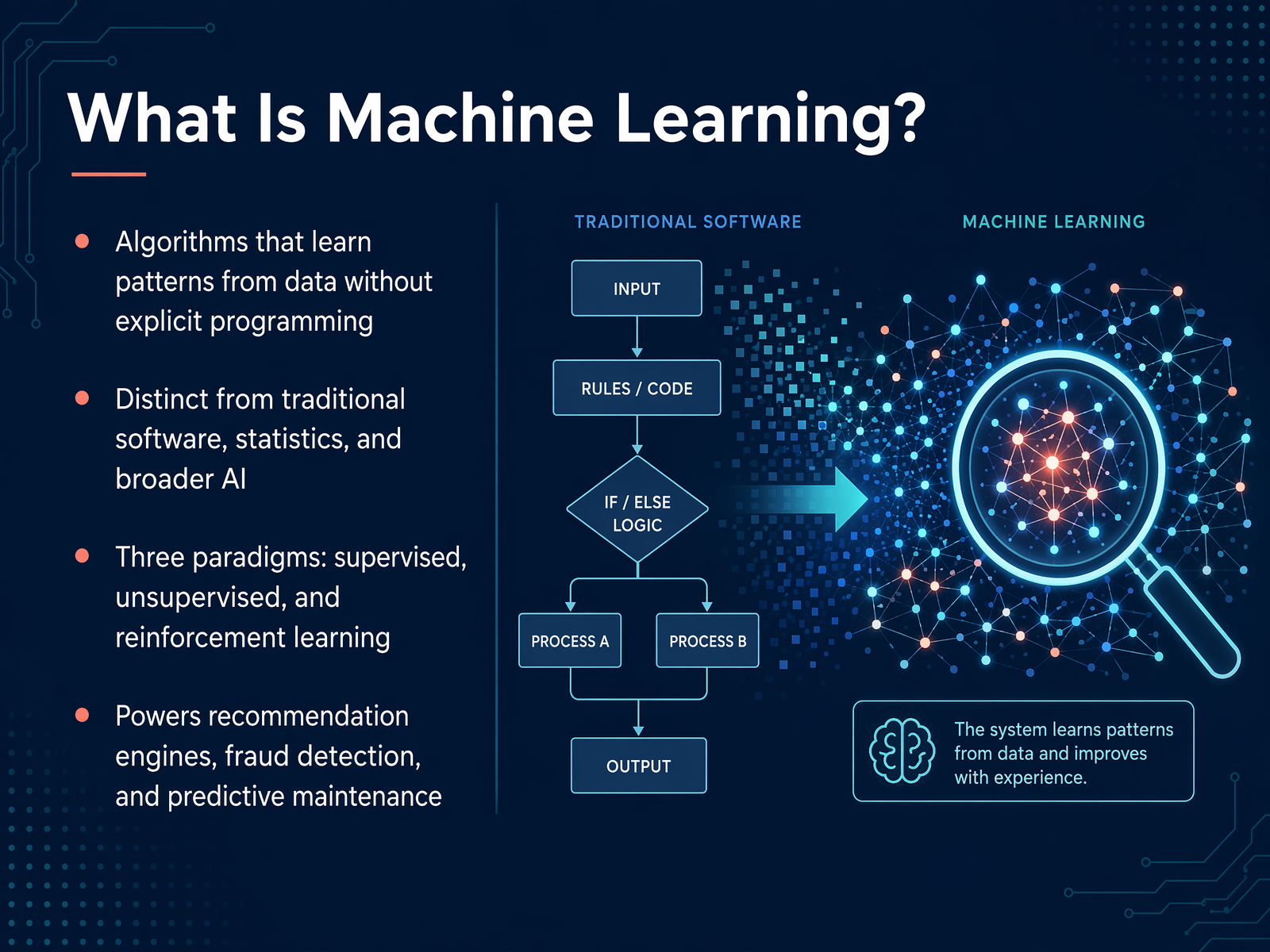
 - 03What Is Machine Learning?Now, let's unpack the definition itself. Machine learning is a field of study where we give algorithms the ability to learn patterns from data, without needing to program explicit rules for every single scenario. Think of it this way: traditional software is like a precise recipe—you spell out every step. Machine learning, on the other hand, is more like a chef who tastes and adjusts the dish based on experience. It's not just traditional statistics, even though it uses statistical methods; its primary goal is to make predictions and decisions at scale. And it's a specific, powerful subset of the broader field of Artificial Intelligence. We typically group these learning approaches into three core paradigms. First, supervised learning, where we teach the model with labeled examples, like showing a student flashcards with the answers on the back. Second, unsupervised learning, where the model finds hidden structures in unlabeled data on its own—think of organizing a library without a catalog. And third, reinforcement learning, where an agent learns through trial and error, receiving rewards for good actions, much like training a pet. This is exactly what powers the technology you interact with every day, from the recommendation engines that suggest your next movie, to fraud detection systems that protect your credit card, to predictive maintenance that keeps factory machinery running smoothly. Let's take this understanding and see how these concepts come together in a practical, step-by-step process, which we'll explore next in the machine learning workflow.
 2 min
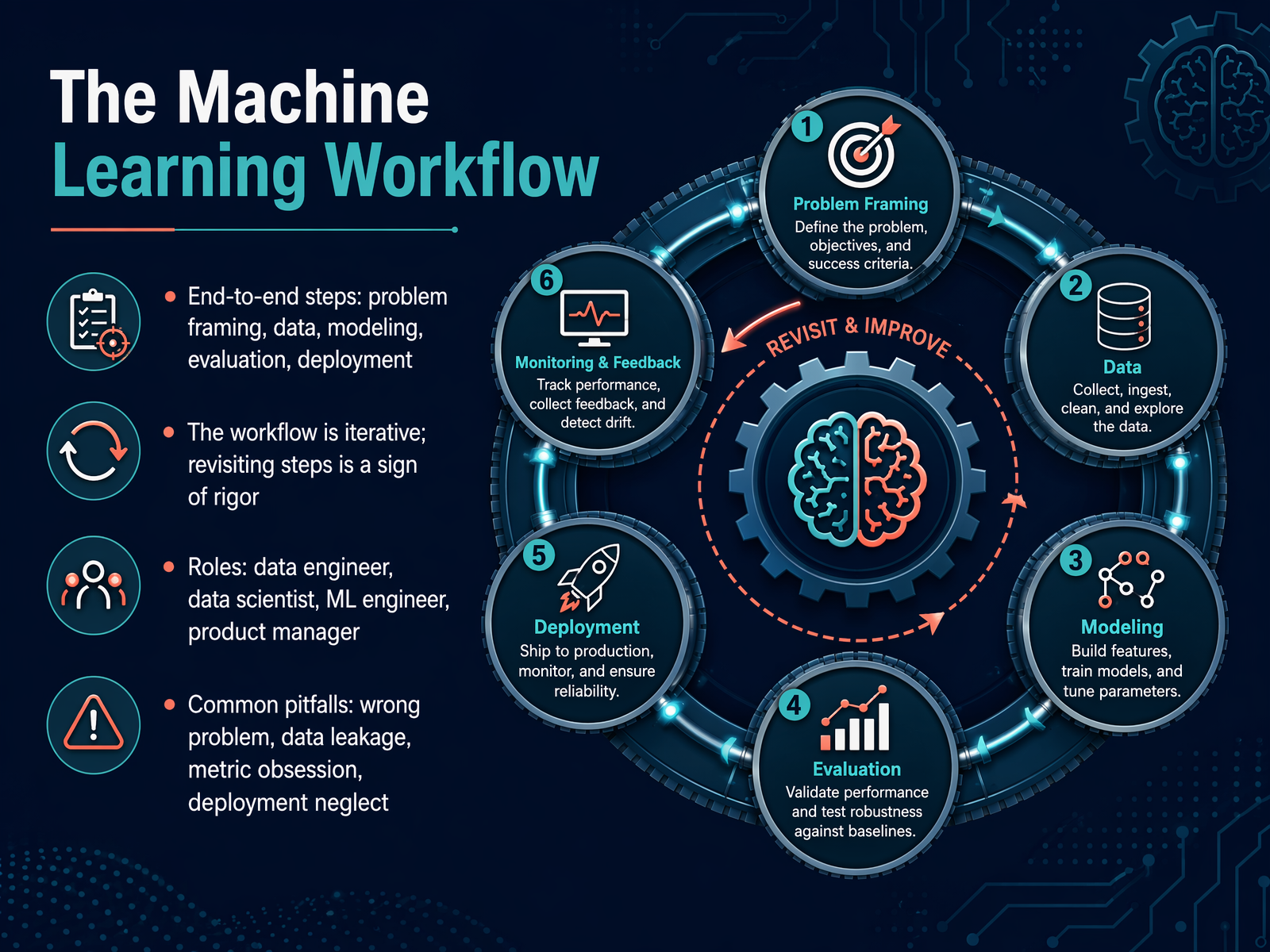
2 min - 04The Machine Learning WorkflowNow, let's walk through the machine learning workflow. Think of this as the step-by-step process that takes you from an initial idea all the way to a live, working system. It starts with problem framing, where you define exactly what you're trying to solve. Next is data, the fuel for the whole process. Then comes modeling, where you train an algorithm to find patterns in that data. After that, you evaluate the model's performance, and finally, you deploy it into the real world. A key thing to remember is that this workflow is highly iterative. Moving back to a previous step, like revisiting your data after a poor evaluation, is not a failure; it's a sign of rigorous, thoughtful work. To make all this happen, you need a team. A data engineer builds the data pipelines, a data scientist experiments and designs the models, an ML engineer hardens them for production, and a product manager ensures the solution actually solves the business problem. Watch out for a few common pitfalls. Solving the wrong problem is a waste of time. Data leakage, where your model accidentally sees the test data during training, creates false confidence. And don't become obsessed with a single metric; a great model on paper is useless if deployment is neglected. Coming up, we'll dive deep into the first and most critical step in this workflow: data, the foundation of machine learning.
 2 min
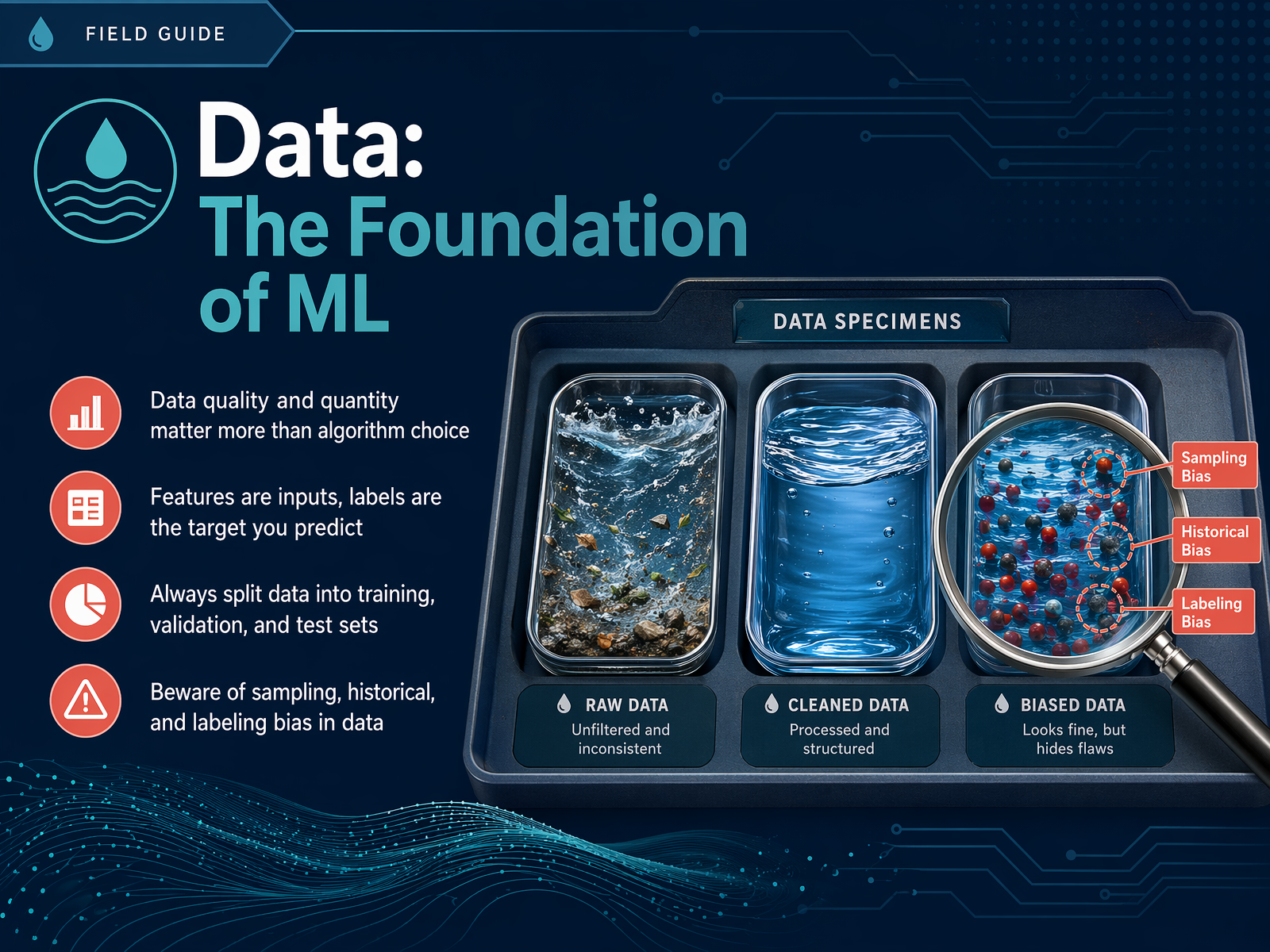
2 min - 05Data: The Foundation of MLNow let's talk about the real raw material of machine learning: data. You'll often hear that data is the foundation of ML, and that's absolutely true. In fact, the quality and quantity of your data will almost always matter more than which fancy algorithm you choose. Think of it this way: you can't build a solid house on a shaky foundation. In machine learning, we call the inputs to our model 'features,' and the thing we're trying to predict is called the 'label' or 'target.' For example, if you're predicting house prices, the features might be square footage, number of bedrooms, and location, while the label is the actual sale price. A critical habit to develop is to always split your data into three distinct buckets: a training set to teach the model, a validation set to tune it, and a test set to get an honest final score of its performance. Never test on the data you trained on. Finally, you have to be a detective with your data. Beware of biases. Sampling bias means your data doesn't reflect the real world. Historical bias means your data reflects past prejudices. And labeling bias creeps in when the humans tagging the data make consistent errors. Clean, fair data is the first step to a trustworthy model. Next, we'll build on this foundation and explore the key algorithm families that learn from this data.
 2 min
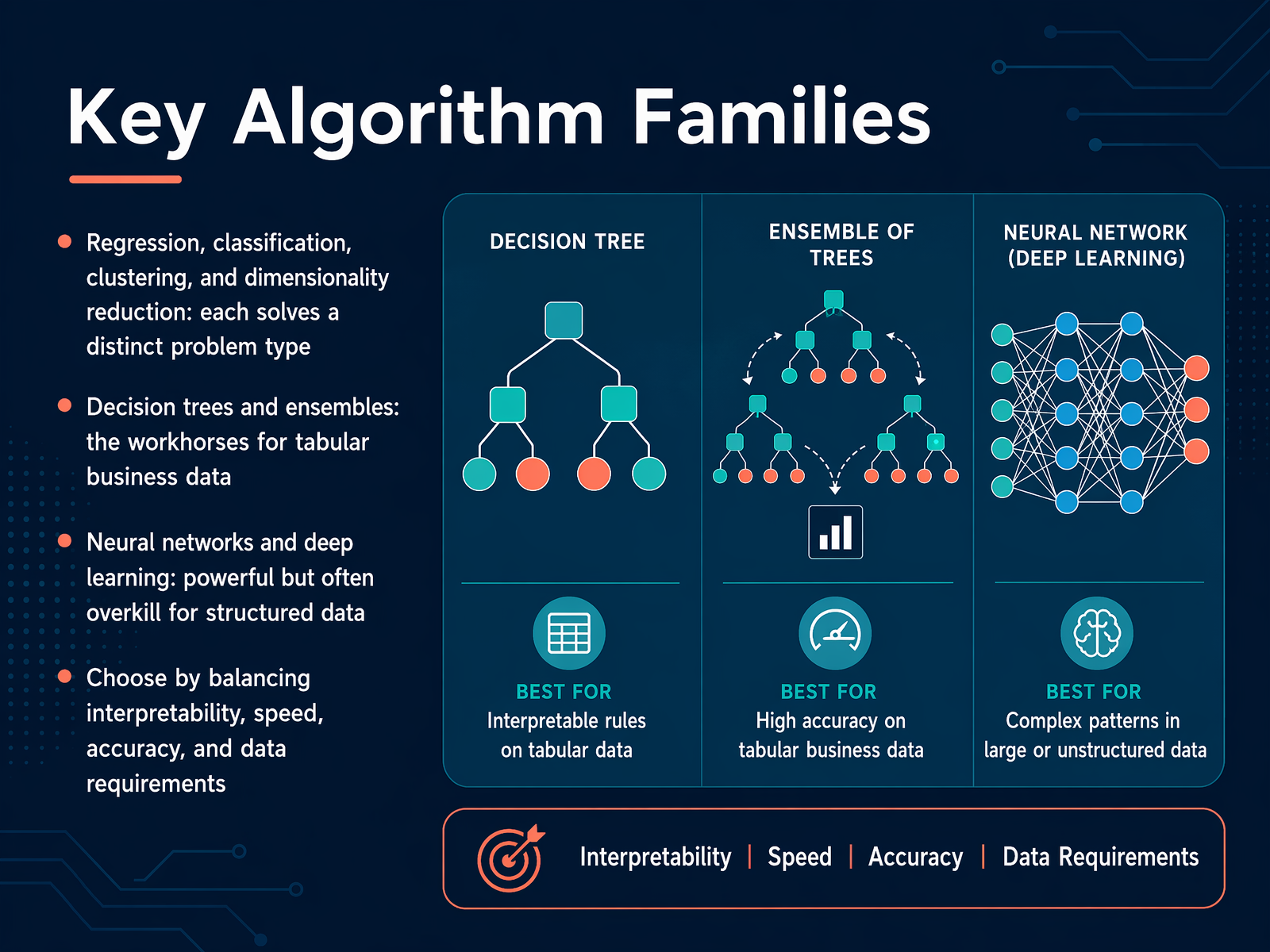
2 min - 06Key Algorithm FamiliesLet's look at the main families of machine learning algorithms. Think of them as distinct tools, each designed for a specific job. First, we have regression for predicting continuous numbers, classification for sorting things into categories, clustering for finding natural groupings without labels, and dimensionality reduction for simplifying complex data. Next, decision trees and ensemble methods, like random forests, are the workhorses for structured business data, like spreadsheets. They are fast and easy to interpret. Neural networks and deep learning, on the other hand, are incredibly powerful for images and language, but they are often overkill for a simple table of numbers. The key is choosing the right tool by balancing four things: how easy it is to explain the model, how fast it needs to run, how accurate it must be, and how much data you have. Next, we'll move on to model evaluation in plain terms, so you can know if your model is actually any good.
 1 min
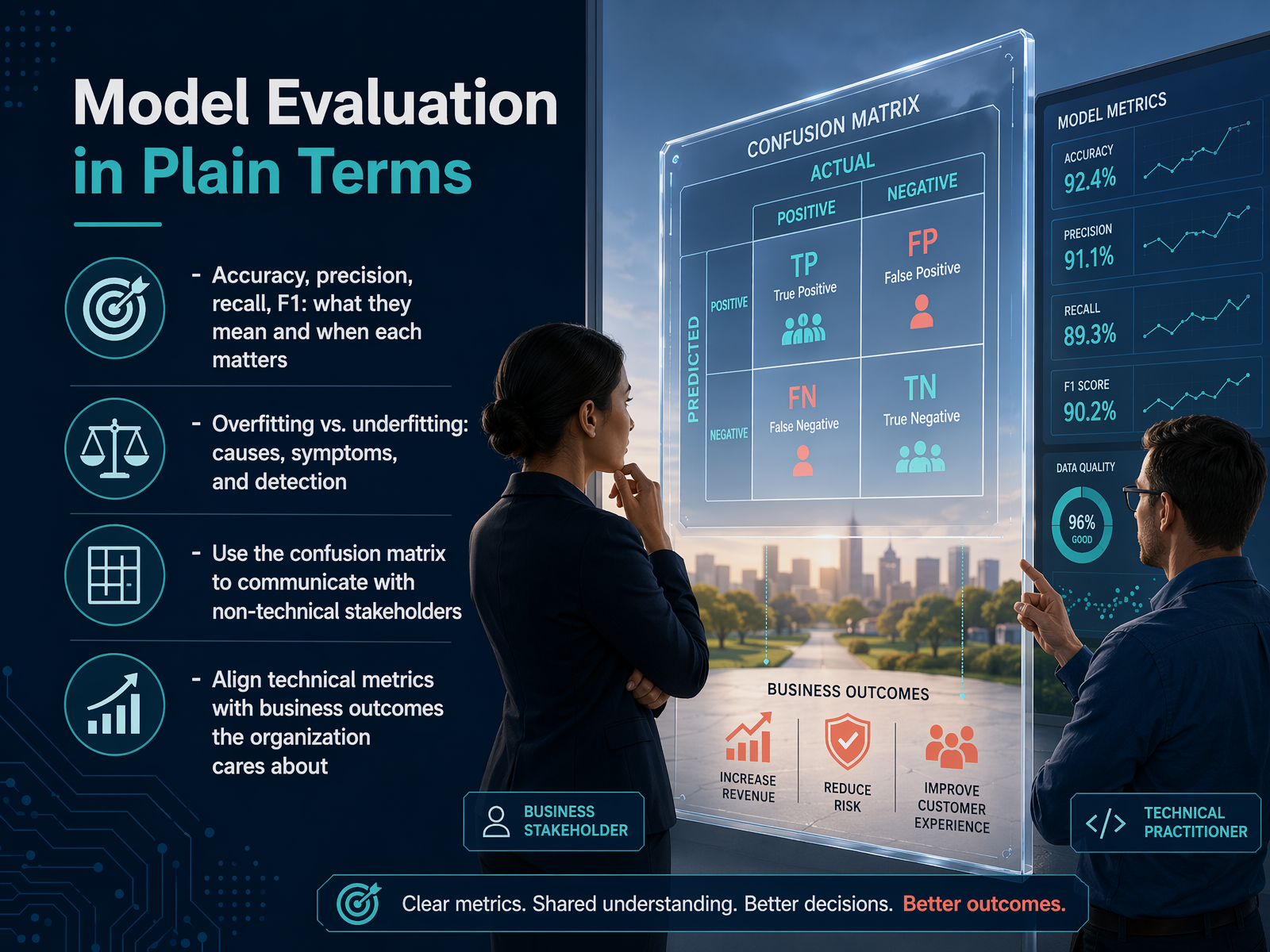
1 min - 07Model Evaluation in Plain TermsNow, let's talk about how we actually know if a machine learning model is any good. This is called model evaluation, and it's much simpler than it sounds. We'll focus on a few key terms that describe different types of success. Accuracy tells you the overall percentage of correct predictions. But if you're looking for a rare event, like fraud, accuracy alone can be misleading. That's where precision and recall come in. Precision means, when the model says something is fraud, how often is it right? Recall means, out of all the actual fraud cases, how many did the model catch? The F1 score balances those two. A common trap is overfitting, where the model just memorizes the training data and fails on new data. The opposite is underfitting, where it hasn't learned the patterns at all. To explain this to non-technical colleagues, I always use a confusion matrix—a simple table that shows where the model gets confused between categories. The most important thing is to tie these metrics back to a business outcome. Don't just say we have ninety percent recall. Say, we're catching almost all of the fraud cases, which saves the company a hundred thousand dollars a month. Next, let's move from the model itself to its real business impact.
 2 min
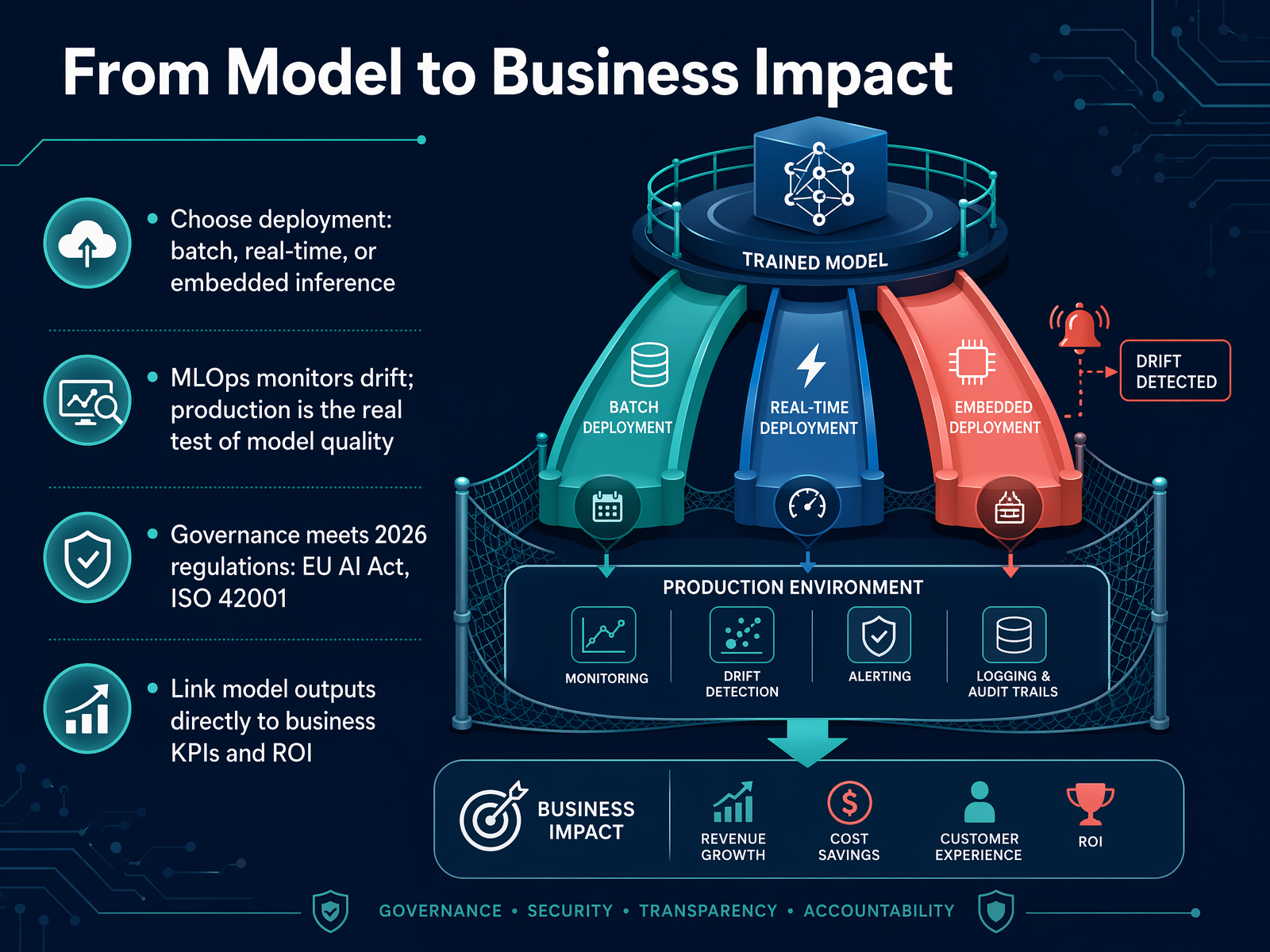
2 min - 08From Model to Business ImpactNow, how do we actually take a promising model and turn it into a real business result? It starts with choosing the right deployment pattern. You might use batch inference to pre-calculate scores overnight, real-time APIs for instant decisions like credit checks, or even embedded inference running directly on a device. The moment a model goes live, the real test begins. That is where MLOps, or Machine Learning Operations, takes over. It constantly monitors for data drift, which is a silent killer of model accuracy. Production is where you truly learn if your model is good. And we can't ignore governance. Regulations like the EU AI Act and standards like ISO forty-two-thousand-one are in effect now. They require full traceability, so you must know exactly which data trained every model. Finally, we must link every prediction back to a tangible business outcome. It's not about the best accuracy; it's about the model that drives the highest ROI, like reducing churn by fifteen percent. Let's look deeper at how MLOps provides the control plane to make all of this manageable.
 mlflow.orgvalanor.comyundoai.com+22 min
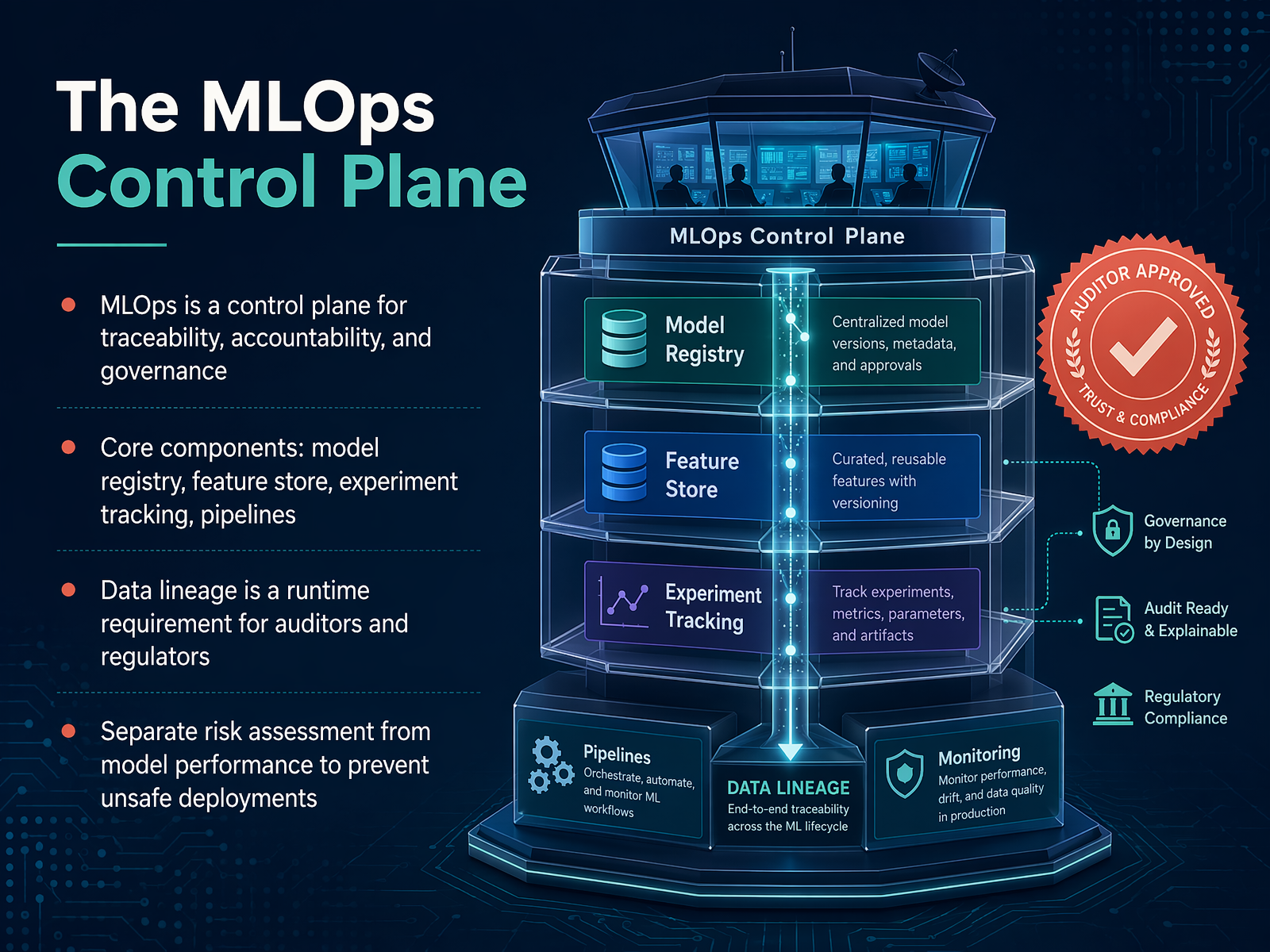
 - 09The MLOps Control PlaneNow let's shift our perspective to the MLOps control plane. Think of it not just as a pipeline for moving models, but as a central system for traceability, accountability, and governance. It coordinates several core components: a model registry to version and track models, a feature store for consistent data definitions, experiment tracking for reproducibility, and automated pipelines. One of the most critical runtime requirements here is data lineage. For auditors and regulators, it's no longer enough to know a model is accurate; you must be able to trace every prediction back to the exact datasets and features used to train it. A key best practice is to separate risk assessment from model performance. A model might score perfectly on accuracy but still be blocked from deployment if it fails a fairness or bias gate. This is a deliberate design choice, acknowledging that high performance does not equal low risk. Next, we'll look at how these principles are applied in practice with production monitoring and observability.
 mlflow.orgvalanor.comyundoai.com+22 min
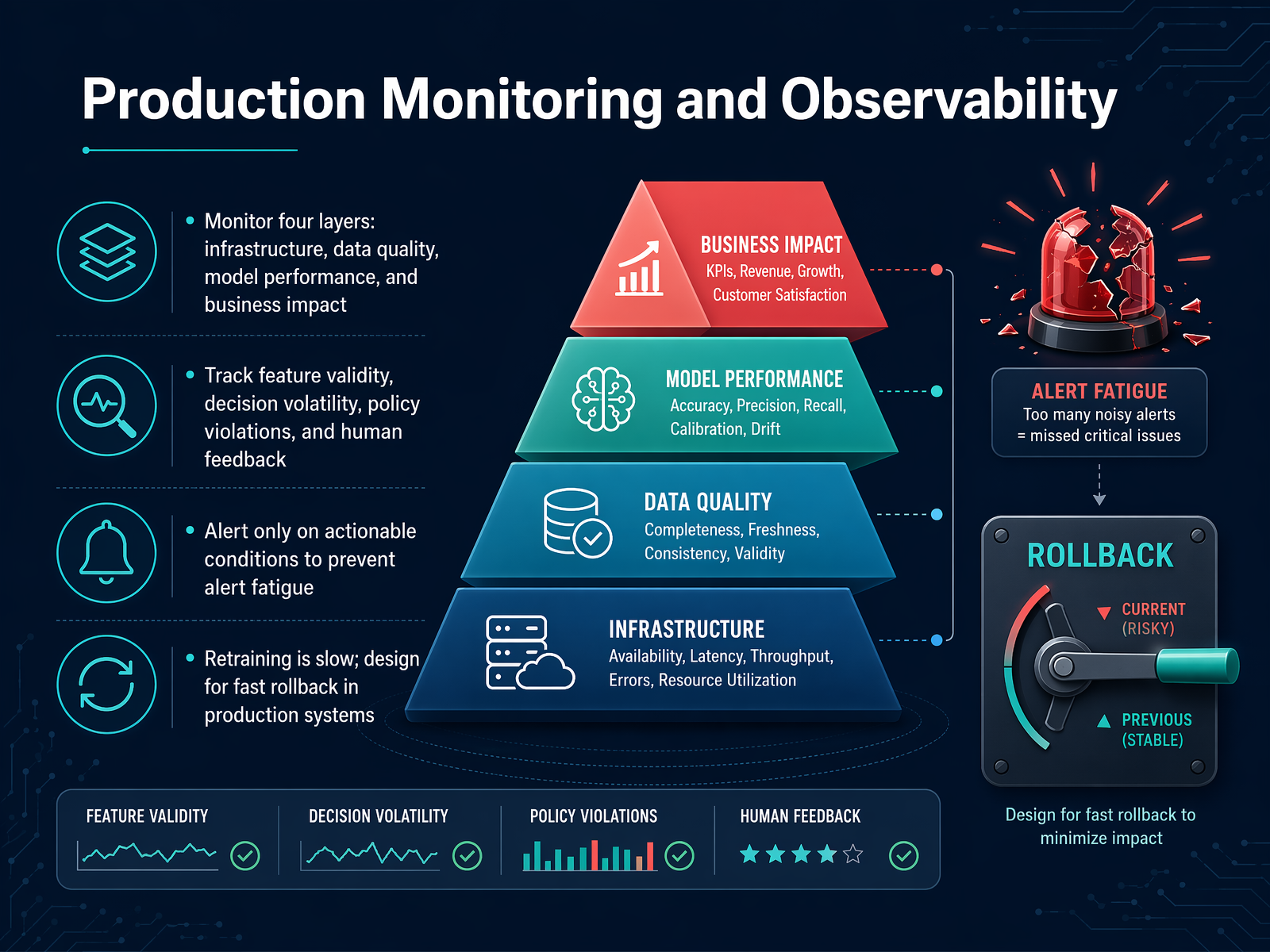
 - 10Production Monitoring and ObservabilityNow, let’s talk about something that keeps your machine learning system healthy once it’s live: production monitoring and observability. Think of it in four layers. First, the infrastructure layer, checking for latency and errors. Next, data quality, watching for drift or anomalies in the data coming in. Then, model performance, tracking accuracy and confidence. And finally, and most importantly, the business impact, measuring the real-world outcomes you actually care about. We also need to track specific signals, like whether the features are still valid, if the model’s decisions are becoming volatile, if it’s violating any business rules, and whether you’re getting an increase in human feedback like appeals or overrides. A critical point is to only alert on actionable conditions. If you set up too many noisy alerts, your team will develop alert fatigue and start ignoring them, which defeats the purpose. And remember, retraining a model is a slow process. Your systems must be designed for a fast rollback, so you can instantly revert to a previous stable version if a new model starts to misbehave. Next, we’ll move on to the human side of the equation and explore working with ML teams.
 mlflow.orgvalanor.comyundoai.com+22 min
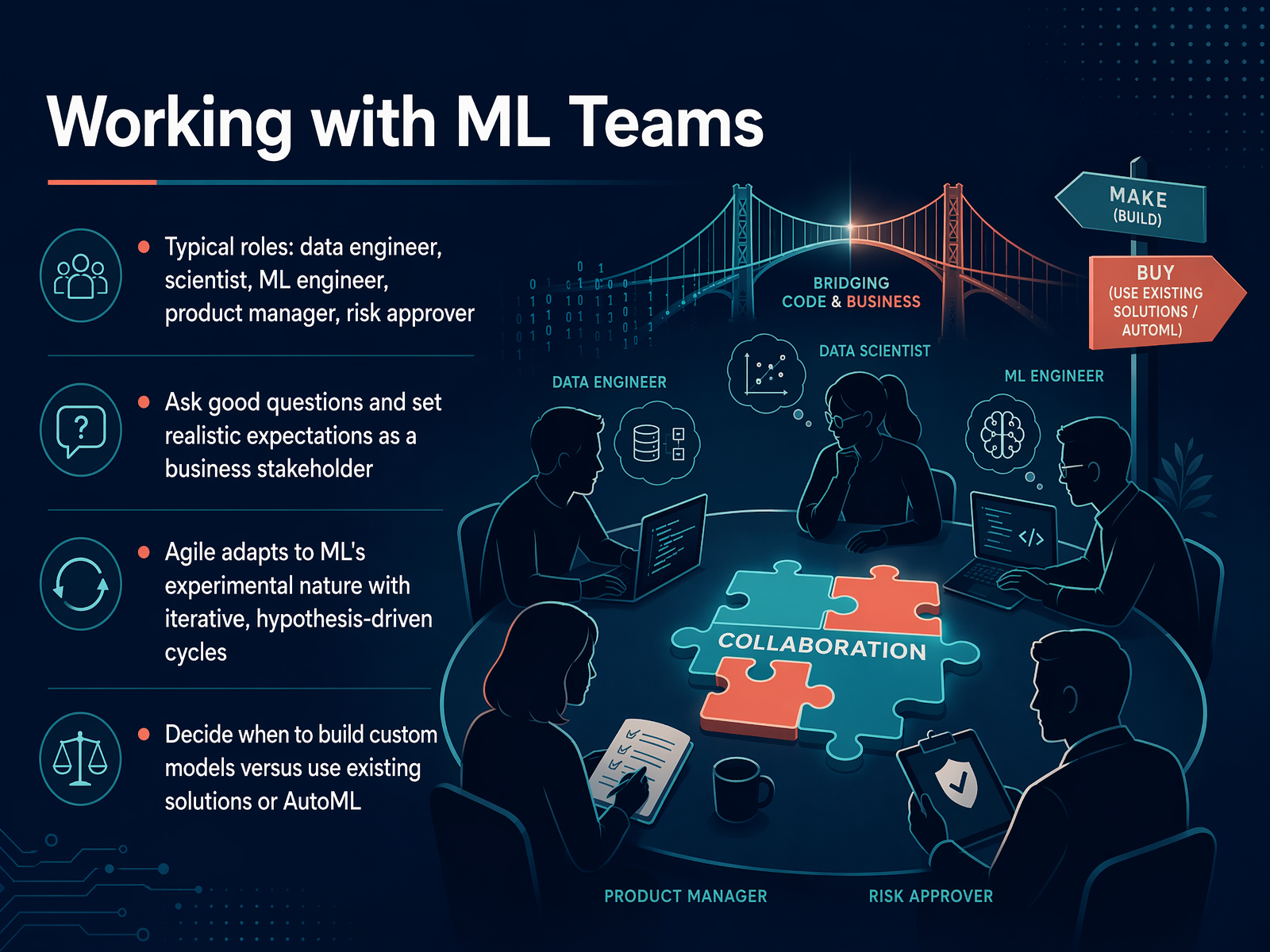
 - 11Working with ML TeamsNow, let's talk about the people who make machine learning projects succeed. You'll typically work with a few key roles: data engineers who build the data pipelines, data scientists who explore and model the data, ML engineers who deploy and maintain models in production, product managers who align the work with business goals, and risk approvers who ensure everything is responsible and compliant. As a business stakeholder, your most powerful tool is asking good questions and setting realistic expectations. Remember, the experimental nature of ML means not every experiment will work, and that's actually okay. That's why many teams adopt Agile practices tailored for ML, using iterative, hypothesis-driven cycles. Instead of guessing up front, they run a small experiment, learn from the results, and then decide the next step. A key decision you'll help navigate is whether to build a custom model from scratch, or to use an existing solution like an API or AutoML tool. The right answer depends on your unique data, the problem's complexity, and how quickly you need a solution. So, stay curious, ask questions, and you'll be a great partner. Next, we'll look at how to ensure these systems are built responsibly with model accountability and governance.
 2 min
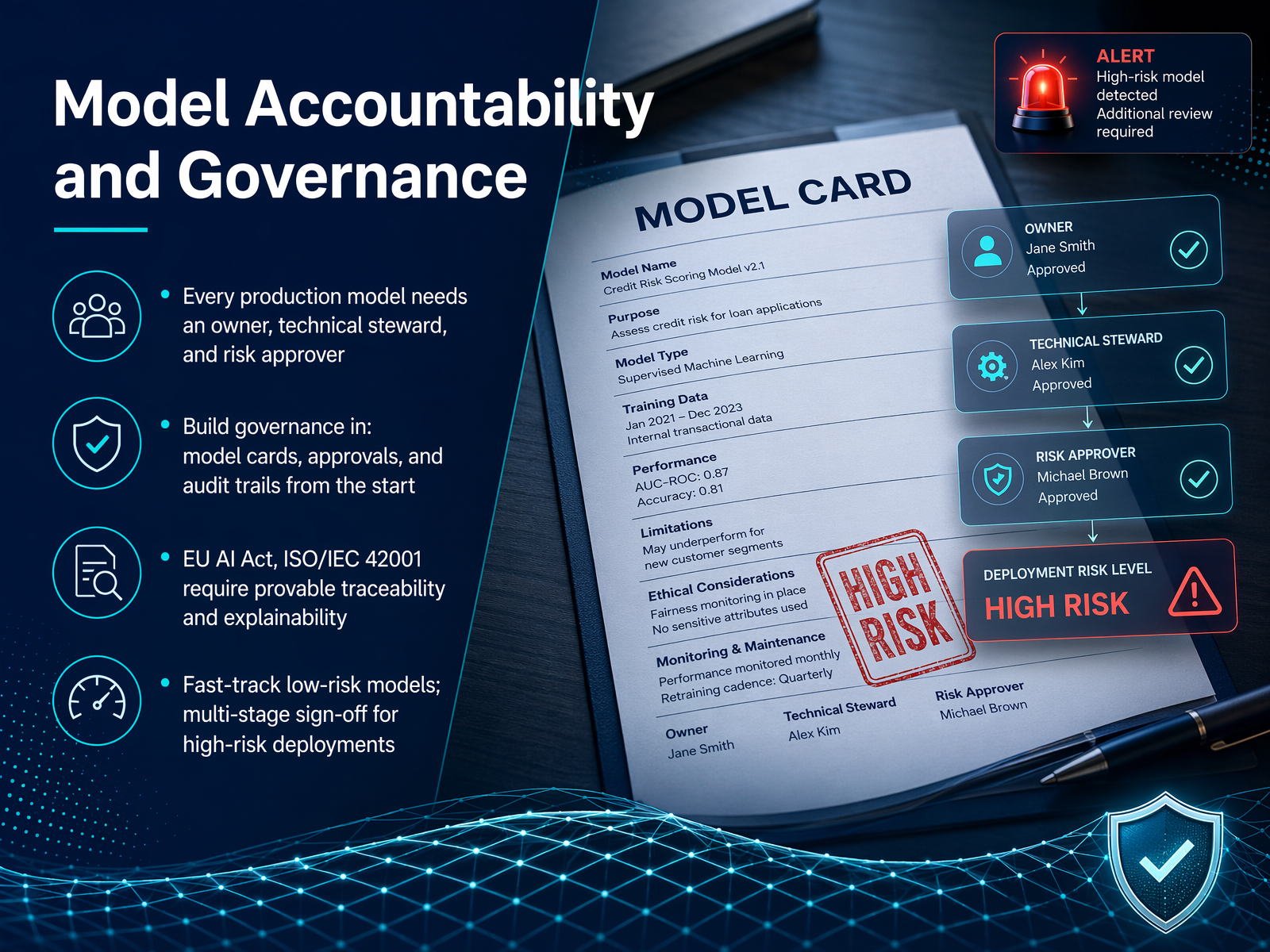
2 min - 12Model Accountability and GovernanceNow, let's talk about something that turns a great model into a trustworthy asset: accountability and governance. It's no longer just about accuracy. Every production model needs a clear owner, a technical steward, and a risk approver. Think of it like this: the owner is accountable for the business outcome, the steward ensures the system runs reliably, and the risk approver confirms it's safe and compliant. You should build this governance in from the start, using model cards, automated approvals, and complete audit trails. Regulations like the EU AI Act and standards like ISO forty-two thousand one now require provable traceability and explainability. So, how do you make this practical? Fast-track your low-risk, internal models to keep up velocity. But for high-risk, customer-facing deployments, use a multi-stage sign-off process. This isn't bureaucracy for its own sake; it's how you scale machine learning with control and trust. Next, we'll explore the newest frontier: Agentic AI and LLMs in the Enterprise.
 mlflow.orgvalanor.comyundoai.com+21 min
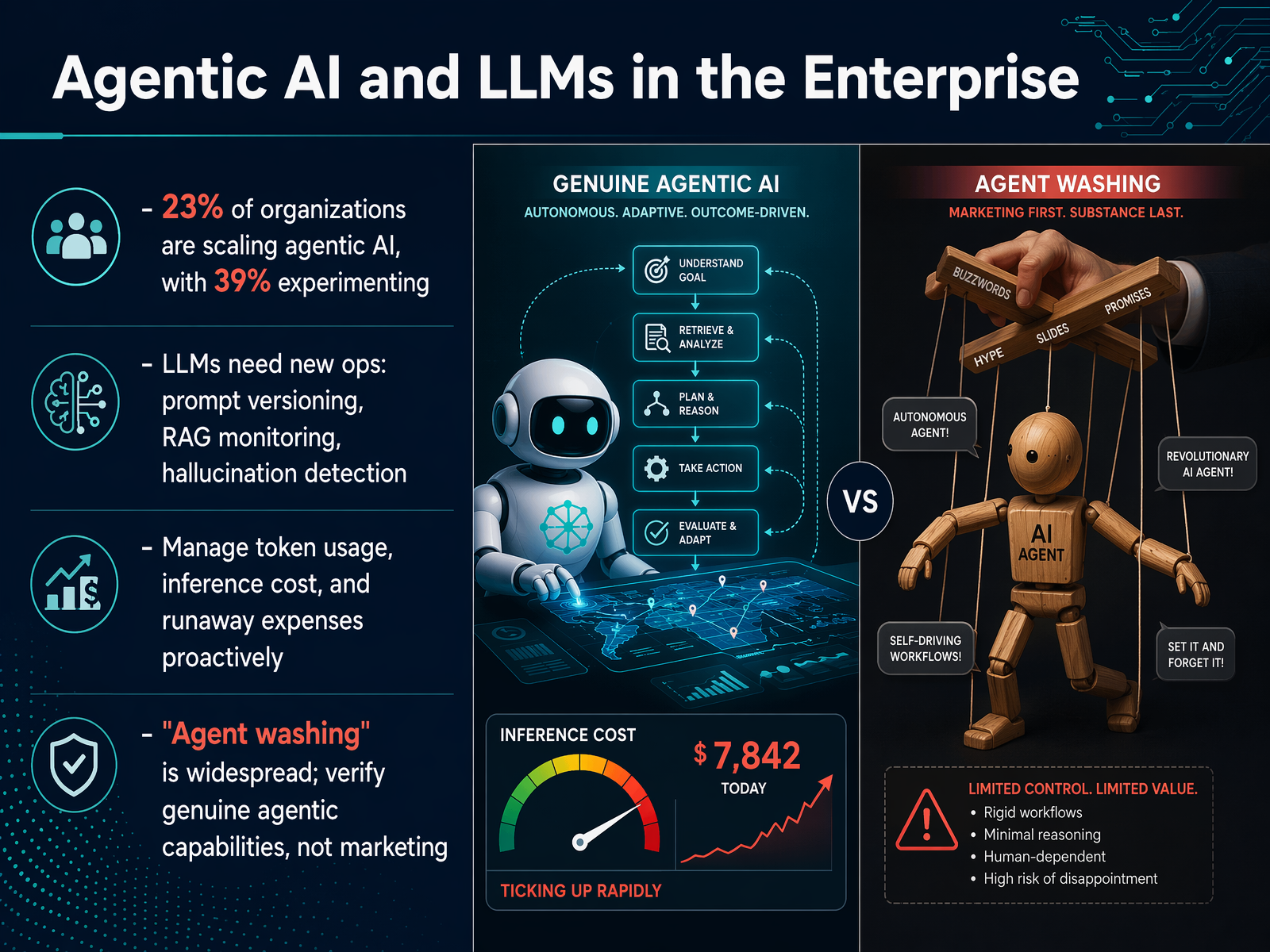
 - 13Agentic AI and LLMs in the EnterpriseLet's talk about what it really takes to bring agentic AI and large language models into the enterprise. The numbers show a lot of motion. Twenty-three percent of organizations are already scaling agentic AI, while another thirty-nine percent are experimenting. But deployment is only the first step. These models demand a new kind of operations, or ops. Think about prompt versioning, monitoring retrieval-augmented generation, or RAG, pipelines, and detecting hallucinations. You also need to manage token usage, inference costs, and runaway expenses proactively. It's easy for costs to spiral if you aren't watching. Finally, be cautious. 'Agent washing' is widespread. Many vendors claim to offer agentic capabilities, but you must verify genuine autonomy and decision-making, not just marketing. So, as you think about operationalizing AI, look for the real thing. Now, let's shift our focus to identifying high-potential ML opportunities.
 deloitte.comassets.kpmg.comprosigns.io+21 min
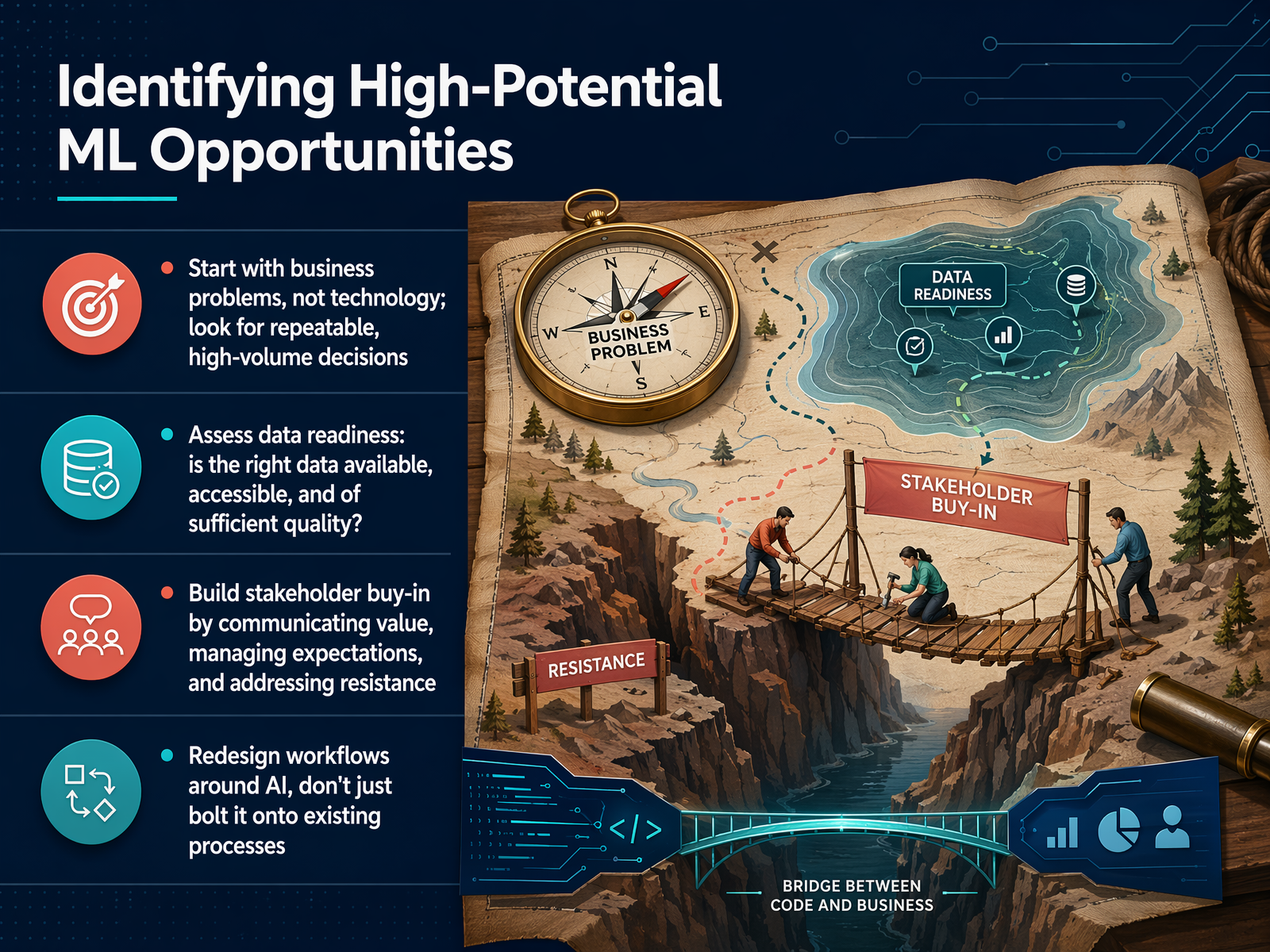
 - 14Identifying High-Potential ML OpportunitiesSo, how do you actually find the right place to start? It begins by looking at your business problems first, not the technology. The best candidates are high-volume, repeatable decisions—things like forecasting demand, routing customer tickets, or screening invoices. If a person makes the same judgment call dozens of times a day, that's a strong signal. Next, assess data readiness. Ask yourself: is the right data available, accessible, and clean enough? A stunning model built on messy data delivers very little. You also need to bring people along. Build stakeholder buy-in by communicating value clearly, managing expectations, and addressing resistance head-on. Data shows that organizations with clear accountability for AI outcomes report established ROI at over three times the rate of others. Finally, and this is critical, redesign the workflow around AI instead of just bolting it onto existing processes. Top performers don't just automate steps; they reimagine how work gets done. When you combine a clear business problem, solid data, aligned stakeholders, and an integrated workflow, you move from isolated pilots toward real, scaled value. Next, we'll explore how to build data literacy and AI fluency across your organization.
 deloitte.comassets.kpmg.comprosigns.io+22 min
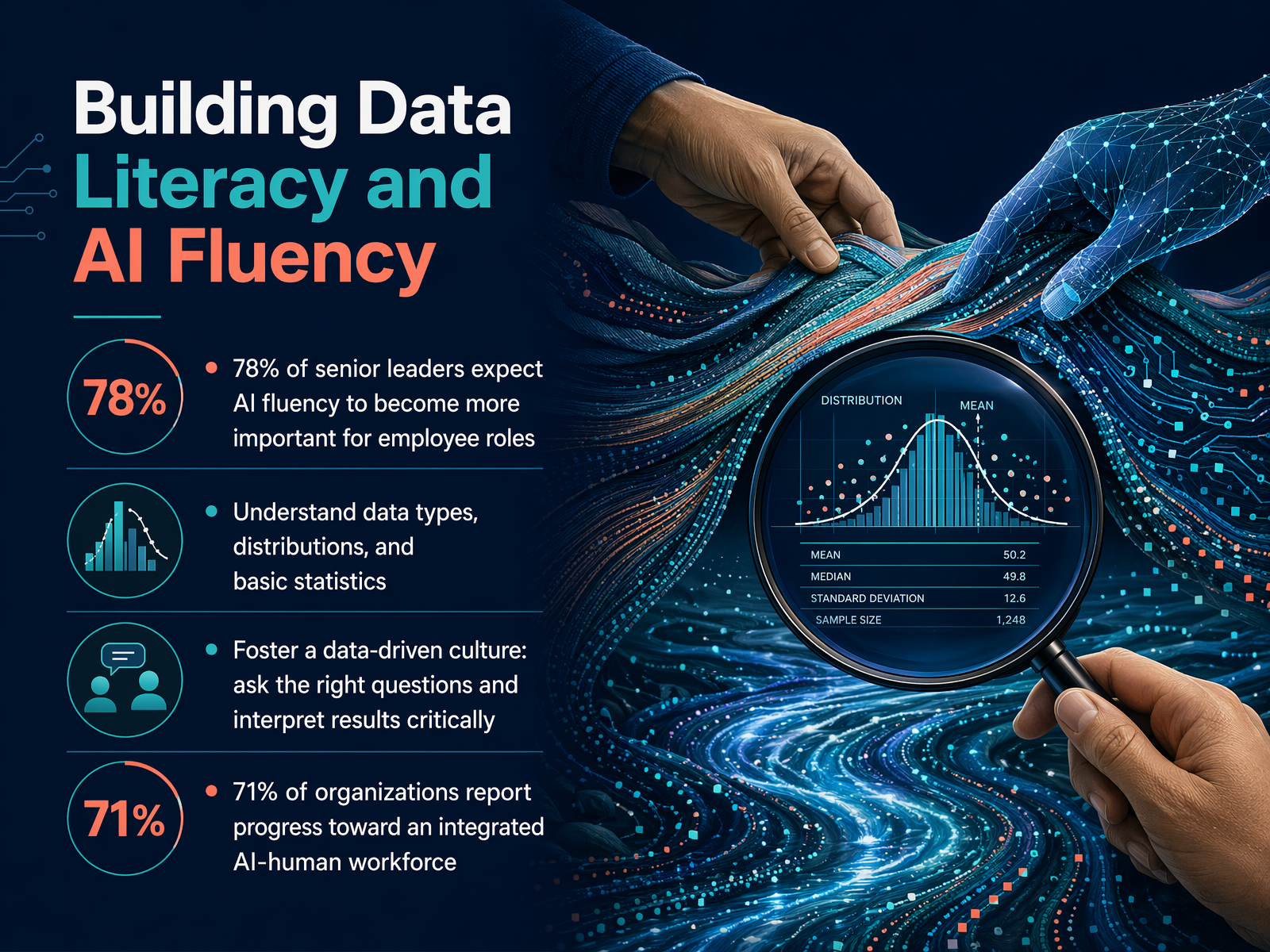
 - 15Building Data Literacy and AI FluencyNow, let's shift our focus to the human side of the AI equation. Technology is only half the story. The other half is building data literacy across your teams. A recent KPMG study found that 78 percent of senior leaders expect AI fluency to become much more important for employee roles very soon. This goes beyond knowing how to code. It means understanding data types, basic distributions, and simple statistics. It is about learning to ask the right questions and interpret results critically, not just accepting the output of a model at face value. We are already seeing progress toward this vision. The same report shows that 71 percent of organizations are making good progress toward a fully integrated AI-human workforce. The goal is not to replace people, but to create a data-driven culture where everyone can partner effectively with intelligent systems. Let's look at how you can start that journey next, in your own next steps.
 deloitte.comassets.kpmg.comprosigns.io+22 min
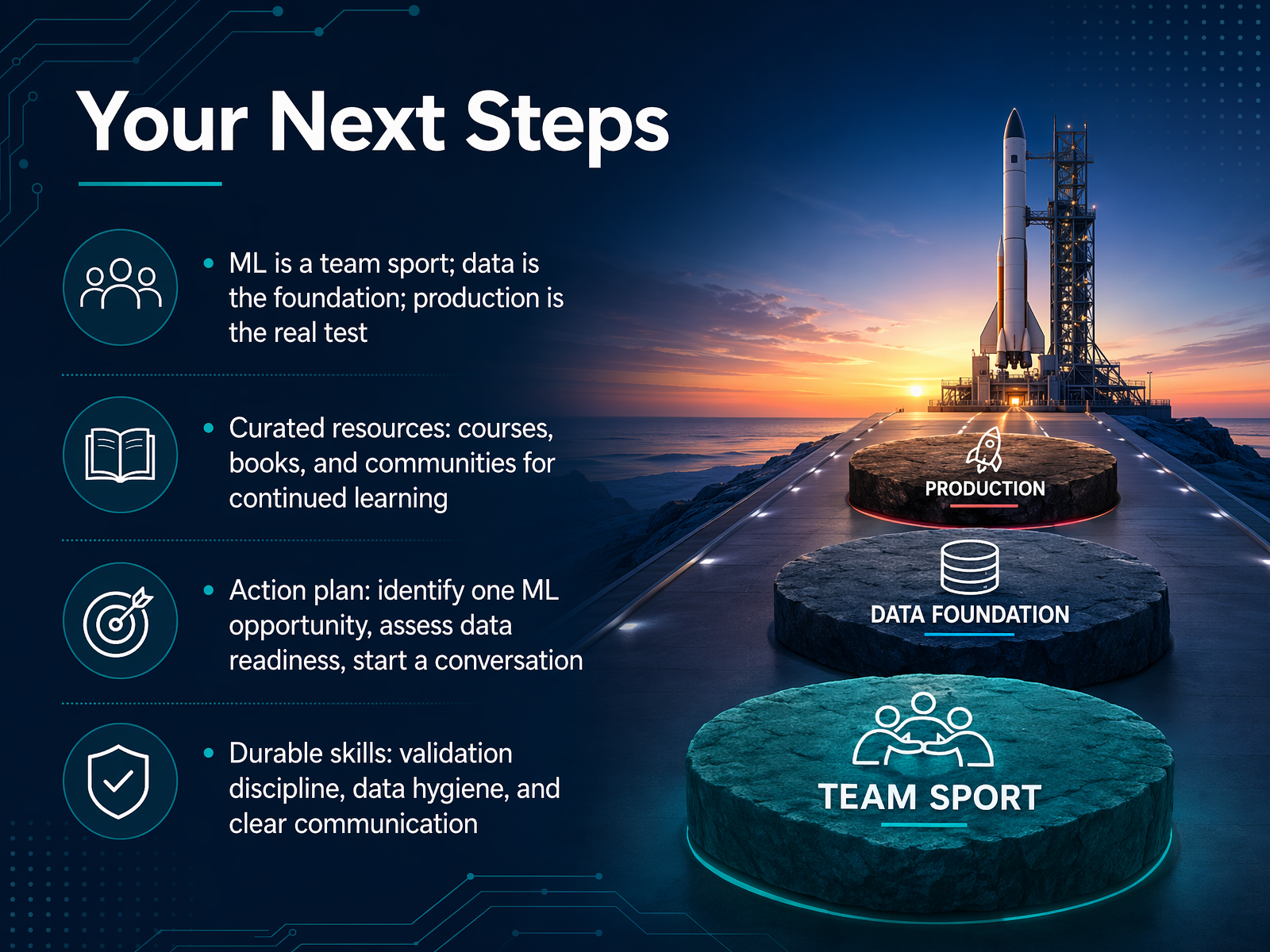
 - 16Your Next StepsWe have reached the final slide, so let us crystallize the three core truths we have explored together. First, machine learning is a team sport. Data is the foundation, but production is the real test. A model only becomes valuable when real users interact with it. Second, your learning journey does not stop here. We have curated specific resources for you, including structured courses like the Deep Learning dot AI specialization, comprehensive roadmaps, and active communities where you can ask questions and share your wins. Third, take action. Your immediate plan is to identify one machine learning opportunity in your work, honestly assess the data readiness, and start a conversation with your team. As you build your career, remember that the tools and architectures will keep changing, but three durable skills will always compound: validation discipline, data hygiene, and clear communication. Thank you for investing your time and attention in this introduction. You now have the map. The next step is to start walking. Good luck on your journey.
 coursera.orgibm.comanalyticsvidhya.com+22 min
Take the deck with you
Download this course as a file — free, no sign-up needed.
- PDF handoutEvery slide page, ready to print or share.17 pages · 5.0 MBDownload
- Narrated PowerPointThe deck that presents itself — every slide carries the digital human's narration video.17 pages · 18.4 MBDownload
- PowerPoint slidesThe full deck as a .pptx — open it in PowerPoint, Keynote, or Google Slides.17 pages · 4.9 MBDownload
Free to use in your own training — please keep the PersonWise credit page at the end.
Have your own deck? Turn it into a course
Sources consulted
Web sources consulted while building this course.
- The State of AI in the Enterprise - 2026 AI report | Deloitte US — deloitte.com
- Global AI Pulse Q2 2026 — assets.kpmg.com
- State of Enterprise AI 2026 | Prosigns — prosigns.io
- Enterprise AI Statistics 2026: ROI, AI Agents & Spending - The AI Index — report-ai.org
- Machine Learning Statistics 2026: Market Size, Adoption, ROI, and the Energy Cost of AI - Axis Intelligence — axis-intelligence.com
- MLOps Pipeline Automation Best Practices in 2026 | MLflow — mlflow.org
- Enterprise MLOps Best Practices for ML Production — valanor.co
- MLOps Best Practices for Production AI in 2026 - MYUNDOAI — myundoai.com
- MLOps in 2026: Architecture, Trends & Strategy Guide — hyscaler.com
- MLOps in 2026 — The Definitive Guide: tools, cloud platforms, architectures, and a practical playbook — rahulkolekar.com
- Machine Learning and Deep Learning Roadmap: Beginner to Expert | Coursera — coursera.org
- The 2026 Guide to Machine Learning | IBM — ibm.com
- 50+ Machine Learning Resources for Self Study in 2026 — analyticsvidhya.com
- terrene-foundation/mlfp — github.com
- Machine Learning in Production - DeepLearning.AI — deeplearning.ai