Control Systems: Feedback & Stability
Begin
15 pages · ~30 min
Control Systems: Feedback & Stability
A concise introduction to control systems, covering feedback and stability principles for engineers and technicians.
What you’ll learn
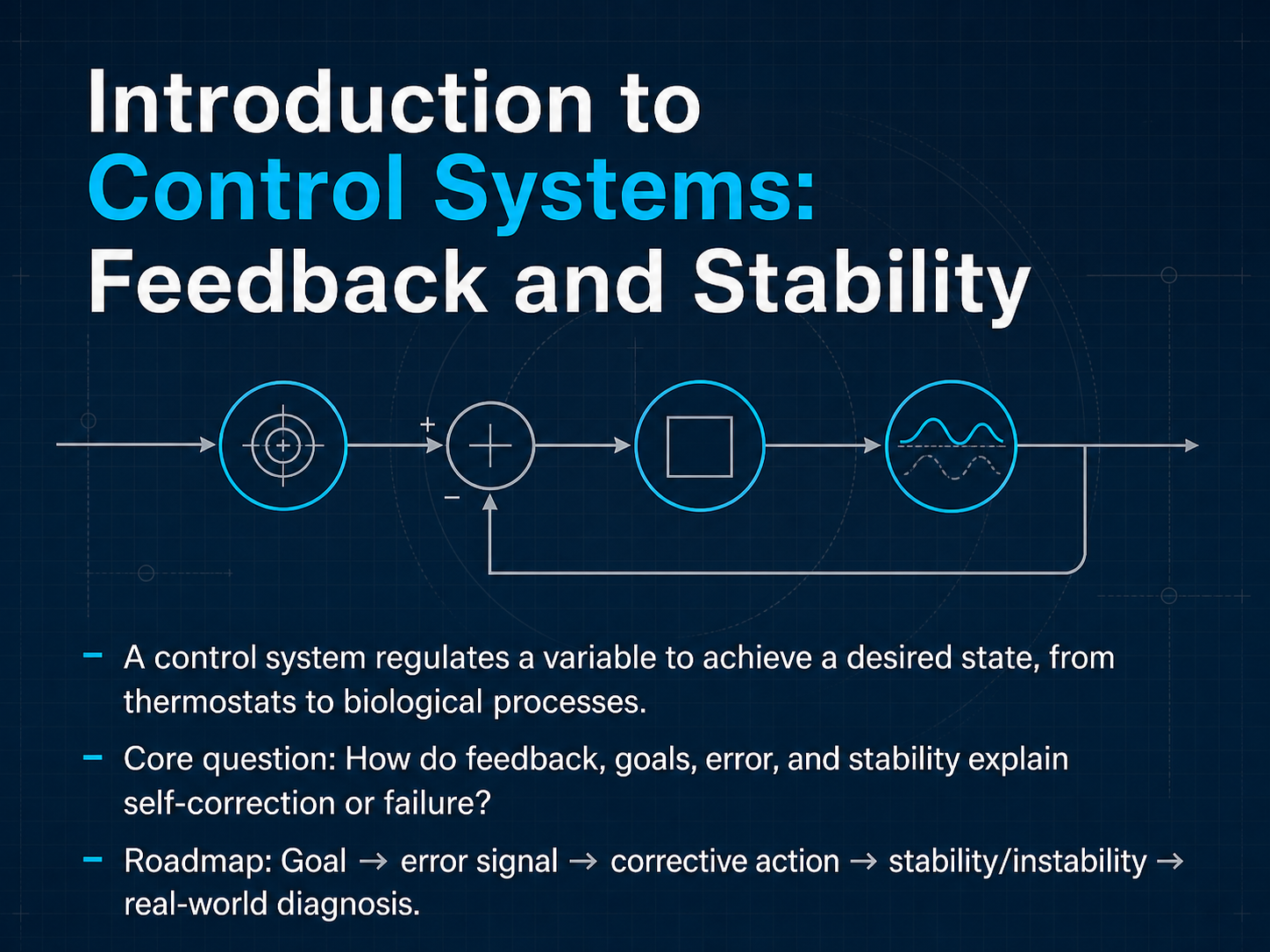
- 01Introduction to Control Systems: Feedback and StabilityWelcome. Today we're going to explore feedback and stability, the two core ideas that explain how systems self-correct. Think of a thermostat keeping your room comfortable, or your own body holding its temperature steady. These are control systems in action. The question we want to answer is this: how do a goal, an error signal, and corrective action work together to create stability, and what happens when that process fails? Here's our roadmap. We'll start with a desired state, a goal. A disturbance creates an error, a gap between what we want and what we have. That error drives a corrective action, which pushes things back toward the goal. When this loop works, we call it stable. When it doesn't, we cross into instability. By the end, you'll have a clear lens for diagnosing both self-correction and breakdown in real-world systems. With that framework in mind, let's move to our next idea: What does it mean for a system to self-correct?bio.libretexts.orgmathworks.combio.libretexts.org+22 min
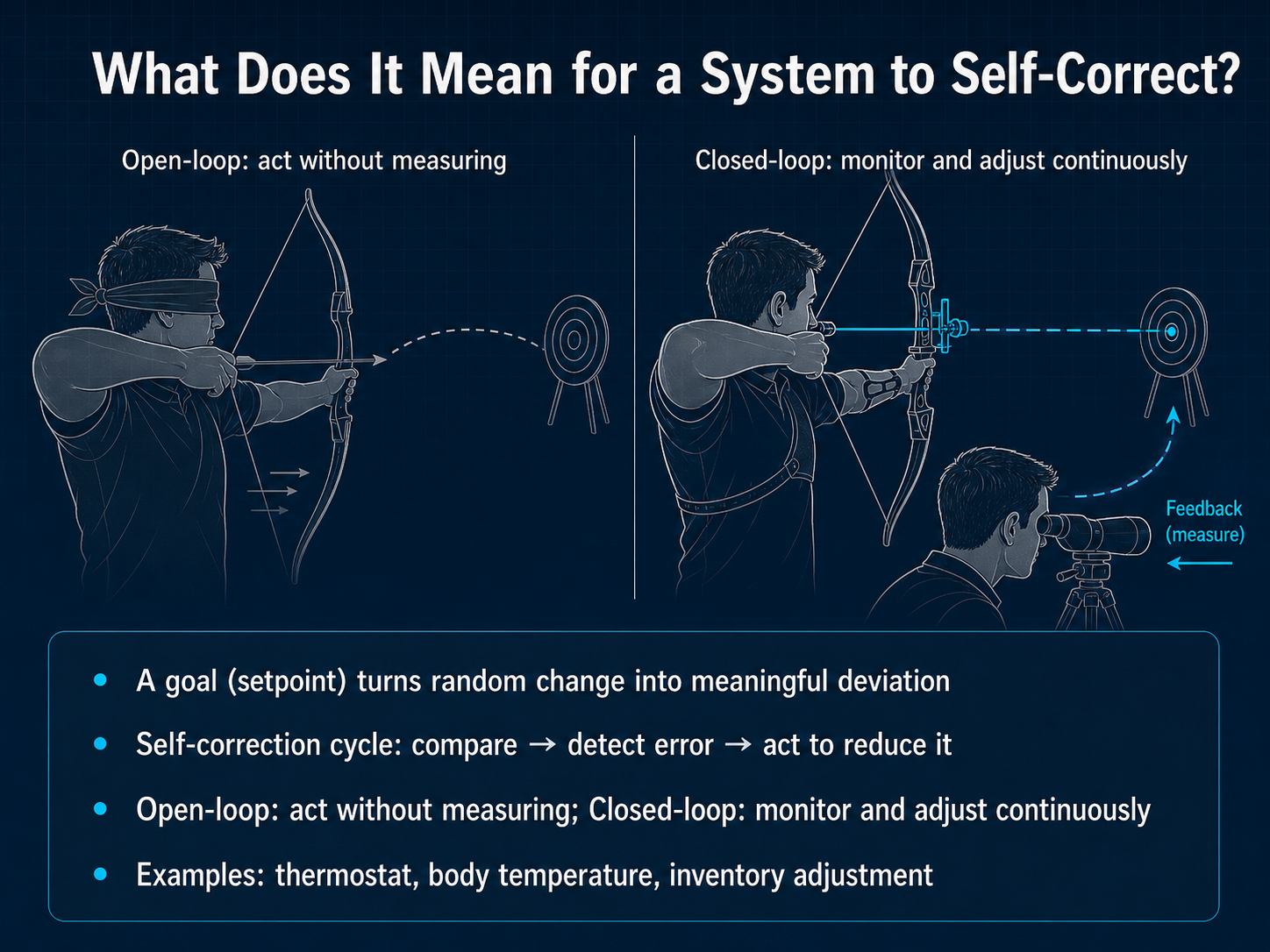
- 02What Does It Mean for a System to Self-Correct?So if a system can correct itself, where does that ability actually come from? It starts with a goal, what we call a setpoint. A setpoint turns random changes into something meaningful: a deviation. Without a goal, a change is just noise. But with a target, that same change becomes an error that the system can act on. This kicks off a simple self-correction cycle. First, you compare the current state to the target. Then you detect any error between them. Finally, you take action to reduce that error. That loop is what we call closed-loop control. You monitor and adjust continuously. In contrast, open-loop control acts without measuring the result. It assumes everything will go as planned. Think of a thermostat. It checks the room temperature, compares it to your setpoint, and switches the heat on or off. Your own body does this too, constantly balancing your internal temperature against a target. Even a store manager works the same way, checking current stock against a target level and placing orders to close the gap. In every case, the key difference between open and closed loop is measurement. A closed loop watches the outcome and corrects. That continuous feedback is what creates stability. Now let's break that cycle down further, and look at the feedback loop and its four essential building blocks.
 2 min
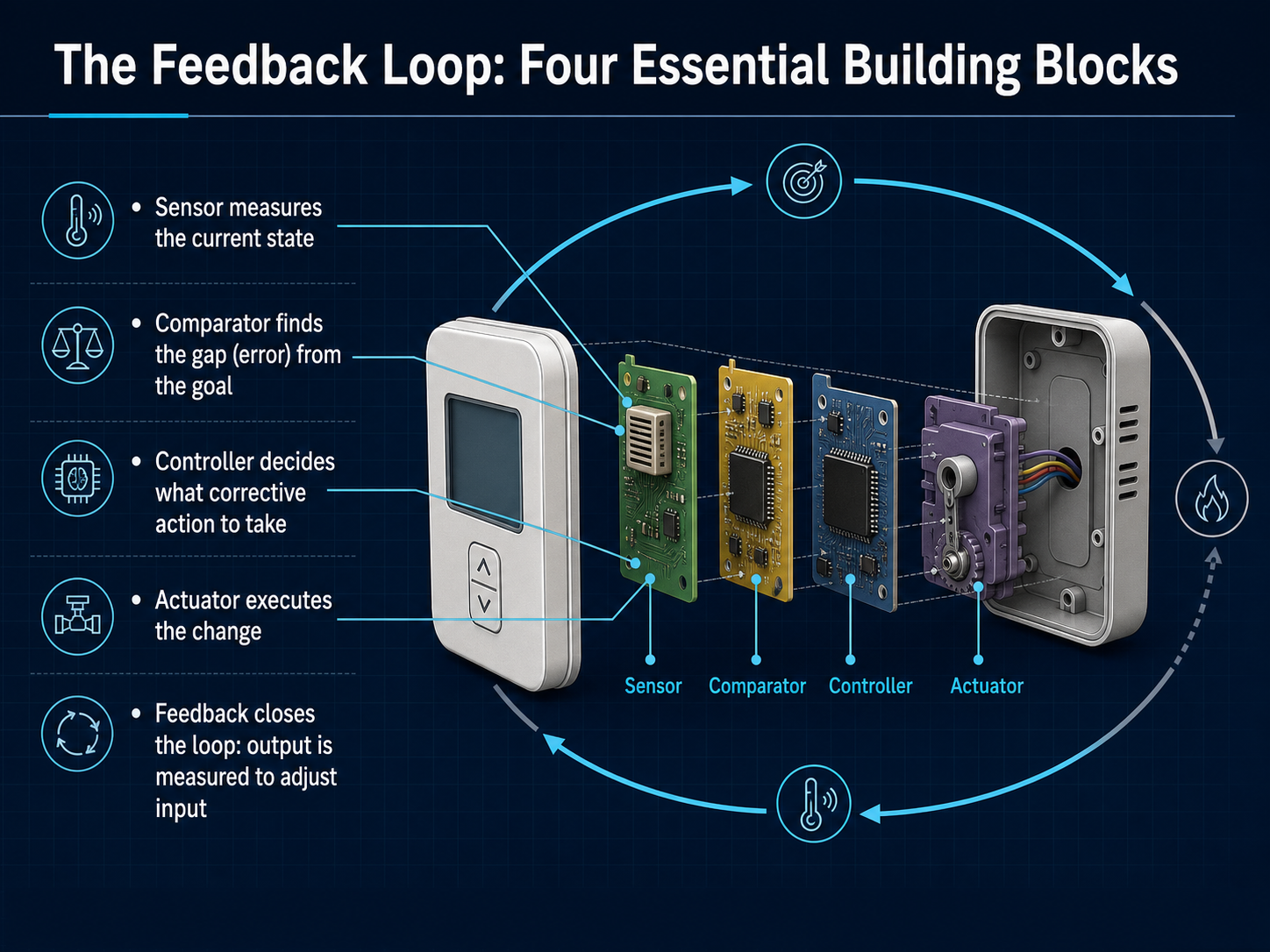
2 min - 03The Feedback Loop: Four Essential Building BlocksNow let’s put the pieces together. A feedback loop really boils down to four essential building blocks that work in a repeating cycle. First, you need a sensor. This is the component that measures the current state or output. Think of a thermometer in a room. It just reports what the temperature actually is. Next comes the comparator. Its job is to take that measured value, compare it to the goal, or setpoint, and find the gap. We call this gap the error. Once the error is known, the controller kicks in. The controller decides what corrective action is needed based on the size and direction of that error. Finally, the actuator executes the change. It’s the element that physically alters the system, like a heater turning on. These four blocks then close the loop, because the sensor immediately starts measuring the new output again. So the system continuously monitors itself and adjusts its own input. Next, we’ll dig into the type of feedback that actually makes self-correction work: negative feedback, the engine of stability.
 2 min
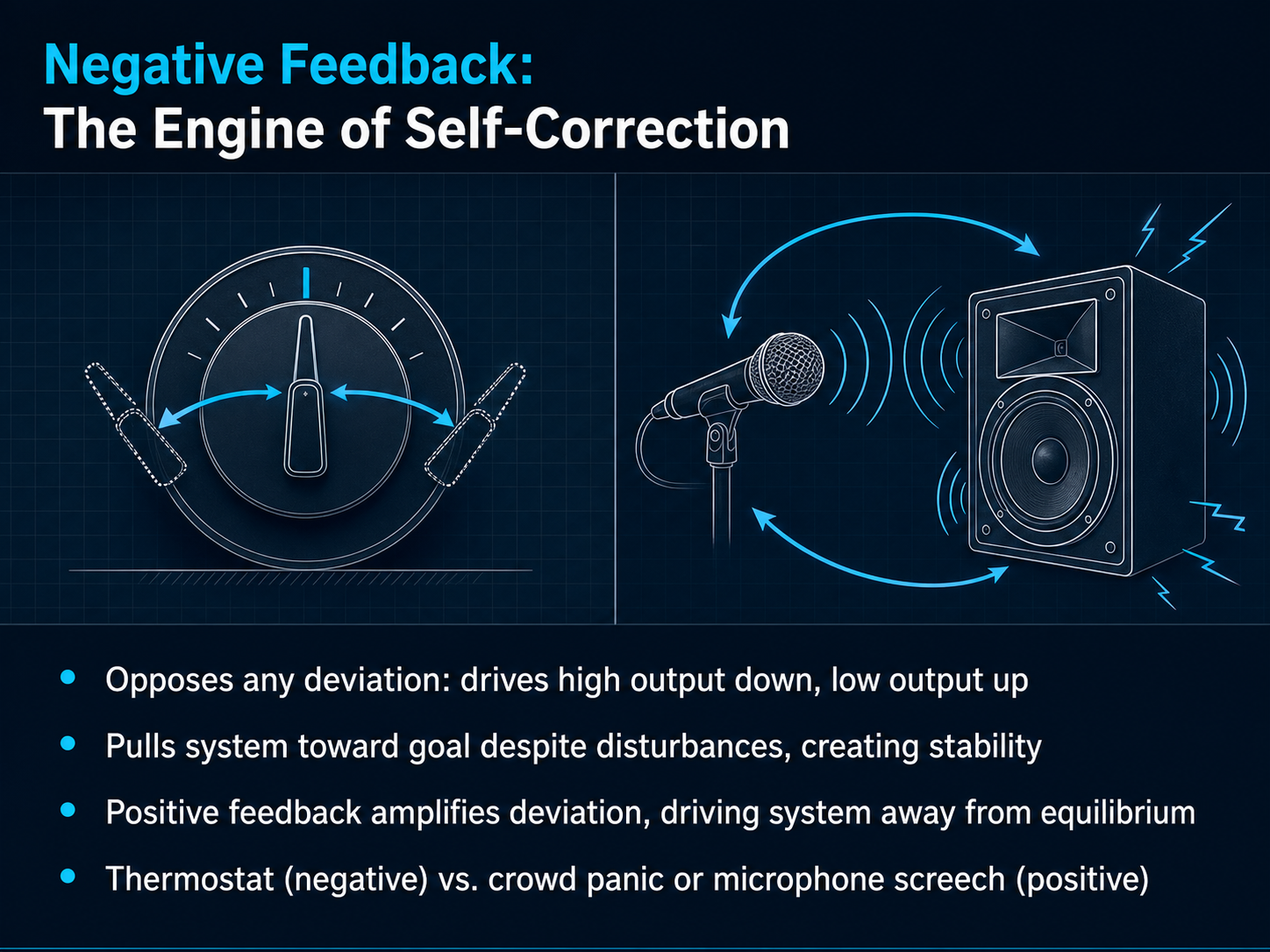
2 min - 04Negative Feedback: The Engine of Self-CorrectionNow we get to the real engine of control. Negative feedback. Think of it as the system's way of opposing any change. If the output goes too high, negative feedback pushes it down. If it goes too low, it pulls it right back up. This constant pulling back is what creates stability. Even when disturbances hit, the system keeps correcting itself toward the goal. That's key. Compare this to positive feedback. Positive feedback amplifies a deviation. Instead of correcting, it drives the system further and further from equilibrium. A thermostat is the classic negative example. Temperature too low? It kicks the heater on. Too high? It stops. It always corrects. But think of a microphone screech. A tiny sound gets picked up, amplified, and fed back through the speakers, getting louder and louder. That's positive feedback in action, pushing the system completely out of control. Coming up next, we'll look at how goals and the resulting error directly form the correction equation.
 1 min
1 min - 05Goals, Error, and the Correction EquationNow let's connect goals, error, and the actual correction equation. At the heart of every control system, error is what drives all correction. It's simply the gap between what is and what's desired. The bigger that gap, the stronger the response needs to be. That idea is called proportional control, or P-control. The strength of the response is proportional to the error. But here's the catch: P-control alone leaves something called steady-state error. The system gets close to the target, but never quite reaches it. It's like a thermostat that stops just short of your set temperature. To fix that, we move to the PID concept. Think of it as three coordinated actions. The proportional term reacts to the present error. The integral term remembers the past, correcting persistent offsets like a ship captain compensating for a steady crosswind. And the derivative term anticipates the future, adding a bit of braking to avoid overshooting the target. Together, P, I, and D turn a simple reaction into a smooth, precise correction. Up next, we'll explore what happens when that correction actually succeeds: stability.
 2 min
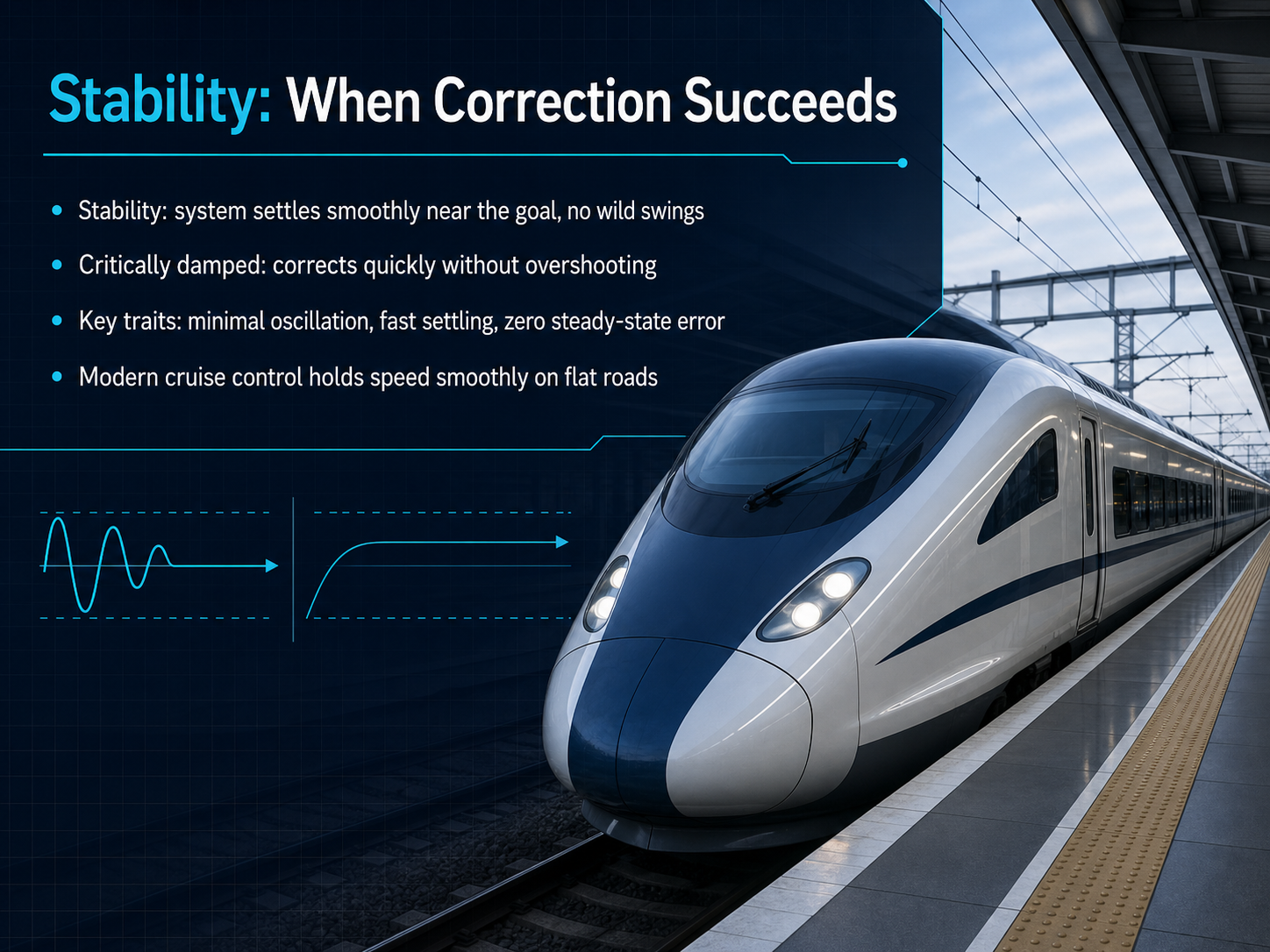
2 min - 06Stability: When Correction SucceedsNow we get to the part where everything clicks: stability. This is what it looks like when correction actually succeeds. In a stable system, the output settles smoothly near the target. No wild swings, no endless hunting. It finds the goal and stays there. Think of a particular flavor of stability called critically damped. This is the sweet spot where the system corrects itself quickly, but doesn't overshoot. It gets to the setpoint as fast as possible without bouncing past it. You can recognize this behavior by three key traits: barely any oscillation, fast settling time, and zero steady-state error. It doesn't keep a small, permanent offset; it eliminates the error entirely. A great everyday example is modern cruise control on a flat road. Set your speed to sixty-five, and the car adjusts the throttle smoothly. It doesn't lurch past the speed, then brake, then accelerate again. It locks onto the target and holds it there, quietly making minor corrections. That's critically damped stability in action. But what happens when those corrections don't succeed? Let's move on to instability.
 2 min
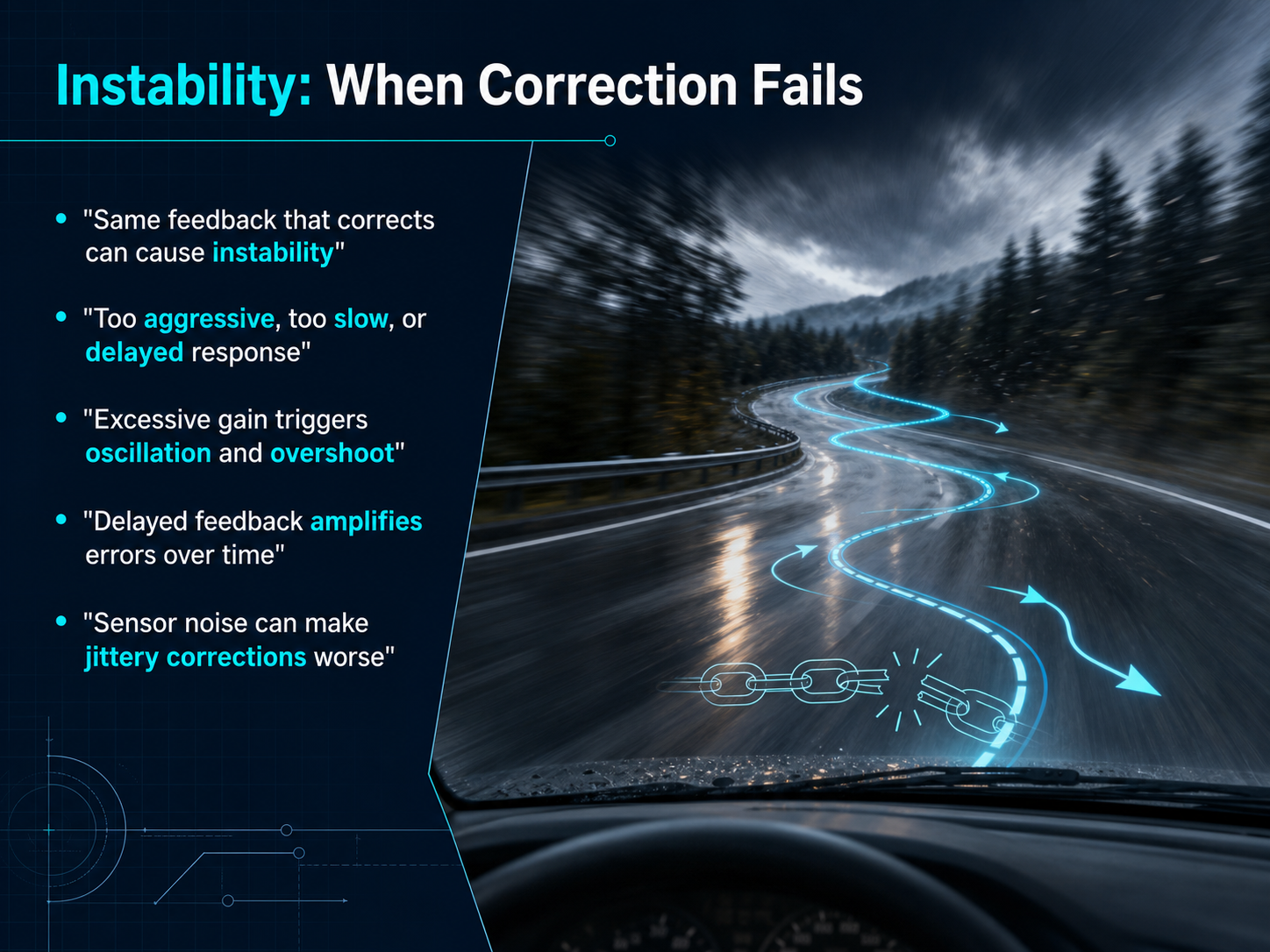
2 min - 07Instability: When Correction FailsSo we have seen how feedback corrects deviations. But here is the tricky part. The very same feedback loop that keeps a system stable can also drive it into instability. It all comes down to how the correction is applied. If the response is too aggressive, the system overshoots the target. It then corrects in the opposite direction, overshoots again, and starts oscillating wildly. This is what we call excessive gain. A slower, delayed correction can be just as dangerous. By the time the system reacts, the error has already grown, so the late fix actually amplifies the next error. Add in some noisy sensor data, and you get jittery, random corrections that make the instability even worse. So stability is not just about having feedback. It is about tuning the strength, timing, and quality of that feedback. Next, we will pull back and see how these same core principles apply when we move from devices to organisms.
 1 min
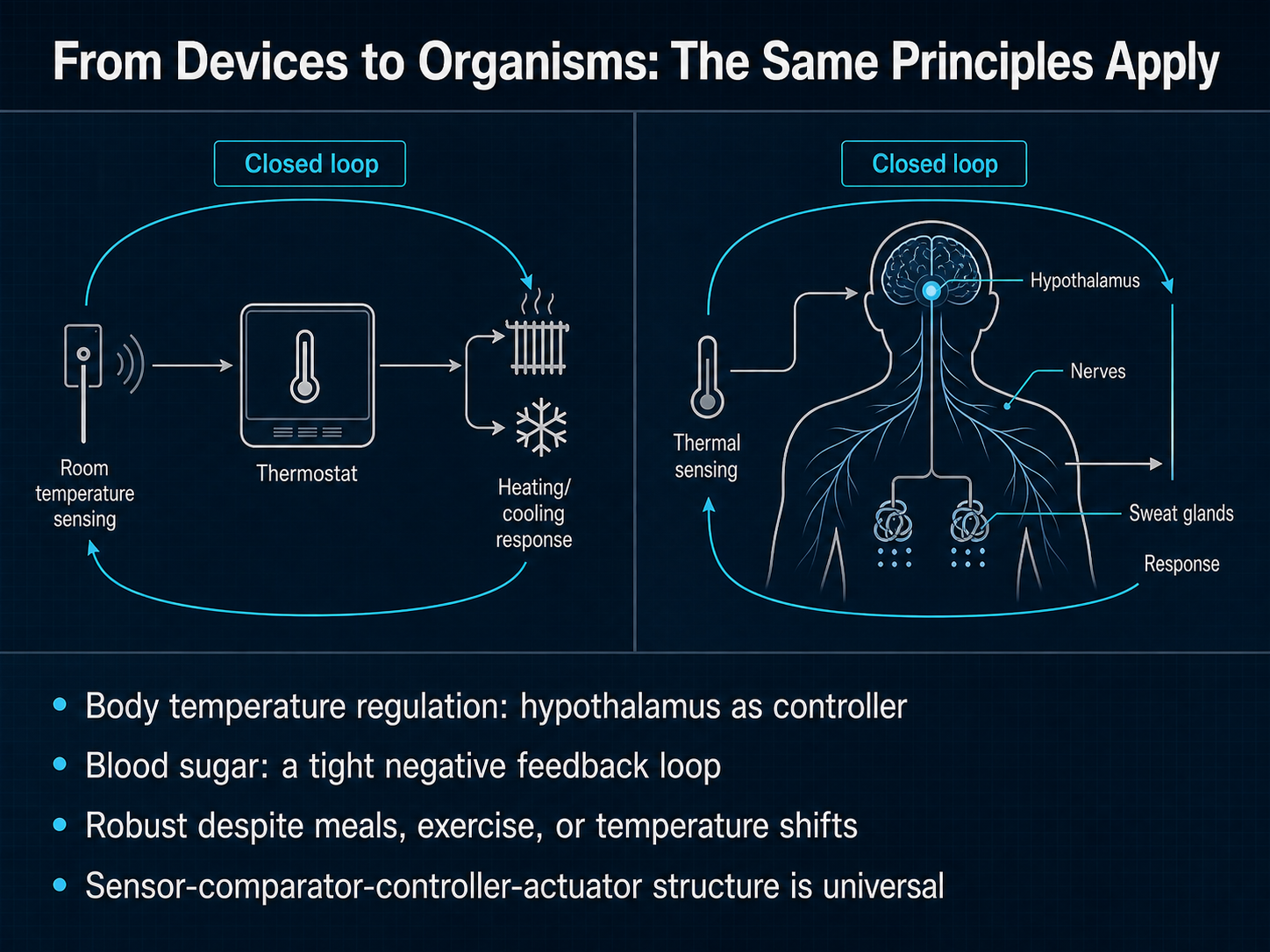
1 min - 08From Devices to Organisms: The Same Principles ApplyNow, let's pull back and see where this same control logic shows up outside of machines. It turns out, your own body runs on exactly these principles. Take temperature regulation. Your hypothalamus acts as the controller, constantly comparing your current body temperature against a set point, around 98.6 degrees. If you get too hot, it sends a signal to sweat and increase blood flow to the skin. Too cold, and it triggers shivering and constricts blood vessels. It's the same sensor-comparator-controller-actuator structure we just discussed, built biologically. Another tight loop is blood sugar control. After a meal, your system detects a rise in glucose and immediately releases insulin to bring it down. This negative feedback is so robust that it handles big disturbances, like a heavy meal, intense exercise, or moving from a cold room to a hot street. The goal is stability, and these biological controllers achieve it with remarkable precision. Next, we're going to look at how these same principles of feedback can be found in organizations and markets.
 1 min
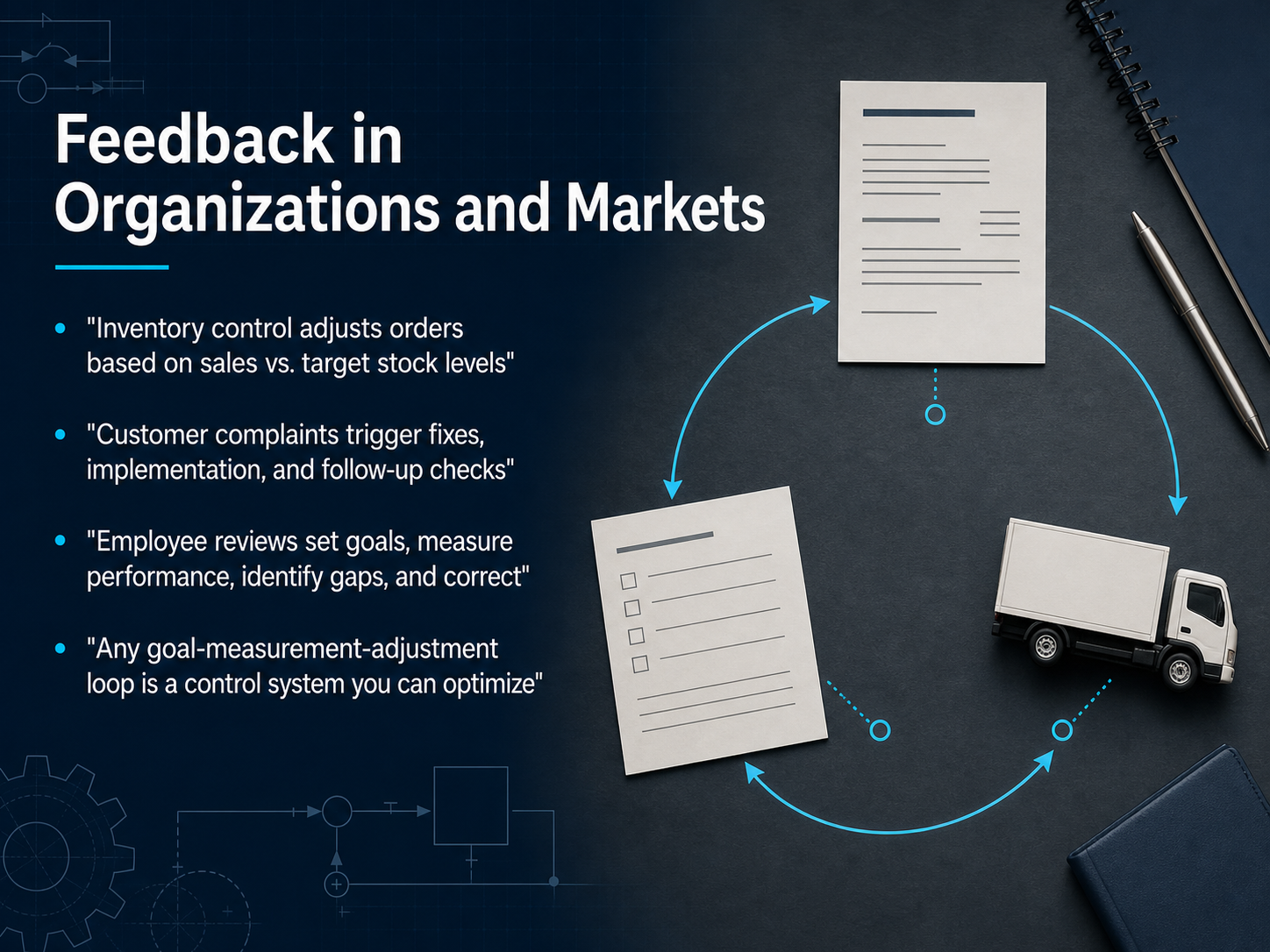
1 min - 09Feedback in Organizations and MarketsNow let's pull this out of the textbook and see where these control loops are running all around us every day. Take inventory control. You set a target stock level. When sales climb above that target, the system automatically triggers a reorder. You measure what you have, compare it to where you want to be, and adjust. That’s the same feedback structure we just talked about. Same goes for customer complaints. A complaint comes in as a signal that experience fell short of expectation. Someone investigates, implements a fix, and then follows up to check if the issue actually went away. They’re closing the loop. Employee reviews work the same way. You set goals, you measure performance, you spot the gap, and you take action to close it. If you step back, every one of these is just a goal-measurement-adjustment loop. And here’s the real takeaway: once you start seeing them as control systems, you can start optimizing them. You can make them faster, smoother, and more stable. Coming up next, we’ll walk through a practical framework for diagnosing what happens when these loops break.
 2 min
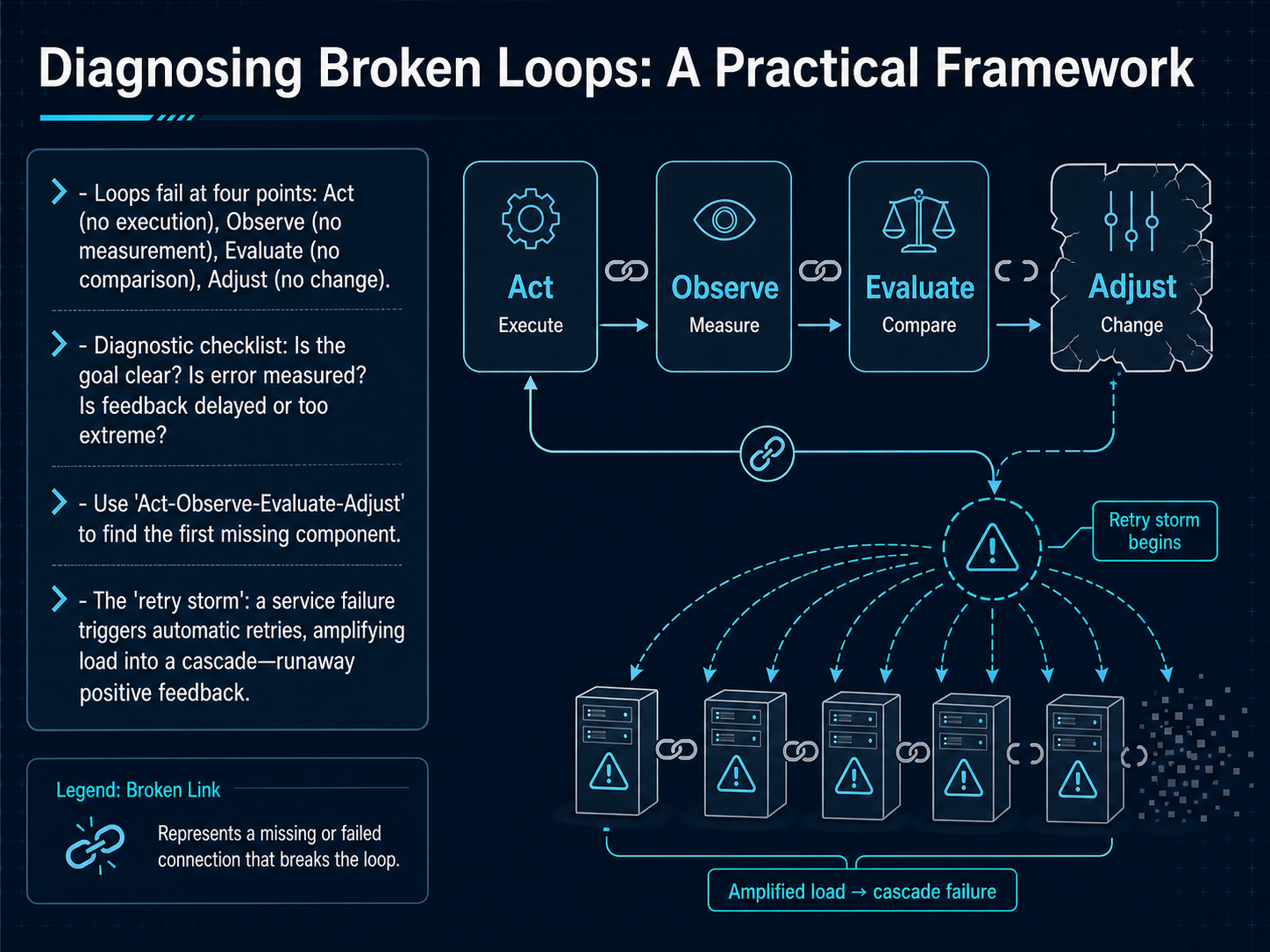
2 min - 10Diagnosing Broken Loops: A Practical FrameworkAlright, let's move from how loops should work to how they actually break. This slide gives you a practical way to diagnose failures. Think of it as a quick troubleshooting framework. Loops fail at exactly four points, which map directly to our Act, Observe, Evaluate, and Adjust model. A failure to Act means no action was taken. A failure to Observe means we didn't measure the result. A failure to Evaluate means we never compared the result to the goal. And a failure to Adjust means we saw the error but didn't change anything. When you're diagnosing a problem, just walk through that list in order and find the first missing component. Your checklist is simple: Is the goal clear? Is the error actually being measured? And is the feedback delayed or so extreme that it overshoots? A classic example of this is the retry storm. Imagine a service call fails, so the system automatically retries. But the original request hasn't finished, so now you've doubled the load, causing more failures, more retries, and a total cascade. That's runaway positive feedback in action. Up next, we'll look at real-world failure patterns, specifically what happens when information is missing or distorted.
 2 min
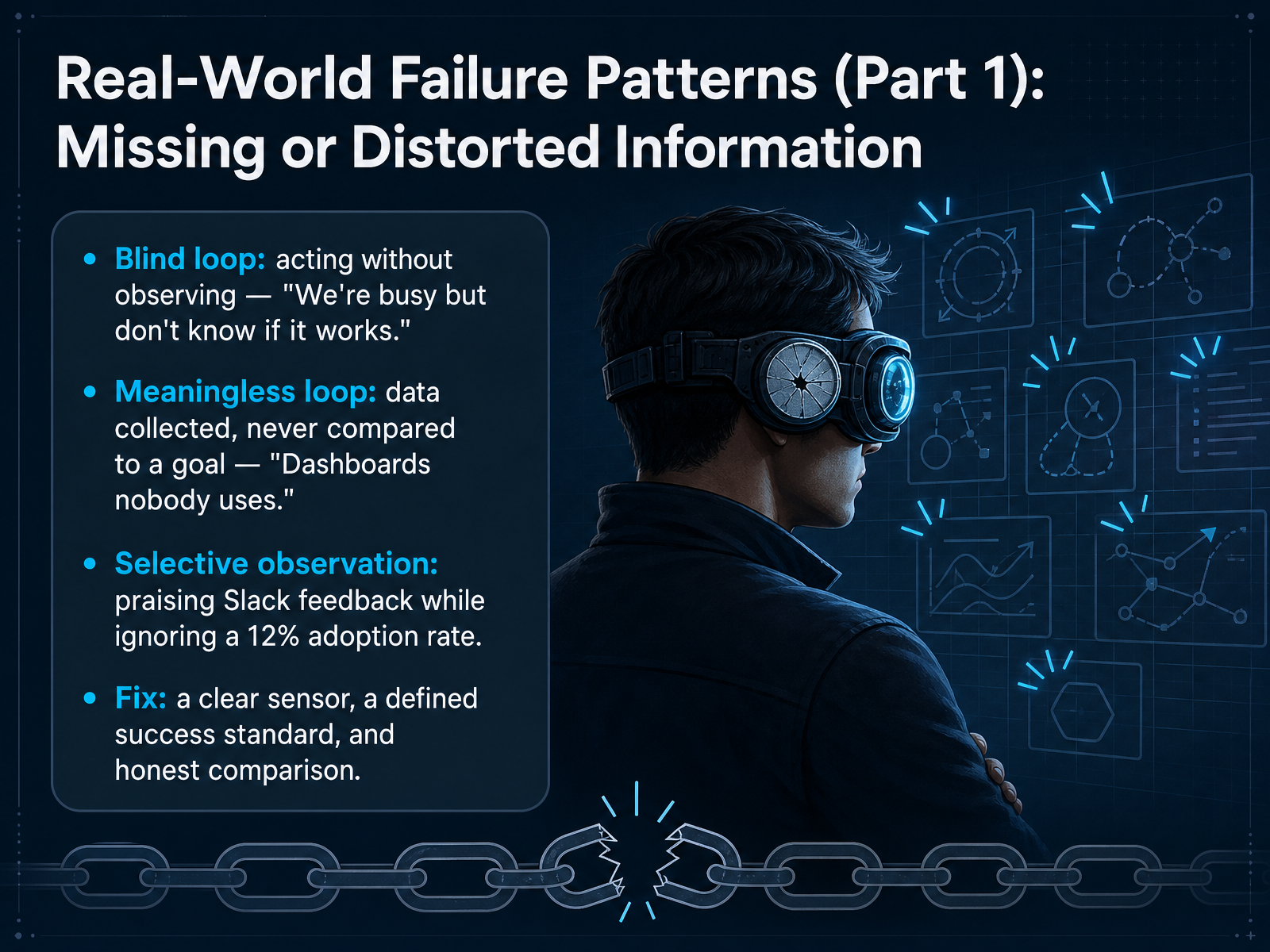
2 min - 11Real-World Failure Patterns (Part 1): Missing or Distorted InformationLet's look at how feedback loops break when information goes missing or gets distorted. First, the blind loop. This is when a team acts without observing the result. They're busy executing, but nobody stops to check whether the action actually moved the needle. You hear things like, 'We're really busy, but we're not sure if any of it is working.' Next, the meaningless loop. Data gets collected, reports get generated, dashboards light up, but nobody ever compares that data to a specific goal. The information exists, but it never informs a correction. You end up with dashboards that look impressive but nobody actually uses to make decisions. Then there's selective observation. This one is sneaky. A team might praise the positive feedback they get on Slack while completely ignoring a twelve percent adoption rate. They're observing, but only the information that feels good. The fix for all three is straightforward. You need a clear sensor, something that actually measures what matters. You need a defined success standard, a number or threshold you compare against. And you need honest comparison, the discipline to look at the gap even when it's uncomfortable. Without those three, your loop isn't really a loop. Now, missing information is one thing, but even with good data, your control system can still fail if the response comes too late. That's what we'll cover next in real-world failure patterns part two, delays and inaction.
 2 min
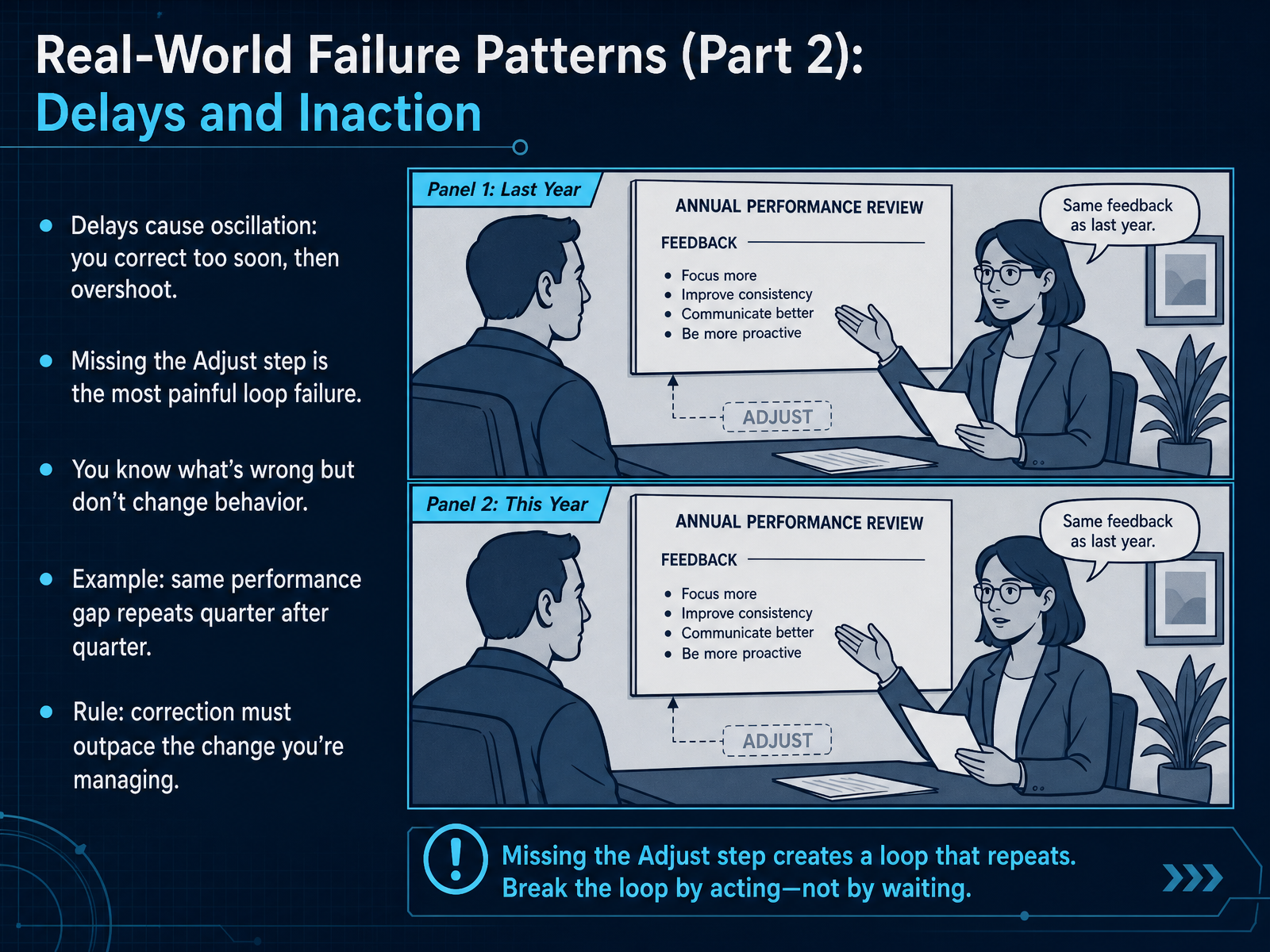
2 min - 12Real-World Failure Patterns (Part 2): Delays and InactionLet's move from external shocks to a trickier problem: delays and inaction. Imagine you're adjusting a shower knob. If the hot water takes ten seconds to arrive, you'll likely crank it further and then suddenly get scalded. That's exactly what delays do in a control system. You correct too soon, based on old information, and then you overshoot wildly. This oscillation isn't random; it's a direct result of a delayed feedback signal. Now, an even more painful failure is simply skipping the adjust step entirely. This is when you can see the gap, you know what's wrong, but you don't change your behavior. Think of a key performance gap that repeats quarter after quarter. The measurement is there, the goal is clear, but the action never happens. The loop is broken, and the system just drifts. The core rule here is simple: your correction speed must outpace the change you're managing. If the situation shifts faster than you can react, you lose control. Next, we'll turn this insight into a practical skill in 'Tuning for Success: The Art of Not Overshooting'.
 2 min
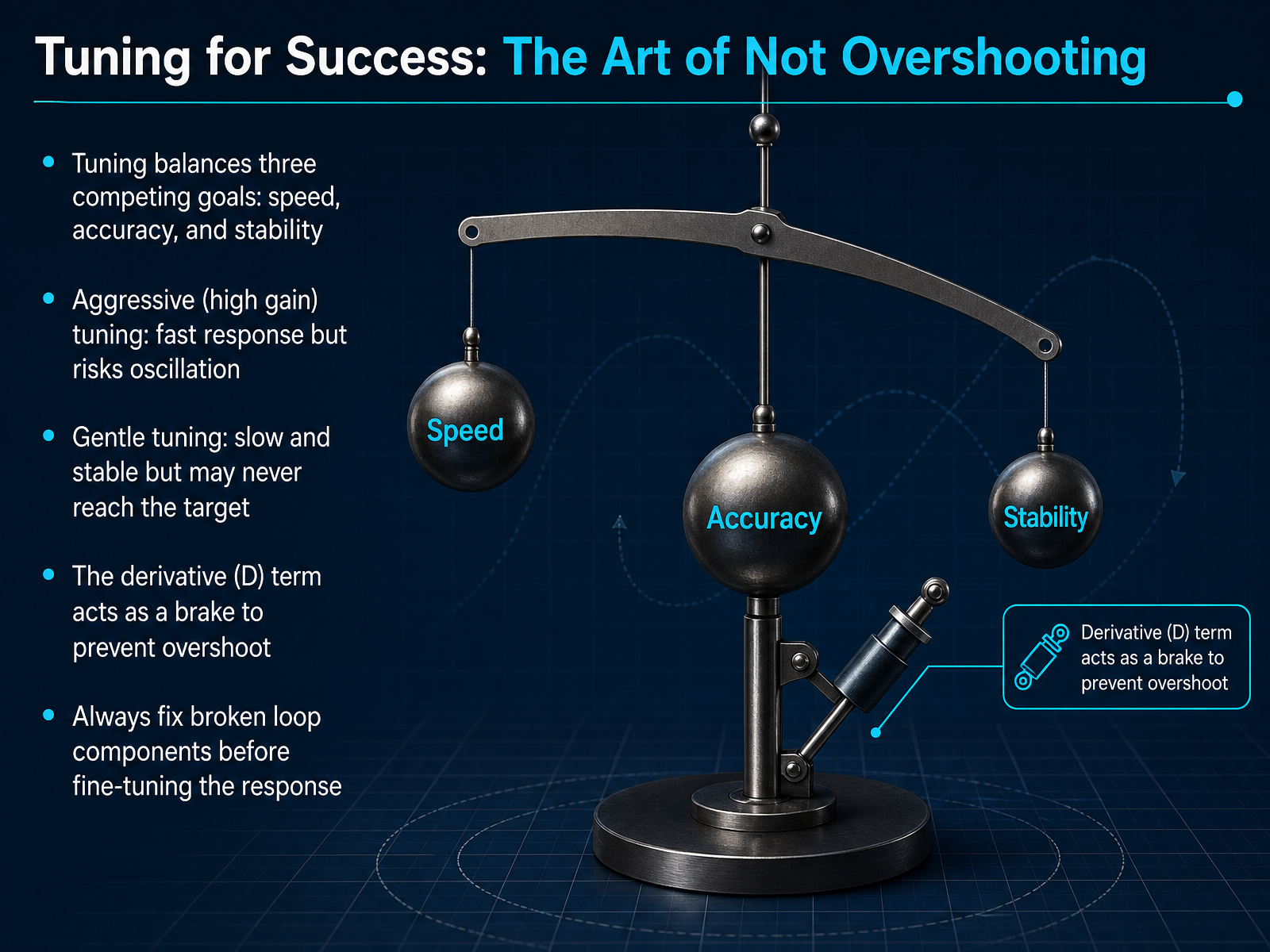
2 min - 13Tuning for Success: The Art of Not OvershootingNow that we understand feedback and stability, let's talk about how we actually tune a system for the real world. It's really about balancing three things that are always fighting each other: speed, accuracy, and stability. You can't have all three perfectly at once. If you tune a controller very aggressively, with high gain, it responds fast. The system jumps toward the target quickly. But that energy makes it prone to overshoot and oscillation. It races past the set point, then slams back, and does it again. On the other hand, a gentle tuning is slow and stable. It approaches the target smoothly, but it might take forever to get there, or it might never fully eliminate the steady-state error. So where does the balance come from? From the derivative term, the D term. Think of D as a smart brake. It looks at the rate of change. As the error shrinks fast and the system rushes toward the target, the derivative action pushes back. It pulls the response back just before it overshoots. But here is the single most important thing: before you fine-tune any of these numbers, first make sure the loop itself is healthy. If a sensor is sticky or a valve has stiction, no amount of tuning will fix the oscillation. Fix the broken components first, then tune the response. Up next, we will apply this control system lens in a simple three-step approach.
 2 min
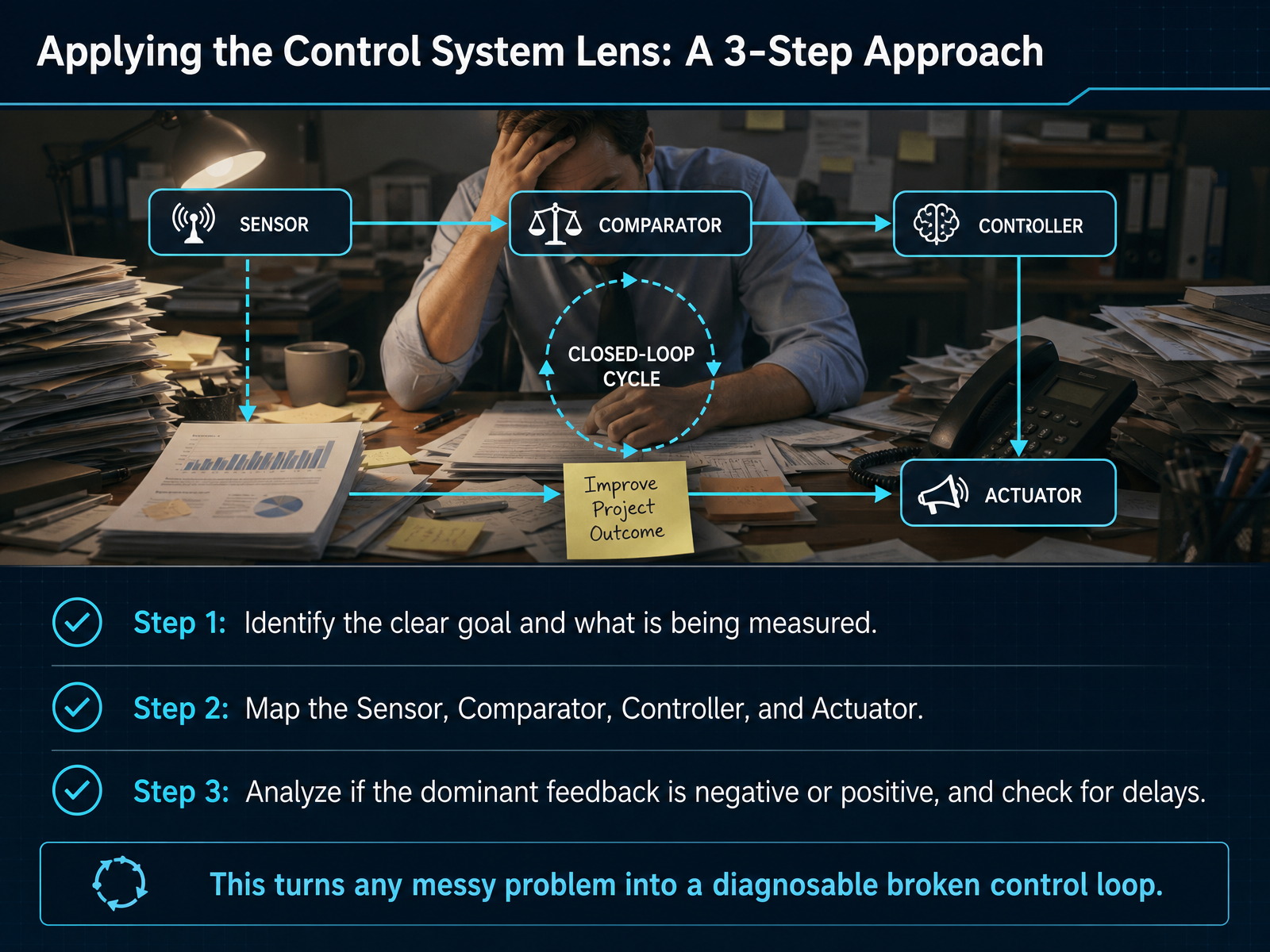
2 min - 14Applying the Control System Lens: A 3-Step ApproachSo how do we actually apply this control system lens to something messy in the real world? It boils down to three simple steps. First, you need absolute clarity on the goal. What is the target state, and what specific thing are you measuring to know you’re on track? Second, map the physical parts. Find the sensor that observes the current state, the comparator that calculates the error, the controller that decides what to do, and the actuator that physically makes the change. Third, analyze the loop’s behavior. Is the dominant feedback negative, meaning it balances and corrects errors, or is it positive, meaning it amplifies them and runs away? You also have to check for delays, because a slow signal can make a negative feedback loop swing wildly out of control. This three-step approach turns any confusing problem, a runaway stock price, a stalled project, a sputtering engine, into a broken control loop you can actually diagnose. Next, let’s pull all these threads together in our final summary, where we’ll see that feedback turns error into correction, and stability is what keeps that correction safe.
 2 min
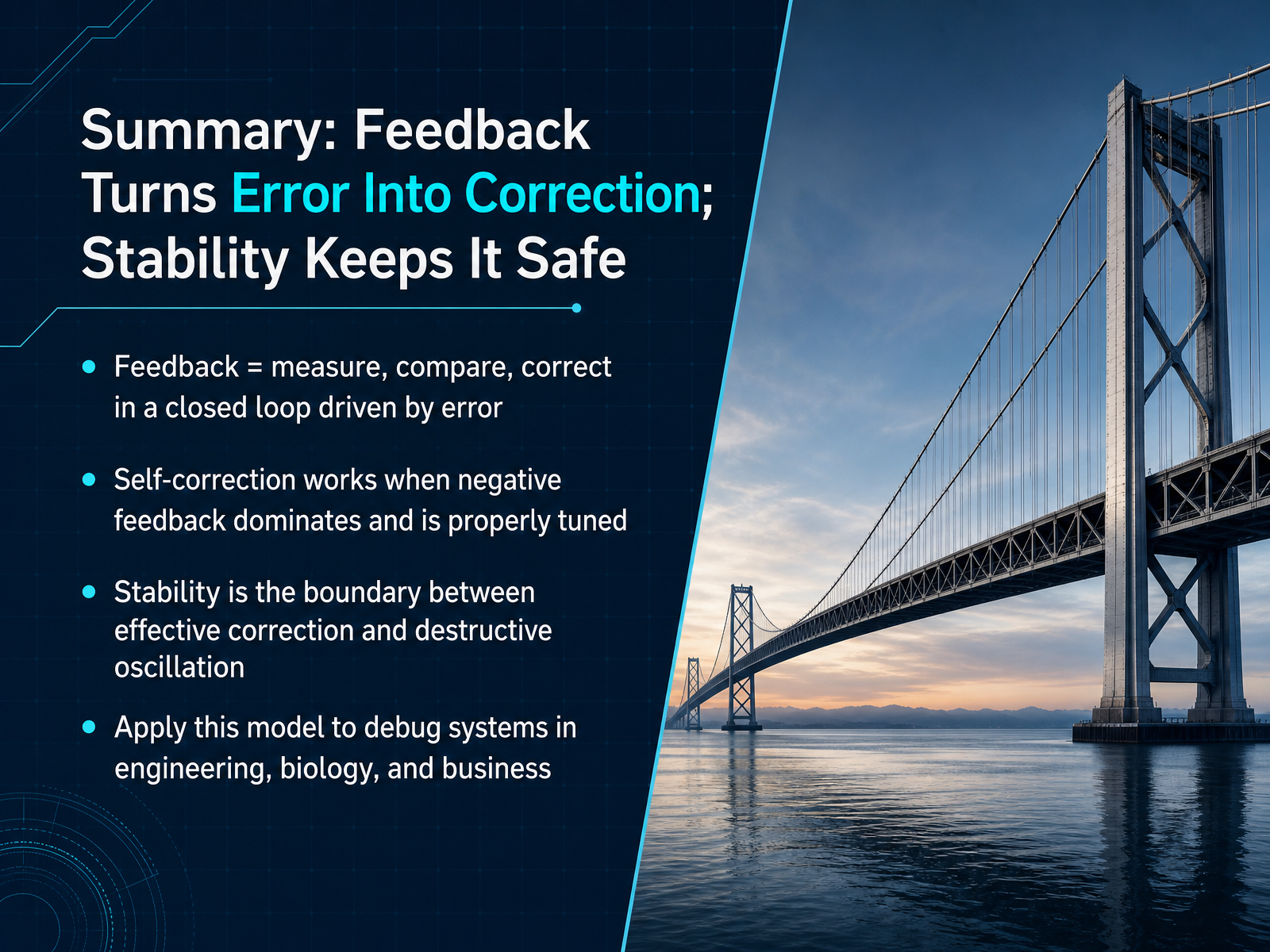
2 min - 15Summary: Feedback Turns Error Into Correction; Stability Keeps It SafeSo, let's bring it all together. At its heart, feedback is a closed loop where you measure what's happening, compare it to a target, and then correct the difference. That difference is the error, and it's the very thing that drives self-correction. The system works when negative feedback dominates and is properly tuned. Think of a thermostat that calmly corrects the temperature without overreacting. But if that correction fights against delays or becomes too aggressive, you cross a line from stability into oscillation. That boundary is what we call stability, and respecting it keeps your system safe rather than destructive. You can apply this model to debug almost anything: an engineering circuit, a biological process like blood sugar regulation, or even a business that keeps overcorrecting its inventory. Remember, error is not the enemy. It is the signal that drives correction, and stability is what keeps that correction on track. Thank you for joining me, and I encourage you to go find a system that's misbehaving and trace the feedback loop. You'll see exactly where it needs tuning.
 2 min
2 min
Take the deck with you
Download this course as a file — free, no sign-up needed.
- PDF handoutEvery slide page, ready to print or share.16 pages · 4.1 MBDownload
- Narrated PowerPointThe deck that presents itself — every slide carries the digital human's narration video.16 pages · 29.5 MBDownload
- PowerPoint slidesThe full deck as a .pptx — open it in PowerPoint, Keynote, or Google Slides.16 pages · 4.0 MBDownload
Free to use in your own training — please keep the PersonWise credit page at the end.
Have your own deck? Turn it into a course
Sources consulted
Web sources consulted while building this course.
- 9.7: Homeostasis and Feedback - Biology LibreTexts — bio.libretexts.org
- Feedback Control Systems | Understanding Control Systems, Part 2 - MATLAB — mathworks.com
- 1.5 Control Systems and Homeostasis - Biology LibreTexts — bio.libretexts.org
- 1.5 Homeostasis - Anatomy and Physiology | OpenStax — openstax.org
- NEGATIVE FEEDBACK LOOP EXAMPLES — www1.gill-line.com