Begin
14 pages · ~28 min
AI Literacy Roles and Responsibilities
This training clarifies AI roles, responsibilities, and handoffs, helping team members understand who owns what and collaborate effectively across the AI lifecycle.
A digital instructor presents all 14 pages. Hold “Ask” at any point and ask out loud — the answer comes from this course. No sign-up needed.
What you’ll learn
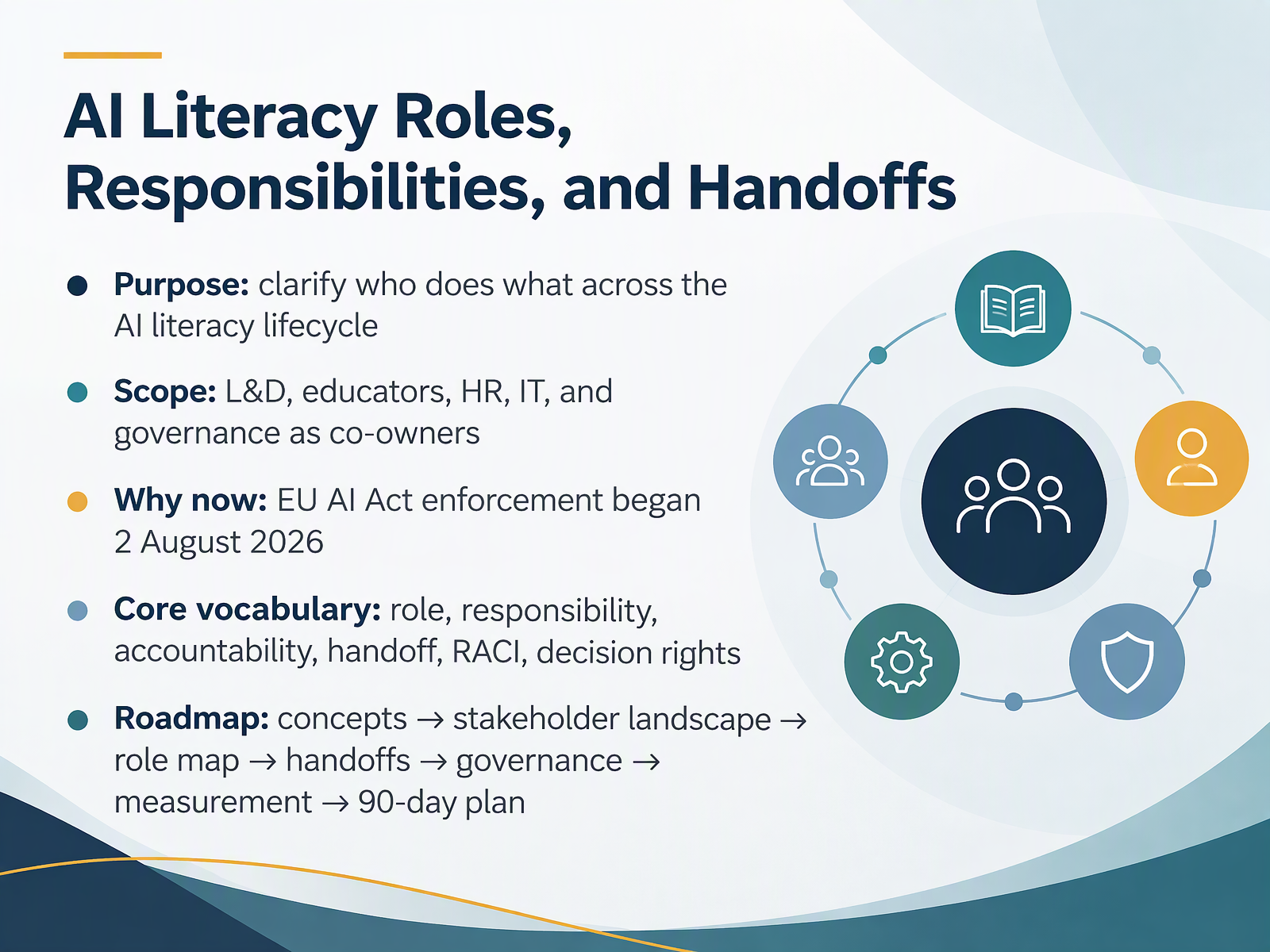
- 01AI Literacy Roles, Responsibilities, and HandoffsWelcome. This course is about who does what in AI literacy, and how work moves between teams without getting dropped.
Here is our purpose. We want to make roles clear across the whole AI literacy lifecycle, from first planning to ongoing support.
Our scope is shared. Learning and development, educators, HR, IT, and governance all co-own this work.
Why now? Enforcement of the EU AI Act began on second August, twenty twenty-six. That makes clear ownership practical, not theoretical.
We will use six plain terms. A role is a set of duties. A responsibility is the work itself. Accountability means answering for the outcome. A handoff is when work passes to another team. RACI is a simple grid for who does, decides, consults, and is informed. Decision rights define who has the final say. We will define each one as we go.
Our roadmap has seven stops. First concepts, then the stakeholder landscape, a role map, handoffs, governance, measurement, and a ninety-day plan.
One next step. Think of one handoff on your team that often goes wrong. Hold it in mind as we go.
Next, we look at why role clarity is the real bottleneck.digital-strategy.ec.europa.eudigital-strategy.ec.europa.euinformationpolicycentre.com+22 min
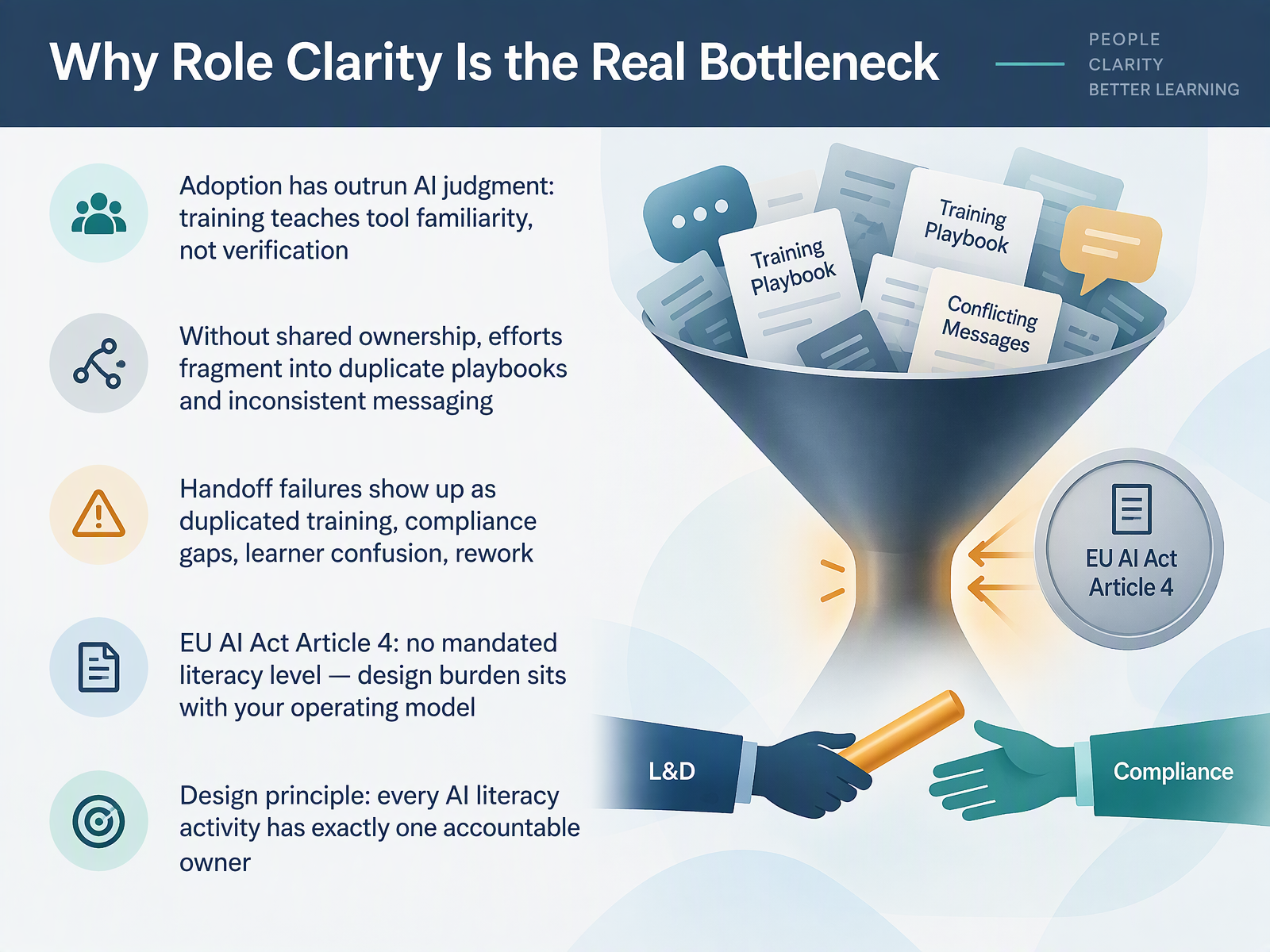
- 02Why Role Clarity Is the Real BottleneckLet's look at where these programs actually get stuck. The real bottleneck is role clarity. Adoption has outrun AI judgment. Most training teaches tool familiarity, but skips verification. People learn which buttons to press, not how to check what comes back. Without shared ownership, efforts fragment. One team builds its own playbook, another writes a different one, and the messaging conflicts. Handoff failures show up as duplicated training, compliance gaps, learner confusion, and rework. Here is the legal context. Under European Union AI Act Article 4, no specific literacy level is mandated. The design burden sits with your operating model, not with a government checklist. So adopt one design principle. Every AI literacy activity has exactly one accountable owner. One named person per activity. Your next step is to list your current activities and write a single name beside each one.
 digital-strategy.ec.europa.eudigital-strategy.ec.europa.euinformationpolicycentre.com+22 min
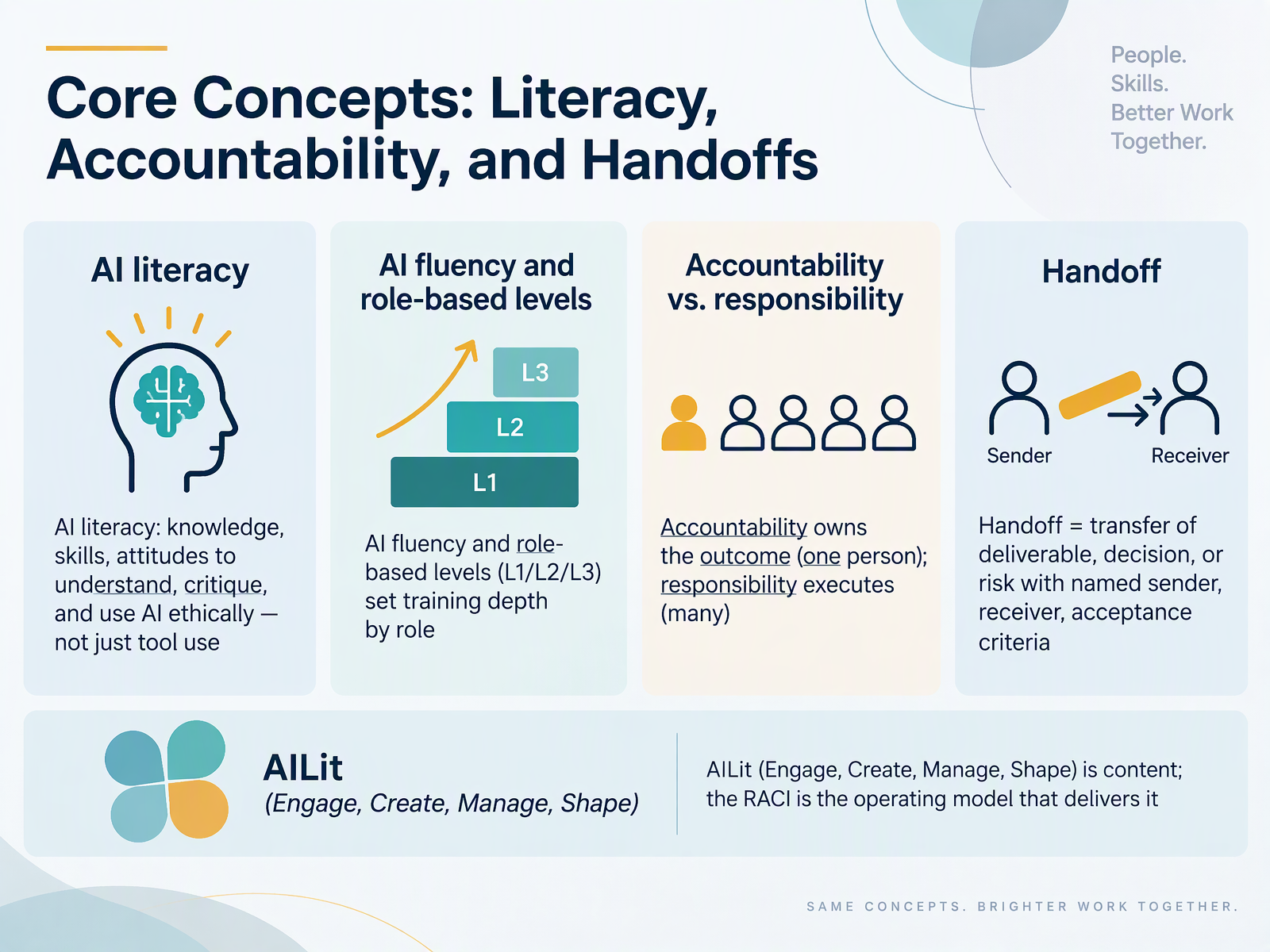
- 03Core Concepts: Literacy, Accountability, and HandoffsLet's ground a few core concepts before we build anything. First, AI literacy. That means knowledge, skills, and attitudes: understanding how AI works, critiquing its output, and using it ethically. It is not just tool use. Second, AI fluency comes in levels. Level one, level two, level three. You set training depth by role, so a frontline user and an oversight lead get different material. Third, accountability and responsibility are different. Accountability owns the outcome, and it sits with one person. Responsibility executes the work, and many people can hold it. Fourth, a handoff. That is a transfer of a deliverable, a decision, or a risk. Every handoff needs a named sender, a named receiver, and acceptance criteria. Here is one example. A training manager hands a finished module to a compliance reviewer. The reviewer confirms it against the criteria before it ships. Fifth, keep the two layers separate. AILit, the Engage, Create, Manage, Shape domains, is your content. The RACI is the operating model that delivers it. Your next step: pick one handoff on your team and name the sender, the receiver, and the acceptance criteria this week. That naturally raises the question of role levels, so let's look at the definition check: what literacy level does each role need?
 oecd.orgunesco.orgoecd.org+22 min
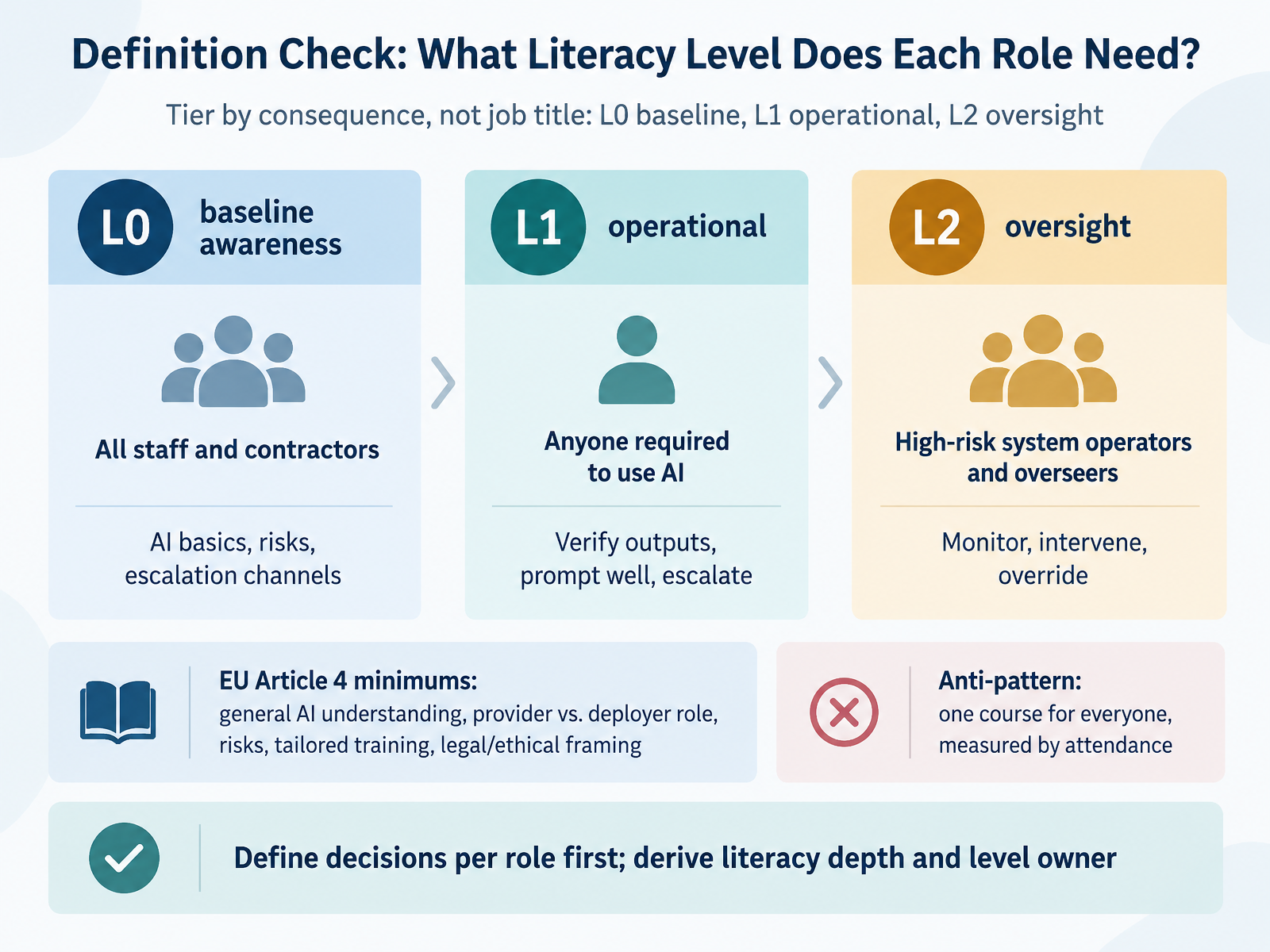
- 04Definition Check: What Literacy Level Does Each Role Need?Let's do a quick definition check. What literacy level does each role actually need? Start with one rule. Tier by consequence, not job title. Level zero is the baseline for all staff and contractors. It covers AI basics, key risks, and how to escalate. Level one is for anyone required to use AI. They learn to verify outputs, prompt well, and escalate when needed. Level two is for people who operate or oversee high-risk systems. They monitor, intervene, and override. Under EU Article 4, the minimums are modest. General understanding, knowing whether you are a provider or deployer, awareness of risks, tailored training, and a legal and ethical frame. Avoid the common trap. One course for everyone, measured by attendance. Instead, define the decisions each role makes first. Then derive literacy depth, and name who owns each level. As you do this, you'll want to see who sits where, which is our next topic, The Stakeholder Landscape.
 dol.govinterface-eu.orgmedia.datacamp.com+22 min
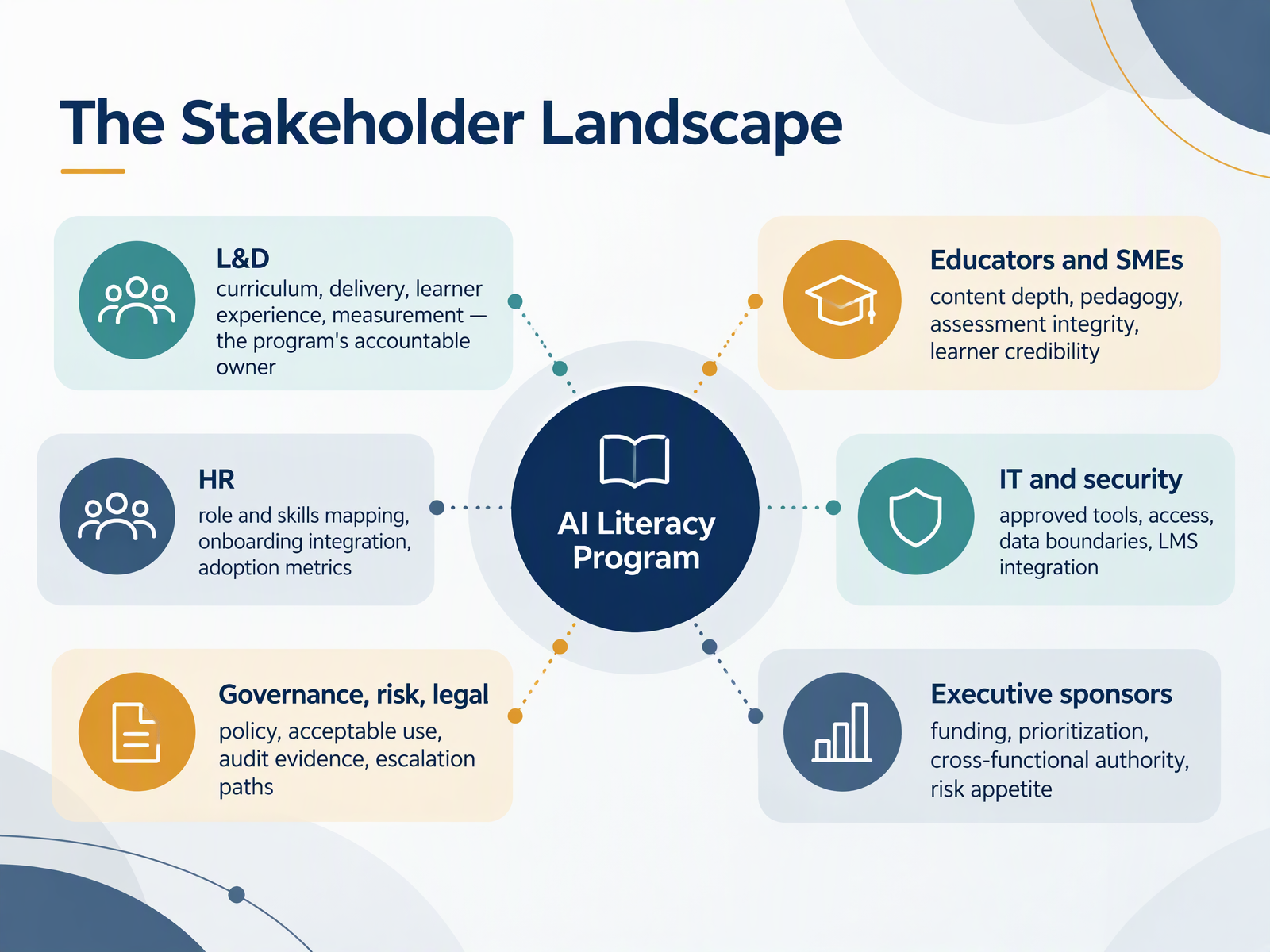
- 05The Stakeholder LandscapeLet's map the stakeholder landscape. Six groups shape an AI literacy program, and each owns something distinct. Learning and development owns the program itself: curriculum, delivery, learner experience, and measurement. Think of L and D as the accountable owner who keeps the whole thing moving. Educators and subject matter experts protect content depth, pedagogy, assessment integrity, and learner credibility. A practical example: an expert reviews a module's technical claims before it ships. HR maps roles and skills, integrates the program into onboarding, and tracks adoption. IT and security approve tools, manage access, set data boundaries, and handle LMS integration. Governance, risk, and legal set policy, acceptable use, audit evidence, and escalation paths. Executive sponsors provide funding, set priorities, lend cross-functional authority, and define risk appetite. Here is the key idea: overlaps are normal, but ambiguity is not. So your next step is to pick one program decision, and confirm exactly which group owns it, which supports, and which stays informed. That brings us to the role map, who owns what.
 get.opensesame.comaction.deloitte.comtantaholdings.com+22 min
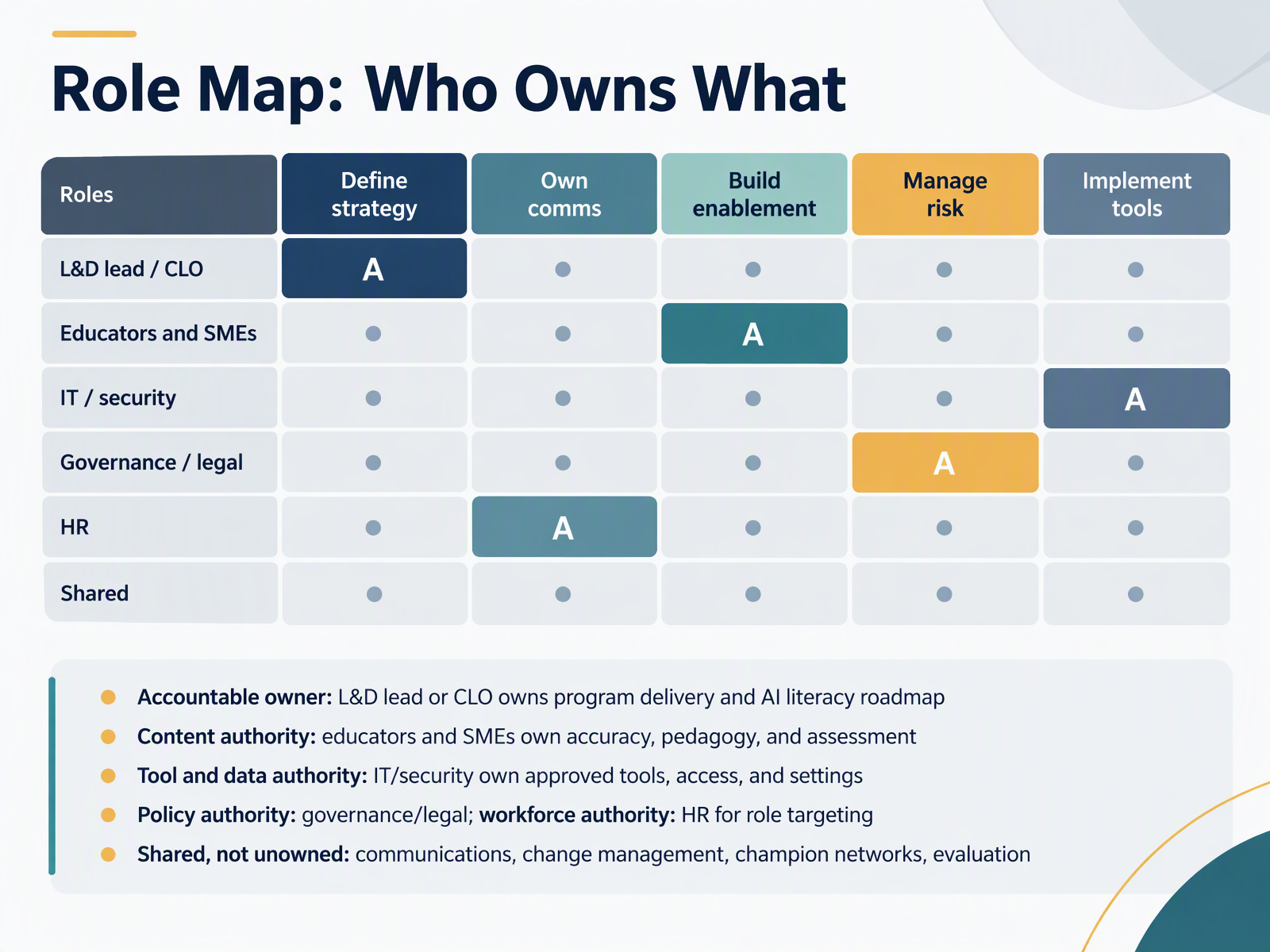
- 06Role Map: Who Owns WhatNow let's look at the role map and who owns what. The accountable owner is your L and D lead or chief learning officer. They own program delivery and the AI literacy roadmap. Next, content authority. Educators and subject matter experts own accuracy, pedagogy, and assessment. Third, tool and data authority. IT and security own approved tools, access, and settings. Policy authority sits with governance and legal, while workforce authority sits with HR for role targeting. And here's the key point. Communications, change management, champion networks, and evaluation are shared, not unowned. So name a single owner for each box this week, and agree in writing how those shared items get coordinated. That small step prevents the gaps that stall programs. Building Your RACI Without the Dust.
 get.opensesame.comaction.deloitte.comtantaholdings.com+22 min
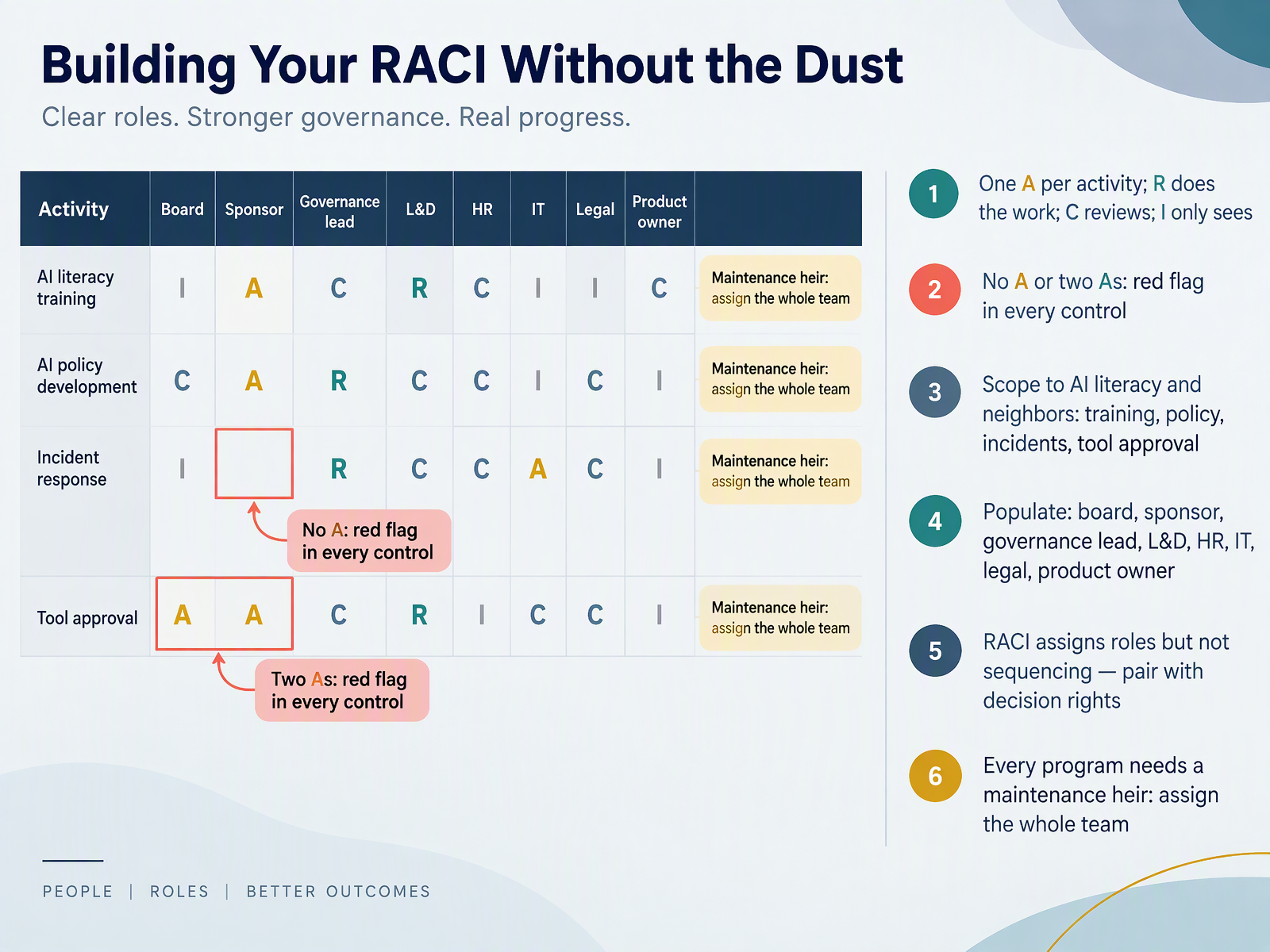
- 07Building Your RACI Without the DustNow let's build your responsibility map, a RACI, without letting it gather dust. RACI means responsible, accountable, consulted, and informed. One person is responsible and does the work. One person is accountable and owns the outcome. Others are consulted before decisions, or simply informed. Keep exactly one accountable person per activity. No A, or two As, is a red flag in every control you review. Scope your chart to AI literacy and its neighbors: training, policy, incidents, and tool approval. Then fill the rows: board, sponsor, governance lead, L and D, HR, IT, legal, and the product owner. Remember that a RACI assigns roles, not order, so pair it with decision rights. And name a maintenance heir for every program, ideally a whole team, so the work survives when one person leaves. Next, we look at critical handoff points across the program lifecycle.
 get.opensesame.comaction.deloitte.comtantaholdings.com+22 min
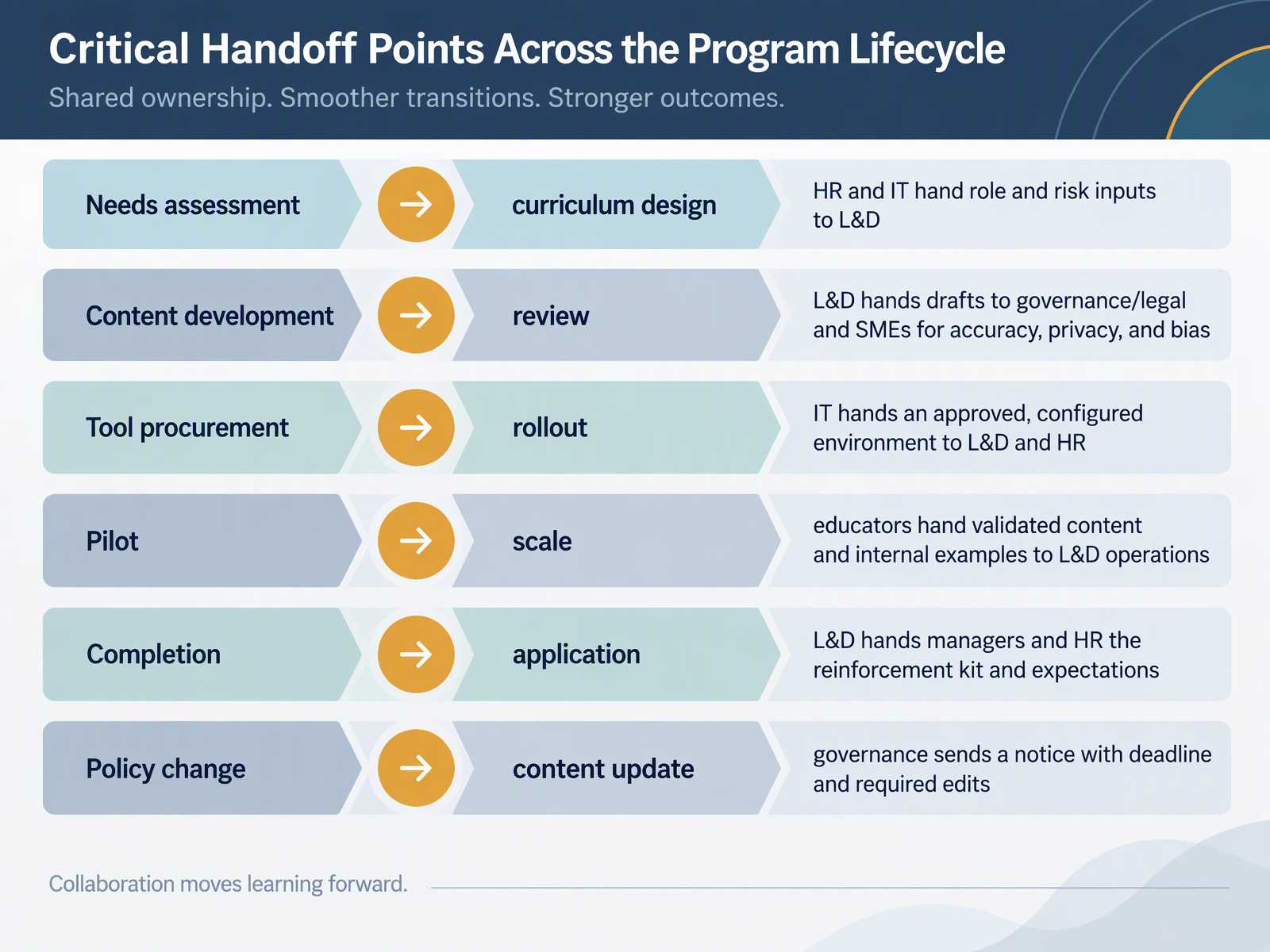
- 08Critical Handoff Points Across the Program LifecycleLet's look at the handoff points across the program lifecycle. Six moments matter most, and each needs a named owner. First, needs assessment to curriculum design. HR and IT hand role and risk inputs to L&D. Second, content development to review. L&D hands drafts to governance, legal, and subject matter experts to check accuracy, privacy, and bias. Third, tool procurement to rollout. IT hands an approved, configured environment to L&D and HR. Fourth, pilot to scale. Educators hand validated content and internal examples to L&D operations. Fifth, completion to application. L&D hands managers and HR the reinforcement kit and clear expectations. Sixth, a policy change to a content update. Governance sends a notice with a deadline and the required edits. So pick one handoff this week, and write down what done looks like. Next, we'll cover designing reliable handoffs.
 2 min
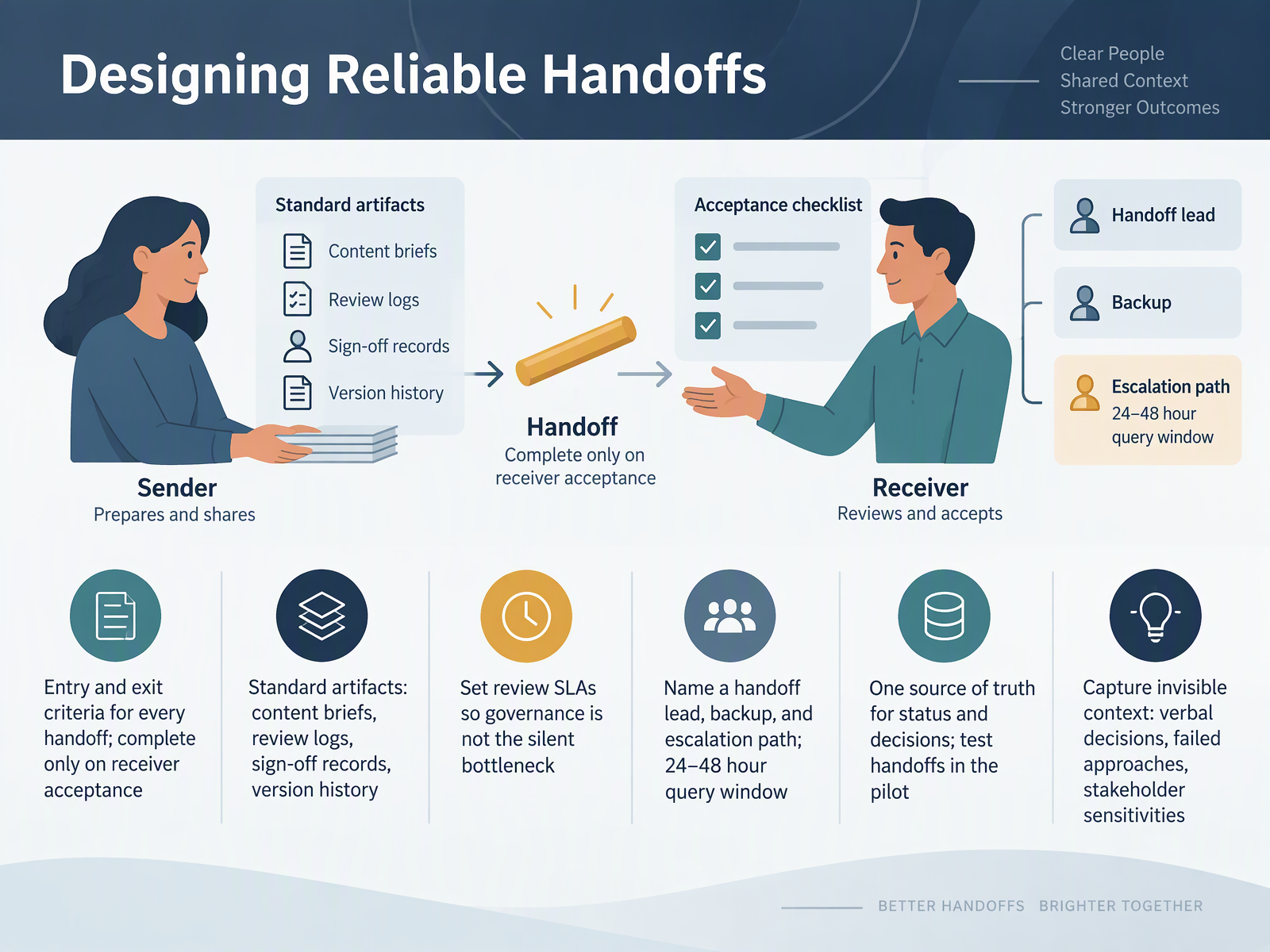
- 09Designing Reliable HandoffsHere is where handoffs stop depending on goodwill. Give every handoff entry and exit criteria, and treat it as complete only when the receiver accepts it. Standardize the artifacts: a content brief, a review log, sign-off records, and version history. Set review service level agreements so governance is not the silent bottleneck. Name a handoff lead, a backup, and an escalation path, with a twenty-four to forty-eight hour window for queries. Keep one source of truth for status and decisions, and test the handoffs in your pilot. Finally, capture the invisible context: verbal decisions, failed approaches, and stakeholder sensitivities. One practical step: write exit criteria for your next handoff this week. Governance, Risk, and Compliance Interfaces.
 1 min
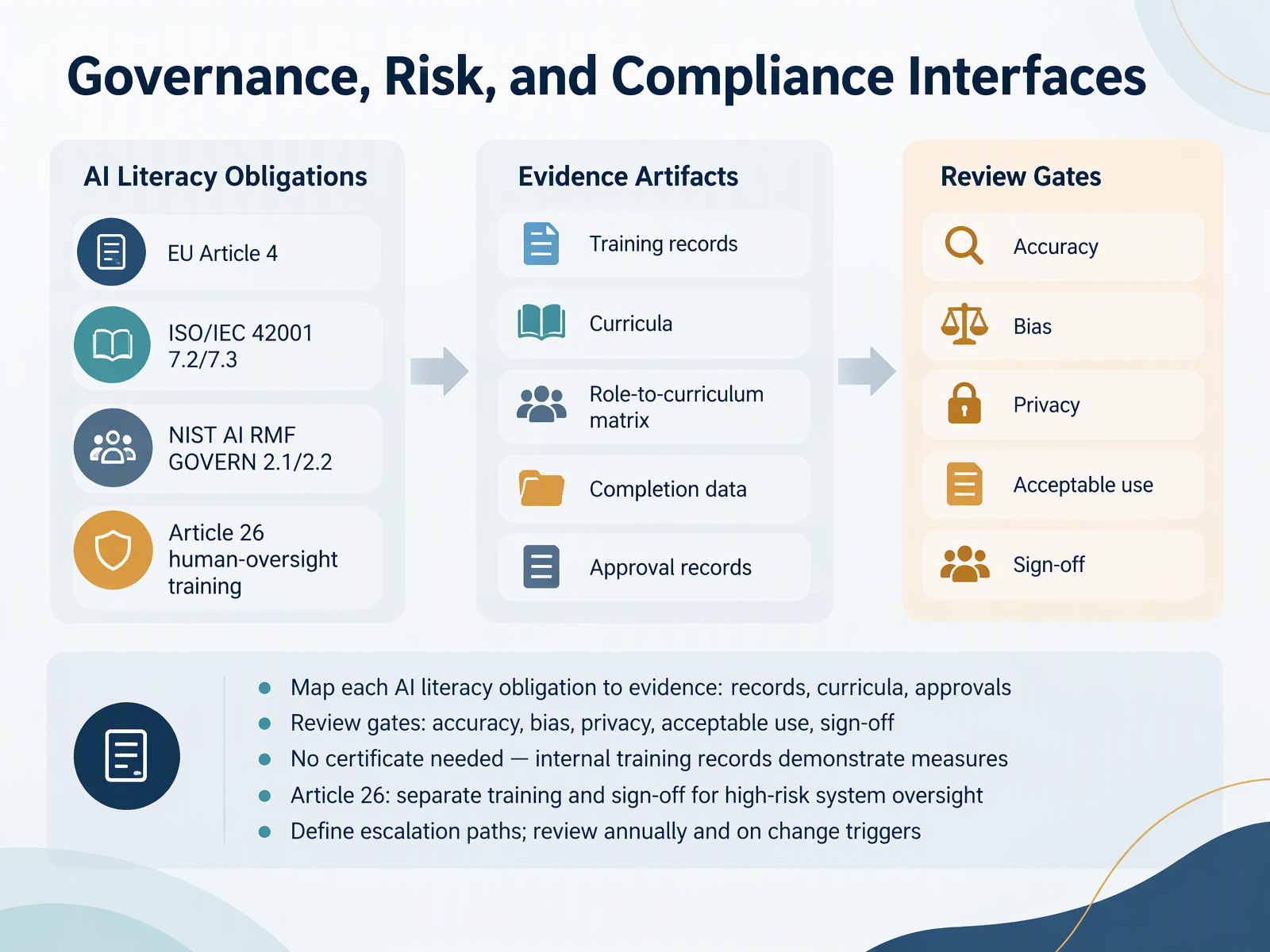
- 10Governance, Risk, and Compliance InterfacesNext, let's look at your governance, risk, and compliance interfaces. Start by mapping each AI literacy obligation to evidence: training records, curricula, and sign-offs. Then set review gates for accuracy, bias, privacy, acceptable use, and formal approval. Here is the reassuring part. You do not need a certificate. Internal training records are enough to show your measures. One distinction matters. Under Article Twenty-Six, deployers of high-risk systems need separate training and sign-off for human oversight. So treat that as its own track. Also define your escalation paths in plain terms. Who does a team member call when something looks wrong? Finally, review this setup annually and whenever a change trigger fires, such as a new model, a new vendor, or a new regulation. Your next step is simple. List your three most important obligations and name the evidence that proves each one. That leads us into measurement: shared metrics, named owners.
 digital-strategy.ec.europa.eudigital-strategy.ec.europa.euinformationpolicycentre.com+22 min
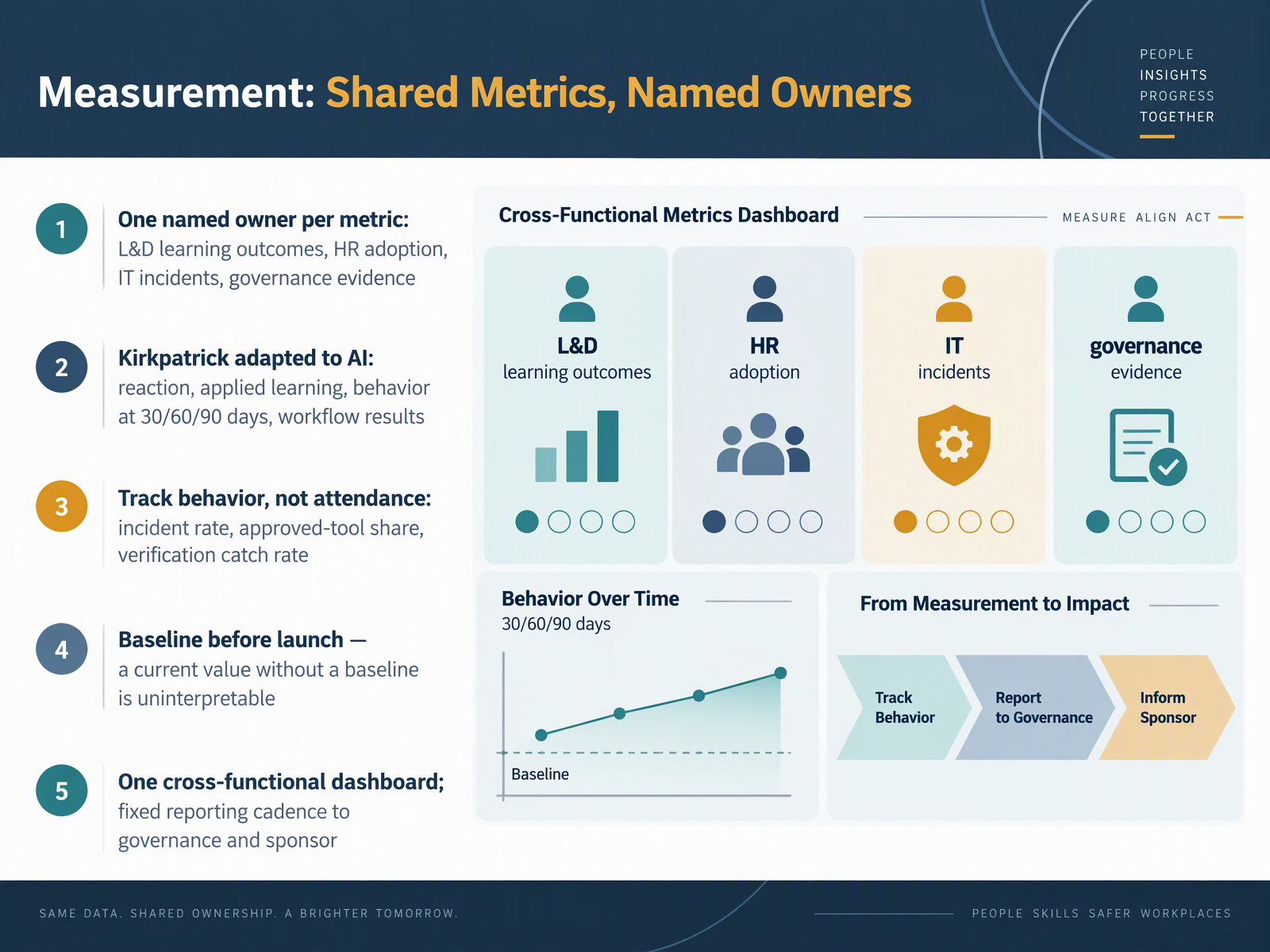
- 11Measurement: Shared Metrics, Named OwnersNext, let's talk about measurement. The principle here is simple. Every metric gets one named owner. L and D owns learning outcomes. HR owns adoption. IT owns incidents. Governance owns evidence. Then apply Kirkpatrick, adapted for AI. Measure reaction right away. Measure applied learning with a practical task, like spotting a planted error. Measure behavior at thirty, sixty, and ninety days. Measure workflow results after that. Track behavior, not attendance. Watch incident rate, approved-tool share, and verification catch rate. And baseline before launch. A current value without a baseline is uninterpretable. Put it all on one cross-functional dashboard, with a fixed reporting cadence to governance and the sponsor. Your next step: write one metric owner's name on the dashboard this week. That sets up our next topic, Escalation Triggers and the Review Cadence.
 get.opensesame.comaction.deloitte.comtantaholdings.com+22 min
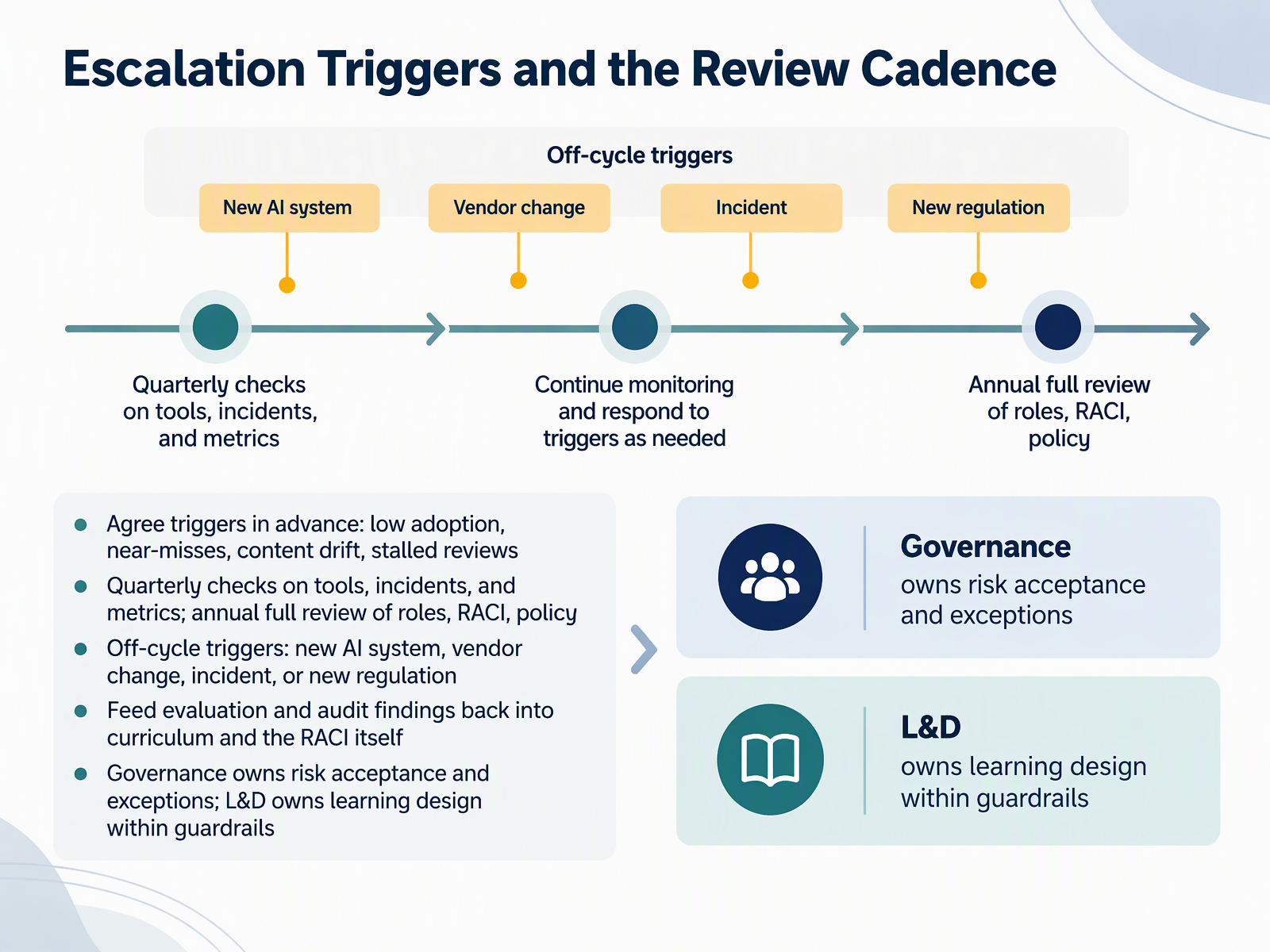
- 12Escalation Triggers and the Review CadenceNext, let's talk about escalation triggers and the review cadence. Agree your triggers in advance. That means low adoption, near-misses, content drift, and stalled reviews. For example, if a quarter passes with few learners using an approved tool, that's a signal, not a surprise. Then set a rhythm. Run quarterly checks on tools, incidents, and metrics. Do a full annual review of roles, the responsibility matrix, and policy. Some triggers sit off-cycle. A new AI system, a vendor change, an incident, or a new regulation all warrant an early look. When evaluations and audits surface findings, feed them back into the curriculum and into the responsibility matrix itself. And keep ownership clear. Governance owns risk acceptance and exceptions. Learning and development owns learning design within those guardrails. One next step. Draft your trigger list this week, and name who receives each escalation. In the practice lab ahead, you'll diagnose a broken handoff.
 digital-strategy.ec.europa.eudigital-strategy.ec.europa.euinformationpolicycentre.com+22 min
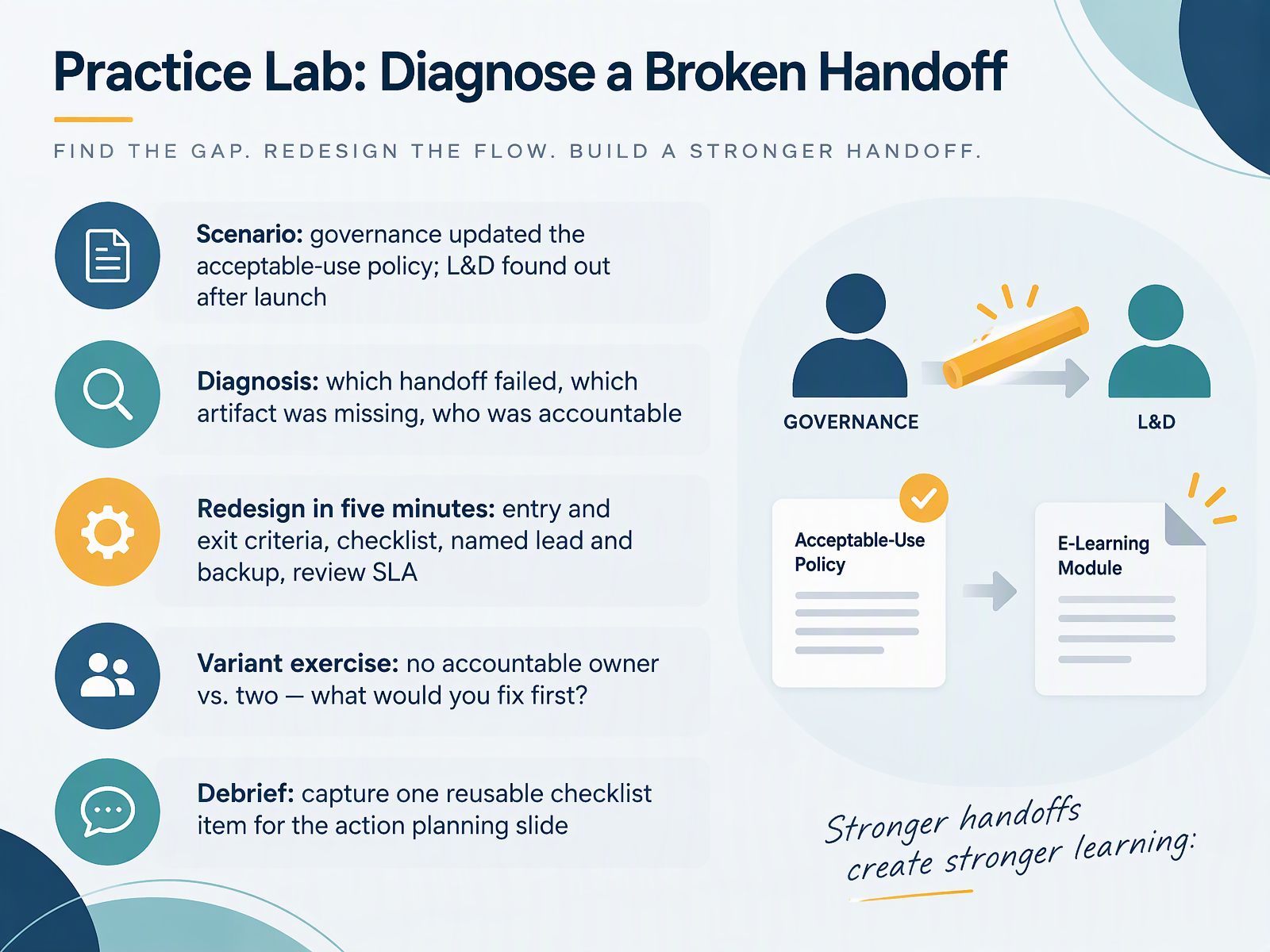
- 13Practice Lab: Diagnose a Broken HandoffNow let's put diagnosis into practice. Here's the scenario. Governance updated the acceptable-use policy. L&D found out after launch. Take a moment and ask three questions. Which handoff failed? Which artifact was missing? Who was accountable? In most cases, the breakdown sits in a missing entry or exit criterion, or a checklist nobody owned. Next, redesign the handoff in five minutes. Define entry and exit criteria. Add a short checklist. Name a lead and a backup. Agree a review service level, meaning the time the receiving team has to respond. Then try the variant exercise. Compare two cases, one with no accountable owner and one with two. Decide what you would fix first. Close the lab by capturing one reusable checklist item for the action planning slide. That single item is your takeaway. In the next section, we turn this into your role map and first ninety days.
 2 min
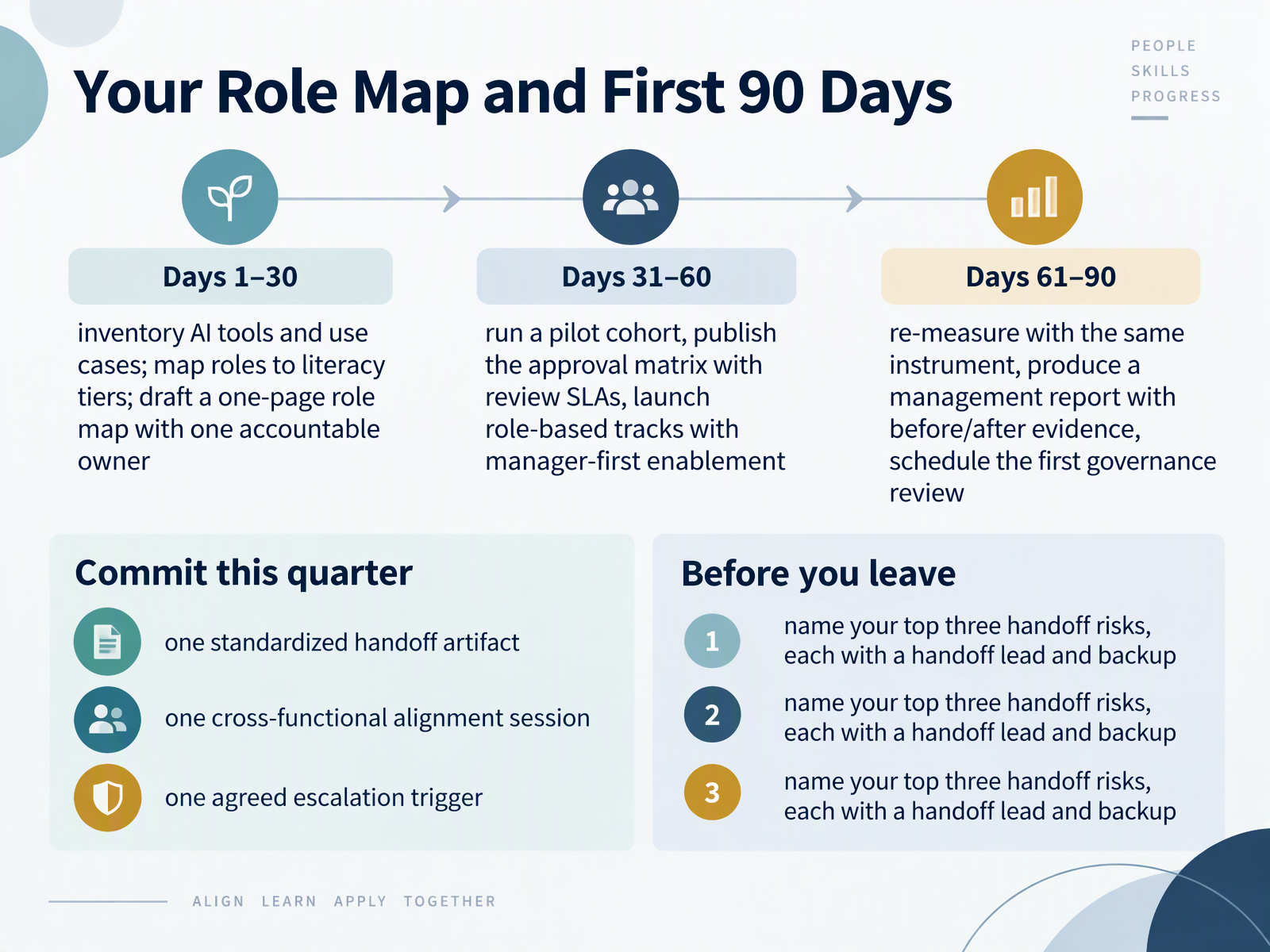
- 14Your Role Map and First 90 DaysLet's close by turning everything into a plan you can actually run. Start your first thirty days with an inventory: list the AI tools and use cases, map roles to literacy tiers, and draft a one-page role map with one accountable owner. For example, one page that names who owns each tier, signed off by a single owner. Days thirty-one to sixty: run a pilot cohort, publish the approval matrix with review time commitments, and launch role-based tracks, training managers first. Days sixty-one to ninety: re-measure with the same instrument, produce a management report with before-and-after evidence, and schedule your first governance review. Commit this quarter to three things: one standardized handoff artifact, one cross-functional alignment session, and one agreed escalation trigger. Before you leave today, name your top three handoff risks, and give each a handoff lead and a backup. That is a small, doable start. Thank you for your attention, and go build your role map with confidence.
 2 min
Take the deck with you
Download this course as a file — free, no sign-up needed.
- PDF handoutEvery slide page, ready to print or share.15 pages · 3.1 MBDownload
- Narrated PowerPointThe deck that presents itself — every slide carries the digital human's narration video.15 pages · 13.5 MBDownload
- PowerPoint slidesThe full deck as a .pptx — open it in PowerPoint, Keynote, or Google Slides.15 pages · 3.0 MBDownload
Free to use in your own training — please keep the PersonWise credit page at the end.
Have your own deck? Turn it into a course
Sources consulted
Web sources consulted while building this course.
- AI Literacy - Questions & Answers | Shaping Europe’s digital future — digital-strategy.ec.europa.eu
- AI talent, skills and literacy | Shaping Europe’s digital future — digital-strategy.ec.europa.eu
- AI Act Article 4: AI Literacy Best Practices and Recommendations for Practitioners — informationpolicycentre.com
- The EU AI Act's AI literacy requirement – key considerations | Travers Smith — traverssmith.com
- Artificial intelligence act : Article 4 — aesia.digital.gob.es
- Empowering Learners for the Age of AI (EN) — oecd.org
- AI competency framework for students — unesco.org
- Empowering Learners for the Age of AI — oecd.org
- AILit Framework — oecd.org
- What you need to know about UNESCO's new AI competency frameworks for — unesco.org
- The U.S. Department of Labor’s Artificial Intelligence Literacy Framework — dol.gov
- An operational framework for AI literacy in the workplace — interface-eu.org
- 7 Best Practices for Driving AI Literacy — media.datacamp.com
- "AI Literacy: The New Workplace Skill Every Organization Needs" — resources.rework.com
- Empower Your Workforce to Thrive in the Age of Generative AI — emt.gartnerweb.com
- Trust-First AI Playbook — get.opensesame.com
- AI governance operating models and framework — action.deloitte.com
- AI Governance Framework for L&D and HR Teams | Tanta — tantaholdings.com
- How to run an AI governance program: roles, RACI, KPIs — aigovernanceengineer.com
- Roles and responsibilities in governing AI | Saidot help center — help.saidot.ai