Begin
15 pages · ~30 min
Sales Enablement Roadmap
This training helps sales enablement teams define priorities, map milestones, and communicate their roadmap effectively to align stakeholders and drive execution.
A digital instructor presents all 15 pages. Hold “Ask” at any point and ask out loud — the answer comes from this course. No sign-up needed.
What you’ll learn
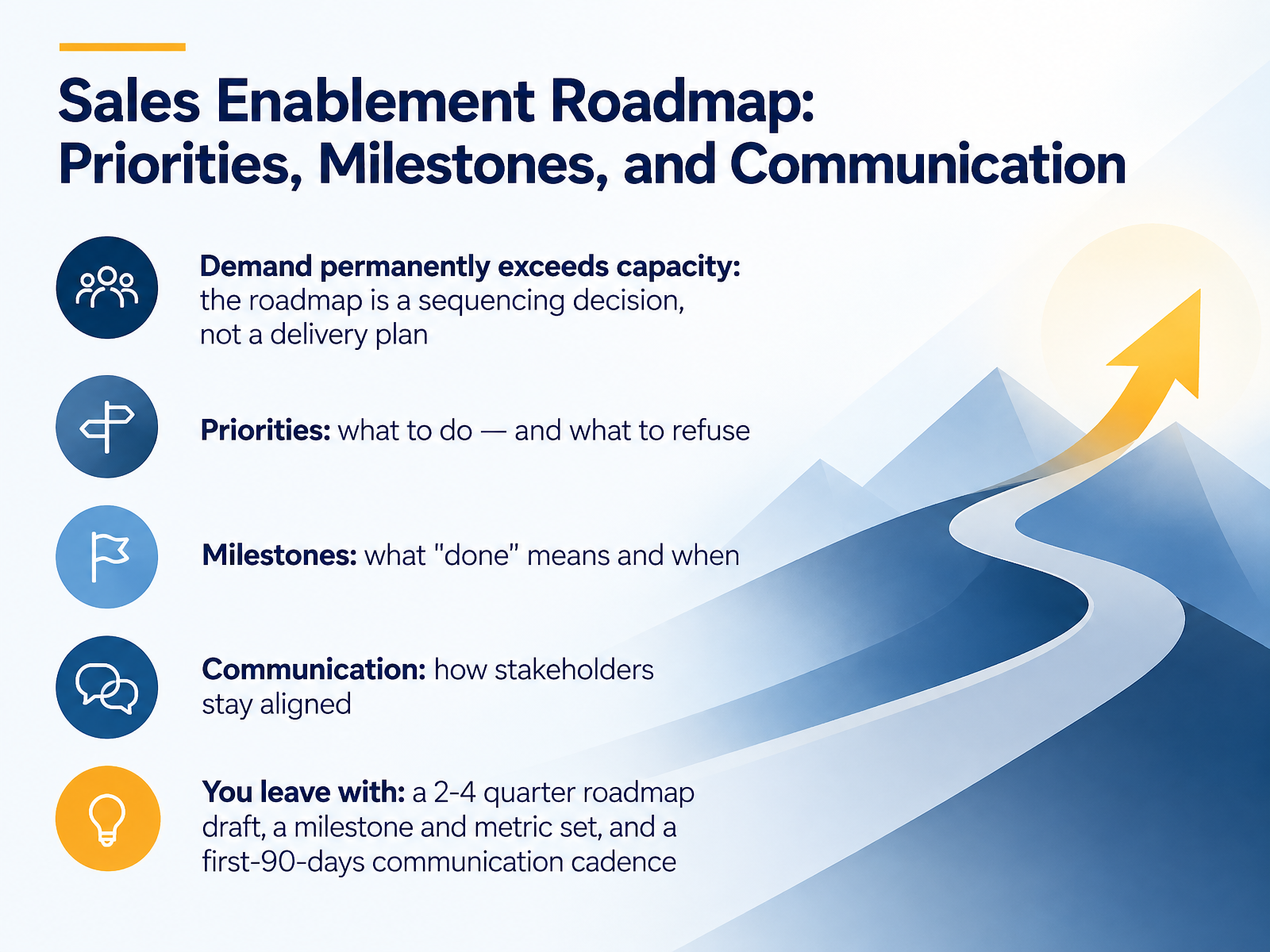
- 01Sales Enablement Roadmap: Priorities, Milestones, and CommunicationWelcome. Over the next fifteen slides, we're going to build a sales enablement roadmap you can actually defend. Here's the premise. Demand permanently exceeds capacity. Your roadmap is a sequencing decision, not a delivery plan. So we'll work through three things. Priorities: what you do, and just as important, what you refuse. Milestones: what done actually means, and when. And communication: how stakeholders stay aligned while you say not yet to good ideas. By the end, you'll have a two to four quarter roadmap draft, a milestone and metric set, and a first ninety days communication cadence. One honest constraint up front. You will not get everything done, and pretending otherwise is how credibility dies. Let's start with why these roadmaps fail without a real sequencing discipline.thecroreport.comenrichlabs.aidelverise.com+21 min
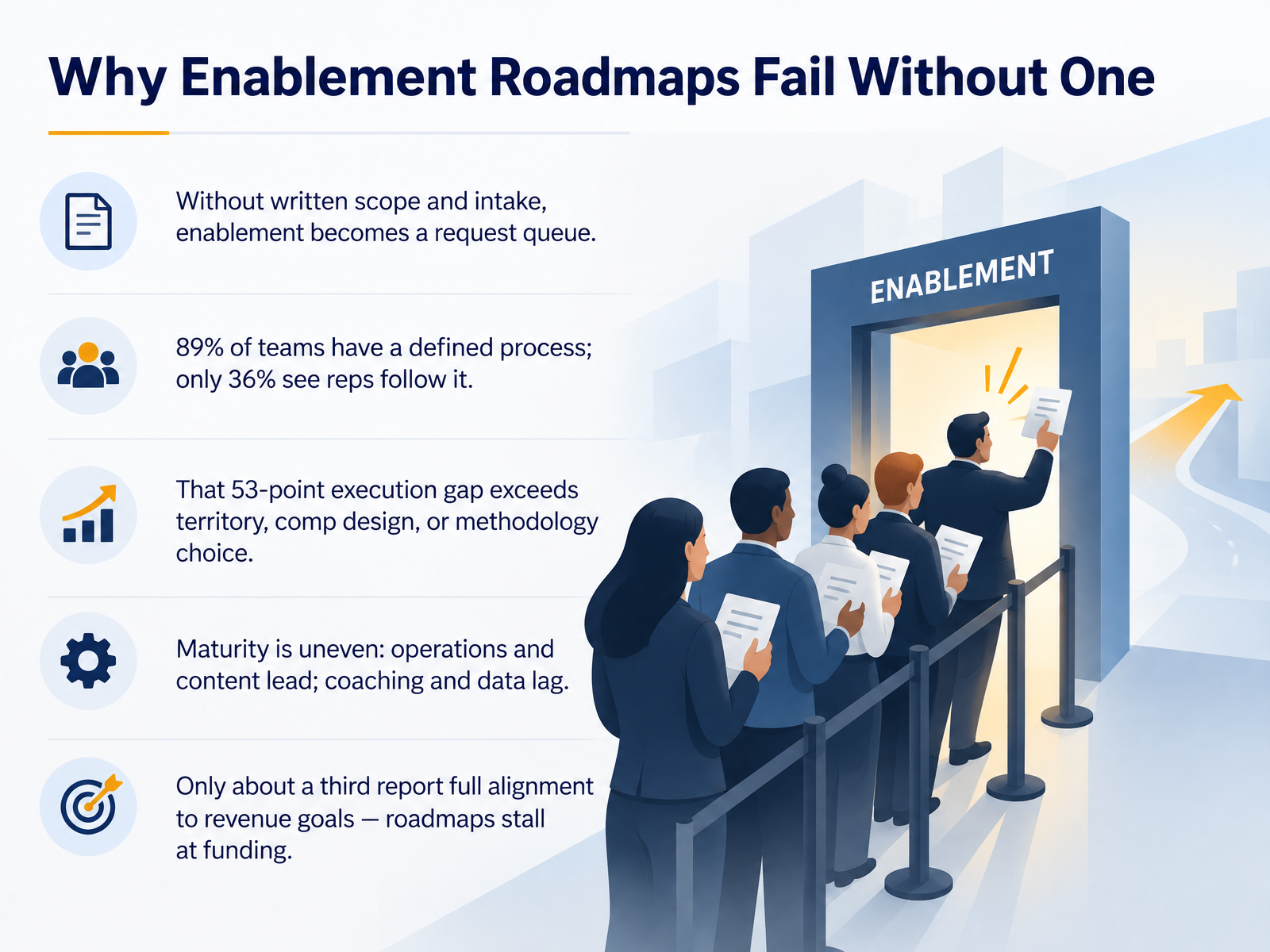
- 02Why Enablement Roadmaps Fail Without OneLet's talk about why enablement roadmaps fail without one. Without written scope and a defined intake process, your enablement function becomes a request queue. You react, you don't sequence. The data backs this up: eighty-nine percent of teams have a defined process, but only thirty-six percent see reps actually follow it. That fifty-three point execution gap exceeds territory, comp design, or methodology choice. It is the single largest performance variable you control. Maturity is also uneven. Operations and content tend to lead. Coaching and data lag behind. And only about a third of teams report full alignment to revenue goals. That is where roadmaps stall, at funding. Because when you cannot show alignment, you cannot defend the investment. The takeaway is direct: written scope, clear intake, and measurable adherence are not administrative overhead. They are the foundation your roadmap needs to survive. Next, we get into diagnosis. Where the Work Actually Breaks: Diagnosing Current State.
 federicopresicci.comlxahub.comknowledgelib.io+22 min
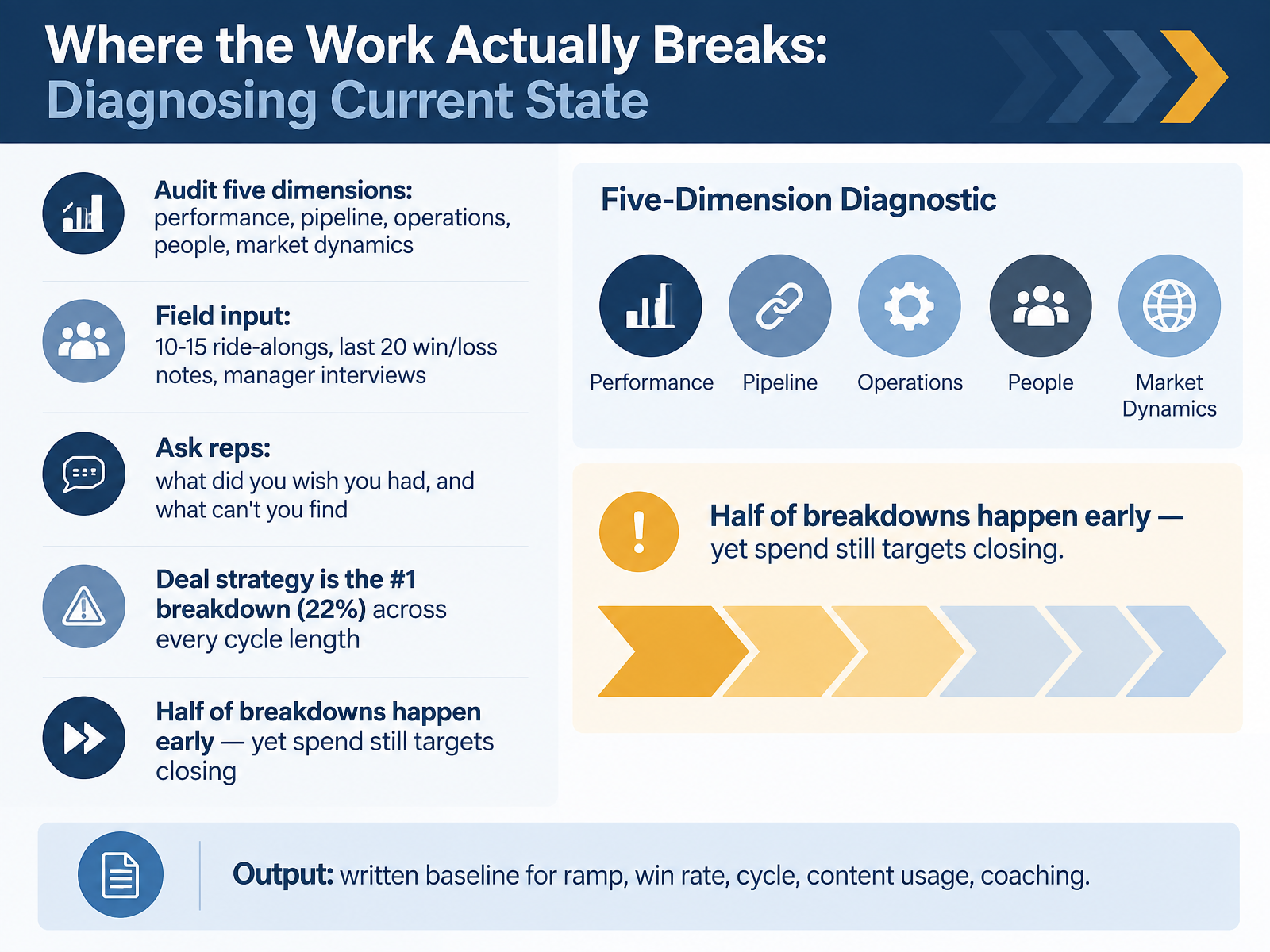
 - 03Where the Work Actually Breaks: Diagnosing Current StateSo let's get into where the work actually breaks. Before you build anything, you diagnose. You audit five dimensions: performance, pipeline, operations, people, and market dynamics. Then you bring in field input. Ten to fifteen ride-alongs, the last twenty win-loss notes, and interviews with every manager. Ask your reps two questions: what did you wish you had, and what can't you find? Here's what the data keeps showing. Deal strategy is the number one breakdown point, twenty-two percent, across every cycle length. And half of all breakdowns happen early, yet most spend still targets closing. That is a sequencing error, and it is expensive. Your output from this step is a written baseline: ramp, win rate, cycle length, content usage, and coaching. Get that on one page. It becomes the reference point for every priority you set. Next, we define the charter itself, covering scope, anti-scope, and decision rights.
 enablementsquad.comtd.orgprospeo.io+22 min
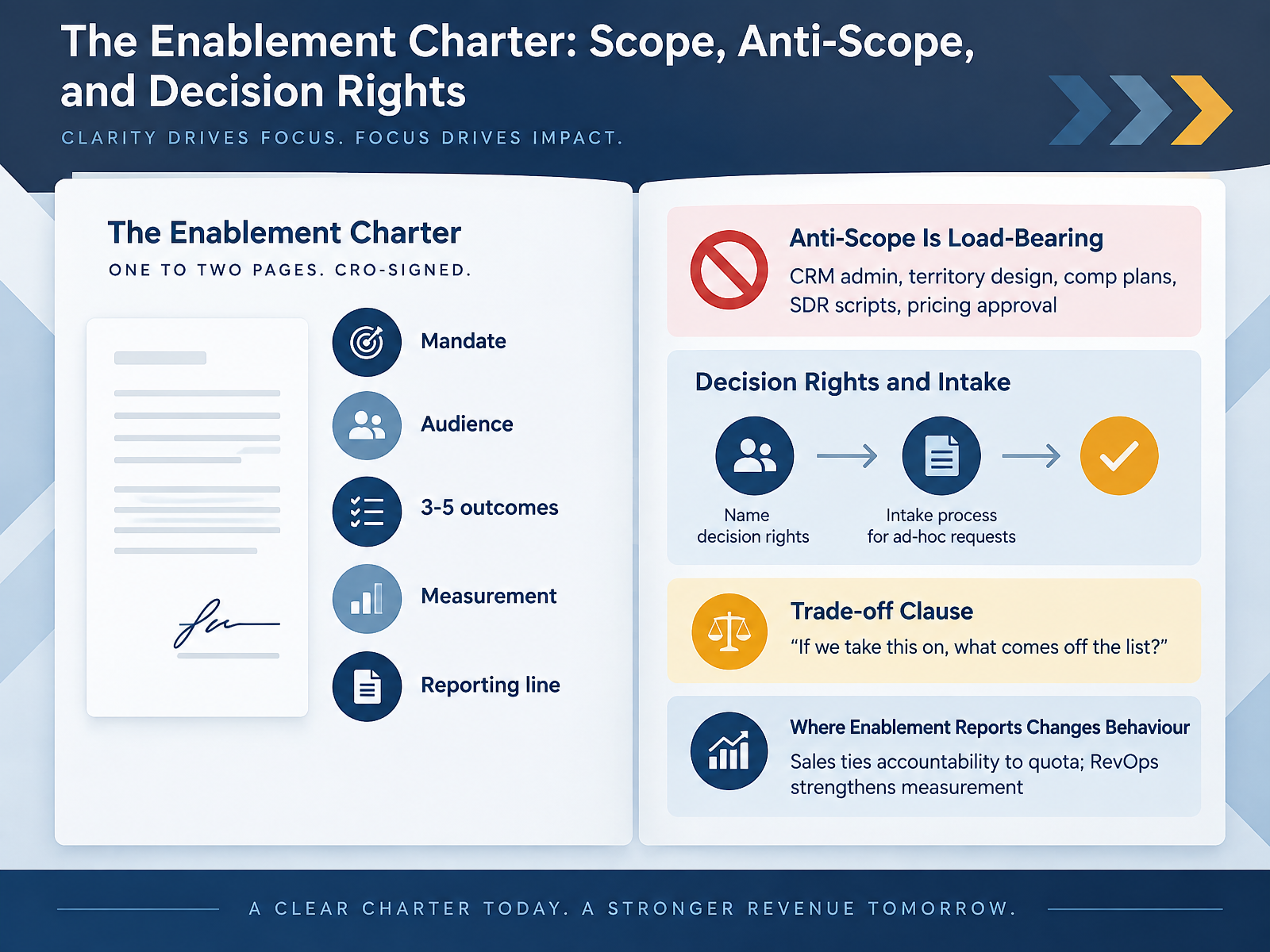
 - 04The Enablement Charter: Scope, Anti-Scope, and Decision RightsLet's talk about the charter, because this document does more work than most teams give it credit for. Keep it to one or two pages, and get your CRO to sign it. It names the mandate, the audience, three to five outcomes, how you'll measure them, and where enablement reports. The anti-scope is load-bearing. Write it down: CRM admin, territory design, comp plans, SDR scripts, pricing approval. Those stay with ops, the SDR manager, and deal desk. Then name decision rights and your intake process for ad-hoc requests, so priorities don't get decided by who shouts loudest. Here's your governance mechanism, the trade-off clause. Every time something new lands, ask: if we take this on, what comes off the list? That moves prioritization from a personal no to an agreement you built together. And know the trade-off in your reporting line. Under Sales, accountability ties to quota, and feedback loops run fast. Under RevOps, measurement infrastructure gets stronger. Neither is wrong, but pick deliberately. Next, let's look at how you score incoming requests in practice, with Priority Lens 1: Scoring and Qualifying Enablement Requests.
 enablementsquad.comtd.orgprospeo.io+22 min
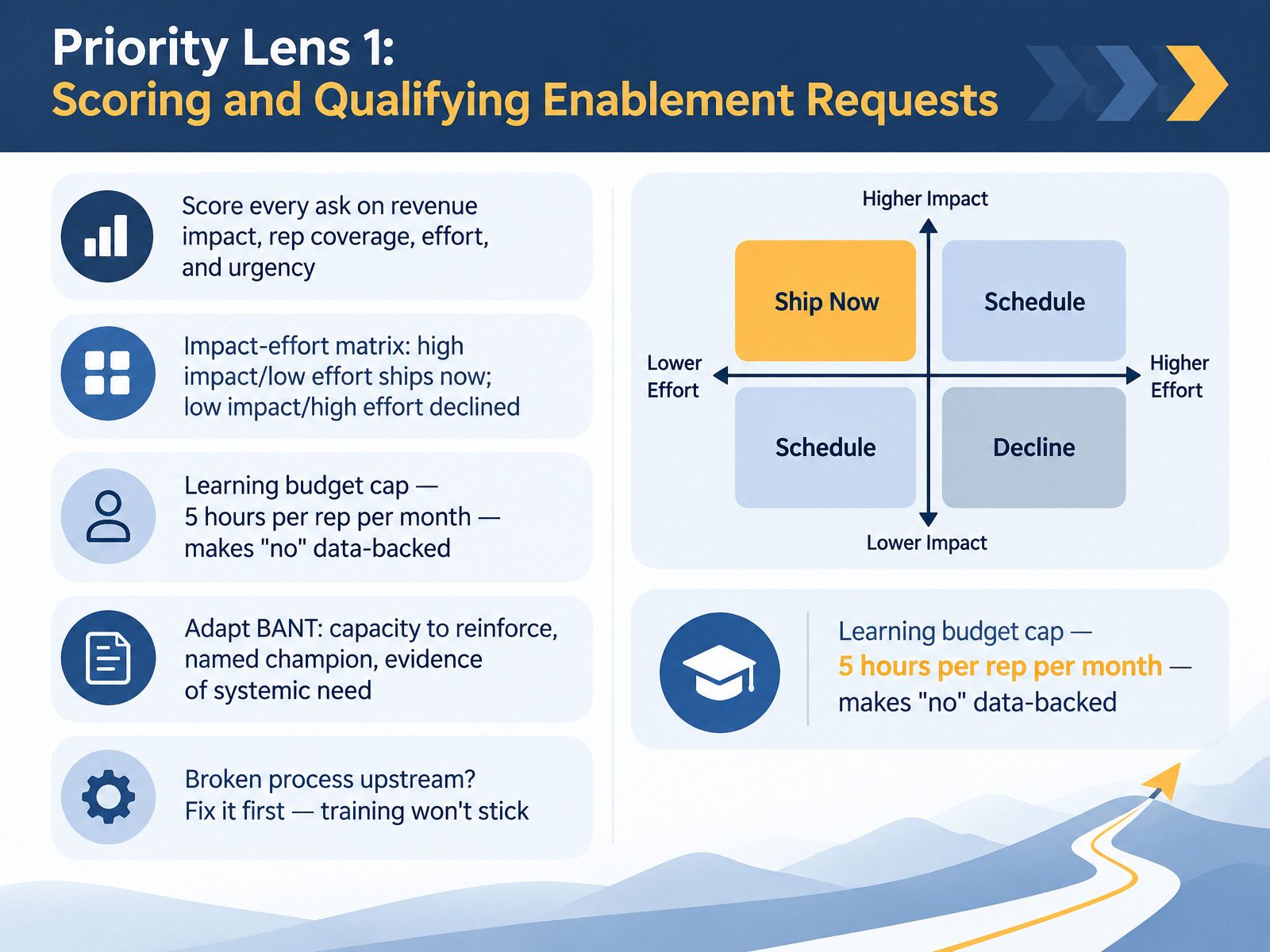
 - 05Priority Lens 1: Scoring and Qualifying Enablement RequestsLet's talk priority lens one: scoring and qualifying enablement requests. Every ask feels urgent. Your job is to score it, not absorb it. Rate each request on four things: revenue impact, rep coverage, effort, and urgency. Then plot it on an impact and effort matrix. High impact, low effort ships now. Low impact, high effort gets declined, and you say so plainly. The learning budget cap is your best friend here. Five hours per rep, per month. When requests stack to seven or eight, you have a data-backed reason to push back. Next, adapt BANT. Capacity to reinforce. A named champion. Evidence of systemic need. And timing. Watch for broken process upstream. If the workflow is broken, training won't stick. Fix the process first, then teach. So your takeaway: score before you commit, and let the roadmap carry the no. Next, we move into priority lens two: tiering, capacity, and the sixty forty roadmap.
 enablementsquad.comtd.orgprospeo.io+22 min
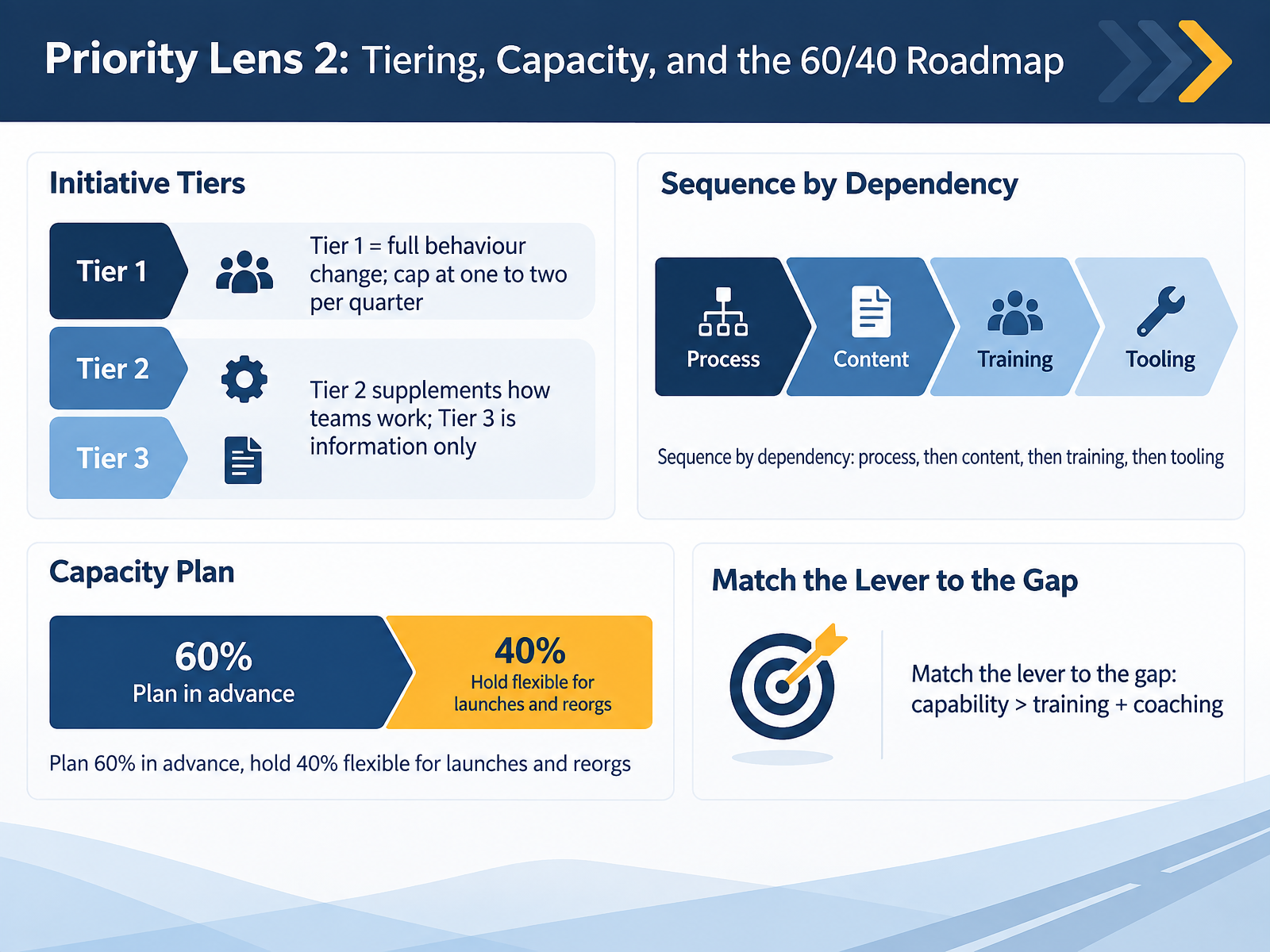
 - 06Priority Lens 2: Tiering, Capacity, and the 60/40 RoadmapLet's talk about the second priority lens: tiering, capacity, and the sixty forty roadmap. Tier one means full behaviour change, so cap it at one or two per quarter. That's your real capacity ceiling. If everything is tier one, nothing lands. Tier two supplements how teams already work. Tier three is information only, so it moves through newsletters, not full programs. Sequence by dependency: process first, then content, then training, then tooling. Training on a broken process never sticks. And when you match the lever to the gap, capability gaps need training plus coaching, not another workshop. Then plan sixty percent in advance and hold forty percent flexible for launches and reorgs. Those will happen. Your takeaway: protect tier one capacity, sequence by dependency, and build in room to absorb the unexpected. Next, we translate these priorities into phased milestones.
 enablementsquad.comtd.orgprospeo.io+21 min
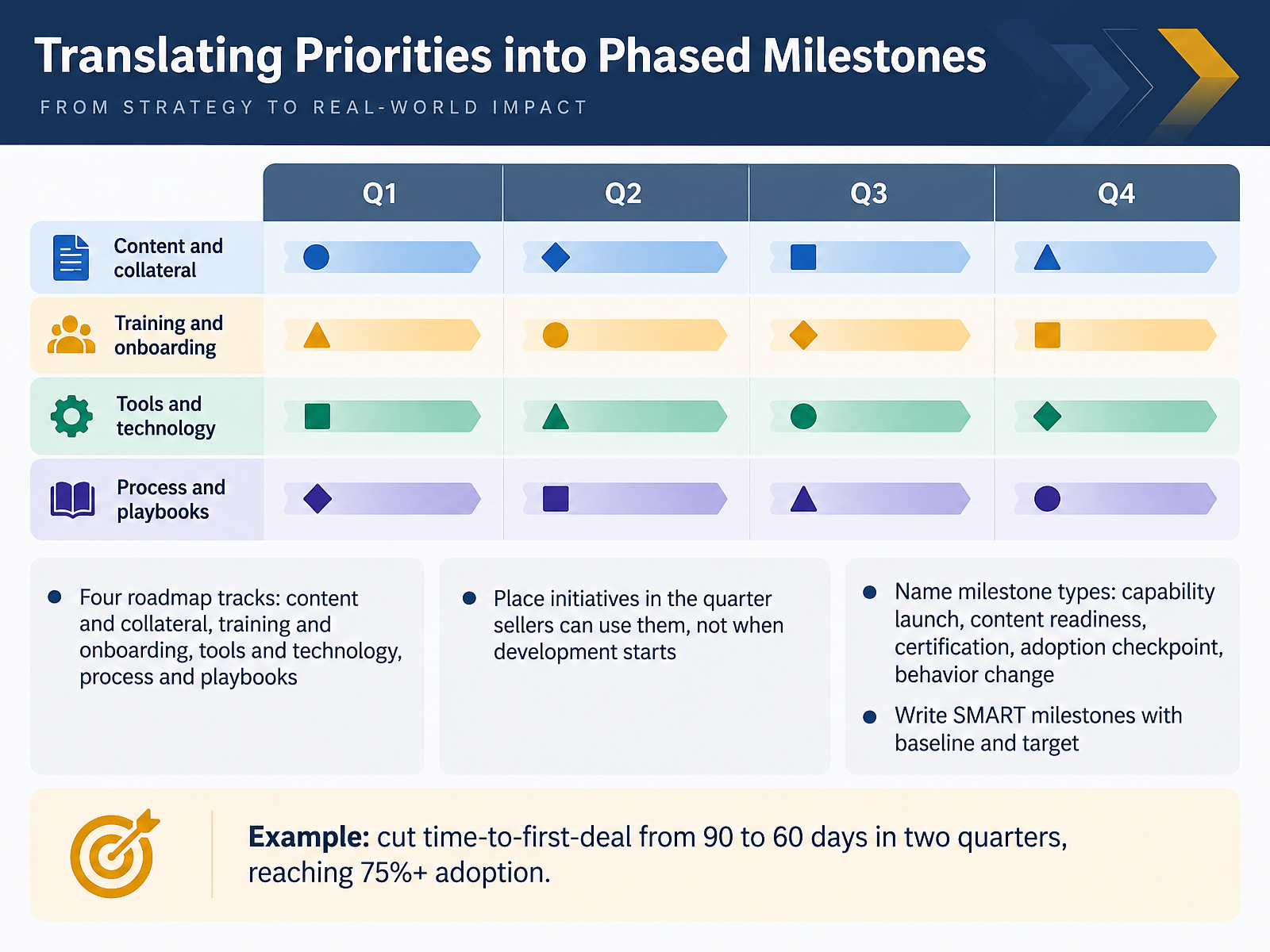
 - 07Translating Priorities into Phased MilestonesNow let's turn those priorities into milestones you can actually ship. You've got four tracks: content and collateral, training and onboarding, tools and technology, and process and playbooks. The core discipline is this. Place each initiative in the quarter sellers can use it, not the quarter development starts. Your reps feel readiness, not effort. So name your milestone types up front. Capability launch. Content readiness. Certification. Adoption checkpoint. And behavior change. Then write them as SMART milestones, with a baseline and a target. For example: cut time-to-first-deal from ninety days to sixty within two quarters, reaching seventy-five percent or higher adoption. Baseline, target, timeframe, done. Now let's design the visual. Roadmap Visual Design: Swimlanes, Owners, and Readiness Scores.
 ideaplan.ioprospeo.iosaleo.io+21 min
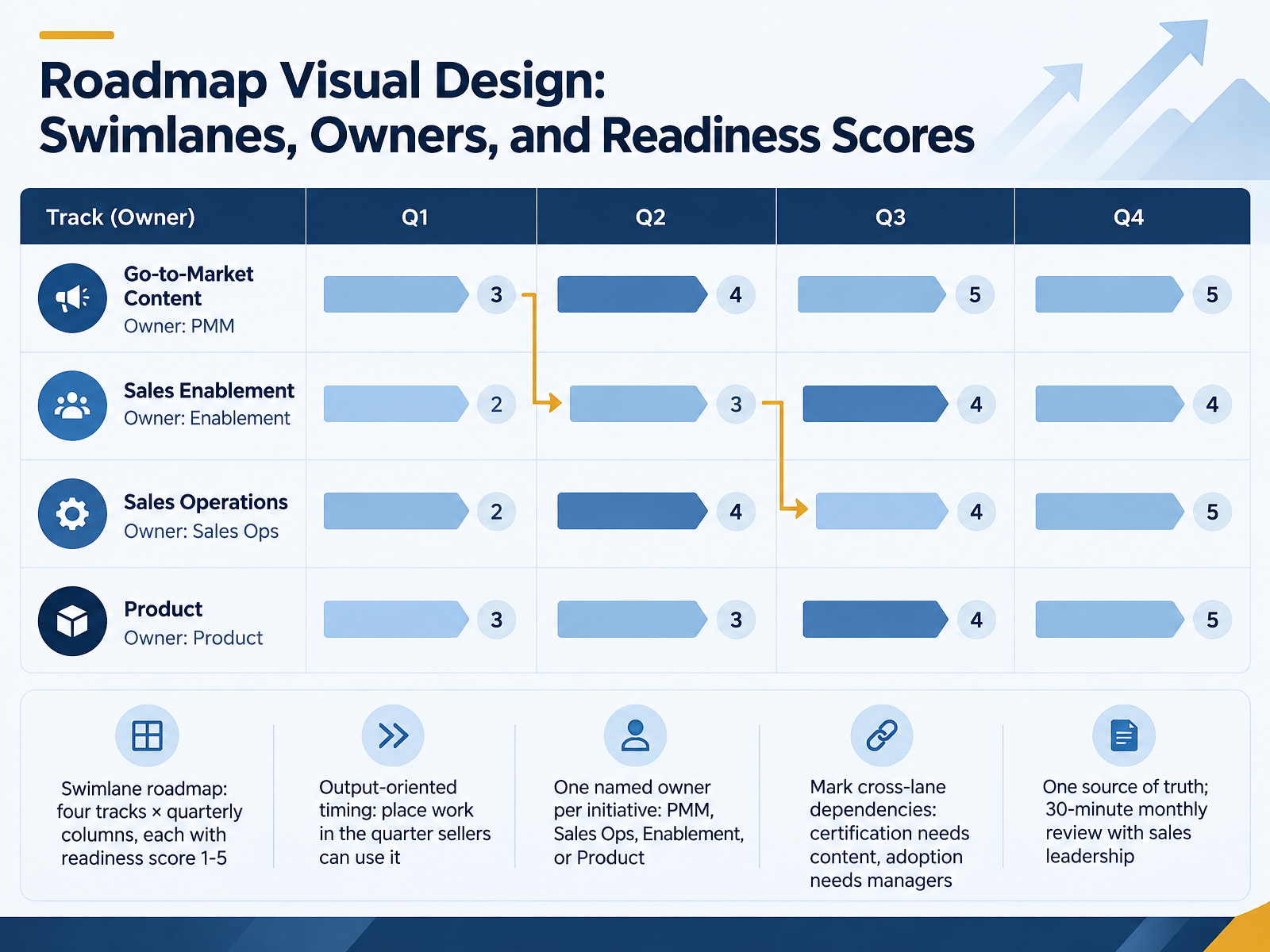
 - 08Roadmap Visual Design: Swimlanes, Owners, and Readiness ScoresLet's talk about how you actually draw the roadmap so it survives contact with reality. The format is a swimlane roadmap: four tracks, Content and Collateral, Training and Onboarding, Tools and Technology, and Process and Playbooks, laid across four quarterly columns. Each track carries a readiness score from one to five, so leadership sees a trajectory, not just a list. Two rules matter. First, output-oriented timing. Place work in the quarter sellers can use it, not when development starts. Second, one named owner per initiative. Product Marketing, Sales Ops, Enablement, or Product. And mark cross-lane dependencies, because certification needs content and adoption needs managers. Keep one source of truth, and run a thirty-minute monthly review with sales leadership. That's where you show what shipped, what shifted, and where readiness moved.
The Measurement Layer: Leading and Lagging Indicators.
 ideaplan.ioprospeo.iosaleo.io+22 min
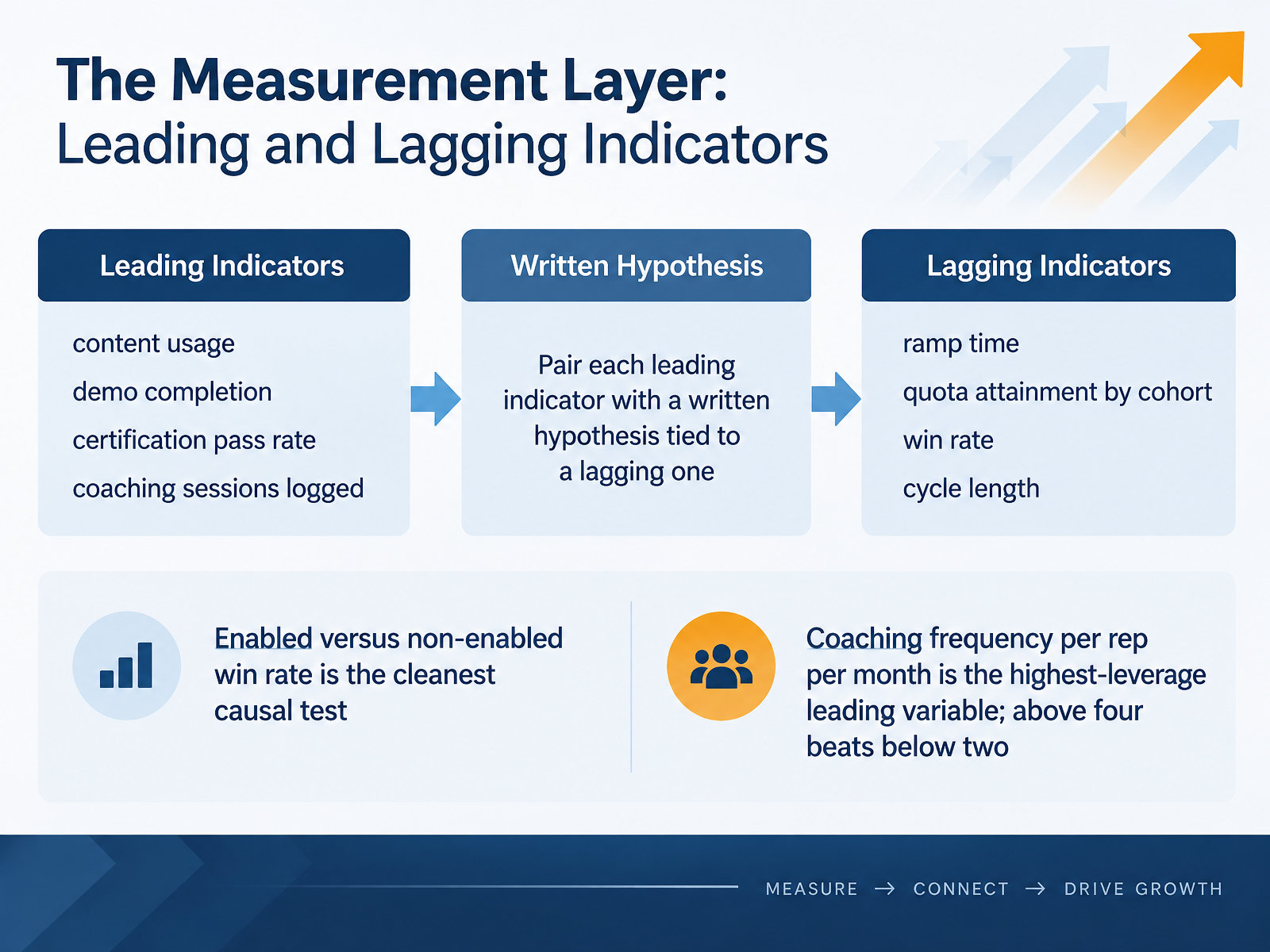
 - 09The Measurement Layer: Leading and Lagging IndicatorsLet's move to the measurement layer, where leading and lagging indicators finally connect. One rule keeps this honest: pair every leading indicator with a written hypothesis tied to a lagging one. For example, higher demo completion predicts more meetings booked. That is testable. Engagement is good is not.
Your leading indicators are content usage, demo completion, certification pass rate, and coaching sessions logged. Your lagging indicators are ramp time, quota attainment by cohort, win rate, and cycle length. Leading moves in days. Lagging confirms over a quarter.
The cleanest causal test you have is enabled versus non-enabled win rate. Compare deals that went through your motion against deals that did not. That gap is your financial case.
And if you optimize one leading variable, make it coaching frequency per rep per month. Teams above four touchpoints consistently beat teams below two. Now, let's look at building a scorecard that survives budget review.
 storylane.ioguideflow.comnimitai.com2 min
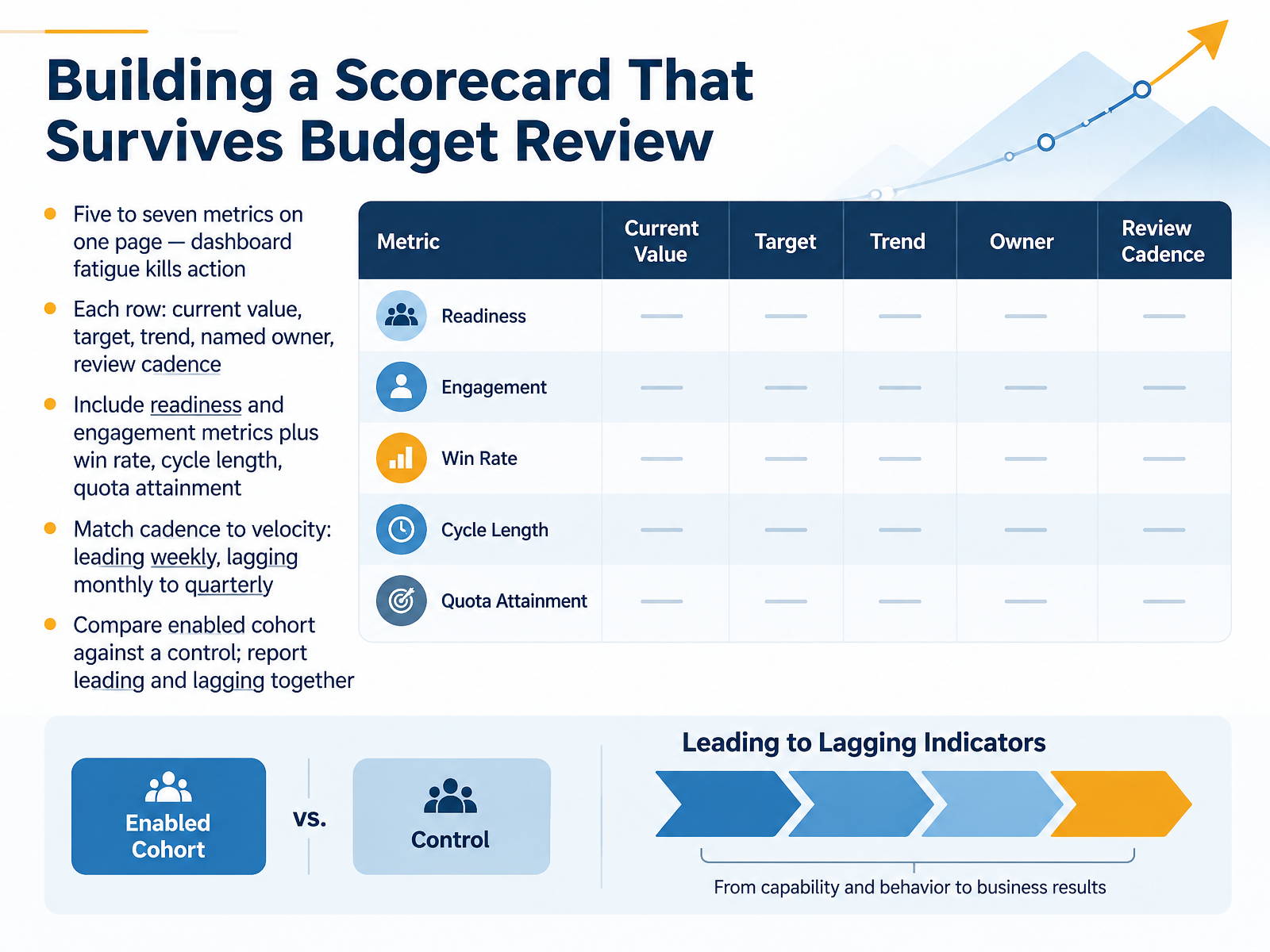
 - 10Building a Scorecard That Survives Budget ReviewNext, let's build a scorecard that survives budget review. Keep it to five to seven metrics on one page. More than that, and dashboard fatigue kills action. Every row carries five things: current value, target, trend, a named owner, and a review cadence. Name one owner per row. Shared ownership means nobody chases the number. Then mix your metric types. Include readiness and engagement signals, like certification pass rate and content usage, alongside the lagging trio: win rate, cycle length, and quota attainment. Report leading and lagging together, because lagging numbers confirm impact but never explain it. Match cadence to velocity. Leading indicators move in days, so review them weekly. Lagging ones need a full sales cycle, so monthly to quarterly. Skip weekly reviews of win rate; that just creates noise. Finally, compare your enabled cohort against a control, even if the control is reps who skipped training. That gap is the story finance will accept. And cut any metric that hasn't changed a decision in ninety days. That's your scorecard. From there, let's look at who needs which message, in Stakeholder Map and Tailored Messaging.
 storylane.ioguideflow.comnimitai.com2 min
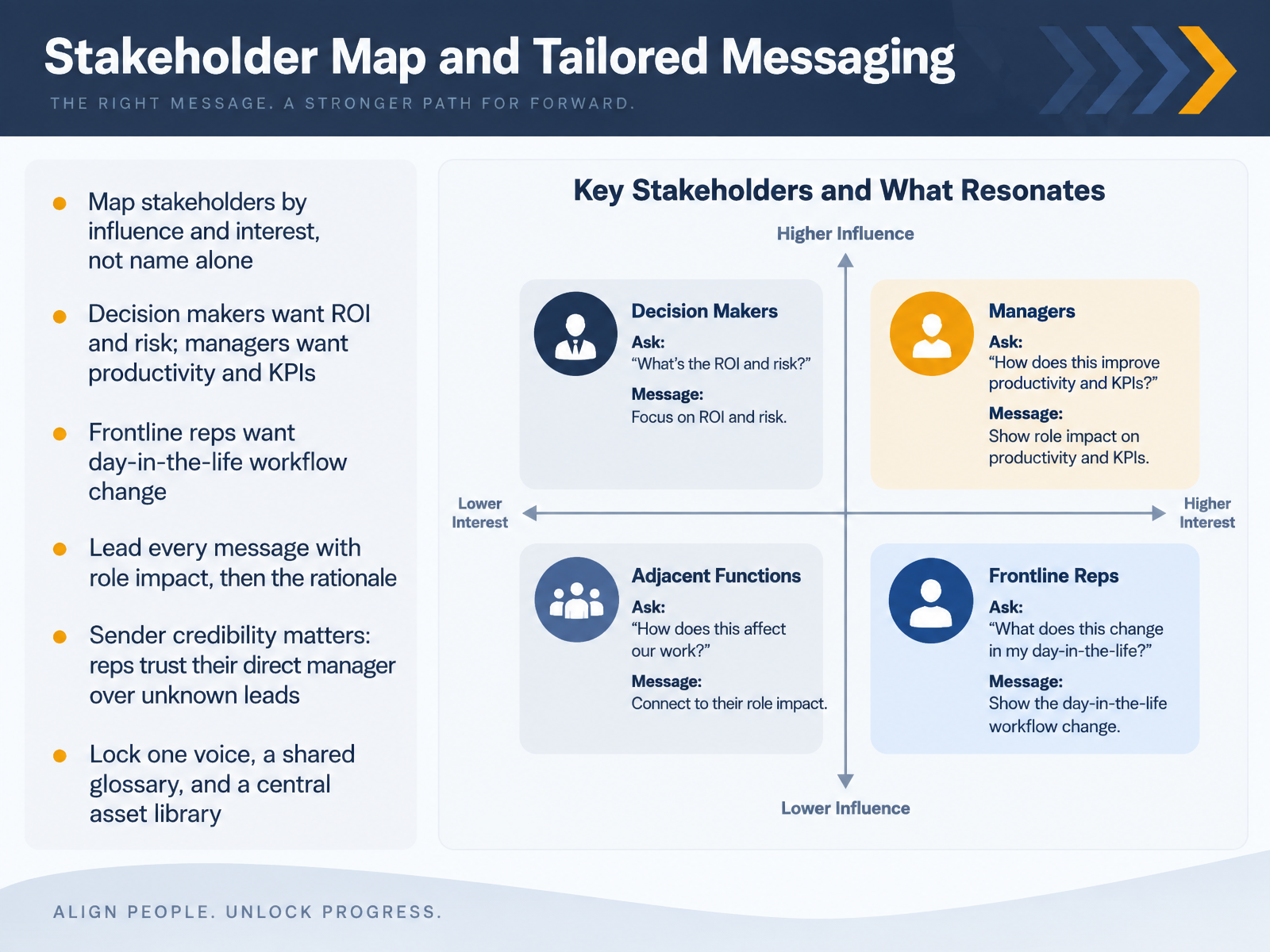
 - 11Stakeholder Map and Tailored MessagingNow let's look at stakeholders and messaging. Map stakeholders by influence and interest, not name alone. A decision maker wants return on investment and risk. A manager wants productivity and key performance indicators. A frontline rep wants to know what changes in their day to day workflow. So lead every message with role impact, then the rationale. Sender credibility matters too. Reps trust their direct manager far more than an unknown enablement lead. And before you scale, lock one voice, a shared glossary, and a central asset library. Next, communication cadence, channels, and feedback loops.
 1 min
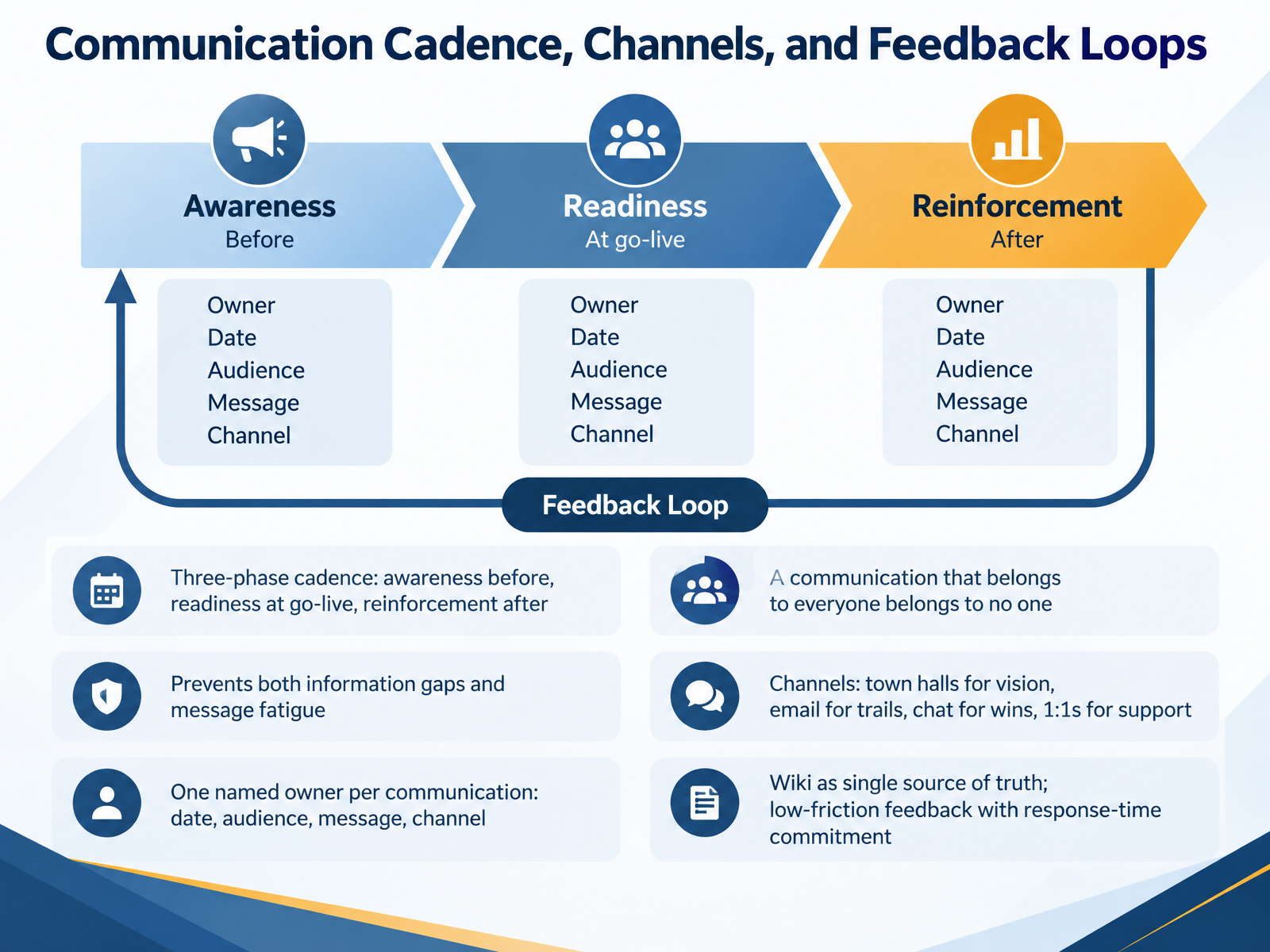
1 min - 12Communication Cadence, Channels, and Feedback LoopsNow let's talk about communication cadence, channels, and feedback loops. Build your plan around three phases: awareness before, readiness at go-live, and reinforcement after. That rhythm prevents both information gaps and message fatigue. Every communication needs one named owner, with the date, audience, message, and channel agreed up front. Because a communication that belongs to everyone belongs to no one. Match the channel to the job: town halls for vision, email for paper trails, chat for quick wins, and one-on-ones for support. Keep the wiki as your single source of truth, and make feedback low friction with a stated response-time commitment. Put that together, and your enablement narrative stays coherent from first announcement through sustained adoption. Next, we'll look at the cross-functional operating rhythm and RACI.
 2 min
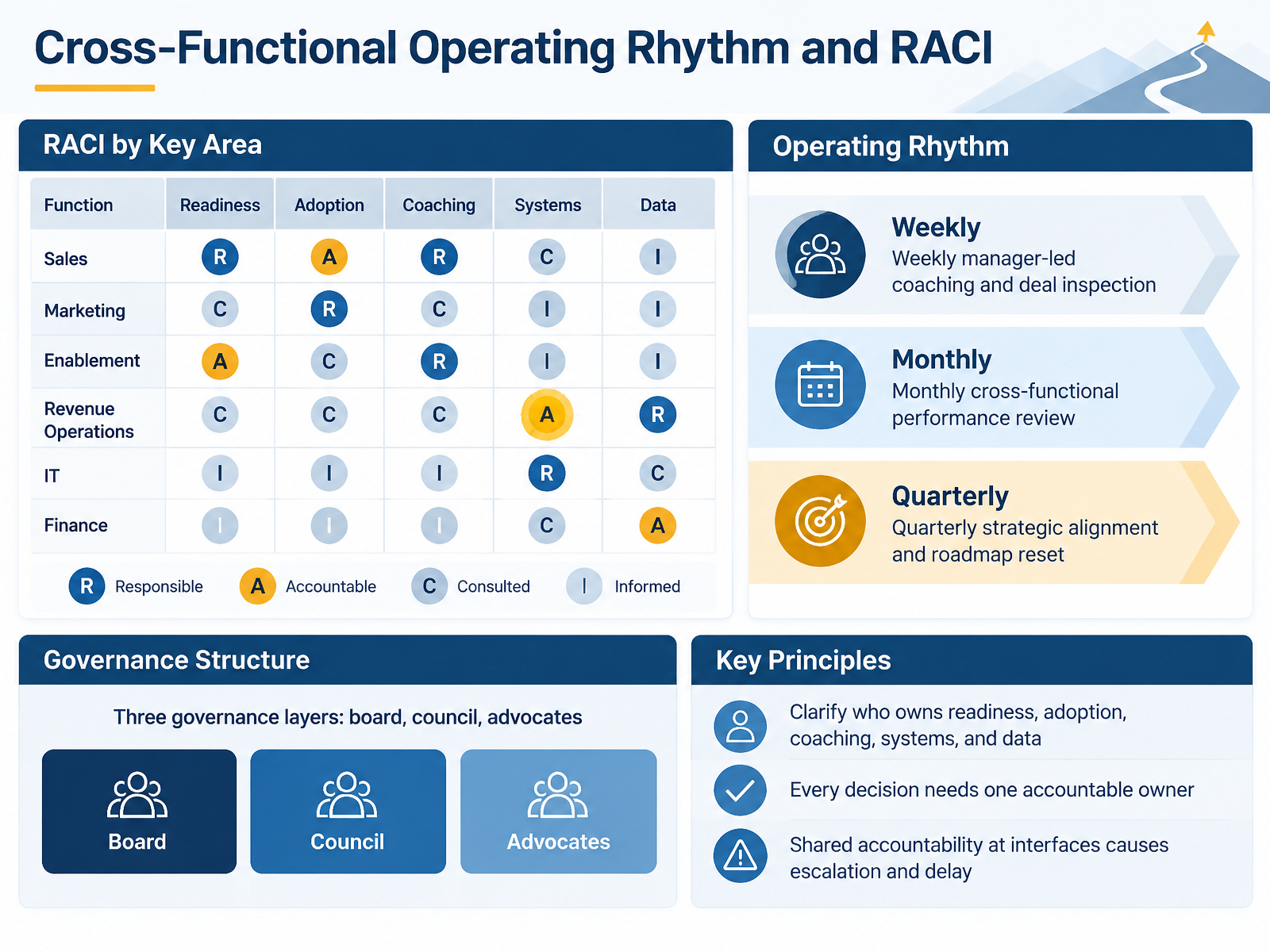
2 min - 13Cross-Functional Operating Rhythm and RACILet's talk about the cross-functional operating rhythm, and the RACI that holds it together. Start by clarifying who owns readiness, adoption, coaching, systems, and data. Ambiguity here is expensive. Then wire three cadences. Weekly manager-led coaching and deal inspection. Monthly cross-functional performance review. Quarterly strategic alignment and roadmap reset. Three governance layers keep this alive: the board for mandate, budget, and direction. The council for field reality. The advocates who speak for enablement when you are not in the room. One rule matters most: every decision needs one accountable owner. Shared input is healthy. Shared accountability causes escalation and delay at the interfaces, usually between sales, marketing, RevOps, and customer success. So name the owner, define the handoff, and inspect it on a rhythm. Next, we will look at common pitfalls and risk mitigation.
 federicopresicci.com1 min
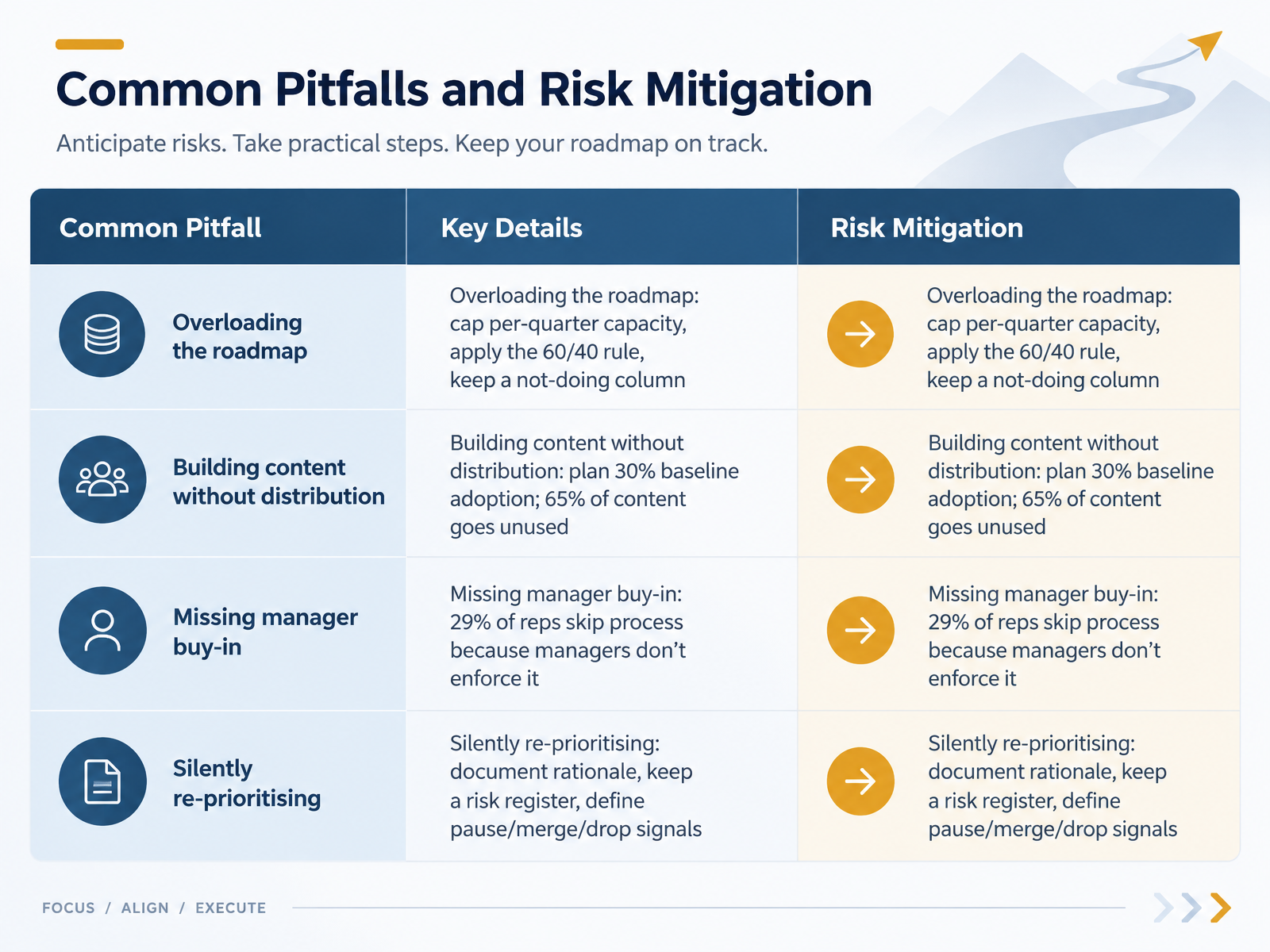
 - 14Common Pitfalls and Risk MitigationLet's talk about the pitfalls that quietly break roadmaps, and how you mitigate them. First, overloading. Cap what you commit to per quarter, apply the sixty forty rule, and keep a visible not-doing column. Saying not yet is a legitimate outcome. Second, building content without distribution. Plan for a thirty percent baseline adoption rate. Roughly sixty five percent of content goes unused, so distribution and workflow placement are the real work. Third, missing manager buy-in. Twenty nine percent of reps skip process because managers don't enforce it, so make inspection a manager expectation, not a request. And fourth, silently re-prioritising. Document the rationale, keep a risk register, and define your pause, merge, and drop signals before you need them. Mitigation is a discipline, not a reaction. Next, we put this into practice. Workshop: Drafting Your Roadmap and First 90 Days.
 federicopresicci.comlxahub.comknowledgelib.io+22 min
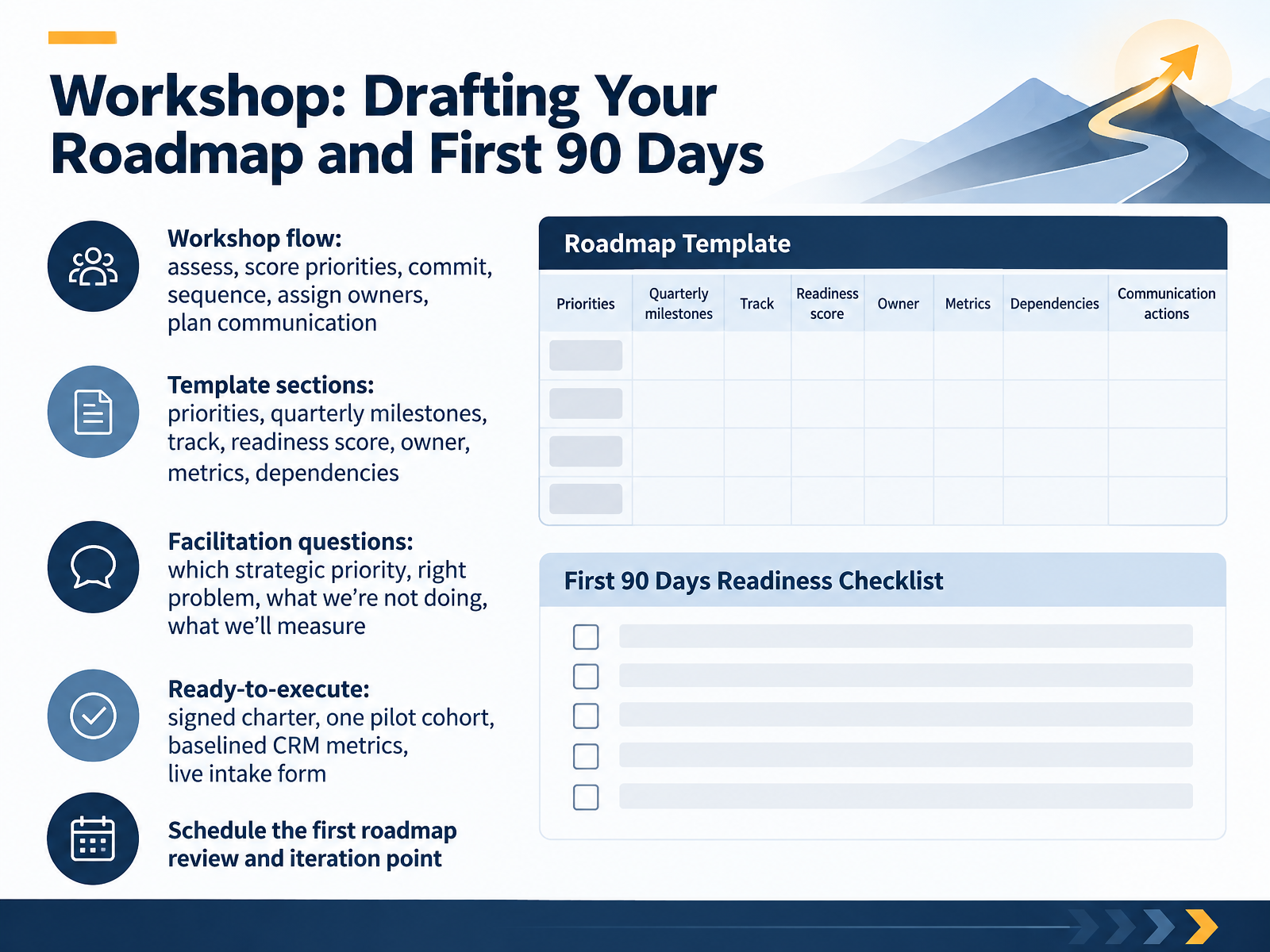
 - 15Workshop: Drafting Your Roadmap and First 90 DaysLet's put it to work. Your workshop flow is six moves. Assess where you stand. Score your priorities. Commit to what's in. Sequence it across quarters. Assign a single owner per initiative. Then plan the communication before you build anything.
Your template carries priorities, quarterly milestones, track, readiness score, owner, metrics, and dependencies. Keep it that tight.
Facilitation questions do the real work. Which strategic priority does this serve? Are we solving the right problem? What are we explicitly not doing? And what will we measure?
By the end of the session, you walk out ready to execute. A signed charter. One pilot cohort. Baseline CRM metrics. A live intake form.
Before you close, schedule two dates. Your first roadmap review, and your iteration point. Remember, enablement is a program, not a launch. Thanks for working through this with me. Now go draft it, and ship the first cohort.
 ideaplan.ioprospeo.iofedericopresicci.com+21 min
Take the deck with you
Download this course as a file — free, no sign-up needed.
- PDF handoutEvery slide page, ready to print or share.16 pages · 3.6 MBDownload
- Narrated PowerPointThe deck that presents itself — every slide carries the digital human's narration video.16 pages · 14.2 MBDownload
- PowerPoint slidesThe full deck as a .pptx — open it in PowerPoint, Keynote, or Google Slides.16 pages · 3.4 MBDownload
Free to use in your own training — please keep the PersonWise credit page at the end.
Have your own deck? Turn it into a course
Sources consulted
Web sources consulted while building this course.
- Sales Enablement Strategy 2026: Building the Function | CRO Report — thecroreport.com
- Sales Enablement: Complete Guide 2026 | Enrich Labs — enrichlabs.ai
- B2B Sales Enablement: Complete Implementation Framework for Revenue Growth [2026] | delverise blog — delverise.com
- How to Build a Sales Enablement Program | 2026 Guide | Backdrop — getbackdrop.ai
- Sales Enablement: The Complete 2026 Guide (Strategy, Tools, KPIs) | Nimitai — nimitai.com
- The State of Sales Enablement Maturity Report 2026 — federicopresicci.com
- The State of Revenue Enablement 2026 — lxahub.com
- Sales Enablement Maturity Assessment | knowledgelib.io — knowledgelib.io
- STATE OF SALES ENABLEMENT — supered.io
- Sales Enablement Evaluation: 2026 Framework — prospeo.io
- Prioritization in Enablement Webinar — The Enablement Squad — enablementsquad.com
- Selecting and Prioritizing Sales Enablement Initiatives for Impact: Part 2 — td.org
- Sales Enablement Process: 7-Stage Framework (2026) — prospeo.io
- How to Build a Sales Enablement Program That Delivers Real Impact — federicopresicci.com
- The Ultimate Sales Enablement Maturity Model — federicopresicci.com
- Sales Enablement Roadmap Template for PowerPoint — ideaplan.io
- Sales Enablement Project Plan: 6-Phase Template (2026) — prospeo.io
- Creating a Sales Enablement Roadmap — saleo.io
- Sales Enablement KPIs: Formulas, Benchmarks & Scorecard — storylane.io
- How to track sales enablement KPIs (15 metrics that matter) - Guideflow Blog — guideflow.com