Begin
14 pages · ~28 min
Data Engineering Roadmap Priorities
This training helps data engineers prioritize roadmap milestones and communicate progress effectively to stakeholders.
A digital instructor presents all 14 pages. Hold “Ask” at any point and ask out loud — the answer comes from this course. No sign-up needed.
What you’ll learn
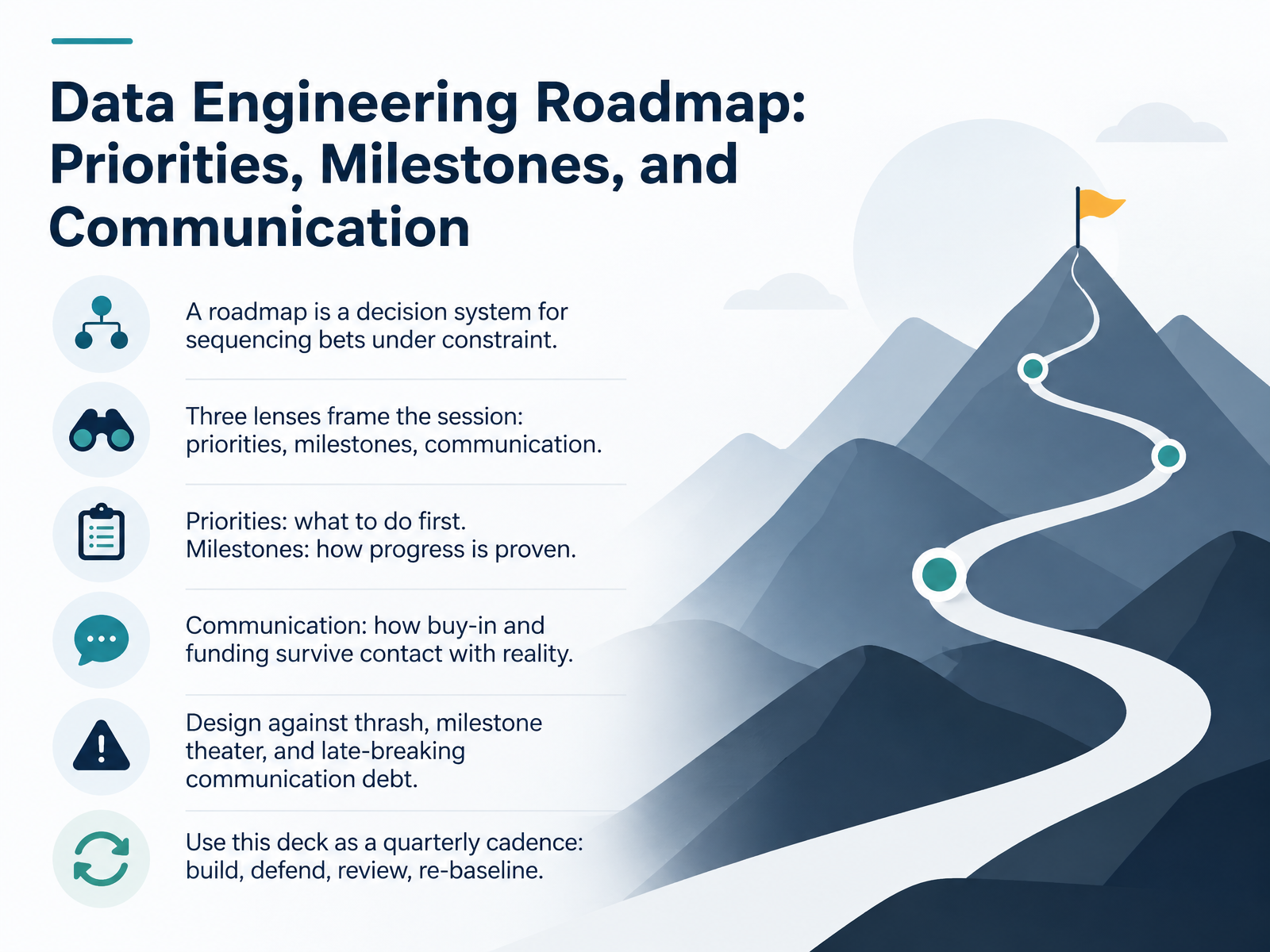
- 01Data Engineering Roadmap: Priorities, Milestones, and CommunicationWelcome. This session is for data leads, engineering managers, architects, and project owners who need a roadmap that survives contact with reality. Here is the core idea. A roadmap is a decision system for sequencing bets under constraint. Not a wish list, not a Gantt chart. Three lenses frame everything we cover. Priorities, what to do first. Milestones, how progress gets proven. And communication, how buy-in and funding survive when plans shift. Most roadmaps fail in predictable ways. Thrash, where priorities change weekly and nothing ships. Milestone theater, where green status hides missing outcomes. And late-breaking communication debt, where stakeholders hear about a slip after the fact. Design against all three. Use this deck as a quarterly cadence. Build, defend, review, re-baseline. Each cycle, you commit work, justify it, measure what actually shipped, and adjust. That rhythm is what keeps a roadmap alive. Next, why data engineering value is measured in decisions, not pipelines.valiotti.comslidekit.comkanbanchi.com+21 min
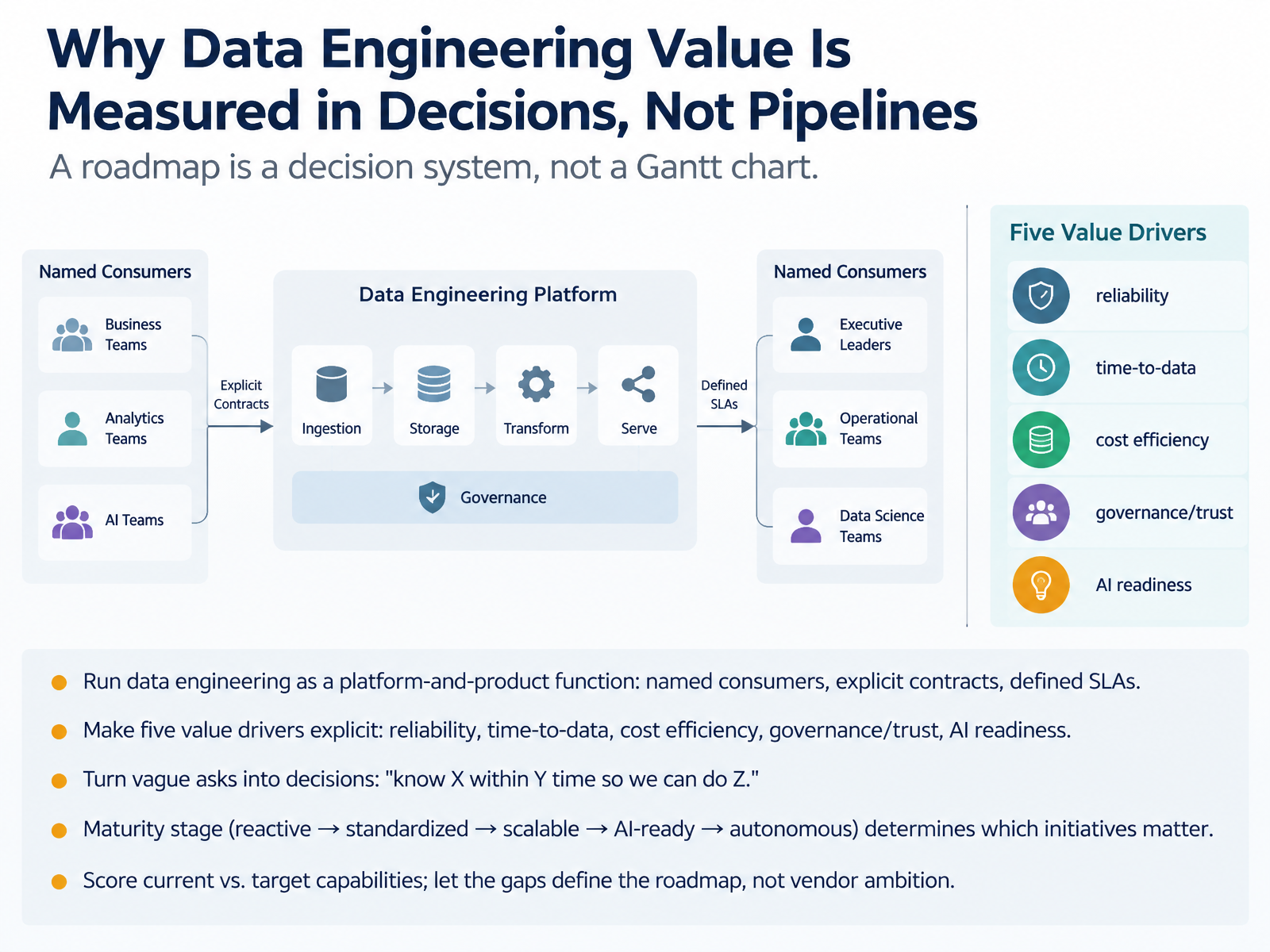
- 02Why Data Engineering Value Is Measured in Decisions, Not PipelinesLet's move to the core mindset shift. A roadmap is a decision system, not a Gantt chart. So run data engineering as a platform-and-product function. Name your consumers, make contracts explicit, and set defined SLAs. Then make five value drivers explicit: reliability, time-to-data, cost efficiency, governance and trust, and AI readiness. Turn vague asks into decisions. Not "we need better attribution," but "we need to know which channel is profitable within fourteen days so we can reallocate spend monthly." Your maturity stage determines which initiatives matter. A team at a reactive stage copying advanced patterns ends up with a data mesh nobody asked for, while dashboards still take weeks. So score current versus target capabilities, and let the gaps define the roadmap, not vendor ambition. Next, we look at scoring priorities by value, risk, dependency depth, and effort.
 engineered.atagileinfoways.comdatafabric.cloud+21 min
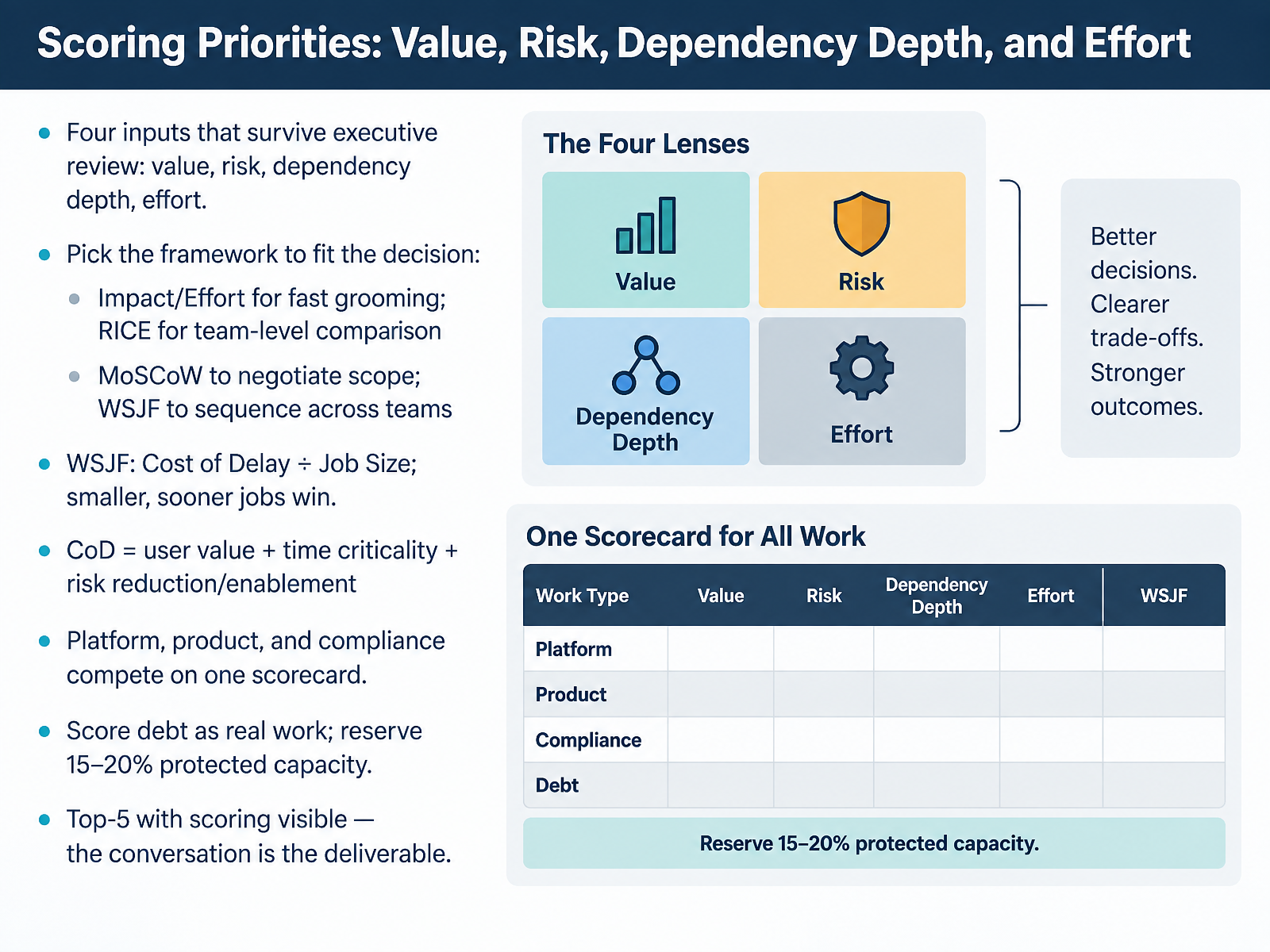
- 03Scoring Priorities: Value, Risk, Dependency Depth, and EffortLet's move to scoring priorities: value, risk, dependency depth, and effort. These four inputs survive executive review because they map to money, downside, sequencing, and cost. When choosing a framework, pick the one that fits the decision in front of you. Impact versus effort works for fast grooming. R I C E, or Reach, Impact, Confidence, Effort, is better for comparing work across one team. MoSCoW, meaning Must have, Should have, Could have, Won't have, is a scope negotiation tool. And W S J F, Weighted Shortest Job First, is the one that sequences work across teams. The formula is simple: Cost of Delay divided by Job Size. Smaller jobs with high delay cost win first. Cost of Delay equals user value plus time criticality plus risk reduction and enablement. So a compliance deadline with a small patch job can outrank a large, high value feature. Platform, product, and compliance compete on one scorecard. Score tech debt as real work, and protect fifteen to twenty percent of capacity for it. Then publish your top five with the scores visible. The conversation is the deliverable. Next, we look at architecture decisions that constrain the roadmap.
 framework.scaledagile.comtechdebt.nowkaizenko.com+22 min
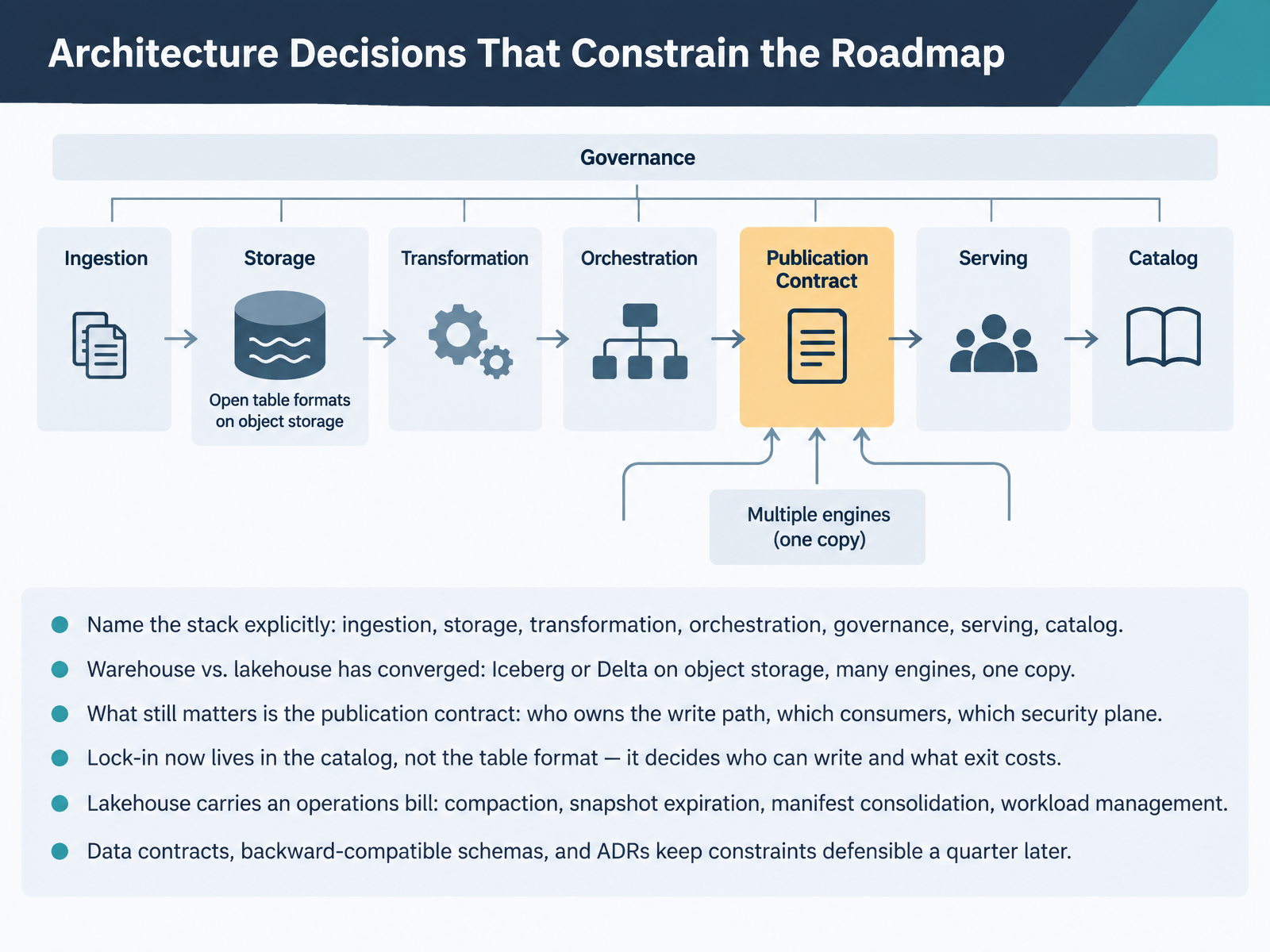
- 04Architecture Decisions That Constrain the RoadmapLet's talk about architecture decisions that constrain the roadmap. First, name your stack explicitly: ingestion, storage, transformation, orchestration, governance, serving, and catalog. If you cannot name each layer on one page, you cannot defend your constraints a quarter from now. The warehouse versus lakehouse debate has largely converged: Iceberg or Delta on object storage, many engines, one copy. So what still matters? The publication contract. Who owns the write path, which consumers depend on it, and which security plane protects it. Lock-in now lives in the catalog, not the table format. The catalog decides who can write and what leaving costs. And remember, the lakehouse carries an operations bill: compaction, snapshot expiration, manifest consolidation, and workload management. Data contracts, backward-compatible schemas, and architecture decision records keep those constraints defensible. Now let's look at milestone anatomy: outcomes, evidence, owners.
 edudatasci.neticeberglakehouse.comdatamy.co+22 min
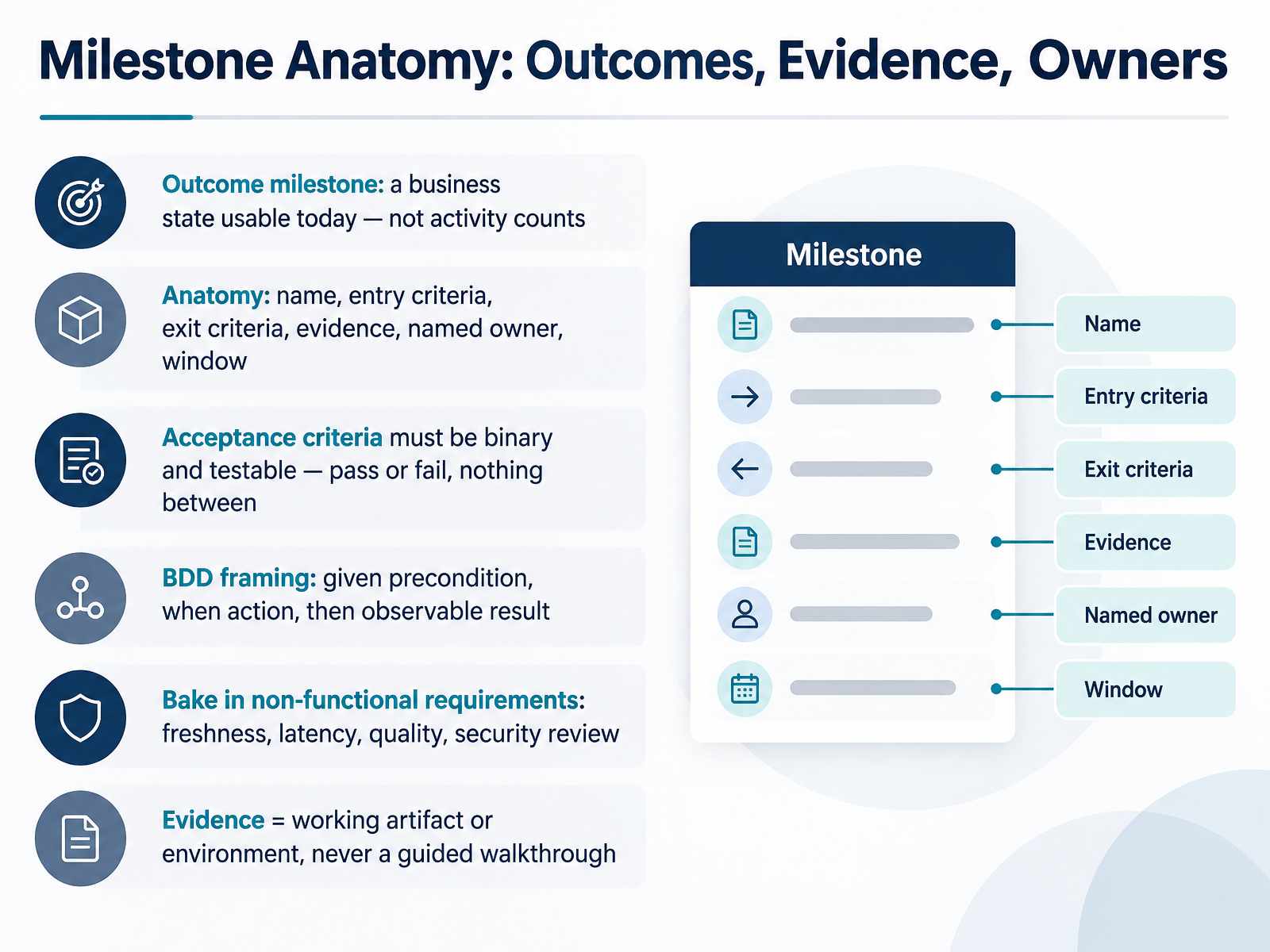
- 05Milestone Anatomy: Outcomes, Evidence, OwnersLet's break down milestone anatomy, because this is where most roadmaps quietly fail. An outcome milestone describes a business state usable today. Not activity counts. Not tickets closed. For example, marketing can target the VIP segment daily, with segments refreshed by two a.m. Each milestone has six parts. Name, entry criteria, exit criteria, evidence, a named owner, and a delivery window. Acceptance criteria must be binary and testable. Pass or fail, nothing between. That kills debates about whether work is mostly done. Use BDD framing. Given the precondition, when the action, then the observable result. Bake in non-functional requirements. Freshness, latency, quality, and security review all belong in acceptance criteria. If they are not written there, they will surface later as disputes. Finally, evidence means a working artifact or an accessible environment. Never a guided walkthrough. Next, setting data-specific milestone targets.
 1 min
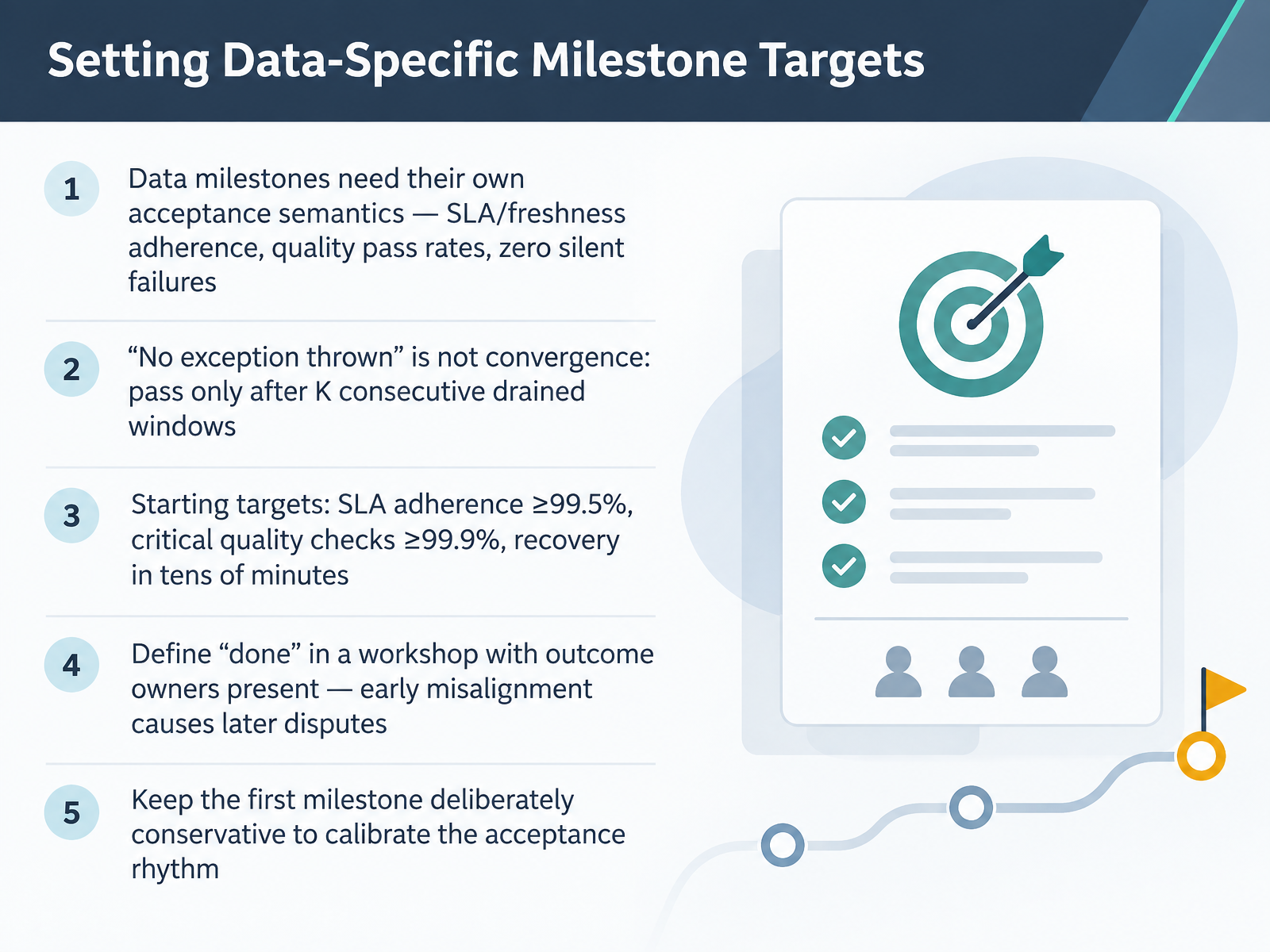
- 06Setting Data-Specific Milestone TargetsNext, let's talk about setting data-specific milestone targets. Data milestones need their own acceptance semantics. Define them as SLA and freshness adherence, quality pass rates, and zero silent failures. Here is the key trap. A pipeline that throws no exception is not converged. Pass only after K consecutive drained windows, meaning the retry queue and streaming backlog are genuinely empty. For starting targets, aim for SLA adherence at ninety-nine point five percent or higher, critical quality checks at ninety-nine point nine percent, and recovery in tens of minutes. Then define done in a workshop with outcome owners present. Early misalignment on what done means is the most common cause of later disputes. Keep your first milestone deliberately conservative. It calibrates the acceptance rhythm before you commit to bigger scope. Coming up next, sequencing and delivery cadence for data teams.
 engineered.atagileinfoways.comdatafabric.cloud+21 min
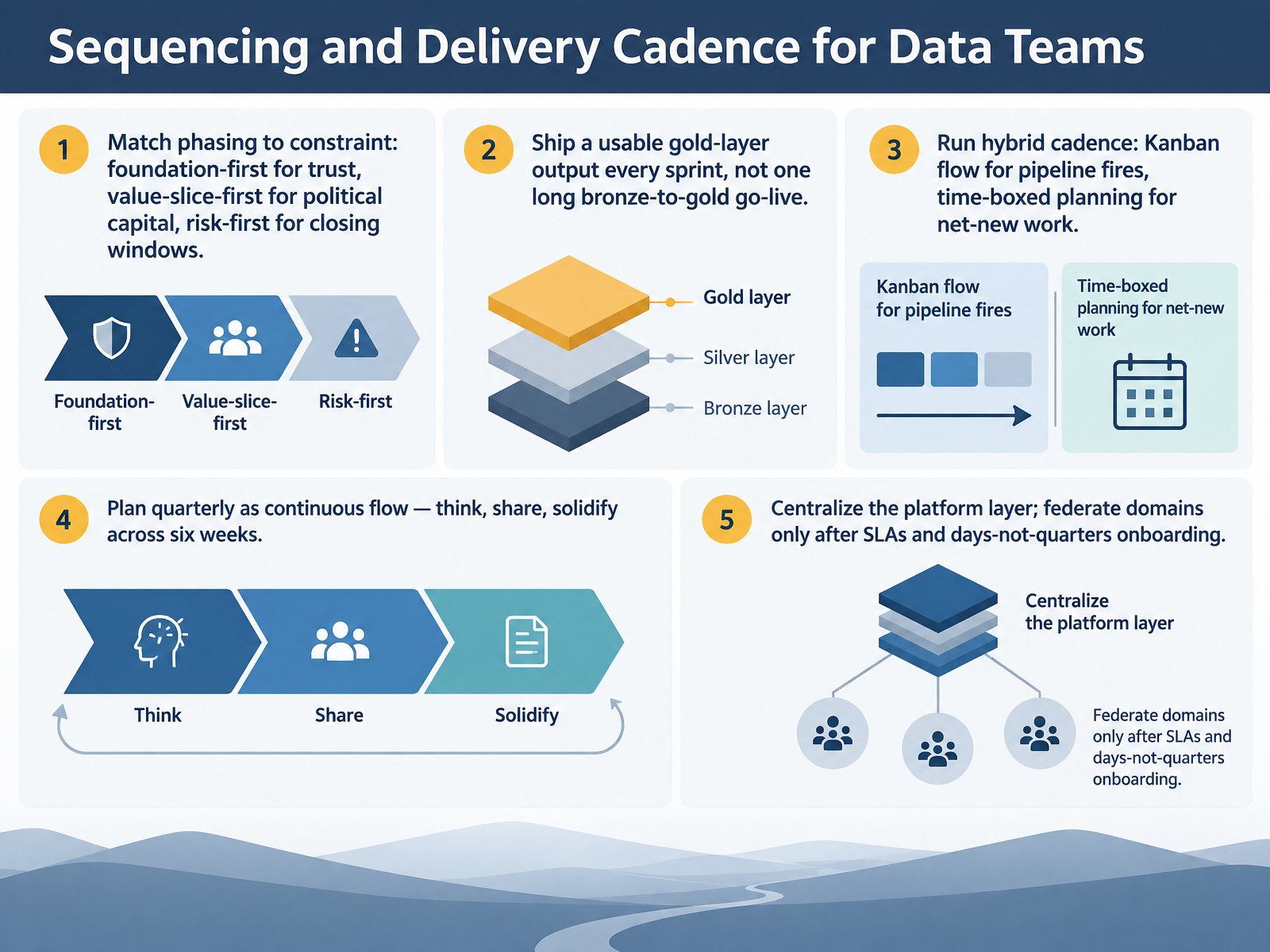
- 07Sequencing and Delivery Cadence for Data TeamsLet's talk about sequencing and delivery cadence. First, match your phasing to the actual constraint. If trust is the problem, go foundation-first. If you need political capital, ship a value slice first. If a window is closing, take the risk-first path. Second, ship a usable gold-layer output every sprint, not one long bronze-to-gold go-live months out. A narrow gold table a stakeholder can query this sprint beats a perfect platform next quarter. Third, run a hybrid cadence. Use Kanban flow for pipeline fires, and time-boxed planning for net-new work. Fourth, plan quarterly as continuous flow: think, share, solidify across six weeks, so planning never becomes a quarterly event. Finally, centralize the platform layer first. Federate domains only after SLAs hold, observability works, and onboarding a new source takes days, not quarters. Next, governance, risk, and compliance as roadmap workstreams.
 valiotti.comslidekit.comkanbanchi.com+21 min
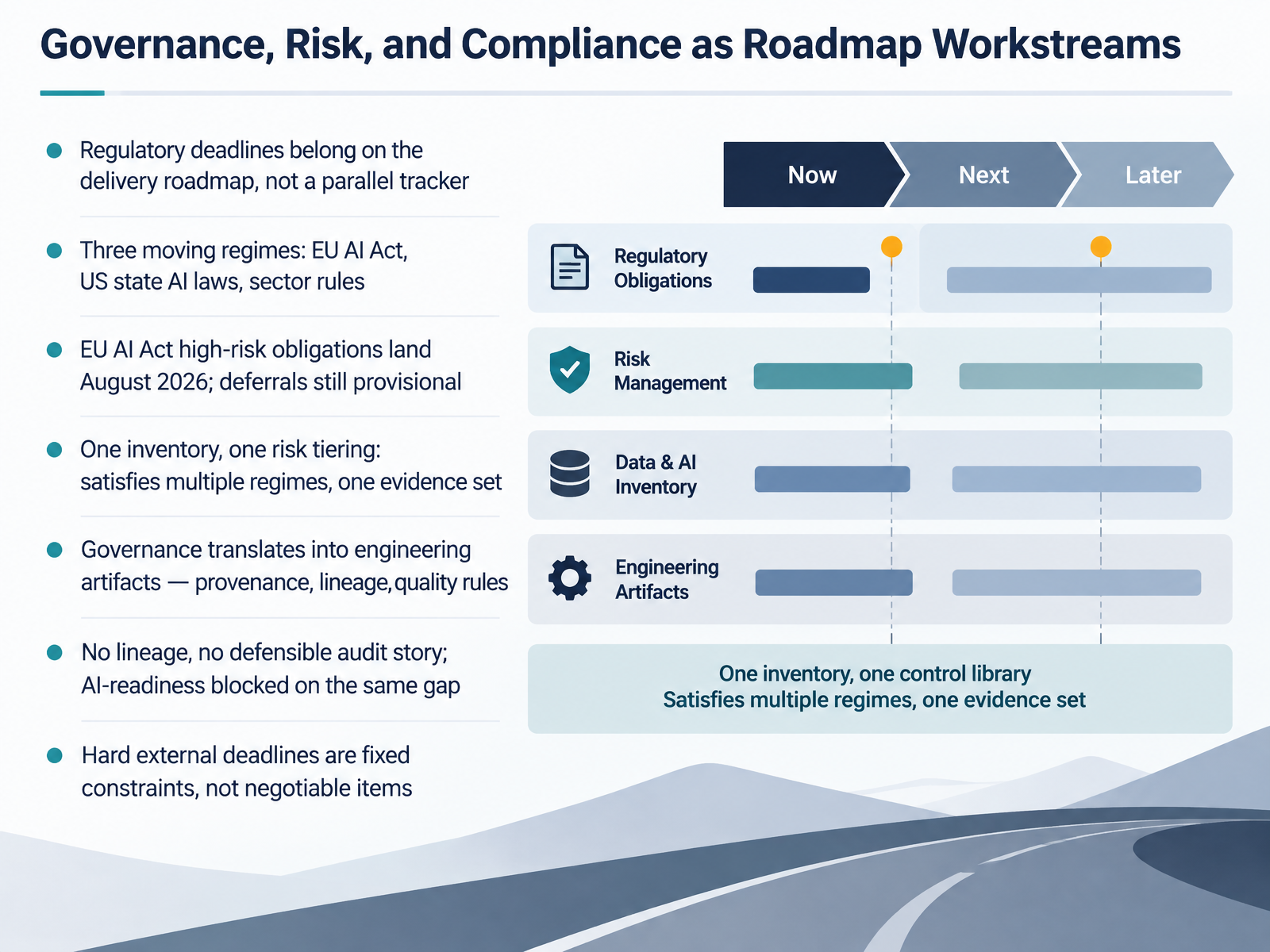
- 08Governance, Risk, and Compliance as Roadmap WorkstreamsLet us move to governance, risk, and compliance as roadmap workstreams. The first point is structural. Regulatory deadlines belong on your delivery roadmap, not a parallel tracker that nobody reviews. You are operating three moving regimes at once: the EU AI Act, US state AI laws, and sector-specific rules. High-risk obligations under the EU AI Act land in August 2026, though deferrals are still provisional, so confirm them with counsel before you commit dates. Here is the leverage point. Build one inventory and one risk tiering. That single assessment maps to multiple regimes and produces one evidence set, instead of three separate programs. Then translate governance into engineering artifacts: provenance, lineage, and quality rules, captured automatically at runtime. If you have no lineage, you have no defensible audit story, and your AI readiness is blocked on that same gap. Treat hard external deadlines as fixed constraints, not negotiable items. That shapes sequencing and staffing now. Next, we look at how to structure the message itself: Communication Architecture, Audience, Message, Cadence.
 2 min
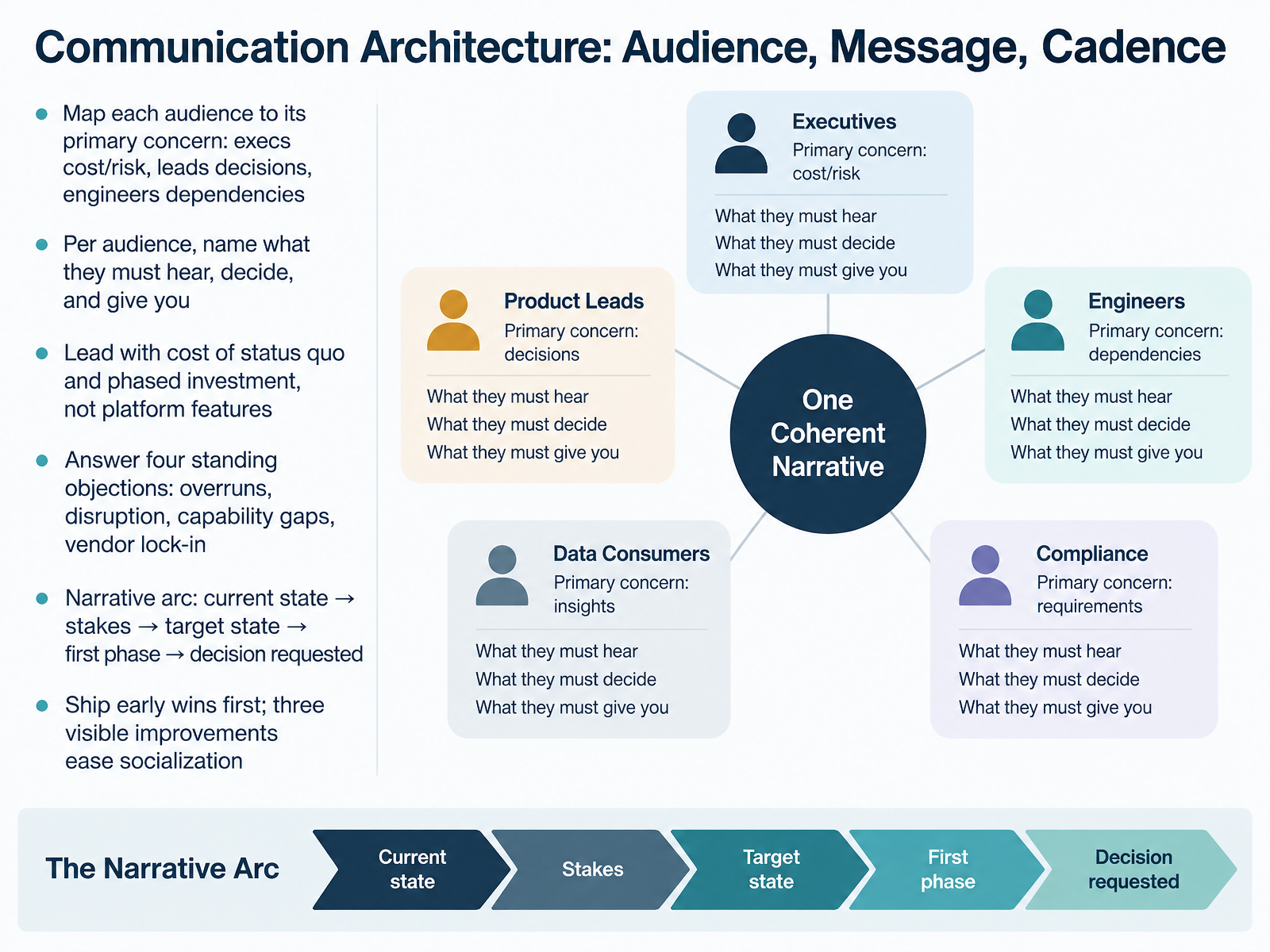
- 09Communication Architecture: Audience, Message, CadenceLet's talk about communication architecture. The core move is simple: map each audience to its primary concern. Executives care about cost and risk. Leads care about decisions. Engineers care about dependencies. For each group, name what they must hear, what they must decide, and what they must give you. Then lead with the cost of the status quo and a phased investment, not platform features. Be ready to answer four standing objections: cost overruns, operational disruption, capability gaps, and vendor lock-in. Your narrative arc should run one way: current state, stakes, target state, first phase, and the decision you are requesting. One more thing. Ship early wins first. Three visible improvements make the rest of the roadmap far easier to socialize. Next, we look at the artifacts that carry this story: Roadmap Artifacts: One Page, Many Views.
 valiotti.comslidekit.comkanbanchi.com+22 min
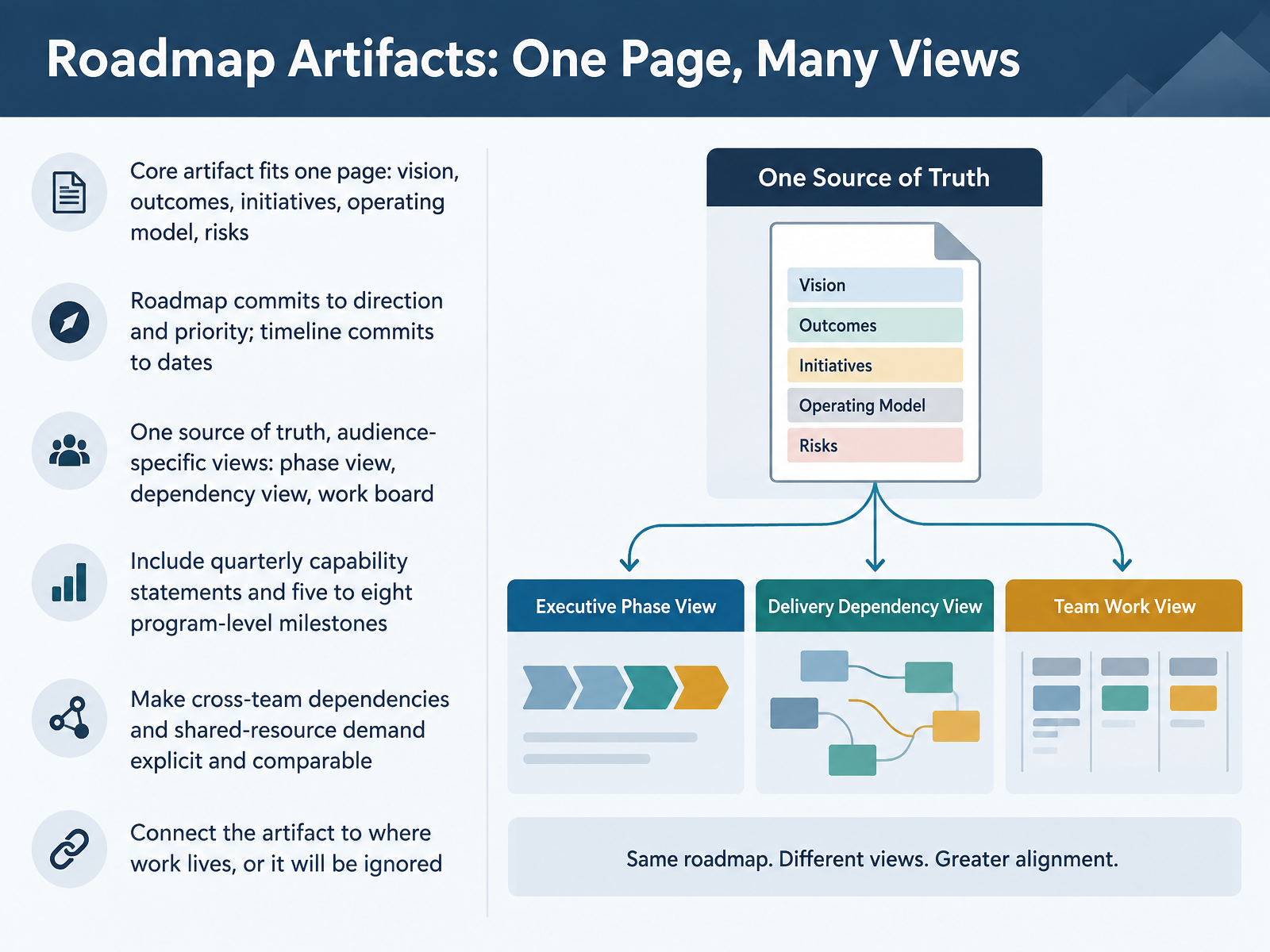
- 10Roadmap Artifacts: One Page, Many ViewsLet's talk about the roadmap artifact itself. It should fit on one page: vision, outcomes, initiatives, operating model, and risks. One page forces clarity and keeps people reading it.
Here is the tradeoff that matters most. A roadmap commits to direction and priority. A timeline commits to dates. If you put firm dates on everything, you have built a timeline, and you will be held to it. Keep one source of truth, then create audience-specific views: a phase view, a dependency view, and a work board for the teams doing the work.
For quarterly planning, include capability statements, what each team can actually deliver, plus five to eight program-level milestones. Those are the gates other teams plan against, not task-level dates.
Then make cross-team dependencies and shared-resource demand explicit and comparable. State each as a need: which team, what is required, and when. That is how you catch two workstreams competing for the same validation team in the same window.
One more discipline: connect the artifact to where work actually lives. If the roadmap and the task board are separate objects, someone updates the board, nobody updates the roadmap, and within a month they disagree.
So keep the roadmap as the single source, publish different views for different audiences, and wire it into your delivery tools so it stays current. Next, we move into Metrics, Reviews, and Trigger-Based Re-planning.
 valiotti.comslidekit.comkanbanchi.com+22 min
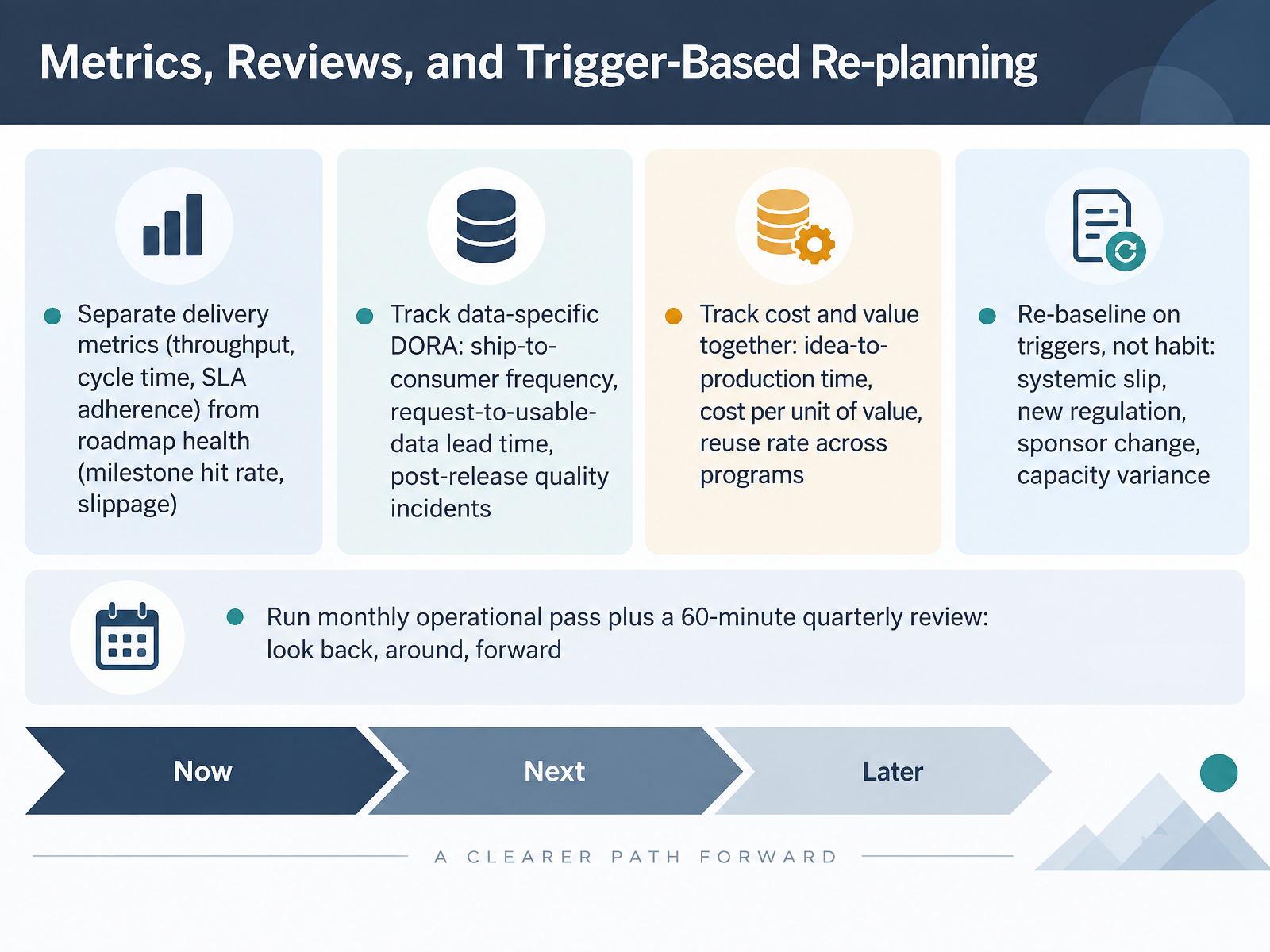
- 11Metrics, Reviews, and Trigger-Based Re-planningNext, let's talk about how you measure and re-plan. Keep two metric families separate. Delivery metrics cover throughput, cycle time, and SLA adherence. Roadmap health covers milestone hit rate and slippage. If you blend them, a team can hit every sprint and still miss the roadmap. For data specifically, track a data-focused version of DORA: ship-to-consumer frequency, request-to-usable-data lead time, and post-release quality incidents. Then track cost and value together: idea-to-production time, cost per unit of value, and reuse rate across programs. Reuse is the metric most teams forget, and it is what compounds. Re-baseline on triggers, not habit. Systemic slip, a new regulation, a sponsor change, or capacity variance. Run a monthly operational pass plus a sixty-minute quarterly review: look back at what shipped, look around at what changed, look forward at what gets added, dropped, or resequenced. Coming up, we will put this into practice in the workshop: Building a Two-Quarter Roadmap, Part One.
 valiotti.comxylitytech.comengineered.at+22 min
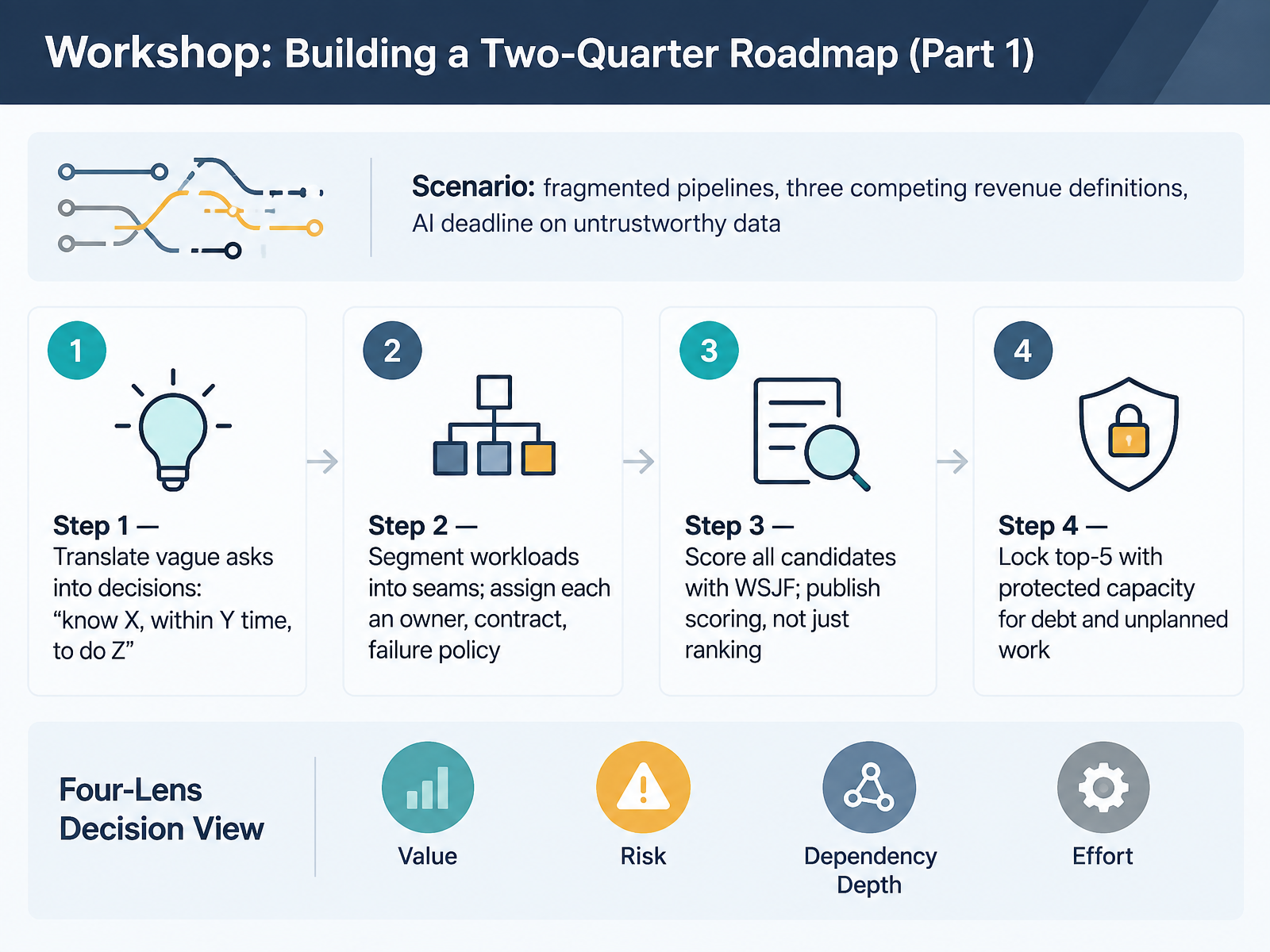
- 12Workshop: Building a Two-Quarter Roadmap (Part 1)Let's put this into practice. Your scenario is a familiar one: fragmented pipelines, three competing revenue definitions, and an AI deadline sitting on data nobody trusts. Step one is to translate vague asks into decisions. Push every stakeholder to the same shape: we need to know X, within Y time, to do Z. That single sentence kills most ambiguity. Step two, segment workloads into seams, and assign each one an owner, a contract, and a failure policy. If a pipeline breaks at two in the morning, you should know who gets paged and what happens next. Step three, score all candidates with Weighted Shortest Job First, then publish the scoring, not just the ranking. When finance sees why a compliance fix beat a dashboard, the political debate disappears. Step four, lock your top five with protected capacity for debt and unplanned work. Fifteen to twenty percent is the usual starting point. Next, we'll take these steps and build out the full two-quarter plan.
 github.comframework.scaledagile.comtechdebt.now+22 min
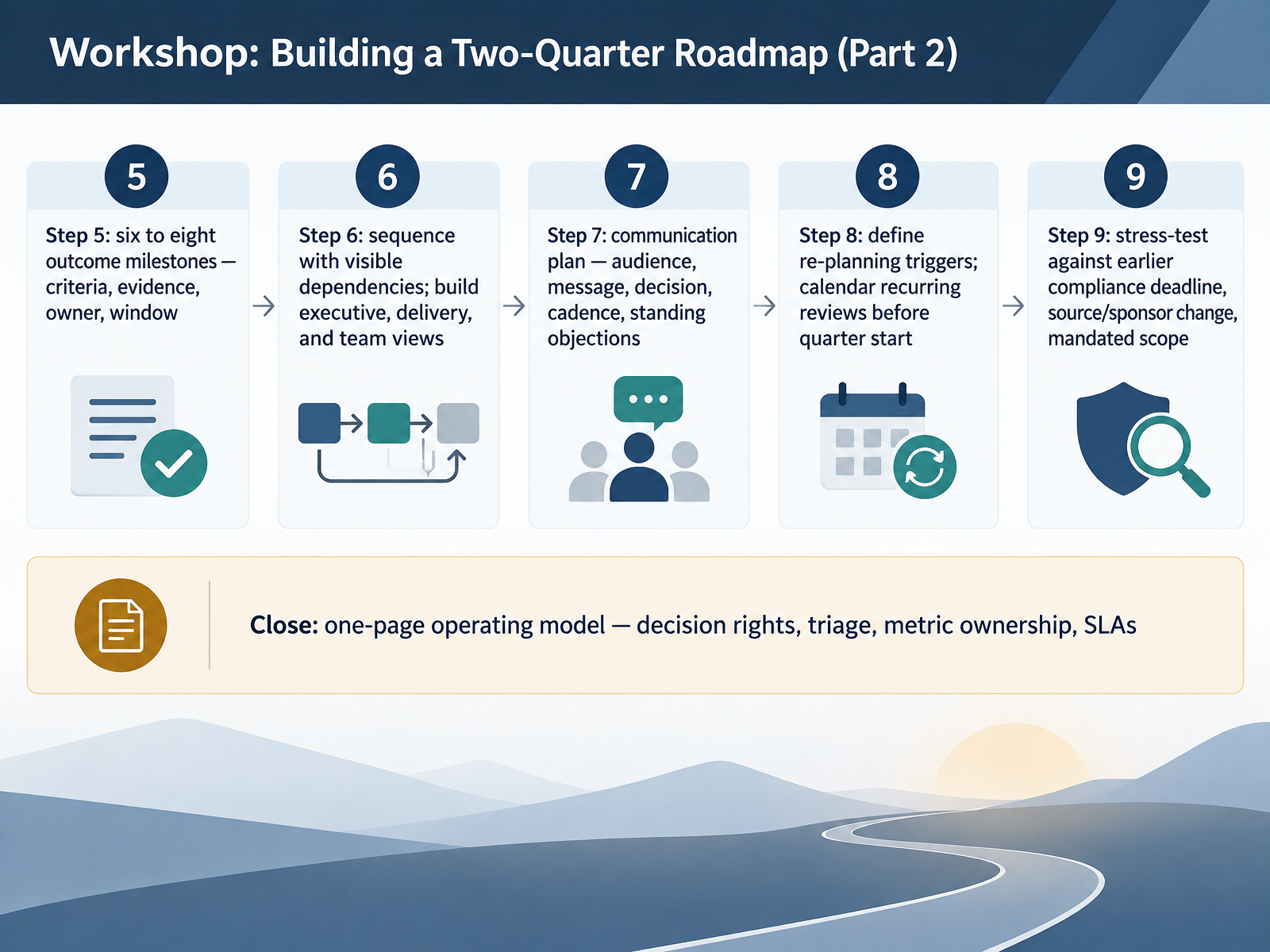
- 13Workshop: Building a Two-Quarter Roadmap (Part 2)Now we finish the two-quarter roadmap with steps five through nine, then close on the operating model. Step five: write six to eight outcome milestones, each with pass or fail criteria, the evidence that proves it, a single named owner, and a time window. Step six, sequence them with dependencies shown. Keep three views: executive for priorities, delivery for dependencies, team for the work itself. Step seven, build the communication plan. For each audience, define the message, the decision you need, the cadence, and the objections you expect every review. Step eight, name the re-planning triggers before quarter start, and put recurring reviews on the calendar. Step nine, stress-test the plan against the compliance deadline, a source or sponsor change, and mandated scope. Then close with a one-page operating model: decision rights, triage path, metric ownership, and SLAs. First 90 Days: Turning the Outline into a Working Cadence.
 valiotti.comxylitytech.comslidekit.com+22 min
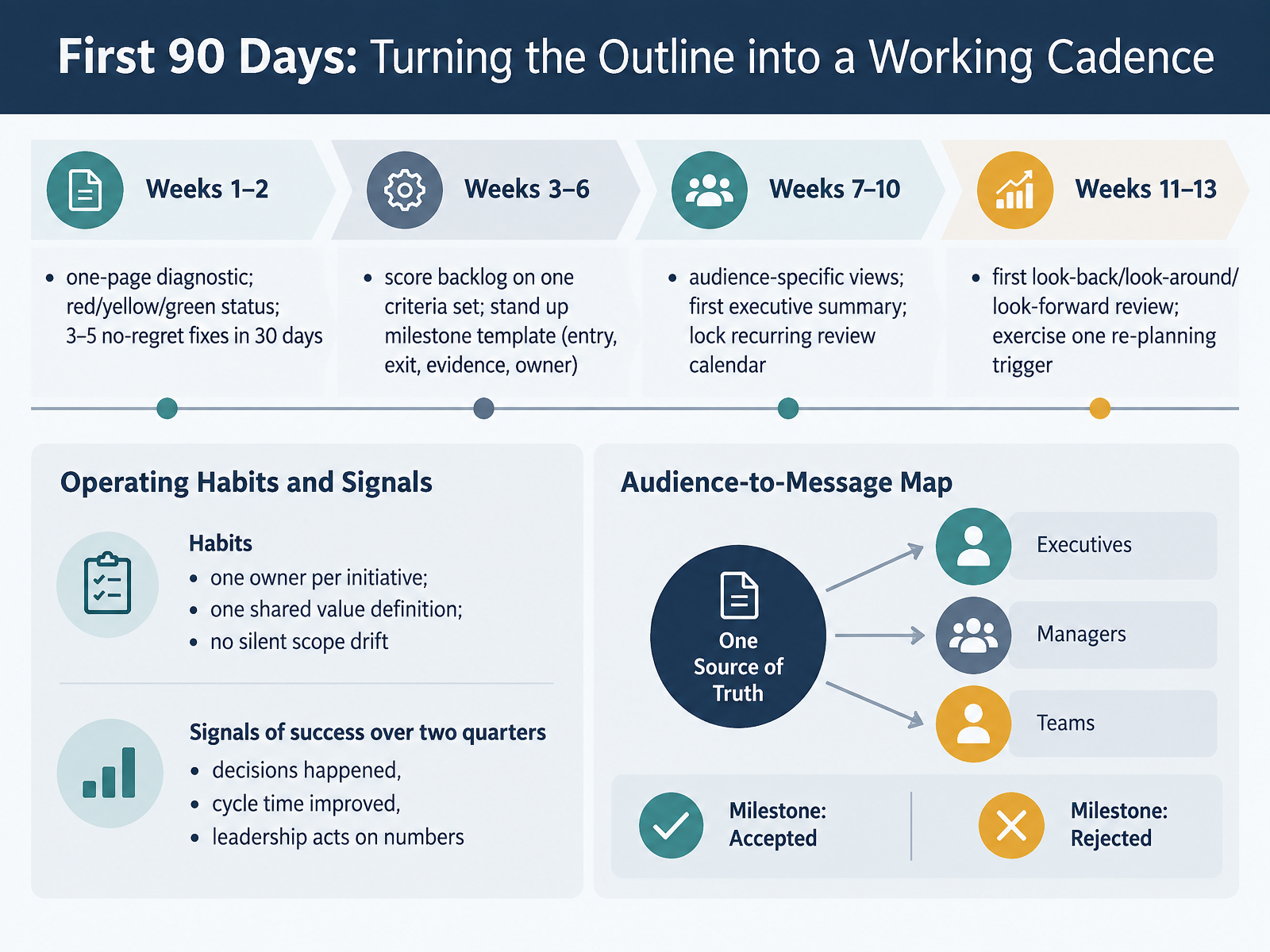
- 14First 90 Days: Turning the Outline into a Working CadenceLet's close with the first ninety days, the point where the outline becomes a working cadence. Weeks one and two: produce a one-page diagnostic with red, yellow, and green status, plus three to five no-regret fixes you can ship in thirty days. Those early wins build the political capital for harder conversations. Weeks three to six: score the backlog against one criteria set, and stand up your milestone template. Every milestone needs four things: entry, exit, evidence, and a named owner. Weeks seven to ten: build audience-specific views, publish your first executive summary, and lock a recurring review calendar rather than meeting ad hoc. Weeks eleven to thirteen: run your first look-back, look-around, look-forward review, and deliberately exercise one re-planning trigger so the team feels how scope actually shifts. Three habits hold it together: one owner per initiative, one shared definition of value, and no silent scope drift. Over two quarters, watch for the real signals. Decisions actually happened, cycle time improved, and leadership acts on the numbers without reconciling them first. If those three move together, your roadmap is working. If not, look at the operating model before you blame the technology. Thank you for working through this. Start with the diagnostic this week, and let the cadence carry the rest.
 valiotti.comslidekit.comkanbanchi.com+22 min
Take the deck with you
Download this course as a file — free, no sign-up needed.
- PDF handoutEvery slide page, ready to print or share.15 pages · 3.3 MBDownload
- Narrated PowerPointThe deck that presents itself — every slide carries the digital human's narration video.15 pages · 14.7 MBDownload
- PowerPoint slidesThe full deck as a .pptx — open it in PowerPoint, Keynote, or Google Slides.15 pages · 3.1 MBDownload
Free to use in your own training — please keep the PersonWise credit page at the end.
Have your own deck? Turn it into a course
Sources consulted
Web sources consulted while building this course.
- Data Strategy Roadmap 2026: A 7-Step Framework for Companies That Need Their Data to Actually Work | Valiotti Data — valiotti.com
- Timeline vs Roadmap Slides: Which Works Better? - SlideKit — slidekit.com
- Project Roadmap Tools That Don't Go Out of Date - Kanabnchi blog — kanbanchi.com
- DATA_ENGINEERING_ROADMAP_2026.md — github.com
- Enterprise Data Engineering Strategy Guide — xylitytech.com
- Data Platform Maturity Model (5 Stages) | Engineered.at — engineered.at
- Data engineering maturity model - Executive snapshot for 2026 — agileinfoways.com
- Data Fabric Maturity Model for Benchmarking — datafabric.cloud
- Autonomous Data Engineering: A 5-Stage Maturity Model — snowflake.com
- Data Maturity Assessment PDF 2026: Framework & Report — data-pilot.com
- Extended Guidance - WSJF - Scaled Agile Framework — framework.scaledagile.com
- Tech Debt Prioritization Frameworks | TechDebt.now — techdebt.now
- WSJF and Cost of Delay: Prioritizing for Economic Value Throughput – Kaizenko — kaizenko.com
- WSJF Calculator • scagile — scagile.io
- WSJF (Weighted Shortest Job First): How to Evaluate and Prioritize Effectively — agility-at-scale.com
- Choose the Publication Contract, Not the Fabric Icon – EduDataSci – Educating the world about data and leadership — edudatasci.net
- Migrating Proprietary Warehouses to Open Lakehouses: The 2026 Playbook for Zero-Copy Metadata Translation | Alex Merced's Lakehouse Blog — iceberglakehouse.com
- Data Warehouse/Lake/Lakehouse - How to Choose for Business | DataMy — datamy.co
- Lakehouse vs data warehouse: the honest 2026 state | Data Warehouse Info — datawarehouseinfo.com
- How to choose between a data warehouse and data lake | Algorithmic — algorithmic.co