Begin
14 pages · ~28 min
Product Management Frameworks Comparison
A concise overview of product management frameworks, comparing their strengths and use cases to help aspiring PMs select the right approach.
A digital instructor presents all 14 pages. Hold “Ask” at any point and ask out loud — the answer comes from this course. No sign-up needed.
What you’ll learn
- 01Product Management Frameworks: Comparing Approaches and Use CasesWelcome. If you are leading a product team, you already know the problem: too many ideas, limited time, and stakeholders who all want different things. This course is about cutting through the noise. We are going to compare the major product management frameworks, see which situations they actually fit, and build a practical selection plan you can use right away. Here is the core mindset: a framework is a repeatable way to decide what to build, in what order, and how to measure success. It reduces ambiguity and aligns stakeholders. But remember, frameworks are tools, not religions. The best one is the lightest one that still forces good decisions. If a ritual is not improving what you ship, drop it. Over the next few minutes, we will move fast, compare approaches, and map them to real situations. Let's get started. Next, we will look at why frameworks matter, covering their roles, contexts, and core trade-offs.blog.logrocket.comcabinco.combeyondpmf.com+22 min
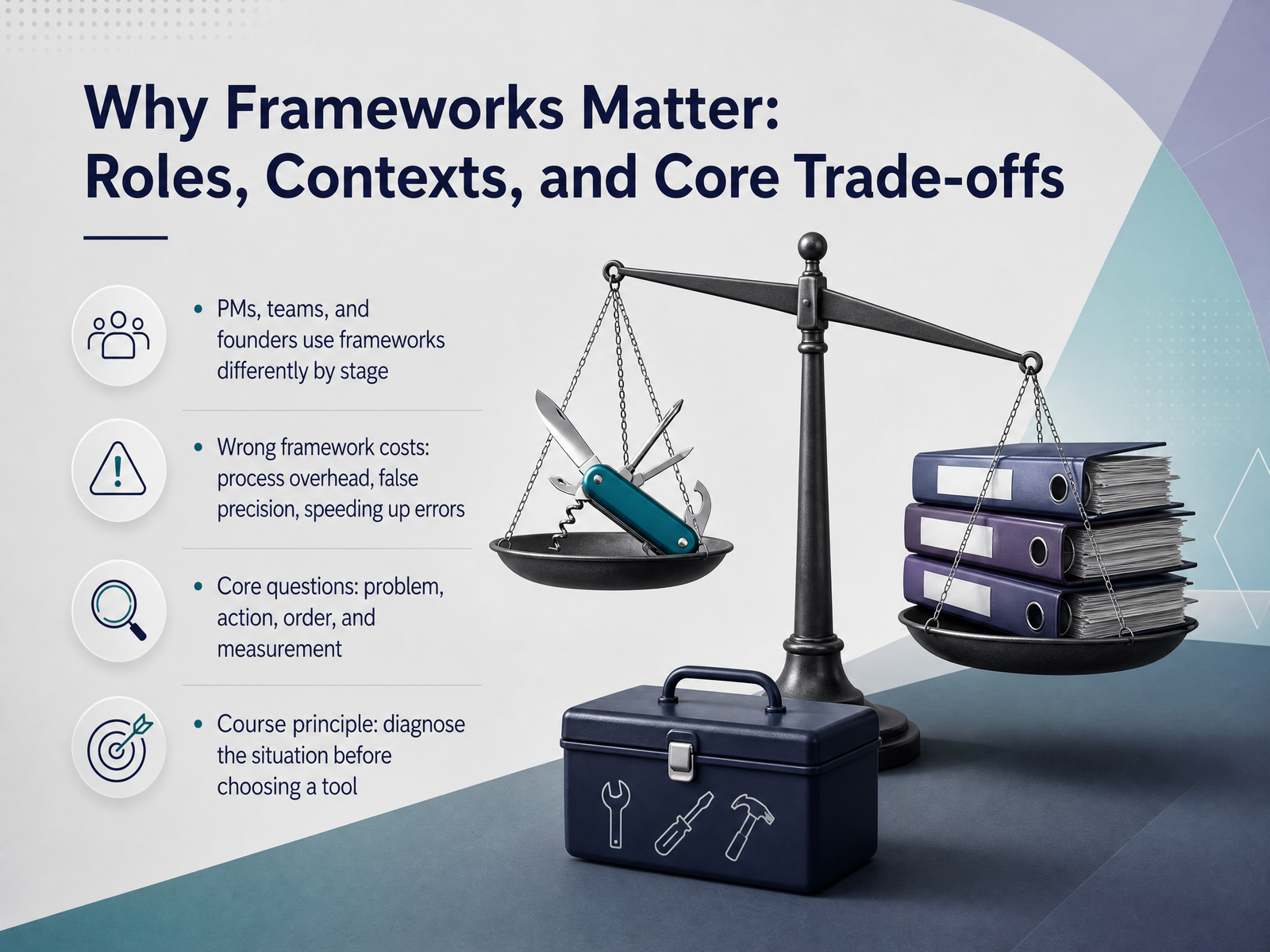
- 02Why Frameworks Matter: Roles, Contexts, and Core Trade-offsSo why do frameworks matter? Because the wrong one costs more than time. It adds process overhead, creates false precision, and helps you speed up errors. The real question isn't which framework is popular, but which one fits your context. Product managers, teams, and founders use them differently depending on their stage. A pre-launch startup needs validation, not quarterly controls. A scaling team needs prioritization that deprioritizes the loudest voice. And a mature team needs alignment, not another scoring ceremony. Before you pick a tool, answer four questions. What problem are we solving? What will we do about it? In what order? And how will we know it worked? If a framework doesn't make those answers faster and clearer, it's overhead dressed up as rigor. The single principle that holds this whole course together is simple: diagnose the situation before choosing the tool. Some decisions are reversible, like a button color, so move on. Others are one-way doors, like a pricing change, so slow down and use a robust framework. Not every problem needs a template, but every good decision starts with reading the context. Keep that filter in mind, and the right framework will be obvious. Now let's look at the full landscape next.
 blog.logrocket.comcabinco.combeyondpmf.com+21 min
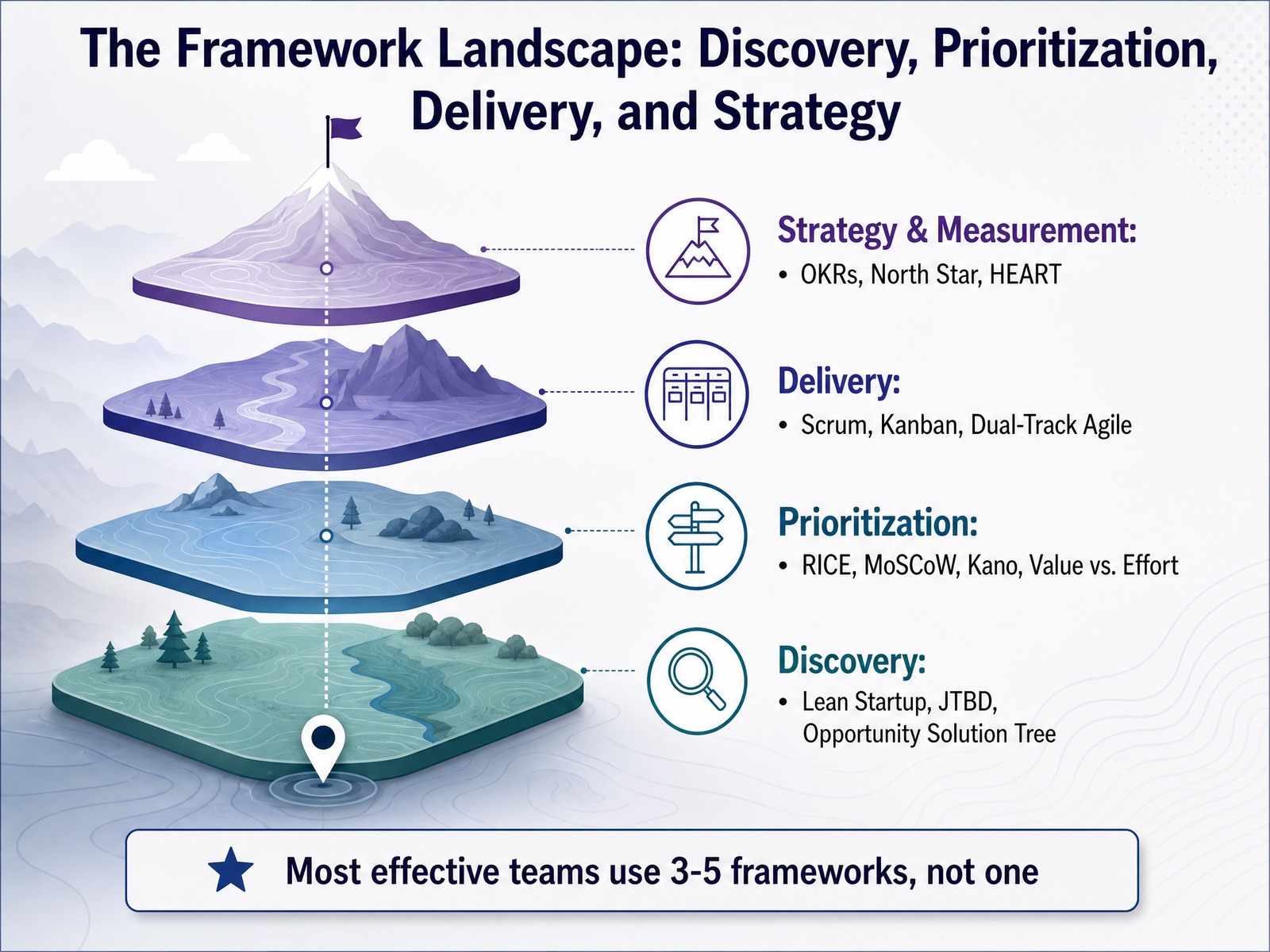
 - 03The Framework Landscape: Discovery, Prioritization, Delivery, and StrategyLet’s take a step back and look at the entire framework landscape. Every framework you’ll meet in this course answers one of four questions. Discovery frameworks like Lean Startup, JTBD, and the Opportunity Solution Tree answer: what problem is worth solving? Prioritization frameworks like RICE, MoSCoW, and Kano answer: what do we build first? Delivery frameworks like Scrum and Kanban answer: how do we ship it reliably? And strategy frameworks like OKRs and North Star answer: did it actually move the needle? Here’s the key insight. The most effective teams don’t pick one framework. They pick a small kit, usually three to five, with one from each category. Use JTBD to find the right problem, RICE to rank the backlog, Scrum to deliver, and OKRs to keep everyone honest. That’s the full loop. Now let’s zoom in and compare what each of these approaches is actually for, and where they break down.
 ideaplan.iolearnanything.proideaplan.io+21 min
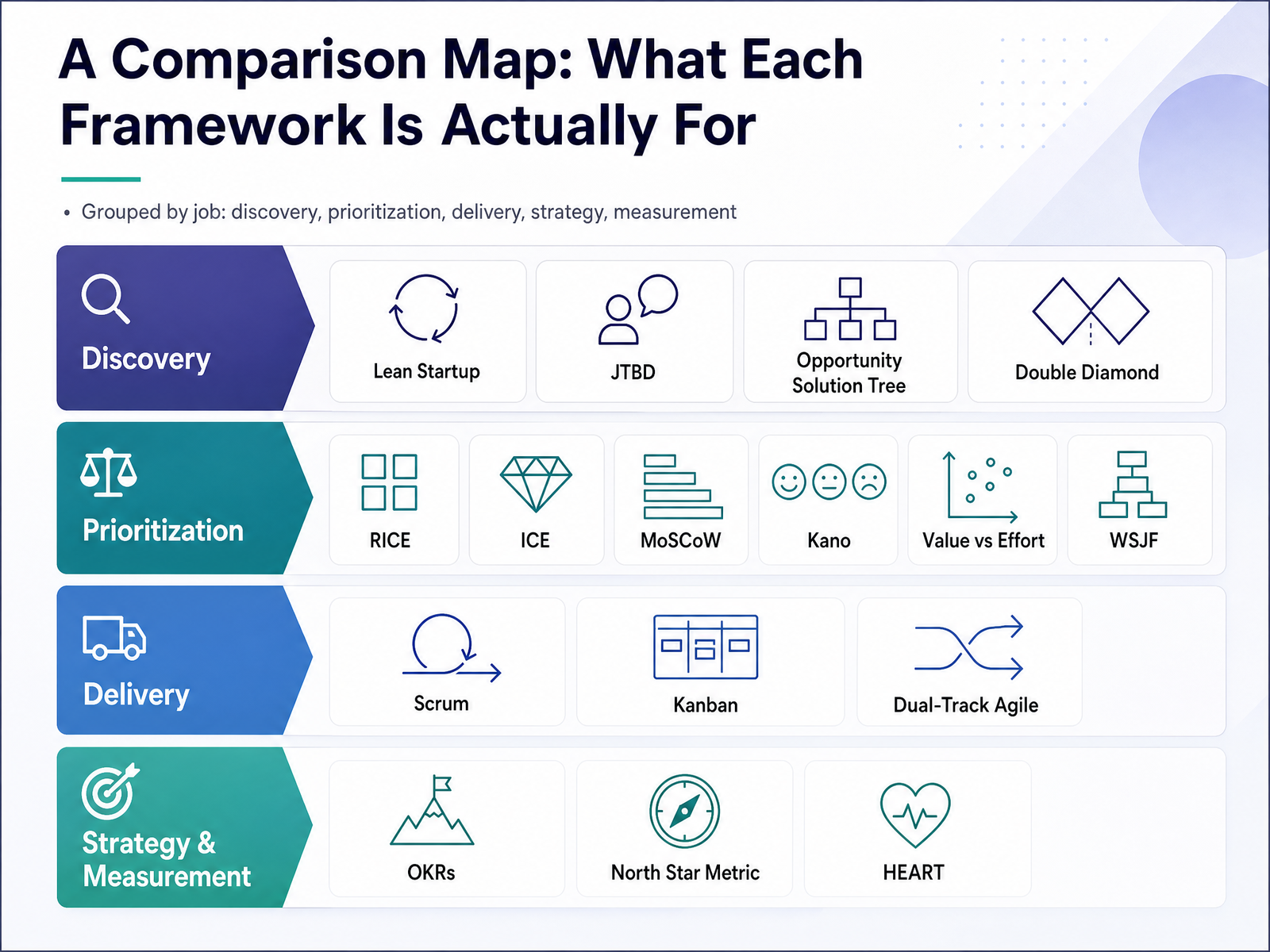
 - 04A Comparison Map: What Each Framework Is Actually ForLet’s zoom out and see what each framework is actually for. The right way to compare them is not by popularity, but by the job they do. Grouped by job: discovery, prioritization, delivery, and strategy with measurement. Discovery is about understanding the problem before you build. Use Lean Startup, JTBD, Opportunity Solution Trees, or the Double Diamond when the risk is building the wrong thing. Prioritization is about deciding what to build first. RICE and ICE for scoring, MoSCoW for scoping a release, Kano for understanding delight versus table stakes, Value versus Effort for a quick visual, and WSJF when cost of delay matters. For delivery, you have Scrum, Kanban, or Dual-Track Agile. These keep the team shipping reliably once the direction is clear. Then strategy and measurement, where OKRs set the quarterly outcomes, and the North Star Metric or HEART track whether you’re actually delivering value. The takeaway here is simple: don’t pick a favorite. Pick the tool that matches the decision in front of you. Next, we’ll look at how to match a framework to your specific situation.
 blog.logrocket.comcabinco.combeyondpmf.com+22 min
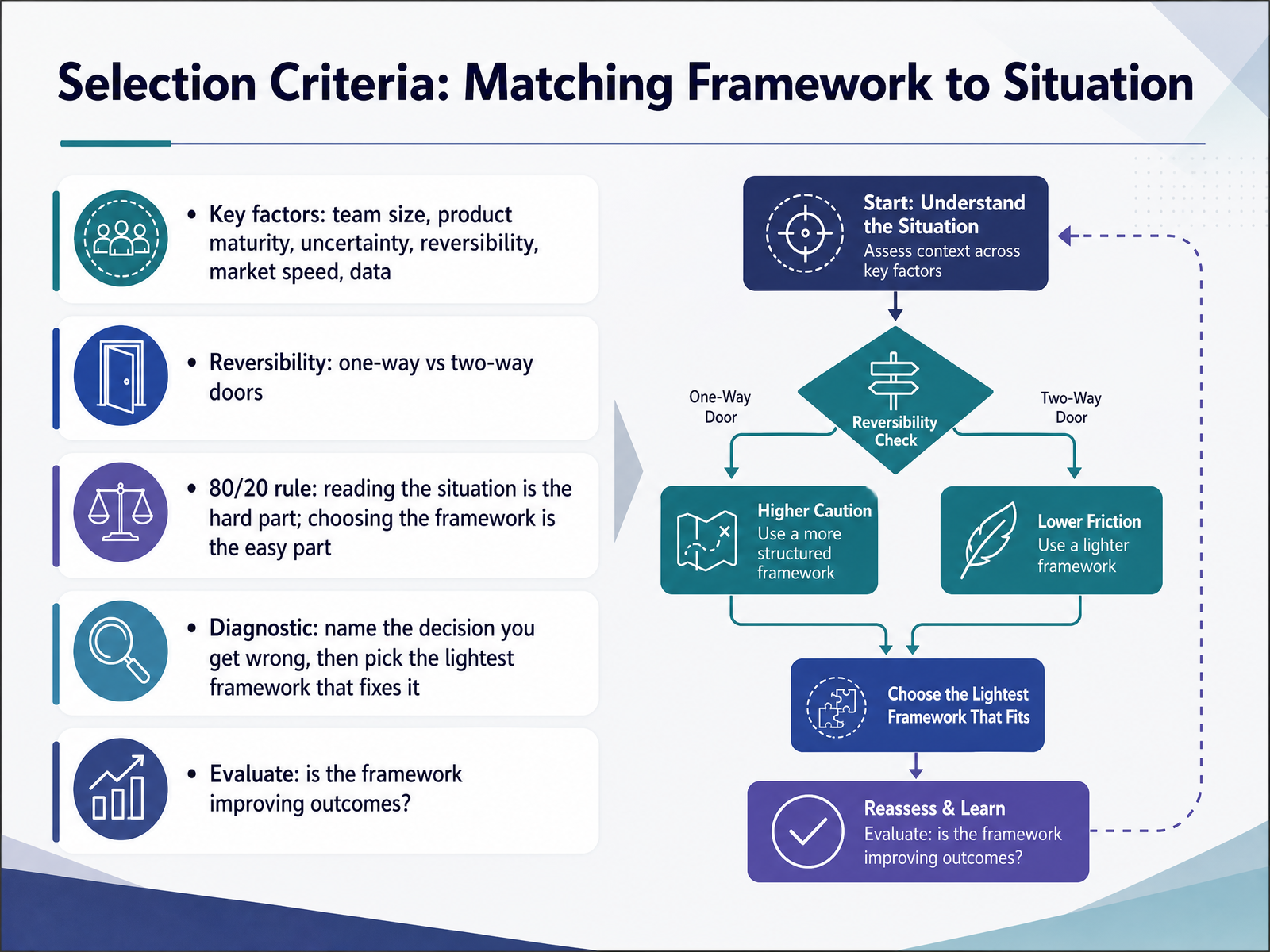
 - 05Selection Criteria: Matching Framework to SituationSo let's talk about how to actually pick. It comes down to a few factors: team size, product maturity, data, and market speed. But the one that matters most? Reversibility. Is this a one-way door or a two-way door? If the decision is cheap and reversible, like a button color, just move on. If it is expensive and irreversible, like a pricing model change, slow down and get rigorous. Here is the honest truth: choosing the framework is the easy twenty percent. Reading the situation is the hard eighty percent. So start with a diagnostic. Name the decision your team gets wrong, and then pick the lightest framework that fixes it. If you keep shipping the wrong things, you need better discovery, not another planning ritual. And then, evaluate. After a quarter, ask if the framework actually improved outcomes. If the numbers never change the decision, the framework is just decoration. Cut it. That brings us to our first real use case, early-stage discovery and validation.
 blog.logrocket.comcabinco.combeyondpmf.com+21 min
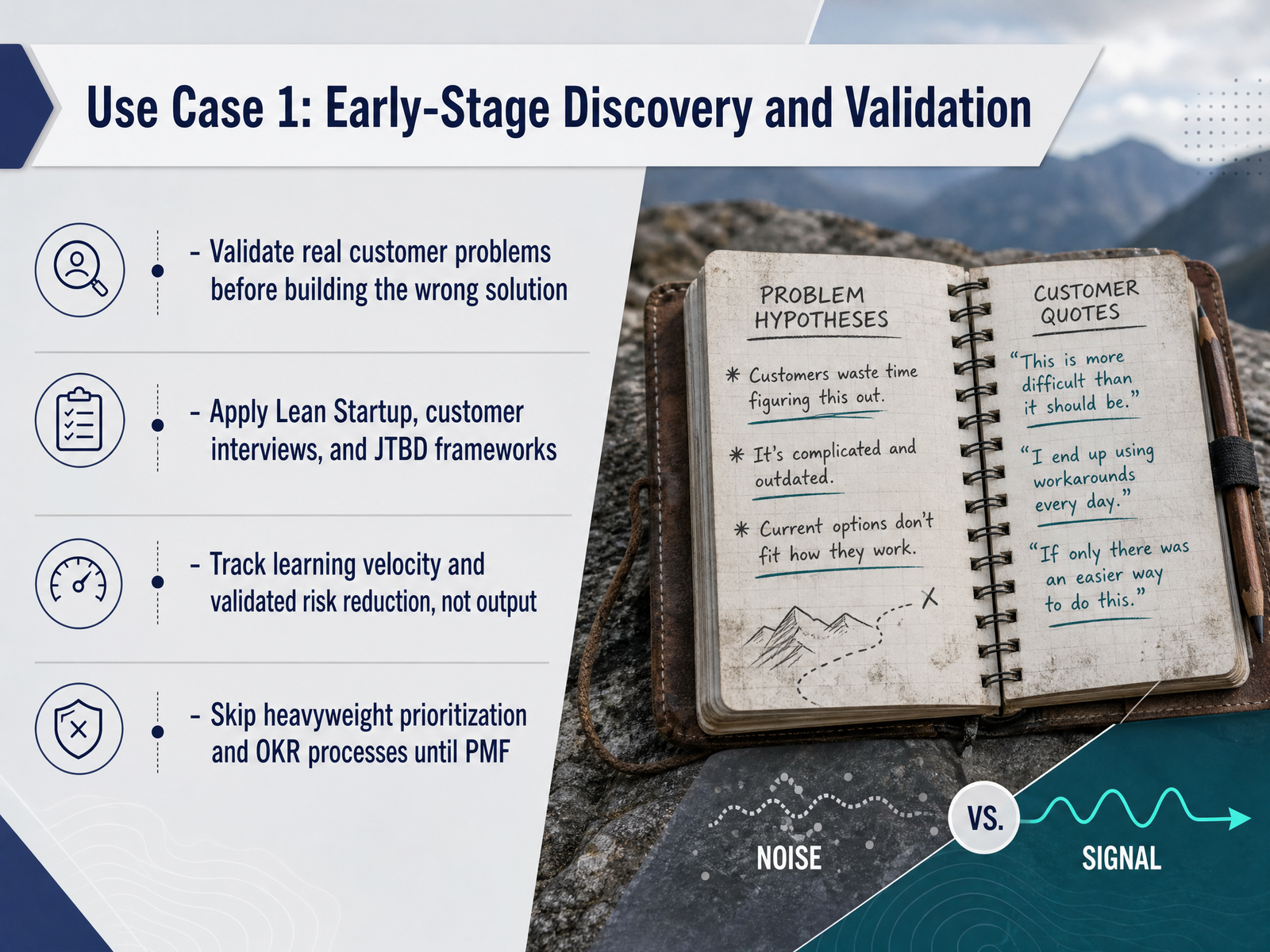
 - 06Use Case 1: Early-Stage Discovery and ValidationLet's look at the first major use case: early-stage discovery and validation. This is the phase where most product failures actually happen, not because of bad execution, but because we validated the wrong problem. Before you write a single line of code, your job is to confirm that real customers have a real pain worth solving. This is where Lean Startup, customer interviews, and Jobs-to-be-Done earn their keep. JTBD is particularly powerful here, because it forces you to understand the progress the customer is trying to make, rather than just collecting feature requests. Now, here's the counterintuitive part: in this stage, you should be tracking learning velocity and validated risk reduction, not output. Don't count features shipped. Count assumptions tested and invalidated. And resist the urge to adopt heavyweight prioritization scoring or quarterly OKRs before you've found product-market fit. With fifty users and no data, a full RICE score is just confident guesswork. Keep the process light, keep discovery continuous, and let the evidence tell you when you're ready to scale up the process. Next, let's shift to the second use case: prioritization and roadmap decisions, where your framework needs change dramatically.
 blog.logrocket.comcabinco.combeyondpmf.com+21 min
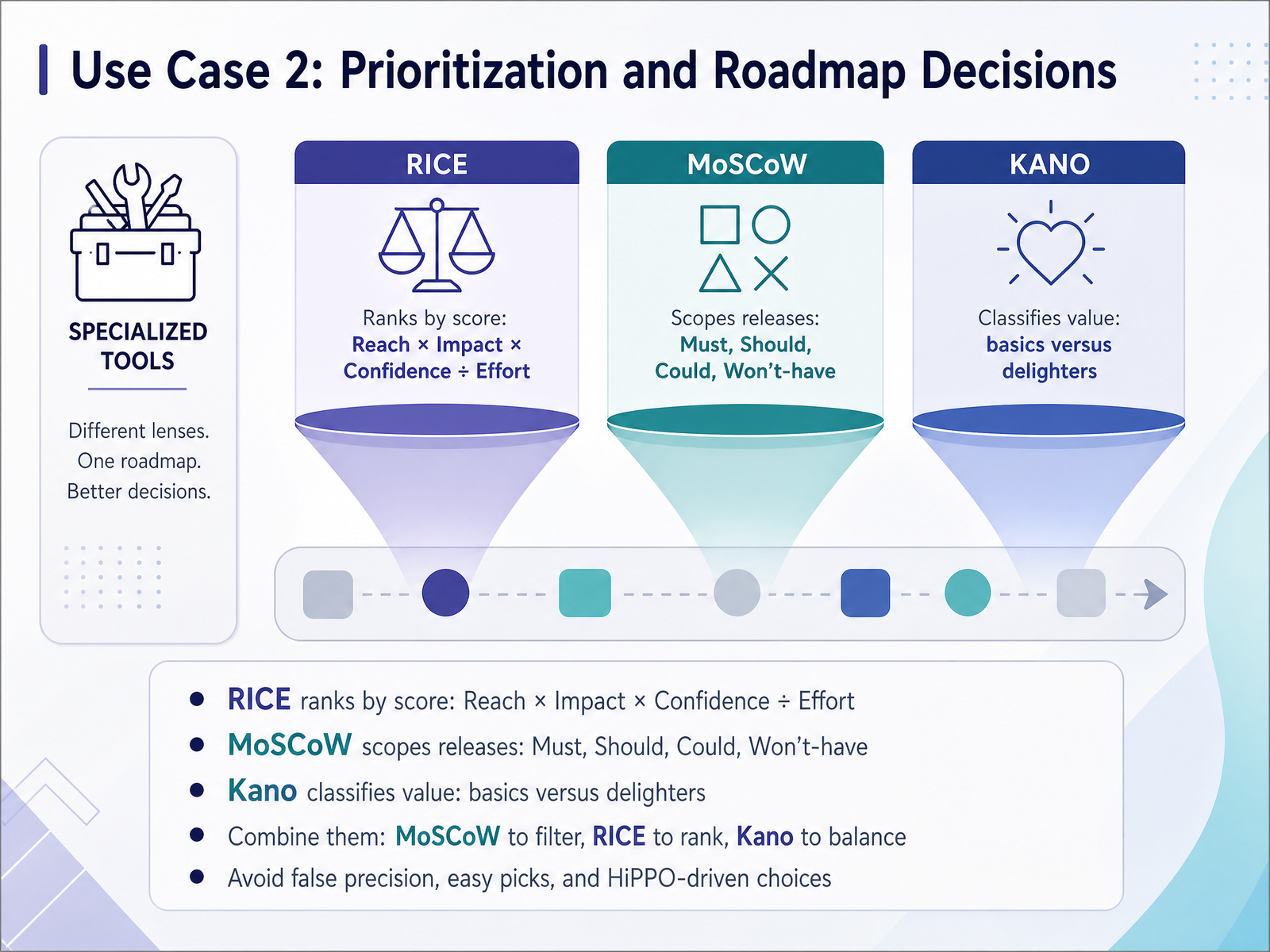
 - 07Use Case 2: Prioritization and Roadmap DecisionsLet’s walk through the second big use case: prioritization and roadmap decisions. When you’re staring at a backlog that keeps growing, you need tools that help you decide what to build—and what to cut. RICE is your scoring workhorse. Multiply reach, impact, and confidence, then divide by effort. It gives you a number you can defend when stakeholders ask why this feature beats that one. MoSCoW, on the other hand, is about scoping. You sort items into must-have, should-have, could-have, and won’t-have. It’s perfect for a release with a fixed deadline. Kano takes a different angle: it classifies features by how they affect customer satisfaction. Some are basics—if they’re missing, users get angry. Others are delighters that create real buzz. Now, the key here is not to pick just one. Combine them. Use MoSCoW to filter the list, RICE to rank what survives, and Kano to make sure you’re balancing essentials with delighters. That’s the pattern most mature teams land on. But be careful: avoid false precision. A score is only as good as your inputs. And don’t fall for easy picks—the low-effort wins that don’t move the needle. And above all, don’t let the framework become a rubber stamp for whoever’s highest paid in the room. Next, let’s look at how these frameworks show up in delivery, iteration, and team alignment.
 blog.logrocket.comcabinco.combeyondpmf.com+22 min
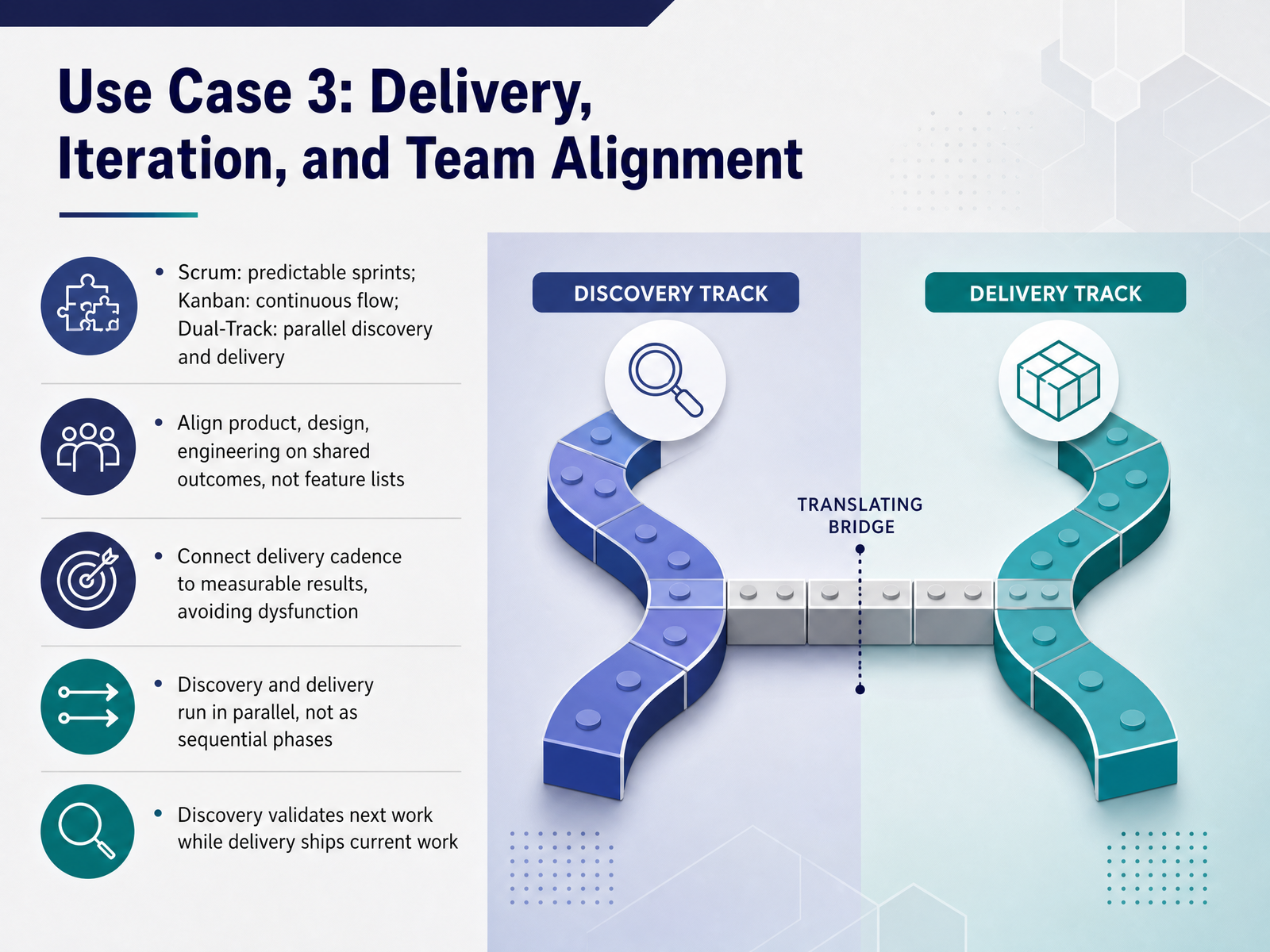
 - 08Use Case 3: Delivery, Iteration, and Team AlignmentNow let's look at the third use case: delivery, iteration, and team alignment. This is where teams often get bogged down in process debates. The real question isn't Scrum versus Kanban, it's what problem are you solving. Scrum gives you predictable sprints, which is great when you need commitment and visible progress. Kanban gives you continuous flow, which works better when work arrives unpredictably. And Dual-Track runs discovery and delivery in parallel, so you're always validating the next thing while shipping the current thing. Here's the key insight: the delivery framework doesn't matter if your team isn't aligned on outcomes. In my experience, the teams that struggle are the ones measuring output, like number of features shipped, instead of results. Shifting the conversation from what to build to what outcome we're trying to achieve changes everything. A practical test: can your delivery cadence connect directly to a measurable result? If not, you've got dysfunction. So remember, the framework is just the container. The value comes from keeping discovery and delivery moving together, with both tracks pointed at the same outcomes. Next, we'll move from delivery to the strategic layer: how to use frameworks for strategy, goals, and measurement.
 ideaplan.iofeaturebase.appcabinco.com+22 min
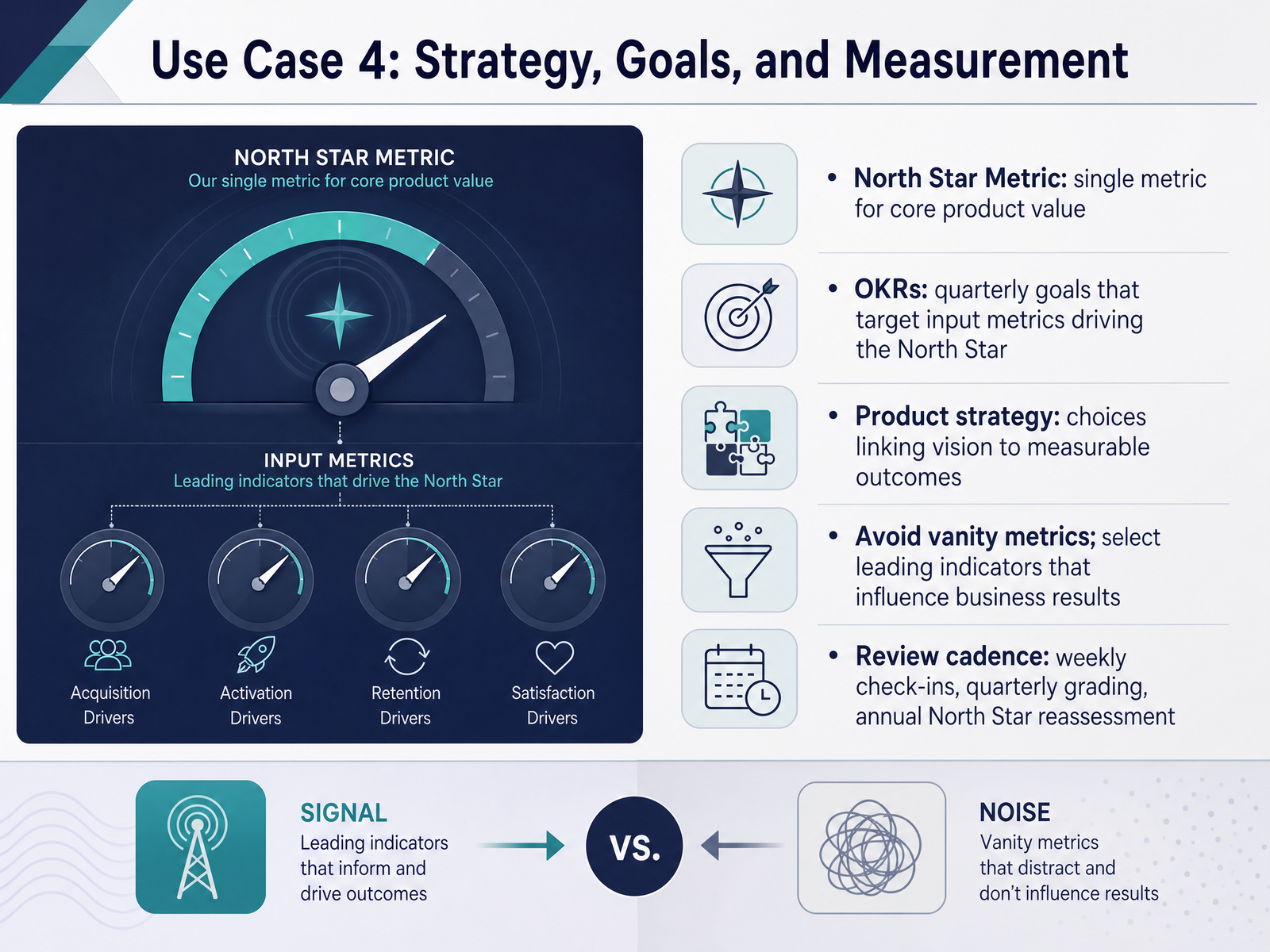
 - 09Use Case 4: Strategy, Goals, and MeasurementNow let's talk about how these pieces fit together for strategy, goals, and measurement. Start with your North Star Metric. That's the single number that captures the core value your product delivers. Think of it as the quantified sibling of your product vision. It should be a leading indicator, not revenue, and it should be something your team can actually influence. Then layer OKRs underneath. Each quarter, you set objectives that target the input metrics driving that North Star. Your product strategy is the bridge between the two. It's the set of choices that links your long-term vision to measurable outcomes. Here's the critical part, avoid vanity metrics. Page views and total registrations feel good, but they don't predict business health. Instead, pick leading indicators that actually influence business results. And keep a steady review rhythm. Check in weekly, grade the OKRs quarterly, and reassess the North Star annually. The North Star keeps everyone pointed in the same direction. OKRs tell each team how far to go this quarter. Together, they keep your strategy honest. Next, let's look at how to combine these frameworks in practice.
 ideaplan.iolearnanything.proideaplan.io+22 min
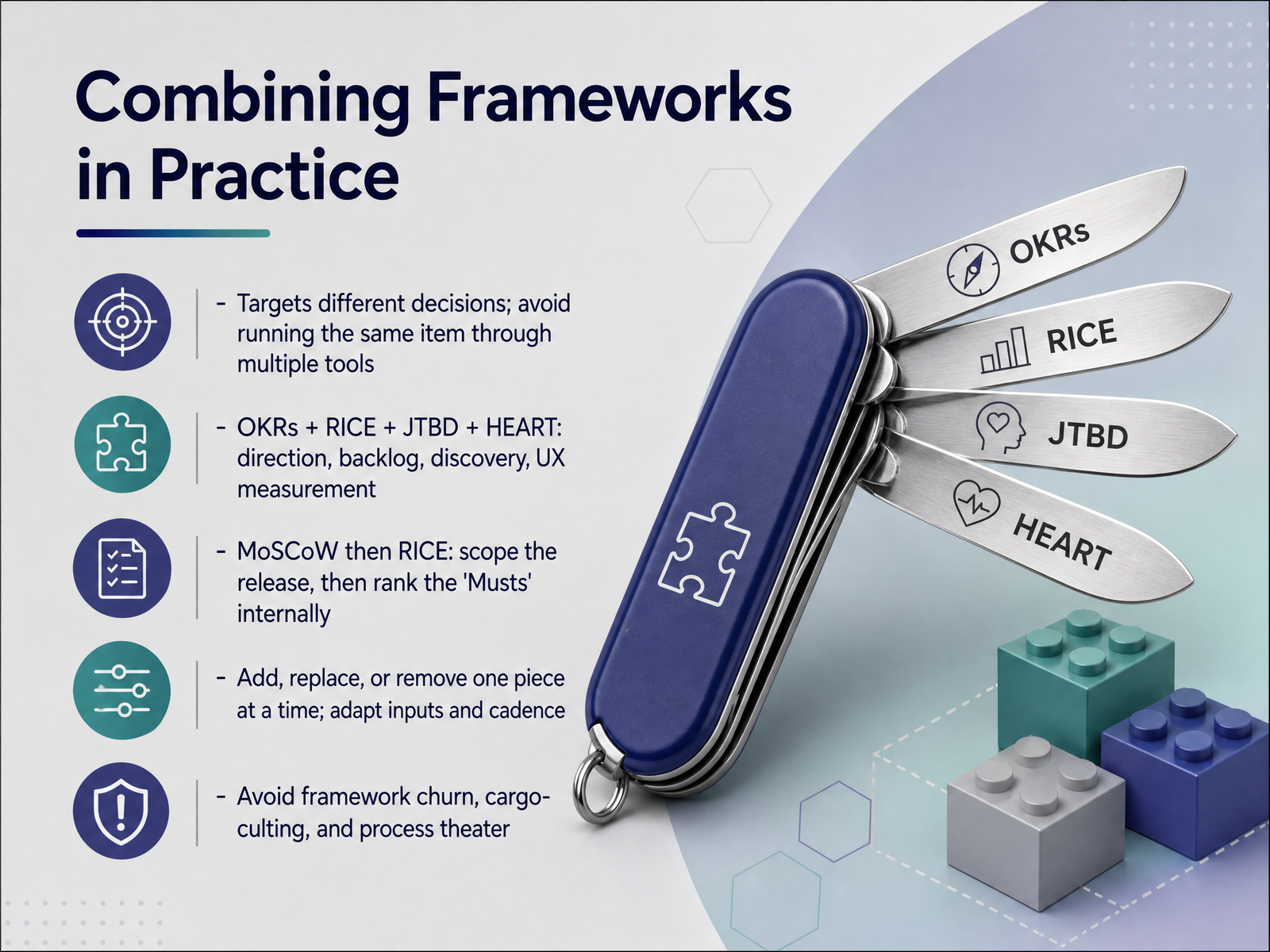
 - 10Combining Frameworks in PracticeLet’s talk about how these frameworks actually work together in practice. The golden rule is simple: each framework targets a different decision. So don’t run the same item through multiple tools—that’s just process theater. Instead, build a stack where each piece answers a different question. Start with OKRs to set direction. Use JTBD for discovery. RICE for backlog prioritization. And HEART for UX measurement. One classic combo is MoSCoW first to scope the release, then RICE to rank the Must-haves against each other. That works well. Make changes one piece at a time. Adjust inputs, tweak cadence, but never replace the whole system at once. And whatever you do, avoid framework churn and cargo-culting. If a tool isn’t changing decisions, drop it. Which brings us to some failure modes worth knowing.
 blog.logrocket.comcabinco.combeyondpmf.com+21 min
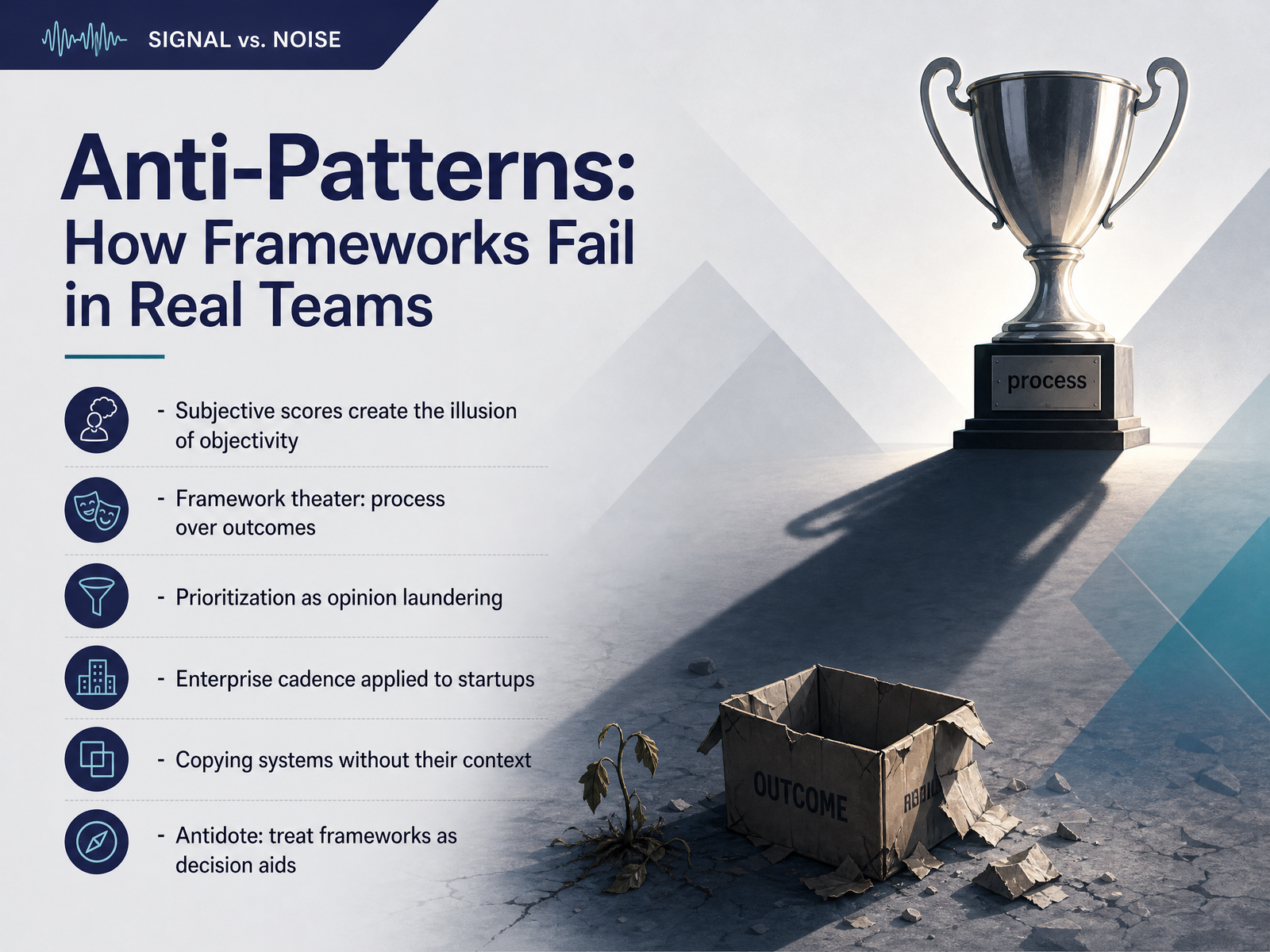
 - 11Anti-Patterns: How Frameworks Fail in Real TeamsLet’s talk about where frameworks actually break down in real teams. First, subjective scores create the illusion of objectivity. Your impact of seven is my impact of four. The math looks rigorous, but it's opinion dressed up in a spreadsheet. Then there's framework theater. Rename the PM a product owner, set up the Jira board, run all the motions, and still ship the wrong things. Process over outcomes, every time. Prioritization often becomes opinion laundering. If the CEO already picked the feature, the RICE score just legitimizes that call. If the numbers never change the decision, they're decoration. Cadence mismatches are common too. Applying an enterprise quarterly OKR rhythm to a pre-PMF startup means you're optimizing against assumptions that were outdated weeks ago. And cargo-culting. Copying Spotify's squad model or another company's scoring system without their context, team size, or data. It won't fit. So what's the antidote? Treat frameworks as decision aids, not belief systems. They should spark structured discussion and sharpen your judgment, not replace it. A framework is a starting hypothesis, not the answer. Read the situation first, adapt the tool, and drop it when it stops changing decisions.
 blog.logrocket.comcabinco.combeyondpmf.com+21 min
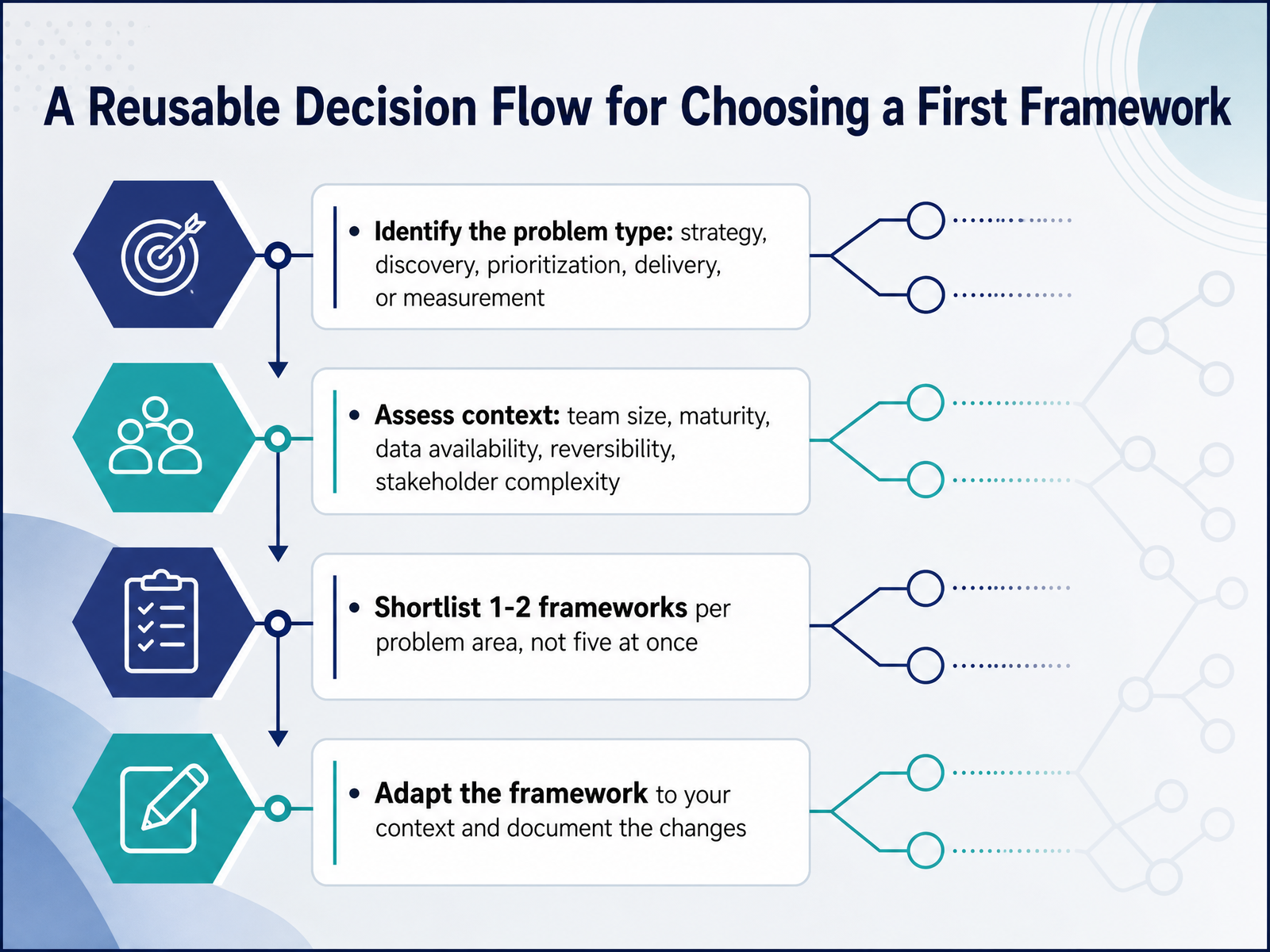
 - 12A Reusable Decision Flow for Choosing a First FrameworkSo how do you actually pick a first framework without analysis paralysis? Start with the problem type, not the tool. Is this a strategy question, a discovery question, prioritization, delivery, or measurement? Each one points to a different family of frameworks. Then assess your context. Team size, maturity, data availability, and how reversible the decision is. A framework that assumes a data team is useless without one. Shortlist one or two frameworks per problem area, not five at once. Most teams only need two or three in total. And when you apply it, adapt it. Customize the inputs and weights to your reality, and document what you changed and why. A framework is a starting hypothesis, not an answer. It should support judgment, not replace it. Keep that in mind, and you will know when to use it, and when to set it aside. Next, let's turn this into a concrete action plan for your team.
 blog.logrocket.comcabinco.combeyondpmf.com+21 min
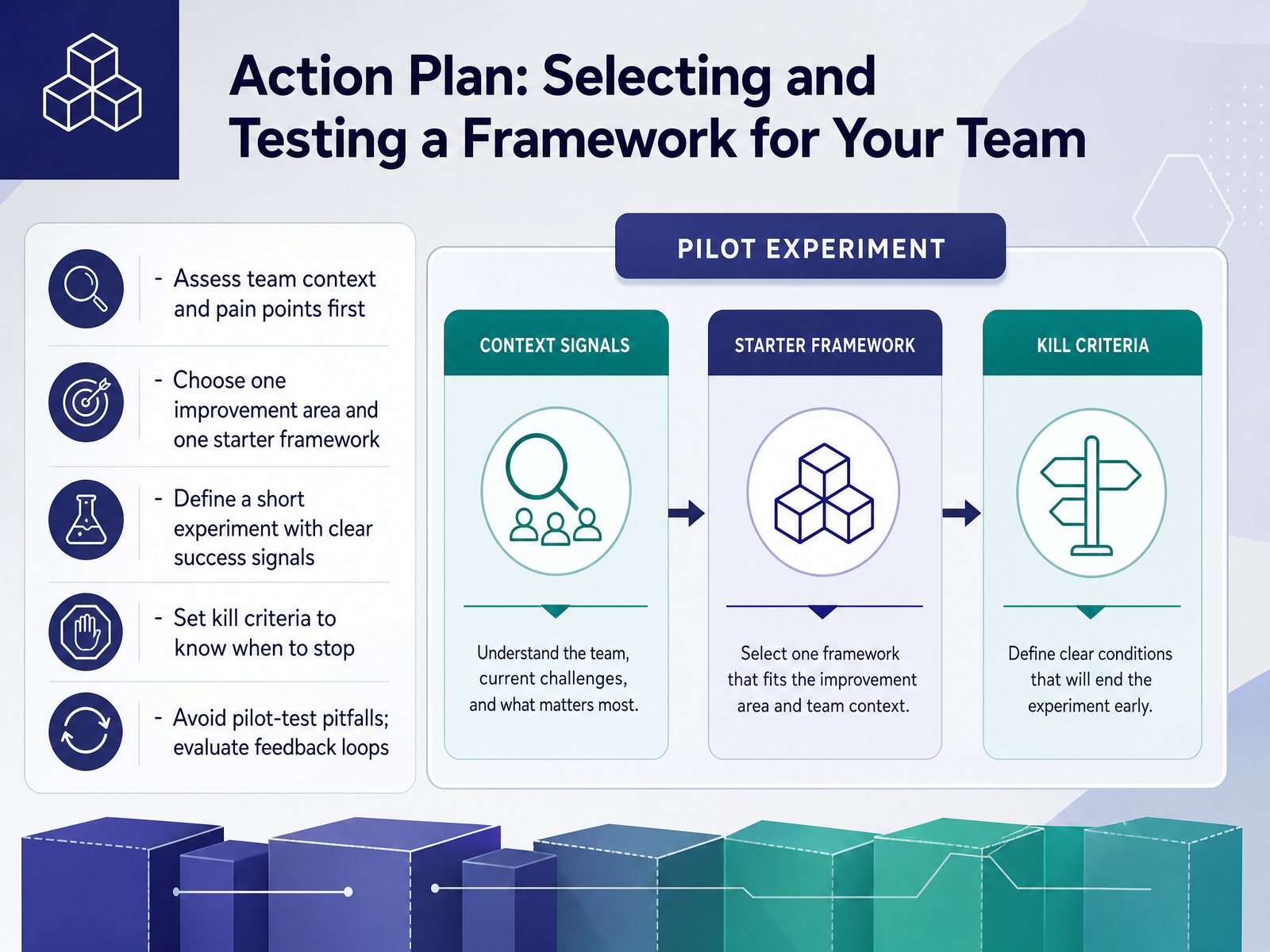
 - 13Action Plan: Selecting and Testing a Framework for Your TeamSo let's turn all of this into action. Start by assessing your team's context and real pain points. Where do decisions stall? Where does work get duplicated? That diagnosis matters more than the framework you pick. Then choose just one improvement area and one starter framework. Resist the urge to adopt five at once. Pick the lightest tool that fixes your actual bottleneck. Now define a short experiment with clear success signals. What does better look like? Faster decisions? Fewer reargued priorities? And be honest about how you'll measure it. Next, set kill criteria before you start. Define two or three conditions that would tell you to walk away. That prevents framework theater from dragging on. Finally, avoid the classic pilot-test pitfalls. Don't cargo-cult another company's process. Don't let scoring become decoration. And above all, evaluate the feedback loop. Ask the team: did this framework actually change a decision? If not, drop it. Run the experiment for about a quarter, review the results, and then decide whether to double down or pivot. That discipline is what separates a useful tool from process bloat. Up next, we'll recap the key takeaways and outline your next steps.
 blog.logrocket.comcabinco.combeyondpmf.com+21 min
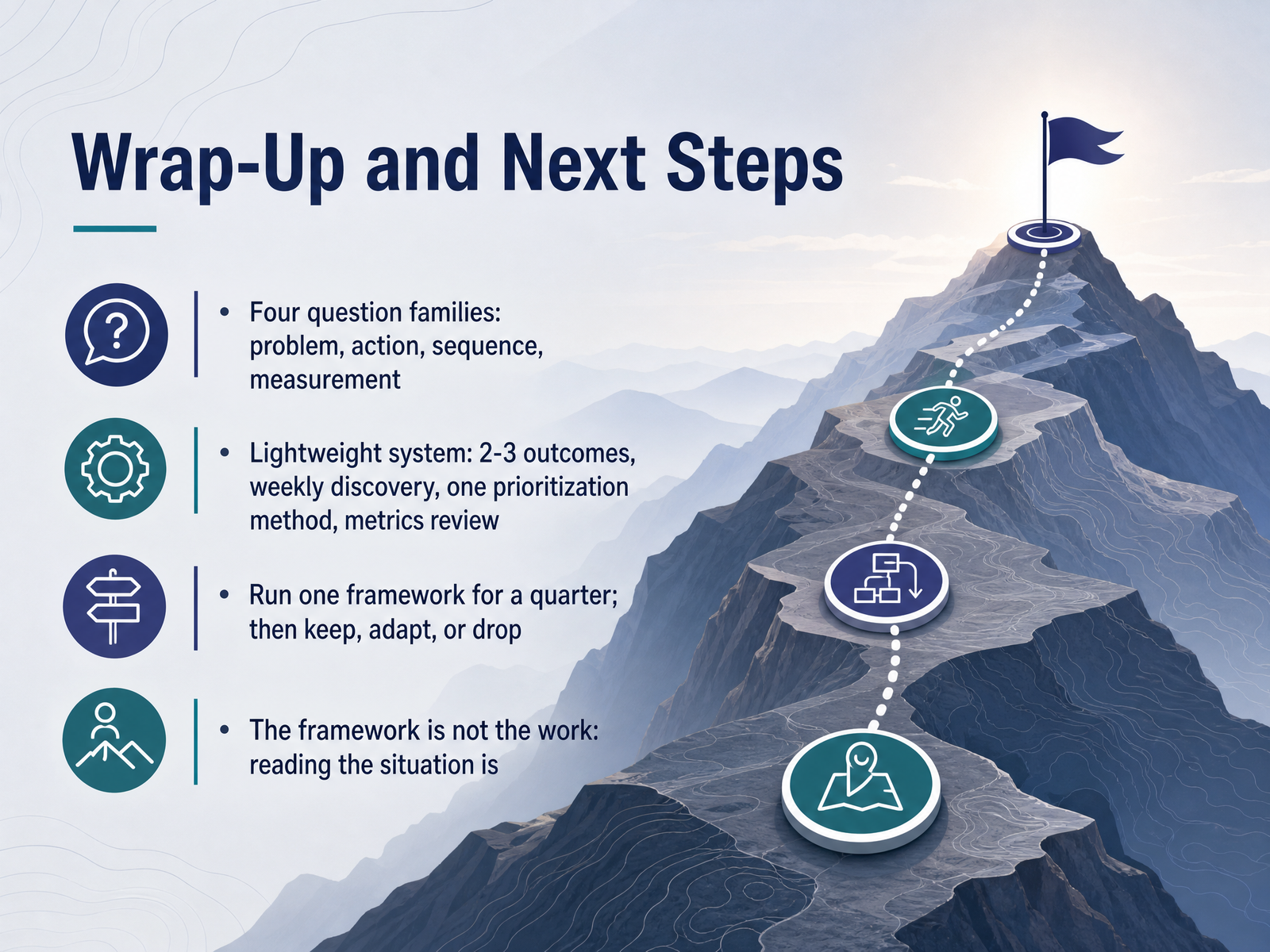
 - 14Wrap-Up and Next StepsWe've covered a lot of ground, so let's pull it together. Remember the four question families: problem, action, sequence, and measurement. Every framework you'll ever meet is just a structured way to answer one of those questions. You don't need a dozen tools. A lightweight system—two or three outcomes a quarter, weekly discovery, one visible prioritization method, and a biweekly metrics review—fits on a page and changes every decision. Pick a combination, run it for a quarter, and then make the call: keep it, adapt it, or drop it. That's the whole practice. And the last point is the most important one. The framework isn't the work. Reading the situation is. Your diagnosis comes first. The tool just sharpens your judgment. Thanks for your time, and go build something that matters.
 blog.logrocket.comcabinco.combeyondpmf.com+21 min
Take the deck with you
Download this course as a file — free, no sign-up needed.
- PDF handoutEvery slide page, ready to print or share.15 pages · 3.6 MBDownload
- Narrated PowerPointThe deck that presents itself — every slide carries the digital human's narration video.15 pages · 14.9 MBDownload
- PowerPoint slidesThe full deck as a .pptx — open it in PowerPoint, Keynote, or Google Slides.15 pages · 3.5 MBDownload
Free to use in your own training — please keep the PersonWise credit page at the end.
Have your own deck? Turn it into a course
Sources consulted
Web sources consulted while building this course.
- How to choose and adapt product management frameworks - LogRocket Blog — blog.logrocket.com
- How to Choose a Product Management Framework That Works - Cabin — cabinco.com
- 544+ PM Frameworks by Growth Stage | BeyondPMF — beyondpmf.com
- PM Frameworks Compared: 8 Methods Tested by Real Teams — ideaplan.io
- Product Management Framework – Project Management Formula — projectmanagementformula.com
- Most Popular PM Frameworks in 2026 (Usage Data) — ideaplan.io
- PM Frameworks Analysis 2026: RICE 8.7/10, OKR 8.2/10 — Rankings of 50+ Frameworks | PM Streak — learnanything.pro
- 2026 State of Product Management Report | IdeaPlan — ideaplan.io
- Product Management Trends 2026: State of PM Report — ideaplan.io
- Product Management Frameworks (26 Methods, 2026) — ideaplan.io
- 15 Product Management Frameworks Every PM Should ... — featurebase.app
- Product Management Frameworks: The Complete Collection — ideaplan.io
- The Ultimate Guide to Product Management Prioritization ... — productplan.com