MLA Student Guide to AI Literacy
Begin
14 pages · ~28 min
MLA Student Guide to AI Literacy
A guide for middle school students on AI literacy, covering how AI works, its real-world uses, and responsible, ethical engagement with AI tools.
What you’ll learn
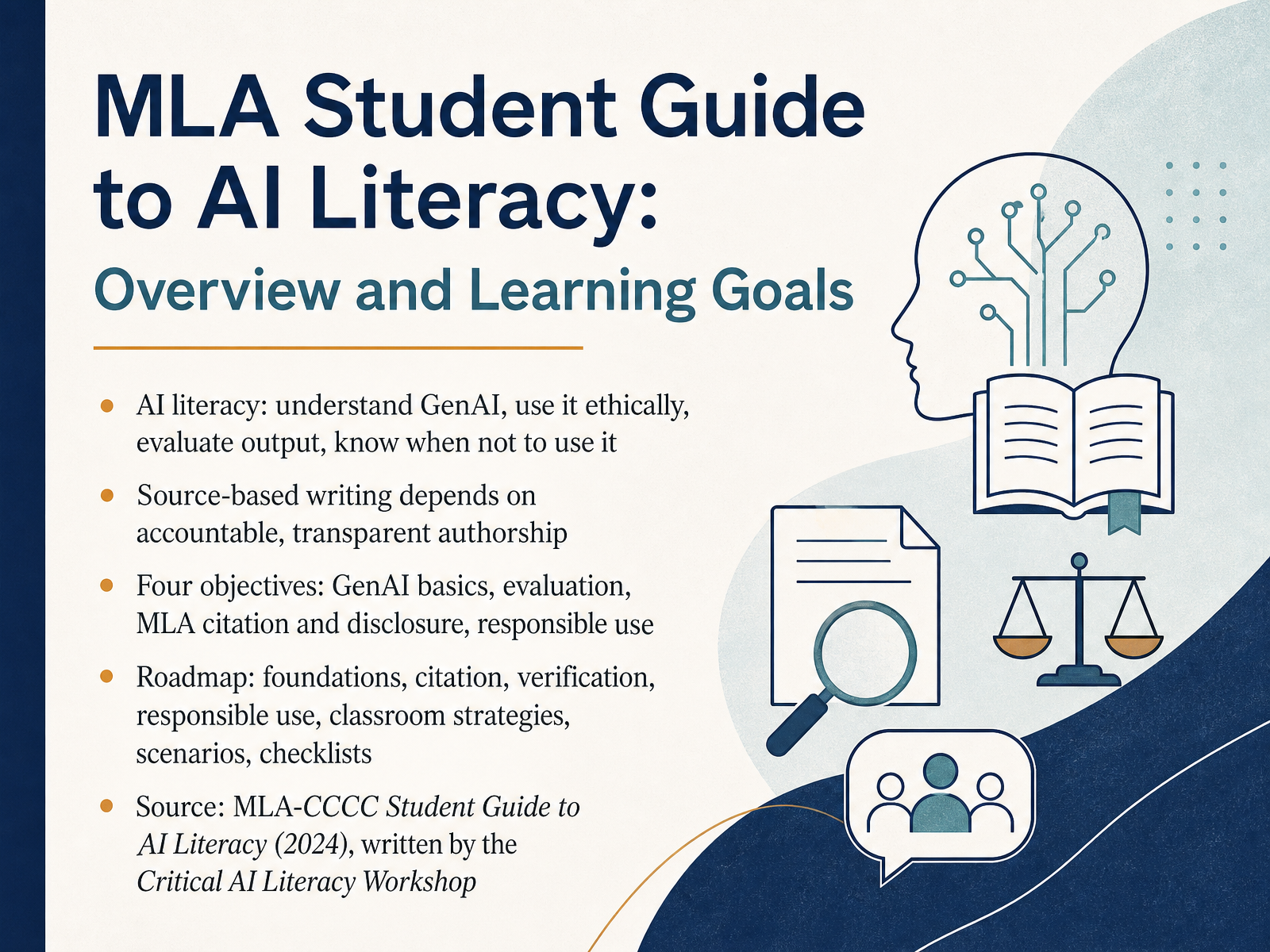
- 01MLA Student Guide to AI Literacy: Overview and Learning GoalsWelcome. I'm glad you're here. This course is about AI literacy in student writing, and it's built on the MLA-CCCC Student Guide to AI Literacy, published in 2024. Let's clarify what AI literacy means. It means you understand generative AI, you use it ethically, you evaluate its output, and you know when not to use it at all.
Here's the key distinction. Source-based academic writing depends on accountable, transparent authorship. If you use AI in your process, you need to be able to explain how, and cite it properly. That's why the guide emphasizes disclosure and reflection, not just citation.
This course has four objectives. First, the basics of generative AI. Second, how to evaluate AI output for accuracy and bias. Third, how to cite and disclose AI use in MLA style. And fourth, responsible use, including when to say no.
Our roadmap covers foundations, citation, verification, responsible use, classroom strategies, real scenarios, and practical checklists. Whether you're new to these tools or already use them daily, take what's useful and ask questions along the way. Honest caution matters more than hype here. Let's turn to what AI literacy means for you as a student writer.style.mla.orghcommons.orgstyle.mla.org+22 min
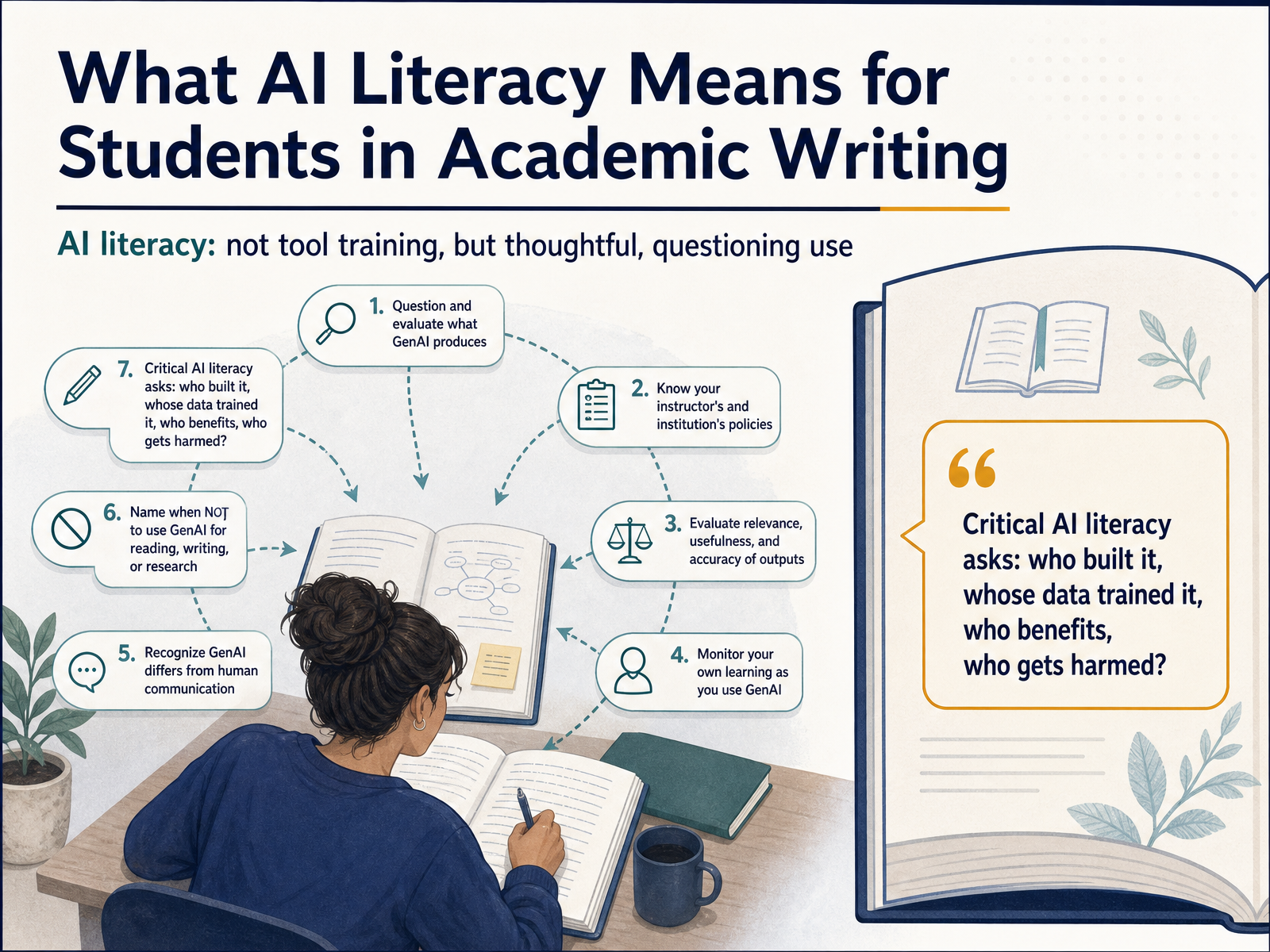
- 02What AI Literacy Means for Students in Academic WritingLet's build on that foundation by asking what AI literacy actually means for you as a student writer. It is not tool training. It is thoughtful, questioning use. In practice, that means several habits. First, question and evaluate what generative AI produces instead of accepting it at face value. Second, know your instructor's and your institution's policies on AI use, because they vary widely. Third, judge each output for relevance, usefulness, and accuracy. Fourth, monitor your own learning, and notice whether AI is helping you grow or quietly replacing your thinking. Fifth, recognize that generative AI is fundamentally different from human communication.
Finally, be able to name when not to use it, whether for reading, writing, or research. And critical AI literacy pushes further, asking who built the tool, whose data trained it, who benefits, and who gets harmed. A quick example: asking an AI tool to summarize a poem for your literature class may save time, but it replaces the very close reading your instructor wants you to practice. So treat this as a starting point for habits you can carry forward. Next, let's look at how generative AI and large language models actually produce text.
 style.mla.orghcommons.orgstyle.mla.org+22 min
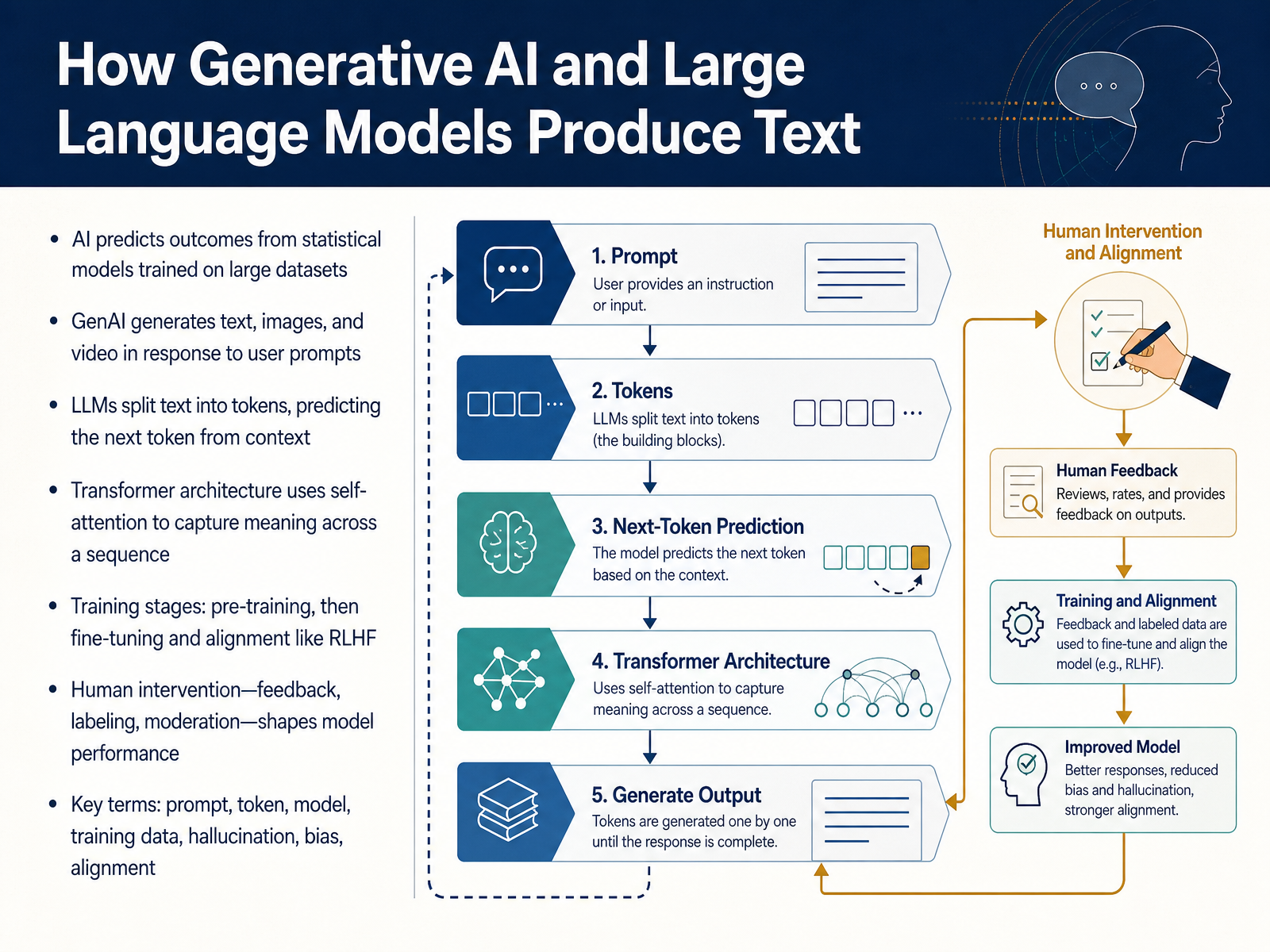
 - 03How Generative AI and Large Language Models Produce TextLet's look at what is actually happening when a generative AI tool produces text. At the broadest level, AI predicts outcomes from statistical models trained on large datasets. Generative AI, or GenAI, responds to your prompts by generating new text, images, or video. Large language models, or LLMs, work by splitting text into small pieces called tokens, then predicting the next token based on the surrounding context. Under the hood, most LLMs use a transformer architecture. Its self-attention mechanism helps the model capture meaning across a whole sequence of words. Training usually happens in stages. First comes pre-training on massive amounts of text, then fine-tuning and alignment, often using reinforcement learning from human feedback, or RLHF. Human intervention matters here. Feedback, labeling, and moderation all shape how a model performs. Keep these key terms in mind: prompt, token, model, training data, hallucination, bias, and alignment. As we move on, we will ask why AI output can sound so confident even when it is wrong.
 nature.comarxiv.orgarxiv.org+21 min
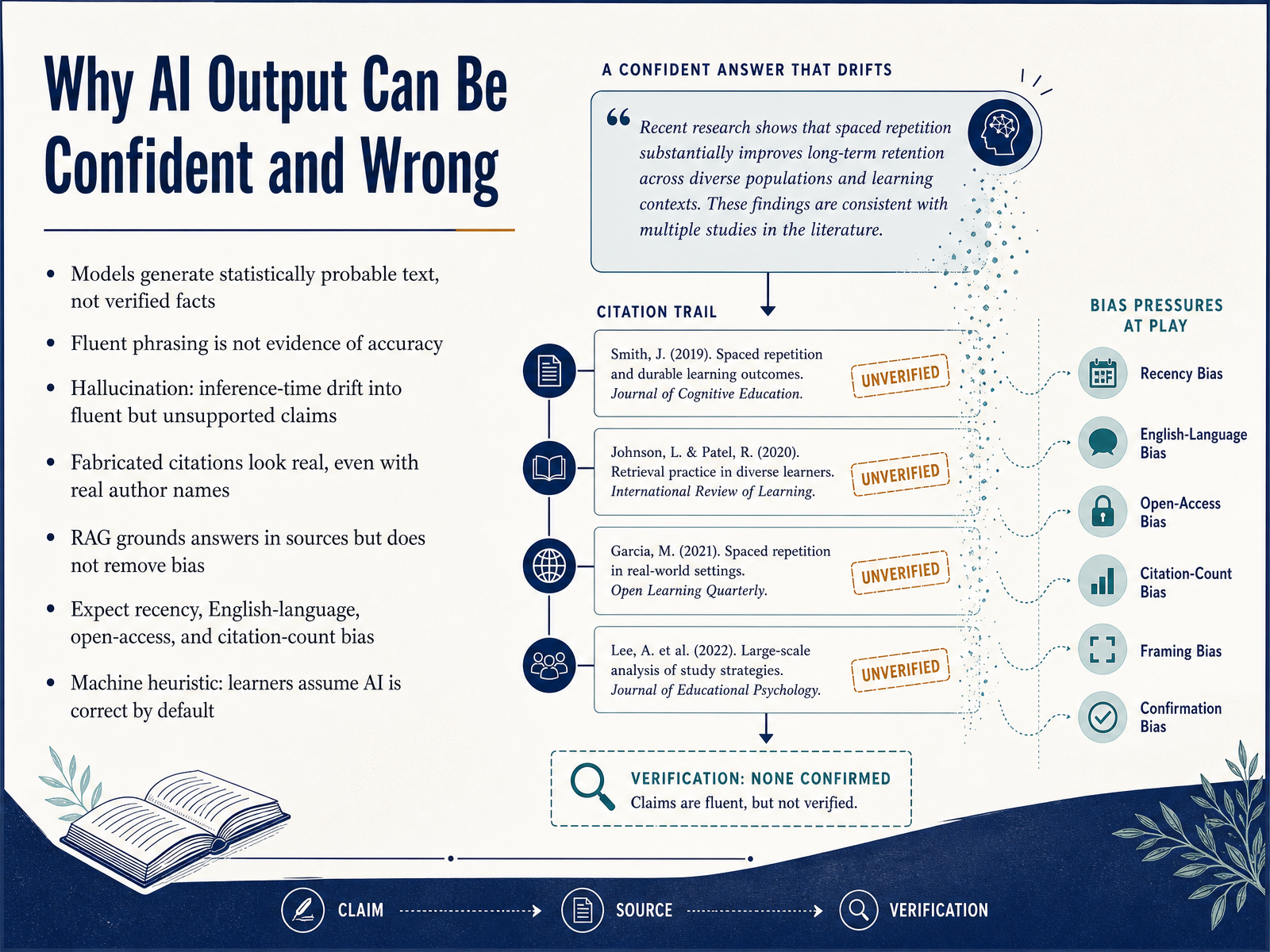
 - 04Why AI Output Can Be Confident and WrongLet's look at why AI output can sound so confident and still be wrong. Language models generate statistically probable text, not verified facts. During inference, the model predicts one token at a time, so fluent phrasing is not evidence of accuracy. That fluency is exactly what makes errors easy to miss. We call this hallucination: a drift into fluent but unsupported claims. Fabricated citations are a common example. They can look real, even naming real authors, while the article itself does not exist. Retrieval augmented generation, or RAG, grounds answers in retrieved sources, but it does not remove bias. Expect recency bias, English-language bias, open-access bias, and citation-count bias, because these patterns live in the training data. There is also the machine heuristic, the tendency to assume AI is correct by default. So before you trust a claim, verify it laterally against independent sources. That habit is your best protection. Next, we turn to MLA, Authorship, and Accountability.
 nature.comarxiv.orgarxiv.org+22 min
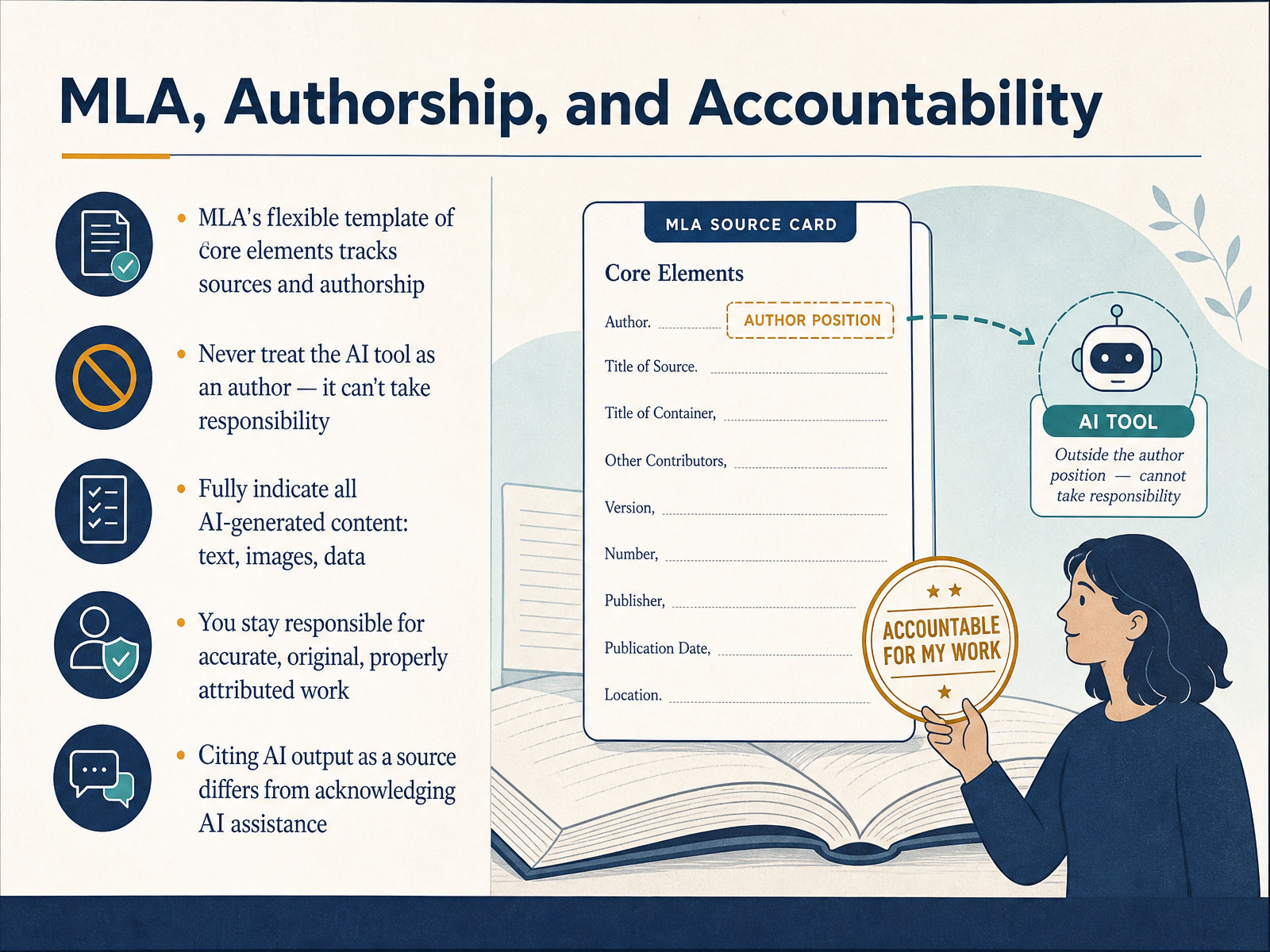
 - 05MLA, Authorship, and AccountabilityLet's turn to authorship and accountability. MLA uses a flexible template of core elements. Instead of rigid rules, it gives you criteria for tracking sources, and that flexibility is exactly why it handles new tools like generative AI. One firm rule: never treat the AI tool as an author. An AI cannot take ethical or legal responsibility for its output. It cannot sign off on accuracy or originality. That responsibility stays with you. When you use AI-generated content, whether it's text, an image, or data, indicate all of it fully. Be specific about what the tool produced, which model you used, and when. Remember, citing AI output as a source is different from acknowledging AI assistance. Citation points to a specific source. Acknowledgment describes how you used the tool, like brainstorming, editing, or translating. You can ask your instructor or a librarian if you're unsure which applies. In short, you remain responsible for work that is accurate, original, and properly attributed. Next, we'll walk through the practical details of citing generative AI in MLA style.
 style.mla.orghcommons.orgstyle.mla.org+22 min
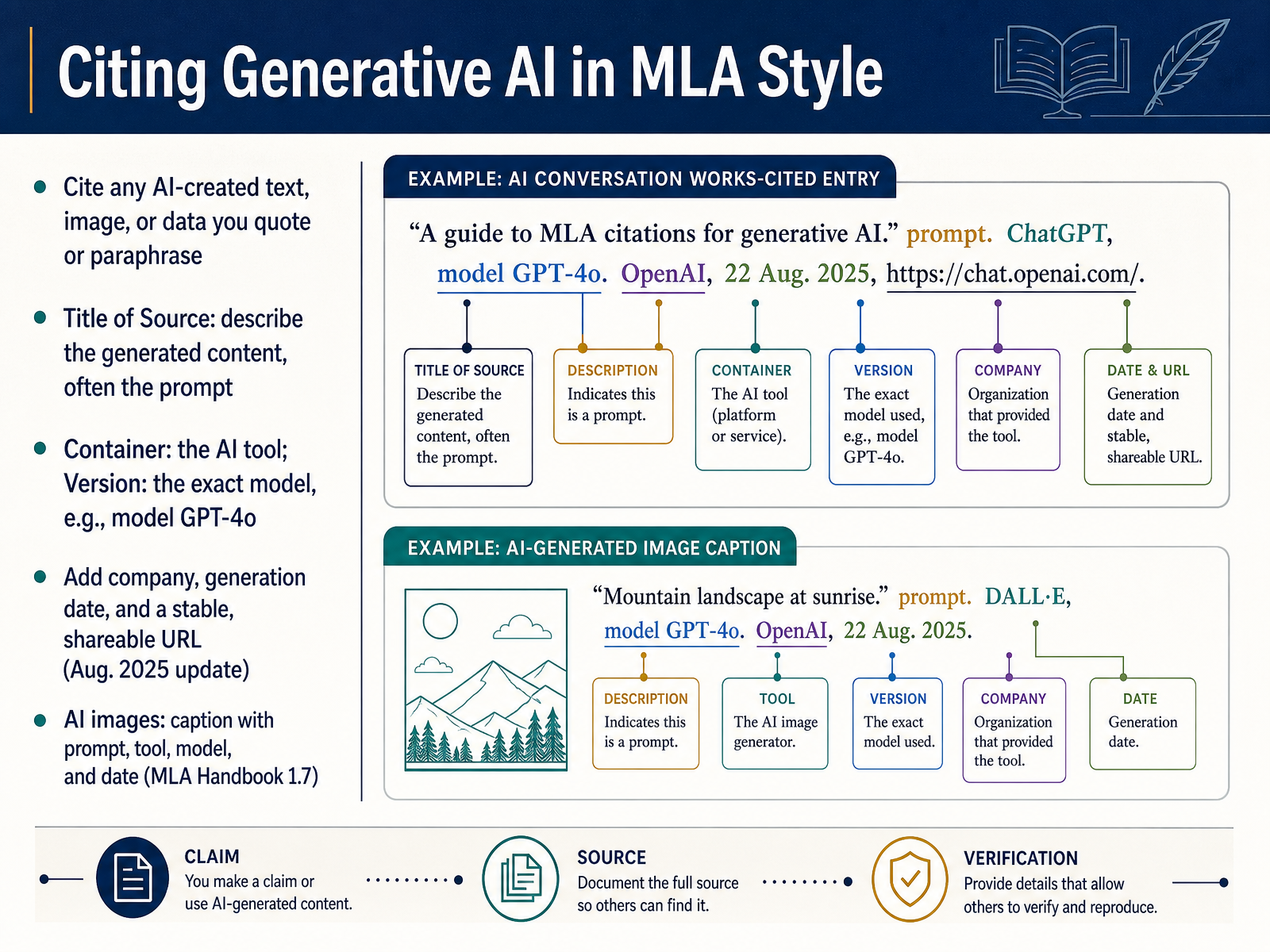
 - 06Citing Generative AI in MLA StyleNow let's talk about citing generative AI in MLA style. The core rule is simple. Cite any AI-created text, image, or data that you quote or paraphrase. You don't cite the tool as an author. The Modern Language Association advises against that. Instead, you describe what was generated. That description often includes your prompt and goes in the Title of Source slot. The AI tool itself is the Container, like ChatGPT. Then, name the exact model as specifically as possible, such as model GPT-4o. Include the company, the generation date, and a stable, shareable link to the conversation. That last point reflects the August 2025 update. Stable shareable links are preferred, but a general tool link works if sharing isn't available. For AI images, you'll usually write a caption with the prompt, tool, model, and date, following section 1.7 of the MLA Handbook. One caution. Save or share your chat before closing it. Generated text often can't be retrieved later. Next, we'll look at disclosing AI use beyond the citation itself, in Beyond Citation: Disclosing How You Used AI.
 style.mla.orgstyle.mla.orgstyle.mla.org+22 min
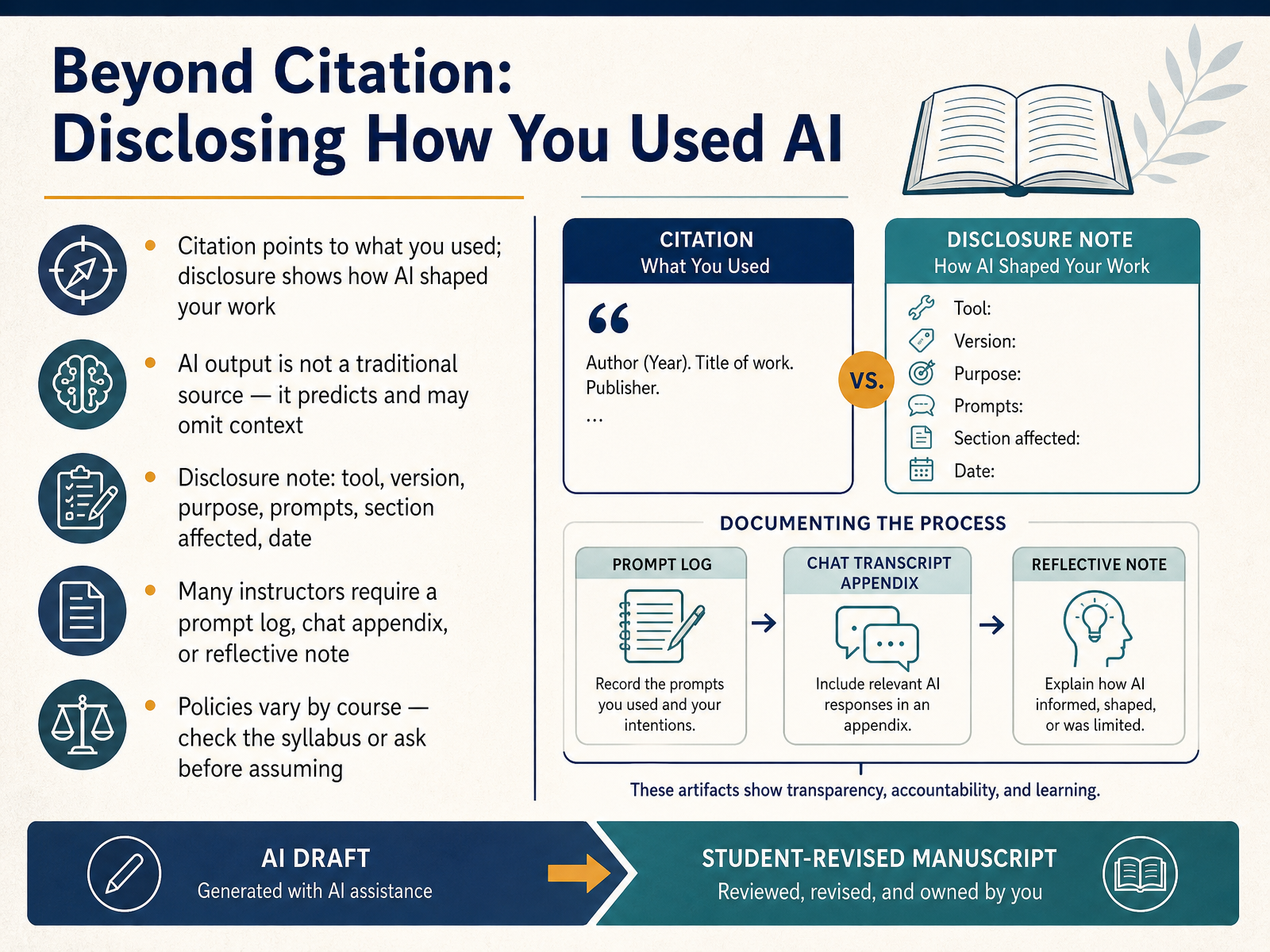
 - 07Beyond Citation: Disclosing How You Used AILet's move from citation to disclosure. Citation points to what you used. Disclosure shows how AI shaped your work. That's a key distinction, so let me pause on it. Generative AI output is not a traditional source. It predicts text and can omit important context, so you should verify and cite the original sources it references. A strong disclosure note includes several things: the tool, its version, your purpose, your prompts, the section affected, and the date. Many instructors also ask for a prompt log, a chat appendix, or a short reflective note. Here's an example. You might write that you used ChatGPT, model GPT-4o, on March eighth to brainstorm counterarguments for your introduction, and include the prompt and link. One caution: policies vary by course, so check your syllabus or ask your instructor before assuming. In short, cite what you use, and disclose how you used it. That protects your credibility. Next, we'll look at evaluating AI output for accuracy, bias, and source quality.
 style.mla.orgstyle.mla.orgstyle.mla.org+22 min
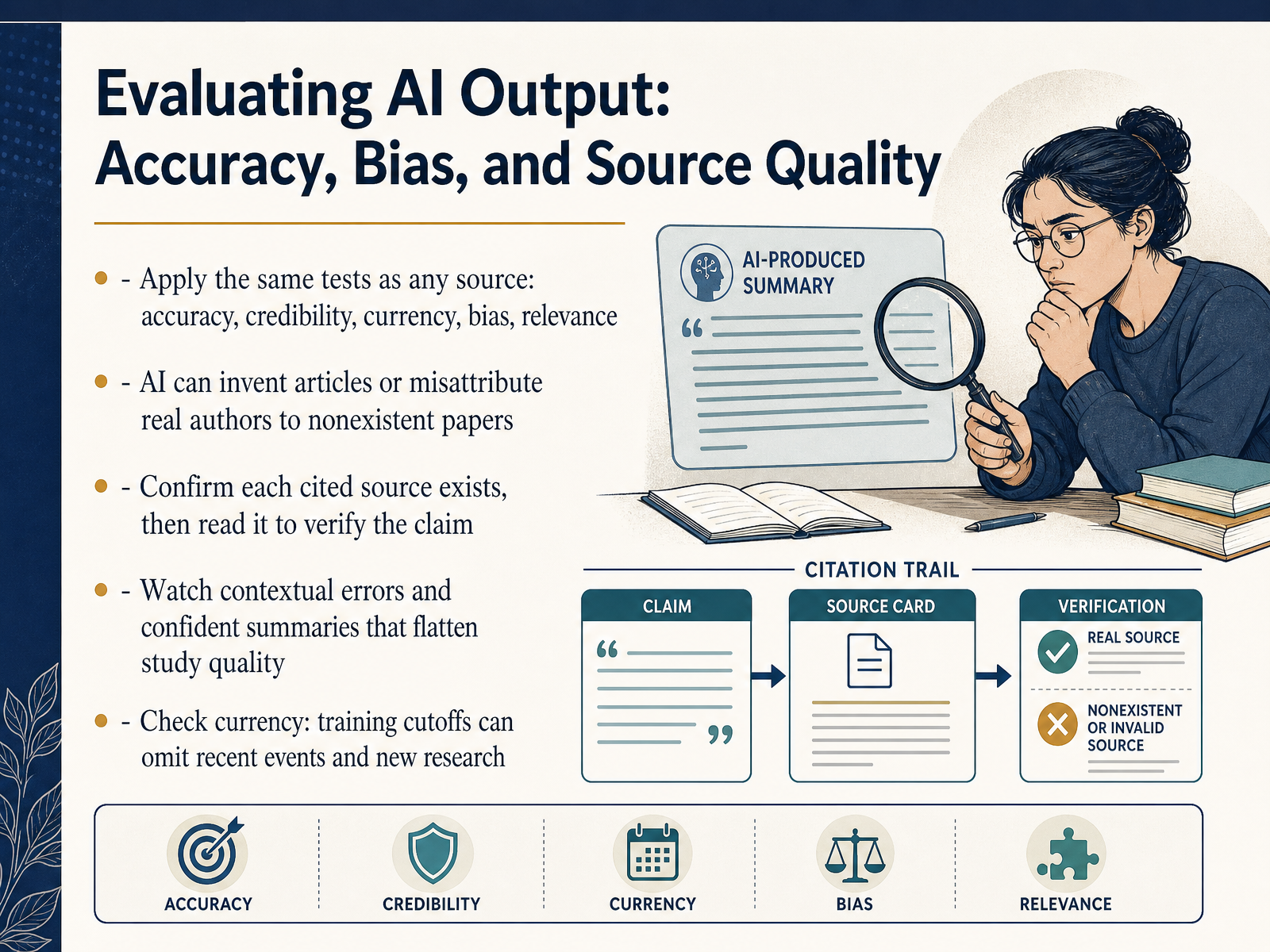
 - 08Evaluating AI Output: Accuracy, Bias, and Source QualityNow let's talk about how to evaluate what an AI tool gives you. Treat AI output like any other source you'd cite. Ask the same questions you'd ask of a journal article or a website: accuracy, credibility, currency, bias, and relevance. Here's where AI differs. It can invent articles that never existed, or attach a real author's name to a paper that isn't real. So when you see a citation, confirm the source actually exists. Search the title in Google Scholar or your library catalog. Then open the article and check whether it really supports the claim. Watch for contextual errors too. AI might place correct facts in the wrong setting, and it often summarizes studies in one confident voice, flattening differences in quality. Do not use any cited source without reading it yourself. Finally, check currency. Because training data has a cutoff, an AI tool may miss recent events or new research. Here's your takeaway: a polished paragraph proves nothing. Verify before you trust. Next, we'll walk through lateral reading and verification workflows.
 lib.guides.umd.eduguides.libraries.wm.eduzsr.wfu.edu+22 min
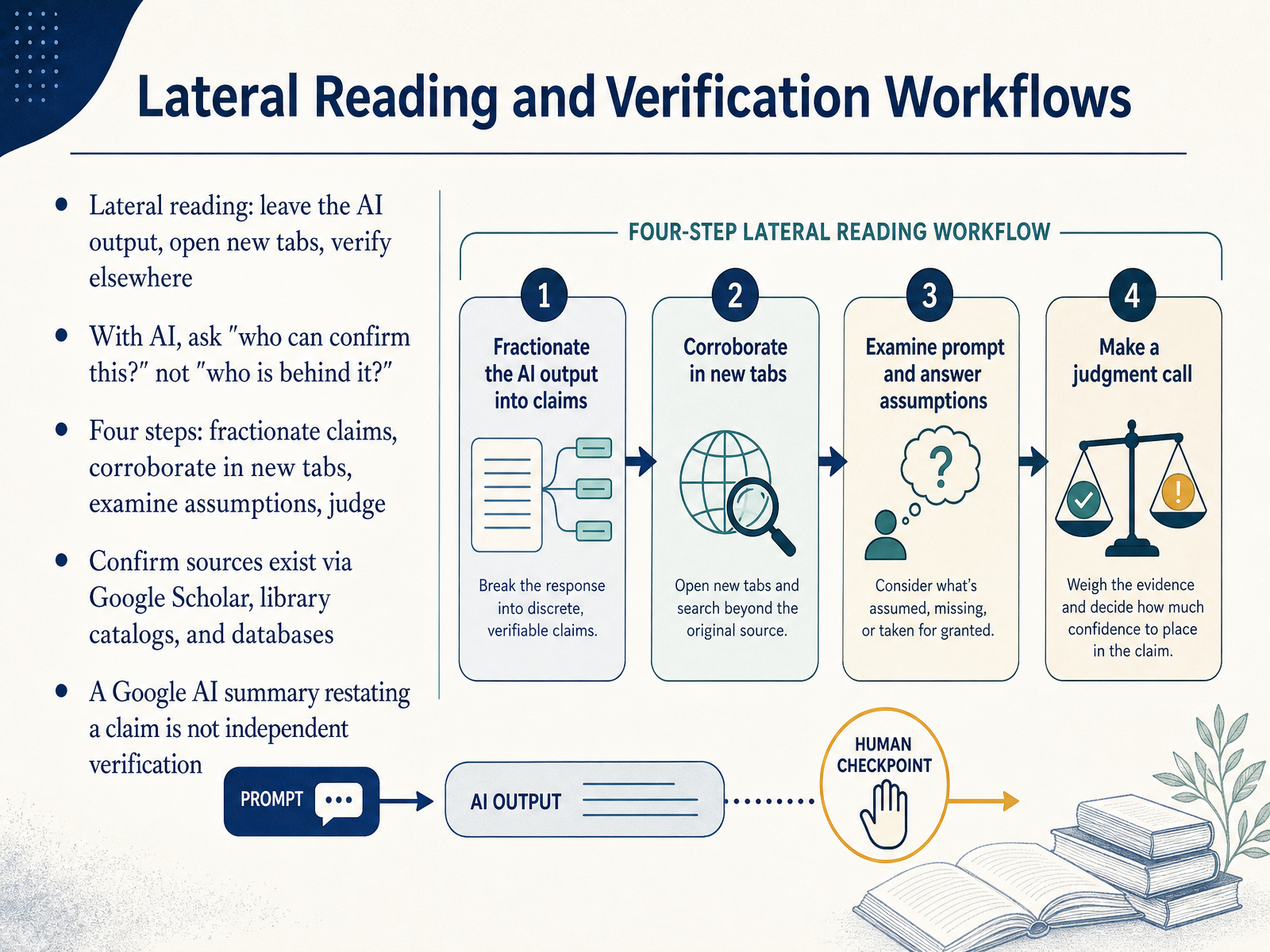
 - 09Lateral Reading and Verification WorkflowsLet's talk about how to verify what an AI tool tells you. The core habit here is lateral reading. Instead of scrolling down the same screen, you leave the AI output, open new tabs, and check elsewhere. With AI, the usual question shifts. You can't really ask who is behind this information, because AI output blends many unidentifiable sources. So ask a different question. Who can confirm this? The workflow has four steps. Fractionate the claims, meaning break the response into separate, searchable pieces. Corroborate each one in new tabs. Examine the assumptions in your prompt and the AI's answer. Then judge what is true, misleading, or wrong. When you check a citation, confirm the source actually exists. Search the title in Google Scholar, your library catalog, or a subject database. One caution. A Google AI summary that repeats a claim is not independent verification. It may be summarizing the very thing you are trying to check. So verify with sources you can trace and read yourself. Next, we will look at using AI responsibly across the writing process.
 lib.guides.umd.eduguides.libraries.wm.eduzsr.wfu.edu+22 min
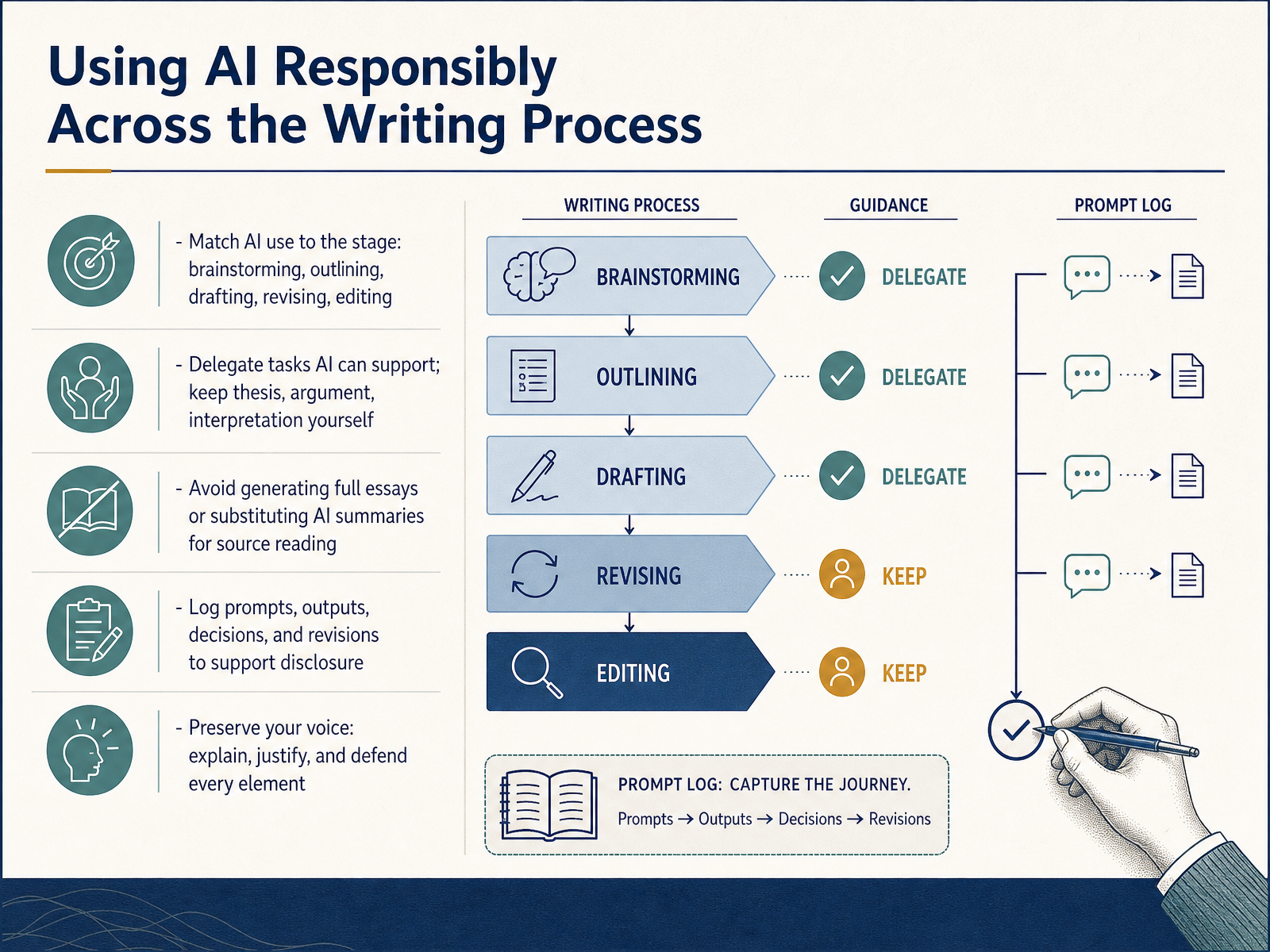
 - 10Using AI Responsibly Across the Writing ProcessLet's talk about using AI responsibly across the writing process. The key idea is simple: match the tool to the stage. Use AI for brainstorming, outlining, maybe grammar and clarity at the editing stage. But keep the thesis, the argument, and the interpretation yourself. Those are your intellectual work. Avoid generating full essays, and don't substitute AI summaries for actually reading your sources. That shortcut often hides inaccuracies. Keep a log of your prompts, outputs, decisions, and revisions. That record supports honest disclosure and shows your process. And preserve your voice. You should be able to explain, justify, and defend every element of what you submit. If you can't defend it, reconsider whether it belongs. Next, we'll look at classroom strategies for instructors, librarians, and support staff.
 2 min
2 min - 11Classroom Strategies for Instructors, Librarians, and Support StaffLet's turn to classroom strategies for instructors, librarians, and support staff. Start with assignment design. Make AI use transparent, and keep the task relevant and authentic, so students have a real reason to do the thinking themselves. Next, integrate AI literacy with what you already teach: MLA citation, source evaluation, and research skills. Then scaffold the work. Ask students to critique AI output, keep prompt journals, run verification assignments, and maintain AI use logs. When you assess, look at process and product: the quality of verification, completeness of attribution, and authorial mastery, meaning students can explain and defend their choices. One caution: avoid over-relying on AI detection tools. They are unreliable, and research shows they can be biased against non-native speakers. So treat detection results as a signal to investigate, never as proof. Next, we will work through practical scenarios applying AI literacy to student work.
 hcommons.org1 min
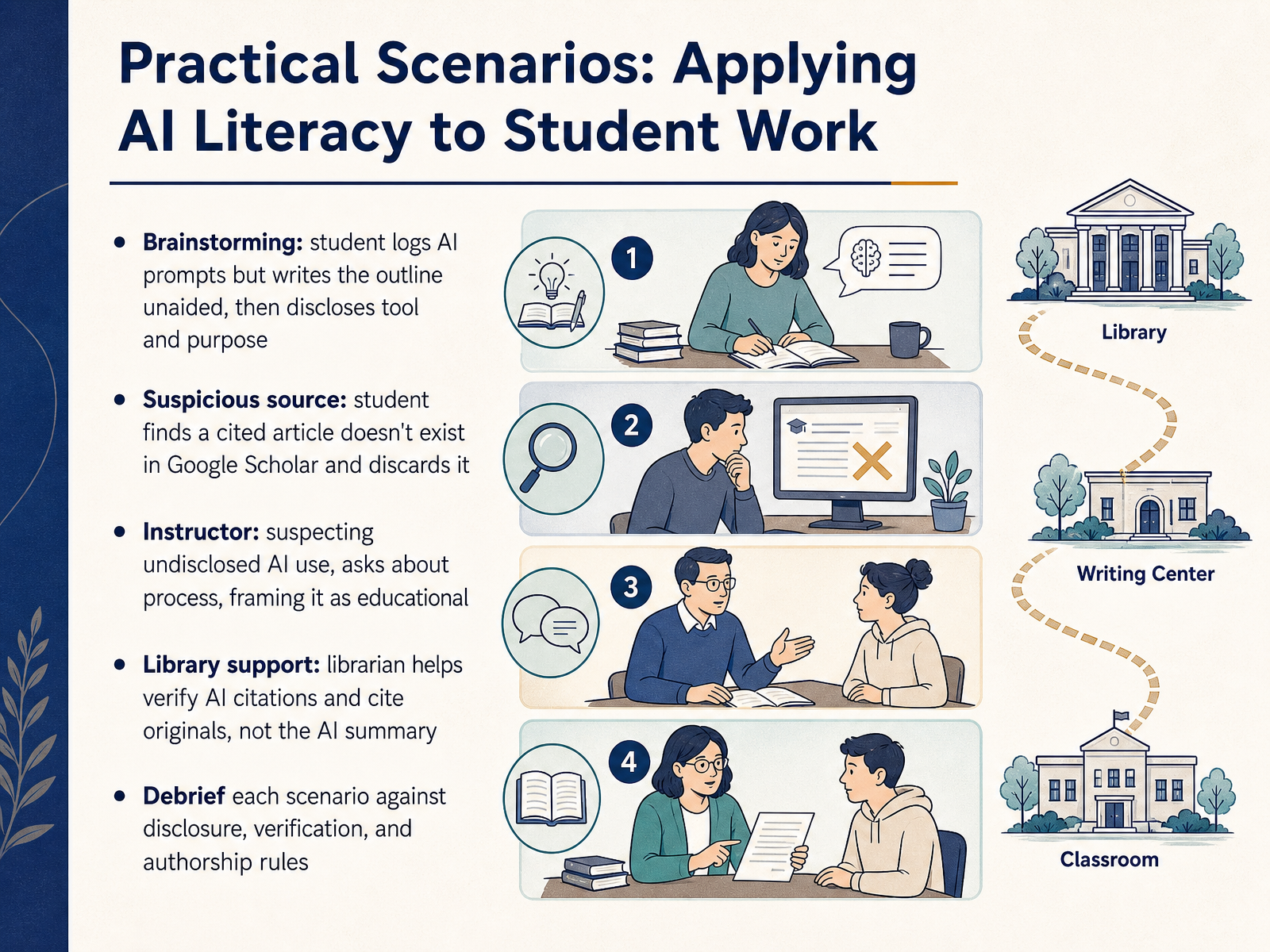
 - 12Practical Scenarios: Applying AI Literacy to Student WorkLet's bring AI literacy into everyday student work with four short scenarios. First, brainstorming. A student logs their AI prompts, writes the outline unaided, then discloses the tool and its purpose. That is transparency in action. Second, a suspicious source. A student finds a cited article that doesn't appear in Google Scholar and discards it. Good move. Generative AI tools can hallucinate references, inventing convincing citations for articles that do not exist. Third, an instructor who suspects undisclosed AI use. Rather than accusing, they ask about the student's process and frame it as educational, which research on writing centers supports: open questions invite disclosure and dialogue. Fourth, library support. A librarian helps a student verify an AI citation and then cite the original article, not the AI summary. After each scenario, debrief against three questions. Was use disclosed? Was the source verified? And does the student remain the author of the thinking? Now let's look at checklists and campus support resources.
 lib.guides.umd.eduguides.libraries.wm.eduzsr.wfu.edu+22 min
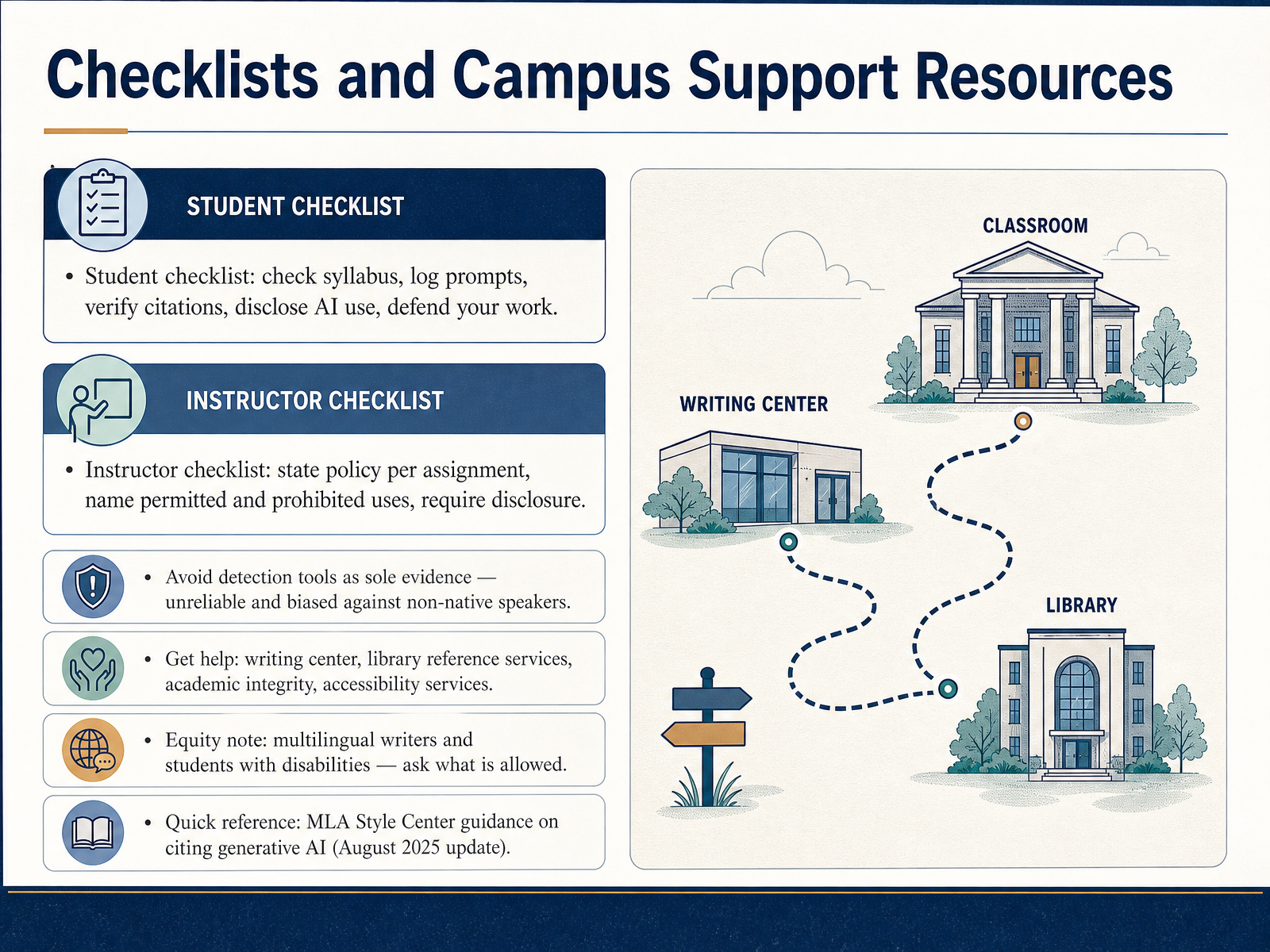
 - 13Checklists and Campus Support ResourcesLet's bring this together with two practical checklists. For students: check your syllabus first, log your prompts, verify every citation, disclose your AI use, and be ready to defend your work in your own words. For instructors: state your policy for each assignment, name what is permitted and what is prohibited, and require disclosure. One caution: do not treat AI detection tools as sole evidence of misconduct. Research shows they are unreliable and biased against non-native speakers. You are not on your own. Writing centers, library reference services, academic integrity offices, and accessibility services can all help. If you are a multilingual writer or a student with a disability, ask what is allowed. Finally, the MLA Style Center updated its guidance on citing generative AI in August two thousand twenty-five, so check the style center directly. Coming up next, Building Your Own AI Literacy Practice.
 hcommons.orgstyle.mla.orgstyle.mla.org+21 min
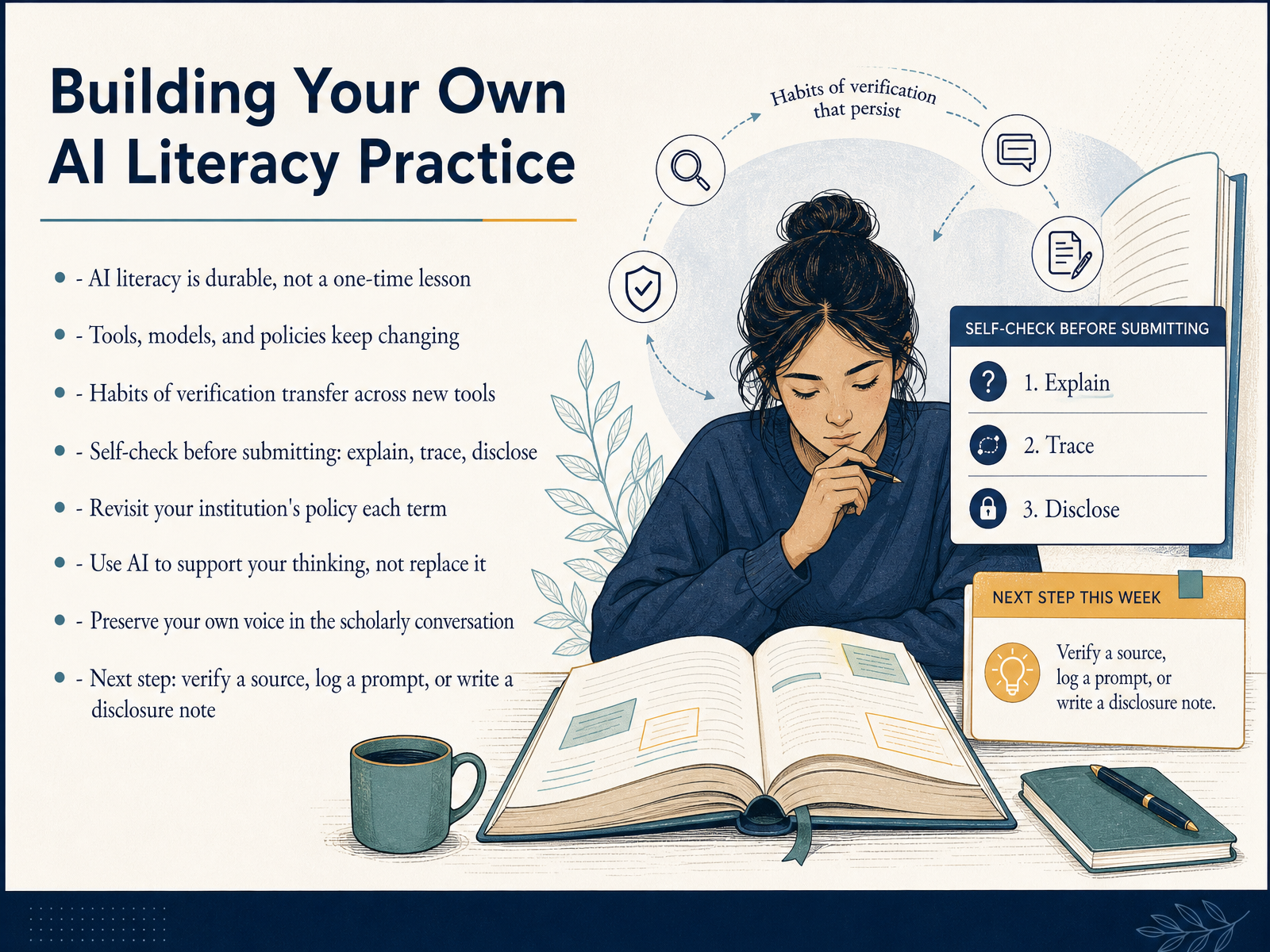
 - 14Building Your Own AI Literacy PracticeAs we close, remember that AI literacy is a practice, not a one-time lesson. Tools, models, and policies keep changing, so build habits that last. Verification is one of them. Checking a claim against a credible source transfers across every new tool you meet. Before you submit, run a self-check: Can you explain your process? Can you trace where the ideas came from? And can you disclose how you used AI? Then revisit your institution's policy each term, since guidance shifts. Use AI to support your thinking, not replace it, and preserve your own voice in the scholarly conversation. For a next step, pick one small action: verify a source, log a prompt, or write a disclosure note. Thank you for working through this guide with me. You do not need to be an expert to be a thoughtful user. Start where you are, stay curious, ask questions, and keep your judgment in the lead.
 style.mla.orghcommons.orgstyle.mla.org+21 min
Take the deck with you
Download this course as a file — free, no sign-up needed.
- PDF handoutEvery slide page, ready to print or share.15 pages · 4.9 MBDownload
- Narrated PowerPointThe deck that presents itself — every slide carries the digital human's narration video.15 pages · 17.9 MBDownload
- PowerPoint slidesThe full deck as a .pptx — open it in PowerPoint, Keynote, or Google Slides.15 pages · 4.8 MBDownload
Free to use in your own training — please keep the PersonWise credit page at the end.
Have your own deck? Turn it into a course
Sources consulted
Web sources consulted while building this course.
- Student Guide to AI Literacy - MLA Style Center — style.mla.org
- Student Guide to AI Literacy — hcommons.org
- AI Resources | MLA Style Center — style.mla.org
- MLA AI Initiatives and Resources - Modern Language Association — mla.org
- Student Guide to AI Literacy — mlaai.hcommons.org
- Generative AI in academic writing: a comparison of human- ... — nature.com
- Understanding Large Language Models — arxiv.org
- https://www.arxiv.org/pdf/2601.22170 — arxiv.org
- https://arxiv.org/pdf/2601.02907v2 — arxiv.org
- Large language models in NLP: evolution, architectural trends, and open challenges | Journal of Big Data | Springer Nature Link — link.springer.com
- How do I cite generative AI in MLA style? (Updated and ... — style.mla.org
- How do I cite generative AI in MLA style? — style.mla.org
- Beyond Citation: Describing AI Use in Your Work | MLA Style Center — style.mla.org
- Artificial intelligence - MLA 9th referencing style - Library Guides at University of Queensland Library — guides.library.uq.edu.au
- Generative Artificial Intelligence (AI) - Referencing style - MLA - Library Guides at University of Western Australia — guides.library.uwa.edu.au
- Fact-checking AI with Lateral Reading - Research Guides — lib.guides.umd.edu
- Evaluating AI Tools & Outputs - Generative AI: Supporting AI Literacy, Research, and Publishing - Research Guides at Swem Library, William & Mary — guides.libraries.wm.edu
- Not the LIB100 You Remember: Evaluating Output in the AI Era - ZSR Library — zsr.wfu.edu
- Generative AI and ChatGPT - Evaluating Information Sources - Research Guides at University of British Columbia — guides.library.ubc.ca
- AI Literacy for Students Guide: Evaluating AI-Generated Output — libguides.stkate.edu