Begin
14 pages · ~28 min
Understanding English Accents
This training helps learners recognize and understand diverse English accents, improving listening comprehension and communication across global English-speaking contexts.
A digital instructor presents all 14 pages. Hold “Ask” at any point and ask out loud — the answer comes from this course. No sign-up needed.
What you’ll learn
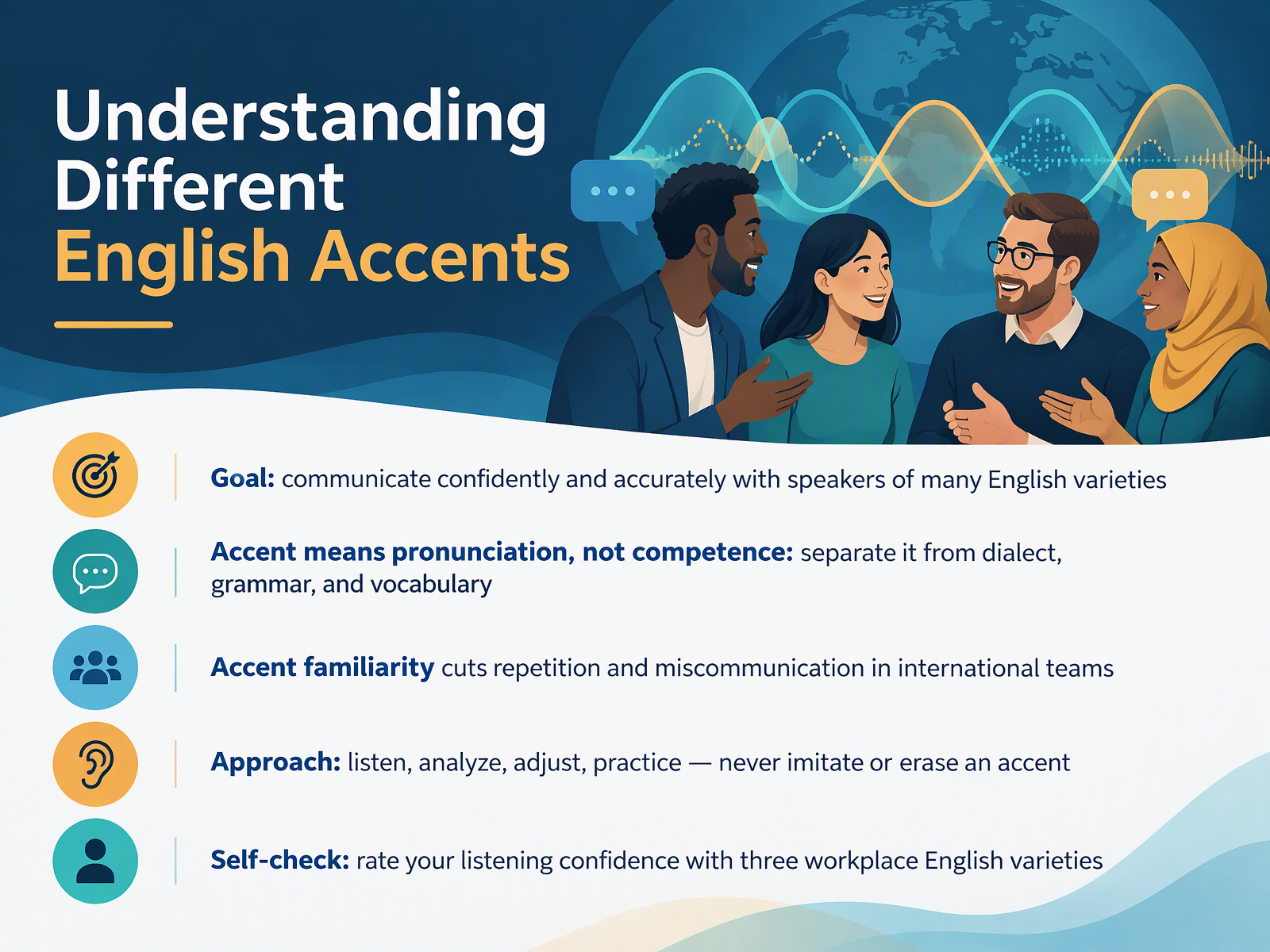
- 01Understanding Different English AccentsWelcome. I'm glad you're here. In this course, we're going to work on one very practical skill: understanding and communicating confidently with speakers of many different English varieties. Think about your last global call or team meeting. Different accents, and the work still got done. That's normal, and it's our starting point. Our goal is simple: communicate confidently and accurately across those varieties. Here's a key distinction. Accent means pronunciation, how words sound. It is not the same as competence. It's separate from dialect, grammar, and vocabulary. So we won't talk about correcting anyone. Research on English as a business lingua franca shows that clarity and getting the work done matter far more than sounding like a native speaker. And familiarity with accents cuts repetition and miscommunication in international teams. Our approach has four steps: listen, analyze, adjust, and practice. Please notice what we never do: we never imitate or erase an accent. For a self-check, rate your listening confidence with three workplace English varieties, maybe one you find easy, one moderate, and one hard. That gives you a baseline. Next, let's look at why English sounds different around the world.journals.sagepub.comcambridge.orgdoi.org+22 min
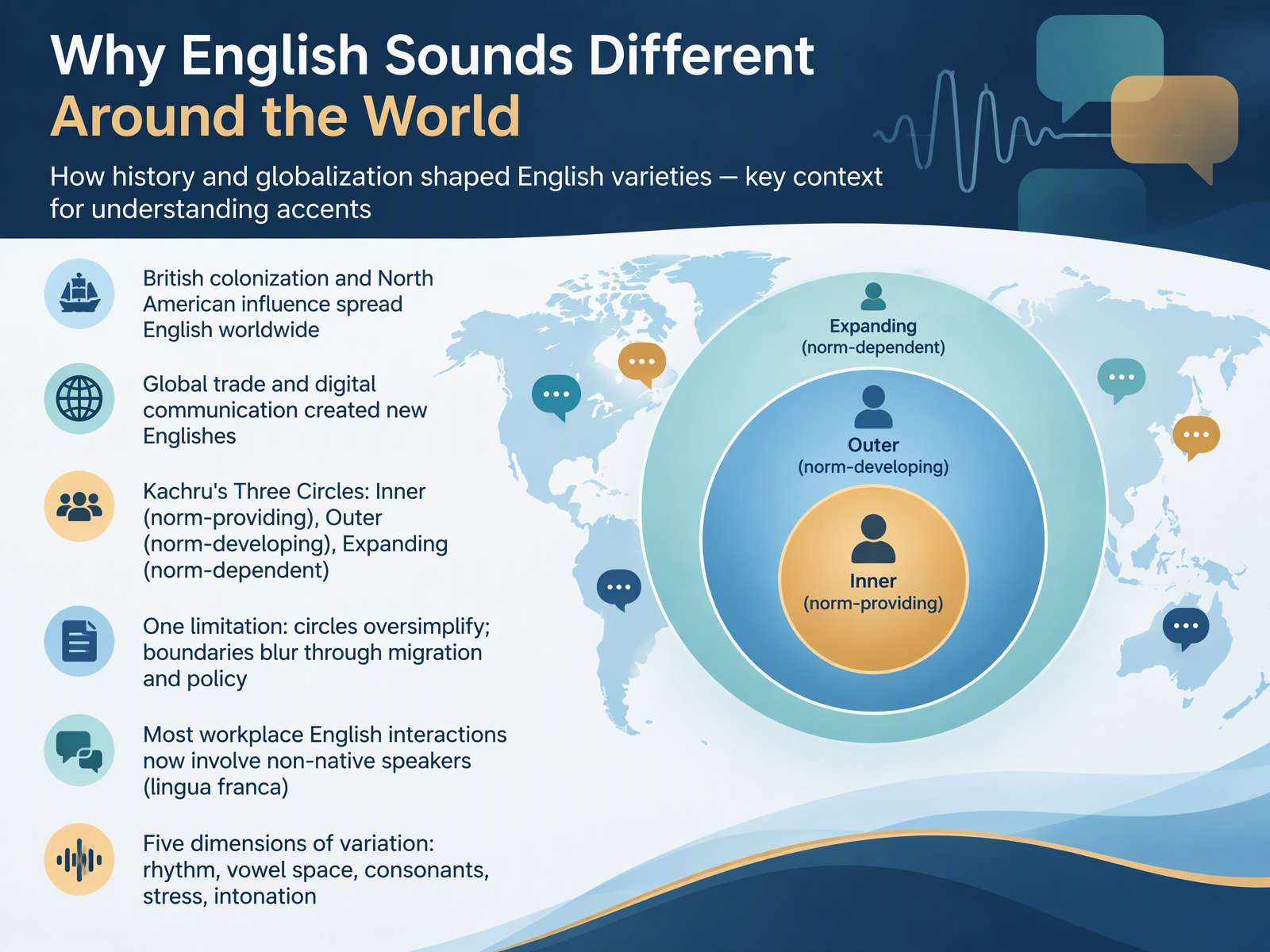
- 02Why English Sounds Different Around the WorldSo let's step back and ask why English sounds different around the world. A lot of it comes down to history. British colonization spread English across Asia, Africa, and the Pacific, and North American influence added another layer. Global trade and digital communication then created new Englishes shaped by local needs. A useful map for this is Kachru's Three Circles. The Inner Circle is norm-providing, places like the UK and the US. The Outer Circle is norm-developing, often former colonies such as India or Nigeria. The Expanding Circle is norm-dependent, countries like China or Japan where English is used mainly for international communication. One limitation: the circles oversimplify, and the boundaries blur through migration and policy. Here is a practical point. Most workplace English interactions now involve non-native speakers, so English often works as a lingua franca. And when you listen, notice five dimensions of variation: rhythm, vowel space, consonants, stress, and intonation. Small differences in these can make a familiar word sound unfamiliar, and naming them helps us stay patient and curious. Next, we'll look at English as a Business Lingua Franca at Work.
 owl.purdue.eduopen.eduen.wikipedia.org+22 min
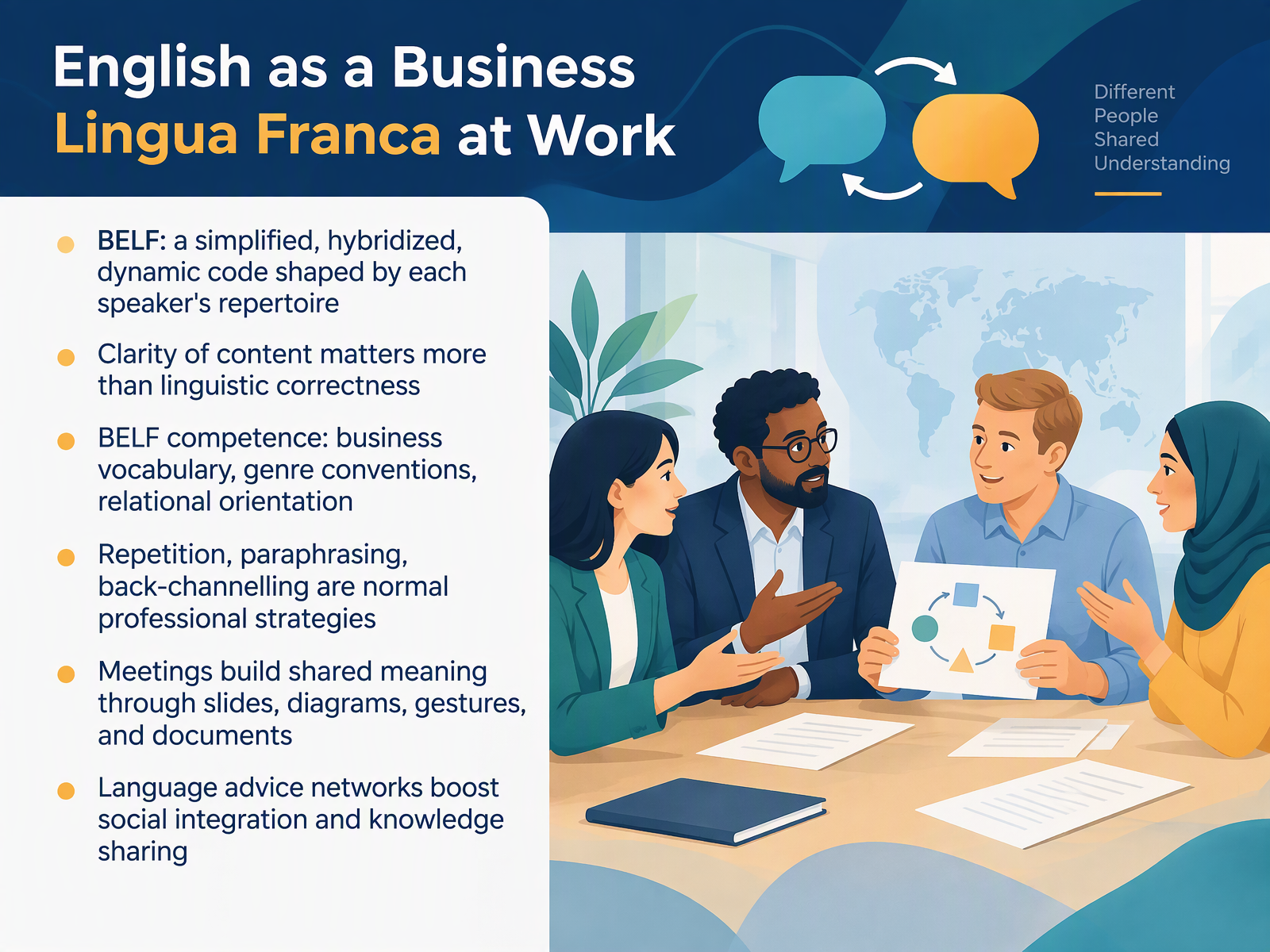
- 03English as a Business Lingua Franca at WorkNow let's look at English as a business lingua franca, or B E L F. In plain terms, this is the shared English people build together at work. It's simplified, hybridized, and dynamic, shaped by each speaker's own language background. So what counts as success? Clarity of content matters more than perfect grammar. Think about it this way. In a meeting, a slightly unusual sentence that everyone understands beats a flawless sentence that confuses the room. BELF competence has three parts. Business vocabulary, genre conventions, like how a status email or a project update usually works, and a relational orientation, meaning you pay attention to the people you're talking with. Repetition, paraphrasing, and back-channelling are normal professional strategies. Saying it again in simpler words, or checking, so if I understand you correctly. That is good practice, not a weakness. In meetings, people build shared meaning with slides, diagrams, gestures, and documents, not words alone. And language advice networks, where colleagues informally ask and share language help, boost social integration and knowledge sharing. So remember this takeaway. Aim for clarity, use every tool available, and never hesitate to ask for clarification. Next, we move on to core concepts: stress, rhythm, and vowel space.
 journals.sagepub.comcambridge.orgdoi.org+22 min
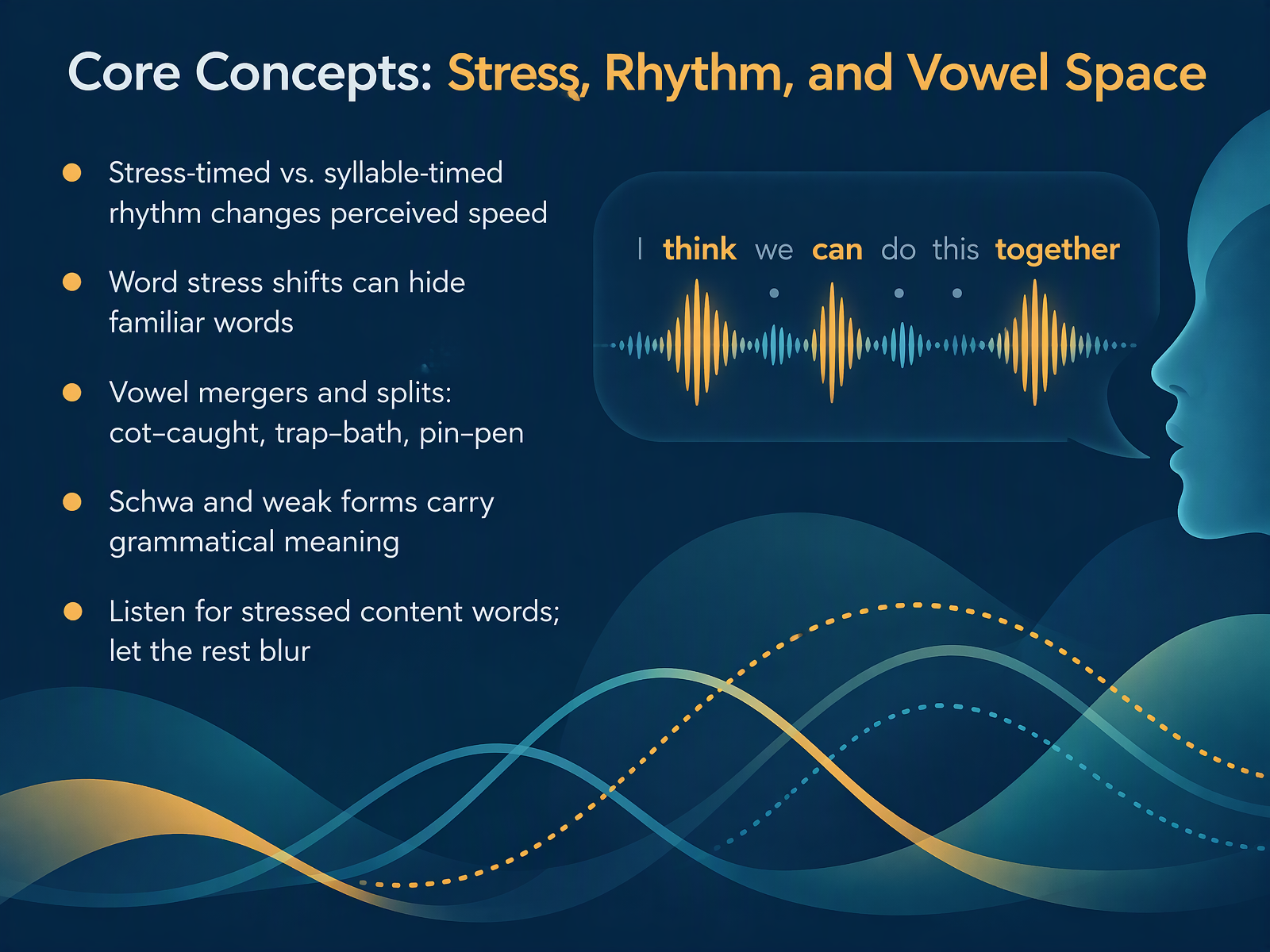
- 04Core Concepts: Stress, Rhythm, and Vowel SpaceLet's look at three core concepts that shape how accents sound to you: stress, rhythm, and vowel space. First, rhythm. Some varieties are stress-timed, like American or British English, where stressed syllables land at fairly even intervals. Others are more syllable-timed, as in Singapore or parts of Scotland and Wales. Same words, but one can sound faster or more clipped to your ear.
Next, word stress. If someone puts the stress on a different syllable, a familiar word can hide. Listen for the stressed content words, the nouns and verbs that carry the meaning, and let the smaller words blur.
Then, vowel space. Mergers and splits change which words sound alike. In a cot-caught merger, those two words become homophones. In the trap-bath split, bath takes a broader vowel. And some accents merge pin and pen.
Finally, the schwa. Weak forms like the unstressed sound in can or to actually carry grammar. So if a sentence sounds odd, ask. That's a normal, professional move.
Next, we turn to consonants and connected speech, and what gets dropped or changed.
 doi.orgcambridge.orgvose.byu.edu+22 min
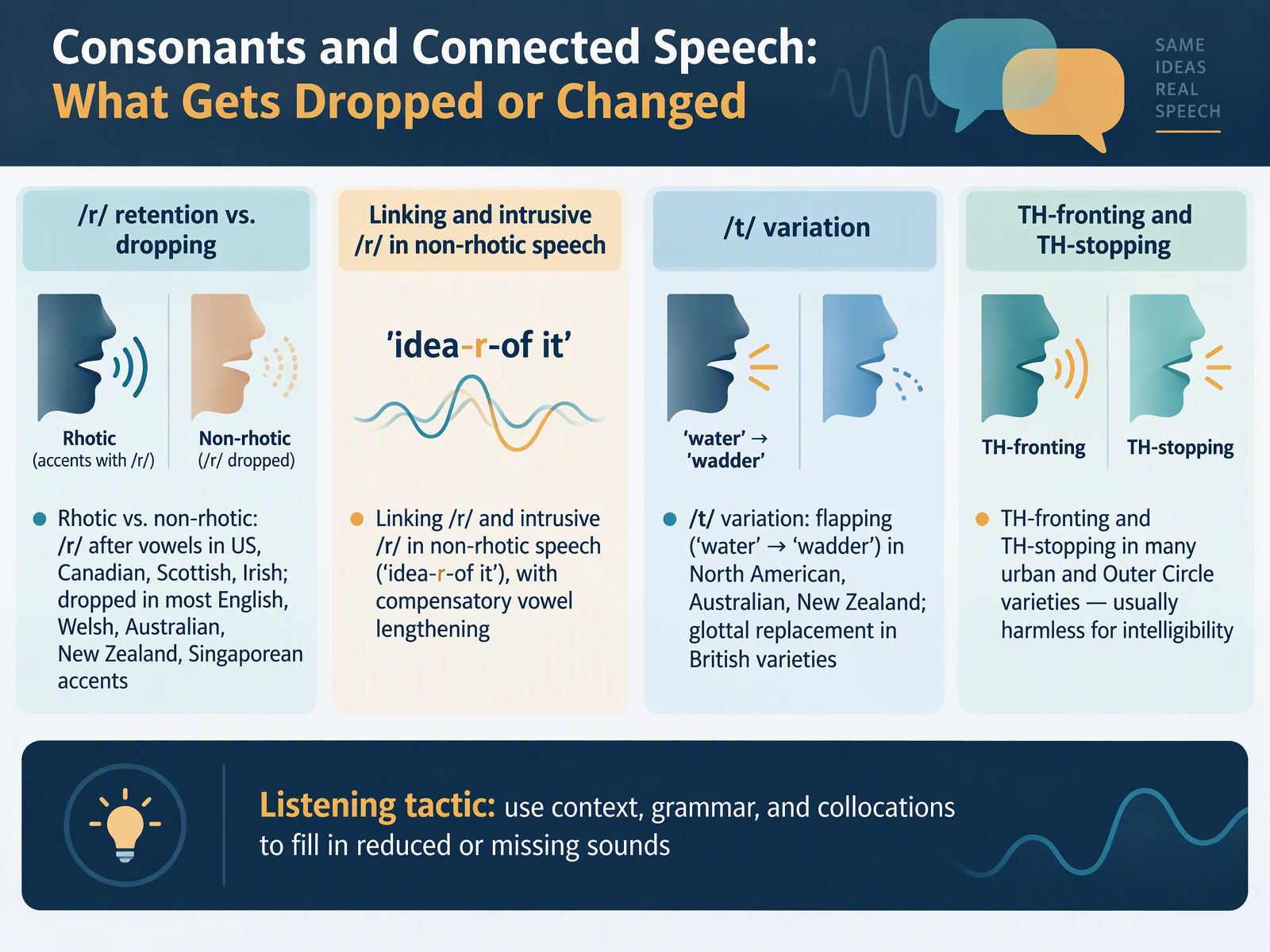
- 05Consonants and Connected Speech: What Gets Dropped or ChangedLet's look at how consonants change in connected speech, because this is where many listening problems actually start. First, rhotic and non-rhotic accents. Speakers from the United States, Canada, Scotland, and Ireland usually pronounce the r after a vowel, so you hear hard with a clear r. Most English, Welsh, Australian, New Zealand, and Singaporean speakers drop that r, so hard becomes hahd. In non-rhotic speech, an r can also appear between vowels, as in idea-r-of it. That is normal, not a mistake. Next, the t sound. In North American, Australian, and New Zealand accents, water often sounds like wadder. In many British varieties, the t becomes a glottal stop, so water sounds like wa-er. You will also hear th-fronting and th-stopping in many urban and Outer Circle varieties, where think may sound like fink or tink. Usually, that does not hurt understanding. So here is your listening tactic. When sounds are dropped or changed, use context, grammar, and collocations to fill in the gaps. Ask for clarification when you need it. That is a normal, professional move. Next, we will map the major accent families together.
 talks.cam.ac.ukinternationalphoneticassociation.orgen.wikipedia.org+22 min
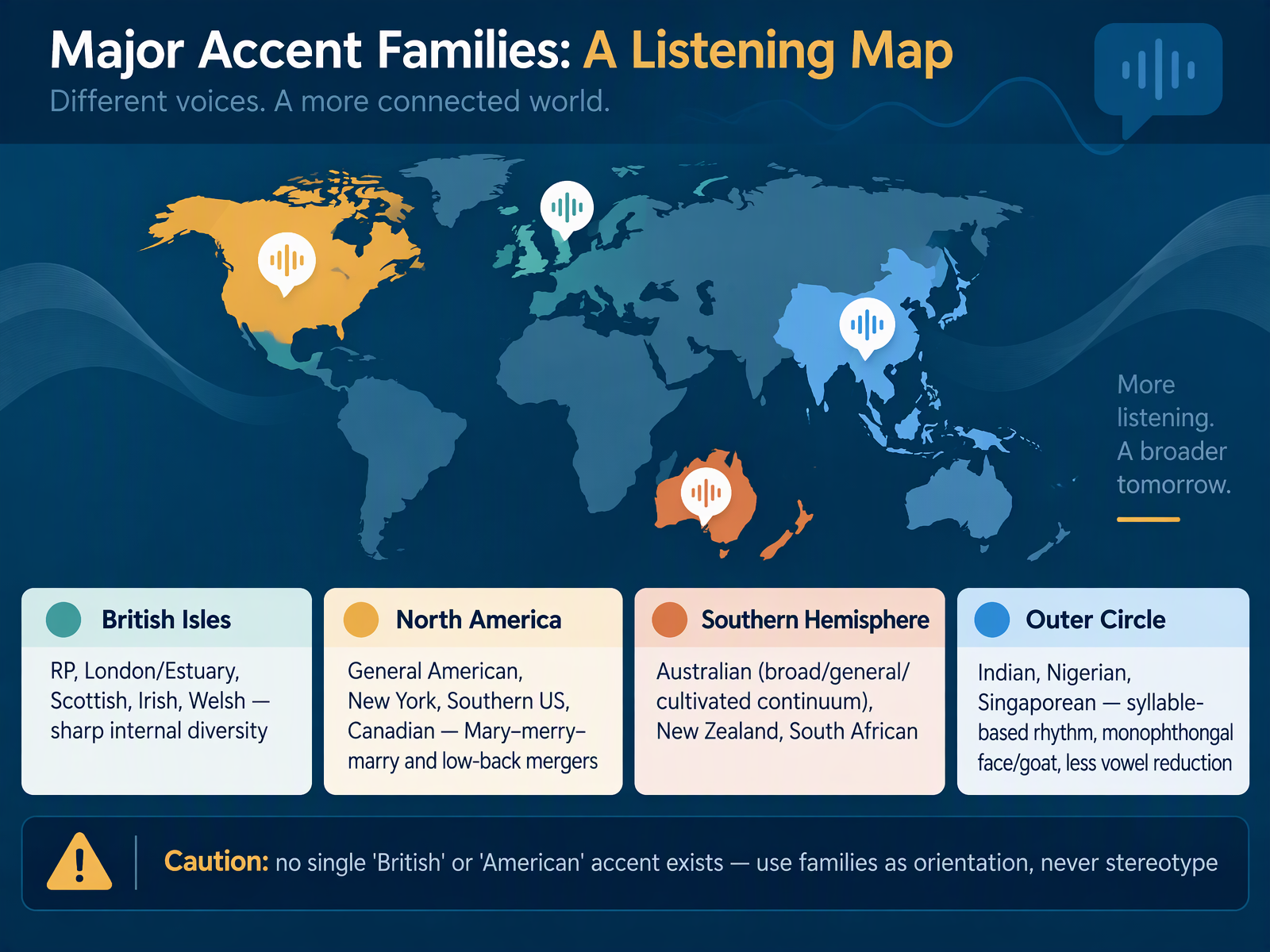
- 06Major Accent Families: A Listening MapBuilding on that, here is a listening map of the major accent families, a way to orient your ear rather than a set of labels to apply to people. Start with the British Isles, where internal diversity is striking. Received Pronunciation, London or Estuary, Scottish, Irish, and Welsh accents can sound very different from one another. In North America, you will hear General American, New York, Southern US, and Canadian accents, with features like the Mary, merry, marry merger and low back vowel mergers. Moving to the Southern Hemisphere, Australian English sits on a broad, general, and cultivated continuum, alongside New Zealand and South African English. In the Outer Circle, Indian, Nigerian, and Singaporean Englishes often share syllable-based rhythm, monophthongal face and goat vowels, and less vowel reduction. Keep this caution in mind. There is no single British or American accent. Use these families as orientation, never as a stereotype. Next, let us look at what actually breaks down, and what rarely does.
 2 min
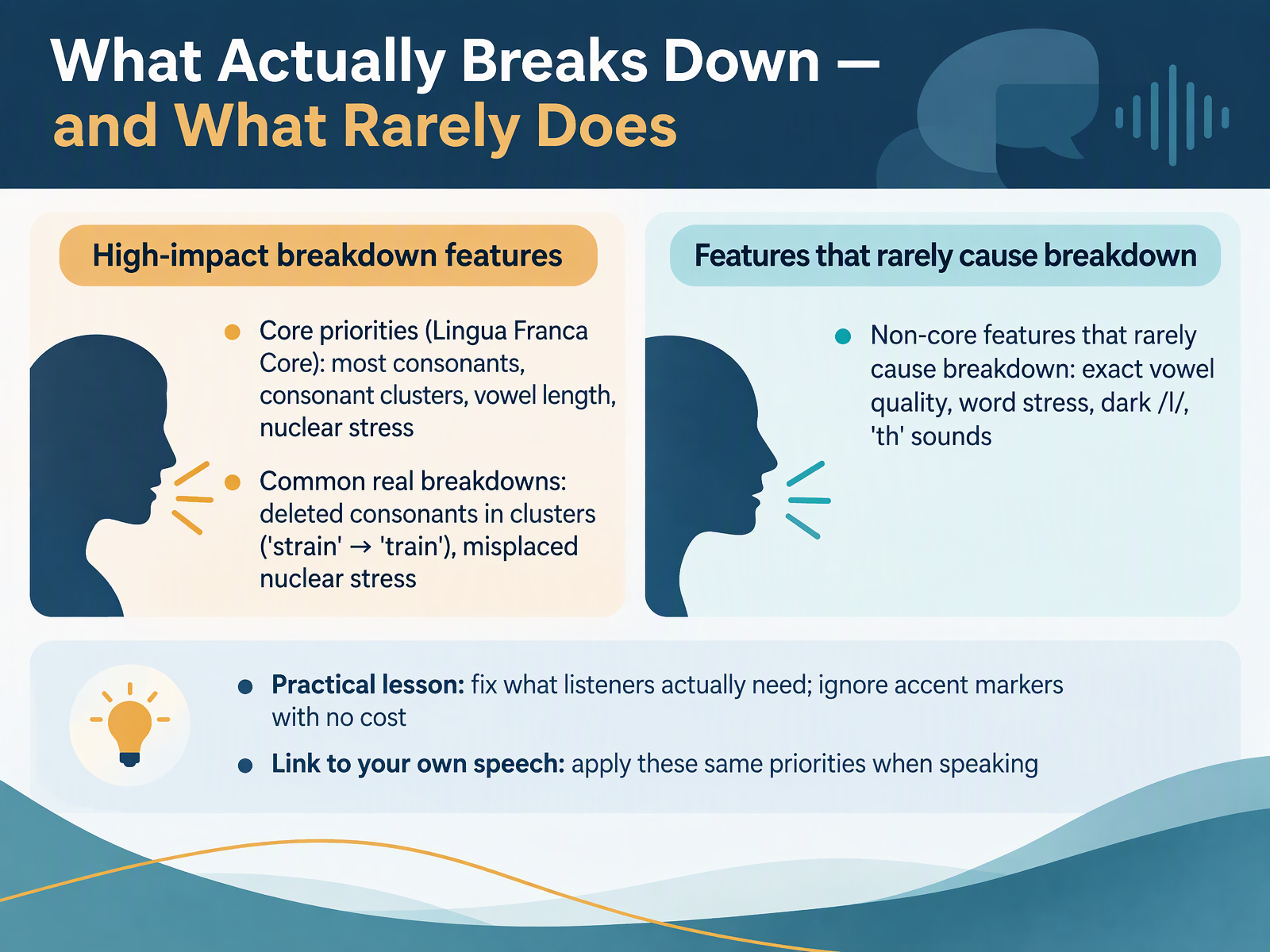
- 07What Actually Breaks Down — and What Rarely DoesSo let's get practical. What actually breaks down in real conversations, and what rarely does? Research on English as a lingua franca points to a small core: most consonant sounds, consonant clusters, vowel length, and nuclear stress, meaning which word in a phrase you make strongest. Get those right and people usually follow you. Now, features that rarely cause breakdown: exact vowel quality, word stress, the dark l at the end of words like well, and the th sounds. Notice those are often accent markers, not obstacles. Where do real breakdowns happen? Often when a consonant disappears from a cluster: say strain, and if you drop the s, listeners hear train. That changes the meaning on a call. Misplaced nuclear stress also confuses people, because it points their attention to the wrong word. So here's the lesson: fix what listeners actually need, and let go of accent markers that cost nothing. And apply the same priorities to your own speech. Keep your clusters, keep your vowel lengths, and stress the word you really mean. Next, we'll look at listening strategies for unfamiliar accents.
 2 min
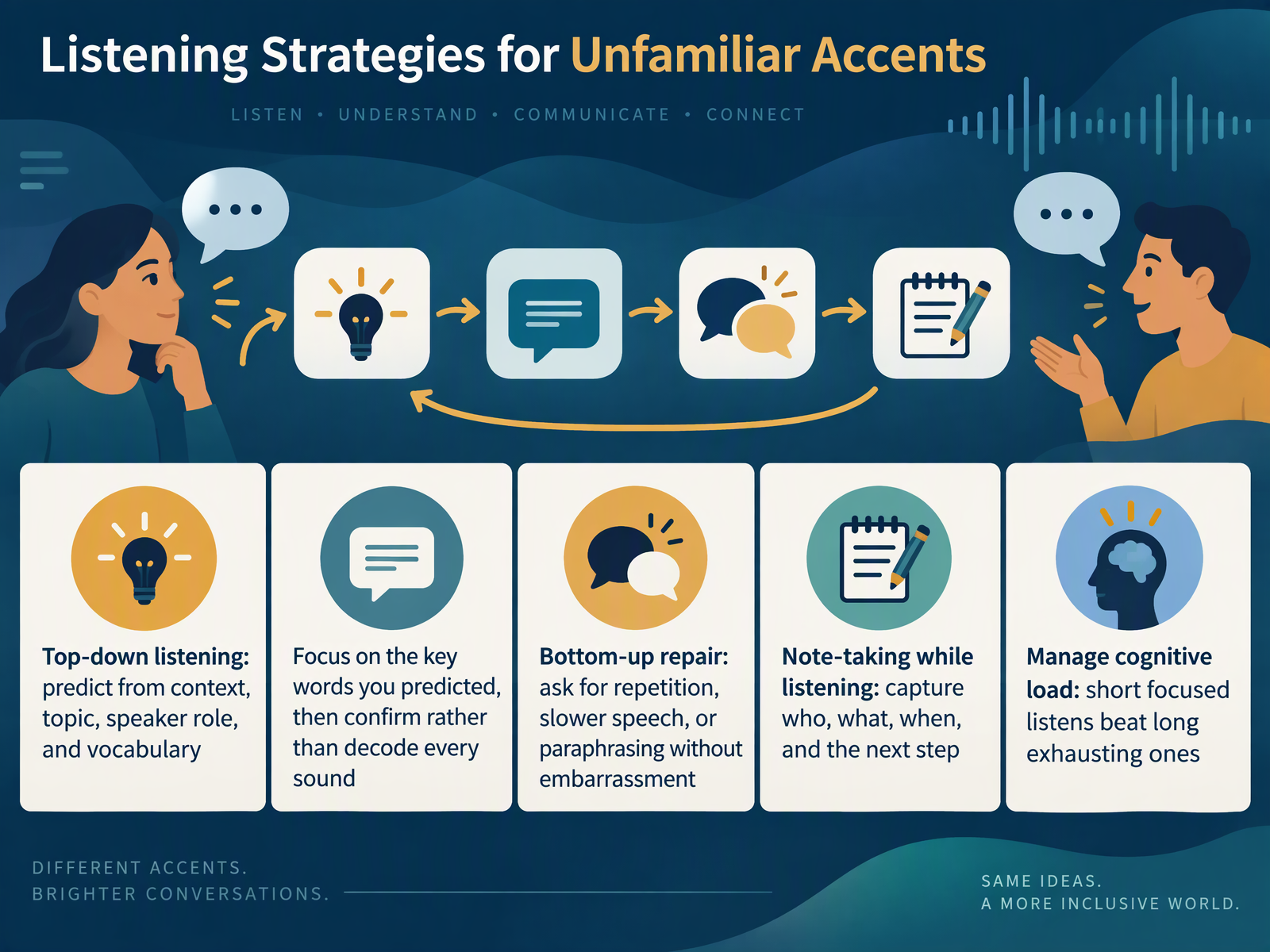
- 08Listening Strategies for Unfamiliar AccentsNow let's look at practical listening strategies for when an accent is unfamiliar. Start with top-down listening. Use context to predict what is coming, the topic, the speaker's role, and likely vocabulary. Then focus on the key words you predicted and confirm your understanding. Don't try to decode every single sound. When you miss something, use bottom-up repair. Ask for repetition, slower speech, or a paraphrase without embarrassment. You might say, sorry, could you say that again more slowly. While listening, take short notes on who, what, when, and the next step. And manage your cognitive load. A few short, focused listens work better than one long, exhausting one. So predict, confirm, ask, note, and keep it short. Next, let's build on this with training your ear through evidence-based practice techniques.
 2 min
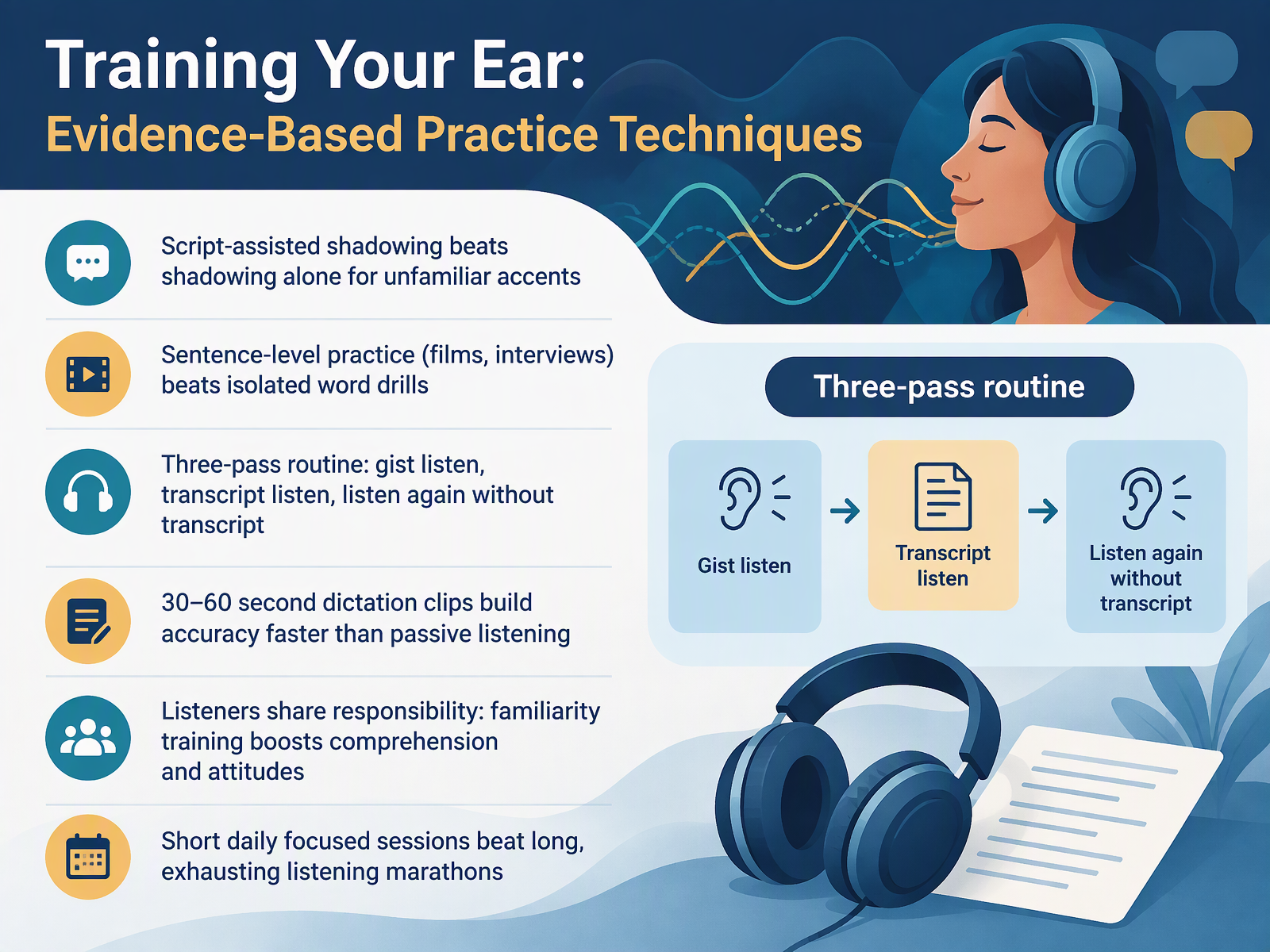
- 09Training Your Ear: Evidence-Based Practice TechniquesNow let's get practical. There are techniques that genuinely train your ear, and they're backed by research. First, try script-assisted shadowing. Shadowing means repeating what you hear, almost at the same moment. Research shows that shadowing with a script in front of you works better than shadowing alone, especially with unfamiliar accents. Next, practice at the sentence level. Films, interviews, meeting recordings. These beat isolated word drills, because you hear rhythm and intonation. Here's a simple three-pass routine. Pass one, listen for the gist. Pass two, listen again with the transcript. Pass three, listen once more without it. Short dictation clips of thirty to sixty seconds build accuracy faster than passive listening. And remember, comprehension is shared. Familiarity training improves both understanding and attitudes. Keep sessions short and daily. A focused ten minutes beats an exhausting marathon. Next, we look at speaking clearly without changing who you are.
 2 min
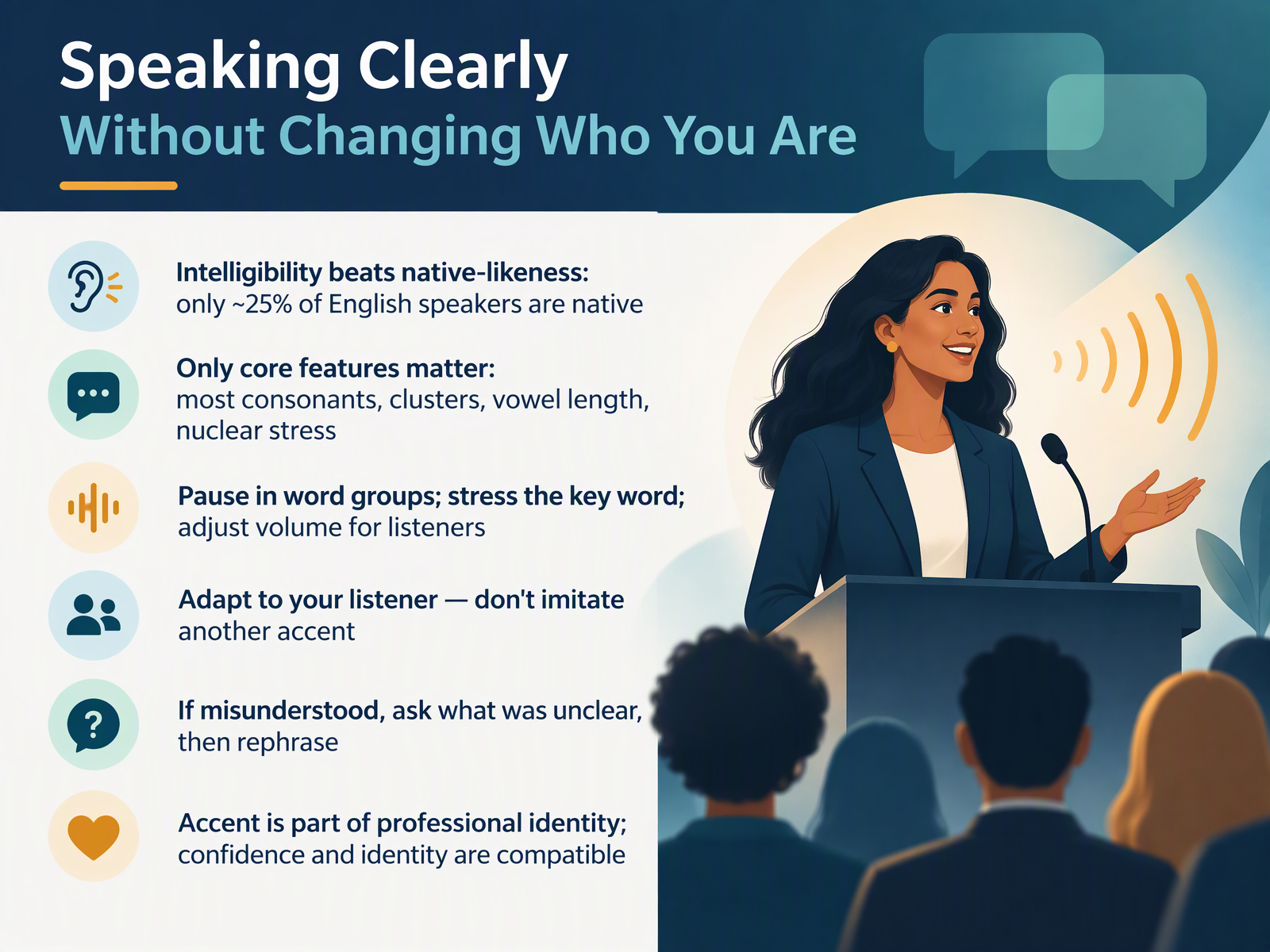
- 10Speaking Clearly Without Changing Who You AreSo let's talk about how to speak clearly without changing who you are. First, a key fact: intelligibility beats sounding native. Only about twenty five percent of English speakers worldwide are native speakers. So your goal isn't imitation. It's being understood.
You only need to get a few core features right. Most consonant sounds, consonant clusters, vowel length, and where you put the main stress in a word group. For example, the difference between ship and sheep is about vowel length, so hold that long vowel.
In calls and meetings, pause between word groups. Stress the key word. For a presentation, adjust your volume for the room and the listeners. And adapt to your listener. Don't copy another accent. If someone misses a point, ask what was unclear, then rephrase. Maybe say the number or name again more slowly, or use a different word.
Accent is part of your professional identity. Confidence and identity are compatible. Next, we'll look at accent bias and inclusive communication.
 journals.sagepub.comcambridge.orgdoi.org+22 min
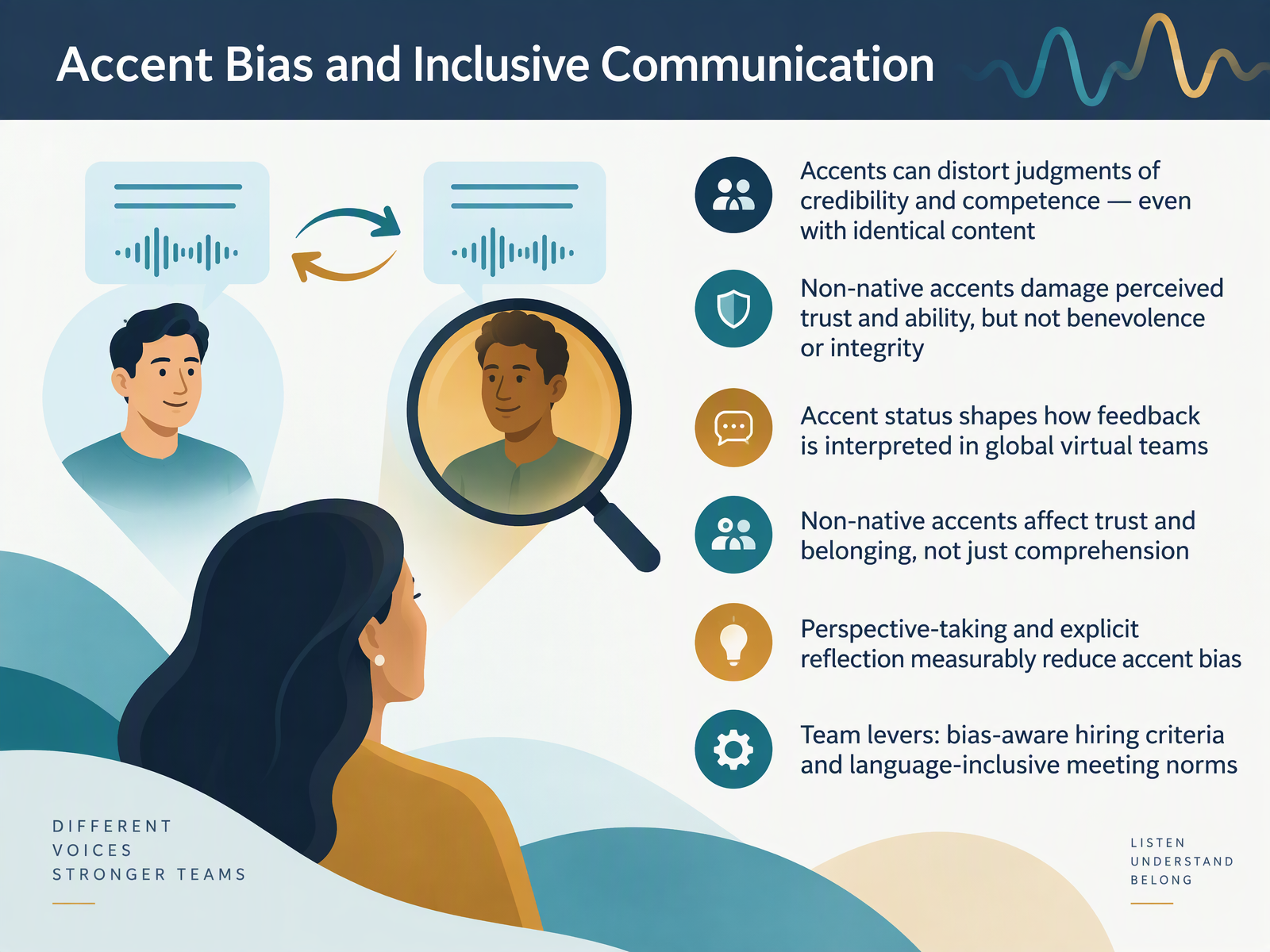
- 11Accent Bias and Inclusive CommunicationNow let's talk about accent bias and inclusive communication. Here's the uncomfortable finding. When the content is identical, an accent can still shift how credible and competent someone sounds to us. Research on hiring decisions shows non-native accents can lower perceived trust and ability. But interestingly, not benevolence or integrity. So we may doubt someone's skill while still seeing them as a good person. In global virtual teams, accent status also shapes how feedback is interpreted, and it affects trust and belonging, not just comprehension. The encouraging part is that bias is reducible. Perspective-taking, deliberately imagining the speaker's viewpoint, measurably lowers accent bias. So before a call, pause and ask yourself, what is this person navigating right now? At team level, two levers help. Use bias-aware hiring criteria, and set language-inclusive meeting norms, such as sharing agendas in advance and allowing written follow-ups. Next, we'll look at practical communication strategies in multilingual teams.
 2 min
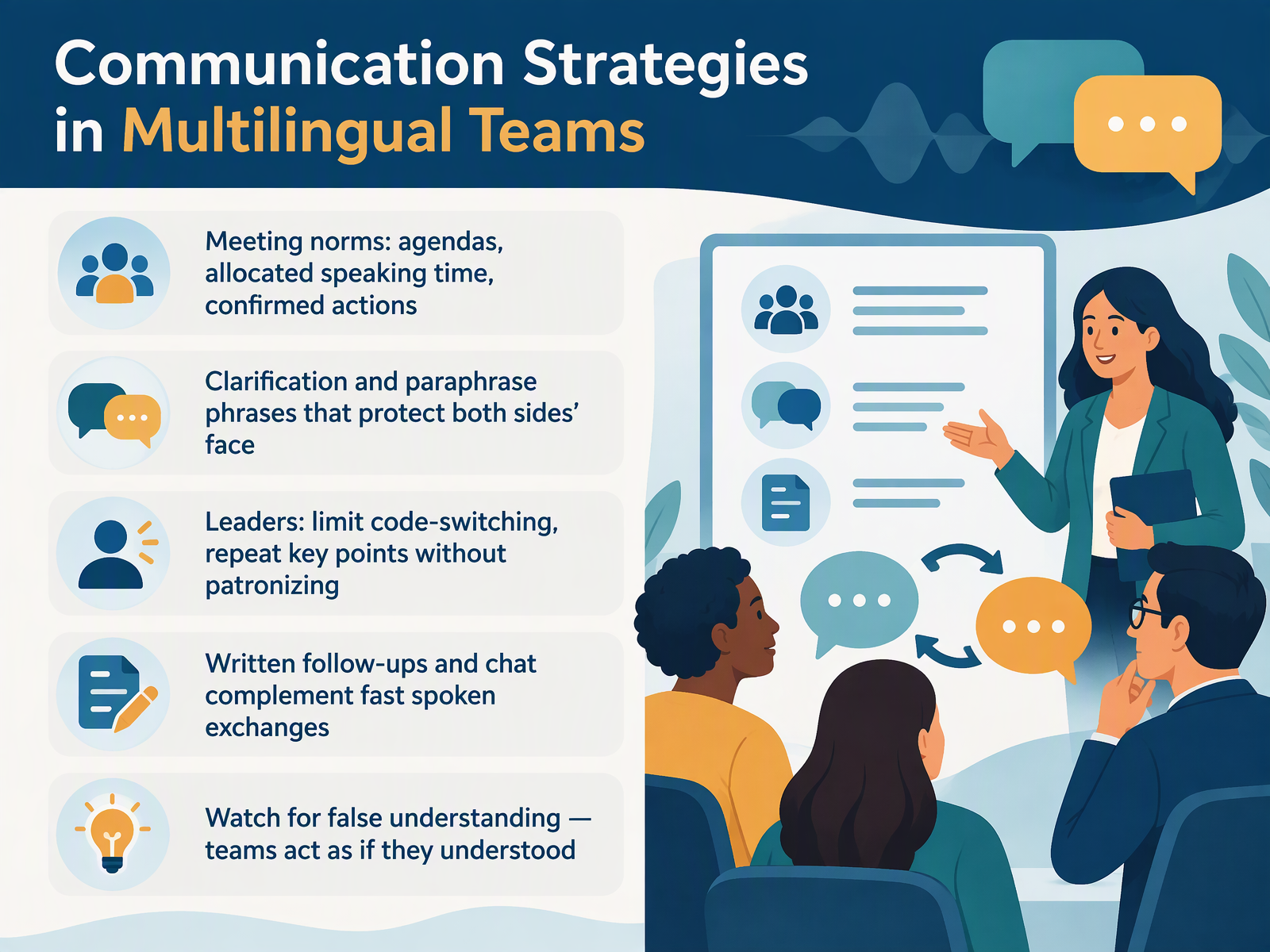
- 12Communication Strategies in Multilingual TeamsLet's look at the concrete habits that make multilingual meetings work. Start with meeting norms. Send the agenda in advance, allocate speaking time so quieter or less fluent colleagues get a real turn, and confirm actions at the end. Next, keep clarification phrases neutral and face-saving. Instead of asking whether someone understood, say, let me repeat that another way, is this what we mean? That checks understanding without testing anyone.
Leaders, limit code-switching during shared meetings. Repeat key points, but vary the wording so it does not sound patronizing. And remember that written follow-ups and chat complement fast spoken exchanges. They give people time to process and respond.
Finally, watch for false understanding, when the team nods as if everything is clear. Build in a quick paraphrase check after each agenda item. That small pause protects the whole team.
Next, let's bring these skills together in the Practice Lab: Listening and Responding Across Varieties.
 journals.sagepub.comcambridge.orgdoi.org+22 min
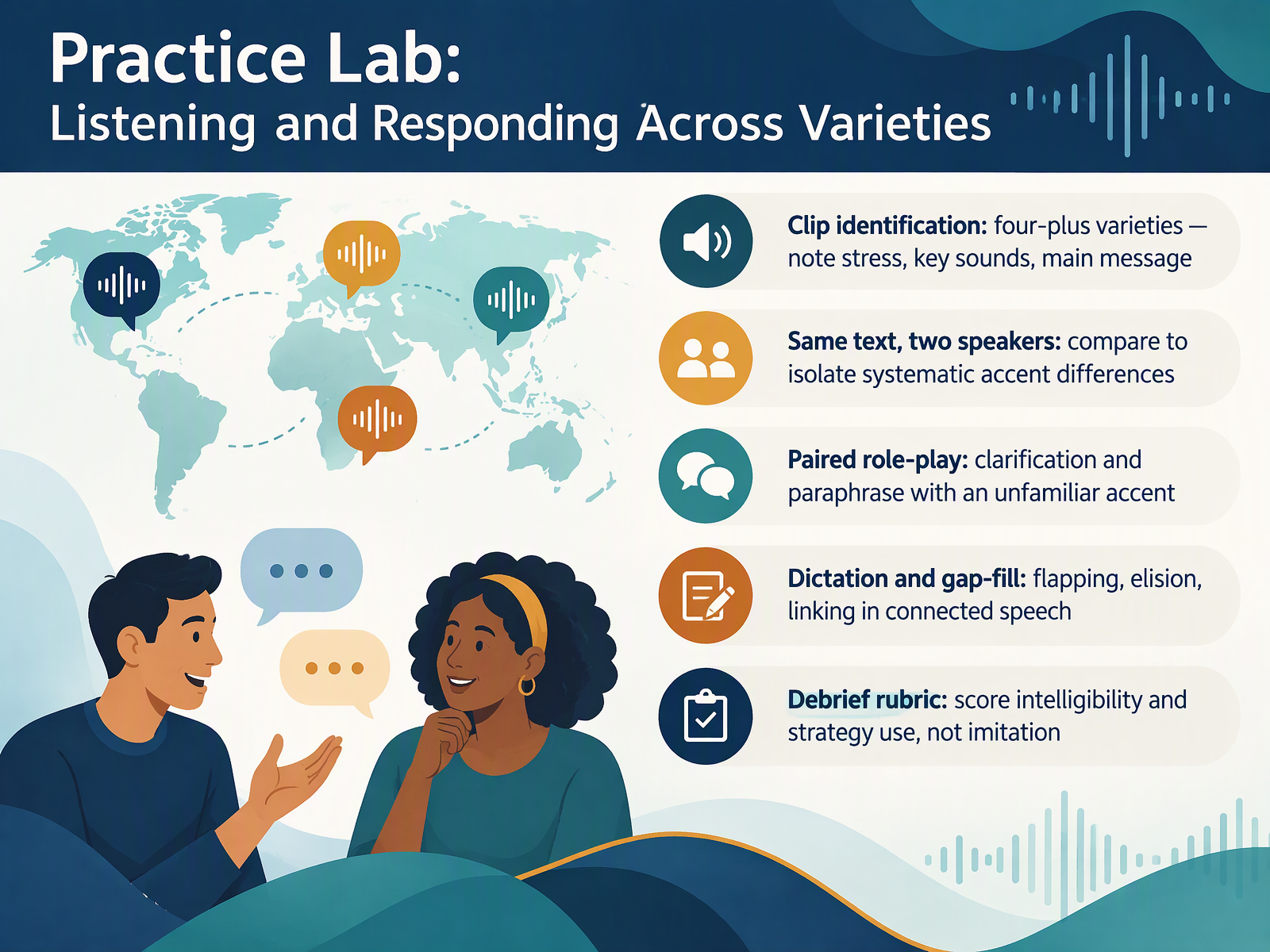
- 13Practice Lab: Listening and Responding Across VarietiesNow let's put it into practice with a short lab. First, clip identification. You'll hear four or more varieties and note three things: where the stress falls, the key sounds, and the main message. Second, the same text with two different speakers. Compare them side by side to isolate systematic differences, not one-off surprises. Third, paired role-play. With an unfamiliar accent, practise asking for clarification and paraphrasing back, for example, so if I understand you correctly, you mean the deadline is Friday. Fourth, dictation and gap-fill, focusing on connected speech: flapping, elision, and linking. Finally, we debrief with a simple rubric. Score intelligibility and your strategy use, not imitation. The goal is understanding, not sounding like anyone else. Next, we'll move on to your Action Plan and Resources.
 1 min
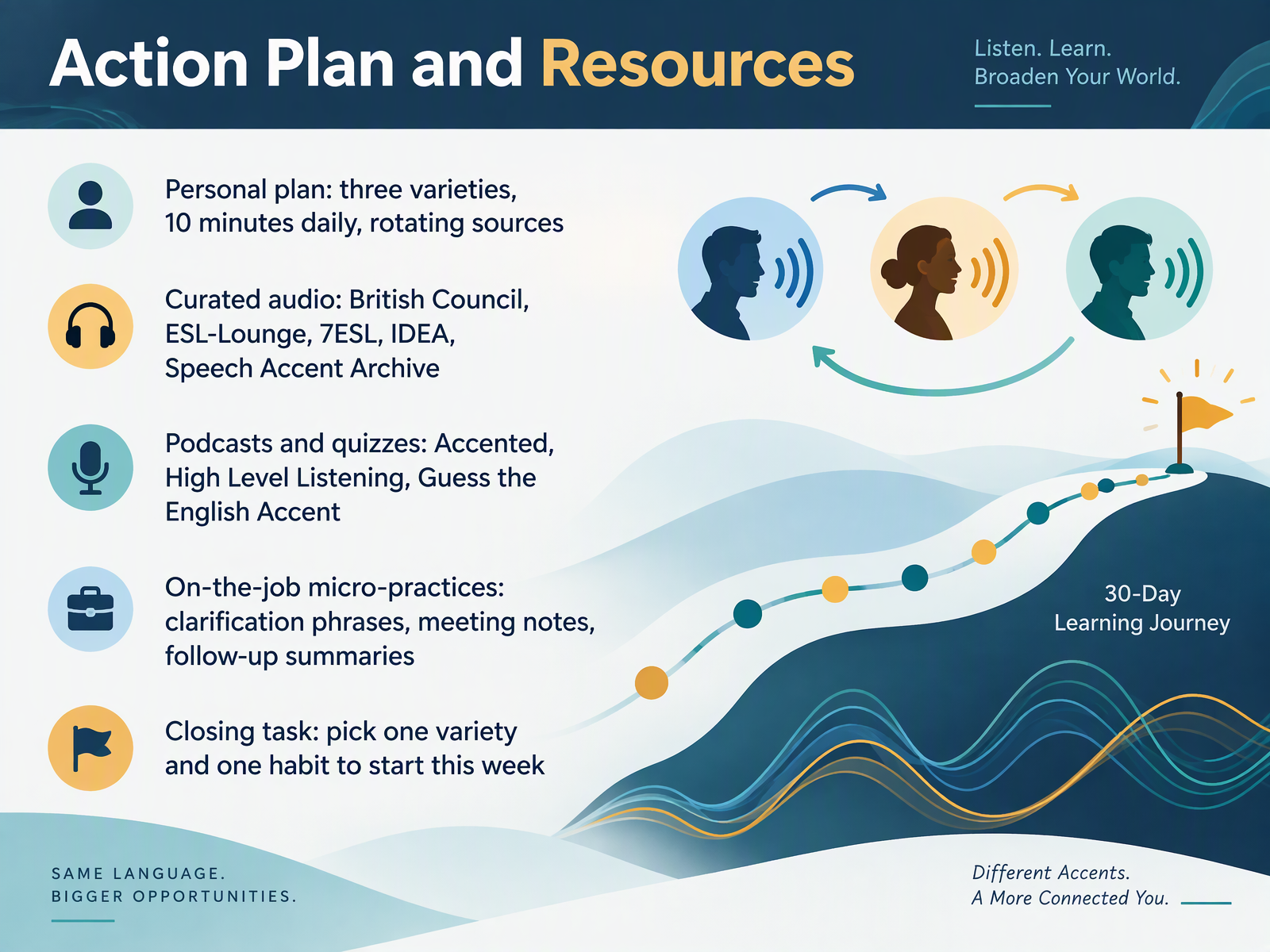
- 14Action Plan and ResourcesSo let's bring it all together with a simple action plan. Your personal plan: choose three varieties, practice about ten minutes a day, and rotate your sources so you hear different voices each week. For curated audio, try the British Council, ESL Lounge, 7ESL, IDEA, and the Speech Accent Archive. For podcasts and quizzes, look at Accented, High Level Listening, and Guess the English Accent. On the job, use micro practices: a clarification phrase like, could you say that again, taking notes during meetings, and sending a short follow up summary. Your closing task is simple. Pick one variety and one habit, and start this week. You have the tools, and every accent you meet is a chance to grow. Thank you for joining me, and keep listening with confidence.
 2 min
Take the deck with you
Download this course as a file — free, no sign-up needed.
- PDF handoutEvery slide page, ready to print or share.15 pages · 3.4 MBDownload
- Narrated PowerPointThe deck that presents itself — every slide carries the digital human's narration video.15 pages · 16.1 MBDownload
- PowerPoint slidesThe full deck as a .pptx — open it in PowerPoint, Keynote, or Google Slides.15 pages · 3.4 MBDownload
Free to use in your own training — please keep the PersonWise credit page at the end.
Have your own deck? Turn it into a course
Sources consulted
Web sources consulted while building this course.
- Transnational Technical Communication: English as a Business Lingua Franca in Engineering Workplaces - Amy Hodges, Leslie Seawright, 2023 — journals.sagepub.com
- The death of the non-native speaker? English as a lingua franca in business communication: A research agenda — cambridge.org
- English as a Lingua Franca and Business Communication — doi.org
- Polite impoliteness? How power, gender and language background shape request strategies in English as a Business Lingua Franca (BELF) in corporate email exchanges — doi.org
- Belf Competence as Business Knowledge of Internationally Operating Business Professionals — doi.org
- Introduction - Purdue OWL® - Purdue University — owl.purdue.edu
- Understanding language and learning: 9 English as a global language and World Englishes | OpenLearn - Open University — open.edu
- World Englishes — en.wikipedia.org
- World Englishes and applied linguistics — onlinelibrary.wiley.com
- Twentieth century English – an overview — oed.com
- Rhythm and Vowel Quality in Accents of English — doi.org
- Introduction: what are mergers and can they be reversed? | English Language & Linguistics | Cambridge Core — cambridge.org
- Phonological Processes - Varieties of Spoken English — vose.byu.edu
- The perception and production of two vowel mergers in Cowlitz County, Washington Recent literature has revealed ongoing variation in Pacific Northwest English. In particular, back vowels (cf. Ward 2003; Becker et al. 2013; McLarty & Kendall 2014) and pre-velar front vowels (cf. Wassink et al. 2009; — joeystanley.com
- Best practices in measuring vowel merger — doi.org
- talks.cam : t-glottalling, flapping and pre-glottalisation in British Englishes: patterns in phonological and social variability — talks.cam.ac.uk
- Connected Speech Strategies at Word Boundaries: Taps and Glottal Stops in RP — internationalphoneticassociation.org
- Rhoticity in English — en.wikipedia.org
- 9. Aspiration, glottalization, and flapping – An Introduction to American English Phonetics — opentextbooks.rug.nl
- T-glottalization in North American and British English : a comparative study — ddd.uab.cat