Begin
14 pages · ~28 min
Stakeholder Communication for Project Management
This training helps project managers and team leads communicate project plans, progress, and risks clearly to stakeholders, building alignment and support.
A digital instructor presents all 14 pages. Hold “Ask” at any point and ask out loud — the answer comes from this course. No sign-up needed.
What you’ll learn
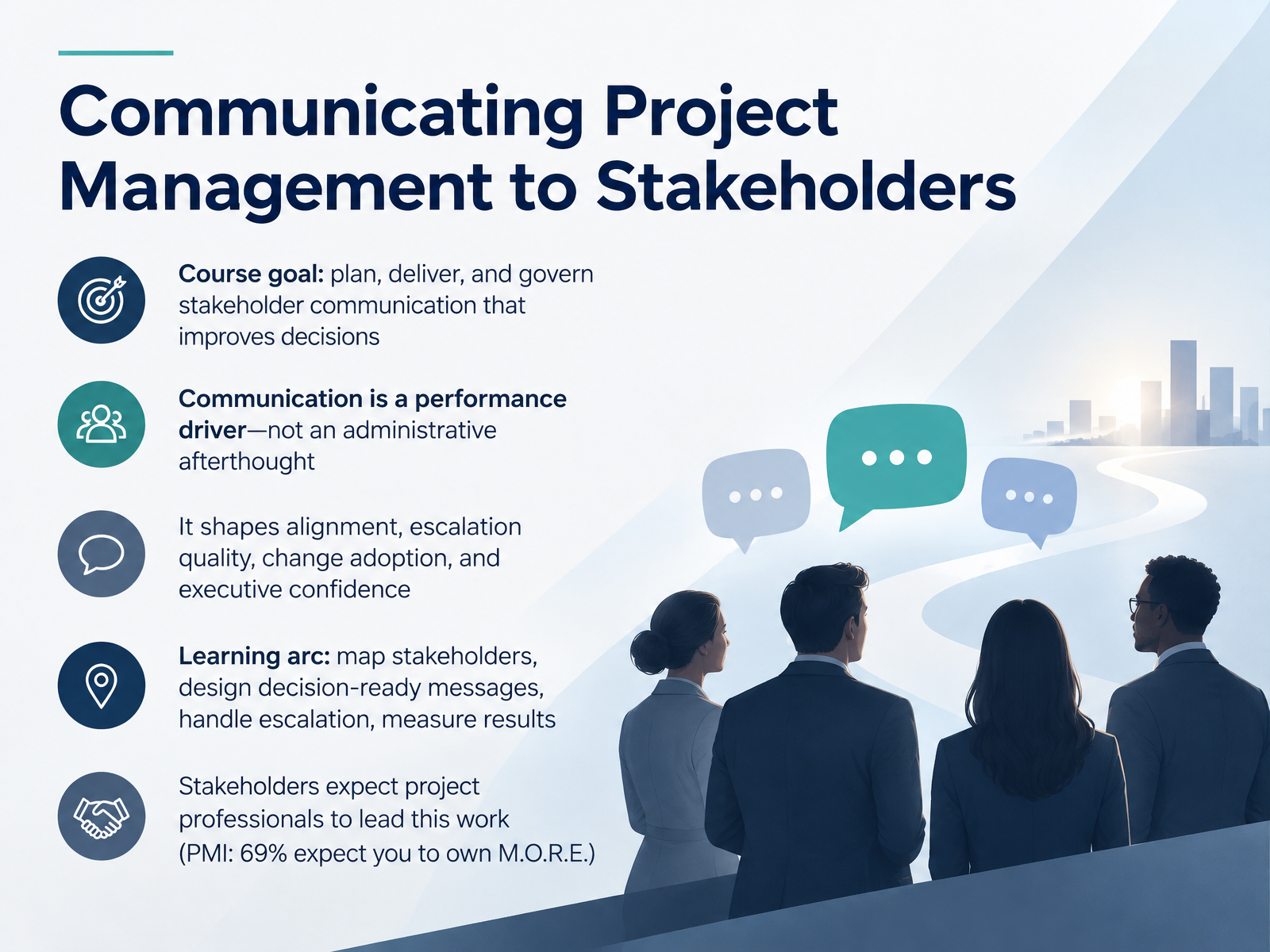
- 01Communicating Project Management to StakeholdersWelcome. This course is about communicating project management to stakeholders. Our goal is practical: plan, deliver, and govern communication that improves decisions. Here is the shift we want to make. Communication is a performance driver, not an administrative afterthought. It shapes alignment, the quality of escalation, change adoption, and executive confidence. So we will work through a clear learning arc. Map your stakeholders. Design decision-ready messages. Handle escalation well. Then measure your results. And you are not doing this alone or from scratch. In PMI's research, sixty-nine percent of stakeholders and executives expect project professionals to own the elements behind M.O.R.E. In other words, your stakeholders already expect you to lead this work. So hold one test for every update you send. Does it help someone make a better decision? With that as our anchor, let's look at how the modules fit together in Course Objectives and How the Modules Fit Together.pmi.orgpmi.orgpmi.org+22 min
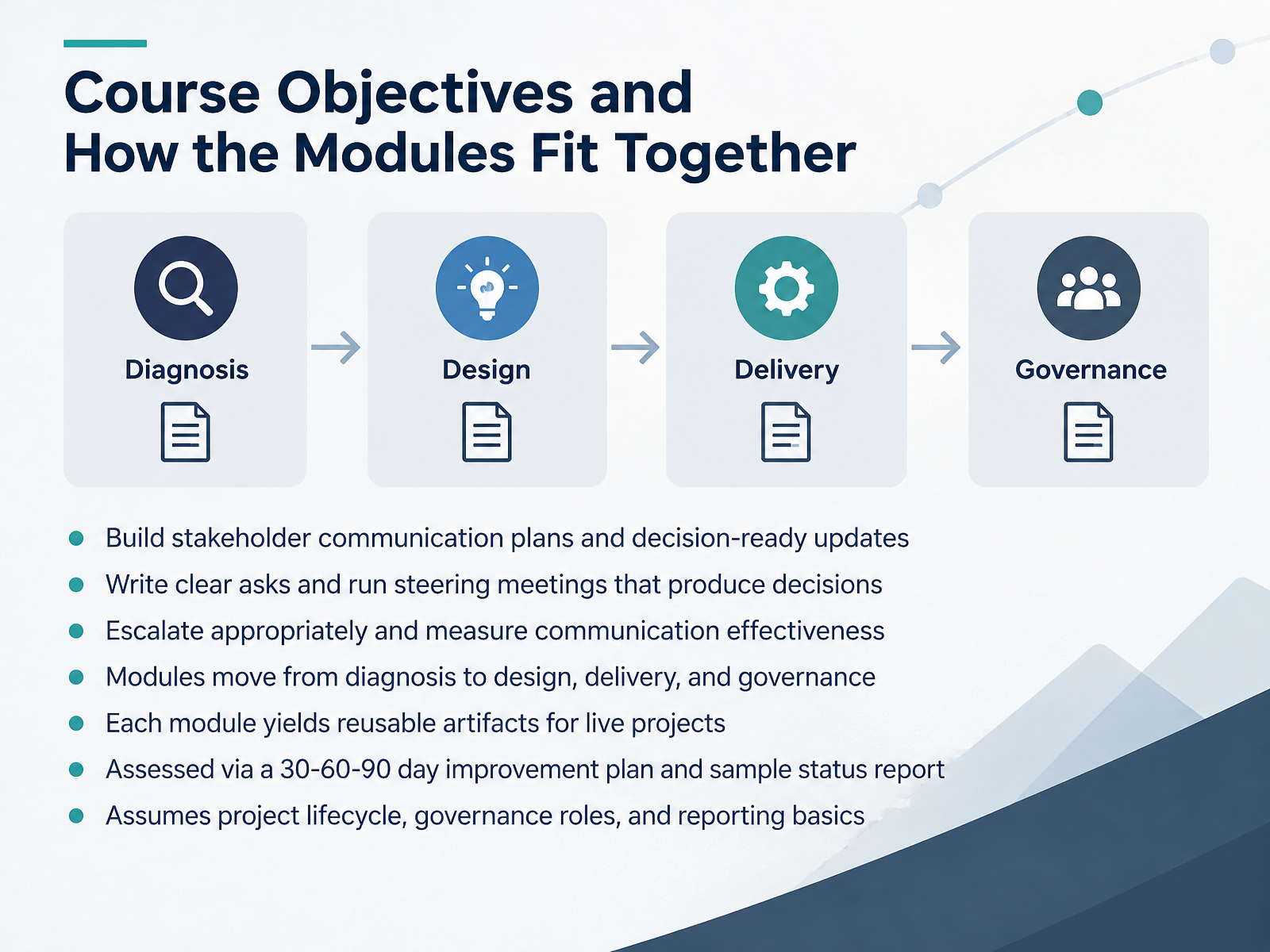
- 02Course Objectives and How the Modules Fit TogetherHere is what we will walk through together. You will build stakeholder communication plans, and updates your decision makers can act on. You will write clear asks, and run steering meetings that actually produce decisions. We will also cover escalation, and how to measure whether your communication is working. The modules follow a logical path. We start with diagnosis, move into design, then delivery, and close with governance. Each module hands you a reusable artifact you can take straight into a live project. Your assessment is a ninety day improvement plan, plus a sample status report. One note on scope. We assume you already know the project lifecycle, governance roles, and reporting basics. That lets us spend our time on the communication itself. Next, we look at why stakeholder communication fails in projects.
 wikis.mit.eduportal.ct.govdocs.aws.amazon.com+22 min
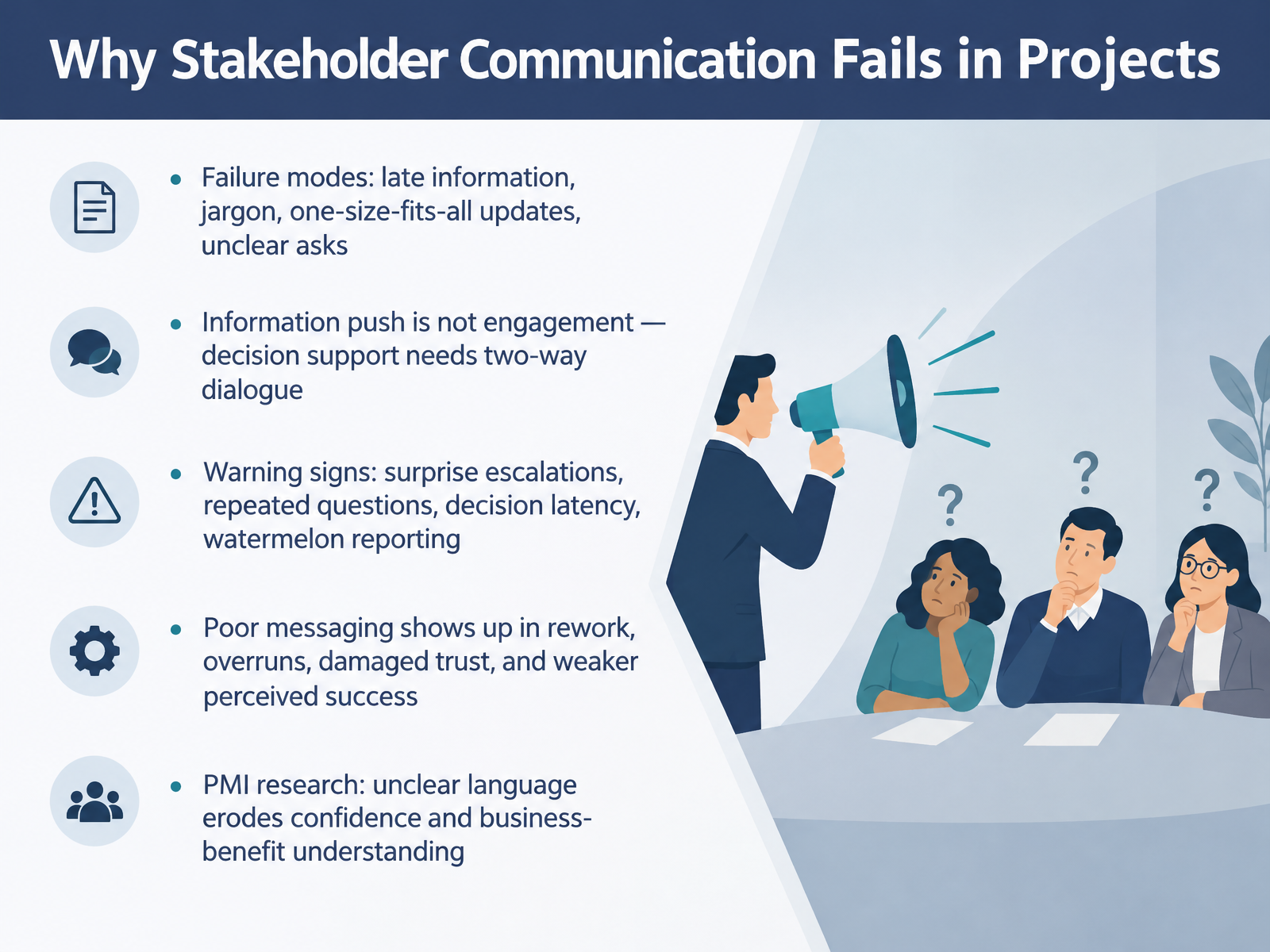
- 03Why Stakeholder Communication Fails in ProjectsSo let's look at why stakeholder communication fails in projects. Four failure modes show up again and again. Late information. Jargon. One-size-fits-all updates. And unclear asks. Pushing status out is not engagement. Decision support needs two-way dialogue. Watch for the warning signs. Surprise escalations. Repeated questions. Decision latency. And watermelon reporting, green on the outside, red on the inside. When messaging is poor, it shows up in rework, overruns, damaged trust, and weaker perceived success. PMI research backs this up. Unclear language erodes confidence and blurs understanding of business benefits. So before your next status update, ask one question. What decision does each stakeholder need to make, and can they make it from what I sent? Next, we map who needs what, in Stakeholder Mapping and Communication Needs.
 doi.orgjournals.vilniustech.ltbcs.org+22 min
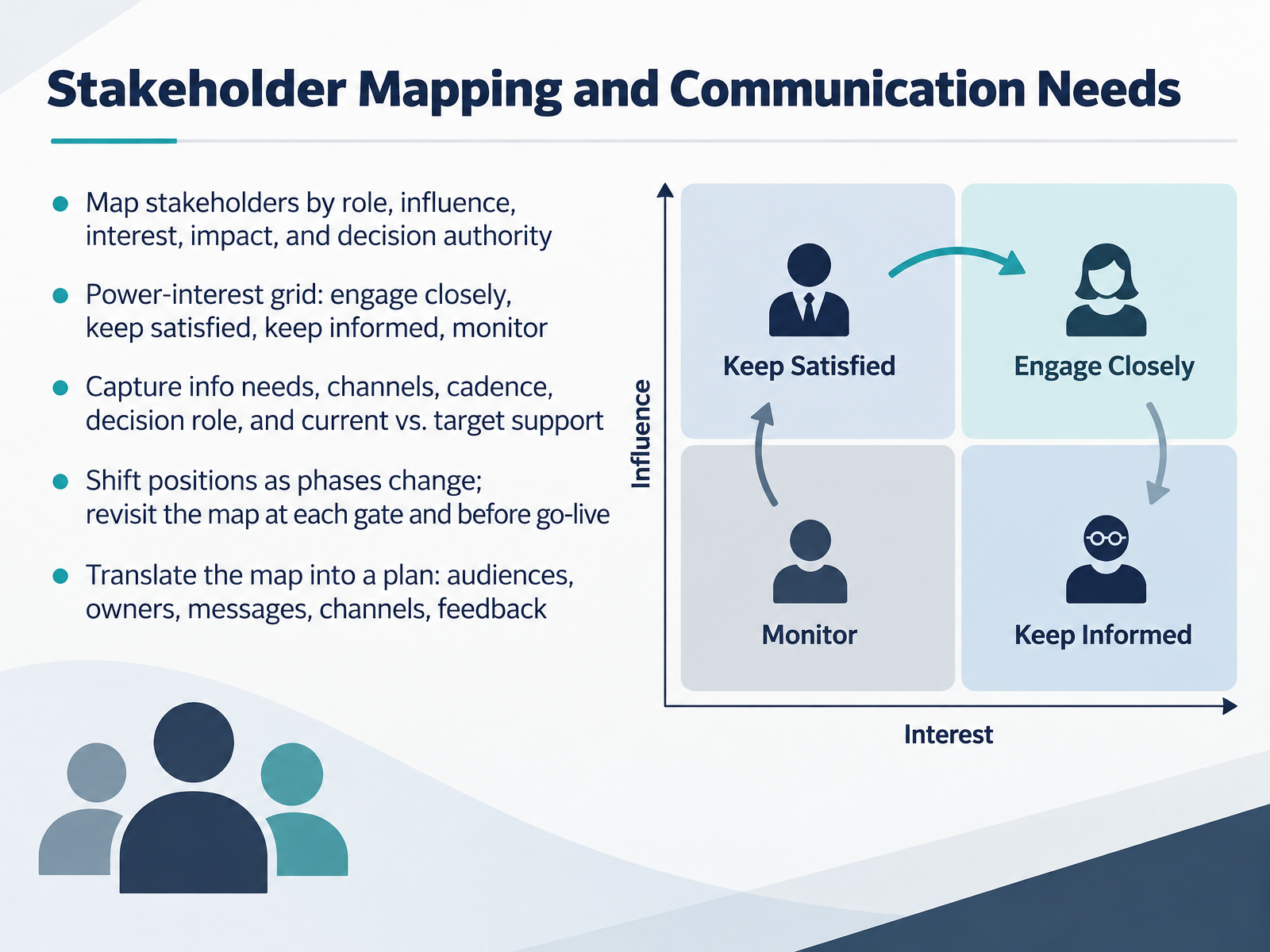
- 04Stakeholder Mapping and Communication NeedsNow let's turn the stakeholder register into something you can act on. Start by mapping each stakeholder by role, influence, interest, impact, and decision authority. Then place them on the power-interest grid. Engage closely with high-power, high-interest people. Keep the high-power, low-interest group satisfied with short, factual updates. Keep the interested, low-power group informed, and monitor the rest. For each name, capture the information they need, the channel, the cadence, and their decision role. Record current versus target support, so you can see the gap you're closing. Positions shift as phases change. Revisit the map at every gate and before go-live. Then translate it into a plan: audiences, owners, messages, channels, and how feedback comes back. Next, we move into message design, from status updates to decision support.
 smartsheet.comprojects101.orgatlassian.com+22 min
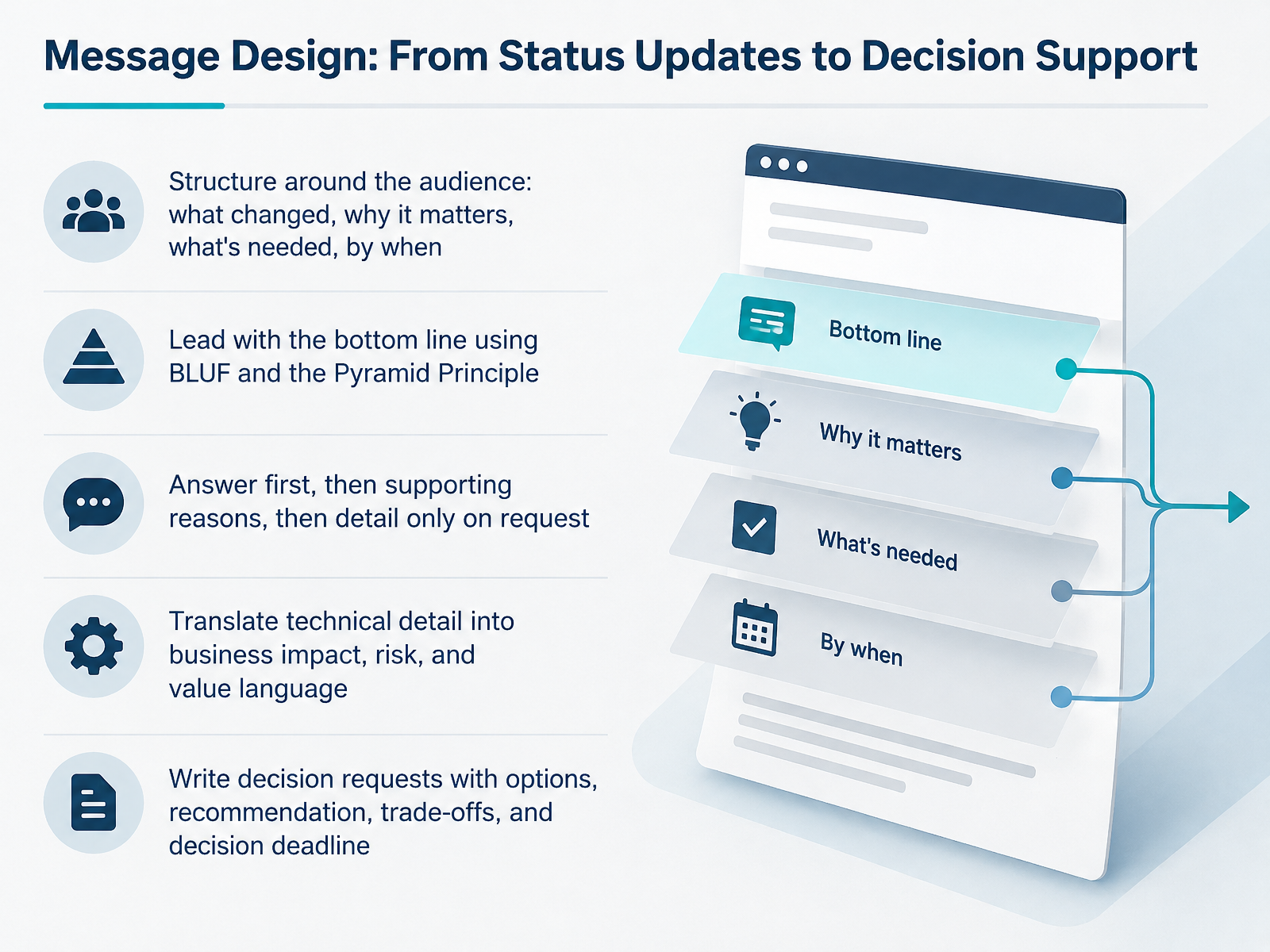
- 05Message Design: From Status Updates to Decision SupportLet's move to message design. Before you write any status update, structure it around your audience. Answer four questions in order: what changed, why it matters, what's needed, and by when. Then lead with the bottom line. That's BLUF, Bottom Line Up Front, paired with the Pyramid Principle. Answer first, reasons second, detail only on request. Executives decide within the first ninety seconds, so bury nothing. Translate technical detail into business impact, risk, and value. For example, instead of saying the API integration slipped three days, say the launch stays on track, with one vendor risk and a mitigation in place. When you need a decision, give options, your recommendation, the trade-offs, and a deadline. That turns a status update into decision support. Next, we look at Channels, Cadence, and the Communication Plan.
 pmi.orgpmi.orgpmi.org+21 min
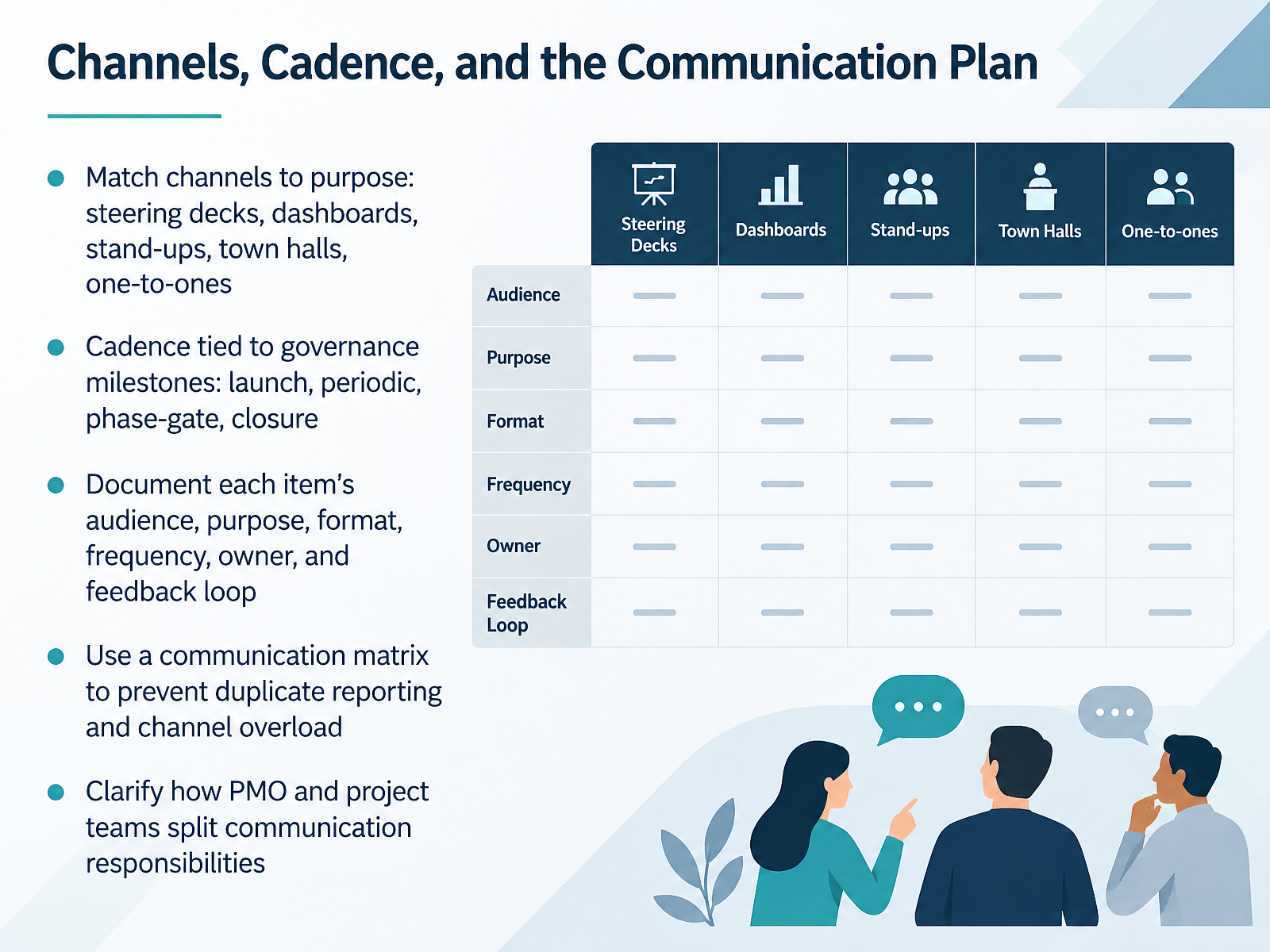
- 06Channels, Cadence, and the Communication PlanNow let's turn the plan into a schedule. Match each channel to its purpose. Steering decks for decisions, dashboards for status, stand-ups for coordination, town halls for awareness, one-to-ones for candid escalation. Then tie cadence to governance milestones: launch, periodic review, phase-gate, and closure. For each item, document six things: audience, purpose, format, frequency, owner, and feedback loop. This is your communication matrix. It prevents duplicate reporting and channel overload. And it clarifies how the PMO and project teams split responsibilities, so one message goes out, once, from the right source. Pull that matrix into your next status cycle. Next, we look at communication gates and cadence in delivery governance.
 wikis.mit.eduportal.ct.govdocs.aws.amazon.com+21 min
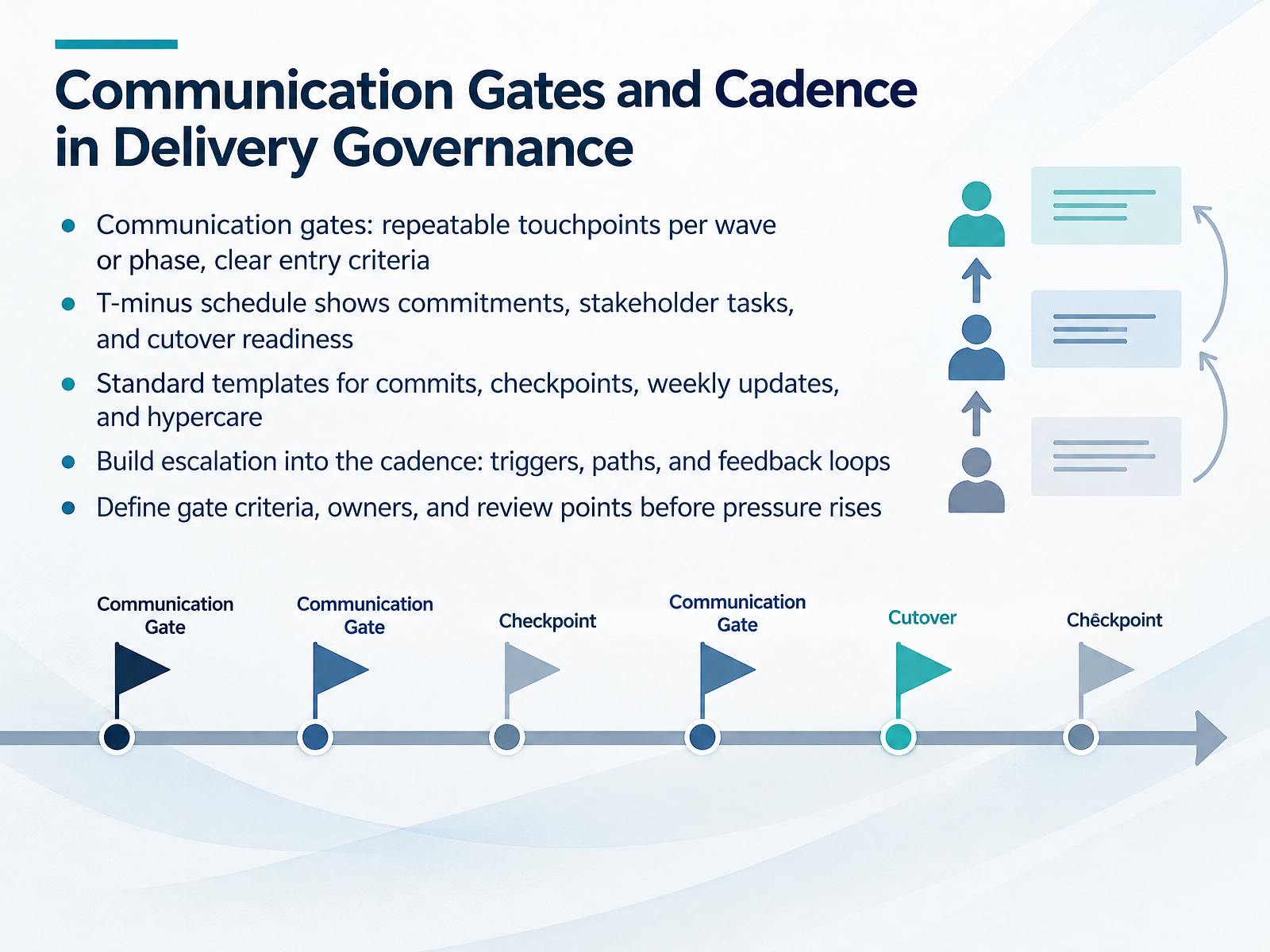
- 07Communication Gates and Cadence in Delivery GovernanceLet's talk about how we structure communication through delivery. Start with communication gates. These are repeatable touchpoints for each wave or phase, each with clear entry criteria. Your stakeholders know exactly what must be true before we move to the next gate. Next, the T-minus schedule. It maps the high-level activities from wave planning to the end of hypercare, and it shows commitments, stakeholder tasks, and cutover readiness on one page. At the T-minus twenty-eight commit meeting, owners confirm the cutover date. At T-minus fourteen, we checkpoint readiness and surface anything that needs escalation. Use standard templates for commits, checkpoints, weekly updates, and hypercare. Then build escalation into the cadence itself. Define triggers, paths, and feedback loops, so issues move to the right level without drama. One directive before pressure rises: agree the gate criteria, the owners, and the review points. Write them down and walk your stakeholders through them early. That turns governance from a surprise into a shared rhythm. Next, we'll look at Dashboards, Reports, and Visual Storytelling.
 wikis.mit.eduportal.ct.govdocs.aws.amazon.com+22 min
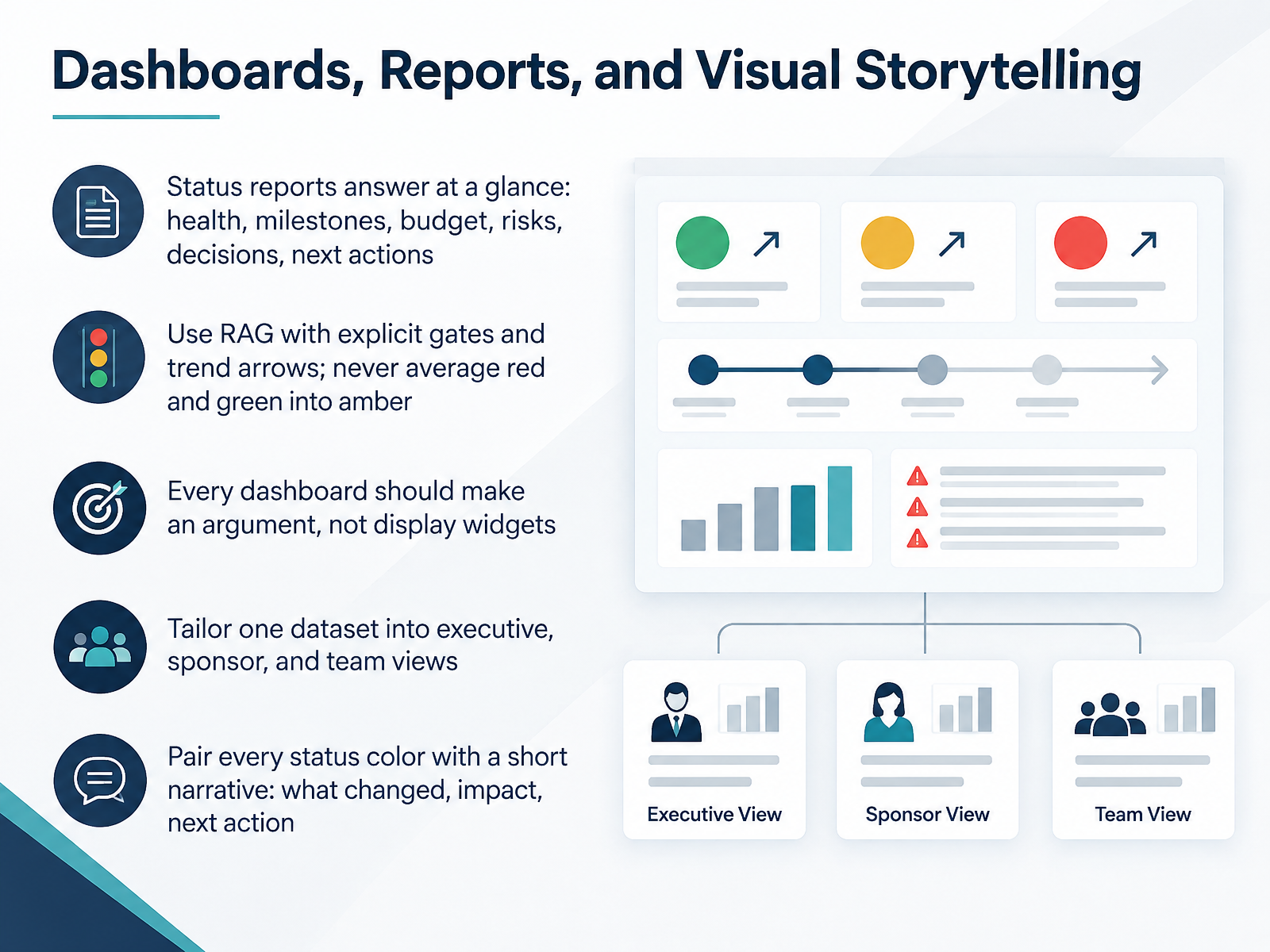
- 08Dashboards, Reports, and Visual StorytellingNext, let's talk about how we turn status into a story. Your status report should answer questions at a glance. Health, milestones, budget, risks, decisions, and next actions, all on one screen. Use red, amber, and green with explicit gates. A red on any critical gate drives the overall status. Never average red and green into amber. Add trend arrows, because amber for three weeks tells a different story than amber since yesterday. Remember, a dashboard should make an argument, not display widgets. The argument is simple. Here is health, here is why, here is what we will do. Take one dataset and tailor it into three views. An executive view, a sponsor view, and a team view. Then pair every status color with a short narrative. What changed, what is the impact, and what is the next action. And say what you need from the sponsor. That turns reporting into coordination. Let's look next at engaging executives and steering committees.
 1 min
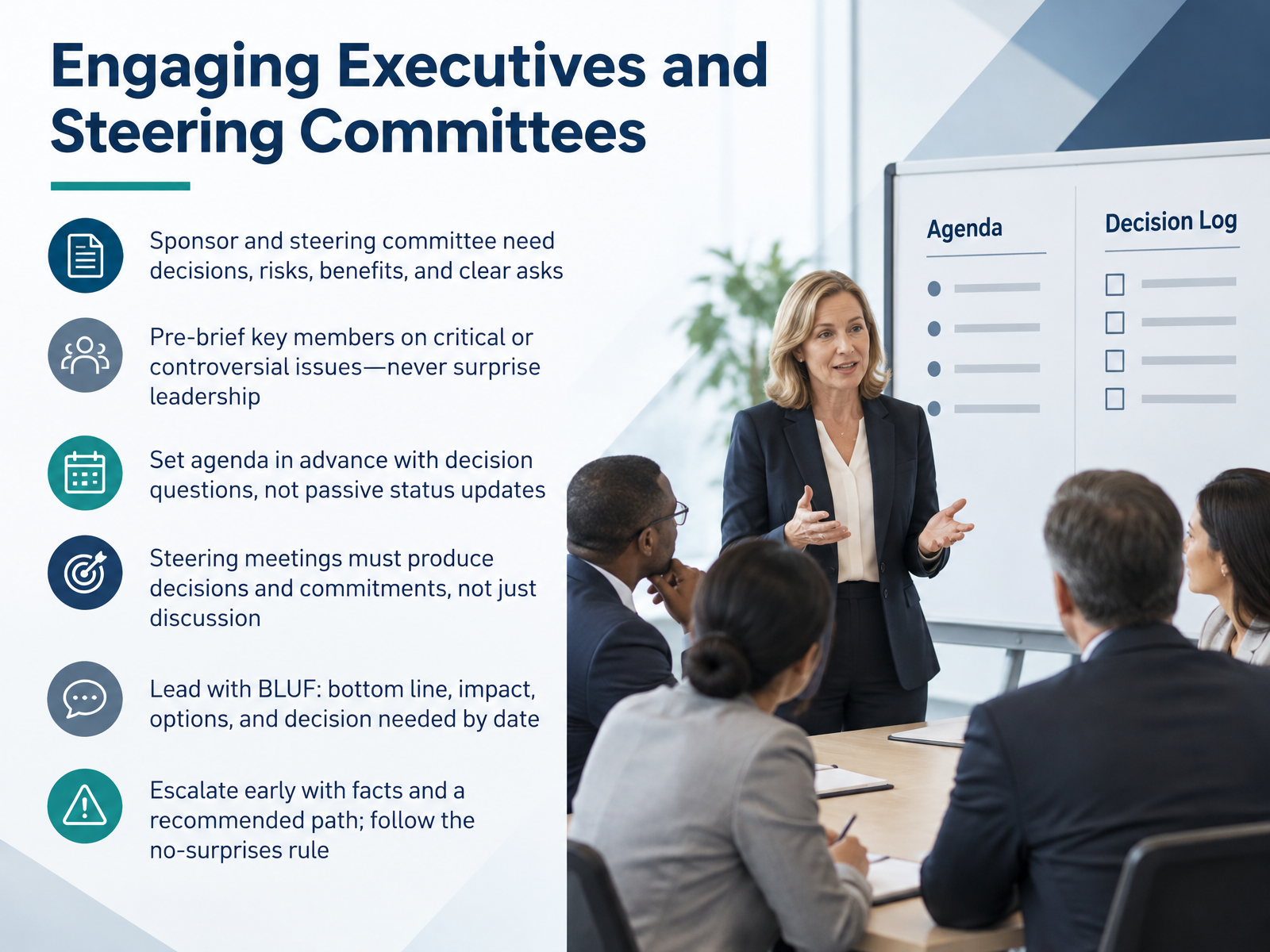
- 09Engaging Executives and Steering CommitteesNext, let's look at engaging executives and steering committees. These meetings have one job: producing decisions. Your sponsor and steering committee need four things from you: decisions, risks, benefits, and clear asks. So set the agenda in advance around decision questions, not passive status updates. Pre-brief key members on critical or controversial issues. Never surprise leadership in the room. When you present, lead with BLUF: bottom line, impact, options, and the decision needed by a date. Escalate early, with facts and a recommended path. Follow the no-surprises rule. A steering meeting that ends without decisions and commitments did not do its job. Next, we'll move into difficult conversations and escalation.
 1 min
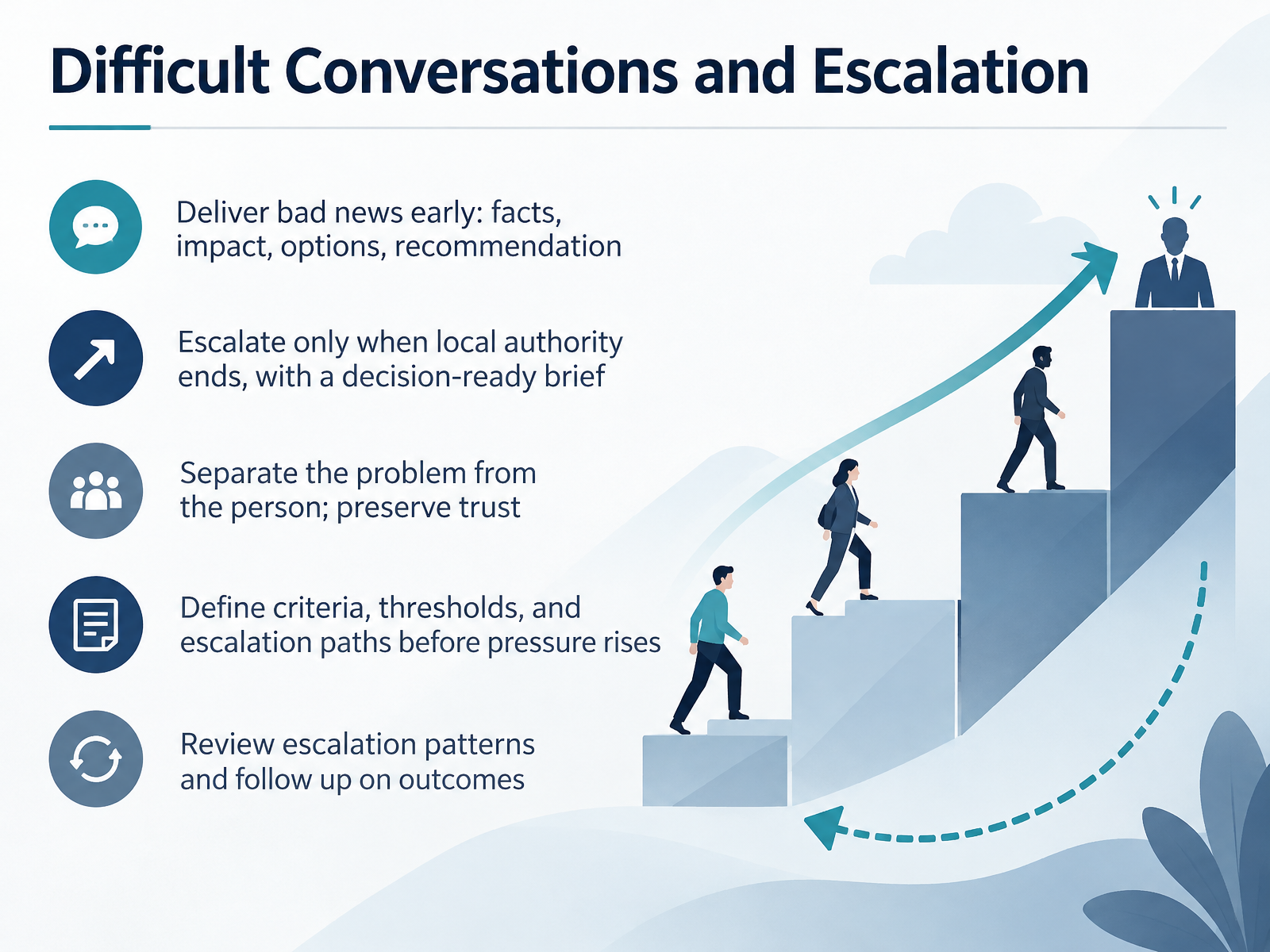
- 10Difficult Conversations and EscalationNow let's talk about difficult conversations and escalation. When you have bad news, deliver it early. State the facts, the impact, the options, and your recommendation. No surprises.
Escalate only when local authority ends. Bring a decision-ready brief, not raw frustration. Separate the problem from the person. Preserve trust.
Before pressure rises, define criteria, thresholds, and escalation paths with your sponsor. Then review escalation patterns and follow up on outcomes, so the same issue doesn't return.
Next, we look at communicating change to teams and end users.
 1 min
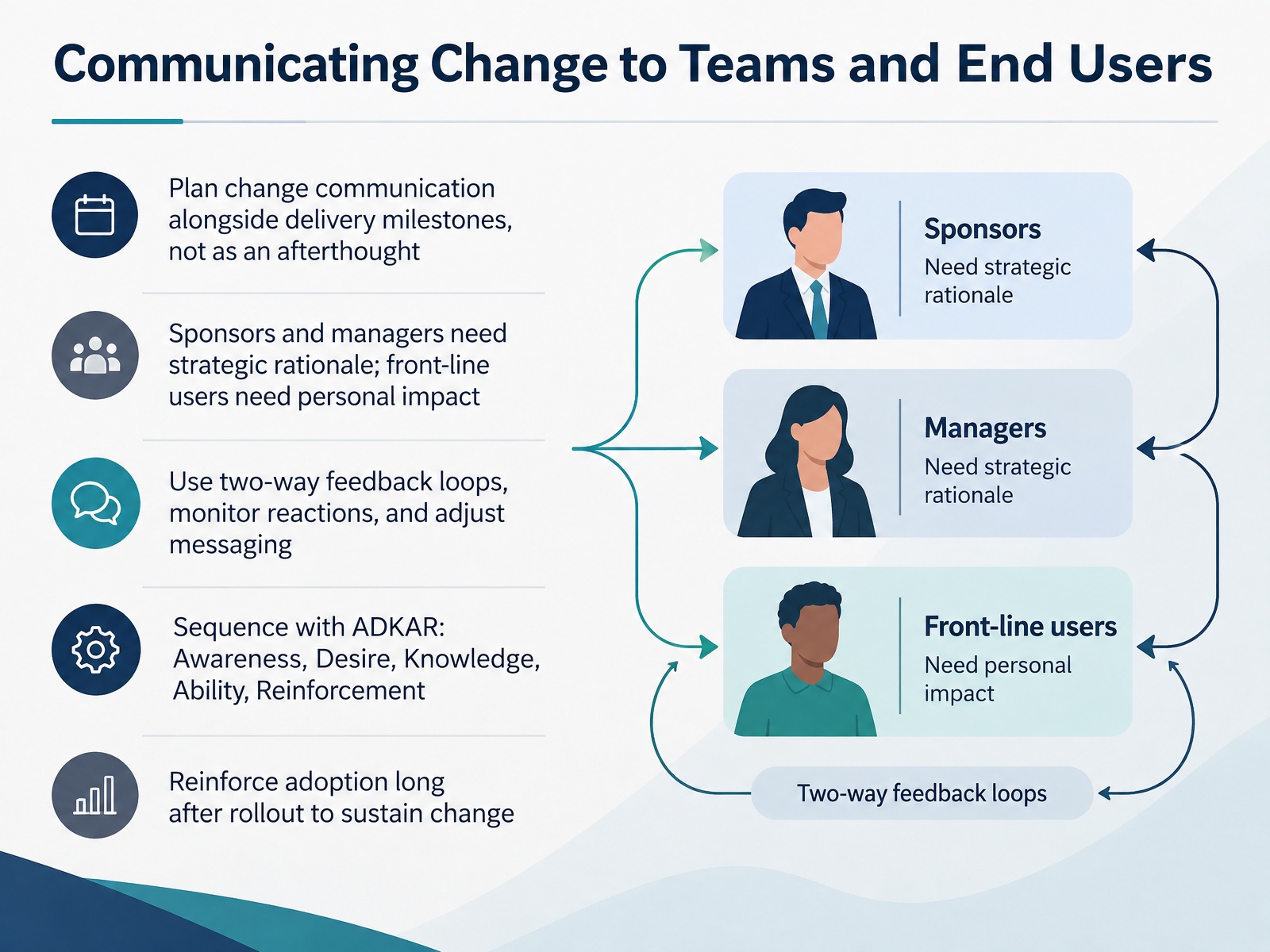
- 11Communicating Change to Teams and End UsersNow let's talk about communicating change to teams and end users. Plan this alongside your delivery milestones, not after go-live. Sponsors and managers need the strategic rationale. Front-line users need to hear the personal impact, what changes in their day and what support they get. Build two-way feedback loops. Run a short pulse survey after each major message, watch reactions in team huddles, and adjust your messaging based on what you hear. Sequence the work with ADKAR: Awareness, Desire, Knowledge, Ability, and Reinforcement. Remember, change happens one person at a time, so track where each group sits. And reinforce adoption long after rollout. Keep celebrating new behaviors and answering questions, because that is what sustains the change. Next, we look at coordinating project communication with organizational change management.
 smartsheet.comprojects101.orgatlassian.com+22 min
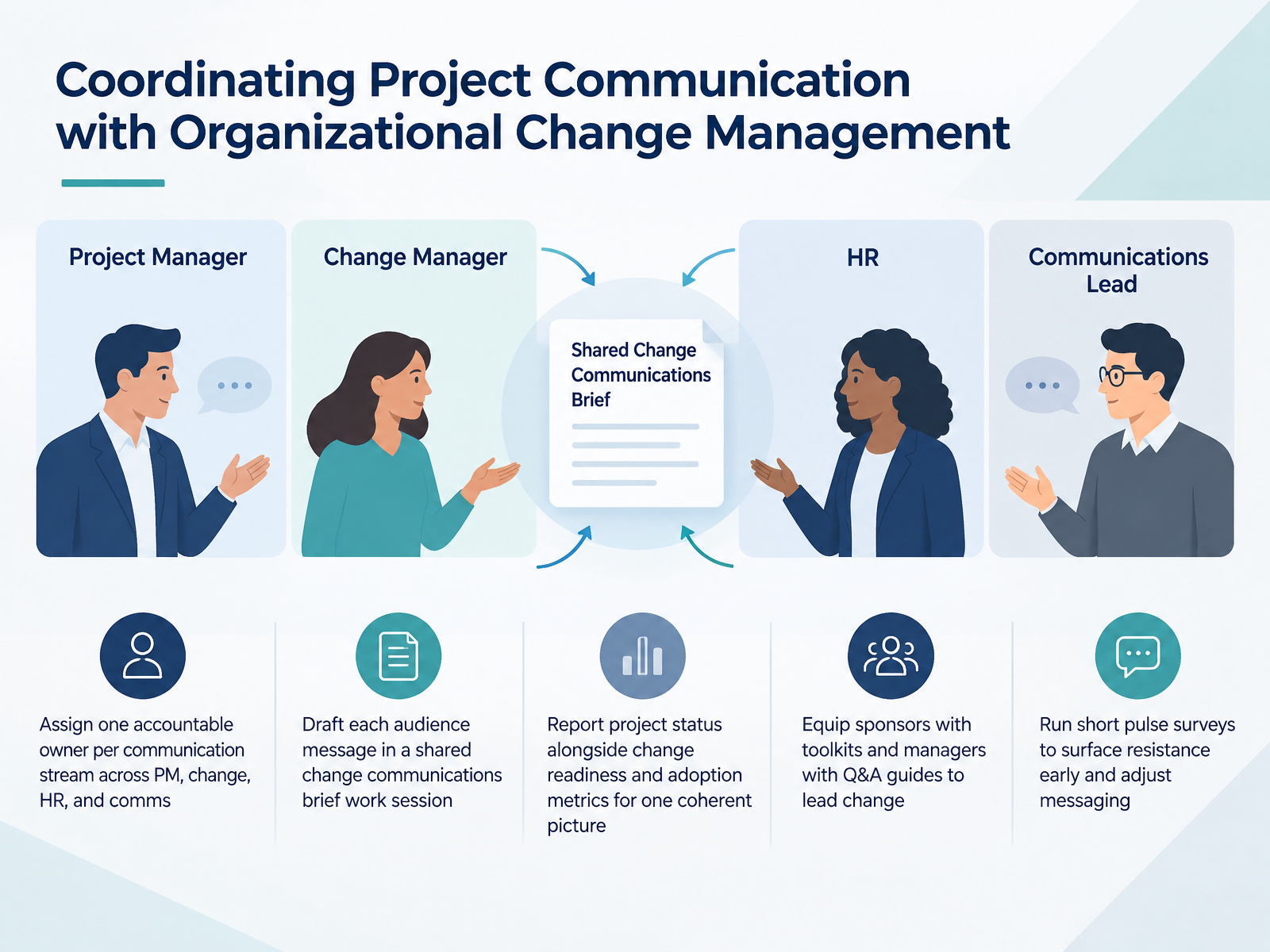
- 12Coordinating Project Communication with Organizational Change ManagementLet's talk about coordinating project communication with organizational change management. When these run in parallel instead of together, your stakeholders hear two different stories. So, start by assigning one accountable owner per communication stream across project management, change, HR, and comms. Then draft each audience message in a shared change communications brief work session, so project, change, and comms leaders agree on who, what, and how before anything goes out. At steering, report project status alongside change readiness and adoption metrics, giving sponsors one coherent picture. Equip sponsors with toolkits, and give managers Q and A guides so they can lead change in their teams. Finally, run short pulse surveys to surface resistance early, and adjust your messaging while there is still time. Next, we look at Measuring Communication Effectiveness.
 1 min
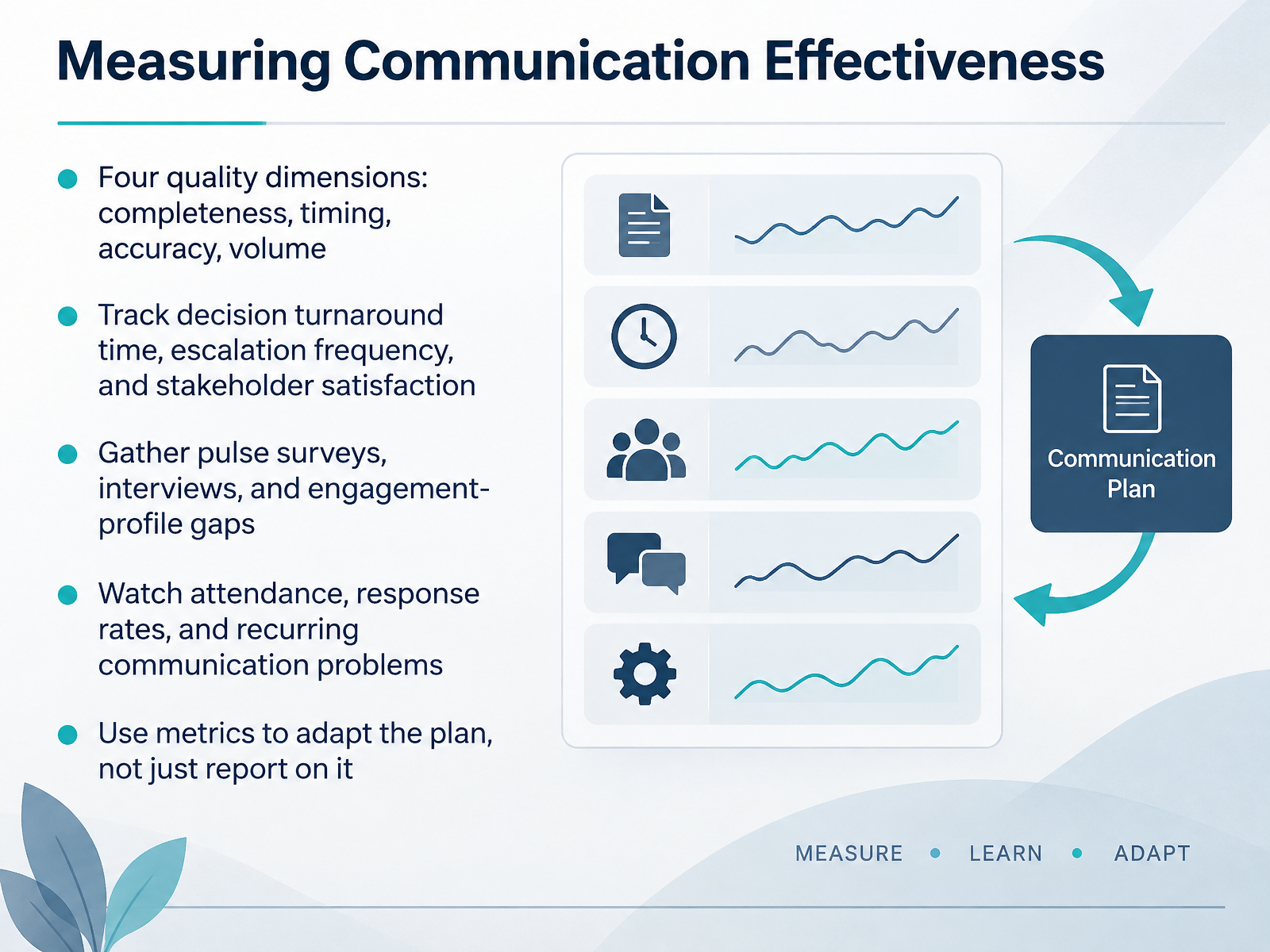
- 13Measuring Communication EffectivenessSo how do we know our communication is actually working? We measure it against four quality dimensions. Completeness, meaning nothing relevant is lost. Timing, meaning information arrives when it is needed. Accuracy, meaning the message is clear and precise. And volume, meaning we send what is required and cut the noise that clogs the channel.
Beyond those dimensions, track behavior. Watch decision turnaround time. Watch how often issues escalate. And ask your stakeholders directly through pulse surveys, interviews, and engagement-profile gaps, comparing where a stakeholder sits today against where they need to be.
Also watch the signals that cost nothing. Meeting attendance. Response rates. Recurring problems that keep resurfacing. They tell you where the plan is breaking down.
Here is the key point. Use these metrics to adapt the plan, not just to report on it. If decision turnaround slips, change the cadence. If escalations climb, revisit who receives what.
Next, we turn those insights into action with your thirty, sixty, ninety day communication improvement plan.
 pmi.orgpmi.orgpmi.org+22 min
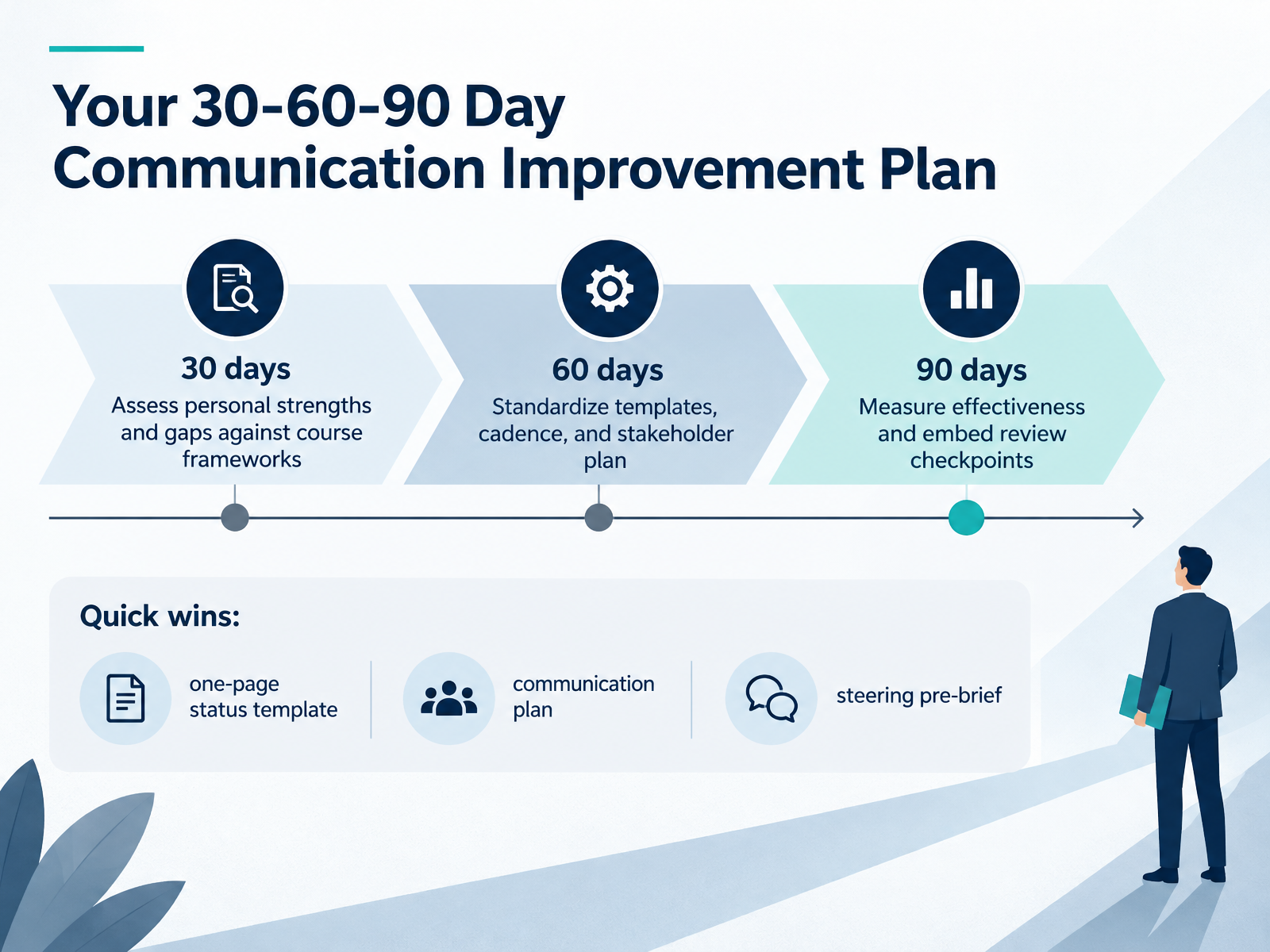
- 14Your 30-60-90 Day Communication Improvement PlanLet's close with a plan you can start on Monday. First, assess yourself honestly against the frameworks from this course. Where are your gaps? Which conversations do you avoid? Thirty days is for urgent gaps and quick wins. Ship a one-page status template. Draft or refresh your communication plan. Pre-brief your steering committee before the formal meeting, so decisions don't ambush you. At sixty days, standardize. Lock in templates, a fixed cadence for status updates and steering reviews, and a stakeholder plan that names who gets what, when, and through which channel. At ninety days, measure and embed. Score your communication on four dimensions: completeness, timing, accuracy, and volume. Watch meeting attendance and feedback turnaround. Then set review checkpoints at each phase gate, so the plan stays alive instead of gathering dust. Pick one quick win this week. Then thank you for your attention and the care you bring to your stakeholders. Keep going. You have what you need.
 wikis.mit.eduportal.ct.govdocs.aws.amazon.com+22 min
Take the deck with you
Download this course as a file — free, no sign-up needed.
- PDF handoutEvery slide page, ready to print or share.15 pages · 3.1 MBDownload
- Narrated PowerPointThe deck that presents itself — every slide carries the digital human's narration video.15 pages · 11.8 MBDownload
- PowerPoint slidesThe full deck as a .pptx — open it in PowerPoint, Keynote, or Google Slides.15 pages · 3.1 MBDownload
Free to use in your own training — please keep the PersonWise credit page at the end.
Have your own deck? Turn it into a course
Sources consulted
Web sources consulted while building this course.
- Project Success — pmi.org
- https://www.pmi.org/-/media/pmi/documents/public/pdf/learning/thought-leadership/pulse-of-the-profession_2026_pdf.pdf — pmi.org
- New PMI Research Reveals Strategy-Execution Gap Is Undermining Transformation And How to Close It — pmi.org
- Maximizing Project Success — pmi.org
- Managing Perceptions for Project Success: How Stakeholders Shape Reality — pmi.org
- Communication Plan Overview - IS&T Project Community of Practice - MIT Wiki Service — wikis.mit.edu
- Communications Management Plan Template — portal.ct.gov
- Communication plan for the delivery layers — docs.aws.amazon.com
- Growing up--the information technology project management office (PMO)'s journey from infancy to maturity — pmi.org
- Communications Management Plan — pmdoc.ua
- Adversarial factors in multi-stakeholders’ engagement of global-IT projects — doi.org
- Causes and effects of poor communication in the construction industry in the MENA region | Journal of Civil Engineering and Management — journals.vilniustech.lt
- Project management perceptions | BCS — bcs.org
- Research Survey with the associates of the S�o Paulo Chapter of PMI for lifting of situations and interlocutors of the main problems of communication in projects and identifying critical success Factors — doi.org
- The Essential Role of Communications Report | PMI Pulse of Profession — pmi.org
- Stakeholder Communication Plan — smartsheet.com
- Communications Management Plan — projects101.org
- Stakeholder Project Communication: Atlassian Plays | Atlassian — atlassian.com
- Project Management Templates for Large Projects — gov.ie
- How to Write a Communication Plan: Examples + Template — asana.com