Begin
14 pages · ~28 min
Evaluating SEO Quality
This training teaches marketers and content professionals how to evaluate SEO quality, covering key metrics and practical assessment methods to improve search performance.
A digital instructor presents all 14 pages. Hold “Ask” at any point and ask out loud — the answer comes from this course. No sign-up needed.
What you’ll learn
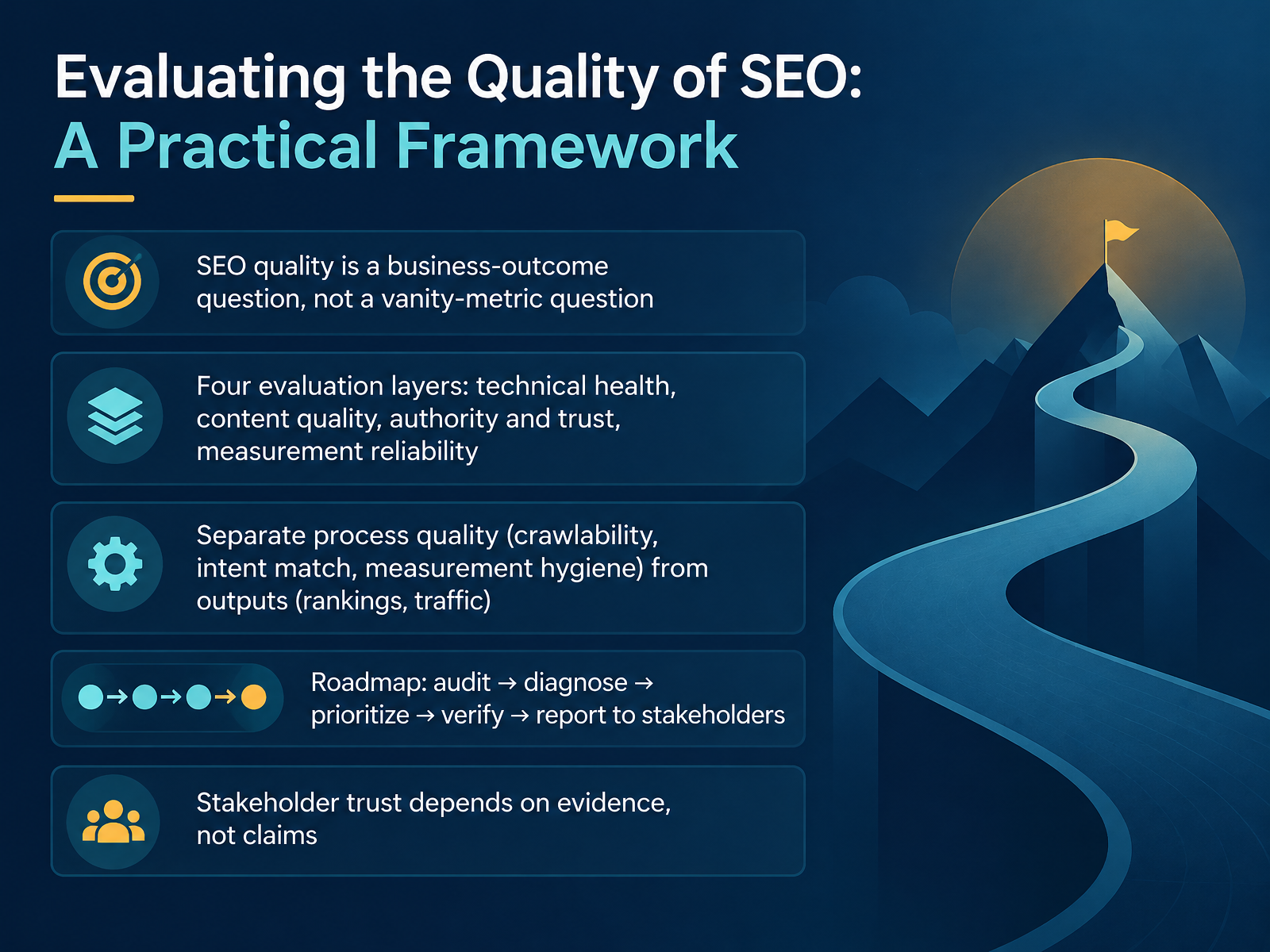
- 01Evaluating the Quality of SEO: A Practical FrameworkWelcome to Evaluating the Quality of SEO. Over the next fourteen slides, we'll build a practical framework you can apply to real audits and editorial workflows. Start with one mindset shift. SEO quality is a business-outcome question, not a vanity-metric question. Impressions and average position only matter when they connect to traffic, conversions, and trust. We'll evaluate four layers: technical health, content quality, authority and trust, and measurement reliability. Keep process quality separate from outputs. Crawlability, intent match, and measurement hygiene are things you control. Rankings and traffic are results. Your roadmap is five steps: audit, diagnose, prioritize, verify, then report to stakeholders. And remember, stakeholder trust depends on evidence, not claims. Let's look at what changed in search quality guidance for 2026.developers.google.comservices.google.comguidelines.raterhub.com+21 min
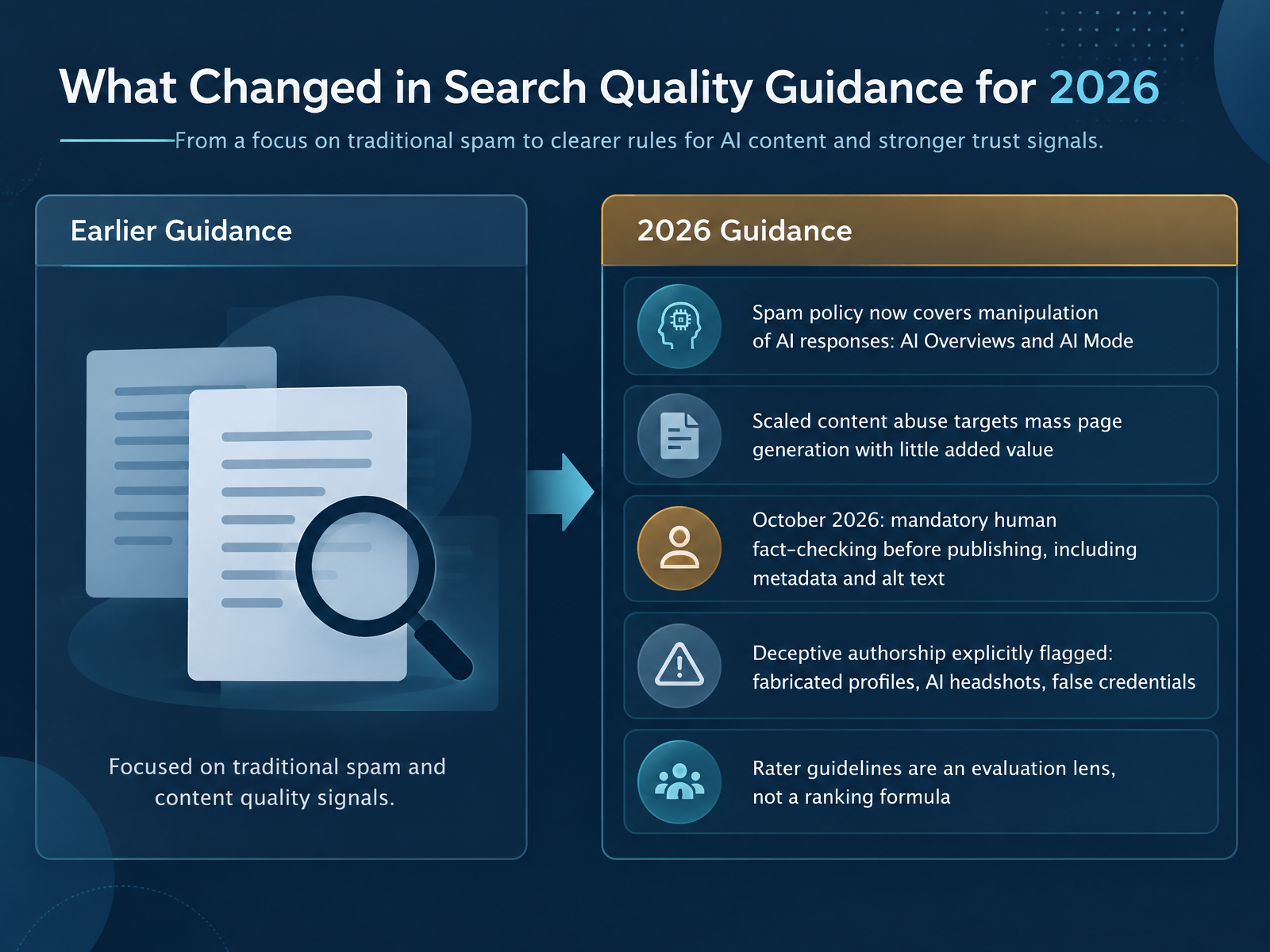
- 02What Changed in Search Quality Guidance for 2026Let's look at what actually changed in search quality guidance for 2026. First, spam policy now covers manipulation of AI responses, specifically AI Overviews and AI Mode. Serving different content to AI crawlers is cloaking, same as before. Second, scaled content abuse still targets mass page generation with little added value. Volume isn't the violation; value is. Third, as of October 2026, human fact-checking before publishing is mandatory, and that includes metadata, structured data, and alt text. Fourth, deceptive authorship is explicitly flagged: fabricated profiles, AI headshots, and false credentials are treated as deception and a low-quality signal. Finally, keep rater guidelines in perspective. They're an evaluation lens for judging E-E-A-T, not a ranking formula. So audit your AI workflows against these five items before your next publishing cycle. That sets up our next topic, The Four-Layer Quality Model and Rollout Plan.
 developers.google.comdevelopers.google.cnblog.google+22 min
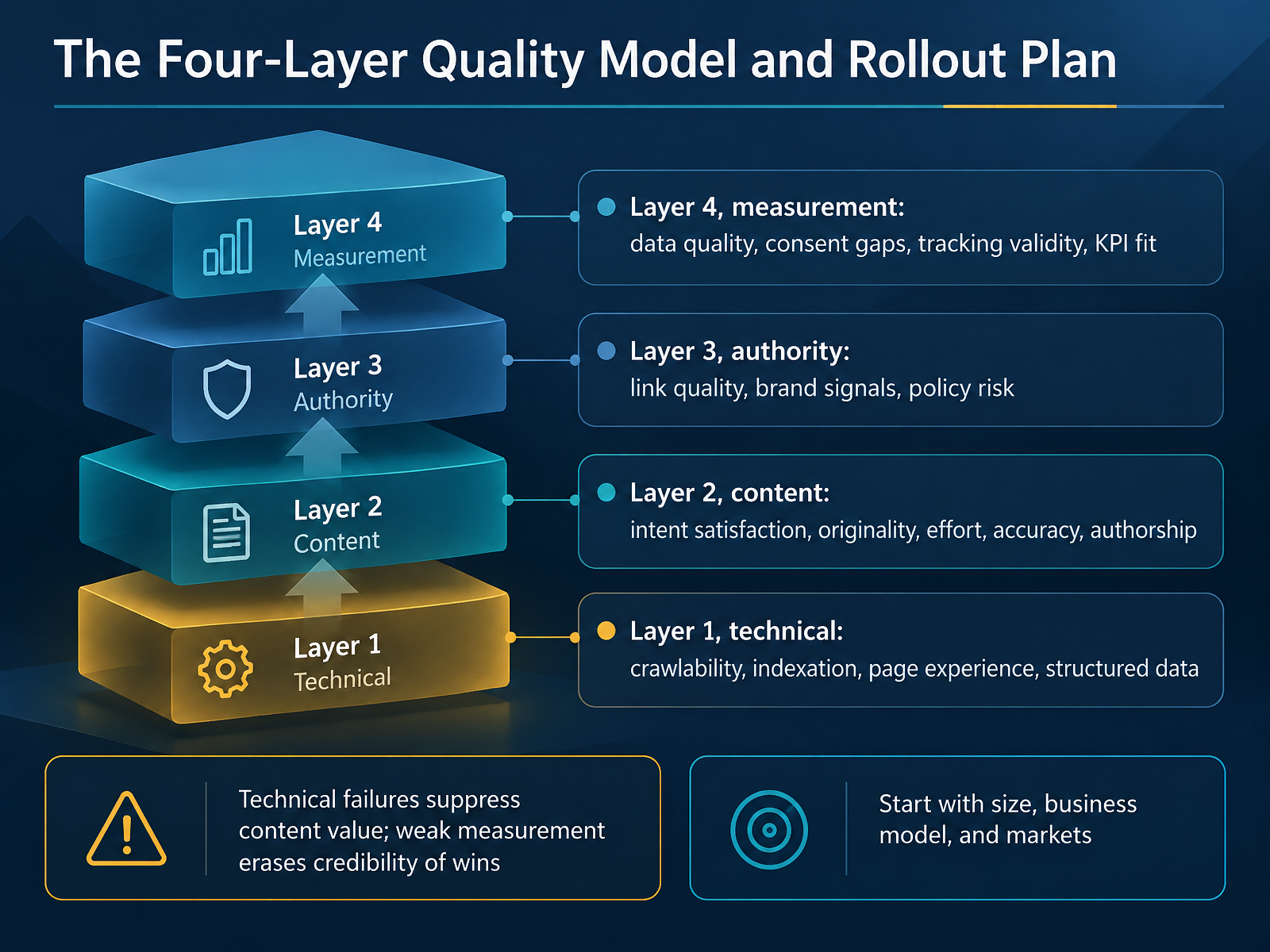
- 03The Four-Layer Quality Model and Rollout PlanLet's look at how to structure an SEO quality evaluation. I use a four-layer model. Layer one is technical: crawlability, indexation, page experience, and structured data. Layer two is content: does the page satisfy intent, is it original, does it show real effort, is it accurate, and is authorship clear. Layer three is authority: link quality, brand signals, and policy risk. Layer four is measurement: data quality, consent gaps, tracking validity, and whether your KPIs actually match business goals. Two rules matter here. Technical failures suppress content value, so a great article on a page Google cannot index earns nothing. And weak measurement erases the credibility of your wins, because you cannot prove what changed. So sequence the rollout around your reality. Start with your site size, your business model, and your markets. A large multi-market site needs technical and measurement fixes first. A smaller content-led site may start with content and authority. Next, we go deeper into technical quality, starting with crawl and indexation hygiene.
 developers.google.comservices.google.comguidelines.raterhub.com+22 min
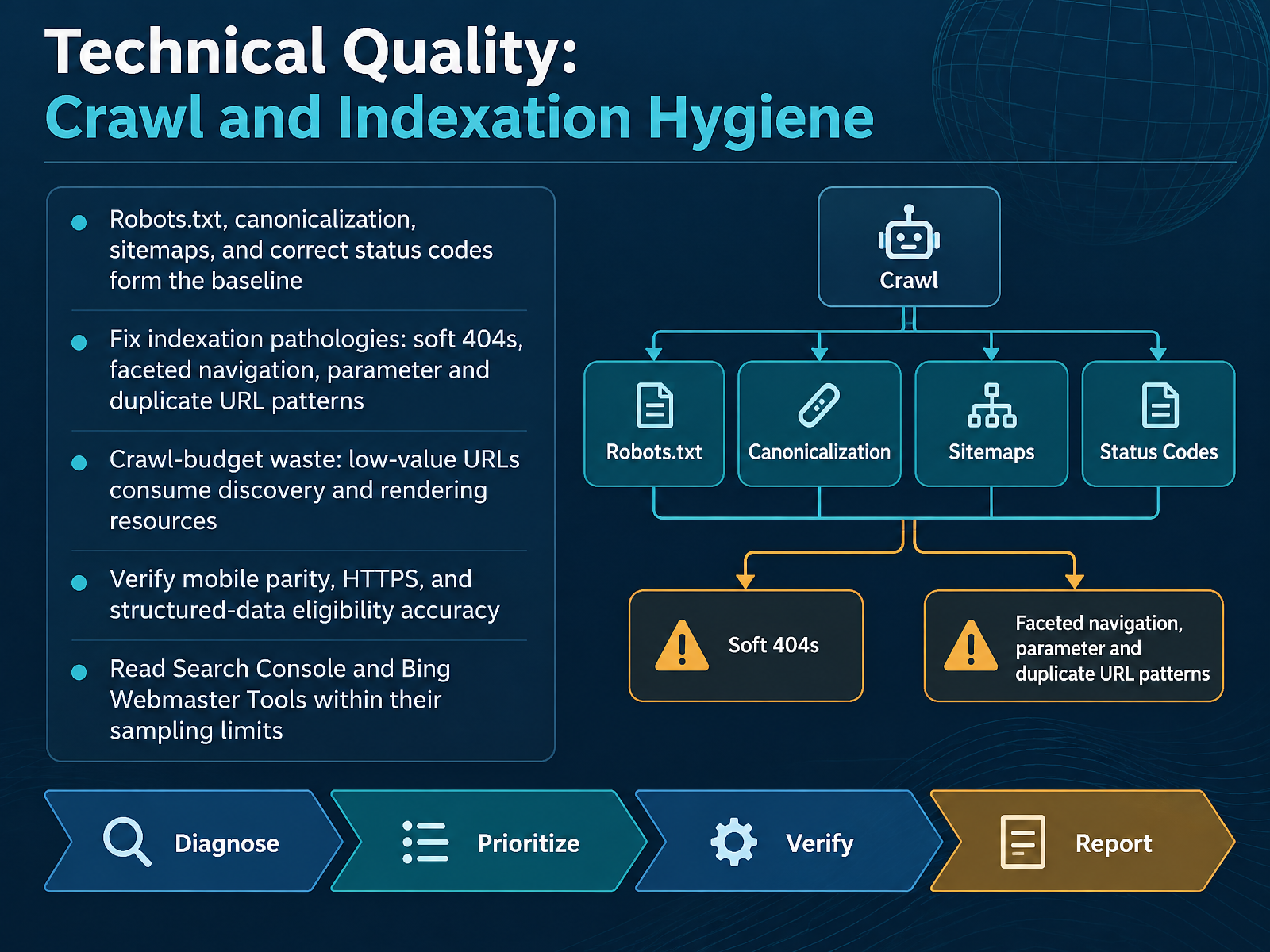
- 04Technical Quality: Crawl and Indexation HygieneNext, let's look at technical quality through crawl and indexation hygiene. Start with the baseline: robots dot txt, canonicalization, sitemaps, and correct status codes. If those are wrong, nothing downstream is trustworthy. Then fix indexation pathologies, such as soft four oh fours, faceted navigation, and parameter or duplicate URL patterns. These quietly inflate your index. Watch crawl-budget waste too. Low-value URLs consume discovery and rendering resources that your money pages need. Also verify mobile parity, HTTPS, and that structured-data eligibility is accurate, not aspirational. Finally, read Search Console and Bing Webmaster Tools with their sampling limits in mind. Treat the numbers as directional evidence, not a full census. Next, we move to page experience, and why field data beats lab data.
 web.devdevelopers.google.comweb.dev+21 min
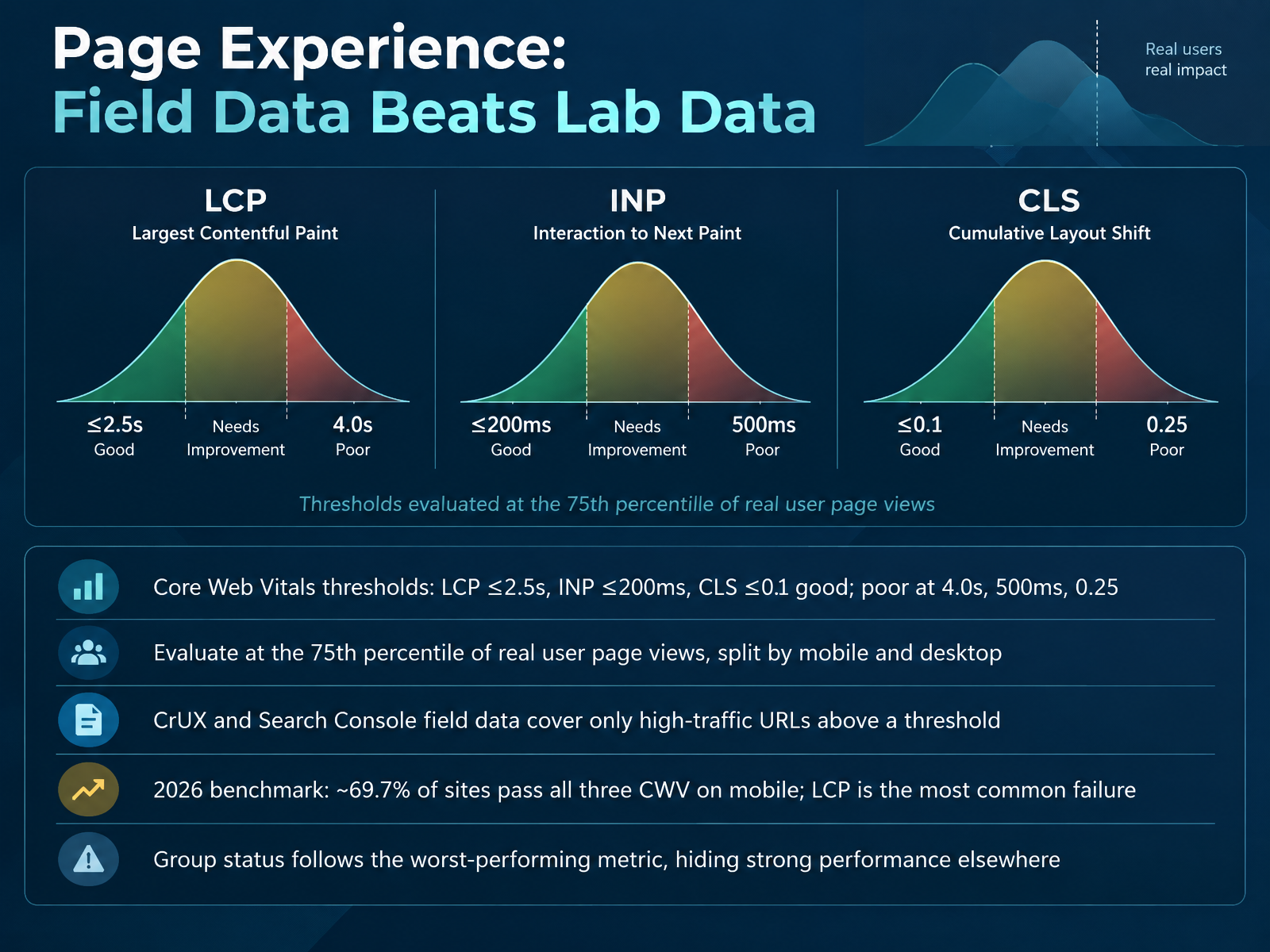
- 05Page Experience: Field Data Beats Lab DataNow let's look at page experience, where field data beats lab data every time. The Core Web Vitals thresholds are clear. For LCP, good is less than or equal to two point five seconds, and poor is above four seconds. For INP, good is two hundred milliseconds or less, and poor is above five hundred. For CLS, good is zero point one or less, and poor is above zero point two five. Always evaluate at the seventy-fifth percentile of real user page views, split by mobile and desktop. Keep in mind that CrUX and Search Console field data only cover high-traffic URLs above a threshold. So for low-traffic pages, set up your own real-user monitoring. Here's a useful benchmark. In twenty twenty-six, about sixty-nine point seven percent of sites pass all three metrics on mobile, and LCP is the most common failure. Finally, remember that a group's status follows its worst-performing metric. A group can show poor because of CLS alone, even when LCP and INP are strong, so check each metric separately before you prioritize fixes. Next, we move to content quality, intent satisfaction, and effort.
 web.devdevelopers.google.comweb.dev+22 min
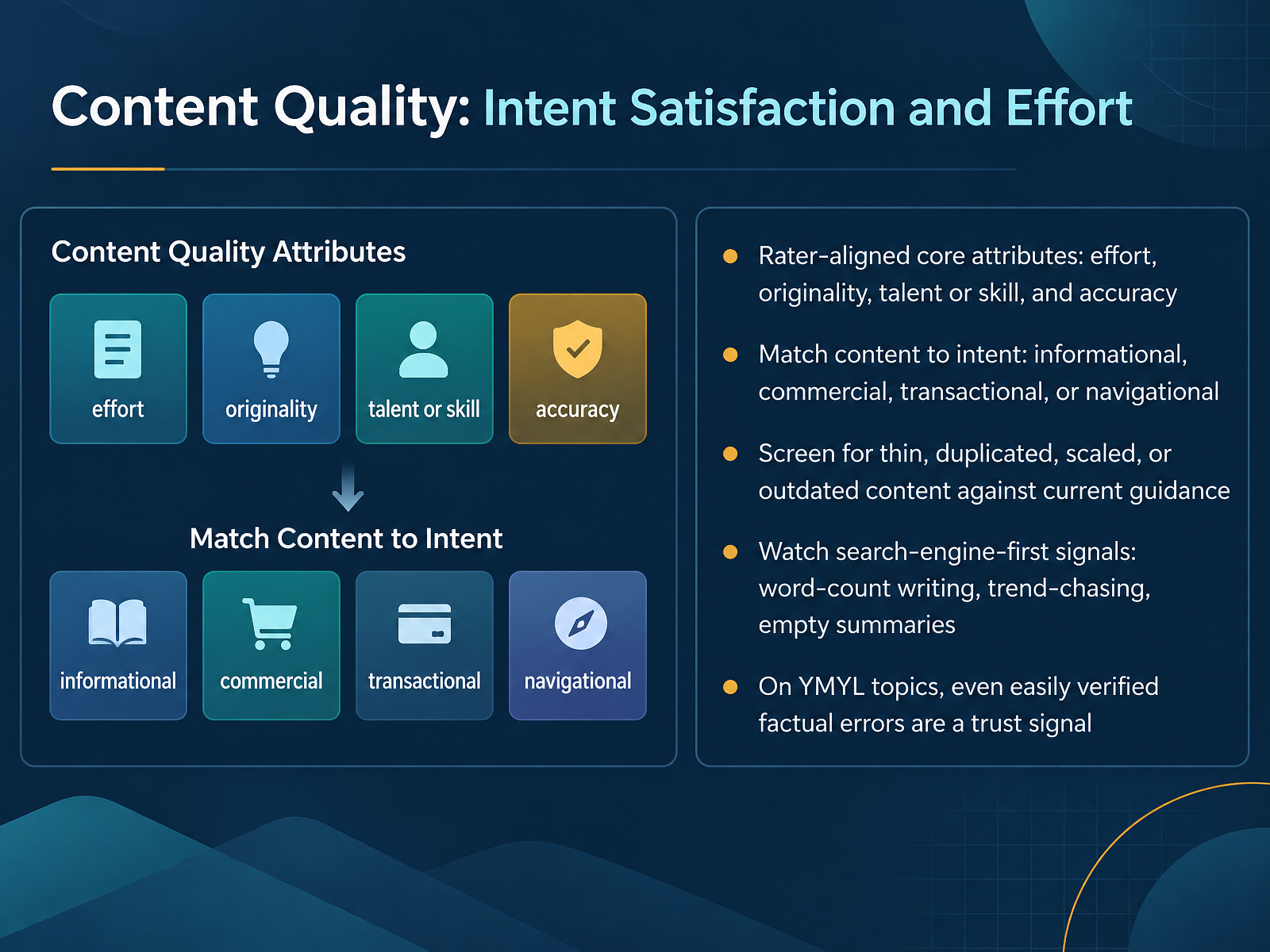
- 06Content Quality: Intent Satisfaction and EffortLet's move on to content quality, and look at it the way trained quality raters do. In the rater guidelines, main content is judged on four core attributes: effort, originality, talent or skill, and accuracy. Ask whether real human work went into this page, whether it offers something not already available elsewhere, whether it is produced well, and whether the facts are correct. Next, match the content to intent. An informational query needs explanation. A commercial query needs comparison and evidence. A transactional query needs a clear path to action. A navigational query needs the right page, not an essay. Then screen your inventory for thin, duplicated, scaled, or outdated content, and check it against current guidance. And watch for search-engine-first signals: writing to a word count, chasing trends your audience doesn't care about, or adding empty summaries that leave readers searching again. Finally, on YMYL topics, even easily verified factual errors become a trust signal, so fact-check before you publish. Next, we'll look at authorship, A I disclosure, and editorial standards.
 developers.google.comservices.google.comguidelines.raterhub.com+22 min
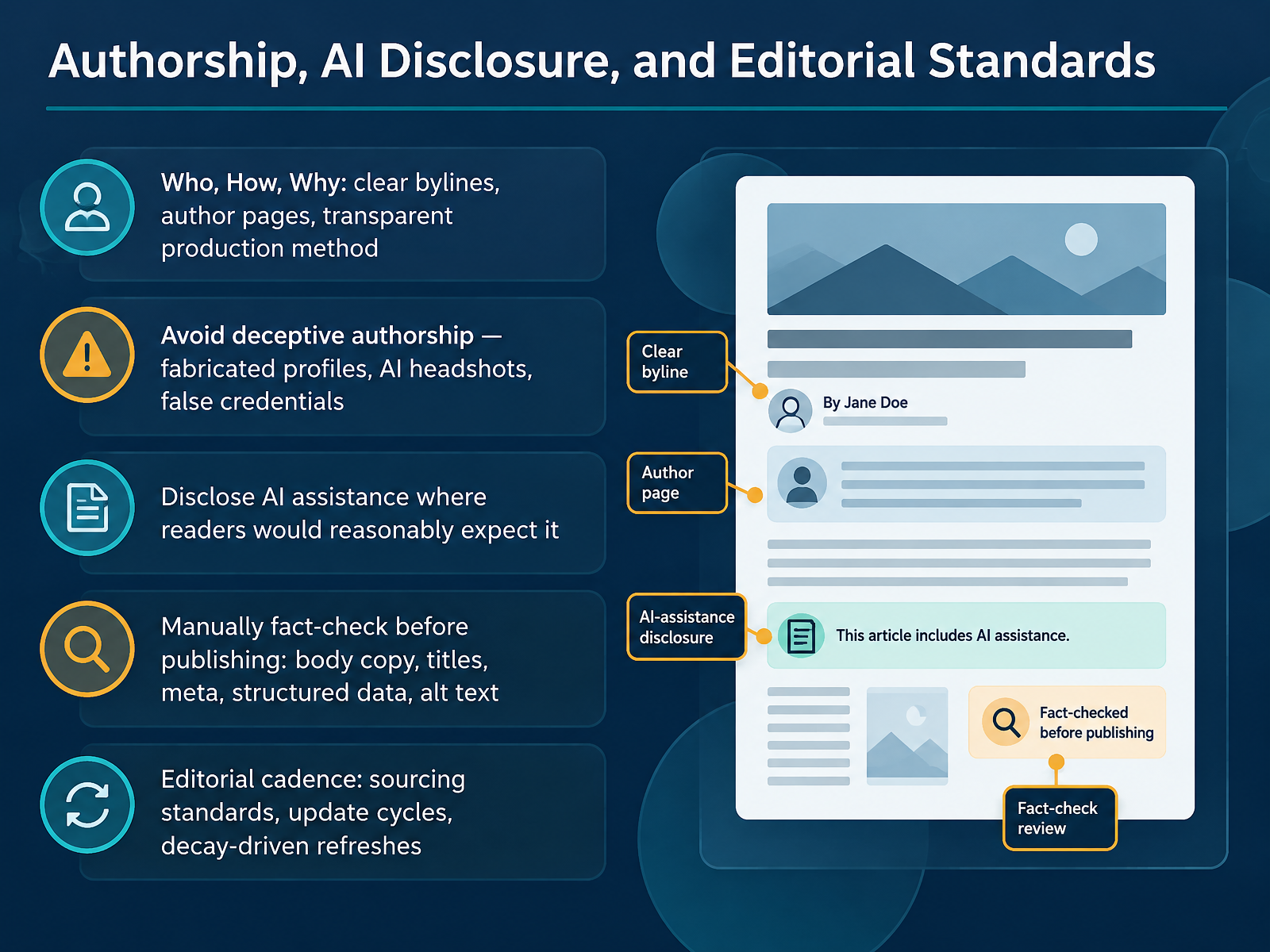
- 07Authorship, AI Disclosure, and Editorial StandardsNext, let's look at who stands behind your content, and how you disclose how it was made. Start with who, how, and why. Clear bylines, real author pages, and a transparent production method. But avoid deceptive authorship. Fabricated profiles, AI headshots, and false credentials are a form of deception. Any deception makes a page untrustworthy to users and to automated quality systems, and it signals a low-quality page. Disclose AI assistance where readers would reasonably expect it. Explain how, and why, automation was used. Then manually fact-check before publishing. Generative models predict words, they don't retrieve facts, so review body copy, titles, meta descriptions, structured data, and alt text. Structured data also needs validation. Finally, set an editorial cadence. Define sourcing standards, set update cycles, and refresh pages based on actual decay, not just changed dates. That keeps trust intact over time. Let's move on to authority and trust: links, entities, and policy risk.
 developers.google.comdevelopers.google.cndevelopers.google.com+22 min
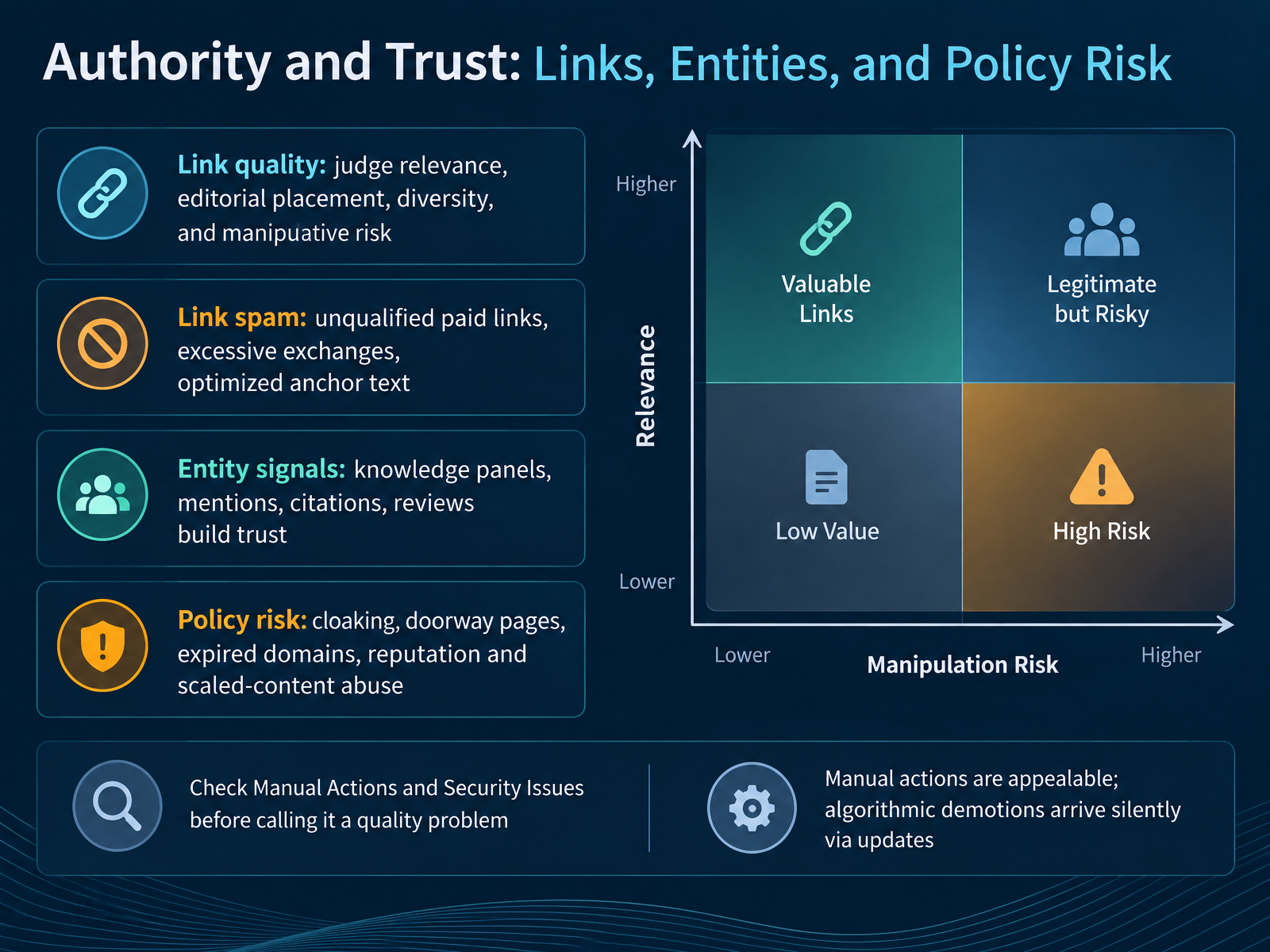
- 08Authority and Trust: Links, Entities, and Policy RiskNext, let's look at authority and trust, because quality problems here often hide in links, entities, and policy risk. Start with link quality. Judge relevance, editorial placement, diversity, and manipulative risk. Watch for link spam: unqualified paid links, excessive exchanges, and optimized anchor text. Remember, paid links are fine when they carry a nofollow or sponsored attribute. Entity signals matter too. Knowledge panels, consistent mentions, citations, and reviews build trust around your brand. Then assess policy risk: cloaking, doorway pages, expired domain abuse, reputation abuse, and scaled content abuse. Before you call anything a content quality problem, open Search Console and check Manual Actions and Security Issues. Manual actions are appealable once you fix the issue. Algorithmic demotions arrive silently through updates, with no notice. That distinction shapes your timeline and your fix. Next, we move into measurement quality and attribution hygiene.
 developers.google.comdevelopers.google.cnblog.google+21 min
- 09Measurement Quality and Attribution HygieneNow let's talk about measurement quality and attribution hygiene. Raw traffic and average position will mislead you. Seasonality, SERP layout shifts, and consent gaps all distort the picture, so check the data before you draw conclusions. Remember the core difference. Search Console logs a click at the result, before your page even loads. GA4 counts a session only after consent and script execution. On EU and UK heavy sites, Consent Mode version two can create thirty to fifty percent gaps, and behavioral modeling only partly closes that. Also watch sampling and thresholds. Use the GA4 data quality icon, respect query quotas, and know that the Search Console interface shows only one thousand rows. Export through the API for the full set. Finally, treat rank tracking as directional only. Location, device, personalization, and rich results all dilute a single position number. Compare trends, not single days. Next, we move into Building KPIs and a Quality Scorecard.
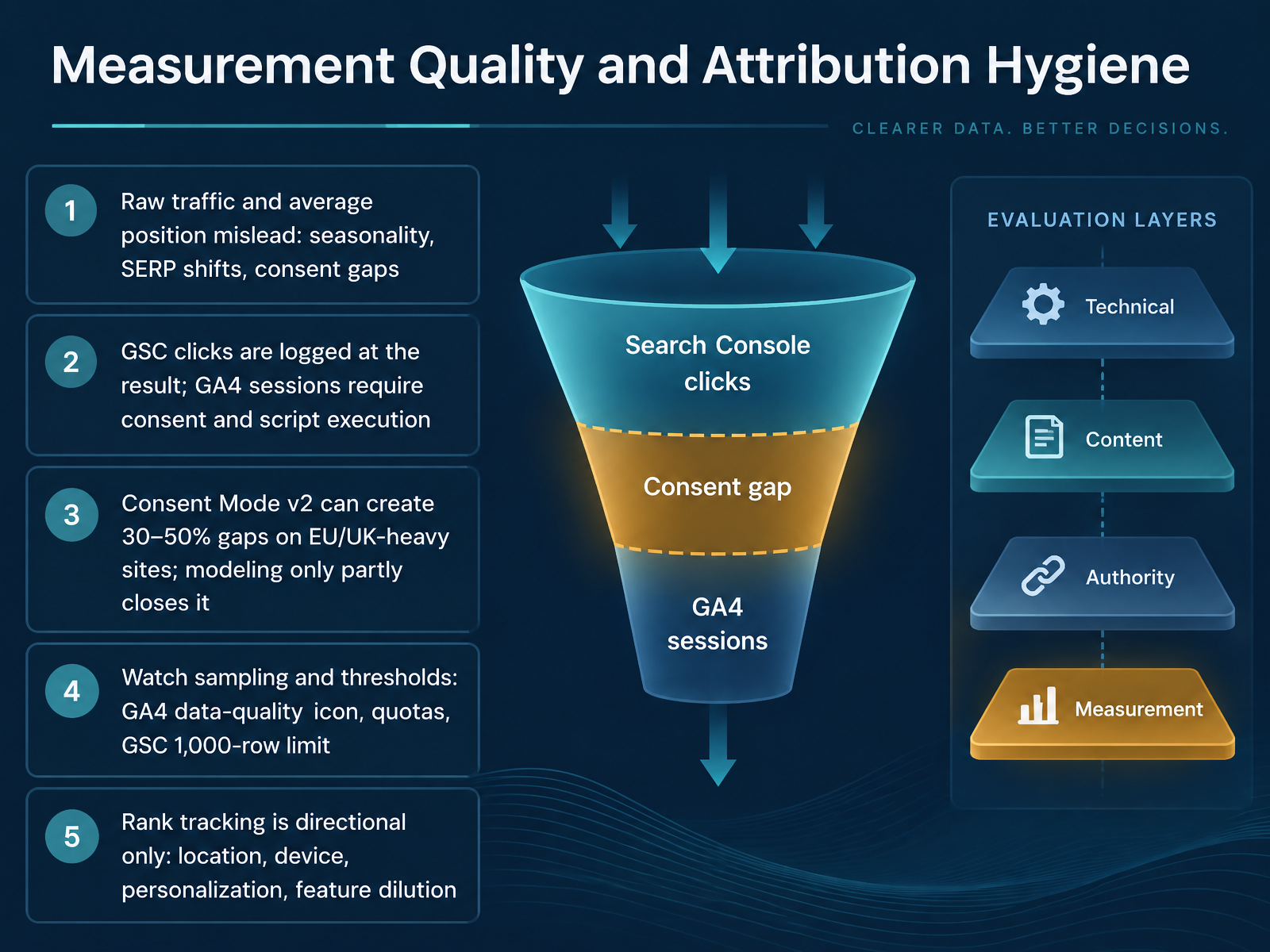 2 min
- 10Building KPIs and a Quality ScorecardNow let's turn the criteria into a scorecard you can defend. First, choose KPIs tied to outcomes: qualified sessions, conversions, and pipeline influence, not vanity rankings. Before you compare anything, reconcile your tools. Check time zones, since Search Console defaults to Pacific time while GA4 uses your property setting. Account for processing delays and never judge the last three days. And remember the anonymized query remainder, so keyword totals rarely match clicks. Separate process KPIs, like indexation rate and Core Web Vitals pass rate, from outcome KPIs. Your scorecard must show explicit evidence, severity, and confidence so leadership can act on it. Finally, avoid the common pitfalls: mixing tools without normalization, and over-weighting a single metric. When you get this right, the scorecard becomes a decision tool, not a report. Next, we'll move into the audit process and prioritization.
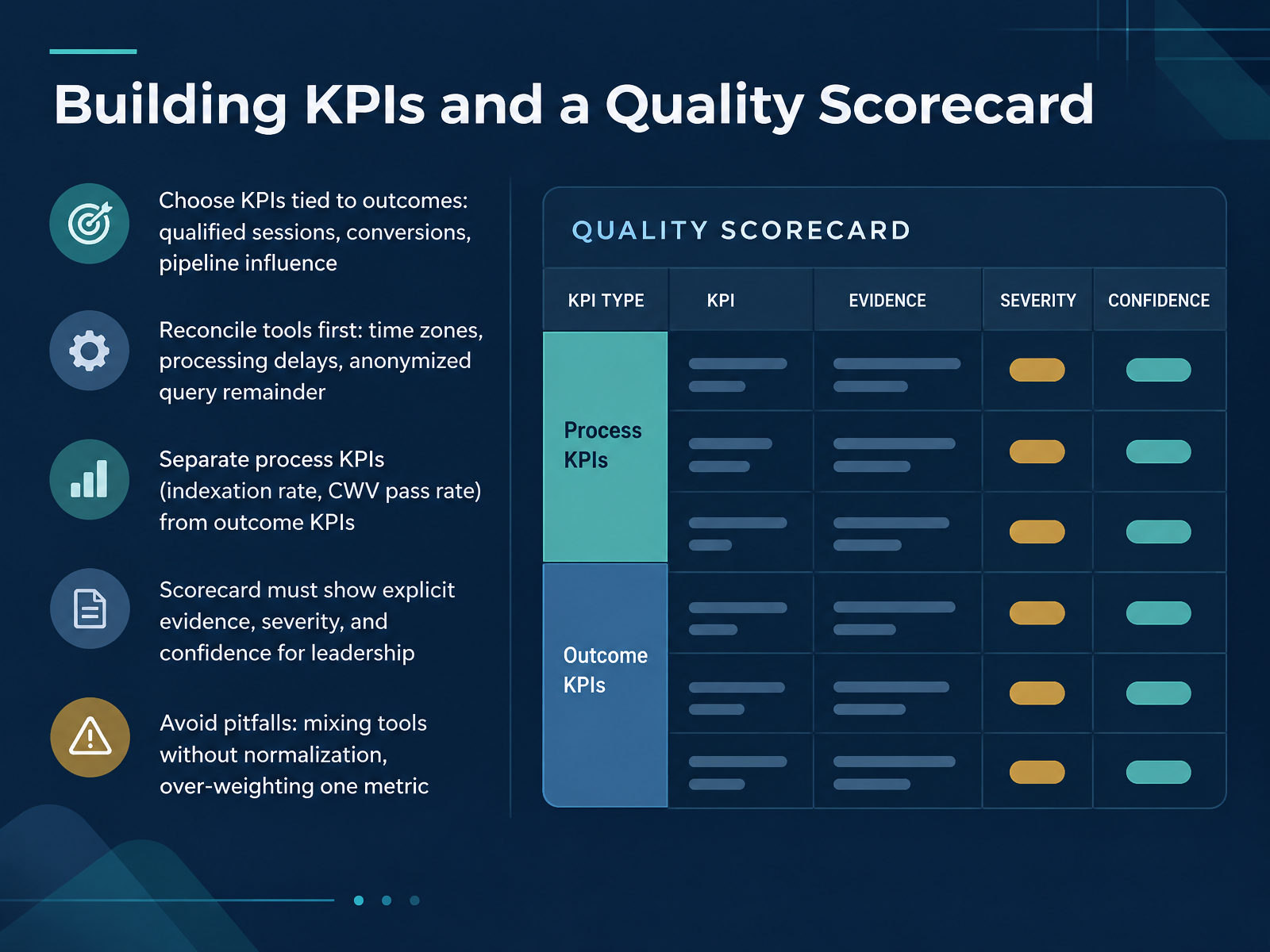 1 min
- 11Audit Process and PrioritizationNow let's turn audit findings into an actionable plan. Start by scoping the audit. Consider site size, business model, target markets, and any regulatory constraints. On large sites, work from a sample. Skip the exhaustive manual review of every URL. Next, score each finding as critical, high, medium, or low, and attach a confidence level to each. Then sequence fixes by impact times confidence times effort. Low effort, high confidence items move first. Roadmap each fix with a named owner and clear success criteria, so completion is measurable. Watch for three pitfalls. Audit sprawl. Duplicate findings. Unfixed recommendations. Keep the scope tight, deduplicate before you prioritize, and track fixes through to verification. Now let's apply this in the Practical Lab: Scoring a Sample Site.
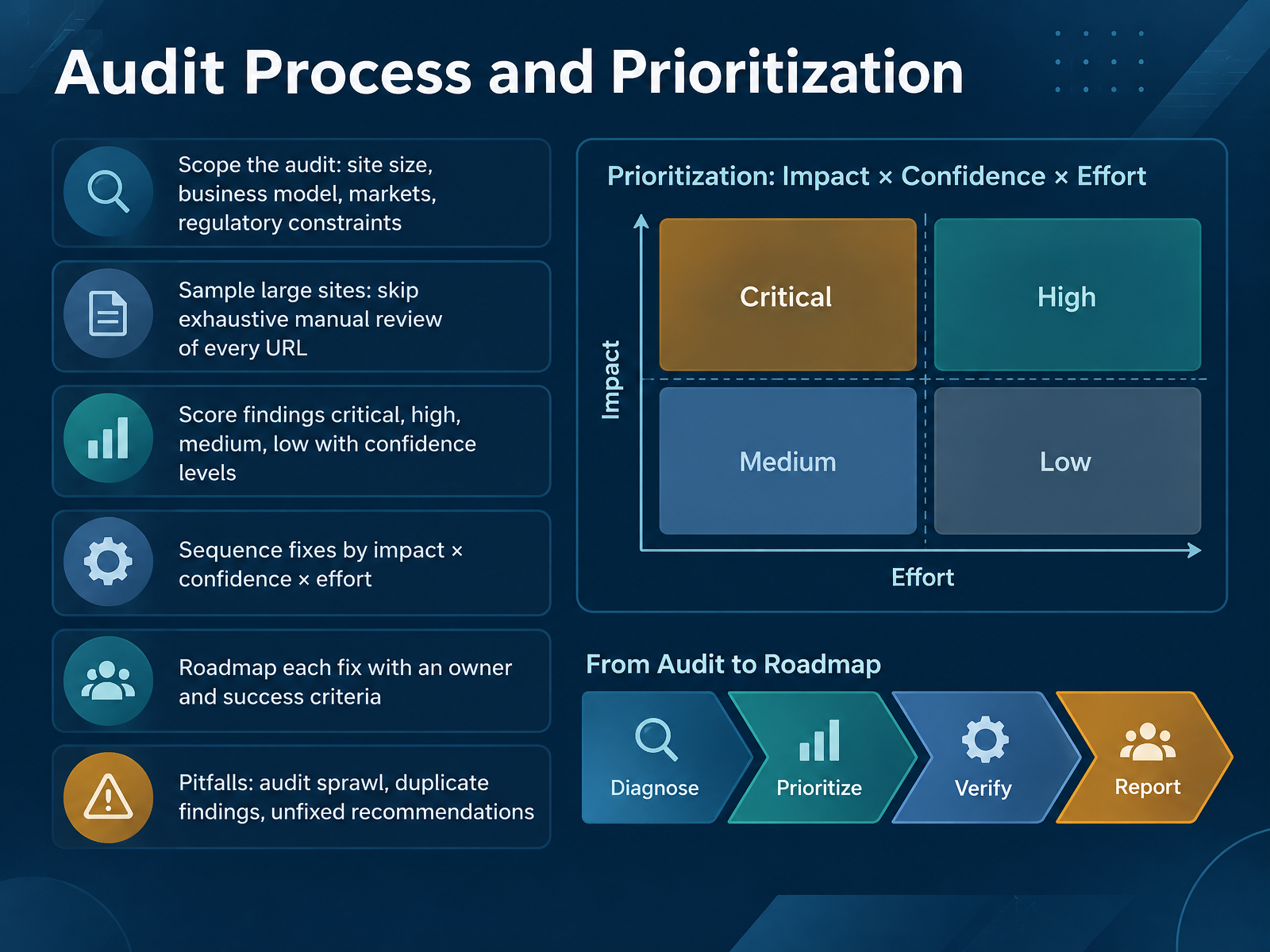 web.devdevelopers.google.comweb.dev+22 min
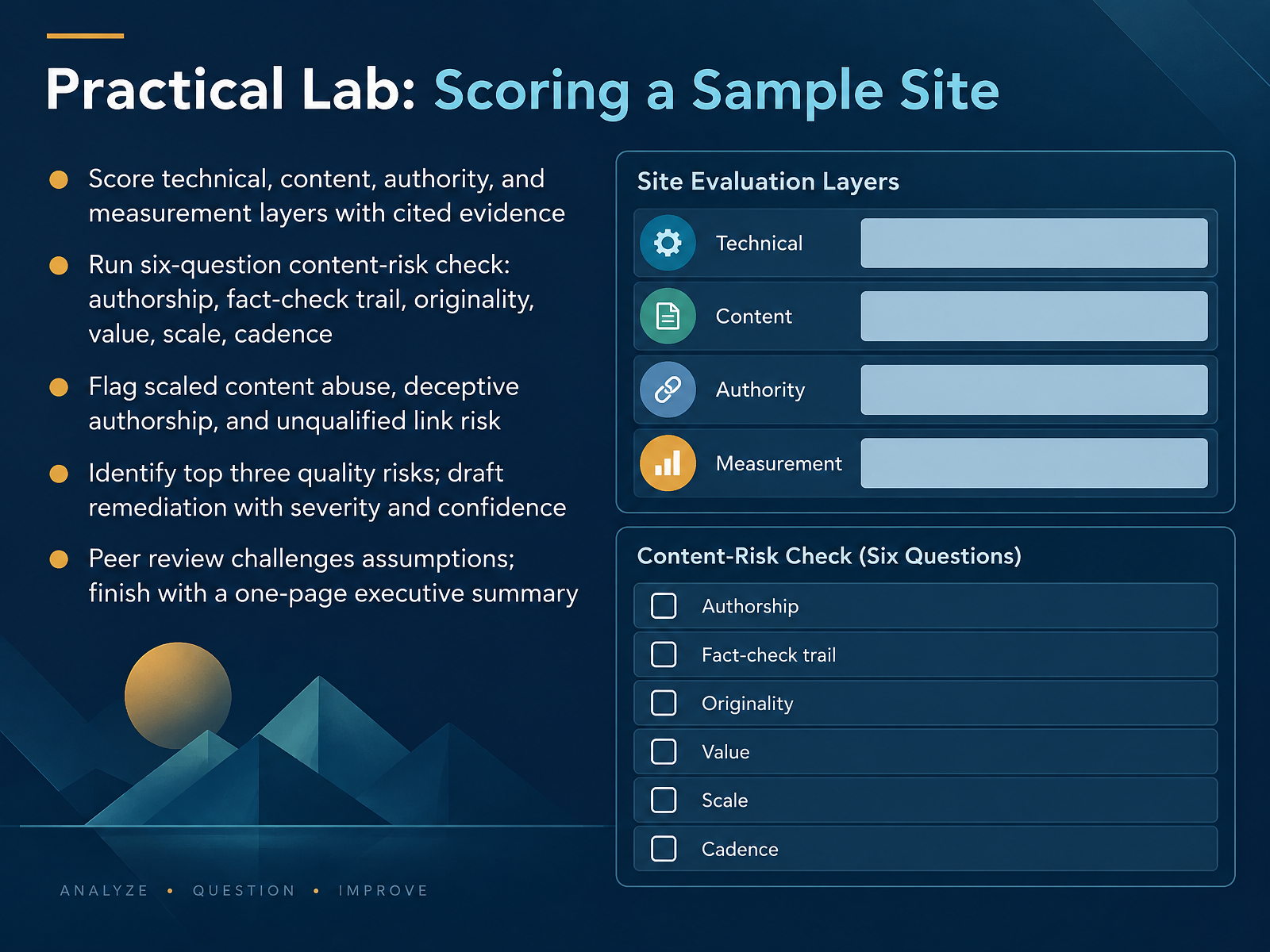
- 12Practical Lab: Scoring a Sample SiteNow let's put the criteria to work and score a sample site. Work layer by layer: technical, content, authority, and measurement. For each score, cite the evidence you saw, so the number holds up under review.
Next, run the six-question content-risk check: authorship, fact-check trail, originality, value, scale, and cadence. Watch for fabricated author profiles or AI headshots. Confirm that AI-assisted pages were manually fact-checked before publishing. Look for what Google calls scaled content abuse: many pages generated mainly to rank, with little value, however they were made. Then flag unqualified link risk, like paid links missing the nofollow or sponsored attribute.
From your findings, name the top three quality risks. Draft remediation with a severity and a confidence level. Then have a peer review challenge your assumptions. Close with a one-page executive summary.
Next, we'll look at how to present these findings to stakeholders in Reporting Quality Findings to Stakeholders.
 developers.google.comdevelopers.google.cnblog.google+22 min
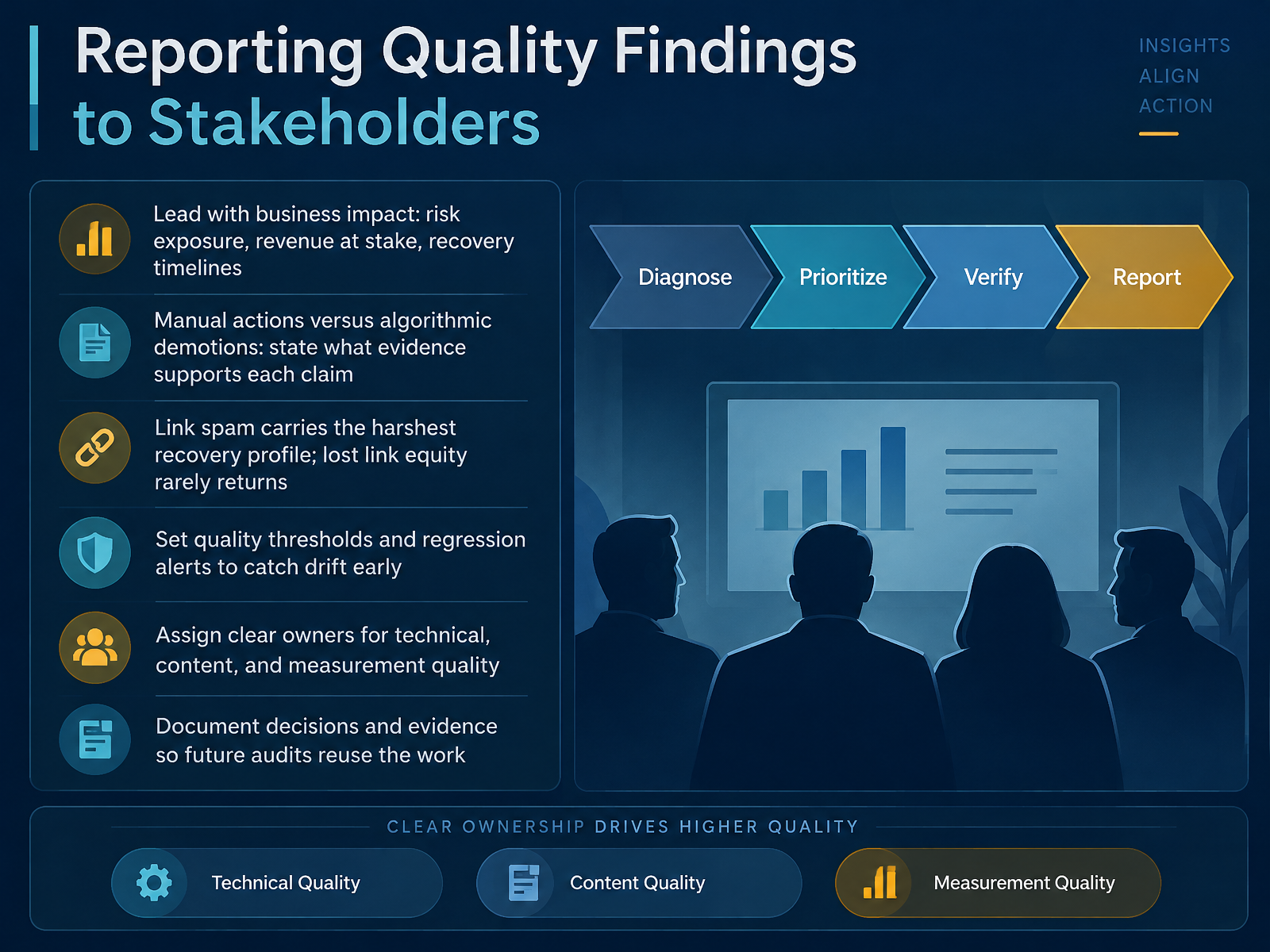
- 13Reporting Quality Findings to StakeholdersNow, let's talk about how you report quality findings to stakeholders. Lead with business impact, not with technical detail. State the risk exposure, the revenue at stake, and a realistic recovery timeline. Next, be precise about what you are seeing. A manual action shows up in Search Console and can be addressed with a reconsideration request. An algorithmic demotion arrives through an update, with no notice, so match your traffic drop date against Google's confirmed update timeline. Say which evidence supports each claim. Also, flag link spam early. It carries the harshest recovery profile, because once the ranking benefit of spammy links is removed, that link equity rarely returns. Then set quality thresholds and regression alerts so you catch drift before it becomes a crisis. Assign clear owners for technical, content, and measurement quality. And document your decisions and evidence. Future audits can reuse that work instead of starting over. That documentation is often what gets budget approved. Up next, we will cover continuous improvement: cadence, triggers, and next steps.
 developers.google.comdevelopers.google.cnblog.google+21 min
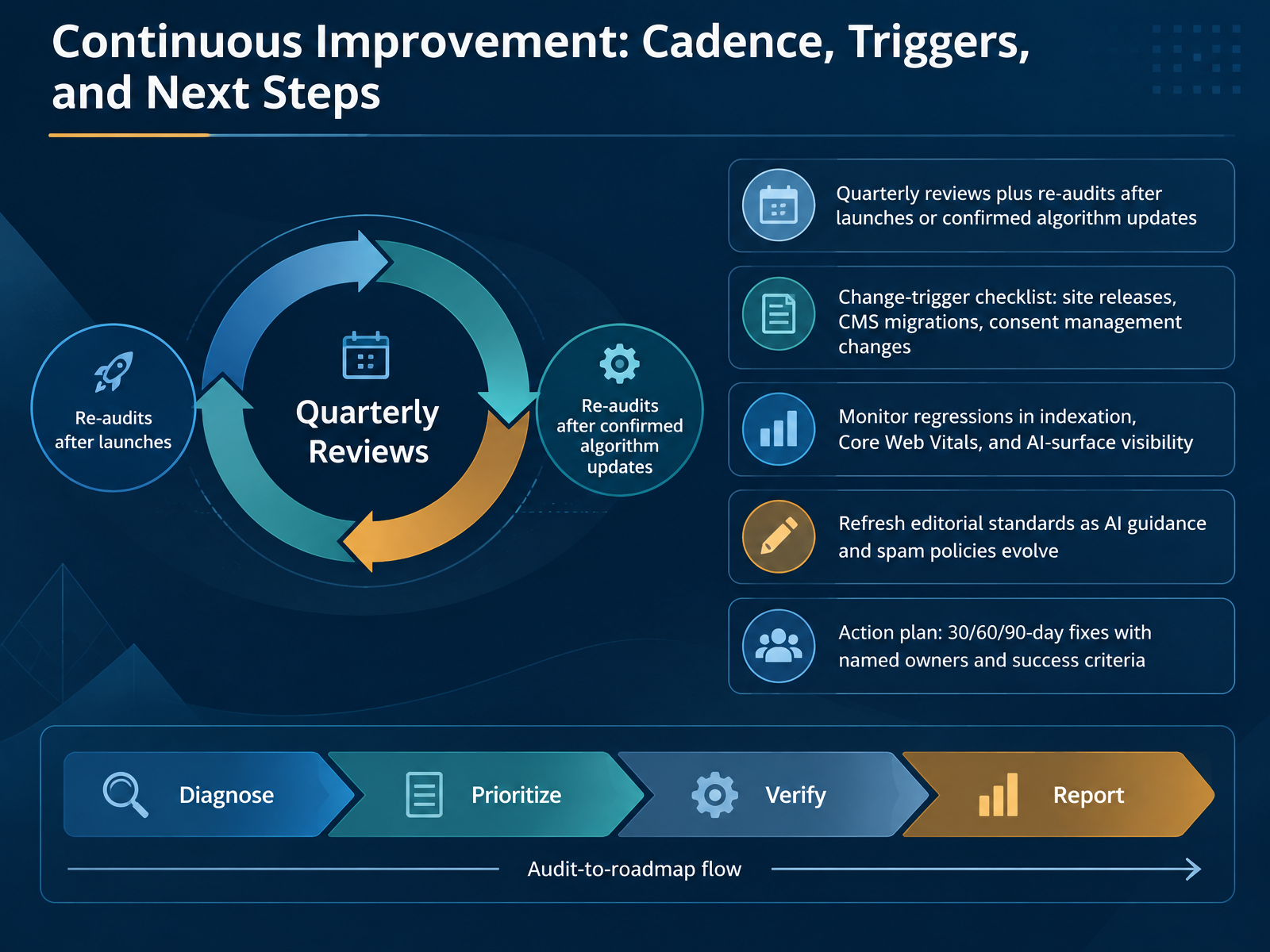
- 14Continuous Improvement: Cadence, Triggers, and Next StepsLet's close by turning quality evaluation into a repeatable habit. Run quarterly reviews, and re-audit after any major launch or confirmed algorithm update. Keep a change-trigger checklist: site releases, CMS migrations, and consent management changes all qualify. After each, monitor for regressions in indexation, Core Web Vitals at the seventy-fifth percentile, and visibility in AI answers, not just blue links. Refresh your editorial standards as AI guidance and spam policies evolve, particularly around scaled content abuse and link qualification. Then put it in an action plan: thirty, sixty, and ninety day fixes, with named owners and clear success criteria. That closes the course. Thank you for working through it with me. Start with one trigger checklist this week, and let the data guide your next review. You have the framework. Now make it routine. Thanks for your time, and good luck.
 developers.google.comdevelopers.google.cnblog.google+21 min
Take the deck with you
Download this course as a file — free, no sign-up needed.
- PDF handoutEvery slide page, ready to print or share.15 pages · 3.4 MBDownload
- Narrated PowerPointThe deck that presents itself — every slide carries the digital human's narration video.15 pages · 14.4 MBDownload
- PowerPoint slidesThe full deck as a .pptx — open it in PowerPoint, Keynote, or Google Slides.15 pages · 3.2 MBDownload
Free to use in your own training — please keep the PersonWise credit page at the end.
Have your own deck? Turn it into a course
Sources consulted
Web sources consulted while building this course.
- Creating Helpful, Reliable, People-First Content — developers.google.com
- Search Quality Rater Guidelines: An Overview — services.google.com
- General Guidelines — guidelines.raterhub.com
- searchqualityevaluatorguidelines — static.googleusercontent.com
- Google Search Quality Raters Guidelines Updated 9/11 — seroundtable.com
- Spam Policies for Google Web Search — developers.google.com
- Spam Policies for Google Web Search | Google Search Central | Documentation | Google for Developers — developers.google.cn
- New ways we're tackling spammy, low-quality content on ... — blog.google
- Detecting spam to bring you relevant and reliable results — google.com
- Google Spam Policies Explained: The Complete Guide (2026) — whitebunnie.com
- How the Core Web Vitals metrics thresholds were defined | Articles | web.dev — web.dev
- Understanding Core Web Vitals and Google search results — developers.google.com
- Best practices for measuring Web Vitals in the field | Articles | web.dev — web.dev
- Core Web Vitals report - Search Console Help — support.google.com
- Optimize Core Web Vitals for business decision makers | Articles | web.dev — web.dev
- Google Search's guidance on using generative AI content ... — developers.google.com
- Creating helpful, reliable, people-first content — developers.google.cn
- Google Search's guidance about AI-generated content — developers.google.com
- Google Search's Guidance on Generative AI Content on Your Website | Google Search Central | Documentation | Google for Developers — developers.google.cn
- Optimizing your website for generative AI features on Google Search — developers.google.cn