AI Literacy in Higher Education
Begin
14 pages · ~28 min
AI Literacy in Higher Education
Equips higher education staff and students with foundational AI literacy to understand, evaluate, and apply AI tools responsibly in academic settings.
What you’ll learn
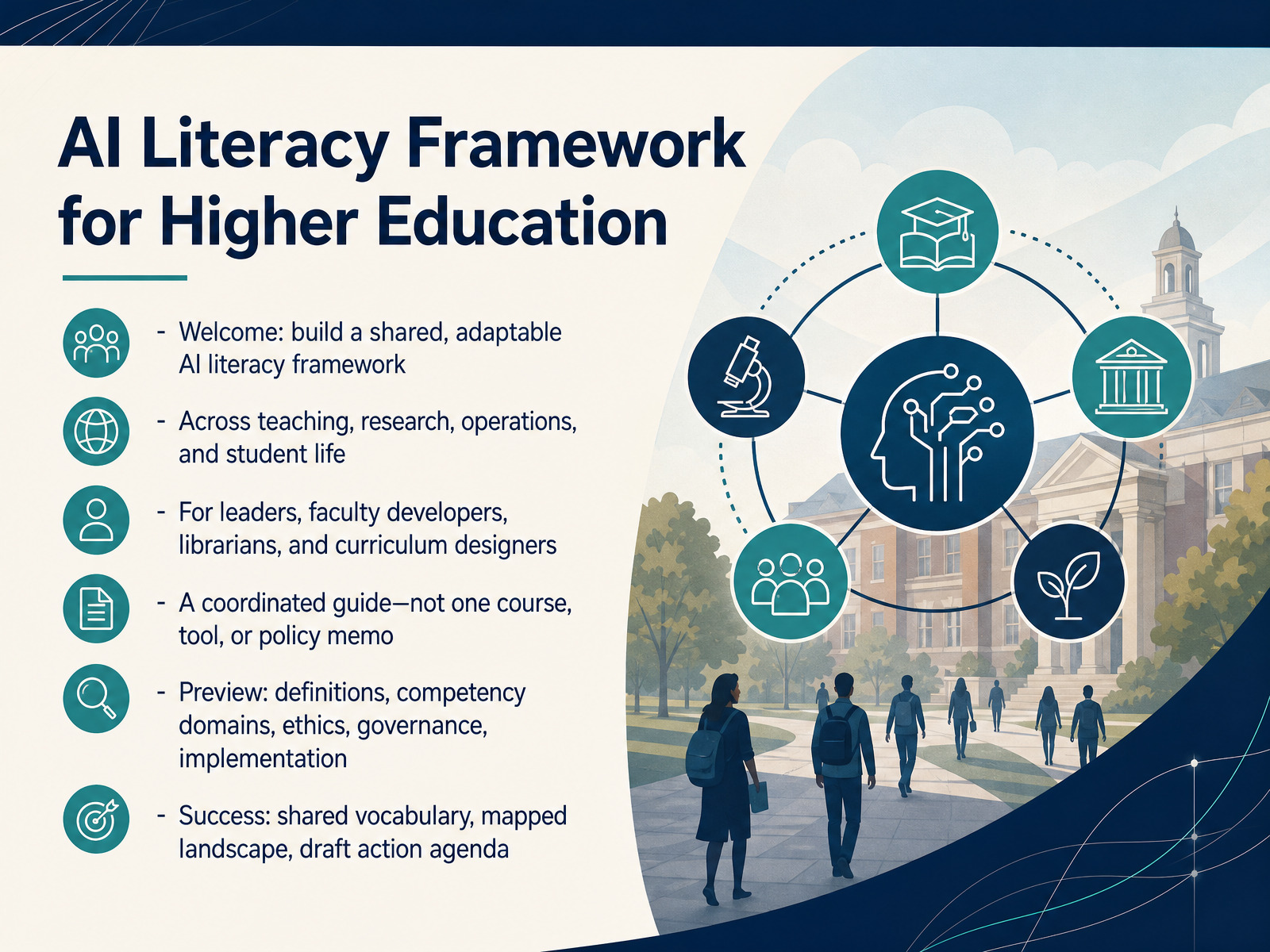
- 01AI Literacy Framework for Higher EducationWelcome. I'm glad you're here. Over the next several slides, we'll build a shared, adaptable AI literacy framework for your institution. This isn't a single course, a single tool, or a policy memo. It's a coordinated guide that spans teaching, research, operations, and student life, and it's written for you: leaders, faculty developers, librarians, and curriculum designers. As we go, we'll look at working definitions, competency domains, ethics, governance, and implementation. Practically, that means you'll leave with three things you can bring into committee work and program review: a shared vocabulary, a mapped landscape of what already exists on your campus, and a draft action agenda you can adapt to your own culture. One caution before we start: this framework is a set of options, not a mandate, and no single model fits every institution. Let's begin by asking why this matters right now. Why AI Literacy Is an Institutional Imperative Now.unesco.orgunesco.orgunesco.org+22 min
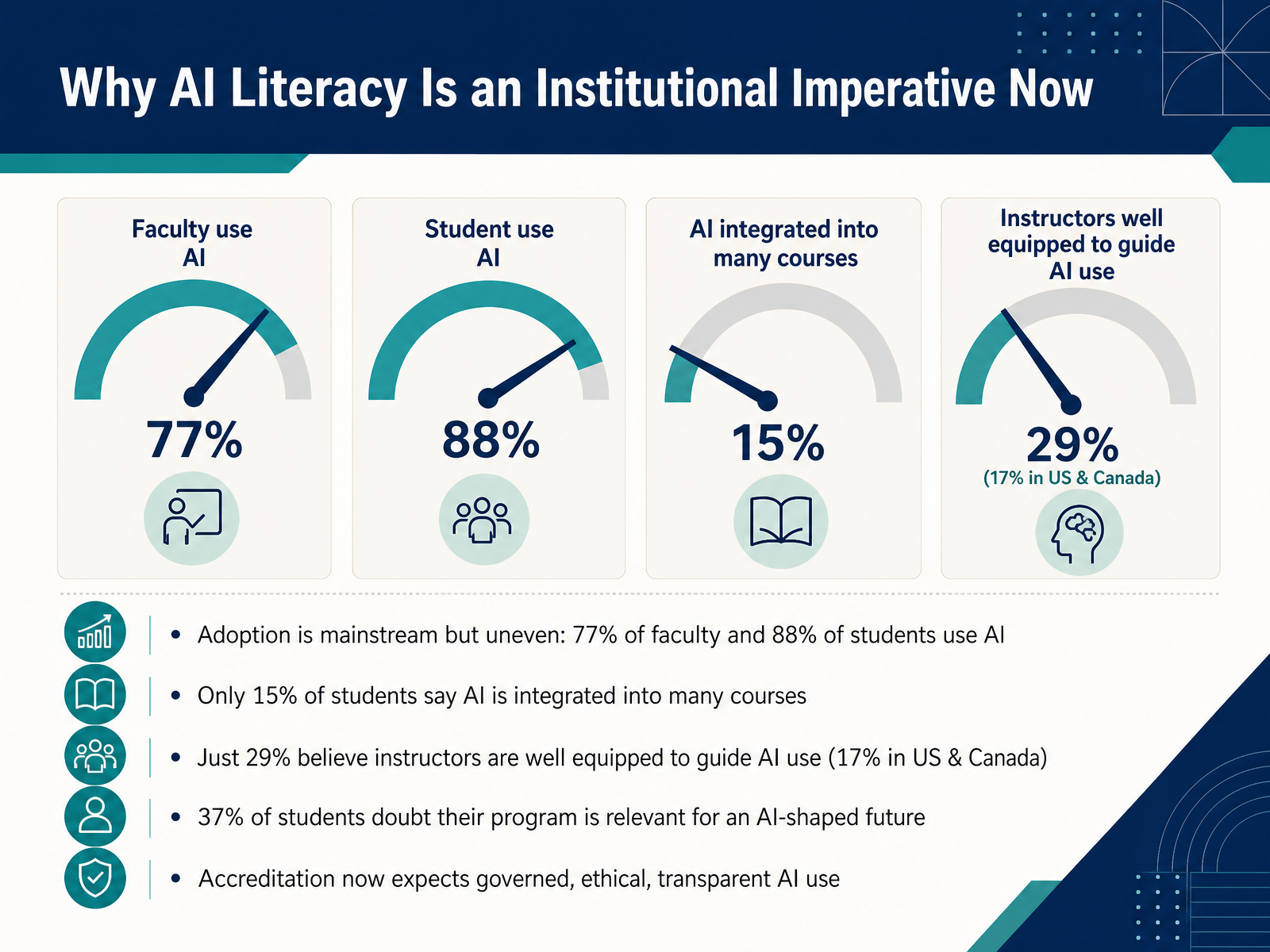
- 02Why AI Literacy Is an Institutional Imperative NowLet us start with the case for acting now. Adoption is mainstream, but uneven. Seventy-seven percent of faculty and eighty-eight percent of students report using AI. Yet only fifteen percent of students say AI is integrated into many of their courses. And only twenty-nine percent believe their instructors are well equipped to guide AI use, dropping to seventeen percent in the United States and Canada. Meanwhile, thirty-seven percent of students doubt their program is relevant for an AI-shaped future. That is a curriculum relevance gap you may already be hearing about in program review. Finally, accreditation now expects governed, ethical, and transparent AI use. So this is no longer optional. It touches governance, teaching support, and student confidence in their credentials. Let us turn to defining AI literacy and its boundaries.
 26556596.fs1.hubspotusercontent-eu1.netcalstate.edudigitaleducationcouncil.com+21 min
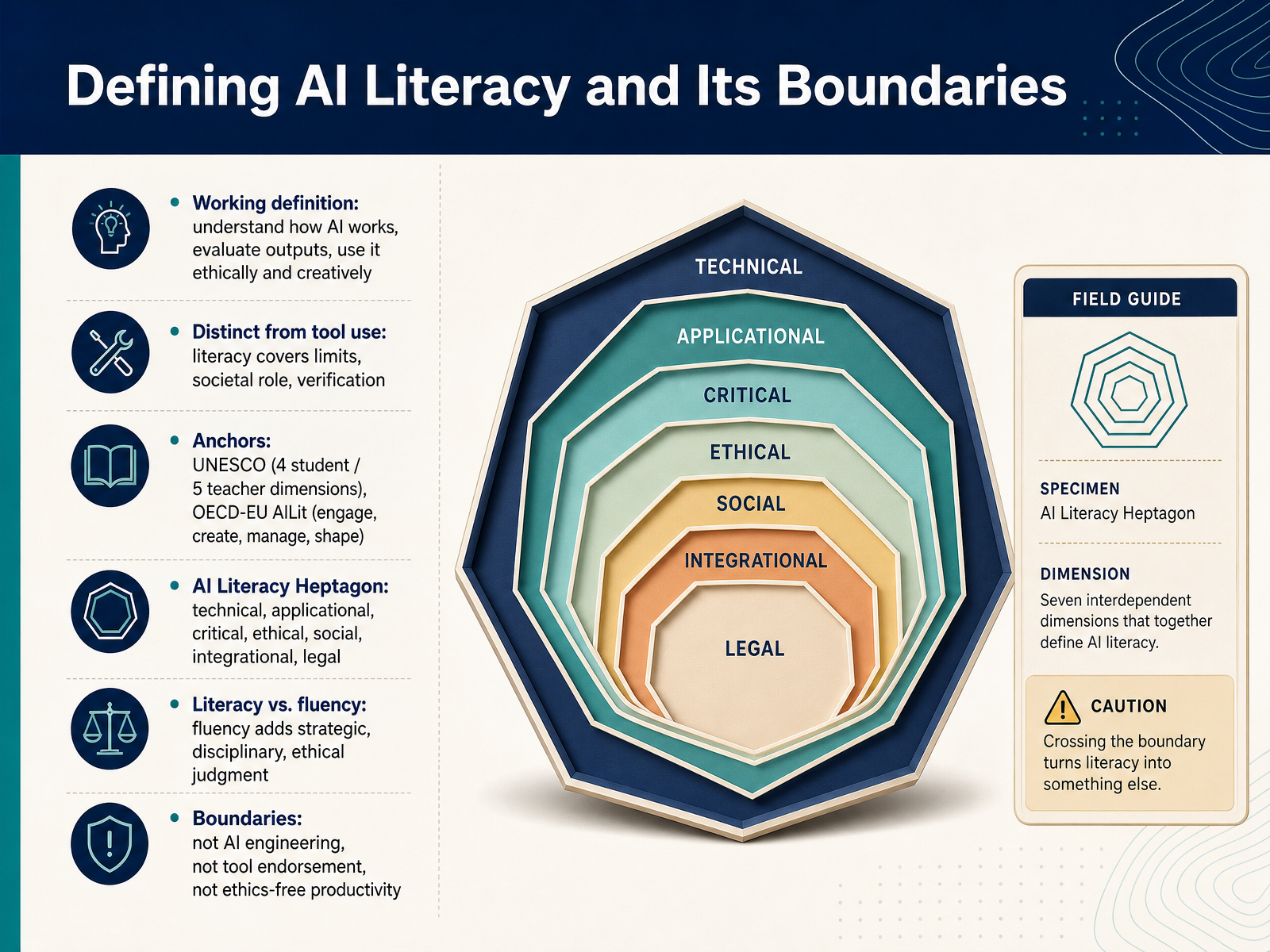
 - 03Defining AI Literacy and Its BoundariesLet's turn to the working definition itself. AI literacy means understanding how AI systems work, critically evaluating their outputs, and using them ethically and creatively. Notice what that is not. It is not simply tool use. Literacy includes knowing a system's limits, its role in society, and how to verify what it produces. Two major reference points can anchor your local work. UNESCO offers four dimensions for students and five for teachers, covering human-centred mindset, ethics, foundations, pedagogy, and professional learning. The OECD and European Commission AILit framework organises interaction around engaging, creating, managing, and shaping AI. For higher education specifically, the AI Literacy Heptagon adds seven dimensions: technical, applicational, critical, ethical, social, integrational, and legal. That legal dimension matters for program review and policy. Literacy and fluency also differ. Fluency adds strategic, disciplinary, and ethical judgment. Finally, mark the boundaries. This is not AI engineering, not endorsement of specific tools, and not ethics-free productivity. Treat these as options you can adapt to your campus culture. Next, we examine the competency domains that follow from this definition: Competency Domains for Higher Education.
 unesco.orgunesco.orgunesco.org+22 min
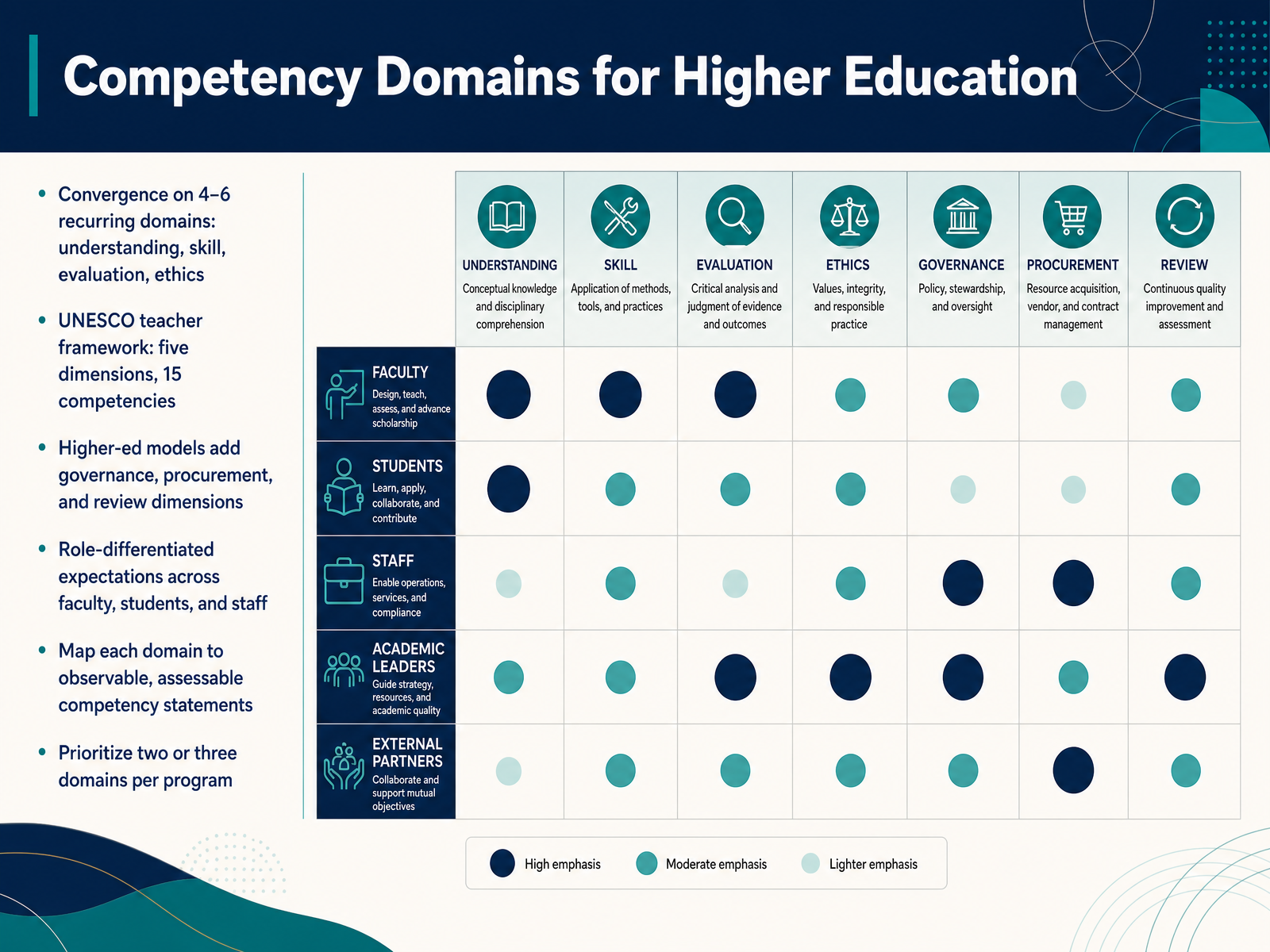
 - 04Competency Domains for Higher EducationLet us look at the competency domains that recur across higher education frameworks. Despite different labels and structures, most models converge on four to six recurring areas. One: understanding how AI works. Two: operational skill with tools. Three: critical evaluation and verification. Four: ethics and responsible use. For example, UNESCO's teacher framework defines five dimensions and fifteen competencies, with progression levels called Acquire, Deepen, and Create. Higher education models add dimensions that schools often do not address: governance, procurement, and formal review of AI tools and data practices. Expectations also differ by role. Faculty need pedagogical and assessment judgment. Students need verification and attribution habits. And staff need operational and privacy awareness. So map each domain to observable, assessable competency statements, then prioritize two or three domains per program. This keeps the work feasible within program review timelines and existing committee structures. Next, we examine proficiency levels and progression pathways.
 unesco.orgunesco.orgunesco.org+22 min
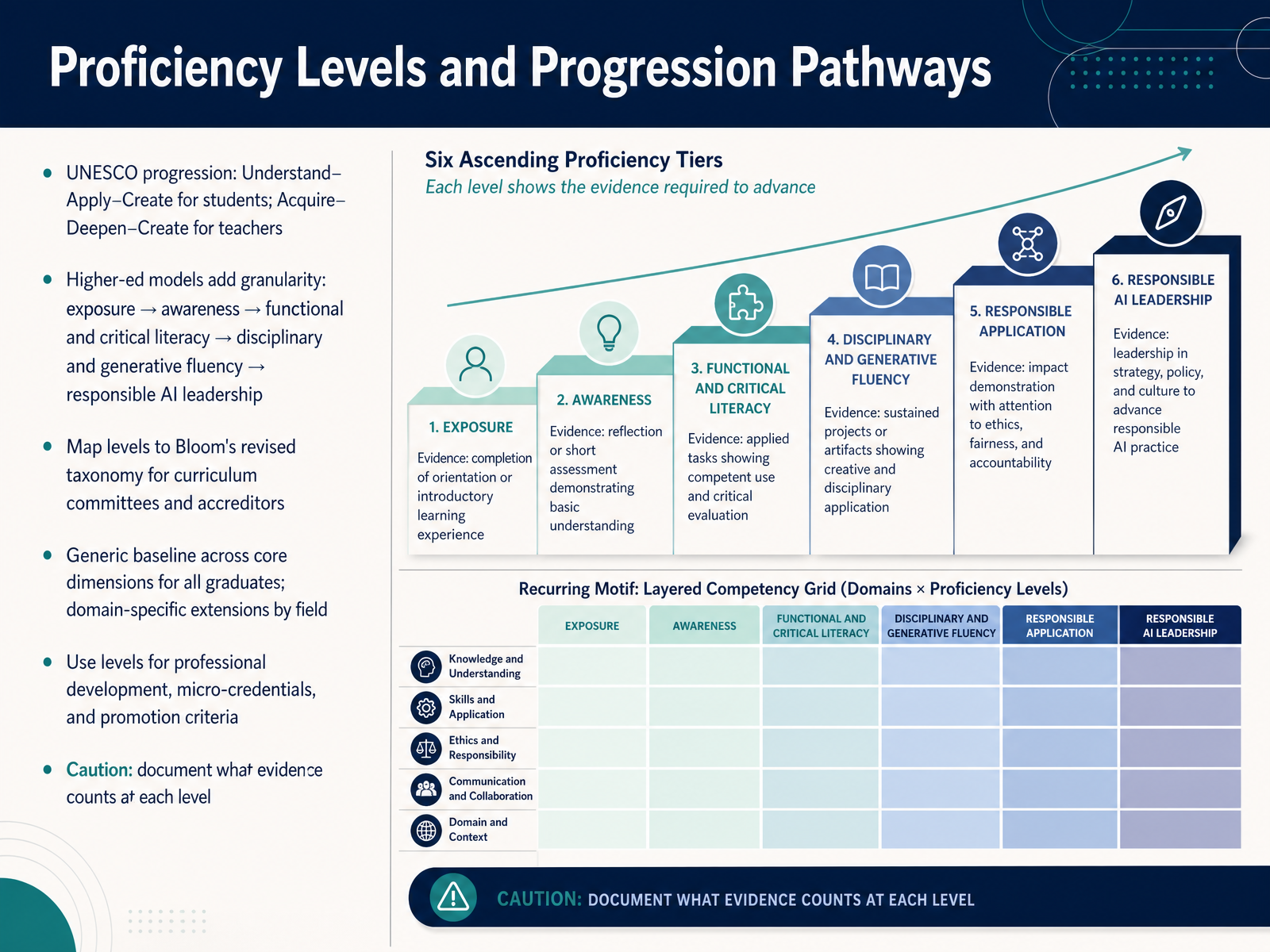
 - 05Proficiency Levels and Progression PathwaysNow let's look at how proficiency actually progresses. Several credible pathways exist. UNESCO frames students as moving from Understand to Apply to Create, and teachers from Acquire to Deepen to Create. Higher education models add more granularity: exposure, awareness, functional and critical literacy, then disciplinary and generative fluency, and finally responsible AI leadership. For curriculum committees and accreditors, the useful move is mapping these levels to Bloom's revised taxonomy, so progression is visible in learning outcomes. Practically, that means a generic baseline across core dimensions for all graduates, with domain-specific extensions by field. You can then use these levels for professional development, micro-credentials, and promotion criteria. One caution: document what evidence counts at each level, because without that, levels become labels rather than measures. Let's turn next to Ethics, Equity, and Responsible Use.
 doi.orgacademyforeducationalstudies.orgacademyforeducationalstudies.org+22 min
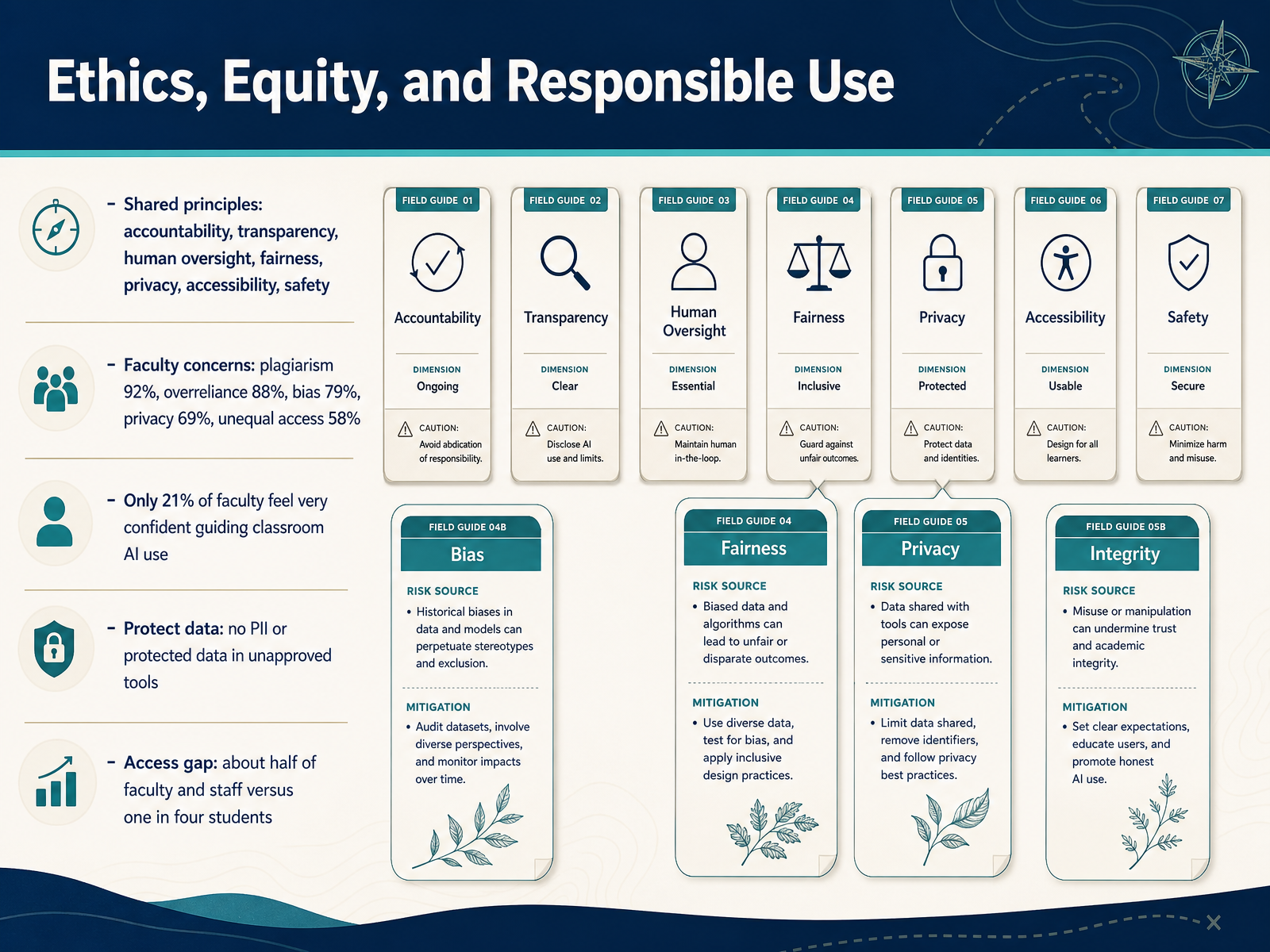
 - 06Ethics, Equity, and Responsible UseLet us turn now to ethics, equity, and responsible use. This is where shared principles meet the pressures you see in committee work, program review, and teaching support. There is broad agreement on a core set: accountability, transparency, human oversight, fairness, privacy, accessibility, and safety. These are not abstract. They translate into concrete expectations, such as clear syllabus guidance, disclosed AI use, and human review before any AI output informs a grade or a formal record. The faculty data is sobering. In one College Board survey of over three thousand faculty, ninety-two percent were concerned about plagiarism, eighty-eight percent about overreliance on automation, and seventy-nine percent about bias. Privacy concerned sixty-nine percent, and unequal access fifty-eight percent. And only twenty-one percent felt very confident guiding classroom AI use. So confidence is scarce, even among experienced colleagues. That is a capability issue, not a character issue. On data, the rule is simple: do not place personally identifiable information or protected data into unapproved tools. Even with approved tools, verify the approved scope and minimize what you enter. On access, note the gap. About half of faculty and staff use institutionally provided tools, compared with roughly one in four students. That asymmetry matters for equity when AI is embedded in coursework. Treat these principles as options you can adapt to your campus culture, then move from principle to practice as we look at redesigning curriculum and assessment.
 26556596.fs1.hubspotusercontent-eu1.netcalstate.edudigitaleducationcouncil.com+22 min
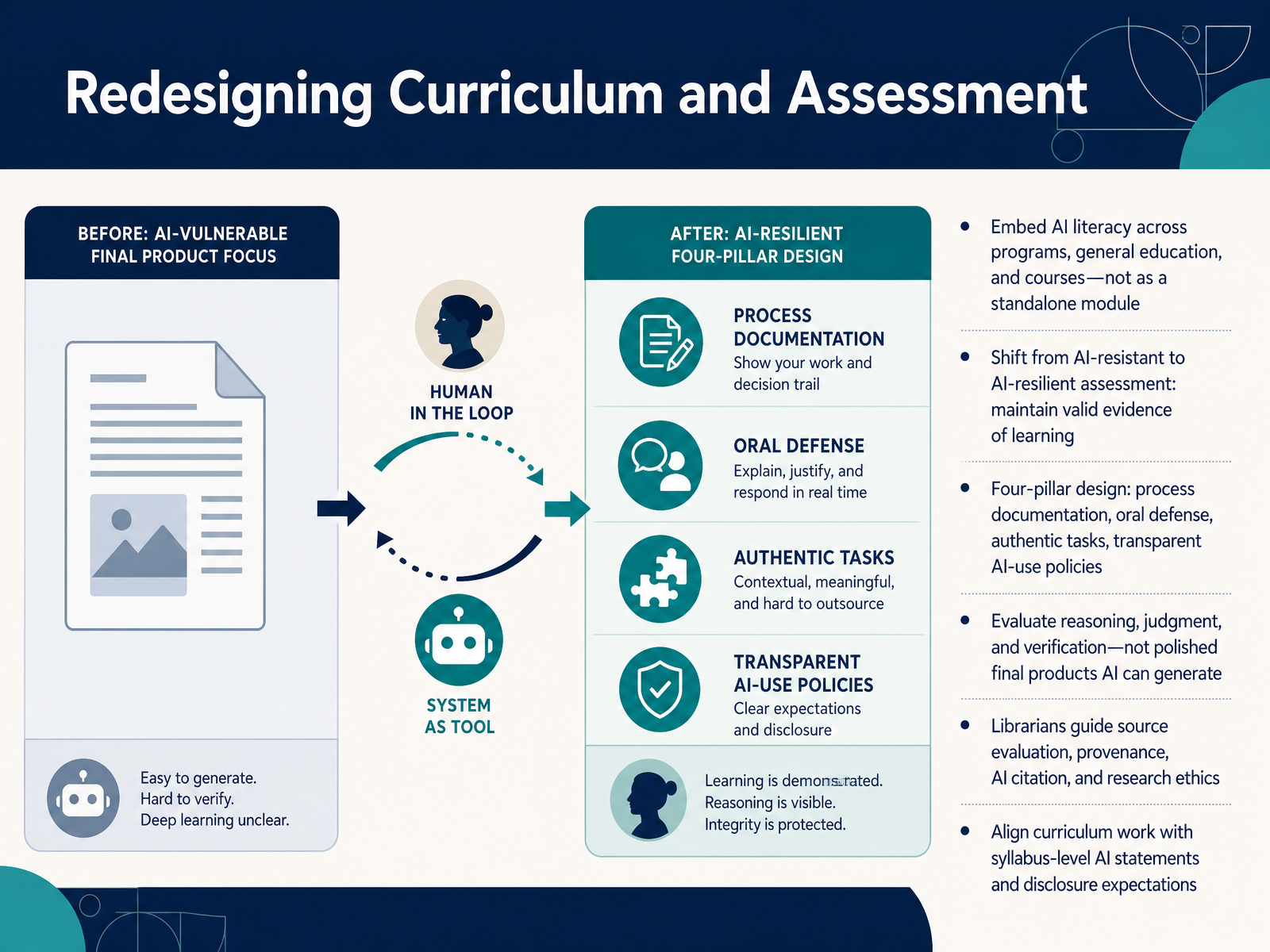
 - 07Redesigning Curriculum and AssessmentLet's turn to where AI literacy actually lives in the curriculum: not as a standalone module, but embedded across programs, general education, and individual courses. A dedicated workshop can raise awareness. It rarely builds durable capability. So the design question becomes: where does this belong in your program review, and who owns it?
On assessment, the shift is from AI-resistant to AI-resilient. Resistant implies an impermeable barrier, and that standard isn't achievable. Resilient means the task still produces valid evidence of learning even when students have AI access. A four-pillar design helps here: process documentation, oral defense, authentic tasks, and transparent AI-use policies tied to your intended learning outcomes.
Notice what this changes. You're evaluating reasoning, judgment, and verification, not polished final products that AI can generate. Rubrics should weight justification more heavily than surface polish.
Librarians are central partners, guiding source evaluation, provenance, citation of AI contributions, and research ethics. And this work has to be aligned, so syllabus-level AI statements and disclosure expectations match the assessment design rather than contradict it. That coherence is what makes the evidence credible. Next, we look at governance, policy, and institutional readiness.
 arxiv.orgrsisinternational.orgmdpi.com+22 min
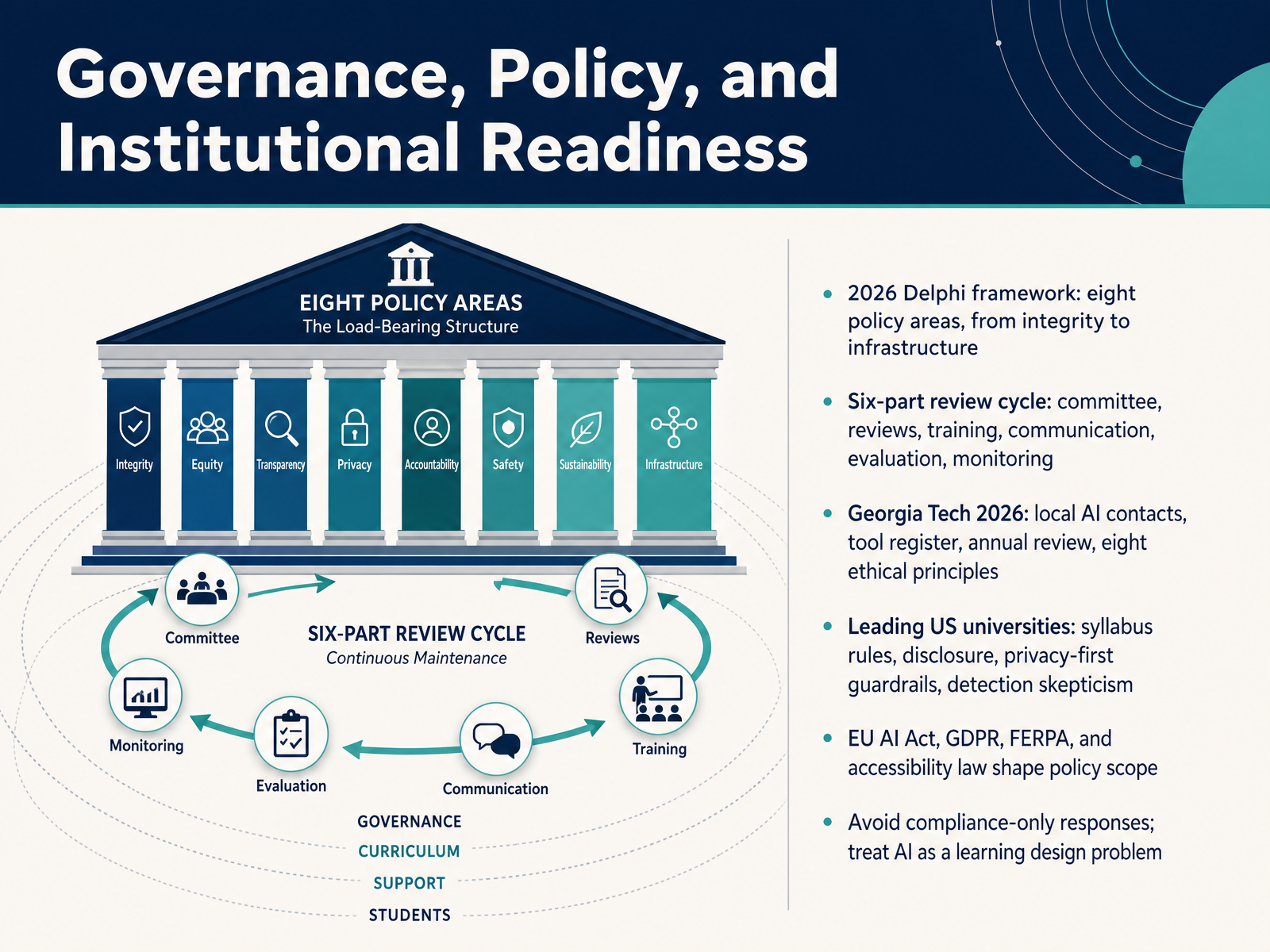
 - 08Governance, Policy, and Institutional ReadinessLet's turn now to governance, policy, and institutional readiness. A 2026 global Delphi study gives us a useful starting point. It names eight policy areas, from academic integrity and privacy through to equitable access and institutional infrastructure. Just as important, it describes a six part review cycle: a dedicated committee, scheduled reviews, training, communication, evaluation, and monitoring external developments. Georgia Tech offers a concrete example. Their 2026 policy uses local AI points of contact, a registered list of approved tools, annual review, and eight ethical principles. Among leading U.S. universities, patterns converge: syllabus level rules, disclosure expectations, privacy first guardrails, and real skepticism toward AI detection tools. Legal scope matters too. The EU AI Act, GDPR, FERPA, and accessibility law all shape what your policy can and cannot do. One caution: avoid a compliance only response. Treat AI as a learning design problem, not just a rule to enforce. Next, we look at roles, collaboration, and professional development.
 msche.org2 min
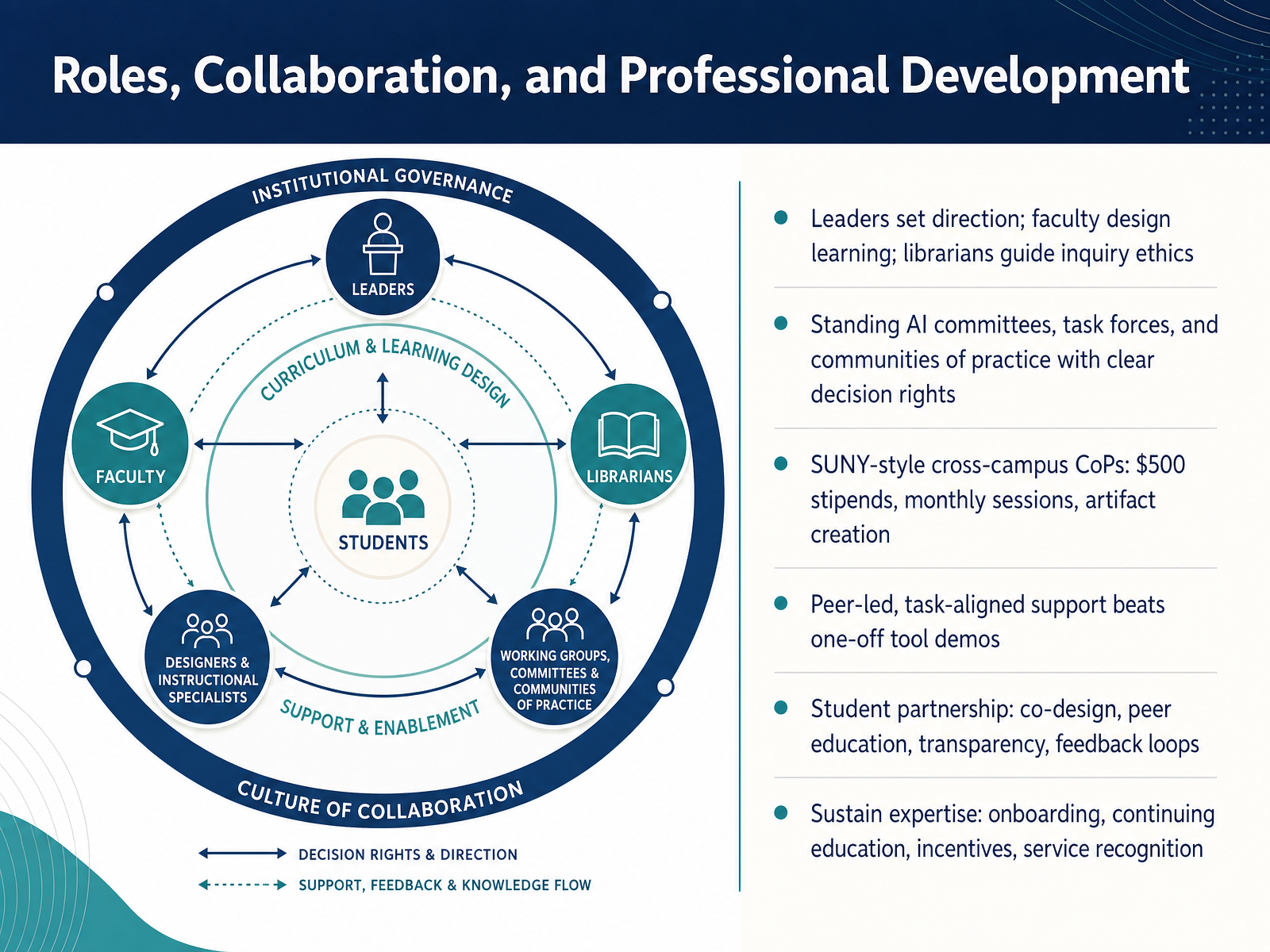
 - 09Roles, Collaboration, and Professional DevelopmentLet's turn to roles and collaboration, because AI literacy work succeeds or stalls based on who owns what. Leaders set direction and resource it. Faculty design the learning. Librarians guide inquiry ethics, including how sources are evaluated and cited. Distinct roles, but they have to connect. A practical structure is a standing committee or community of practice with clear decision rights. Be explicit about who recommends, who decides, and who is consulted, so the group does not become a discussion forum without authority. A useful model comes from the SUNY system, where cross-campus communities of practice offered five hundred dollar stipends, monthly virtual sessions, and required artifact creation. Participants produced shareable course materials, so the investment left something behind. One design lesson from the research is that peer-led, task-aligned support outperforms one-off tool demonstrations. When a colleague shows how AI fits a specific teaching task, confidence and follow-through rise. Include students as partners, not just recipients. Co-design, peer education, transparency, and feedback loops improve both policy and practice. And sustain expertise through onboarding, continuing education, incentives, and recognition of service. Otherwise your experts graduate, retire, or burn out. Next, the implementation roadmap and institutional maturity.
 26556596.fs1.hubspotusercontent-eu1.netcalstate.edudigitaleducationcouncil.com+22 min
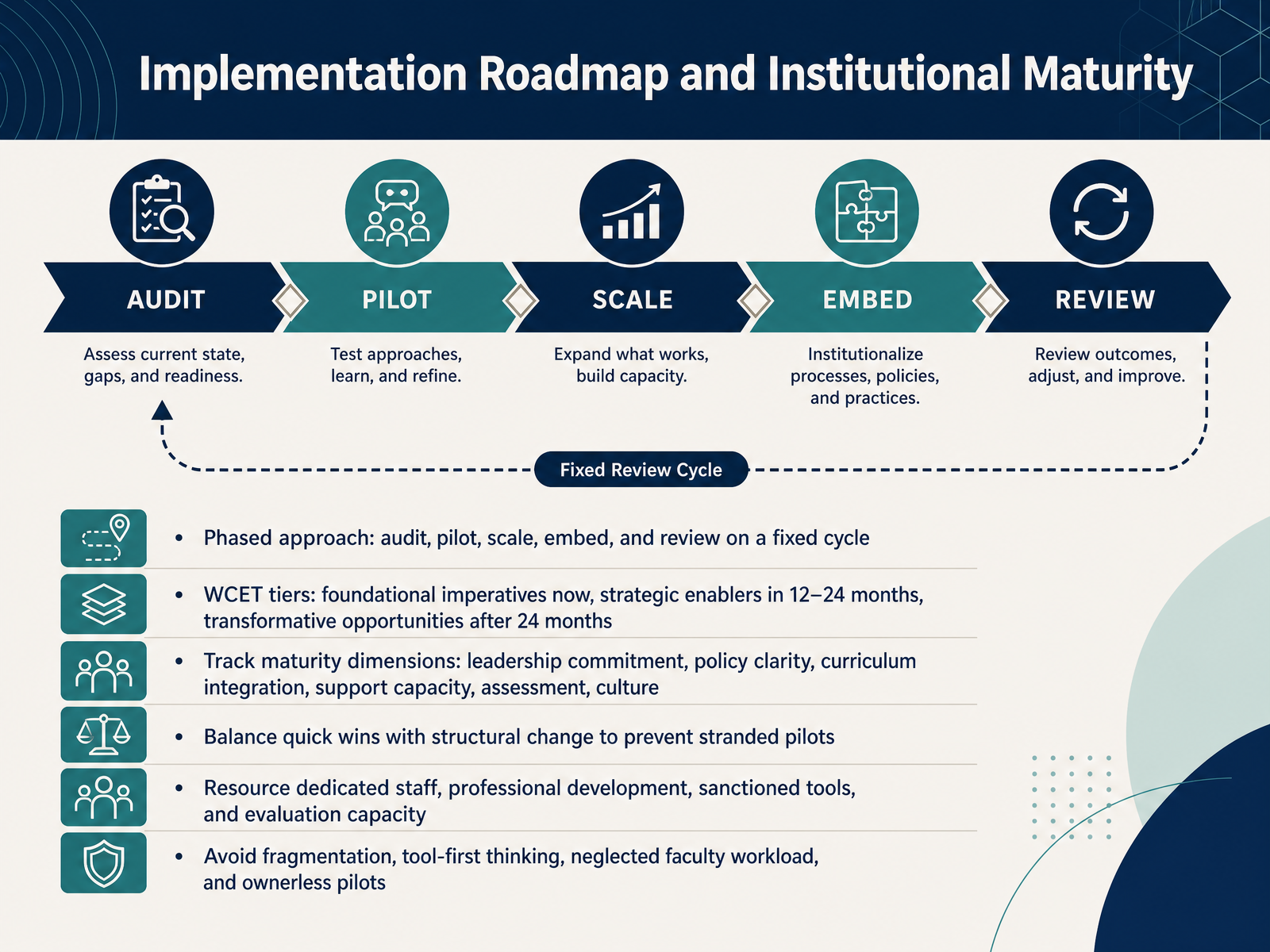
 - 10Implementation Roadmap and Institutional MaturityLet's turn now to the implementation roadmap and institutional maturity. The practical starting point is a phased cycle: audit, pilot, scale, embed, and review, all on a fixed schedule so progress is visible and review is expected rather than optional. The W C E T framework offers a useful prioritization. Foundational imperatives come now, covering compliance, privacy, and basic capacity. Strategic enablers follow in twelve to twenty-four months. Transformative opportunities are planned beyond twenty-four months. As you sequence this work, track maturity across several dimensions: leadership commitment, policy clarity, curriculum integration, support capacity, assessment, and culture. Balance quick wins with structural change, because quick wins without structure tend to produce stranded pilots. That means resourcing dedicated staff, professional development, sanctioned tools, and evaluation capacity. And watch for the common failure patterns: fragmentation, tool-first thinking, neglected faculty workload, and pilots that have no owner. A simple rule: every initiative needs an owner, a metric, and a sunset date from day one. That is how you move from scattered experiments to durable capability. Next, we look at assessing and evaluating AI literacy.
 2 min
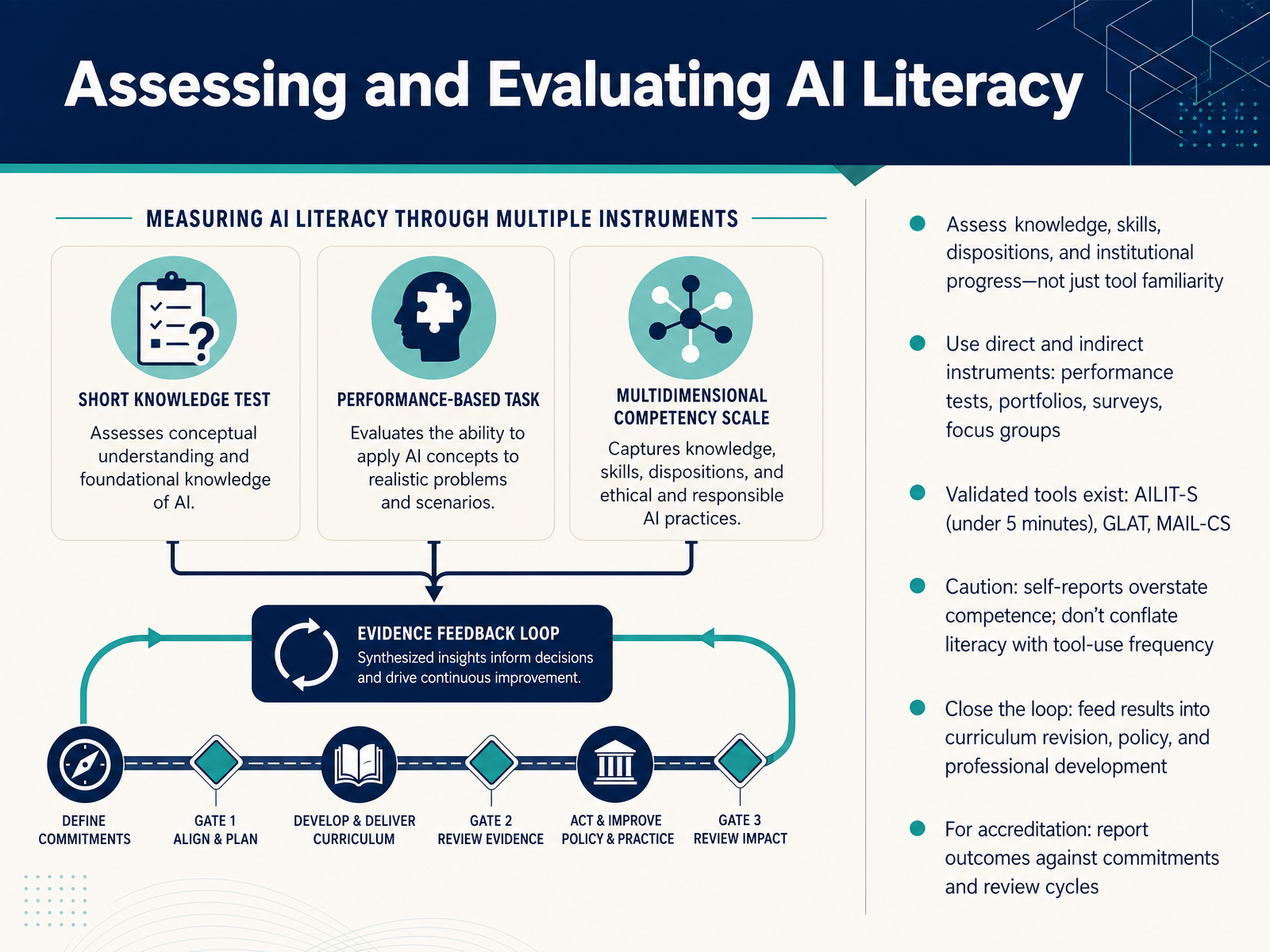
2 min - 11Assessing and Evaluating AI LiteracyLet's turn to assessment. When your committee asks whether the AI literacy initiative is working, the answer has to rest on evidence, not impressions. So assess four things: knowledge, skills, dispositions, and institutional progress. Not simply whether students have touched the tools. Use both direct and indirect instruments. Direct measures include performance tests and portfolios; indirect measures include surveys and focus groups. Validated tools are available. The short AI literacy test, AILIT-S, takes under five minutes and suits group-level course evaluation. GLAT is performance-based, and its scores predict actual task performance better than self-ratings do. MAIL-CS offers a multidimensional measure with dimensions covering foundational knowledge and ethics, operational skills, critical evaluation, and application. One caution: self-reports tend to overstate competence, so do not equate literacy with tool-use frequency. Finally, close the loop. Feed results into curriculum revision, policy, and professional development. For accreditation, report outcomes against your stated commitments and your review cycles. That turns assessment into governance evidence. Next, Adapting the Framework Locally.
 doi.orgacademyforeducationalstudies.orgacademyforeducationalstudies.org+22 min
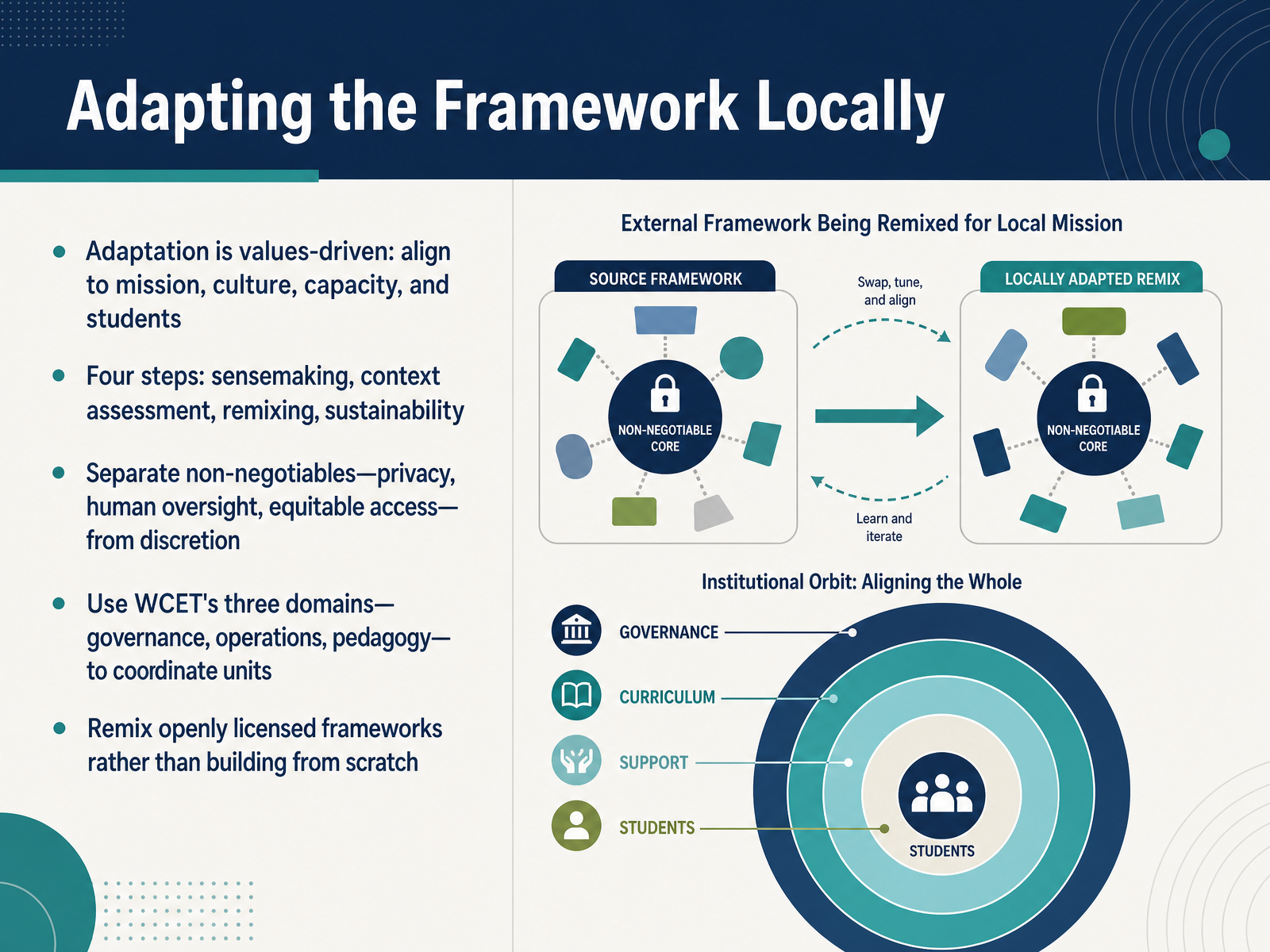
 - 12Adapting the Framework LocallySo how does a framework actually take root on your campus? Adaptation is values-driven. You align it to your mission, your culture, your capacity, and your students. WCET's process gives you four steps: sensemaking, to build shared vocabulary; context assessment; remixing; and sustainability. Early on, separate what is non-negotiable, like privacy, human oversight, and equitable access, from what is simply a matter of local discretion. Then use the three WCET domains, governance, operations, and pedagogy, to coordinate units that often work in isolation. And remember, remix openly licensed frameworks rather than building from scratch. That is both faster and more honest about your own constraints. Now let's turn that into your own plan, in our Action Planning Workshop.
 doi.org1 min
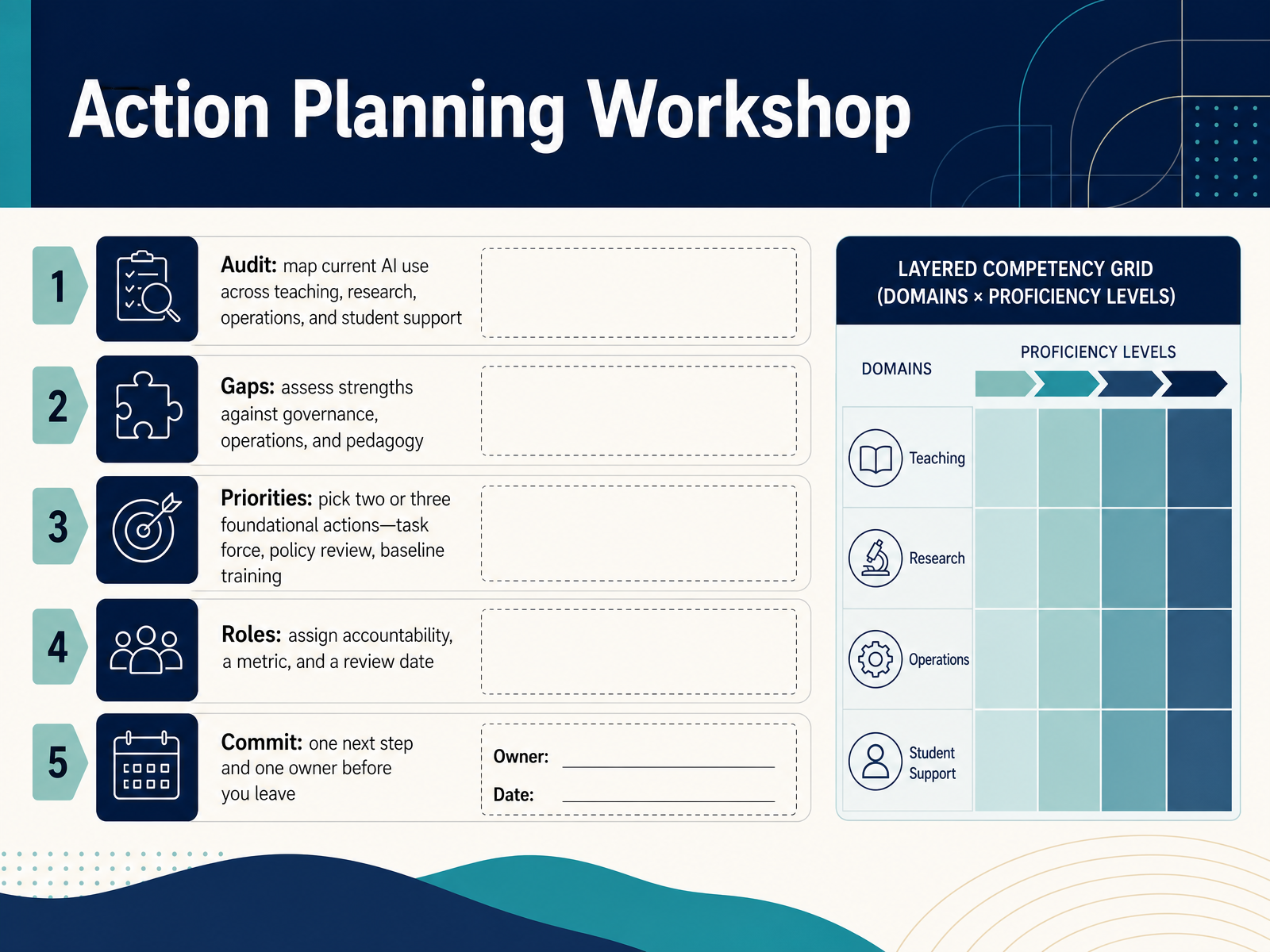
 - 13Action Planning WorkshopNow let's move from frameworks to your own action plan. Think of this as a structured working session you can run with your AI task force or steering committee. Start with an audit. Map where AI is already in use across teaching, research, operations, and student support. What you'll find, in most institutions, is more activity than anyone assumed, and often a few tools nobody formally approved. Next, assess gaps against governance, operations, and pedagogy. Frameworks like WCET's three domains and the Digital Education Council's readiness dimensions give you a shared vocabulary for that conversation. Then, and this matters, narrow your focus. Pick two or three foundational actions. A cross-functional task force, an annual policy review cycle, or baseline training for all faculty, staff, and students. Resist the temptation to launch everything at once. For each priority, assign accountability, one metric, and a review date. WCET puts it plainly: require an owner, a metric, and a sunset date from day one, so pilots don't become stranded experiments. Before you leave today, commit to one next step and one owner. That single commitment is what converts a framework into institutional practice. Let's close with your key takeaways and resources.
 2 min
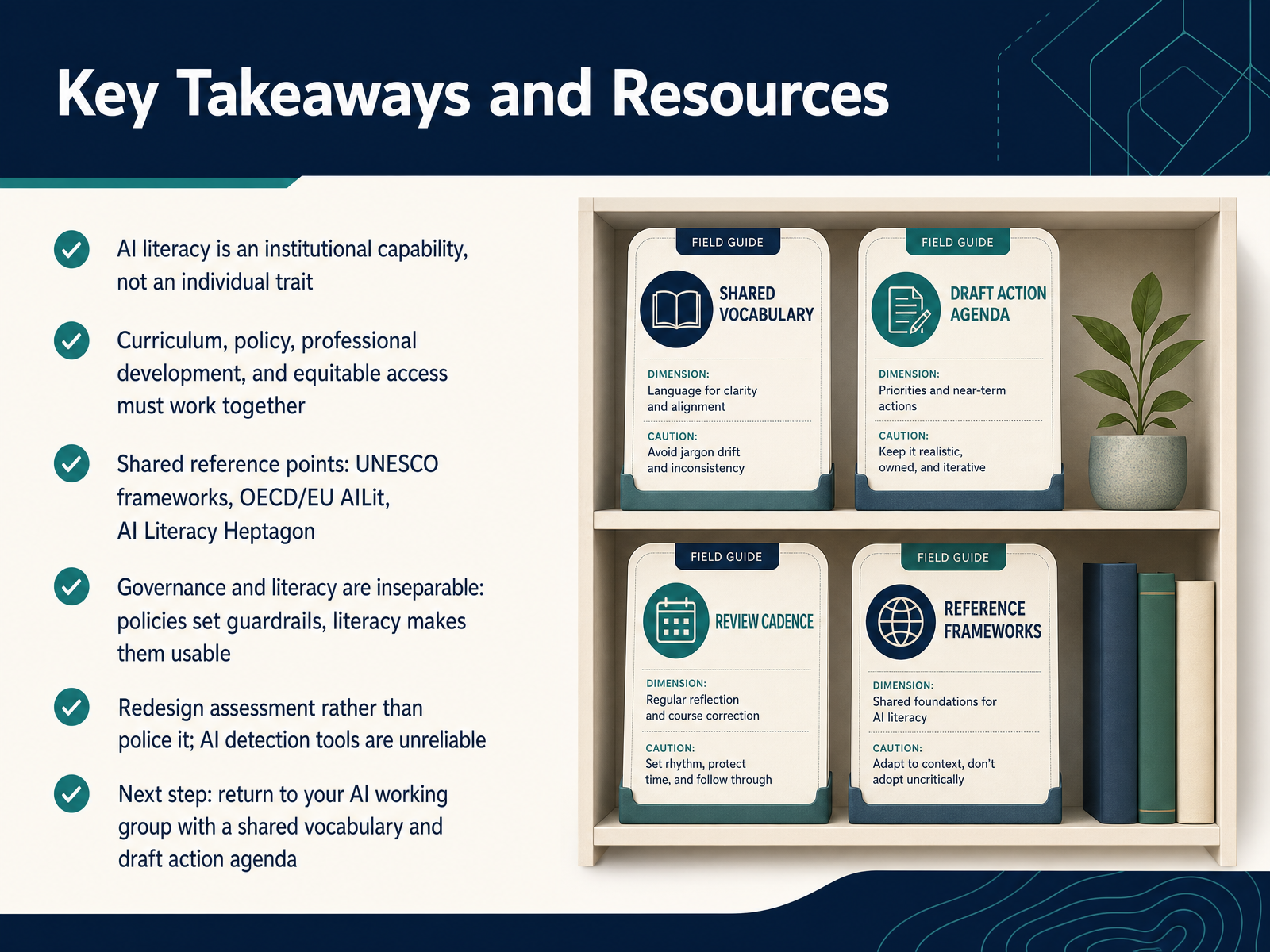
2 min - 14Key Takeaways and ResourcesLet's bring this together. First, AI literacy is an institutional capability, not an individual trait. It depends on curriculum, policy, professional development, and equitable access working in tandem. No single workshop or champion sustains it; your structures do. Second, useful shared reference points already exist: the UNESCO frameworks, the OECD and European Commission AI literacy framework, and the AI Literacy Heptagon. They give your working group a common vocabulary and spare you from starting over. Third, governance and literacy are inseparable. Policies set the guardrails; literacy makes them usable day to day. Fourth, redesign assessment rather than police it. AI detection tools remain unreliable, so authentic tasks and clear expectations serve you better. As a next step, take these takeaways back to your AI working group. Adopt shared language, then draft a short action agenda. Thank you for your engagement, and good luck with the work ahead.
 unesco.orgunesco.orgunesco.org+22 min
Take the deck with you
Download this course as a file — free, no sign-up needed.
- PDF handoutEvery slide page, ready to print or share.15 pages · 3.9 MBDownload
- Narrated PowerPointThe deck that presents itself — every slide carries the digital human's narration video.15 pages · 15.2 MBDownload
- PowerPoint slidesThe full deck as a .pptx — open it in PowerPoint, Keynote, or Google Slides.15 pages · 3.8 MBDownload
Free to use in your own training — please keep the PersonWise credit page at the end.
Have your own deck? Turn it into a course
Sources consulted
Web sources consulted while building this course.
- What you need to know about UNESCO's new AI ... — unesco.org
- AI competency framework for teachers — unesco.org
- AI competency framework for students — unesco.org
- What you need to know about UNESCO's new AI competency frameworks for — unesco.org
- Artificial intelligence in education: UNESCO advances key competencies — unesco.org
- Digital Education Council AI in Higher Education Global Survey 2026 — 26556596.fs1.hubspotusercontent-eu1.net
- WHATTHE NATION’S LARGEST PUBLIC UNIVERSITY SYSTEM IS LEARNING ABOUTAI — calstate.edu
- AI in Higher Education Global Survey 2026 — digitaleducationcouncil.com
- Generative AI in Higher Education: Academic and Student Perspectives | QS — qs.com
- https://research.collegeboard.org/media/pdf/ai-research-brief-3-vf.pdf — research.collegeboard.org
- From AI Literacy to AI Fluency: A Developmental Framework for Higher Education — doi.org
- Scaffolding holistic AI literacy in Higher Education — academyforeducationalstudies.org
- AI & Data Competencies: Scaffolding holistic AI literacy in Higher Education — academyforeducationalstudies.org
- GenerativeAIinHigherEducationTeaching&Learning AI Fluency Framework — hub.teachingandlearning.ie
- AI Competence Framework_EN Version — teachingtools.uzh.ch
- [2510.24783v1] AI & Data Competencies: Scaffolding holistic AI literacy in Higher Education — arxiv.org
- Designing AI Literacy Curricula for Higher Education: A Comparative Framework | IJRISS — rsisinternational.org
- Framing and Evaluating Task-Centered Generative Artificial Intelligence Literacy for Higher Education Students — mdpi.com
- AI literacy as a core component of AI education — doi.org
- New Use of Artificial Intelligence Accreditation Policy and Procedures — msche.org