Begin
13 pages · ~26 min
Public Speaking Types
This training covers the main types of public speaking, helping learners identify and understand different speaking formats for effective communication.
A digital instructor presents all 13 pages. Hold “Ask” at any point and ask out loud — the answer comes from this course. No sign-up needed.
What you’ll learn
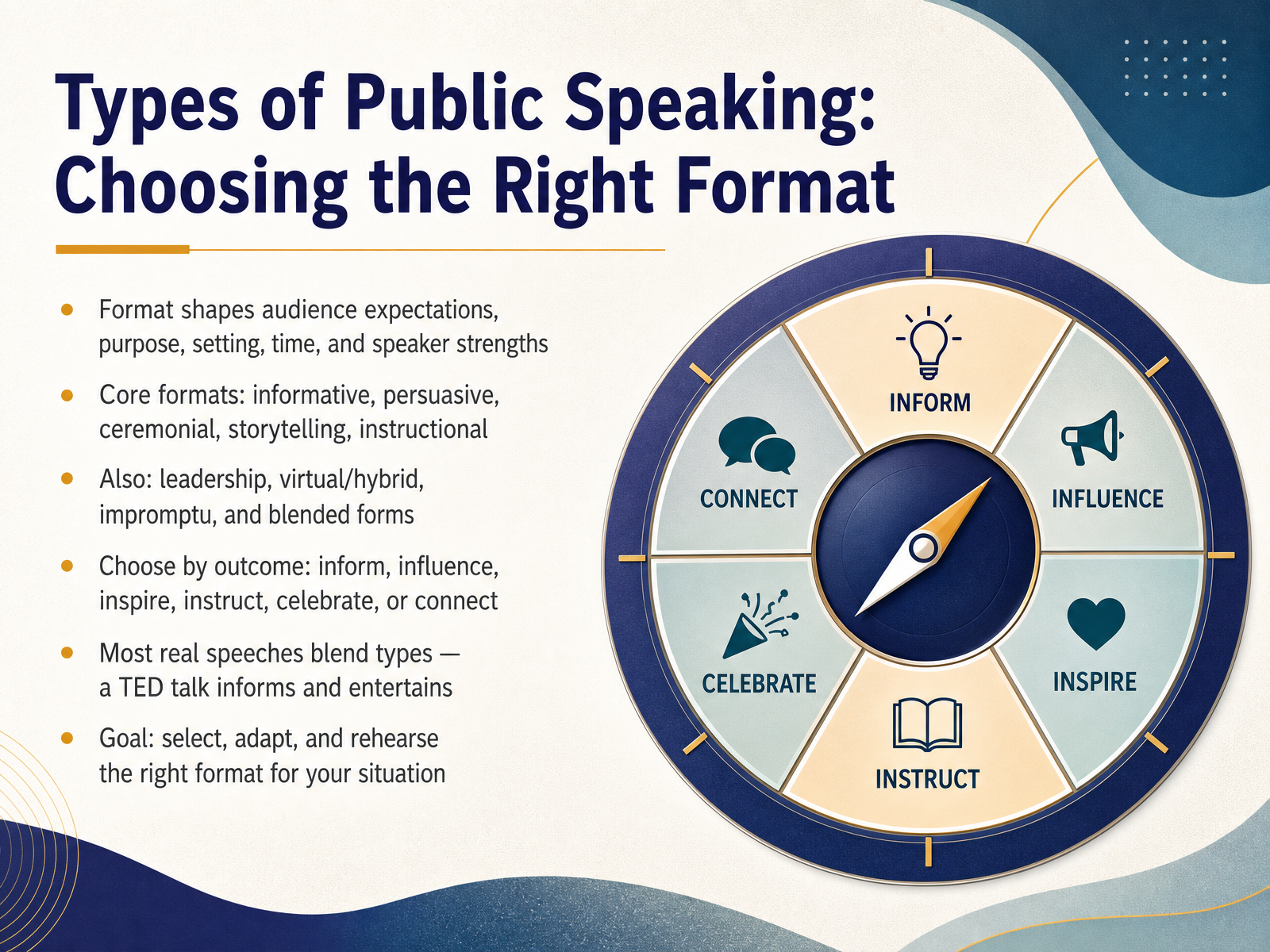
- 01Types of Public Speaking: Choosing the Right FormatWelcome. I'm glad you're here, because today we're talking about one of the most practical skills in public speaking. Choosing the right format. Every speaking situation sends your audience a set of expectations. A wedding toast, a sales pitch, a training session, and a TED talk are all speeches, but each one follows different rules and needs a different approach. In this course, we'll explore the core formats: informative, persuasive, ceremonial, storytelling, and instructional. We'll also look at leadership talks, virtual and hybrid settings, impromptu moments, and blended forms. Here's the key idea. Choose by outcome. Do you want to inform, influence, inspire, instruct, celebrate, or connect? And remember, most real speeches blend types. A TED talk informs and entertains at the same time. So your goal is simple. Select, adapt, and rehearse the right format for your situation. Let's start with purpose, because that's where every strong format decision begins.gamma.com.aiahaslides.comteleprompter.works+22 min
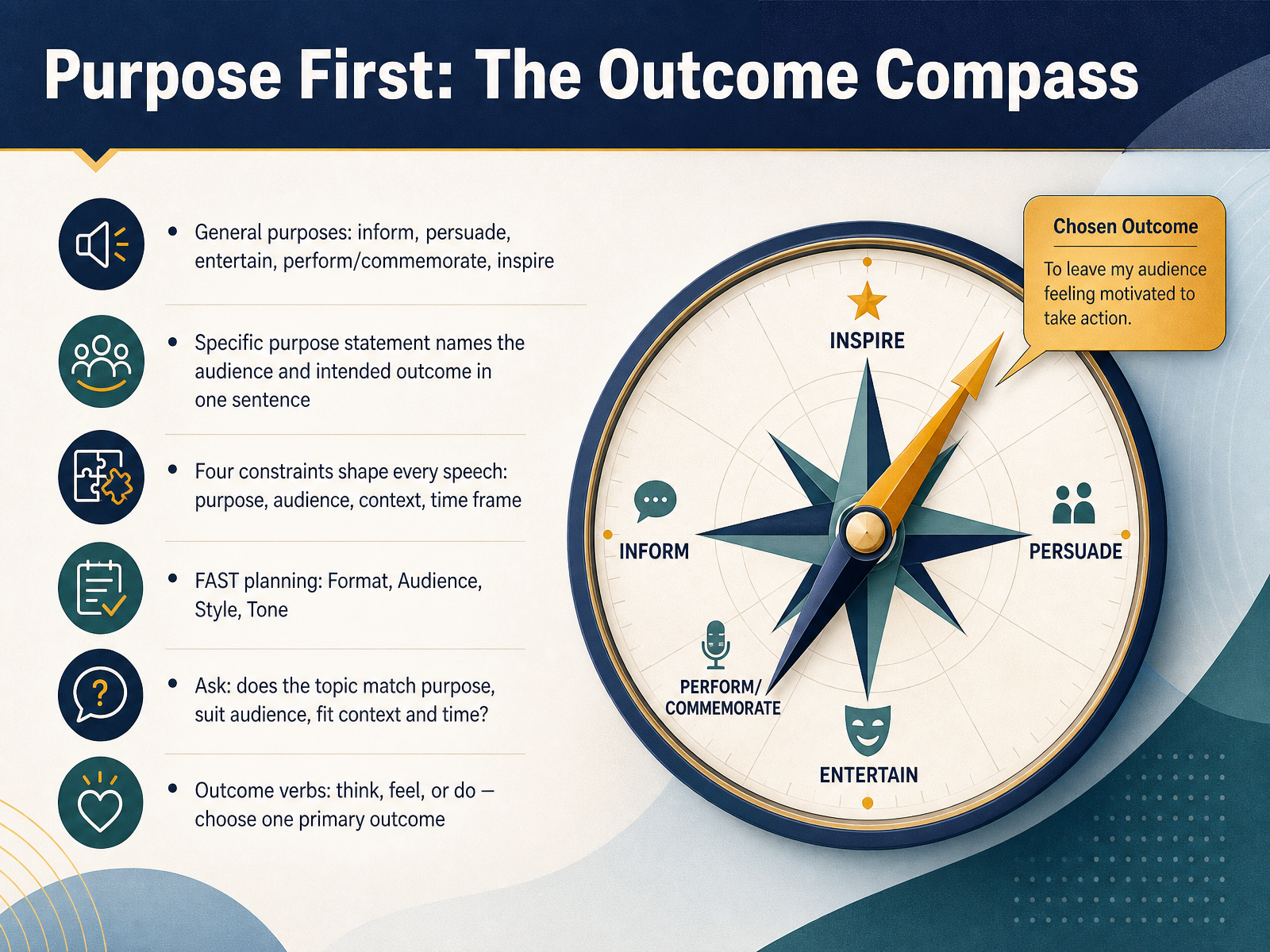
- 02Purpose First: The Outcome CompassLet's start with the compass that guides every speaking choice: purpose. Most speeches fall into a handful of general purposes. You inform, you persuade, you entertain, you perform or commemorate, and you inspire. Now here is the move that makes your purpose usable. Write a specific purpose statement. That is one sentence that names your audience and the outcome you want. For example, by the end of this talk, my team will agree to adopt the new client intake process. Four constraints shape every speech: purpose, audience, context, and time frame. Run them through the FAST planning check: Format, Audience, Style, and Tone. Then ask yourself, does my topic match my purpose, suit this audience, and fit the context and the time I have? Finally, pick one primary outcome. Do you want them to think, feel, or do? Choose this when you need clarity fast. If your topic fits all four constraints and your one outcome verb, you are ready to build. If not, adjust now, before you write a single slide. Next, we look at the audience itself, in Know the Room: Audience Analysis That Changes the Speech.
 winningpresentations.comjuliehansen.livewinningpresentations.com+22 min
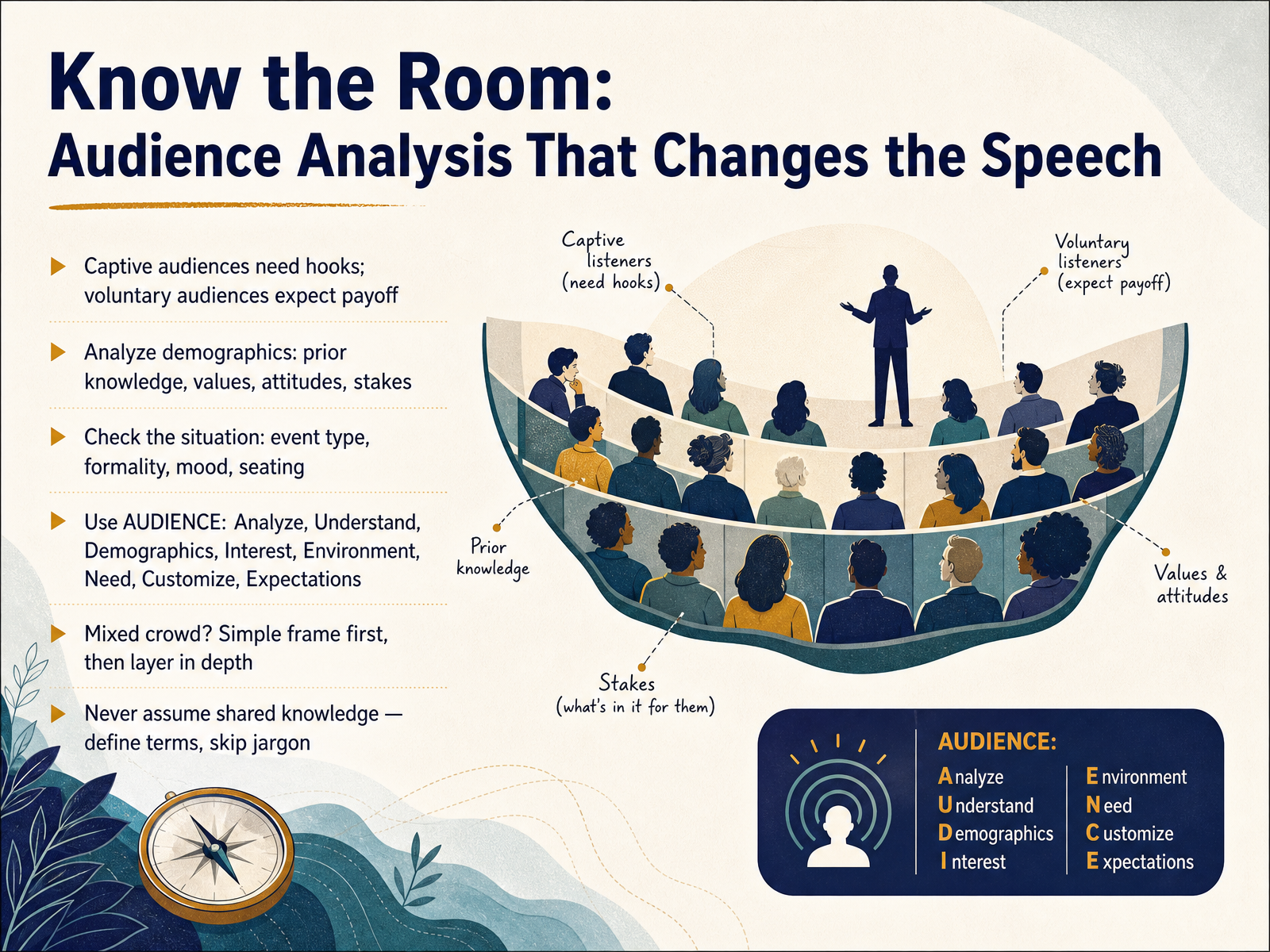
- 03Know the Room: Audience Analysis That Changes the SpeechNow let's talk about knowing the room, because audience analysis is what quietly changes your speech. Start with the type of audience. A captive audience is required to be there, so you need a hook early. A voluntary audience chose to attend, so they expect a real payoff. Then analyze demographics, like prior knowledge, values, attitudes, and what is at stake for them. Also check the situation: event type, formality, mood, and seating. The acronym AUDIENCE can guide you: Analyze, Understand, Demographics, Interest, Environment, Need, Customize, and Expectations. Quick self check: for each main point, ask who needs this and why now. If your crowd is mixed, build a simple frame first, then layer in depth. And never assume shared knowledge. Define your terms and skip the jargon. In the next section, we'll look at informative speaking and how to build understanding.
 ecampusontario.pressbooks.pubwustl.pressbooks.pubopenfl.pressbooks.pub+21 min
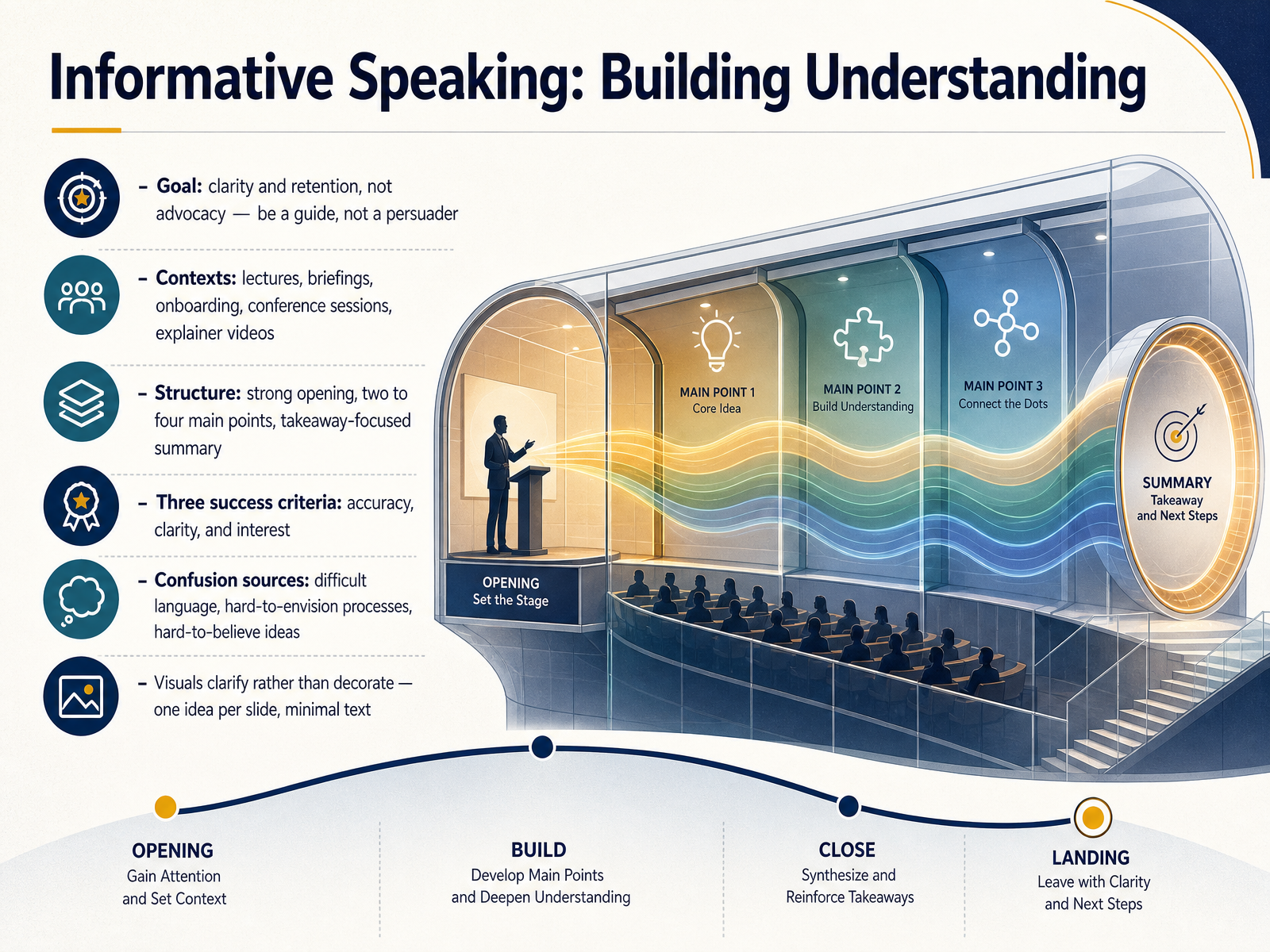
- 04Informative Speaking: Building UnderstandingNow let's look at the first major format: informative speaking. Your goal here is clarity and retention, not advocacy. You're a guide, not a persuader. You'll see this in lectures, briefings, onboarding sessions, conference talks, and explainer videos. Structure it with a strong opening, two to four main points, and a takeaway-focused summary. Aim for three success criteria: accuracy, clarity, and interest. Watch for confusion sources like difficult language, hard-to-envision processes, and hard-to-believe ideas. Choose this when your audience needs to understand something, not agree with you. And keep visuals clarifying rather than decorating. One idea per slide, minimal text. Next, we'll explore persuasive speaking, from claim to action.
 milnepublishing.geneseo.eduprezentium.comcomm.pitt.edu+21 min
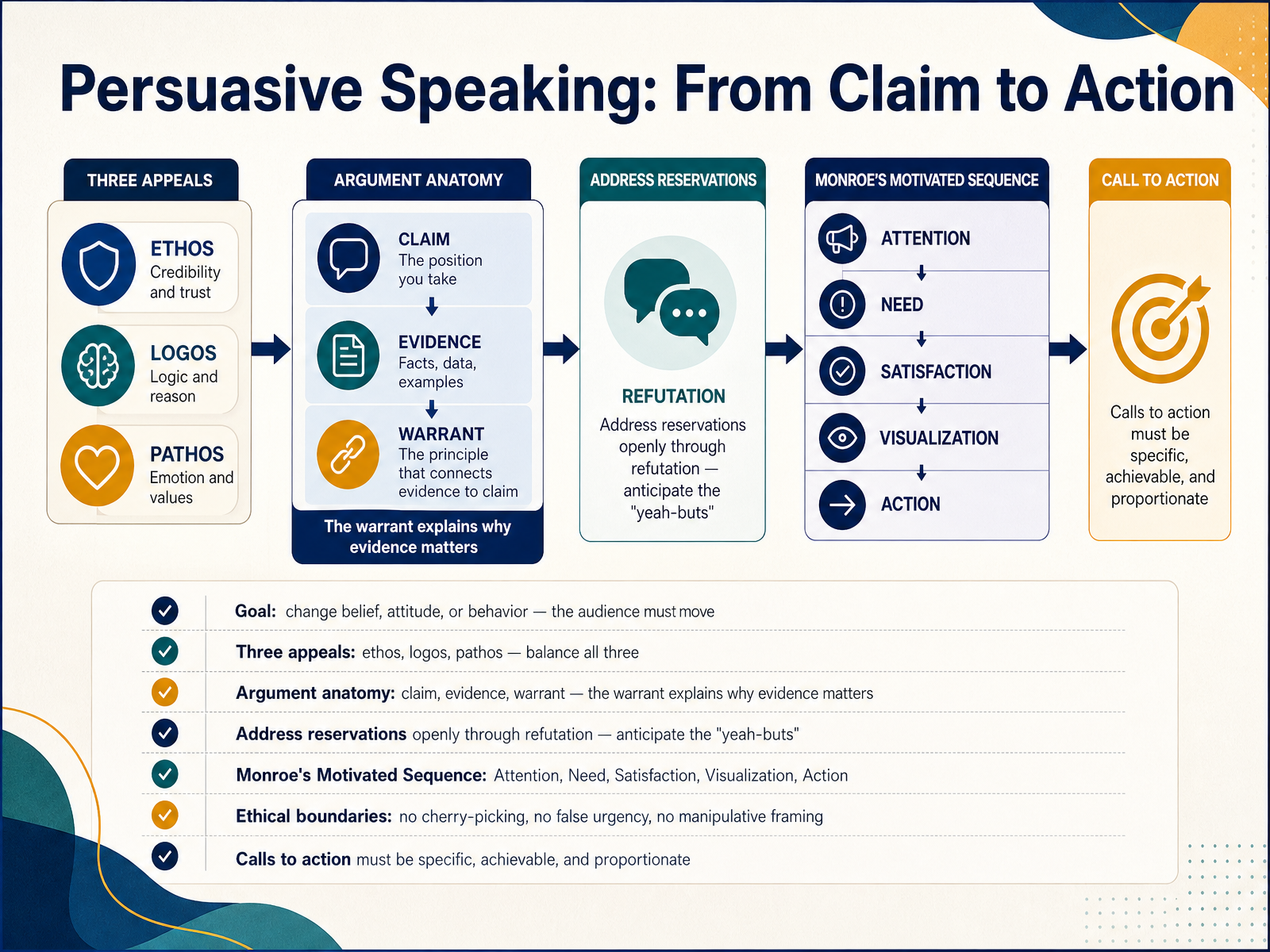
- 05Persuasive Speaking: From Claim to ActionLet's move on to persuasive speaking, where your goal is simple to say but hard to do. You want to change what your audience believes, feels, or actually does. The audience has to move. To get there, balance three appeals: ethos, your credibility; logos, your logic and evidence; and pathos, the emotional connection. Lean too hard on one and the speech wobbles. Next, build each argument with a claim, evidence, and a warrant, and remember the warrant is the part that explains why your evidence matters. Now, your listeners are having a mental dialogue, and they're thinking yeah, but. So address those reservations openly through refutation. For structure, try Monroe's Motivated Sequence: Attention, Need, Satisfaction, Visualization, and Action. And stay ethical: no cherry-picking, no false urgency, no manipulative framing. Finally, make your call to action specific, achievable, and proportionate. Choose this format when you need more than understanding. You need movement. Ask yourself: will my audience know exactly what to do next? If not, sharpen the action step. Ceremonial and Special-Occasion Speaking.
 gamma.com.aiahaslides.comteleprompter.works+22 min
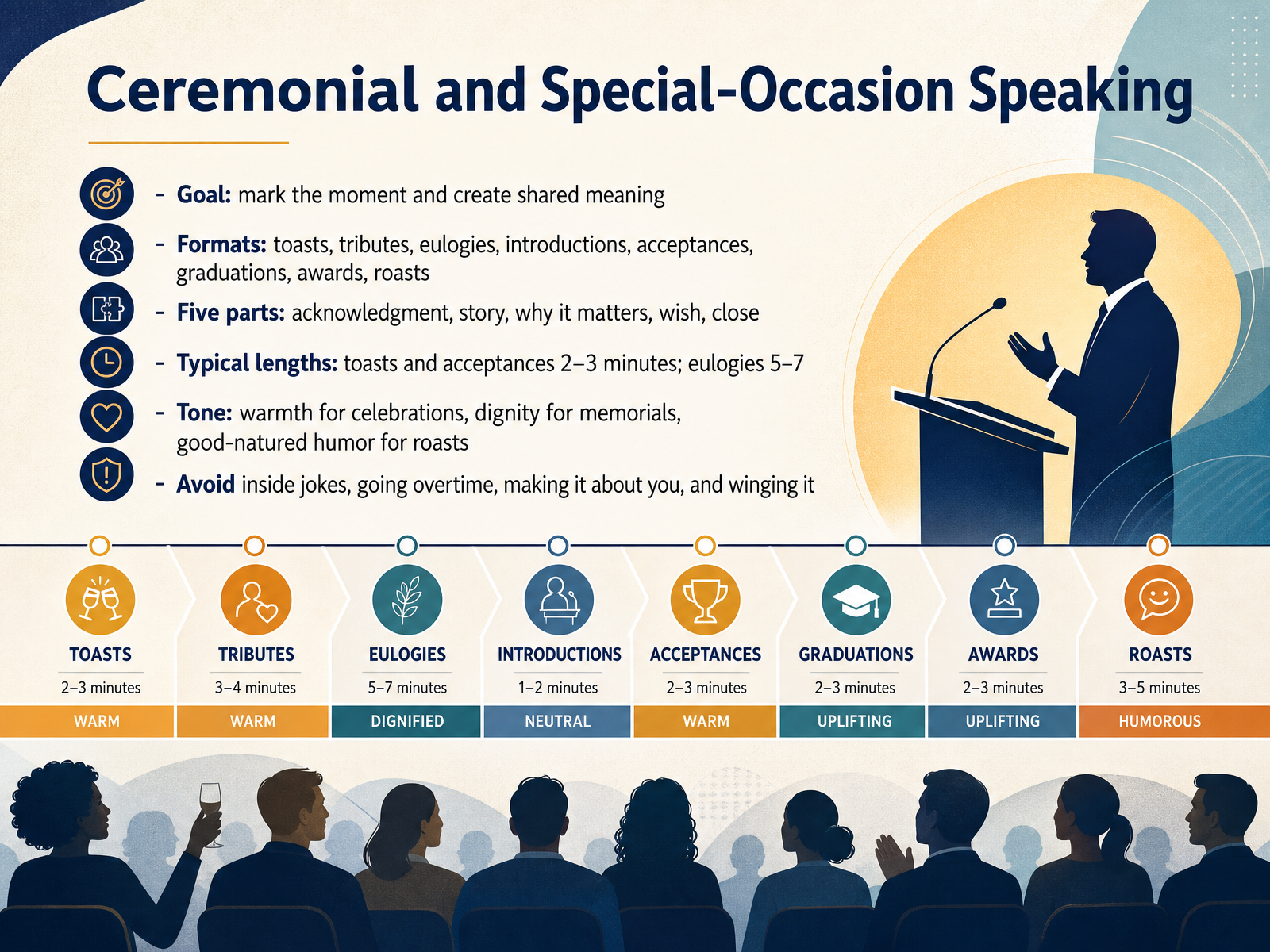
- 06Ceremonial and Special-Occasion SpeakingLet's turn now to ceremonial and special-occasion speaking. Here, your goal isn't to inform or persuade. It's to mark the moment and create shared meaning. This is the speech people remember from a wedding, a retirement, an awards night, or a memorial. The formats include toasts, tributes, eulogies, introductions, acceptances, graduations, awards, and roasts. Choose this when the occasion itself is the message. Now, most of these follow a simple five-part shape: acknowledgment, a story, why it matters, a wish, and a clean close. This works best if you anchor everything in one specific story. For timing, keep toasts and acceptances to two or three minutes. Eulogies usually run five to seven. Tone matters just as much. Use warmth for celebrations, dignity for memorials, and good-natured humor for roasts. Before you write, run one quick self-check. Ask yourself: does my tone match this room? And finally, avoid inside jokes, going overtime, making it about you, and winging it. Prepare, then rehearse out loud. Next, we'll look at storytelling: narrative as structural, not ornamental.
 socialsci.libretexts.orggamma.com.aiahaslides.com+22 min
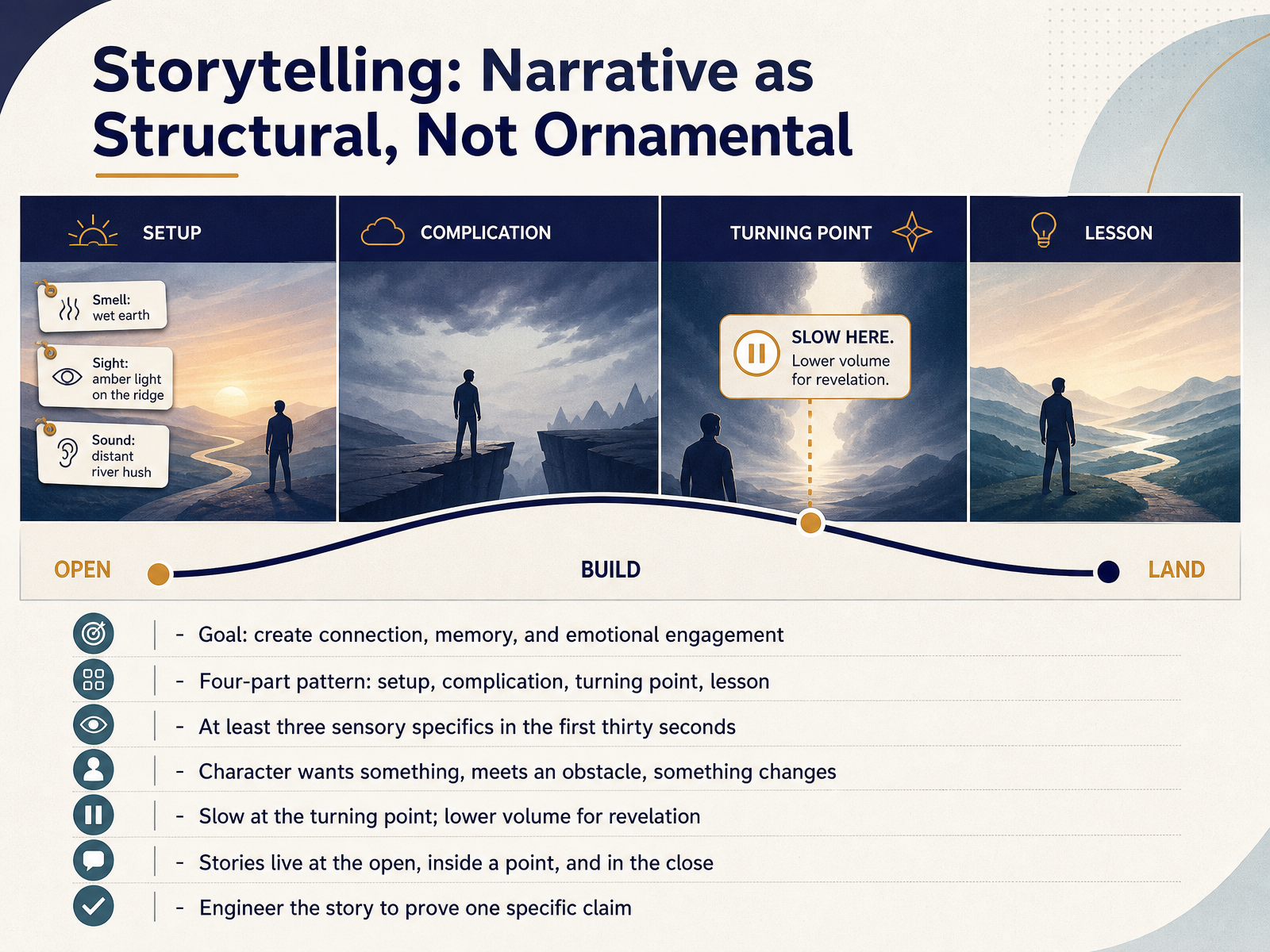
- 07Storytelling: Narrative as Structural, Not OrnamentalNow let's talk about storytelling, not as decoration, but as structure. The goal is connection, memory, and emotional engagement. A story isn't an aside you drop into a speech. It's the frame that carries your idea. You can build almost any story from four parts: the setup, the complication, the turning point, and the lesson. Every effective story also has a character who wants something, meets an obstacle, and changes. In your first thirty seconds, give the audience at least three sensory specifics. Not vague claims, but things they can picture, hear, or feel. If you can't picture it, neither can they. Delivery matters too. Slow down at the turning point and lower your volume for the revelation. That quiet moment is where the meaning lands. And place stories deliberately. Stories live at the open, inside a point, and in the close. Each position does a different job. Before you use a story, run one check. What specific claim does this story prove? If you can't say it in a single sentence, the story isn't engineered yet. When you can, that's when you choose this format. Next, let's look at Instructional Speaking: Building Skill, Not Just Knowledge.
 2 min
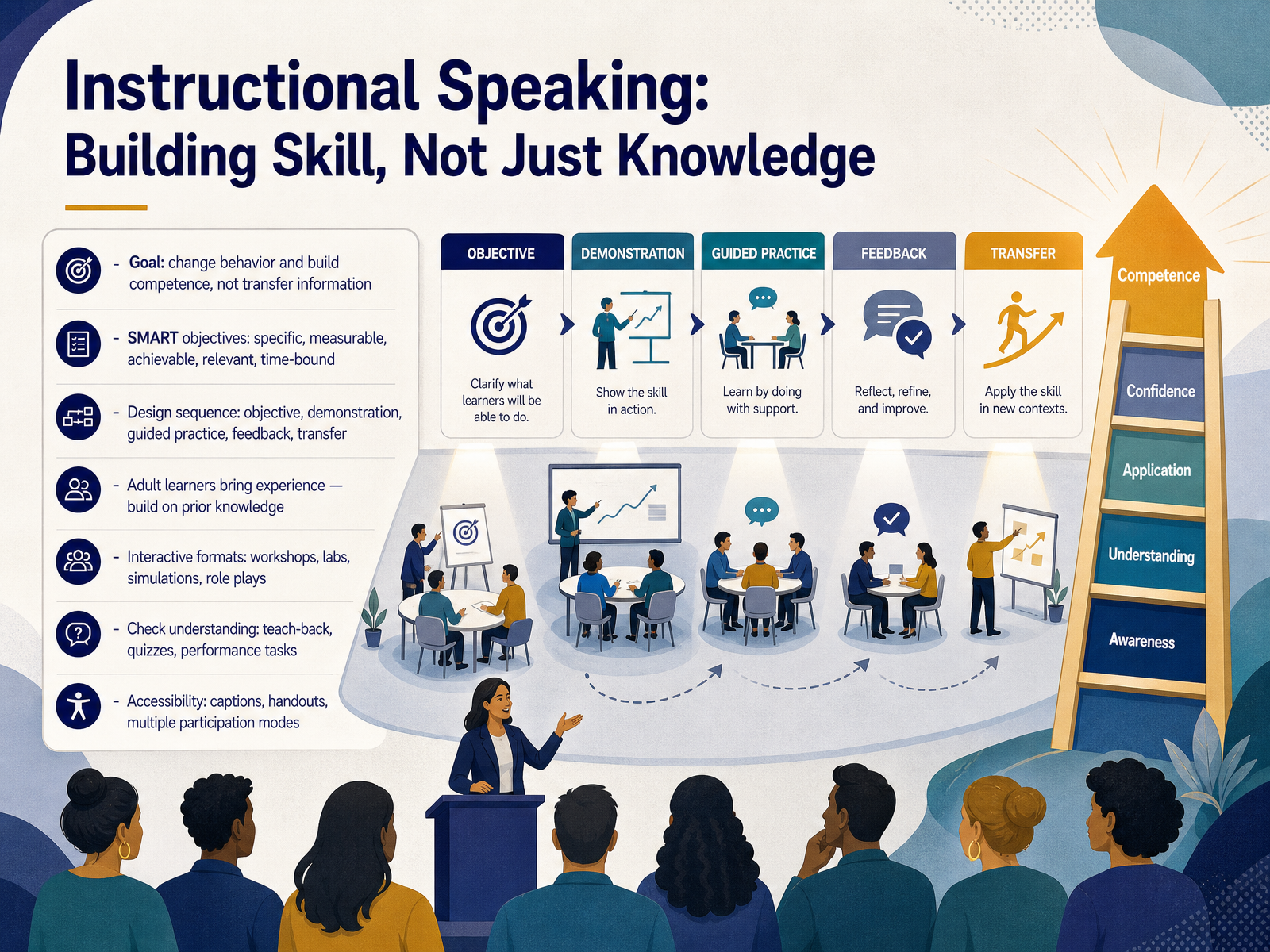
- 08Instructional Speaking: Building Skill, Not Just KnowledgeNow let's look at instructional speaking, which is all about building skill, not just sharing knowledge. Your goal here is to change behavior and grow real competence. Choose this format when your audience needs to do something differently afterward, not just understand it. Start with SMART objectives: specific, measurable, achievable, relevant, and time-bound. Then design a sequence, objective, demonstration, guided practice, feedback, and transfer. Remember, adult learners bring experience, so build on what they already know. Use workshops, labs, simulations, and role plays to keep it interactive. Check understanding with teach-back, quizzes, or performance tasks. And keep it accessible with captions, handouts, and multiple ways to participate. A quick self-check, can your learners demonstrate the skill by the end? If yes, you are on track. Next, we turn to leading through speaking, all-hands, town halls, and change.
 2 min
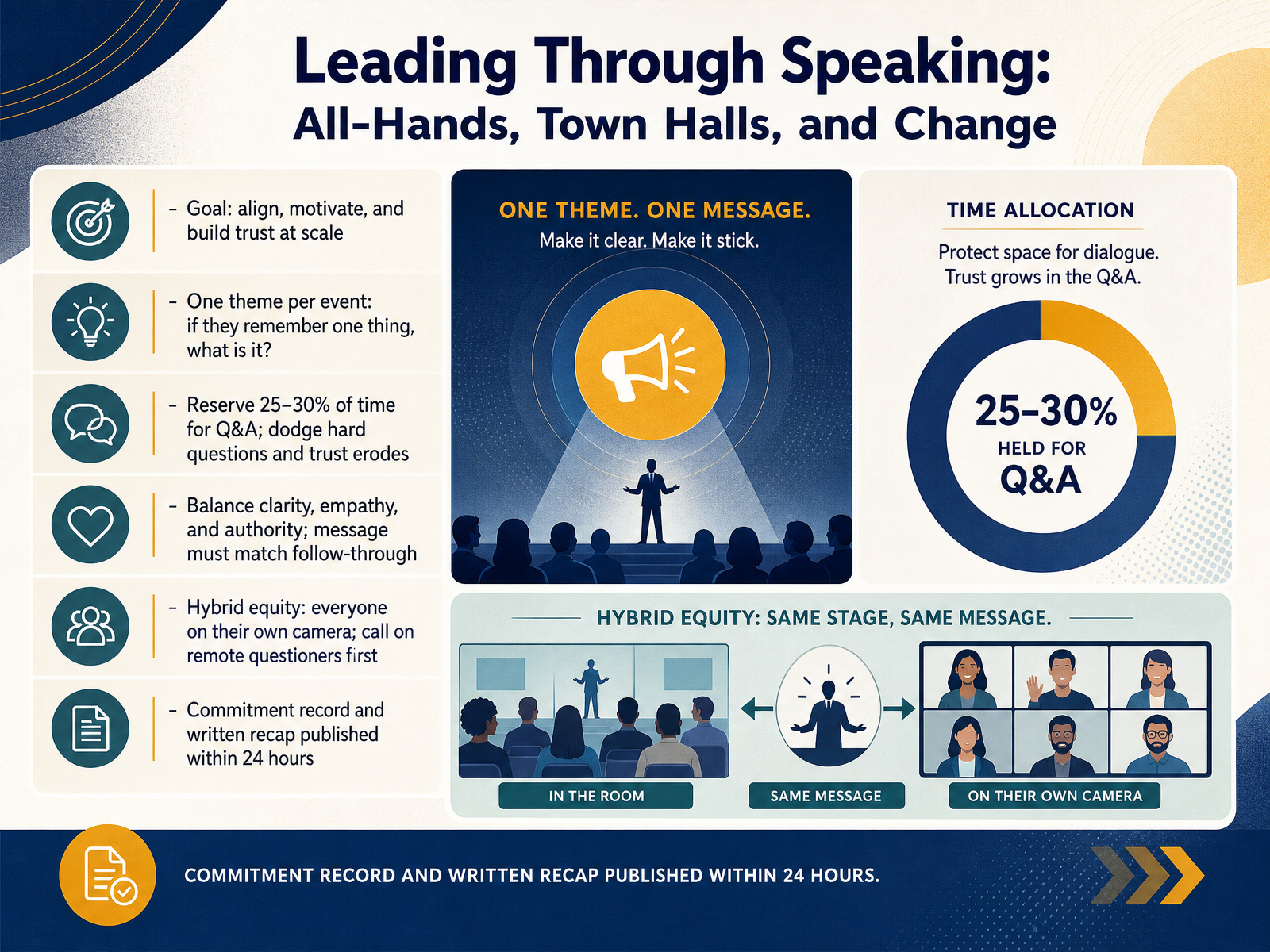
- 09Leading Through Speaking: All-Hands, Town Halls, and ChangeNow let's talk about leading through speaking, especially all-hands, town halls, and change moments. These events have one big goal: to align, motivate, and build trust at scale. But scale only works when your message is simple. So decide on one theme per event. Ask yourself: if people remember one thing, what should it be? When you can name that in a sentence, every section supports it. Next, protect the conversation. Reserve twenty five to thirty percent of the time for Q and A. If you dodge hard questions, trust erodes fast. This works best if you balance clarity, empathy, and authority, and your follow-through matches your message. For hybrid events, keep it fair. Everyone joins on their own camera, and you call on remote questioners first. Finally, close the loop. Create a commitment record and publish a written recap within twenty four hours. That record turns one meeting into weeks of alignment. So when you plan, choose one theme, protect the Q and A, and make the follow-through visible. Coming up next, virtual, hybrid, and on-camera speaking.
 2 min
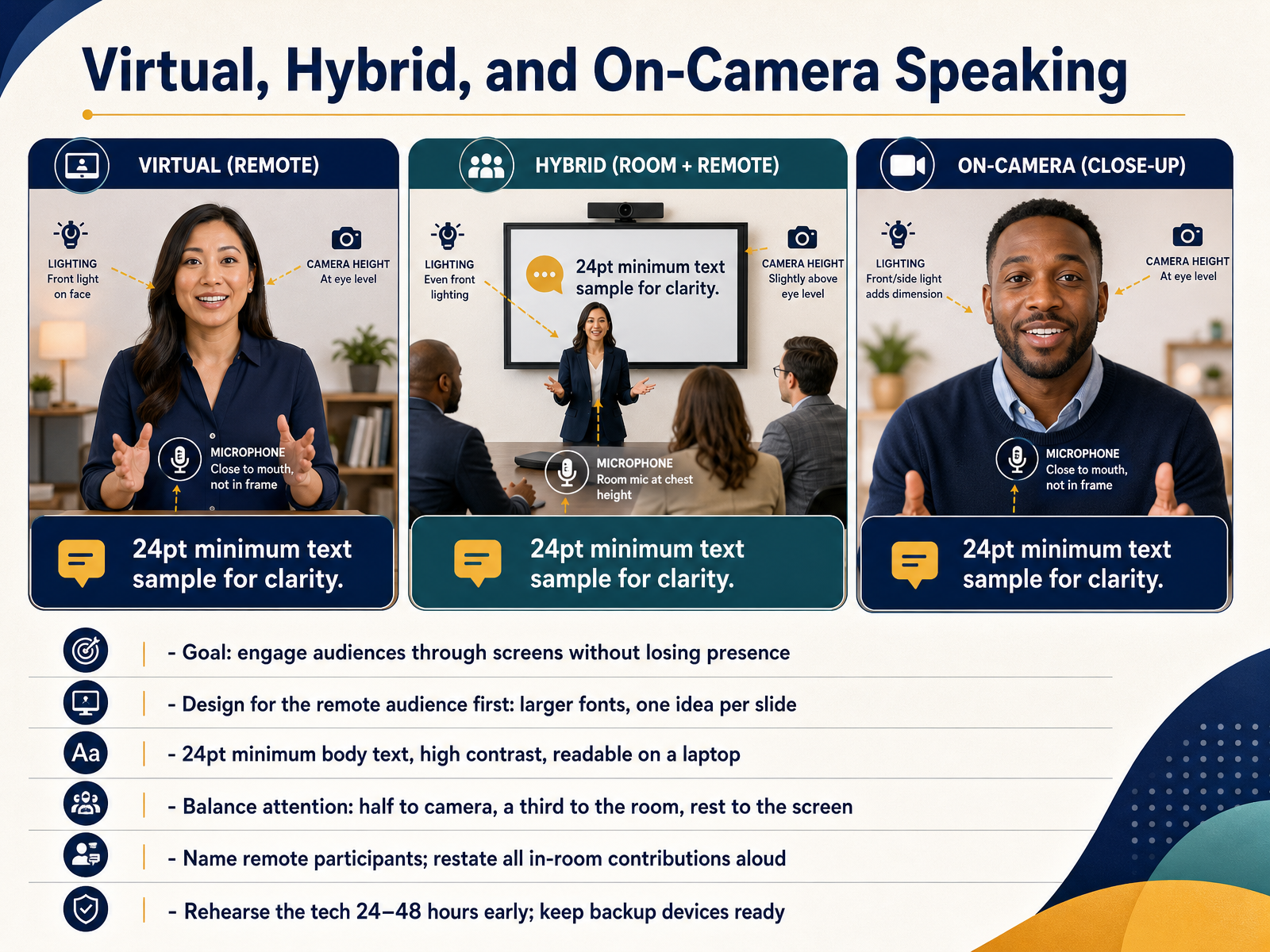
- 10Virtual, Hybrid, and On-Camera SpeakingNow let's talk about virtual, hybrid, and on-camera speaking. The goal here is simple. Engage people through a screen without losing your presence. So design for the remote audience first. Larger fonts, one idea per slide, and a minimum of twenty-four point body text with high contrast. If you can't read it on a laptop, they can't either. Then balance your attention. About half to the camera, a third to the room, and the rest to the screen. Name remote participants directly. Restate every in-room comment out loud so everyone hears it. And rehearse your tech a day or two early, with backup devices ready. Choose this approach when your audience is split. It works best if you treat the screen as equal, not optional. Next, we move into impromptu and interactive speaking under pressure.
 winningpresentations.comjuliehansen.livewinningpresentations.com+21 min
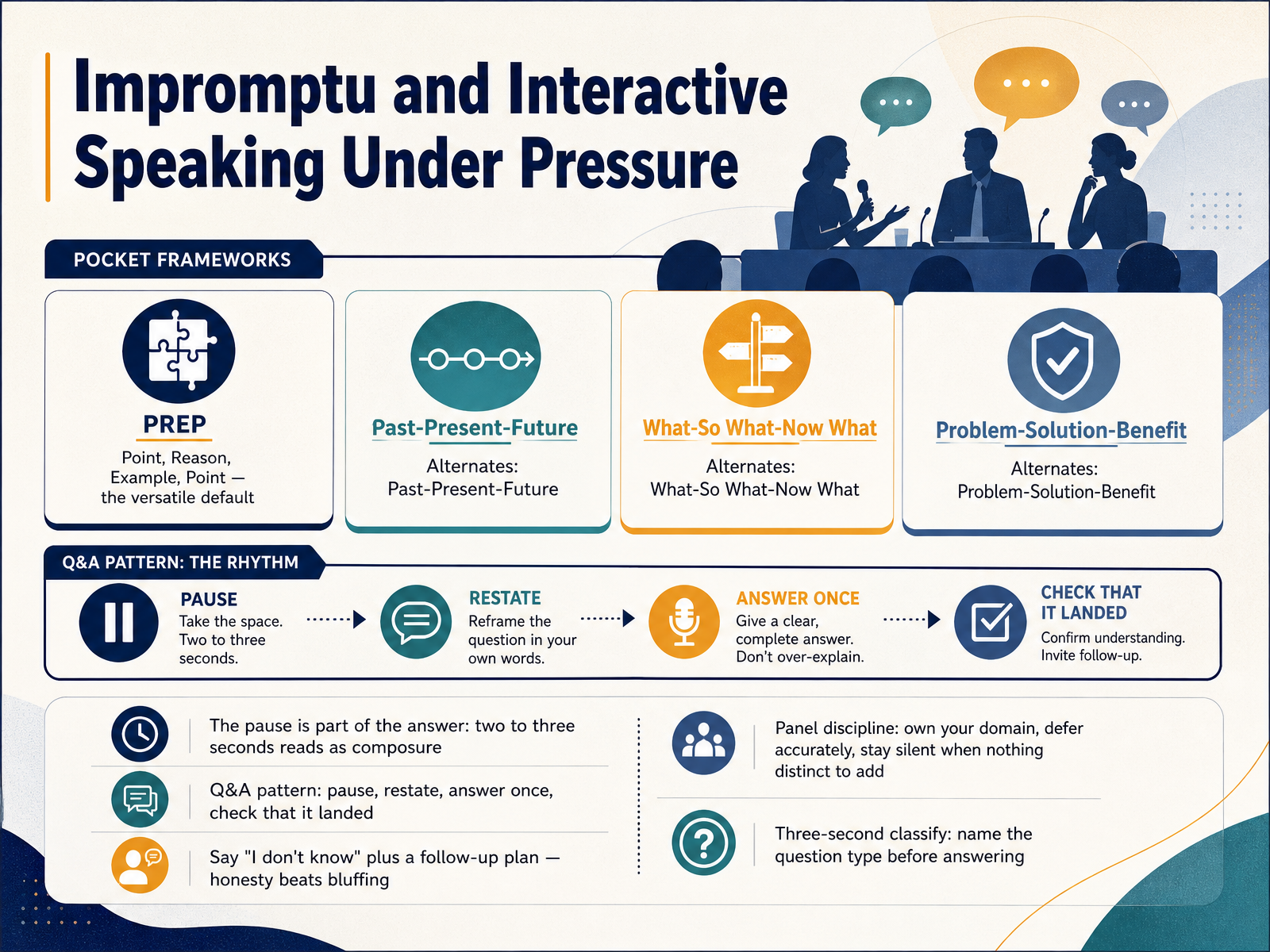
- 11Impromptu and Interactive Speaking Under PressureNow let's talk about speaking when you have no time to prepare. Impromptu moments show up everywhere. Q and A sessions, panels, interviews, meetings, hallway chats, and unplanned toasts. Your default here is PREP. Point, Reason, Example, Point. Make your point first, explain why it matters, give one example, then land the point again. For different situations you can swap in Past-Present-Future for updates, What-So What-Now What for implications, or Problem-Solution-Benefit for recommendations. One quick self-check. What type of question was asked? Opinion, update, or recommendation? That tells you which structure to reach for. The pause is part of the answer. Two to three seconds reads as composure, not hesitation. In Q and A, use a simple pattern. Pause, restate the question so the room hears it, answer once, then check that it landed. And if you genuinely do not know, say so plainly, then add your follow-up plan. Honesty beats bluffing every time. On a panel, own your domain, defer accurately to the right person, and stay silent when you have nothing distinct to add. Silence is confidence, not weakness. Here is your takeaway. Classify the question in three seconds, choose your frame, and trust the pause. That is how you stay composed when the pressure is real. Next, we will look at Adapting One Message Across Formats.
 1 min
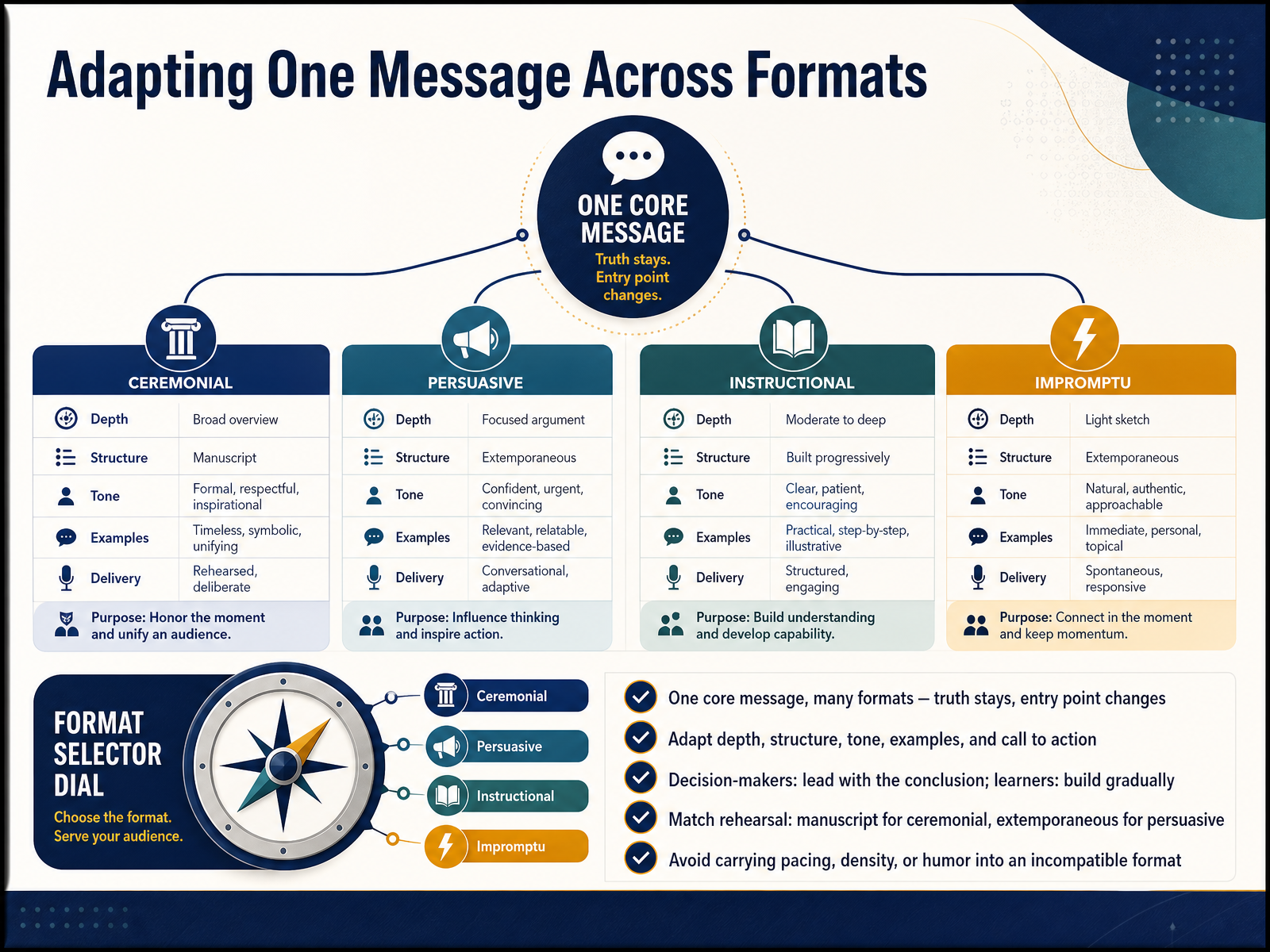
- 12Adapting One Message Across FormatsLet's pull it all together. Here is the big idea: you can carry one core message across many formats. The truth stays the same. What changes is the entry point. So when you adapt, adjust five things: depth, structure, tone, examples, and your call to action. Ask yourself, who is in this room, and what do they need from this moment? If you are speaking to decision-makers, lead with the conclusion, then support it. This works best if their time is short and they need to act. If you are speaking to learners, build gradually, because they need context before conclusions. Match your rehearsal to the format too. Ceremonial moments often call for a manuscript, so every word lands with care. Persuasive talks usually work best extemporaneous, so you can respond to the room. One quick self-check before you switch formats: does your pacing, density, and humor still fit this audience and setting? If not, adjust them. Same message, new path in. Next, we will build your Format Decision Matrix and next steps.
 ecampusontario.pressbooks.pubwustl.pressbooks.pubopenfl.pressbooks.pub+22 min
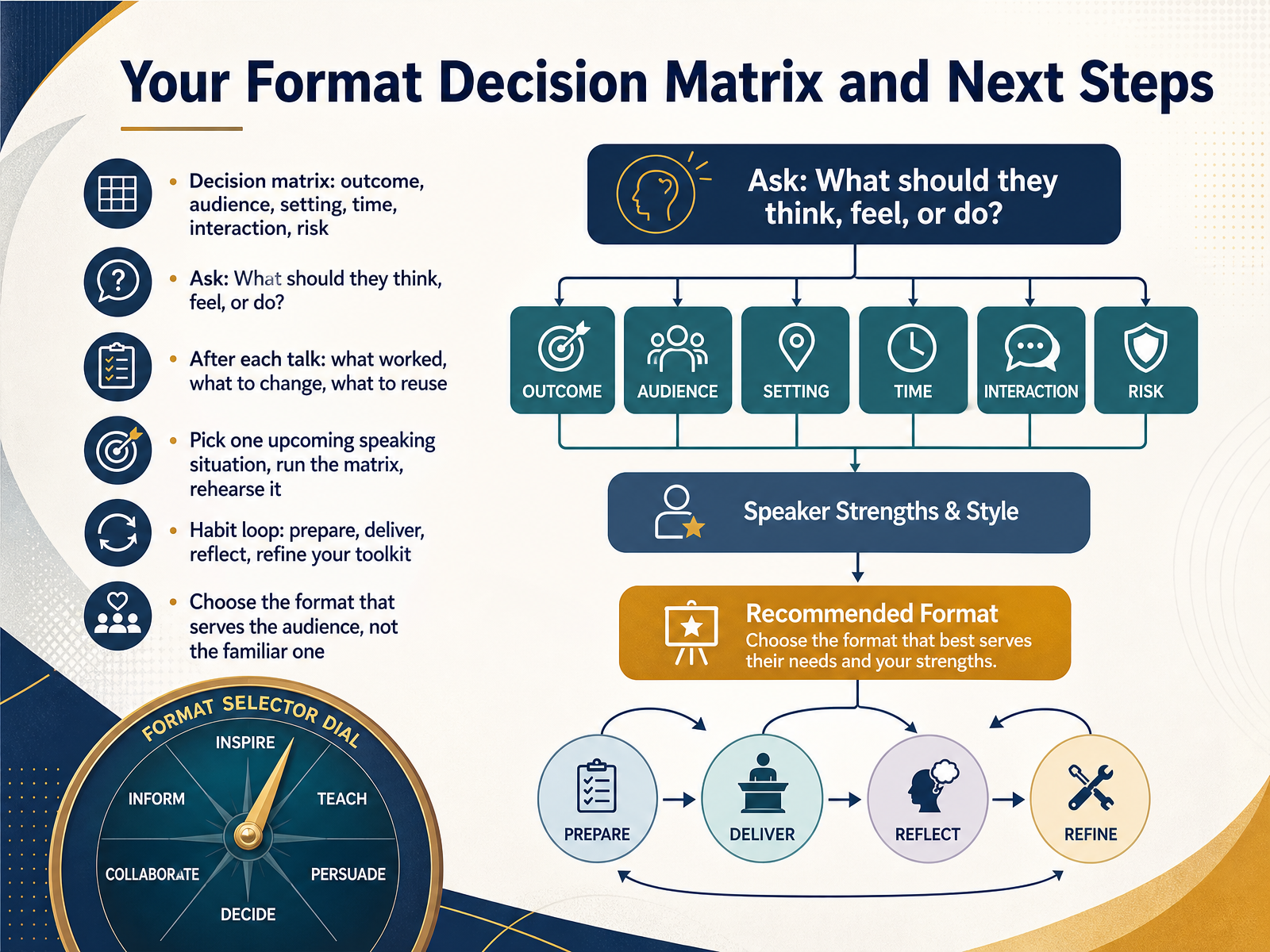
- 13Your Format Decision Matrix and Next StepsLet's bring it all together. Your format decision matrix asks six simple questions: What outcome do you want? Who is the audience? What is the setting? How much time do you have? How much interaction do you need? And what is the risk if the message lands poorly? Each answer points you toward a format. Before you speak, ask one more question: what should they think, feel, or do? After every talk, review three things: what worked, what to change, and what to reuse. Then pick one upcoming speaking situation, run it through the matrix, and rehearse it. That is your habit loop: prepare, deliver, reflect, and refine your toolkit. And remember the core principle. Choose the format that serves your audience, not the one that feels most familiar. You have the framework now. Trust it, use it, and keep growing as a speaker. Thank you for learning with me.
 ecampusontario.pressbooks.pubwustl.pressbooks.pubopenfl.pressbooks.pub+22 min
Take the deck with you
Download this course as a file — free, no sign-up needed.
- PDF handoutEvery slide page, ready to print or share.14 pages · 4.6 MBDownload
- Narrated PowerPointThe deck that presents itself — every slide carries the digital human's narration video.14 pages · 14.7 MBDownload
- PowerPoint slidesThe full deck as a .pptx — open it in PowerPoint, Keynote, or Google Slides.14 pages · 4.6 MBDownload
Free to use in your own training — please keep the PersonWise credit page at the end.
Have your own deck? Turn it into a course
Sources consulted
Web sources consulted while building this course.
- Types of Speeches: 4 Categories, 10 Subtypes & Speaking Styles — gamma.com.ai
- Public Speaking: Types, Examples, and Tips to Nail It — ahaslides.com
- Types of Speeches Explained: How to Choose the Right Format — teleprompter.works
- Informal and Special Occasion Speeches – Public Speaking for Modern Learners: Self-Assurance, Adaptability, and Professional Growth — wustl.pressbooks.pub
- Toastmasters International -Exploring 5 Types of Speeches — toastmasters.org
- Hybrid Presentation Mistakes: Why Remote People Check Out — winningpresentations.com
- Hybrid Presentations Best Practices: Part 1 Planning - Julie Hansen — juliehansen.live
- Hybrid Presentations: When Half the Room Disconnects (And How to Fix It) — winningpresentations.com
- Virtual & Hybrid Presentation Design: Engagement Practices — slidesorbis.com
- Tips for an Effective Hybrid Presentation – DS News — dsnews.co.uk
- 14.3 Planning the Presentation – Pre-health Science Pathways to Success — ecampusontario.pressbooks.pub
- Audience Analysis and The Research Stage – Public Speaking for Modern Learners: Self-Assurance, Adaptability, and Professional Growth — wustl.pressbooks.pub
- Chapter 5: Selecting a Topic and Adapting to the Audience – Introduction to Public Speaking — openfl.pressbooks.pub
- Chapter 6: Finding a Purpose and Selecting a Topic – Stand Up, Speak Out 3rd Edition — milnepublishing.geneseo.edu
- Speaking Occasion – Public Speaking as Performance — opentext.ku.edu
- Chapter 16: Informative Speaking – Stand Up, Speak Out 3rd Edition — milnepublishing.geneseo.edu
- How to Create an Informative Presentation | 2026 Guide — prezentium.com
- Audience Analysis - Communication - University of Pittsburgh — comm.pitt.edu
- How to Prepare and Deliver Effective Informative Public Speeches - AmberWillo — amberwillo.com
- 16.1: Informative Speaking Goals — socialsci.libretexts.org