Instructional vs Learning Design: Key Differences
Begin
12 pages · ~24 min
Instructional vs Learning Design: Key Differences
This training explains the differences between instructional design and learning design, helping educators and L&D professionals choose the right approach for their goals.
What you’ll learn
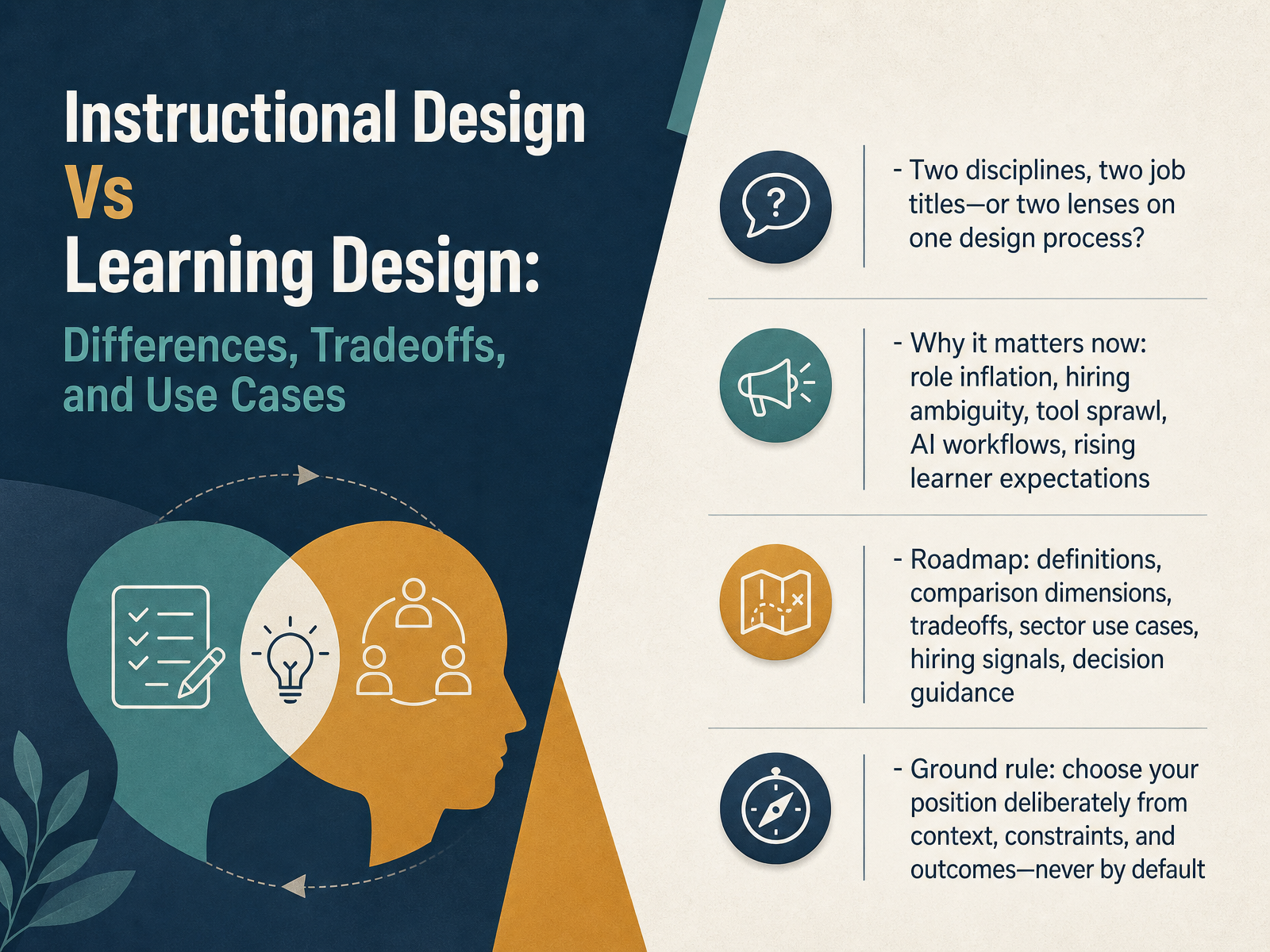
- 01Instructional Design Vs Learning Design: Differences, Tradeoffs, and Use CasesWelcome. This course is about two terms you see everywhere right now: instructional design and learning design. Are they two disciplines, two job titles, or two lenses on the same design process? Honestly, in practice, it depends on context. Here is the goal. By the end, you will be able to compare them across clear dimensions, name the tradeoffs, and choose deliberately instead of falling back on default. So why does this matter now? Role inflation is real. Hiring posts blur the titles. Tool sprawl keeps growing. AI workflows are reshaping how we build. And learner expectations keep rising. Our roadmap covers definitions, comparison dimensions, tradeoffs, sector use cases, hiring signals, and decision guidance. The ground rule for today: choose your position from context, constraints, and outcomes. Never by default. One grounding note. Research treats these as overlapping points on one continuum, not rival camps. Next, let us unpack why the terminology stays so contested.doi.orgteachers.instituterisely.me+21 min
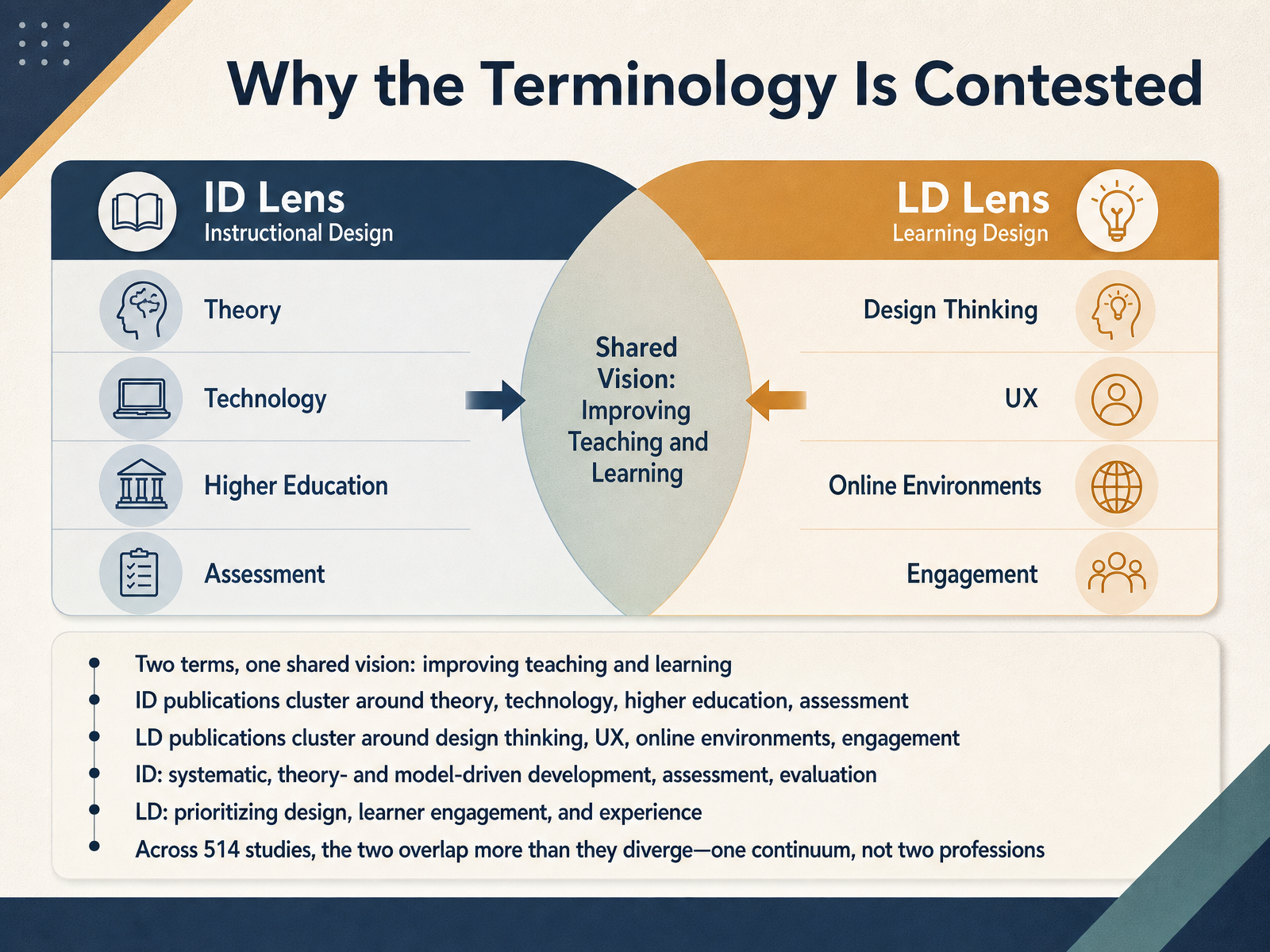
- 02Why the Terminology Is ContestedLet us dig into why the terminology is contested. Both terms share one vision, improving teaching and learning, and they are often used interchangeably. But the literature splits in revealing ways. In a review of five hundred fourteen studies, instructional design publications clustered around theory, technology, higher education, and assessment. Learning design publications clustered around design thinking, user experience, online environments, and engagement. In practice, instructional design is systematic and theory driven, focused on developing, assessing, and evaluating instruction. Learning design prioritizes design, learner engagement, and the learner's experience. Here is the key takeaway. Across all those studies, the two overlap far more than they diverge. Think of one continuum, not two professions. Each term simply highlights different practices within the same ecosystem. So when you scope a role or read a job description, treat the labels as clues about emphasis, not hard boundaries. That framing will matter as we look at origins, so let us move to origins and evolution of the two terms.
 doi.orgteachers.instituterisely.me+21 min
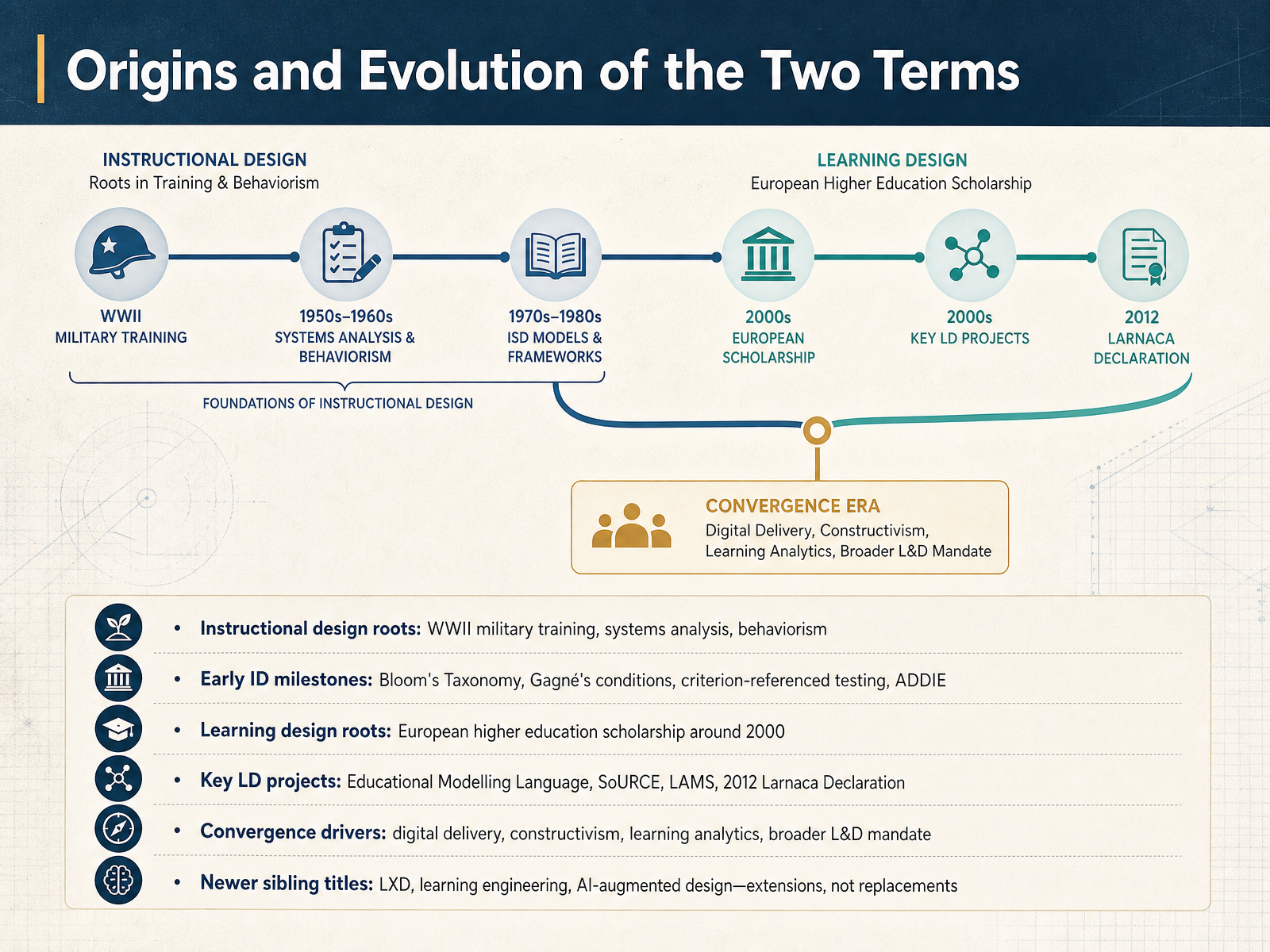
 - 03Origins and Evolution of the Two TermsLet's trace where these two terms actually come from, because the history explains the tension you still feel today. Instructional design grew out of World War Two military training. Psychologists and educators built training materials using systems analysis and behaviorist principles, and that lineage stuck. In the decades after, you get Bloom's Taxonomy, Gagné's conditions of learning, criterion-referenced testing, and eventually ADDIE. Structured, objective-driven, and built to scale. Learning design has a different starting point. It emerged from European higher education scholarship around two thousand, shaped by projects like Educational Modelling Language, SoURCE, and LAMS, and it crystalized in the twenty twelve Larnaca Declaration. The framing there was pedagogical neutrality and learner-centered design. Then the two paths started converging, driven by digital delivery, constructivism, learning analytics, and a broader L&D mandate. And newer sibling titles followed. LXD, learning engineering, AI-augmented design. In practice, those are extensions, not replacements. So next, let's put these two concepts side by side. Core Concepts Side by Side.
 elearnmag.acm.orgesmartarena.comdoi.org+22 min
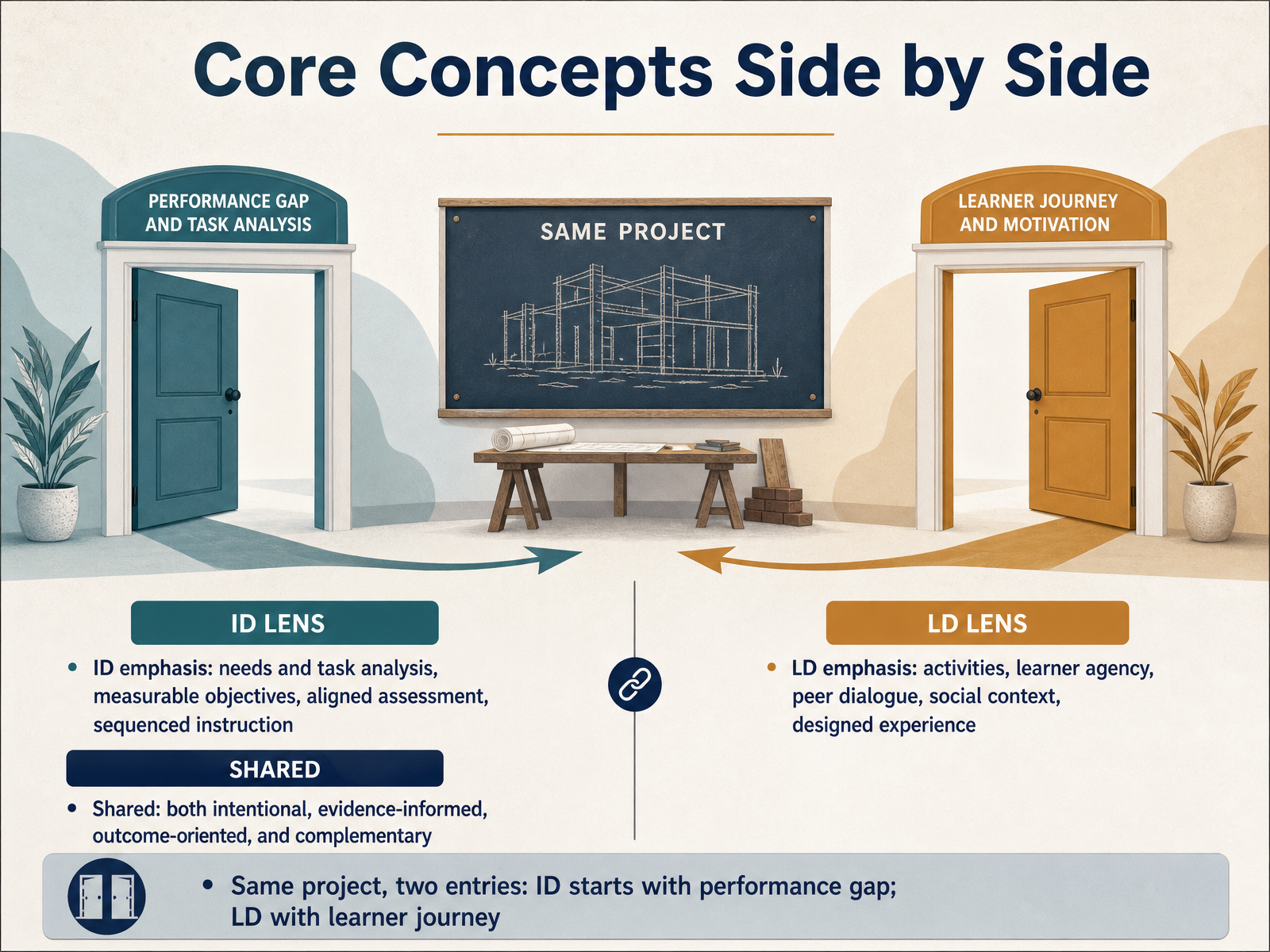
 - 04Core Concepts Side by SideLet's put the two side by side. Instructional design emphasizes needs and task analysis, measurable objectives, aligned assessment, and sequenced instruction. In practice, that's your ADDIE-style rigor: what's the performance gap, what should learners be able to do, and how will we prove it. Learning design emphasizes activities, learner agency, peer dialogue, social context, and the designed experience. Its question is different: what will learners actually do, and how will that journey feel? Here's the key point. They're not opposites. Both are intentional, evidence-informed, and outcome-oriented. The tradeoff is emphasis, not values. So look at the same project through two entries. Instructional design starts with the performance gap. Learning design starts with the learner journey. Same destination, different first step. Five Comparison Dimensions That Actually Matter.
 doi.orgteachers.institutehttps-sage-cnpereading-com-443.webvpn1.xju.edu.cn+22 min
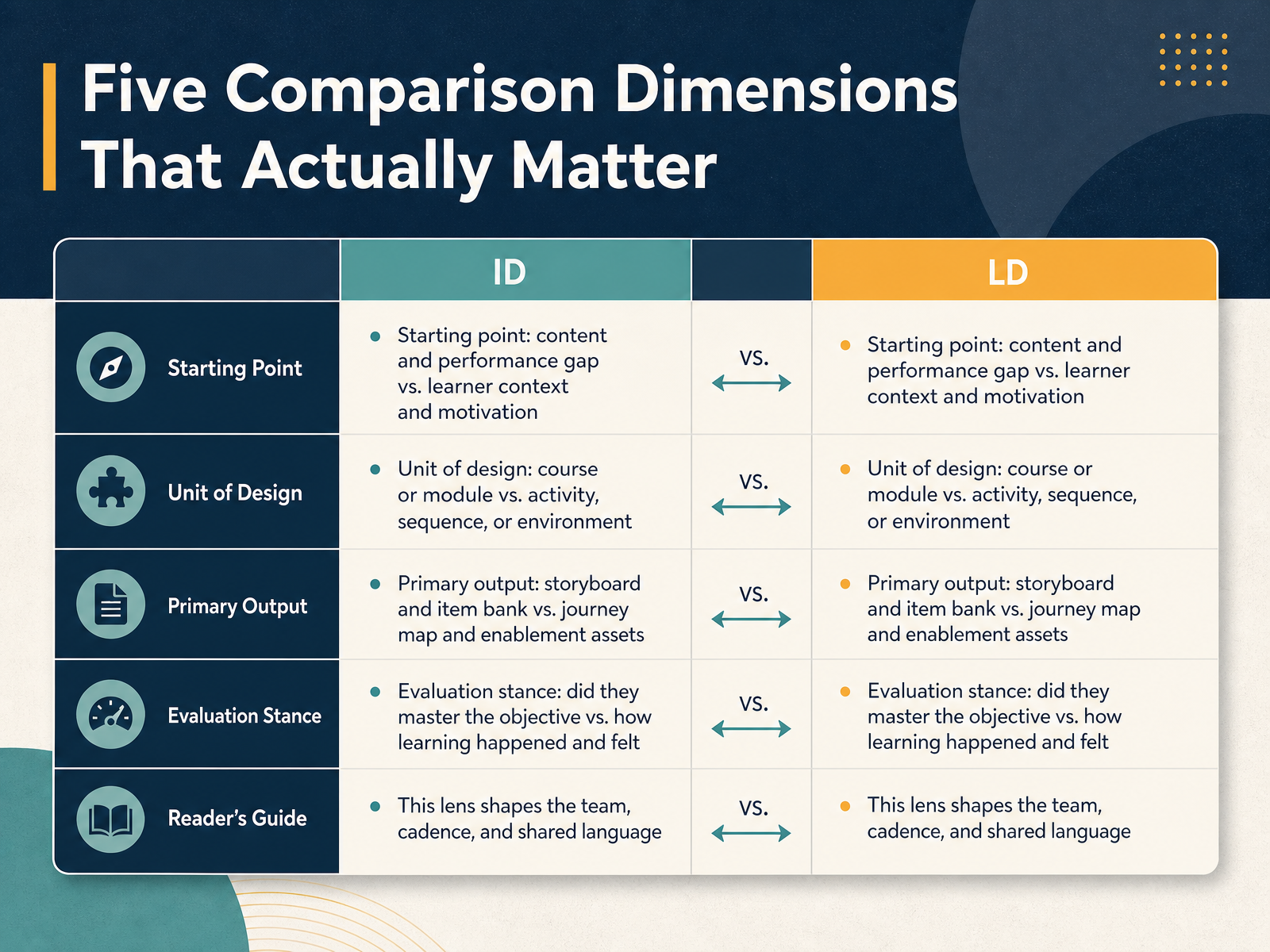
 - 05Five Comparison Dimensions That Actually MatterLet's make this practical. Five comparison dimensions that actually matter. First, the starting point. Instructional design often begins with content and the performance gap. Learning design starts with learner context and motivation. Second, the unit of design. Is it a course or module, or an activity, a sequence, or a whole environment? Third, the primary output. Think storyboard and item bank, versus journey map and enablement assets. Fourth, evaluation stance. Did they master the objective, or how learning happened and felt? And fifth, this lens shapes the team, the cadence, and the shared language. In practice, choose instructional depth when accuracy and assessment validity are your top risk. Choose learning design breadth when adoption and workflow integration matter more. Most teams need both, sequenced deliberately. Next, tradeoffs: speed, rigor, scale, and experience.
 doi.orgteachers.institutehttps-sage-cnpereading-com-443.webvpn1.xju.edu.cn+22 min
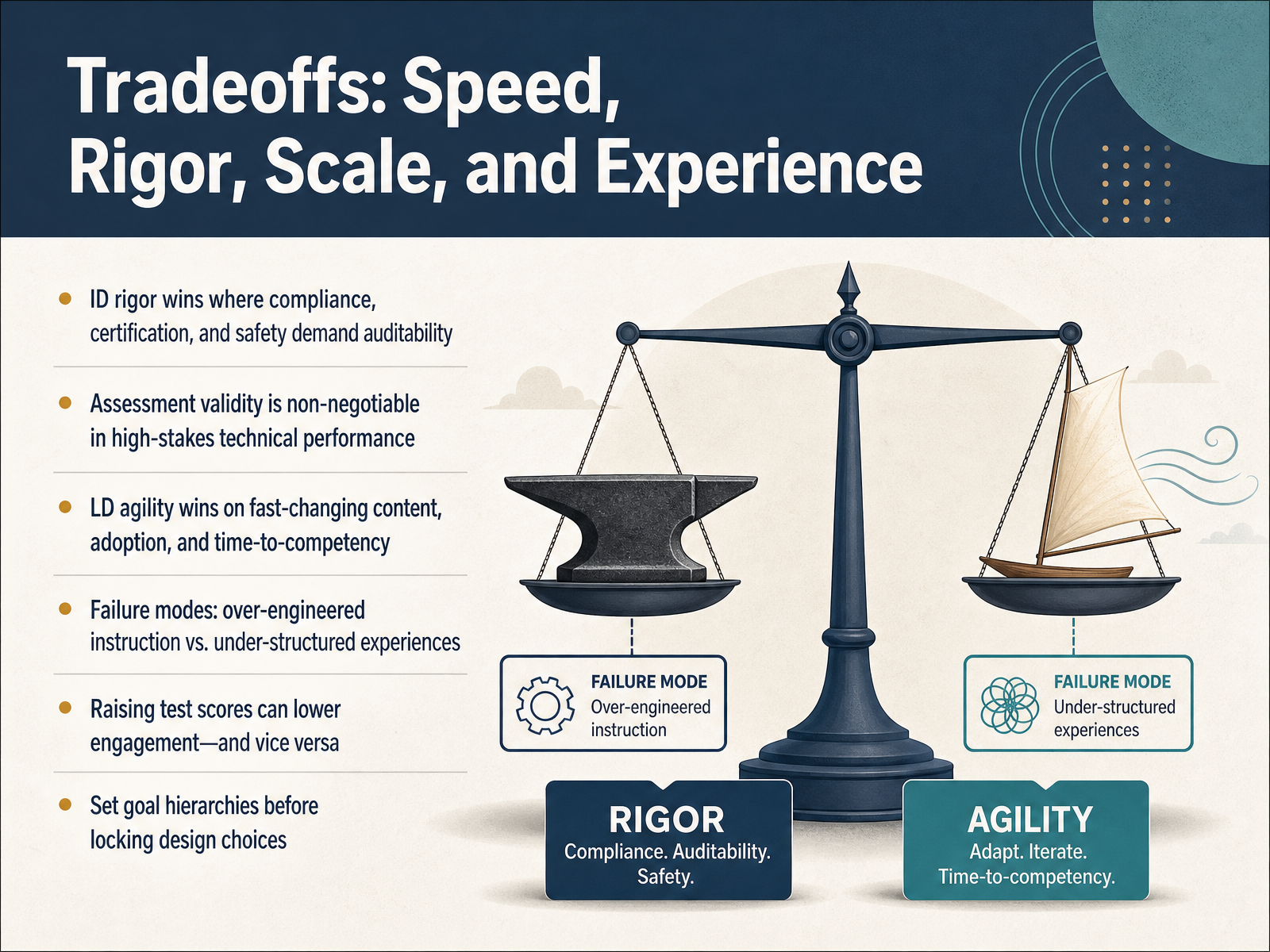
 - 06Tradeoffs: Speed, Rigor, Scale, and ExperienceNow let's get into the tradeoffs: speed, rigor, scale, and experience. This is where design philosophy meets business reality. Instructional design rigor wins where compliance, certification, and safety demand auditability. In regulated environments, assessment validity is non-negotiable, especially for high-stakes technical performance. You need evidence that a learner can do the job safely and correctly. On the other side, learning design agility wins on fast-changing content, adoption, and time-to-competency. When the product changes every quarter, you need experiences that flex, not courses that lock. The tradeoff is real. Watch for two failure modes: over-engineered instruction that nobody finishes, and under-structured experiences that feel fun but don't build competence. And here's the tension researchers keep documenting. Raising test scores can lower engagement, and vice versa. These aren't always compatible. So set your goal hierarchy before you lock design choices. Decide what matters most, then let that drive your method. Next, we'll look at hybrid practice and how to use both deliberately.
 website.education.wisc.edudoi.orgdoi.org+21 min
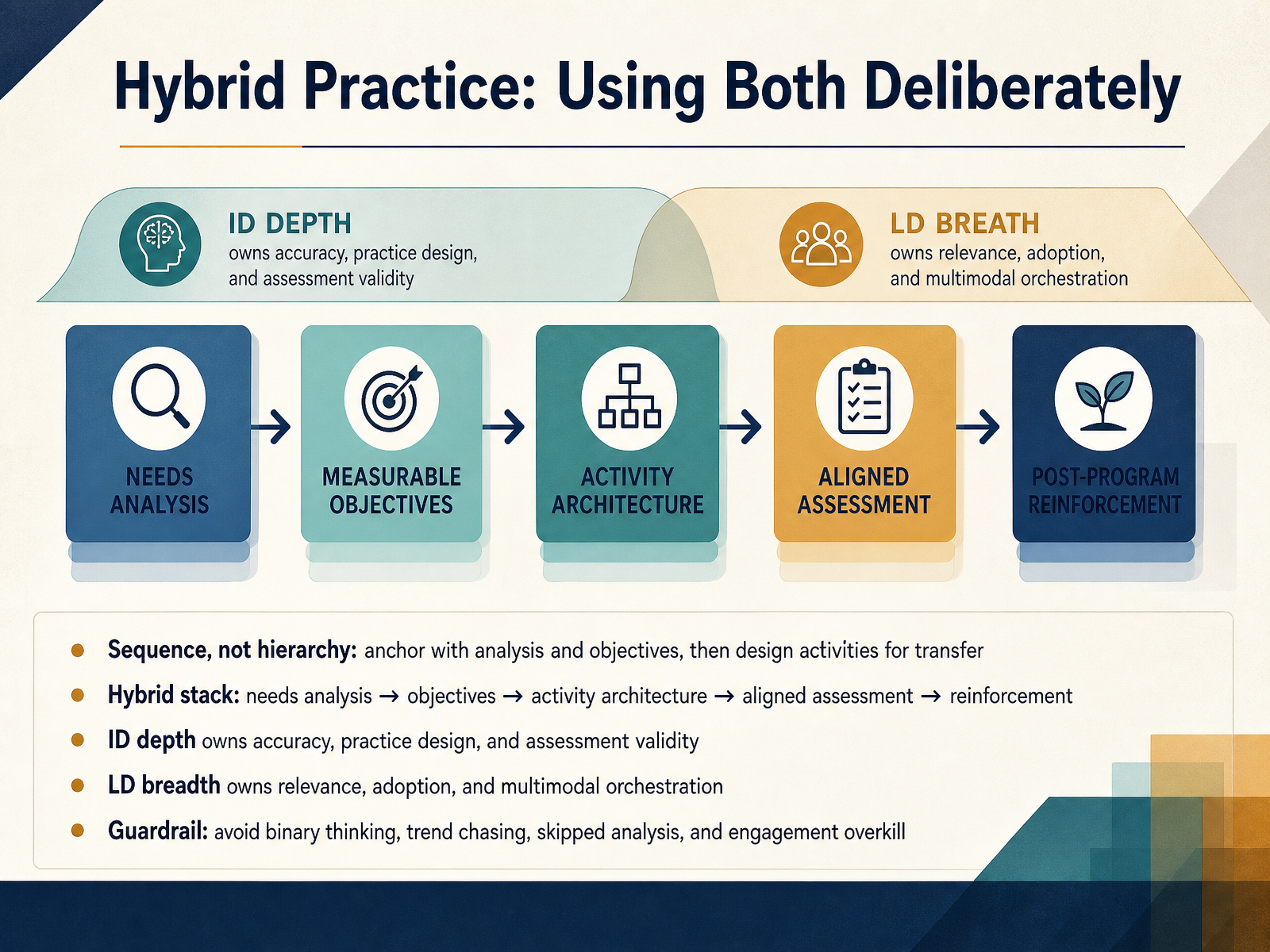
 - 07Hybrid Practice: Using Both DeliberatelyNow let's talk about hybrid practice, using both approaches deliberately. The key idea here is sequence, not hierarchy. Anchor your design work with analysis and objectives first, then design activities that drive transfer. In practice, a hybrid stack looks like this. Needs analysis, objectives, activity architecture, aligned assessment, then reinforcement. Both perspectives add real value. Instructional design depth owns accuracy, practice design, and assessment validity. Learning design breadth owns relevance, adoption, and multimodal orchestration. So if your top risk is instructional quality or audit readiness, lead with that depth. If your challenge is adoption and business alignment, lead with that breadth. A practical split that works well: instructional design drives accuracy and practice, while learning design drives relevance and adoption. But watch the guardrails. Avoid binary thinking that pits one camp against the other. Avoid trend chasing. Avoid skipped analysis. And avoid engagement overkill that adds polish without producing capability. Choose this hybrid approach when headcount is limited and you need end-to-end value from one team. The takeaway is simple: respect the science of learning, master the art of the experience, and use both on purpose. That sets up our next discussion, Use Cases Across Sectors.
 doi.orgteachers.institutehttps-sage-cnpereading-com-443.webvpn1.xju.edu.cn+22 min
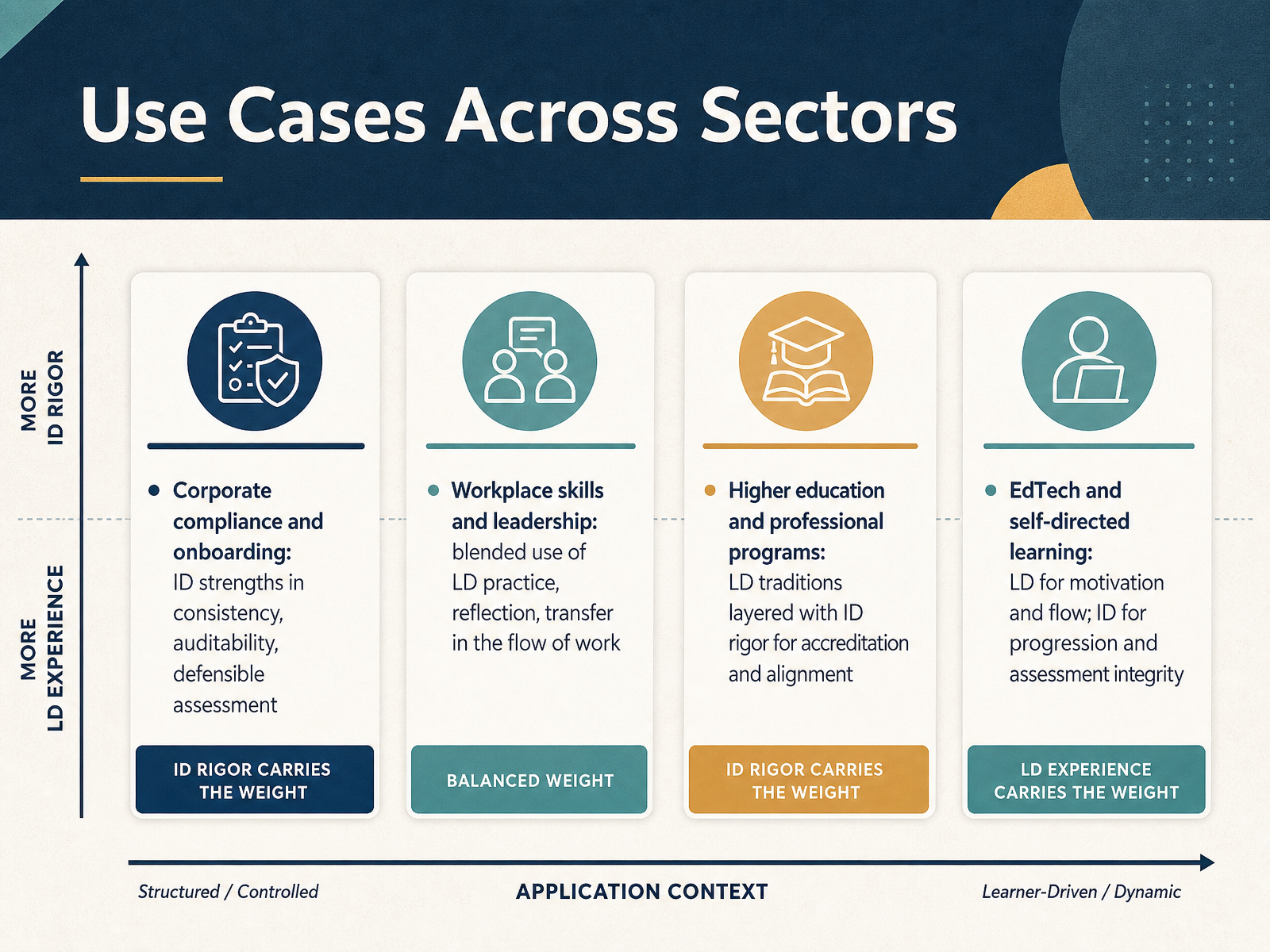
 - 08Use Cases Across SectorsNow let's look at use cases across sectors, because the right blend depends on context. In corporate compliance and onboarding, ID strengths win: consistency, auditability, and defensible assessment. Choose this when the risk is audit readiness, not engagement. For workplace skills and leadership, blended practice works better. LD habits like reflection, cohort discussion, and transfer in the flow of work keep learners applying what they learn on the job. In higher education and professional programs, LD traditions get layered with ID rigor: outcomes alignment, rubrics, and accreditation evidence. In EdTech and self-directed learning, split the work. LD drives motivation, flow, and progression design. ID protects assessment integrity and verified skill claims. The tradeoff is simple. ID buys you evidence and scale. LD buys you adoption and stickiness. Most mature teams stop choosing sides and scope both into the plan. Next, we'll cover roles, skills, and hiring signals.
 mediatum.ub.tum.denatalieberkman.mla.hcommons.orglink.springer.com+22 min
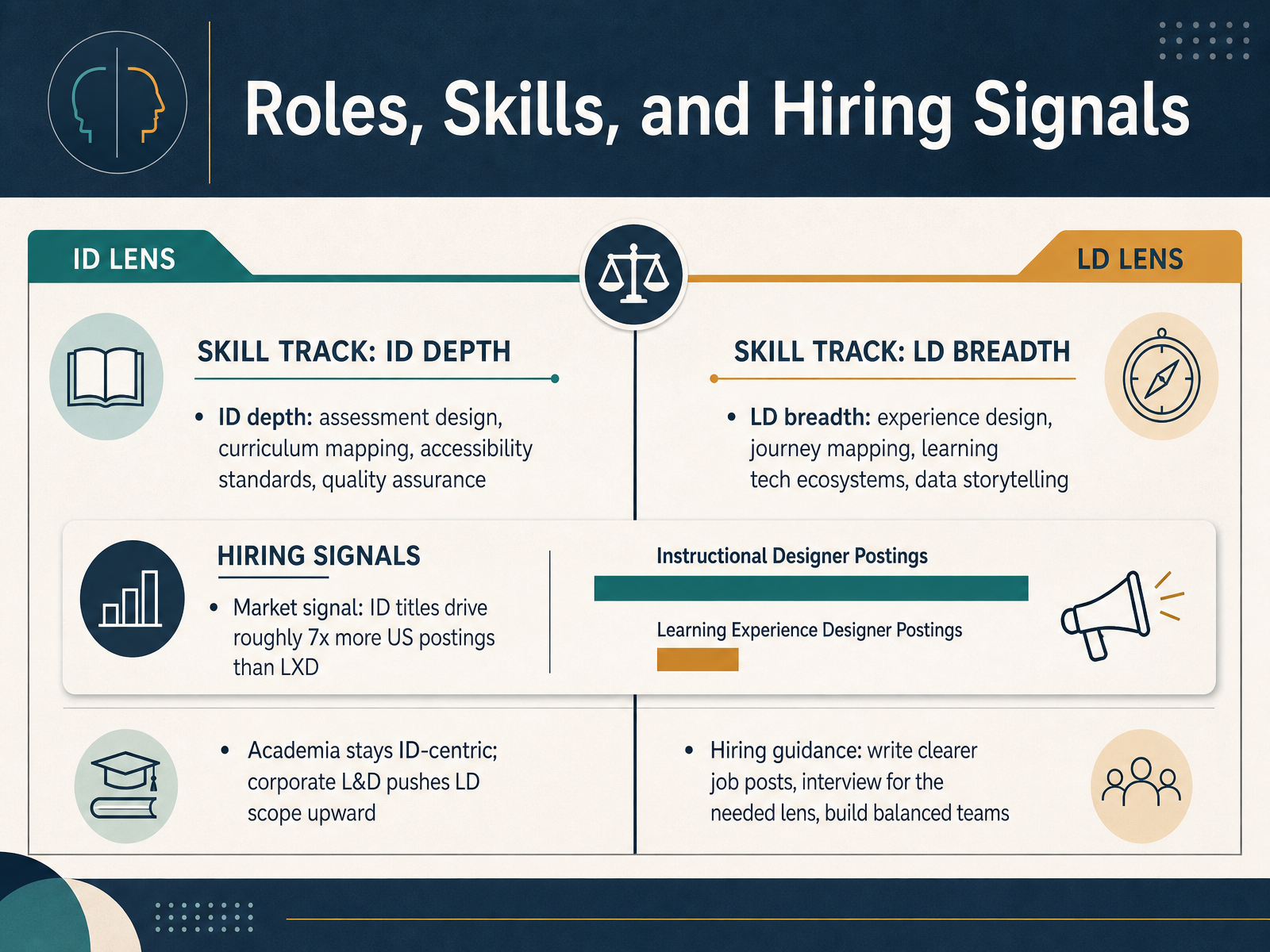
 - 09Roles, Skills, and Hiring SignalsLet's talk about who you actually hire, and how you write the role. Both profiles share a common core: needs analysis, storyboarding, authoring tools, evaluation, and stakeholder management. That overlap is real, so don't interview as if these are two different professions. The difference is depth versus breadth. Instructional design depth shows up in assessment design, curriculum mapping, accessibility standards, and quality assurance. Learning design breadth shows up in experience design, journey mapping, learning technology ecosystems, and data storytelling. The market signal is lopsided: instructional design titles drive roughly seven times more US postings than learning experience design. Academia stays instructional design centric, while corporate L and D keeps pushing the learning design scope upward. So here's the hiring guidance. Write clearer job posts that name the lens you need. Interview for that lens, not the label. And build balanced teams, because accuracy and adoption usually come from different strengths. Next, let's look at practical strategies for teams.
 esmartarena.comteachers.institutedoi.org+22 min
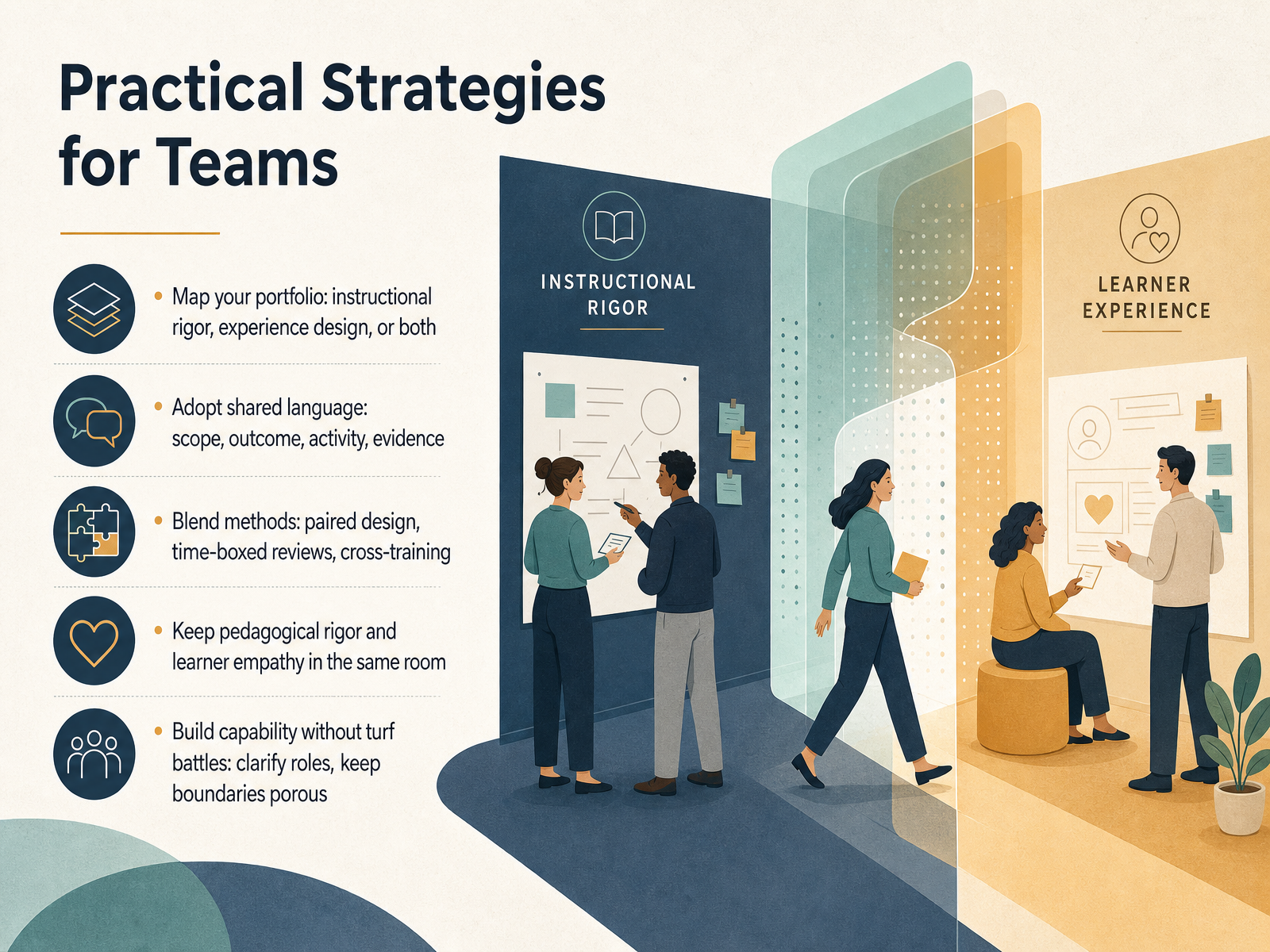
 - 10Practical Strategies for TeamsLet's make this practical for teams. Start with your portfolio. Map each person honestly: do they bring instructional rigor, experience design, or both? That tells you where you need coverage. Next, adopt shared language. Agree on four words: scope, outcome, activity, evidence. When everyone means the same thing, meetings get shorter and reviews get sharper. Then blend methods. In practice, pair designers on the same project, time-box your reviews, and cross-train deliberately. One practical goal: keep pedagogical rigor and learner empathy in the same room. The tradeoff is tempo, but the payoff is stronger work. Finally, build capability without turf battles. Clarify roles, then keep boundaries porous. Role clarity manages expectations; porosity lets people fill gaps and grow. Do both, and the team gets results and capacity at the same time. Next, we'll look at the decision framework and common pitfalls.
 esmartarena.comteachers.institute2 min
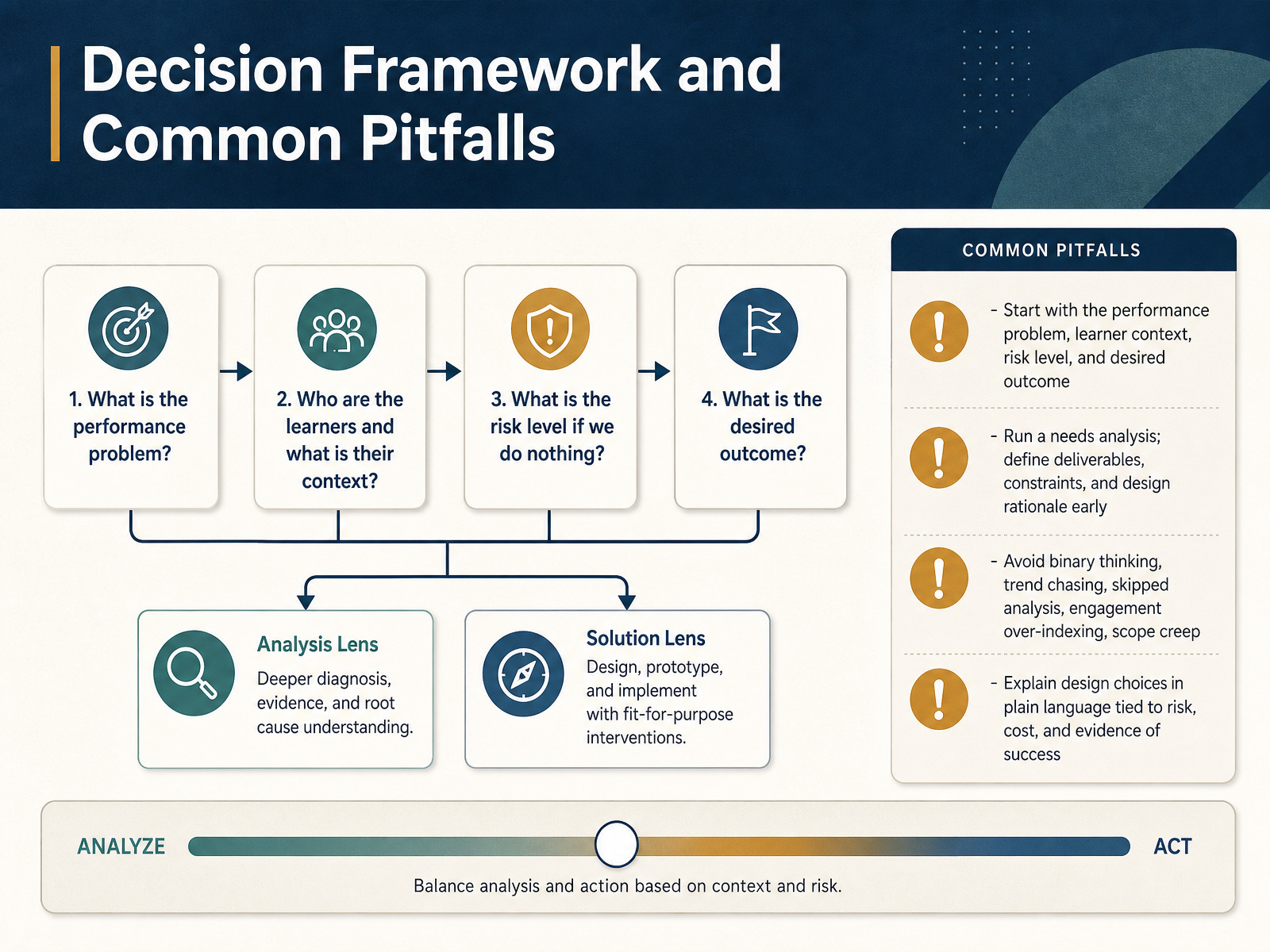
 - 11Decision Framework and Common PitfallsLet's bring this together with a decision framework. Start with four inputs: the performance problem, the learner context, the risk level, and the desired outcome. Those four drive every choice that follows. In practice, run a needs analysis before you design anything. Then define deliverables, constraints, and your design rationale early, and write them down, so scope creep has a document to argue with. Now, the common pitfalls. Avoid binary thinking, like instructional design versus learning design as a turf war. Avoid trend chasing. Avoid skipping analysis. Avoid over-indexing on engagement at the expense of performance. And watch for scope creep. Finally, explain design choices in plain language tied to risk, cost, and evidence of success. That's what earns trust with stakeholders and hiring managers. Next, let's pull this into your key takeaways and action plan.
 website.education.wisc.edudoi.orgdoi.org+21 min
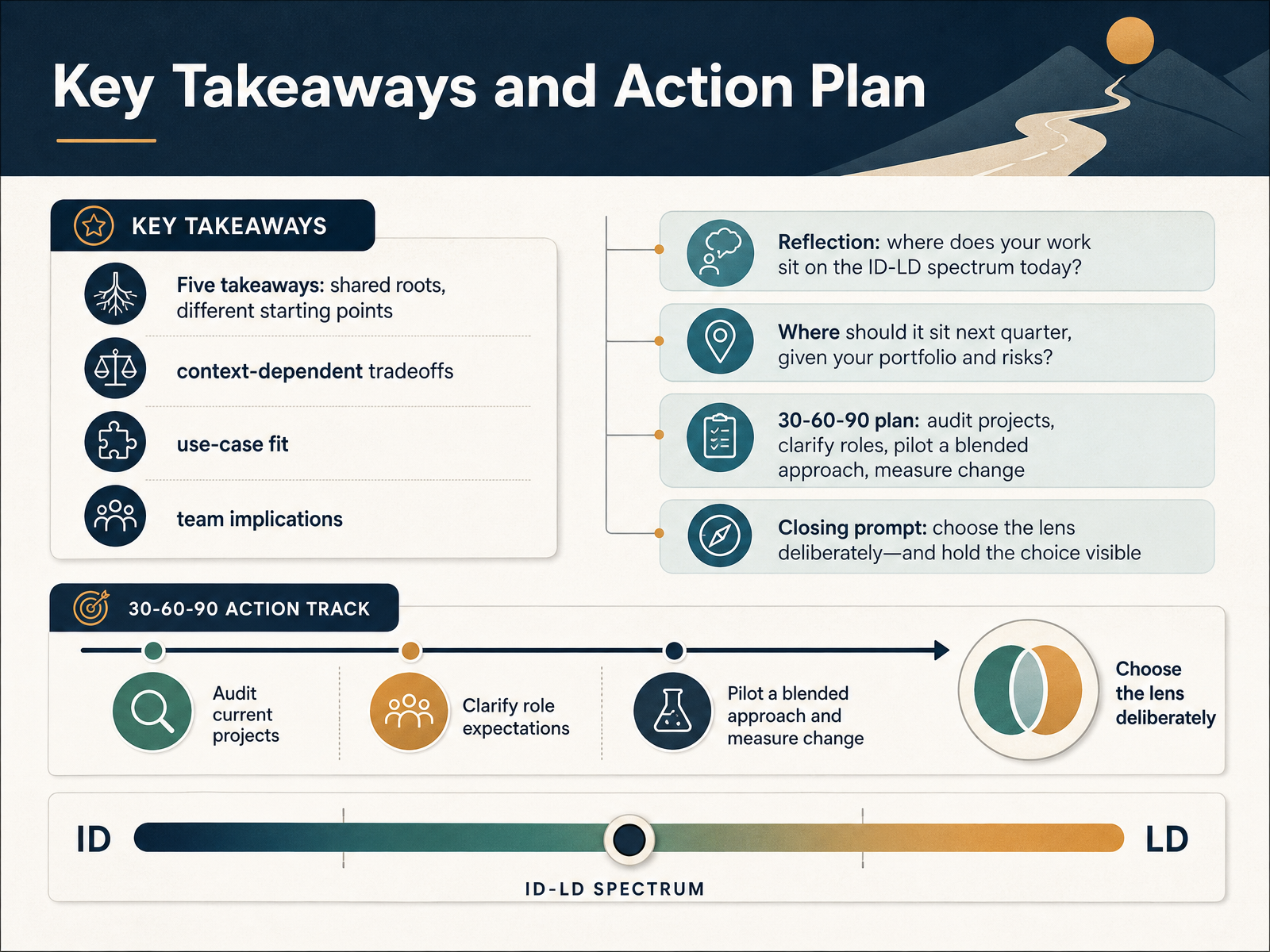
 - 12Key Takeaways and Action PlanSo let's land this. Five takeaways. First, ID and learning design share the same roots. Second, they start from different questions: what should learners know, versus how does learning fit the work. Third, the tradeoffs are context dependent. Fourth, use-case fit decides it. Fifth, it shapes how you hire and scope roles. Now reflect. Where does your work sit on the ID to LD spectrum today? And where should it sit next quarter, given your portfolio and your risks? If audit readiness is your top risk, lean ID. If adoption and speed are the challenge, lean LD. Try a 30-60-90 plan. Audit your projects, clarify roles, pilot a blended approach, then measure the change. In practice, the strongest teams build like an instructional designer and design like a learning experience designer. One closing prompt: choose the lens deliberately, and hold that choice visible. Thank you for working through this with me. Both perspectives are valid, so go apply them with intention. You've got the framework. Now make it fit your context.
 esmartarena.comteachers.institute2 min
Take the deck with you
Download this course as a file — free, no sign-up needed.
- PDF handoutEvery slide page, ready to print or share.13 pages · 3.7 MBDownload
- Narrated PowerPointThe deck that presents itself — every slide carries the digital human's narration video.13 pages · 13.0 MBDownload
- PowerPoint slidesThe full deck as a .pptx — open it in PowerPoint, Keynote, or Google Slides.13 pages · 3.6 MBDownload
Free to use in your own training — please keep the PersonWise credit page at the end.
Have your own deck? Turn it into a course
Sources consulted
Web sources consulted while building this course.
- Learning Design versus Instructional Design: A Bibliometric Study through Data Visualization Approaches — doi.org
- Learning Design vs. Instructional Design: Understanding the Difference • Teachers Institute — teachers.institute
- Learning Design: The Complete Guide for L&D Professionals — risely.me
- Courses design based on perspective human-centered learning design — doi.org
- Digital Learning Design vs Instructional Design | DLI Blog — digitallearninginstitute.com
- Down the rabbit hole: Revisiting etymology, epistemology, history and practice of instructional and learning design — elearnmag.acm.org
- What is the difference between instructional designer and learning designer? - Smart Arena — esmartarena.com
- Learning Design versus Instructional Design: A Bibliometric Study ... — mdpi.com
- Learning Design vs Instructional Design: Are They Different? — atomisystems.com
- Centering the Learner Within Instructional Design: The Evolution of Learning Design and the Emergence of Learning Experience Design (LXD) in Workforce Training and Development — https-sage-cnpereading-com-443.webvpn1.xju.edu.cn
- (Re)defining learning design: a framework fit for the twenty-first century — doi.org
- Why Interactive Learning Environments Can Have It All: Resolving Design Conflicts Between Competing Goals — website.education.wisc.edu
- Challenges and Tradeoffs of “Good” Teaching: The Pursuit of Multiple Educational Outcomes — doi.org
- Designing for engagement: a systematic literature review of multimodal e-learning in TVET and post-compulsory education — doi.org
- Problem-based learning design multi-objective optimization to smart education: a digital transformation digital literacy model of higher education | Scientific Reports — nature.com
- Design for learning: Principles, processes, and praxis — scholarsarchive.byu.edu
- Instructional Design Decoded: Bridging Theory and Practice with Insights from a Case Study and a Systematic Review — mediatum.ub.tum.de
- Applying Best Practices from Corporate Instructional Design to ... — natalieberkman.mla.hcommons.org
- AI-assisted course design through accelerators and multipliers in online higher education | Discover Education | Springer Nature Link — link.springer.com
- Design and implementation of gamified web based active learning in corporate education | Discover Education | Springer Nature Link — link.springer.com