Begin
14 pages · ~28 min
Evaluating Generative AI Quality
This training teaches professionals to evaluate generative AI output quality, covering key criteria and practical assessment methods.
A digital instructor presents all 14 pages. Hold “Ask” at any point and ask out loud — the answer comes from this course. No sign-up needed.
What you’ll learn
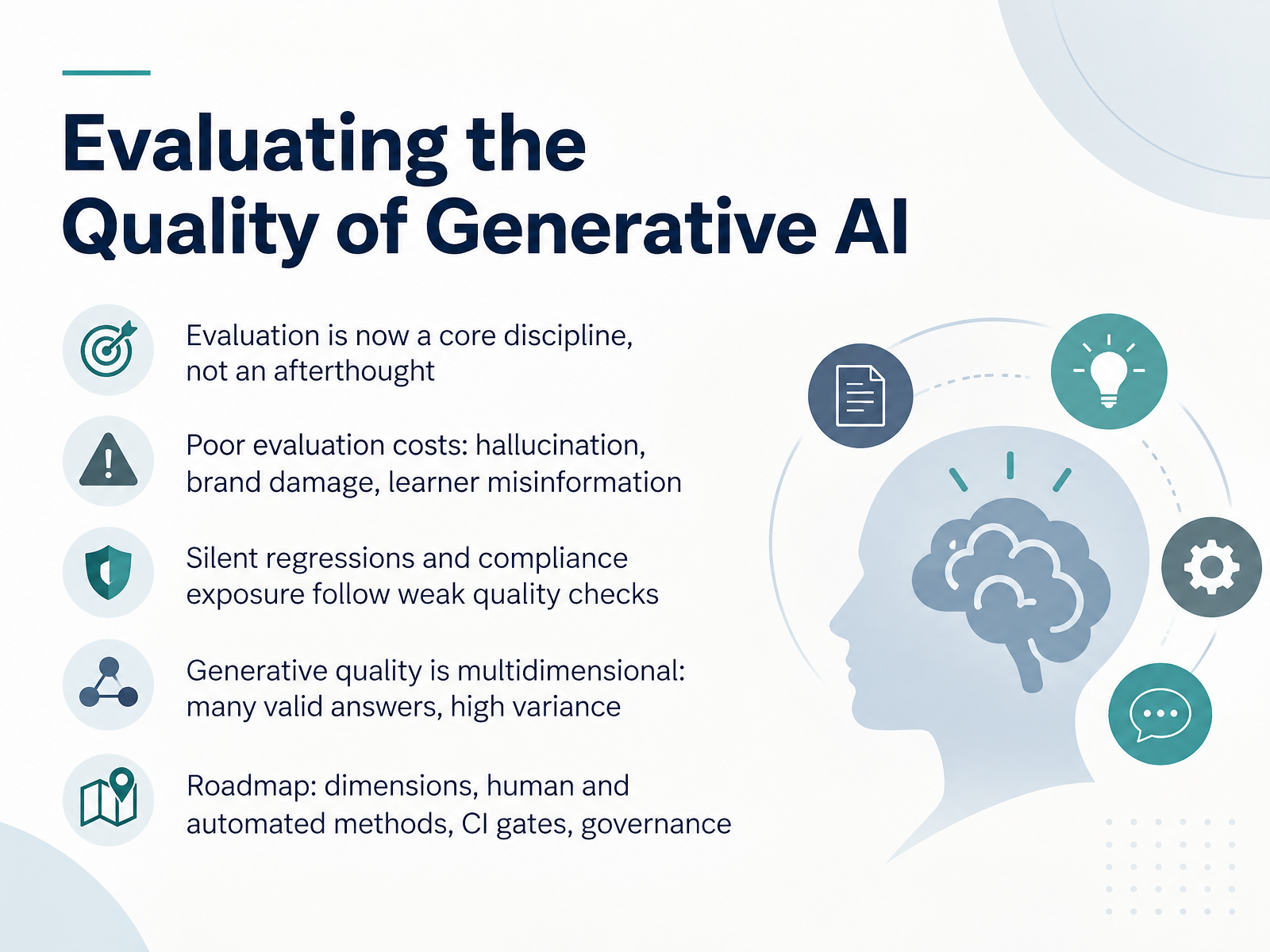
- 01Evaluating the Quality of Generative AIWelcome. I'm glad you're here. In the next few minutes, we're going to treat generative AI evaluation as a real discipline, not a checkbox at the end. Here's the core idea. Quality is now something you build, measure, and defend, continuously. When evaluation stays weak, three costs show up fast. Your model hallucinates, your brand takes the hit, and your learners get misinformation they trust. Worse, weak checks hide silent regressions. A prompt change, a model swap, and quality quietly drops. Nobody notices until compliance asks, and you can't explain the result. Here's the hard part. Generative quality is multidimensional. There are many valid answers, high variance, and no single correct output. So a single score will never tell the whole story. Over this course, we'll walk a practical roadmap. First, the quality dimensions you actually care about. Then, human and automated methods, and how to combine them. Then, continuous integration gates that catch regressions early. And finally, governance, so your team can defend every result to stakeholders. One takeaway before we move on. Evaluate early, evaluate often, and write down what you measured and why. Next, let's look at why generative AI quality is genuinely different.github.comllwang.netnature.com+22 min
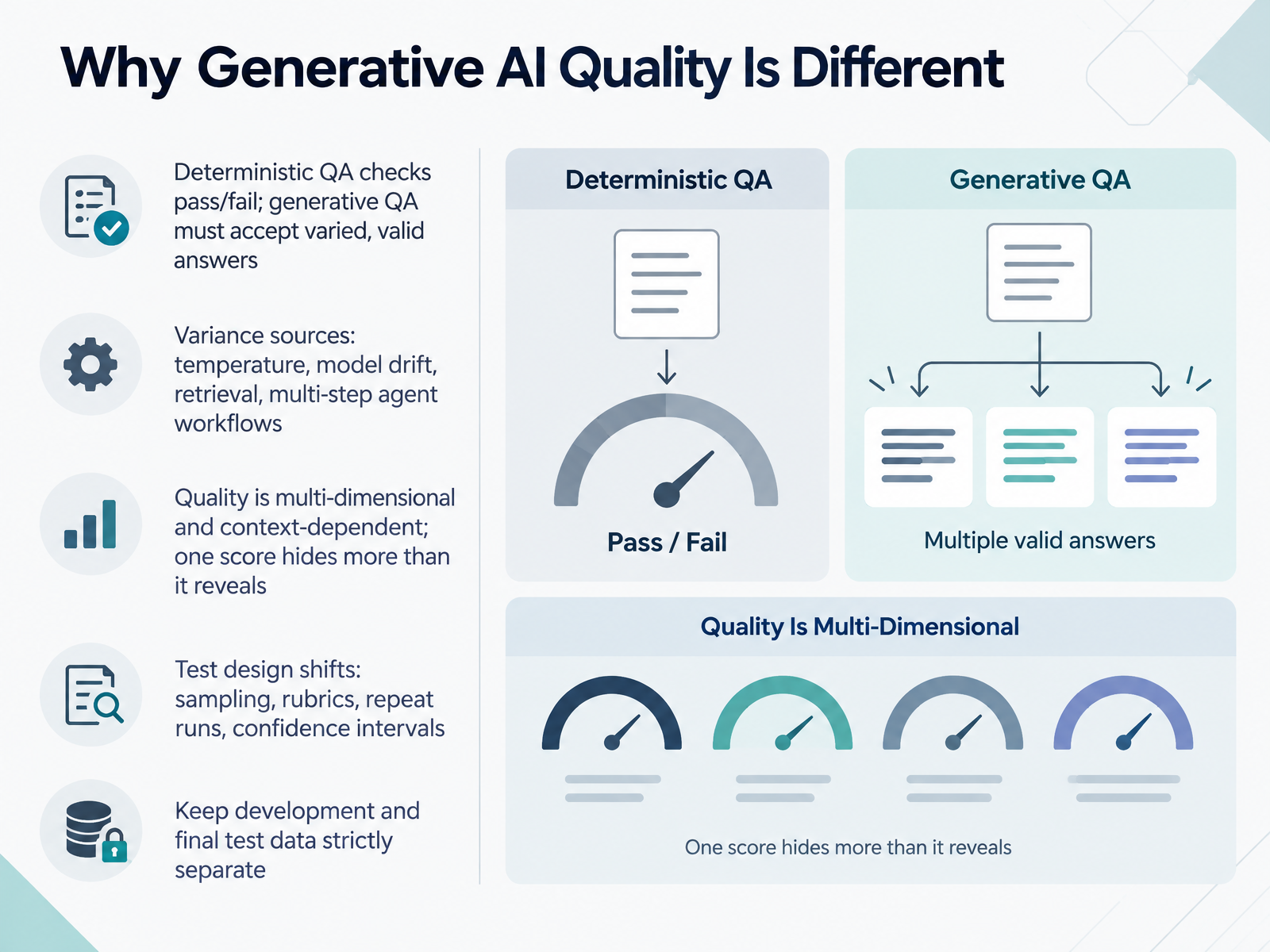
- 02Why Generative AI Quality Is DifferentLet's talk about why generative AI quality is genuinely different. With deterministic software, your tests pass or fail. With generative systems, several different answers can all be valid, so your evaluation has to accept that range. Where does the variance come from? Temperature settings, model drift over time, retrieval changes, and multi-step agent workflows. Each one moves the output. Quality is also multi-dimensional and context-dependent. A single score hides more than it reveals, so you lose the why behind a failure. That changes your test design. You move to sampling, rubrics, repeat runs, and confidence intervals. And keep development data strictly separate from your final test data, or contamination will quietly inflate your numbers. Next, we'll break down the core quality dimensions.
 aclanthology.orgdevelopers.openai.comarxiv.org+21 min
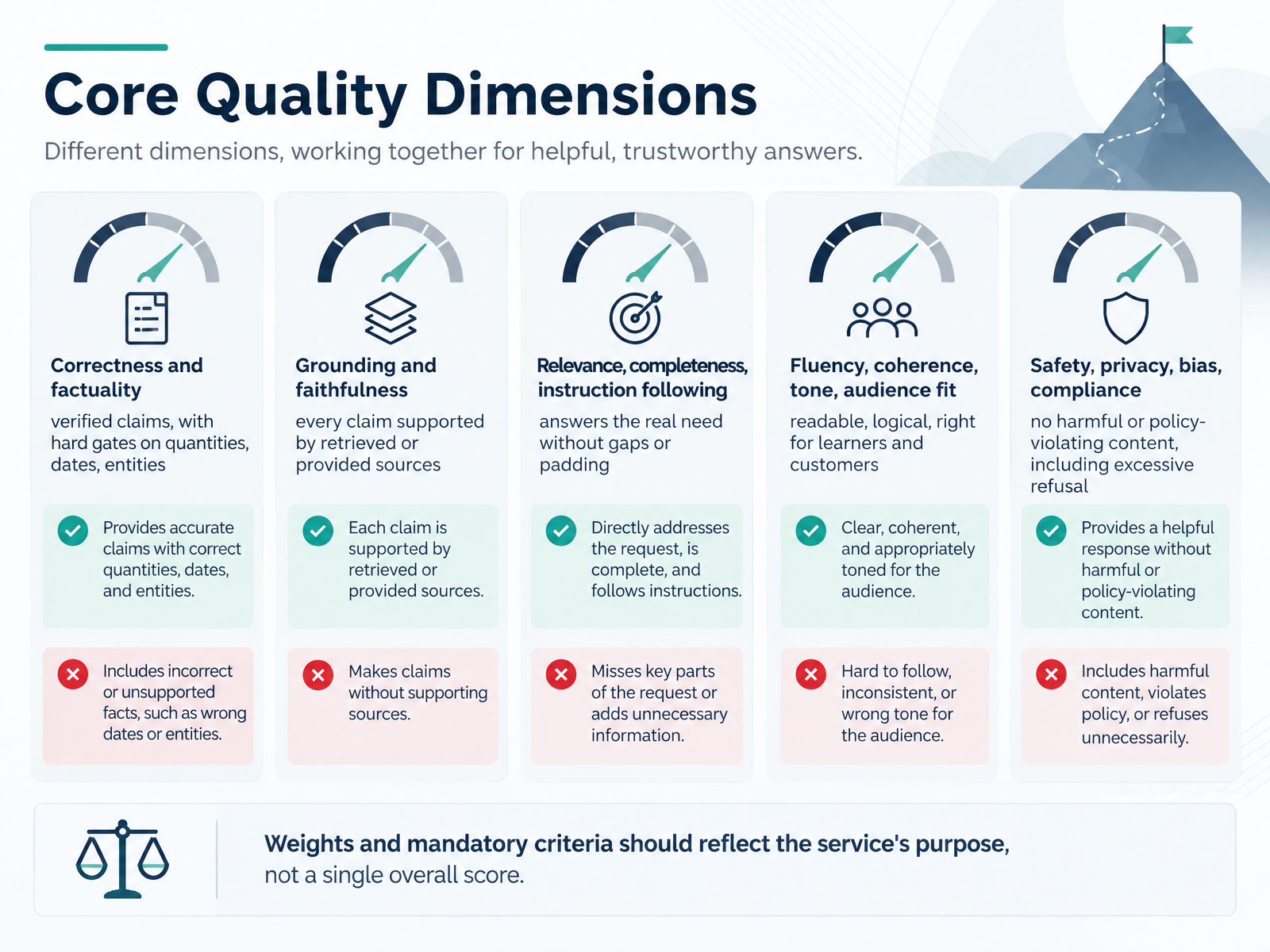
 - 03Core Quality DimensionsNow let's break quality down into the dimensions your team actually scores. First, correctness and factuality. Verify every claim, and put hard gates on quantities, dates, and entities. A wrong number fails, no matter how polished the answer looks. Second, grounding and faithfulness. Every claim should be supported by retrieved or provided sources. If it isn't in the source, it's a hallucination risk you flag. Third, relevance, completeness, and instruction following. Does the answer meet the real need, without gaps or padding? Fourth, fluency, coherence, tone, and audience fit. Is it readable, logical, and right for your learners and customers? Fifth, safety, privacy, bias, and compliance. No harmful or policy-violating content. And count excessive refusal too, because over-cautious answers fail real users. That's a real trade-off to watch. Finally, set weights and mandatory criteria around your service's purpose, not one overall score. A single number hides which gate failed. Next, we'll look at Human Evaluation and Rubric Design.
 papers.neurips.ccdlnext.acm.orgzitniklab.hms.harvard.edu+21 min
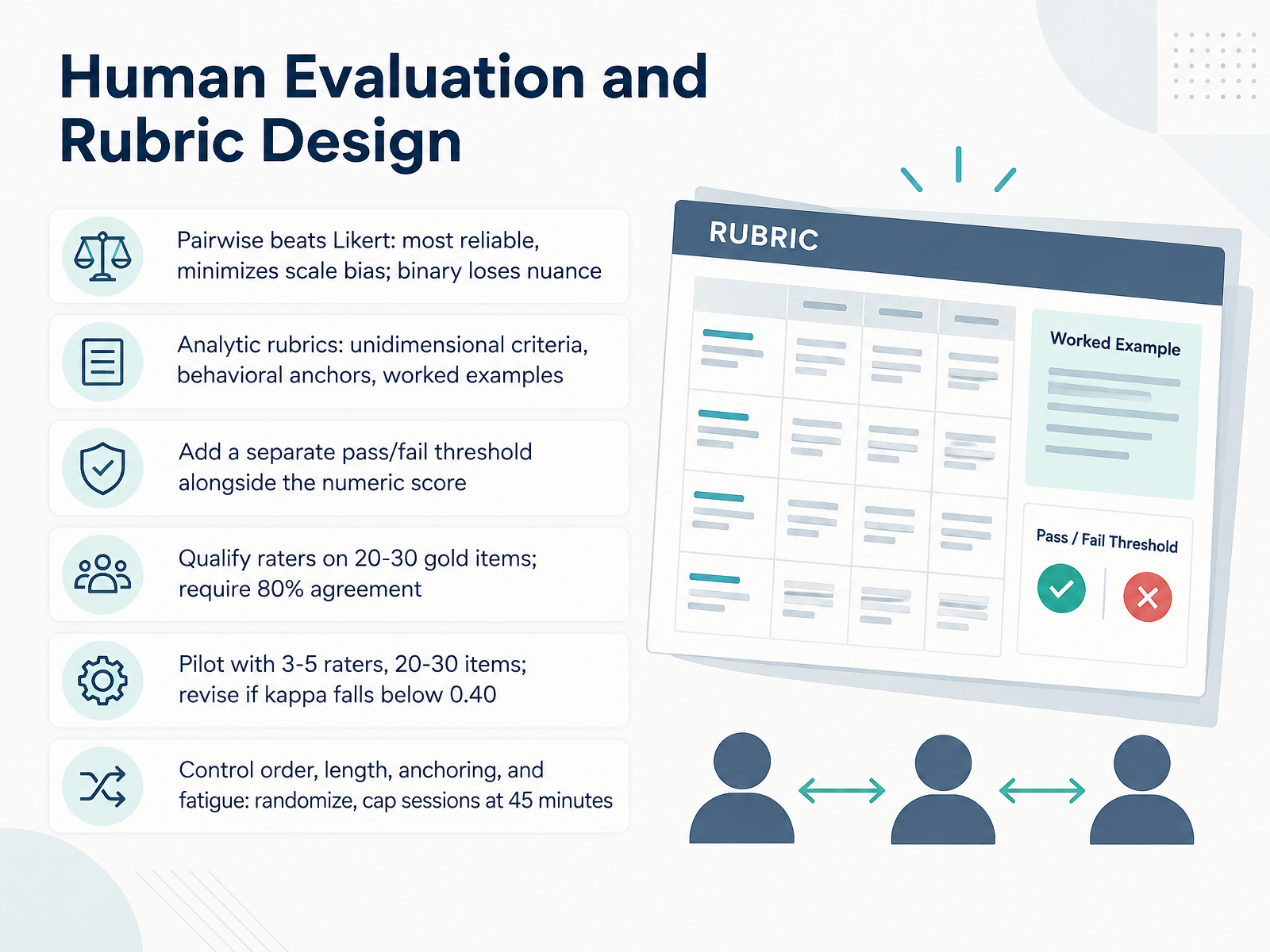
 - 04Human Evaluation and Rubric DesignNow let's talk about how you actually run human evaluation. First, pairwise beats Likert. Asking raters to pick the better of two outputs is your most reliable method, and it minimizes scale bias. Binary judgments are simple, but they lose nuance. Next, build analytic rubrics: one criterion at a time, behavioral anchors, and worked examples, so your team knows what a three looks like versus a four. Then add a separate pass or fail threshold alongside the numeric score. This matters because a fluent answer can still be unsafe, and your stakeholders need that called out. Qualify your raters on twenty to thirty gold items, and require eighty percent agreement before they touch real data. Pilot with three to five raters on twenty to thirty items. If kappa drops below zero point four zero, revise the guidelines and rerun. Finally, control order, length, anchoring, and fatigue. Randomize presentation, watch for length bias, use warm-up items, and cap sessions at forty five minutes. Next, Measuring Whether Raters Agree.
 github.comllwang.netnature.com+22 min
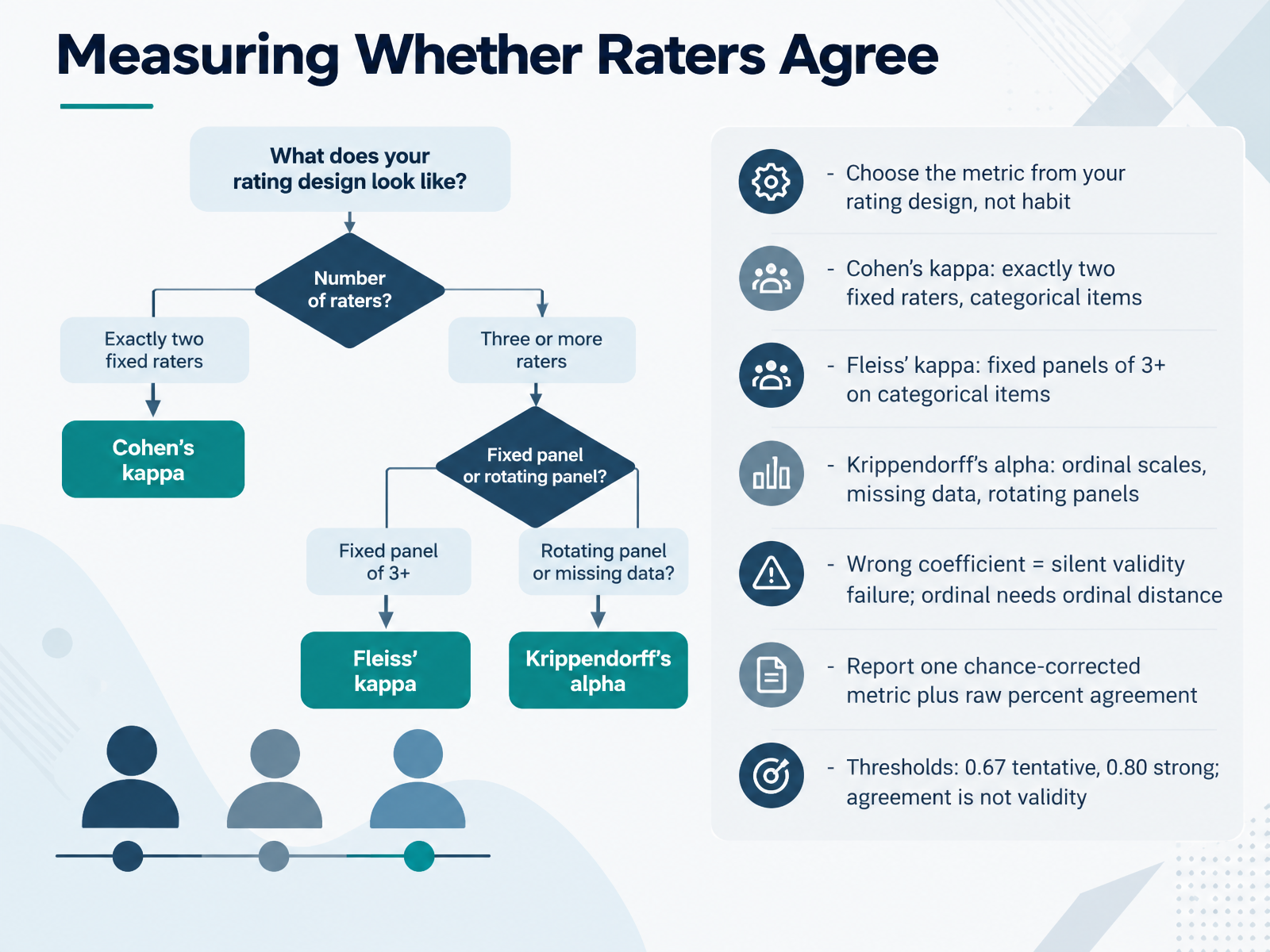
 - 05Measuring Whether Raters AgreeNow let's talk about measuring whether your raters actually agree. Pick your metric from the rating design, not from habit. Cohen's kappa works for exactly two fixed raters on categorical items. Fleiss' kappa handles a fixed panel of three or more raters on categorical items. Krippendorff's alpha covers ordinal scales, missing data, and rotating panels. Choosing the wrong coefficient is a silent validity failure. Ordinal data needs an ordinal distance, so a one-point disagreement and a four-point disagreement are not equal. Report one chance-corrected metric plus raw percent agreement. For thresholds, point six seven is tentative, point eight zero is strong. And remember, agreement is not validity. Raters can agree consistently and still measure the wrong thing. Next, we look at automated metrics and their limits.
 github.comllwang.netnature.com+21 min
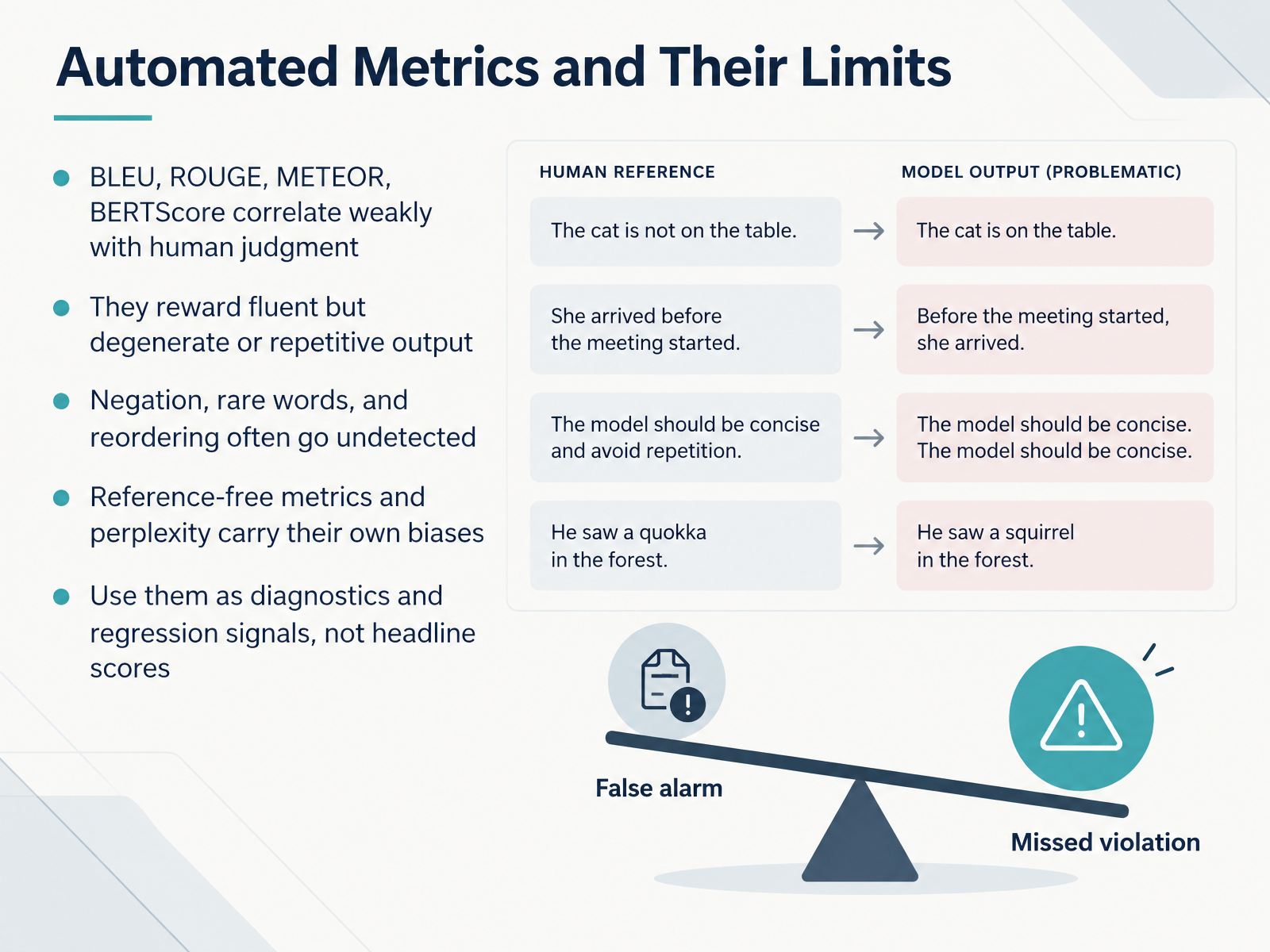
 - 06Automated Metrics and Their LimitsNow let's talk about automated metrics and where they break down. You know BLEU, ROUGE, METEOR, BERTScore. They're fast, cheap, and reproducible, so your team will reach for them. But here's the catch. They correlate weakly with human judgment, especially on open-ended tasks. Worse, they reward fluent but degenerate or repetitive output. A model can loop the same sentence and still score well. They also miss meaning-level errors. Negation, rare words, and reordering often go undetected. Reference-free metrics and perplexity carry their own biases too. Studies show they can prefer machine text over human writing. So how do you use them without getting burned? Treat them as diagnostics and regression signals, not headline scores. Track them over time to catch drift, pair them with human review, and never ship a release based on a single number. In the next section, we look at a scalable alternative, LLM-as-Judge design patterns.
 aclanthology.orgaclanthology.orgdl.acm.org+22 min
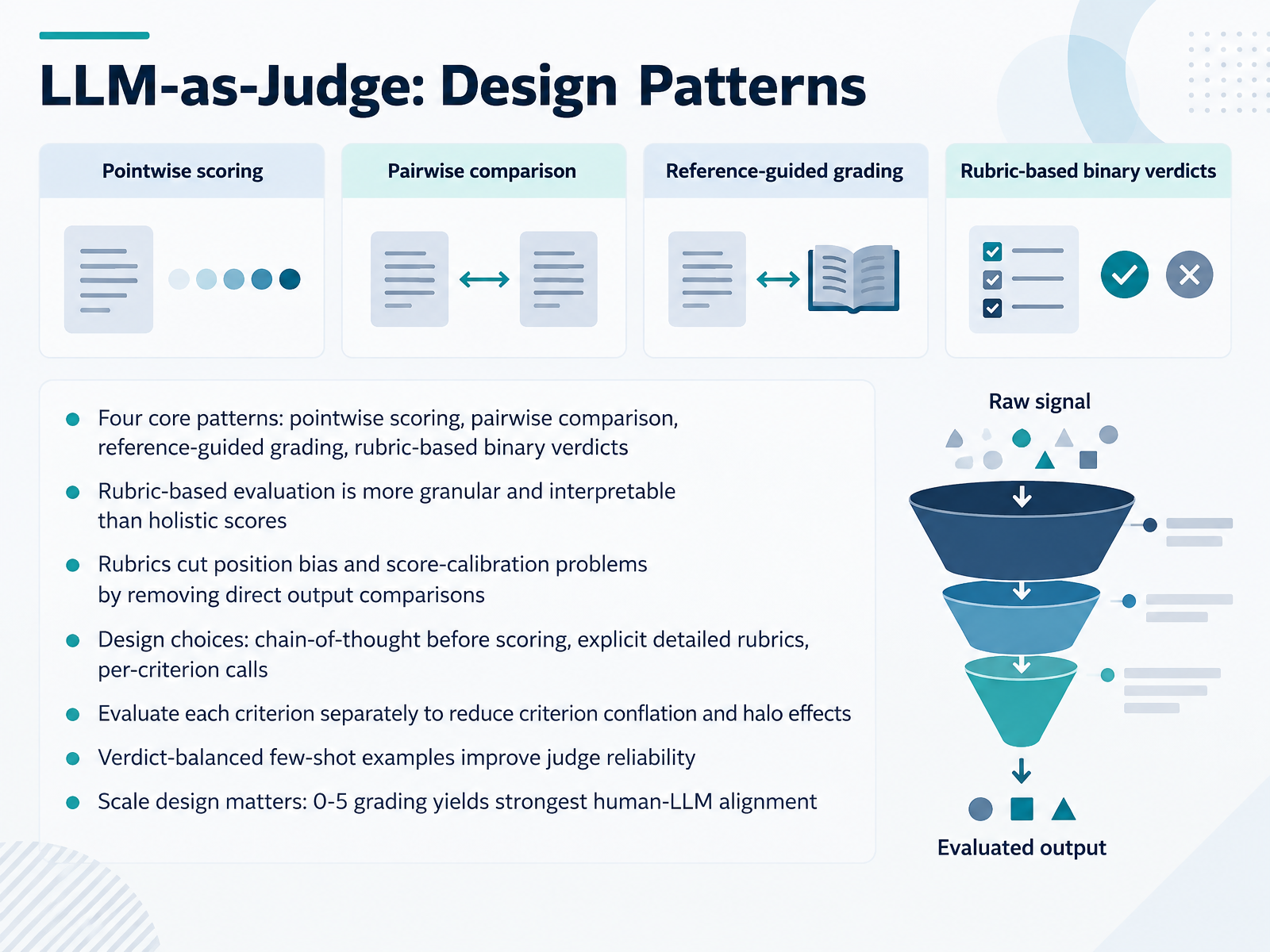
 - 07LLM-as-Judge: Design PatternsLet's talk about how to design an LLM judge that actually holds up. There are four core patterns. Pointwise scoring grades one output alone. Pairwise comparison pits two outputs against each other. Reference-guided grading checks against a gold answer. And rubric-based binary verdicts ask yes or no on specific criteria. For most teams, that last one wins. Rubrics are more granular and more interpretable than a single holistic score. They also cut position bias and score-calibration problems, because you stop comparing outputs directly. Now, the design choices matter. Make the judge reason before it scores, using chain of thought. Write explicit, detailed rubrics. And evaluate each criterion in its own call. That separate call reduces criterion conflation and halo effects, where one strong trait lifts everything else. Verdict-balanced few-shot examples improve reliability. And scale design matters: zero to five grading yields the strongest human to LLM alignment. So your takeaway: prefer rubrics, keep criteria atomic, and calibrate your scale. Now the hard part. Judges carry their own biases. Next, we cover biases and calibration.
 aclanthology.orgdevelopers.openai.comarxiv.org+22 min
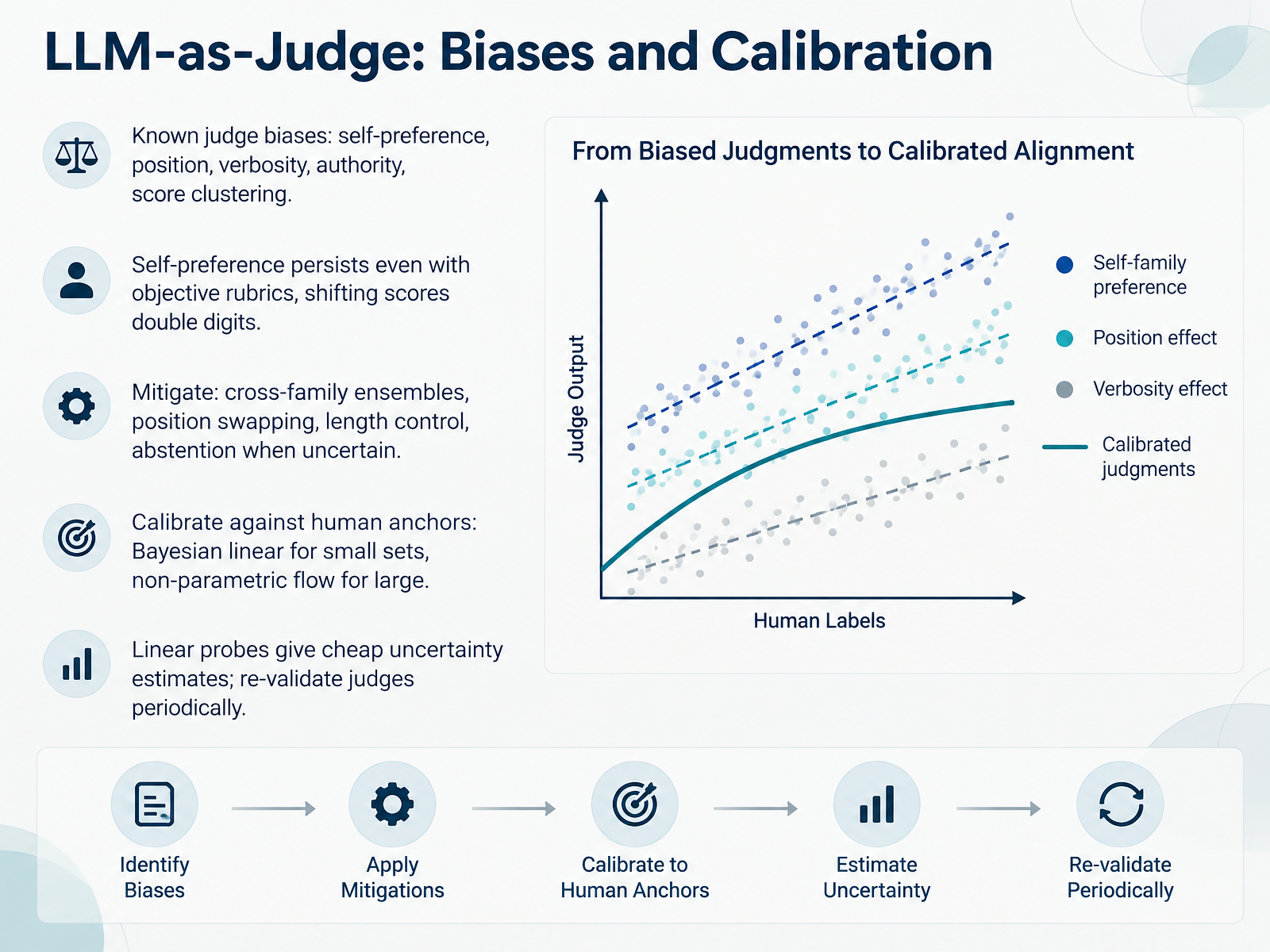
 - 08LLM-as-Judge: Biases and CalibrationNow let's talk about the judge itself. LLM-as-a-judge is cheap, but biased. You'll see self-preference, position bias, verbosity bias, authority bias, and score clustering. Self-preference is the stubborn one. It persists even with objective rubrics, and it can shift scores by double digits. So how do you mitigate it? Use cross-family ensembles, not one model judging its own family. Swap positions. Control for length. And let the judge abstain when it's uncertain. Then calibrate against human anchors. With a small anchor set, a Bayesian linear corrector works well. With a large one, around a thousand labels or more, a non-parametric flow wins. Linear probes give you cheap uncertainty estimates, roughly ten times less compute. Re-validate your judges periodically. Biases drift as models update. Next, hallucination, grounding, and safety checks.
 dl.acm.orggithub.comllwang.net+21 min
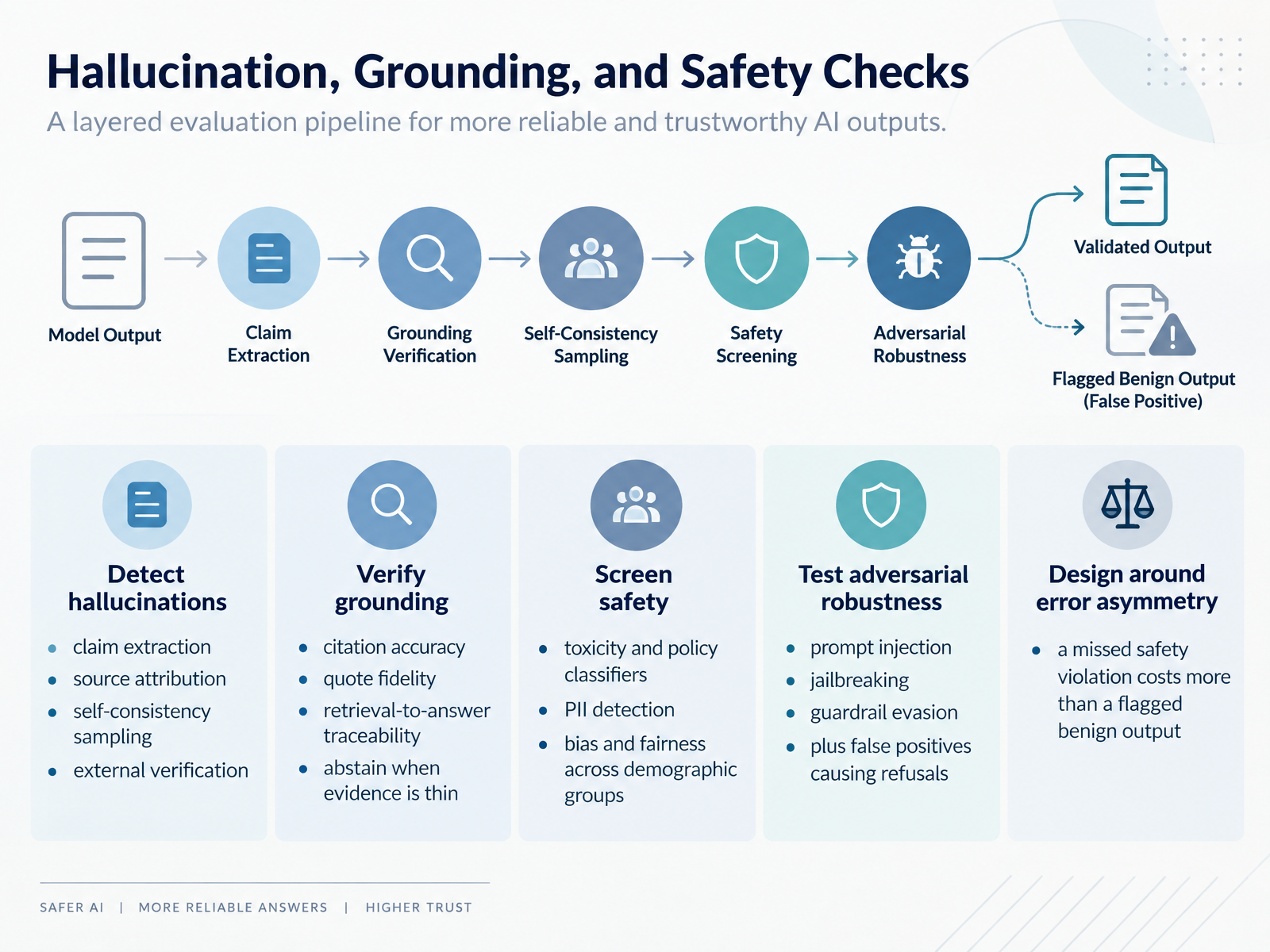
 - 09Hallucination, Grounding, and Safety ChecksNext, let's talk about hallucination, grounding, and safety checks. This is where your evaluation gets high stakes.
Start with hallucination detection. Extract each claim from the output, attribute it to a source, run self-consistency sampling, and verify externally. If your model states a number or a date, check it against the actual document.
Then verify grounding. Citation accuracy, quote fidelity, and traceability from retrieval to answer. When evidence is thin, the right behavior is to abstain, not guess.
Screen for safety using toxicity and policy classifiers, P I I detection, and bias checks across demographic groups. Test adversarial robustness too. Prompt injection, jailbreaking, guardrail evasion, and false positives that trigger unnecessary refusals.
Design around error asymmetry. A missed safety violation costs far more than a flagged benign output. So tune your thresholds to catch harm, then measure how often you over-block.
Building a Layered Evaluation Workflow.
 papers.neurips.ccdlnext.acm.orgzitniklab.hms.harvard.edu+22 min
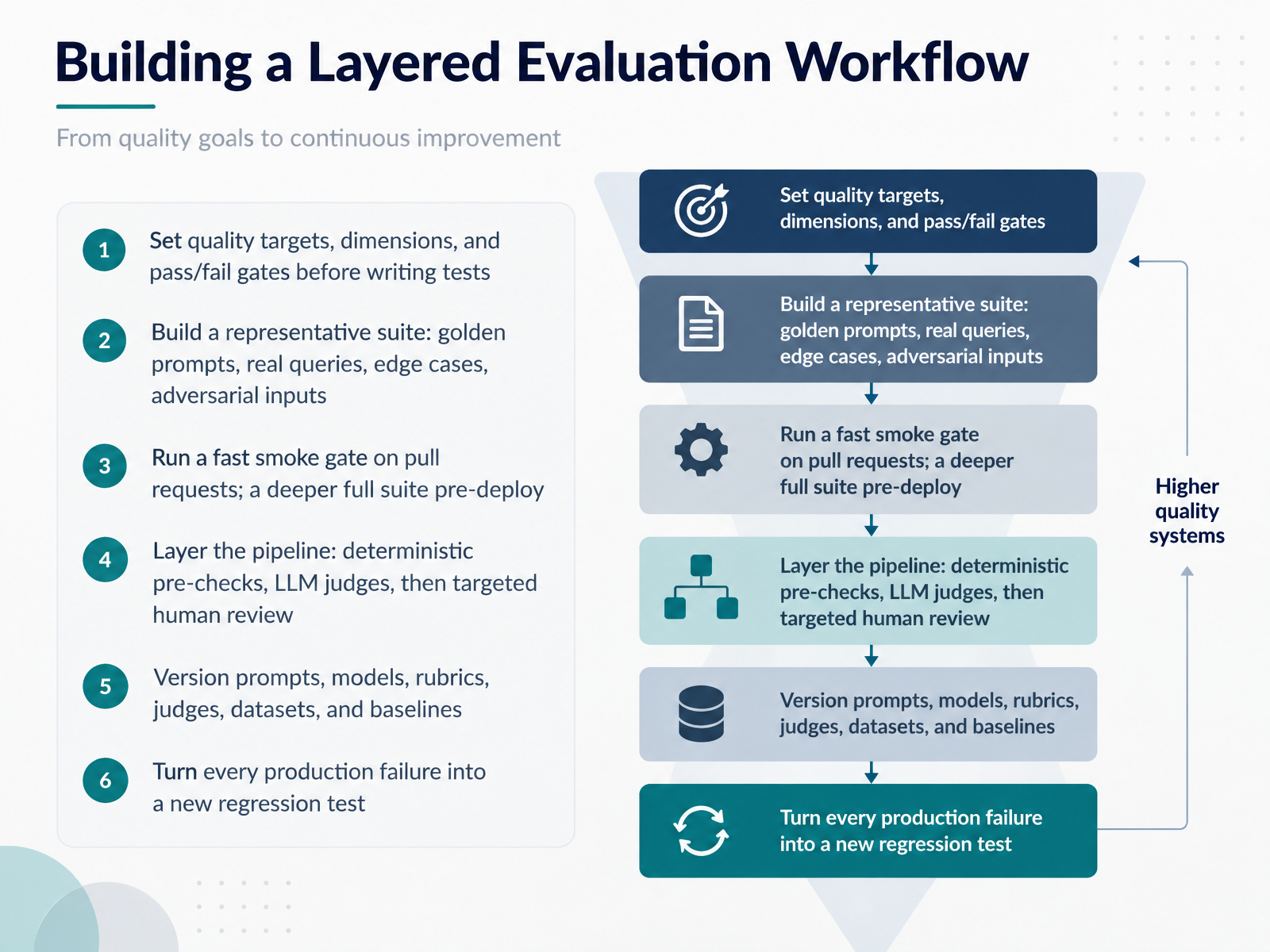
 - 10Building a Layered Evaluation WorkflowNow let's build a layered evaluation workflow. Start with quality targets, dimensions, and pass or fail gates, defined before you write a single test. Your suite needs golden prompts, real user queries, edge cases, and adversarial inputs. Run a fast smoke gate on every pull request. Save the deeper full suite for pre-deploy. Then layer the pipeline itself. Deterministic pre-checks catch the obvious failures first. LLM judges handle the nuanced quality calls. Targeted human review resolves what automation cannot. Here is an example. A team defines a pass gate of ninety percent accuracy, then layers an exact match check, an LLM judge for tone, and a human review for flagged safety cases. Critically, version everything. Prompts, models, rubrics, judges, datasets, and baselines must all be tracked together. And when production breaks, that failure becomes your next regression test. Wire this into your CI, and every merge gets verified automatically. Let's see how that works in practice, as we move into wiring evaluation into CI and production.
 aclanthology.orgdevelopers.openai.comarxiv.org+21 min
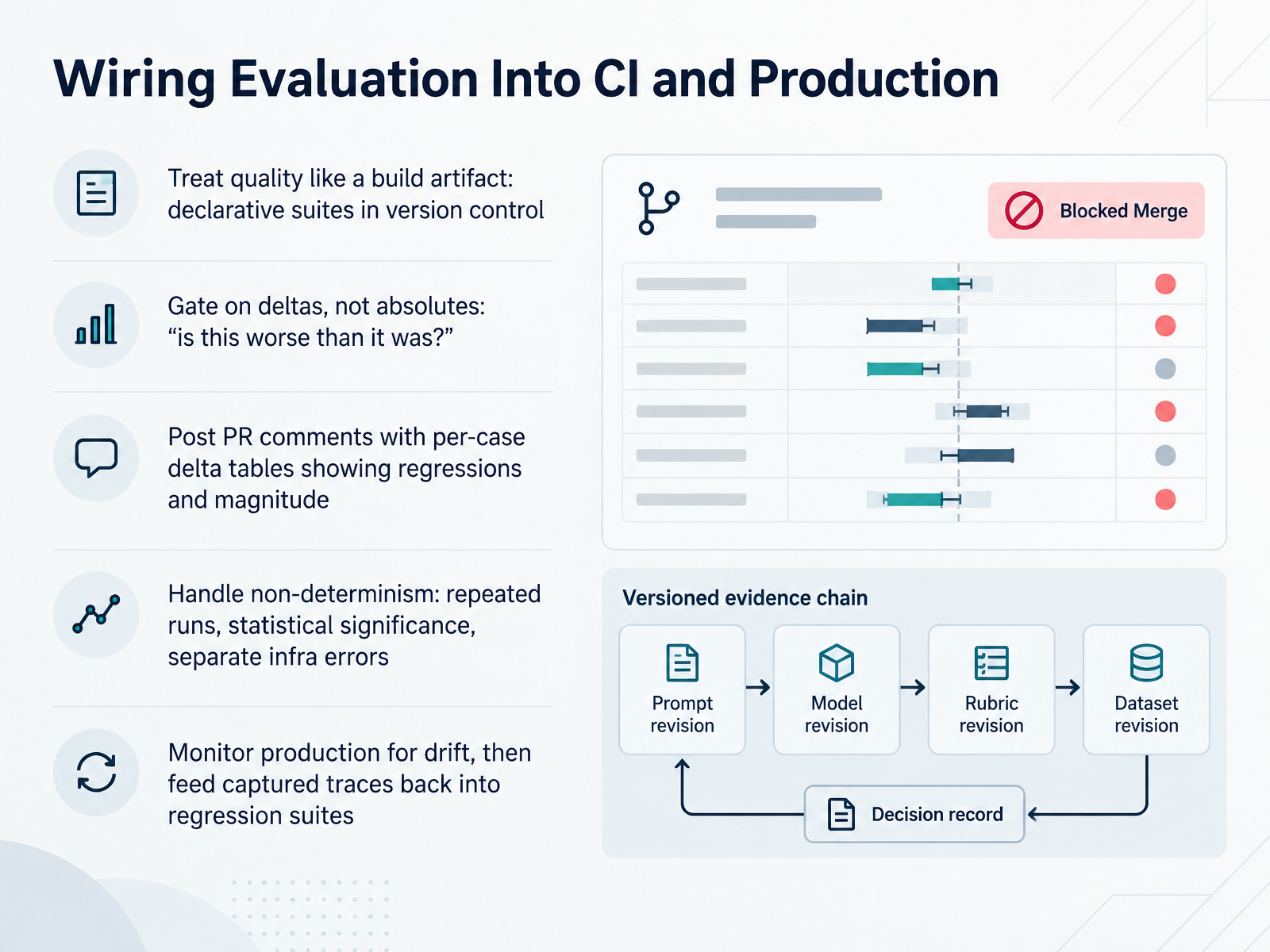
 - 11Wiring Evaluation Into CI and ProductionNow let's wire evaluation into your pipeline. Treat quality like a build artifact. Keep declarative eval suites in version control, right next to your code. Then gate on deltas, not absolutes. Ask one question: is this worse than it was? Not is this good. Every pull request gets a comment with a per case delta table, so your team sees exactly which cases regressed and by how much. Next, handle non determinism. Models vary run to run. So run repeated samples, check statistical significance, and separate infrastructure errors from real quality drops. Finally, monitor production for drift, then feed captured traces back into your regression suites. Close the loop. That is how you ship safely, and your stakeholders can defend it. Scorecards and Case Examples by Function, up next.
 aclanthology.orgdevelopers.openai.comarxiv.org+21 min
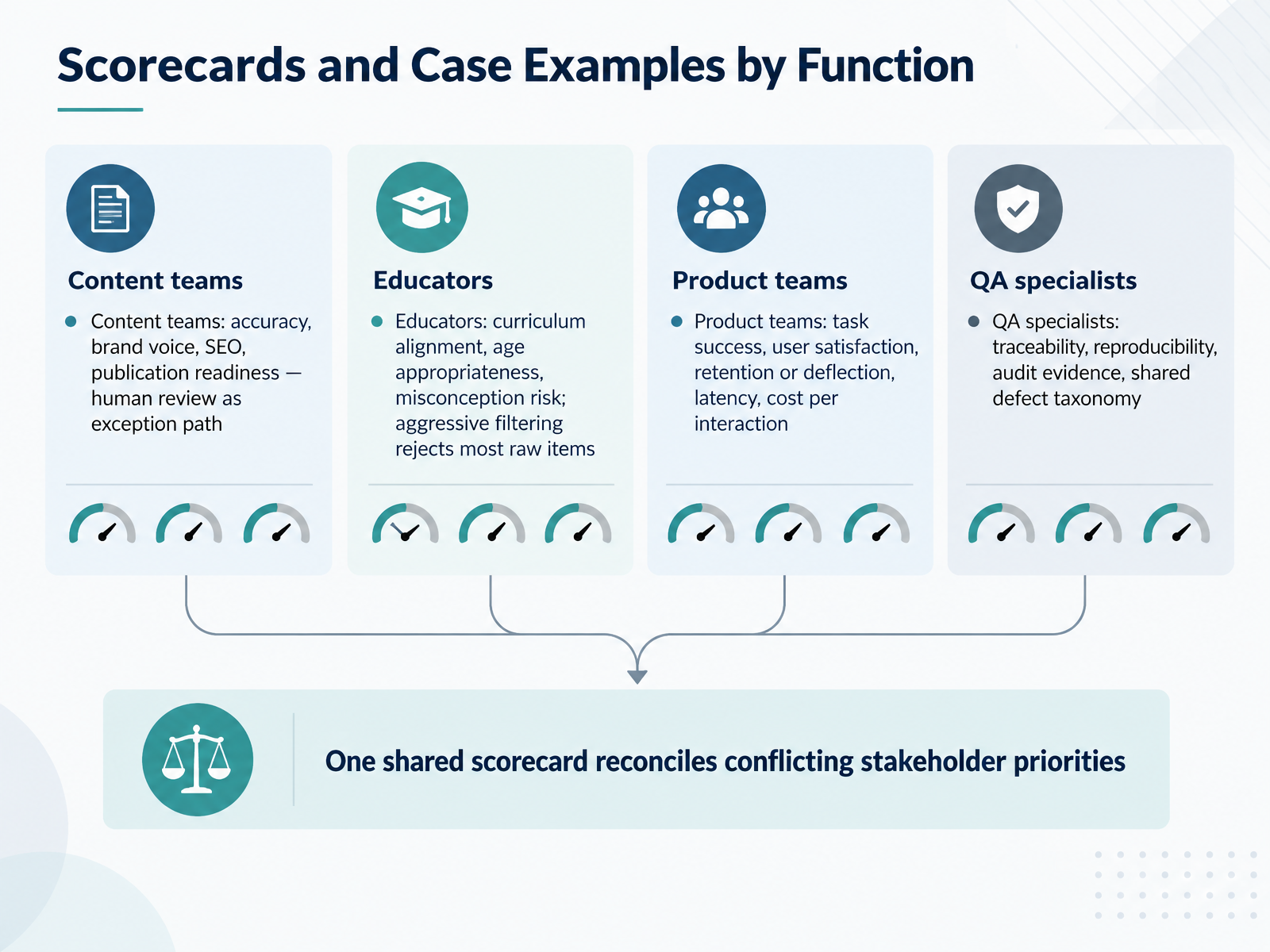
 - 12Scorecards and Case Examples by FunctionNow let's make scorecards concrete, function by function. Content teams score accuracy, brand voice, SEO, and publication readiness. Human review becomes the exception path, not the default. Educators weigh curriculum alignment, age appropriateness, and misconception risk. Watch the filtering rate here. In one case study, 93.5 percent of generated questions were rejected to keep only the strongest items. Product teams track task success, user satisfaction, retention or deflection, latency, and cost per interaction. QA specialists need traceability, reproducibility, audit evidence, and one shared defect taxonomy. Now here's the hard part. These priorities conflict. Marketing wants speed. Educators want safety. Finance wants low cost per call. So one shared scorecard reconciles them. Weight each dimension once. Make mandatory gates explicit, so a wrong answer can't pass on style points. And remember, high agreement between raters isn't proof you're measuring the right thing. Next, we'll look at governance, transparency, and audit trails.
 dl.acm.orggithub.comllwang.net+22 min
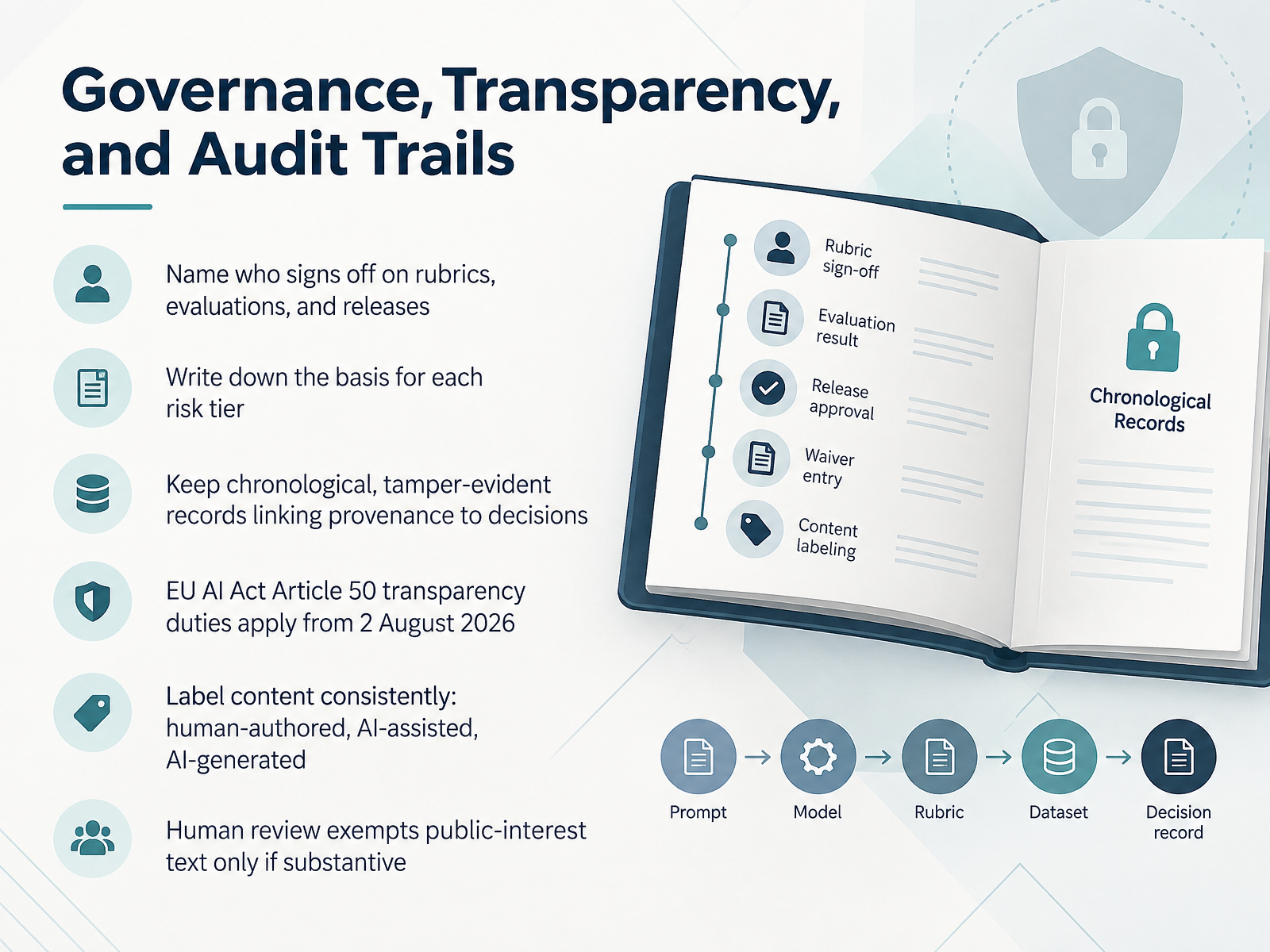
 - 13Governance, Transparency, and Audit TrailsNext, let's talk governance, transparency, and audit trails. This is where quality stops being a feeling and becomes evidence. First, name who signs off. Who approves rubrics, evaluations, and releases? Put a person behind each. Second, write down the basis for every risk tier. If you call something low risk, record why. A tier you cannot defend is a tier that will not survive scrutiny. Third, keep chronological, tamper-evident records linking provenance to decisions. One practical rule: your audit trail should answer why this was approved, on what basis, and by whom, a year later, when nobody remembers. Now, the regulatory clock. EU AI Act Article 50 transparency duties apply from the second of August, 2026. So label consistently, human-authored, AI-assisted, AI-generated. And remember, human review exempts public-interest text only if it is substantive. A spell check is not review. The takeaway: your audit trail is your defense. Now let's move into your Hands-On Practice and 30/60/90-Day Plan.
 2 min
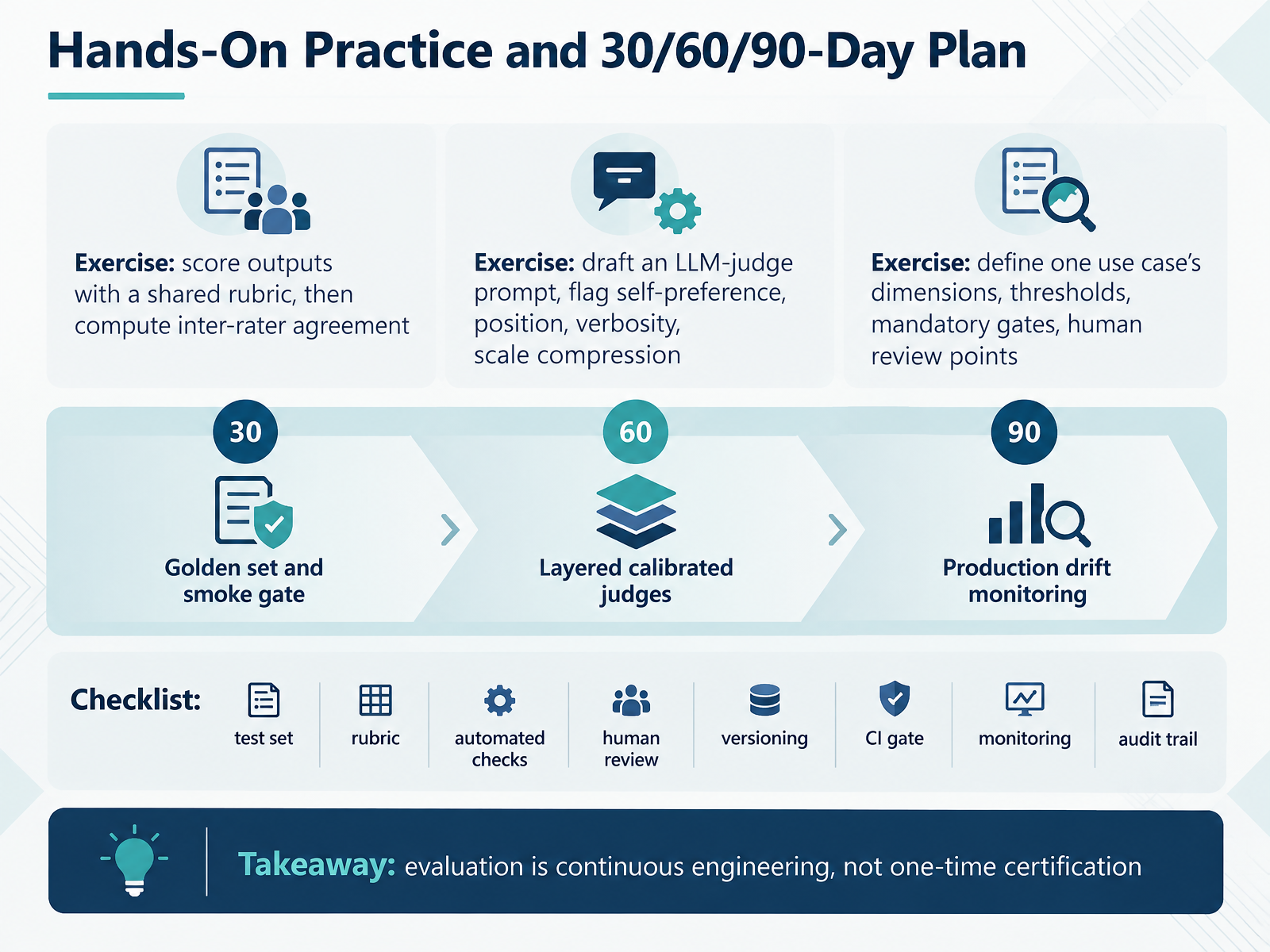
2 min - 14Hands-On Practice and 30/60/90-Day PlanLet's make this practical. First, run a scoring exercise with your team. Score the same outputs against one shared rubric, then compute inter-rater agreement, like Krippendorff's alpha. If agreement is low, your rubric is the problem, not your model. Second, draft an LLM judge prompt, then stress-test it. Flag self-preference, position bias, verbosity bias, and scale compression before you trust any score. Third, pick one use case. Define its dimensions, thresholds, mandatory gates, and human review points in writing. Then sequence the rollout. In the first thirty days, build a golden set and a smoke gate that runs on every pull request. By day sixty, layer in calibrated judges from at least two model families. By day ninety, add production drift monitoring. Keep this checklist close. Test set, rubric, automated checks, human review, versioning, CI gate, monitoring, and an audit trail. The core lesson from this whole course is simple. Evaluation is continuous engineering, not one-time certification. You never finish. You just keep the gate green and the evidence defensible. Thank you for working through this with me. Now go build your first gate, and remember, small golden sets catch most regressions. You've got this.
 github.comllwang.netnature.com+22 min
Take the deck with you
Download this course as a file — free, no sign-up needed.
- PDF handoutEvery slide page, ready to print or share.15 pages · 3.1 MBDownload
- Narrated PowerPointThe deck that presents itself — every slide carries the digital human's narration video.15 pages · 14.2 MBDownload
- PowerPoint slidesThe full deck as a .pptx — open it in PowerPoint, Keynote, or Google Slides.15 pages · 3.0 MBDownload
Free to use in your own training — please keep the PersonWise credit page at the end.
Have your own deck? Turn it into a course
Sources consulted
Web sources consulted while building this course.
- skills/research/research-paper-writing/references/human-evaluation.md — github.com
- Illusions of the Gold Standard: A Large-scale Analysis of Human Evaluation Protocols for Long-form Text Generation — llwang.net
- Grading scale impact on LLM-as-a-judge: human-LLM alignment is highest on 0–5 grading scale | npj Artificial Intelligence — nature.com
- Autorubric: A Unifying Framework for Rubric-Based LLM Evaluation on Non-Verifiable Tasks — arxiv.org
- Measurement Without Validity: The Compounding Reliability Problem in Agentic AI Evaluation — arxiv.org
- From Rubrics to Recipe: Principle-Centric Benchmark for Evaluating Large Language Models — aclanthology.org
- Evaluation best practices | OpenAI API — developers.openai.com
- QQJ: Quantifying Qualitative Judgment for Scalable and Human-Aligned Evaluation of Generative AI — arxiv.org
- Generative AI Evaluation Playbook: Policy Brief — cgdev.org
- The TEVV-Athlon Framework for Evaluating AI Systems - ipd — nvlpubs.nist.gov
- BenchmarkCards: Standardized Documentation for Large Language Model Benchmarks — papers.neurips.cc
- Grounding and Evaluation for Large Language Models: Practical Challenges and Lessons Learned (Survey) — dlnext.acm.org
- TRUSTLLM: — zitniklab.hms.harvard.edu
- Holistic Evaluation of Language Models - Bommasani - 2023 - Annals of the New York Academy of Sciences - Wiley Online Library — nyaspubs.onlinelibrary.wiley.com
- LLM Evaluations: A Survey of Programmatic, Human, and LLM-as-Judge Approaches — exa.ai
- On the Blind Spots of Model-Based Evaluation Metrics for Text Generation — aclanthology.org
- NLG Evaluation Metrics Beyond Correlation Analysis: An Empirical Metric Preference Checklist — aclanthology.org
- A Survey of Evaluation Metrics Used for NLG Systems — dl.acm.org
- Curious Case of Language Generation Evaluation Metrics: A Cautionary Tale — arxiv.org
- On the Limitations of Reference-Free Evaluations of Generated Text — cogcomp.seas.upenn.edu