Begin
14 pages · ~28 min
Shakespeare's Language: A Reading Guide
This training helps learners decode Shakespeare's language, building the skills to read and understand his works with confidence. Perfect for students and literature enthusiasts.
A digital instructor presents all 14 pages. Hold “Ask” at any point and ask out loud — the answer comes from this course. No sign-up needed.
What you’ll learn
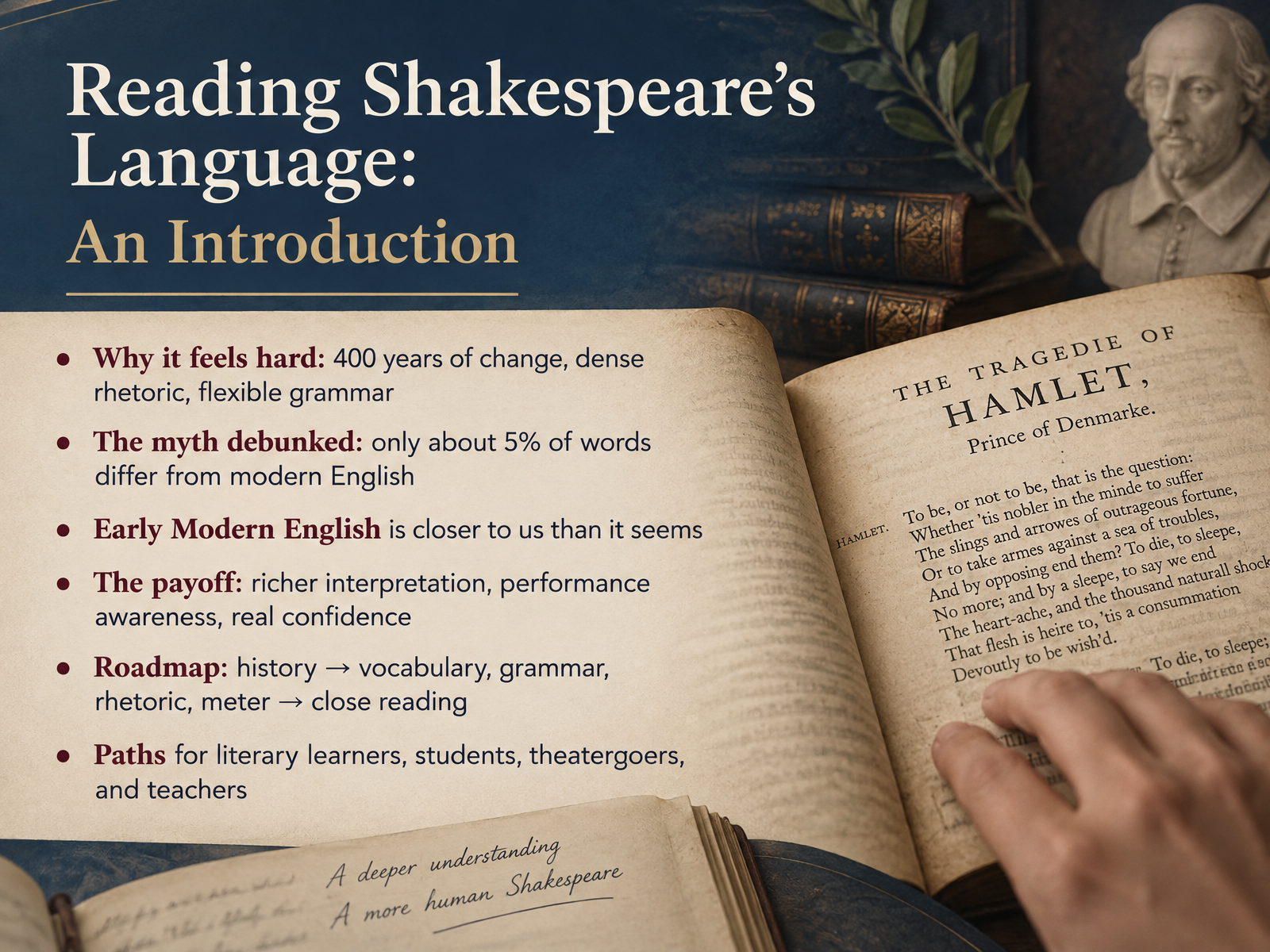
- 01Reading Shakespeare's Language: An IntroductionWelcome. In this course, we're going to learn how to read Shakespeare's language with confidence and pleasure. If his lines have ever felt dense or out of reach, you're in good company, and you're in the right place. Yes, four hundred years of language change, dense rhetoric, and flexible grammar make the plays feel hard at first. But here's the myth worth debunking: only about five percent of the words differ from modern English. Early Modern English, the English of Shakespeare's time, is closer to us than it seems. The payoff is real. You'll interpret passages more richly, watch performances with a sharper ear, and build genuine confidence, whether you're studying for an exam or preparing to teach. Our roadmap runs from history, through vocabulary, grammar, rhetoric, and meter, into close reading. Let's begin with the historical and linguistic background.1 min
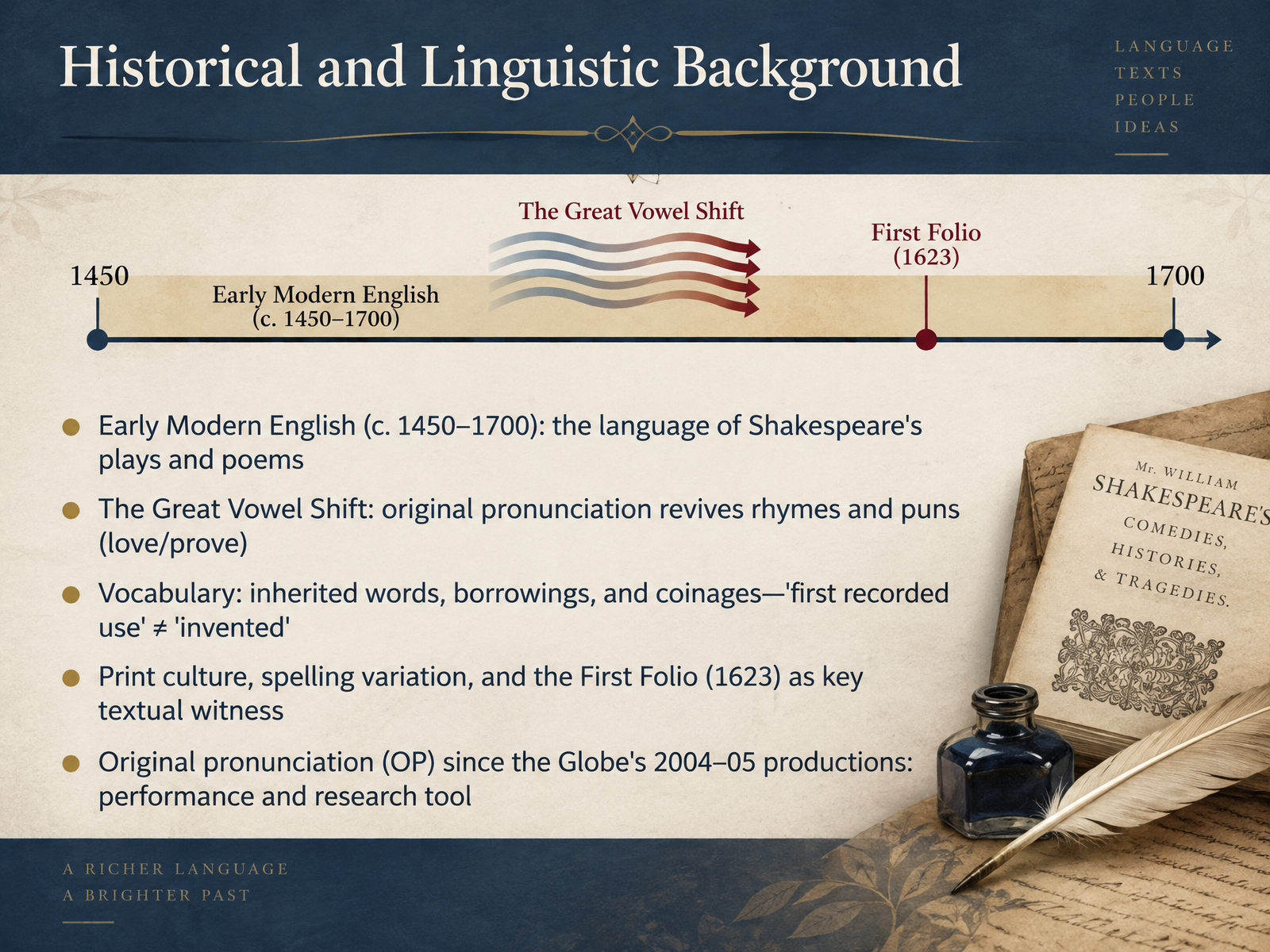
- 02Historical and Linguistic BackgroundTo read Shakespeare well, we first need to know what kind of English he was writing. His plays and poems belong to Early Modern English, the stage of the language spoken roughly from fourteen fifty to seventeen hundred. One major change was the Great Vowel Shift, a long reshaping of long vowel sounds. Because of it, some of Shakespeare's rhymes and puns sound odd today, but original pronunciation, or O P, can bring them back, as with love and prove. Vocabulary is another key area. Shakespeare's wordstock includes inherited words, borrowings from other languages, and coinages. A first recorded use, though, does not always mean the poet invented the word. Print culture matters too, and spelling varied widely. The First Folio of sixteen twenty three is a central textual witness, the printed collection that preserved many plays. Since the Globe's productions in two thousand four and five, original pronunciation has become both a performance choice and a research tool. Listen for sound and spelling as you read. Next, we turn to decoding vocabulary, words that have shifted.
 2 min
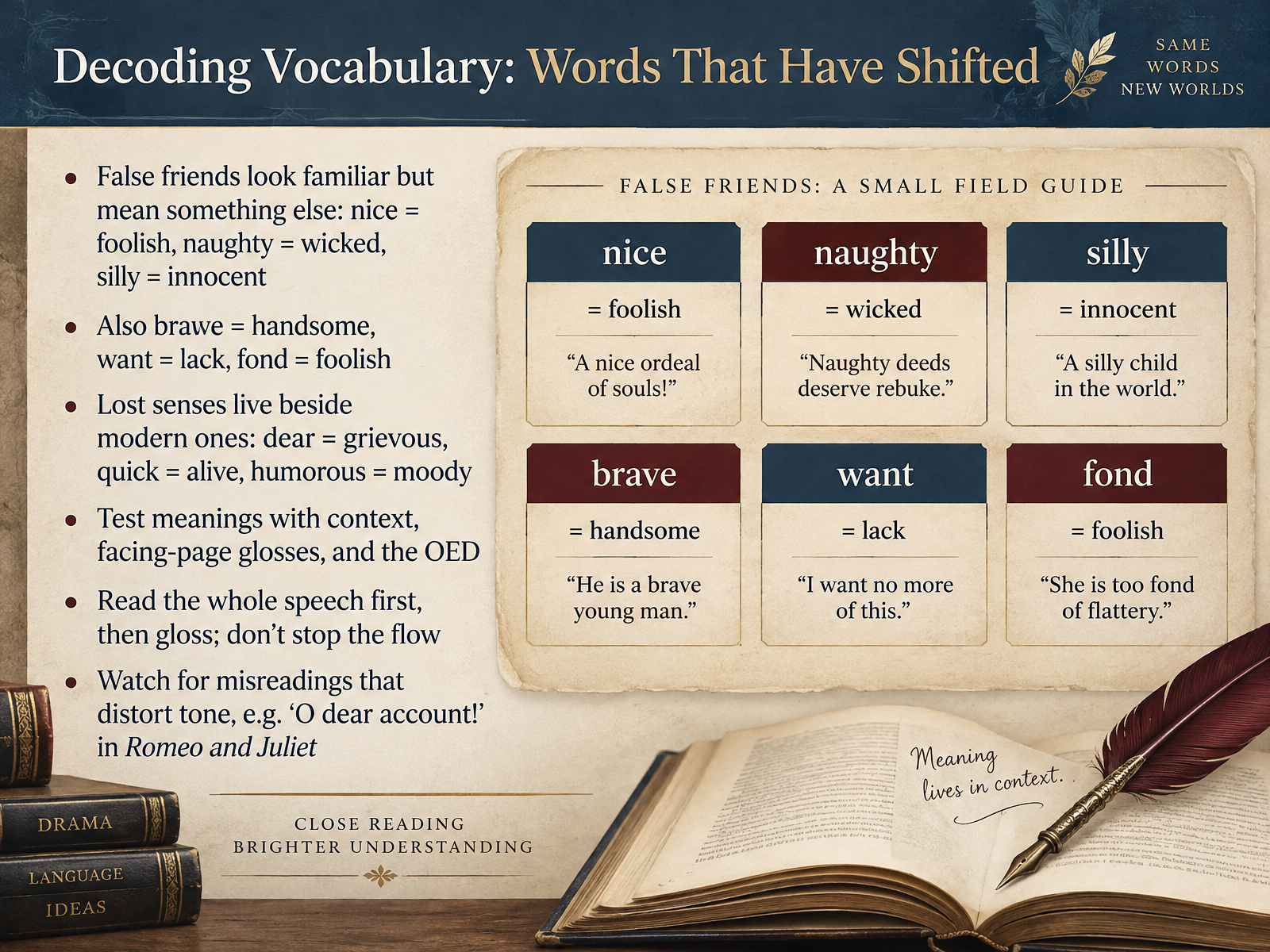
- 03Decoding Vocabulary: Words That Have ShiftedNext, let's decode vocabulary, because many Shakespearean words have shifted. These are false friends: words that look familiar but mean something else. In Shakespeare's day, nice meant foolish, naughty meant wicked, and silly meant innocent. Likewise, brave meant handsome, want meant lack, and fond meant foolish. Some lost senses live beside modern ones. Dear can mean grievous, quick can mean alive, and humorous can mean moody. To test a meaning, use three things: the context, facing-page glosses, brief notes printed opposite the text, and the Oxford English Dictionary. But here is the key habit. Read the whole speech first, then gloss. Don't stop the flow. Watch for misreadings that distort tone, like O dear account in Romeo and Juliet, where dear means costly, not beloved. Try that discipline on the next passage you open. Now let's turn to syntax and grammar: unpacking the sentence.
 2 min
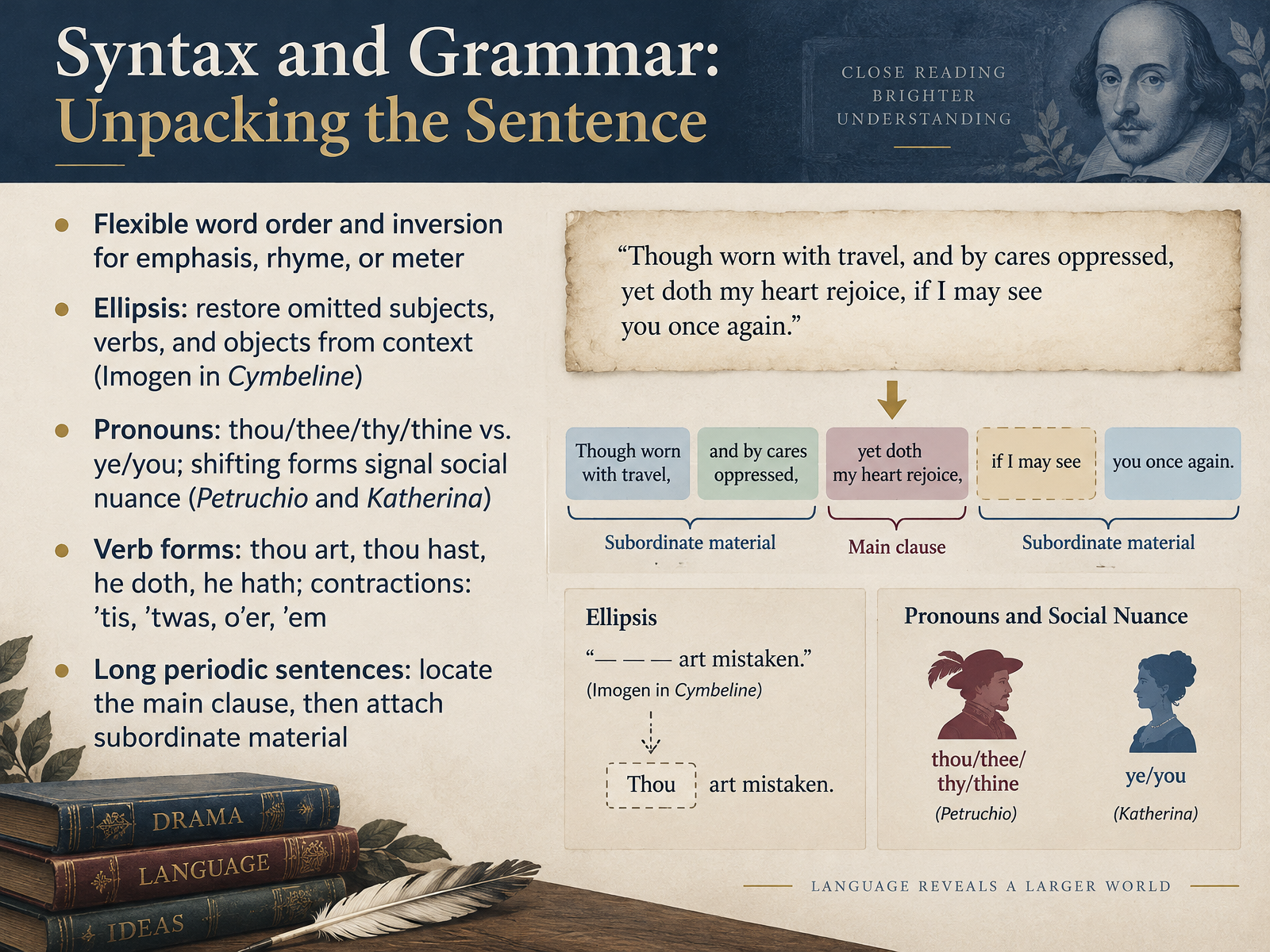
- 04Syntax and Grammar: Unpacking the SentenceNow let's look at syntax, the way sentences are built. Shakespeare bends word order freely, inverting it for emphasis, rhyme, or meter. When you meet an odd order, ask what the inversion stresses. He also uses ellipsis, omitting words you must restore from context. In Cymbeline, Imogen's compressed speeches often drop subjects or verbs, so read the surrounding lines to fill them in. Pronouns matter too. Thou, thee, thy, and thine, the familiar forms, contrast with ye and you, the polite forms. In Petruchio and Katherina's exchanges, a shift between them signals social nuance, so track it. Verb forms like thou art, thou hast, he doth, he hath, and contractions such as 'tis, 'twas, o'er, and 'em are common. In long periodic sentences, locate the main clause first, then attach the subordinate material piece by piece. As you read the next passage, notice how one inverted phrase changes the whole emphasis.
 2 min
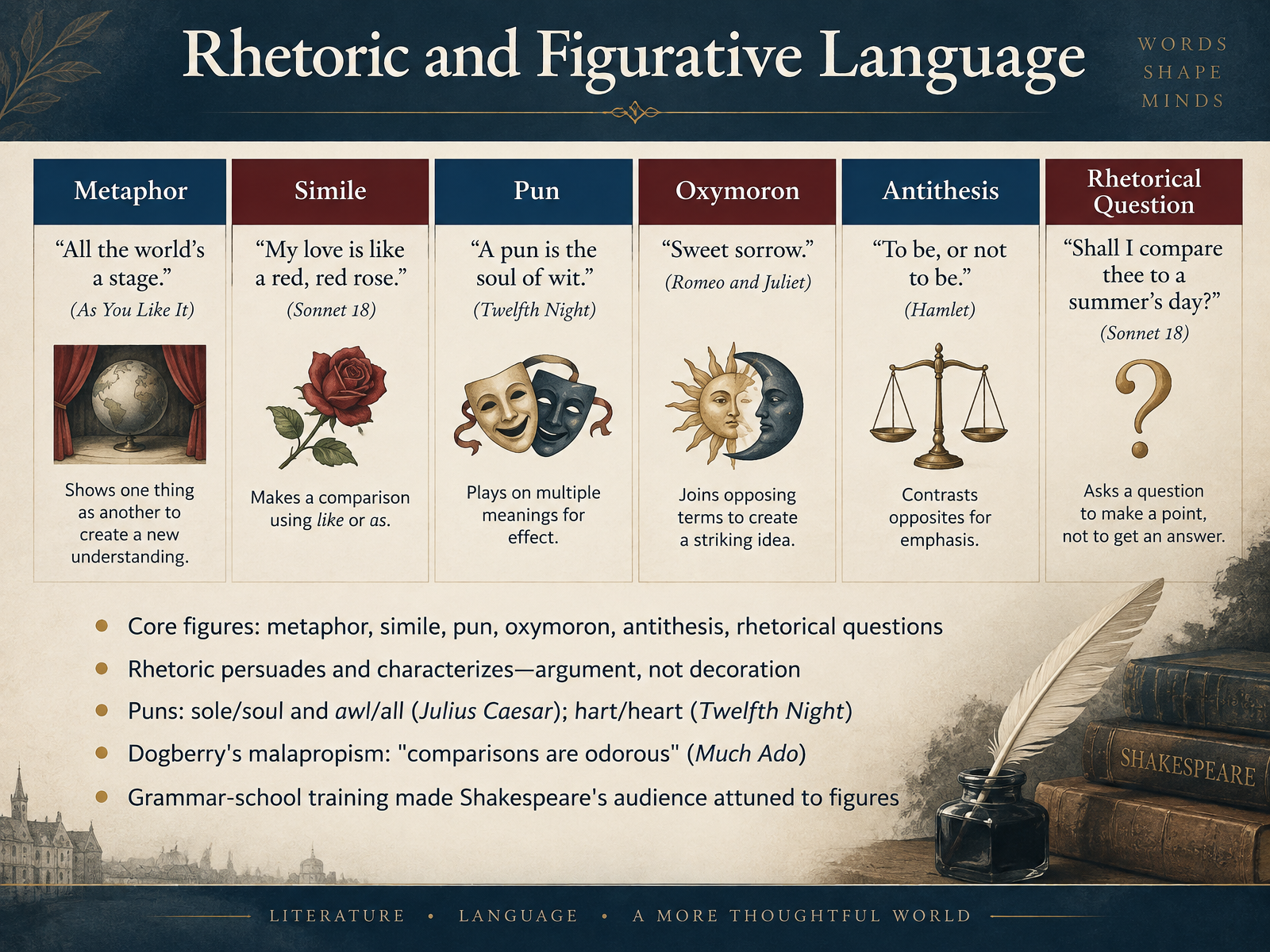
- 05Rhetoric and Figurative LanguageNext, let's look at rhetoric and figurative language, the deliberate patterns that shape how a line persuades and reveals character. The core figures are metaphor, simile, pun, oxymoron, antithesis, and rhetorical questions. Treat these as argument, not decoration. They do persuasive work on the stage. Puns carry weight, too. In Julius Caesar, sole and soul collide, and awl and all, so a cobbler's joke becomes political commentary. In Twelfth Night, hart, the deer, and heart, the feeling, keep the comedy turning. And Dogberry's malapropism, that is, a comic misuse of a word, gives us comparisons are odorous, when he means odious. Because grammar-school training drilled these figures, Shakespeare's audience caught them quickly, and so can you. Watch for the next figure hiding in plain sight.
 1 min
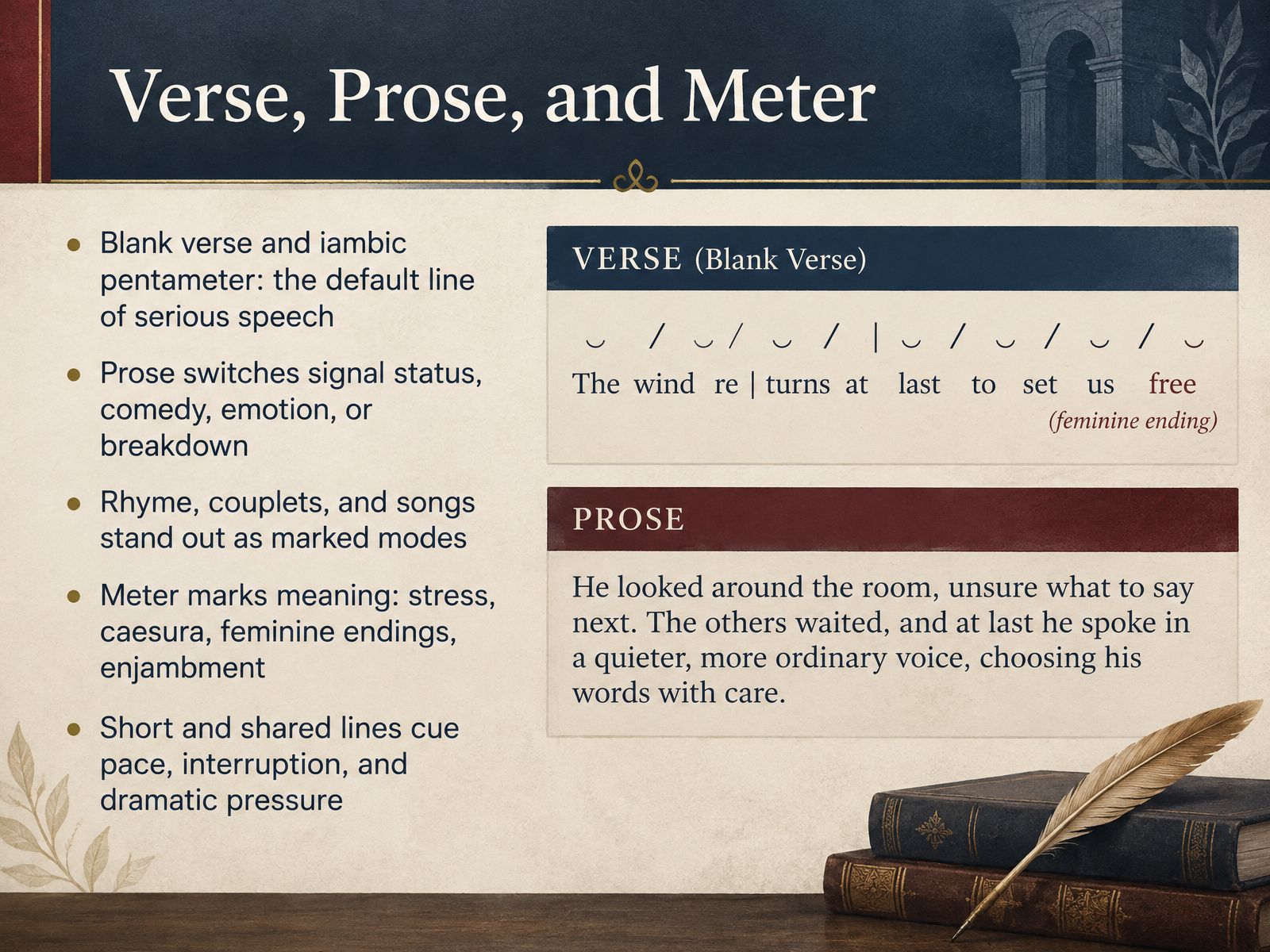
- 06Verse, Prose, and MeterNow let's look at the technical heart of Shakespeare's language: verse, prose, and meter. Blank verse, unrhymed lines of iambic pentameter, is the default for serious speech. That means ten syllables per line, five stresses, alternating unstressed and stressed: da DUM, da DUM, da DUM. Listen: "But soft, what light through yonder window breaks." Feel the steady beat. When Shakespeare switches to prose, he signals a change: lower status, comedy, raw emotion, or a character's mental breakdown. Rhyme, couplets, and songs are marked modes. They stand out and often close a scene with a memorable chime. Meter itself carries meaning. A heavy stress, a caesura, a mid-line pause, a feminine ending with an extra unstressed syllable, or enjambment, where the sentence runs past the line break, all shape how we hear the line. And short or shared lines cue pace, interruption, and dramatic pressure. As you read, mark the stresses and pauses. Next, we'll explore how punctuation, line endings, and breath bring these lines to life in performance.
 2 min
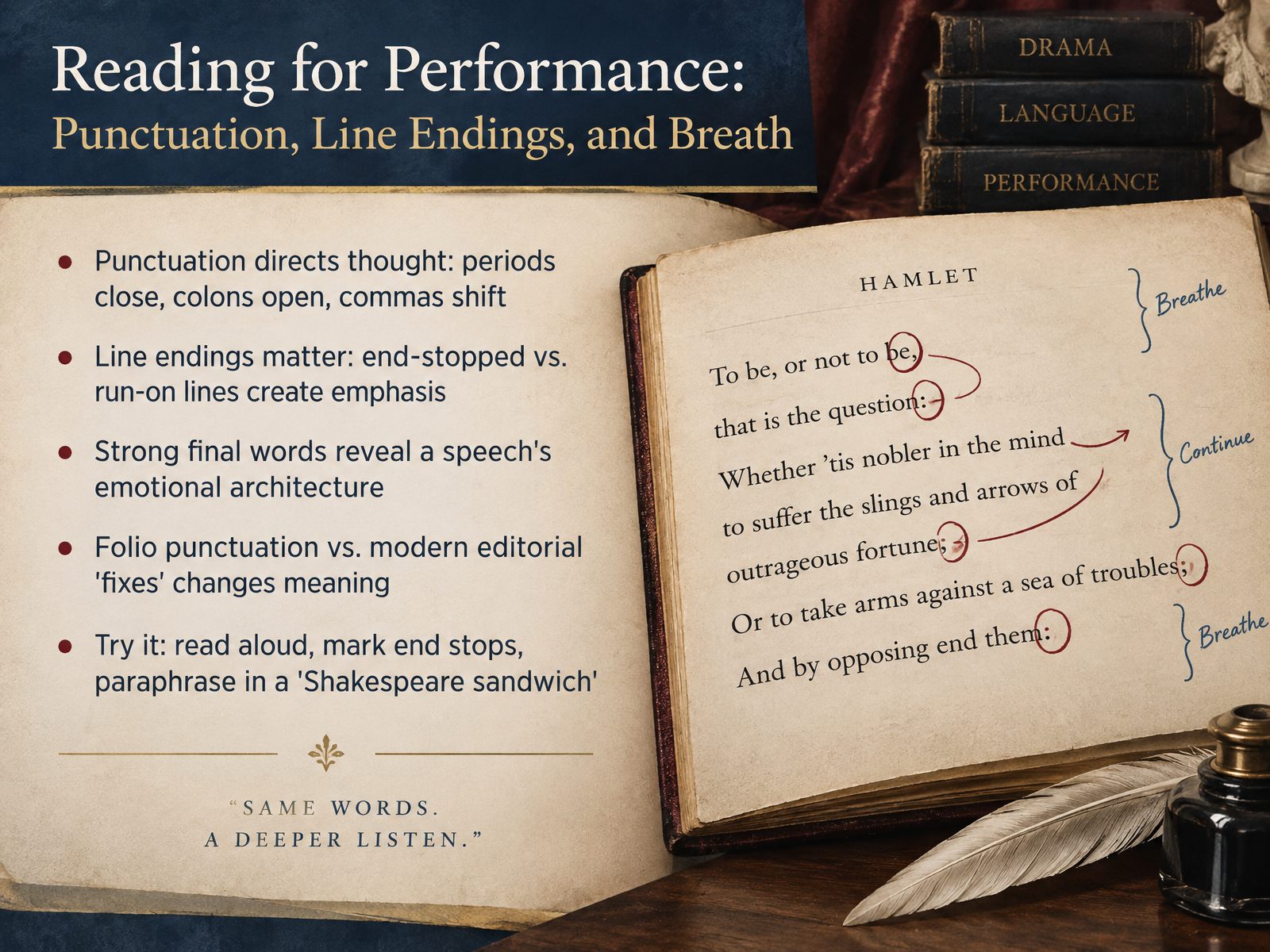
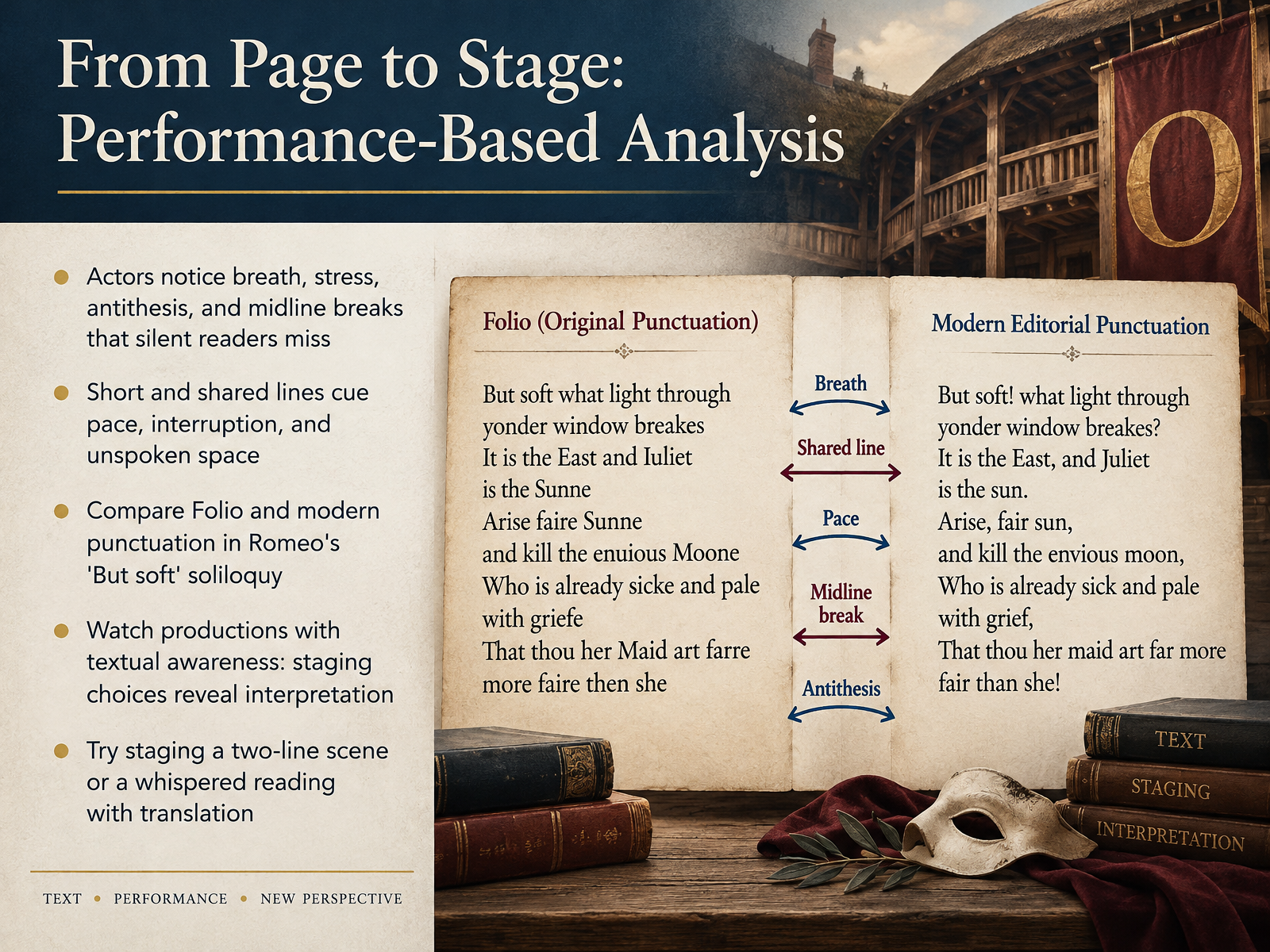
- 07Reading for Performance: Punctuation, Line Endings, and BreathNow let's read for performance. Punctuation is not decoration; it directs thought. A period closes an idea. A colon opens one, inviting what follows. A comma shifts direction slightly, like a turn in conversation. Line endings matter just as much. An end-stopped line finishes with punctuation and creates emphasis. A run-on line carries the thought forward, building momentum. Listen to the difference. 'To be, or not to be, that is the question.' The end stop lands hard. Now a run-on: 'But soft, what light through yonder window breaks?' The thought spills forward. Strong final words reveal a speech's emotional architecture, so watch where a line lands. And remember, Folio punctuation often differs from modern editorial fixes, which can change meaning. Try this: read aloud, mark the end stops, then paraphrase in a Shakespeare sandwich, quoting the line, explaining it plainly, and quoting it again. That habit will serve you in class, on exams, and in the theater. Next, we turn to working with editions, annotations, and digital resources.
 2 min
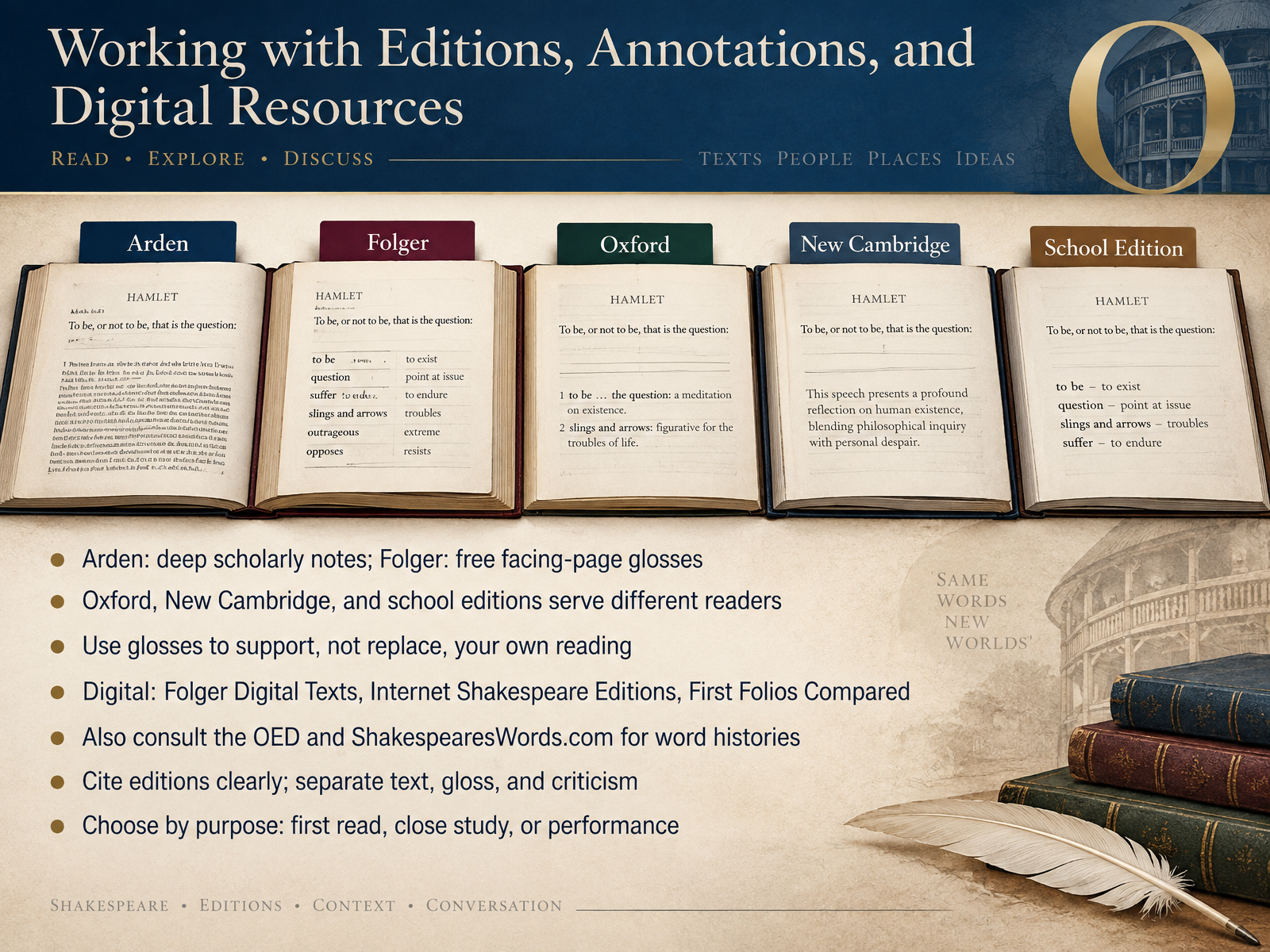
- 08Working with Editions, Annotations, and Digital ResourcesNow let's talk about the editions and tools that sit around the text. The Arden Shakespeare offers deep scholarly notes, while the Folger editions give you free glosses on facing pages, meaning notes printed opposite the play text so your eye can move back and forth easily. Oxford, New Cambridge, and school editions each serve different readers. Use glosses to support your own reading, not to replace it: read the line first, then check the note. For digital work, look at the Folger Digital Texts, the Internet Shakespeare Editions, and First Folios Compared, a site that lets you compare early printed copies side by side. Also consult the Oxford English Dictionary and ShakespearesWords.com for word histories. Cite editions clearly, and keep text, gloss, and criticism separate in your notes. Choose by purpose: a first read, close study, or performance. Next, we put these tools to work in a close reading method.
 2 min
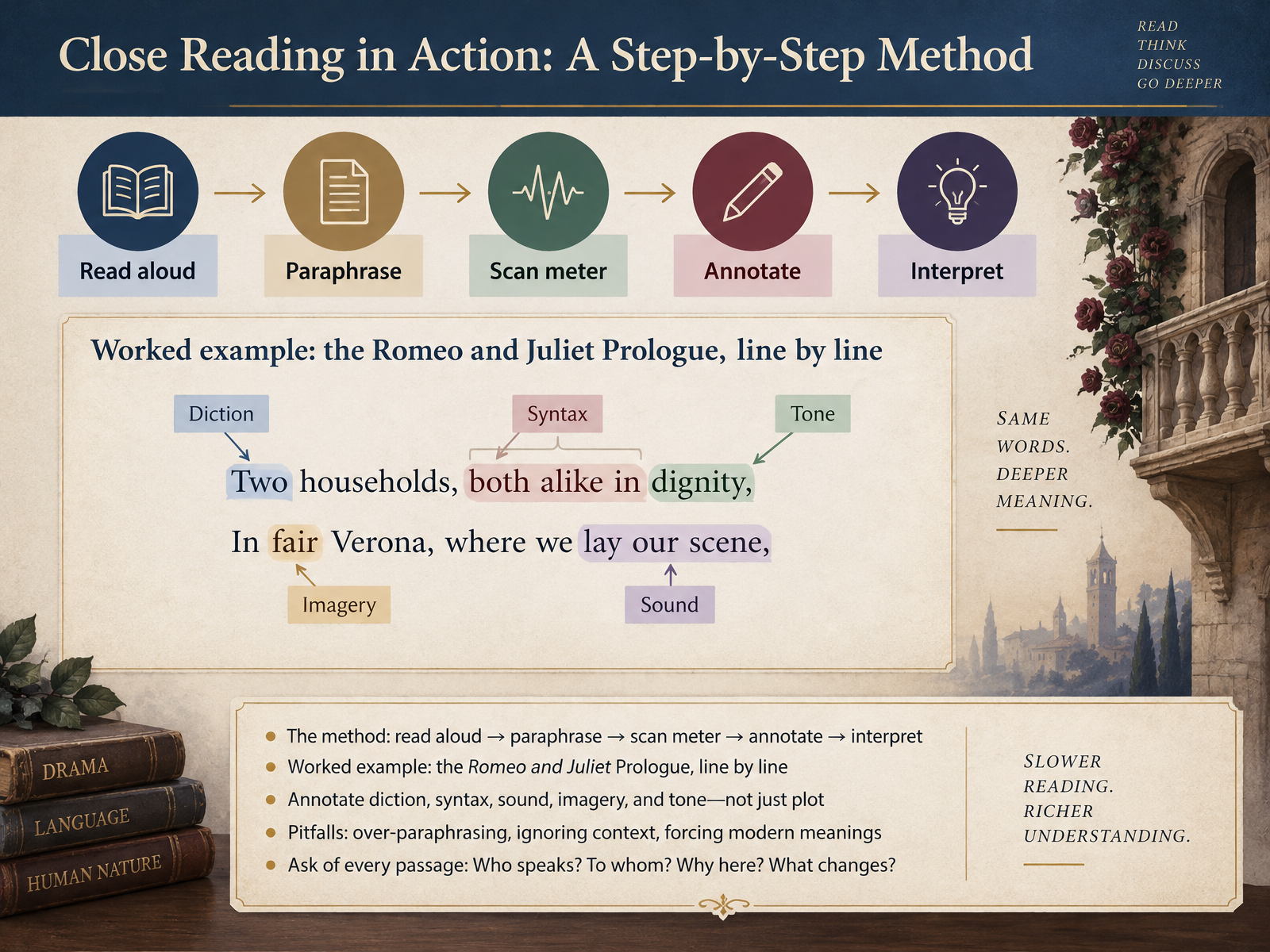
- 09Close Reading in Action: A Step-by-Step MethodNow let's put that method into practice. The method is simple: read aloud, paraphrase, scan the meter, annotate, then interpret. Take the Romeo and Juliet Prologue, line by line. Read it aloud, then paraphrase in your own words, scan the meter, and annotate diction, syntax, sound, imagery, and tone, not just plot. Watch for pitfalls: over-paraphrasing, ignoring context, forcing modern meanings. And ask of every passage: Who speaks? To whom? Why here? What changes? From page to stage, performance-based analysis comes next.
 1 min
- 10From Page to Stage: Performance-Based AnalysisNow let's move from the page to the stage. Performance-based analysis begins when you hear the text in an actor's voice. Actors notice things silent readers miss: breath, stress, antithesis, meaning the balancing of opposite ideas, and midline breaks, where a thought stops before the line does. Short lines and shared lines cue pace, interruption, and unspoken space. Take Romeo's 'But soft' soliloquy. Compare the Folio punctuation with a modern edition, and you will see how commas and periods steer the actor's breath and pacing, and how those choices shape meaning. Watch productions with textual awareness. Staging choices reveal interpretation. Try staging a two-line scene, or a whispered reading with a translation beside you. Notice how the rhythm changes when the words become physical. Next, we will turn to classroom and study applications.
 2 min
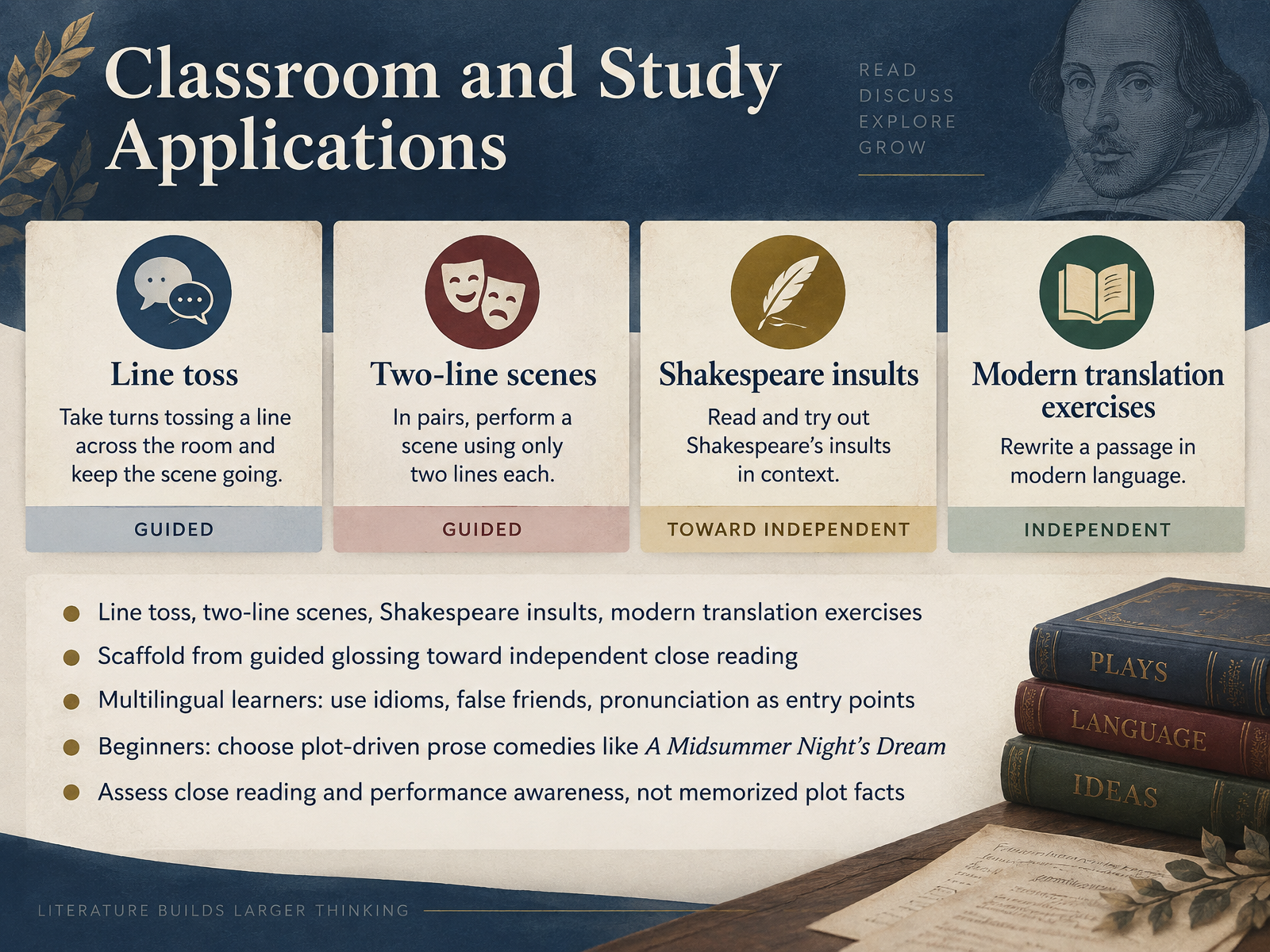
- 11Classroom and Study ApplicationsSo how do these habits of reading carry into the classroom? Start with low-stakes games. A line toss, where students speak one verse line to each other like a ball, builds confidence with rhythm before meaning. Two-line scenes let pairs trade quick exchanges, and Shakespeare insults, those wonderfully inventive put-downs, teach tone and vocabulary fast. Then move to modern translation exercises, asking students to render a short speech in their own words. Scaffold gradually, from guided glossing, where you supply the difficult words in the margin, toward independent close reading. For multilingual learners, treat idioms, false friends, and pronunciation as entry points rather than obstacles. Beginners often do best with plot-driven prose comedies such as A Midsummer Night's Dream. And assess close reading and performance awareness, not memorized plot facts. Try one line toss this week and watch how quickly the verse loosens. Next, we turn to reading Shakespeare in translation and in original pronunciation.
 2 min
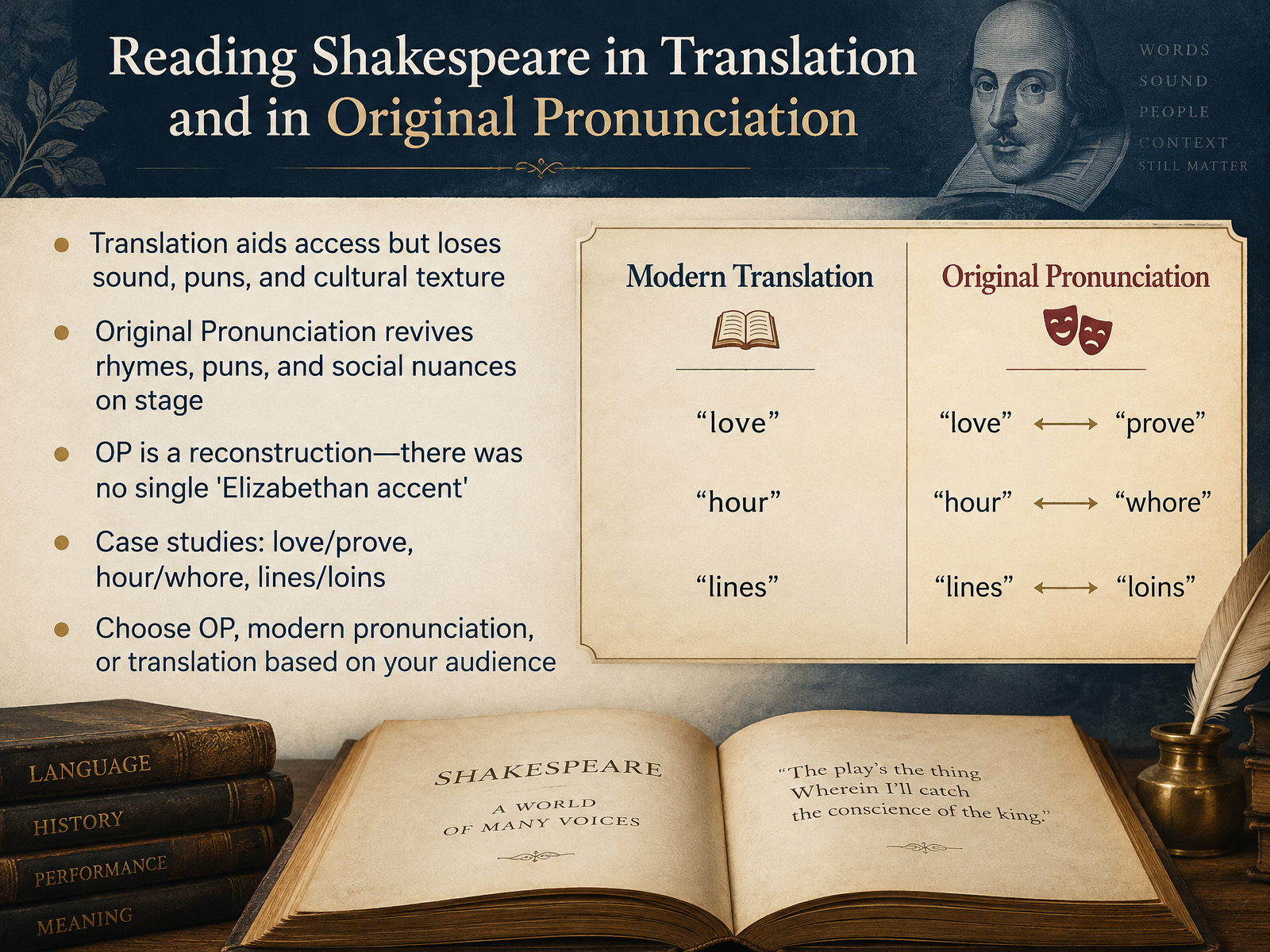
- 12Reading Shakespeare in Translation and in Original PronunciationNow let's talk about translation and Original Pronunciation. A translation gives you access, but it loses sound, puns, and cultural texture. Original Pronunciation, or O P, revives rhymes, puns, and social nuances on stage. But O P is a reconstruction. There was no single Elizabethan accent. Consider three case studies. Love and prove rhyme in O P. So do hour and whore. And lines and loins. These sound shifts change meaning and humor in performance. For your audience, choose O P, modern pronunciation, or translation. Each serves a different purpose. In a classroom, a modern edition with notes may work best. On stage, O P adds energy. For exam prep, compare the options. As you read the next scene, notice which choice changes your understanding most. Next, we'll look at common pitfalls and how to avoid them.
 2 min
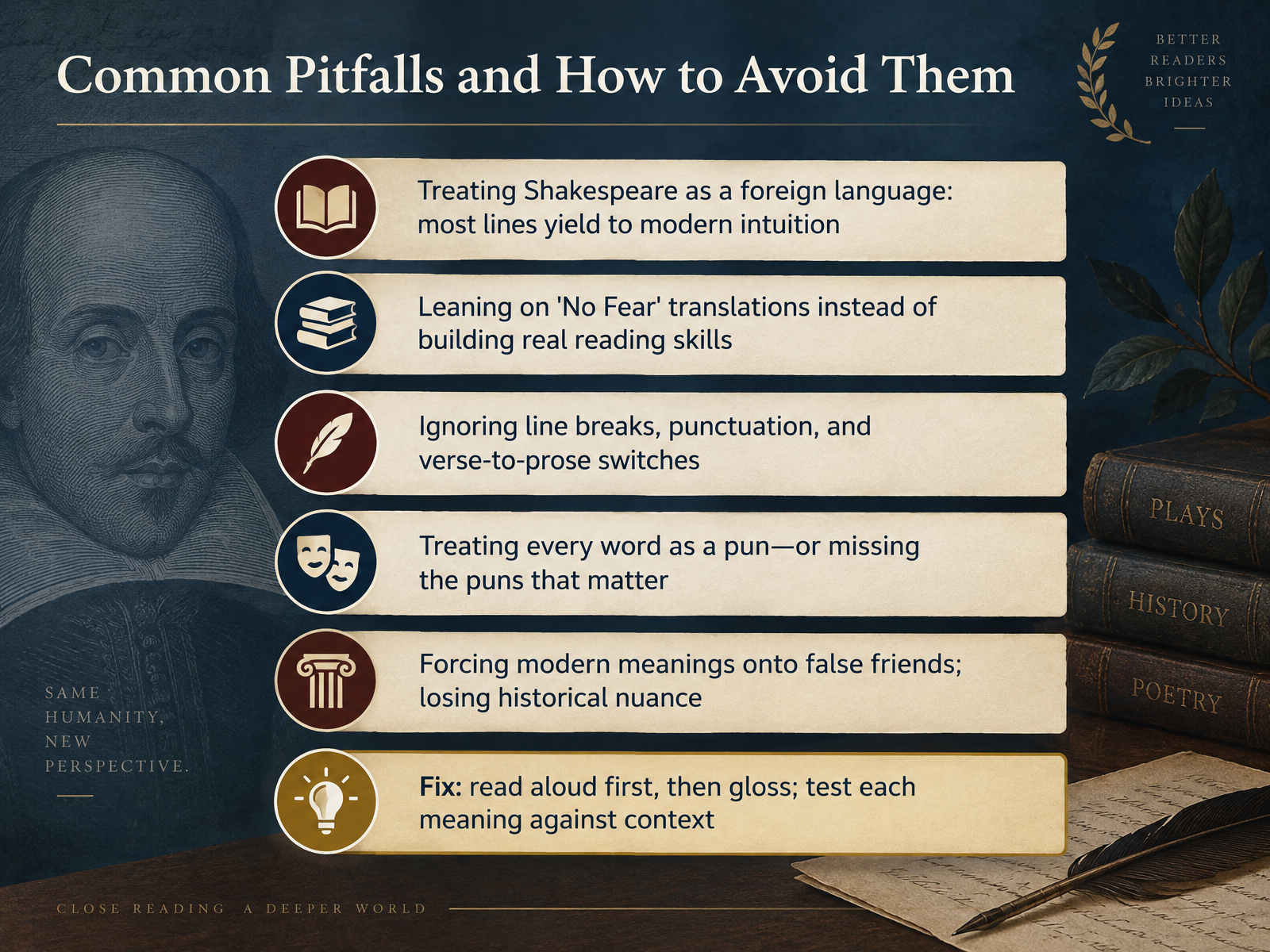
- 13Common Pitfalls and How to Avoid ThemNow let's look at the common pitfalls and how to avoid them. The first trap is treating Shakespeare as a foreign language. Most lines yield to modern intuition, so trust your first reading before reaching for a glossary. Second, leaning on No Fear translations, those side by side modern versions, can feel efficient, but it prevents you from building real reading skills. Read the original first, then check a gloss only when a line truly stalls. Third, pay attention to line breaks, punctuation, and switches between verse and prose. A full stop in the middle of a line, for instance, often signals a shift in thought or emotion. Fourth, don't treat every word as a pun, yet don't miss the puns that matter. Ask whether the double meaning is active in the scene. Fifth, avoid forcing modern meanings onto false friends, words that look familiar but carried different senses. Test each meaning against the context around it. The reliable fix is simple. Read aloud first, then gloss, and test every meaning against the context. In our final slide, we'll gather the key takeaways and suggest next steps for your own reading and teaching.
 2 min
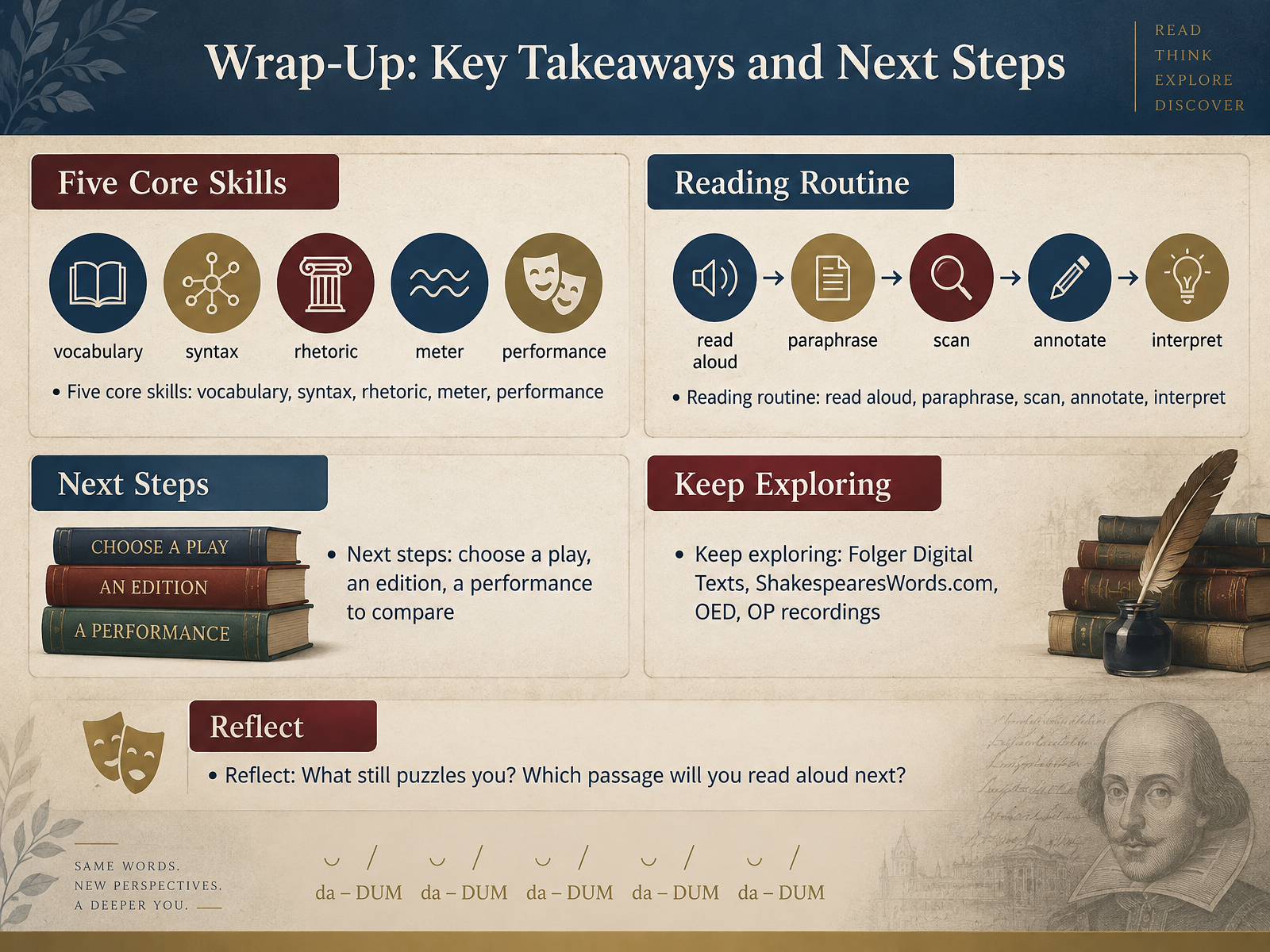
- 14Wrap-Up: Key Takeaways and Next StepsLet's bring everything together. You've built five core skills: vocabulary, syntax, rhetoric, meter, and performance. Use them as one reading routine. Read a passage aloud, paraphrase it in plain prose, scan the meter, annotate the margins, then interpret. For example, take the opening of Macbeth: read the witches' lines aloud, paraphrase their meaning, mark the trochaic beat, circle the paradox of fair and foul, then ask how a performance might make that paradox eerie. Next, choose a play, pick an edition with good notes, and compare a staged performance. Keep exploring with the Folger Digital Texts, ShakespearesWords dot com, the Oxford English Dictionary, and recorded performances. Finally, reflect: what still puzzles you, and which passage will you read aloud next? Thank you for reading closely with me. Keep listening to the verse, and let the next line surprise you.
 2 min
Take the deck with you
Download this course as a file — free, no sign-up needed.
- PDF handoutEvery slide page, ready to print or share.15 pages · 5.4 MBDownload
- Narrated PowerPointThe deck that presents itself — every slide carries the digital human's narration video.15 pages · 15.3 MBDownload
- PowerPoint slidesThe full deck as a .pptx — open it in PowerPoint, Keynote, or Google Slides.15 pages · 5.4 MBDownload
Free to use in your own training — please keep the PersonWise credit page at the end.
Have your own deck? Turn it into a course