Begin
14 pages · ~28 min
Telescopes Across the EM Spectrum
Explore how telescopes reveal the universe across different wavelengths, from radio to gamma rays, and what each part of the electromagnetic spectrum teaches us about cosmic objects and phenomena.
A digital instructor presents all 14 pages. Hold “Ask” at any point and ask out loud — the answer comes from this course. No sign-up needed.
What you’ll learn
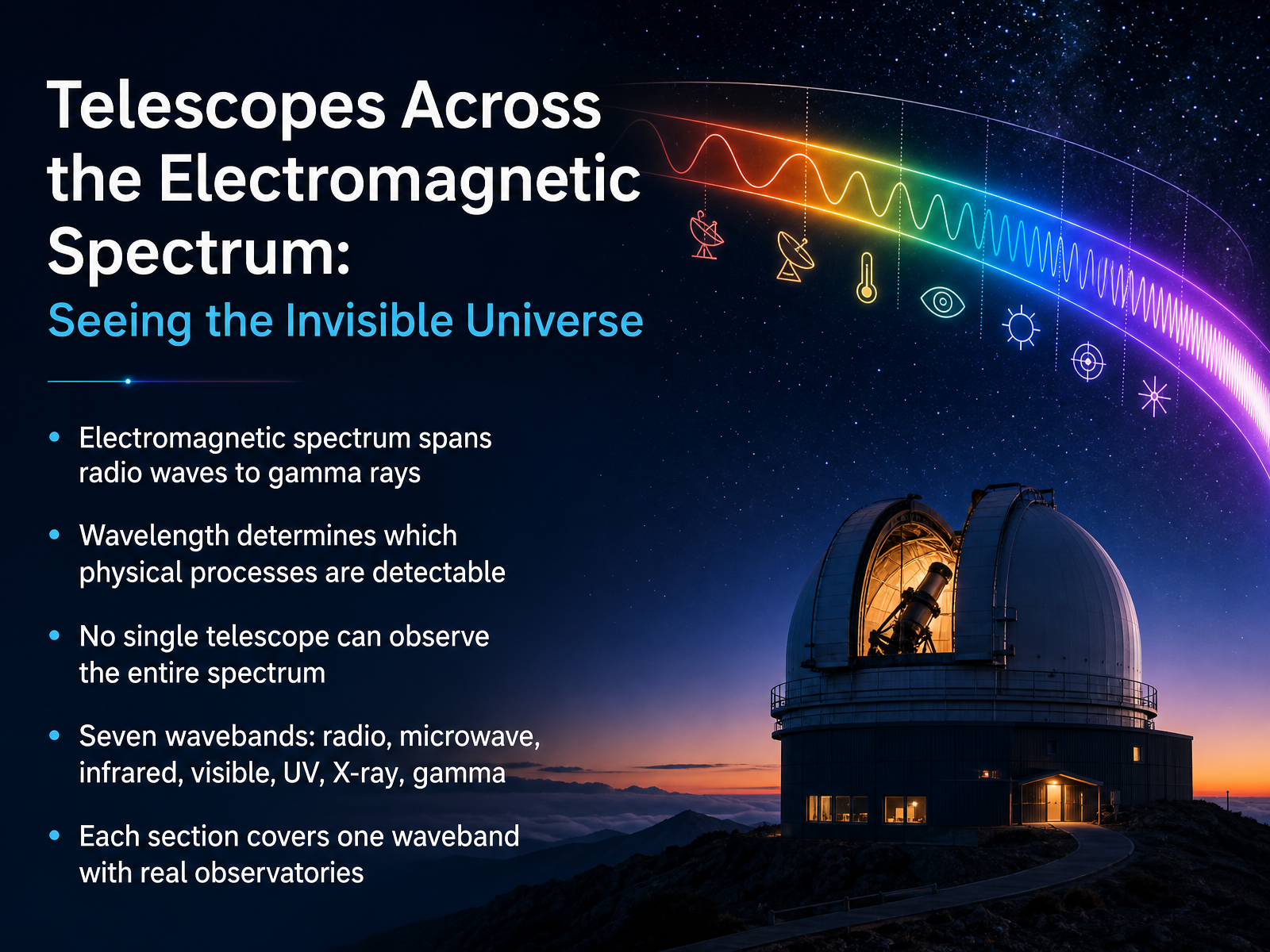
- 01Telescopes Across the Electromagnetic Spectrum: Seeing the Invisible UniverseWelcome to a journey through the invisible universe. When we look up at the night sky, our eyes are only catching a tiny sliver of the light that is actually out there. The universe communicates across a vast range of energy, what we call the electromagnetic spectrum. This spectrum stretches all the way from low-energy radio waves, with wavelengths longer than a meter, up to high-energy gamma rays, which have wavelengths smaller than an individual atom. Each type of light reveals different physical processes and objects, from cold clouds of dust glowing in the infrared to supermassive black holes shining in X-rays. Because no single instrument can see everything, astronomers use different telescopes designed for specific wavebands. Over the next few lessons, we will explore the seven major wavebands, radio, microwave, infrared, visible, ultraviolet, X-ray, and gamma ray, and visit real observatories that unlock their secrets. Let's begin by understanding why wavelength is the key that helps us decode the cosmos.heasarc.gsfc.nasa.govastrobites.orgastrobites.org+22 min
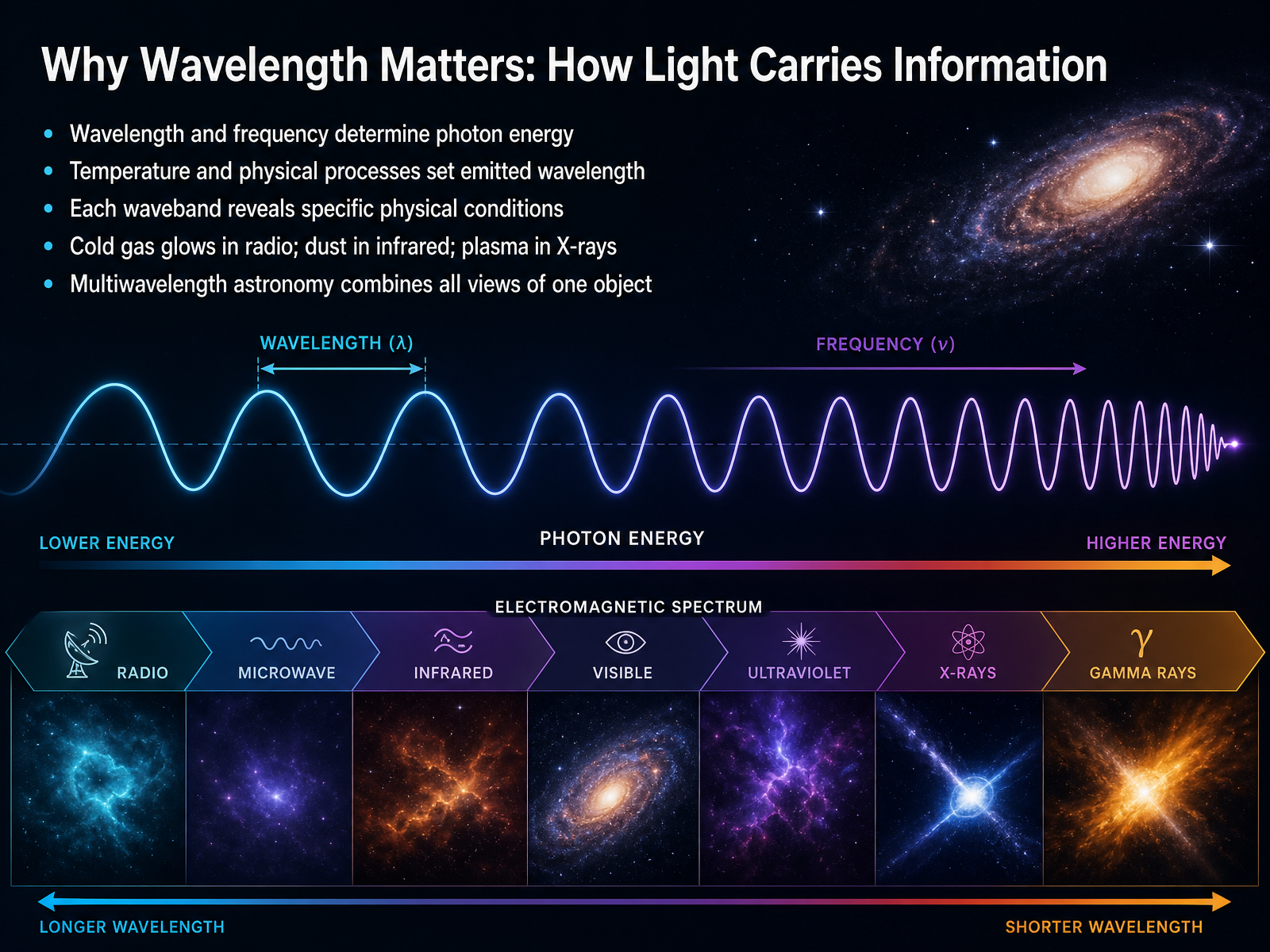
- 02Why Wavelength Matters: How Light Carries InformationNow, let us explore why wavelength really matters. Light is more than just what our eyes can see. Each wavelength carries a specific amount of energy, and that energy tells us what kind of physical process created the light. Think of it this way. If you heat metal slowly, it first glows a dull red, then orange, and eventually blue-white as it gets hotter. In the same way, cold gas glows in radio waves, warm dust shines in infrared, and extremely hot plasma blazes in X-rays. So each waveband is like a different lens, revealing conditions that would otherwise stay completely hidden. A cloud of interstellar dust may look dark in visible light, but in infrared, that same cloud becomes transparent, showing us stars forming inside. And when we combine all of these views, radio through gamma rays, we are no longer guessing at the story of an object. We are reading the full record of its temperature, its motion, and its physics. Next, we will look at atmospheric windows and why some of these wavelengths must be observed from space, while others can reach us on the ground.
 imagine.gsfc.nasa.govcosmos.astro.caltech.eduatnf.csiro.au+22 min
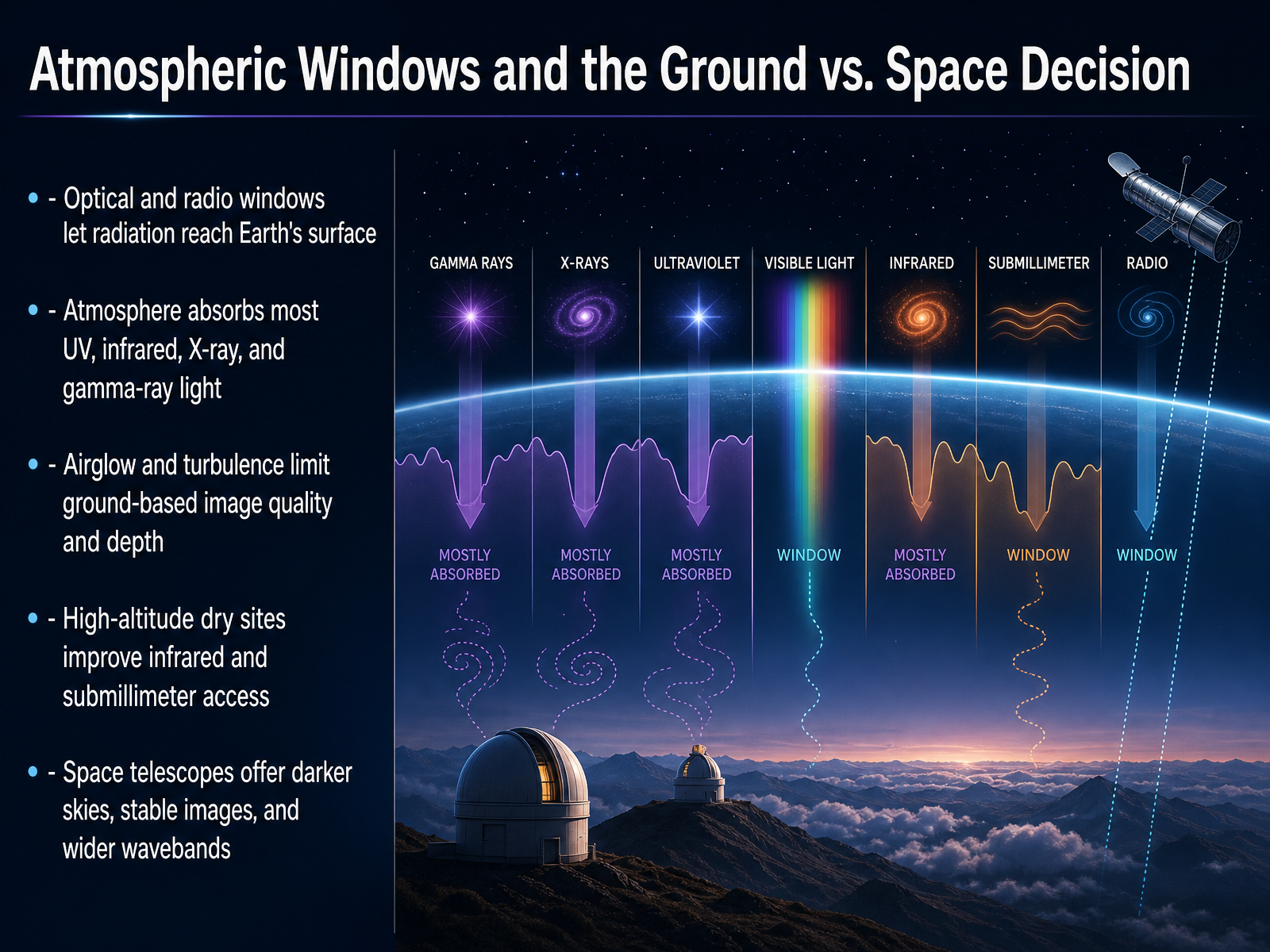
 - 03Atmospheric Windows and the Ground vs. Space DecisionThat brings us to a core decision in astronomy: building a telescope on the ground, or placing one in space. Our atmosphere acts as a protective shield, but it is also a filter. There are only two main windows where light can easily reach the surface, the optical window, where we see with our own eyes, and the radio window. Most ultraviolet, X-ray, and gamma-ray light is absorbed high above us, which is great for life, but it hides some of the most energetic events in the universe. Even in visible light, the air is always moving. That is why stars twinkle, and it causes images from the ground to blur. The faint glow of the atmosphere itself, known as airglow, also limits how dim an object we can see. For infrared light, we can improve things by building telescopes on very high, dry mountains, above much of the water vapor that blocks those wavelengths. But space telescopes offer the ultimate solution. Above the atmosphere, the sky is perfectly dark and stable, giving us sharper images and access to the entire electromagnetic spectrum. So the choice is not about one method being better, but about matching the right tool to the scientific question. Next, we will look at radio telescopes, and how they listen to the cold universe.
 doi.orglink.springer.comen.wikipedia.org+22 min
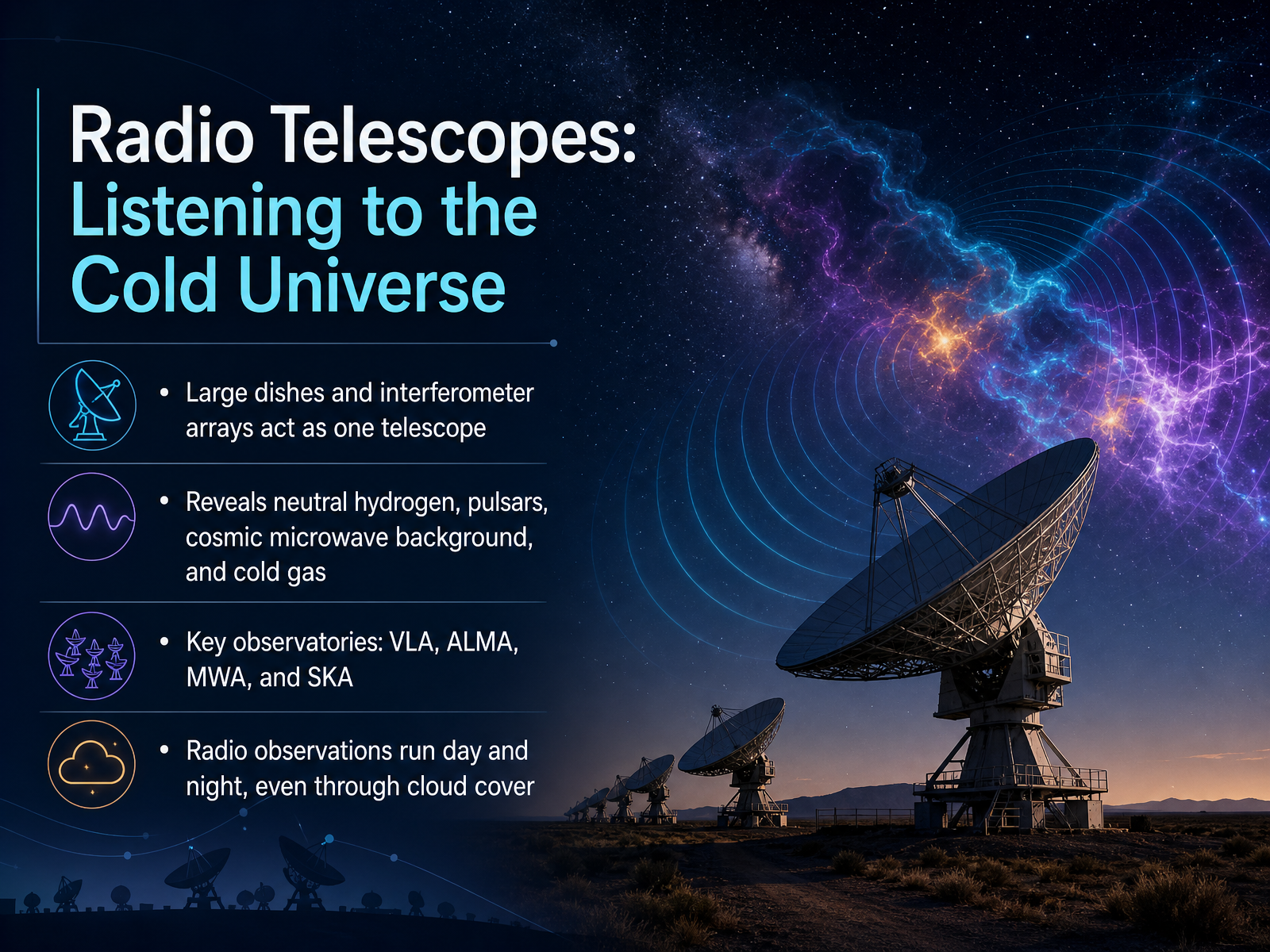
 - 04Radio Telescopes: Listening to the Cold UniverseNow, let us move from light we can see to a completely different way of perceiving the universe. When we tune into radio waves, we are listening to the cold universe. The objects here are not hot stars, but vast clouds of neutral hydrogen, rapidly spinning pulsars, and even the faint afterglow of the Big Bang itself, the cosmic microwave background. To capture these long wavelengths, astronomers use enormous dishes, but often a single dish is not enough. Facilities like the Very Large Array, or VLA, and ALMA link many dishes together. Using a technique called interferometry, this network acts as one giant telescope, with a resolving power equal to the distance between its farthest antennas. And a unique advantage exists here. Unlike optical telescopes, radio observatories do not need darkness or clear skies. They can observe continuously, day and night, and listen through cloud cover that would blind other instruments. Next, we will explore the bridge between radio and infrared light, as we look at microwave and submillimeter astronomy and the echoes of the early universe.
 iram-institute.orgcambridge.orgskao.int+21 min
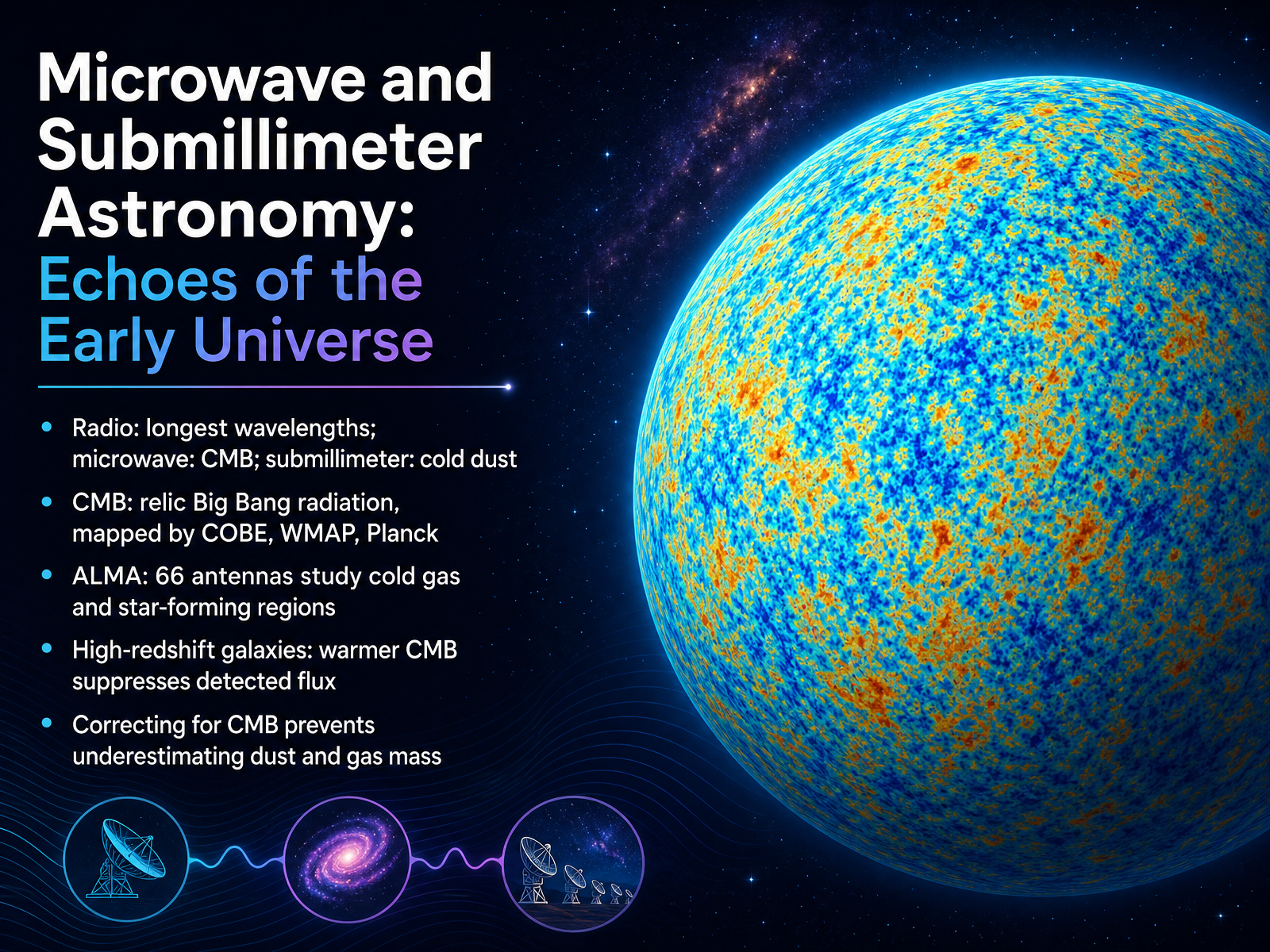
 - 05Microwave and Submillimeter Astronomy: Echoes of the Early UniverseNow we move from the longest radio waves into a part of the spectrum that lets us hear echoes of the very beginning. Microwave and submillimeter astronomy opens a window on the cold universe, from the relic radiation of the Big Bang to the dusty clouds where new stars are forming. The most famous signal here is the cosmic microwave background, or CMB. This faint glow is heat left over from the Big Bang itself, cooled over nearly fourteen billion years to just a few degrees above absolute zero. Space missions like COBE, WMAP, and Planck mapped this radiation across the entire sky, revealing tiny ripples that became the seeds of galaxies. On the ground, the ALMA observatory uses sixty-six antennas high in the Chilean desert to study a different kind of cold signal. ALMA peers into dense clouds of gas and dust to see the raw material of future stars and planets. But there is a subtle catch when we observe very distant galaxies. At high redshift, the cosmic microwave background was warmer, which can reduce the contrast of the signal we detect. Without correcting for this effect, astronomers can severely underestimate how much dust and gas those early galaxies actually contain. This careful correction keeps our picture of the young universe accurate. Next, we turn to infrared telescopes, which see through cosmic dust to reveal hidden star birth.
 iopscience.iop.org2 min
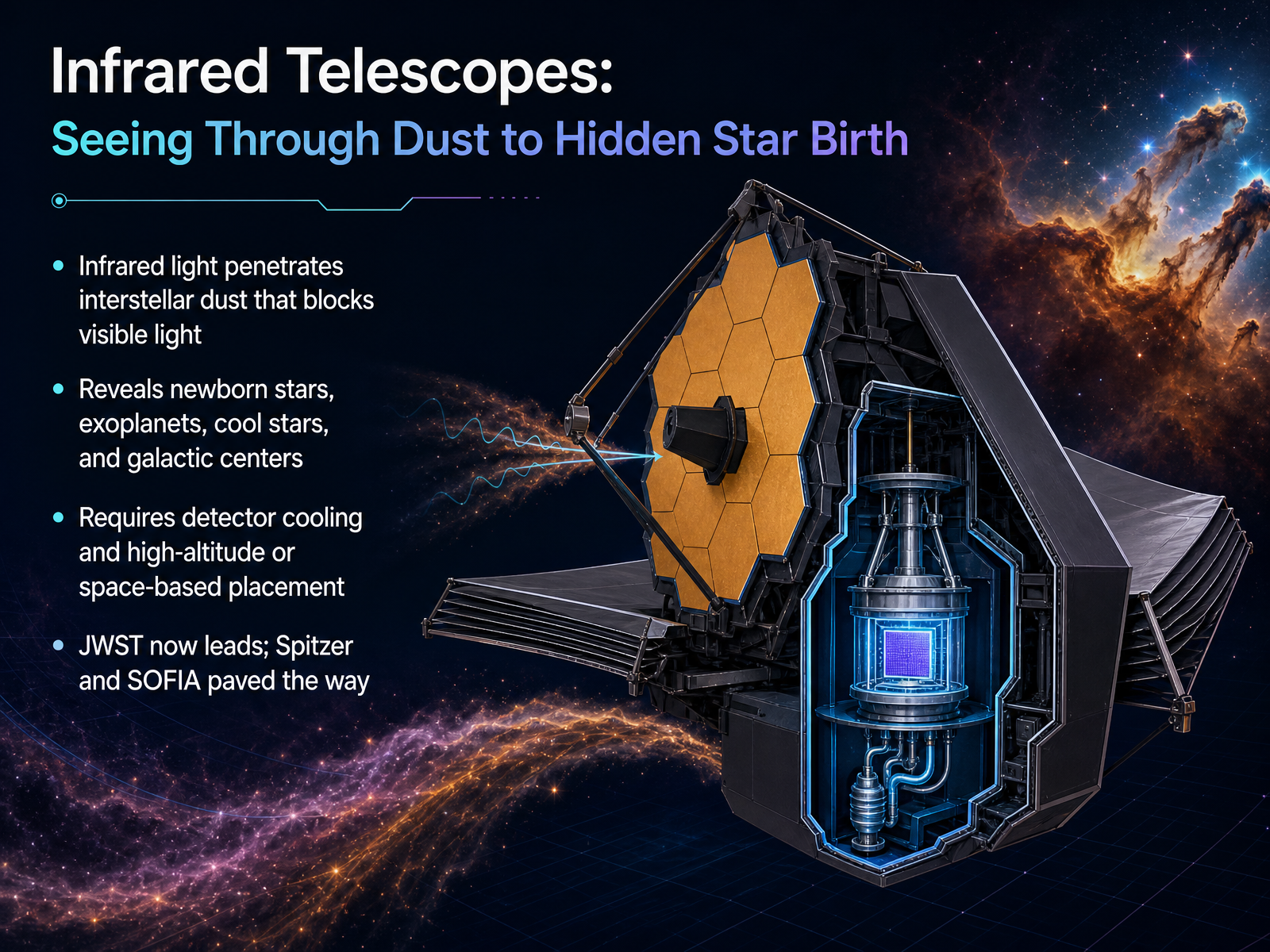
 - 06Infrared Telescopes: Seeing Through Dust to Hidden Star BirthNow let’s turn to infrared telescopes, the instruments that let us see through cosmic dust to witness hidden star birth. In visible light, interstellar dust acts like a thick fog, blocking our view of regions where new stars are forming. But infrared light has longer wavelengths, so it can pass through that dust and reveal what’s on the other side. With infrared vision, we can observe newborn stars still wrapped in their dusty cocoons, detect exoplanets orbiting distant suns, and even peer into the crowded centers of galaxies. There is a catch, though. Infrared telescopes are sensitive to heat, so their detectors must be kept extremely cold, and many are placed at high altitudes or in space to avoid Earth’s own warmth. The James Webb Space Telescope now leads this field, but it stands on the shoulders of earlier missions like Spitzer and the airborne observatory SOFIA. Together, they have opened a hidden universe for us. Up next, we shift to visible and ultraviolet telescopes to explore the hot, energetic side of the cosmos.
 1 min
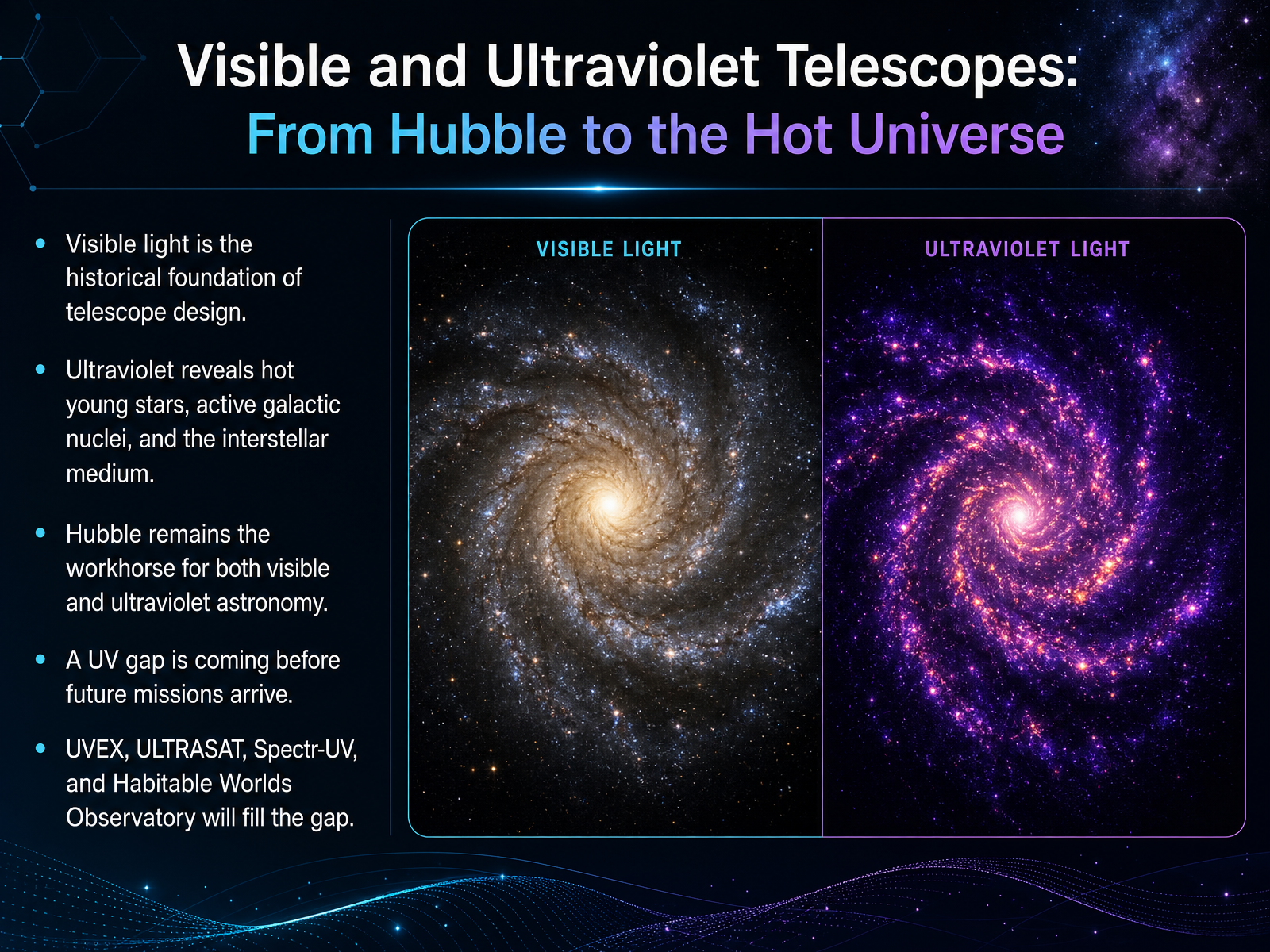
1 min - 07Visible and Ultraviolet Telescopes: From Hubble to the Hot UniverseLet's turn now to the part of the spectrum our own eyes know best, visible light, and its more energetic neighbor, ultraviolet. Visible light is the historical foundation of telescope design, and it still anchors much of what we do. Shift just beyond the blue end, and ultraviolet begins to reveal a hotter, more dynamic universe. Ultraviolet light brings us into contact with hot young stars, active galactic nuclei, and the interstellar medium, the raw material between the stars. For decades the Hubble Space Telescope has been the workhorse for both visible and ultraviolet astronomy, but its detector sensitivity is declining, and right now there is no approved high resolution ultraviolet spectrograph ready to take over. That means a real gap in ultraviolet coverage is coming. The good news is that a wave of future missions is being prepared to fill it. Projects like U V E X, ULTRASAT, Spectr U V, and the eventual Habitable Worlds Observatory will extend our ultraviolet eyes and prepare the scientific foundation for the next generation of discovery. Next we move to even higher energies, as we explore X ray telescopes and what they reveal about black holes and extreme environments.
 1 min
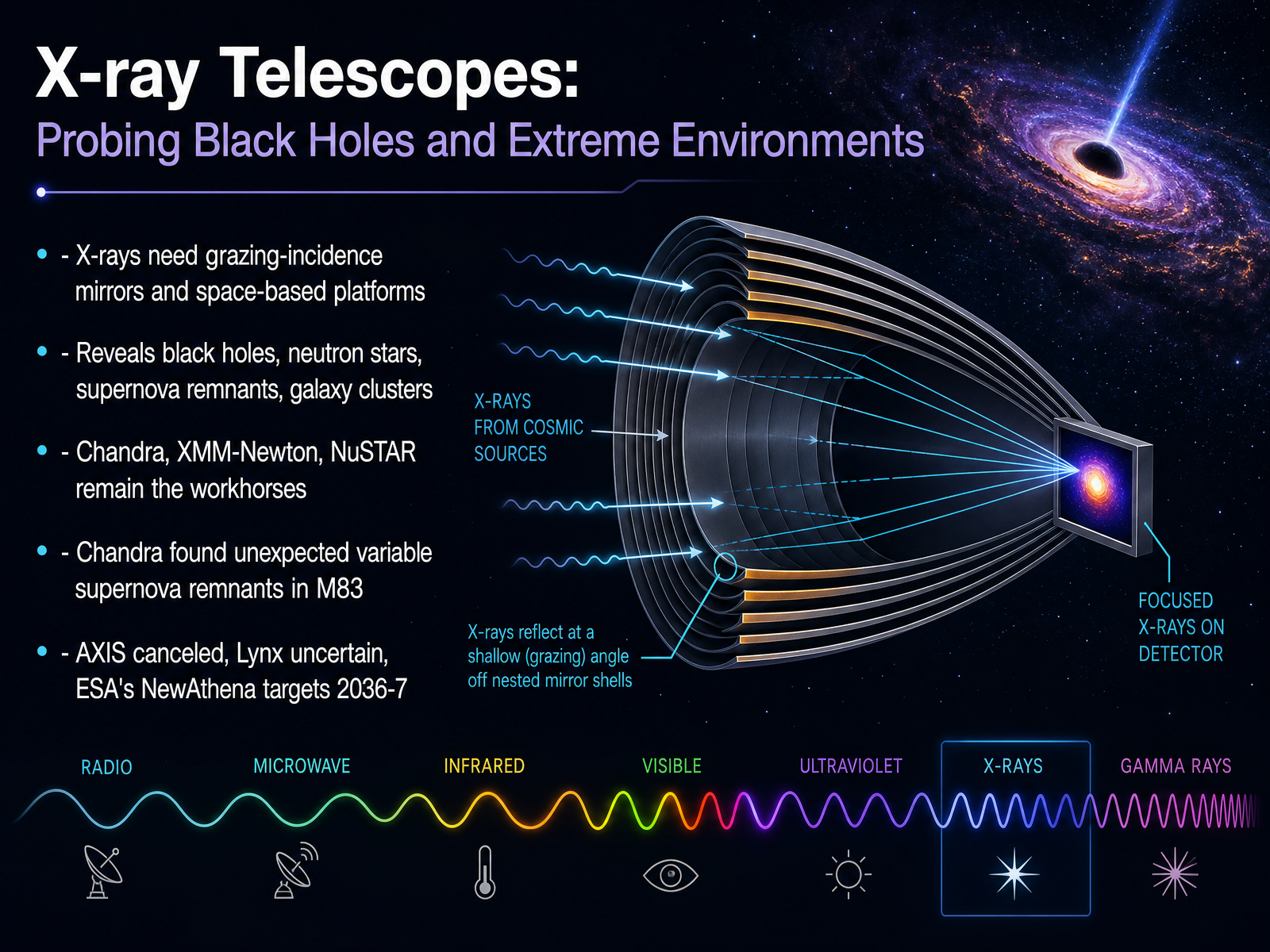
1 min - 08X-ray Telescopes: Probing Black Holes and Extreme EnvironmentsNow we step into a realm where light itself behaves in surprising ways, the realm of X-ray astronomy. X-rays are so energetic that they would pass right through a conventional mirror, so telescopes like Chandra use grazing-incidence mirrors, carefully shaped surfaces that gently bounce the photons into focus. Because our atmosphere absorbs X-rays, these observatories must operate from space. They reveal the universe's most extreme environments, including swirling disks around black holes, the crushed cores of neutron stars, and the glowing remains of supernova explosions. Chandra, along with XMM-Newton and NuSTAR, remains a workhorse for this science. In fact, Chandra has made surprising discoveries even in nearby galaxies. In the galaxy M83, astronomers found unexpected, variable X-ray sources tied to supernova remnants, a result that challenges our understanding of how stellar debris evolves. Looking ahead, the path is uncertain. NASA's AXIS mission has been canceled, and the larger Lynx concept remains uncertain. The European Space Agency's NewAthena is now targeted for launch in 2036 or 2037. Up next, we push to even higher energies as we explore gamma-ray astronomy and the universe's most powerful explosions.
 2 min
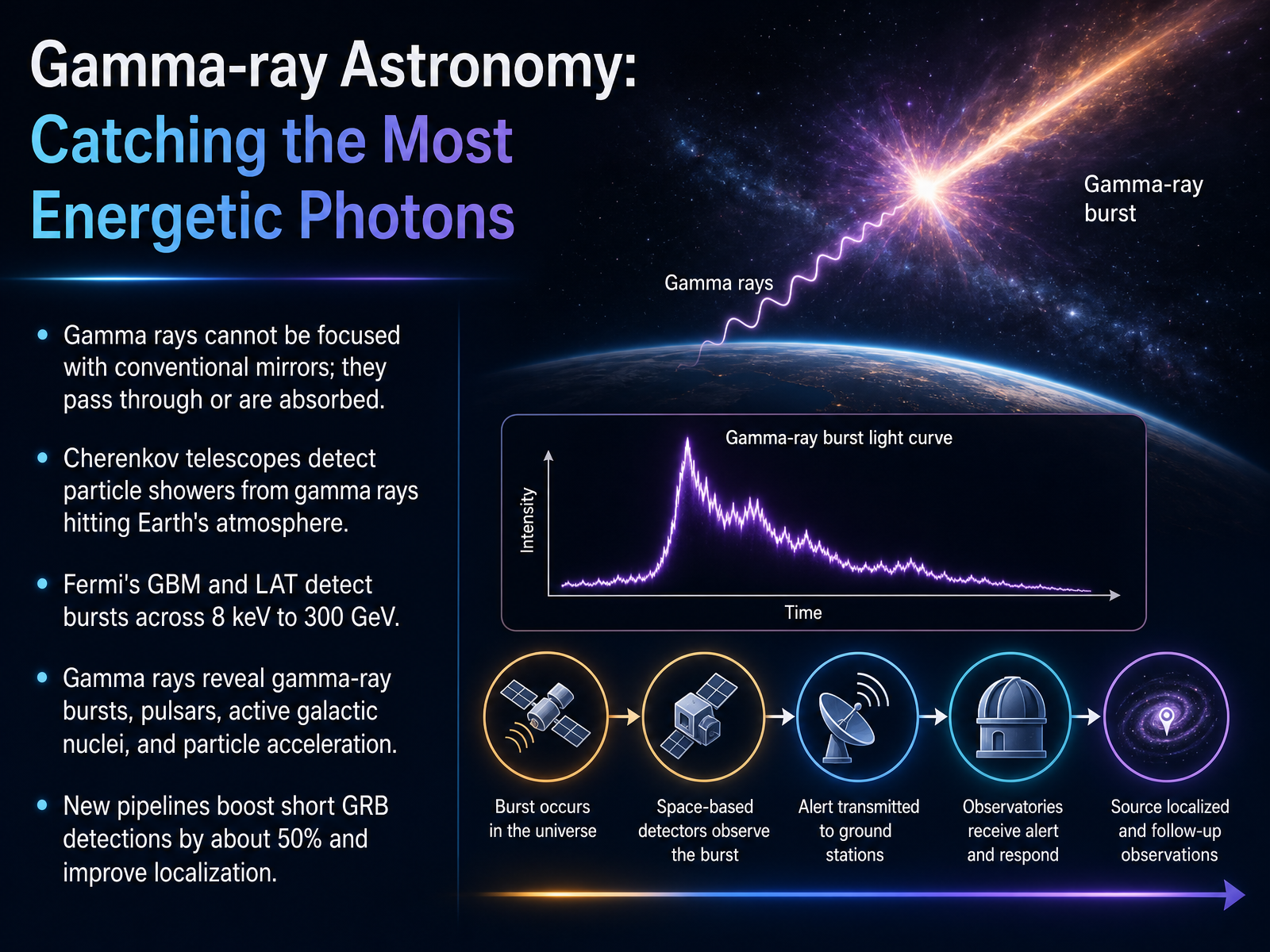
2 min - 09Gamma-ray Astronomy: Catching the Most Energetic PhotonsNow we reach the very top of the energy scale: gamma-ray astronomy. These are the most energetic photons in the universe, but catching them requires completely different tricks. Unlike visible light, gamma rays cannot be focused with conventional mirrors. They either pass straight through or get absorbed. So how do we actually see them? When a gamma ray slams into Earth's atmosphere, it creates a shower of particles. Instruments called Cherenkov telescopes detect the faint flash of light from that particle shower. In space, NASA's Fermi observatory uses the GBM and LAT instruments to watch for bursts across a huge range, from eight kiloelectronvolts all the way to three hundred gigaelectronvolts. These observations reveal incredible events like gamma-ray bursts, spinning pulsars, and active galactic nuclei. And new search pipelines are even better at spotting the shortest bursts, improving detections by about fifty percent and telling us more precisely where they happened. This high-energy view connects naturally to our next topic.
 2 min
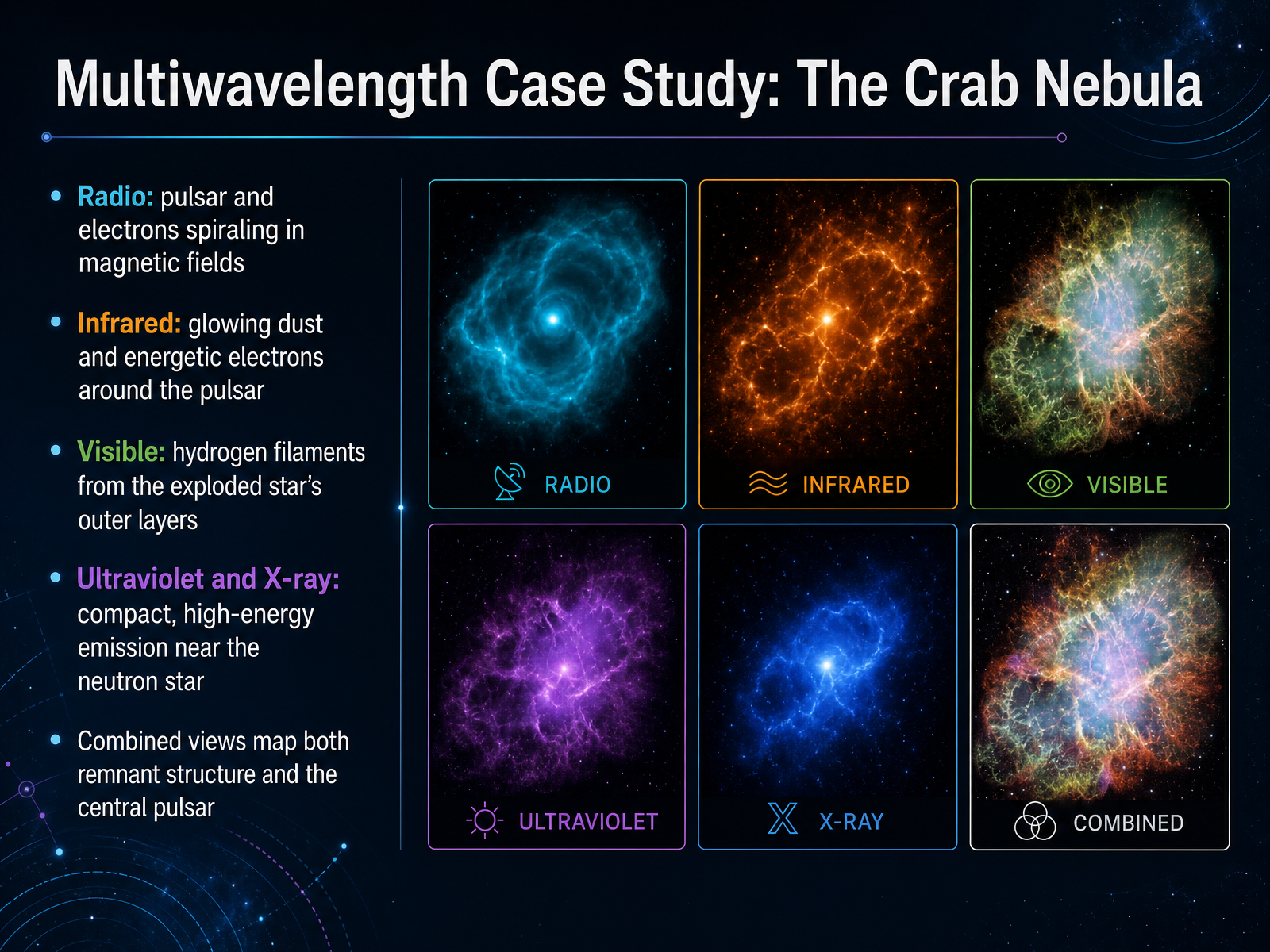
2 min - 10Multiwavelength Case Study: The Crab NebulaNow let's put all of these ideas together by looking at one of the most famous objects in the sky, the Crab Nebula. When we view it in radio light, we see the central pulsar clearly, along with electrons spiraling around in strong magnetic fields. In the infrared, we pick up the glow of warm dust, and energetic electrons surrounding that rapidly spinning pulsar. In visible light, we see reddish hydrogen filaments, which are the stretched and tattered outer layers of the original star, still expanding into space. When we shift to ultraviolet and X-ray wavelengths, the view becomes far more compact. The highest energy emission comes from very close to the neutron star itself, where intense conditions accelerate particles to extreme speeds. By combining all of these images, we can map both the full structure of the nebula and the behavior of its hidden central engine. Each wavelength answers a different question. Next, we will apply this same multiwavelength approach to a much closer and busier environment, the Galactic Center.
 imagine.gsfc.nasa.govcosmos.astro.caltech.eduatnf.csiro.au+21 min
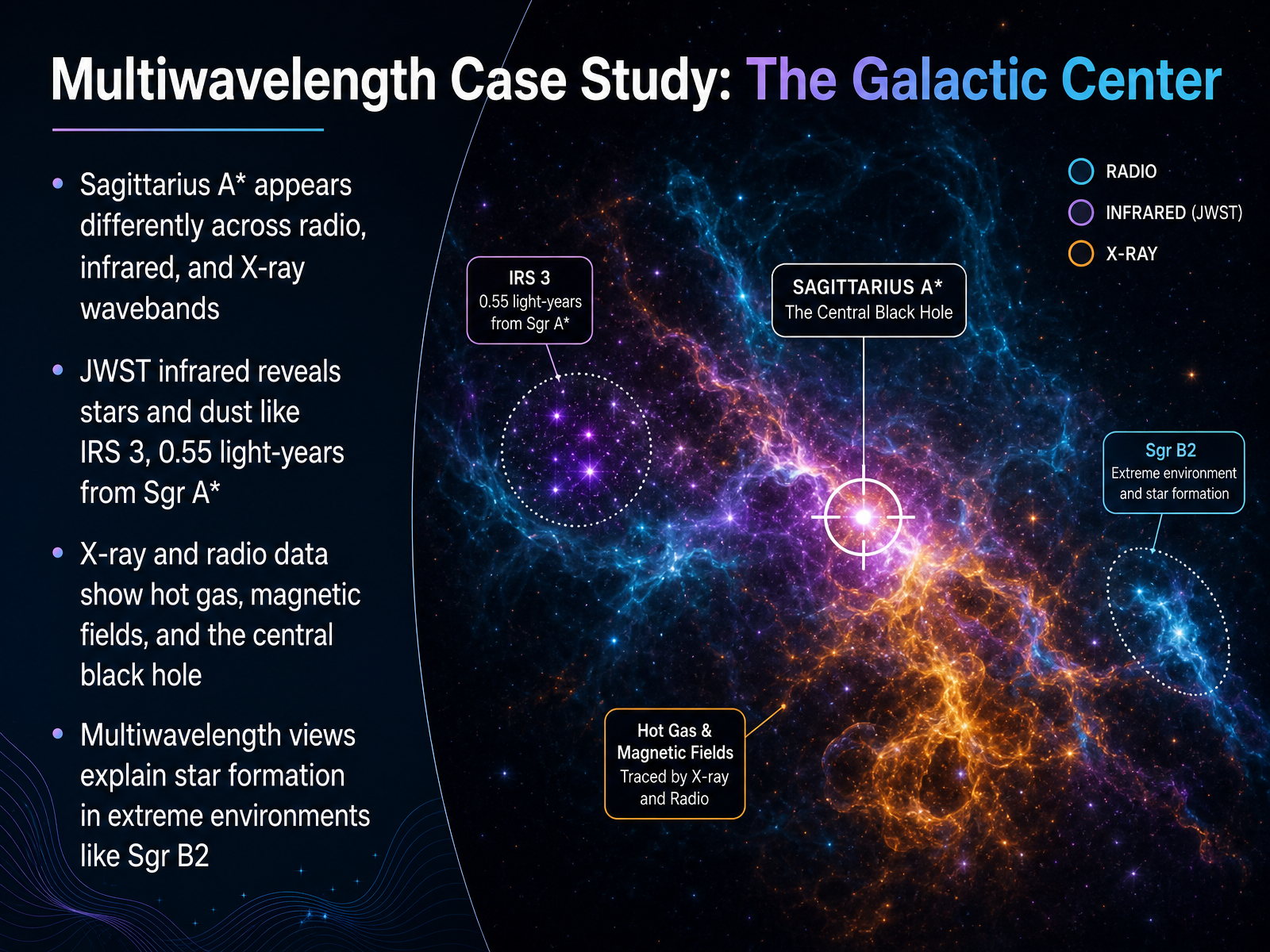
 - 11Multiwavelength Case Study: The Galactic CenterLet's bring everything together and look at one extraordinary place: the center of our own Milky Way galaxy. There, we find Sagittarius A-star, our galaxy's supermassive black hole. This region looks completely different depending on the wavelength of light we use. Radio observations trace powerful magnetic fields and fast-moving particles. Infrared light from JWST cuts through dense dust to reveal individual stars, like IRS 3, located just over half a light-year from the black hole. X-ray telescopes, such as Chandra, show us the incredibly hot gas swirling in the extreme environment. Combining these views helps us answer big questions, like how stars can form in such a violent place. For instance, JWST has given us a stunning new look at Sagittarius B2, one of the most active star-forming clouds in our galaxy, showing how infrared light can even escape from its deepest regions. This is the true power of multiwavelength astronomy. Now let's look ahead and see what the future holds.
 imagine.gsfc.nasa.govcosmos.astro.caltech.eduatnf.csiro.au+21 min
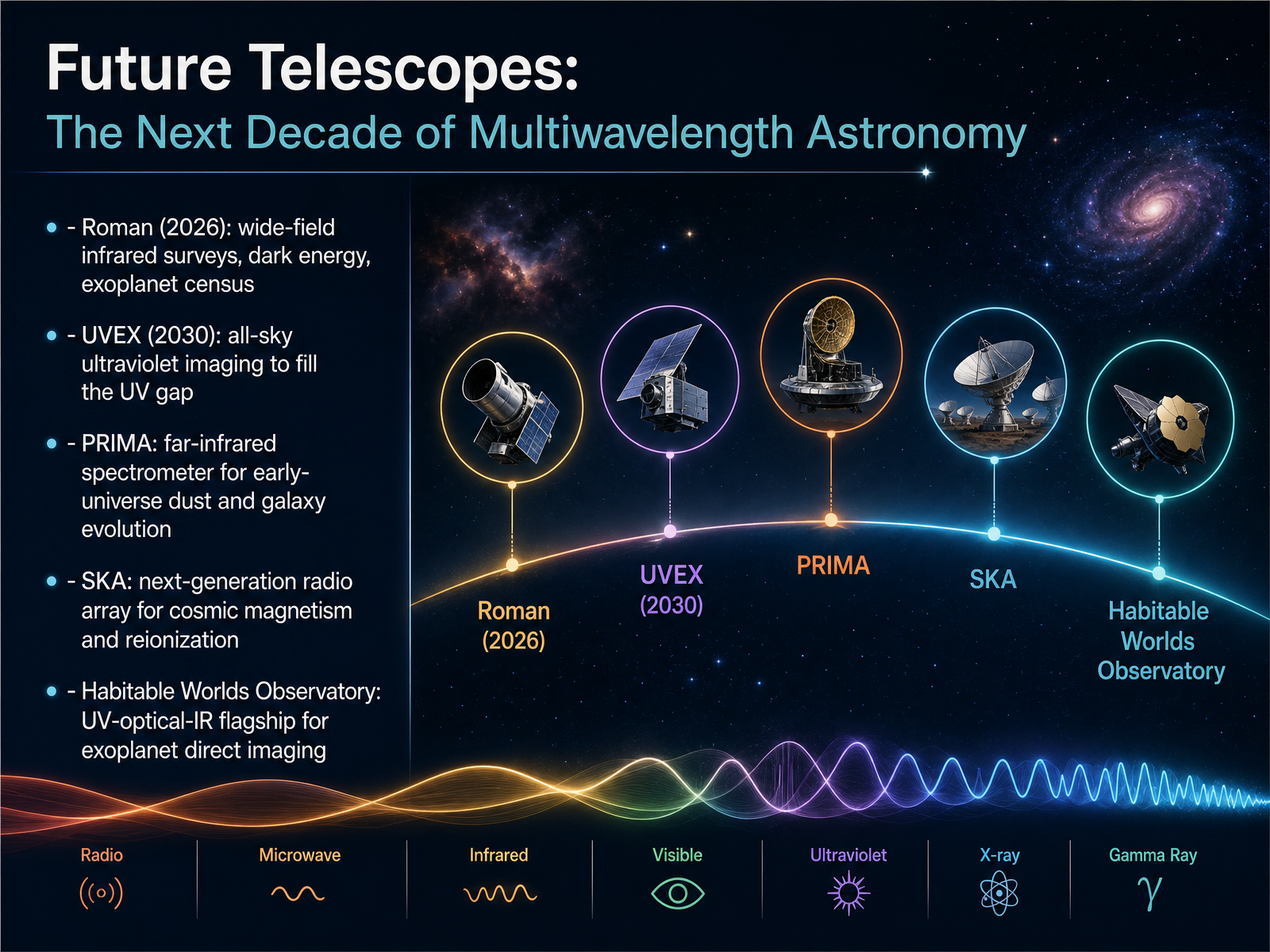
 - 12Future Telescopes: The Next Decade of Multiwavelength AstronomySo far we have focused mostly on observatories already in space. But the next decade will bring an entirely new fleet of instruments, each designed to fill a specific gap in our multiwavelength view of the universe. The Nancy Grace Roman Space Telescope is scheduled to launch in 2026. It will carry out wide field infrared surveys to study dark energy and perform a census of exoplanets. In 2030, the UVEX mission will map the entire sky in ultraviolet light. That fills a major gap left by older missions like GALEX. PRIMA will then push into the far infrared, giving us a spectrometer sensitive enough to study dust and galaxy evolution in the early universe. Looking further ahead, the SKA will become the next great radio array, probing cosmic magnetism and the epoch of reionization. And the Habitable Worlds Observatory is being planned as a future flagship for direct imaging of exoplanets across ultraviolet, optical, and infrared wavelengths. Together, these missions will not just extend our sight, they will connect the full electromagnetic spectrum in new and powerful ways. Next, we will talk about how to teach and communicate multiwavelength astronomy.
 2 min
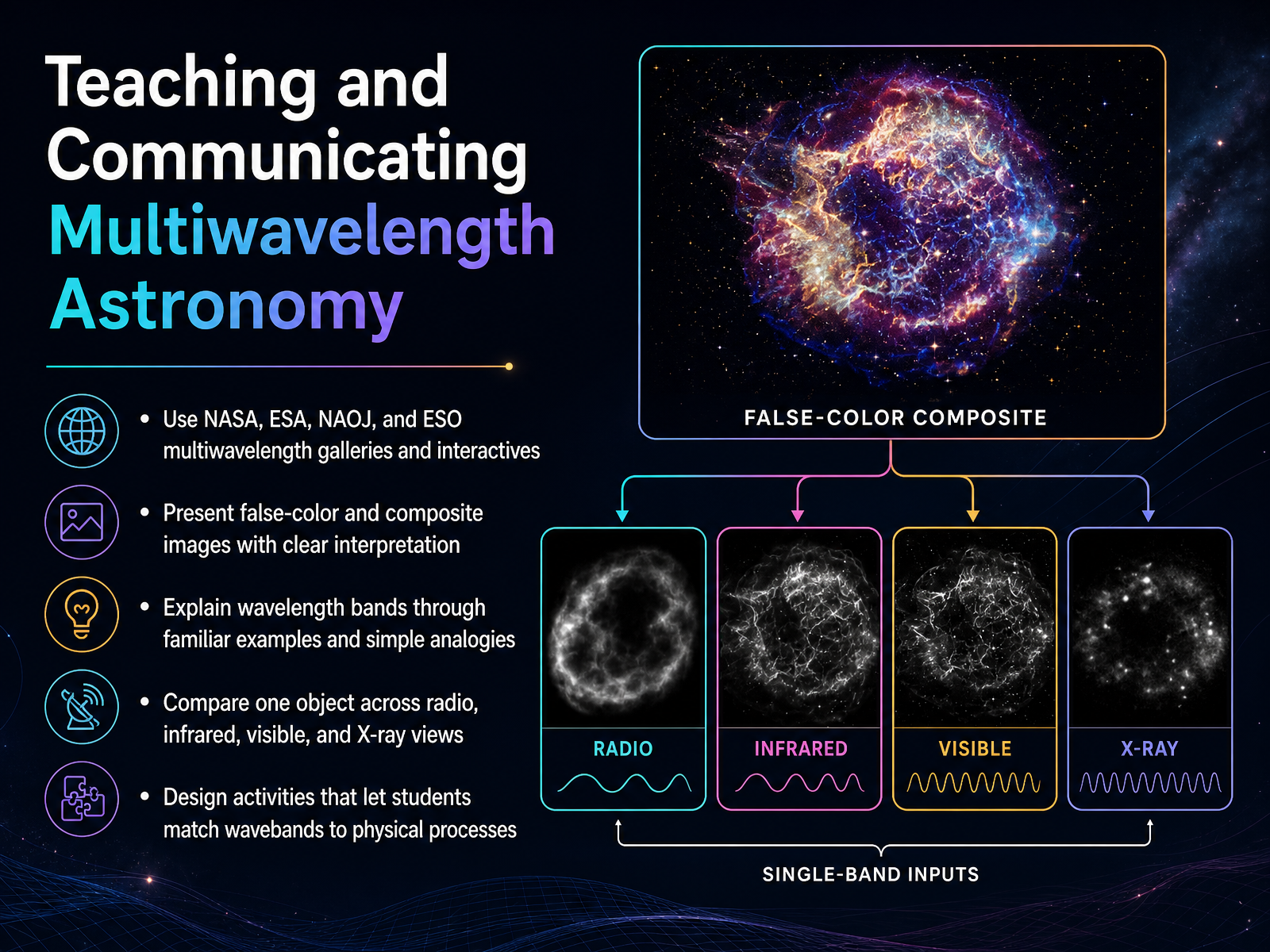
2 min - 13Teaching and Communicating Multiwavelength AstronomyAs we move from observing the universe to teaching about it, a practical approach makes all the difference. Start by exploring the rich galleries and interactive tools offered by NASA, the European Space Agency, and other major observatories. When you show those stunning false-color images, take a moment to explain what the colors actually represent, because a composite image is really a map of physical processes, not a photograph. Use familiar analogies to anchor each waveband. For example, infrared lets us see through dust, much like night-vision goggles reveal warm objects in the dark, while X-rays highlight the most energetic, violent events. One of the most effective activities is to place a single object, like a supernova remnant, side by side in radio, infrared, visible, and X-ray views. Then ask students to match each view to the physics behind it. Does this band show cold gas, hot electrons, or starlight? That simple question turns a beautiful picture into a powerful lesson. With these tools and comparisons, learners begin to see how each waveband completes a different piece of the cosmic puzzle. In our final slide, we will pull these ideas together into a clear summary and an action plan for your own multiwavelength teaching.
 imagine.gsfc.nasa.govcosmos.astro.caltech.eduatnf.csiro.au+22 min
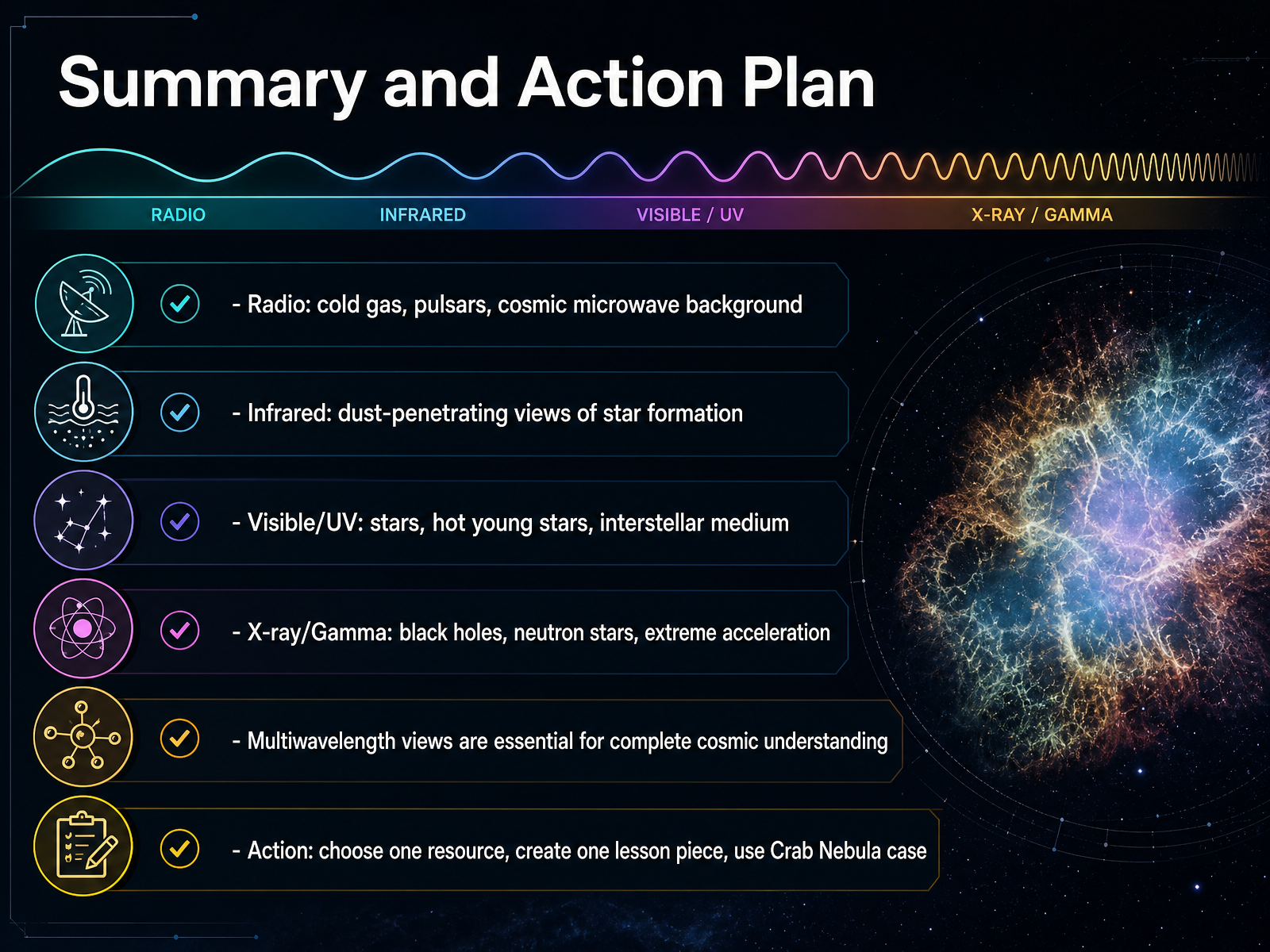
 - 14Summary and Action PlanWe have covered a lot of ground, so let us bring the picture together. Each band of light gives us a different clue. Radio waves reveal cold gas and pulsars. Infrared lets us peer through dust and watch new stars being born. Visible and ultraviolet light show us hot young stars and the space between them. And X rays and gamma rays point to the most extreme events, like black holes and rapidly spinning neutron stars. The key takeaway is that no single view tells the whole story. A multiwavelength approach is essential if we want a complete cosmic understanding. For a practical next step, I invite you to choose one resource from this course and turn it into a short lesson piece. The Crab Nebula makes an excellent case study because it changes dramatically depending on the wavelength you use to observe it. Thank you for joining me on this journey across the electromagnetic spectrum. Keep looking up, and keep exploring.
 heasarc.gsfc.nasa.govastrobites.orgastrobites.org+22 min
Take the deck with you
Download this course as a file — free, no sign-up needed.
- PDF handoutEvery slide page, ready to print or share.15 pages · 4.8 MBDownload
- Narrated PowerPointThe deck that presents itself — every slide carries the digital human's narration video.15 pages · 17.2 MBDownload
- PowerPoint slidesThe full deck as a .pptx — open it in PowerPoint, Keynote, or Google Slides.15 pages · 4.8 MBDownload
Free to use in your own training — please keep the PersonWise credit page at the end.
Have your own deck? Turn it into a course
Sources consulted
Web sources consulted while building this course.
- What are the Energy Range Definitions for EM Radiation? — heasarc.gsfc.nasa.gov
- Guide to the Electromagnetic Spectrum in Astronomy | astrobites — astrobites.org
- Guide to the Electromagnetic Spectrum in Astronomy — astrobites.org
- 5.2 The Electromagnetic Spectrum - Astronomy 2e | OpenStax — openstax.org
- Observational Astrophysics 2. Electromagnetic Radiation — users.camk.edu.pl
- Multiwavelength Astronomy — imagine.gsfc.nasa.gov
- Why different wavelengths? | COSMOS — cosmos.astro.caltech.edu
- Wavebands - Photons from Space - Australia Telescope National Facility — atnf.csiro.au
- Spectroscopic Observations of Different Wavelengths of Light in Astronomy — science.nasa.gov
- Multiwavelength Astronomy - Imagine the Universe! - NASA — imagine.gsfc.nasa.gov
- Comparison of optical observational capabilities for the coming decades: ground versus space — doi.org
- Extra-Atmospheric Astronomy and the New James Webb Space Telescope — link.springer.com
- Atmospheric window — en.wikipedia.org
- Why Do We Launch Space Telescopes? | Scientific American — scientificamerican.com
- NOEMA – IRAM — iram-institute.org
- The Murchison Widefield Array Phase III upgrade: Sensitivity doubled, number of baselines quadrupled, flexibility enhanced, and EoR observations optimised | Publications of the Astronomical Society of Australia | Cambridge Core — cambridge.org
- SKAO's telescope in South Africa 'comes alive' with first fringes milestone | SKAO — skao.int
- Radio — kvn.kasi.re.kr
- Introduction — NRAO Science Site — science.nrao.edu
- Confirming the Calibration of ALMA Using Planck Observations - IOPscience — iopscience.iop.org