
Brand Protection Strategy: Goals & Tradeoffs
Begin
15 pages · ~30 min
Brand Protection Strategy: Goals & Tradeoffs
Learn to craft effective brand protection strategies by understanding key goals, strategic choices, and tradeoffs. Ideal for professionals involved in intellectual property and brand risk management.
What you’ll learn
- 01Brand Protection Strategy: Goals, Choices, and TradeoffsWelcome. If you're leading a brand, a marketing team, or a startup, you already know that your brand is one of your most valuable assets. What we're going to do in this session is treat brand protection as the strategic business function it needs to be, not just a legal defense. We'll define clear goals, walk through the real choices you have, and be honest about the tradeoffs those choices create. Because in today's market, protecting your brand is about growth, customer trust, and the long-term value of everything you're building. Let's get to work. First, we need to make the case for why this deserves a formal strategy in the first place.worldtrademarkreview.comsummitgeneralcounsel.comredpoints.com+21 min
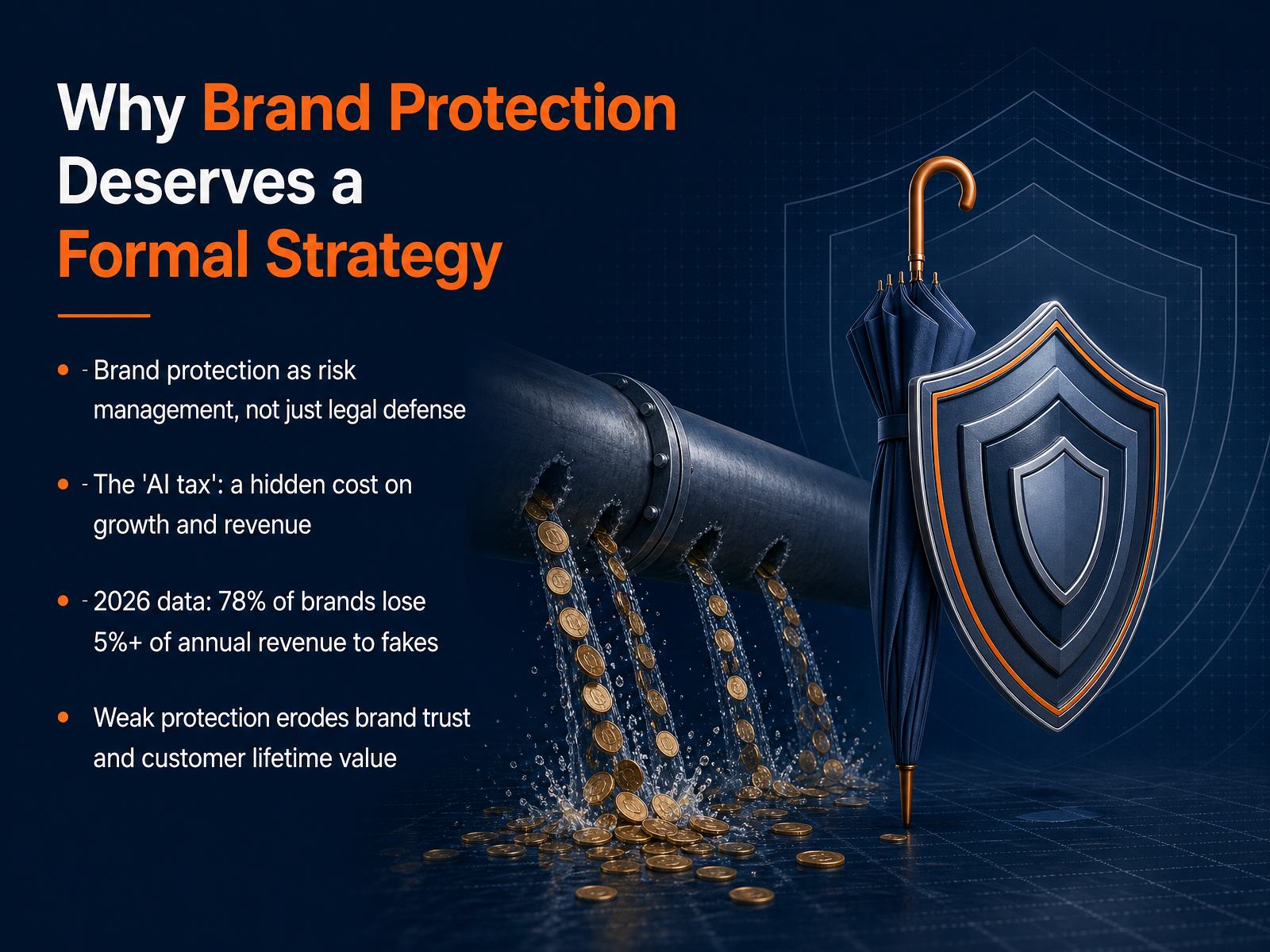
- 02Why Brand Protection Deserves a Formal StrategyLet's reframe how we think about brand protection. It's not just a legal defense mechanism. It's a critical component of risk management that directly impacts your bottom line. In 2026, we're seeing the rise of what we call the AI tax. This is a hidden cost on your growth and revenue, driven by counterfeiters and impersonators who exploit your marketing success. The latest data shows that 78 percent of brands lose at least 5 percent of their annual revenue to fakes. And for nearly half of them, that number exceeds 10 percent. But the financial loss is only the tip of the iceberg. Weak protection actively erodes the trust you've built with your customers. When a buyer has a bad experience with a fake product sold under your name, they blame you. This directly damages customer lifetime value, turning a one-time fraudulent transaction into a permanent loss of loyalty. So, the question is no longer if you should invest in brand protection, but what it's costing you every day you don't. This brings us directly to the expanding threat landscape in 2026.
 marqvision.comremove.techprnewswire.com+22 min
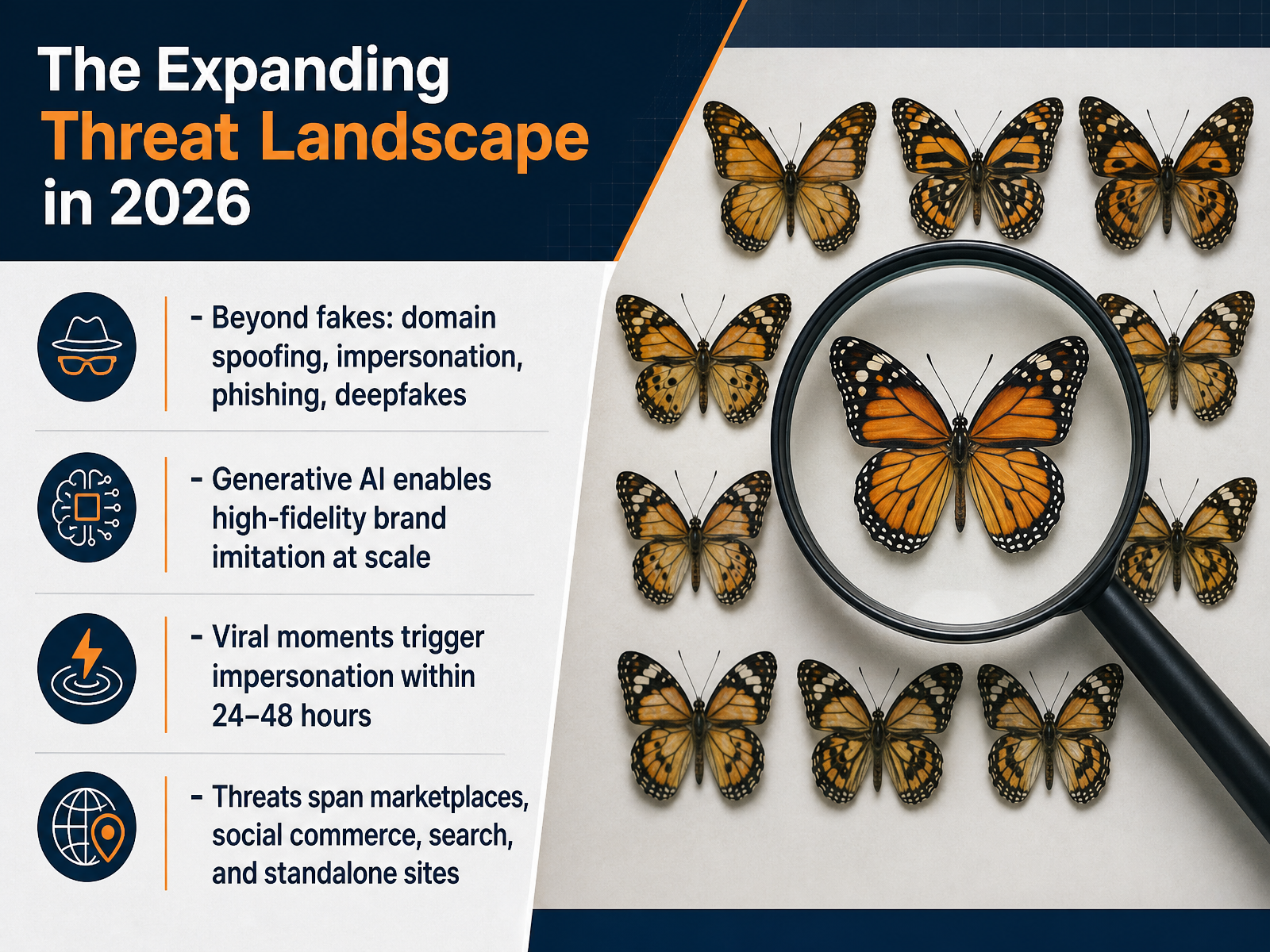
 - 03The Expanding Threat Landscape in 2026Now let's look at the threat landscape you're actually facing in 2026. It's no longer just counterfeit products. Domain spoofing, social media impersonation, phishing, and even deepfakes are all part of the attack surface. And here's the game-changer: generative AI lets bad actors create high-fidelity imitations of your brand at scale. They can clone your storefront, your ads, even your CEO's voice. When your product goes viral, impersonators move fast. In fact, 57 percent of brands see fake accounts or websites within one week of a viral moment, and for 24 percent, it's just 24 to 48 hours. The threats span marketplaces, social commerce, search results, and standalone sites. So the question isn't if you'll be targeted, it's when—and whether you'll be ready. Let's talk about defining your brand protection goals.
 marqvision.comremove.techprnewswire.com+21 min
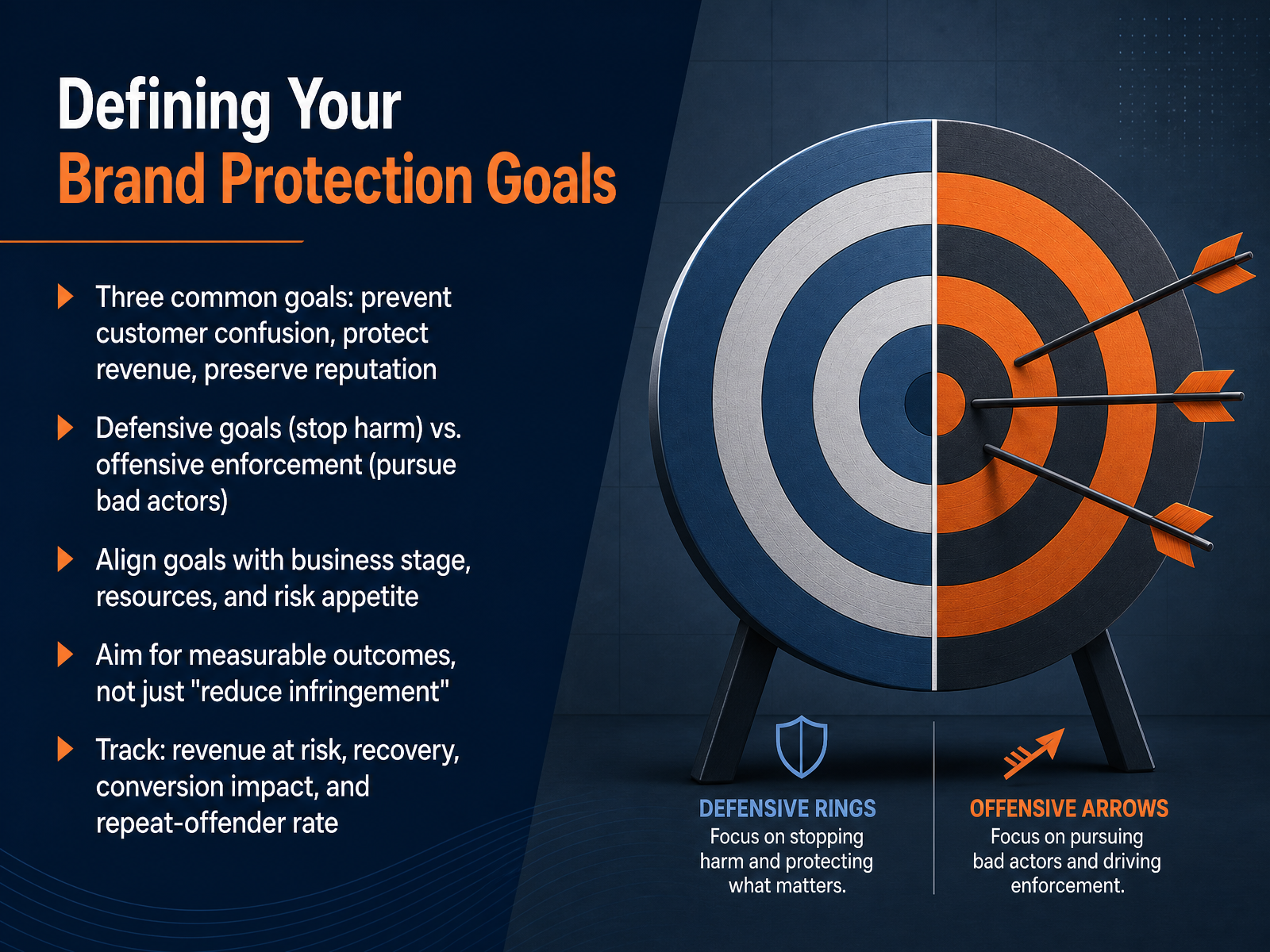
 - 04Defining Your Brand Protection GoalsNow let's get specific about what you're actually trying to achieve. Most brand protection efforts fall into three goals: preventing customer confusion, protecting revenue, and preserving reputation. Sounds straightforward, but here's the strategic fork in the road. Are you playing defense or offense? Defensive goals stop harm. You remove the counterfeit listing, you shut down the fake store. Offensive enforcement goes after the bad actors themselves, pursuing repeat offenders and dismantling their networks. The right mix depends entirely on your business stage, your resources, and your risk appetite. A startup has different priorities than a global enterprise. Here's the trap. Don't settle for a vague goal like reduce infringement. That's not a strategy, that's an activity. Instead, define measurable outcomes. Track revenue at risk, meaning the commercial value exposed to abuse. Track estimated revenue recovered after enforcement sweeps. Measure conversion impact on your protected product pages and keep a close eye on the repeat offender rate. If the same actors keep coming back, your takedowns aren't solving the problem. These are the numbers that make brand protection a strategic function instead of a cost center. Now, let's move on to the core levers you can actually control.
 remove.techremove.techredpoints.com+21 min
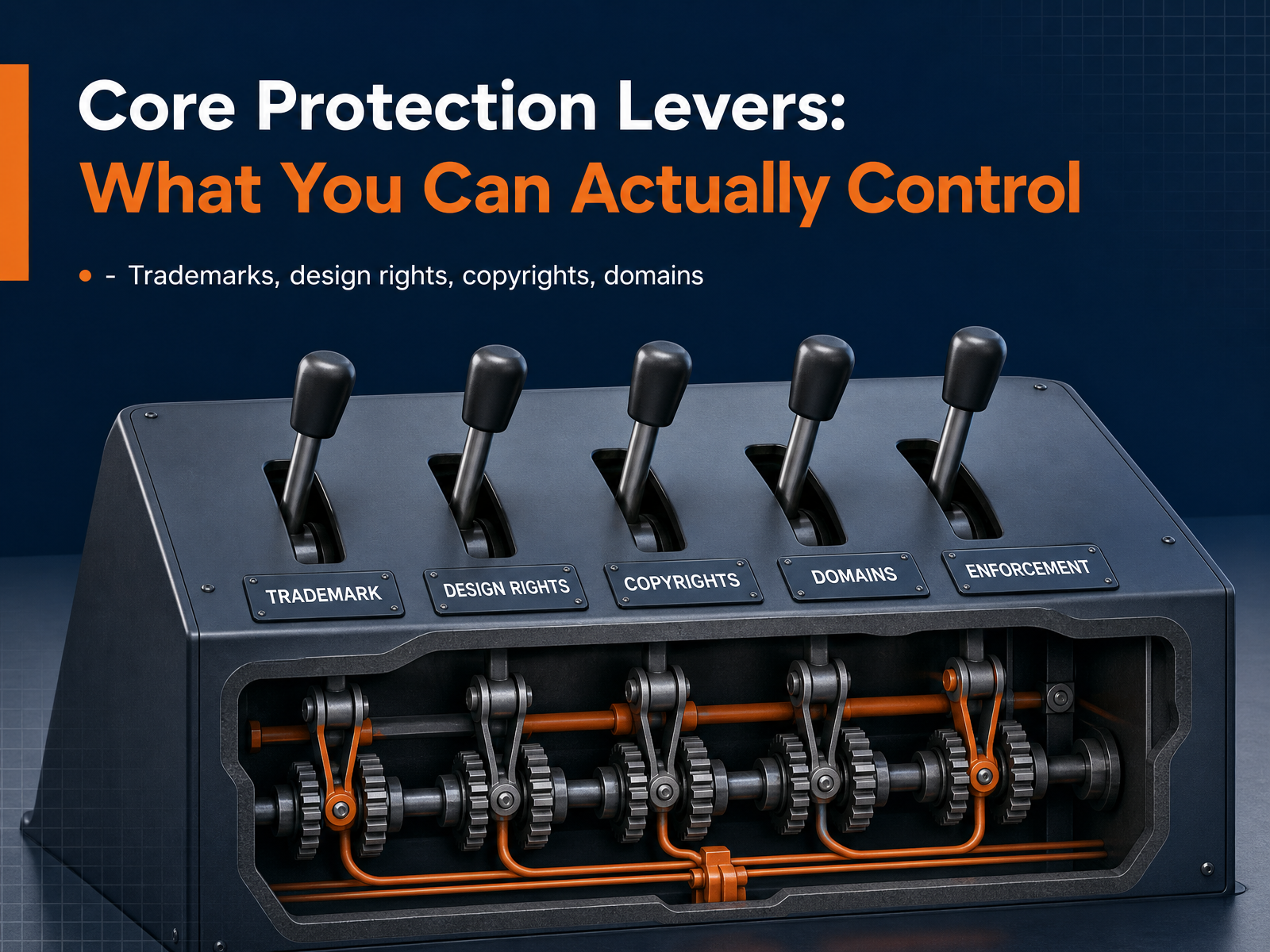
 - 05Core Protection Levers: What You Can Actually ControlNow let's get tactical, because strategy only works when you control the right levers. Your core protection levers are trademarks, design rights, copyrights, and domains. Think of these as the legal and technical perimeter of your brand. Trademarks protect your name and logo—the identifiers that make you recognizable. Design rights guard the product's look, while copyrights cover your creative assets, from photography to ad copy. And domains are the real estate that keeps your customers landing on you, not a lookalike. Your choice here is one of scope and budget. Registering globally and defensively for every variation is expensive. So prioritize by market revenue and consumer safety. A targeted portfolio in your key markets beats a thin, global one. Secure the core extensions and common misspellings now to avoid costly disputes later. The tradeoff is clear: proactive registration costs hours and fees today, while reactive enforcement costs market share and trust tomorrow. Strong levers simplify every downstream choice. Next, we'll build on this foundation with trademarks, domains, and social handles.
 marqvision.comsigna.soguideflow.com+21 min
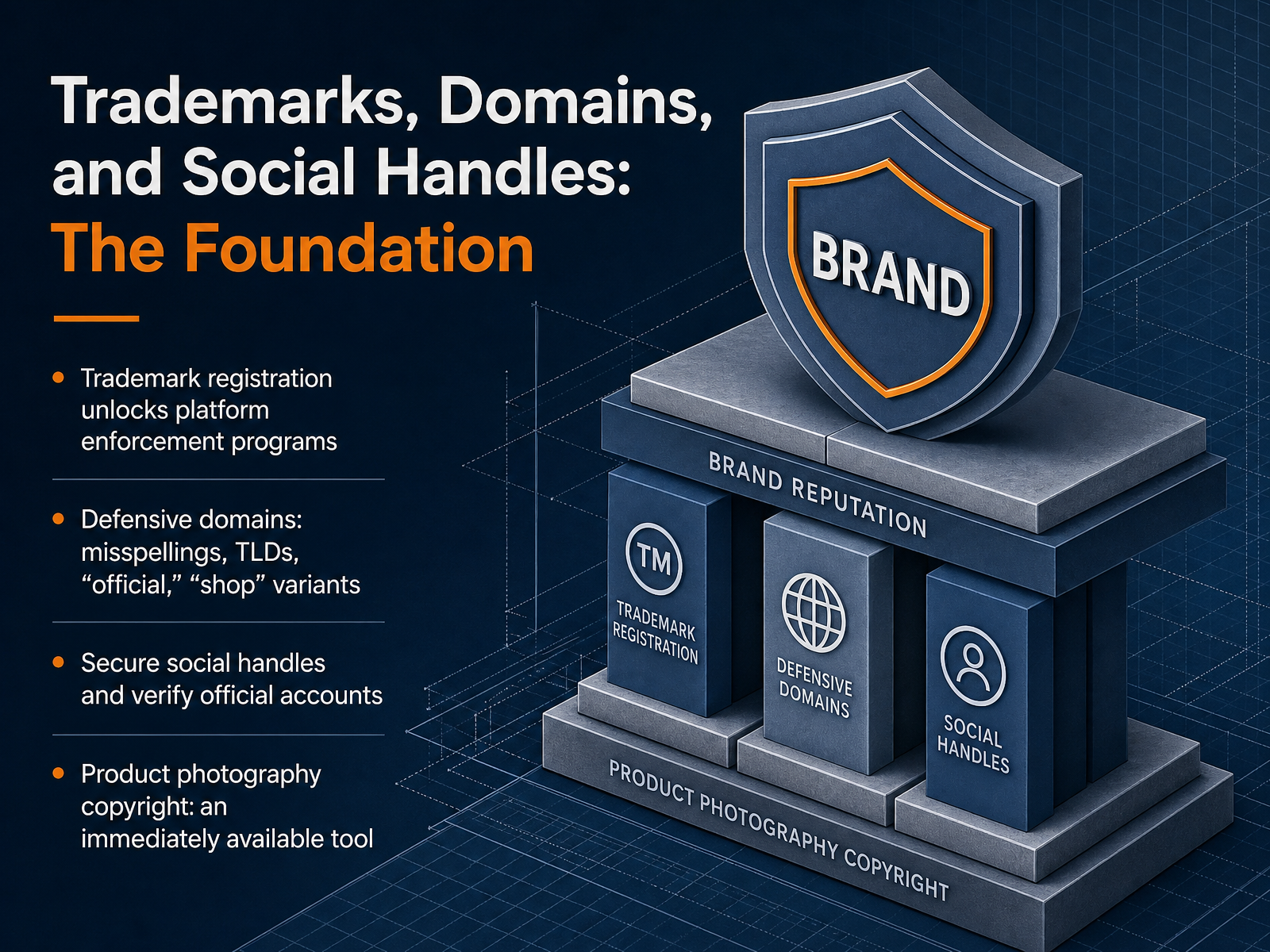
 - 06Trademarks, Domains, and Social Handles: The FoundationNow let's talk about the foundation you need in place before any enforcement happens. Trademark registration is your legal backbone. Without it, platform enforcement programs like Amazon Brand Registry or eBay's VeRO won't even consider your takedown requests. That registration unlocks the tools that actually remove listings fast. Next, defensive domains. Register the misspellings, the alternate TLDs, and the variations with 'official' or 'shop' appended. It's a small annual cost that prevents typosquatting and customer confusion down the road. Then, secure your social handles and get verified on every major platform. Verification creates a clear signal for customers and gives you a direct reporting channel when impersonators appear. And don't overlook product photography. Your copyright on original images is an immediately available enforcement tool, often faster to act on than trademark claims because the infringement is so clear-cut. These four moves are cheap, they're quick, and they give you the standing to act. Now, let's look at the tradeoffs every brand team must face when choosing where to focus next.
 marqvision.comsigna.soguideflow.com+22 min
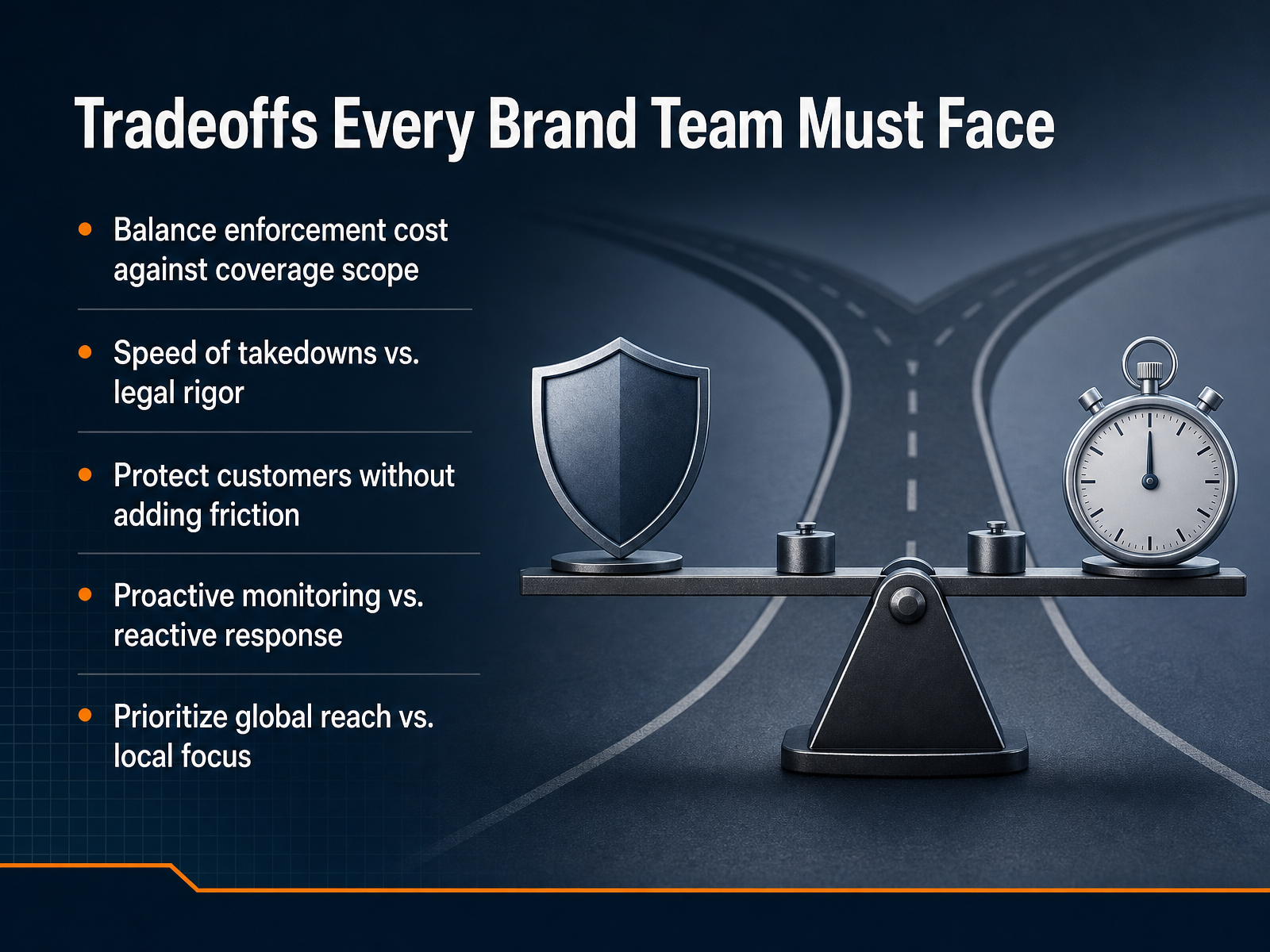
 - 07Tradeoffs Every Brand Team Must FaceNow let's talk about the tradeoffs that every brand team has to face. These are the decisions that keep you up at night because there's no perfect answer, only better tradeoffs. First, enforcement cost versus coverage scope. You can't protect everything everywhere with a lean team, so you have to prioritize the channels and markets that drive revenue. Then there's speed versus legal rigor. A quick takedown stops the bleeding, but it might lack the evidence needed for a strong legal case. You need both, but you can't always have them at the same time. Protecting customers without adding friction is another one. Verification can slow down the buying experience, and you need to find that balance. And then there's proactive monitoring versus reactive response. Monitoring gives you early warnings, but it costs resources. Reactive response is cheaper until it's not. Finally, global reach versus local focus. A global approach spreads your resources thin, while a local focus might miss threats elsewhere. The key takeaway? Don't try to do everything. Make deliberate choices based on risk, revenue, and trust. One thing that can help you avoid a lot of collateral damage is a well-maintained authorized-dealer safe list, which we'll cover next.
 pricelysis.comredpoints.commarqvision.com+21 min
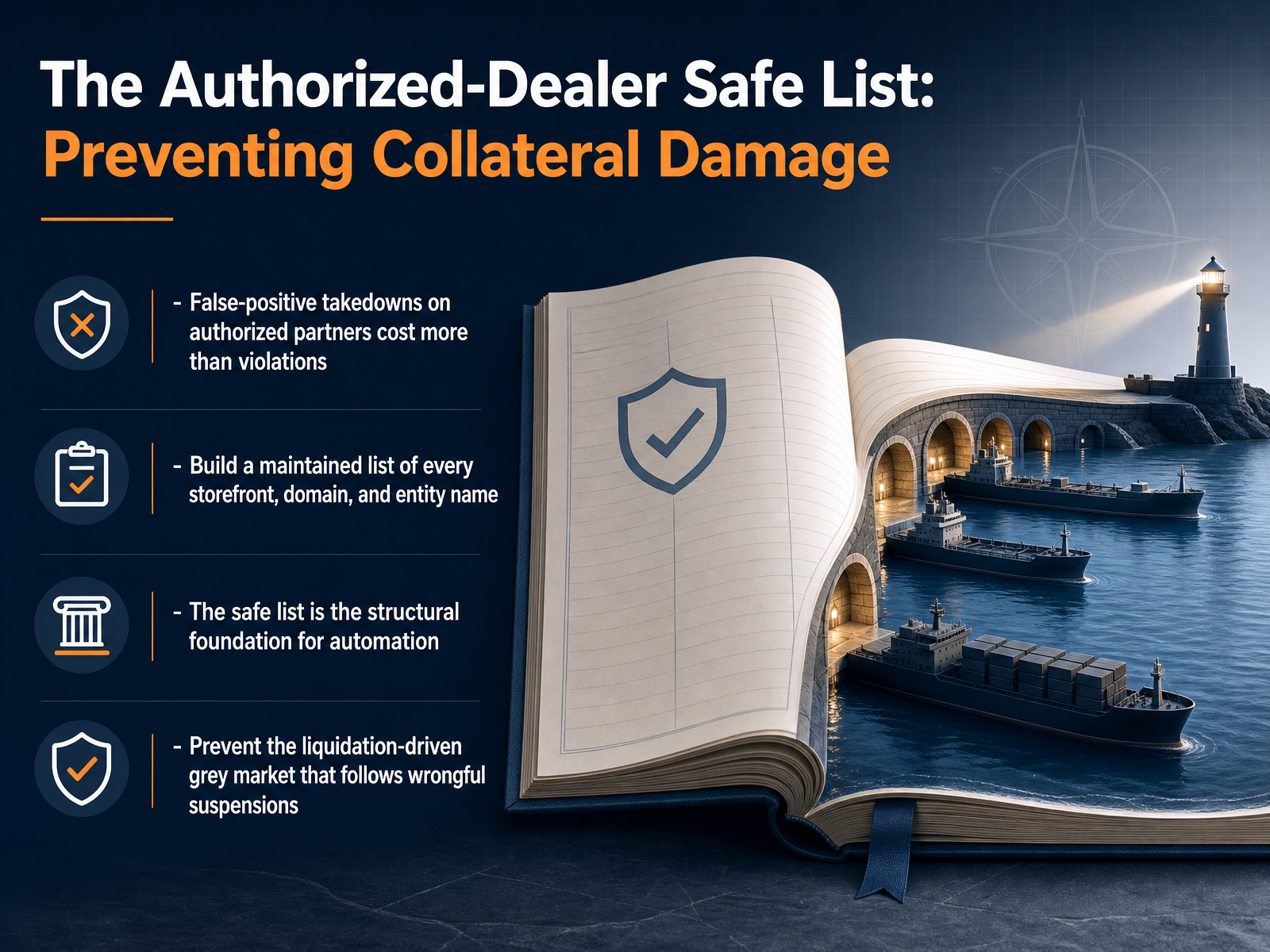
 - 08The Authorized-Dealer Safe List: Preventing Collateral DamageNow let’s talk about the single most overlooked safeguard in enforcement: the authorized-dealer safe list. This is the structural foundation that prevents collateral damage. A wrongful takedown on an authorized partner can cost you more than the violations it was meant to remove. Lost retailer revenue, relationship damage, and the liquidation-driven grey market that follows a wrongful suspension—those are absorbable at enterprise scale. At your scale, they are not. So build and maintain a complete list of every storefront, domain, and entity name your authorized partners trade under. This list is what separates an unauthorized seller from an approved partner you simply don’t recognize. Without it, automation flags everything that isn’t on a stale CRM list, and false positives absorb the value your tooling creates. But with it as a hard filter, you get the precision to act decisively, and the confidence to scale. Protect your partners, and you protect your market. Next, we’ll look at how to prioritize where you act first.
 pricelysis.comredpoints.commarqvision.com+21 min
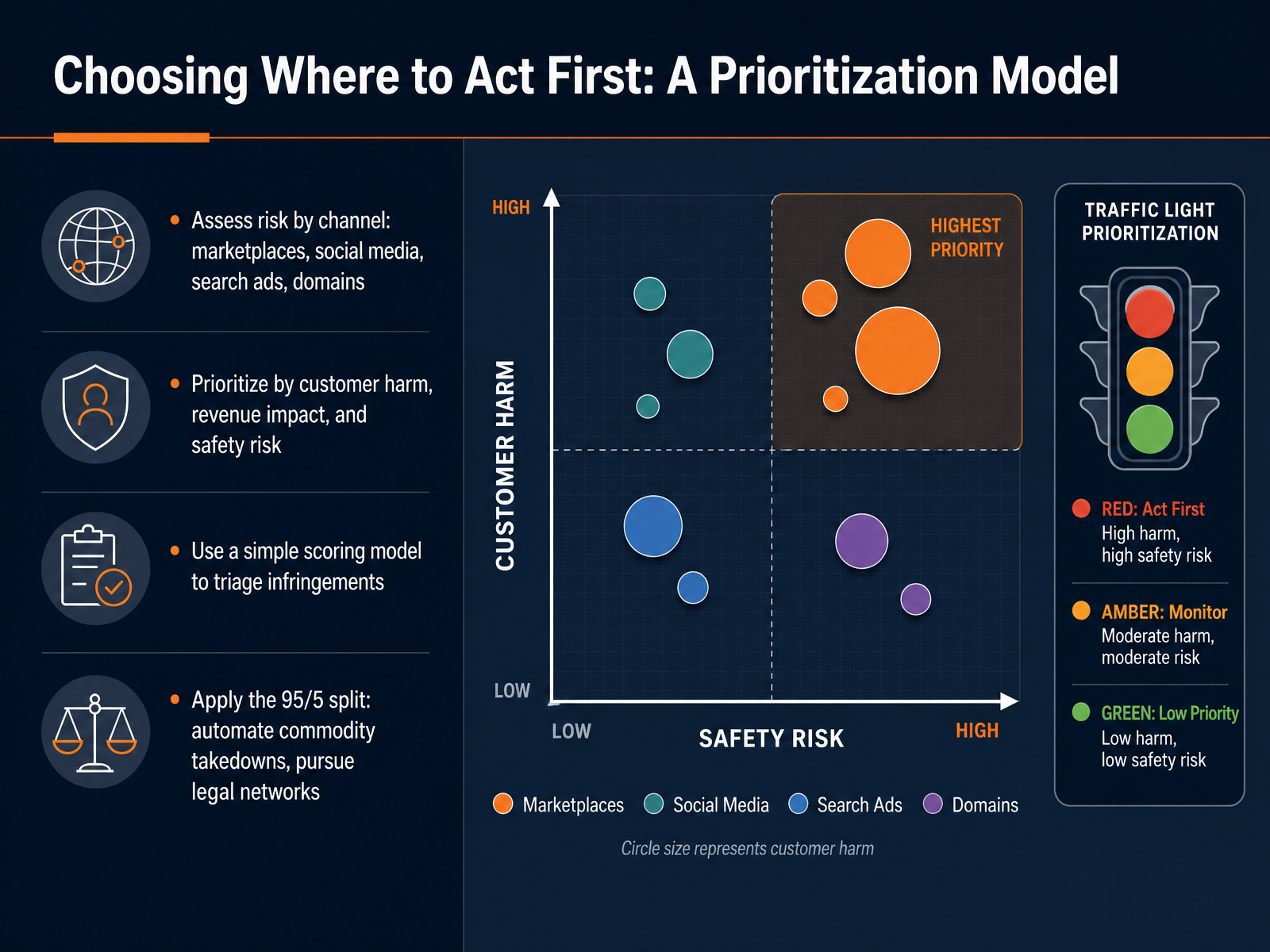
 - 09Choosing Where to Act First: A Prioritization ModelSo how do you decide where to strike first? Not every infringement deserves the same level of urgency. Assess your risk by channel. Marketplaces, social media, search ads, and domains each carry different exposure levels. Prioritize based on three factors: customer harm, revenue impact, and safety risk. A counterfeit listing of a beauty product poses a direct safety threat. A lookalike domain with no live site is a lower-level concern. Build a simple scoring model to triage these cases automatically. Weight each factor, score every hit, and let the system rank what needs human eyes today versus what can wait. Then apply the 95-5 split. Commodity takedowns, those single fake listings or stolen images, automate them. Legal firepower is reserved for the five percent: the organized networks operating across hundreds of storefronts. Those are the cases worth settlements and permanent disruption. Your team's time is the scarcest resource. Spend it on high-value targets and let automation handle the noise. Coming up, we'll walk through building a lean brand protection workflow that puts this into action.
 pricelysis.comredpoints.commarqvision.com+22 min
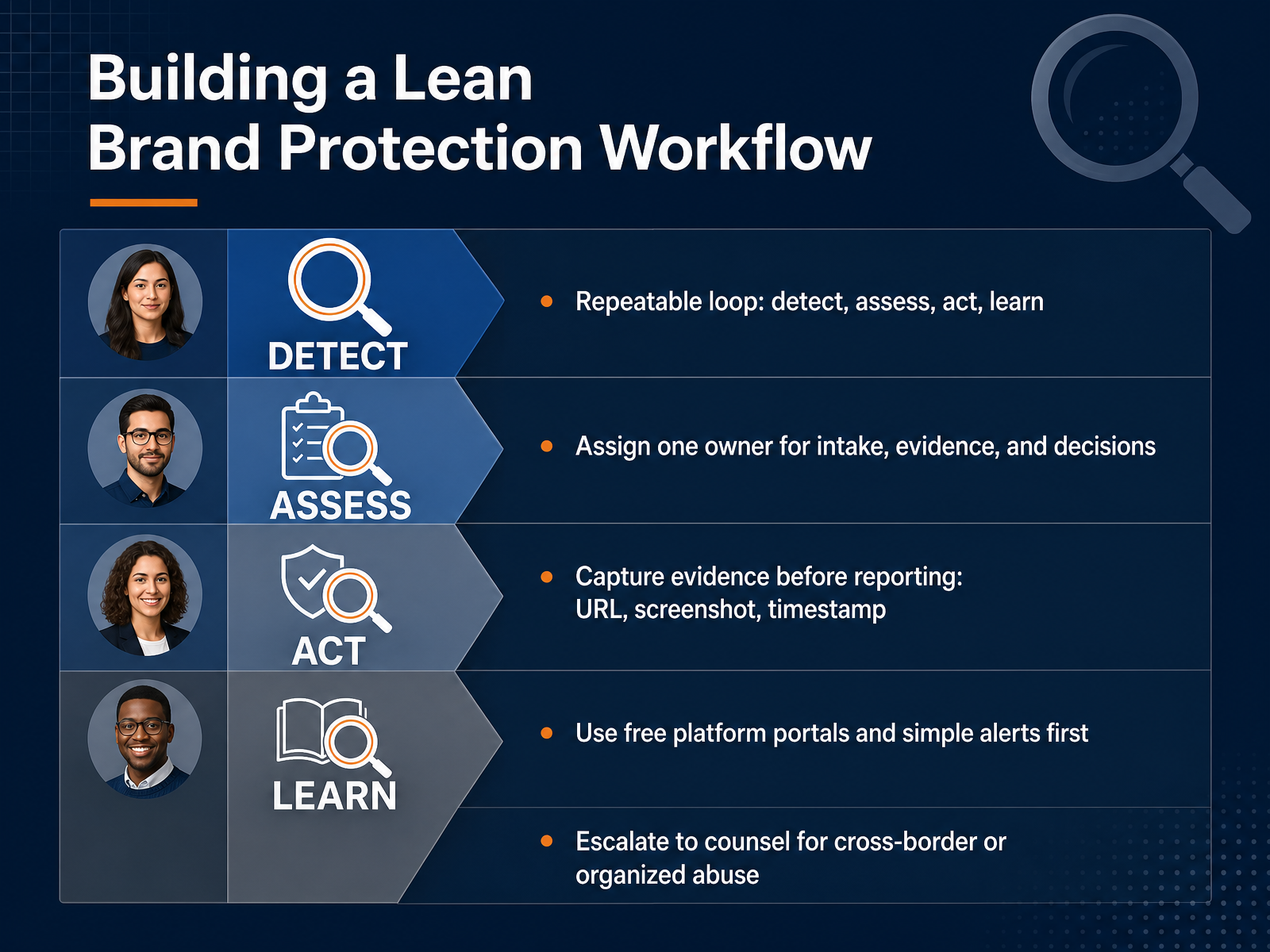
 - 10Building a Lean Brand Protection WorkflowNow let's turn that strategy into something your team can actually run every week. The goal here is a lean workflow that protects the brand without eating your entire bandwidth. Think of it as a loop: detect, assess, act, learn. You spot a potential issue, you judge how serious it is, you respond appropriately, and then you note what happened so the next round is faster. The critical piece is ownership. Assign one person to own intake, evidence, and decisions. If everyone owns it, no one does, and infringement slips through the gaps. And before you file anything, capture the evidence properly. That means the URL, a screenshot, and a timestamp. Infringers vanish the moment they sense trouble, so a claim without proof is a claim you lose. Start with the free tools: platform portals and simple alerts. For most early-stage brands, that covers the real threats. Only escalate to counsel when you're dealing with cross-border cases or organized abuse. The takeaway is this: a consistent, documented loop beats a heroic one-off cleanup every time. Next, let's talk about working with platforms and external partners to scale this further.
 redpoints.comsummitgeneralcounsel.combrandbuildr.ai+22 min
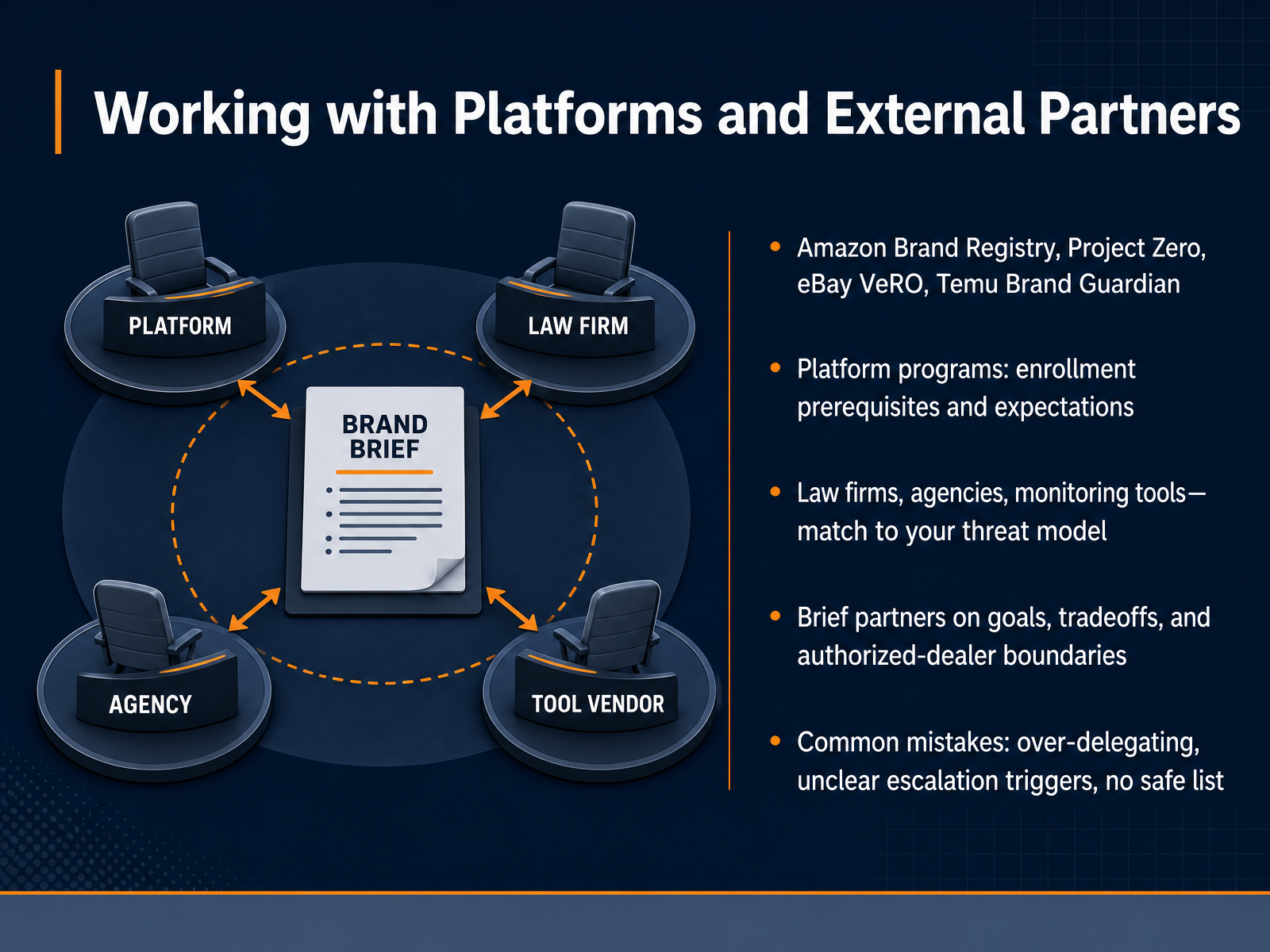
 - 11Working with Platforms and External PartnersNow let’s talk about working with platforms and external partners. Here’s the critical truth about Amazon Brand Registry, Project Zero, or eBay’s VeRO: they are tools, not strategies. They only cover what each platform allows. eBay’s VeRO, for example, won’t help you with MAP violations. At all. Know the limits before you rely on them. And when you bring on law firms, agencies, or monitoring software, match them to your actual threat model. If your problem is gray-market sellers, a trademark attorney is the wrong first call. Brief every partner on your goals, your tradeoffs, and, most importantly, your authorized-dealer boundaries. If they don’t know your safe list, they can’t enforce effectively. The most common mistakes? Over-delegating decisions, having no clear escalation triggers, and operating without that safe list. Keep control in-house. Partners execute — you direct. Up next, we’ll look at how to measure progress without getting lost in legal jargon.
 marqvision.comsigna.soguideflow.com+22 min
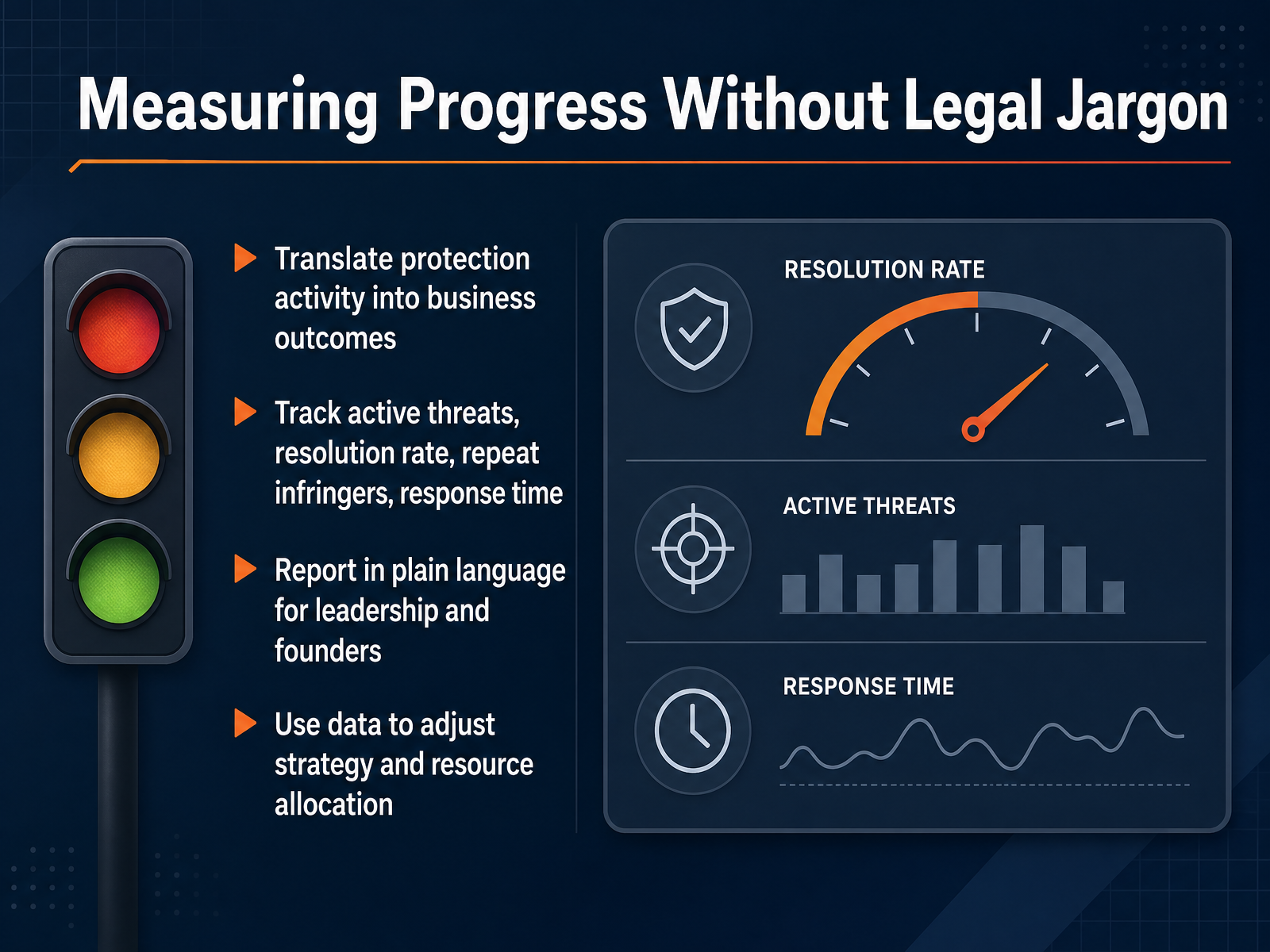
 - 12Measuring Progress Without Legal JargonLet's talk about measurement—because what gets measured gets managed. The goal is to translate your protection activity into business outcomes that leadership and founders actually care about. You need a dashboard that tracks the numbers that matter: the number of active threats, your resolution rate, how quickly you respond, and how many of those threats are repeat infringers. A high volume of takedowns might look like progress, but if the same offenders keep relisting, you're only playing whack-a-mole. That repeat-offender rate is the metric that tells you if you're solving the problem or just treating a symptom. Now, about reporting. Resist the urge to present legal briefs or a flood of data. Your executive team wants to know: what was at risk, what did we recover, and what's the trend? Frame everything in plain language—revenue protected, market share defended, support costs avoided. An eighty-percent enforcement success rate is meaningless to a founder until you frame it as the eighty percent of hijacked demand you pushed back to your official channels. Finally, use this data to make decisions. If your takedown rate on a marketplace is low and your response time is slow, that's not a legal failure; that's a signal to shift resources or adjust your workflow. You are allocating capital and effort based on evidence, not hunches. Make measurement the engine of your strategy. Next, let's shift from the metrics themselves to the ultimate conversation: moving the narrative from takedown counts to revenue impact.
 remove.techredpoints.comremove.tech+22 min
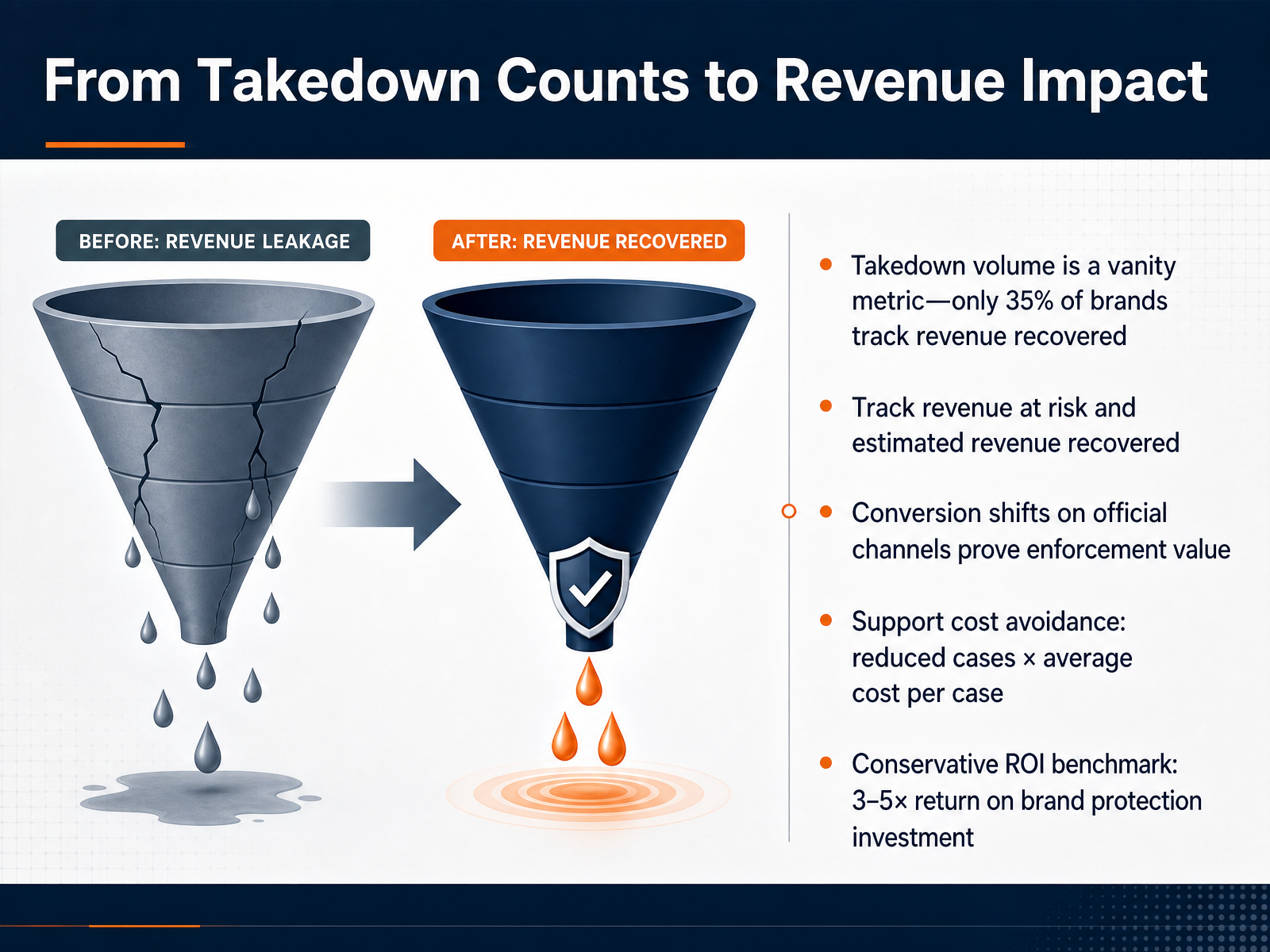
 - 13From Takedown Counts to Revenue ImpactNow let’s talk about what actually matters. Takedown counts are vanity metrics. In fact, only thirty-five percent of brands actively track revenue recovered. That’s a huge blind spot. You need to shift your focus to revenue at risk and estimated revenue recovered. Track the money, not the activity. Here’s how you prove value. Watch conversion shifts on your official channels after enforcement. If conversions climb when fake listings disappear, that’s your evidence. Also, calculate support cost avoidance. Take the reduction in support cases and multiply it by your average cost per case. That’s real money you’re not spending. For a conservative benchmark, you should be targeting a three to five times return on your brand protection investment. A lower number means you’re likely measuring the wrong things. Move from counting takedowns to tracking revenue. That’s the shift that gets you budget. Next, let’s put this all together with a practical action plan for your first thirty days.
 remove.techredpoints.comremove.tech+22 min
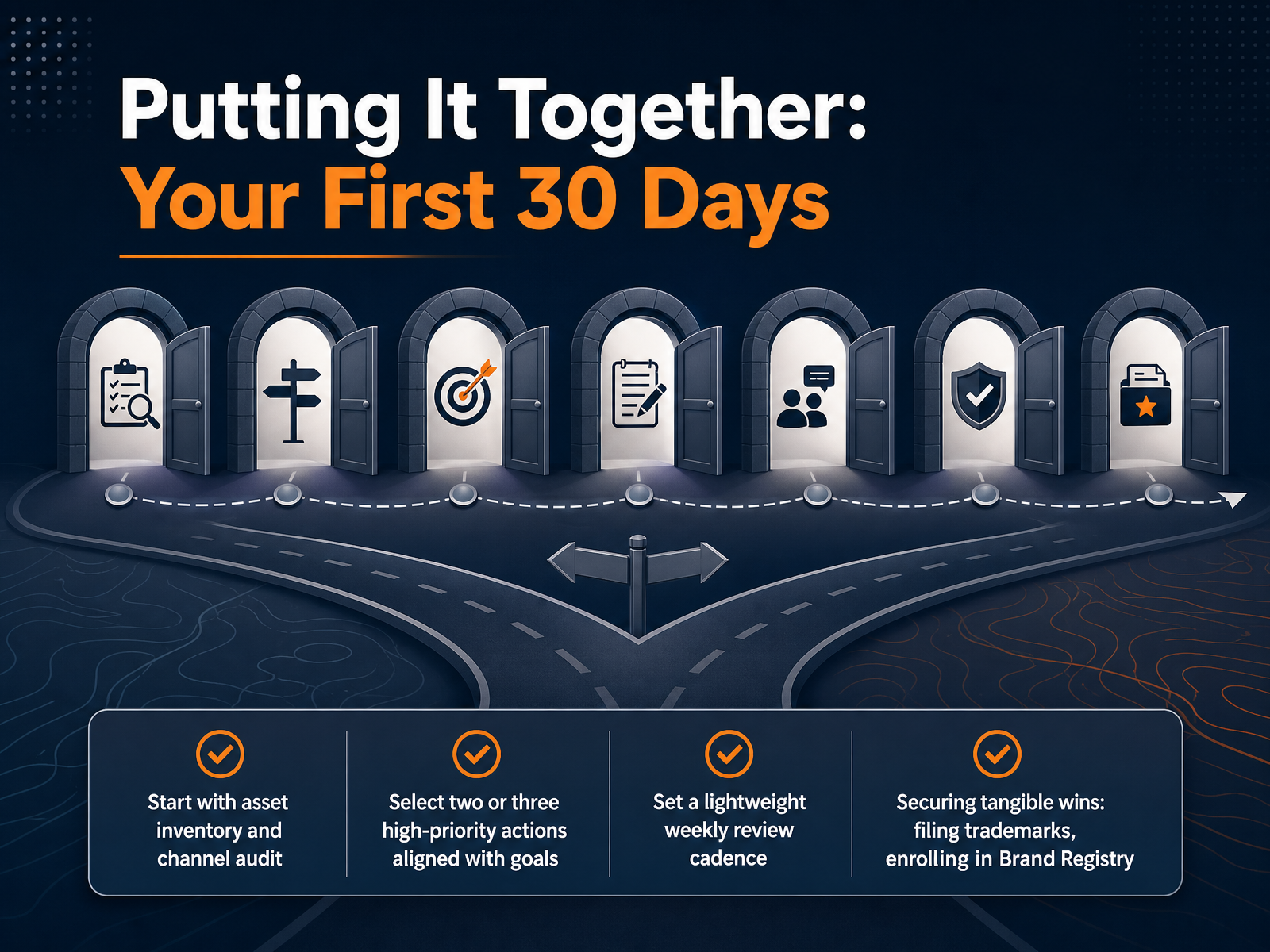
 - 14Putting It Together: Your First 30 DaysSo, let's turn all of that strategy into action. Your first thirty days are about building a foundation, not boiling the ocean. Start with a full asset inventory and a channel audit. Map every trademark, domain, listing, and social handle so you know exactly what you're defending. Then, resist the urge to fix everything. Select just two or three high-priority actions that align directly with your goals. Focus on the threats that impact revenue and trust. And set a lightweight weekly review cadence. A fifteen-minute sweep of your marketplaces and alerts can catch issues before they scale. Your tangible wins in this first month should be security filings: submit your trademarks, enroll in Amazon Brand Registry, and claim your brand accounts everywhere. Each of these anchors your rights and unlocks faster takedowns later. Start small, lock down your core assets, and build the habit. From here, we'll look at organizing your team for the long haul.
 pricelysis.combrandbuildr.aisummitgeneralcounsel.com+22 min
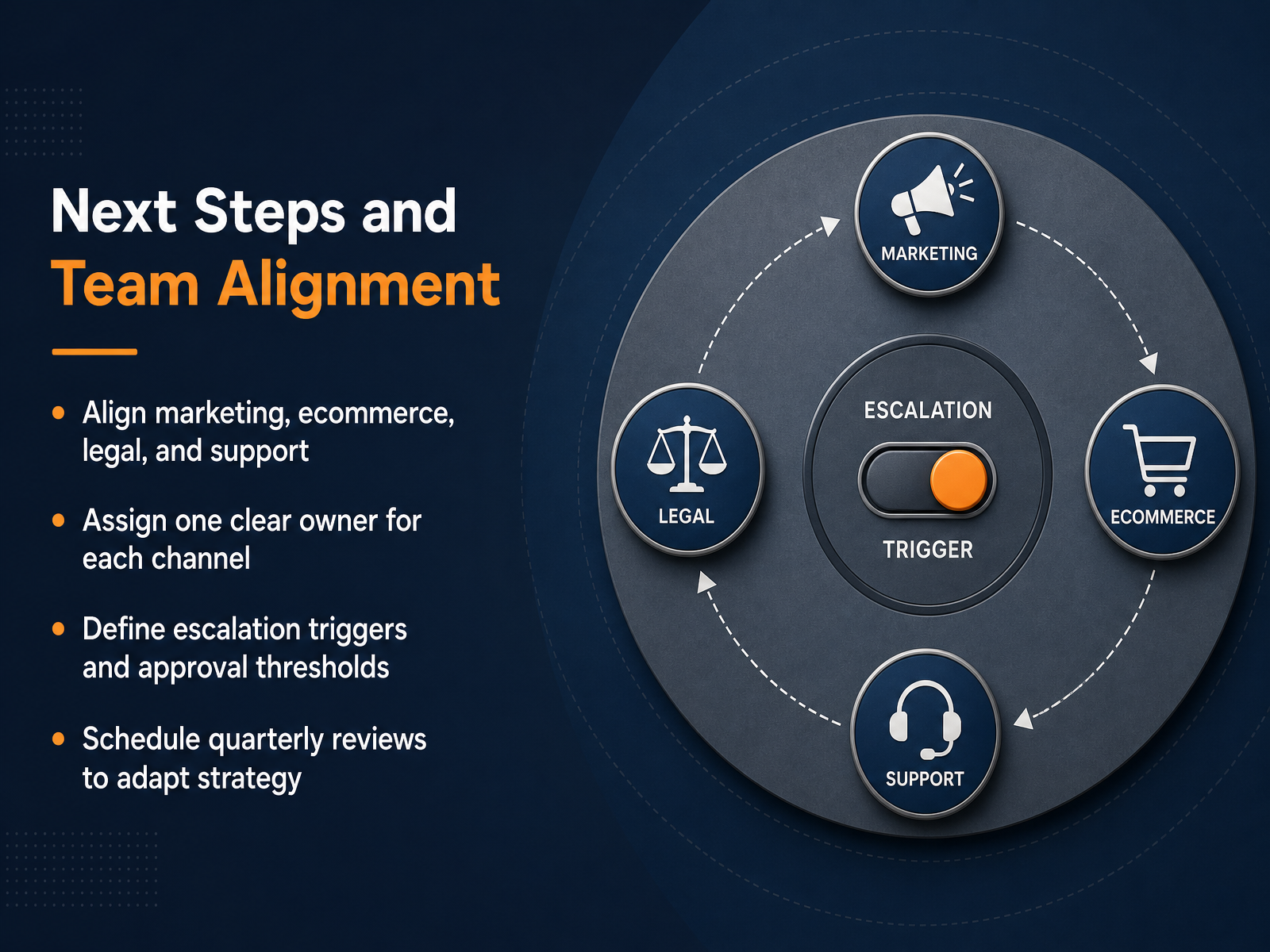
 - 15Next Steps and Team AlignmentSo, where do you go from here? Strategy only works when the team actually runs it. That starts with alignment. Marketing, ecommerce, legal, and support all see different pieces of the threat picture. They need a shared workflow and a shared understanding of what matters. Next, assign one clear owner for each channel. A single person who owns marketplace listings, another who owns domains, another who owns social impersonation. One owner per channel, no ambiguity. Then, define your escalation triggers and approval thresholds now, before an incident happens. Decide which cases the team handles internally, which ones need legal review, and which ones need executive sign-off. The time to make that call is not during a crisis. Finally, schedule quarterly reviews. Threats evolve, platforms change their policies, and your strategy has to keep pace. A static plan is a vulnerable plan. Bring the team together, review what worked, what got taken down, and what came back. Adjust your playbook accordingly. This is not about building a perfect system overnight. It is about building a repeatable one that moves with your business. Start with clear owners, clear thresholds, and a regular cadence. The rest will follow. Thank you for your attention, and here is to building a brand that is built to last.
 pricelysis.combrandbuildr.aisummitgeneralcounsel.com+22 min
Take the deck with you
Download this course as a file — free, no sign-up needed.
- PDF handoutEvery slide page, ready to print or share.16 pages · 4.2 MBDownload
- Narrated PowerPointThe deck that presents itself — every slide carries the digital human's narration video.16 pages · 15.3 MBDownload
- PowerPoint slidesThe full deck as a .pptx — open it in PowerPoint, Keynote, or Google Slides.16 pages · 4.1 MBDownload
Free to use in your own training — please keep the PersonWise credit page at the end.
Have your own deck? Turn it into a course
Sources consulted
Web sources consulted while building this course.
- Anti-counterfeiting and Online Brand Enforcement: Global Guide 2026 - Rethinking brand protection and what effective programmes are doing differently - WTR — worldtrademarkreview.com
- How to Build a Brand Protection Strategy in 2026 — summitgeneralcounsel.com
- 12 Brand Protection strategies for 2026 (with real-world examples) — redpoints.com
- Online Brand Protection Strategy Framework for 2026 – BrandBuildr.ai — brandbuildr.ai
- The Brand Protection Playbook for Mid-Market Consumer Brands | Pricelysis — pricelysis.com
- The 2026 Brand Integrity Report — marqvision.com
- Fake Ads, Fake Stores, and Traffic Theft: The New Revenue Threat for B2C Brands | Remove.tech — remove.tech
- Brands Face Growing 'AI Tax' as Counterfeit Activity and Impersonations Threaten Revenue — prnewswire.com
- Counterfeiting: What it is and why it’s illegal (2026 Guide) — redpoints.com
- The True Cost of Counterfeiting to Brands | Axencis — axencis.com
- Brand Protection ROI Metrics: What CMOs Should Track to Prove Revenue Impact | Remove.tech — remove.tech
- How Heads of Marketing Can Measure Revenue Lost to Online Brand Abuse | Remove.tech — remove.tech
- The complete guide to brand protection (2026) - Red Points — redpoints.com
- Blog | Blog | Measuring Brand Protection ROI: 3 Ways to Prove Value - June 2026 — marqvision.com
- What is Brand Protection? The Definitive Strategic Guide for 2026 | Counterfake Blog — counterfake.ai
- Brand Protection Software: The 2026 Buyer's Guide — marqvision.com
- Brand Protection Software: How to Match the Right Tool to Your Threat Model | Signa Blog — signa.so
- 9 best brand protection software for 2026 — guideflow.com
- Trademark Watch Services Compared: How to Pick a Provider in 2026 - PerspireIP — perspireip.com
- 2026 Brand Protection Trends: AI Threats, Revenue Loss & The Shift to Brand Integrity — marqvision.com