Building a Data Science Portfolio
Begin
14 pages · ~28 min
Building a Data Science Portfolio
This training helps aspiring data scientists build a compelling portfolio that showcases their skills and projects to attract employers.
What you’ll learn
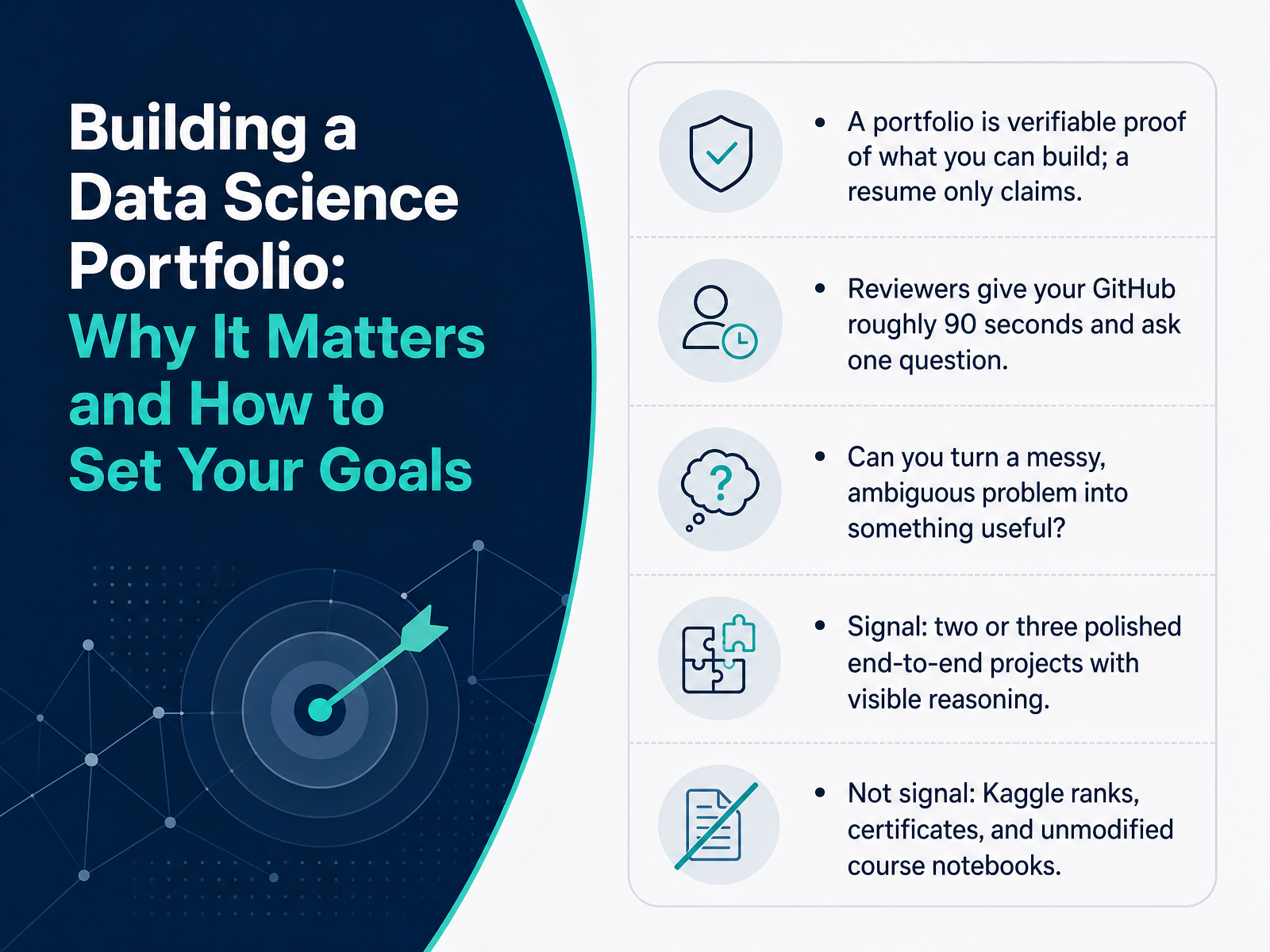
- 01Building a Data Science Portfolio: Why It Matters and How to Set Your GoalsWelcome. I'm glad you're here. Over the next few slides, we're going to build something that genuinely moves your job search forward: a data science portfolio that proves what you can do. Here's the core idea. A resume makes claims. A portfolio provides verifiable proof. When a reviewer opens your GitHub, you usually get about ninety seconds. In that time, they're not checking your model's accuracy score. They're asking one question. Can this person take a messy, ambiguous problem and turn it into something useful? That's it. So what actually sends that signal? Two or three polished, end-to-end projects where your reasoning is visible. What doesn't help? Kaggle rankings, certificates, and unmodified course notebooks. Those feel like progress to you, but they read as noise to a hiring manager. I know that's a lot to absorb, especially if you're switching careers or have no industry experience yet. But here's the good news. Your portfolio is the one lever you fully control. You can't control the market. You can control whether the person who opens your work thinks, this one actually did something real. As we go, think about your own goal. Not ten projects. Two or three you'd be proud to defend. Next, let's look at what reviewers actually look for in a portfolio.alijabbary.comthetailorcv.comdataexpertise.in+22 min
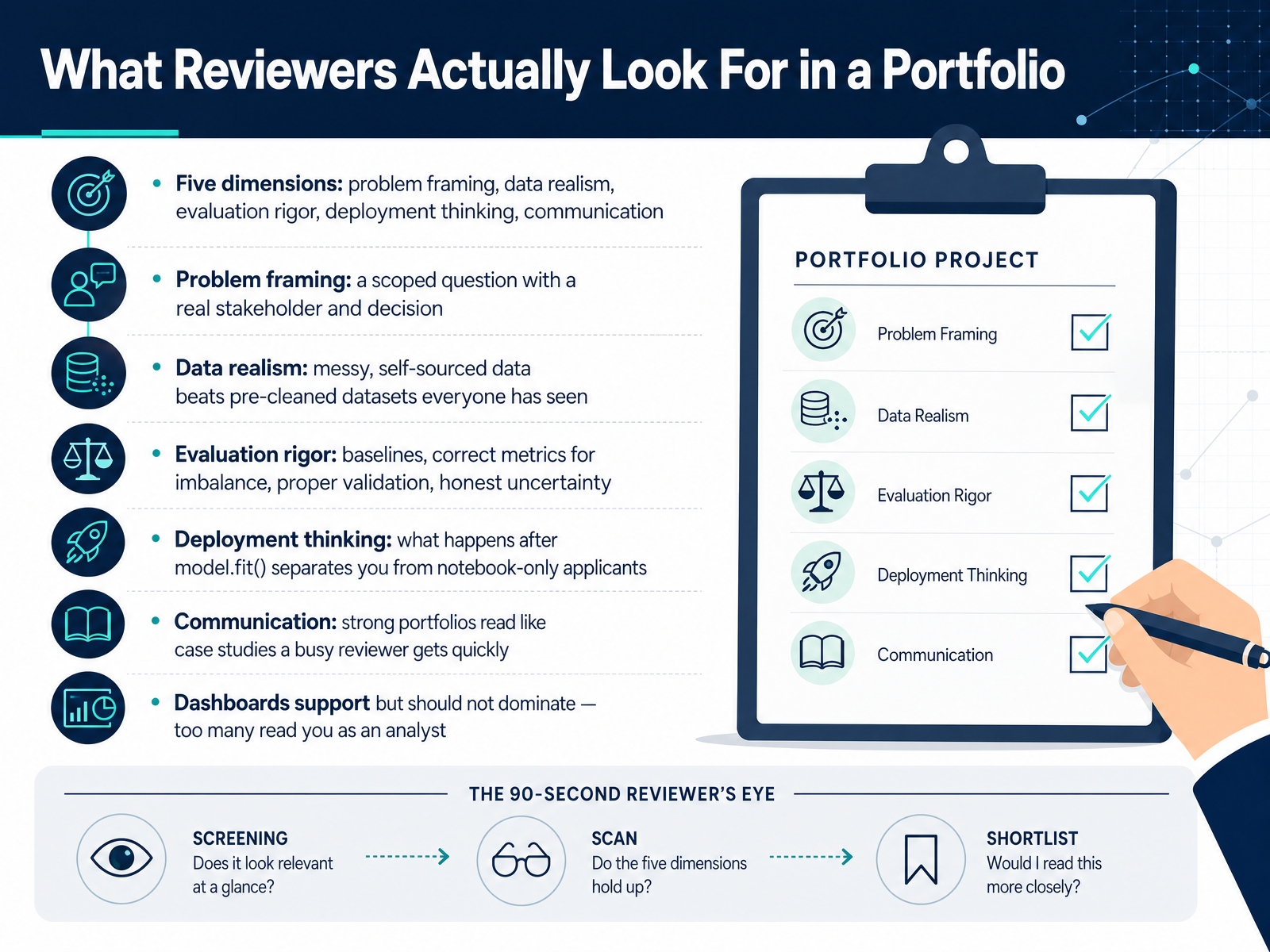
- 02What Reviewers Actually Look For in a PortfolioHere is what reviewers actually look for when they open your portfolio. There are five dimensions. First, problem framing. This means a scoped question with a real stakeholder and a decision attached. For example, which bus routes are chronically late, and would fixing them change how riders plan their trips? Second, data realism. Messy, self-sourced data beats a pre-cleaned dataset everyone has already seen. The messy part is your proof of skill. Third, evaluation rigor. Show baselines, the right metric for imbalanced data, proper validation, and honest uncertainty. Fourth, deployment thinking. What happens after the model training call? That question separates you from notebook-only applicants. Fifth, communication. Strong portfolios read like case studies a busy reviewer understands quickly. One caution: dashboards support your work, but if they dominate, reviewers may read you as an analyst, not a data scientist. Next, we look at portfolio architecture: projects, profiles, and platform choices.
 alijabbary.comthetailorcv.comdataexpertise.in+22 min
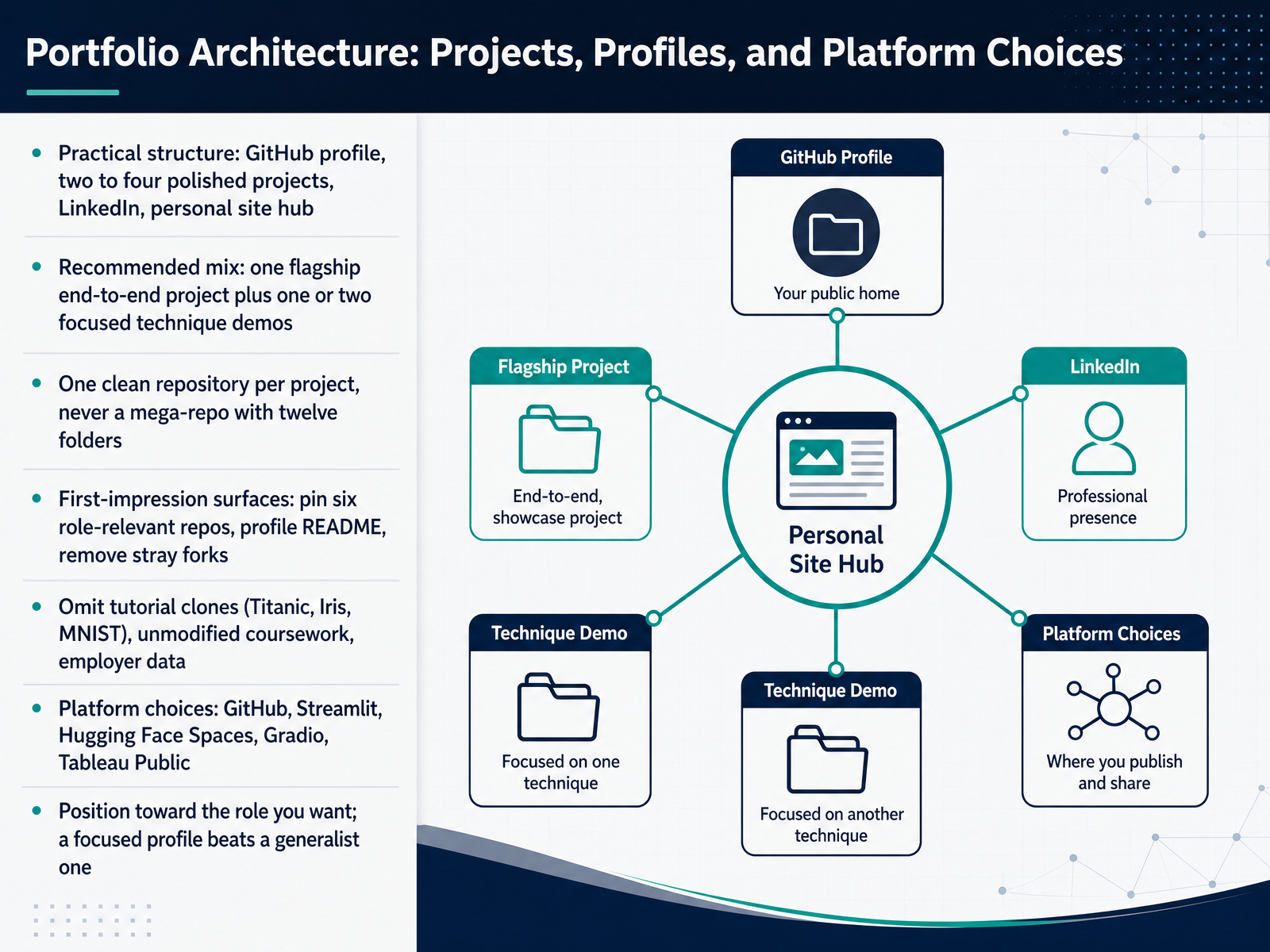
 - 03Portfolio Architecture: Projects, Profiles, and Platform ChoicesLet's talk about how your portfolio is actually structured, because the architecture matters as much as the projects themselves. Think of it in four parts: your GitHub profile, two to four polished projects, your LinkedIn, and a personal site that acts as a hub linking everything together. For the mix, aim for one flagship end-to-end project, plus one or two focused demos of a specific technique. Give each project its own clean repository. Never bundle twelve folders into one mega-repo. Hiring managers screen fast, so your first-impression surfaces matter: pin six role-relevant repositories, write a profile README, and remove stray forks. Skip the tutorial clones, the Titanic and Iris notebooks, unmodified coursework, and any employer data. For demos, GitHub, Streamlit, Hugging Face Spaces, Gradio, and Tableau Public are all solid choices. And position yourself toward the role you want, because a focused profile beats a generalist one every time. Next, we'll look at selecting projects that signal employability.
 github.comgithub.laiyagushi.comgithub.com+22 min
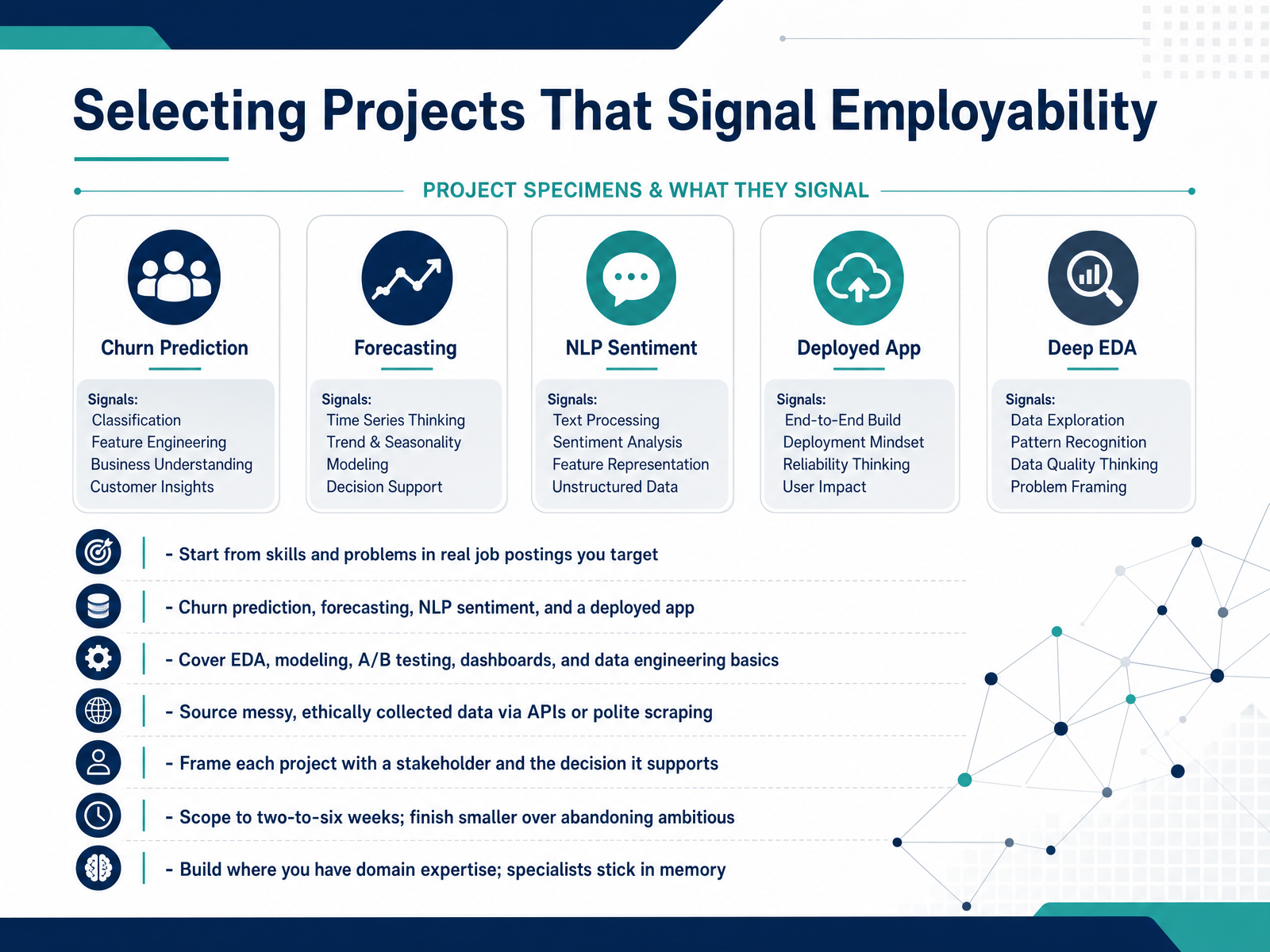
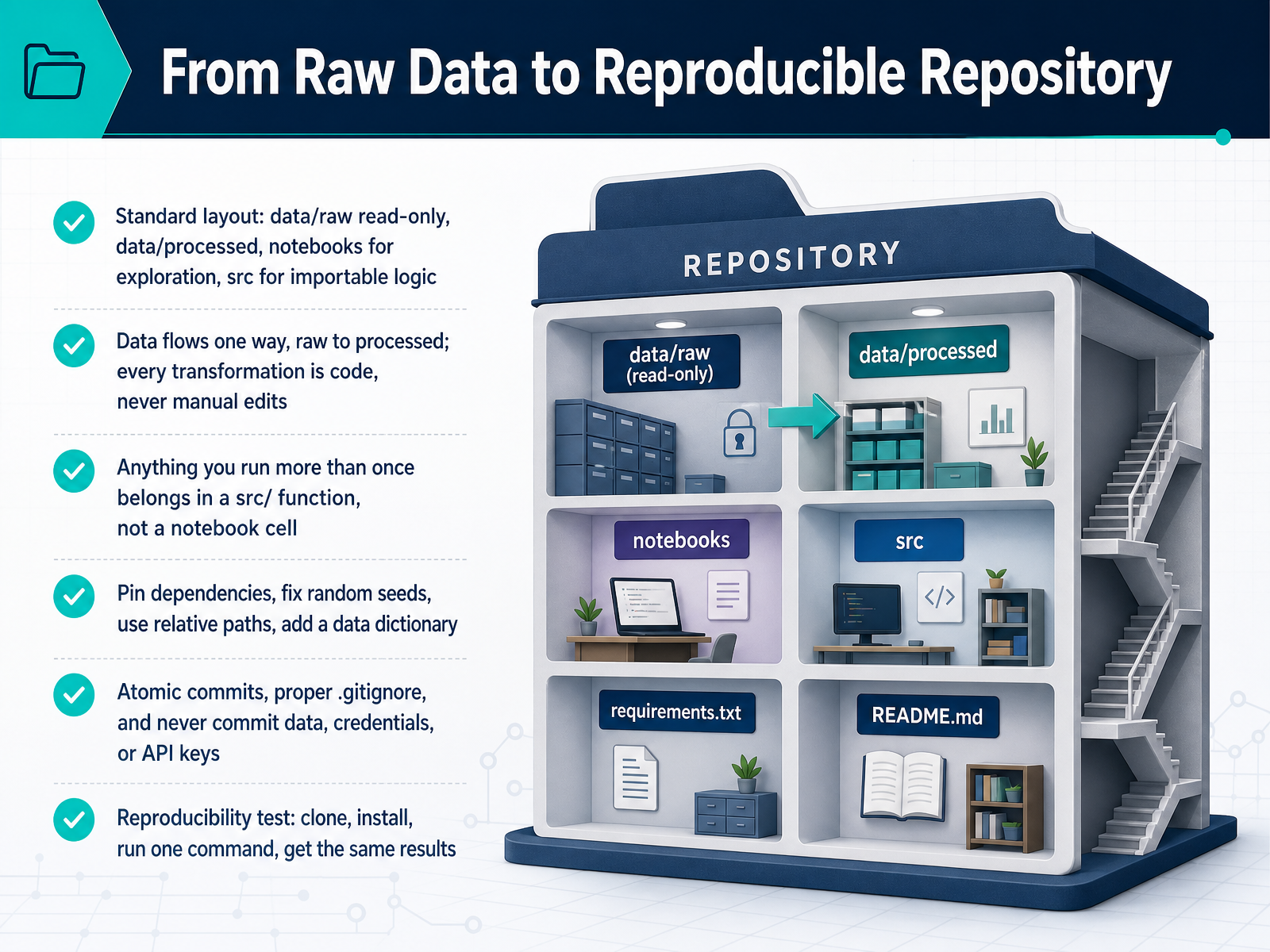
 - 04Selecting Projects That Signal EmployabilityLet's talk about choosing projects that actually signal employability. Start by reading the job postings you want to apply for, and pull out the skills and problems they repeat. Then build projects that map to them. Churn prediction, forecasting, sentiment analysis, or a small deployed app are strong, recognizable choices. Cover the full workflow too: exploratory analysis, modeling, A/B testing, dashboards, and basic data engineering. Use messy but ethically collected data, from public APIs or polite scraping. Here's the part many portfolios miss. Frame each project around a stakeholder and the decision it supports. And scope it to two to six weeks. A finished small project beats an abandoned ambitious one. Finally, build in a domain you already understand. Specialists stick in a hiring manager's memory far longer than another generic model. From raw data to reproducible repository. Next, we'll turn these projects into clean, shareable repositories.
 tripleten.comsociavae.comcdo.business.rice.edu+21 min
 - 05From Raw Data to Reproducible RepositoryLet's talk about turning raw data into a reproducible repository. Structure matters here. Keep raw data read-only, put processed data in its own folder, reserve notebooks for exploration, and place reusable logic in a source folder. Data should flow one way, from raw to processed. Every transformation should be code, never a manual edit. If you run something more than once, move it into a function in your source folder, not a notebook cell. Then lock things down. Pin your dependencies, set random seeds, use relative paths, and add a data dictionary. Make atomic commits, write a proper git ignore file, and never commit data, credentials, or API keys. Here is your reproducibility test. Clone the repository, install dependencies, run one command, and get the same results. That is the standard.
Next, we will look at writing a README that passes the 30 second scan.
 analyticsvidhya.comsuperml.orgtechietory.com+22 min
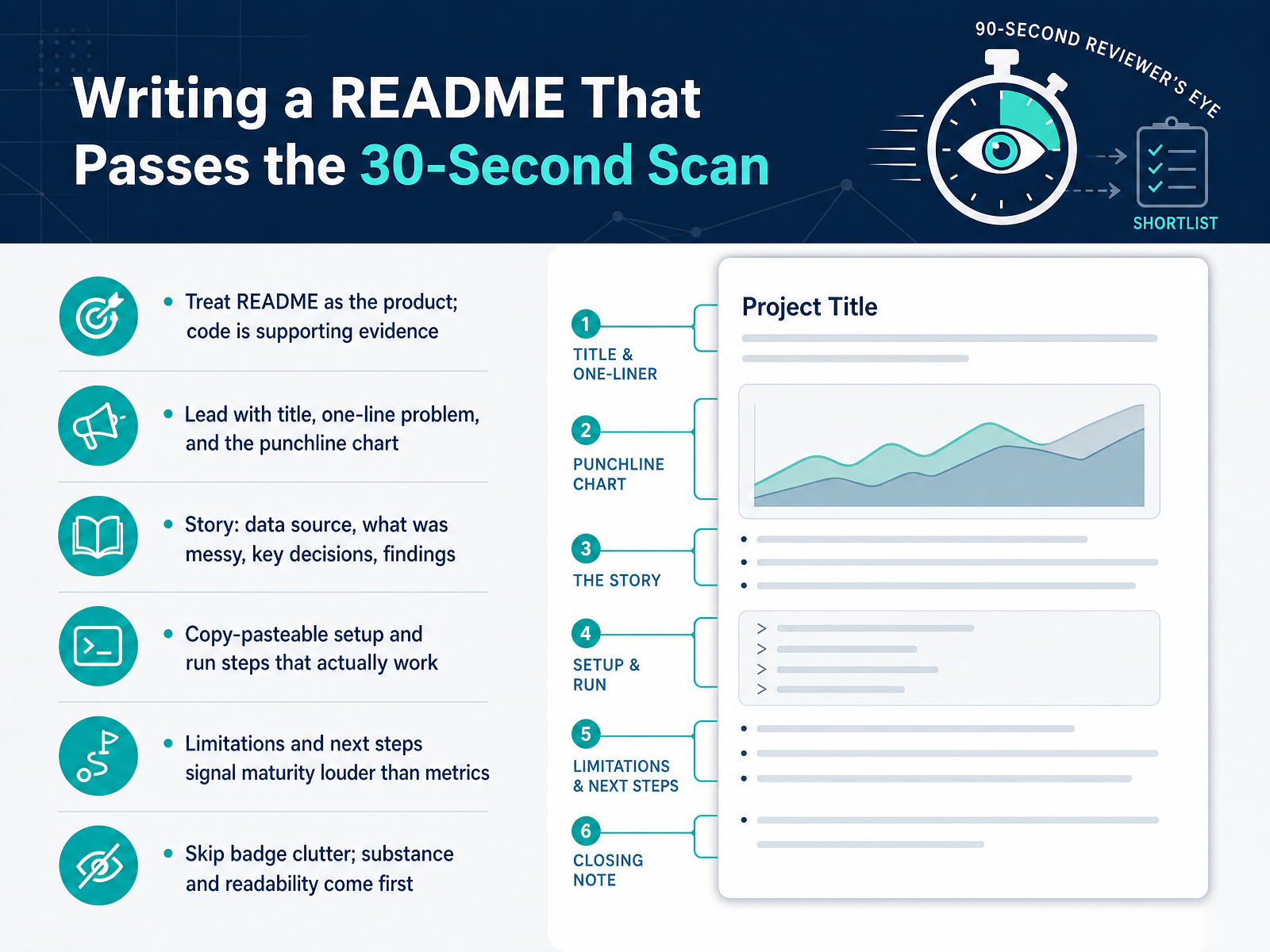
 - 06Writing a README That Passes the 30-Second ScanNow let's talk about the first thing a hiring manager actually sees: your README. Here's the mindset shift. Treat the README as the product. Your code is supporting evidence. Most reviewers spend about thirty seconds before deciding to keep reading or move on. So lead with a clear title, a one-line problem statement, and your punchline chart near the top. Then tell the story: where the data came from, what was messy, the key decisions you made, and what you found. Include setup and run steps someone can copy and paste that actually work. And here's a maturity signal: state your limitations and next steps. That impresses reviewers more than big metric claims. Skip the badge clutter. Substance and readability come first. Next, we'll look at documenting decisions, showing how you think.
 2 min
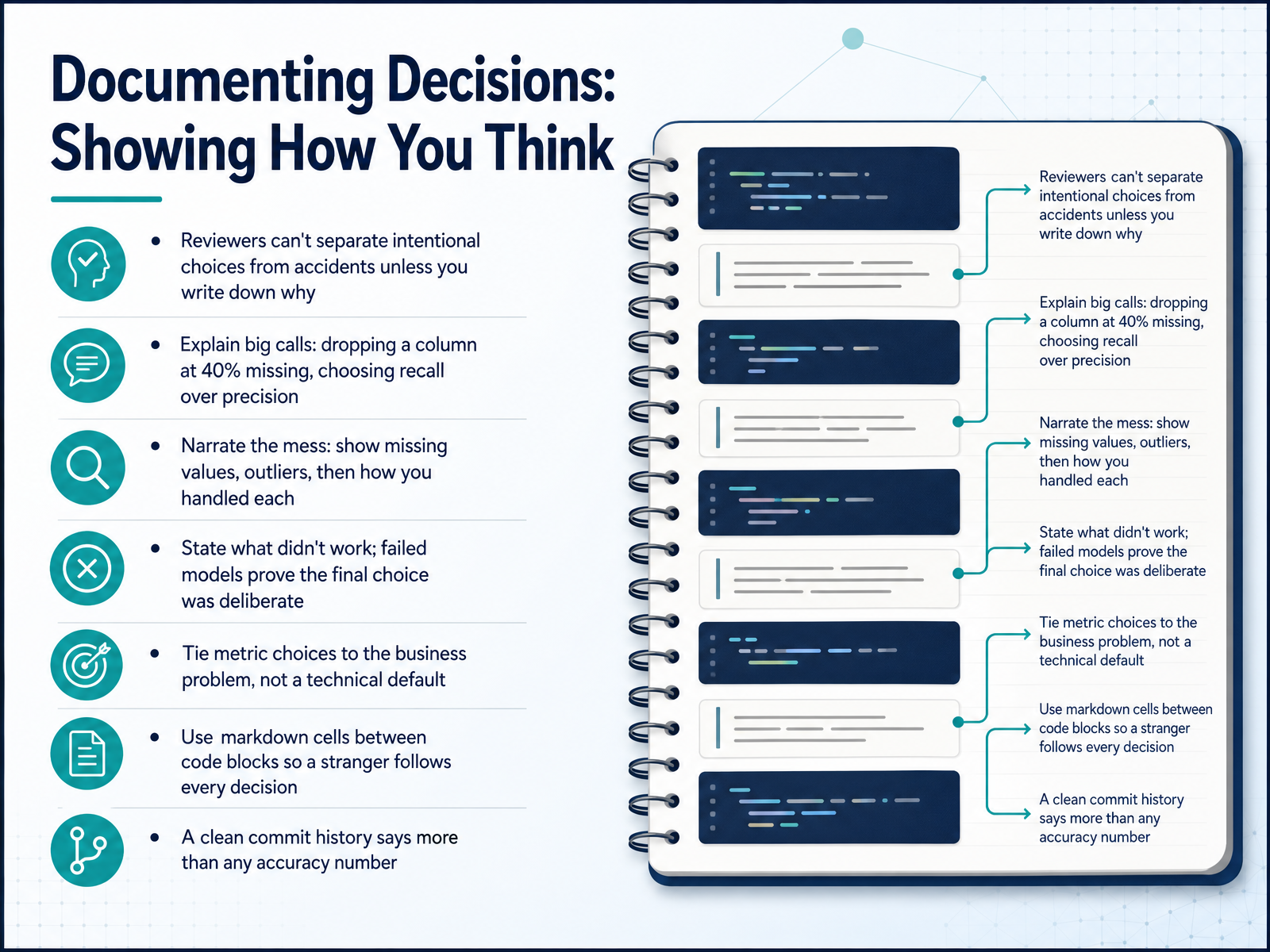
2 min - 07Documenting Decisions: Showing How You ThinkNow let's talk about documenting your decisions. Here's why it matters. A reviewer opening your notebook cannot tell an intentional choice from an accident unless you write down the reason. If you dropped a column because forty percent of its values were missing, say so. If you chose recall over precision, explain that false negatives were more costly for this business problem. Narrate the mess. Show the missing values and outliers, then show how you handled each one. And state what did not work, because a failed model proves your final choice was deliberate. Tie your metric choices to the business problem instead of a technical default. Use markdown cells between code blocks so a stranger can follow every decision. A clean commit history says more than any accuracy number. So write for the person who will read this next, because that person might be you in six months. Next, we look at communicating results through visuals, narratives, and business impact.
 analyticsvidhya.comsuperml.orgtechietory.com+21 min
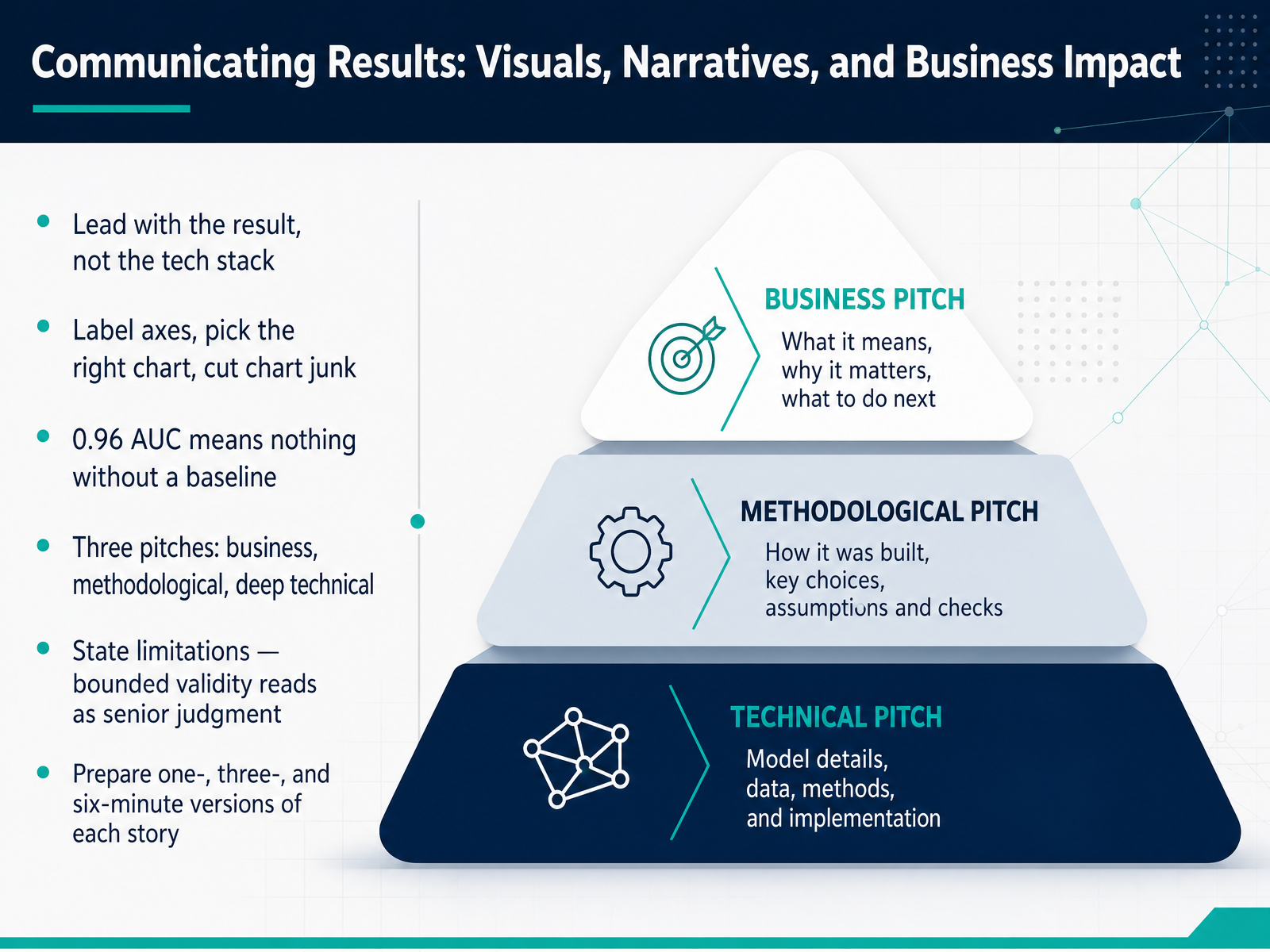
 - 08Communicating Results: Visuals, Narratives, and Business ImpactNow let's talk about how you actually communicate your results. First, lead with the result, not the tech stack. Say what changed and why it matters. Then let the tools come later. When you build visuals, label your axes, choose the right chart for the question, and cut anything that does not help someone make a decision. And remember: a zero point nine six A U C means nothing without a baseline. Compare it to something simple, like a naive guess or current performance, so the number has meaning. Prepare three pitches: one business-focused, one methodological, and one deep technical. Also state your limitations honestly. Bounded validity reads as senior judgment, not weakness. Finally, rehearse one, three, and six minute versions of each story, because interviewers interrupt and you need the short version to still land. Next, we will look at deploying a live demo without overengineering.
 alijabbary.comthetailorcv.comdataexpertise.in+22 min
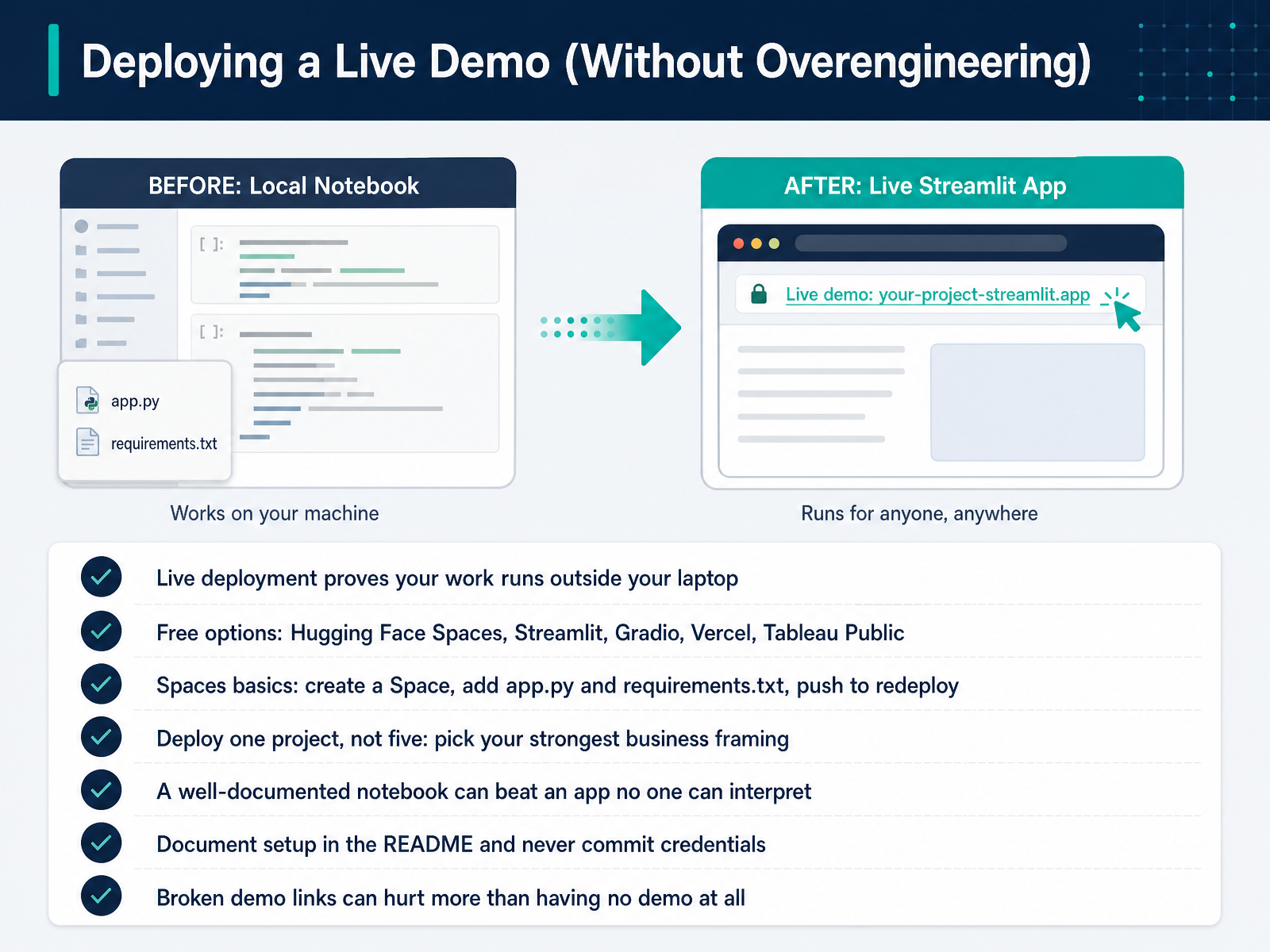
 - 09Deploying a Live Demo (Without Overengineering)Let's talk about deploying a live demo without overengineering it. A live deployment proves your work actually runs outside your laptop, and hiring managers notice that. Start with free options like Hugging Face Spaces, Streamlit, Gradio, Vercel, or Tableau Public. Spaces are straightforward. Create a Space, add your app dot py file and a requirements dot txt file, then push your code. Every commit automatically rebuilds and redeploys the app. Here is the key recommendation. Deploy one project, not five. Pick the one with your strongest business framing. And remember, a well documented notebook can beat an app no one can interpret. So document setup clearly in your README, and never commit credentials like API keys or passwords. One final warning. A broken demo link can hurt you more than having no demo at all. Test your link before you share it. Now let's move on to building an online presence without overexposure.
 2 min
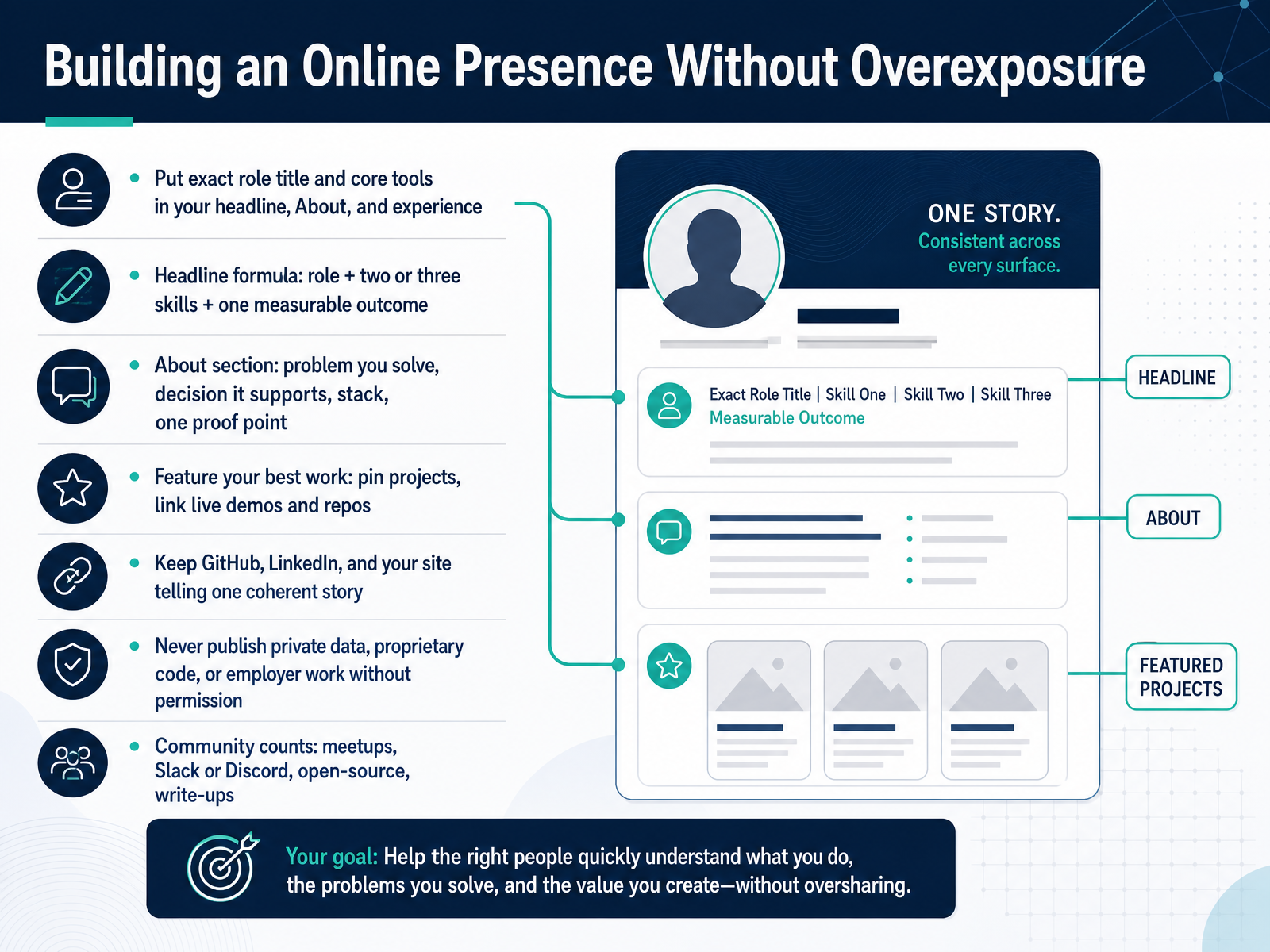
2 min - 10Building an Online Presence Without OverexposureNext, let's build your online presence without overexposing yourself. A recruiter spends seconds on your profile, so make those seconds count. Put your exact target role title and core tools in your headline, your About section, and your experience. Use a simple headline formula: role, plus two or three skills, plus one measurable outcome. For example, Data Scientist, Python and SQL, delivered a model that cut churn by twelve percent. Your About section should name the problem you solve, the decision it supports, your stack, and one proof point. Then feature your best work. On GitHub, pin your strongest projects, not your most recent fork, and link live demos and repositories. Keep LinkedIn, GitHub, and your personal site telling one coherent story. One warning: never publish private data, proprietary code, or employer work without written permission. Finally, community counts. Join meetups, Slack or Discord groups, contribute to open source, and write up what you learn. A small, consistent presence beats a silent profile. Tailoring the Portfolio to Job Applications.
 2 min
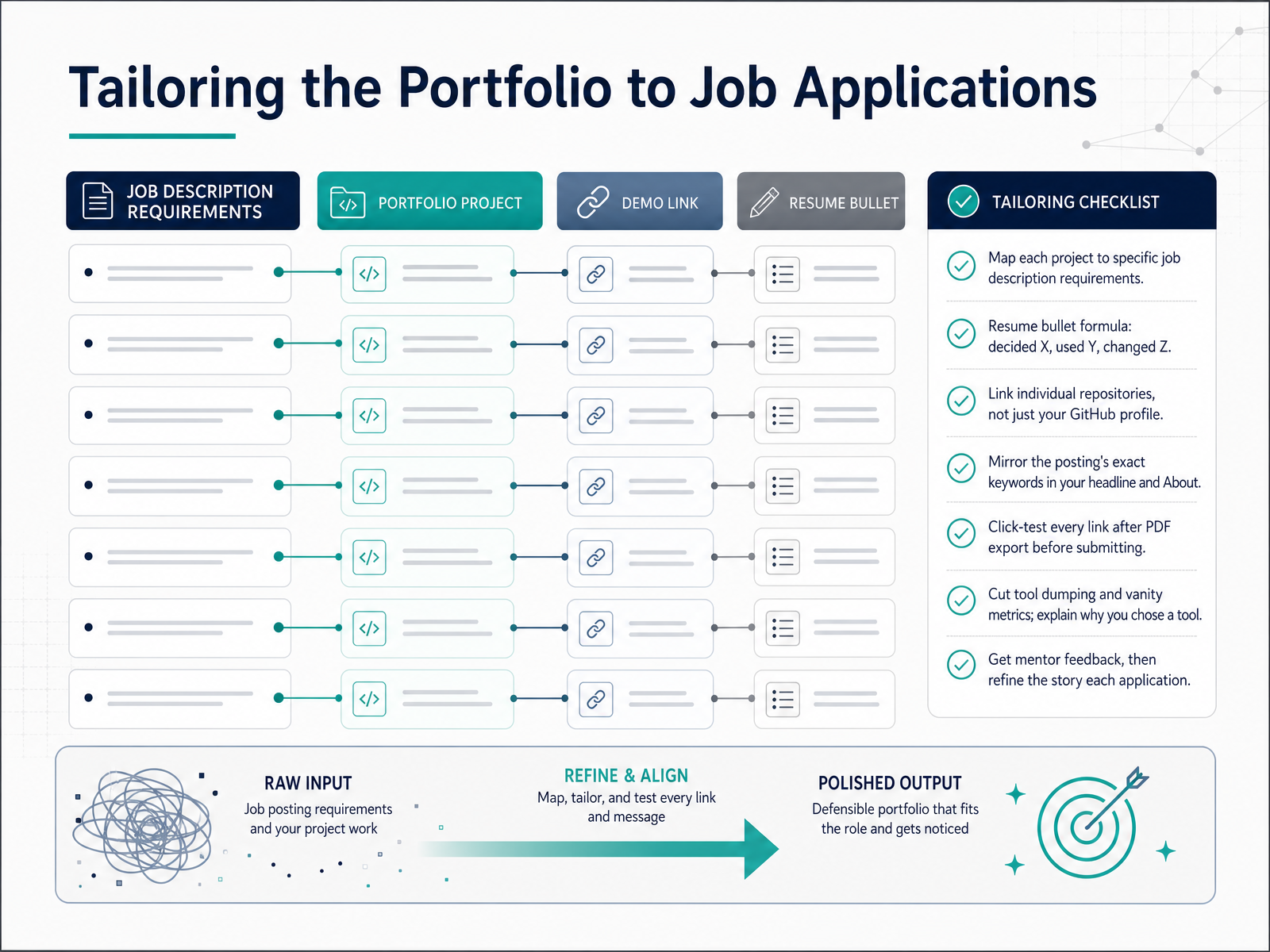
2 min - 11Tailoring the Portfolio to Job ApplicationsNow let's make your portfolio work harder for each application. Start by reading the job description closely, then map each project to a specific requirement it lists. For your resume bullets, use a simple formula. Decided X, used Y, changed Z. For example, decided to re-segment inactive users, used survival analysis, changed targeting logic. Instead of linking only your GitHub profile, link the individual repositories that match the role. Mirror the posting's exact keywords in your headline and About section, because recruiter search is keyword driven. After you export your resume to PDF, click every link to confirm it still works. Cut tool dumping and vanity metrics. Explain why you chose a tool, not just that you used it. Finally, ask a mentor for feedback, then refine your story for each application. Next, we'll look at defending your projects in interviews.
 alijabbary.comthetailorcv.comdataexpertise.in+21 min
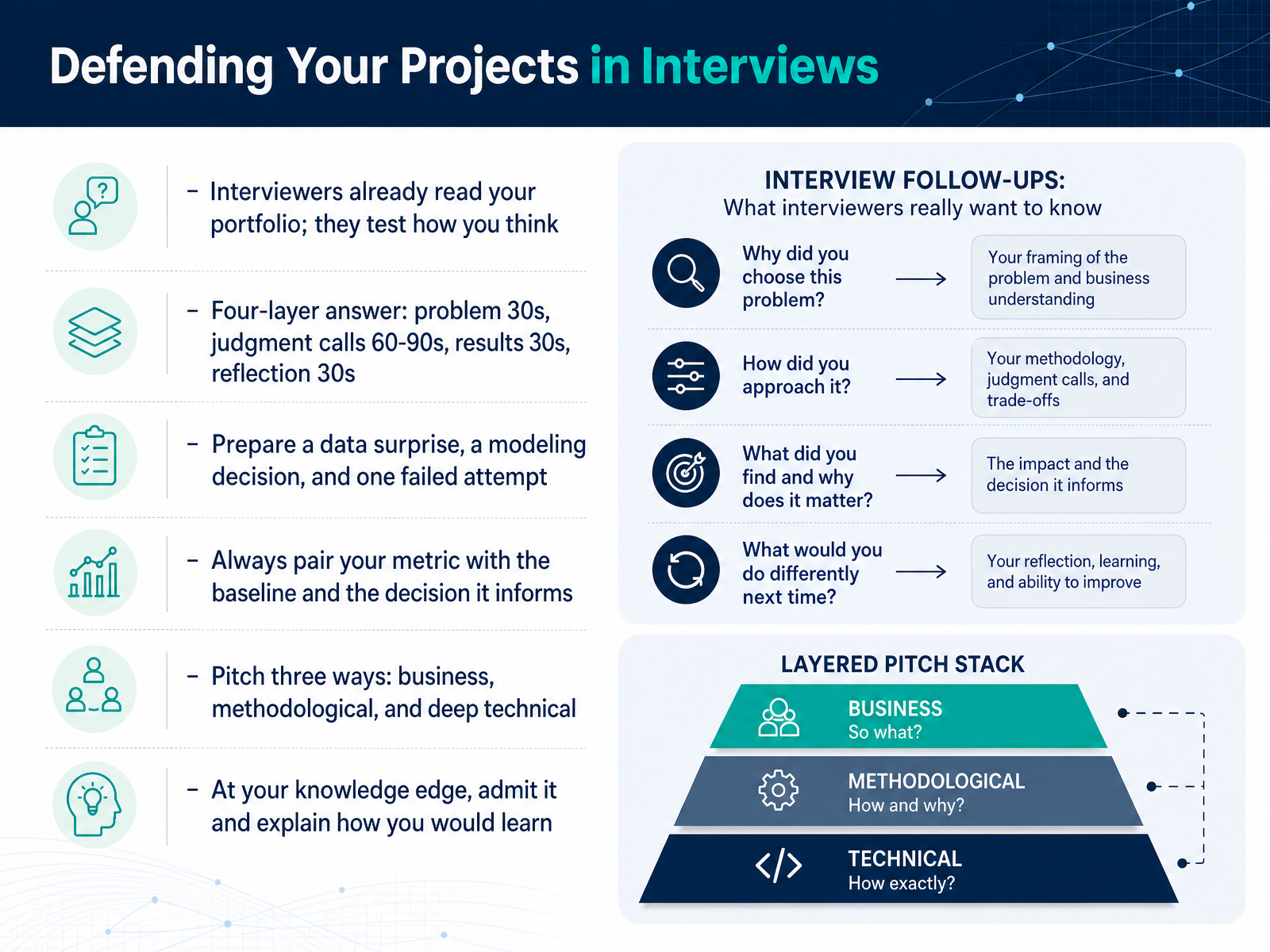
 - 12Defending Your Projects in InterviewsNow let's talk about defending your projects in interviews. Here is the key shift. By the time you sit down, the interviewer has usually already read your portfolio. So they are not checking what you built. They are testing how you think. A reliable structure is a four layer answer. Give the problem in about thirty seconds. Spend sixty to ninety seconds on your judgment calls, the interesting decisions. Then results in thirty seconds, and reflection in thirty seconds. Before the interview, prepare three specific stories. One data surprise, like finding class imbalance that made accuracy misleading. One modeling decision, like choosing recall over precision because missing a case costs more. And one honest failed attempt. When you share a metric, always pair it with the baseline and the decision it informs. For example, recall improved from eighty nine to ninety seven percent, so the team catches more at risk cases per hundred screened. Practice pitching the same project three ways, business focused, methodological, and deep technical. And at the edge of your knowledge, say so, then explain how you would learn it. Next, let's look at handling take homes and working alongside your portfolio.
 2 min
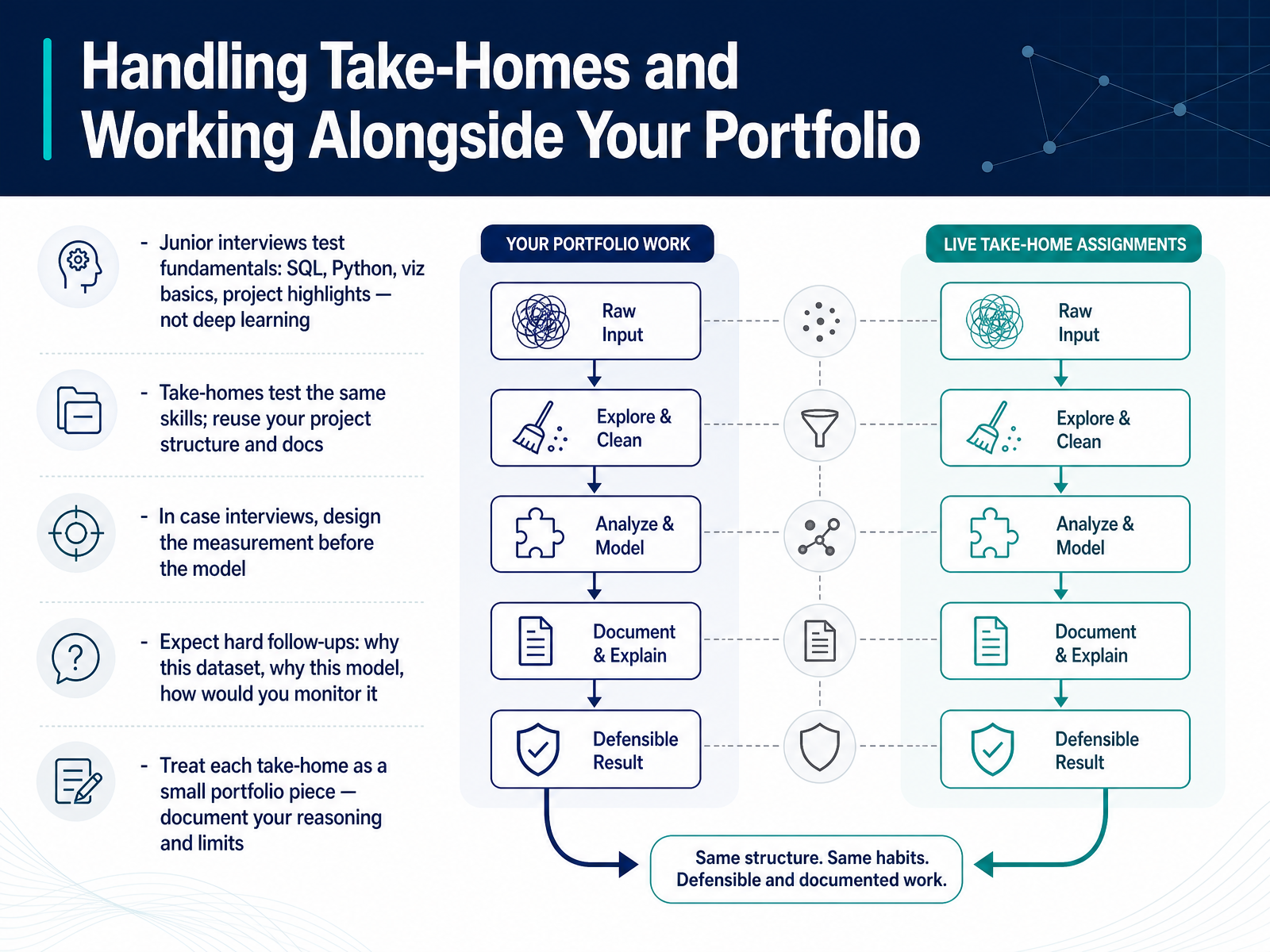
2 min - 13Handling Take-Homes and Working Alongside Your PortfolioNow let's talk about take-homes and how they connect to your portfolio. Junior interviews test fundamentals. SQL, Python, visualization basics, and your project highlights. Not deep learning. Take-homes test the same skills, so reuse your project structure and documentation. In a case interview, design the measurement before the model. Ask yourself what you're measuring and why, then choose your approach. Expect hard follow-ups. Why this dataset? Why this model? How would you monitor it in production? These questions aren't traps. They're checking whether you think like a practitioner. Treat each take-home as a small portfolio piece. Document your reasoning, your assumptions, and your limits. If something didn't work, say so. That honesty stands out. When you show a hiring manager how you think through trade-offs, you're demonstrating the judgment they're looking for. Next, we'll cover maintaining, iterating, and planning your next ninety days.
 tripleten.comsociavae.comcdo.business.rice.edu+21 min
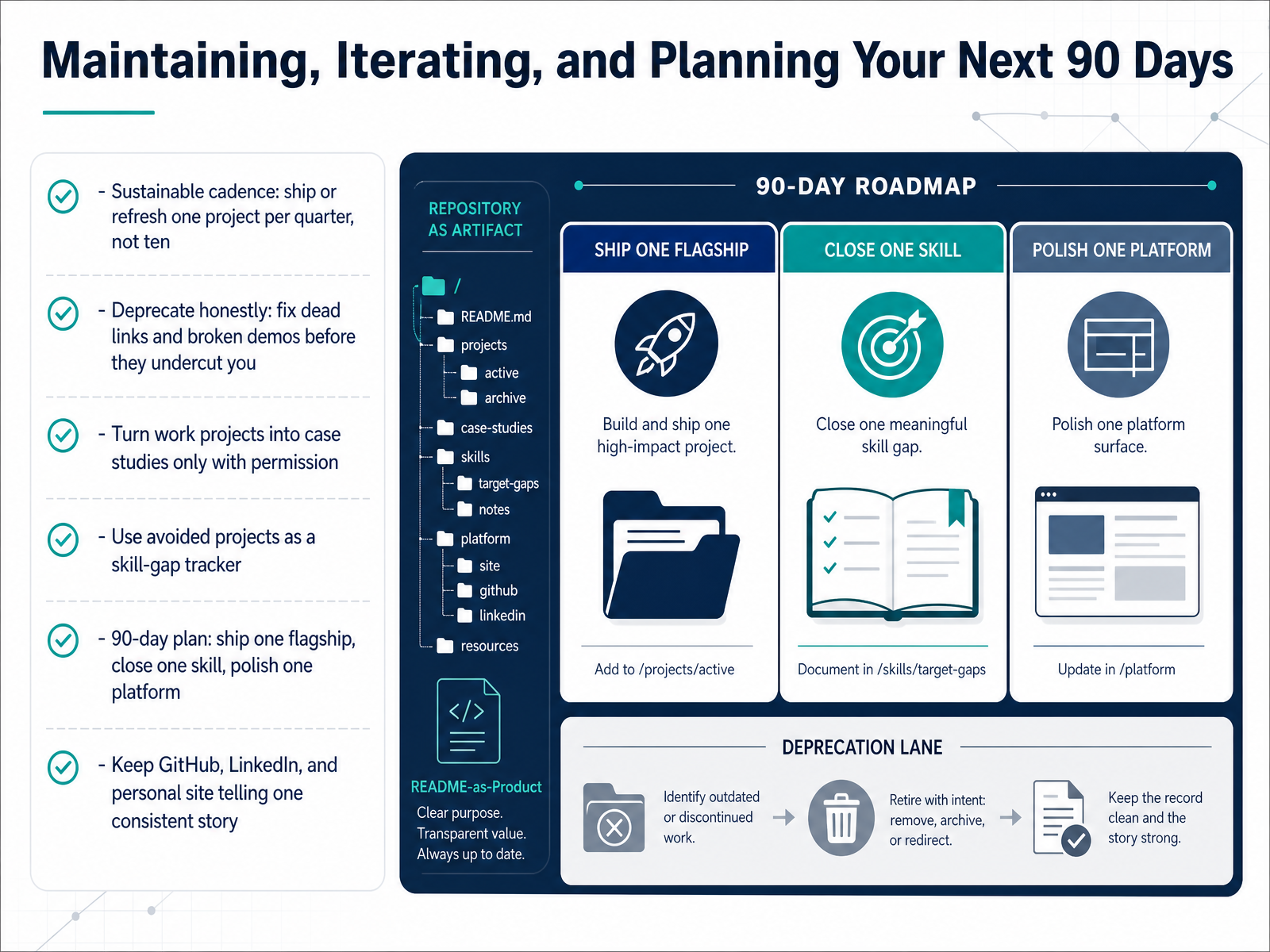
 - 14Maintaining, Iterating, and Planning Your Next 90 DaysLet's bring this home. A portfolio is not a one-time project. It's a living thing, and the goal is a sustainable cadence. Ship or refresh one project per quarter, not ten. Two or three polished projects beat a pile of unfinished notebooks every time. Keep that cadence realistic. Next, deprecate honestly. Fix dead links and broken demos before they undercut you. A hiring manager who clicks your live app and sees an error learns the wrong thing about you. If you turned work projects into case studies, do it only with permission. Never share confidential data. Now, use avoided projects as a skill-gap tracker. If you keep skipping time-series work, that's your signal. Here's a ninety-day plan. Ship one flagship project. Close one skill gap. Polish one platform. Keep GitHub, LinkedIn, and your personal site telling one consistent story. You don't need to do everything at once. Pick those three moves, put them on your calendar, and start this week. Thank you for learning with me. You're more ready than you think. Now go build something real.
 alijabbary.comthetailorcv.comdataexpertise.in+22 min
Take the deck with you
Download this course as a file — free, no sign-up needed.
- PDF handoutEvery slide page, ready to print or share.15 pages · 3.8 MBDownload
- Narrated PowerPointThe deck that presents itself — every slide carries the digital human's narration video.15 pages · 13.4 MBDownload
- PowerPoint slidesThe full deck as a .pptx — open it in PowerPoint, Keynote, or Google Slides.15 pages · 3.7 MBDownload
Free to use in your own training — please keep the PersonWise credit page at the end.
Have your own deck? Turn it into a course
Sources consulted
Web sources consulted while building this course.
- The data/ML portfolio that actually gets you hired in 2026 (projects beat certificates) — alijabbary.com
- Data Scientist Portfolio Guide: Notebooks, Models, and Impact | TailorCV Blog — thetailorcv.com
- How to Build a Data Science Portfolio That Gets You Hired (2026) - DataExpertise — dataexpertise.in
- The Portfolio Rubric Data Science Hiring Managers Use — nb-data.com
- Building a Standout Data Science Portfolio 2026: Your Career Roadmap — blog.weskill.org
- nishan2204/ml-portfolio — github.com
- GitHub - kanikapitaliya/kanika-pitaliya: A portfolio of things I’ve built, explored, and learned along the way. Data. Models. Intelligence. · GitHub — github.laiyagushi.com
- marepallisanthosh999333/marepallisanthosh.engineer — github.com
- svdexe/Portfolio_SVD_V1 — github.com
- devaldaki3/deval-portfolio — github.com
- How to Get Into Data Science in 2026: Career Guide — tripleten.com
- Data Scientist Job Description - Skills, Salary & Responsibilities - Sociavae — sociavae.com
- Data Scientist (Entry Level) – Career Development Office | Rice Business — cdo.business.rice.edu
- Data Scientists : Occupational Outlook Handbook — bls.gov
- What Is a Data Scientist? Salary, Duties + How to Become ... — coursera.org
- How to Structure Your Data Science Project in 2026? — analyticsvidhya.com
- ML Project Structure and Git Workflows for Reproducibility — SuperML.org — superml.org
- Organizing Your Data Science Project Files: Complete Guide — techietory.com
- Chapter 29: Software Engineering for Data Scientists | Intermediate Data Science — datafield.dev
- Writing Reproducible Data Science Code: Complete Guide — techietory.com