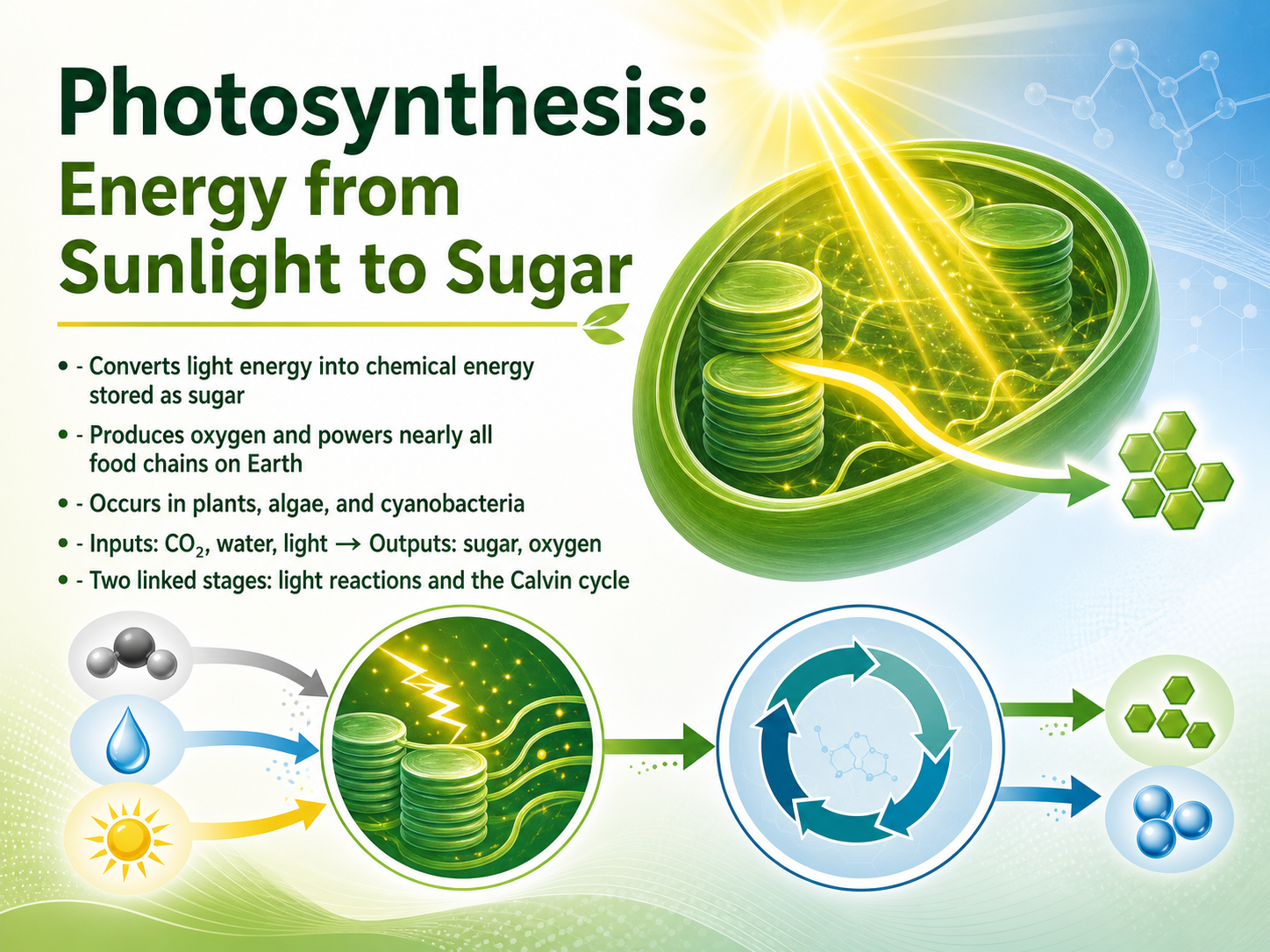
Photosynthesis: Sunlight to Sugar
Begin
15 pages · ~30 min
Photosynthesis: Sunlight to Sugar
This training explores how plants convert sunlight into chemical energy, teaching learners the key stages and processes of photosynthesis.
What you’ll learn
- 01Photosynthesis: Energy from Sunlight to SugarWelcome. In this module, we’re going to explore photosynthesis—the process that converts energy from sunlight into sugar. Think of it as nature’s way of capturing solar power and packaging it into food. By the end, you’ll have a clear, step-by-step model of how plants, algae, and cyanobacteria turn light, water, and carbon dioxide into sugar and oxygen. This single process powers nearly every food chain on Earth. It’s organized into two linked stages: the light reactions and the Calvin cycle. We’ll build each one slowly, starting with the core concepts.1 min
- 02What Is Photosynthesis? Core ConceptsNow that we have the big picture, let's define exactly what photosynthesis is. At its core, photosynthesis is a process where plants, algae, and some bacteria capture light energy from the sun and convert it into chemical energy. Think of it like a tiny solar panel built into a leaf. That captured energy is then used to transform two simple ingredients—carbon dioxide from the air and water from the soil—into a type of sugar called glucose. Glucose is the plant's main source of food and fuel. A helpful byproduct of this reaction is oxygen, which is released into the atmosphere for us to breathe. So, in simple terms, the plant takes in light, water, and carbon dioxide, and produces food and oxygen. Up next, we will zoom in on the specific location where this all happens inside the plant. Let's look at 'Where It Happens: The Leaf and Chloroplast.'
 1 min
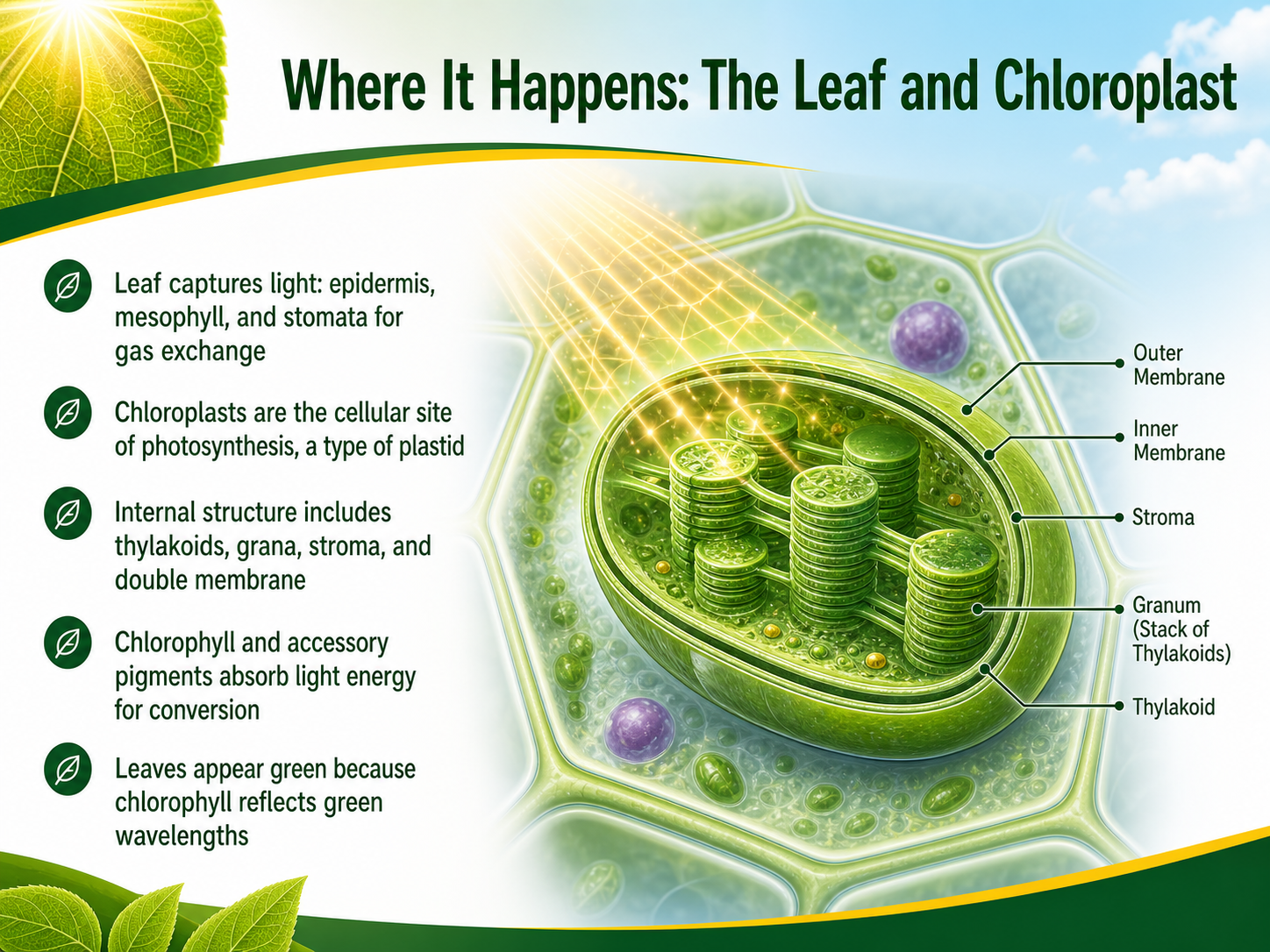
1 min - 03Where It Happens: The Leaf and ChloroplastNow, let's zoom in to see exactly where photosynthesis happens. The first location is the leaf itself. Think of the leaf's structure as a carefully organized solar collection system. It has a protective outer layer called the epidermis, and a middle layer, the mesophyll, which is the main work area. The leaf also has tiny pores, called stomata, that open and close to let carbon dioxide in and oxygen out, like the building's ventilation system. Inside the mesophyll cells, we find the true powerhouses of photosynthesis: the chloroplasts. A chloroplast is a specialized compartment, or organelle, unique to plant cells. To understand its job, we need to look at its internal structure. The chloroplast has a double membrane outer wall. Inside, it contains stacks of disc-shaped sacs called thylakoids. A single stack is a granum, and many stacks are called grana. The space surrounding these stacks is a fluid called the stroma. This structure is where light energy is captured. The thylakoid membranes contain chlorophyll, the primary pigment, along with other accessory pigments. These pigments act like a light antenna, absorbing energy mostly from the red and blue parts of the spectrum. They reflect green light, which is why most leaves appear green to us. So, the leaf captures light and gases, and the chloroplasts precisely organize the pigments to begin converting that light energy. Next, we will follow the captured energy into the first stage of the process: the light-dependent reactions.
 2 min
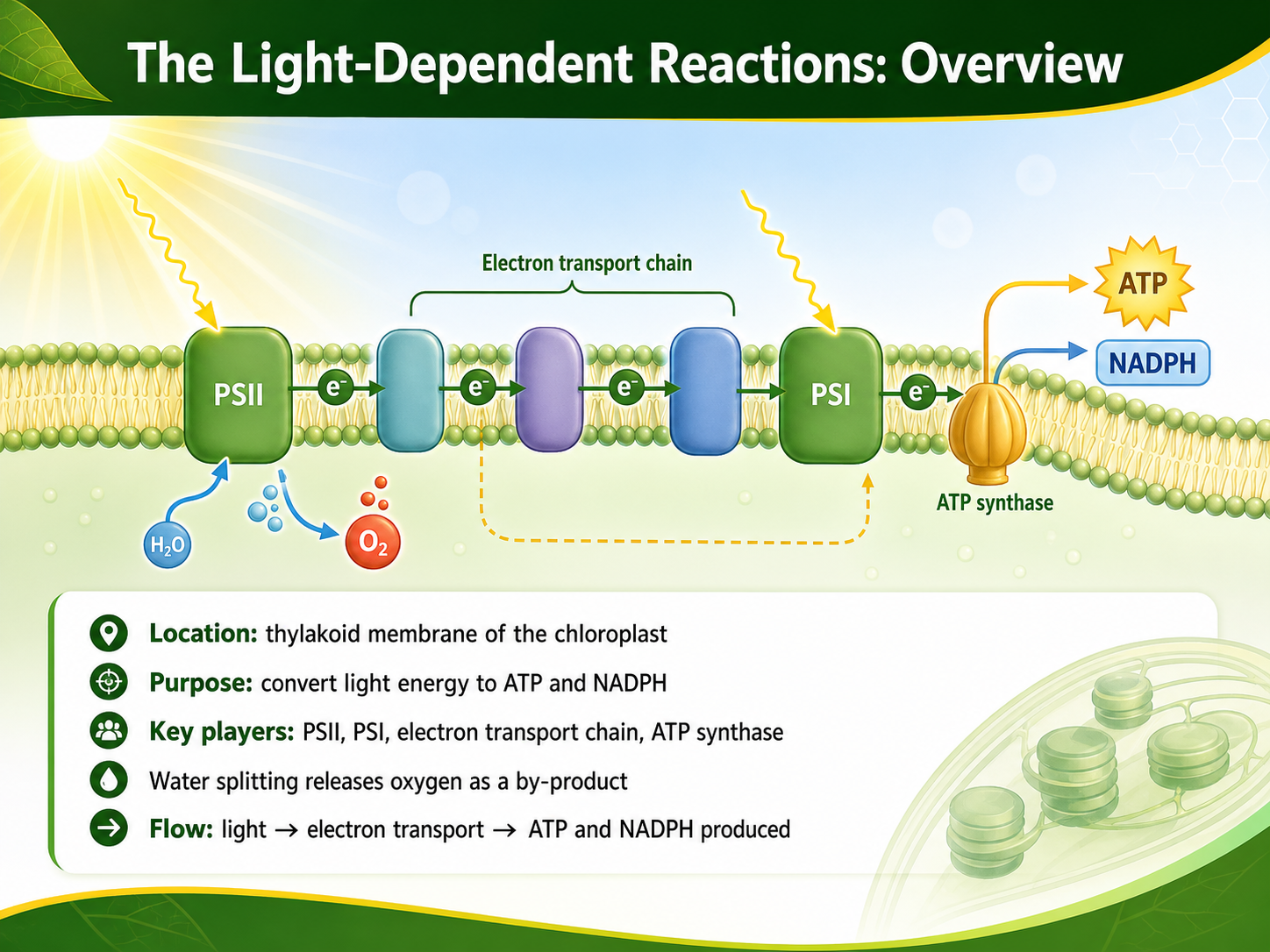
2 min - 04The Light-Dependent Reactions: OverviewNow, let's zoom in on the first major stage: the light-dependent reactions. These take place on a special membrane inside the chloroplast, called the thylakoid membrane. Think of this membrane as the solar panel of the cell. Its main purpose is to capture light energy and convert it into two chemical energy carriers, named ATP and NADPH. These molecules will be used as fuel in the next stage. To do this, the cell uses a few key players, including two large protein complexes called Photosystem II and Photosystem I, a chain of electron carriers, and a fascinating enzyme called ATP synthase. A critical step here is the splitting of water molecules. This process releases electrons and, as a byproduct, the oxygen we breathe. So, the overall flow is simple: light energy is absorbed, which drives electrons along a transport chain. This activity powers the production of ATP and NADPH. Next, we will explore the specific roles of photosystems and the electron transport chain in more detail.
 2 min
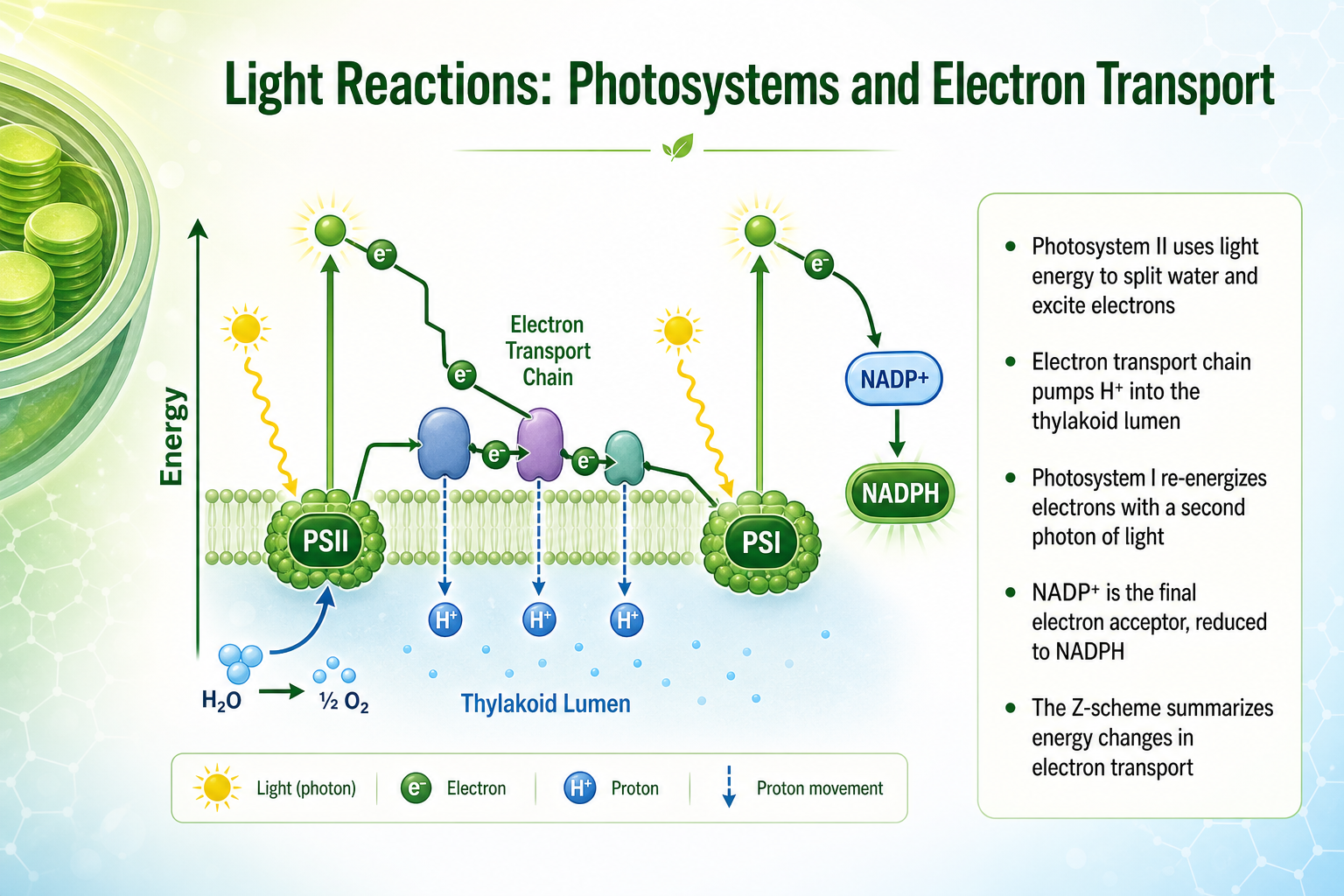
2 min - 05Light Reactions: Photosystems and Electron TransportNow, let's look inside the thylakoid membrane at the light reactions. These reactions involve two large protein complexes called photosystems. Think of each photosystem as a tiny antenna that captures light energy. First, light strikes Photosystem II. This energy is used to split a water molecule, releasing oxygen and exciting a pair of electrons. These high-energy electrons are then passed to an electron transport chain. As the electrons move through this chain, their energy is used to pump hydrogen ions into the thylakoid lumen, building up a concentration gradient. The electrons then arrive at Photosystem I, where they get a second energy boost from another photon of light. Finally, the energized electrons are transferred to a carrier molecule called NADP plus, which also picks up a hydrogen ion. This converts NADP plus into NADPH, a crucial energy-rich molecule for the next stage of photosynthesis. The overall energy journey of these electrons is often illustrated by a diagram called the Z-scheme, which shows the two energy boosts. Next, we will see how that hydrogen ion gradient is used to make ATP in a process called chemiosmosis.
 2 min
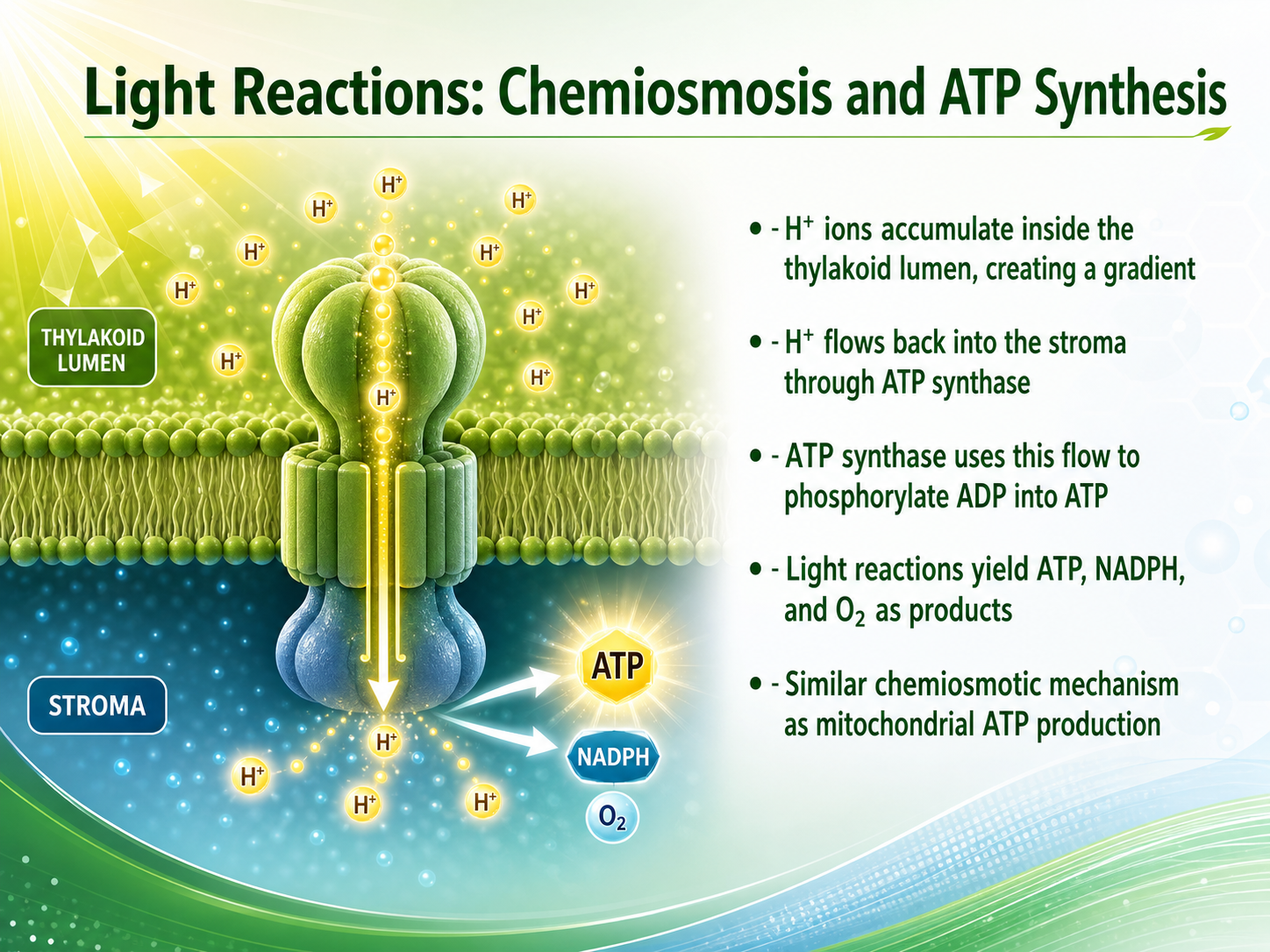
2 min - 06Light Reactions: Chemiosmosis and ATP SynthesisNow let's look at how the energy captured so far is converted into a more usable form for the plant. The light reactions have been pumping hydrogen ions, or protons, into a compartment inside the chloroplast called the thylakoid lumen. This creates a high concentration of protons inside, like water building up behind a dam. These protons naturally want to flow back out to the other side, the stroma, to balance the concentration. They can only do this by passing through a special protein channel called ATP synthase. As the protons flow through, their movement causes ATP synthase to spin, which is the mechanical force that attaches a phosphate group to an ADP molecule, creating ATP. This process is called chemiosmosis, and it is very similar to how our own mitochondria produce ATP. So, at the end of the light reactions, we have made three key products: ATP, which is the energy currency; NADPH, a carrier of energized electrons; and oxygen, which is released as a byproduct. Next, we will see how the ATP and NADPH are used to build sugar in the Calvin cycle.
 2 min
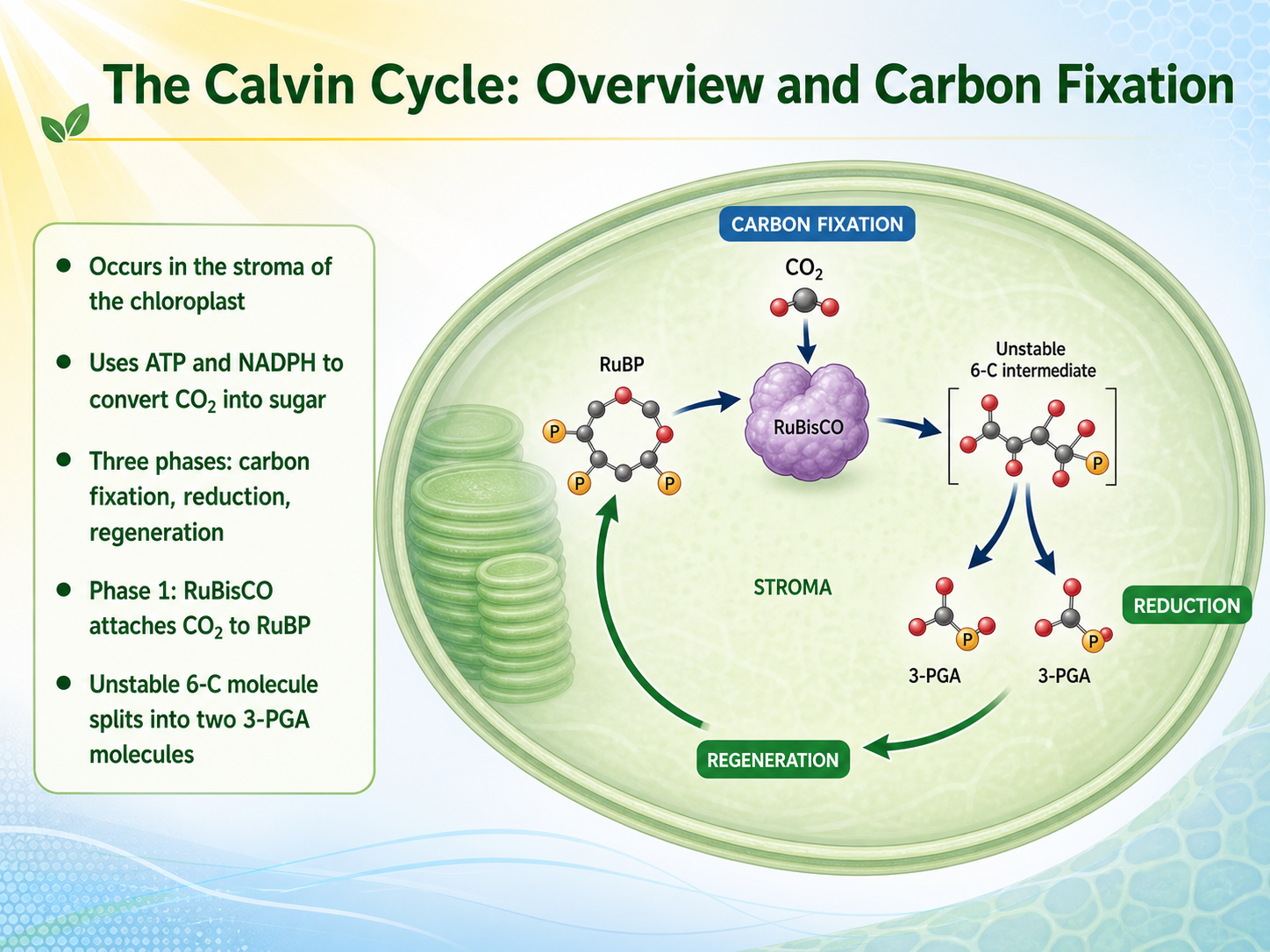
2 min - 07The Calvin Cycle: Overview and Carbon FixationNow let’s move into the Calvin Cycle, which takes place in the stroma—the fluid-filled space surrounding the thylakoids inside the chloroplast. While the light reactions produce ATP and NADPH, the Calvin Cycle uses that energy to build sugar from carbon dioxide. Think of it as the assembly line where the actual sugar product is constructed. The cycle runs through three main phases: carbon fixation, reduction, and regeneration. We’ll focus on the first phase, carbon fixation. In this step, an enzyme called RuBisCO grabs a carbon dioxide molecule and attaches it to a five-carbon starter molecule named RuBP. The resulting six-carbon compound is highly unstable and immediately splits into two identical molecules, each with three carbons, called 3-PGA. This is the moment where inorganic carbon from the air first gets locked into an organic form the plant can work with. Next, we’ll look at the reduction phase, where those 3-PGA molecules get converted into the actual sugar building blocks.
 1 min
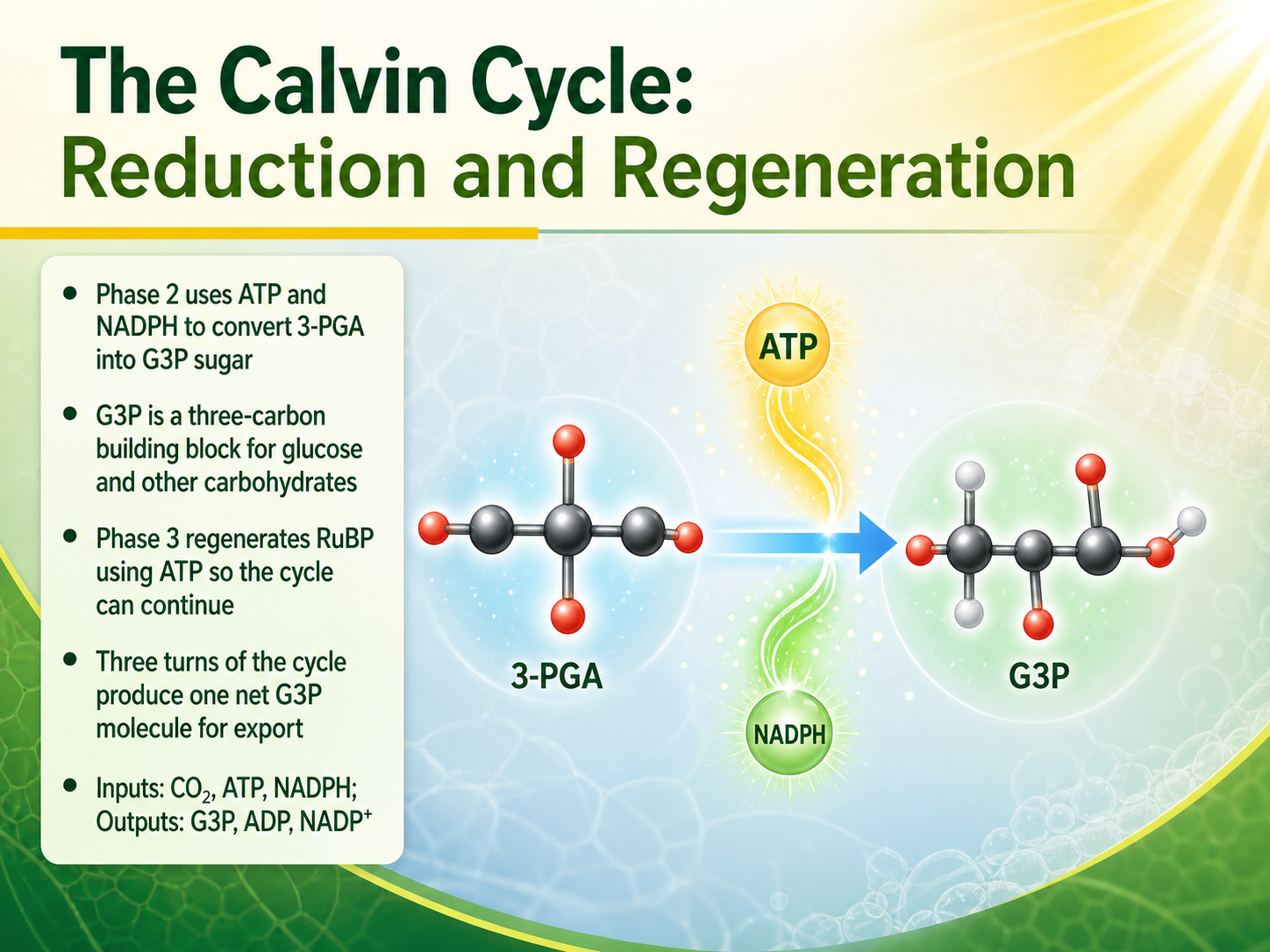
1 min - 08The Calvin Cycle: Reduction and RegenerationNow, let's follow the energy and electrons into the next stage, the Calvin Cycle's reduction and regeneration phases. Think of this as an assembly line that builds a sugar molecule. The immediate ingredients are molecules called ATP and NADPH, which we produced in the light reactions. The cycle takes a three-carbon compound, called 3-PGA, and uses the energy from ATP and the high-energy electrons from NADPH to convert it into a new molecule called G3P. G3P is a three-carbon sugar building block. It serves as the primary product of photosynthesis, which the plant can then link together to form glucose and other carbohydrates. After releasing one G3P molecule, the cycle needs to continue. It uses more ATP to regenerate RuBP, the starter molecule that grabs carbon dioxide. This regeneration is essential, allowing the cycle to keep turning. It takes three complete turns of the Calvin Cycle, fixing three carbon dioxide molecules, to produce a single net G3P molecule for export. The outputs of this process are G3P, and the spent energy carriers, ADP and NADP+. These carriers will travel back to the light reactions to be recharged. Next, we'll explore what the plant does with its sugar.
 2 min
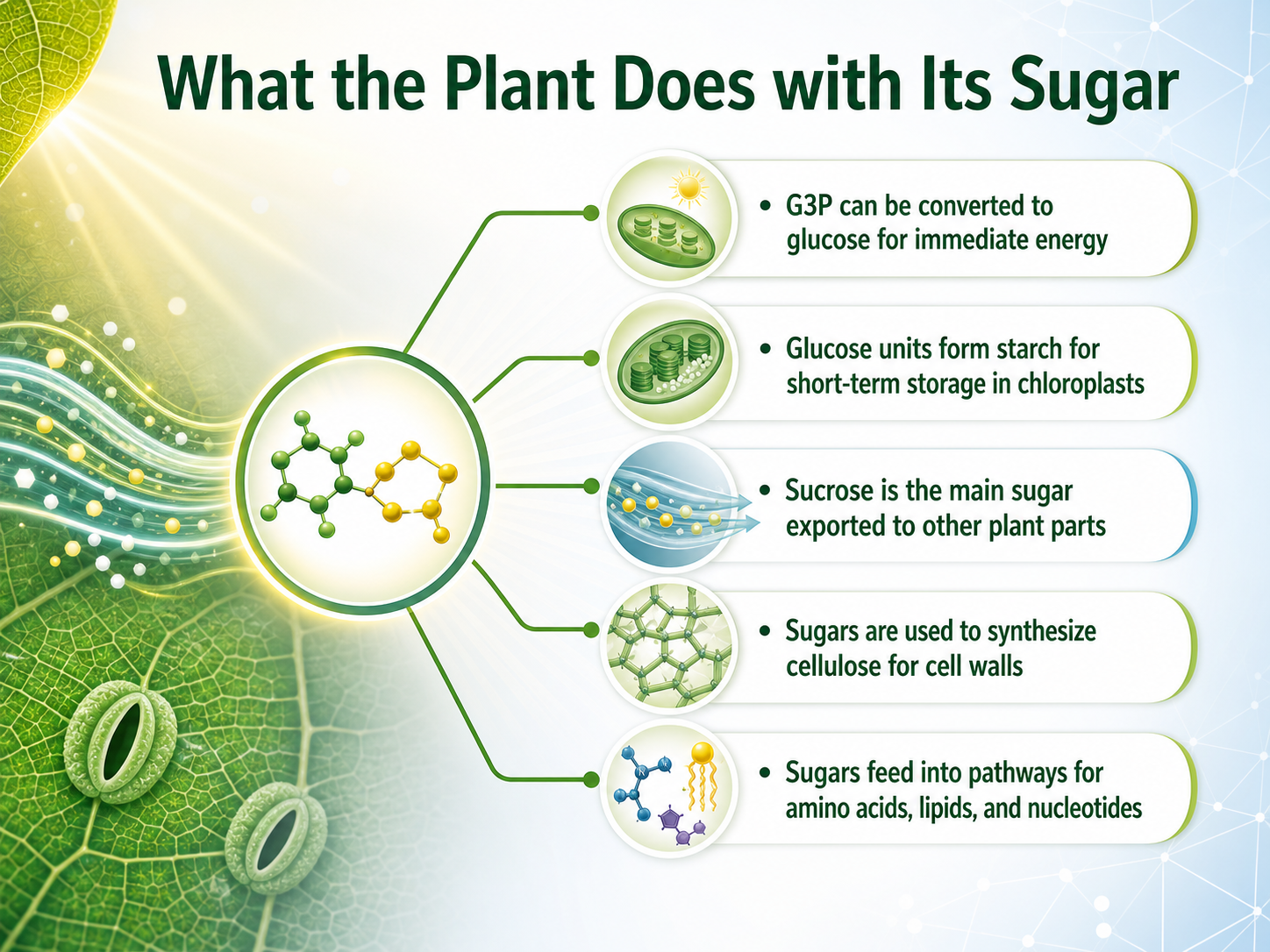
2 min - 09What the Plant Does with Its SugarSo, once the Calvin cycle produces G3P, the plant has a flexible building block it can use in many ways. One immediate use is converting G3P into glucose, which the plant can break down right away for quick energy. For short-term storage, the plant links many glucose molecules together to form starch, which it keeps right inside the chloroplast for later. When energy needs to be sent to other parts of the plant, like roots or developing leaves, the sugar is converted to sucrose and exported through the plant's transport system. These sugars are also the raw materials for building plant structure. They are used to synthesize cellulose, the tough fiber that makes up cell walls, giving the plant its shape and strength. Beyond that, the carbon from these sugars feeds into other metabolic pathways, helping the plant produce amino acids for proteins, lipids for membranes, and even nucleotides for DNA and RNA. In short, the sugar made from photosynthesis isn't just food; it's the starting point for nearly everything the plant makes. Next, we'll bring these concepts together by looking at how the light and dark reactions coordinate in a process we call 'Putting It All Together: Light and Dark Reactions.'
 2 min
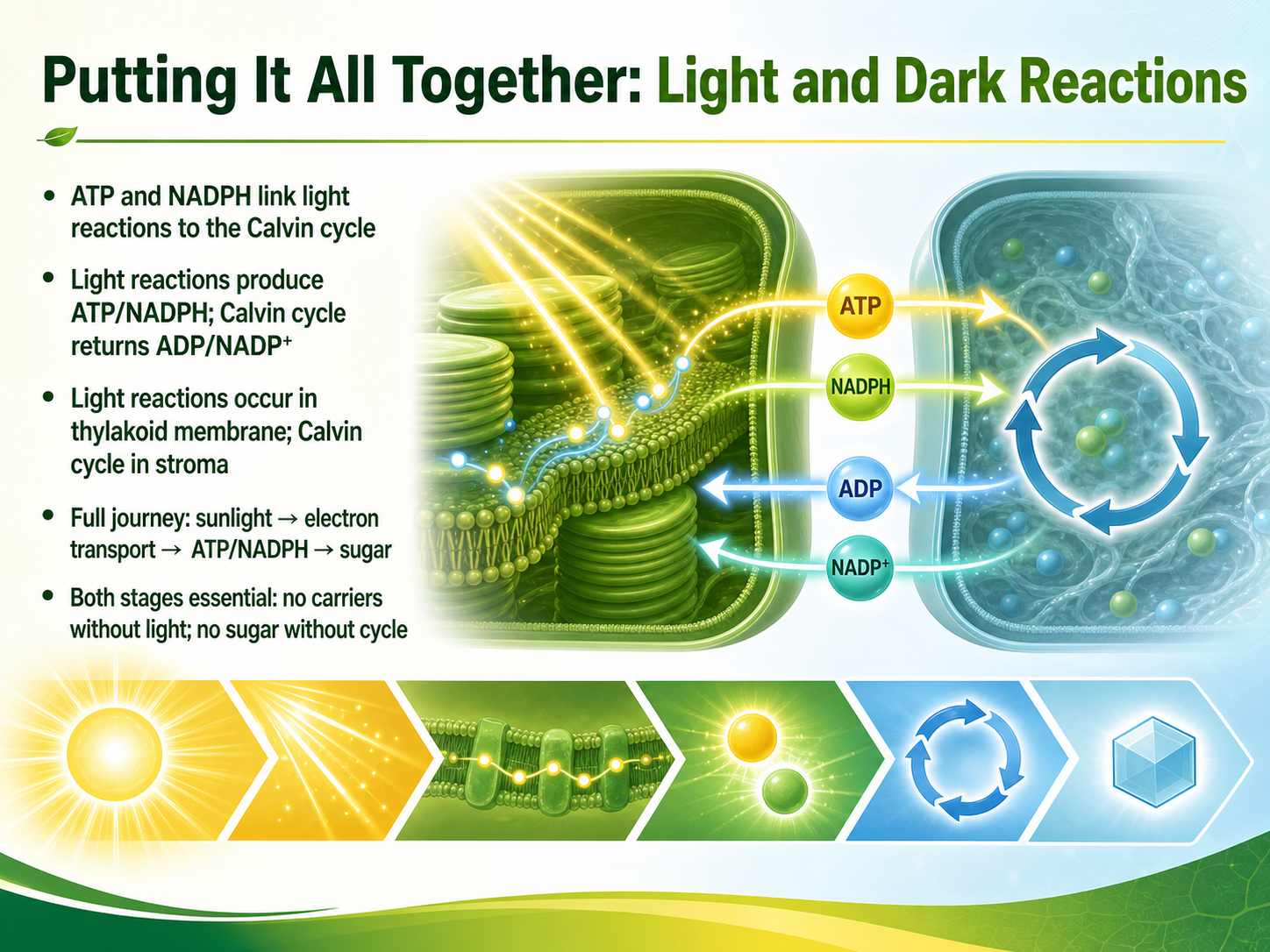
2 min - 10Putting It All Together: Light and Dark ReactionsNow we can see how the two stages connect. The light reactions act like a solar panel, capturing sunlight to produce ATP and NADPH. These molecules are energy carriers. Once they are made, they travel into the stroma, which is the fluid-filled space surrounding the thylakoid stacks. There, the Calvin cycle uses the energy from ATP and NADPH to build sugar. As the cycle runs, it converts ATP back to ADP, and NADPH back to NADP plus. These empty carriers return to the light reactions to be recharged, creating a continuous loop. So the full journey goes from sunlight, through electron transport, to ATP and NADPH, and finally to sugar. Both stages are essential. Without the light reactions, there are no charged carriers. Without the Calvin cycle, there is no sugar. Next, we will explore how real-world factors like light intensity, carbon dioxide levels, and temperature affect this entire process.
 1 min
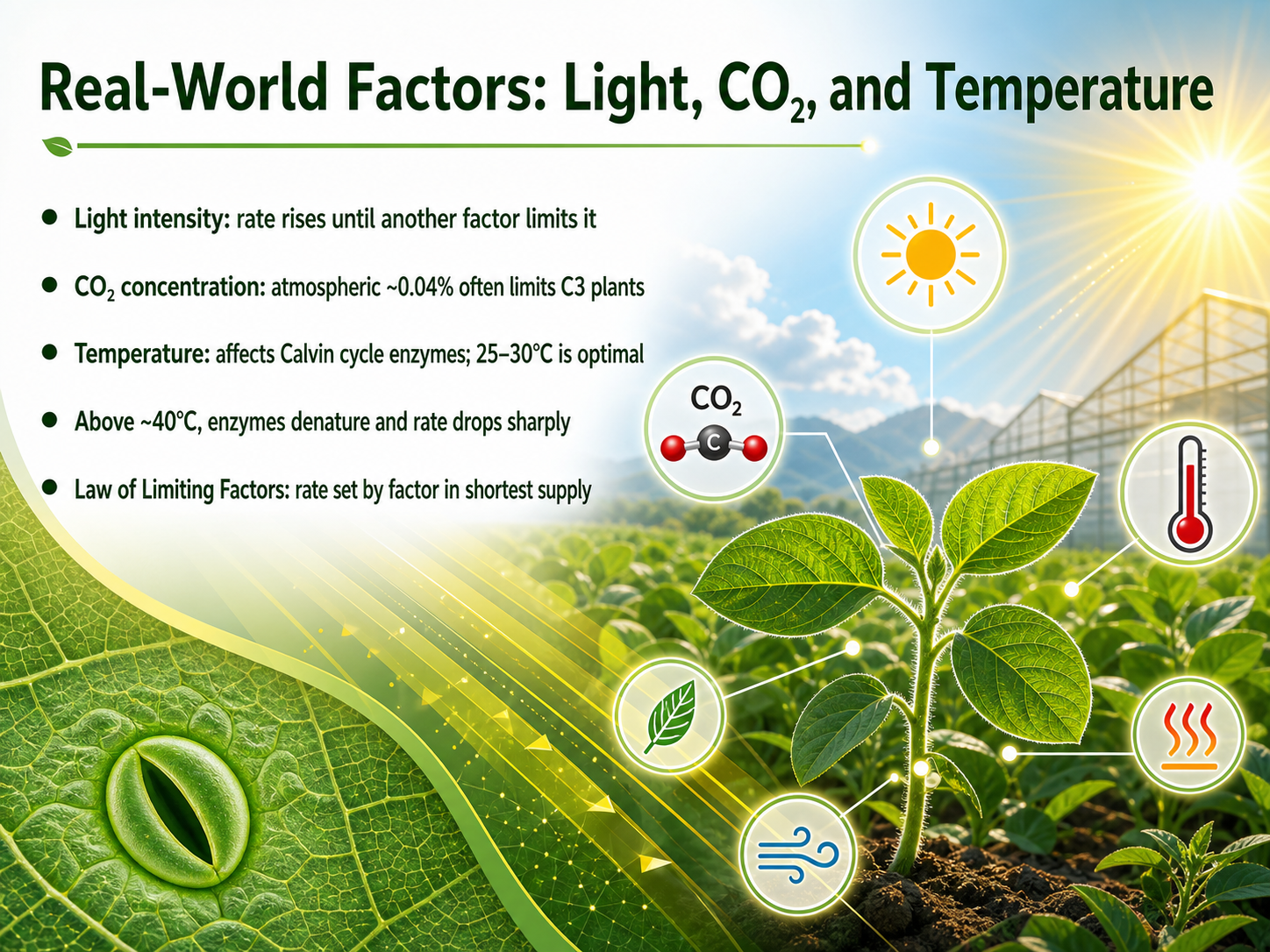
1 min - 11Real-World Factors: Light, CO₂, and TemperatureNow let's look at how real-world conditions affect the rate of photosynthesis. The three main factors are light intensity, carbon dioxide concentration, and temperature. Think of each factor as a team member. If one is missing, the whole process slows down. First, as light intensity increases, the rate of photosynthesis goes up, just like a solar panel generating more power in brighter sun. But eventually, the rate levels off because another factor becomes the bottleneck. Next, carbon dioxide. The atmosphere contains only about 0.04 percent CO2, which often limits the rate for C3 plants. Even if light is plentiful, a lack of CO2 restricts sugar production. Temperature mostly affects the enzymes in the Calvin cycle. The optimal range is usually 25 to 30 degrees Celsius. At these temperatures, enzymes work efficiently. However, above about 40 degrees, enzymes denature and the rate drops sharply. This leads us to the Law of Limiting Factors. It states that the rate is always set by the factor in shortest supply. So, you can only speed up photosynthesis by identifying and increasing that single limiting factor. Next, we will apply these concepts to interpreting limiting factor graphs.
 bbc.co.uklivephysics.comcityleicester.co.uk+22 min
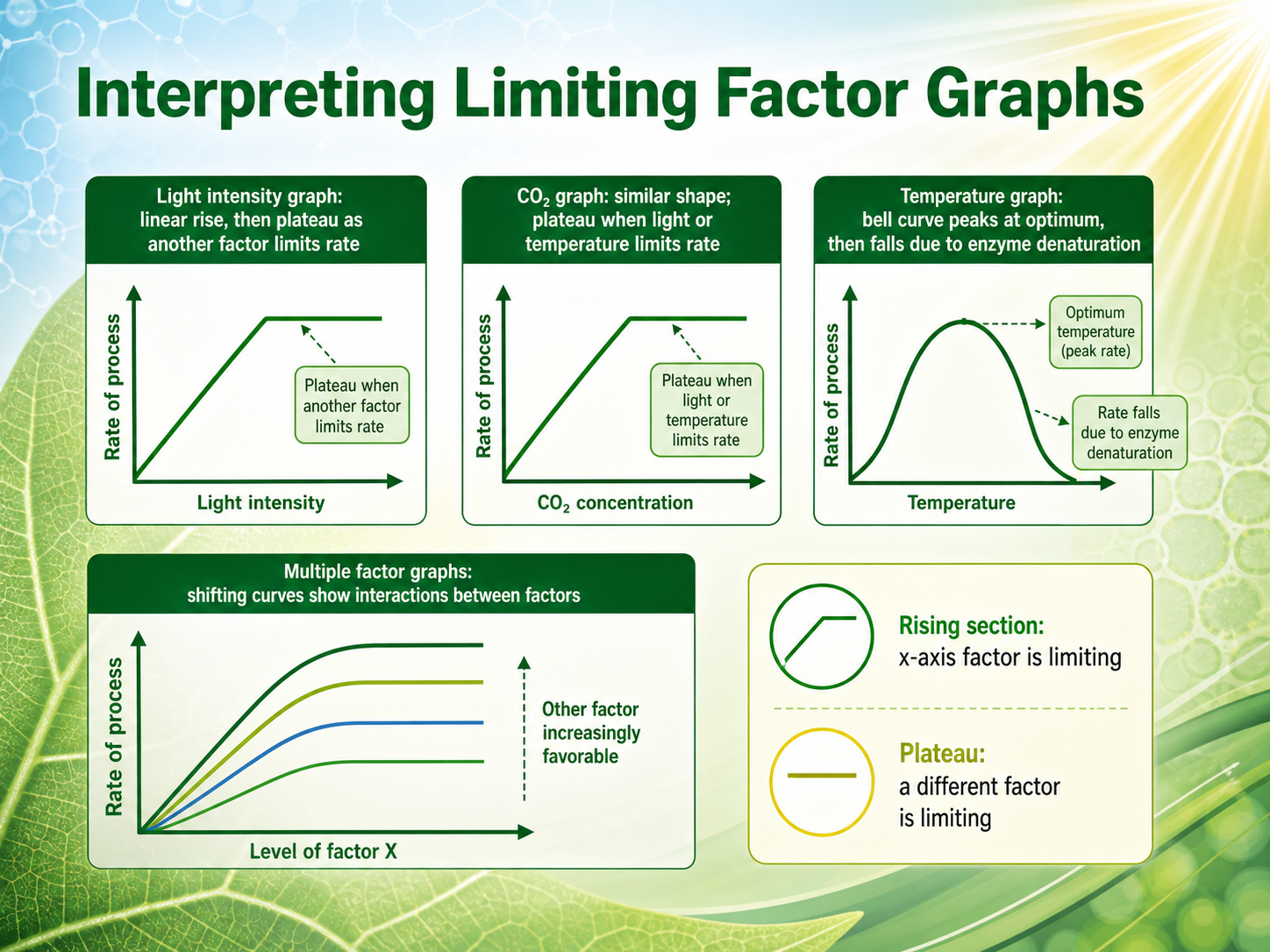
 - 12Interpreting Limiting Factor GraphsNow, let’s learn how to read the graphs that show these limiting factors. For light intensity, the graph rises in a straight line at first. This tells us light is the limiting factor—more light directly speeds up photosynthesis. Eventually, the line levels off into a plateau. When it flattens, light is no longer the limiting factor; something else, like carbon dioxide level or temperature, is holding the rate back. The carbon dioxide graph follows a very similar pattern. It rises, then plateaus when another factor becomes the bottleneck. The temperature graph looks different—it forms a bell curve. The rate rises as enzymes work faster, peaks at an optimum temperature, and then falls sharply as the enzymes lose their shape, or denature. When graphs show multiple curves, the lines shift. This reveals how different factors interact. A simple rule to remember: when the line is going up, the factor on the bottom axis is limiting. When the line is flat, a different factor is limiting the rate. Next, we’ll explore photosynthesis beyond land plants.
 bbc.co.uklivephysics.comcityleicester.co.uk+22 min
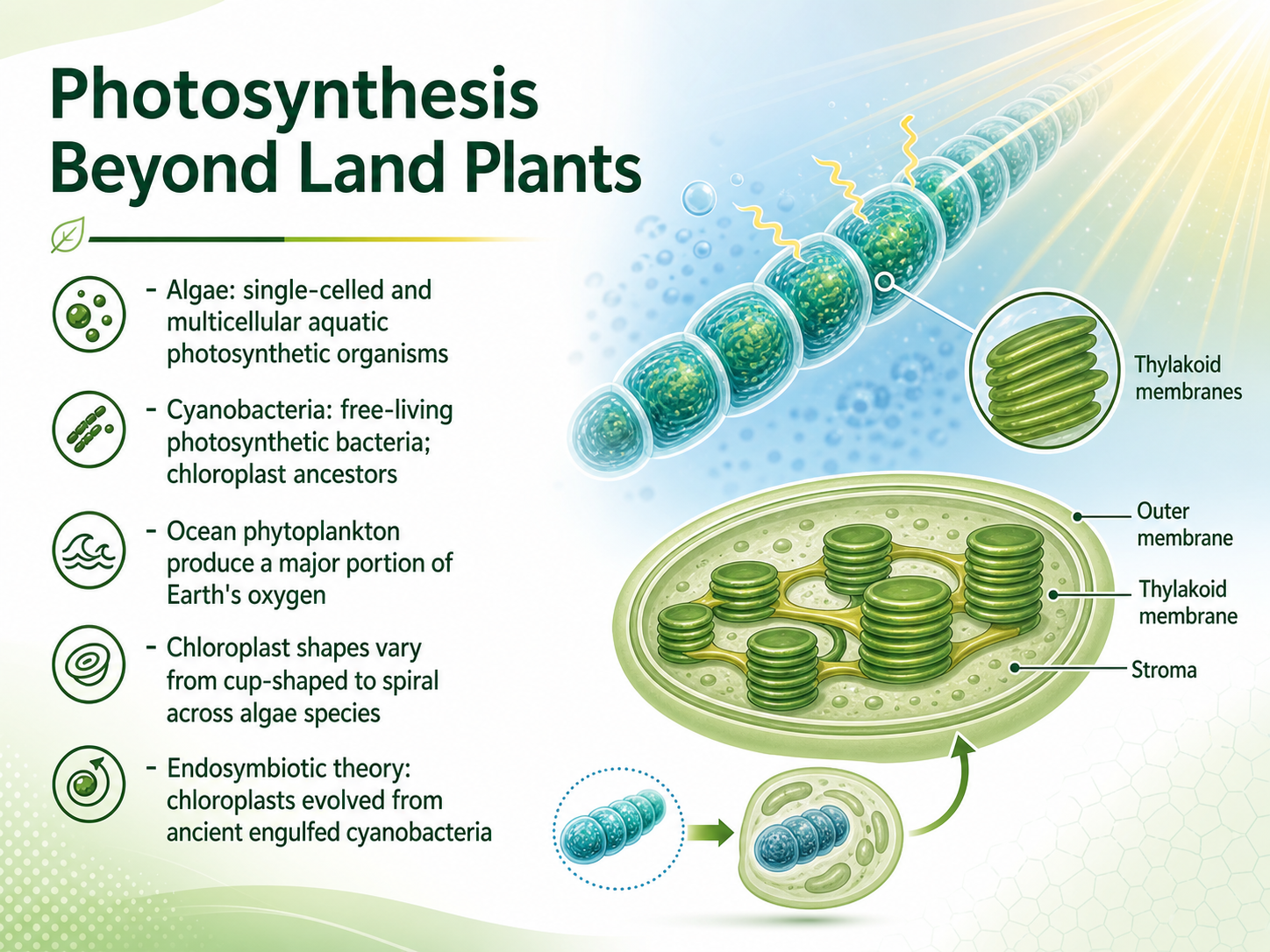
 - 13Photosynthesis Beyond Land PlantsNow let's step outside the typical green leaf and look at photosynthesis in other organisms. Plants aren't the only living things that can turn sunlight into sugar. Algae are a huge group of photosynthetic organisms, ranging from single-celled individuals to large multicellular seaweeds. Then there are cyanobacteria. These are free-living bacteria that perform photosynthesis, and they hold a special place in our story. Scientists believe that ancient cyanobacteria are the ancestors of the chloroplasts inside plant cells. This is called the endosymbiotic theory. It proposes that a larger cell engulfed a cyanobacterium long ago, and instead of being digested, it became a permanent resident, eventually evolving into the chloroplast. You can see evidence of this history in the many shapes of chloroplasts across different algae species. Some are cup-shaped, others form a spiral, and some look like a star. These diverse forms remind us that photosynthesis is an ancient and adaptable process. And its global impact is massive. Ocean phytoplankton, which are microscopic algae and cyanobacteria, produce a major portion of the oxygen we breathe. So every other breath you take likely comes from these tiny, floating photosynthesizers in the sea. Next, we will connect this biological process to the bigger picture in the global carbon cycle.
 2 min
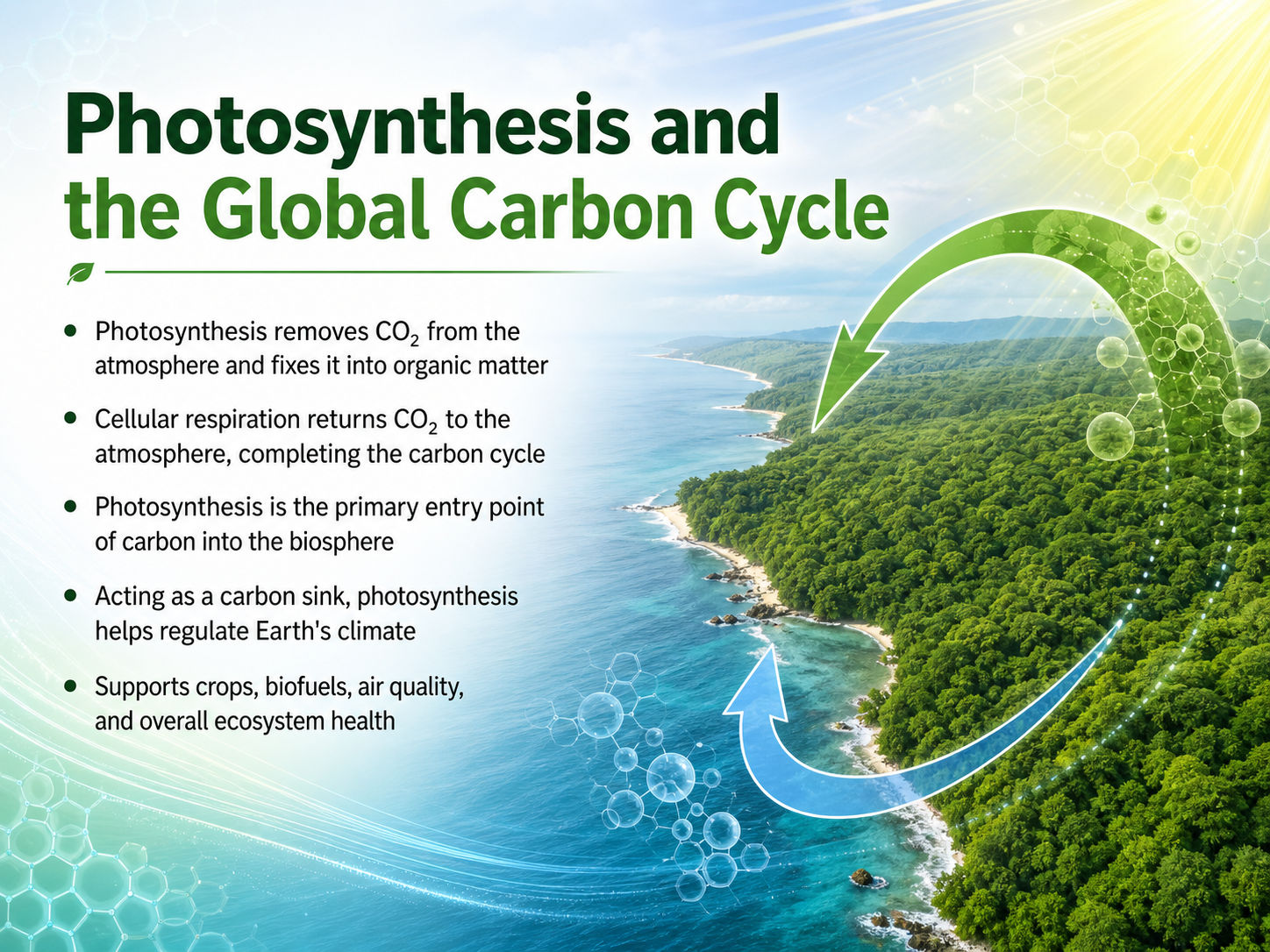
2 min - 14Photosynthesis and the Global Carbon CycleNow, let's take a step back and see how photosynthesis connects to the bigger picture of our planet's carbon cycle. You can think of the carbon cycle as a large-scale recycling system. Photosynthesis is the engine that drives it. It pulls carbon dioxide, a gas, directly out of the atmosphere and uses it to build the solid organic matter of the plant, like its leaves, stems, and roots. This process is the main gateway for carbon to enter the entire living world, or biosphere. Later, both plants and the animals that eat them use cellular respiration to break down that organic matter for energy, which releases carbon dioxide back into the air. This completes the cycle. Because photosynthesis constantly removes carbon dioxide on a massive scale, it acts as a powerful carbon sink, helping to regulate Earth's climate and buffering against changes. Beyond climate, this process is the foundation that supports our food crops, the biofuels we may use for energy, the quality of the air we breathe, and the health of entire ecosystems. Let's now bring all of these ideas together in our final summary of key takeaways.
 2 min
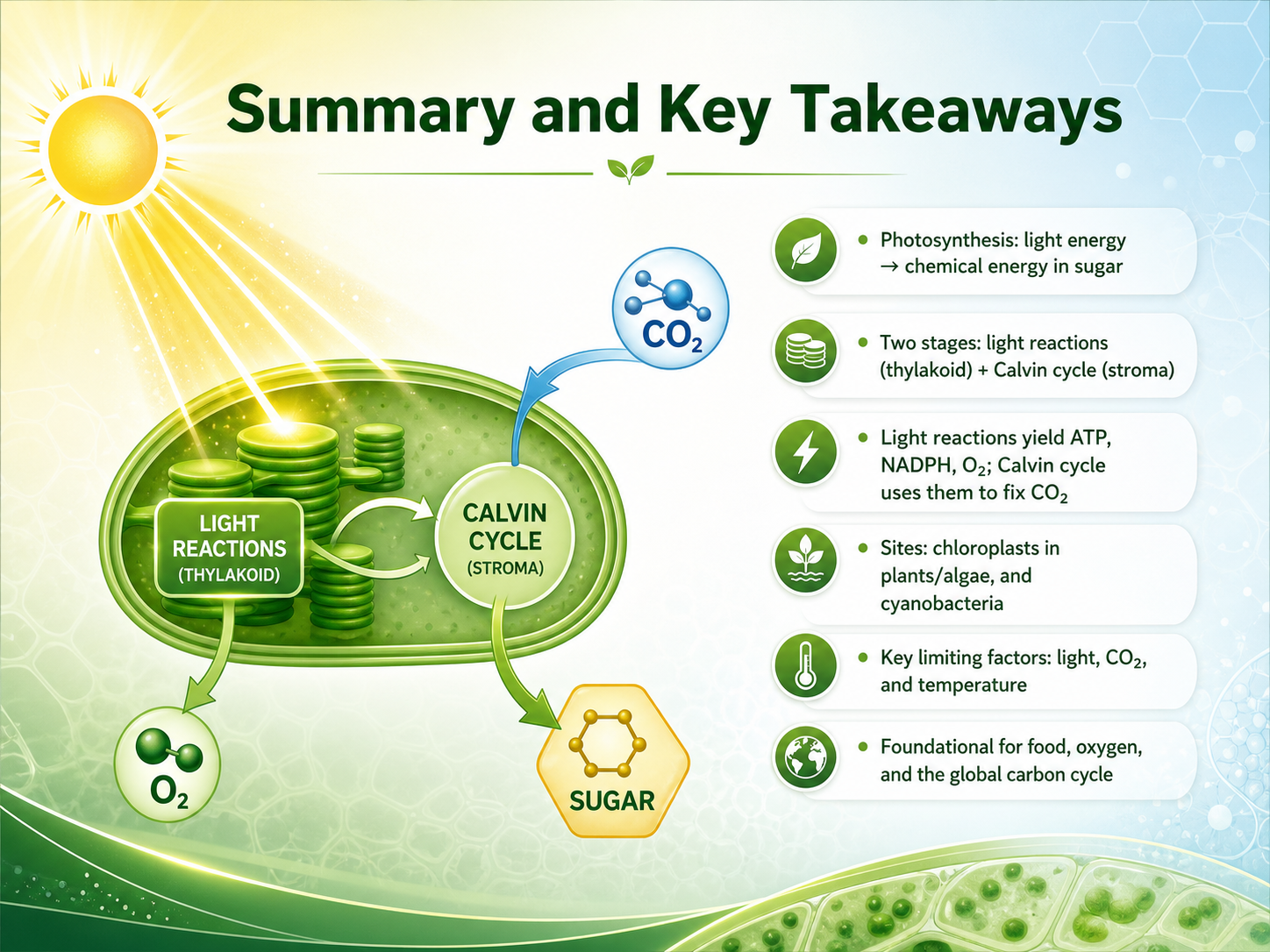
2 min - 15Summary and Key TakeawaysLet's bring together what we've covered. Photosynthesis is the process that converts light energy into chemical energy stored in sugar. It happens in two main stages. The first stage is the light reactions, which take place in the thylakoid membranes. Here, light energy is captured and used to make ATP and NADPH, and oxygen is released as a byproduct. The second stage is the Calvin cycle, which occurs in the stroma. This cycle uses the ATP and NADPH from the first stage to fix carbon dioxide and build sugar. These reactions happen inside chloroplasts in plants and algae, and in cyanobacteria as well. The rate of photosynthesis is influenced by three key limiting factors: light intensity, carbon dioxide concentration, and temperature. Remember, this process is foundational. It provides the food and oxygen we depend on, and it drives the global carbon cycle. Thank you for joining this introduction to photosynthesis. I encourage you to look for this elegant energy conversion in the plants around you.
 2 min
2 min
Take the deck with you
Download this course as a file — free, no sign-up needed.
- PDF handoutEvery slide page, ready to print or share.16 pages · 4.5 MBDownload
- Narrated PowerPointThe deck that presents itself — every slide carries the digital human's narration video.16 pages · 16.7 MBDownload
- PowerPoint slidesThe full deck as a .pptx — open it in PowerPoint, Keynote, or Google Slides.16 pages · 4.5 MBDownload
Free to use in your own training — please keep the PersonWise credit page at the end.
Have your own deck? Turn it into a course
Sources consulted
Web sources consulted while building this course.
- Interpret graphs - photosynthesis limiting factors - Revise — bbc.co.uk
- Photosynthesis Rate Explorer | LivePhysics™ — livephysics.com
- Tackling Data Interpretation Questions II: Photosynthesis — cityleicester.co.uk
- Limiting Factors of Photosynthesis | Cambridge (CIE) A Level Biology Revision Notes 2023 — savemyexams.com
- Factors Affecting the Rate of Photosynthesis ( OCR A Level Biology ) : Revision Note — savemyexams.com