Begin
14 pages · ~28 min
Machine Learning Interview Prep
Prepare for machine learning interviews with practice questions covering core concepts, algorithms, and common technical topics for aspiring data scientists and ML engineers.
A digital instructor presents all 14 pages. Hold “Ask” at any point and ask out loud — the answer comes from this course. No sign-up needed.
What you’ll learn
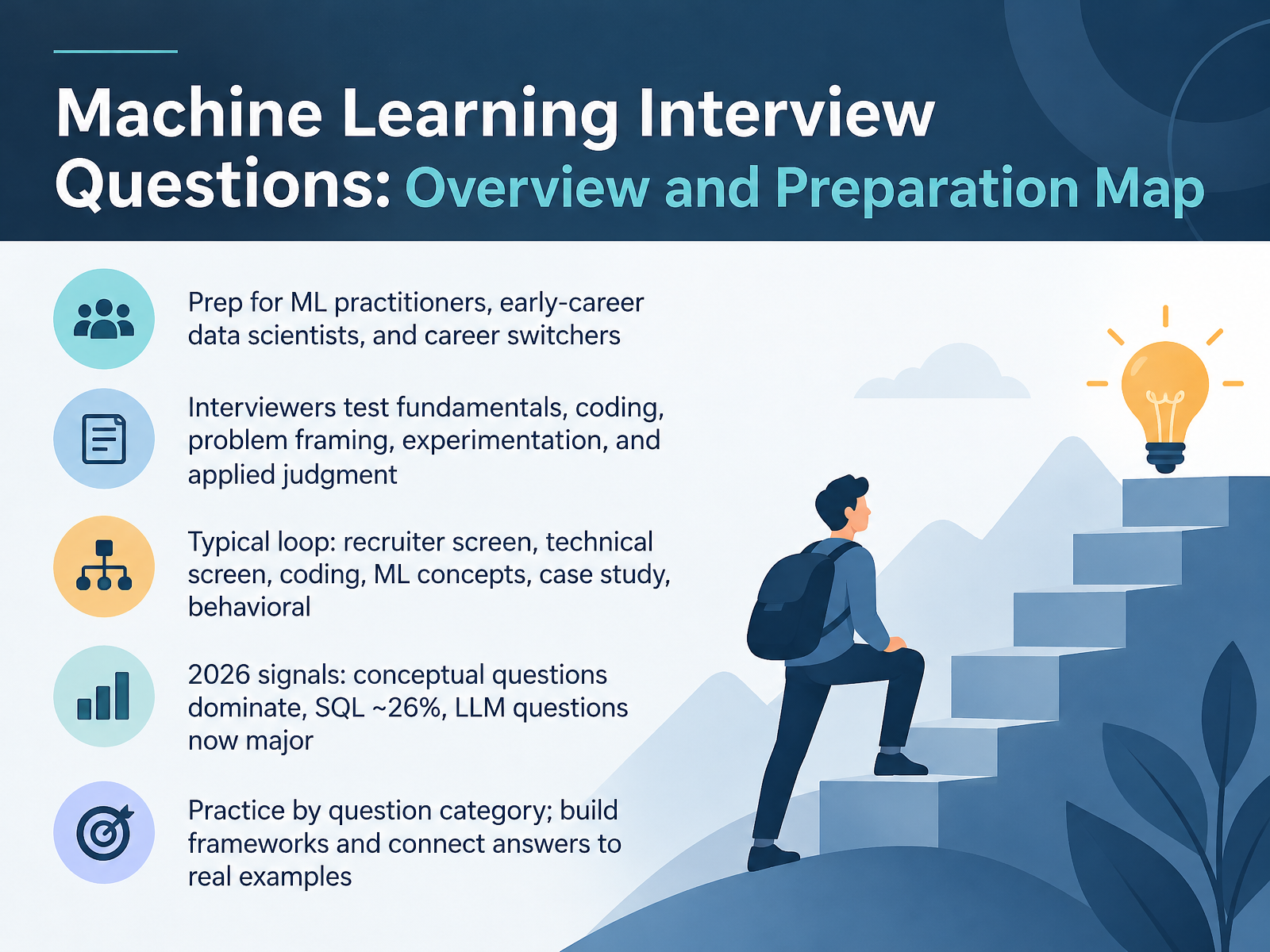
- 01Machine Learning Interview Questions: Overview and Preparation MapWelcome. This is the first slide in our series on machine learning interview questions, and think of it as your preparation map. My goal is simple: to help you walk into an interview with structure, not guesswork.
First, who is this for? Aspiring machine learning practitioners, early-career data scientists, and career switchers. If that describes you, you are in the right place.
So what do interviewers actually test? Five things: fundamentals, coding, problem framing, experimentation, and applied judgment. Notice that only one of those is pure theory. The rest are about how you think and communicate.
A typical interview loop runs through a recruiter screen, a technical screen, a coding round, an ML concepts round, a case study, and a behavioral conversation. Not every company runs all six, but most run at least four.
Now, the 2026 signals. Conceptual questions now dominate the question pool, SQL shows up in roughly twenty-six percent of questions, and large language model questions have become a major category in just two years.
Here is the takeaway. Prepare by question category, not by memorizing answers. Build a framework for each category, and connect every answer to a real example from your own work.
Next, let us look at what the 2026 interview data actually shows.dataexpertise.indatasciencehired.comsharpskill.dev+22 min
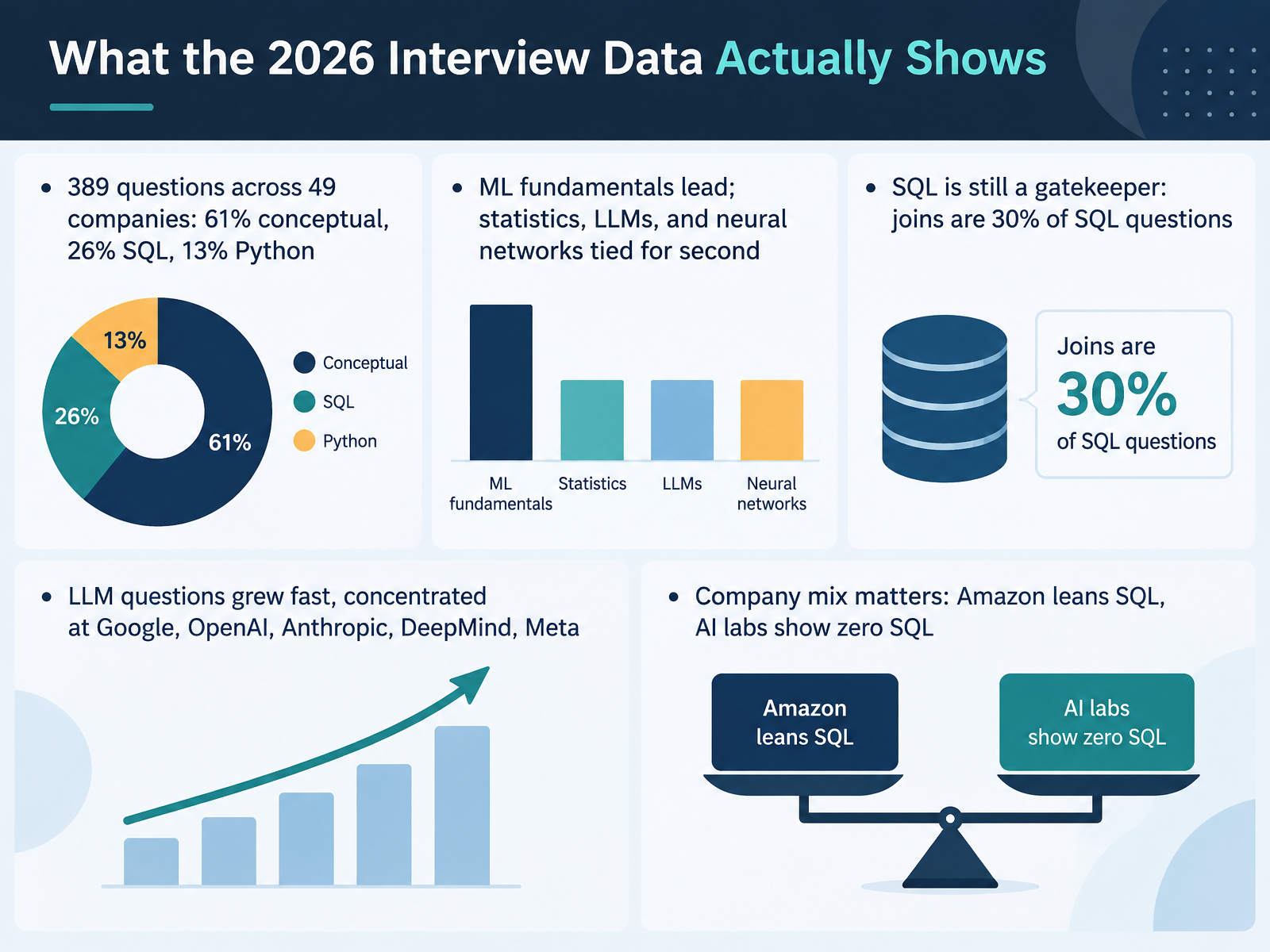
- 02What the 2026 Interview Data Actually ShowsLet's look at what the 2026 interview data actually shows. One dataset tracks 389 published questions across 49 companies. The split is clear: 61 percent conceptual, 26 percent SQL, and 13 percent Python. So the majority of what you face is explaining ideas, not writing code. Machine learning fundamentals is the single largest topic. Statistics, LLMs, and neural networks are tied for second. SQL is still a gatekeeper. Joins alone make up 30 percent of all SQL questions, so drill those first. LLM questions grew fast, and they cluster at Google, OpenAI, Anthropic, DeepMind, and Meta. One important caveat: company mix matters. Amazon leans SQL, while the AI labs show zero SQL questions. In an interview, you would say you tailor prep to the target company. Next, let's cover role differences: Data Scientist, ML Engineer, Applied Scientist, and Analytics.
 dataexpertise.indatasciencehired.comsharpskill.dev+21 min
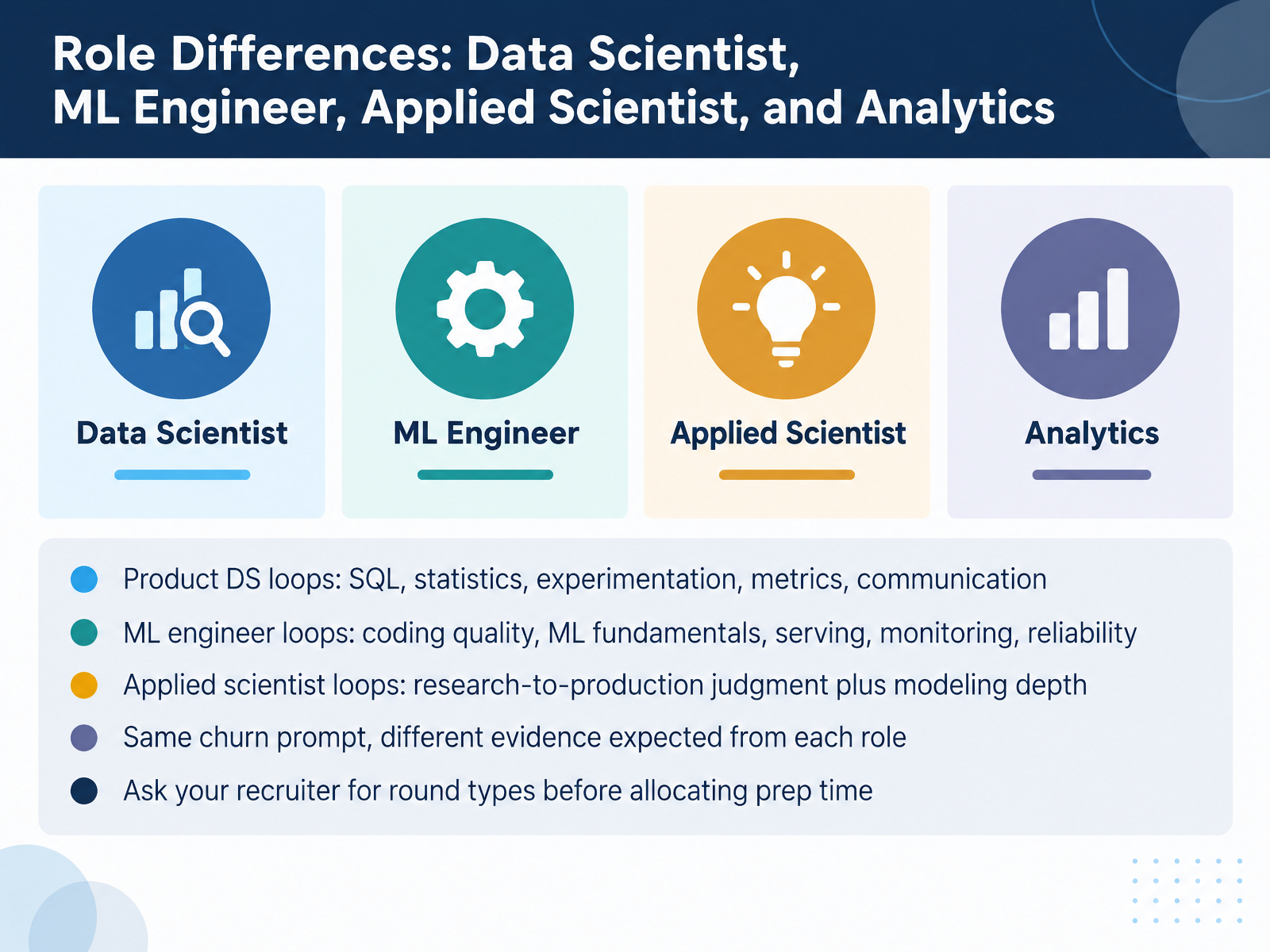
- 03Role Differences: Data Scientist, ML Engineer, Applied Scientist, and AnalyticsNext, let's separate the role differences, because the same job title means different loops at different companies. Product data science loops lean on SQL, statistics, experimentation, and metrics, plus communication. In an interview, you would say how you framed an ambiguous question and connected an analysis to a launch decision. ML engineer loops lean on coding quality, ML fundamentals, serving, monitoring, and reliability. A common follow-up is what happens when the scoring job is late, or how you would roll back a bad model. Applied scientist loops add research-to-production judgment on top of modeling depth, so they expect you to defend why a slightly better model is worth the extra complexity. Here is the key point. The same churn prompt expects different evidence from each role. A product data scientist defines the label horizon and designs a retention experiment. An ML engineer covers feature freshness, batch versus online scoring, and monitoring. An applied scientist weighs the modeling approach and the trade-offs against production constraints. So before you allocate prep time, ask your recruiter for the round types. That one email tells you where to spend your hours. Let's move on to core ML concepts and how interviewers probe them.
 mlmentorship.cominterviewstack.ioneuraprep.com+22 min
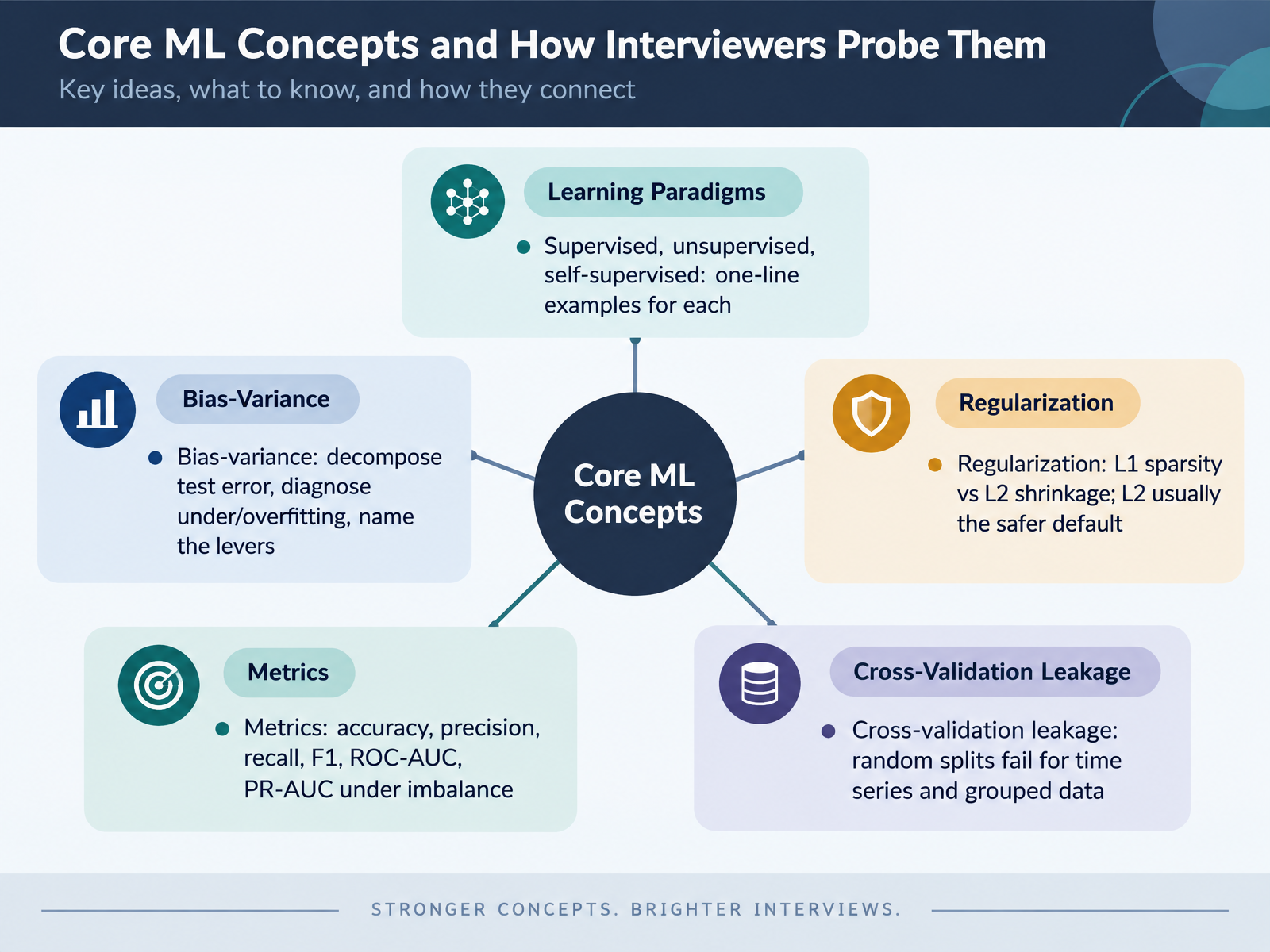
- 04Core ML Concepts and How Interviewers Probe ThemNow let's walk through the core concepts interviewers keep returning to, and how they probe them. For learning types, you should be able to give one example each. Supervised learning predicts a label, like churn. Unsupervised finds structure, like customer segments. Self-supervised builds its own labels from the data, like masked language modeling. In an interview, you would say the type first, then one concrete example. Next, bias and variance. Total test error equals bias squared plus variance plus irreducible noise. High bias means underfitting. High variance means overfitting. The levers you can name are regularization, more data, and cross-validation. Then regularization. L1 pushes weights to zero, so it produces sparsity. L2 shrinks weights smoothly, and it is usually the safer default. For metrics, accuracy misleads under imbalance, so reach for precision, recall, F one, ROC-AUC, and PR-AUC. Finally, cross-validation leakage. A random split fails for time series and grouped data. Split by time, or group by user, so the same person never lands in both train and test. Model metrics next.
 dataexpertise.indatasciencehired.comsharpskill.dev+21 min
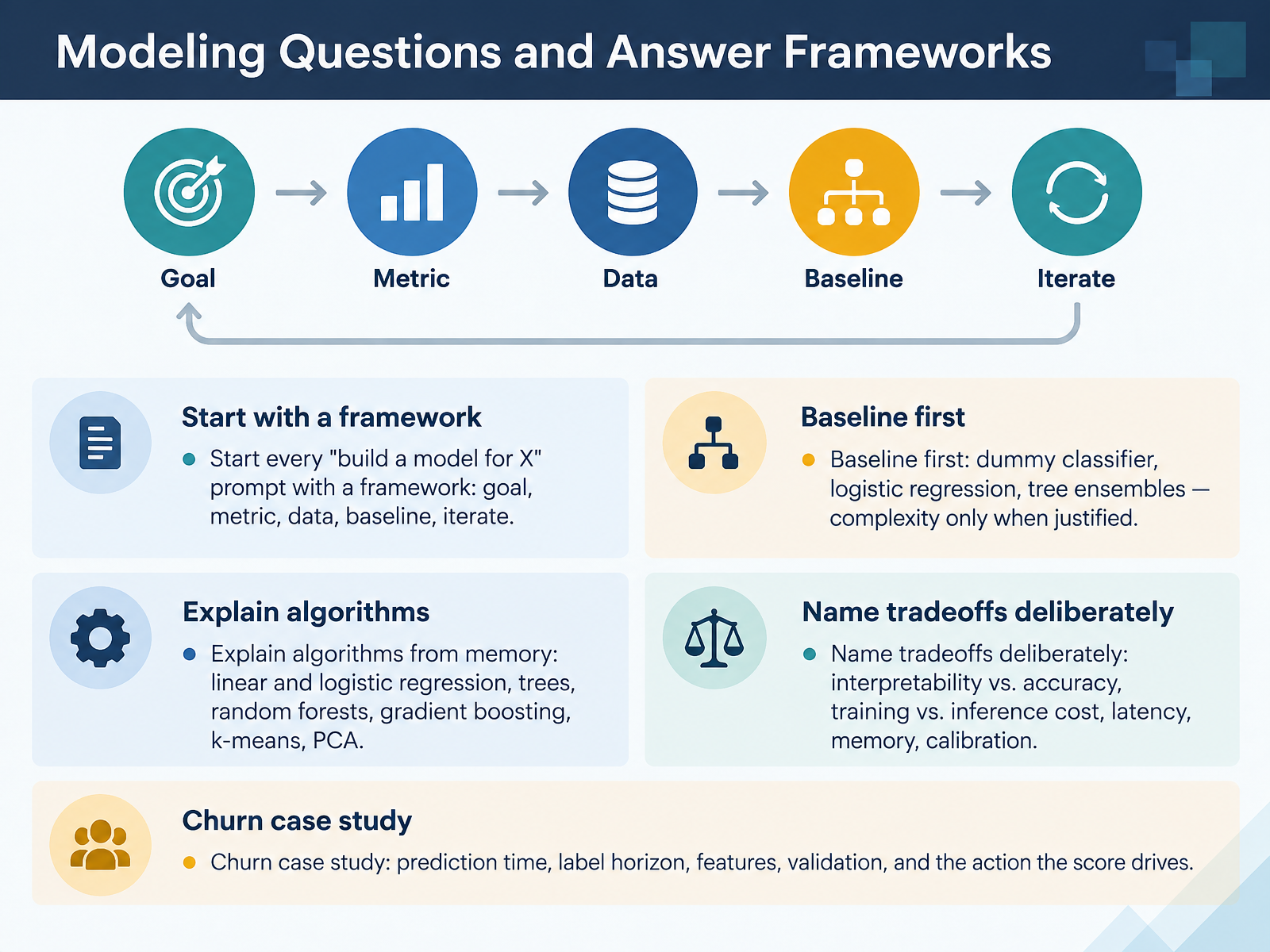
- 05Modeling Questions and Answer FrameworksNow let's look at how to handle modeling questions with a clear answer framework. When you get a prompt like build a model for X, don't jump to an algorithm. In an interview, you would say: here is the goal, here is the metric, here is the data, here is my baseline, and here is how I would iterate. That structure buys you time and shows judgment. Start with a baseline first. A dummy classifier, logistic regression, or a simple tree ensemble is often enough. Reach for complexity only when you can justify it. Next, be ready to explain algorithms from memory. Linear and logistic regression, decision trees, random forests, gradient boosting, k-means, and PCA. Keep each explanation short and connect it to when you would use it. Then name tradeoffs deliberately. Interpretability versus accuracy, training versus inference cost, latency, memory, and calibration. A common follow-up is how you would choose between two models, and the right answer always depends on the constraint. Let me make this concrete with a churn case study. You would cover prediction time, label horizon, features, validation strategy, and the action the score actually drives. For example, if the retention team can only call two hundred customers a week, your metric should reflect that capacity. So the takeaway is simple. Framework first, baseline early, algorithms from memory, tradeoffs stated out loud, and always tie the model back to the decision it supports. Coming up next, Coding Rounds: Python, NumPy, pandas, and SQL.
 learnmlacademy.cominterviews.chatprachub.com+22 min
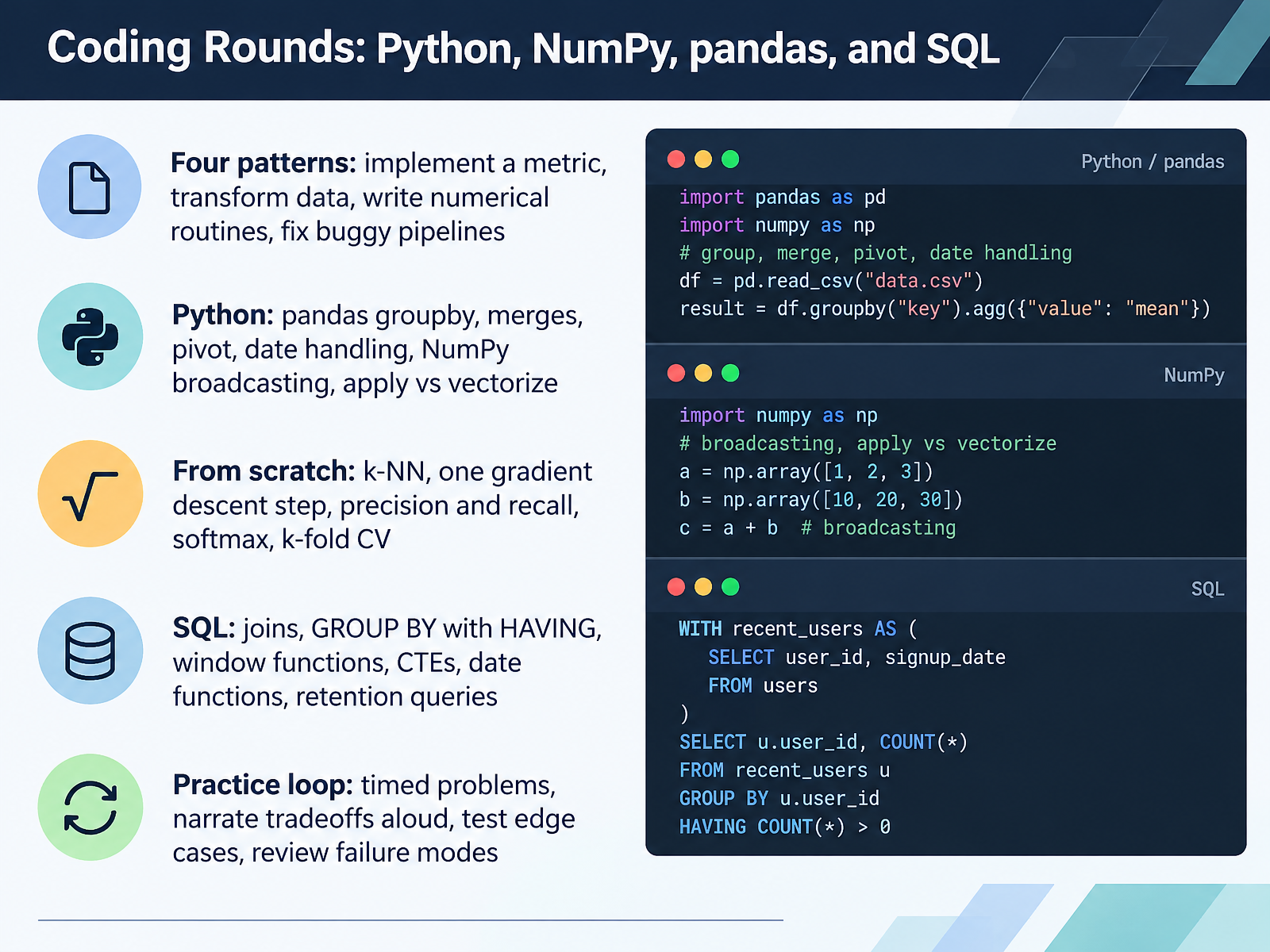
- 06Coding Rounds: Python, NumPy, pandas, and SQLNow let us talk about coding rounds, where you write Python, NumPy, pandas, and SQL. These rounds come down to four patterns. Implement a metric. Transform data. Write a numerical routine. Or fix a buggy pipeline. So how do you prepare? In pandas, expect groupby, merges, pivot, and date handling. In NumPy, expect broadcasting, and be ready to explain when to use apply versus vectorize. For from-scratch problems, you may implement k-nearest neighbors, a single gradient descent step, precision and recall, softmax, or k-fold cross-validation without scikit-learn. Interviewers want the mechanism, not the API call. On the SQL side, practice joins, GROUP BY with HAVING, window functions, common table expressions, date functions, and retention queries. And accuracy matters, so always check your denominator. A common follow-up is, what happens to your result if duplicate rows appear? Build a practice loop. Solve timed problems. Narrate your tradeoffs aloud. Test edge cases. And review your failure modes after each attempt. Next, we go deeper into SQL, with joins, window functions, and metric questions.
 dataexpertise.indatasciencehired.comsharpskill.dev+22 min
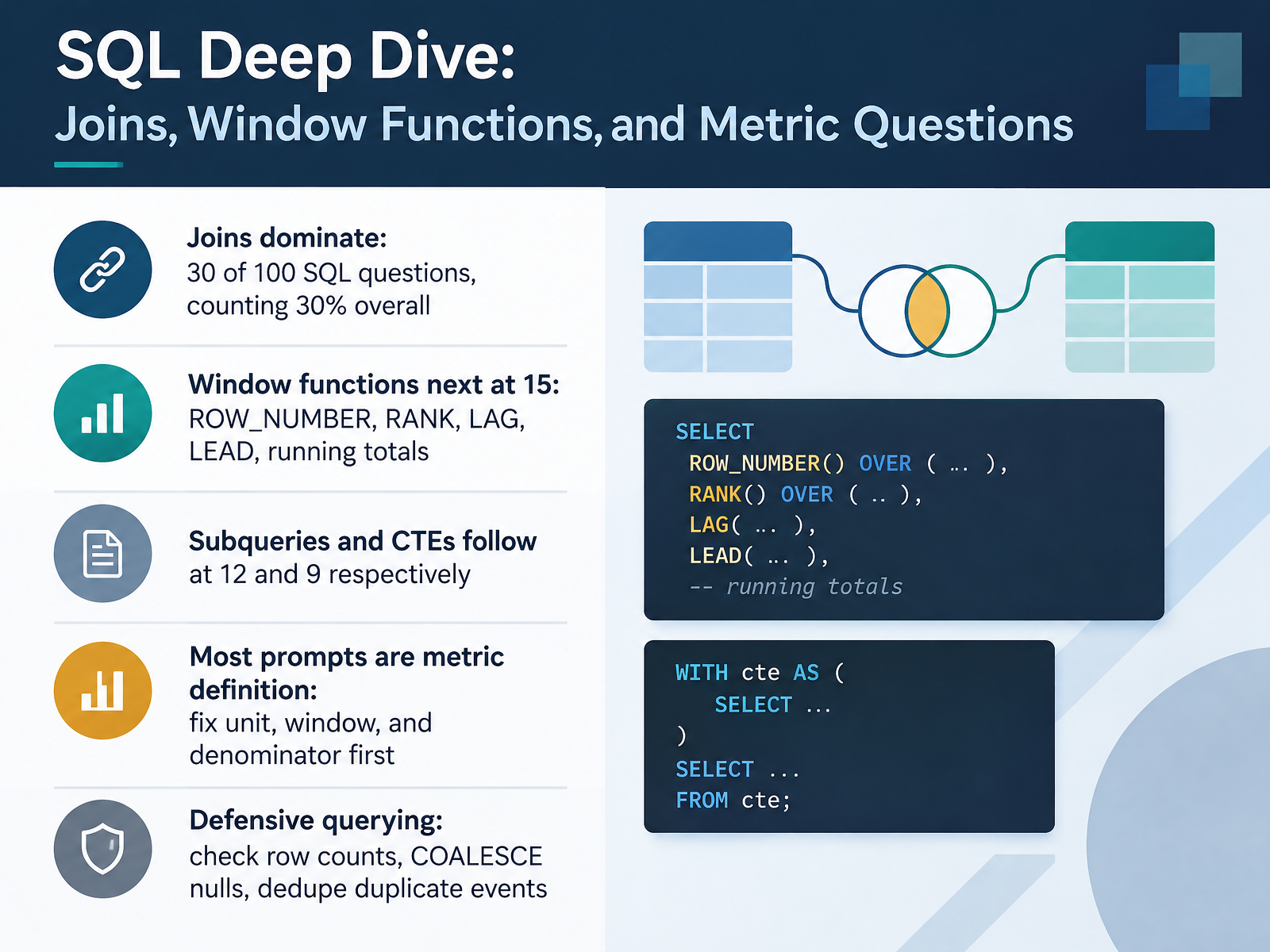
- 07SQL Deep Dive: Joins, Window Functions, and Metric QuestionsNow let's go deep on SQL, because this is where most technical screens are won or lost. Of one hundred SQL questions in a recent survey bank, joins account for thirty. That is thirty percent, nearly double the next topic. In an interview, you would say, let me start by identifying the join keys and the expected grain. A common follow-up is, how do you avoid duplicate rows after the join?
Window functions come next at fifteen questions. Know ROW_NUMBER, RANK, LAG, LEAD, and running totals. Subqueries and CTEs follow at twelve and nine.
Here is the key distinction. Most SQL prompts are metric definition in disguise. Before writing anything, fix the unit, the time window, and the denominator. A common follow-up is, why did you choose that denominator?
Finally, query defensively. Check row counts after each join. Use COALESCE for nulls from left joins. Deduplicate events before you aggregate.
So define the metric first, then write SQL you can defend. Next, let's look at data quality, feature engineering, and experimental design.
 dataexpertise.indatasciencehired.comsharpskill.dev+22 min
- 08Data Quality, Feature Engineering, and Experimental DesignLet's talk about data quality, feature engineering, and experimental design. These come up in nearly every interview, because they show whether you can think past the model.
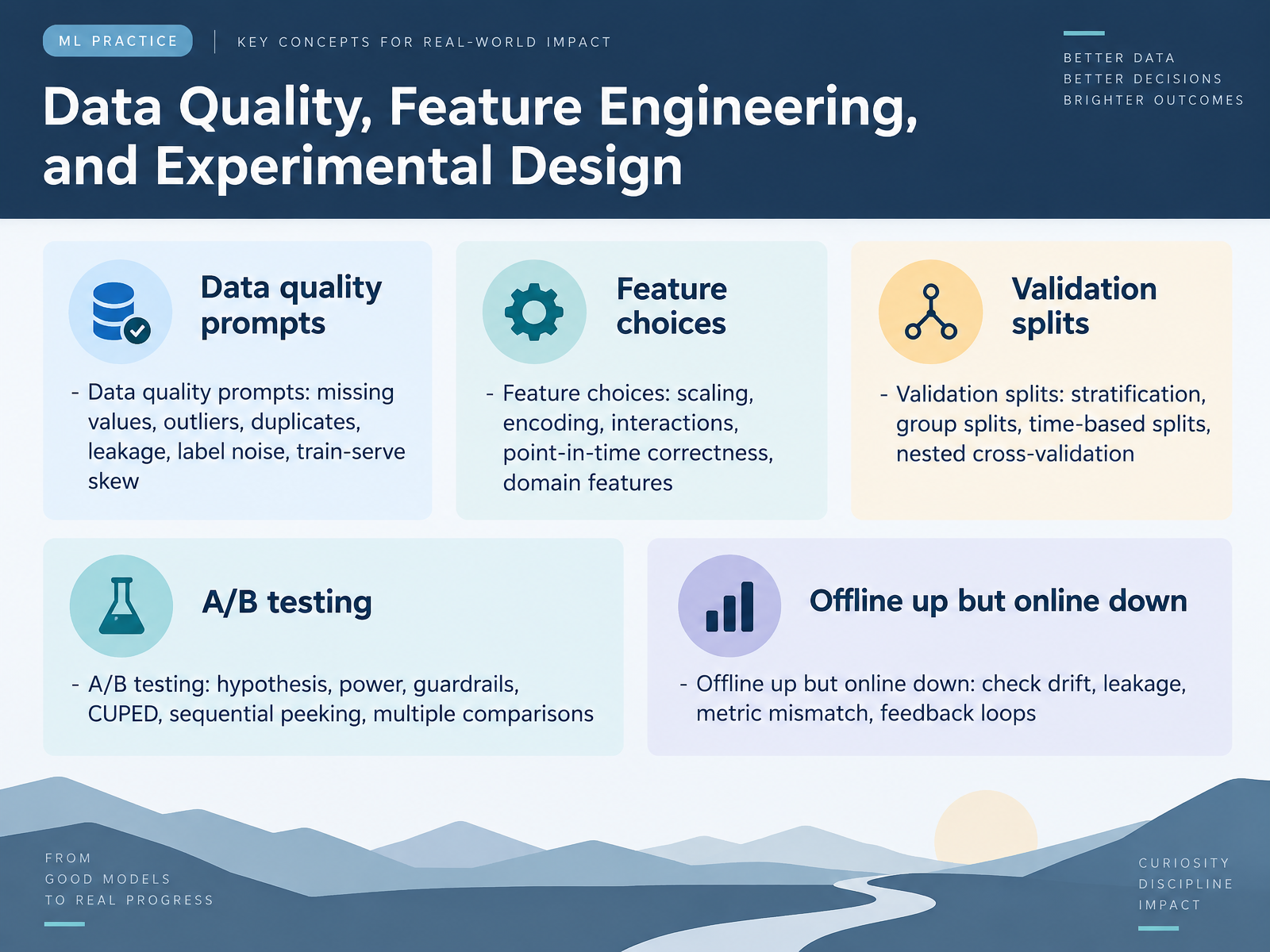
Start with data quality. In an interview, you would say: I check missing values, outliers, duplicates, leakage, and label noise. A common follow-up is train-serve skew, where features are computed differently in training than in production. Define each one in a sentence, then give a realistic example.
Next, feature choices. Scaling, encoding, and interactions are standard. Point-in-time correctness matters when features must reflect only what was known at prediction time. Domain features often beat clever transformations.
For validation splits, state the rule. Stratify for imbalanced classes. Group splits keep related rows together. Time-based splits respect chronology. Nested cross-validation is for tuning without leaking.
On A/B testing, name the hypothesis, power, and guardrails. Mention CUPED for variance reduction, sequential peeking, and multiple comparisons.
Finally, when offline improves but online drops, check drift, leakage, metric mismatch, and feedback loops.
Let's move on to deep learning and transformer questions.
 learnmlacademy.cominterviewbit.comcallsphere.ai+22 min
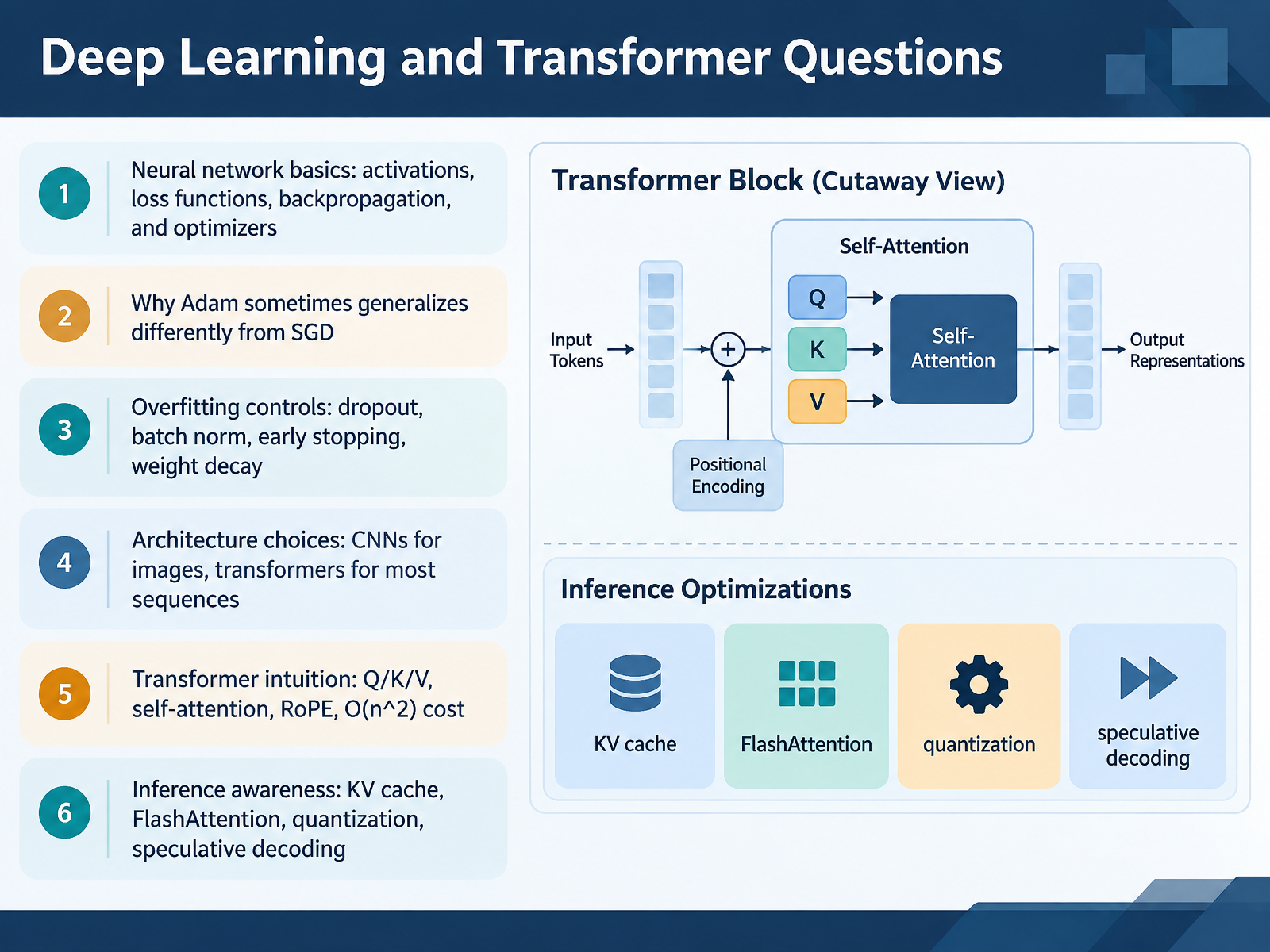
- 09Deep Learning and Transformer QuestionsLet's move into deep learning and transformer questions. Start with the basics. An activation function decides whether a neuron fires. A loss function scores how wrong the model is. Backpropagation passes that error backward through the network. Optimizers like SGD and Adam then update the weights. A common follow-up is why Adam sometimes generalizes differently from SGD. One honest answer is that adaptive step sizes can find sharper minima, and that is still an active research question. For overfitting, name your controls: dropout, batch normalization, early stopping, and weight decay. On architecture, the expected shape is simple. Convolutional networks for images, transformers for most sequences. Then be ready to explain attention. Queries, keys, and values let each token gather information from other tokens. Rotary position embeddings encode relative position through rotation. The cost is quadratic in sequence length, which is why inference techniques matter. Mention the KV cache, FlashAttention, quantization, and speculative decoding. A strong close is naming the trade-off: quality against latency and cost. Next, we will cover LLM, RAG, and Fine-Tuning Interview Questions.
 learnmlacademy.cominterviewbit.comcallsphere.ai+22 min
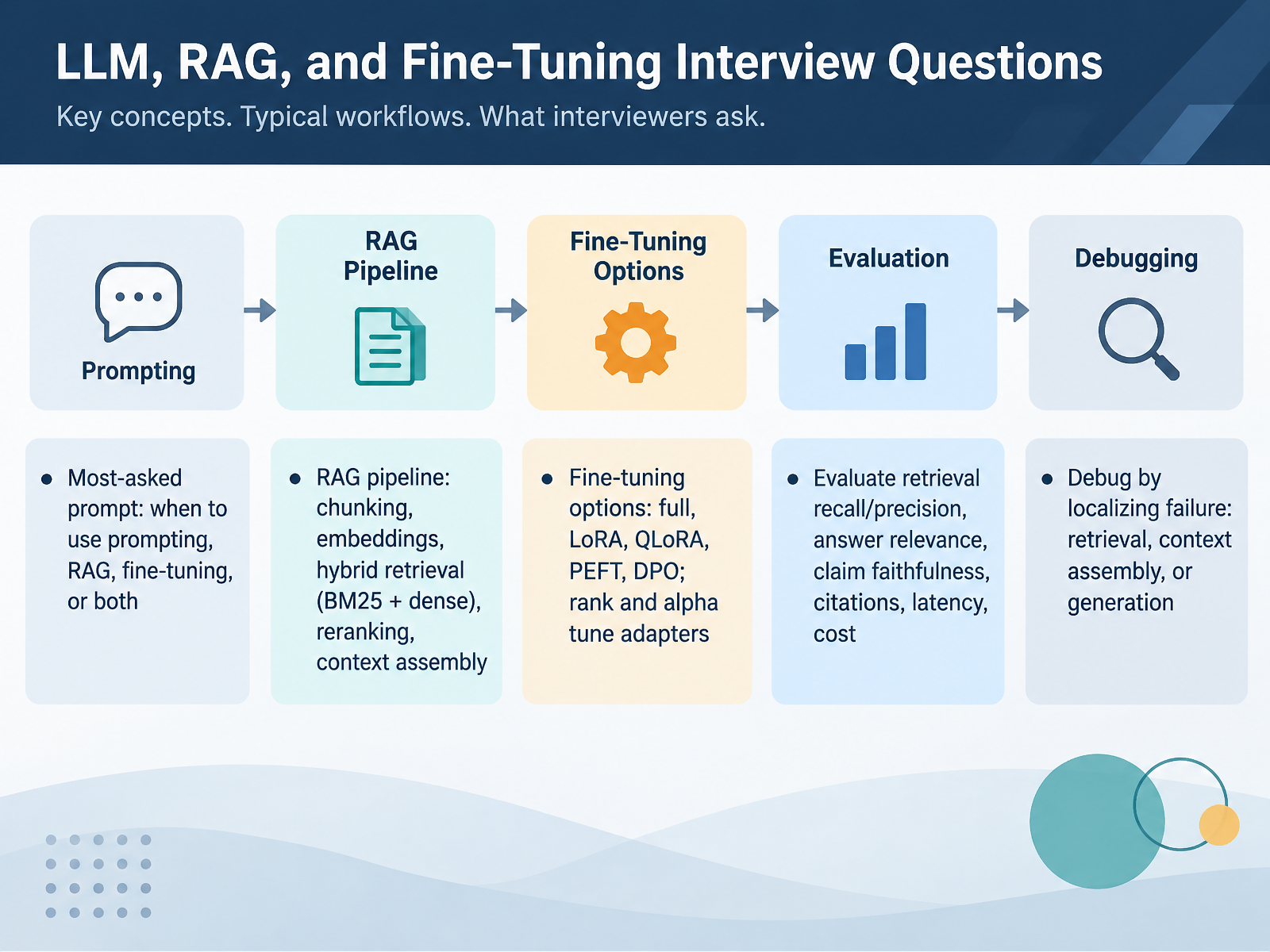
- 10LLM, RAG, and Fine-Tuning Interview QuestionsNow let us move to the questions most candidates find hardest: LLMs, RAG, and fine-tuning. The most-asked prompt here is simple. When do you use prompting, RAG, fine-tuning, or both? In an interview, you would say: prompt first for instruction clarity, use RAG for external or changing knowledge, and fine-tune for stable behavior, style, or output format. A common follow-up is to walk through a RAG pipeline. Name the stages: chunking, embeddings, hybrid retrieval with BM25 plus dense search, reranking, and context assembly. Then fine-tuning options: full fine-tuning, LoRA, QLoRA, PEFT, and DPO. Expect rank and alpha questions on adapters. For evaluation, check retrieval recall and precision, answer relevance, claim faithfulness, citations, latency, and cost. The takeaway: debug by localizing the failure to retrieval, context assembly, or generation. Next, we will cover Applied AI System Design and Evaluation.
 learnmlacademy.cominterviewbit.comcallsphere.ai+22 min
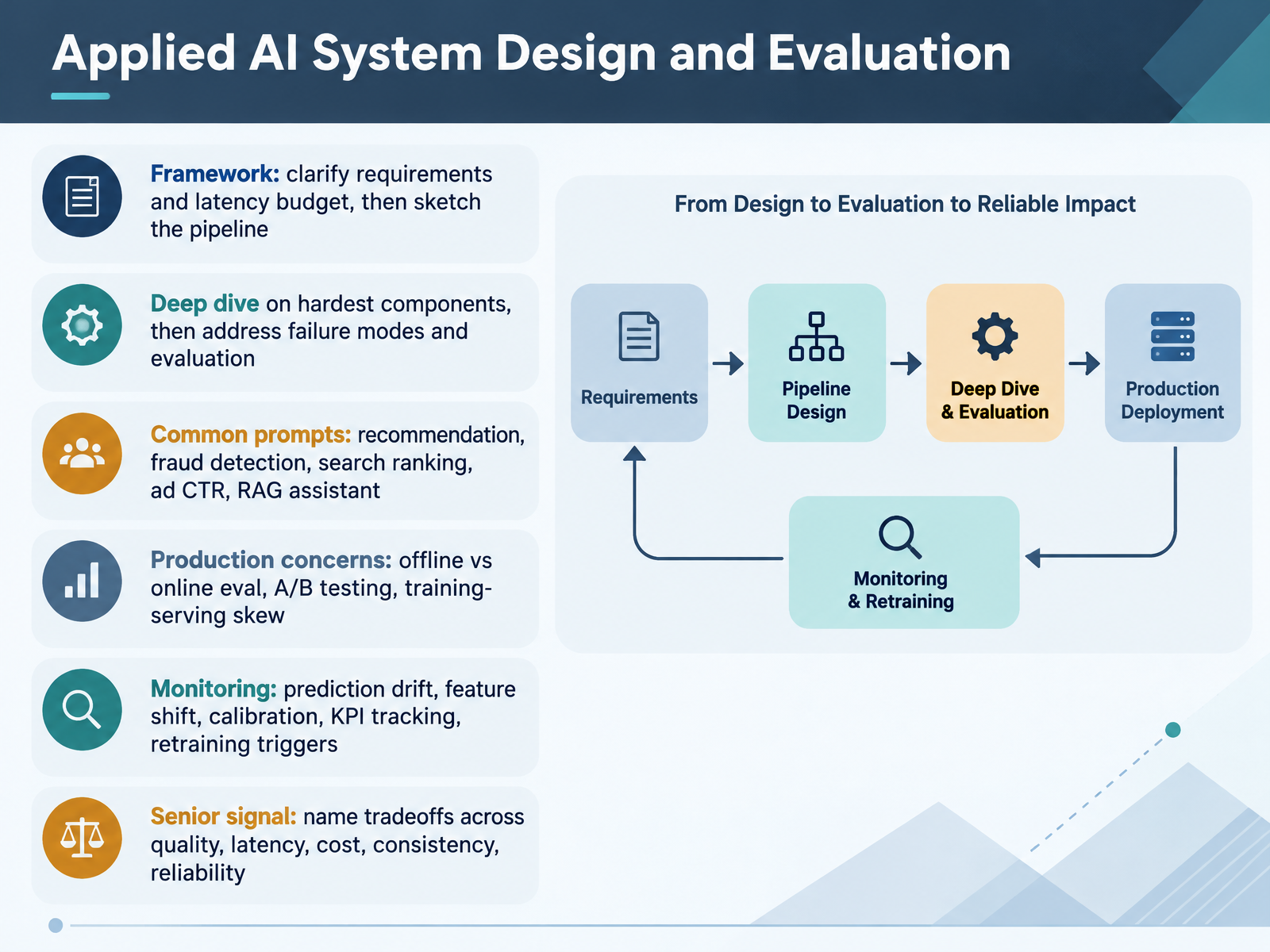
- 11Applied AI System Design and EvaluationLet's move into applied AI system design and evaluation. This round is where offers are often won or lost. Start by clarifying requirements and the latency budget. In an interview, you would ask about queries per second, acceptable error rates, and cost ceilings before sketching the pipeline. A common follow-up is the hardest component, so go deep on retrieval quality or ranking, then name your failure modes. Prompts usually cover recommendation, fraud detection, search ranking, ad click-through rate, and RAG assistants. Then cover production concerns: offline versus online evaluation, A and B testing, and training-serving skew. For monitoring, track prediction drift, feature shift, calibration, and K P I trends, and define clear retraining triggers. The senior signal is naming tradeoffs across quality, latency, cost, consistency, and reliability. Next, explainability, ethics, and responsible AI.
 datasciencehired.com2 min
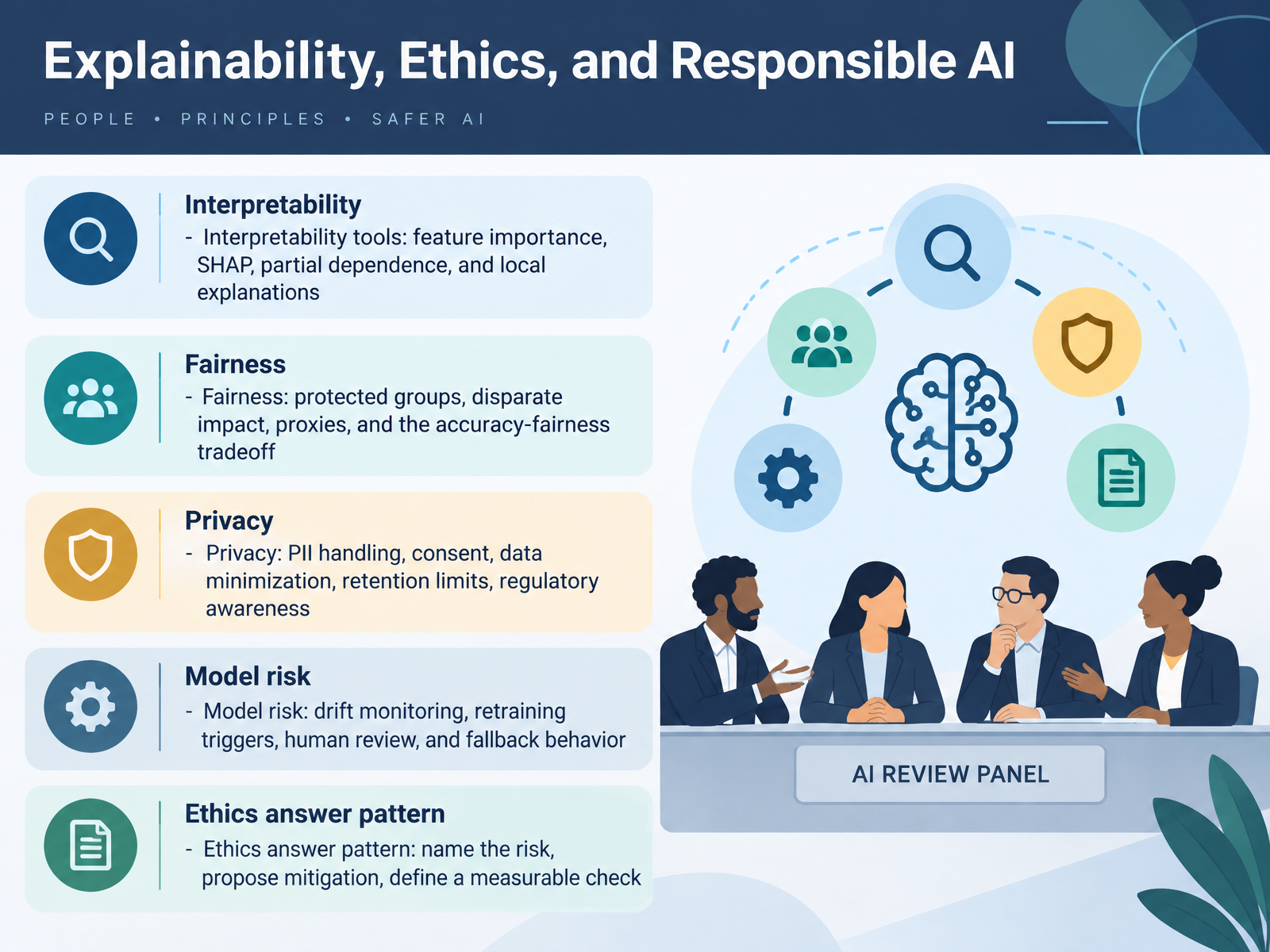
- 12Explainability, Ethics, and Responsible AILet's talk about explainability, ethics, and responsible AI. In an interview, you would say something like this: feature importance, SHAP, partial dependence, and local explanations all help you explain a model to a reviewer. But ethics questions usually matter more than the tools. Here is a pattern that works. Name the risk. For example, a model may create disparate impact for a protected group, or a proxy variable like zip code might quietly reintroduce bias. Then propose a mitigation, such as removing the proxy, reweighting the training data, or adding human review. Finally, define a measurable check, like monitoring false positive rates across groups each month, setting a retraining trigger when drift crosses a threshold, and keeping a simple fallback model if fairness metrics degrade. A common follow-up is the accuracy-fairness tradeoff. Be ready to say which metric you would protect and why. That is the answer shape interviewers want.
 learnmlacademy.cominterviews.chatprachub.com+22 min
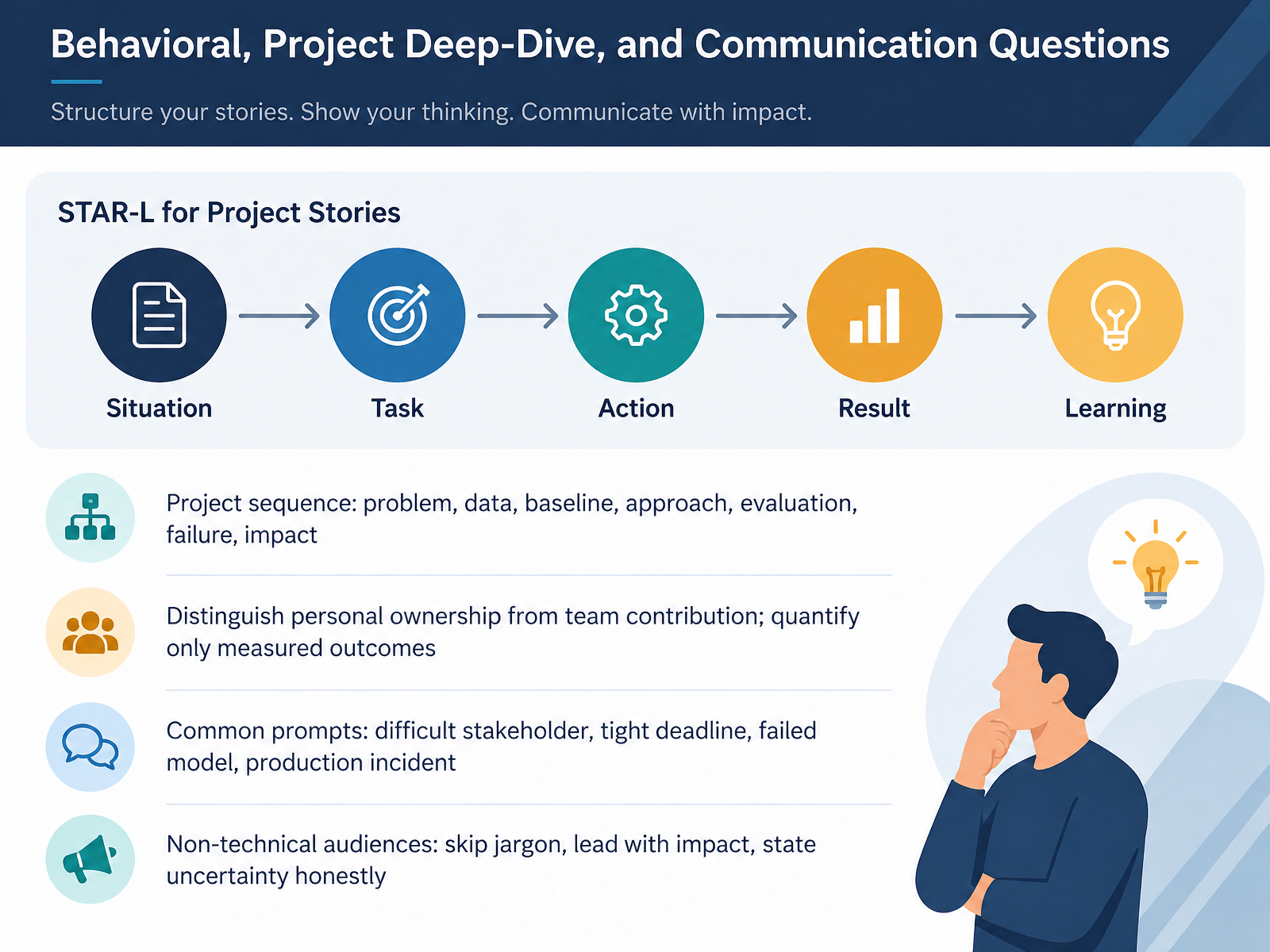
- 13Behavioral, Project Deep-Dive, and Communication QuestionsNow let's talk about the behavioral and project deep-dive portion of the interview. For project stories, use STAR L. That means situation, task, action, result, and an added learning. In an interview, you would say what the problem was, what you personally decided, what failed, and what you changed afterward. A common follow-up is: walk me through that project. Your sequence should be problem, data, baseline, approach, evaluation, failure, and impact. Be precise about personal ownership versus team contribution. Quantify only outcomes you actually measured. Common prompts include a difficult stakeholder, a tight deadline, a failed model, and a production incident. For each, name the shared goal, the trade-off, the decision, and the evidence. Finally, when speaking to non-technical audiences, skip jargon, lead with impact, and state uncertainty honestly. If a forecast is wrong, say so plainly and explain the range. Next, let's move into your Four-Week Practice Plan, Mock Interviews, and Final Preparation.
 learnmlacademy.cominterviews.chatprachub.com+22 min
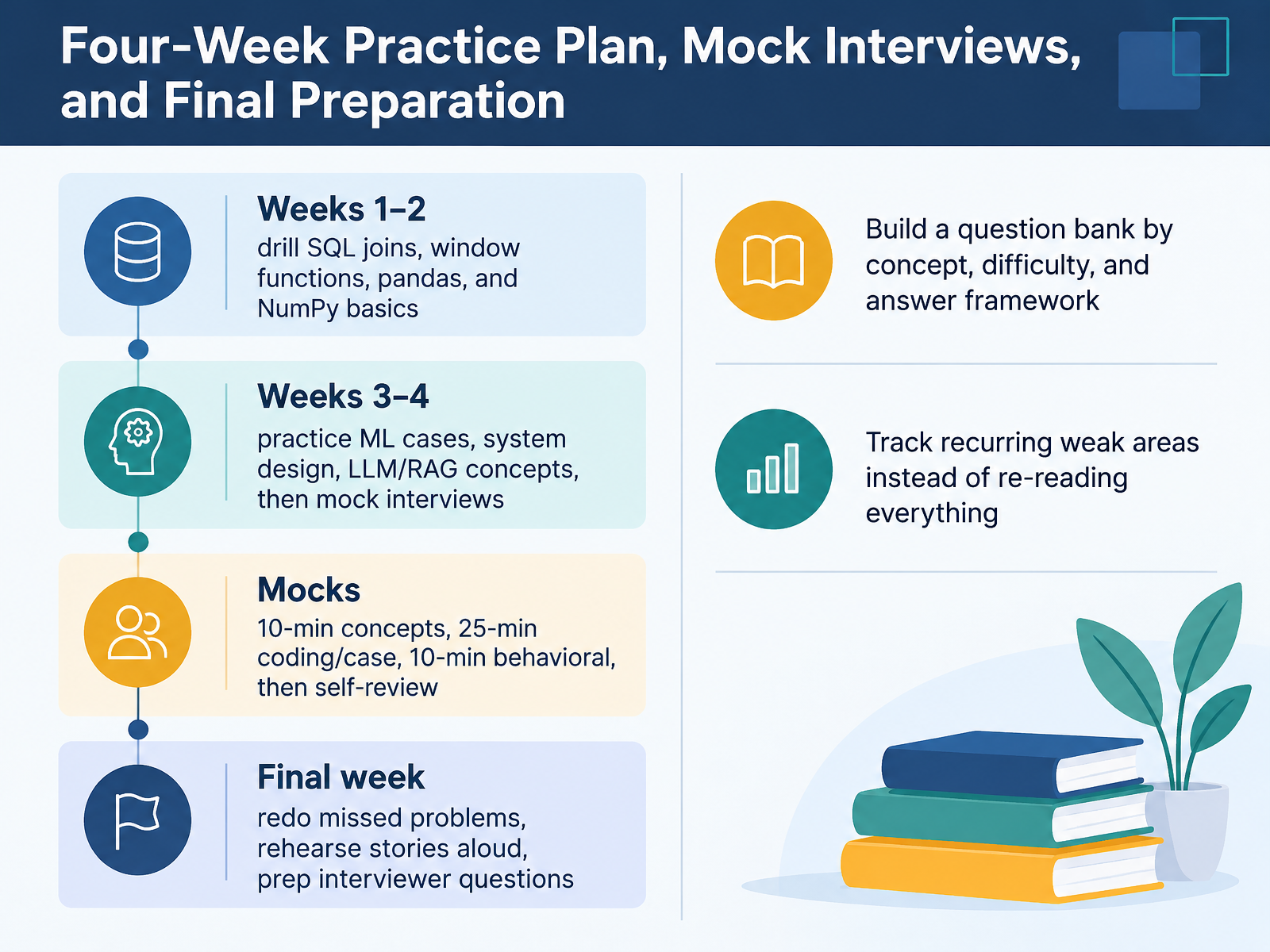
- 14Four-Week Practice Plan, Mock Interviews, and Final PreparationLet's put your preparation into a four-week plan. Weeks one and two are for drilling fundamentals: SQL joins, window functions, pandas, and NumPy basics. In an interview, you would say you prioritized SQL first because it gates the phone screen. Weeks three and four move to machine learning cases, system design, and LLM or retrieval-augmented generation concepts, then mock interviews. Build a question bank tagged by concept, difficulty, and answer framework. A common follow-up is which areas keep tripping you up, so track recurring weak spots instead of re-reading everything. For mocks, run ten minutes of concepts, twenty-five minutes of coding or a case, ten minutes of behavioral, then self-review. In your final week, redo missed problems, rehearse your stories aloud, and prepare questions for the interviewer. Stick to this rhythm, and you will walk in prepared. Thank you for working through this course with me, and good luck in your interviews.
 dataexpertise.indatasciencehired.comsharpskill.dev+22 min
Take the deck with you
Download this course as a file — free, no sign-up needed.
- PDF handoutEvery slide page, ready to print or share.15 pages · 3.2 MBDownload
- Narrated PowerPointThe deck that presents itself — every slide carries the digital human's narration video.15 pages · 16.2 MBDownload
- PowerPoint slidesThe full deck as a .pptx — open it in PowerPoint, Keynote, or Google Slides.15 pages · 3.1 MBDownload
Free to use in your own training — please keep the PersonWise credit page at the end.
Have your own deck? Turn it into a course
Sources consulted
Web sources consulted while building this course.
- Data Science Interview Questions 2026 — With Answers (SQL, Python, ML) - DataExpertise — dataexpertise.in
- The State of Data Science Interviews (2026): What 389 Real Questions Reveal About What Companies Actually Test | DataScienceHired Blog — datasciencehired.com
- Top 25 Data Science Interview Questions in 2026 | SharpSkill — sharpskill.dev
- Python Machine Learning Interview Questions for Data Scientists | Let's Data Science — letsdatascience.com
- Data Scientist Interview Questions for 2026: 40+ Questions Across SQL, Stats, A/B Testing, Product Sense (DS Pivot Edition) — InterviewChamp.AI — interviewchamp.ai
- Applied Scientist vs MLE vs Research Engineer: what these roles actually do · mlmentorship — mlmentorship.com
- Data Scientist vs Applied Scientist: The Skill the Title Skips | InterviewStack.io — interviewstack.io
- Data Scientist vs ML Engineer Interviews: What Changes and ... — neuraprep.com
- Data Scientist Hub: Product DS, ML DS, and Analytics DS Are Three Different Jobs in 2026 — resumegeni.com
- Data Scientist vs ML Engineer: Which to Hire (2026) — kore1.com
- AI/ML Behavioral Interview Questions 2026 | STAR Guide — learnmlacademy.com
- Behavioral Interview Questions for Data Scientist (STAR Method Answers) — interviews.chat
- Microsoft: Describe leading an ambiguous ML project end-to-end — prachub.com
- Walk through a DS project end-to-end | OneMain Financial — prachub.com
- Describe Your Path and Key Data Science Project | Shopify — prachub.com
- LLM & RAG Interview Questions 2026 | GenAI Answers — learnmlacademy.com
- LLM Interview Questions and Answers (2026) - InterviewBit — interviewbit.com
- 8 LLM & RAG Interview Questions That OpenAI, Anthropic & Google Actually Ask | CallSphere Blog — callsphere.ai
- Top 36 LLM Interview Questions and Answers for 2026 — datacamp.com
- LLM Interview Questions 2026: 45+ Questions | 123ofAI — 123ofai.com