How Recommendation Systems Work
Begin
13 pages · ~26 min
How Recommendation Systems Work
This training explains how recommendation systems work and who they are designed for, helping learners understand the core algorithms and evaluation methods used to personalize user experiences.
What you’ll learn
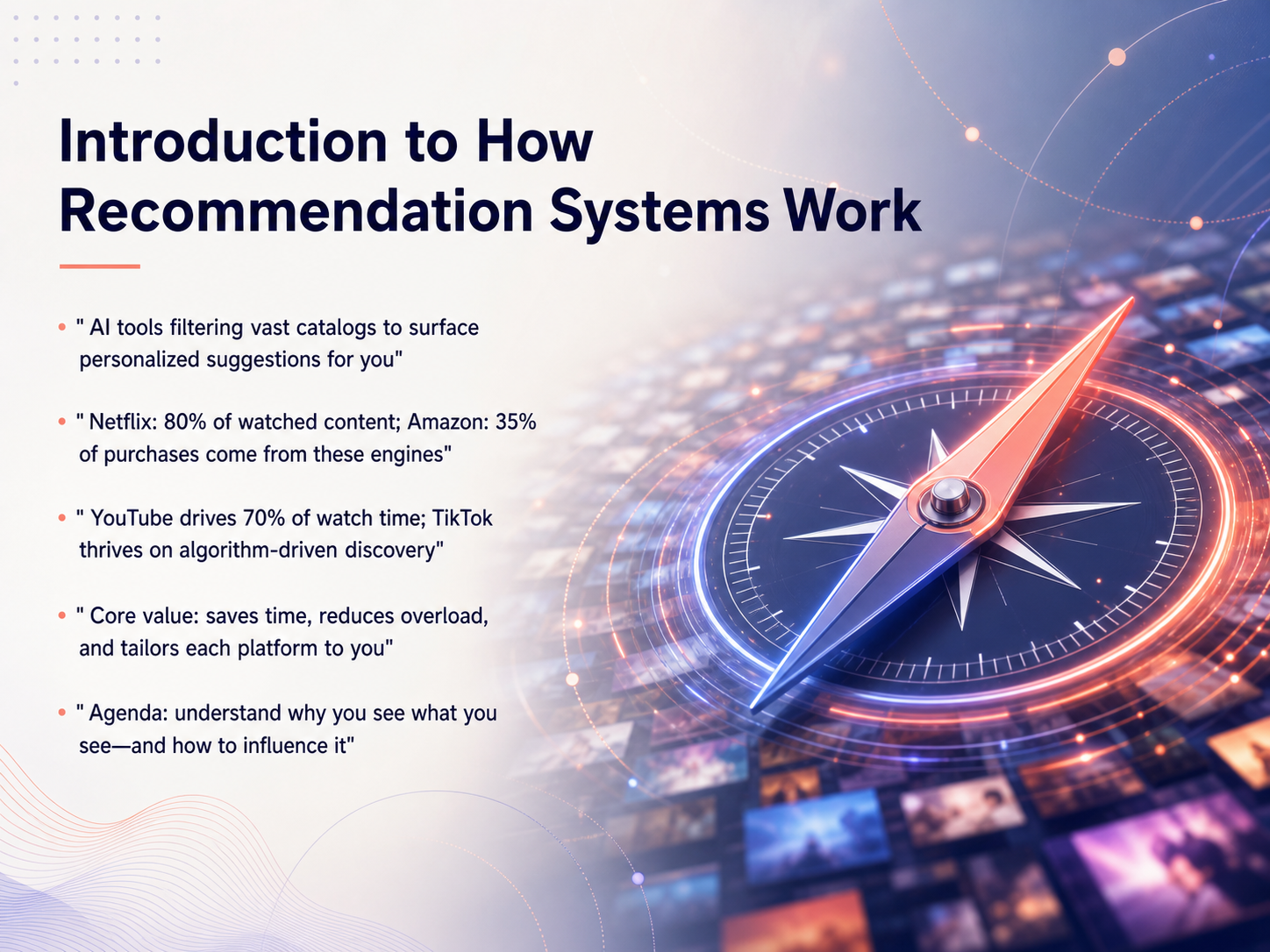
- 01Introduction to How Recommendation Systems WorkWelcome. Have you ever wondered how your phone seems to know exactly what you want to watch, buy, or listen to next? It’s not magic—it’s a recommendation system. These smart digital helpers filter thousands or even millions of options to surface just a few that feel personally chosen for you. Their impact is everywhere. For example, about eighty percent of what people watch on Netflix comes from its suggestions. Around thirty-five percent of Amazon purchases start the same way. YouTube’s recommendations drive roughly seventy percent of watch time, and TikTok’s entire experience is built around this kind of tailored discovery. The real value, though, is simpler than the numbers. These engines save you time, cut through the noise, and quietly shape each platform so it feels like it was designed for you. In this course, we’ll explore why you see what you see. More importantly, you’ll learn how you can influence those suggestions. Let’s begin by looking at the core problem these systems solve: information overload meets personalization.appstekcorp.comyoutube.comaimultiple.com+22 min
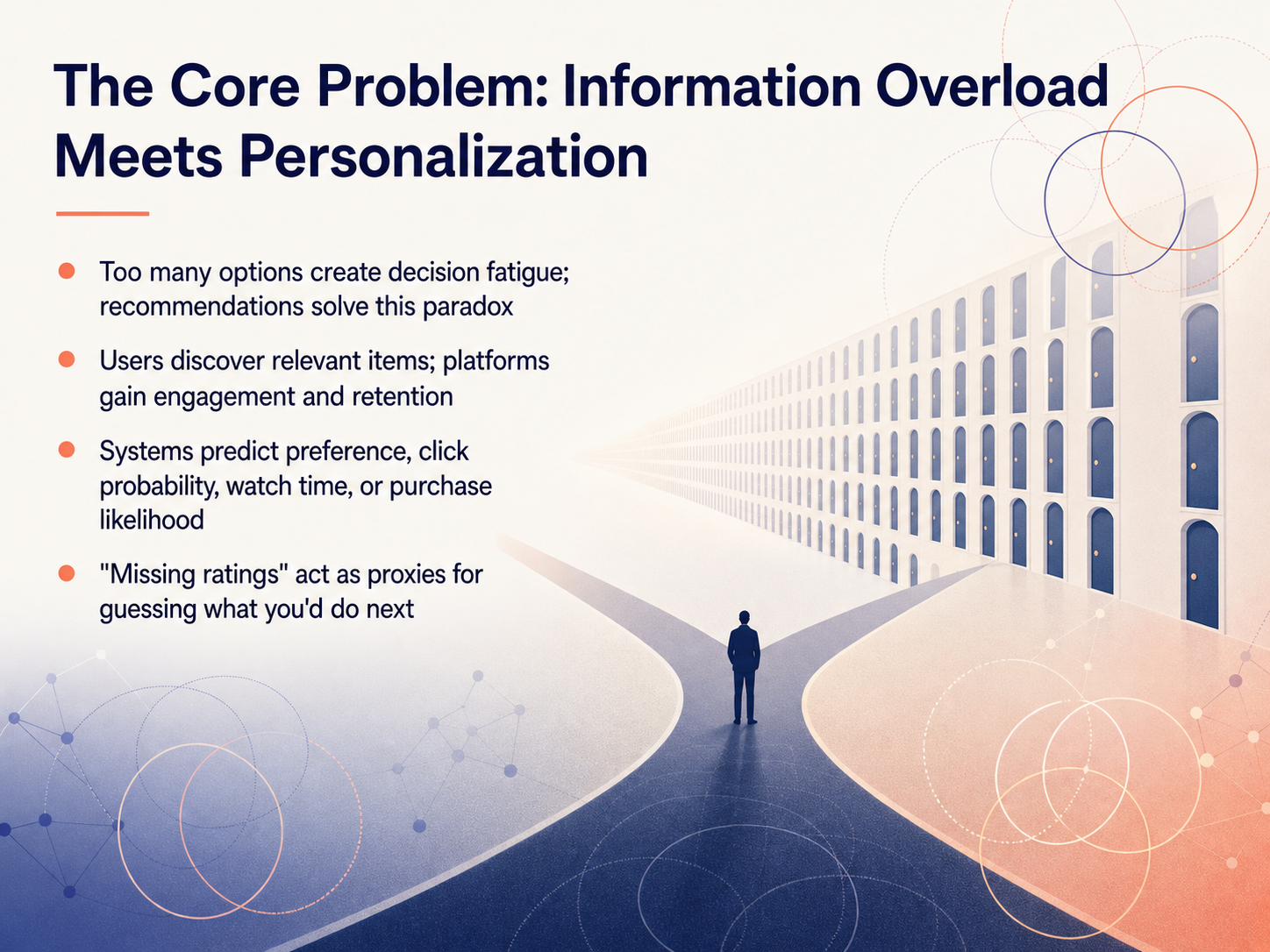
- 02The Core Problem: Information Overload Meets PersonalizationNow, let's talk about the core problem these systems solve. You've probably faced this yourself: you open a streaming app, and there are thousands of titles. Or you're shopping online, faced with endless options. This is information overload. A great recommendation engine cuts through the noise. It transforms an overwhelming paradox of choice into a personalized shortlist, like a smart friend who just knows your tastes. The goal isn't just to show you stuff. These systems are quietly making predictions. They might calculate how likely you are to click on something, how long you’d watch a video, or the probability that you’ll actually make a purchase. A key idea here is that every missing rating is a signal. When the system sees you haven't watched a certain show, that blank space becomes a placeholder for its best guess about what you want to do next. It’s a constant, gentle nudge to help you discover something relevant, while also keeping you engaged with the platform. Next, we’ll move from the problem to the solution, exploring the three major approaches that make this personalization possible.
 appstekcorp.comyoutube.comaimultiple.com+21 min
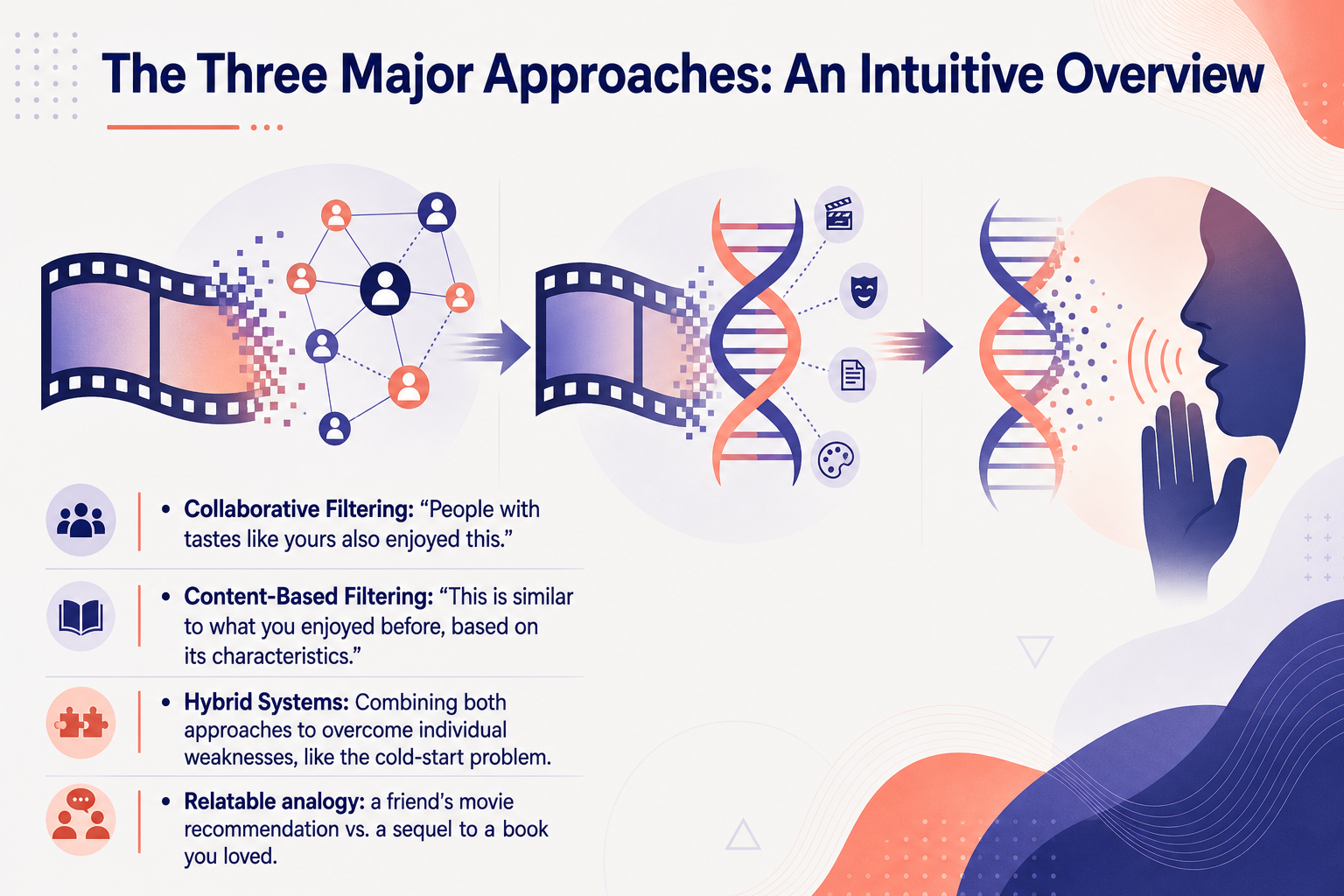
 - 03The Three Major Approaches: An Intuitive OverviewSo, how does a recommendation system actually decide what to show you? Under the hood, most of them use at least one of three main strategies. Think of the first one, collaborative filtering, like a friend who says, 'People with tastes like yours also enjoyed this.' It doesn't care what the item is, only that people similar to you liked it. The second strategy, content-based filtering, is totally different. It ignores other people and focuses on the item itself. It’s like saying, 'This thriller novel is similar to that thriller novel you loved before.' It matches characteristics. Finally, hybrid systems just smush these two together. They combine the power of the crowd with the details of the content. This helps solve tricky problems, like when a new user joins and you have no history to work with yet. That's the cold-start problem. A quick way to remember them is: collaborative filtering is when a friend recommends a movie because they know you. Content-based filtering is when you pick up the sequel to a book you just finished. Now, let's dig into the first of these ideas: collaborative filtering, and how it learns from collective behavior.
 developers.google.commedium.comyoutube.com+22 min
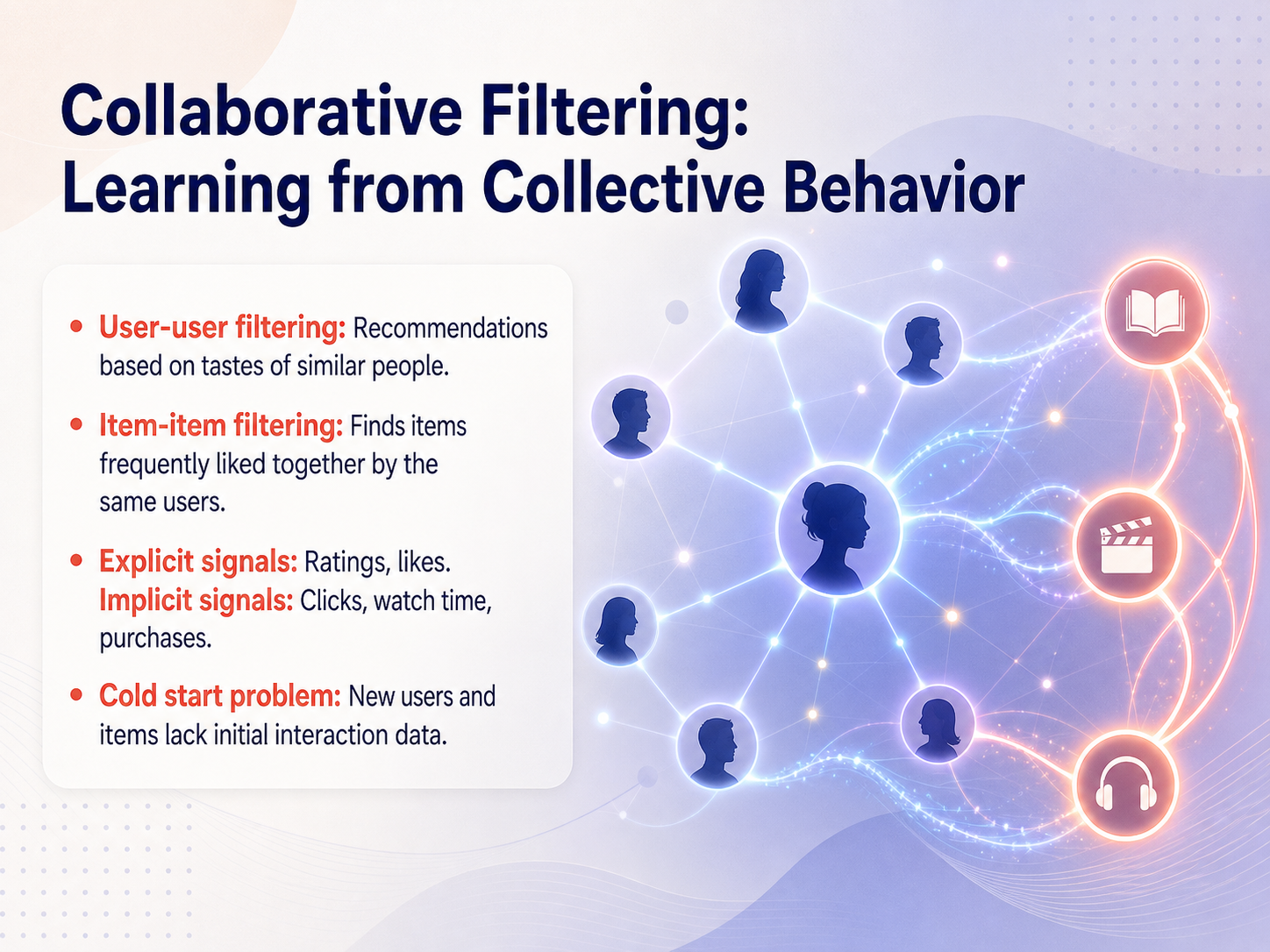
 - 04Collaborative Filtering: Learning from Collective BehaviorNow let's talk about collaborative filtering. Think of it like a smart friend who knows your tastes, but also knows what people with similar tastes enjoyed. That's the core idea. Instead of looking at what an item is made of, this method learns from collective behavior. It comes in two main flavors. The first is user-user filtering. We find people who have a history similar to yours, and we recommend things they liked that you haven't seen yet. The second is item-item filtering. Here, we look for items that are frequently liked together by the same users. So if you buy a camera, it might suggest the lens that other camera buyers also purchased. Now, how does the system learn these patterns? Through your signals. Explicit signals are direct, like giving a star rating or tapping a heart button. Implicit signals are quieter but just as powerful; things like which product you clicked, how long you watched a video, or if you made a purchase. A key challenge here is the cold start problem. Imagine a brand new user with no history, or a newly released movie with no ratings. The system can't find similar users or identify co-purchases because there's simply no data yet. It's like trying to make a friend recommendation for someone who just walked into the party. Next, we'll pivot to the other major approach to understand its strengths. Let's explore content-based filtering and what the system knows about the items themselves.
 developers.google.commedium.comyoutube.com+22 min
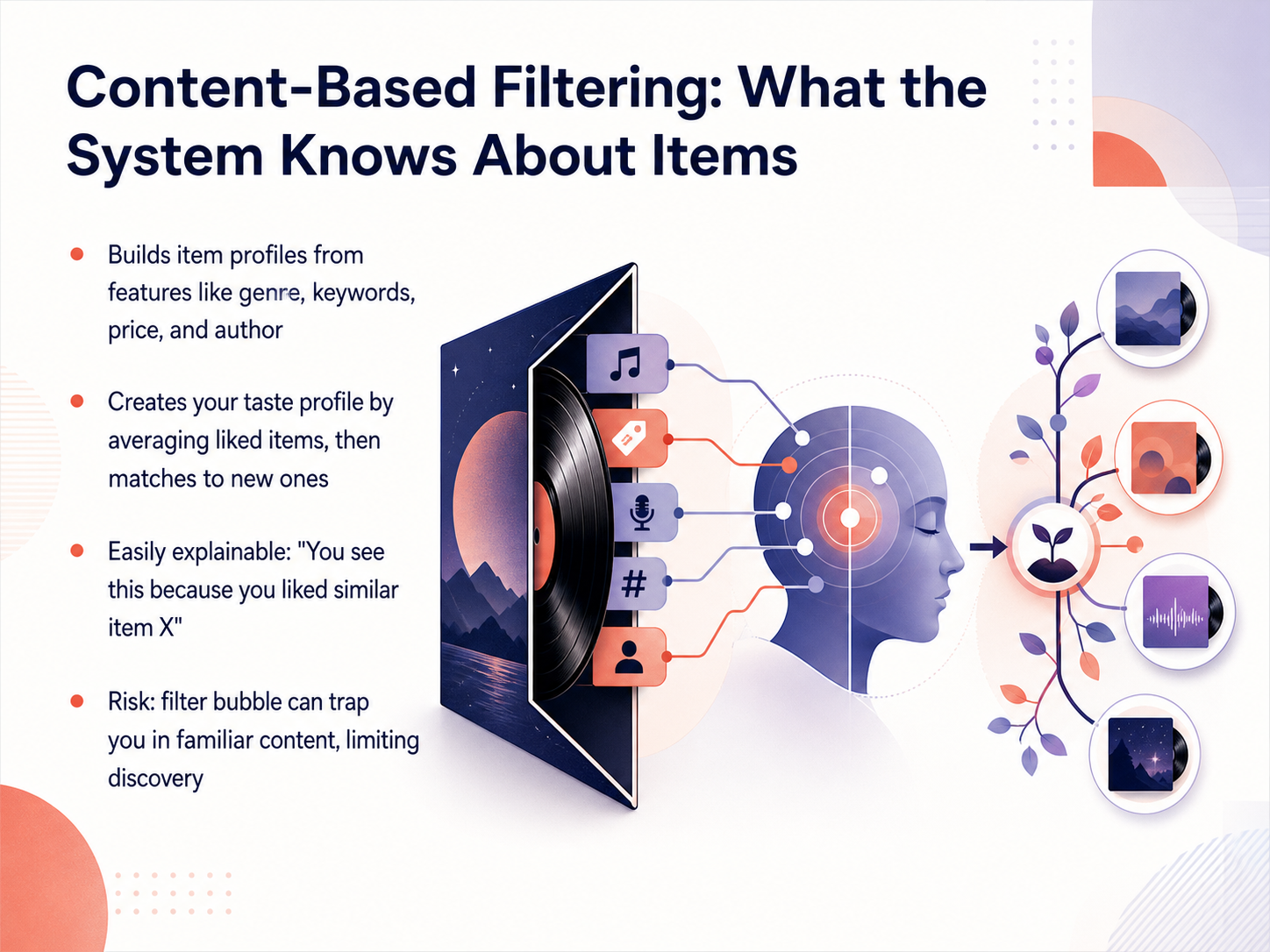
 - 05Content-Based Filtering: What the System Knows About ItemsLet's shift our focus to a different approach: content-based filtering. Instead of worrying about what other people like, this method looks right at the items themselves. Think of it like a detailed product catalog in the system's brain. It builds profiles for every movie, song, or article by studying its features—things like the genre, the director, specific keywords in the description, or even the price. Then, the system builds your personal taste profile. For example, it averages the features of all the films you’ve watched and loved recently, creating a sort of digital fingerprint of your preferences. It then simply matches that fingerprint to other items in the catalog. The real beauty here is how easy it is to explain. The system can literally tell you, 'You're seeing this action movie because you enjoyed those other two action thrillers with the same actor.' It’s transparent. However, there is a catch. This approach can create a filter bubble. By only suggesting things that are very similar to what you've already liked, it can trap you in familiar content and limit those happy accidents of discovering something completely new and different. Up next, we'll explore modern engines that use embeddings, deep learning, and a clever two-tower architecture that tries to solve these exact problems.
 developers.google.commedium.comyoutube.com+22 min
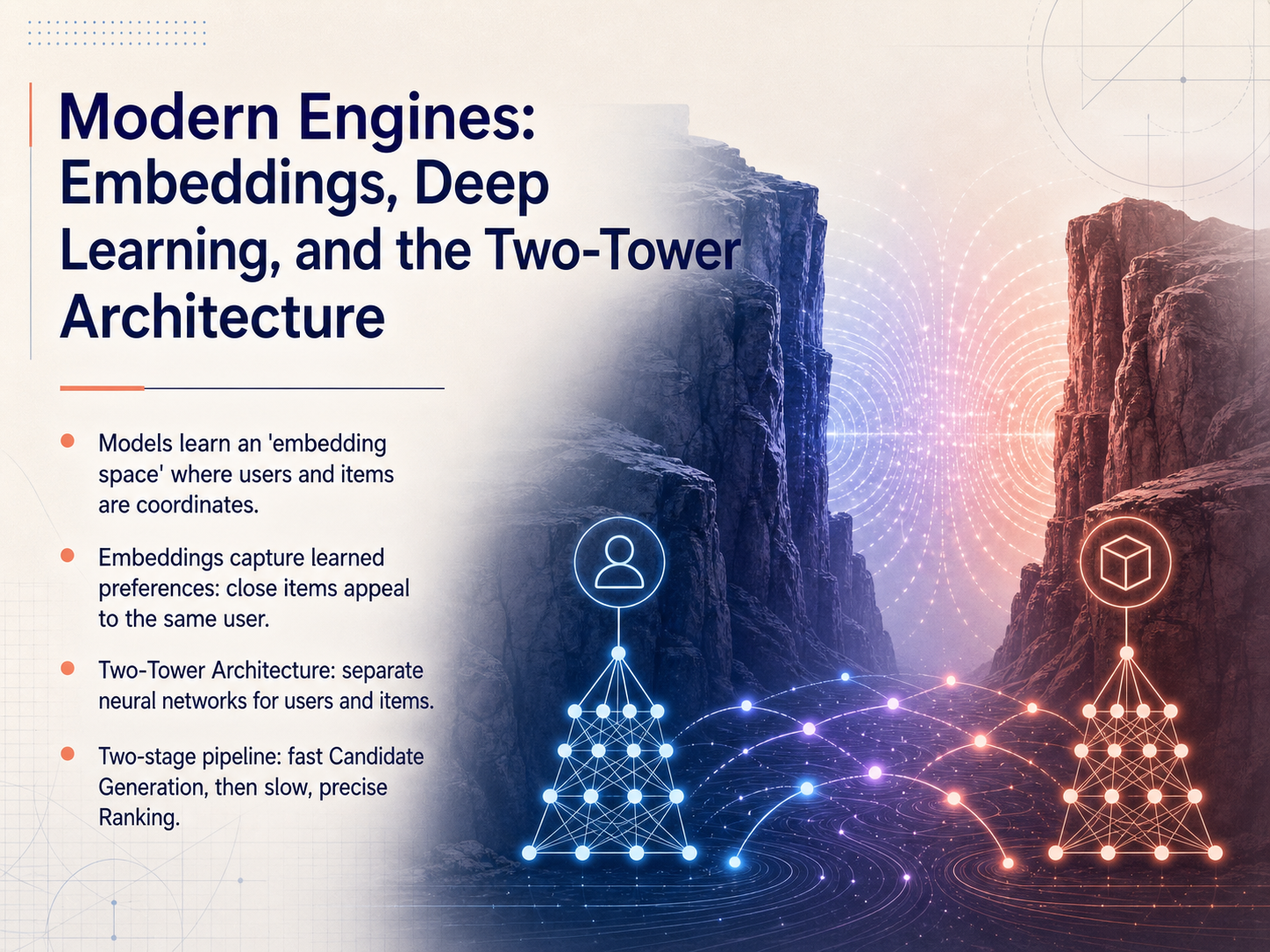
 - 06Modern Engines: Embeddings, Deep Learning, and the Two-Tower ArchitectureNow let's open up the modern engine and see what's actually happening inside. Today’s recommenders learn to map everything into what we call an embedding space. Picture a giant, multi-dimensional map. Users and items each get their own set of coordinates on this map. The magic is that your coordinates aren't just random; they capture your learned tastes. If a movie and a book are sitting very close to you in this space, the system predicts you'll love them. To build this map, modern systems often use something called a Two-Tower Architecture. Think of it as two separate learning factories. One tower, the user tower, crunches everything about you and your history. The other tower, the item tower, analyzes details about a movie or a product. They don't mingle until the end, when the system checks how close their final coordinates are. This process usually runs in a two-stage pipeline. First, a super-fast candidate generation stage scans the whole catalog and grabs maybe a hundred potentially good options. Then, a slower, much smarter ranking stage takes those candidates and sorts them perfectly just for you, so the very best ones land at the top of your feed. Coming up next, we'll look at the raw signals that fuel this entire process, in 'The Data Behind the Scenes: Signals Shaping Your Experience'.
 developers.google.commedium.comyoutube.com+22 min
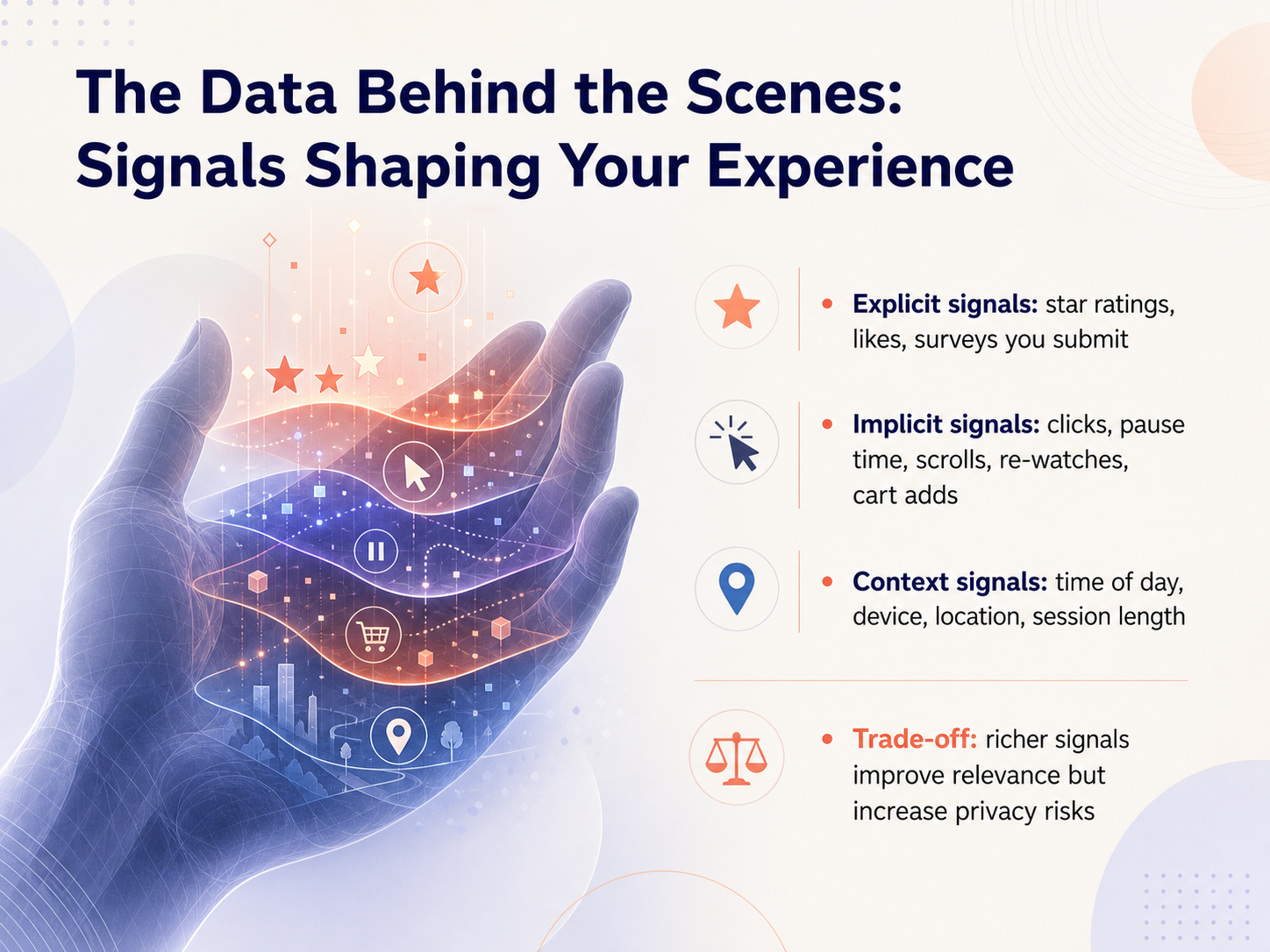
 - 07The Data Behind the Scenes: Signals Shaping Your ExperienceNow let's look at the fuel that powers every recommendation system: data, and specifically, the different signals you send every time you use an app. Think of these signals as falling into three buckets. First, there are explicit signals. These are the things you do on purpose, like giving a movie five stars, liking a post, or filling out a taste survey. The system doesn't have to guess; you told it directly. Next, and this is a much bigger bucket, are implicit signals. These are the clues you leave just by browsing. A click, how long you pause on a video, a quick scroll past something, a full re-watch, or adding an item to your cart. You might not even realize you're giving feedback, but the system is paying attention. It treats a long pause as mild interest and a re-watch as a pretty strong thumbs-up. Finally, there are context signals. These help the system understand where and when you are. The time of day matters because you might want coffee recipes in the morning and dinner ideas at night. Your device and location help too, since a phone user on a bus probably wants shorter videos than someone on a tablet at home. The big trade-off here is that richer signals create a much more relevant experience for you, but they also increase important privacy risks. A system that knows your location and watch time can be incredibly helpful, but it also needs to handle that data with real care. In the next slide, we'll follow these signals as they start to become actual suggestions, moving from raw data into the recommendation pipeline.
 developers.google.commedium.comyoutube.com+22 min
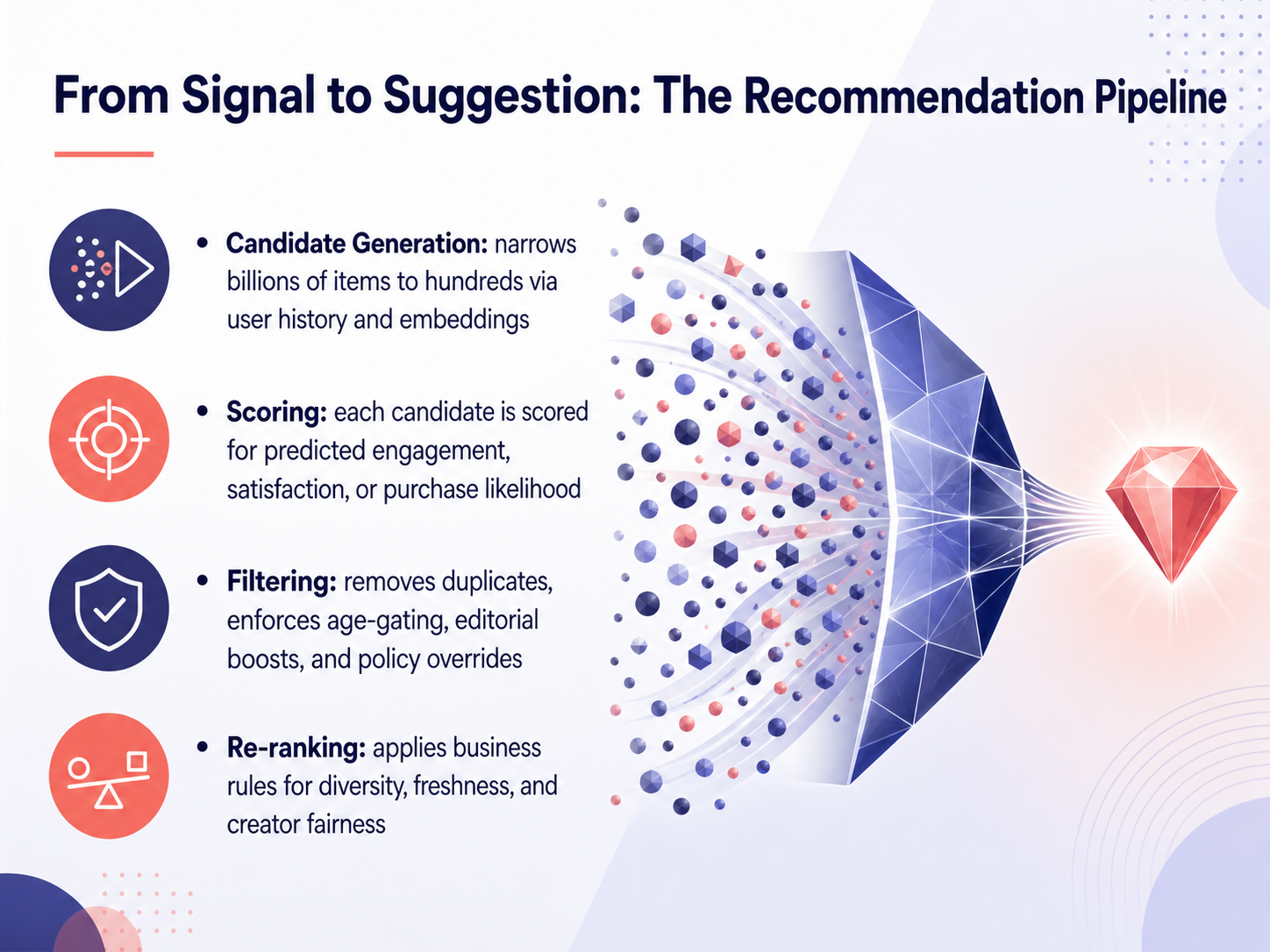
 - 08From Signal to Suggestion: The Recommendation PipelineNow let's pull back the curtain on how these signals become actual suggestions. Think of it as a four‑stage assembly line. First up is Candidate Generation. Here, the system takes a massive ocean of content, potentially billions of items, and filters it down to a manageable pool of a few hundred. It does this by looking at your history and those smart embedding maps we mentioned, quickly grabbing the most promising starting points. Next comes Scoring. Each one of those candidates gets a detailed score, like a grade, predicting how likely you are to click it, watch it to the end, or make a purchase. After scoring, we hit the Filtering stage. This is where the system cleans things up. It removes videos you've already seen, enforces age restrictions, and applies policy rules like blocking harmful content or inserting an editor's curated pick. Finally, the refined list goes through Re‑ranking. This is the final polish, where business rules get applied. The algorithm adjusts the order to ensure you see a mix of fresh content and diverse creators, instead of just the same topic over and over again. So in just a few steps, we go from a world of noise to a tight, personalized page just for you. Up next, we'll follow a single item through this entire pipeline in 'Behind the Curtain: A Walkthrough of a Single Recommendation.'
 developers.google.commedium.comyoutube.com+22 min
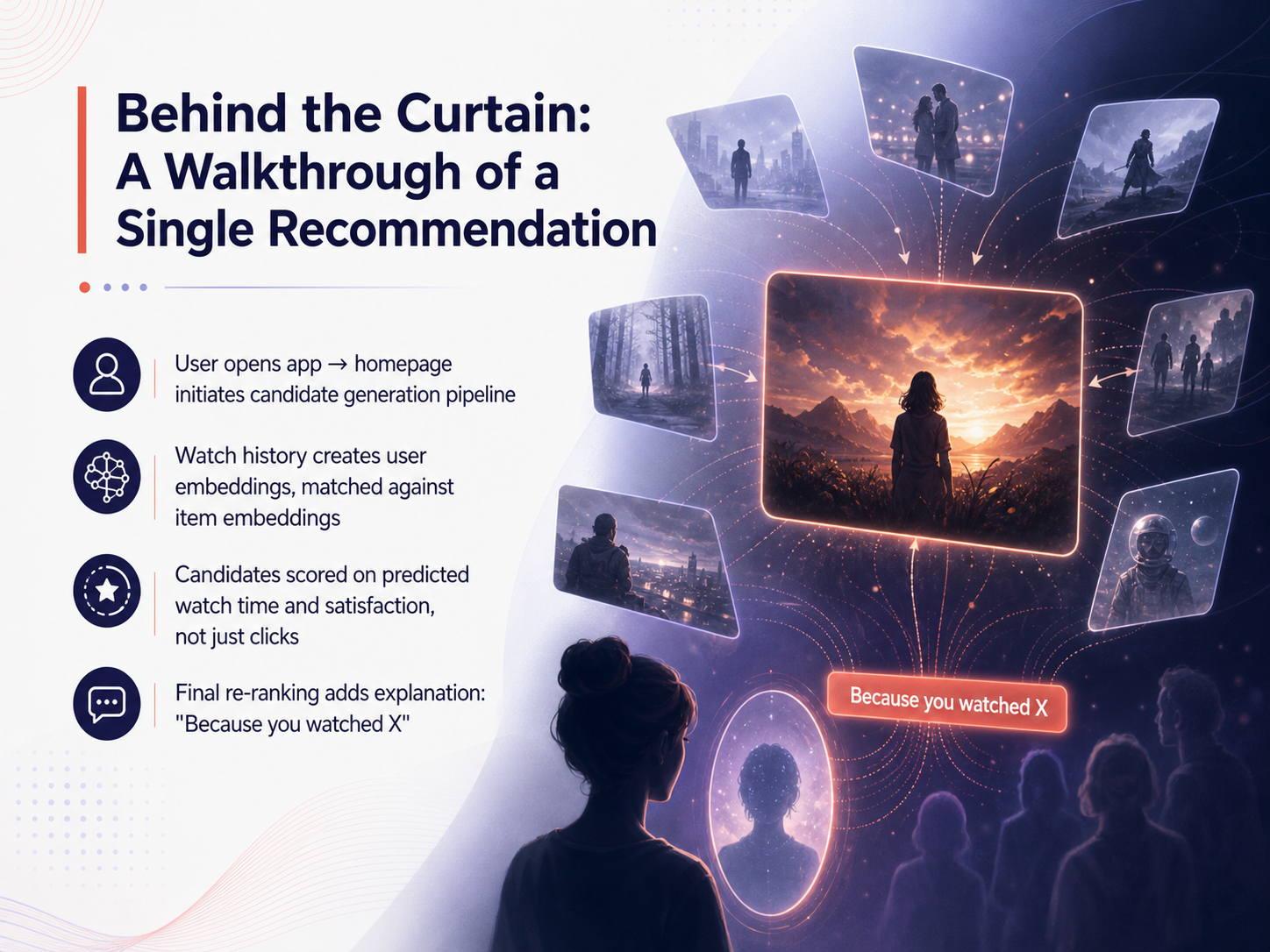
 - 09Behind the Curtain: A Walkthrough of a Single RecommendationNow let's peek behind the curtain and follow a single recommendation from start to finish. Picture this. You open your favorite video app. That simple action instantly triggers a pipeline that starts hunting for the right candidates. Your watch history gets turned into a compact digital fingerprint. The system then compares it against similar fingerprints for every piece of content in the catalog. Now here is where it gets clever. The algorithm is not just looking for what you might click. It scores candidates based on predicted watch time and deeper satisfaction signals, like finishing a video or giving it a thumbs up. Before anything appears on your screen, there is one final re-ranking step. It adds a simple human explanation, like "Because you watched X." This transparency helps the suggestion feel more like a smart friend who knows your tastes, rather than a cold calculation. Next, let's explore how platforms measure whether these systems actually work, in "Measuring Success: How Platforms Know What Works."
 appstekcorp.comyoutube.comaimultiple.com+22 min
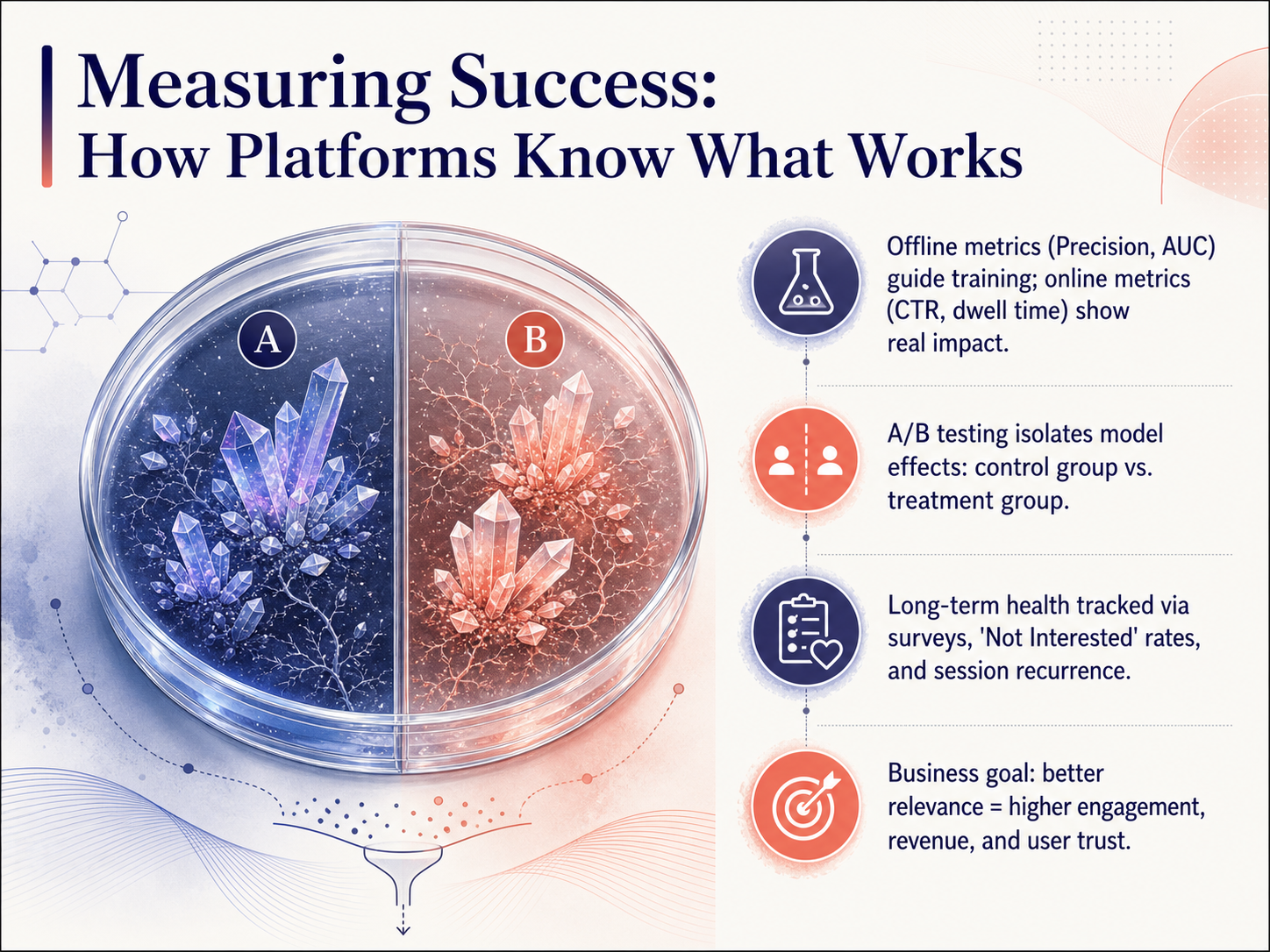
 - 10Measuring Success: How Platforms Know What WorksSo, a platform has a recommendation model, but how does the team actually know if it's working? It’s a mix of offline tests and real-world signals. During training, data scientists use metrics like Precision or a score called AUC to evaluate the model on historical data. But the truth comes from online metrics—things like click-through rate and how long someone lingers, known as dwell time. A powerful reality check is A B testing. The platform splits users carefully: a control group sees the old system, while a treatment group sees the new model. By comparing their actions, we isolate the effect of the model itself. For the bigger picture, platforms also track long-term health. They run surveys, watch the rate of 'Not Interested' feedback, and check if people return session after session. All of this serves a core business goal. Better relevance isn't just about smart algorithms—it deepens engagement, grows revenue, and builds lasting user trust. Next, we’ll tackle a critical balancing act: the echo-chamber challenge, including bias, fairness, and diversity.
 appstekcorp.comyoutube.comaimultiple.com+22 min
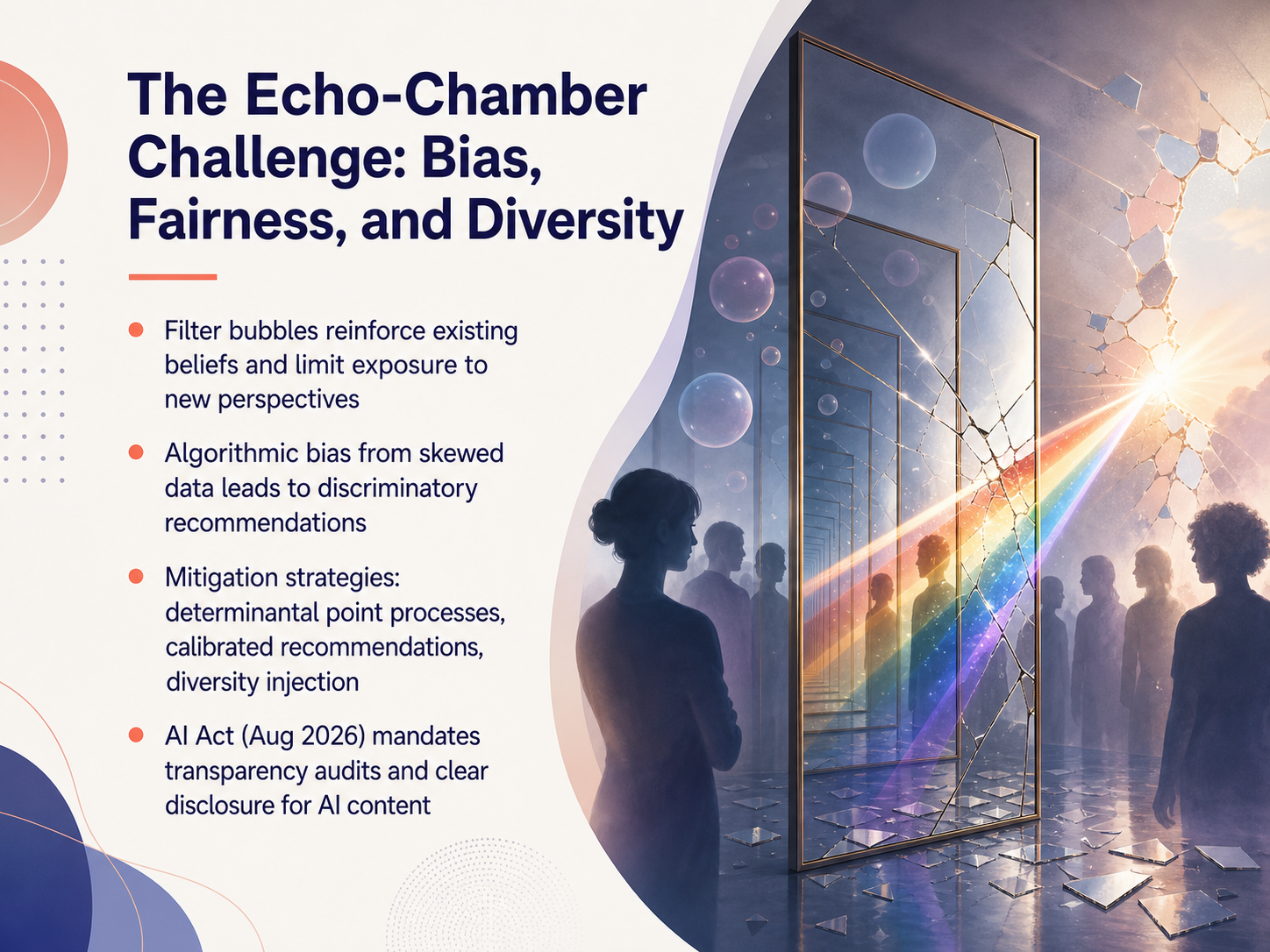
 - 11The Echo-Chamber Challenge: Bias, Fairness, and DiversityNow, let's talk about the trickier side of recommendations—the echo chamber challenge. You know that feeling when your feed seems to show you the same ideas over and over? That is a filter bubble. Systems learn what keeps you clicking, but they can end up just reinforcing what you already believe, boxing you in. It is not just about seeing the same music genre, it can limit exposure to completely new perspectives. At the root, algorithmic bias often sneaks in through skewed training data. If the data has blind spots, the recommendations will too, and that can lead to discriminatory suggestions. But smart teams are fighting back with strategies like injecting diversity or using calibrated recommendations to ensure a healthier mix. On top of that, a major regulation called the EU AI Act becomes enforceable in August two thousand twenty-six. It mandates transparency audits and clear disclosure when you are interacting with AI-generated content. Think of it as a public health label for algorithms. Next, we will build on this by exploring the tools that put users back in control in Transparency and Control: User Tools in twenty twenty-six.
 mdpi.commeegle.compartnershiponai.org+22 min
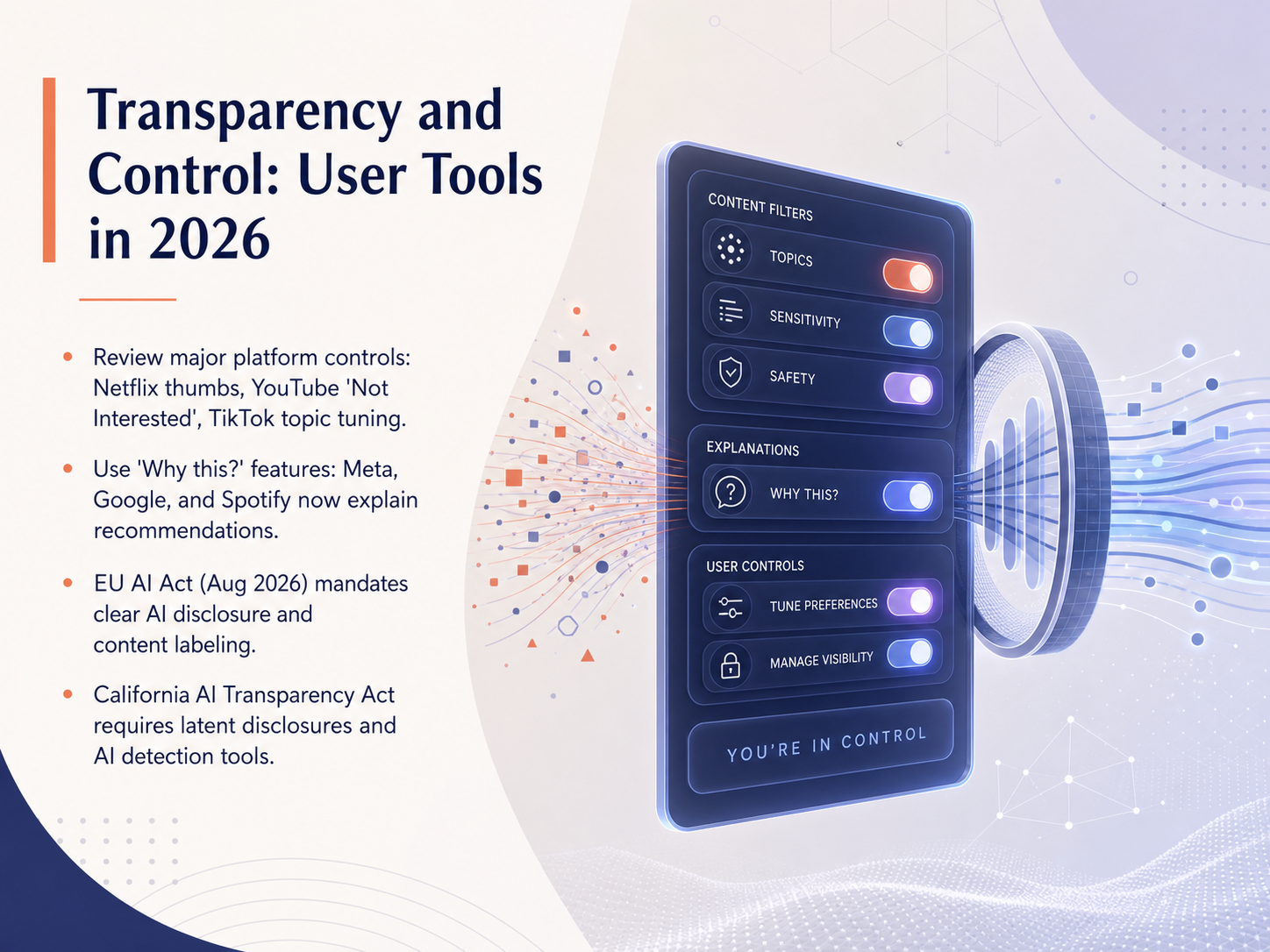
 - 12Transparency and Control: User Tools in 2026Now let's pull back the curtain even further on transparency and the controls you actually have in 2026. The big platforms have moved far beyond a simple thumbs-up or thumbs-down. On Netflix, a double thumbs-up still tells the system you really loved something, while YouTube's 'Not Interested' button acts like an instant, powerful signal to clean up your feed. TikTok even lets you fine-tune the topics you see more or less of, right from the settings. Beyond that, the 'Why this?' feature has become standard. On Meta, Google, and Spotify, you can now simply tap a button to get a plain-language explanation for why you are seeing a specific ad, post, or song. It is like having a key to the recommendation engine. This shift is also driven by major regulations that are now in effect. The EU AI Act, live since August of 2026, mandates clear AI disclosure. It means content generated by artificial intelligence must be labeled as such. In the US, California's new AI Transparency Act requires platforms to embed latent disclosures, essentially invisible digital fingerprints, so AI-generated media can be detected by special tools. You are gaining more control and clarity than ever before.
 mdpi.commeegle.compartnershiponai.org+22 min
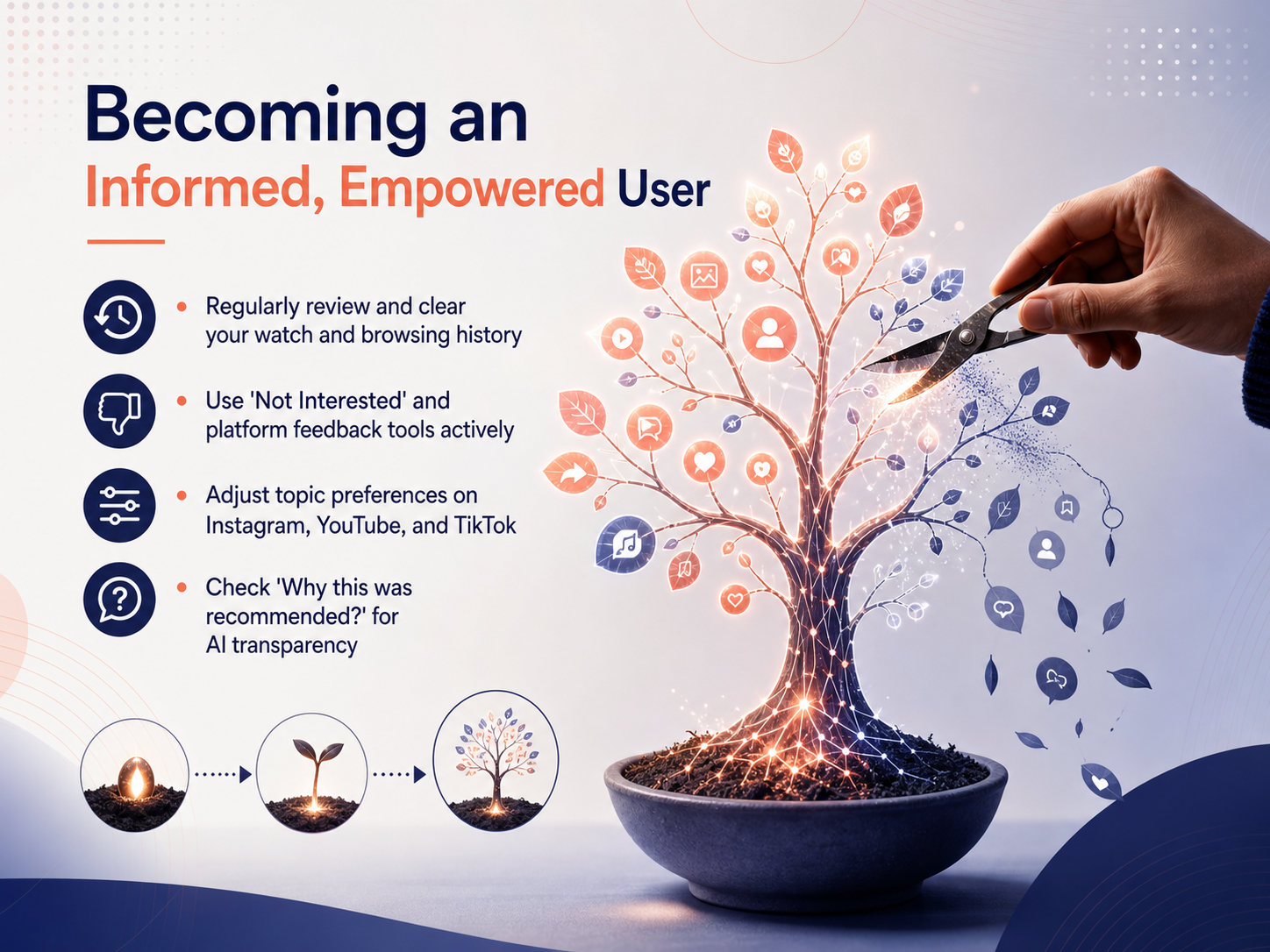
 - 13Becoming an Informed, Empowered UserWe have come to the final, and perhaps most empowering, part of our journey: how you can take control. Think of the recommendation system not as a mysterious black box, but as a garden you can tend. First, regularly clear your watch and browsing history. This is like pulling out weeds that might be leading the system down the wrong path, so old interests don't clutter your fresh suggestions. Next, don't just ignore content you dislike—use the 'Not Interested' button and other feedback tools actively. Every time you tap that, you are casting a vote that teaches the algorithm your true taste. You can also adjust your topic preferences directly on Instagram, YouTube, and TikTok. Look for those settings; they let you dial up topics you love and dial down the ones you don't. Finally, keep an eye out for labels like 'Why am I seeing this?' This is the transparency feature in action, showing you the exact reason a post appeared—maybe it’s a video you liked, or a topic you follow. Using these four simple habits turns you from a passive viewer into an informed, empowered user. You define your digital world. Thanks for learning with me today.
 mdpi.commeegle.compartnershiponai.org+22 min
Take the deck with you
Download this course as a file — free, no sign-up needed.
- PDF handoutEvery slide page, ready to print or share.14 pages · 3.6 MBDownload
- Narrated PowerPointThe deck that presents itself — every slide carries the digital human's narration video.14 pages · 15.2 MBDownload
- PowerPoint slidesThe full deck as a .pptx — open it in PowerPoint, Keynote, or Google Slides.14 pages · 3.6 MBDownload
Free to use in your own training — please keep the PersonWise credit page at the end.
Have your own deck? Turn it into a course
Sources consulted
Web sources consulted while building this course.
- 10 Remarkable Real World Examples Of Recommender Systems — appstekcorp.com
- Recommender Systems: Basics, Types, and Design Consideration ... — youtube.com
- Recommendation Systems: Applications and Examples — aimultiple.com
- AI Recommendation Systems 2026: ROI, Platforms & Real-World Guide — gloriumtech.com
- How To Build A Recommendation System In 2026: Full Guide — tezeract.ai
- Collaborative filtering | Machine Learning — developers.google.com
- Content-Based vs Collaborative Filtering: How TikTok and ... — medium.com
- Content-based filtering & collaborative filtering (Building ... — youtube.com
- What is collaborative filtering? — ibm.com
- A Comparison of Content-Based and Collaborative Filtering — sciencedirect.com
- AI Transparency and User Behavior in Human ... — mdpi.com
- Transparency In Recommendation Algorithms — meegle.com
- Policy Alignment on AI Transparency — partnershiponai.org
- TOP Guidelines — cos.io
- The EU AI Act's Transparency Rules: A Practical Guide to ... — artificialintelligenceact.eu