Begin
14 pages · ~28 min
Customer Education Value
Customer education training that explains why it matters and equips learners with strategies to drive product adoption and customer success.
A digital instructor presents all 14 pages. Hold “Ask” at any point and ask out loud — the answer comes from this course. No sign-up needed.
What you’ll learn
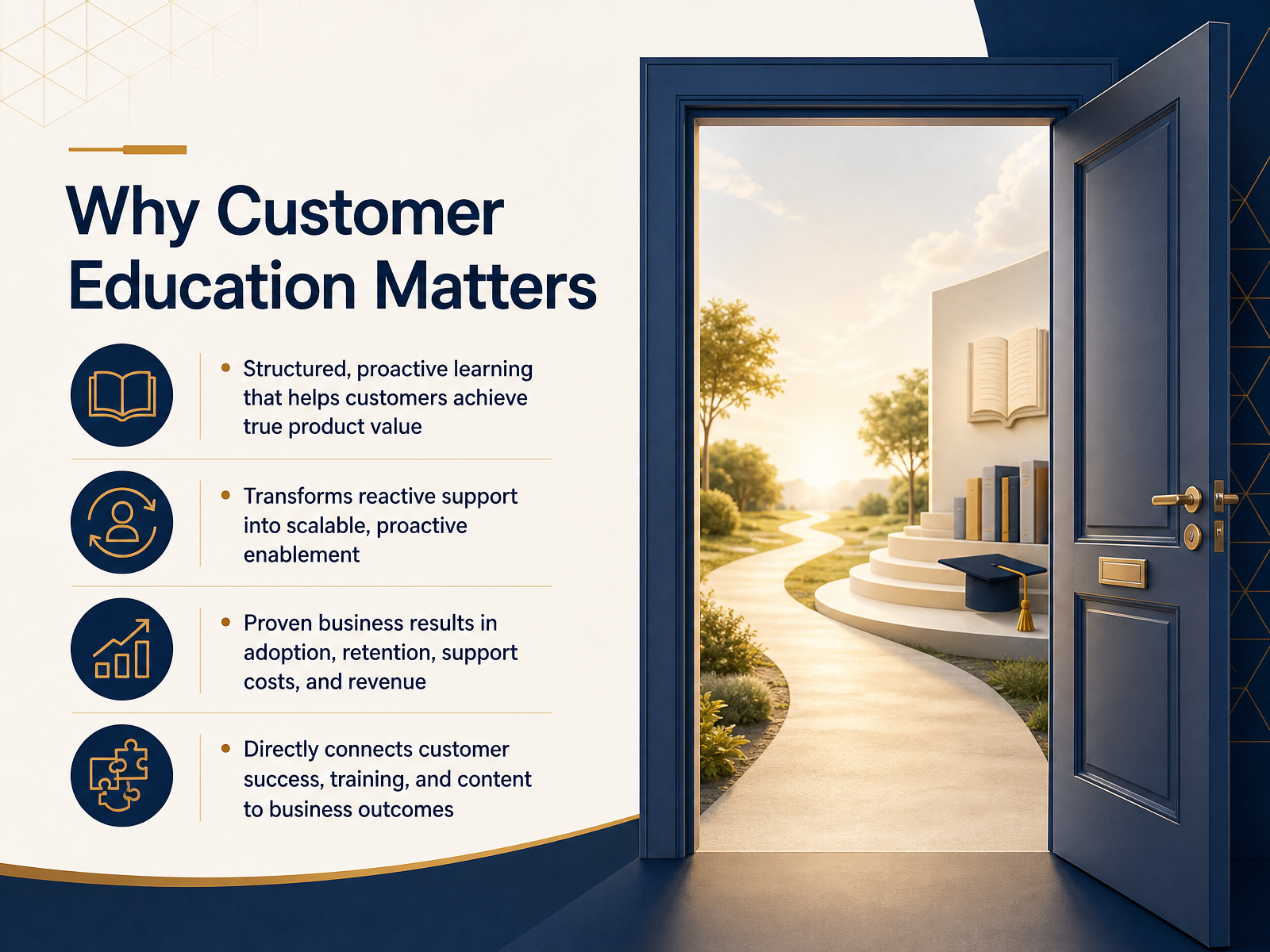
- 01Why Customer Education MattersWelcome. I'm glad you could join us. Over the next few minutes, we're going to talk about why customer education has moved from being a nice-to-have to a genuine business lever. We all know the pressures: customers who stall before they reach value, support queues that grow with every new sale, and renewals that feel like a coin flip. The usual fix is more headcount. But that makes costs rise just as fast as revenue. Customer education is the way out. Think of it as structured, proactive learning that helps customers achieve real product value on their own terms. It transforms reactive support into scalable, proactive enablement. And the results are not soft. Formal programs are linked to measurable improvements in adoption, retention, support costs, and top-line revenue. In fact, research consistently shows double-digit gains across all four. That makes education a direct bridge between what your teams do every day and the outcomes your leadership actually tracks. Let's start by defining exactly what we mean by customer education.intellum.compapers.ssrn.cominfo.thoughtindustries.com+22 min
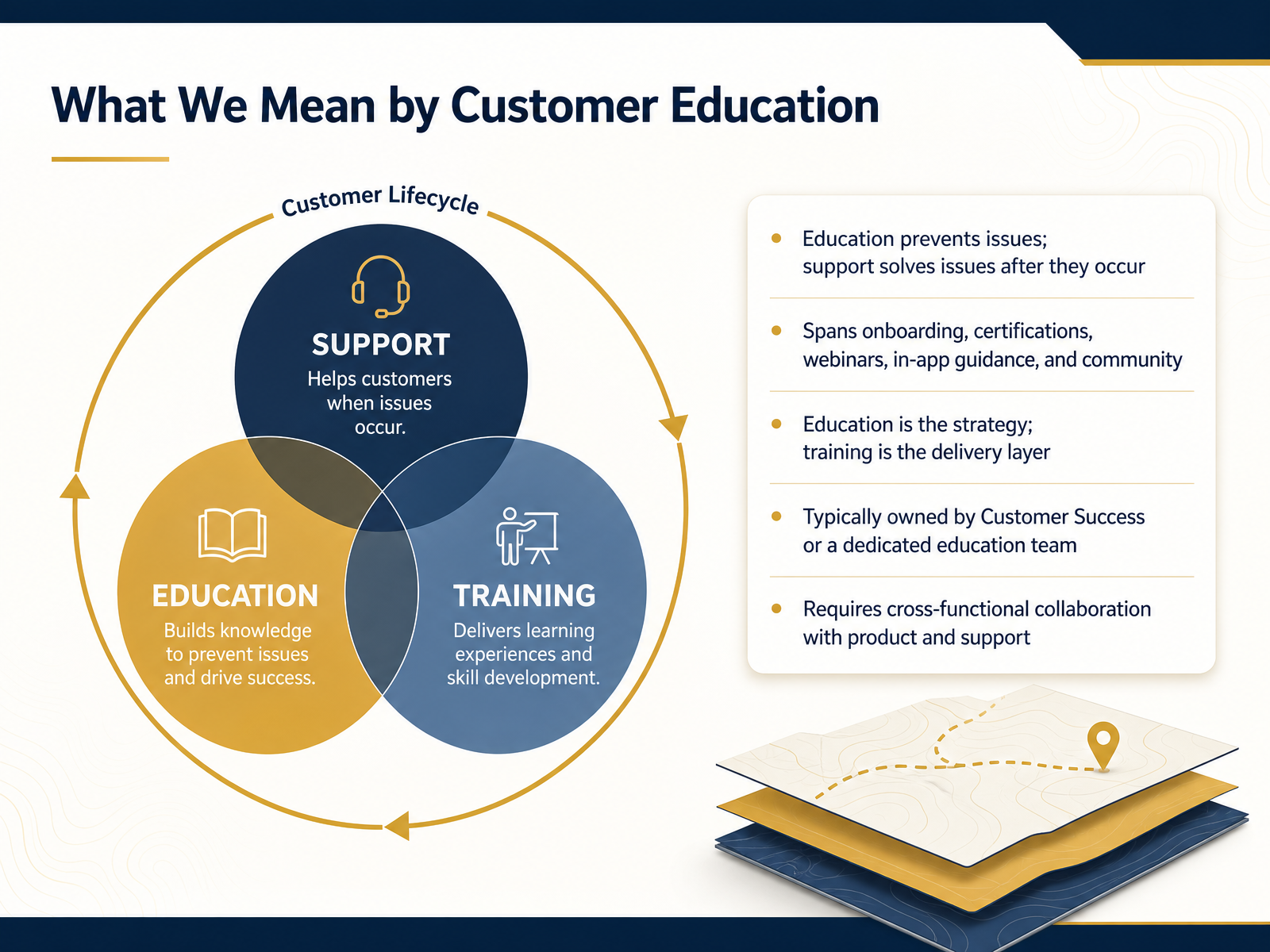
- 02What We Mean by Customer EducationLet's define the playing field. Customer education is not the same as customer support. Support is what you do after a customer hits a wall. Education is how you stop them from hitting the wall in the first place. That is a fundamental shift from reactive to proactive. And this is not just a two week onboarding project. It spans the entire customer lifecycle, from initial onboarding and certification to webinars, in app guidance, and community investment. Now, let's clarify one thing up front. Education is the strategy. Training is simply the delivery mechanism. The strategy decides what to teach, when to teach it, and how we measure whether it actually worked. Because this work is strategic, it cannot live as a side project. It requires a clear owner, usually within Customer Success or a dedicated education team. But that owner needs a direct line to Product and Support. Here is why that matters. If education is not aligned with product development, you are teaching old features. If it is not aligned with support, you are answering old tickets. This cross functional alignment is how you turn education into a lever for adoption and retention. Next, we will look at what happens when this function is ignored.
 trainn.cointellum.comabsorbai.com+22 min
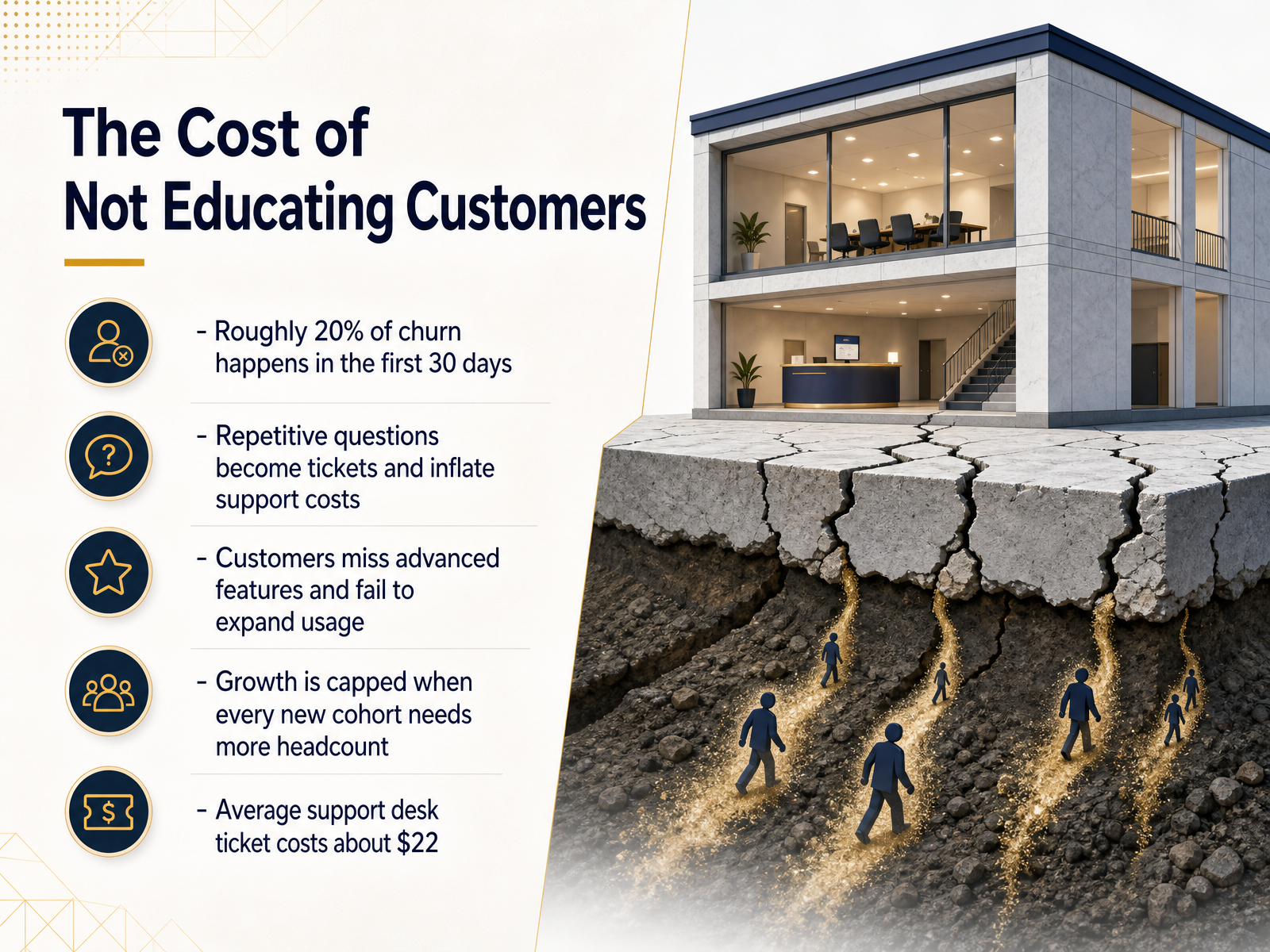
 - 03The Cost of Not Educating CustomersNow let's talk about what happens when customers are not educated well. And I want to frame this around the costs you are already carrying, whether you see them or not. First, around twenty percent of churn happens in the first thirty days. That is the window where a customer is deciding if your product is worth the effort. Without a strong onboarding and education flow, you lose them before they ever reach value. Second, repetitive questions become tickets. Every how-to question that should have been answered by a short tutorial lands in your support queue. The average support desk ticket costs about twenty two dollars, so this adds up fast across hundreds or thousands of accounts. Third, customers miss advanced features. They stay stuck on the basics, which means they never expand usage, and your expansion revenue stays flat. Finally, growth gets capped. Without scalable education, every new cohort demands more support and more success headcount. Your cost grows in lockstep with your customer base, instead of decoupling from it. So the question is not whether you can afford customer education. The question is what this current approach is already costing you. Next, let's look at the positive side and connect these costs to business impact, specifically adoption, retention, and expansion.
 trainn.cointellum.comabsorbai.com+22 min
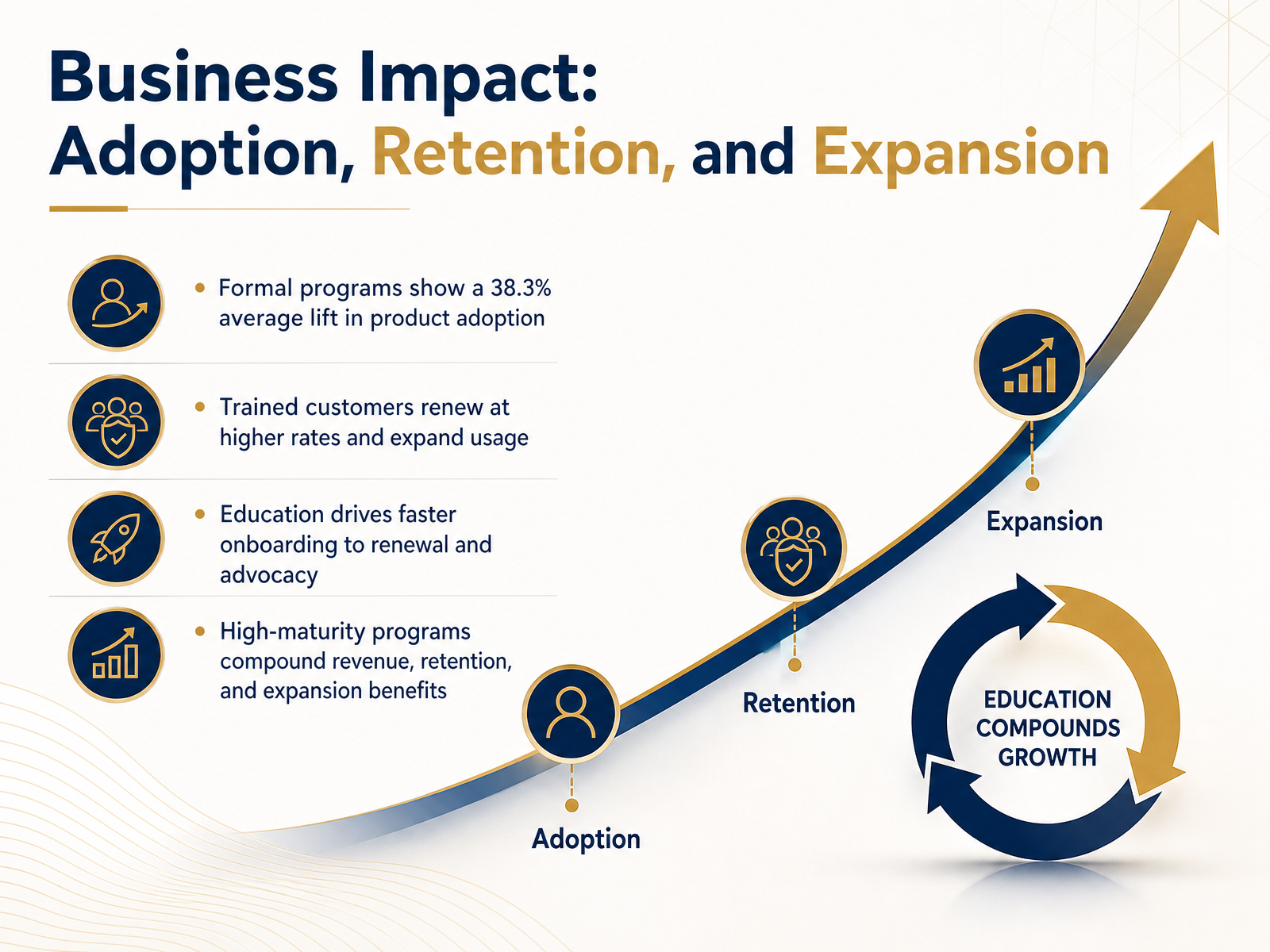
 - 04Business Impact: Adoption, Retention, and ExpansionNow, let’s get concrete about the business impact. Customer education is not a cost center. It is a growth lever that shows up in three places: adoption, retention, and expansion. Formal programs report an average lift of thirty-eight point three percent in product adoption. That is not a vanity metric. It means trained customers actually use what they bought, reach value faster, and become harder to lose. Those same customers renew at higher rates. They also expand usage over time, which protects your existing revenue and creates natural upsell motion. Education also compresses the path from onboarding to renewal and advocacy. Instead of waiting for customers to figure things out, you accelerate their momentum through the journey. And here is the compounding effect. High-maturity programs do not just improve one metric. They combine revenue, retention, and expansion benefits into a durable growth engine. The more mature the program, the bigger the return. Next, let’s put a revenue and cost number on this for your executives.
 intellum.compapers.ssrn.cominfo.thoughtindustries.com+21 min
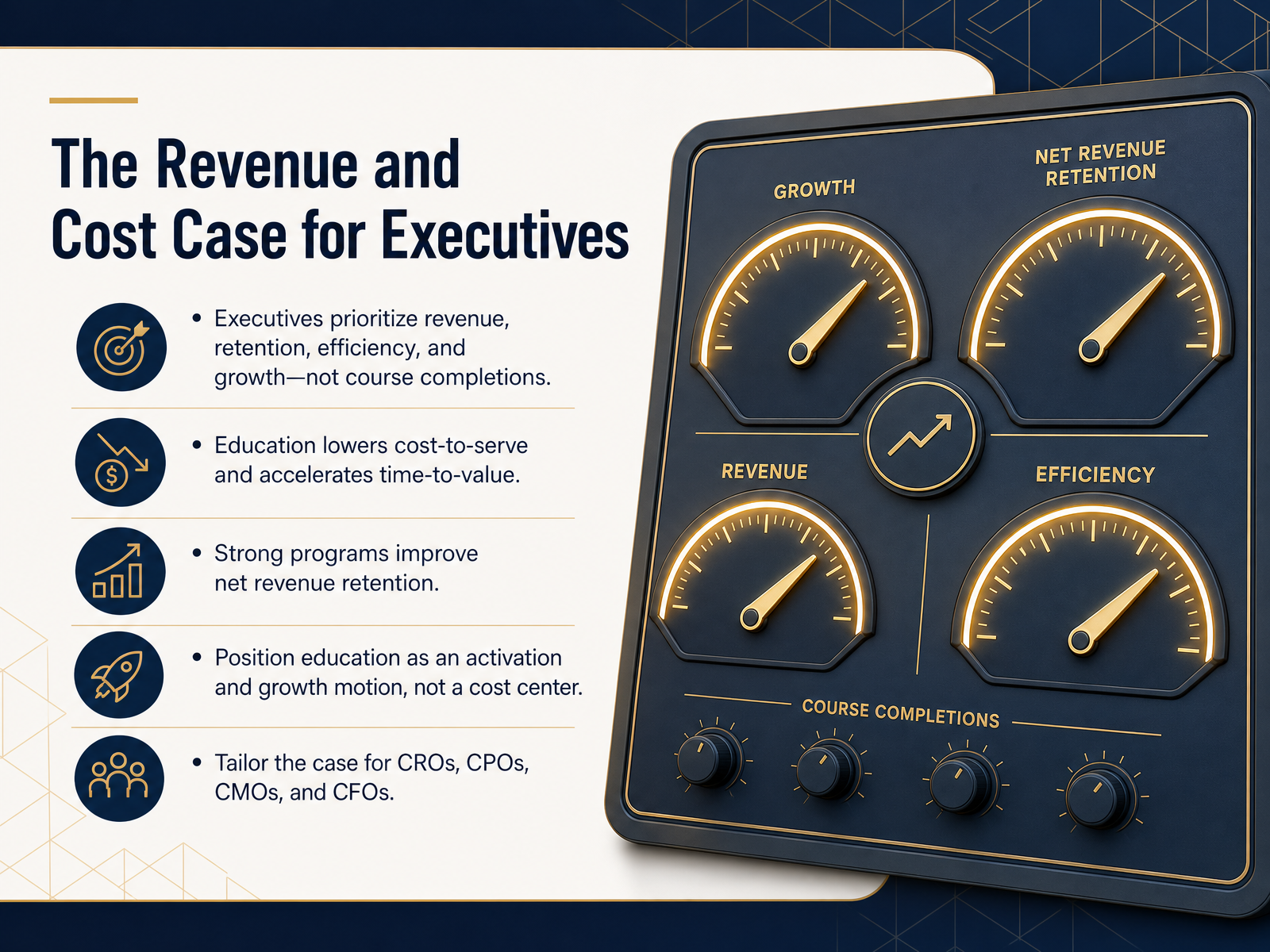
 - 05The Revenue and Cost Case for ExecutivesLet’s get practical about how to position this with leadership. Your executives are not sitting around asking about course completions. They are asking about revenue, retention, efficiency, and growth. So your case needs to show how education moves those specific numbers. Start with cost. Structured education programs consistently reduce support ticket volume and lower the overall cost to serve each customer. That is a direct efficiency gain your CFO can appreciate. Then bring in time to value. When customers learn your product faster, they reach their first meaningful outcome sooner, which protects renewals and reduces early churn risk. Strong programs also create measurable impact on net revenue retention. When customers use more of the product and understand advanced workflows, they renew more often and expand more readily. That is the growth angle your CRO and CPO care about. But the case is not one size fits all. Tailor it by audience. For the CRO, focus on expansion and upsell signals. For the CPO, emphasize product adoption and activation. For the CMO, talk about educated users becoming advocates and qualified demand. And for the CFO, lead with cost to serve, margin, and measurable return. The key is to frame education as an activation and growth motion, not a cost center. When you do that, you stop asking for budget and start showing how this investment pays for itself. Up next, let’s look at what strong programs actually get right.
 skilljar.comintellum.comgo.cloudshare.com+21 min
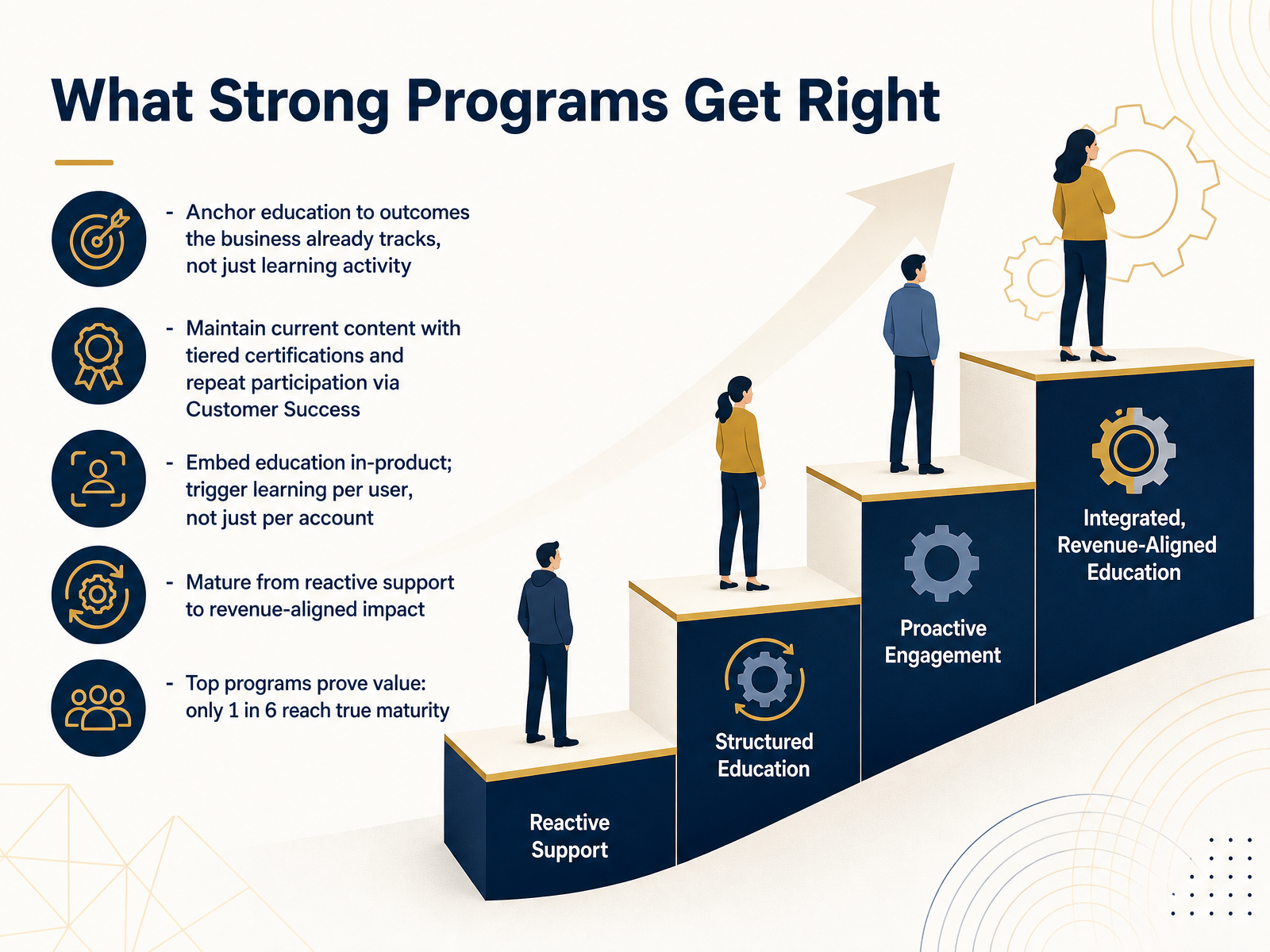
 - 06What Strong Programs Get RightLet's look at what strong programs actually get right. First, they anchor education to outcomes the business already tracks. Not course completions. Adoption, retention, expansion. The numbers your leadership already cares about. Second, they keep content current. Tiered certifications, repeat participation, and close partnership with Customer Success. Not a one-time course dump. Third, they embed learning inside the product and trigger it per user. Every new seat gets the right guidance at the right moment, not just the account owner. Fourth, they mature from reactive support to revenue-aligned impact. Education becomes a growth lever, not just cost deflection. And here's the reality check. Only one in six programs reach true maturity. That's a gap. But it's also an opportunity for teams willing to move beyond engagement metrics. Next, let's explore how customer education directly supports your Customer Success teams.
 skilljar.comintellum.comgo.cloudshare.com+21 min
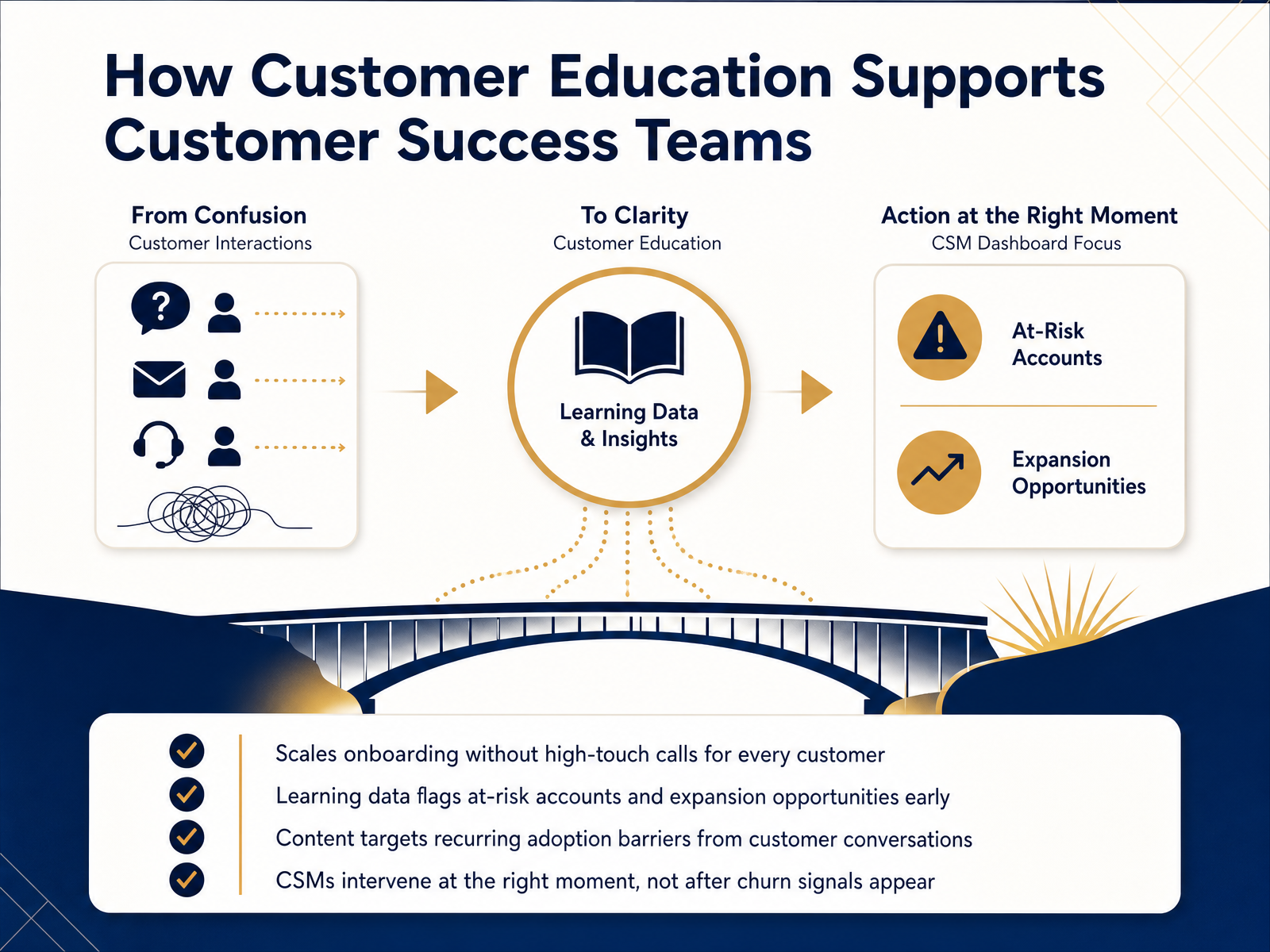
 - 07How Customer Education Supports Customer Success TeamsLet's talk about how customer education directly supports your customer success team. First, it scales onboarding without dragging a CSM onto a call for every new account. Self-paced paths handle the basics, so your team can save those high-touch moments for when they actually matter. Second, learning data becomes an early warning system. When a customer stalls in onboarding or stops engaging with training, that's a signal. It flags at-risk accounts before churn signals show up, and it can also reveal expansion opportunities as users go deeper into advanced content. Third, customer education gives you a way to act on recurring adoption barriers. You hear the same questions in customer conversations. Your content can now target those exact friction points, proactively. And finally, that combination means your CSMs intervene at the right moment, not after it's too late. With that foundation in place, let's move to designing effective learning paths.
 gainsight.comlearnworlds.comgainsight.com+21 min
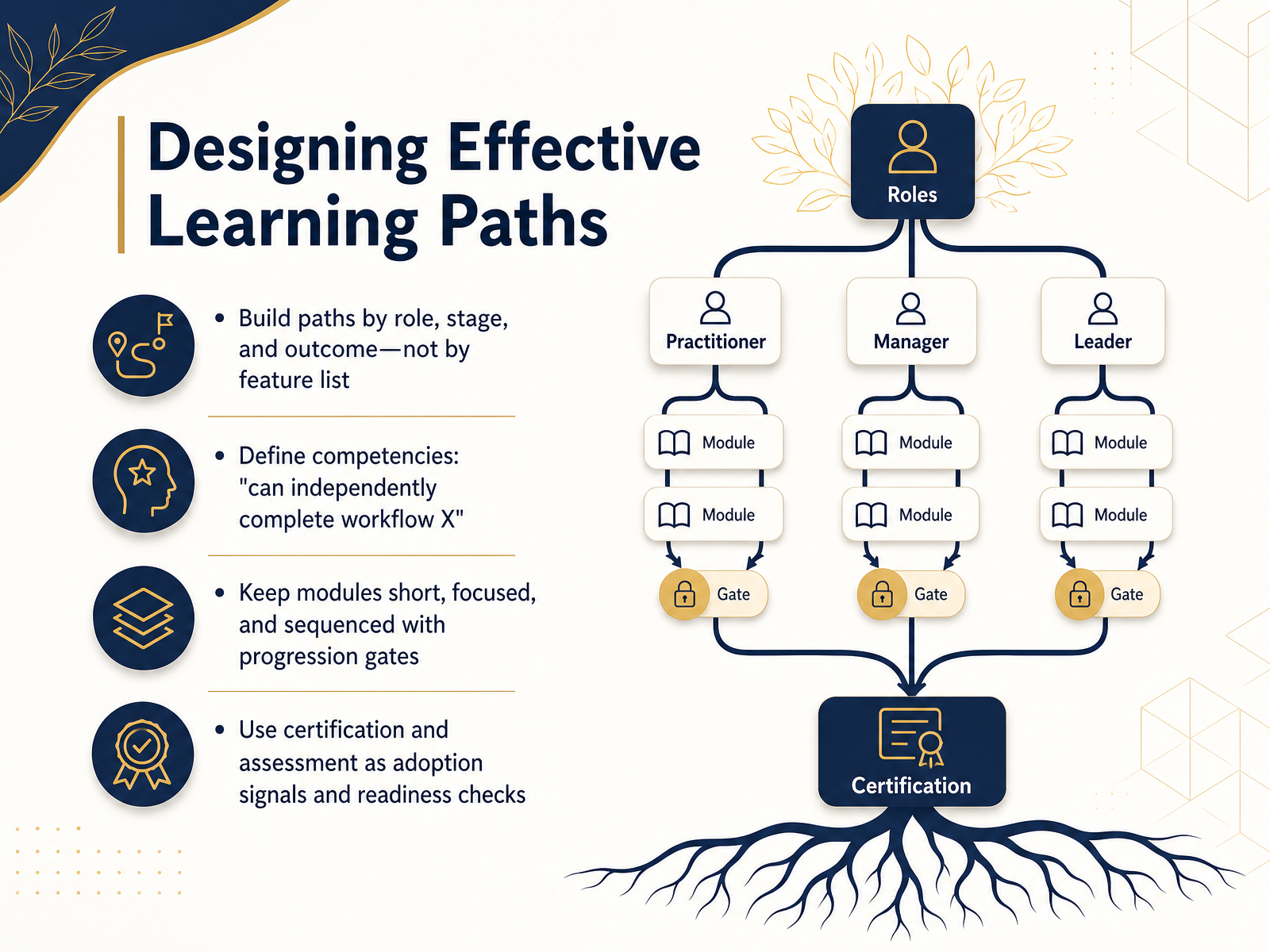
 - 08Designing Effective Learning PathsLet's get practical about designing learning paths that actually move the needle. The first rule is to build around roles, stages, and outcomes, not your feature list. An admin configuring permissions has a completely different job than an end user running daily workflows. So give each of them a focused path that gets them to their own first win. Next, define competencies in plain language. Instead of saying someone understands the reporting module, set the bar as, they can independently build a filtered report and schedule it to a stakeholder. That clarity becomes your curriculum, your success criteria, and your readiness check all at once. Keep modules short and sequenced with progression gates. Data consistently shows completion drops sharply after about thirty minutes. So break longer journeys into focused steps and let each one build on the last. Finally, treat certification and assessment as adoption signals. A certificate isn't just recognition. It tells your customer success team which accounts are ready for advanced workflows or expansion conversations. That is how education starts to show up in retention and revenue discussions. Up next, we'll look at the content creator's role in bringing these paths to life.
 absorbai.comthinkific.com1 min
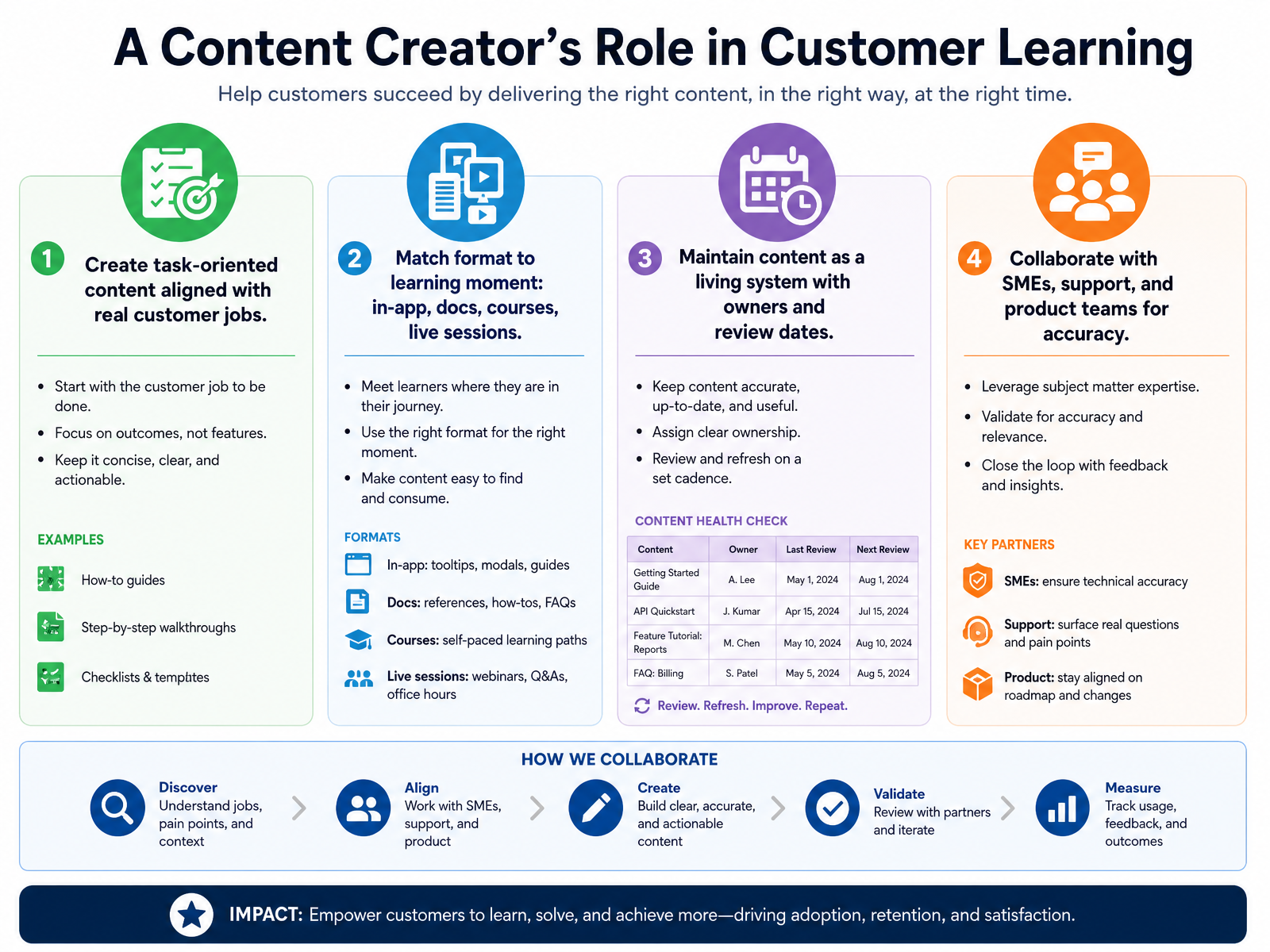
 - 09The Content Creator's Role in Customer LearningNow let's talk about the hands-on work of content creation, because that's where strategy either succeeds or quietly fails. The first rule is to stay task-oriented. Your content should map directly to a real customer job, like setting up a dashboard, not just explaining a feature. The second rule is to match the format to the learning moment. A quick in-app tooltip works for a first-time task, a searchable doc works for reference, and a structured course works for deep skill building. Trying to make one channel do everything is where most teams lose momentum. Third, treat your content as a living system. Every asset needs a named owner and a review date. Stale screenshots erode trust faster than almost anything else. And finally, don't work in isolation. Collaborate with subject matter experts, support, and product teams. Their input keeps your content accurate, and their frontline questions tell you what to build next. So, keep it task-oriented, match the format to the job, govern it like a system, and build it with the experts. That's how content moves from a pile of artifacts into a measurable program.
 learnworlds.com1 min
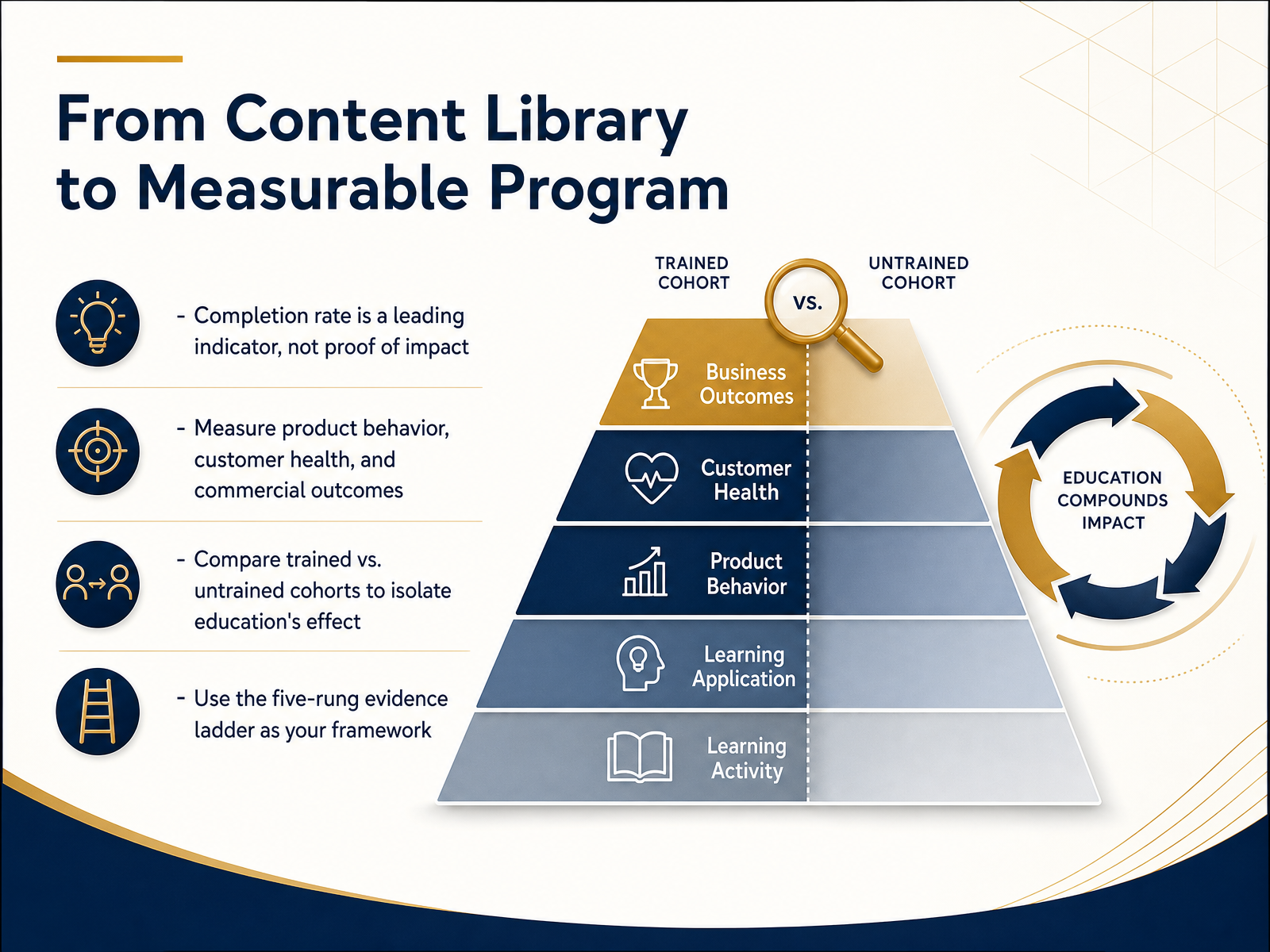
 - 10From Content Library to Measurable ProgramThe shift from a content library to a measurable program starts with one uncomfortable truth. Completion rate is a leading indicator, not proof of impact. It tells you someone finished a course. It does not tell you they changed what they do in the product, or that the account is healthier because of it. So we measure three things instead. Product behavior. Are trained customers activating faster, adopting key features, completing the workflows that matter. Customer health. Are support tickets declining on trained topics, is time to value shrinking, are health scores improving. And commercial outcomes. Renewal rate, retention, expansion, net revenue retention. The power move is cohort comparison. Pull trained versus untrained accounts in the same segment, controlling for size and CSM attention, and let the difference speak. Use the five-rung evidence ladder as your framework. Activity, comprehension, behavior, health, business outcome. Every rung builds a stronger chain of evidence. Climb it deliberately. Next, we turn to the metrics that move business decisions.
 skilljar.comintellum.comgo.cloudshare.com+21 min
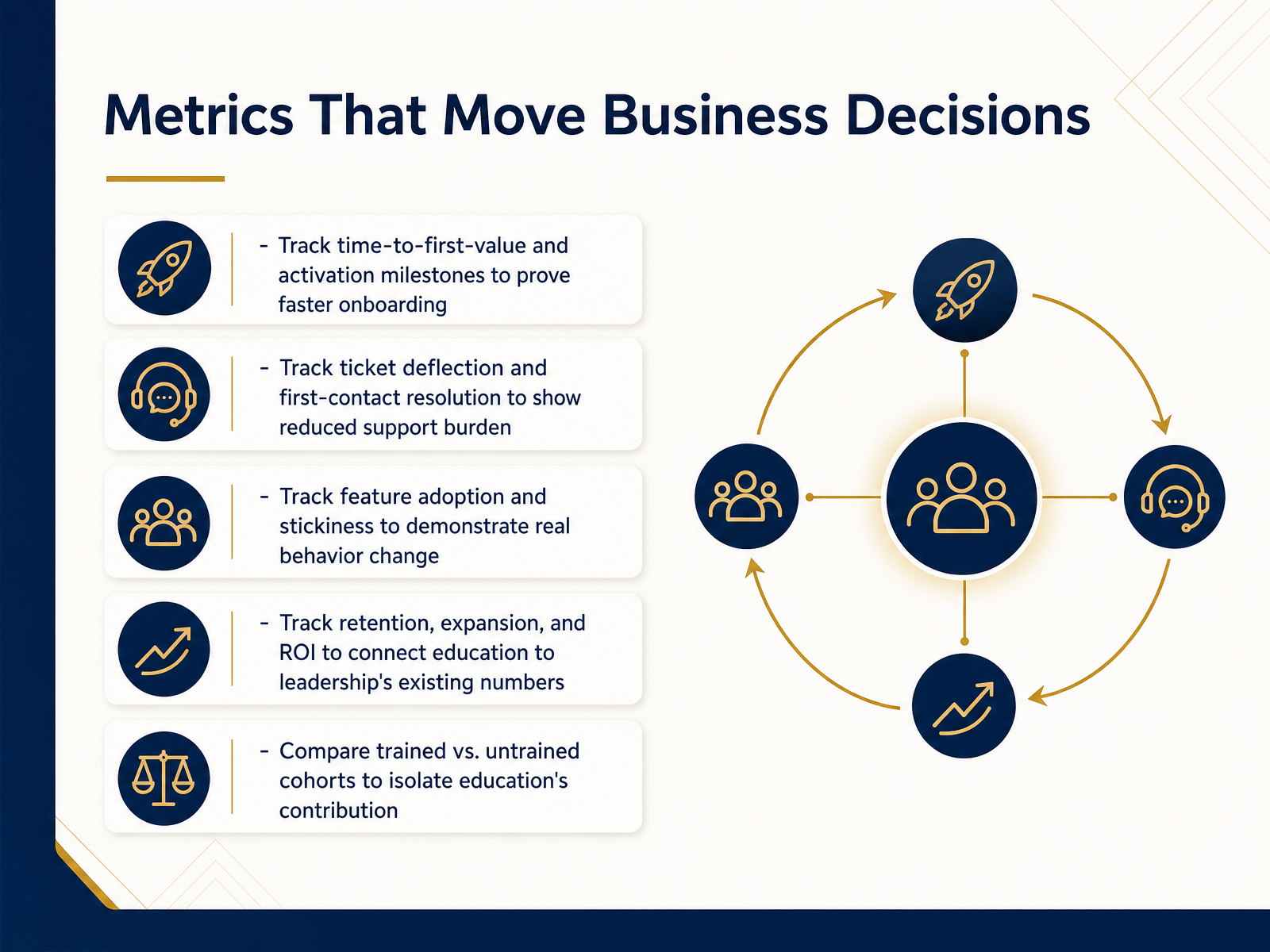
 - 11Metrics That Move Business DecisionsNow let's talk about the numbers that actually move decisions. Completion rates are fine, but they don't tell leadership whether education changed the business. To prove faster onboarding, track time to first value and activation milestones. Compare how quickly trained customers reach that first meaningful outcome versus those who skip training. To show reduced support burden, measure ticket deflection on covered topics and first contact resolution. The question is not how many people watched a video. It's whether ticket volume dropped after the content shipped. For real behavior change, look at feature adoption and stickiness. Are trained customers actually using the advanced functionality you taught them? And to connect with leadership, you need to speak their language. Report on retention, expansion, and ROI, the numbers already on their dashboard. The most powerful approach is comparing trained versus untrained cohorts. That comparison isolates your contribution and turns a narrative into evidence. Now let's move to common barriers and practical solutions.
 skilljar.comintellum.comgo.cloudshare.com+21 min
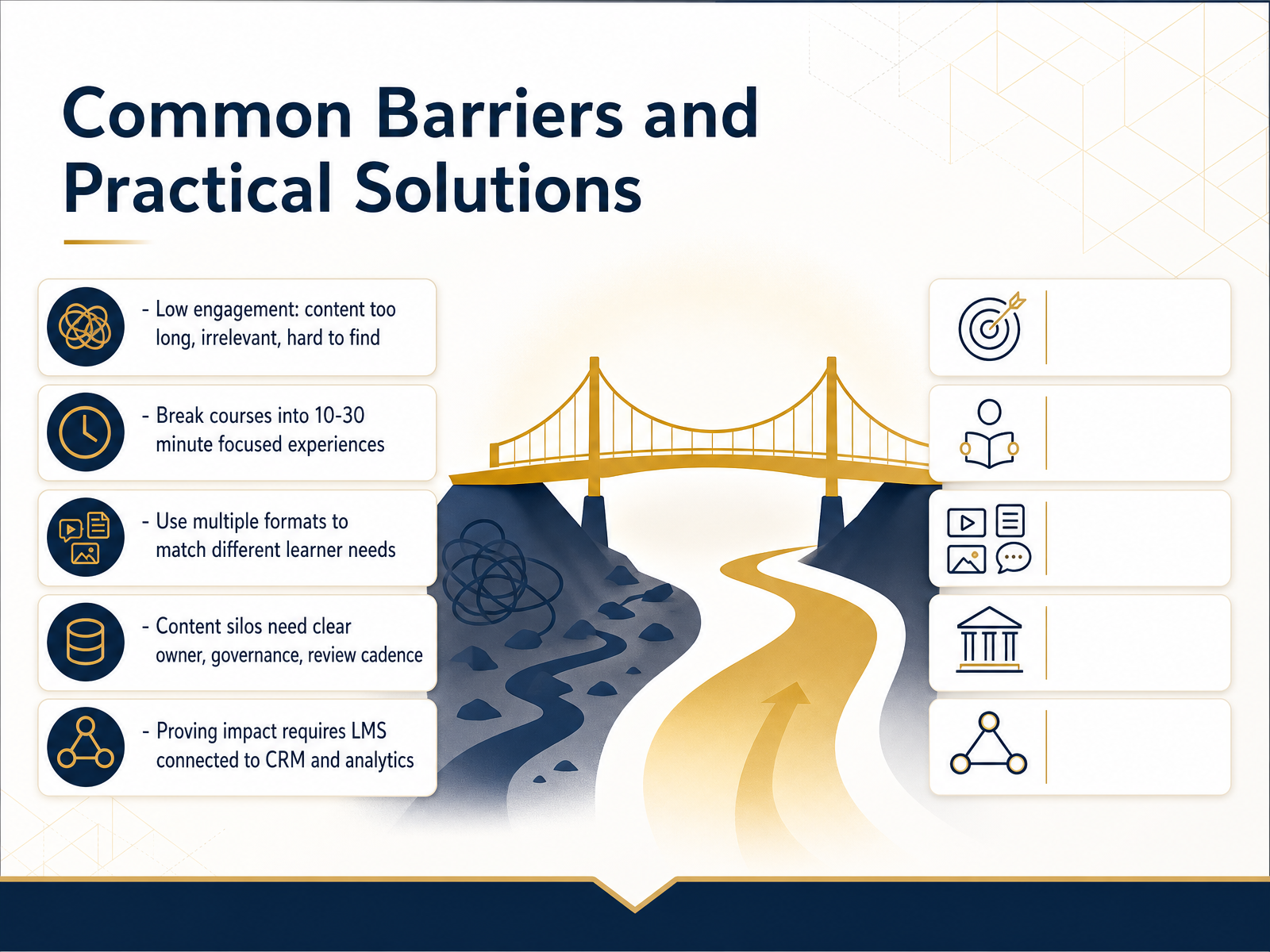
 - 12Common Barriers and Practical SolutionsLet’s talk about the barriers that quietly undermine customer education, and more importantly, the practical fixes. Low engagement usually means content is too long, not relevant, or simply hard to find. The strongest move is to break training into focused ten to thirty minute experiences. Data shows completion rates stay above eighty percent in that range, then drop sharply. Mix formats as well. Video, short lessons, and hands-on paths serve different learners better than one style for everyone. Next, content silos. If no one owns accuracy and freshness, trust erodes quickly. Assign a clear owner, establish a governance rhythm, and set a regular review cadence. Finally, proving impact. Completion counts alone will not persuade leadership. Connect your LMS to your CRM and analytics stack. Then you can compare trained versus untrained cohorts on renewal, adoption, and support tickets. That is the evidence that turns education from a cost center into a growth lever. Next, we’ll look at launching or improving your program.
 thinkific.com2 min
 - 13Launching or Improving Your ProgramSo how do you actually get this off the ground? The answer is to start small, but start with intent. Don't try to build a full-scale academy on day one. Instead, launch a minimum viable academy for one high-impact audience, like new admins during onboarding. Then, source your first pieces of content from real friction. Look at your top support tickets and the gap between what your best accounts do and what your typical accounts do. That gap is your curriculum. Use a thirty, sixty, ninety day roadmap to show early progress. In the first thirty days, drive initial logins and validate the content. By sixty, refine based on data and surface early wins. By ninety, you should have a repeatable model ready to expand. And most importantly, don't let this become a side project. Name a single owner and define governance from day one, because content without an owner goes stale quickly. Let's move on to your action plan and next steps.
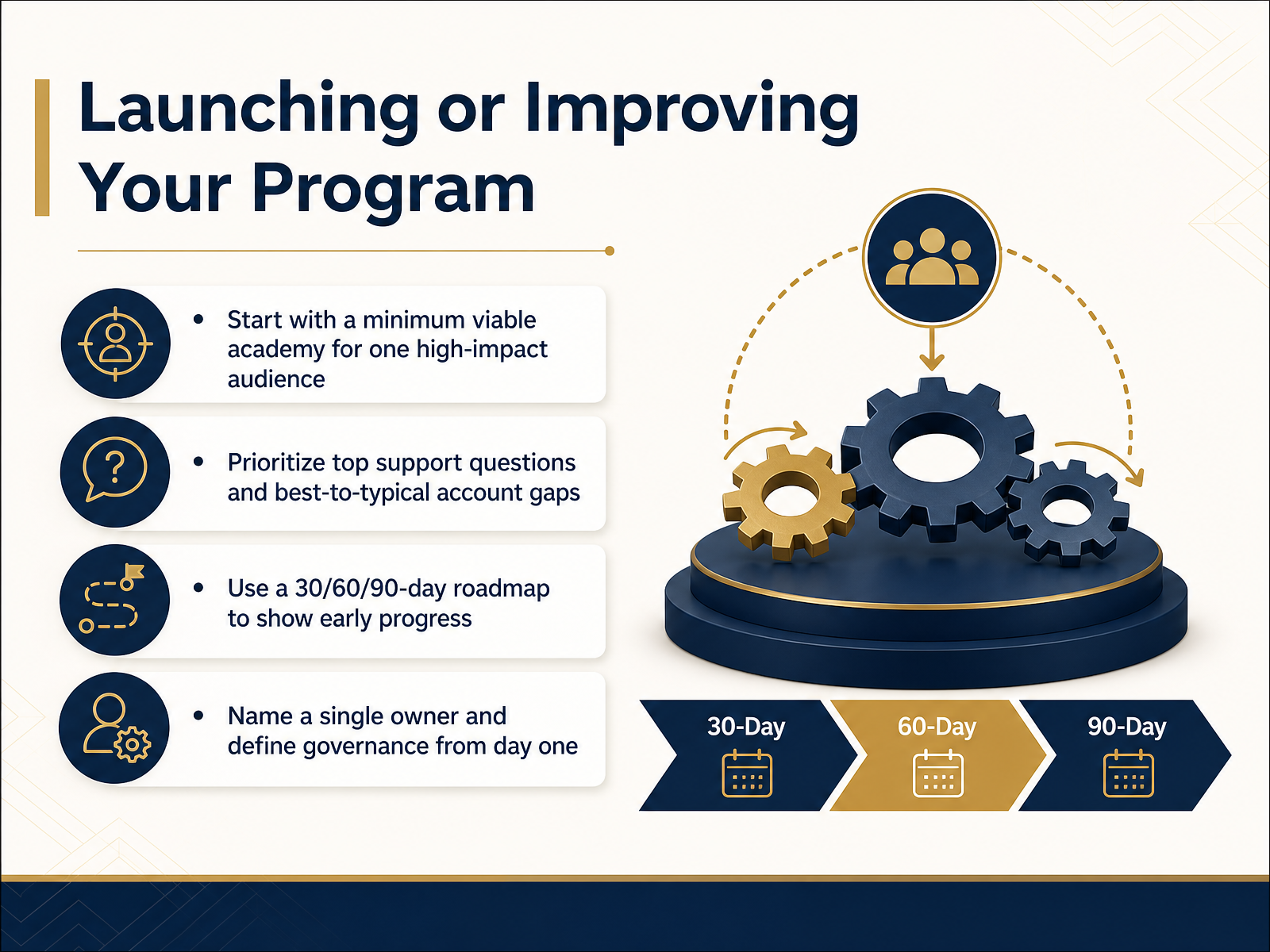 absorbai.com2 min
 - 14Action Plan and Next StepsSo here is the short version of what happens next. Customer Success owns the diagnosis. That means identifying where onboarding actually stalls, and which adoption questions keep coming up in real conversations. Training leaders own the measurement. Before anything launches, define the outcome, the baseline, and the number you are trying to move. And content creators own the mapping. Take the top questions, match each one to the right format, and give every asset an owner and a review date. Then give yourselves two weeks to lock in success metrics, clear ownership, and a simple governance rhythm. That governance is what keeps content from going stale after launch. And resist the urge to boil the ocean. Start with a minimum viable academy for one high impact audience: one role, one high-value outcome, one channel. Get it live. Measure what actually changed. Then expand deliberately. You do not need the perfect academy. You need a working one that proves customer education is a growth lever. Thank you for sticking with this, and now go ship something useful.
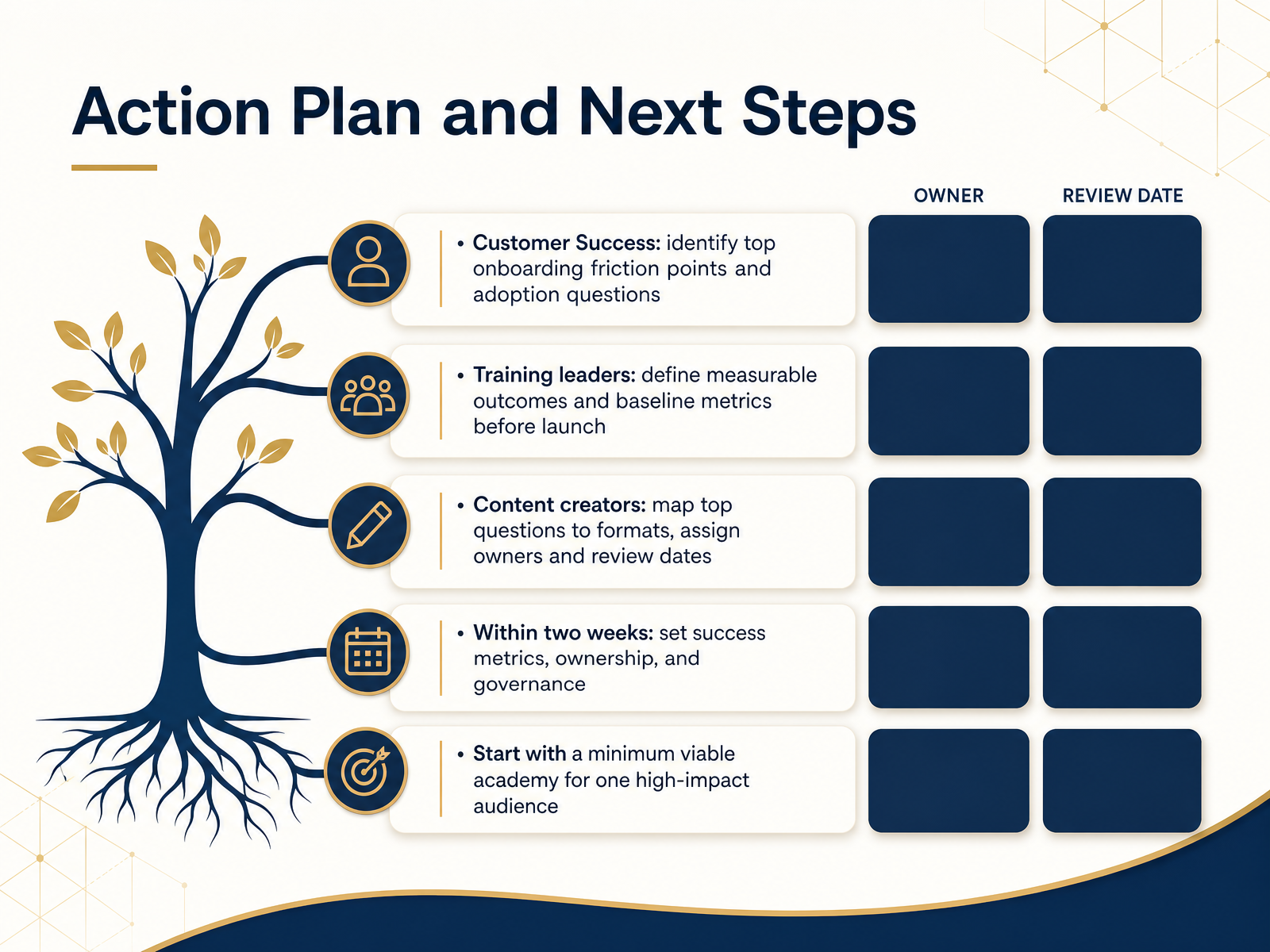 gainsight.comlearnworlds.comgainsight.com+22 min
Take the deck with you
Download this course as a file — free, no sign-up needed.
- PDF handoutEvery slide page, ready to print or share.15 pages · 3.7 MBDownload
- Narrated PowerPointThe deck that presents itself — every slide carries the digital human's narration video.15 pages · 14.3 MBDownload
- PowerPoint slidesThe full deck as a .pptx — open it in PowerPoint, Keynote, or Google Slides.15 pages · 3.6 MBDownload
Free to use in your own training — please keep the PersonWise credit page at the end.
Have your own deck? Turn it into a course
Sources consulted
Web sources consulted while building this course.
- Customer Education Impact: 7.6% Revenue Lift (Research) — intellum.com
- Proactive Customer Education, Customer Retention, and Demand for Technology Support: Evidence from a Field Experiment — papers.ssrn.com
- Investments in Customer — info.thoughtindustries.com
- 2022 Customer Education Benchmarks and Trends Report: Key Insights Into the Growing Impact of Customer Training — skilljar.com
- StateofEducation-101B — info.thoughtindustries.com
- 7 Data-Backed Benefits of Customer Education (2026) | Trainn — trainn.co
- New Research Confirms Education-Led Growth as a Critical Business Strategy — intellum.com
- The state of customer education in 2026 | Absorb LMS Software — absorbai.com
- New Absorb Software and Lighthouse Research & Advisory Study Reveals How the Highest-Performing Customer Education Programs Turn Learning into Measurable Growth | Absorb LMS Software — absorbai.com
- 2025 Roundup: Advice from Customer Education Leaders in 2026 - Thought Industries — thoughtindustries.com
- CE 2025 Trends—Skilljar — skilljar.com
- CloudShare Report | The State of Customer Education in 2025 — go.cloudshare.com
- Customer Education Benchmarks & ROI Report: Discover Key Insights to Maximize Impact and Drive Growth | Thinkific — thinkific.com
- From Learning To Revenue: 2026 Industry Benchmarks Report | Thinkific — thinkific.com
- How Jamf Made Customer Success + Customer Education a Power Duo | Gainsight Software — gainsight.com
- Customer Education in SaaS: The Complete Guide | LearnWorlds — learnworlds.com
- What Is Customer Enablement? Definition and Framework — gainsight.com
- How Orca Security Scaled Self-Serve Onboarding and Cut Activation Time with EverAfter — everafter.ai
- Asana Scales Training and Sees 2X+ Growth in Users for eLearning Platform — skilljar.com
- Customer expansion strategy: How training drives revenue ... — absorbai.com