Data Engineering Tool Selection and Workflow Design
Begin
14 pages · ~28 min
Data Engineering Tool Selection and Workflow Design
Learn to select appropriate data engineering tools and design efficient workflows for data processing pipelines.
What you’ll learn
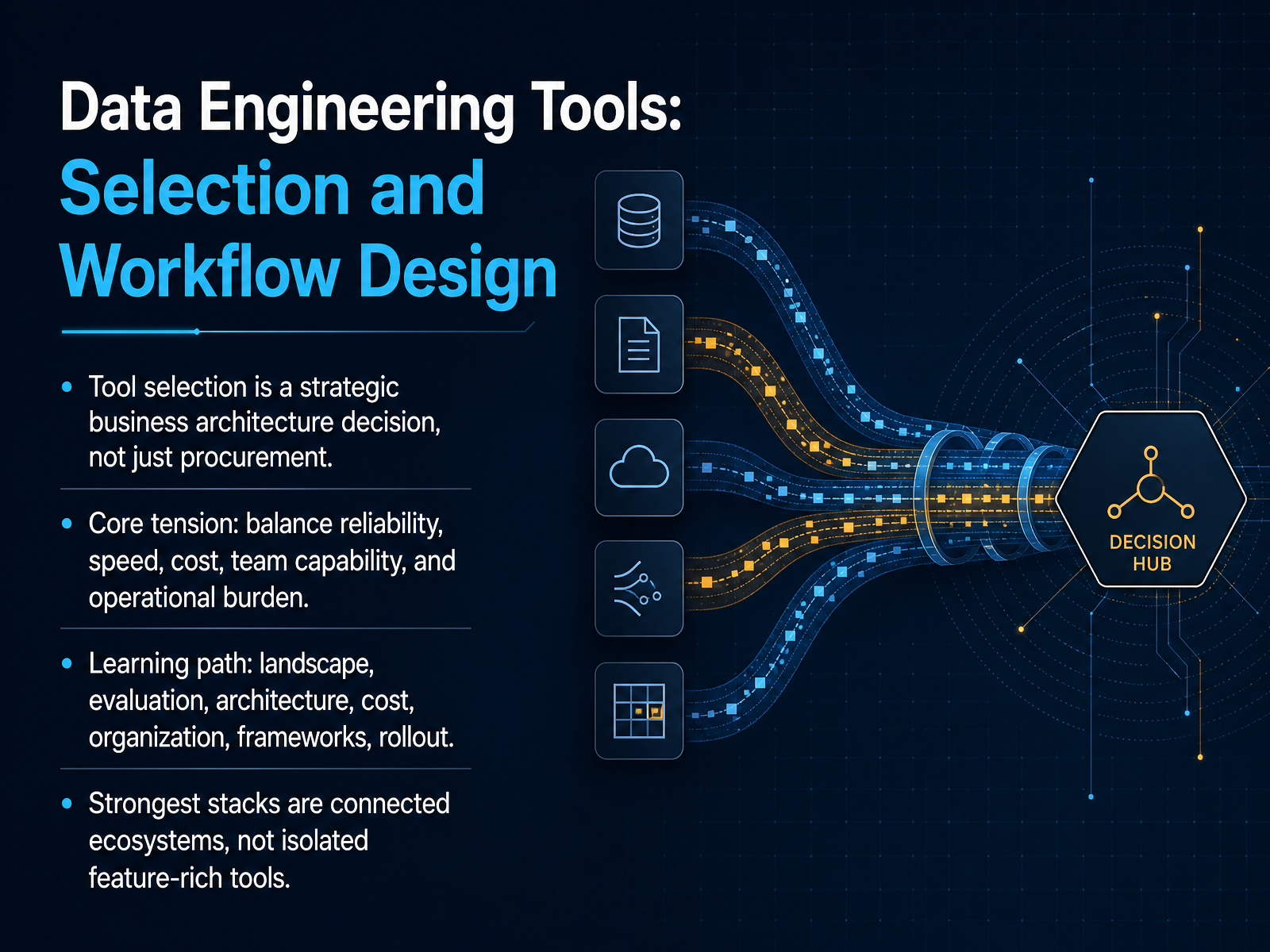
- 01Data Engineering Tools: Selection and Workflow DesignWelcome to Data Engineering Tools: Selection and Workflow Design. This course is built for technical decision-makers who need to choose tooling that holds up in production, not just on paper. The core premise is straightforward. Tool selection is a business architecture decision. It determines your scalability, your governance surface, and your cost profile long before the first pipeline is built. Throughout this course, we will move through the landscape, the evaluation criteria, the architecture design, and the operational trade-offs. We will not do feature lists. We will focus on the tension that matters: reliability versus speed, cost versus team capability, and managed simplicity versus operational control. The strongest stacks are connected ecosystems, not isolated tools. What matters is how well the components integrate, and whether your team can operate the system under real production load. In the next slide, we will look at why this decision has become significantly harder in recent years.cto.milupsolver.combarc.com+21 min
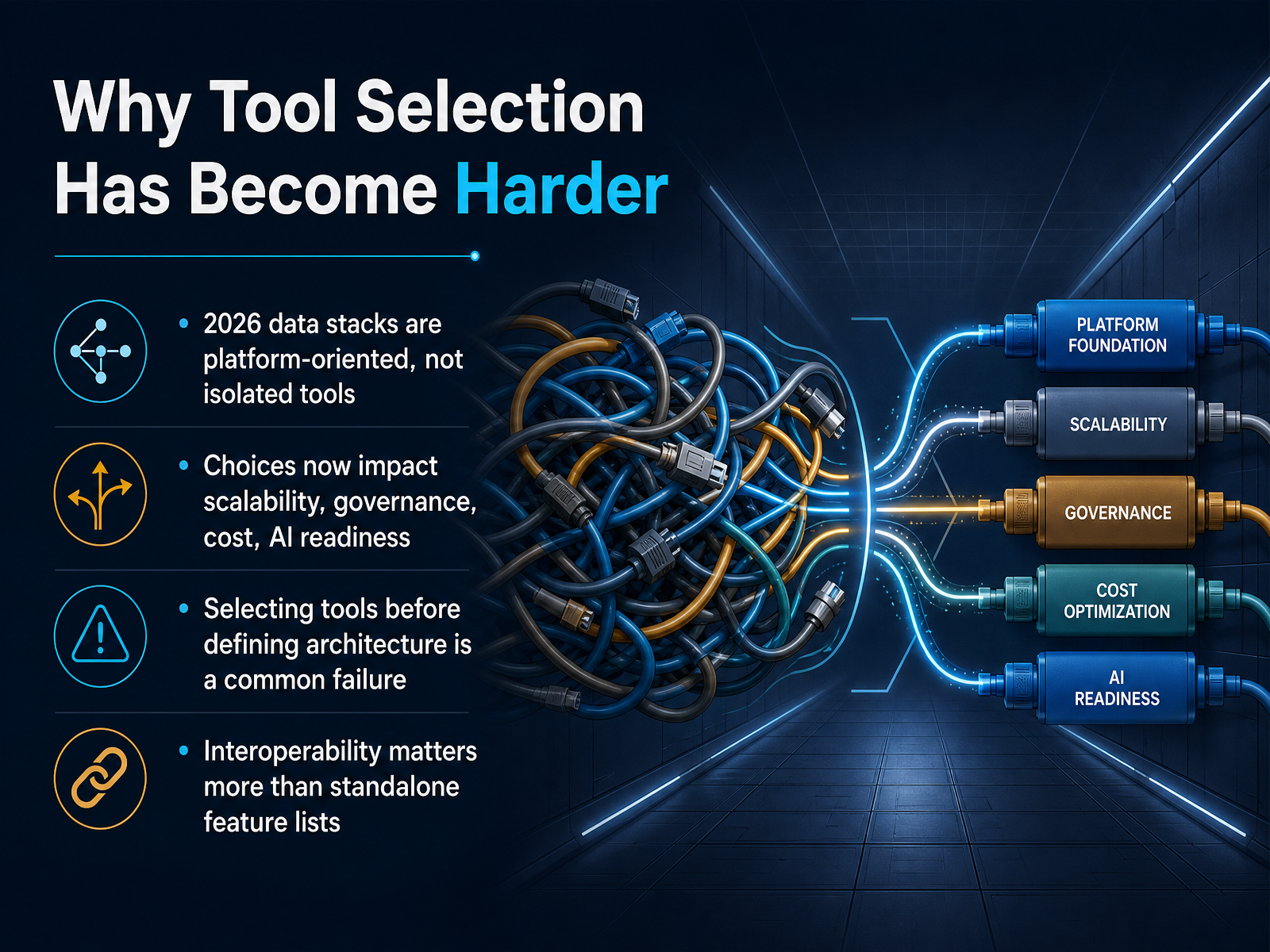
- 02Why Tool Selection Has Become HarderLet's start with why tool selection has become genuinely harder. In 2026, data stacks are platform-oriented. They are not a collection of isolated tools. Every choice you make now ripples through scalability, governance, cost, and AI readiness. That is a significant shift from even a few years ago. The most common failure we see is selecting tools before defining architecture. Teams evaluate feature lists, pick a vendor, and only then discover the integration costs. Interoperability matters more than any standalone feature set. A tool that performs well in isolation but fights your ecosystem will create operational drag everywhere else. Strong stacks are connected stacks. When you approach selection, think in terms of ecosystem fit first, then functionality. That principle frames everything else we will cover. Next, we will look at the tool selection landscape.
 cto.milupsolver.combarc.com+21 min
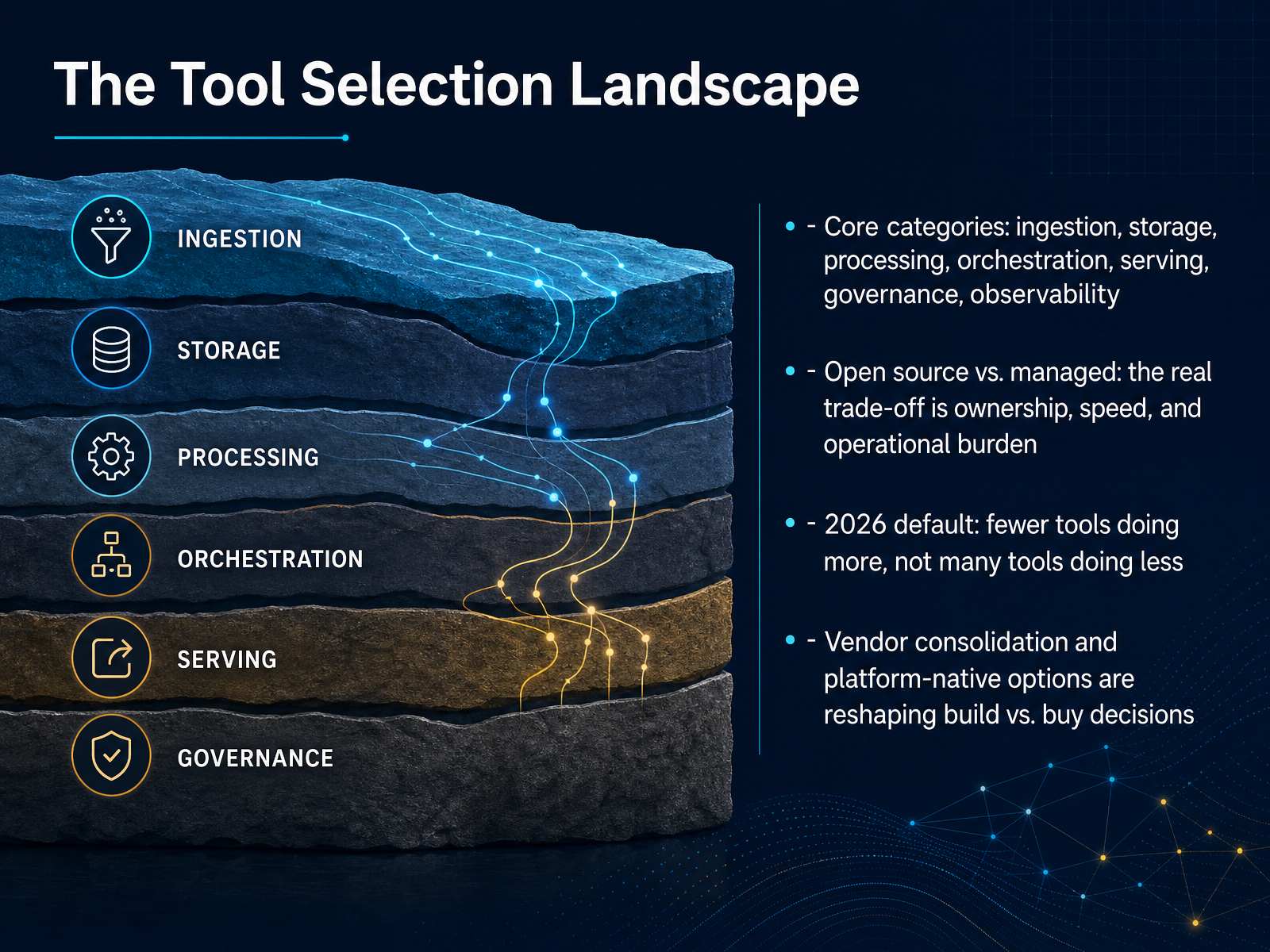
 - 03The Tool Selection LandscapeNow let's step back and look at the selection landscape itself before we get into specific evaluation methods. Your platform decomposes into seven functional responsibilities: ingestion, storage, processing, orchestration, serving, governance, and observability. When choosing tools, the first real fork is open source versus managed. The trade-off isn't merely software cost. It comes down to ownership, speed of delivery, and operational burden. Open source buys control but shifts infrastructure, upgrades, and incident response onto your team. Managed options trade that control for faster time to value and lower operational load, but costs can increase sharply at scale. In 2026, the default is consolidation: fewer tools doing more, not many tools doing less. Tool sprawl has shifted from an integration tax to a governance and cost risk. Vendors are converging the stack. Snowflake, Databricks, and Microsoft Fabric are expanding platform native capabilities, which reshapes the build versus buy question. The smart position is to treat every layer as a responsibility you must cover, then decide whether you want to own it or rent it. Next, let's look at the evaluation criteria that actually matter.
 getorchestra.iosmallbizamerica.orgnkpremices.com+21 min
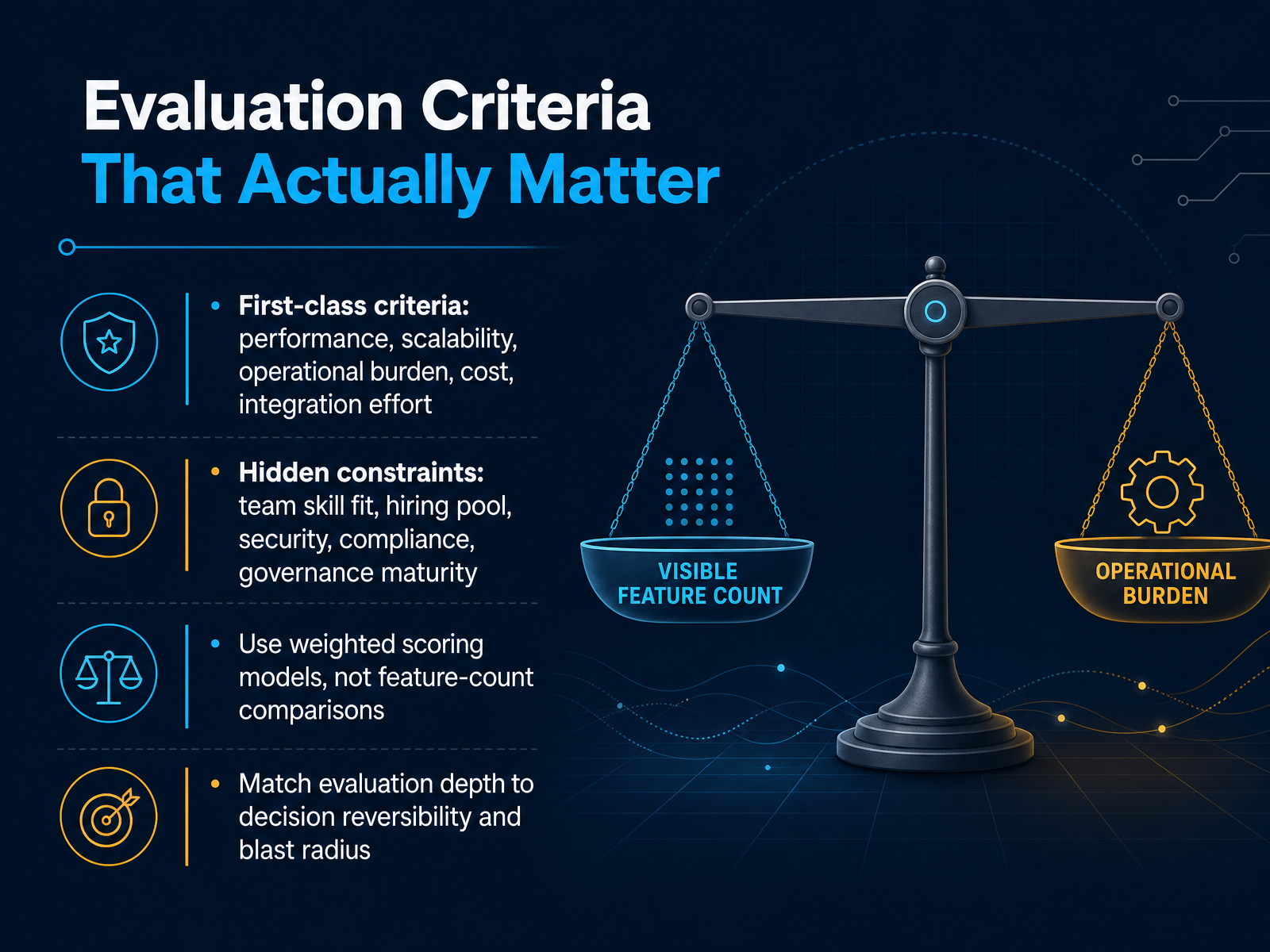
 - 04Evaluation Criteria That Actually MatterLet's get specific about evaluation criteria. Most teams run vendor demos and compare feature lists. That approach misses the point. What actually determines whether a tool succeeds in production is its cost profile across five dimensions. Performance and scalability under your real workloads. Operational burden, meaning the ongoing engineering hours required to keep it healthy. Total cost, including compute, licensing, and the hidden cost of pipeline maintenance. And integration effort with your existing stack. These five factors are first-class criteria. They decide whether the tool survives contact with production. But there is a second set of constraints that often gets ignored until it is too late. Your team's current skill fit, the hiring pool for engineers who know the tool, security and compliance requirements, and your organization's governance maturity. These are not nice-to-haves. They are hard constraints that can invalidate an otherwise strong technical choice. So how do you structure all this? Use weighted scoring models. Assign numeric weights to each criterion based on your specific operational context, and score each candidate against those weights. This surfaces trade-offs that feature-count comparisons completely hide. And do not apply the same evaluation depth to every tool decision. A tool with high reversibility and small blast radius can be evaluated quickly. A platform that anchors your entire pipeline for years deserves a much deeper process, including a proof of concept with your own data. Next, we will map these evaluation criteria to specific workflow stages.
 cto.milupsolver.combarc.com+21 min
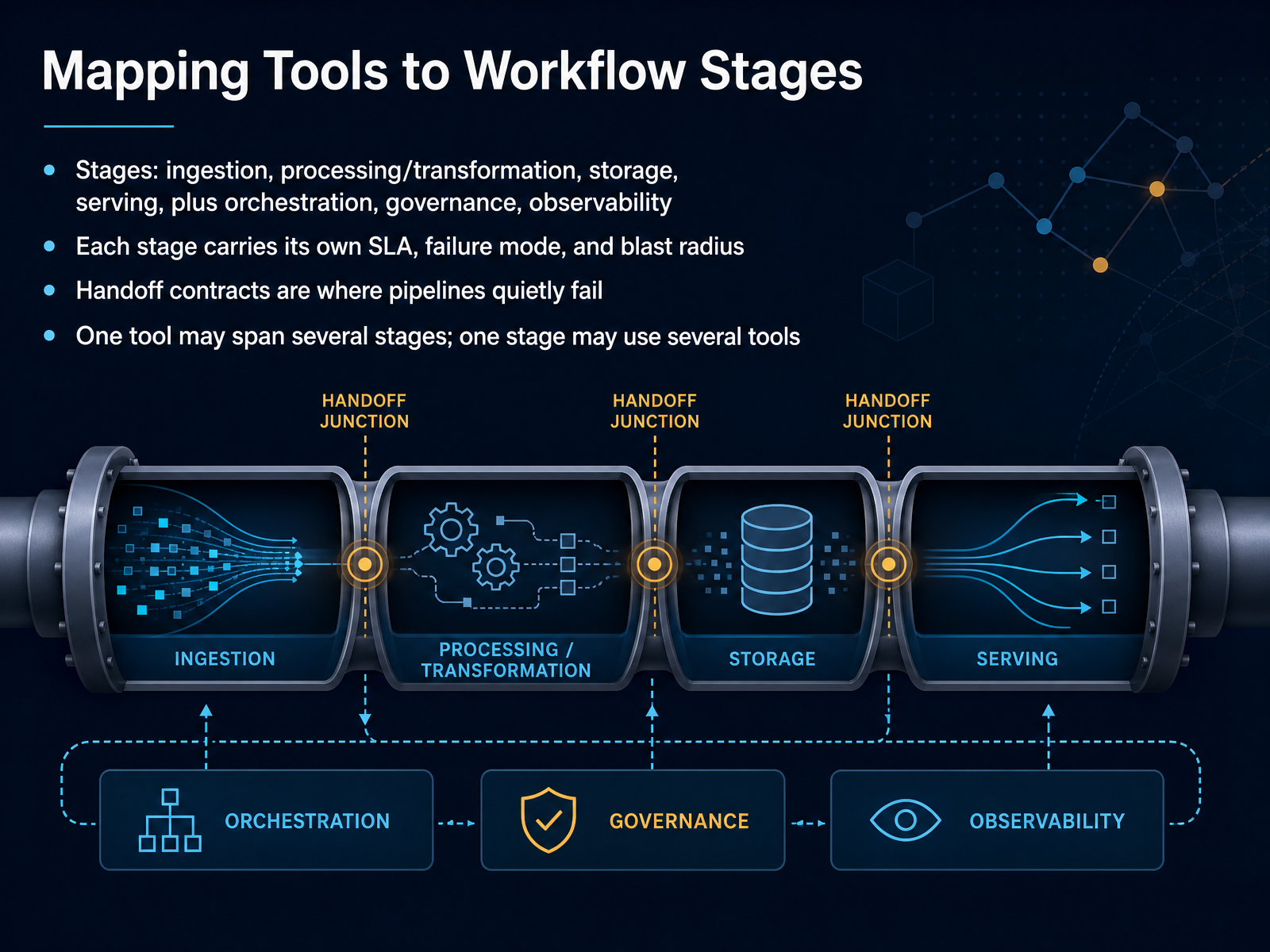
 - 05Mapping Tools to Workflow StagesLet's map those selection criteria onto the actual workflow stages. You have ingestion, processing and transformation, storage, and serving. Around those core stages sit orchestration, governance, and observability. Treat these seven as responsibilities, not seven distinct servers. ClickHouse, for example, spans both storage and serving. Conversely, a single stage like ingestion might combine Fivetran for SaaS sources with Kafka Connect for database change capture. The key is that each stage carries its own SLA, its own failure mode, and its own blast radius. An ingestion failure stalls everything downstream. A serving layer failure is visible to users immediately. The place where pipelines quietly break is in the handoff contracts between stages. Schema drift at the ingestion to storage boundary, or a semantic mismatch between transformation and serving, will corrupt trust silently. So when you map tools, define the interface contract explicitly. Ask what schema, what freshness guarantee, and what failure semantics the downstream stage inherits. That contract discipline sets up the workflow choices we will compare next.
 ibm.comtechtarget.comibm.com+21 min
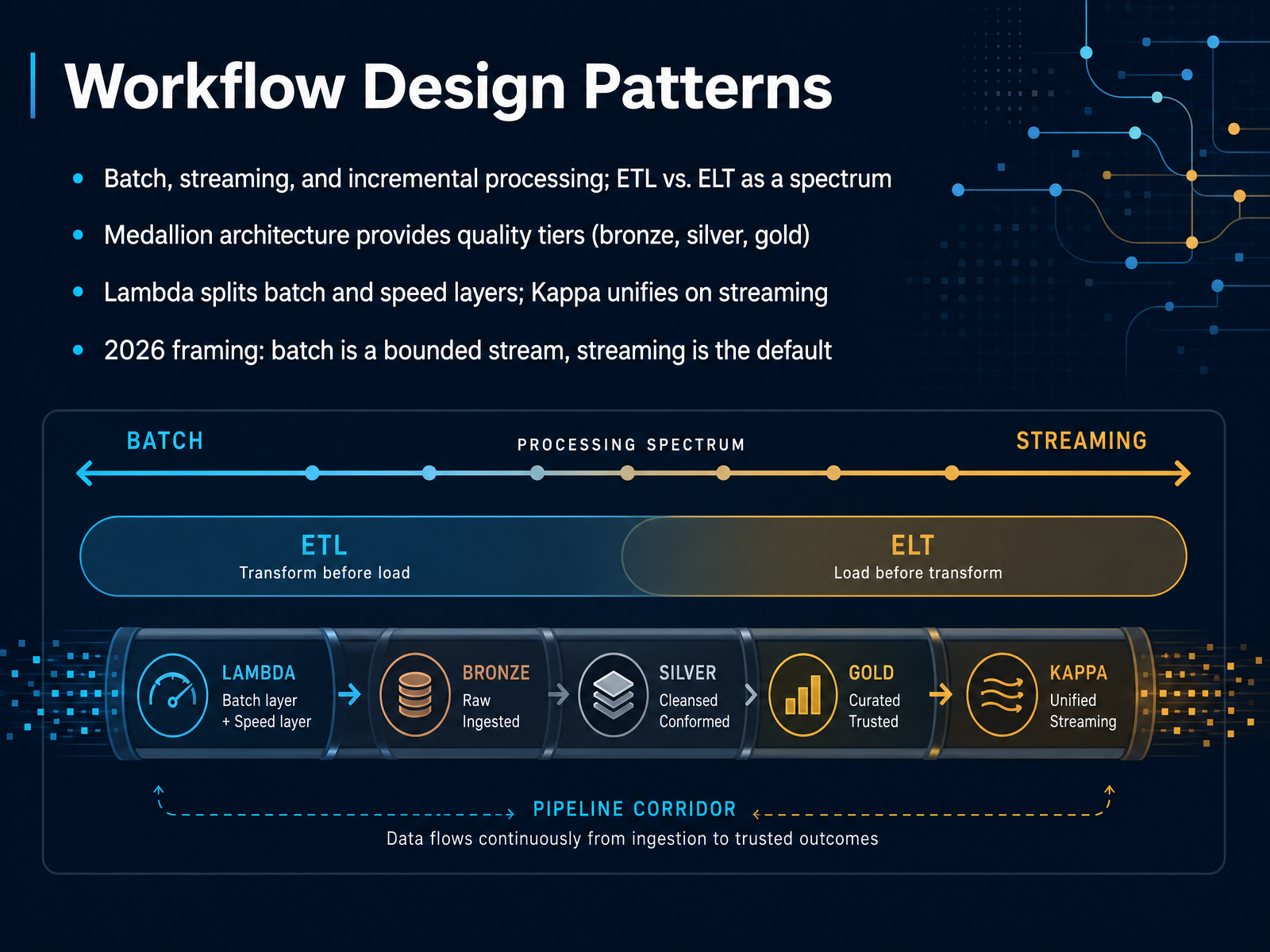
 - 06Workflow Design PatternsNow let's move from tool selection to the workflow patterns those tools operate within. The core tension is batch versus streaming, with incremental processing sitting between them, and ETL versus ELT is no longer a binary choice. It is a spectrum driven by where your compute is most cost-effective and where data quality gates are enforceable. For most cloud-native stacks, ELT is the default. Load raw data first, transform inside the warehouse using tools like dbt. ETL still wins when regulations force redaction before storage, when source volume is too large to land raw, or when transformation logic cannot be expressed in SQL. The medallion architecture remains the standard for organizing quality tiers. Bronze is raw ingestion. Silver is cleaned, validated, and deduplicated. Gold is business-ready aggregates. This pattern applies regardless of whether your pipeline is batch or streaming. When choosing between Lambda and Kappa, Lambda splits batch and speed layers, but carries the cost of maintaining two codebases. Kappa unifies on a single streaming path, with replay handling historical reprocessing. For 2026, frame the decision this way: batch is a bounded stream, and streaming is the default ingestion mode. Add batching only where latency genuinely does not matter. Let's now look at the workflow anti-patterns that undermine these patterns.
 ibm.comtechtarget.comibm.com+22 min
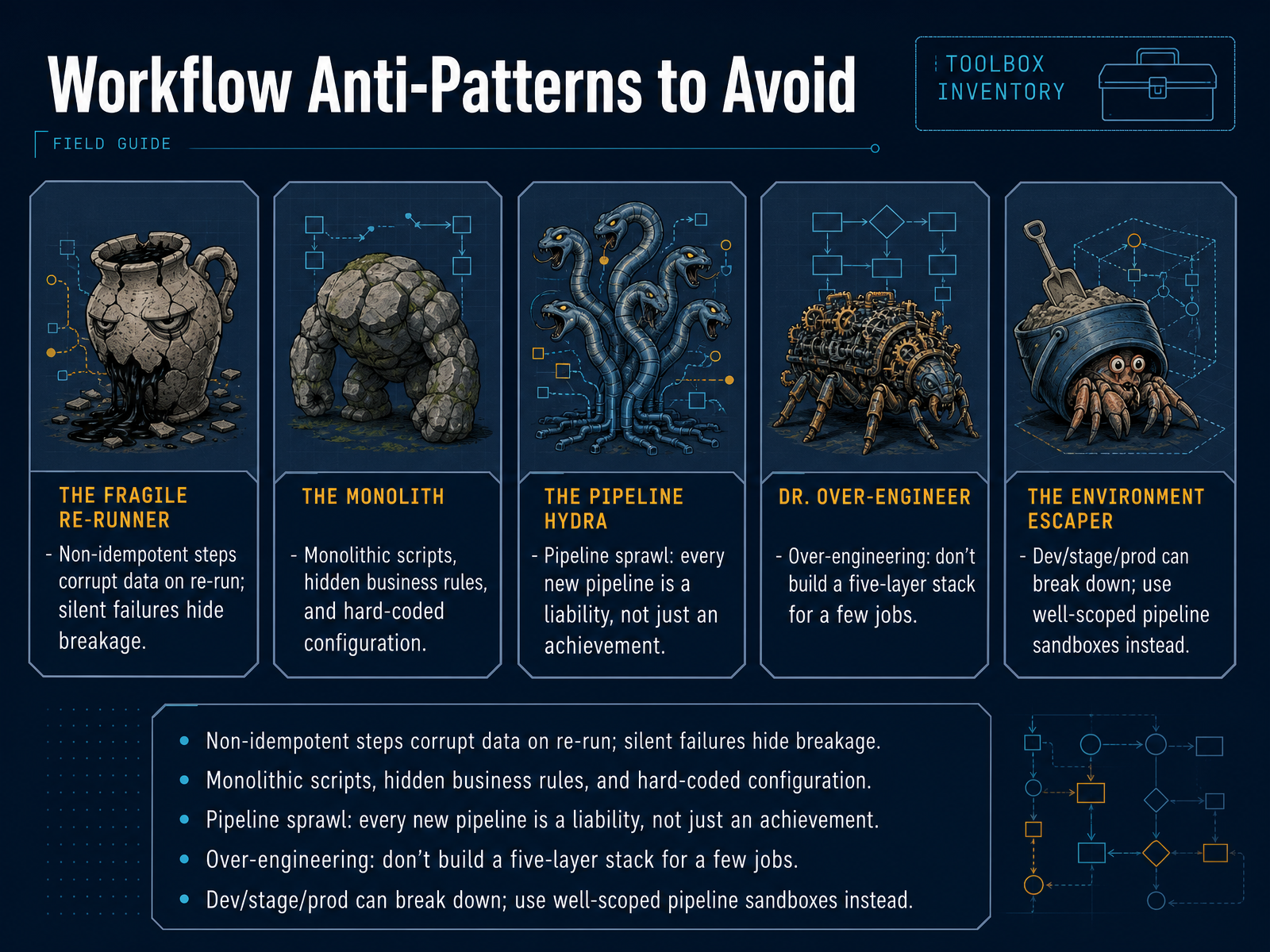
 - 07Workflow Anti-Patterns to AvoidNext, the workflow anti-patterns that quietly erode reliability. First, non-idempotent steps. If a re-run duplicates data or leaves gaps, you have corrupted state and silent failure. Every step must be safe to execute more than once. Second, monolithic scripts with hidden business rules and hard-coded configuration. These make changes risky and debugging slow. Move rules into documented, config-driven modules. Third, pipeline sprawl. Every new pipeline adds compute, monitoring, and maintenance load. Treat each one as a liability to justify, not an achievement to celebrate. Fourth, over-engineering. A five-layer stack for a handful of jobs creates complexity with no payoff. Match the architecture to the actual workload. Fifth, the dev stage prod model often fails for data pipelines because synchronizing large data states becomes expensive and slow. Use well-scoped pipeline sandboxes tied to a git branch and a writable snapshot instead. That gives isolation without freezing the team. Up next, we will assess total cost and operational burden.
 dorianbg.github.ioinfinisynapse.comcoeurdata.com+21 min
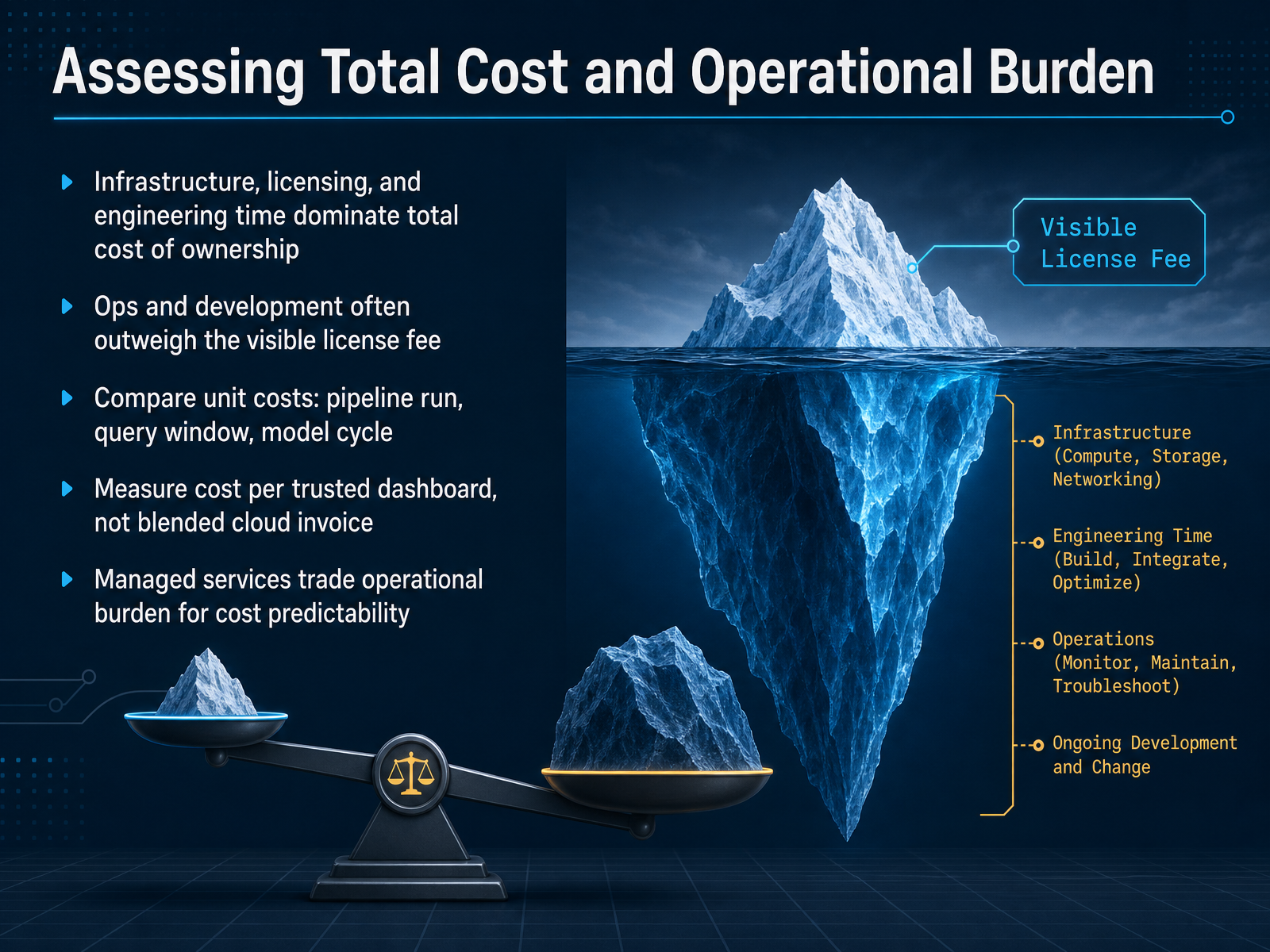
 - 08Assessing Total Cost and Operational BurdenLet's shift from feature comparison to the cost picture that actually shows up on your P-and-L. Total cost of ownership is driven by three things: infrastructure, licensing, and engineering time. The visible license fee is rarely the dominant cost. Operations and ongoing development usually outweigh it. So how do you measure this properly? Stop looking at a blended cloud invoice. Instead, compare unit costs. Cost per pipeline run. Cost per query window. Cost per model cycle. The unit that matters most is cost per trusted dashboard. That single number ties platform spend to business output. It exposes whether a tool is cheap to run or just cheap to buy. Managed services usually reduce operational burden. In exchange, they trade that burden for cost predictability. You pay a premium, but the spend becomes forecastable. Self-managed tools invert that trade. Lower visible license cost, higher engineering and on-call burden. Neither is universally better. The right choice depends on which side of that trade your team can absorb. That cost and burden analysis leads directly into who will actually run the platform. Let's talk about team structure and organizational fit.
 getorchestra.iosmallbizamerica.orgnkpremices.com+21 min
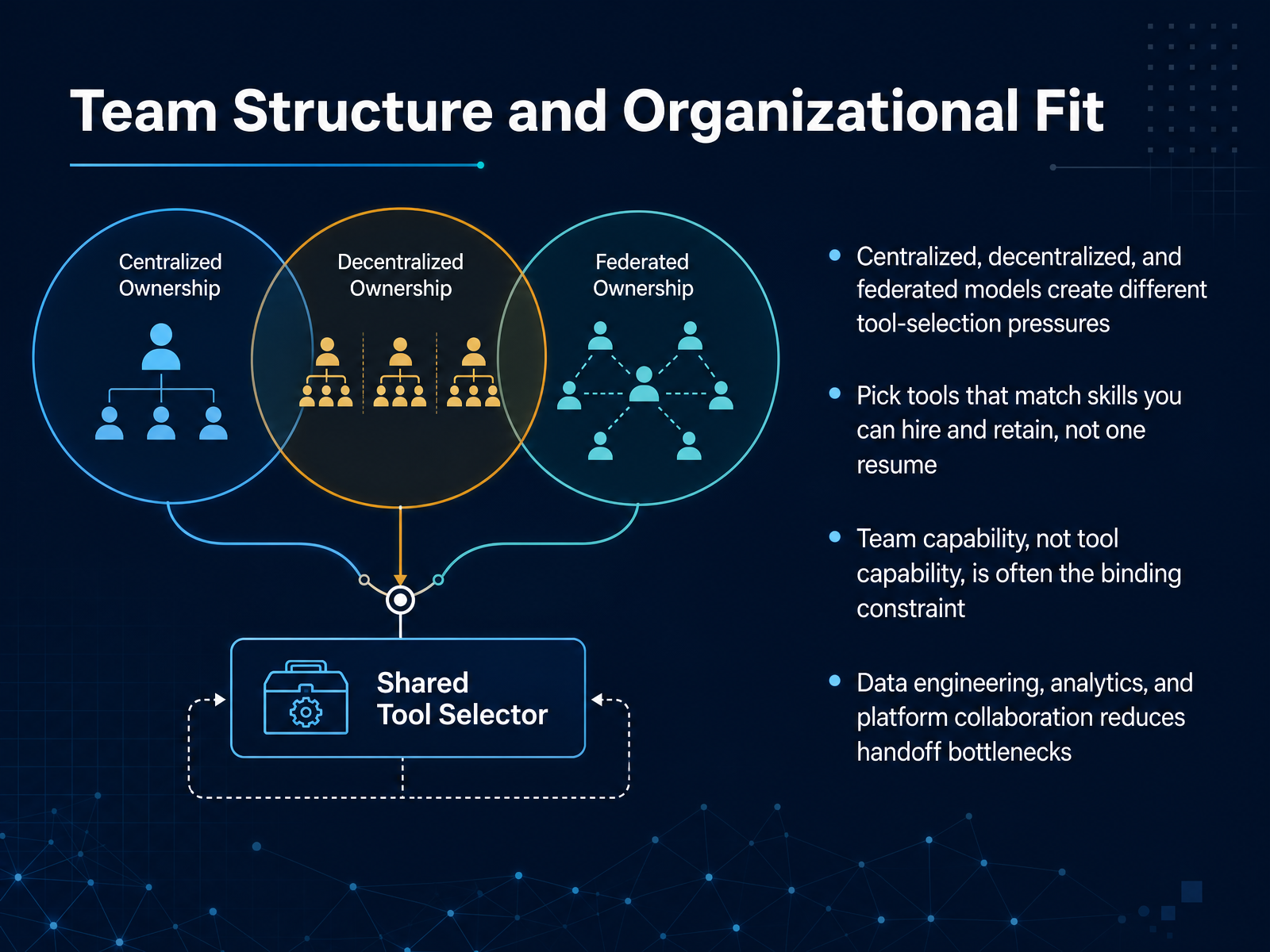
 - 09Team Structure and Organizational FitNext, let's focus on organizational structure, because team topology creates different tool-selection pressures. Centralized models favor standardization and a single governance plane, which pushes you toward platforms with strong collaboration and lineage features. Decentralized teams need tools that are safe for domain-level autonomy. Federated models sit in between, requiring both central guardrails and local flexibility. The key constraint is rarely tool capability. It is team capability. Select tools that match the skills you can realistically hire and retain, not the resume of a single engineer. A team experienced in SQL will deliver faster on dbt than on a Python-native framework, regardless of feature lists. When tool complexity outpaces team capacity, delivery stalls. Cross-functional collaboration between data engineering, analytics, and platform teams also reduces handoff bottlenecks. Tools that share a common catalog or observable layer help different functions work on the same platform without stepping on each other. Up next, we will examine decision frameworks and trade-off playbooks.
 cto.milupsolver.combarc.com+22 min
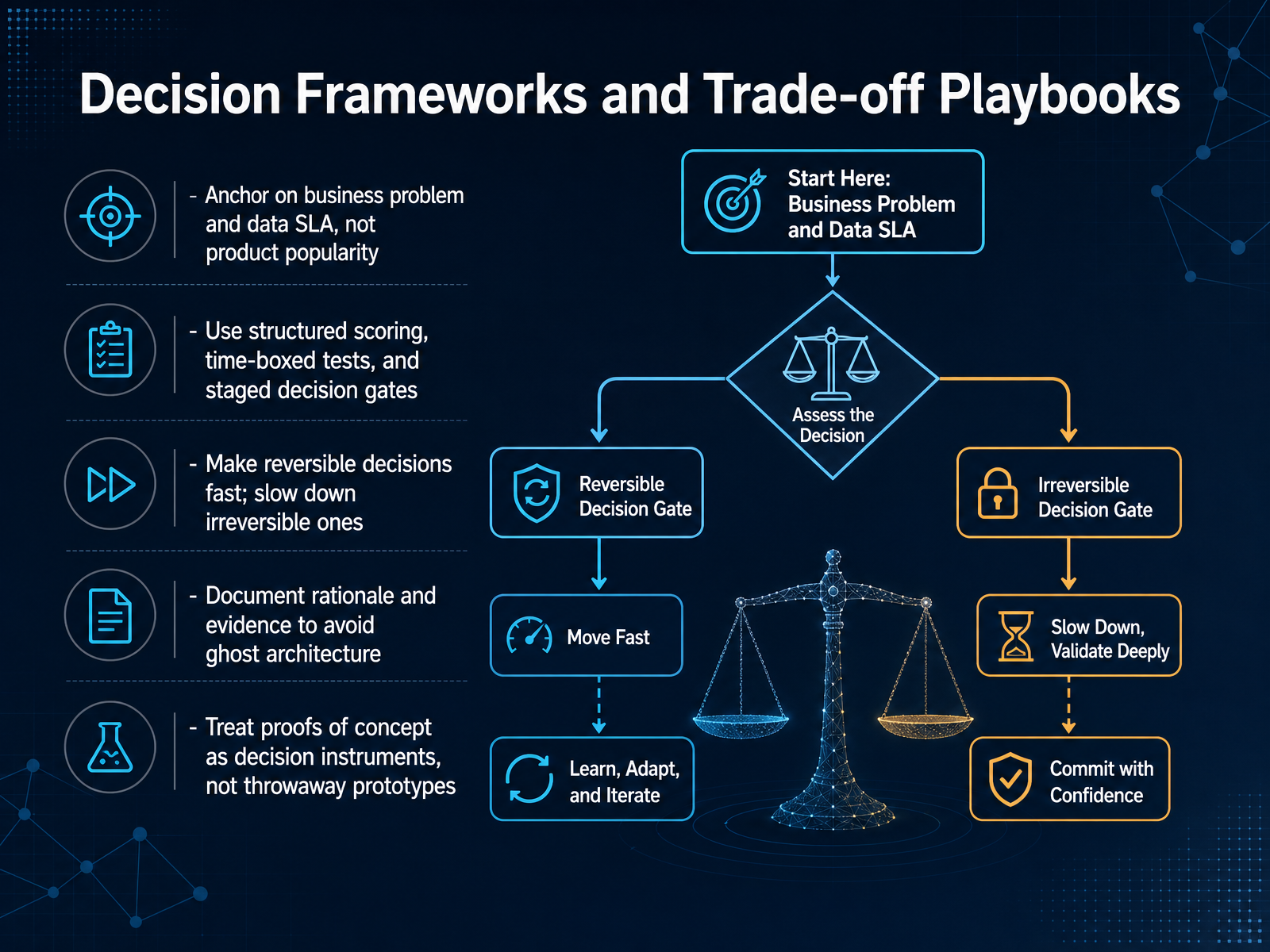
 - 10Decision Frameworks and Trade-off PlaybooksLet's move from criteria to the decision framework itself. The core rule is simple: anchor every choice to a business problem and a data SLA, not to product popularity. A tool is only a good tool if it closes a specific capability gap with measurable evidence. Use structured scoring, time-boxed tests, and staged decision gates. That prevents the drift from a technical evaluation into a demo-driven purchase. Make reversible decisions fast. If a tool can be swapped out cheaply, do not spend three months debating it. But slow down on irreversible choices like a proprietary storage format or a deeply embedded orchestration layer. Document the rationale and the evidence for every major call. That avoids ghost architecture, where high-impact decisions are made off the record and cannot be justified later. Finally, treat proofs of concept as decision instruments, not throwaway prototypes. Each PoC should answer a falsifiable question, with pass and fail thresholds defined before you start. In the next slide, we'll look at how to run those proofs of concept effectively.
 iso.orgcto.milupsolver.com+22 min
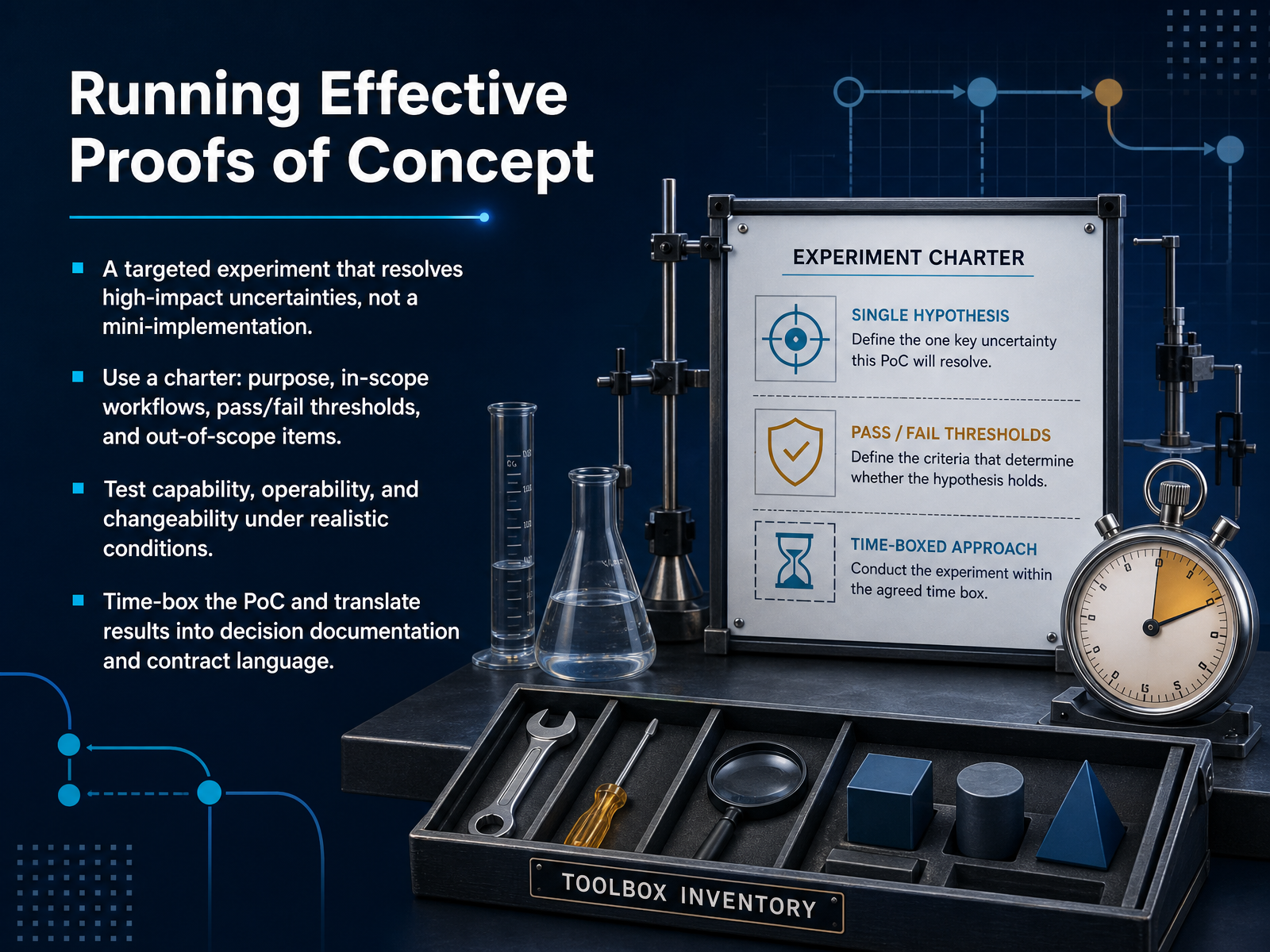
 - 11Running Effective Proofs of ConceptNow let's talk about running proofs of concept in a way that actually changes decisions. A PoC is a targeted experiment, not a mini implementation. Start with a charter that fixes purpose, in-scope workflows, out-of-scope items, and hard pass or fail thresholds. Then test three things under realistic conditions. Capability: does the tool handle your actual rules and messy data? Operability: can your team detect, troubleshoot, and recover from failures? Changeability: can an admin safely modify rules or schemas without vendor help? Time-box the exercise, typically four to six weeks, and stop early if a gated item fails. When the PoC ends, translate results into decision documentation and negotiation leverage. Proven behaviors become acceptance criteria or contract language. Residual gaps become priced options or explicit commitments. If the PoC does not produce an Architecture Decision Record or update the selection scorecard, treat it as incomplete. The output is not comfort. It is evidence that changes the deal. Next, we move into the practical selection exercise.
 iso.orgibm.comtechtarget.com+22 min
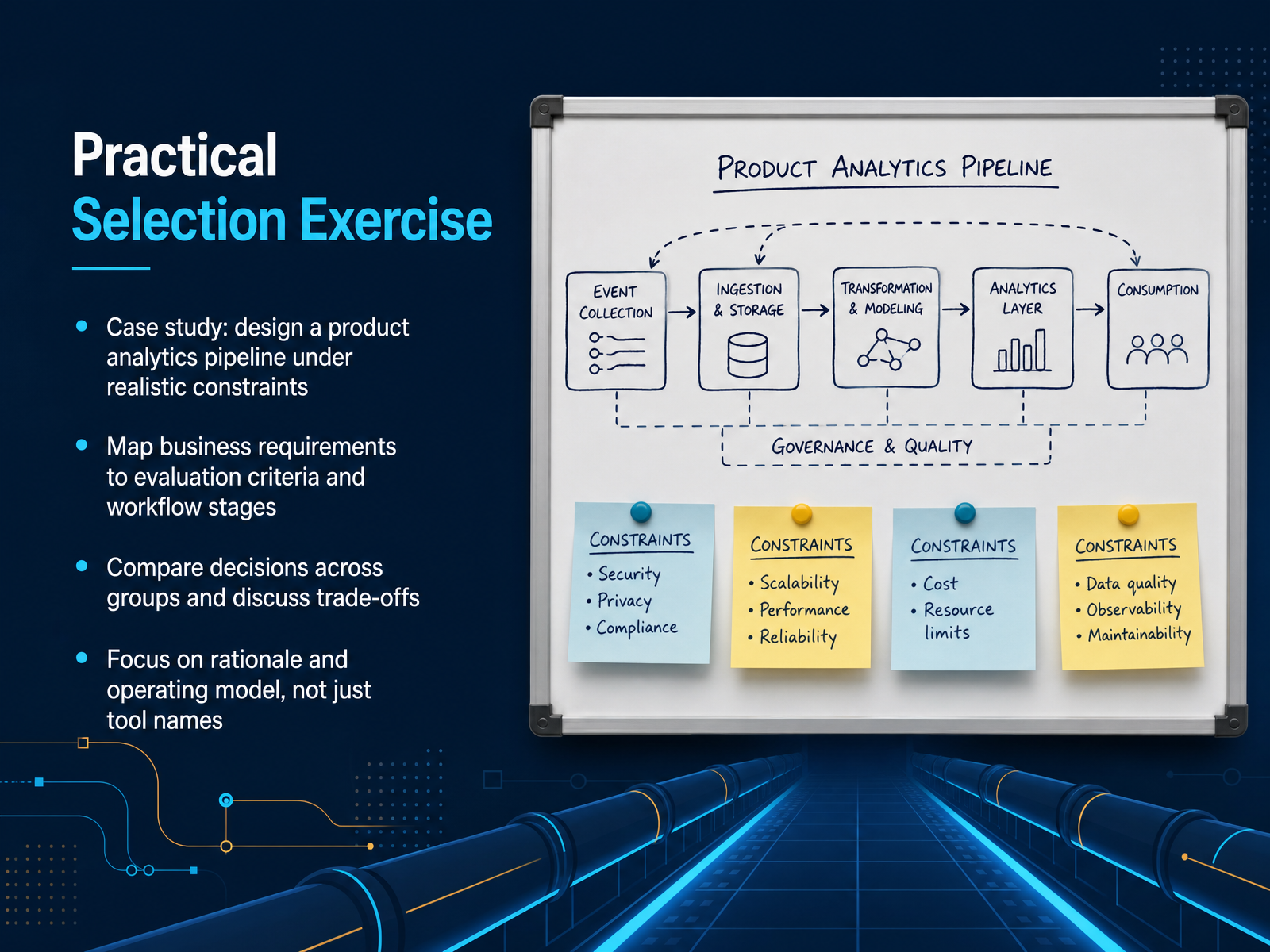
 - 12Practical Selection ExerciseLet's move from framework to practice. Consider a product analytics pipeline under realistic constraints. Start with the business problem, not the vendor list. What latency does the product team actually need? What is the governance boundary? What can the team operate long term? Map those answers to evaluation criteria across ingestion, storage, transformation, and serving. Then compare decisions across groups, because rationale is the real output. Two teams can pick different tools and both be right if their operating models differ. Do not defend a tool name. Defend the trade-off. Does ELT preserve enough history for reprocessing? Does streaming justify its cost here? Does the catalog support the compliance surface? Capture the decision as an architecture document, including what you rejected and why. Next, we will cover rolling out your decision.
 ibm.comtechtarget.comibm.com+21 min
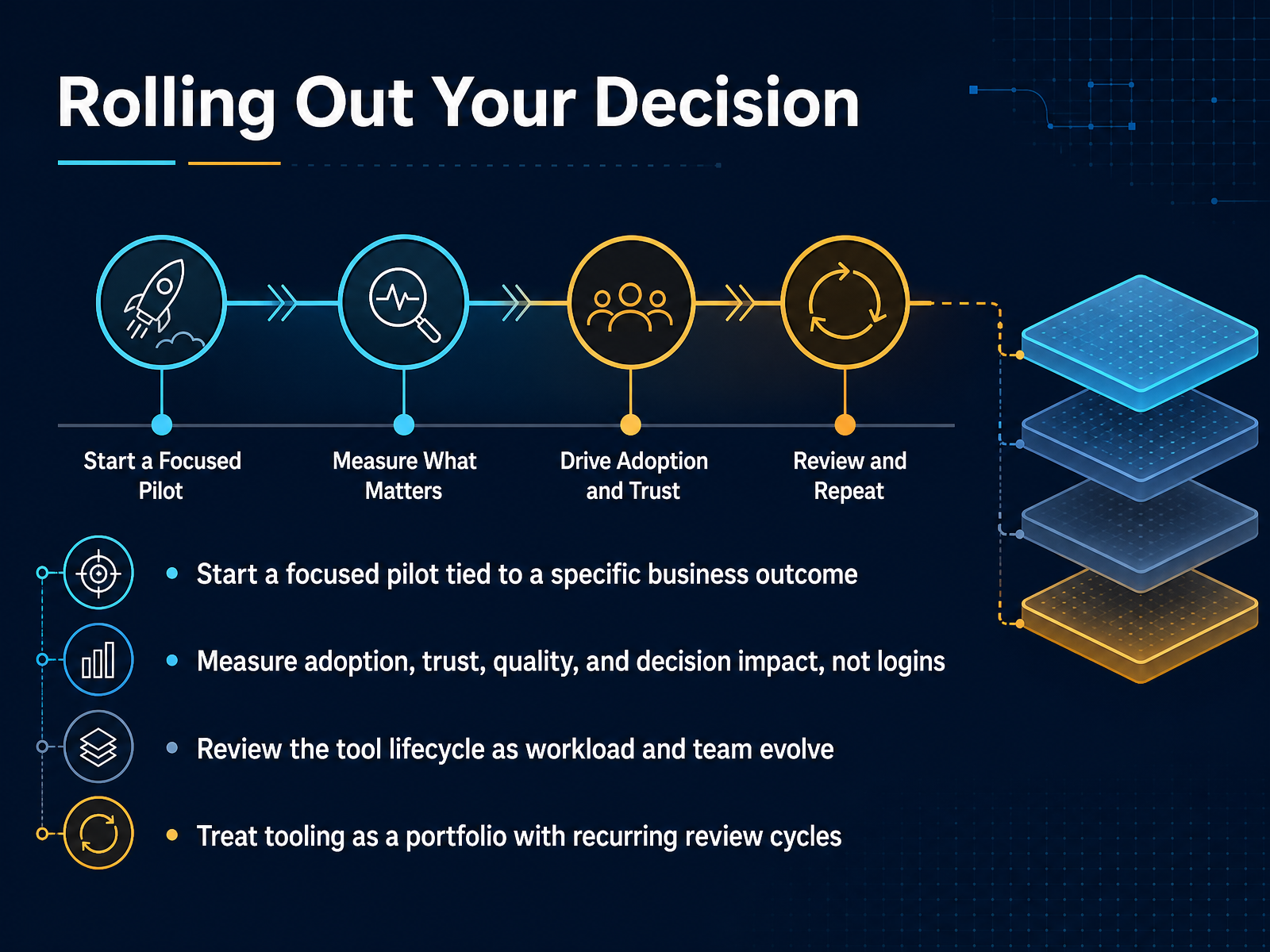
 - 13Rolling Out Your DecisionWhen you roll out a data engineering tool, start with a focused pilot tied to a specific business outcome. That outcome should be concrete: a faster month-end close, reduced data team ticket volume, or shorter time to decision. Choose fifteen to twenty-five users in one department, prove measurable value, and then expand using that success as an internal case study. What you measure matters. Do not track logins. Track behaviors that map to outcomes: activation rate within fourteen days, time to first insight, repeat usage, self-serve completion, and data trust scores. Also measure decision impact. Ask whether the tool changed a decision, reduced cycle time, or eliminated manual work. Adoption without that link means you have engagement with zero value. Finally, treat tooling as a portfolio. Review the lifecycle as workload and team maturity evolve. Deprecate unused assets, consolidate overlapping tools, and run recurring review cycles against unit economics. That operating discipline controls total cost better than list price ever will. Next, we will close with the key takeaways and next steps.
 1 min
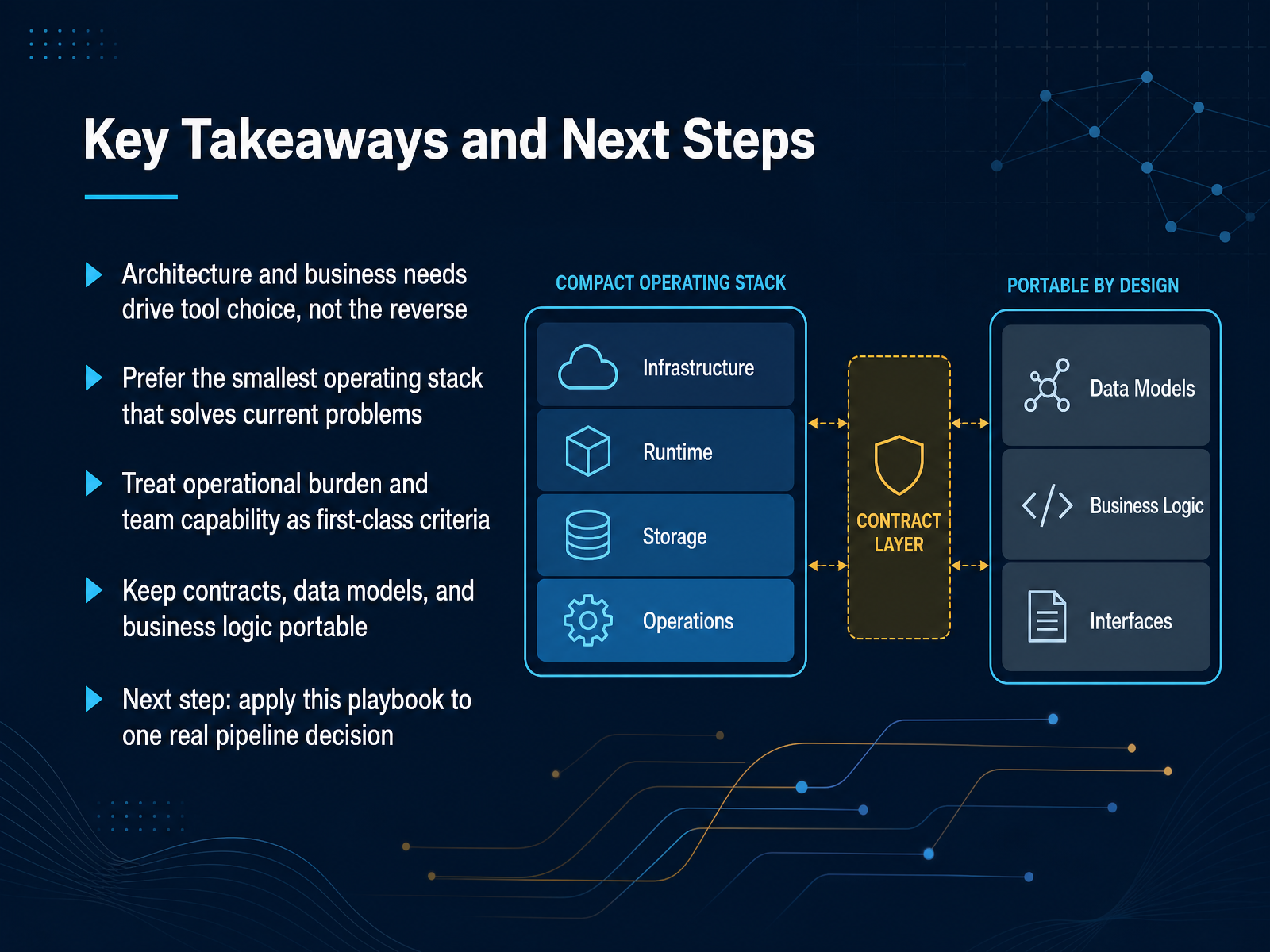
1 min - 14Key Takeaways and Next StepsLet's close with the core decision rule. Architecture and business needs drive tool choice, not the other way around. That single ordering prevents most expensive mistakes. Prefer the smallest operating stack that solves current problems, not hypothetical future scale. A lean stack with clear ownership almost always outperforms a sophisticated one your team cannot operate. Treat operational burden and team capability as first-class criteria, alongside features and price. A tool your team cannot run well is a liability, no matter how capable it looks on a demo. Keep contracts, data models, and business logic portable. Design optionality early, because switching costs compound after data, dashboards, and habits form around one vendor. Your next step is straightforward. Apply this playbook to one real pipeline decision. Name the business problem, identify the consumer, set freshness needs, and choose the smallest stack that ships a reliable answer quickly. Run that decision through this framework. Then repeat the pattern. Thank you for working through this training. The goal is not a perfect tool stack on paper. It is a stack your team can operate, evolve, and defend with evidence.
 getorchestra.iosmallbizamerica.orgnkpremices.com+22 min
Take the deck with you
Download this course as a file — free, no sign-up needed.
- PDF handoutEvery slide page, ready to print or share.15 pages · 3.8 MBDownload
- Narrated PowerPointThe deck that presents itself — every slide carries the digital human's narration video.15 pages · 15.0 MBDownload
- PowerPoint slidesThe full deck as a .pptx — open it in PowerPoint, Keynote, or Google Slides.15 pages · 3.8 MBDownload
Free to use in your own training — please keep the PersonWise credit page at the end.
Have your own deck? Turn it into a course
Sources consulted
Web sources consulted while building this course.
- DIGITAL ENGINEERING TOOL EVALUATION CRITERIA TEMPLATE (DETECT) — cto.mil
- How to Compare and Evaluate Data Pipeline Tools — upsolver.com
- The Ultimate Guide to Data Pipelines for Generative AI: Five Criteria to Evaluate Tools — barc.com
- ISO/IEC 20741:2017 - Systems and software engineering — Guideline for the evaluation and selection of software engineering tools — iso.org
- [PDF] Digital Engineering Tool Evaluation Criteria Template (DETECT) — cto.mil
- Open-source vs. managed data architectures | How to optimise using both | Orchestra — getorchestra.io
- Building the Modern Data Stack: Open Source vs. Managed Tools - Community Articles - Small Biz America — smallbizamerica.org
- Managed vs Open Source in Cloud Architectures — nkpremices.com
- The Modern Data Stack: Open-source edition — datafold.com
- Build vs buy data pipelines for enterprise teams | Lumenalta — lumenalta.com
- What is a data pipeline architecture? | IBM — ibm.com
- Understanding the layers of the AI‑ready modern data stack | TechTarget — techtarget.com
- What Is the Modern Data Stack? | IBM — ibm.com
- Data pipeline architecture: A guide to better design — rudderstack.com
- What Belongs in a Modern Data Platform in 2026: A Reference Architecture for Engineers — bigdataboutique.com
- Data pipeline design anti-patterns | Dorian B — dorianbg.github.io
- Data Pipelines: Patterns & Anti-Patterns (2026) — infinisynapse.com
- Common ETL Anti-Patterns and How to Avoid Them – CoeurData Guides — coeurdata.com
- Data Pipelines: The Hammer for Every Nail — abhishek-tiwari.com
- ETL Antipattern: Start With Writing Code - Tim Mitchell — timmitchell.net