AI Tools for Product Management Workflows
Begin
10 pages · ~20 min
AI Tools for Product Management Workflows
Equips product managers to evaluate and select AI tools and design efficient workflows, enabling faster, higher-impact product decisions and delivery.
What you’ll learn
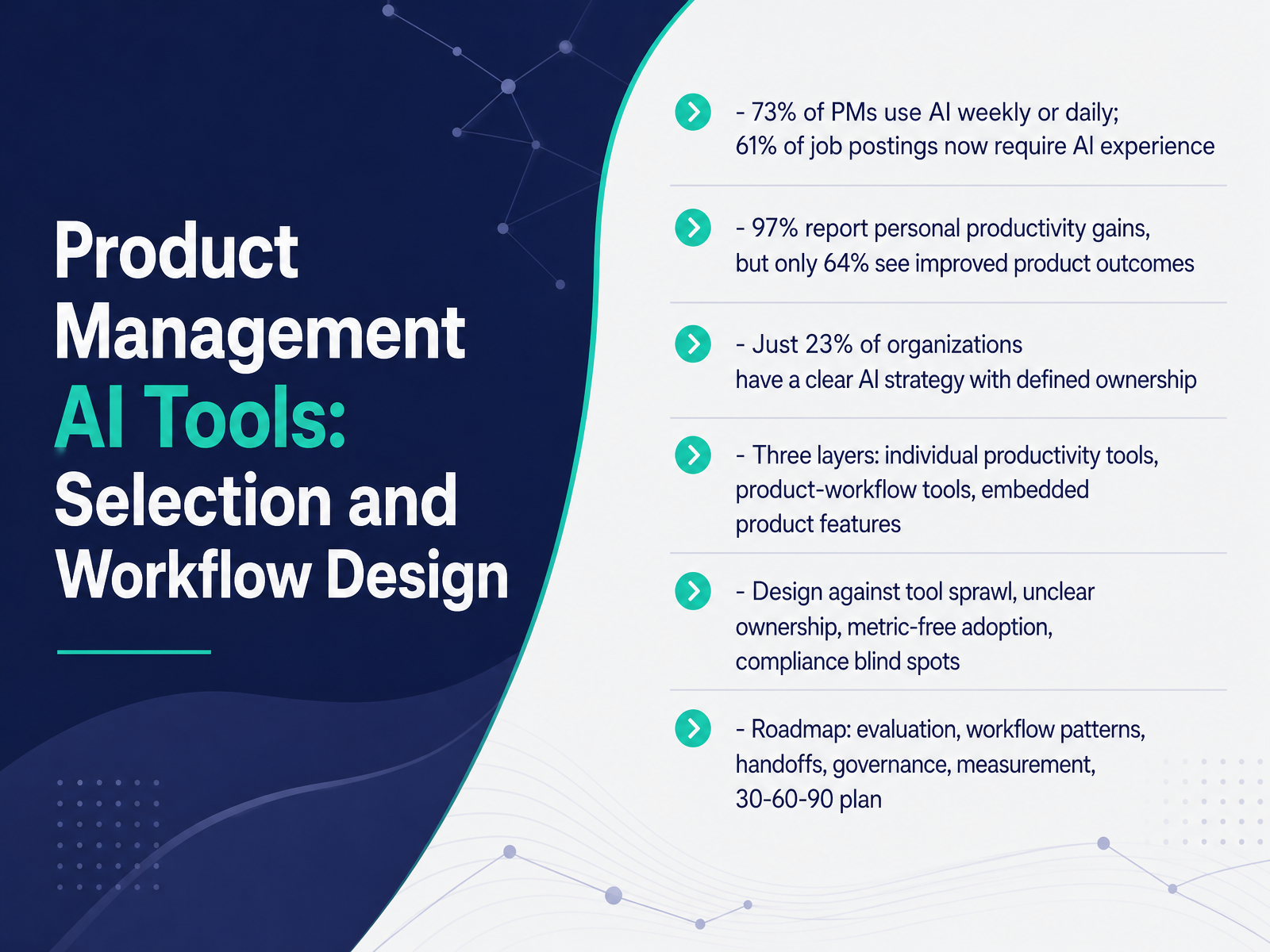
- 01Product Management AI Tools: Selection and Workflow DesignWelcome. This course is about choosing AI tools for product management, and designing workflows that actually stick. You are busy, so we will keep this practical. Think of it as what to check, when to use it, and what to avoid.
Here is why this matters. Seventy three percent of product managers now use AI weekly or daily. Sixty one percent of job postings ask for AI experience. But adoption is not the same as impact. Ninety seven percent report personal productivity gains, yet only sixty four percent see better product outcomes. And just twenty three percent of organizations have a clear AI strategy with defined ownership.
So we will look at three layers. Individual productivity tools, like drafting a PRD. Product workflow tools, like turning user interviews into themes. And embedded AI features in your own product.
We will also design against four common traps. Tool sprawl, unclear ownership, adoption with no metrics, and compliance blind spots.
By the end, you will have a roadmap. Evaluating tools, spotting reusable workflow patterns, defining handoffs, setting governance, measuring results, and turning it into a thirty sixty ninety day plan.
Let's start with the landscape. The 2026 AI Landscape for Product Teams.productside.comlearnanything.prouxcam.com+22 min
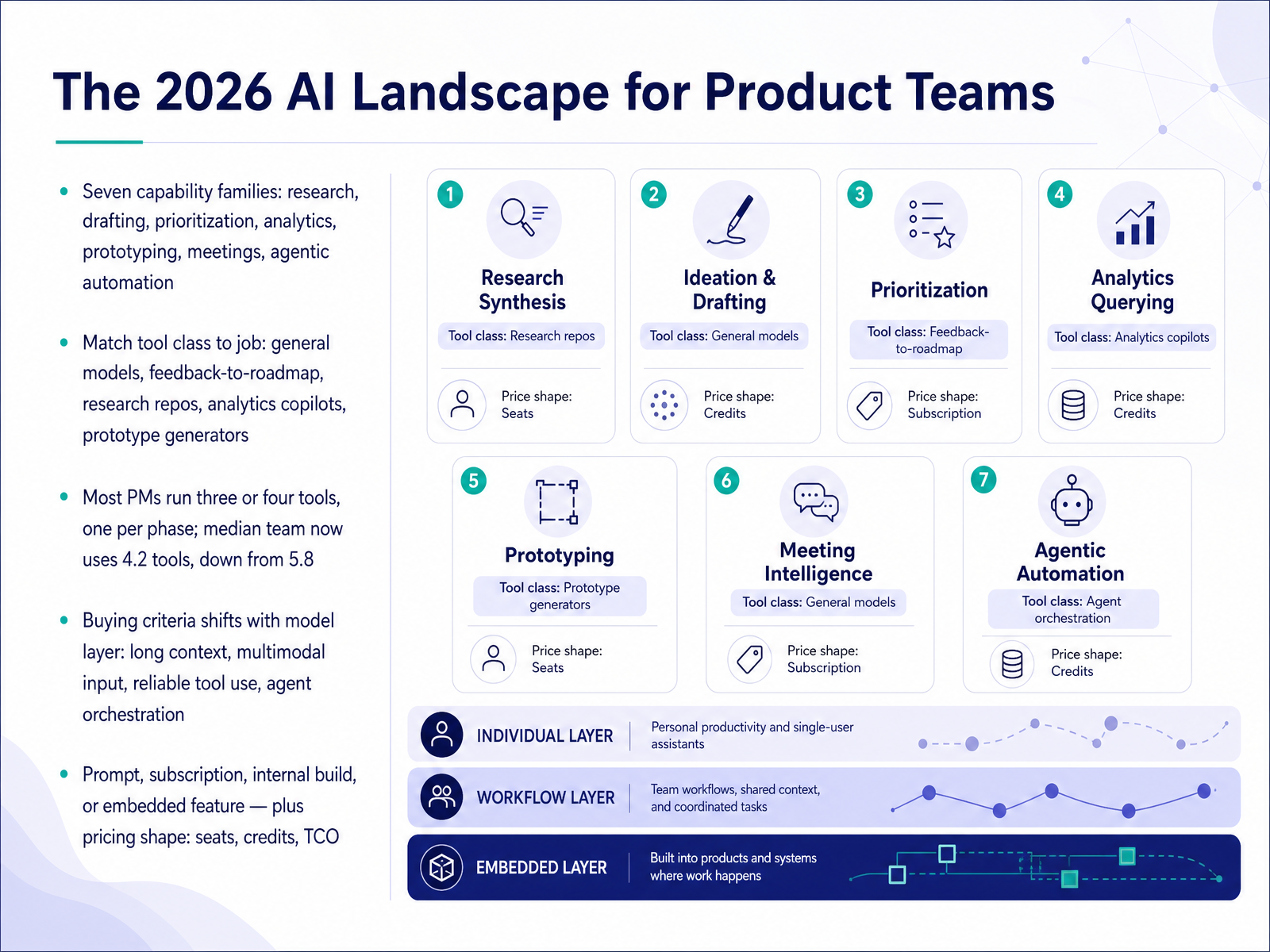
- 02The 2026 AI Landscape for Product TeamsLet's look at the tool landscape you're actually choosing from. Most PM tools fall into seven capability families. Research, drafting, prioritization, analytics, prototyping, meetings, and agentic automation. The trick is matching the tool class to the job. General models for drafting. Feedback-to-roadmap platforms for prioritization. Research repositories for interviews. Analytics copilots for usage data. Prototype generators for quick validation. Most PMs run three or four tools, one per phase. And teams are consolidating. The median team now uses four point two tools, down from five point eight. Buying criteria also shift with the model layer. Long context, multimodal input, reliable tool use, and agent orchestration. Finally, decide how you'll buy. Prompt, subscription, internal build, or an embedded feature. Then check the pricing shape. Seats, credits, or total cost of ownership. Next, let's map your workflow before you pick any tool. Requirements Before Tools: Map the Workflow First.
 resources.rework.comtechno-pulse.comlearn.g2.com+22 min
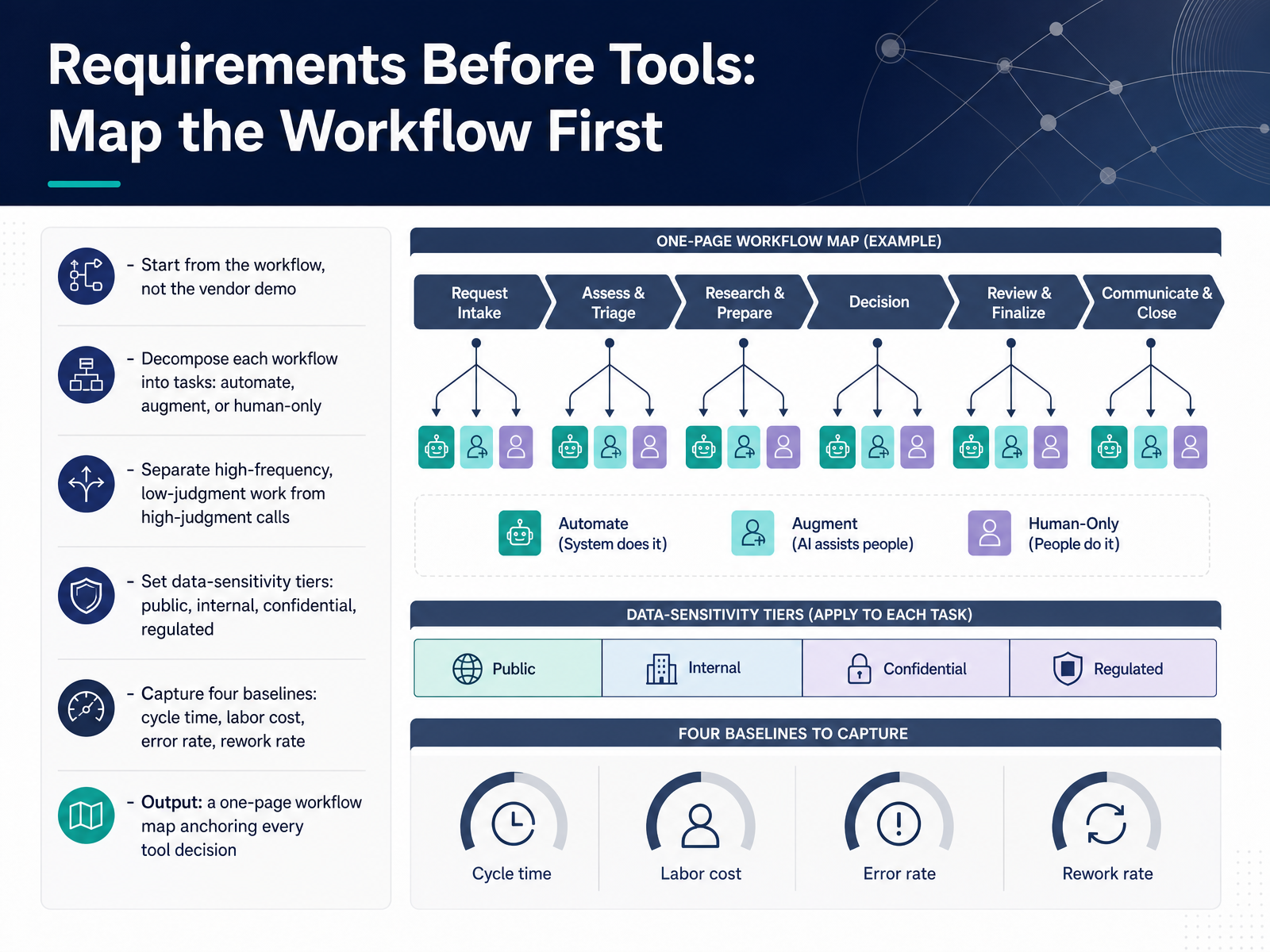
 - 03Requirements Before Tools: Map the Workflow FirstNow let's talk about what has to happen before you pick any tool. Start with the workflow, not the vendor demo. Take one real workflow, like writing a PRD or running backlog triage, and break it into tasks. Then label each task. Some tasks you can automate end to end, like pulling themes from a batch of interview transcripts. Some you augment, like a first draft of a roadmap you then edit. And some stay human only, like the final prioritization call. Separate the high frequency, low judgment work from the high judgment calls. Then set data sensitivity tiers: public, internal, confidential, and regulated. That tells you what can touch an outside model. Next, capture four baselines for each workflow: cycle time, labor cost, error rate, and rework rate. Without them, you cannot prove a tool helped. The output is a one page workflow map. Every tool decision should point back to it. So check the workflow first, classify the tasks, and avoid buying a demo. Next, we'll look at how to score tools against that map, in Evaluation Framework: Score Tools Against Real Work.
 shiftharness.technuvepro.aiprodmgmt.world+22 min
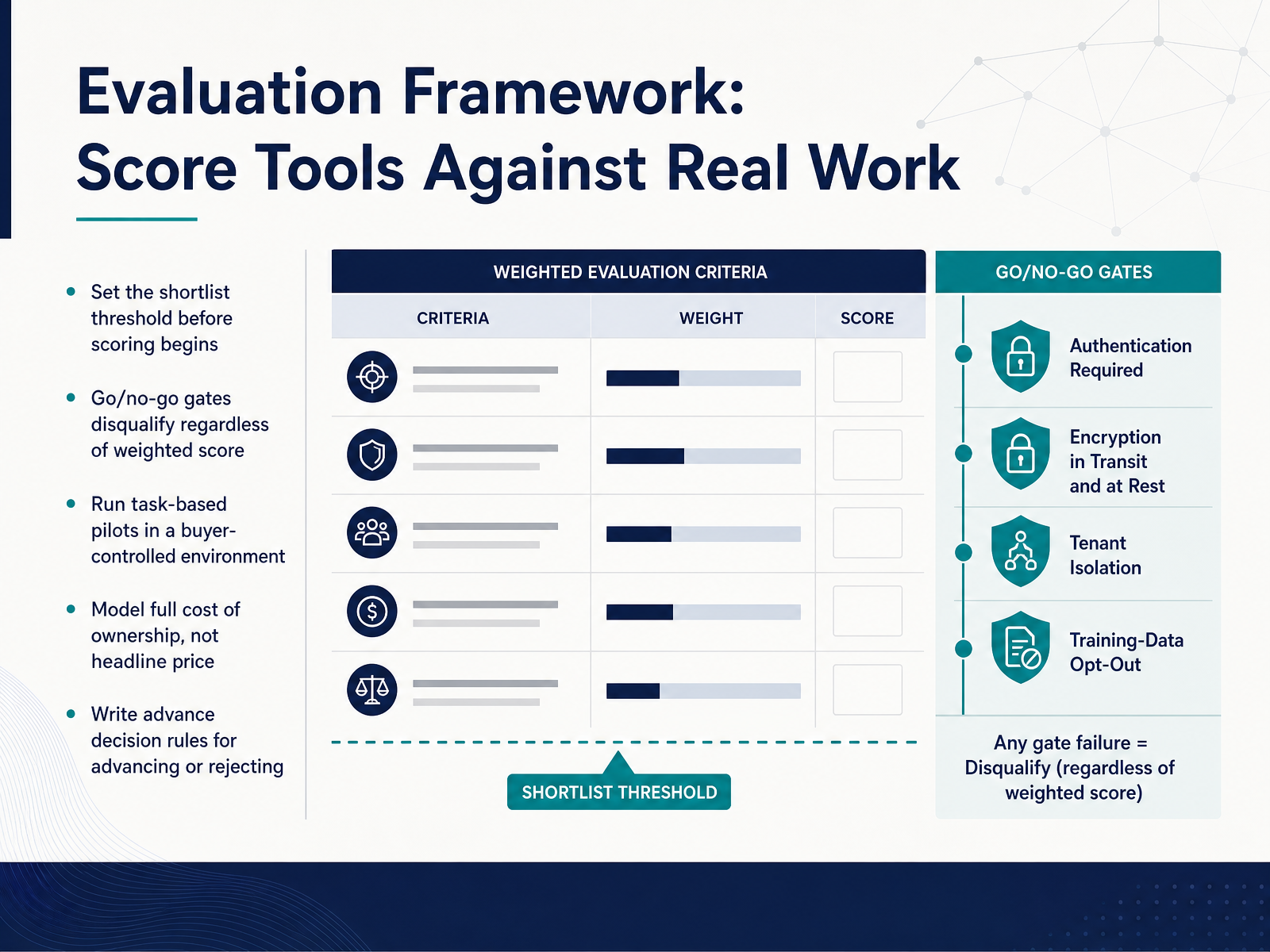
 - 04Evaluation Framework: Score Tools Against Real WorkLet's look at how to score tools against real work. First, set your shortlist threshold before scoring begins. A common baseline is seventy-five percent of the weighted total. Deciding the bar after you see the numbers turns evaluation into rationalization. Second, use go/no-go gates. A single critical failure, like no training opt-out, disqualifies a vendor no matter how high they score elsewhere. Third, run task-based pilots in a buyer-controlled environment. Build three to five scenarios from your actual use cases, such as drafting a PRD or triaging the backlog, and make every shortlisted vendor run them. Fourth, model full cost of ownership. That means licenses, usage, implementation, security review, and ongoing maintenance, not just the headline price. Finally, write advance decision rules. State clearly what score advances, what conditions apply, and what rejects, before the results come in. That keeps the decision defensible. Next, we'll look at where AI fits in the product cycle.
 mickai.co.ukknowlee.aidigitalapplied.com+22 min
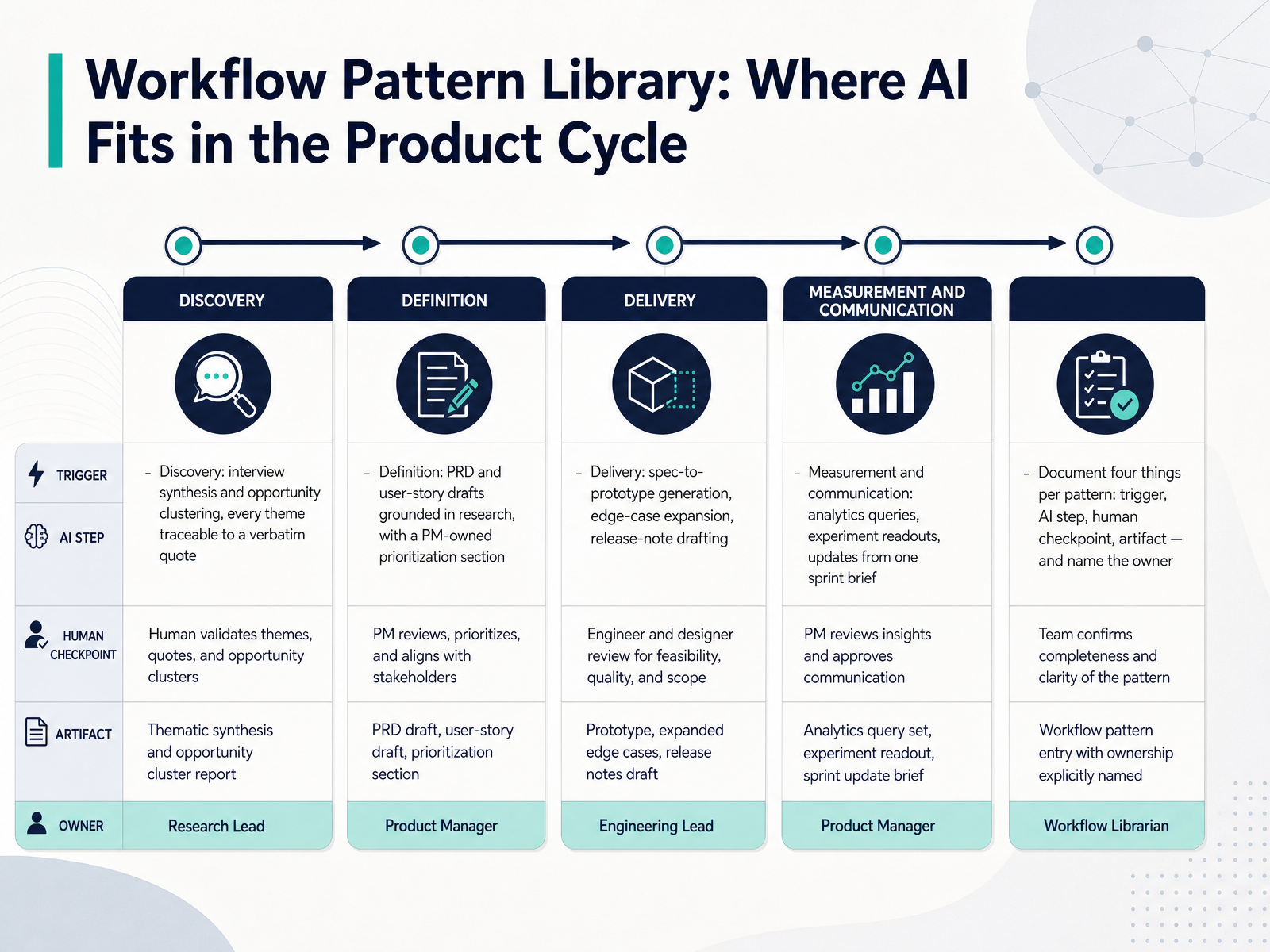
 - 05Workflow Pattern Library: Where AI Fits in the Product CycleNow let's look at where AI actually fits in the product cycle. Think of this as a pattern library. Four patterns, one per stage. For Discovery, use AI to synthesize interviews and cluster opportunities. One rule: every theme must trace back to a verbatim quote. For Definition, let AI draft the PRD and user stories from your research, but keep a PM-owned prioritization section. The ranking stays yours. For Delivery, generate a spec-to-prototype draft, expand edge cases, and draft release notes. For Measurement and communication, write analytics queries, experiment readouts, and updates from a single sprint brief. Then document four things per pattern. The trigger, the AI step, the human checkpoint, and the artifact. And always name the owner. That last step is what keeps the pattern repeatable across the team. Next, Designing the Human-AI Handoff.
 productos.devshiftharness.technuvepro.ai+22 min
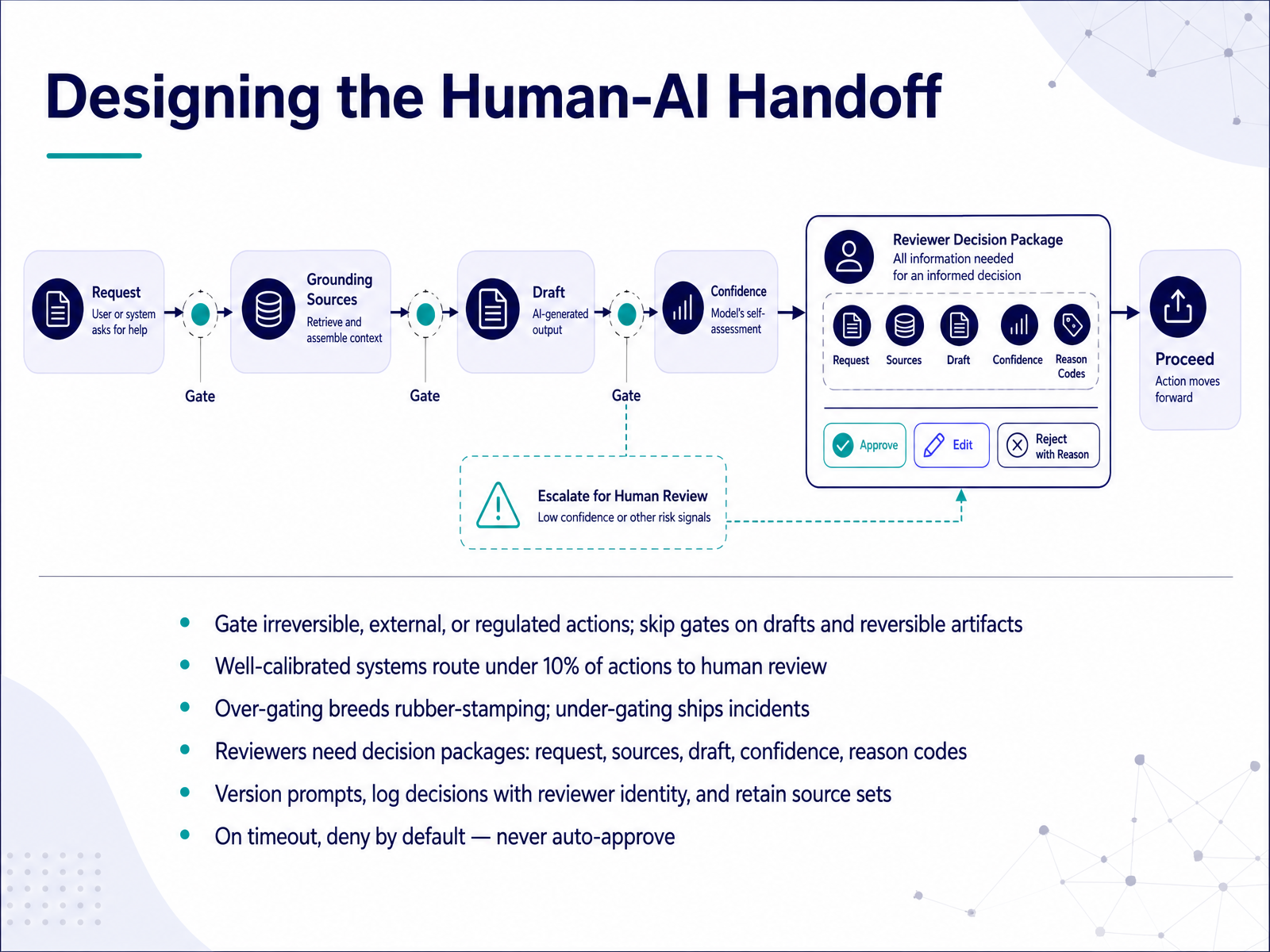
 - 06Designing the Human-AI HandoffNow let's talk about designing the human-AI handoff. This is where most teams either move too fast or slow themselves to a crawl. The core rule is simple. Gate actions that are irreversible, external, or regulated. So before you publish to a live site, send a customer notification, or merge to production, a human should sign off. But skip gates on drafts and reversible artifacts. A branch, a draft, a comment, a label. Those can always be undone. Here is your benchmark. A well-calibrated system routes under ten percent of actions to human review. If your queue is longer, your risk tiers are wrong. Gate too much and reviewers start rubber-stamping. Gate too little and you ship incidents. And a gate only works when the reviewer has what they need. Give them a decision package. The request, the sources, the draft, the confidence level, and reason codes. Version your prompts. Log every decision with reviewer identity. Keep the source sets. And one non-negotiable. On timeout, deny by default. Never auto-approve, because an approval that times out into execution is a gate that does not exist. Next, we will look at governance, risk, and compliance for AI-enabled product work.
 shiftharness.technuvepro.aiprodmgmt.world+22 min
 - 07Governance, Risk, and Compliance for AI-Enabled Product WorkNow let's talk about governance, risk, and compliance for AI-enabled product work.
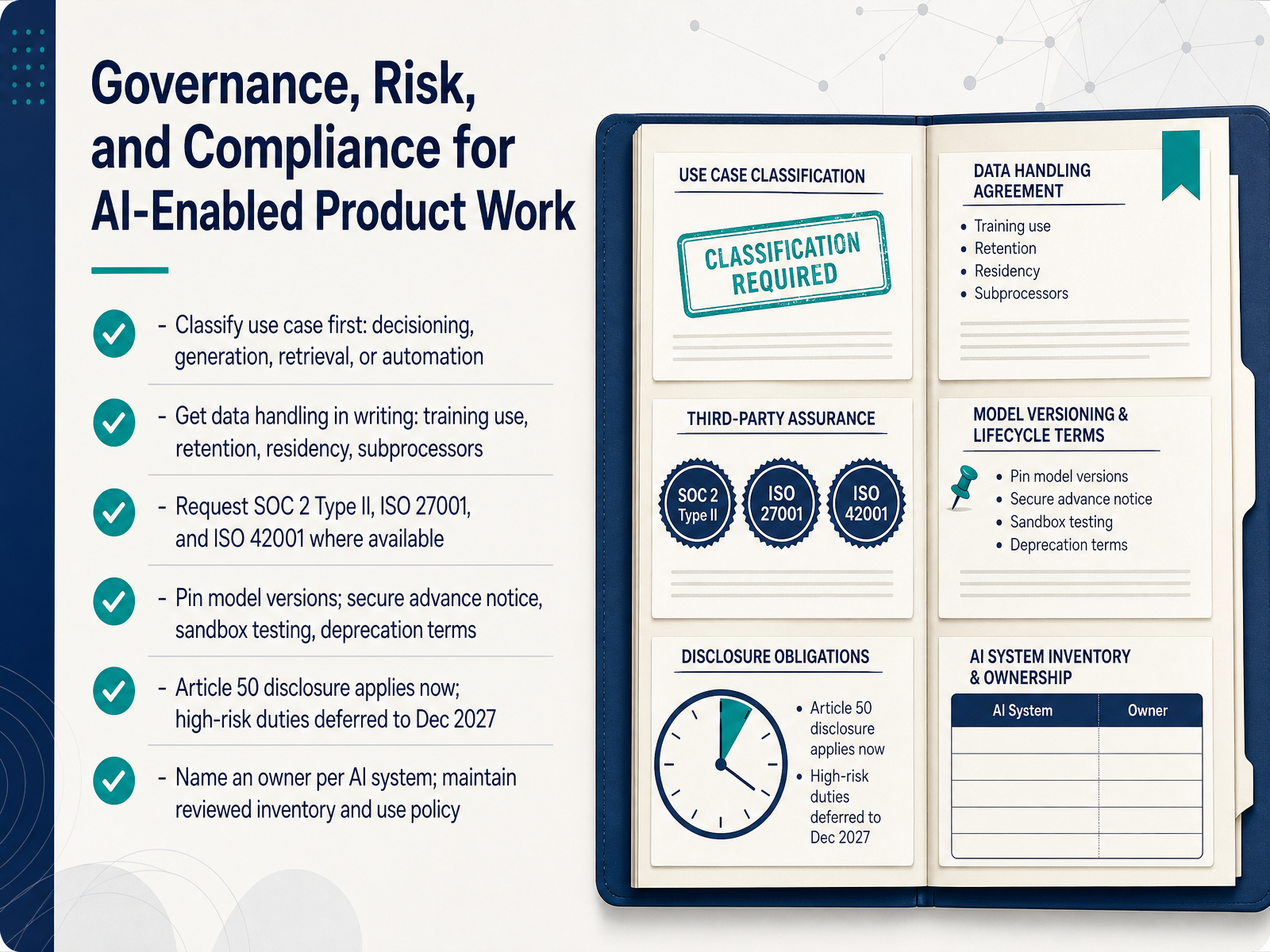
Start by classifying the use case. Is it decisioning, generation, retrieval, or automation? Decisioning carries the heaviest scrutiny. A credit scoring model needs more oversight than a tool that summarizes meeting notes.
Next, get data handling in writing. Ask about training use, retention, residency, and subprocessors. Sales promises don't count. The contract does.
Request SOC 2 Type Two, ISO twenty seven thousand one, and ISO forty two thousand one where available. These prove the vendor runs a real governance program.
Pin model versions. Secure advance notice of updates, sandbox testing, and clear deprecation terms. You don't want a silent model change breaking your product.
On timing, Article fifty disclosure applies now. High-risk duties are deferred to December twenty twenty seven. But build toward them anyway.
Finally, name an owner for every AI system. Keep a reviewed inventory and a use policy.
That's the foundation. Next, let's look at measuring impact and avoiding adoption theater.
 mickai.co.ukknowlee.aidigitalapplied.com+22 min
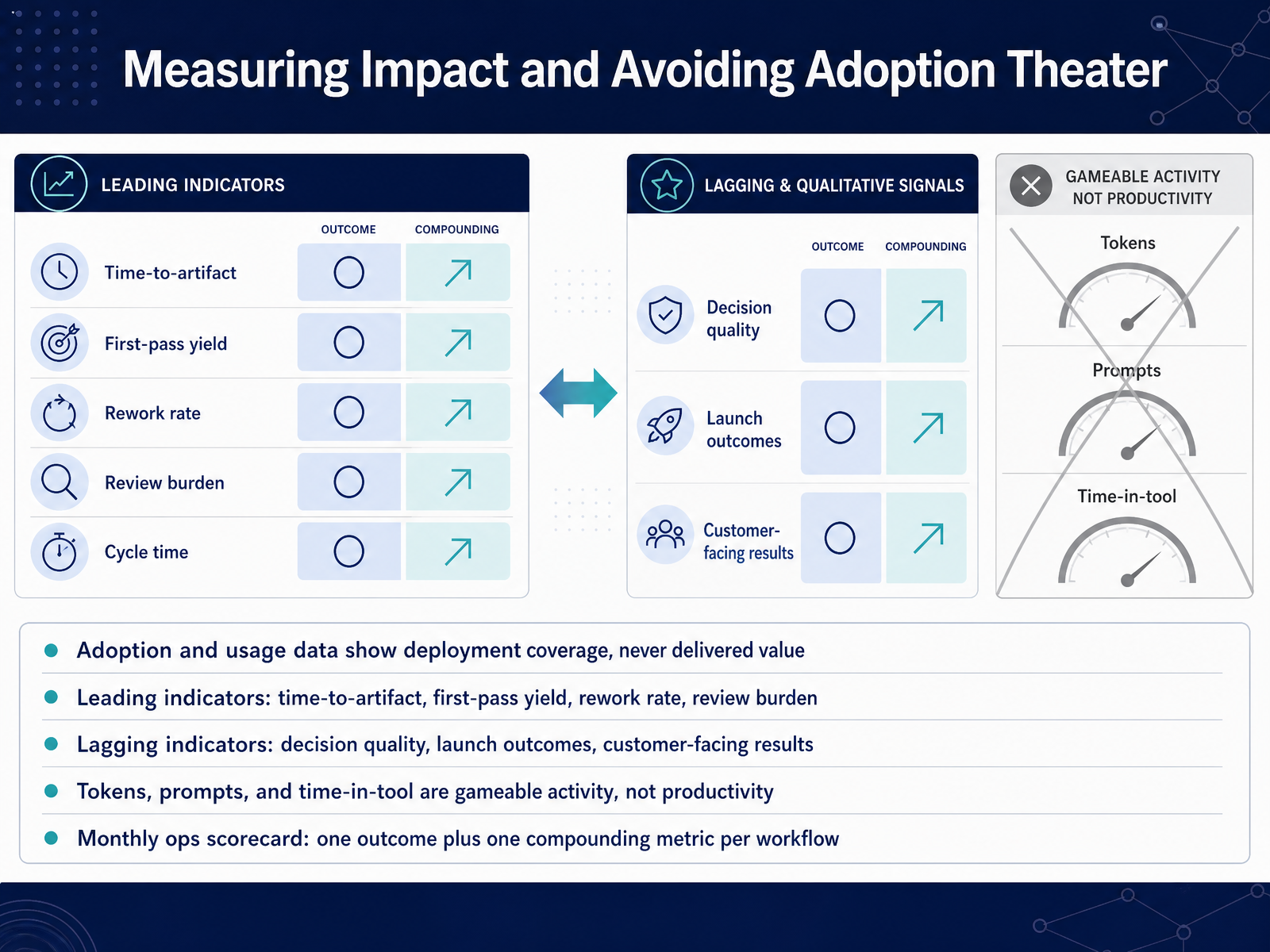
 - 08Measuring Impact and Avoiding Adoption TheaterLet's talk about how to prove AI is actually working, and how to avoid adoption theater. Here is the core rule. Adoption and usage data show deployment coverage. They never show delivered value. A green dashboard just means people logged in. So track leading indicators: time to artifact, first pass yield, rework rate, and review burden. These move first, and you can act on them. Then track lagging indicators: decision quality, launch outcomes, and customer facing results. These tell you if it mattered. Now, be careful. Tokens, prompts, and time in tool are gameable activity, not productivity. An engineer burning tokens on buggy code is not faster. And remember the Microsoft study: two hours a week saved per person, with no clear shift in overall output. Time saved is only half a metric. Redirect that time, or it just evaporates. So keep it simple. A monthly ops scorecard with one outcome plus one compounding metric per workflow. That is enough to separate real gains from theater. Next, we build the plan: 30 60 90 day AI workflow adoption.
 2 min
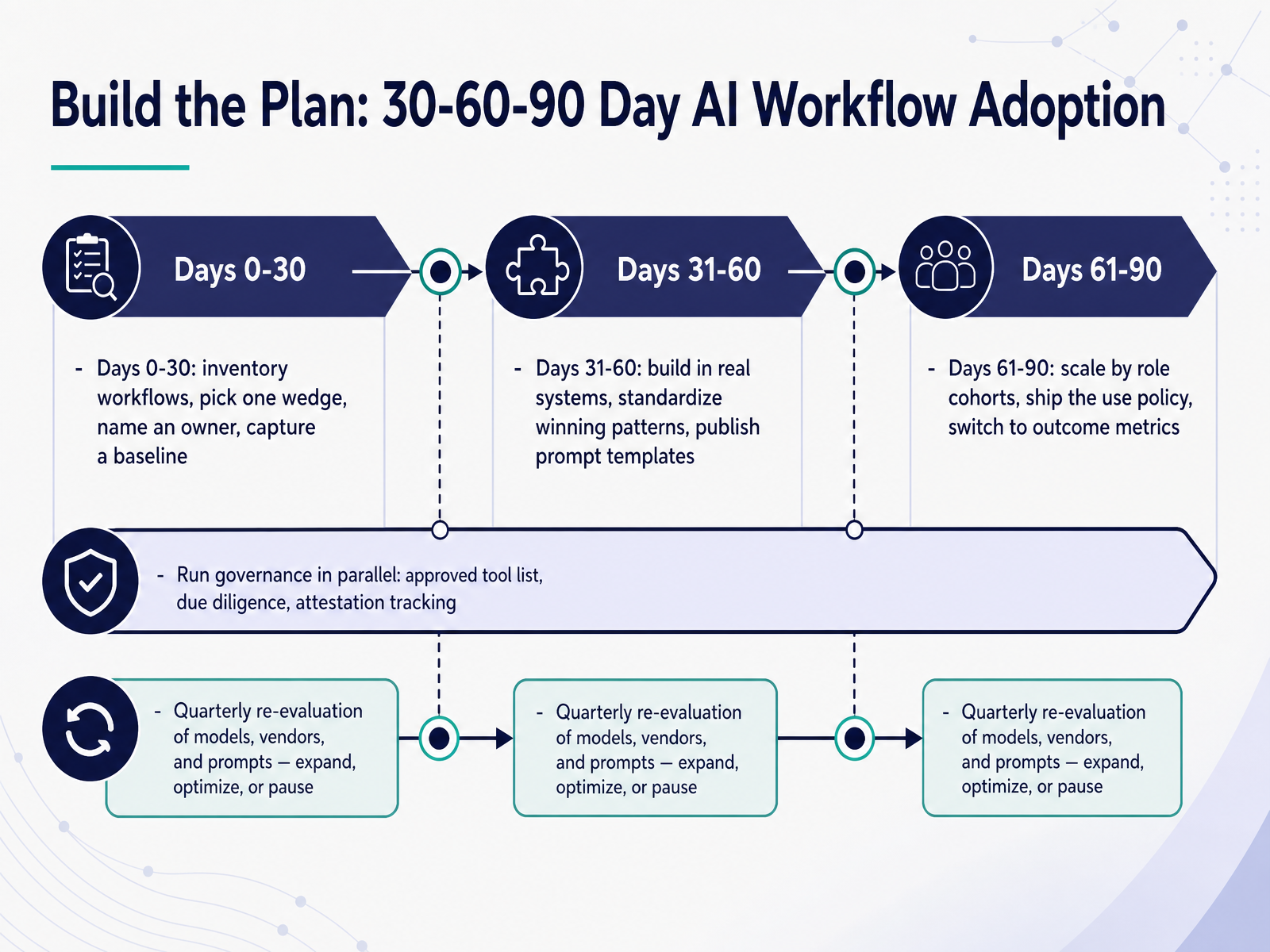
2 min - 09Build the Plan: 30-60-90 Day AI Workflow AdoptionNow let's turn all of this into an actual plan. Think in three windows. Days zero to thirty are for diagnosis. Inventory your workflows. Pick one wedge, like backlog triage or PRD first drafts. Name a single owner. And capture a baseline, so you know what you're improving. Days thirty-one to sixty are for building. Build inside your real systems, not a sandbox. Standardize the patterns that are working. Then publish prompt templates the whole team can reuse. Days sixty-one to ninety are for scaling. Roll out by role, so each team gets its own examples. Ship the use policy. And switch from activity metrics to outcome metrics like cycle time and rework. Run governance in parallel, not after. Keep an approved tool list, do vendor due diligence, and track attestation. Every quarter, re-evaluate your models, vendors, and prompts. Then choose: expand, optimize, or pause. That cadence keeps adoption from sliding backward. Next, you'll put this into practice in the workshop: Score a Tool and Draft One Workflow.
 2 min
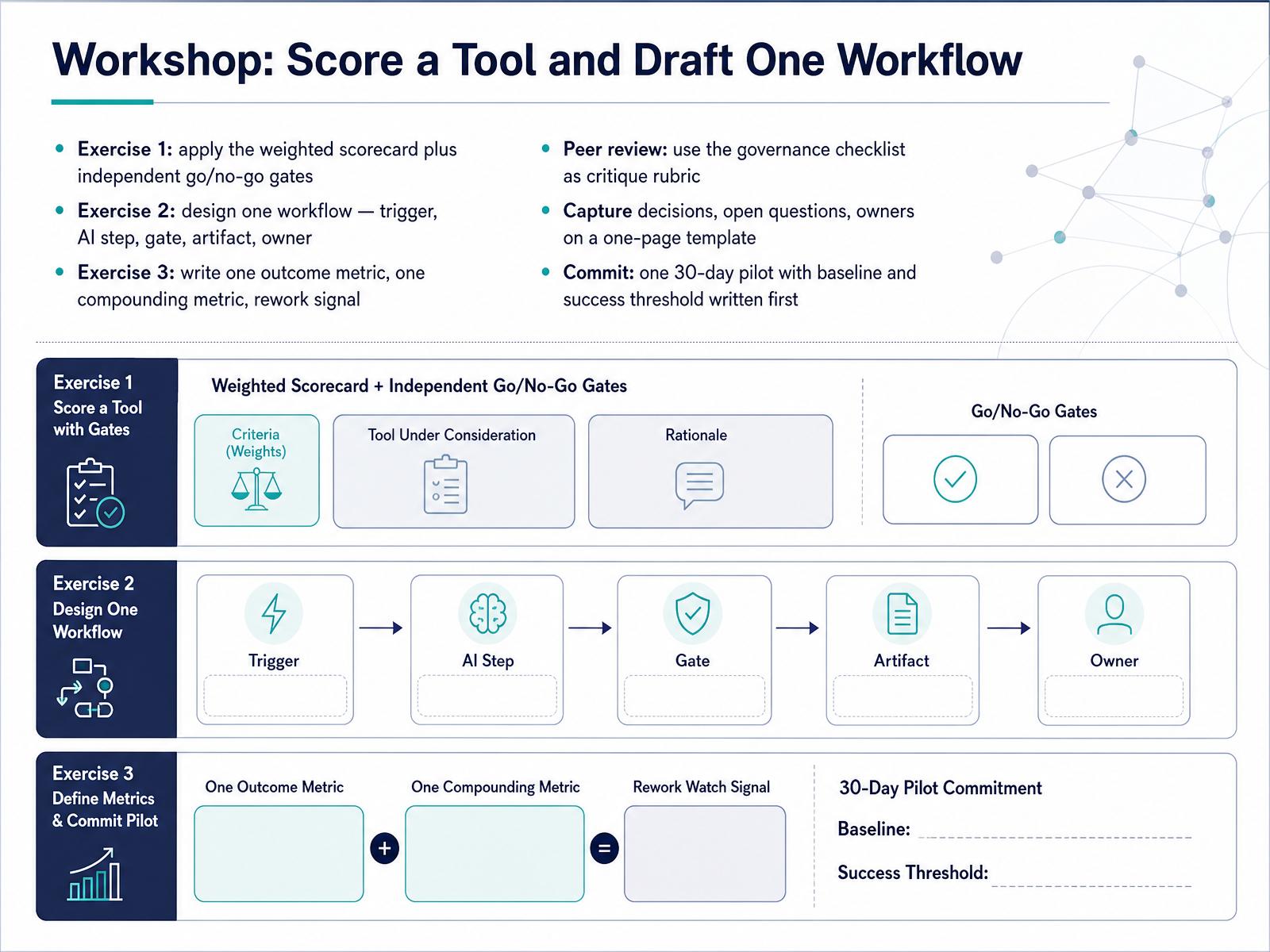
2 min - 10Workshop: Score a Tool and Draft One WorkflowLet's put it all into practice. This is a working session, so grab your scorecard and pick one real tool you're considering. Exercise one: score that tool on your weighted criteria, then check the independent go, no-go gates. A high score never overrides a failed gate. Exercise two: design one workflow. Name the trigger, the AI step, the human gate, the artifact, and the owner. Exercise three: write one outcome metric, one compounding metric, and one rework signal. Then peer review. Use the governance checklist as your critique rubric, and keep it honest. Capture decisions, open questions, and owners on a single page. Before you leave, commit to one thirty-day pilot, with the baseline and success threshold written first. Good luck, and thank you for the work you put in today.
 mickai.co.ukknowlee.aidigitalapplied.com+21 min
Take the deck with you
Download this course as a file — free, no sign-up needed.
- PDF handoutEvery slide page, ready to print or share.11 pages · 2.7 MBDownload
- Narrated PowerPointThe deck that presents itself — every slide carries the digital human's narration video.11 pages · 10.2 MBDownload
- PowerPoint slidesThe full deck as a .pptx — open it in PowerPoint, Keynote, or Google Slides.11 pages · 2.5 MBDownload
Free to use in your own training — please keep the PersonWise credit page at the end.
Have your own deck? Turn it into a course
Sources consulted
Web sources consulted while building this course.
- The State Of AI For Product Management Report 2026 - Productside | Product Management Courses & Training — productside.com
- AI in Product Management 2026: 312% Adoption Growth Study | PM Streak — learnanything.pro
- The State of AI in Product Management 2026 | UXCam — uxcam.com
- Survey of the Product Management Profession — cdn.productfocus.com
- Product Management In 2026: GenAI Features Are Now Standard In Product Portfolios | Forrester — forrester.com
- "Best AI Tools for Product Managers in 2026: 14 Tools Ranked by Use Case" — resources.rework.com
- Best AI Product Management Tools in 2026: Productboard vs Aha! vs Roadmunk vs Craft.io — techno-pulse.com
- 10 Powerful AI Tools for Product Managers in 2026 — learn.g2.com
- 18 Best AI Tools for Product Managers in 2026: Review & Comparison With Pros, Cons and Pricing | Coursiv Blog — coursiv.io
- The 12 Best AI Tools for Product Managers in 2026 (Tested) — storyflow.so
- AI operating system for product managers: 11 pipelines — shiftharness.tech
- What Is Workflow Intelligence? Classify Every Task Across Business Processes | Nuvepro — nuvepro.ai
- AI for Product Management: The First 5 Workflows to Start With — prodmgmt.world
- Product Map: TASK Framework for Agentic Product Management — productmap.io
- AI in product management: a complete 2026 workflow | ProductOS — productos.dev
- AI Procurement Checklist (2026): The Complete Buyer's Framework — mickai.co.uk
- AI Vendor Risk Assessment Checklist (2026): 35 Questions for Provider, Deployer, and GPAI Risk | Knowlee Blog — knowlee.ai
- AI Vendor Risk Assessment: 50-Point Template for 2026 — digitalapplied.com
- AI Vendor Risk Assessment: Ultimate 2026 Guide — trusteraai.com
- Generative AI vendor risk questionnaire template: the... — areebi.com