Begin
14 pages · ~28 min
Python Communication for Stakeholders
This training helps Python programmers explain technical concepts and project value to non-technical stakeholders, enabling clearer communication and better-informed decisions.
A digital instructor presents all 14 pages. Hold “Ask” at any point and ask out loud — the answer comes from this course. No sign-up needed.
What you’ll learn
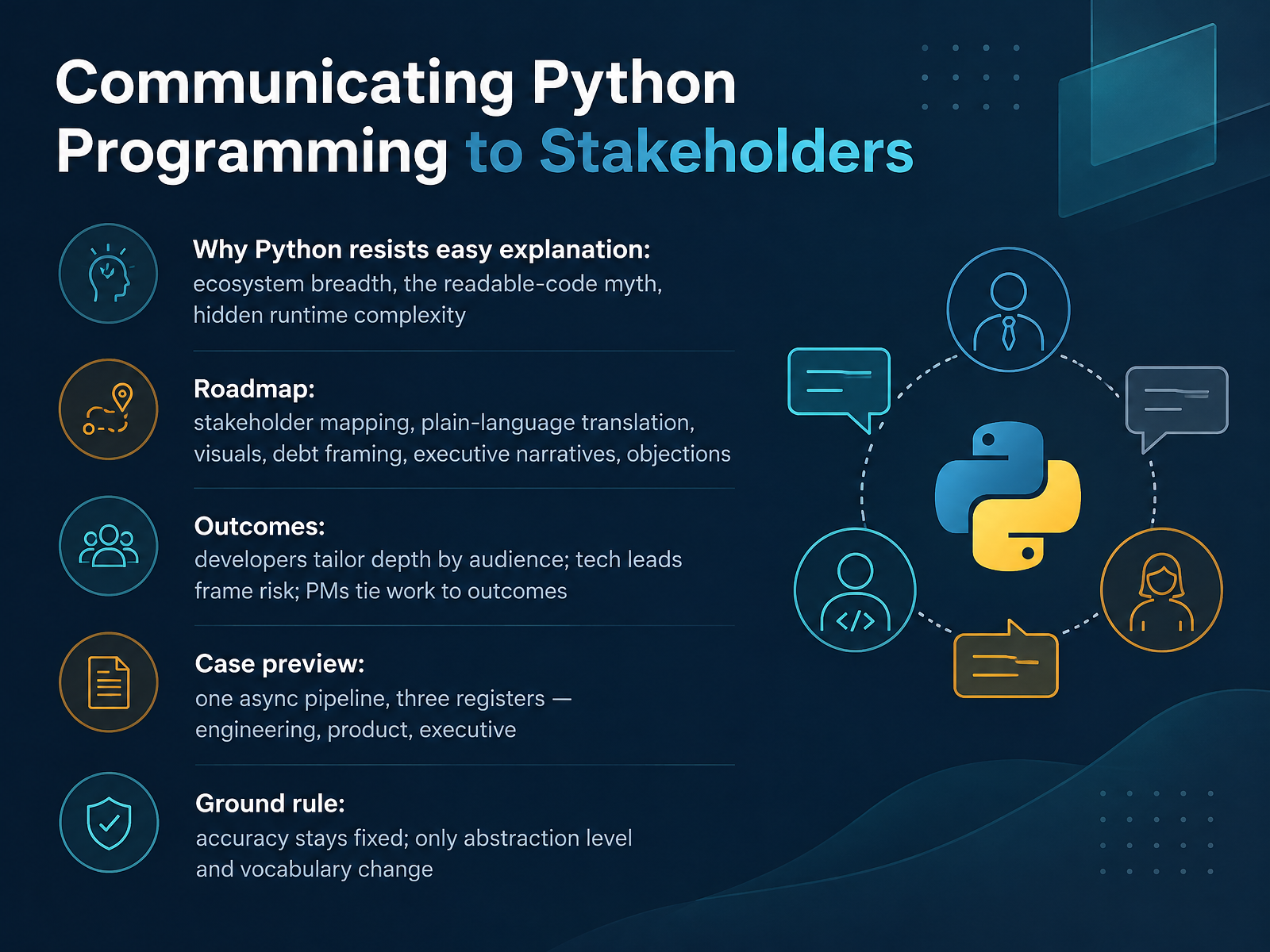
- 01Communicating Python Programming to StakeholdersWelcome. This course is about communicating Python work to the people who fund it, approve it, and depend on it. Our goal is simple. You will learn to explain the same technical reality at different levels of abstraction, without losing accuracy. Here is the problem we start from. Python resists easy explanation. The ecosystem is broad. Readable code creates a false sense that the work is simple. And important runtime complexity stays hidden until it fails. Over these fourteen slides, we will cover stakeholder mapping, plain-language translation, visuals, framing technical debt, executive narratives, and handling objections. Developers will learn to tailor depth by audience. Tech leads will learn to frame risk clearly. Product managers will learn to tie engineering work to outcomes. We will preview one case, an async pipeline, told three ways: to engineering, to product, and to the executive team. One ground rule holds throughout. Accuracy stays fixed. Only the abstraction level and the vocabulary change. Your first action is this. Before your next sprint review, write one sentence describing your current work for each of those three audiences. Next, we look at why Python is hard to explain well.muhammadamal.my.idandrewweinberg.usomnigaze.com+22 min
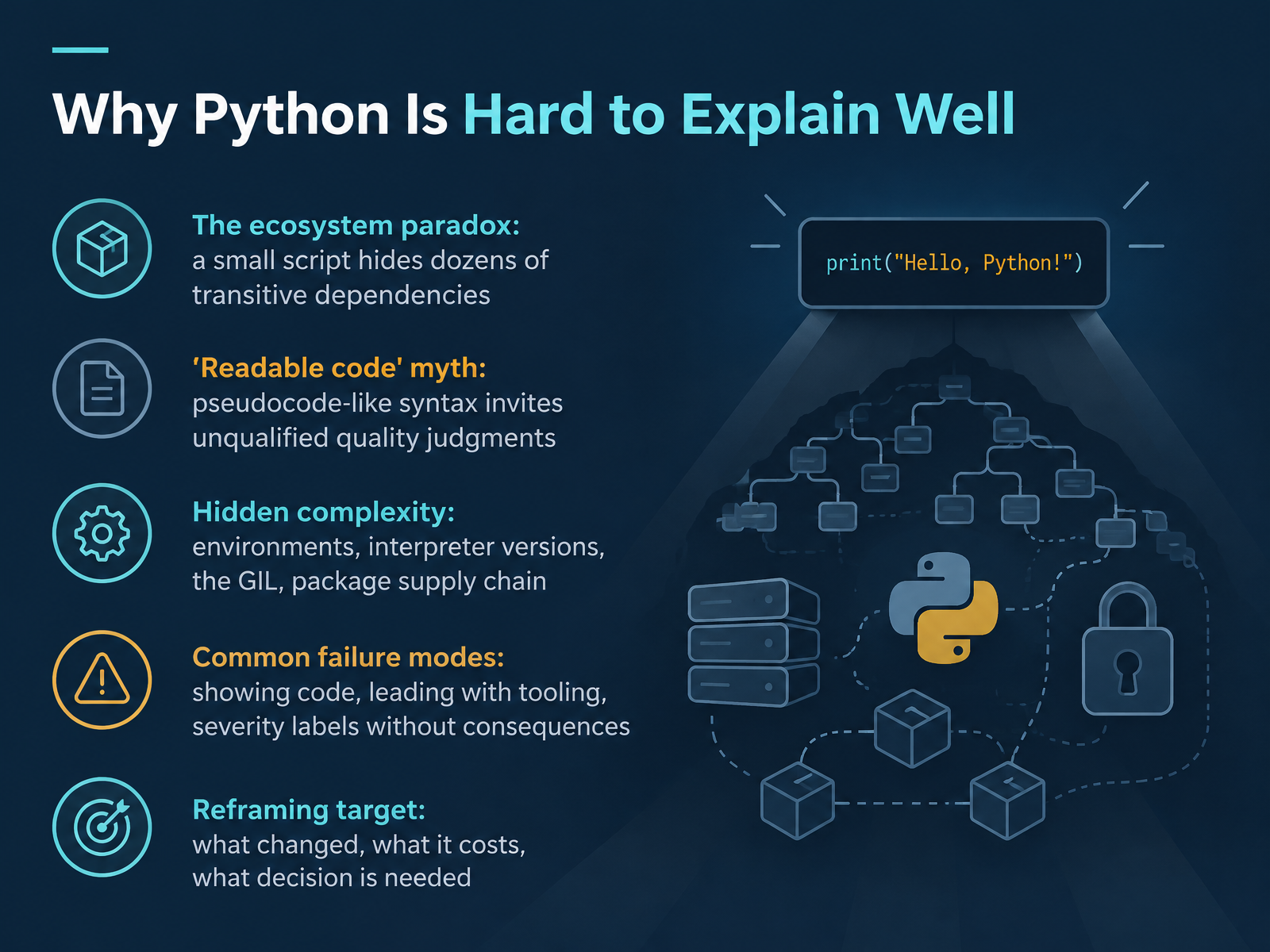
- 02Why Python Is Hard to Explain WellLet's look at why Python is hard to explain well. Start with the ecosystem paradox. A small script can hide dozens of transitive dependencies underneath it. Readable syntax is also a trap, because pseudocode-like code invites quality judgments that the reader is not qualified to make. And real complexity stays hidden: environments, interpreter versions, the global interpreter lock, and the package supply chain. The false comfort is that the code looks simple. Common failure modes follow from that. Teams show code, lead with tooling, or hand out severity labels with no consequences attached. Reframe instead. Say what changed, what it costs, and what decision is needed. That turns a code conversation into a decision conversation. Next, we will look at stakeholder mapping for Python projects.
 kolodziejj.inforohanvarma.merealpython.com+21 min
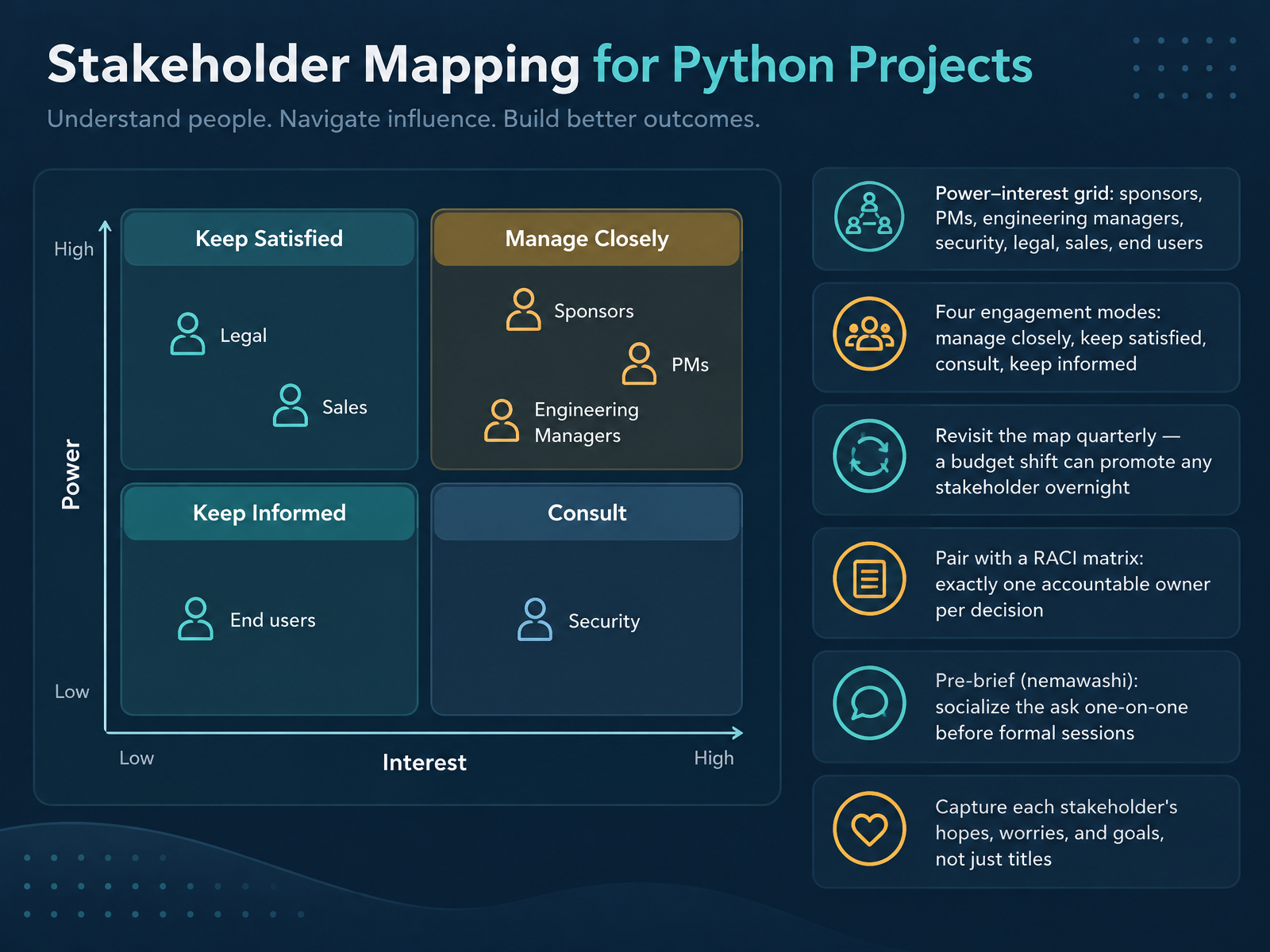
- 03Stakeholder Mapping for Python ProjectsNext, let's talk about stakeholder mapping for Python projects. Start with a power and interest grid. High power, high interest people you manage closely, like sponsors. High power, low interest, keep satisfied, such as legal or security. Low power, high interest, consult, like engineering managers and end users. Everyone else, keep informed. Revisit this map every quarter, because a budget shift can promote any stakeholder overnight. Pair it with a RACI matrix, with exactly one accountable owner per decision. And pre-brief before formal sessions, so nobody is surprised in a sprint review. Capture each person's hopes, worries, and goals, not just their title. Your action: map your top five stakeholders this week. Next up, what each audience actually wants to know.
 software-engineering-guide.github.ioscrum.orgpubs.opengroup.org+21 min
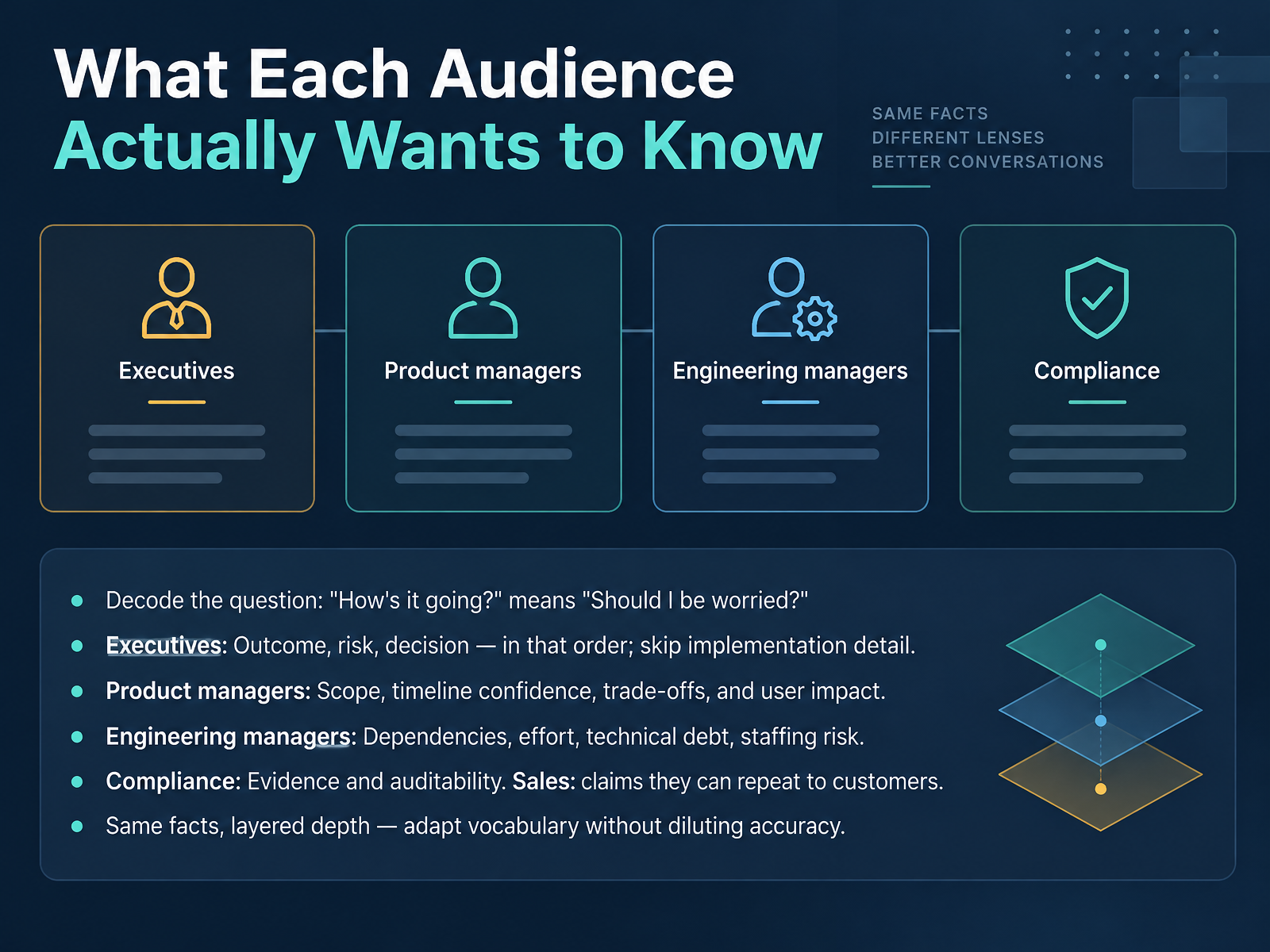
- 04What Each Audience Actually Wants to KnowSo let's look at what each audience actually wants to know. When someone asks, how's it going, they usually mean, should I be worried? Answer that question first. Executives want outcome, risk, and the decision you need, in that order. Skip implementation detail. Product managers want scope, timeline confidence, trade-offs, and user impact. Engineering managers want dependencies, effort, technical debt, and staffing risk. Compliance wants evidence and auditability. Sales wants claims they can repeat to customers. Same facts, layered depth. Adapt your vocabulary without diluting accuracy. Before your next sprint review, write one sentence of your update for each audience in the room. Next, we'll look at translating Python concepts into plain language.
 muhammadamal.my.idandrewweinberg.usomnigaze.com+21 min
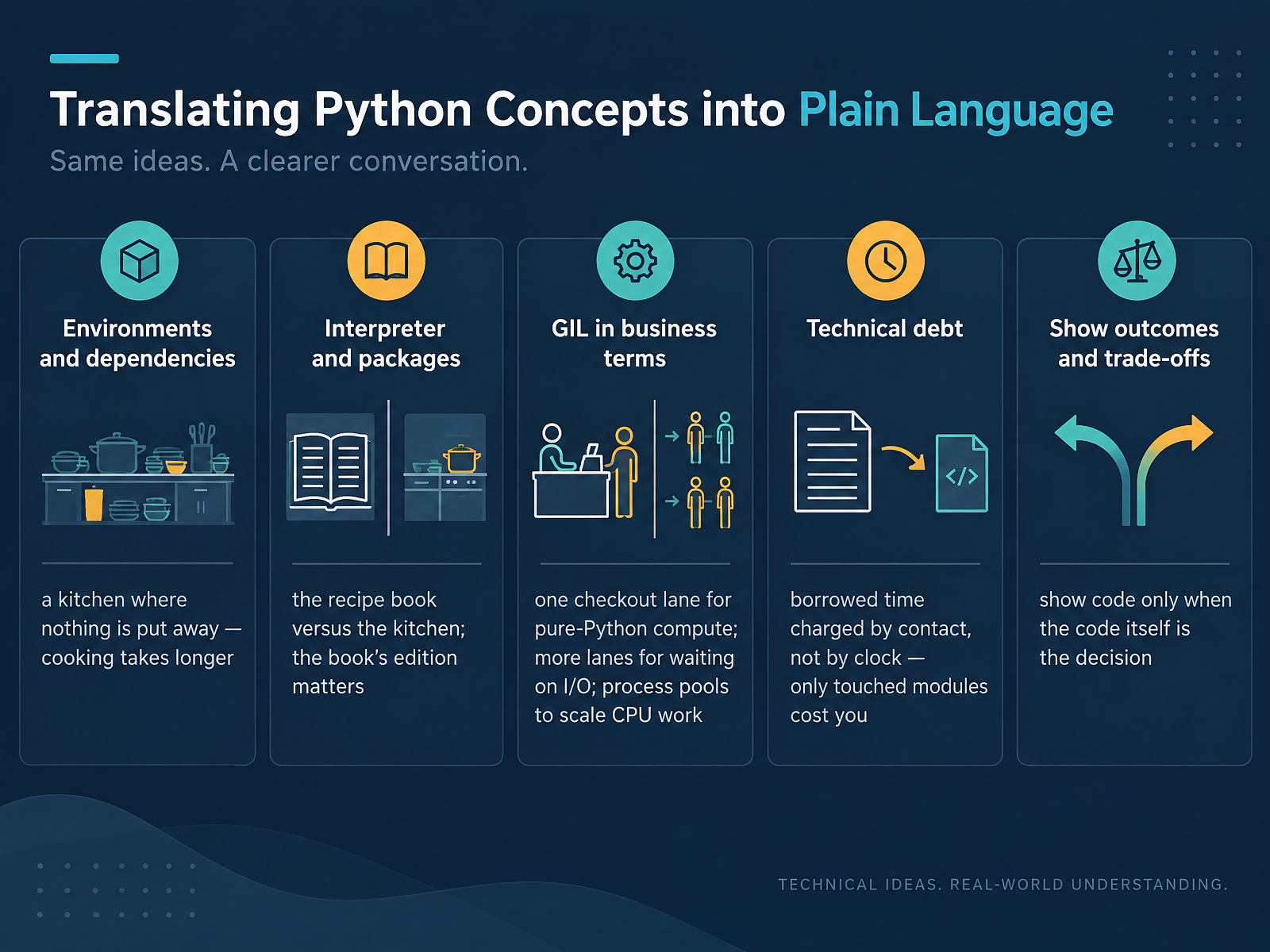
- 05Translating Python Concepts into Plain LanguageNow let's talk about translating Python concepts into plain language. Start with outcomes and trade-offs, and show code only when the code itself is the decision. Environments and dependencies are like a kitchen where nothing is put away. You can still cook, but every task takes longer. The interpreter and packages are the recipe book versus the kitchen, and the book's edition matters, so version drift is a real risk. The GIL is one checkout lane for pure-Python compute. Threads help when work is waiting on input and output. For heavy CPU work, use process pools to open more lanes. Technical debt is borrowed time charged by contact, not by clock. A module nobody touches costs nothing. Rank debt by where interest is actually paid. Your action: in the next sprint review, present one outcome, one trade-off, and one concrete decision instead of a code walkthrough. Next, let's look at choosing the right visual for the room.
 coderslingo.comcyclic.shenterprisersproject.com+22 min
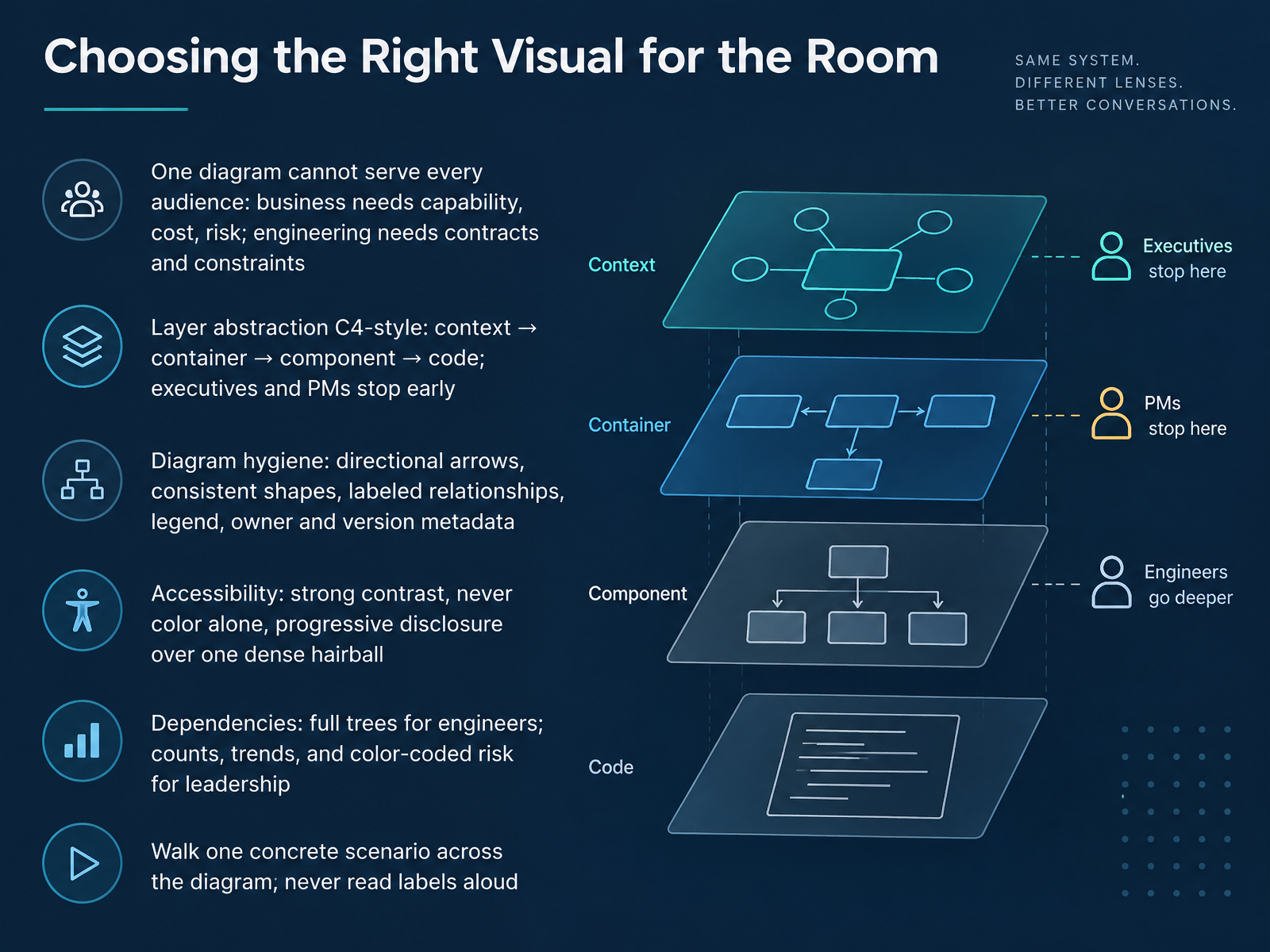
- 06Choosing the Right Visual for the RoomNow let's talk about choosing the right visual for the room. Here is the takeaway up front. One diagram cannot serve every audience. Business stakeholders need capability, cost, and risk. Engineers need contracts and constraints. So layer your abstraction, C4 style. Start at context, move to containers, then components, then code. Executives and product managers should stop early. Keep your diagrams clean. Use directional arrows, consistent shapes, labeled relationships, and a legend. Add owner and version metadata. For accessibility, use strong contrast, never rely on color alone, and prefer progressive disclosure over one dense hairball. For dependencies, give engineers full trees, but give leadership counts, trends, and color-coded risk. Finally, walk one concrete scenario across the diagram, and never read the labels aloud. Your action for this slide: pick one audience and one diagram level for your next sprint review. From Technical Finding to Business Consequence.
 2 min
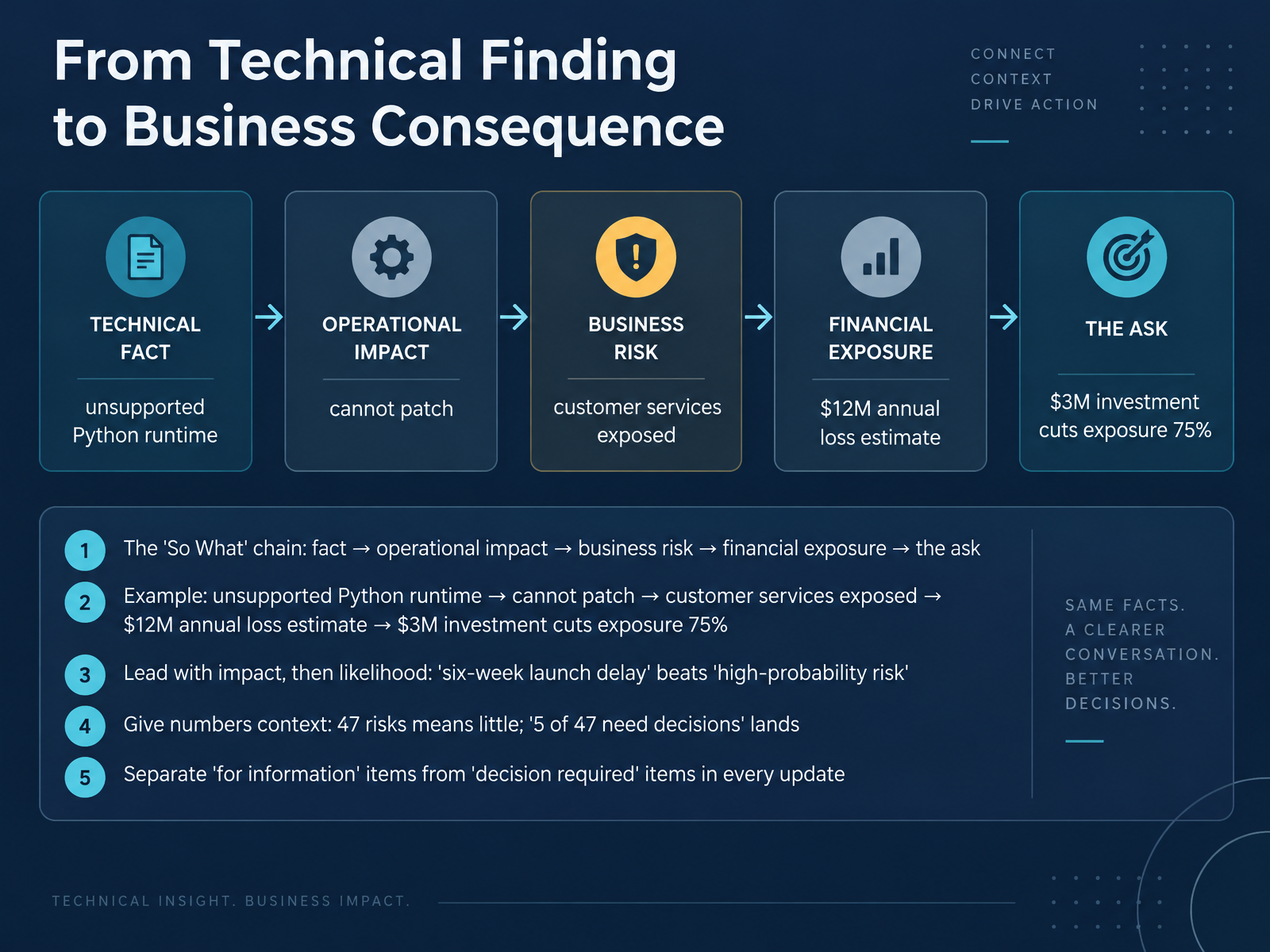
- 07From Technical Finding to Business ConsequenceNow let's turn findings into decisions. Every technical finding should travel the so what chain. Start with the fact, then operational impact, business risk, financial exposure, and finally the ask. For example, an unsupported Python runtime means you cannot patch it. That exposes customer services, with an estimated twelve million dollar annual loss. A three million dollar investment cuts exposure by seventy five percent. That is a decision, not a status update. Lead with impact, then likelihood. Six week launch delay lands better than high probability risk. Give numbers context. Forty seven risks means little, but five of forty seven need decisions lands. And in every update, separate for information items from decision required items. Before your next sprint review, run your top finding through the chain and name the ask.
 muhammadamal.my.idandrewweinberg.usomnigaze.com+21 min
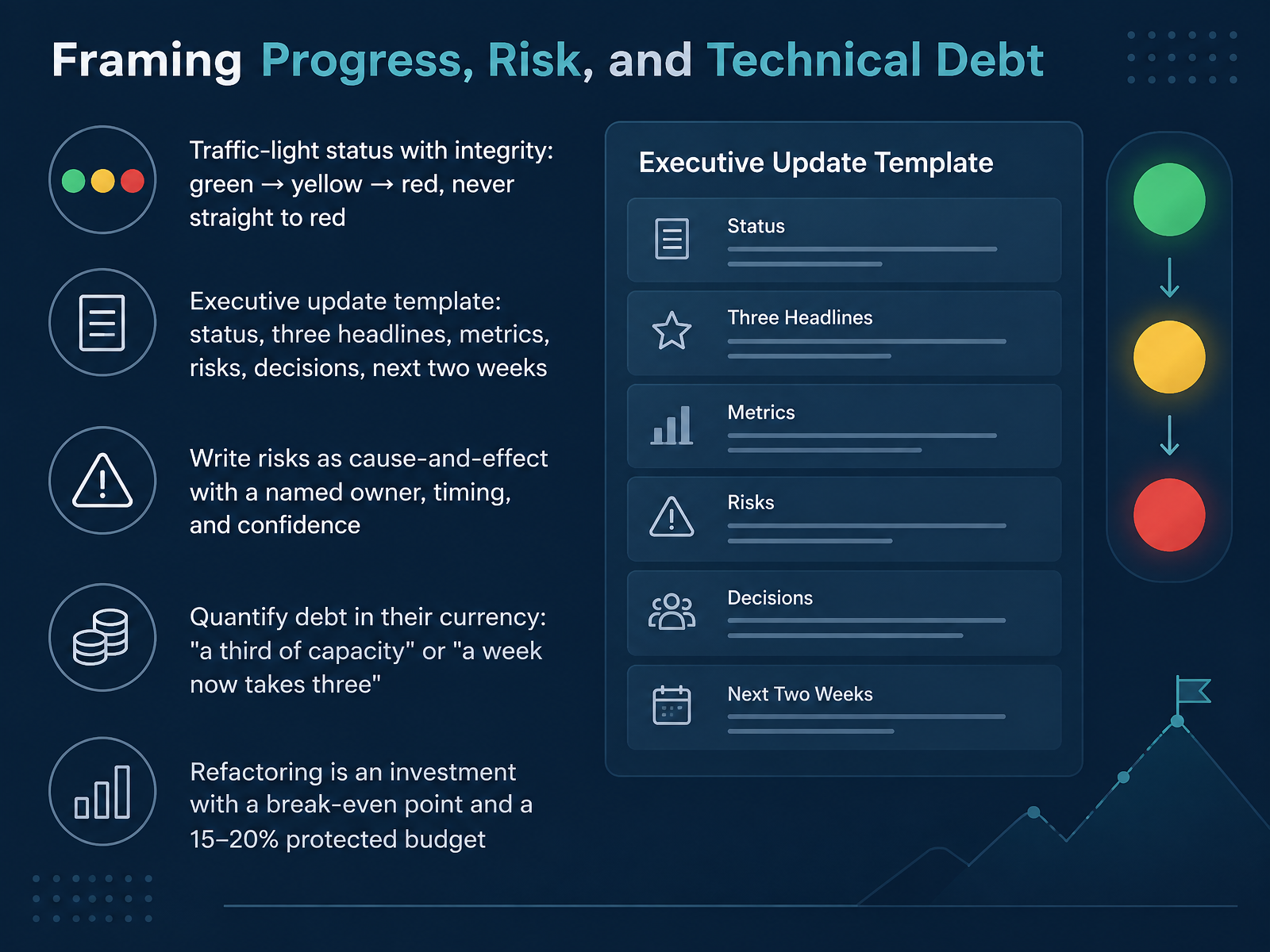
- 08Framing Progress, Risk, and Technical DebtLet's talk about framing progress, risk, and technical debt honestly. First, use traffic-light status with integrity. Move from green to yellow to red, never straight to red. If a project jumps from green to red in one update, your stakeholders were surprised, and that erodes trust. So the moment you see yellow, say so. Second, keep executive updates short and predictable: status, three headlines, key metrics, risks, decisions needed, and the next two weeks. Third, write each risk as cause and effect, with a named owner, timing, and your confidence level. Fourth, quantify debt in their currency. Say a third of capacity goes to workarounds, or a task that should take a week now takes three. Finally, treat refactoring as an investment with a break-even point, and protect a fifteen to twenty percent budget for it. Your action: this week, rewrite one risk as cause and effect with an owner, and put a number on your debt. Next, we look at executive and product narratives.
 muhammadamal.my.idandrewweinberg.usomnigaze.com+22 min
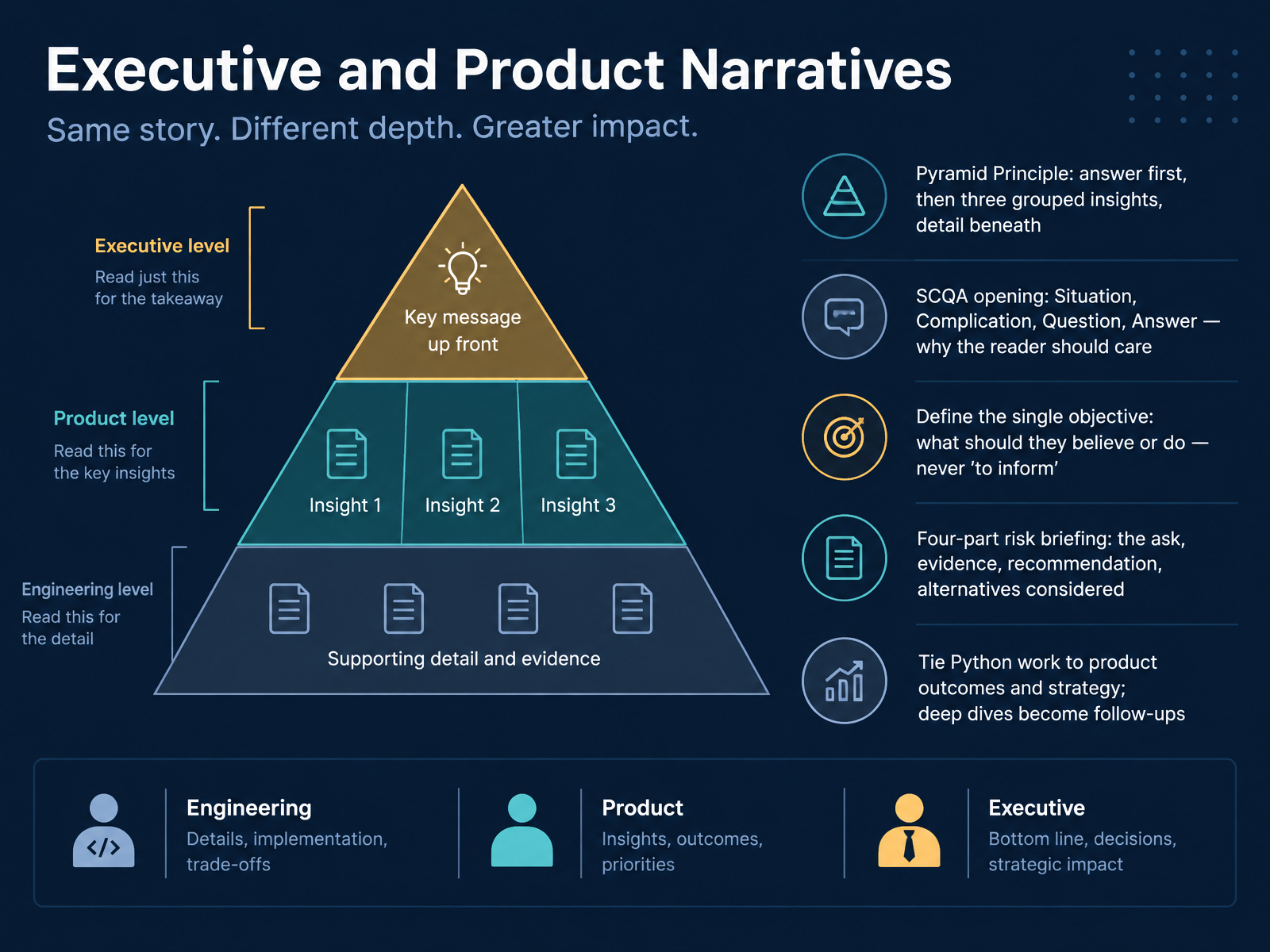
- 09Executive and Product NarrativesNow let's look at how you frame Python work for executives and product leaders. Start with the Pyramid Principle. Lead with the answer, then three grouped insights, with detail underneath for anyone who wants it. Open with S C Q A: Situation, Complication, Question, Answer. That tells the reader why they should care before you deliver the point. Then define one objective. What should they believe or do? Never settle for to inform. For risk, use a four-part briefing: the ask, the evidence, your recommendation, and alternatives considered. And always tie Python work to product outcomes and strategy. Technical deep dives become follow-up conversations, not the main event. Your takeaway: before your next sprint review or stakeholder demo, write the answer in one sentence, and delete anything that doesn't support it. Next, we'll cover answering why Python and handling objections.
 muhammadamal.my.idandrewweinberg.usomnigaze.com+22 min
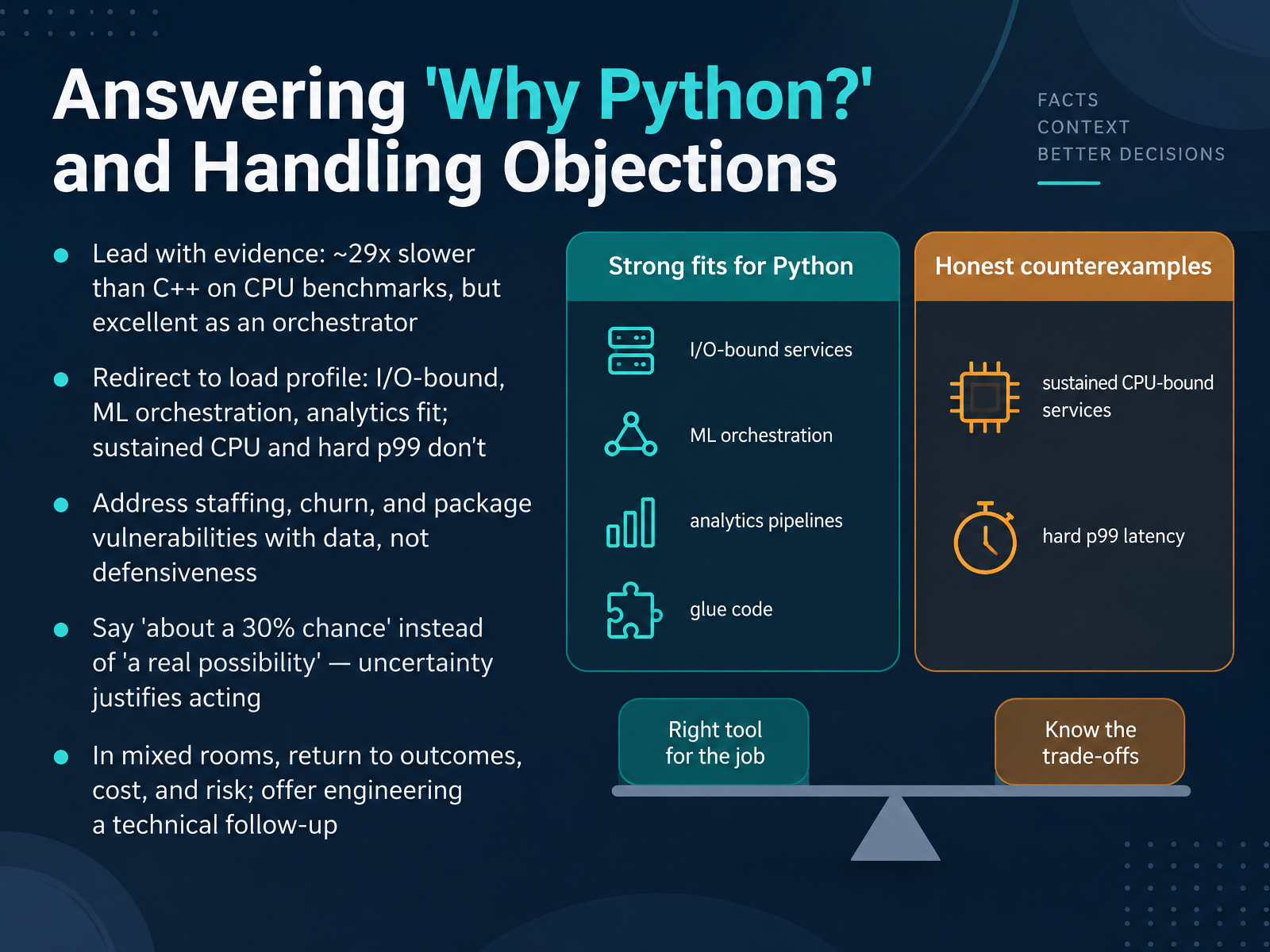
- 10Answering 'Why Python?' and Handling ObjectionsLet's talk about the question every stakeholder eventually asks. Why Python? Lead with evidence, not enthusiasm. On raw CPU benchmarks, Python runs roughly twenty nine times slower than C plus plus. Say that plainly. Then redirect to your load profile. Python is an excellent orchestrator for I/O bound services, machine learning pipelines, and analytics. It is a poor fit for sustained CPU work and hard p ninety nine latency targets. On staffing and package vulnerabilities, bring data, not defensiveness. Replace vague language with real numbers. About a thirty percent chance beats a real possibility, because uncertainty is itself a reason to act. In mixed rooms, return to outcomes, cost, and risk. Offer engineering a separate technical follow up. Here is your action. Before the next review, write your top objection and the one number that answers it. Next, we put this into practice with a workshop called One Feature, Three Audiences.
 muhammadamal.my.idandrewweinberg.usomnigaze.com+22 min
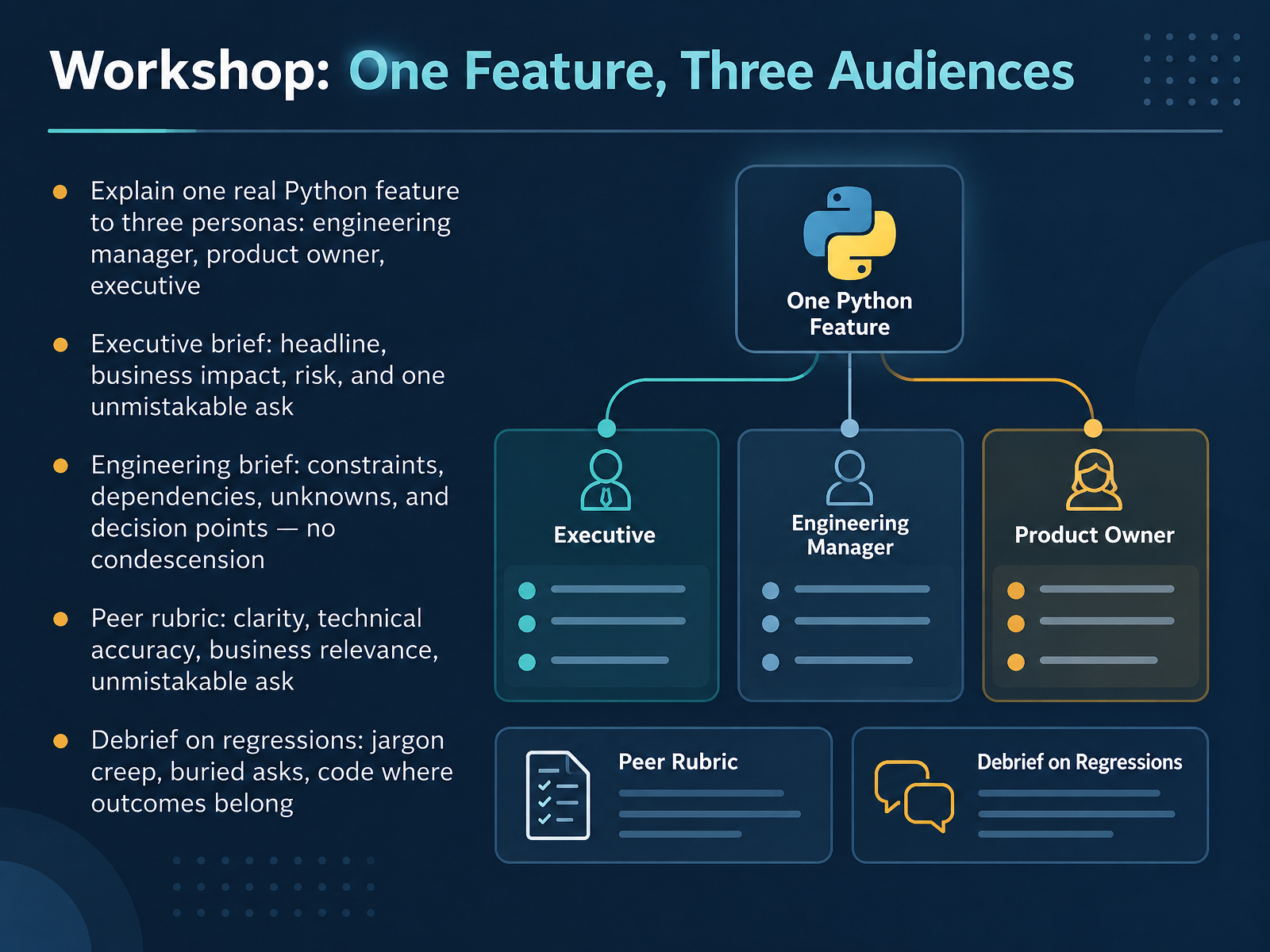
- 11Workshop: One Feature, Three AudiencesNow let's put this into practice. Pick one real Python feature and explain it three ways: to an engineering manager, a product owner, and an executive. The executive brief has four parts. A headline, the business impact, the risk, and one unmistakable ask. The engineering brief covers constraints, dependencies, unknowns, and decision points, with no condescension. Then swap with a peer and score each other on clarity, technical accuracy, business relevance, and whether the ask was unmistakable. In the debrief, watch for regressions: jargon creep, buried asks, and code where outcomes belong. So choose one feature today and write the executive version first. That single habit will sharpen every brief you deliver. Next, we move on to Reusable Artifacts and Feedback Loops.
 coderslingo.comcyclic.shenterprisersproject.com+22 min
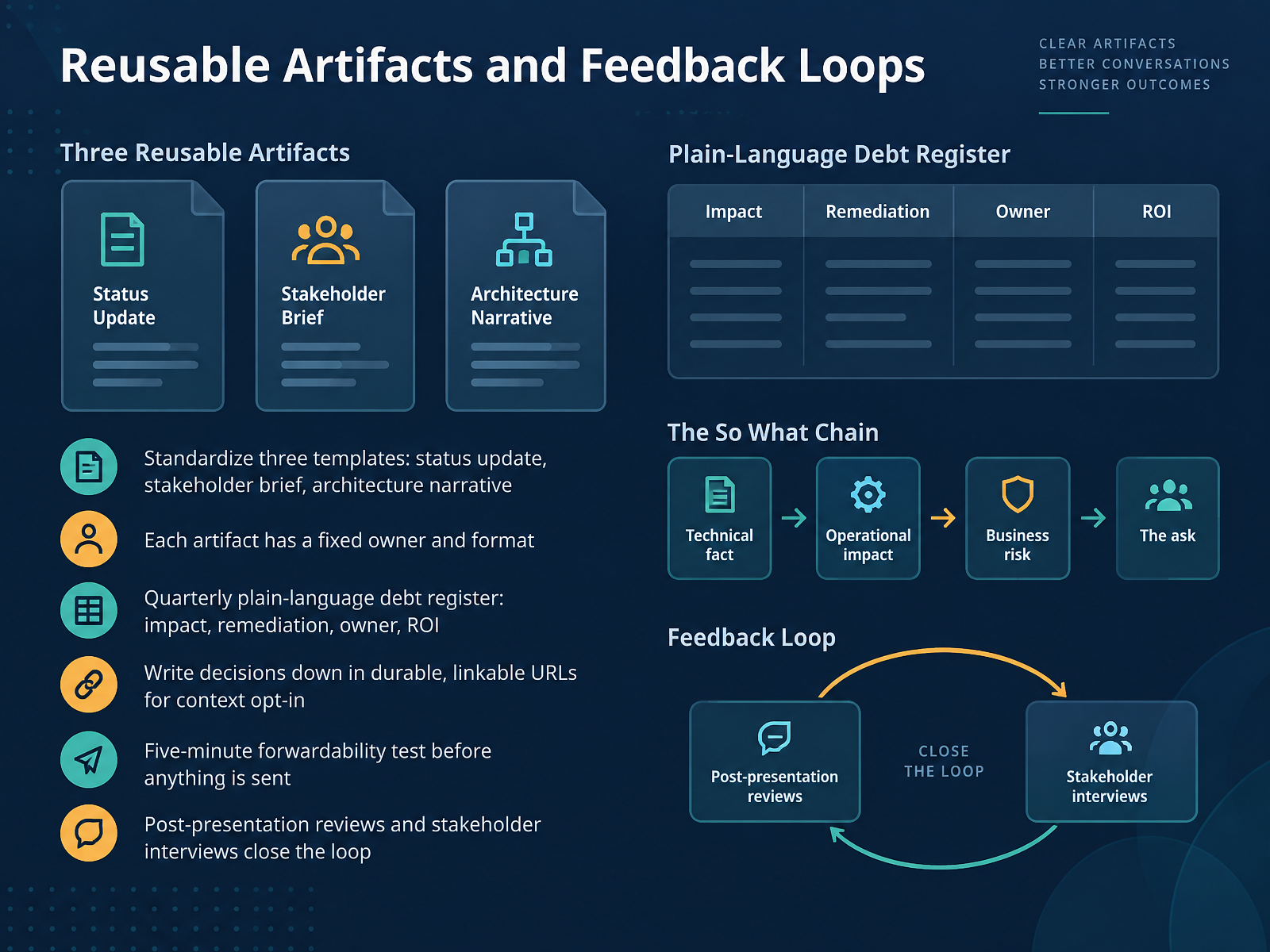
- 12Reusable Artifacts and Feedback LoopsNow let's look at reusable artifacts and feedback loops. The practical takeaway is this: make communication repeatable. Standardize three templates: a status update, a stakeholder brief, and an architecture narrative. Give each artifact a fixed owner and a fixed format, so nobody starts from a blank page during sprint reviews or demos. Keep a quarterly plain-language debt register. For each item, record the business impact, the remediation, the owner, and the return on investment. Write decisions down in durable, linkable URLs, so people can opt in to context instead of being pulled into every meeting. Before you send anything, run a five-minute forwardability test. Ask whether a colleague could forward this without your explanation. Then close the loop with post-presentation reviews and stakeholder interviews. Pick one artifact this week and assign its owner. Next, we turn to measuring communication effectiveness.
 coderslingo.comcyclic.shenterprisersproject.com+22 min
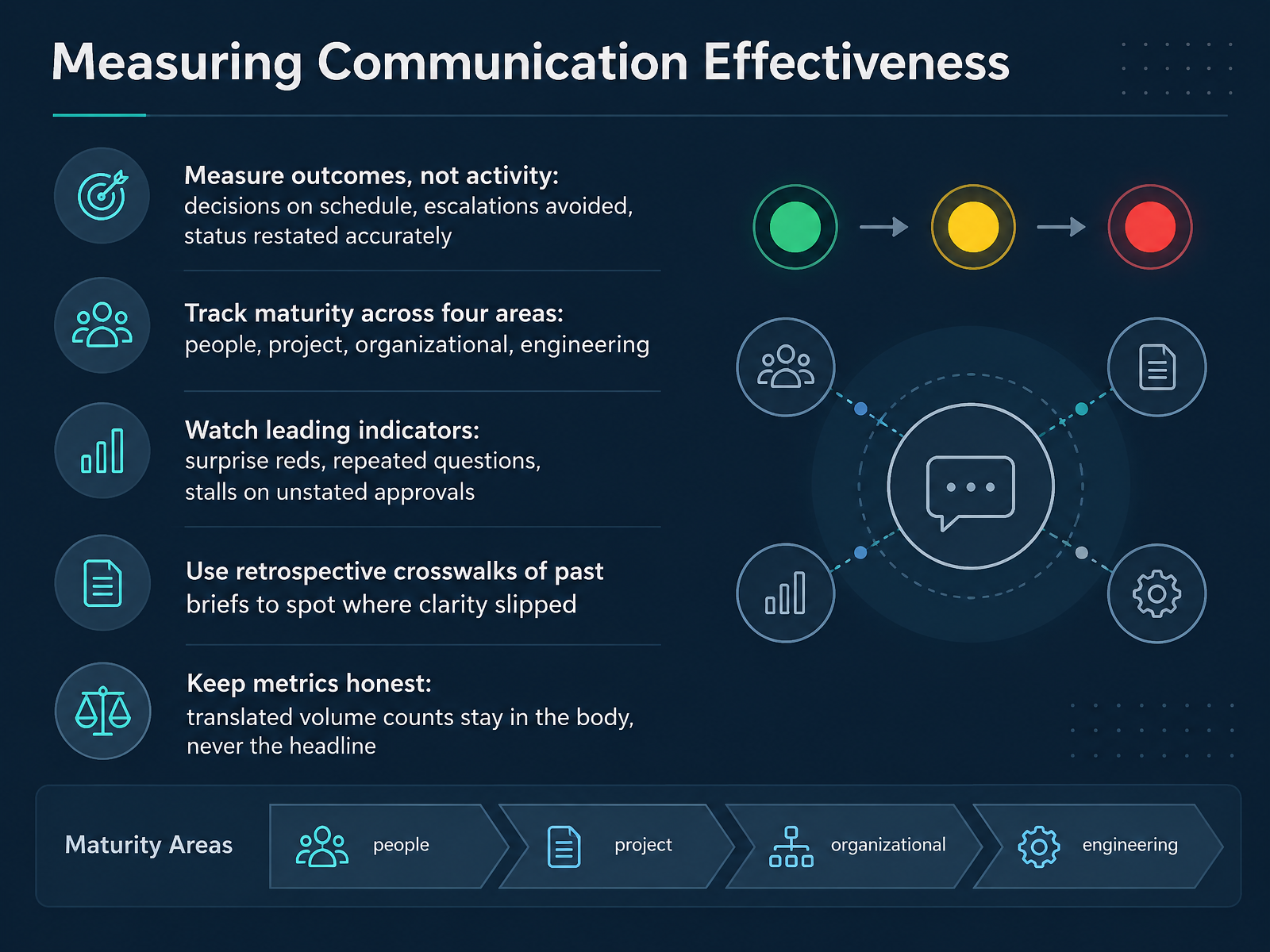
- 13Measuring Communication EffectivenessLet's talk about measuring whether your communication actually works. Measure outcomes, not activity. Did decisions land on schedule? Were escalations avoided? Could a stakeholder restate the status accurately? Those are the signals that matter. Next, track maturity across four areas: people, project, organizational, and engineering. Then watch leading indicators, like surprise reds, repeated questions, and stalls on approvals nobody stated. Run retrospective crosswalks of past briefs to spot where clarity slipped. And keep metrics honest: translated volume counts stay in the body, never the headline. The takeaway is one decision. This sprint, pick one outcome metric and one leading indicator, and review both at your next sprint review. That gives you an honest baseline to improve from. Next, we'll look at Your Next 30 Days.
 1 min
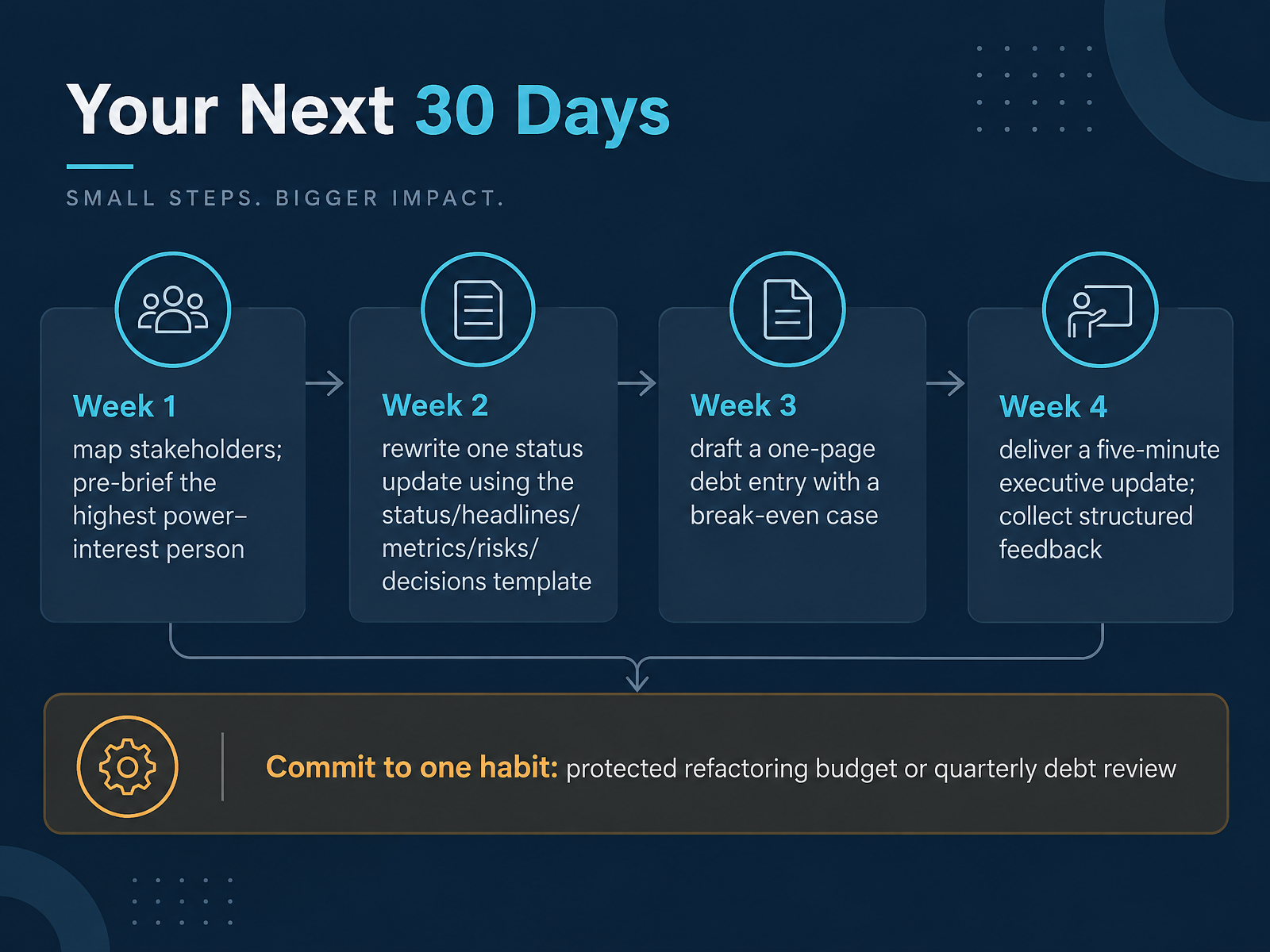
- 14Your Next 30 DaysLet's close by turning everything we covered into a concrete thirty day plan. Make it small and repeatable. Week one, map your stakeholders and pre-brief the person with the highest power and interest, before the meeting, not during it. Week two, rewrite one status update using the status, headlines, metrics, risks, and decisions template. Week three, draft a one-page debt entry with a clear break-even case, for example, three days of refactoring that saves two days on every future feature breaks even by feature two. Week four, deliver a five-minute executive update and collect structured feedback. Then commit to one habit that lasts. Either a protected refactoring budget of fifteen to twenty percent each sprint, or a quarterly debt review with a visible register. Pick one, write it down, and put it on the calendar. Thank you for joining this course. You now have the language and the structure. Start with week one this week, and keep the conversation going.
 coderslingo.comcyclic.shenterprisersproject.com+22 min
Take the deck with you
Download this course as a file — free, no sign-up needed.
- PDF handoutEvery slide page, ready to print or share.15 pages · 3.2 MBDownload
- Narrated PowerPointThe deck that presents itself — every slide carries the digital human's narration video.15 pages · 13.0 MBDownload
- PowerPoint slidesThe full deck as a .pptx — open it in PowerPoint, Keynote, or Google Slides.15 pages · 3.1 MBDownload
Free to use in your own training — please keep the PersonWise credit page at the end.
Have your own deck? Turn it into a course
Sources consulted
Web sources consulted while building this course.
- Talking to Executives About Technical Risk, A Practical Framework | Hi, I'm Muhammad Amal — muhammadamal.my.id
- Translating Technical Risk into Executive Decisions | Andrew Weinberg — andrewweinberg.us
- How to Present Technical Risk to the Board | OmniGaze | OmniGaze — omnigaze.com
- Communicating Risk to Stakeholders Who Don't Speak Risk — p3m.tech
- How To Mitigate Delivery Risk in Software Engineering | Jellyfish Blog — jellyfish.co
- GIL: What's the hassle and... should I care? - Jacek Kołodziej — kolodziejj.info
- The Python GIL – Rohan Varma – Software Engineer @ Facebook — rohanvarma.me
- Understanding Concurrency and Processes (Video) – Real Python — realpython.com
- What, exactly, is the GIL? — finbarr.ca
- PEP 703 – Making the Global Interpreter Lock Optional in ... — peps.python.org
- 10.16 Stakeholder management and communication - Software Engineering Guide — software-engineering-guide.github.io
- Using Stakeholder Mapping to Collaborate | Scrum.org — scrum.org
- The TOGAF Standard, Version 9.2 - Stakeholder Management — pubs.opengroup.org
- Stakeholders in Requirements Engineering — ifi.uzh.ch
- Stakeholder mapping - Government Analysis Function — analysisfunction.civilservice.gov.uk
- How to Explain Technical Debt to Stakeholders — English for IT — coderslingo.com
- We sound like idiots when we talk about technical debt — cyclic.sh
- How to explain technical debt in plain English — enterprisersproject.com
- Technical debt has a price: how to brief it to a non-technical board | Encelyte — encelyte.com
- Tech-to-Business Translation Exercises — English for IT Professionals — English for IT — coderslingo.com