Begin
14 pages · ~28 min
Graphic Design Portfolio Builder
Learn to showcase your design work effectively by creating a professional portfolio that highlights your skills and attracts potential clients or employers.
A digital instructor presents all 14 pages. Hold “Ask” at any point and ask out loud — the answer comes from this course. No sign-up needed.
What you’ll learn
- 01Building a Graphic Design PortfolioWelcome. If you are building a graphic design portfolio, you are in the right place. This course will help you turn your work into a clear, focused career asset. Here is the first thing to understand. Your portfolio is the single most important tool you own. It is not a storage folder for everything you have ever made. It is a pitch. It tells an employer or a client how you think. Hiring managers today do not just want to see polished visuals. They want to see decisions. They want to see the problem you solved and the outcome you reached. So do not wait until you feel ready. Start now with what you have. A strong portfolio does not need twenty projects. Two to five focused case studies are enough. Quality beats quantity every time. Over the next few slides, we will build this together. We will start with what hiring managers and clients actually look for.mantlr.comsuperhive.coverifiedinsider.substack.com+21 min
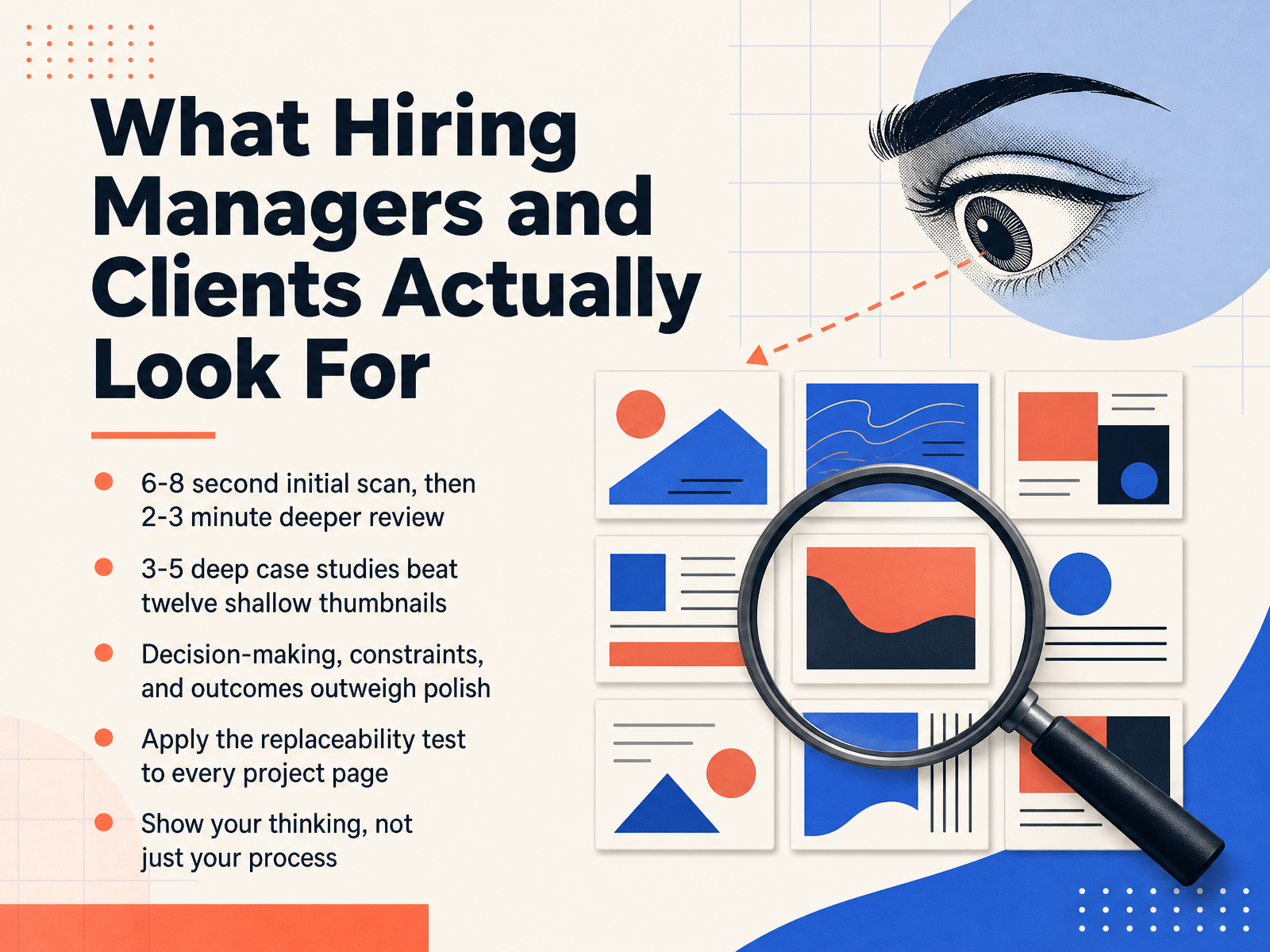
- 02What Hiring Managers and Clients Actually Look ForLet's look at what actually happens when a hiring manager opens your portfolio. The scan happens fast. You have six to eight seconds to earn a deeper look. If you pass that test, they may spend two or three minutes with your work. That changes how you should build every page. Depth beats breadth here. Three to five strong case studies will serve you better than twelve shallow thumbnails. A case study should lead with the decision you made, the constraint you faced, and the outcome you created. Polish is not the point. Thinking is. Run the replaceability test on every project page. Ask yourself if someone could recreate this page in an afternoon with a style reference and an AI tool. If the answer is yes, that project belongs in your archive, not at the top. On each page, name the constraint in one plain sentence. Show one direction you killed and why you killed it. Prove the system worked across real formats. That shows a reviewer how you think, not just what you can make. Let's move into how to choose projects that show your best thinking.
 mantlr.comsuperhive.coverifiedinsider.substack.com+21 min
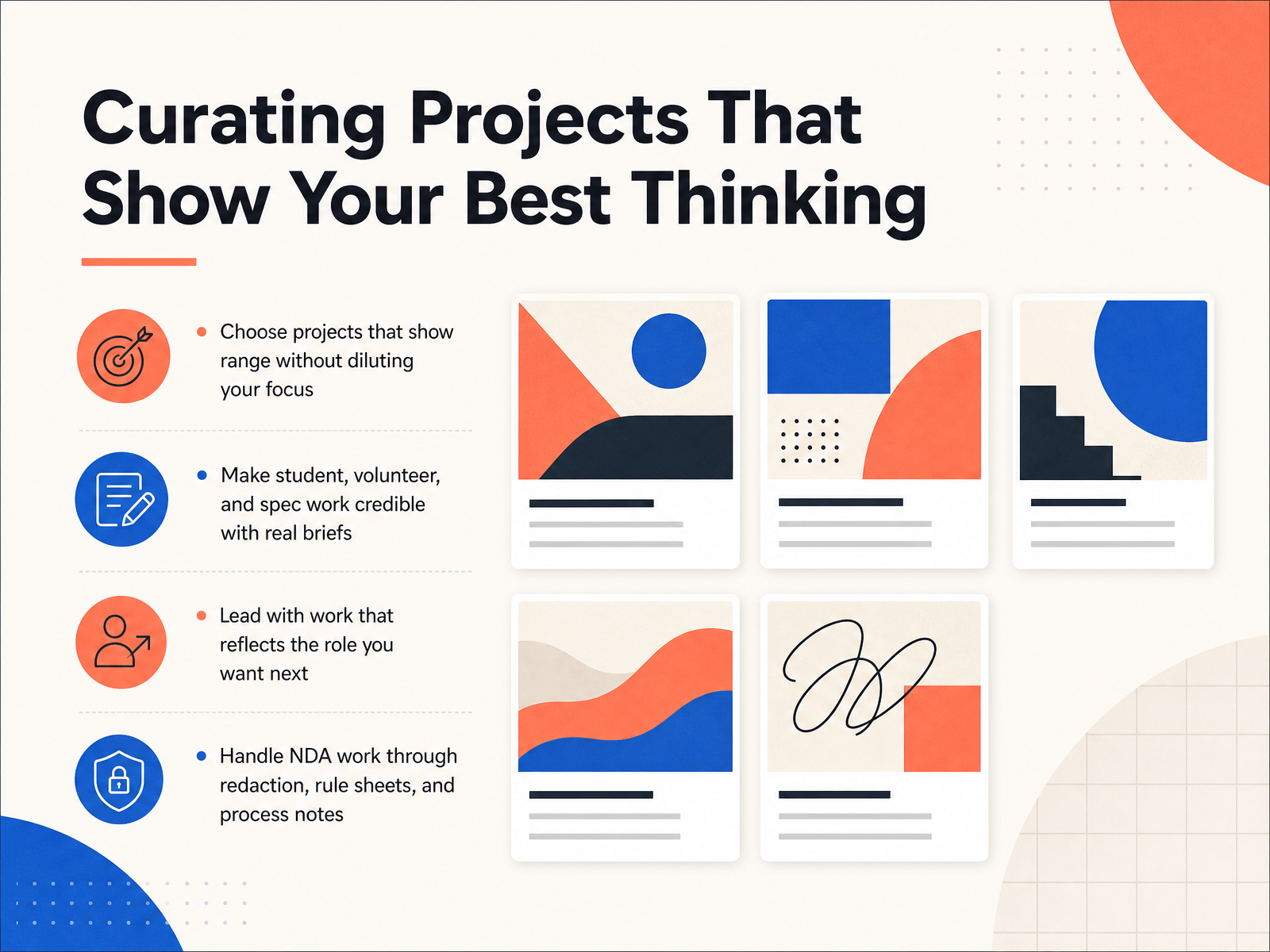
 - 03Curating Projects That Show Your Best ThinkingLet's talk about curation. This is where your portfolio stops being a folder of work and starts being a pitch for the job you want. The rule is simple: choose projects that show range without diluting your focus. Every piece should earn its place by pointing toward the kind of designer you're trying to become. Now, what if you don't have enough paid work? That's okay. Make student, volunteer, and spec work credible by giving it a real brief. Name the audience. Name the channel. Show one direction you rejected and why. That one detail instantly signals professional thinking. Then, lead with the work that reflects the role you want next. Put your most relevant project first. Not your favorite. Not your biggest. The one a hiring manager will see and think, yes, this person can do this job. And if your best work is locked under an NDA, do not leave a blank space. Create a redacted version. Strip the brand name. Show the process, the rules, and the thinking. Often, that reveals your mind in a way a finished ad never could. This is the heart of a portfolio that works. And it leads us directly into how you structure it. Next, let's look at the case study structure that works.
 dochipo.comsuperhive.codesigner-daily.com+22 min
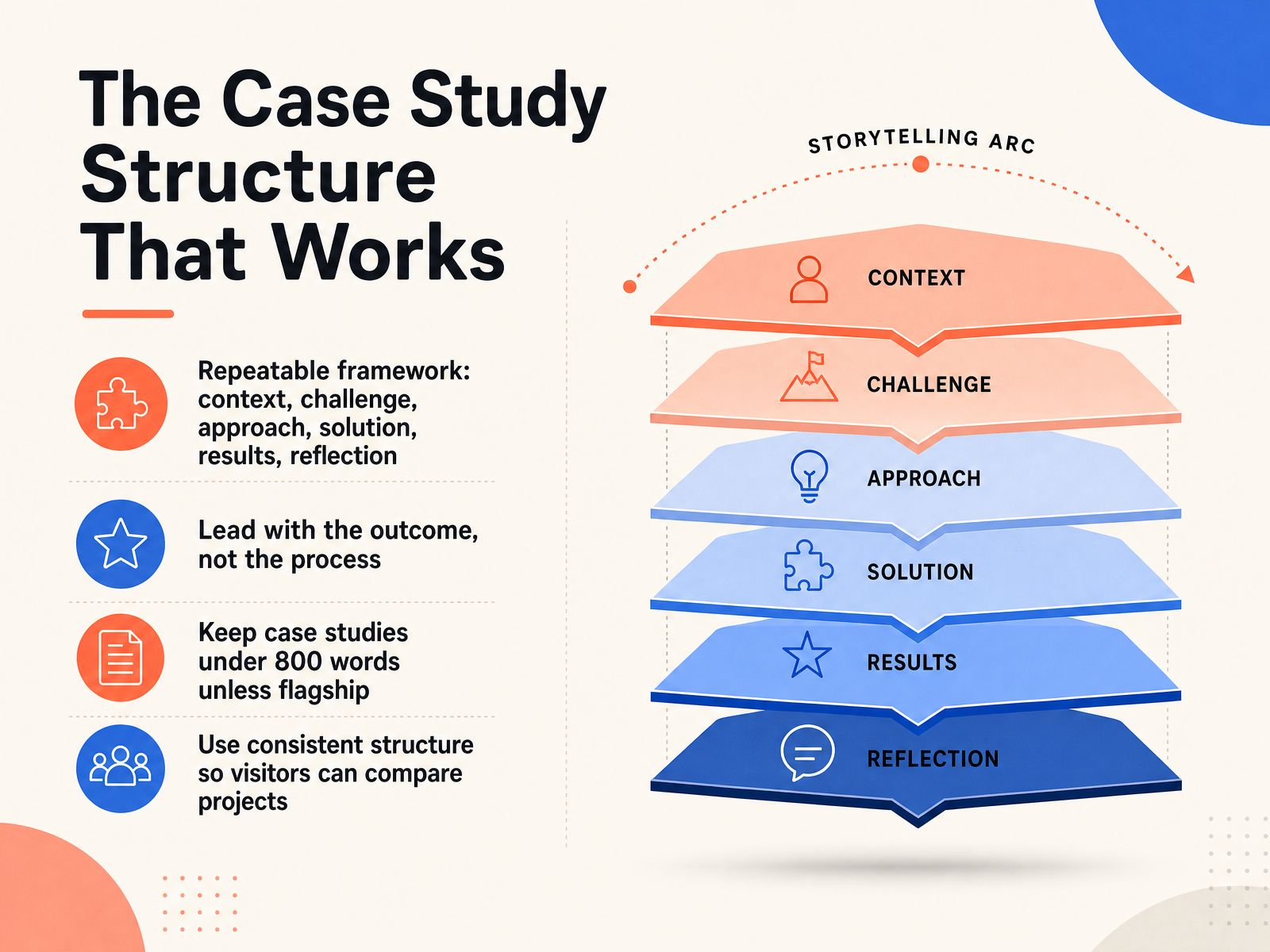
 - 04The Case Study Structure That WorksNow let's look at the structure that holds your best work together. A strong case study follows a repeatable framework. Think of it as six beats: context, challenge, approach, solution, results, and reflection. This order gives your reader a clear story, from the problem you faced to the outcome you created. But here is the key move. Lead with the outcome, not the process. Start with the result, the impact, the transformation. That hooks your reader before you walk them through how you got there. And keep it tight. Aim for under eight hundred words for most projects. Save the longer, deeper treatment for a flagship piece. Most importantly, use this same structure on every case study. When each project follows the same beats, visitors can scan, compare, and actually understand your range. Up next, we'll explore how to show your process without burying the work.
 template.netlistaaj.comdochipo.com+21 min
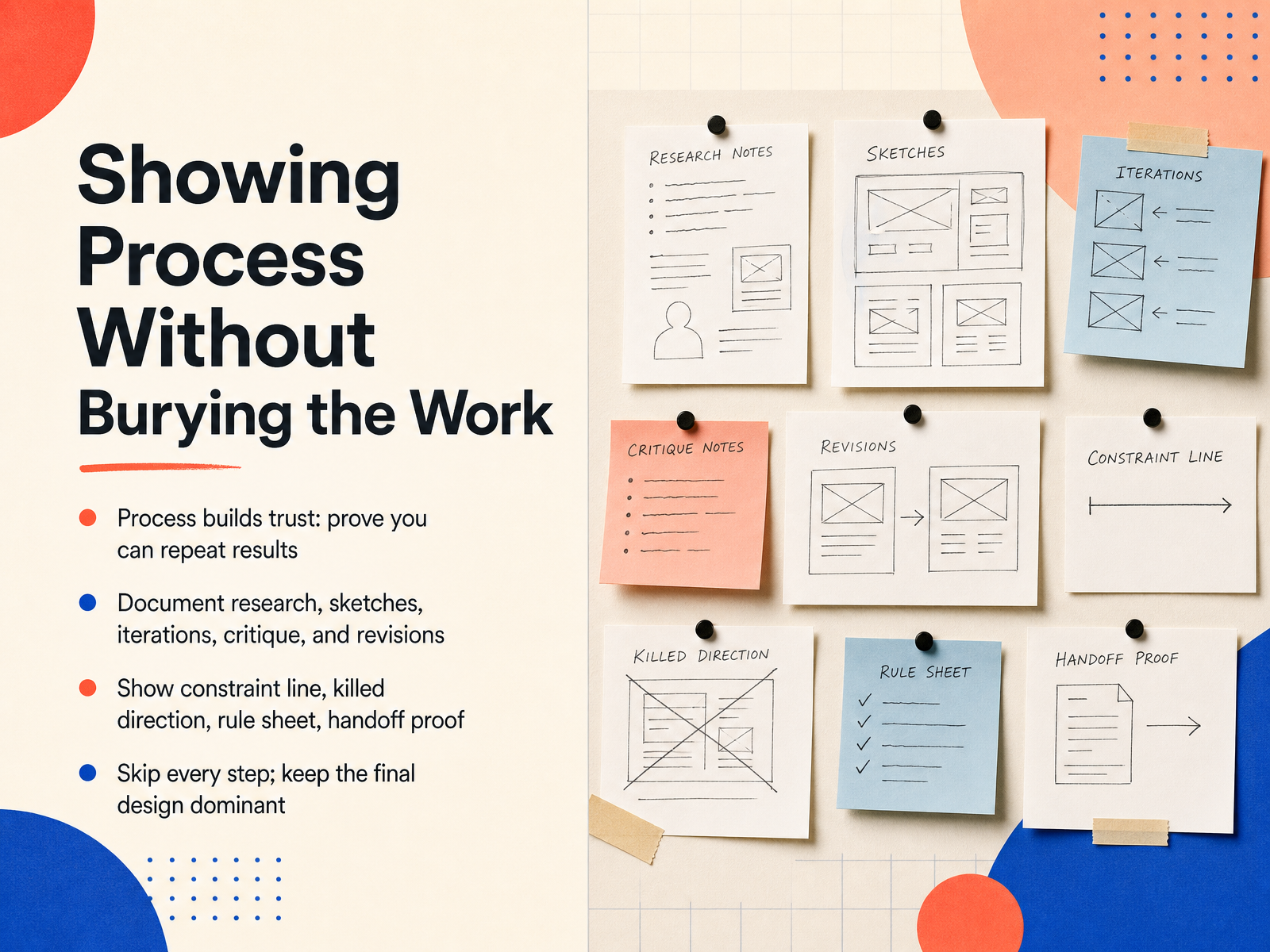
 - 05Showing Process Without Burying the WorkLet's get real about process. You don't need to show every single sketch. You need to show enough to prove you can think. Hiring managers want to know your great result wasn't a fluke. They want to see you can repeat it. So document the big moments. Show your research. Show how your sketches led to iterations. Show what changed after critique and revision. But don't bury the final design under a pile of sticky notes. Keep process visuals smaller, cleaner, and secondary. Let the polished mockup stay front and center. If you had a killed direction, that's gold. It shows you made a choice, not just a happy accident. Build these pages like a story. The final work is the hero. The process is just the supporting cast. Now, let's talk about how your own personal brand can support the work you're sharing.
 graphicdesign.stackexchange.comandybudd.opalstacked.comriffon.com+21 min
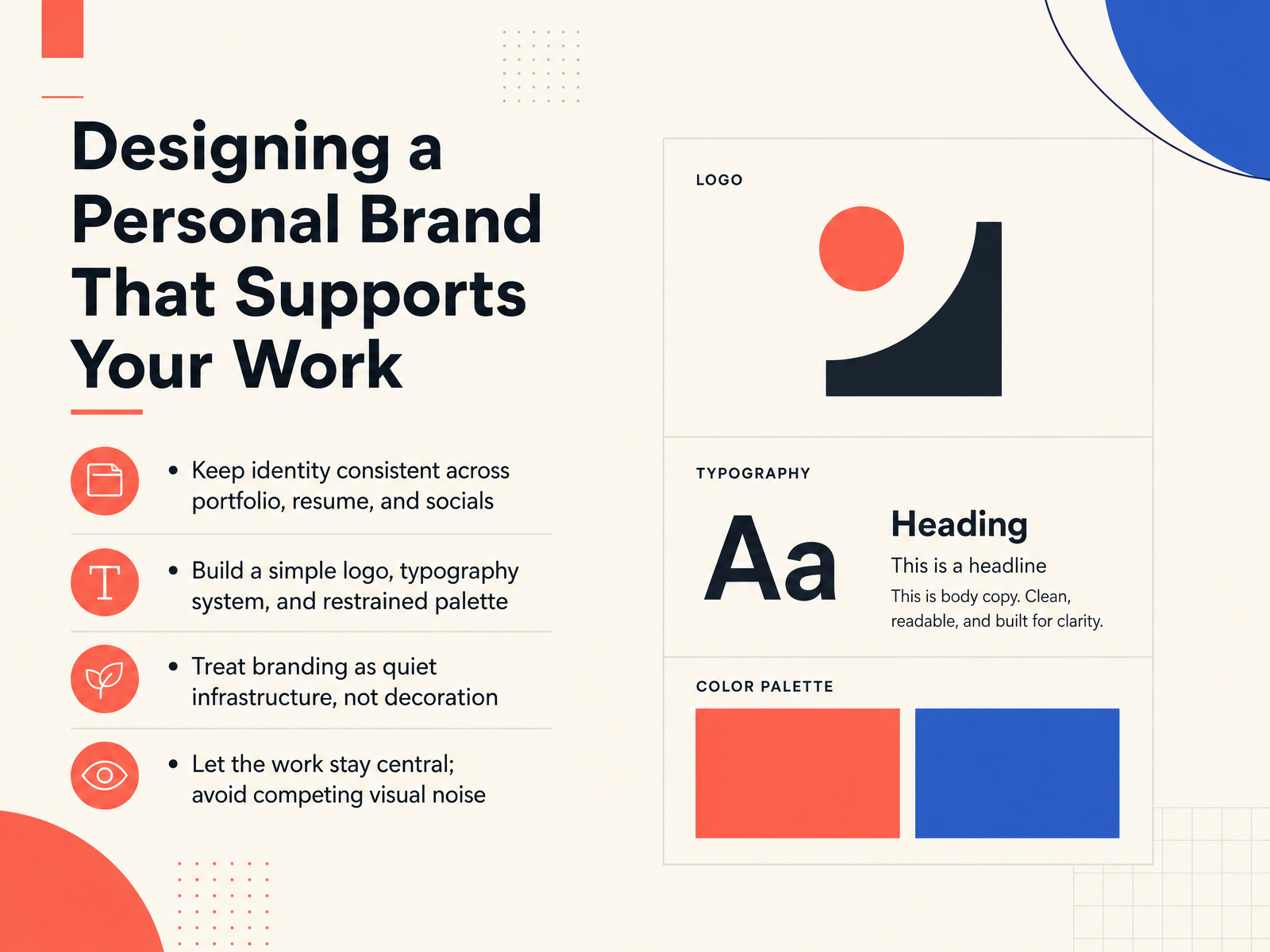
 - 06Designing a Personal Brand That Supports Your WorkNow let's talk about the visual system that holds your portfolio together: your personal brand. The goal here is not to build a loud identity. The goal is to build quiet infrastructure. Start by keeping your identity consistent across your portfolio, your resume, and your social profiles. If your resume uses one font and your website uses another, you create friction. Consistency signals professional care. Next, build a simple logo or even just a wordmark with a clear typography system and a restrained color palette. Two or three colors are enough. This isn't about creating a complicated symbol. It is about creating a recognizable signature. Treat this branding as infrastructure, not decoration. It should create a controlled environment where your work stays central. If your logo is competing with a project image, it is too loud. Remember, clients are not hiring your logo. They are hiring your ability to solve visual problems. Let the work breathe. Keep the frame minimal. Up next, we'll talk about choosing the right platform to house all of this work.
 bordolenc.comdylanklemm.commarcuskelly.design1 min
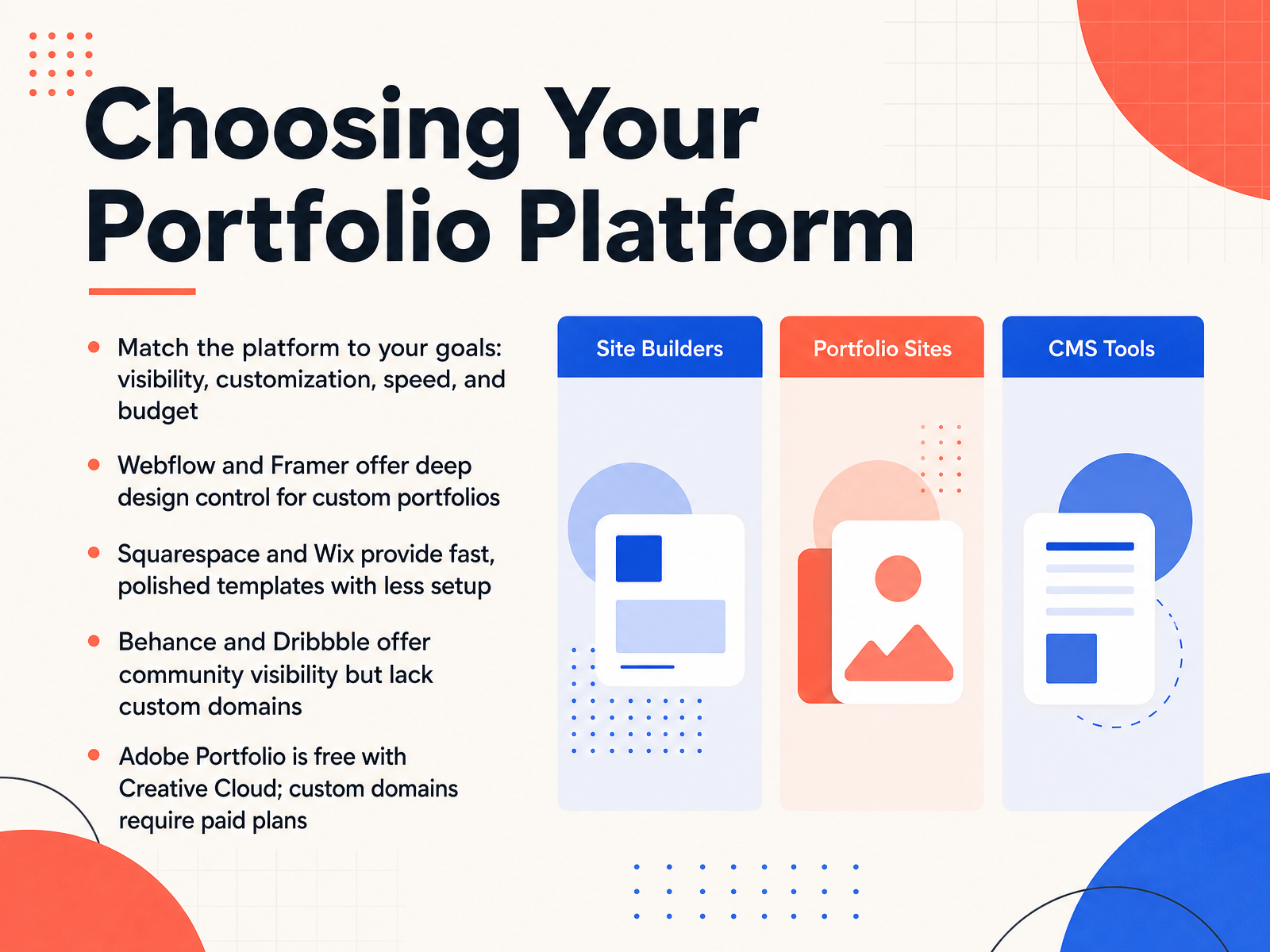
 - 07Choosing Your Portfolio PlatformNow, let's talk about where your portfolio will live. Choosing the right platform is a strategic decision, so match it to your goals first. Think about visibility, customization, speed, and your budget. If you want deep design control and a truly custom feel, Webflow and Framer are powerful options. They let you build almost anything, but they take more time to learn. If speed is your priority, Squarespace and Wix offer fast, polished templates with less setup. You can have a professional site live in a weekend. Behance and Dribbble are excellent for visibility. They put your work in front of a large creative community, but you do not get your own custom domain there. And if you already use Adobe Creative Cloud, Adobe Portfolio is included for free. That is a great starting point, though remember that connecting a custom domain usually requires a paid plan. Choose the tool that fits how you want to be seen, and how fast you need to ship. Next, we will look at the essential pages every portfolio website needs.
 mantlr.comsuperhive.coverifiedinsider.substack.com+22 min
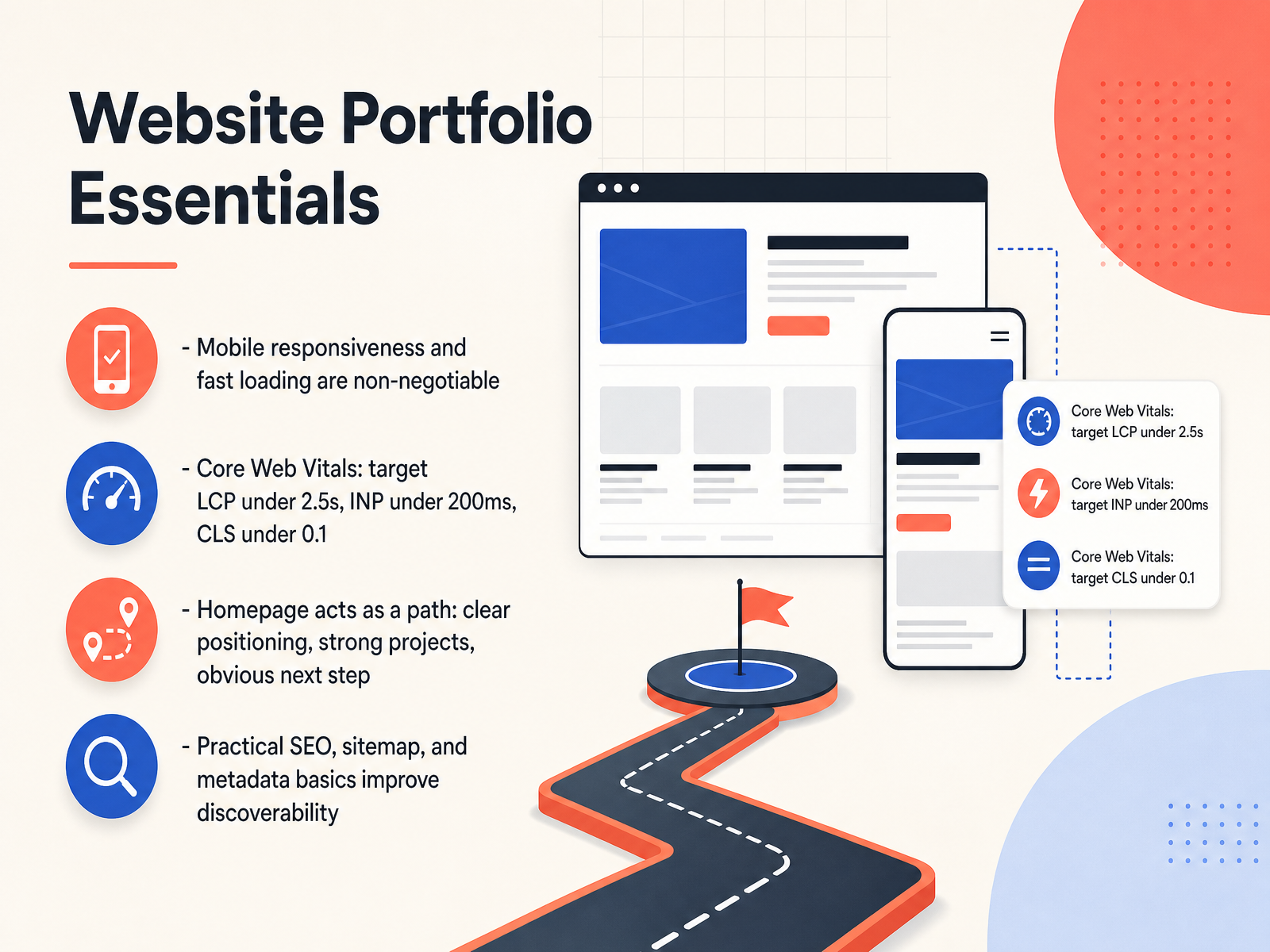
 - 08Website Portfolio EssentialsNow let's talk about your website itself. A beautiful portfolio is worthless if no one can view it or find it. Your site must be fast and mobile responsive. That is the cost of entry. If a design director opens your work on a phone and it is broken or slow, you have lost them in seconds. Treat performance as part of your design skill. Aim for a Largest Contentful Paint under two and a half seconds, and ensure interactions feel instant. Keep your layout stable so nothing jumps around while loading. Also think about your homepage as a path, not a gallery. A visitor should know who you are, see strong work, and understand exactly what to click next. Make that next step obvious. Finally, do not skip the basics of search. Write clear page titles, add a sitemap, and use simple metadata so your name is discoverable. These quiet details make you look professional and dependable. With the live site covered, we will use the next slide to prepare your polished PDF and print portfolio.
 mantlr.comsuperhive.coverifiedinsider.substack.com+22 min
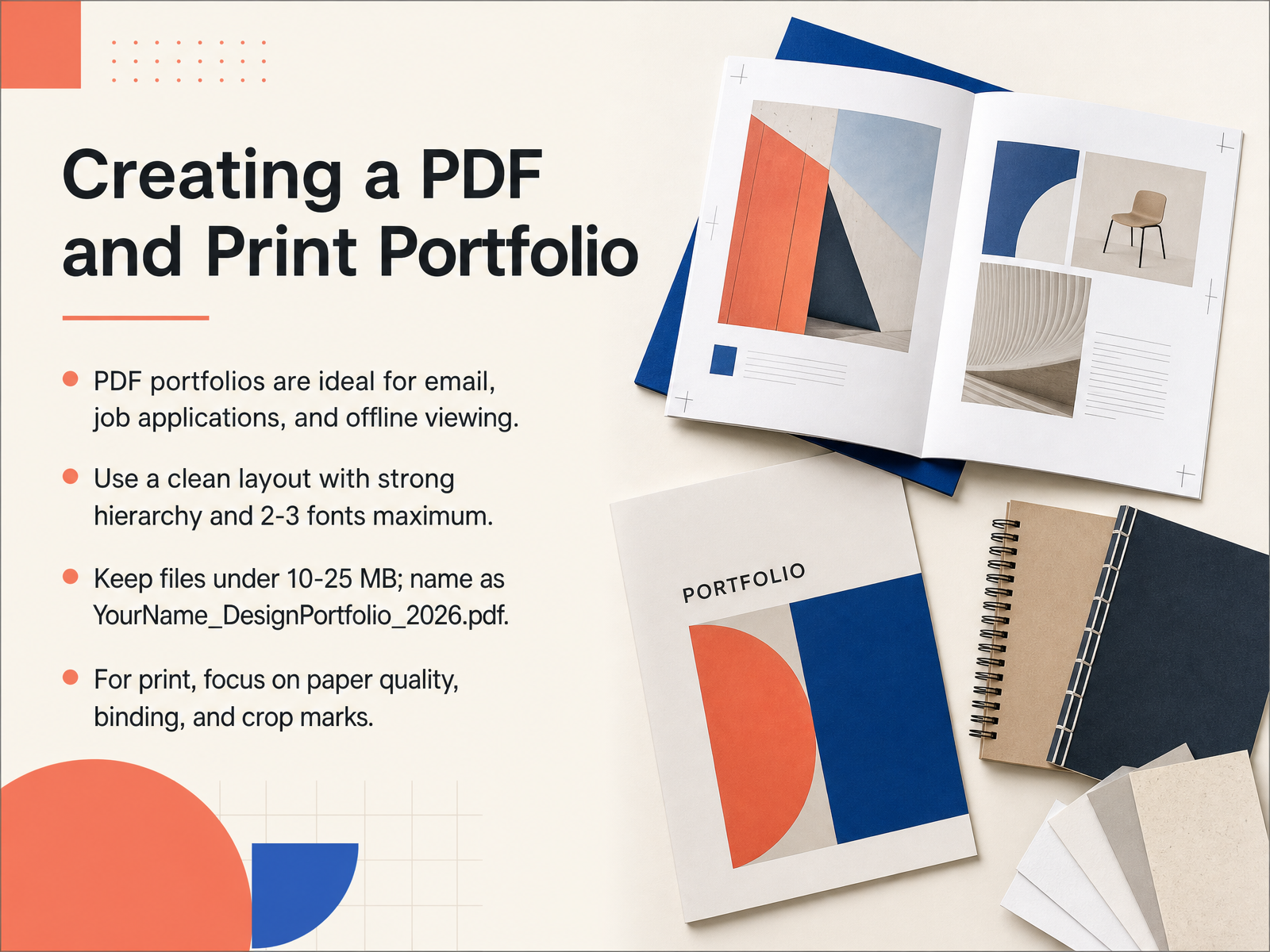
 - 09Creating a PDF and Print PortfolioNext, let's make your portfolio portable. A PDF version is essential. It is the version you will attach to emails, include with job applications, and share when someone wants to review your work offline. When you design this document, keep it clean. Use a clear grid. Let your work breathe with good use of white space. Stick to two or three fonts maximum, just like your online portfolio. Always check your file size. Keep it between ten and twenty-five megabytes so it is easy to download and open. And rename your file professionally, like Your Name, underscore, Design Portfolio, underscore, twenty twenty six, dot PDF. A messy file name is a missed opportunity. If you are preparing a physical book for an interview, do not print it on standard office paper. Choose a heavier, quality stock. Consider the binding carefully, and if you are showing packaging or editorial work, include bleed and crop marks to show you understand production. A thoughtfully crafted PDF or print piece proves your attention to detail. Next, we will focus on how to frame your projects with a narrative in every case study.
 superhive.cotemplate.netlistaaj.com+21 min
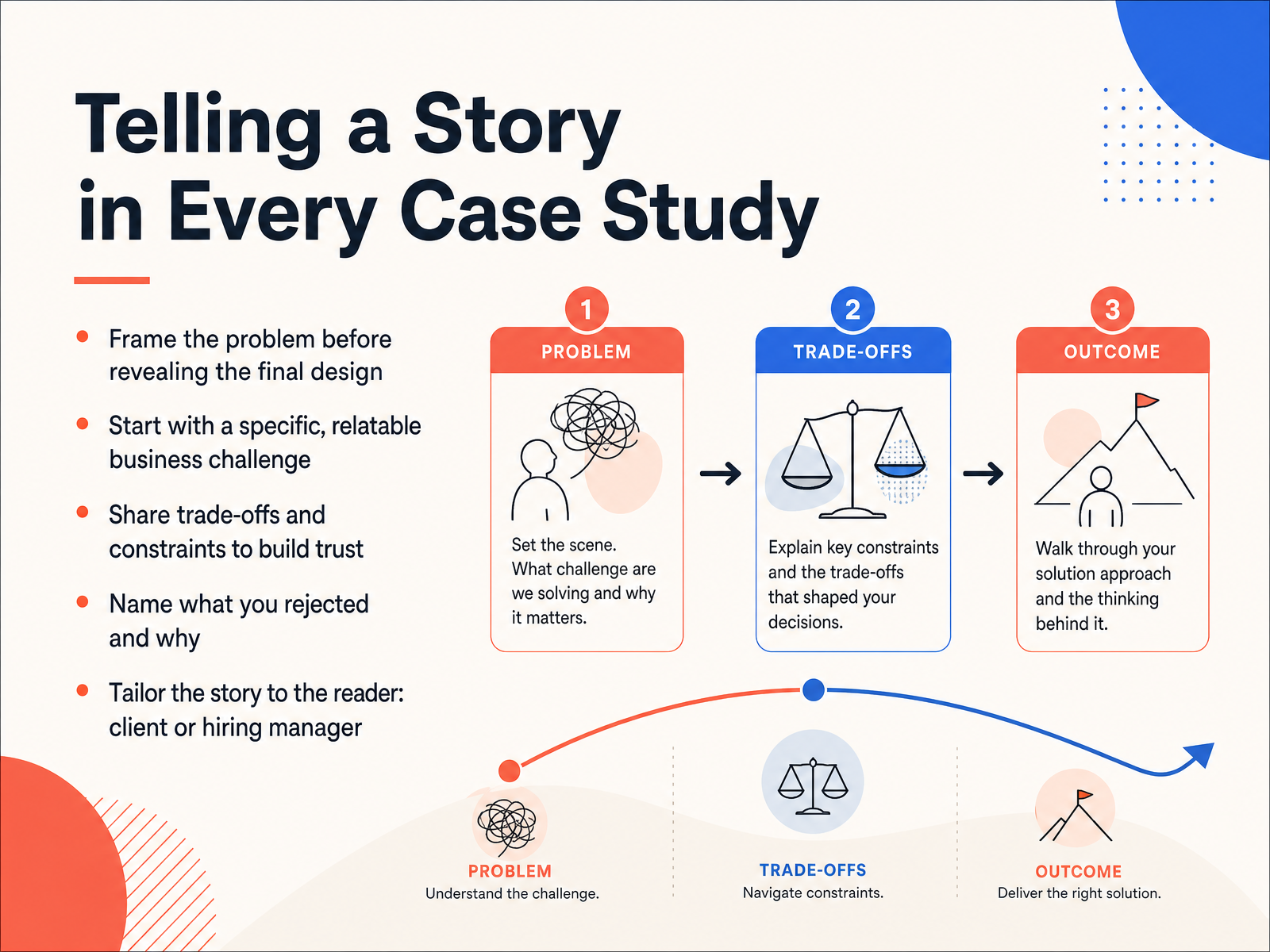
 - 10Telling a Story in Every Case StudyA case study only works if it reads like a story, not a gallery. So start with the problem. Frame the business challenge before you reveal the final design. Make it specific and relatable. For example, say the client was losing sales because their brand looked outdated, not just that they needed a refresh. Then share the constraints. Tell the reader about tight deadlines, budget limits, or technical barriers. This builds trust because it proves you solved a real problem, not just a pretty one. Next, name what you rejected. Show one direction you killed and say why it lost. That single decision tells a hiring manager more than ten polished mockups. It shows you can choose. Finally, tailor the story. A client wants to know you understand their market. A hiring manager wants to see your thinking and your role on the team. Adjust the emphasis, not the truth. Lead with the problem, prove your decisions, and end with the outcome. That is how a case study turns a picture into an argument. Next, we will look at getting feedback that actually improves your portfolio.
 dochipo.comsuperhive.codesigner-daily.com+21 min
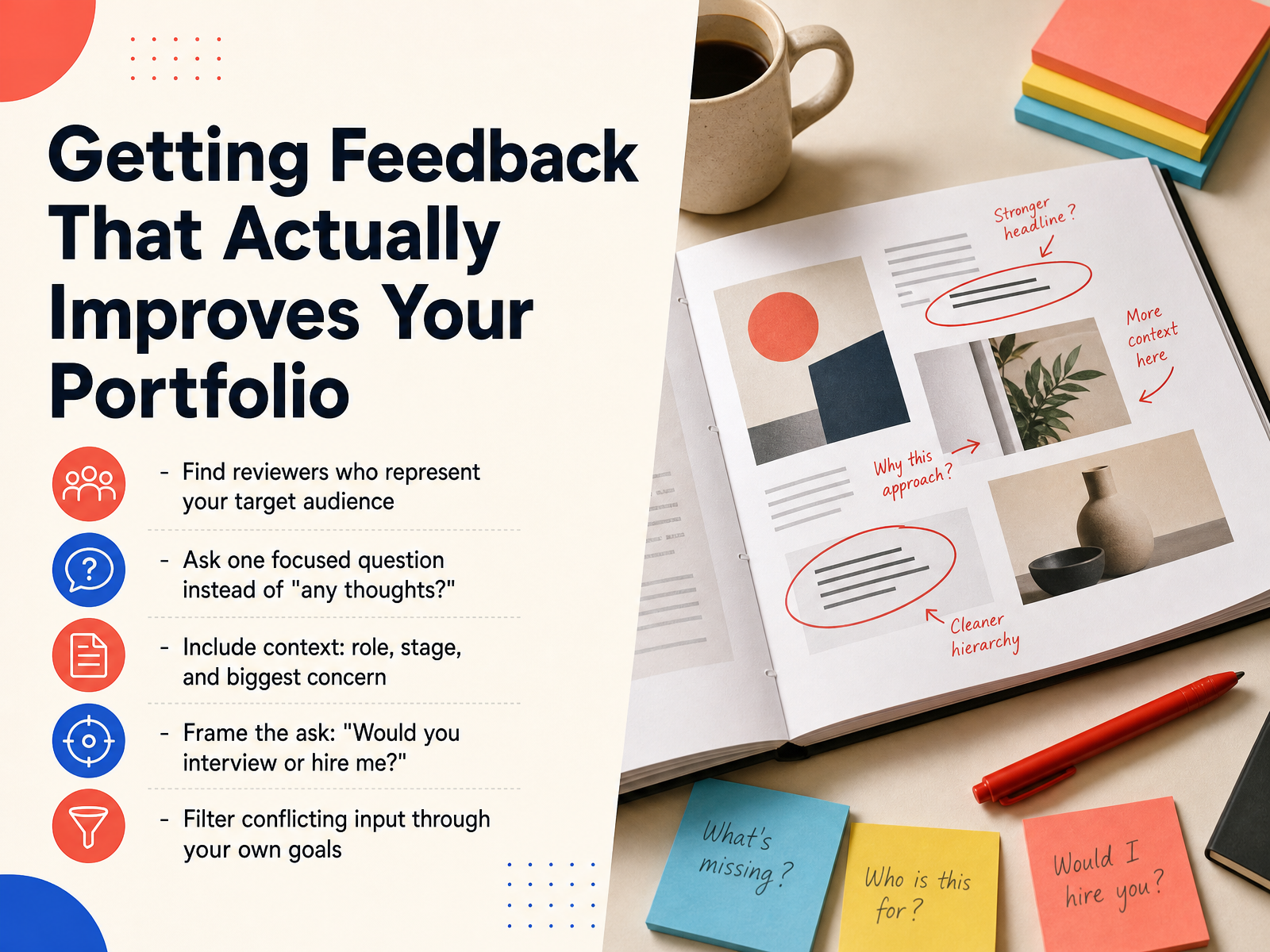
 - 11Getting Feedback That Actually Improves Your PortfolioLet's talk about feedback, because a portfolio that never gets a second opinion rarely gets a callback. The goal here is not just to hear nice things. It's to get feedback that actually moves your portfolio forward. Start with who you ask. Find reviewers who represent your target audience. If you want to work at a branding agency, show your work to a branding art director, not just a friend who likes design. When you ask for feedback, skip the vague 'any thoughts' and ask one focused question. For example, 'After scanning my homepage, do you know what role I'm targeting?' And give them context. Tell them your role, your career stage, and your biggest concern. This helps them tailor their advice. More importantly, frame the ask around the decision that matters most. Ask them directly, 'Based on this portfolio, would you interview me or hire me?' That question changes everything. It moves the conversation from subjective taste to career outcomes. Finally, you will get conflicting advice. One person might say cut a project, another says keep it. Filter all of it through your own goals and the kinds of roles you want. Now, once your portfolio is strong enough to show, it's time to think about how to put it in front of the right people. Next, we'll look at launching and sharing your portfolio.
 mantlr.comsuperhive.coverifiedinsider.substack.com+21 min
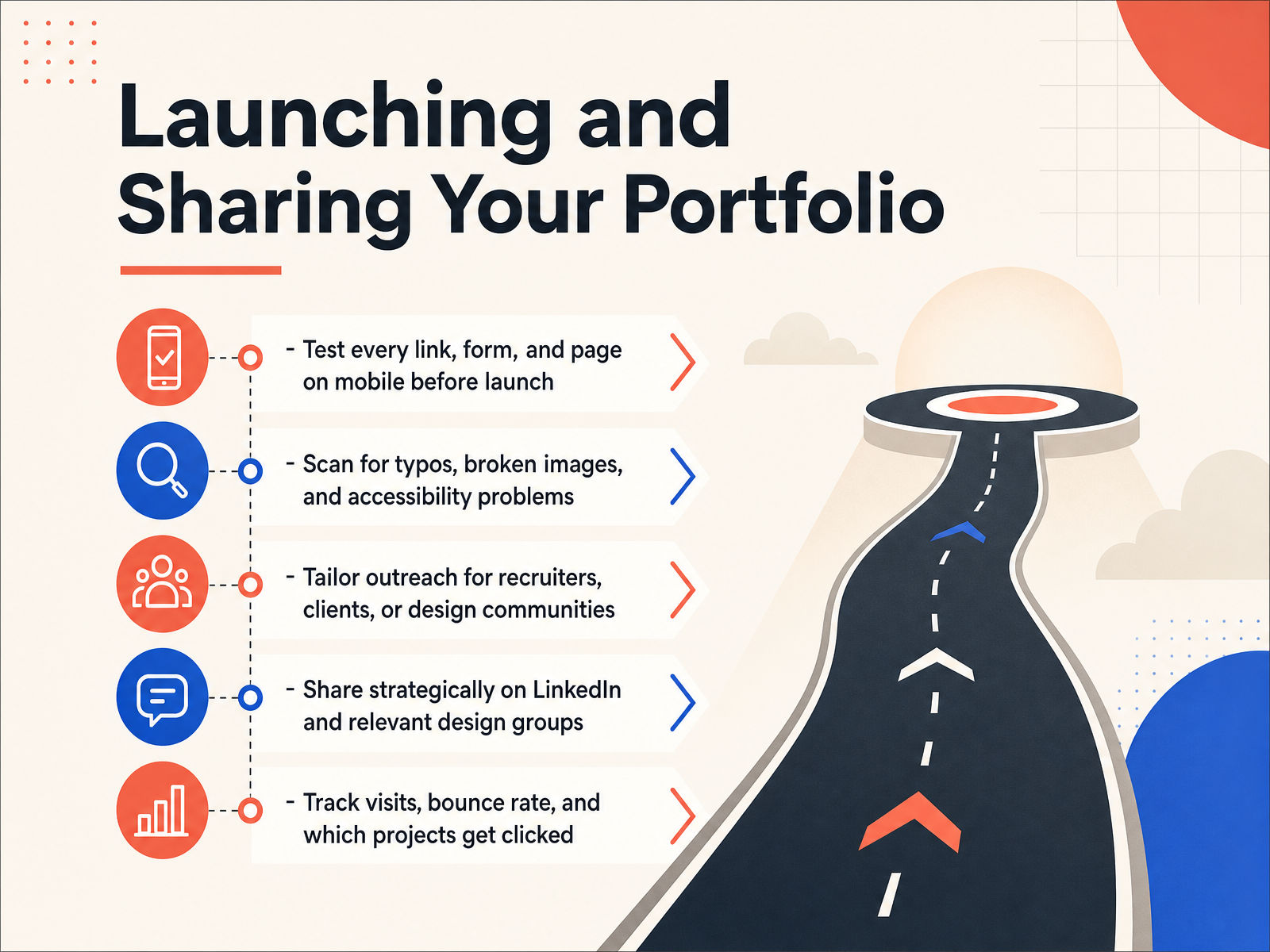
 - 12Launching and Sharing Your PortfolioNow we get to the moment that matters most: the launch. Before you share the link with anyone, test everything. Open your portfolio on your phone. Tap every link. Send yourself a message through the contact form. Look for typos, broken images, and any layout that feels off on a small screen. These are the small failures that quietly cost you opportunities. Next, think about who you are sharing with. Recruiters want a fast path to your work. Potential clients want to understand your process and your pricing. Design communities want to see your thinking. Tailor your message to each group. Do not copy and paste the same generic note. When you share on LinkedIn or in design groups, point to a specific project that fits the conversation. Finally, watch the data after you launch. See which projects get the most clicks. Notice your bounce rate. If people leave quickly, something on the page is not working. Use what you learn to sharpen the experience. Launching is not the finish line. It is the start of the real test. Up next, we will look at how to maintain and evolve your portfolio so it keeps working for you.
 mantlr.comsuperhive.coverifiedinsider.substack.com+22 min
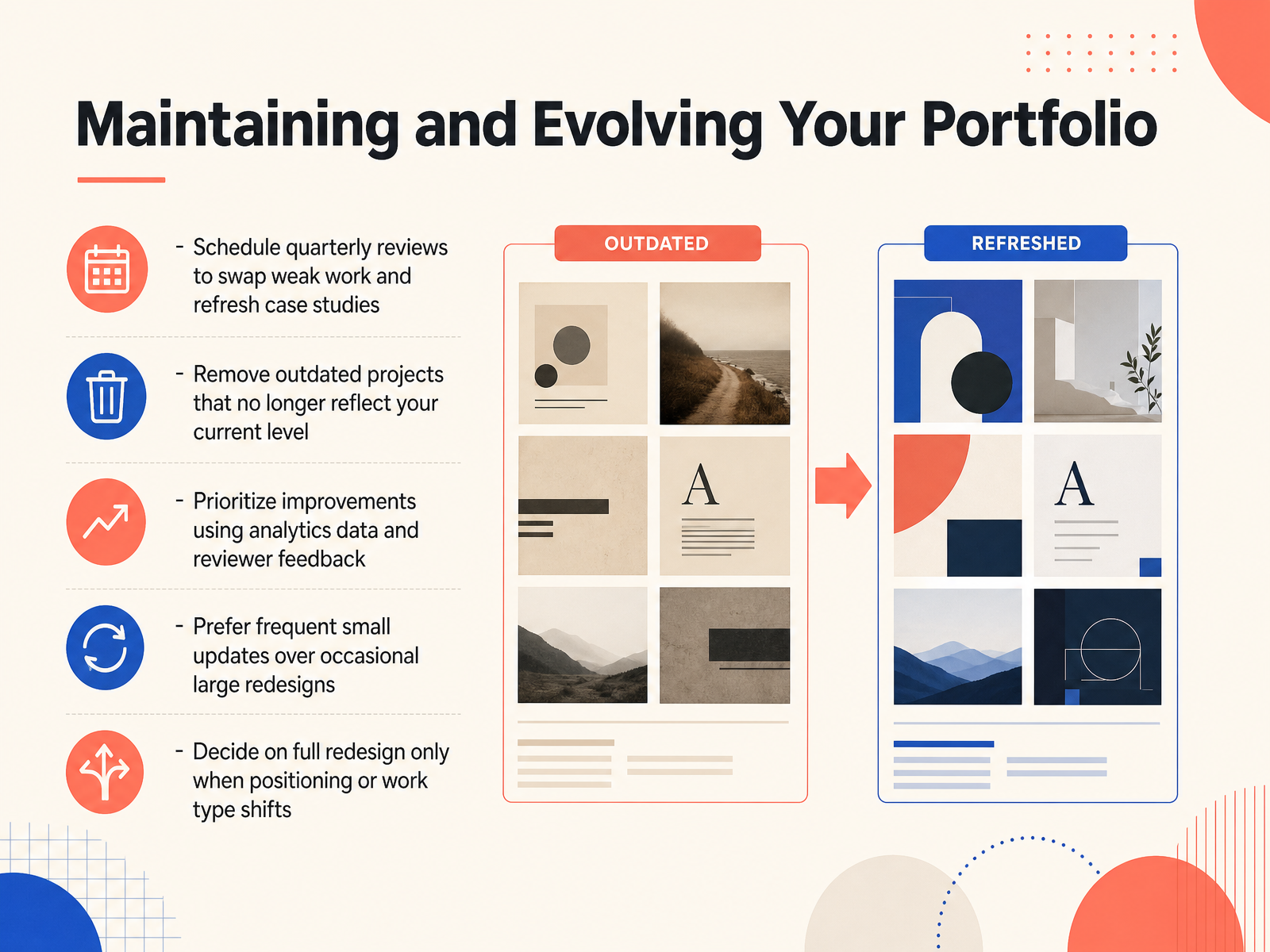
 - 13Maintaining and Evolving Your PortfolioLet's talk about keeping your portfolio alive. A great portfolio is never really finished. It's a living document. Treat it that way. Schedule a quarterly review. Yes, every three months. Open your site and ask one hard question. Does every project still represent your best current work? If the answer is no, swap it out. Remove outdated projects that no longer reflect your level. Weak work drags down strong work. Do not let loyalty to an old project cost you a new opportunity. Use data to guide you. Check your analytics. Which projects get clicks. Which ones get ignored. Listen to reviewer feedback. If someone says a case study felt thin, fix it. Prioritize frequent small updates over occasional massive redesigns. This keeps your site fresh without burning you out. Think of it like tending a garden. Pull weeds monthly, not once a year. A full redesign is only necessary when something fundamental changes. Maybe your positioning shifts. Maybe the type of work you want changes entirely. Otherwise, refine. Do not rebuild. Your portfolio should always feel current. That is how you stay ready for the next opportunity. Now let's put this into a clear action plan and define your next steps.
 superhive.comantlr.comverifiedinsider.substack.com+21 min
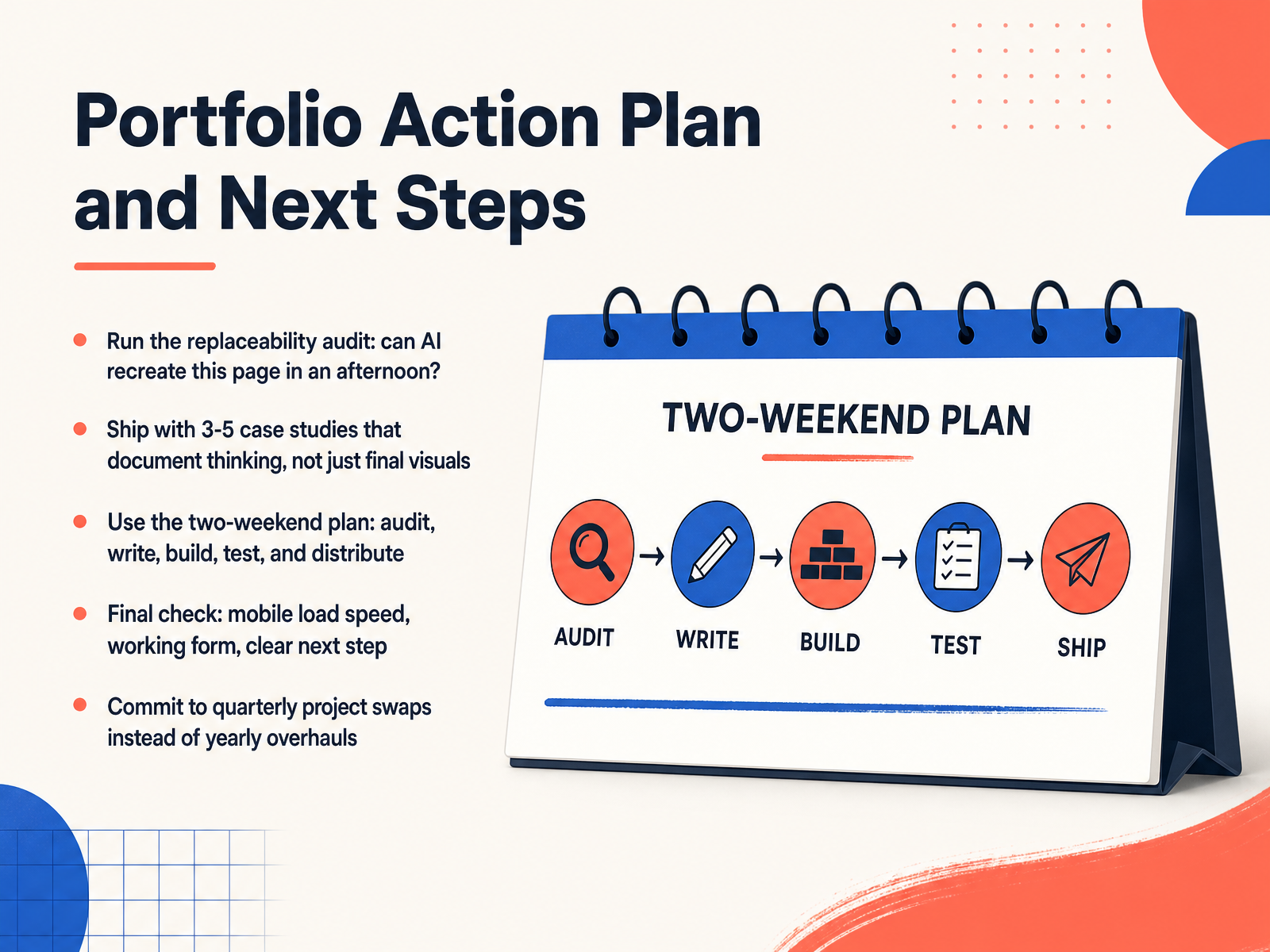
 - 14Portfolio Action Plan and Next StepsHere is your action plan. First, run the replaceability audit. Open every project page and ask one honest question. Could AI recreate this page in an afternoon? If the answer is yes, archive it or rebuild it around your thinking. Second, ship with three to five case studies that document decisions, not just final visuals. Show the constraint, the direction you killed, and why. Third, use the two-weekend plan. Weekend one, audit and write. Weekend two, build, test, and distribute. Fourth, do the final check. Test mobile load speed on a real phone. Test your contact form from a phone on mobile data. Make the next step impossible to miss. Fifth, commit to quarterly project swaps instead of yearly overhauls. Small, steady updates keep your portfolio fresh and signal that you are actively working. That is the whole system. Curation over volume. Thinking over polish. Momentum over perfection. You now have everything you need to ship a portfolio that gets you hired. Thank you for being here, and go build something worth showing.
 dochipo.comsuperhive.codesigner-daily.com+22 min
Take the deck with you
Download this course as a file — free, no sign-up needed.
- PDF handoutEvery slide page, ready to print or share.15 pages · 3.3 MBDownload
- Narrated PowerPointThe deck that presents itself — every slide carries the digital human's narration video.15 pages · 14.2 MBDownload
- PowerPoint slidesThe full deck as a .pptx — open it in PowerPoint, Keynote, or Google Slides.15 pages · 3.2 MBDownload
Free to use in your own training — please keep the PersonWise credit page at the end.
Have your own deck? Turn it into a course
Sources consulted
Web sources consulted while building this course.
- Design Portfolio 2026: What Hiring Managers Actually Want — Mantlr — mantlr.com
- Graphic design portfolio: What to show when AI can match your style — superhive.co
- FAQ - Design Hiring in 2026 - by Tom Scott — verifiedinsider.substack.com
- How to Build a Design Portfolio That Gets You Hired — maven.com
- Read the Room. - by Julien Martin - Offmarket — offmarketjobs.substack.com
- How to Write a Design Case Study: A Complete Guide with Templates — dochipo.com
- Case Study Design: Presenting Results That Close Deals — designer-daily.com
- All About Process: Dissecting Case Study Portfolios | Toptal® — toptal.com
- Portfolio Reviews Done Right: Tell the Story, Not Just the Process — product.hubspot.com
- Free Graphic Design Case Study Template — template.net
- Web Design Case Study Template | Listaaj — listaaj.com
- Web Design Case Study Template | AAMAX — aamax.co
- Graphic Designer Portfolio Landing Page Template — rocket.new
- How much process can I / should I show in my portfolio? — graphicdesign.stackexchange.com
- What to Include in Your Design Portfolio | Andy Budd — andybudd.opalstacked.com
- Over-Explaining Your Design Process in a Portfolio Creates Unnecessary Risk | RiffOn — riffon.com
- Should You Include Process Work in Your Portfolio? Why Universities Say Yes — Dan Studios — danstudios.net
- Personal Brand [ BD ] - Structuring Philosophy Through Design — bordolenc.com
- Dylan Klemm | Graphic Designer - Personal Brand — dylanklemm.com
- The Portfolio - Marcus Kelly — marcuskelly.design