Reading Strategies for English Learners
Begin
14 pages · ~28 min
Reading Strategies for English Learners
Helps English learners improve reading comprehension through strategic techniques, focusing on vocabulary, context clues, and text analysis for academic success.
What you’ll learn
- 01Reading Strategies for English LearnersWelcome. I'm really glad you're here. Whether you're learning English yourself or you're helping others learn, this session is for you. Reading in a new language can feel challenging, but with the right tools, it becomes something you can enjoy and feel proud of. Today, we'll explore why reading strategies matter so much for beginner and intermediate English learners. Then, we'll walk through practical strategies you can use right away, whether you're reading a news article, a menu, or a story. We'll also talk about how teachers and supporters can help learners build confidence. The session is organized into four simple parts: first, some friendly foundations; second, practical strategies you can apply; third, ways to support learners; and fourth, making a plan you can act on. So take a deep breath. You don't need to know every word. You just need a few good tools. Let's begin by looking at what makes reading in a second language different from reading in your first language.tahricteaches.comblog.rosettastone.comies.ed.gov+21 min
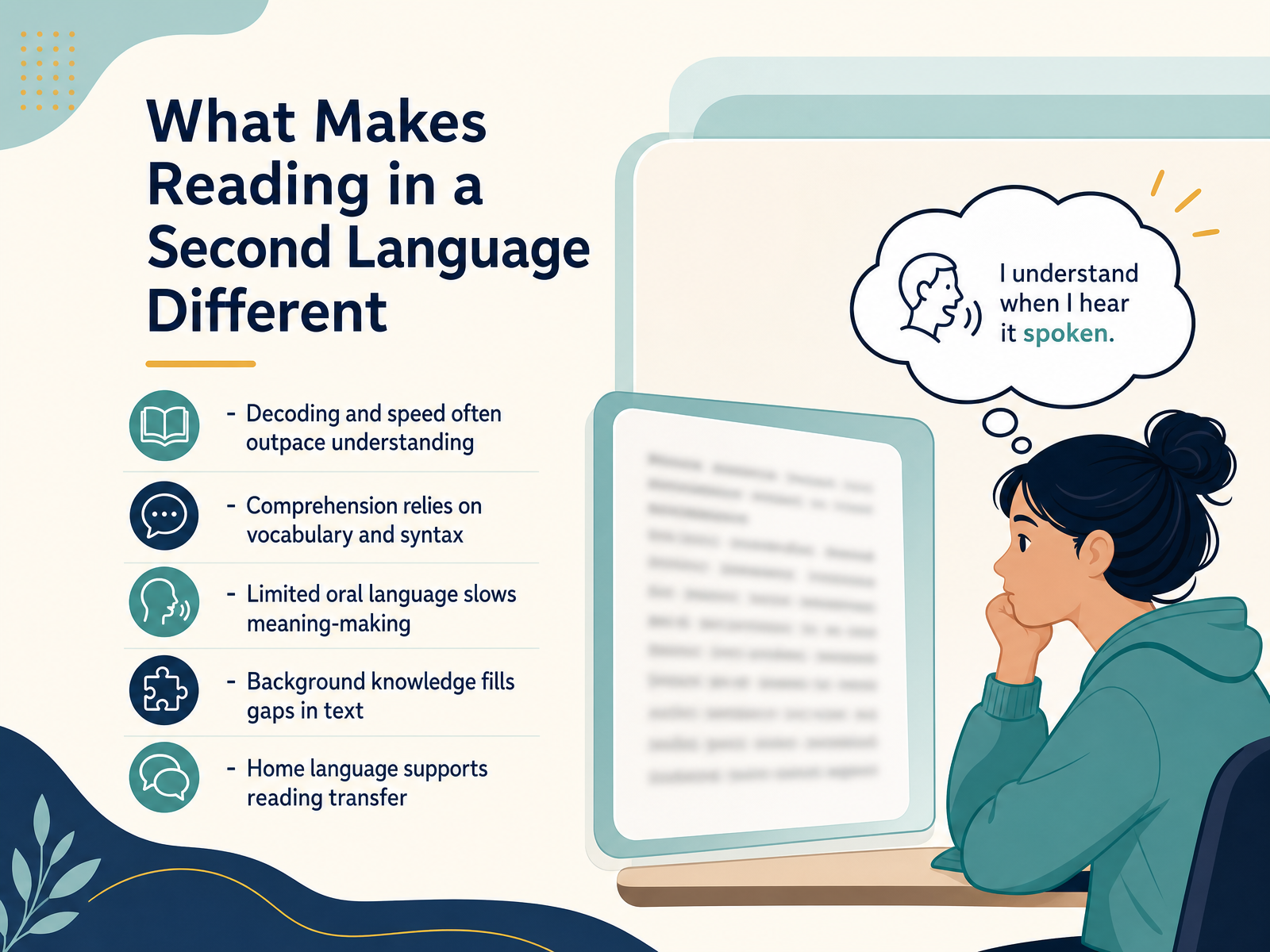
- 02What Makes Reading in a Second Language DifferentLet us take a closer look at what happens when we read in a second language. For many learners, reading speed and word recognition can actually develop faster than full understanding. You might find yourself reading every word correctly, but still feel unsure about the main idea. This is very common, and it happens because comprehension depends heavily on vocabulary knowledge and sentence structure, or syntax. If you do not know the key words, or you are not used to how English sentences are built, the meaning can stay just out of reach. Another piece of this puzzle is oral language. The more you can hear and speak English in daily conversation, the easier it becomes to understand what you read. Your oral vocabulary supports your reading vocabulary. Let us not forget background knowledge. If you already know something about the topic, it can fill in the gaps when the text is difficult. And finally, your home language is a tremendous asset. The reading skills you have in your first language, like predicting or summarizing, can transfer directly to English. You are not starting from zero. You are building on what you already know. So, as we move forward, we will look at some core concepts and practical strategies that use all of these strengths to help you become a more confident reader.
 tahricteaches.comblog.rosettastone.comies.ed.gov+22 min
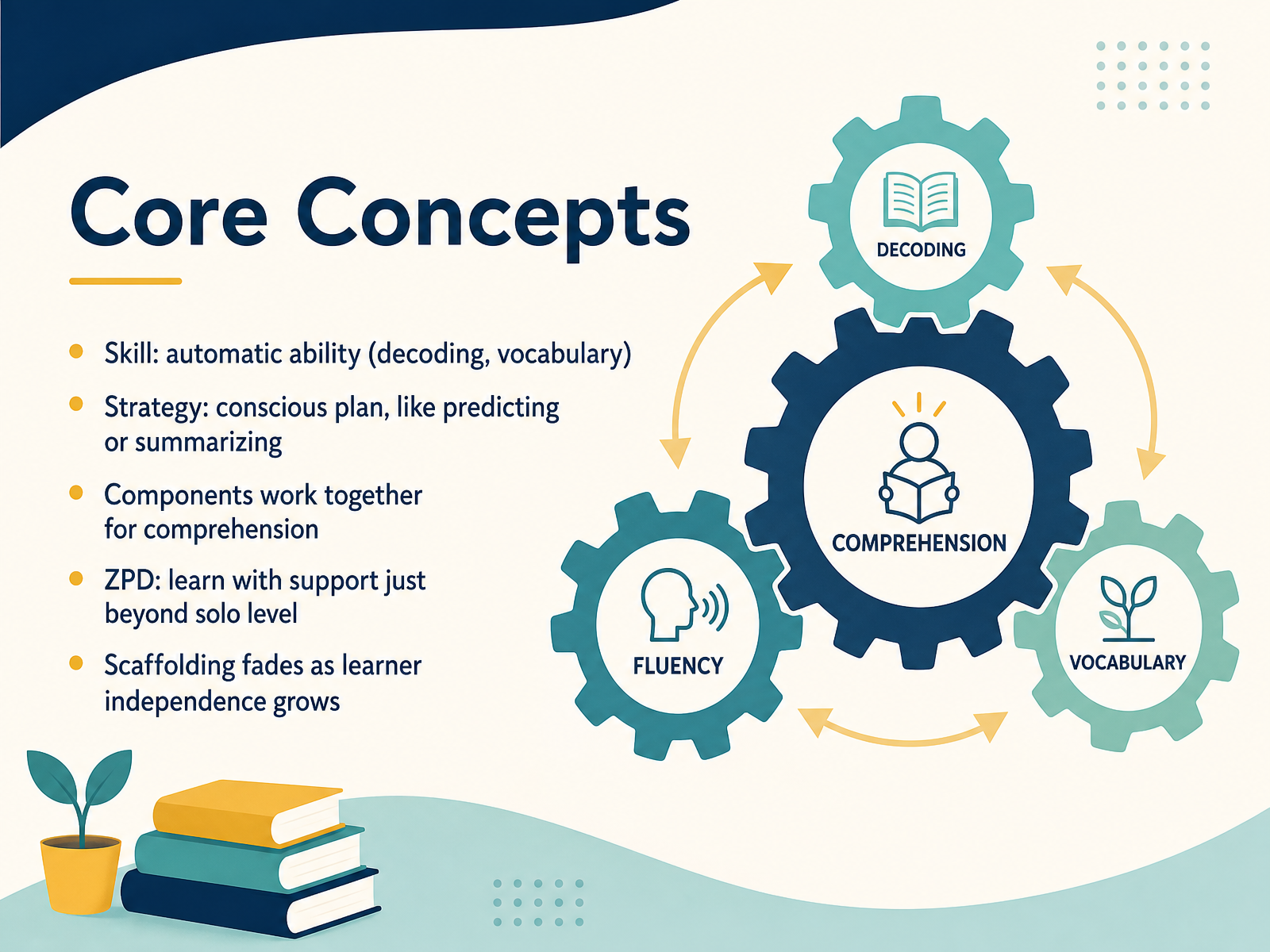
 - 03Core ConceptsLet’s look at the core ideas we’ll use throughout this course. First, a skill is something you can do automatically, without thinking too hard. In reading, skills include decoding, which means sounding out words, and knowing vocabulary. A strategy, on the other hand, is a conscious plan. You choose to do it on purpose. For example, you might predict what a text will say before you read it, or you might summarize a paragraph after you finish it. Skills and strategies work together to help you understand what you read. Now, there’s an important idea called the Zone of Proximal Development, or ZPD for short. This is the learning space where a task is just a little too hard for you to do alone, but you can do it with support. That support is called scaffolding. Scaffolding is temporary help. It can be a teacher’s question, a graphic organizer, or a word bank. As you become more confident and capable, that support slowly fades away. The goal is for you to become an independent reader who can handle texts on your own. Now, let’s talk about what to do before you even start reading. The next step is activating your prior knowledge and previewing the text.
 nysed.govdoi.orgnysed.gov+22 min
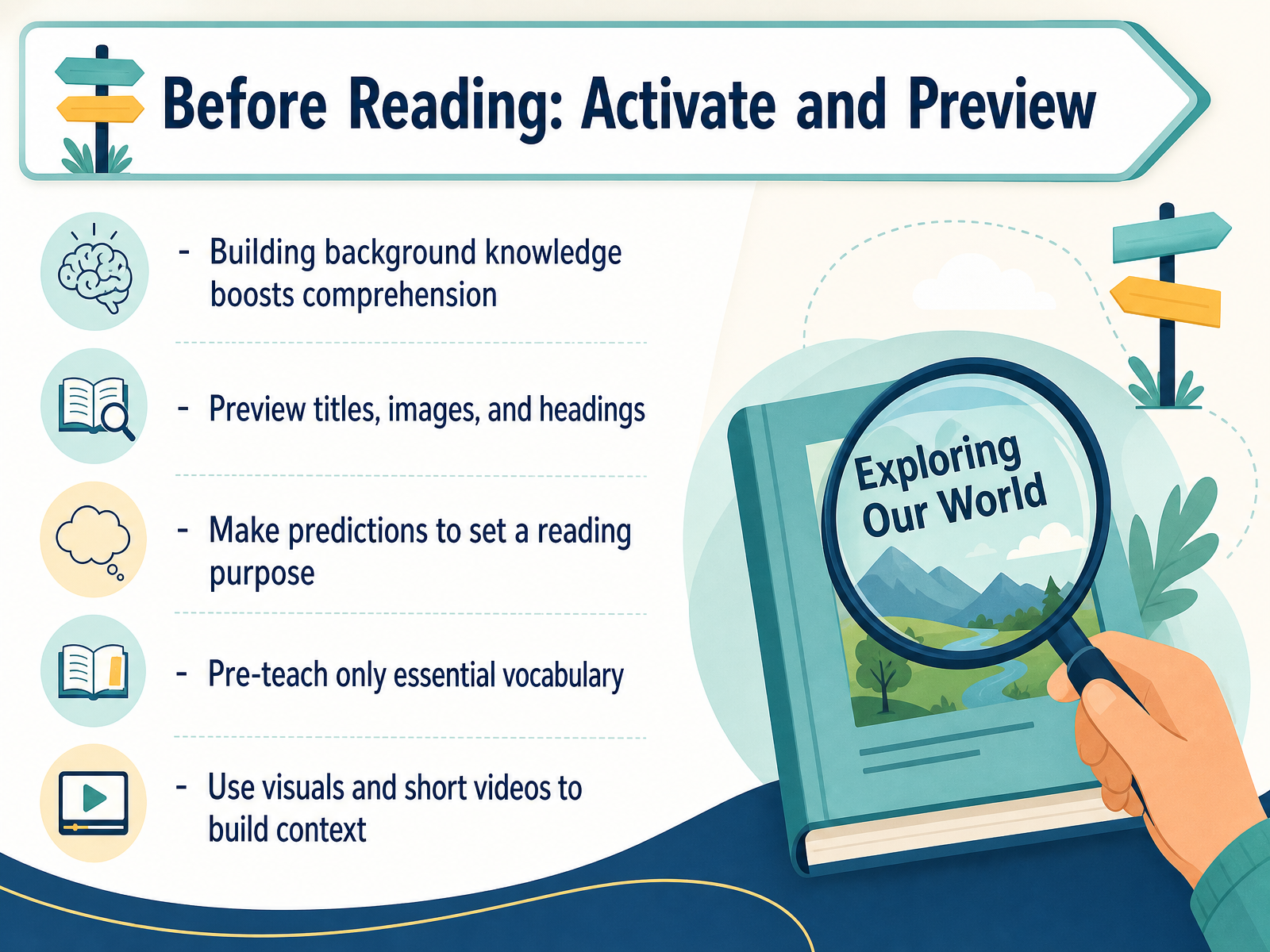
 - 04Before Reading: Activate and PreviewNow let's talk about what to do before you start reading. This step is like warming up before exercise. It prepares your brain. First, think about what you already know about the topic. This is called background knowledge. It helps you understand the text better. Next, take a quick look at the titles, images, and headings. These give you clues about the content. Then, make a prediction. Ask yourself, what will this text be about? This gives you a purpose for reading. For teachers, pre-teach only the essential vocabulary. Focus on the words that are important for understanding the main ideas. Do not teach every new word. Finally, use pictures or short videos to build context. Visuals make new ideas easier to grasp. Remember, a few minutes of preparation makes the reading experience smoother and more enjoyable. Up next, we will explore strategies to use during reading, such as chunking, monitoring, and questioning.
 nysed.govdoi.orgnysed.gov+21 min
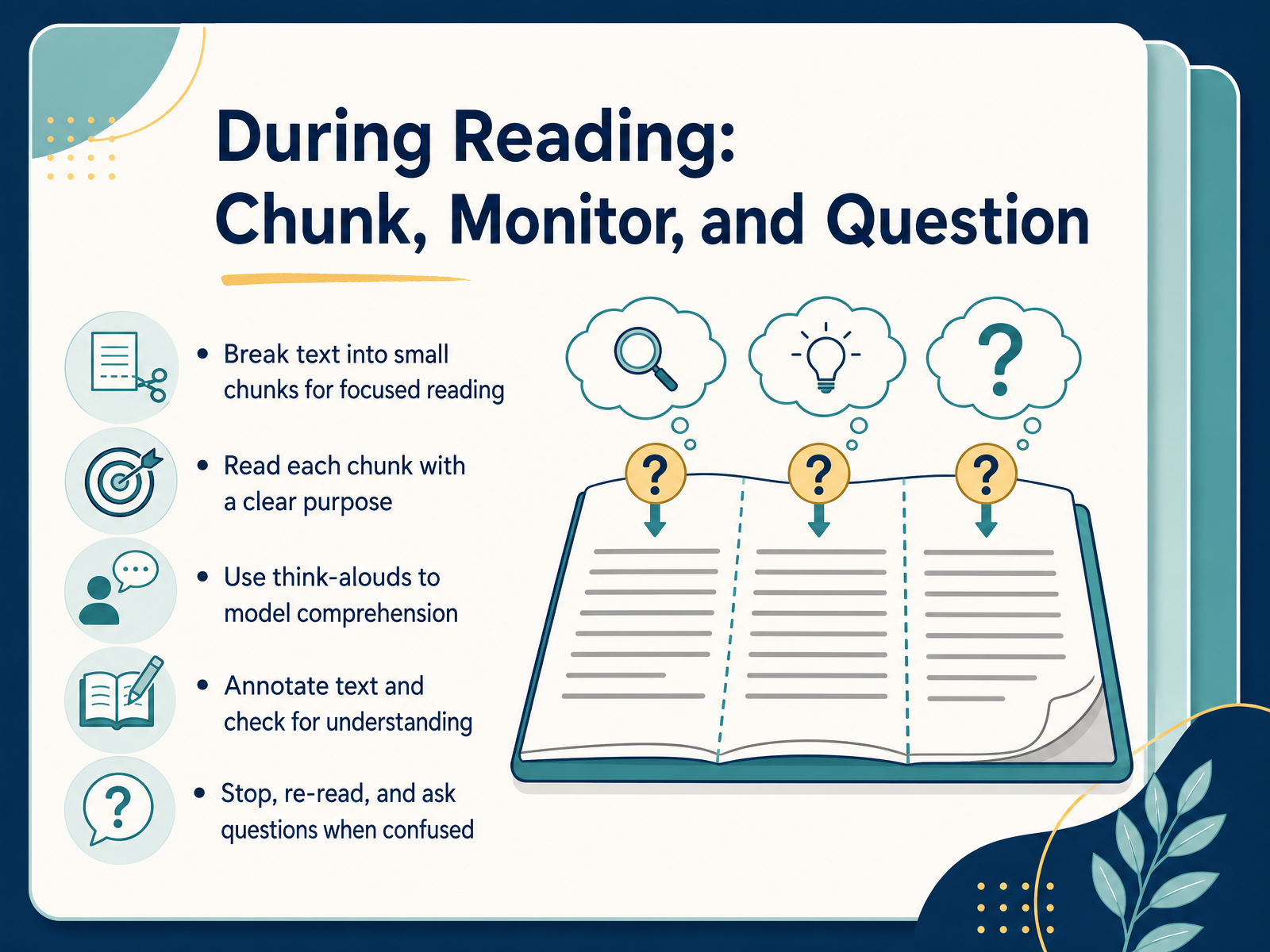
 - 05During Reading: Chunk, Monitor, and QuestionNow we move into the heart of reading—the during reading stage. This is where you actively work with the text. Start by breaking the text into small chunks. Read one paragraph or even a few sentences at a time, instead of facing a whole page. For each chunk, have a clear purpose. Ask yourself, What is this part mainly saying? This keeps your mind focused.
A powerful technique is the think-aloud. When you read, say your thoughts out loud. For example, you might say, Oh, this character is nervous because of the storm. When teachers do this, they model how good readers think. This makes the invisible process visible for learners.
Another helpful habit is annotating. This means writing on the text. You can underline key ideas, circle new words, or write a short note in the margin, like, this is the main point. After each chunk, pause and check your understanding. Ask yourself simply, Did I get that? If you feel confused, that is a signal. Stop, go back, and re-read that part. Ask a question about it, like, Why did this happen? or, What does this word mean here? Re-reading is not a failure—it is a smart strategy that strong readers use all the time.
So remember, as you read: chunk the text, monitor your understanding, and question when something is unclear. Coming up next, we will look at what to do after you finish reading: summarizing and making connections.
 nysed.govdoi.orgnysed.gov+22 min
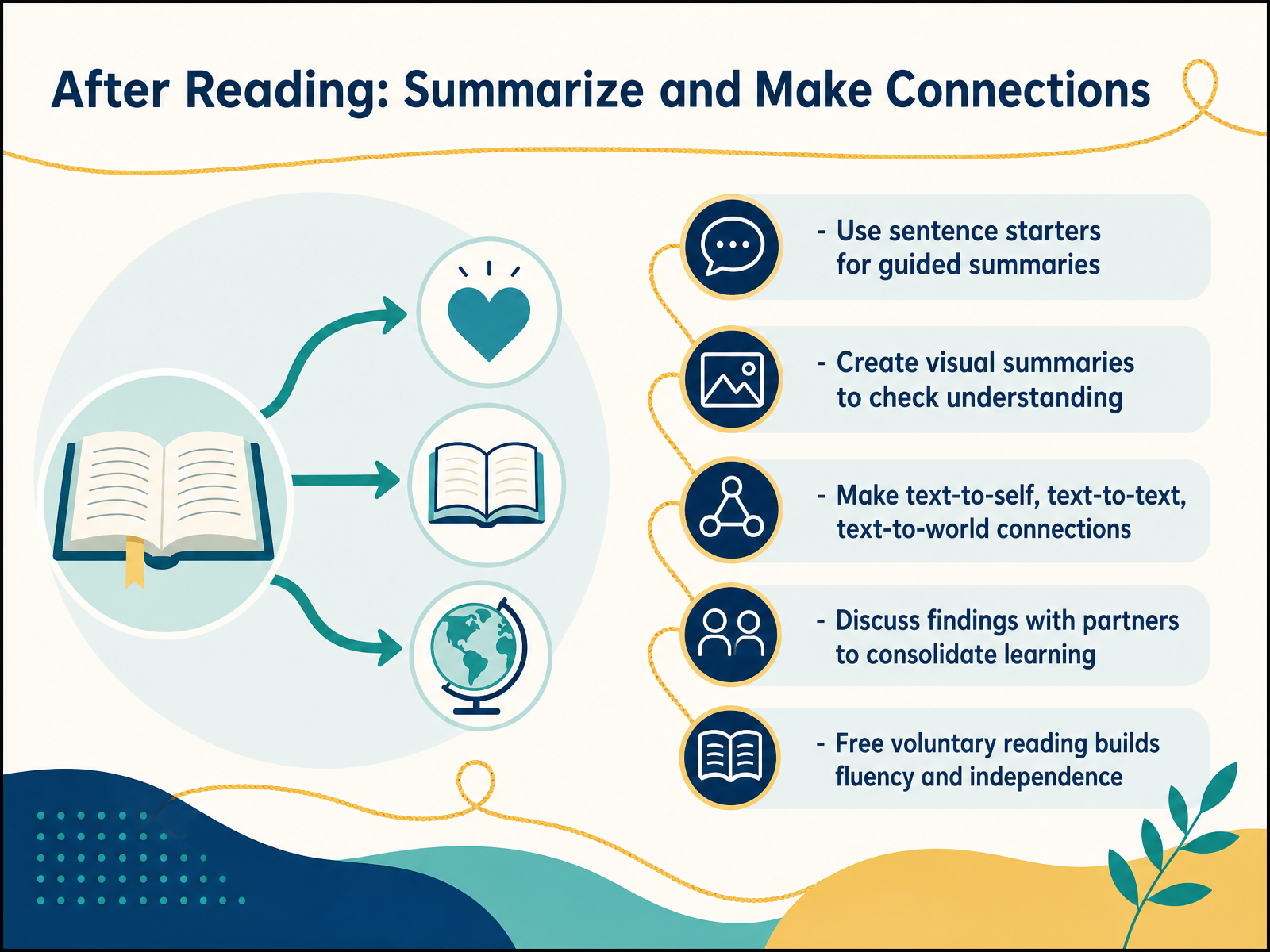
 - 06After Reading: Summarize and Make ConnectionsOnce you finish a text, the work is not over yet. This is the perfect time to check your understanding and make the reading your own. Let's look at a few simple ways to do that. First, sentence starters can guide your summary. For example, you can say, "The main idea of this text is..." or "First, the author explains..." These phrases give you a clear place to begin. Another great tool is a visual summary. You can draw a quick picture, a simple chart, or a map that shows the main points of what you read. This helps you see if you understood the big picture. Next, try making connections. A text-to-self connection is when the story reminds you of something in your own life. A text-to-text connection is when it reminds you of another book or article. And a text-to-world connection links the story to something happening in the real world. Talking with a partner about what you read is also powerful. Explaining your ideas out loud helps you remember them and deepens your understanding. Finally, remember free voluntary reading. This means reading for fun, just because you want to. It is one of the best ways to build your fluency and your independence as a reader. Up next, we will explore strategies for working with vocabulary. Let's continue.
 nysed.govdoi.orgnysed.gov+22 min
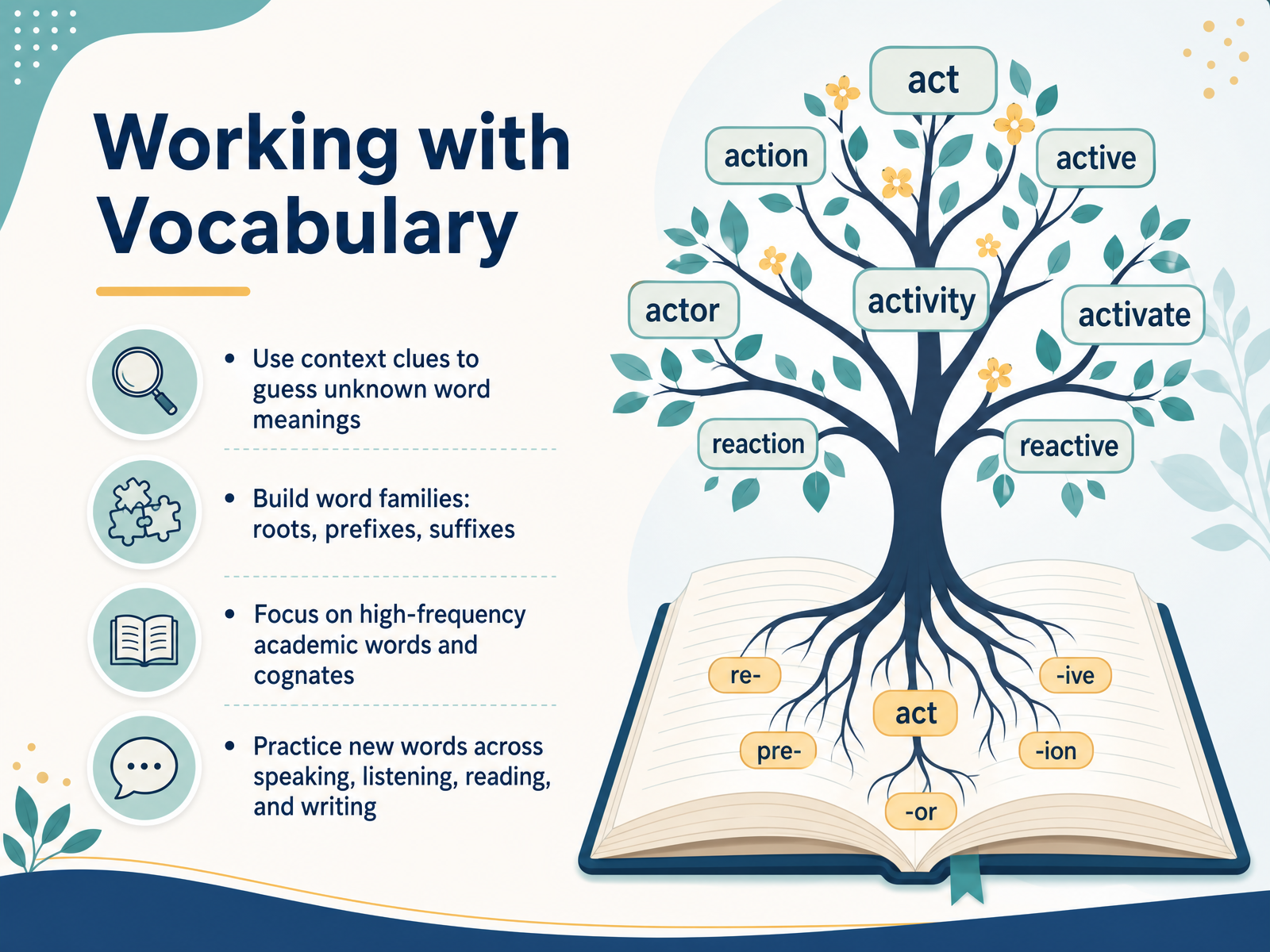
 - 07Working with VocabularyNow let's talk about working with vocabulary. When you meet a new word while reading, don't stop. Try to guess its meaning from the context, the words and sentences around it. For example, if you read, 'The desert was arid, with very little rain,' you can guess 'arid' means dry. Another helpful tool is learning word families. If you know the root word 'help,' you can understand 'helper,' 'helpful,' and 'unhelpful.' Look for prefixes, like 'un' or 're,' and suffixes, like 'ful' or 'less.' Also, focus on common academic words that appear in many school subjects. And here's a nice trick: look for cognates. These are words that look and sound similar to words in your own language and often have the same meaning. For example, 'information' in English and 'información' in Spanish. Finally, practice new words in all four skills: say them, listen for them, read them, and write them. This will help you remember them for a long time. Next, we will look at building your reading fluency.
 nysed.govdoi.orgnysed.gov+22 min
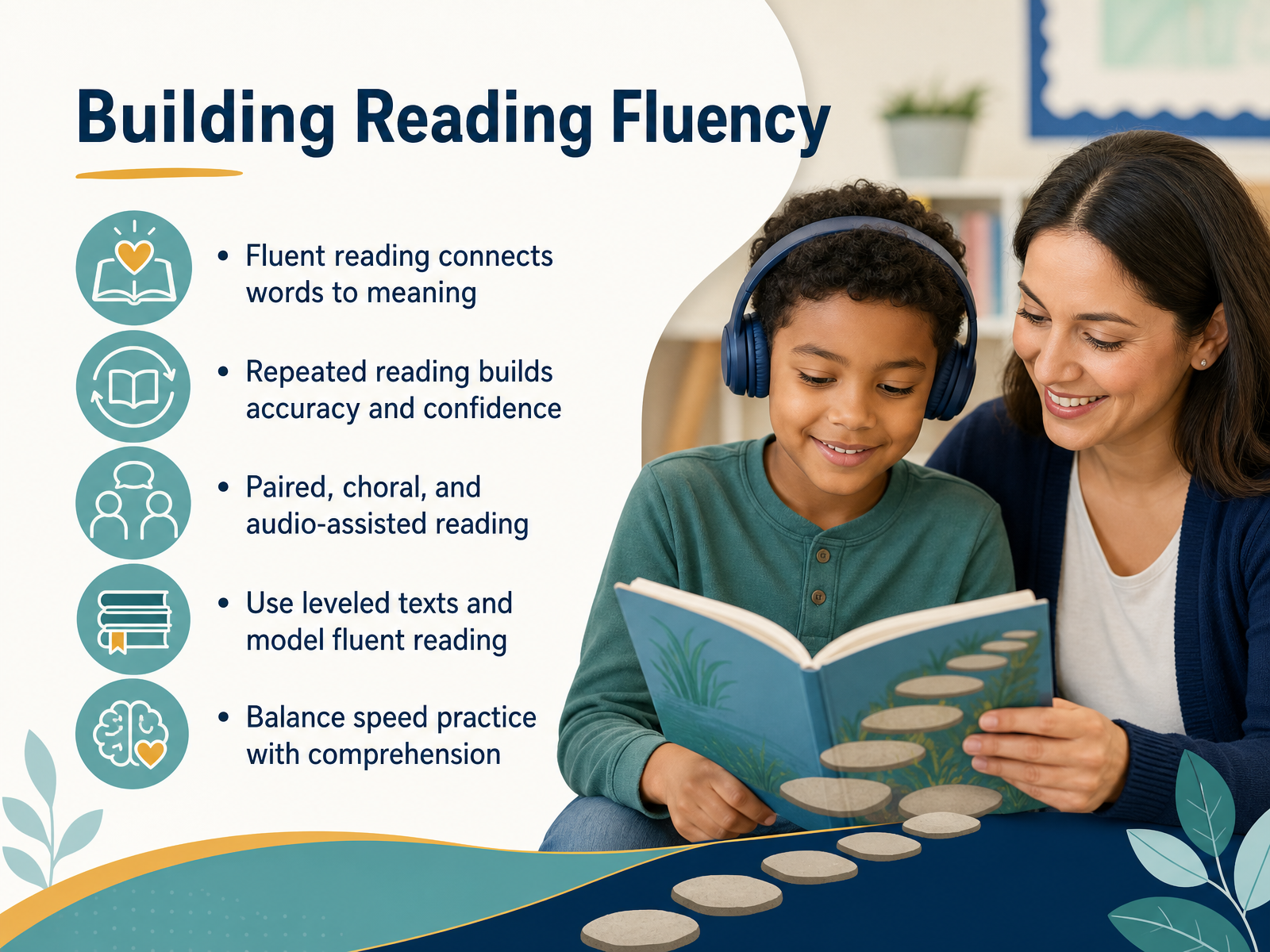
 - 08Building Reading FluencyNow, let’s talk about reading fluency. Fluency means reading smoothly, accurately, and with meaning. When you read fluently, you connect the words on the page to their meaning. One of the best ways to build fluency is through repeated reading. This means reading the same text several times. Each time, your accuracy and your confidence grow. Try paired reading, where two people read together. Or choral reading, where a group reads aloud as one. Audio-assisted reading is another helpful way. You listen to a recording and read along. It’s also important to choose leveled texts, which are designed for your current reading ability. And for educators, modeling fluent reading for your students makes a real difference. One key point to remember is to balance speed practice with comprehension. Reading fast is not the same as reading well. You want to understand the ideas, not just say the words quickly. Keep this balance in mind as we now move into improving comprehension.
 nysed.govdoi.orgnysed.gov+22 min
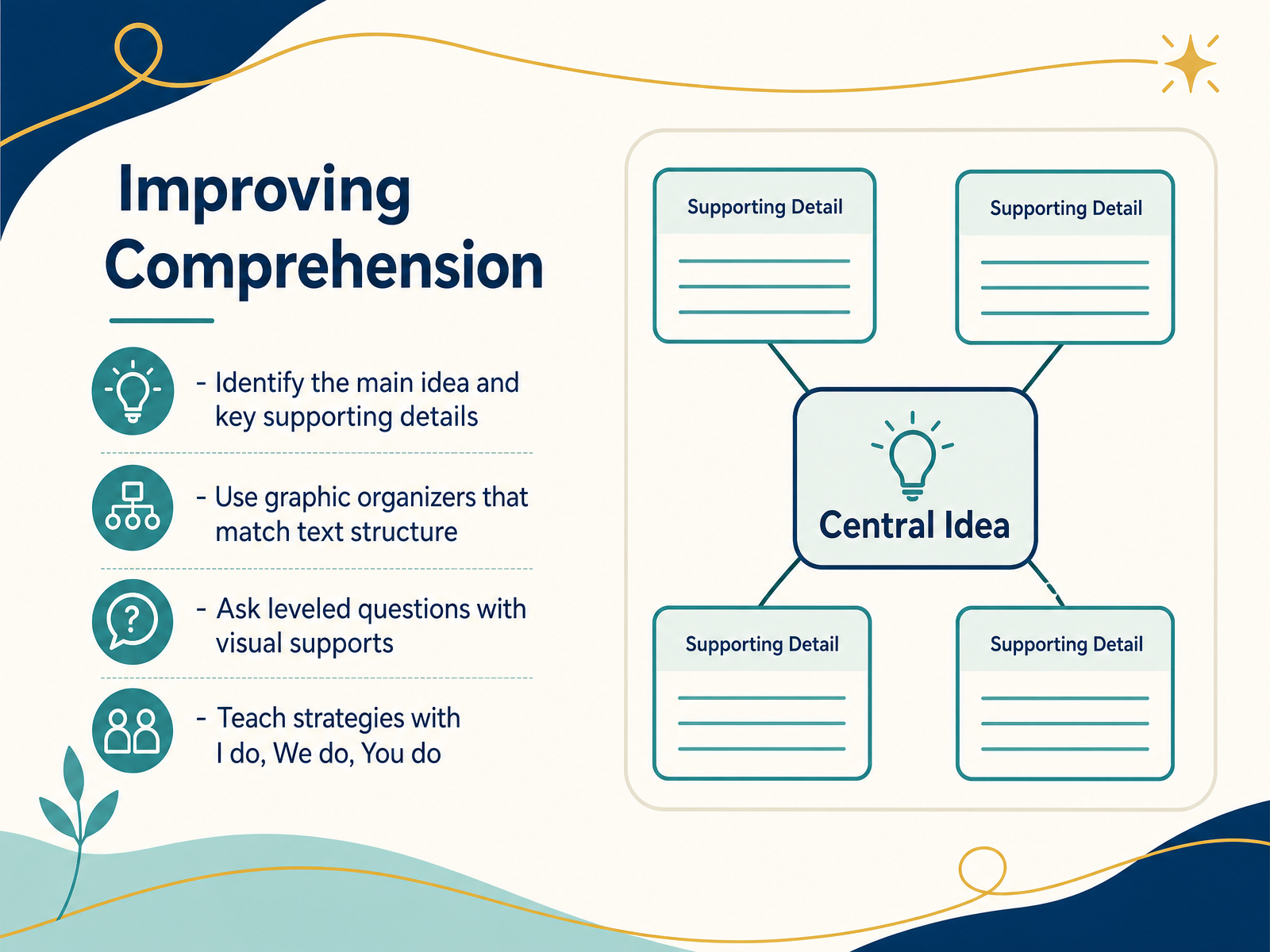
 - 09Improving ComprehensionNow let's talk about improving comprehension. This is where reading starts to feel more manageable. First, help your students find the main idea and the important details that support it. For example, after reading a short paragraph, ask: What is this mostly about? Then look for details that tell you more about it. Next, use graphic organizers that match how the text is structured. If the text compares two things, use a compare and contrast chart. If it tells a story, use a story map. These visuals make the organization clear. Third, ask leveled questions with visual supports. For beginners, ask simple questions like Who is in the story? For more advanced learners, ask Why do you think she did that? Adding pictures or symbols helps everyone understand the question. Finally, teach strategies step by step using I do, We do, You do. First you model the strategy. Then you practice it with the class. Then students try it on their own. This gradual release builds confidence and independence. Next, we'll talk about how reading changes across different types of texts, like stories, articles, and poems.
 nysed.govdoi.orgnysed.gov+22 min
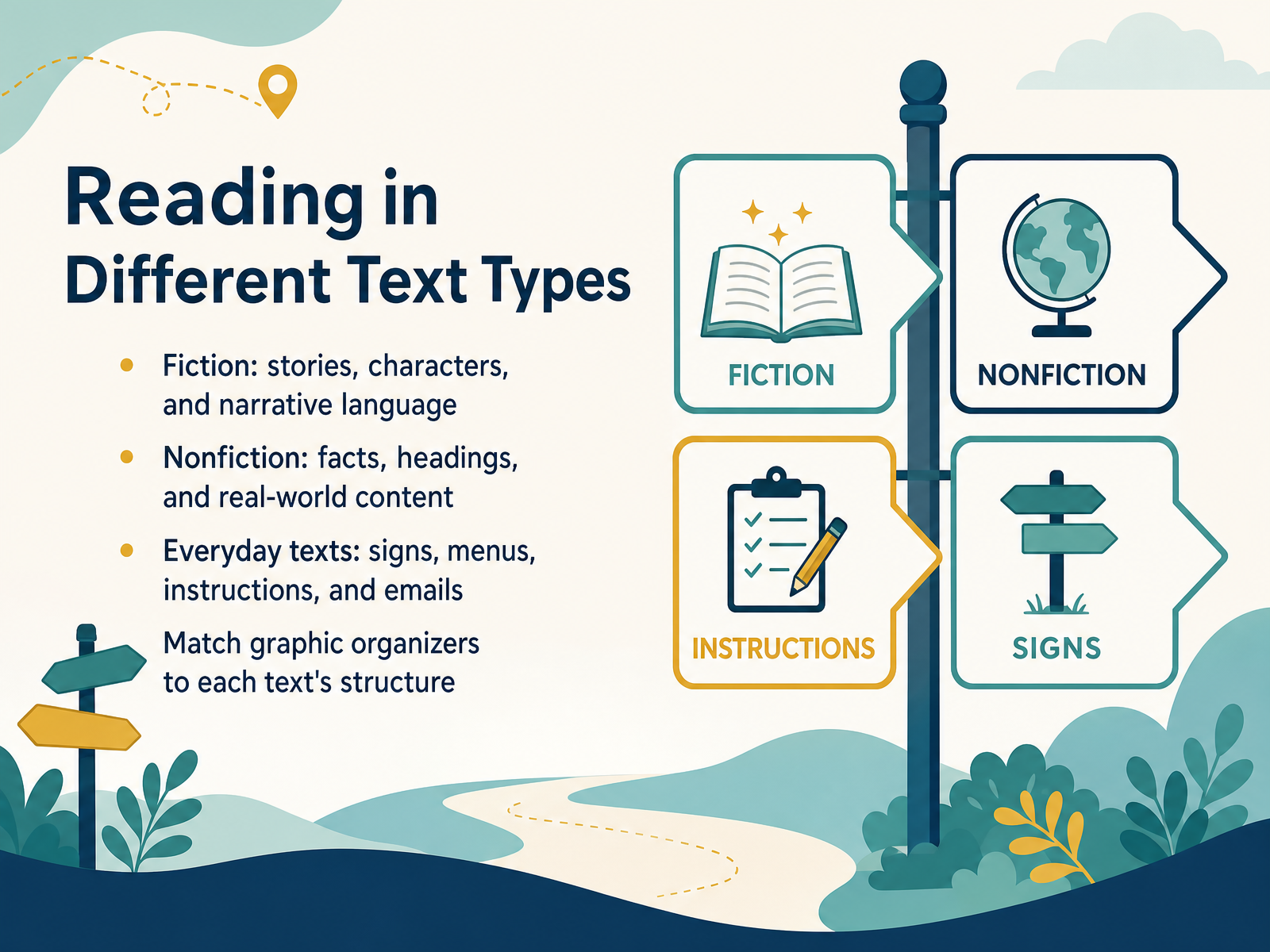
 - 10Reading in Different Text TypesLet’s talk about the different kinds of texts you read every day. The way you read a story is different from how you read a news article or a bus schedule. For fiction, like stories and novels, focus on the characters, the setting, and the problem in the plot. As you read, ask yourself, what is the character feeling now? For nonfiction, like textbooks or news, your job is to find facts and main ideas. The headings and pictures give you strong hints about what you will learn. And do not forget everyday texts, like signs, menus, emails, or instructions. These are practical, so scan them quickly for the key words you need, like an address or a time. Before you start reading any text, look at its structure. Then, choose a simple graphic organizer that matches. A story map helps you track the parts of a fiction tale. A chart with three boxes works well for the main idea of a nonfiction chapter. Matching the organizer to the text makes your thinking visible, which builds your understanding. And educators, modeling this choice once with your own text shows students how to pick the right tool. Up next, we will look at how to support readers who are still facing some challenges.
 tahricteaches.comblog.rosettastone.comies.ed.gov+22 min
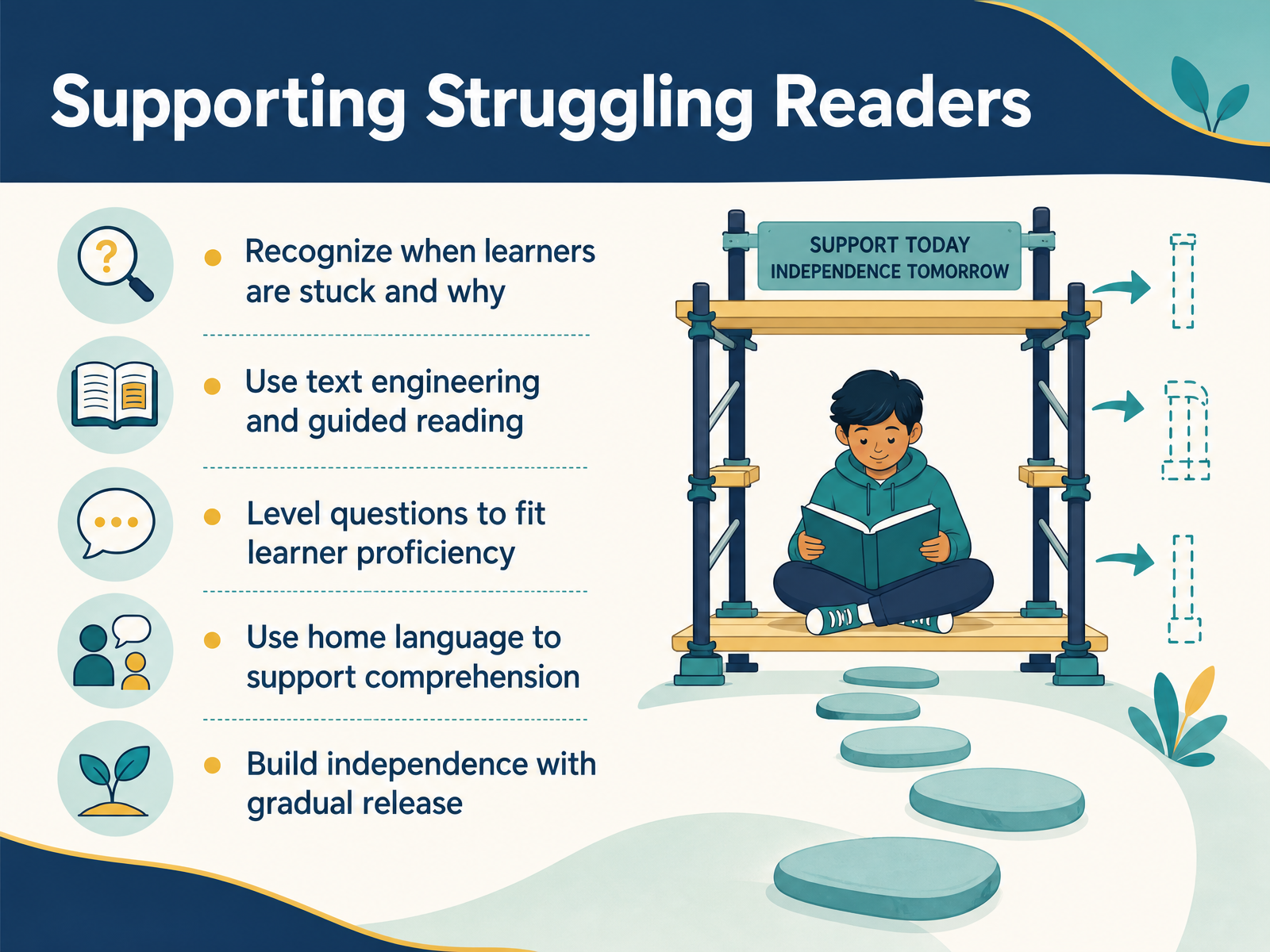
 - 11Supporting Struggling ReadersWhen a learner gets stuck, pause and ask why. Is it a hard word? A new idea? Or too much text at once? That answer tells you which support to use. Text engineering means making the text easier to manage. You can break it into smaller sections, add pictures, or explain tricky words before reading. Guided reading means you read together. You model the thinking, and the learner follows. Your questions should match their level. A beginner can point to the main idea. An intermediate learner can explain why something happened. The home language is a powerful tool. Allow quick translations or discussions in that language to build understanding. Then, slowly remove your support. This is called gradual release. You do it together, then they try with a partner, then they try alone. Each small step builds their confidence. And next, we will look at how digital tools can support this same process.
 nysed.govdoi.orgnysed.gov+22 min
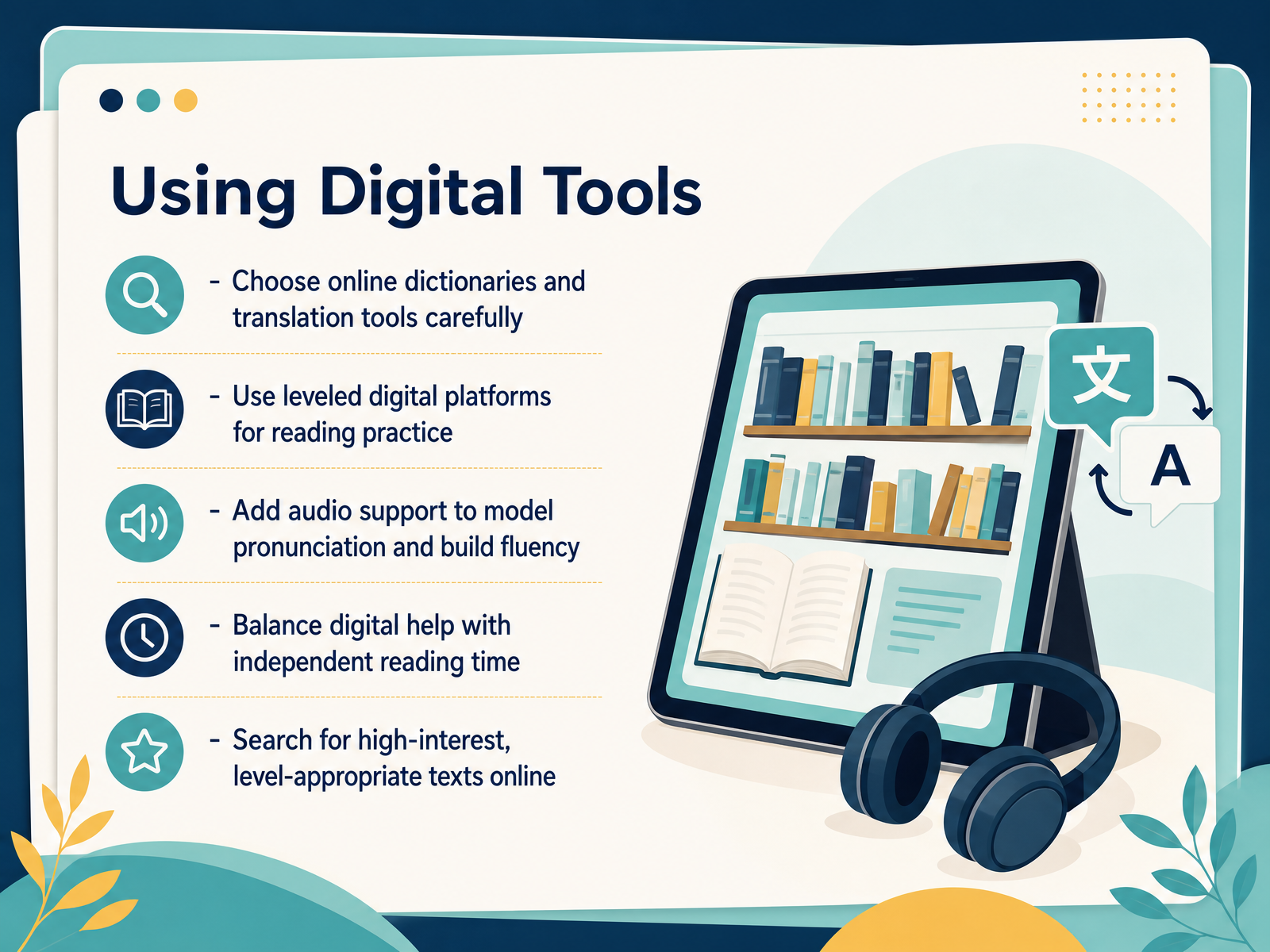
 - 12Using Digital ToolsLet's look at how digital tools can support your reading practice. First, choose online dictionaries and translation tools carefully. A bilingual dictionary can help you, but do not stop at every word. Use it only when a word blocks your understanding. Second, try leveled digital reading platforms. These sites offer texts at different difficulty levels, so you can read content that matches your current skills without feeling lost. Third, use audio support. Listen to a text while you read along. This models pronunciation and helps you build reading fluency. Audiobooks or read-aloud features are great choices. Fourth, and this is important, balance digital help with independent reading time. Try to read some passages without any tools, simply to practice what you already know. Finally, search online for high-interest, level-appropriate texts. Think about your hobbies. You can find simplified news articles or short stories about nearly any topic. Next, we will talk about how to set up a simple, regular reading routine that brings these strategies together.
 tahricteaches.comblog.rosettastone.comies.ed.gov+21 min
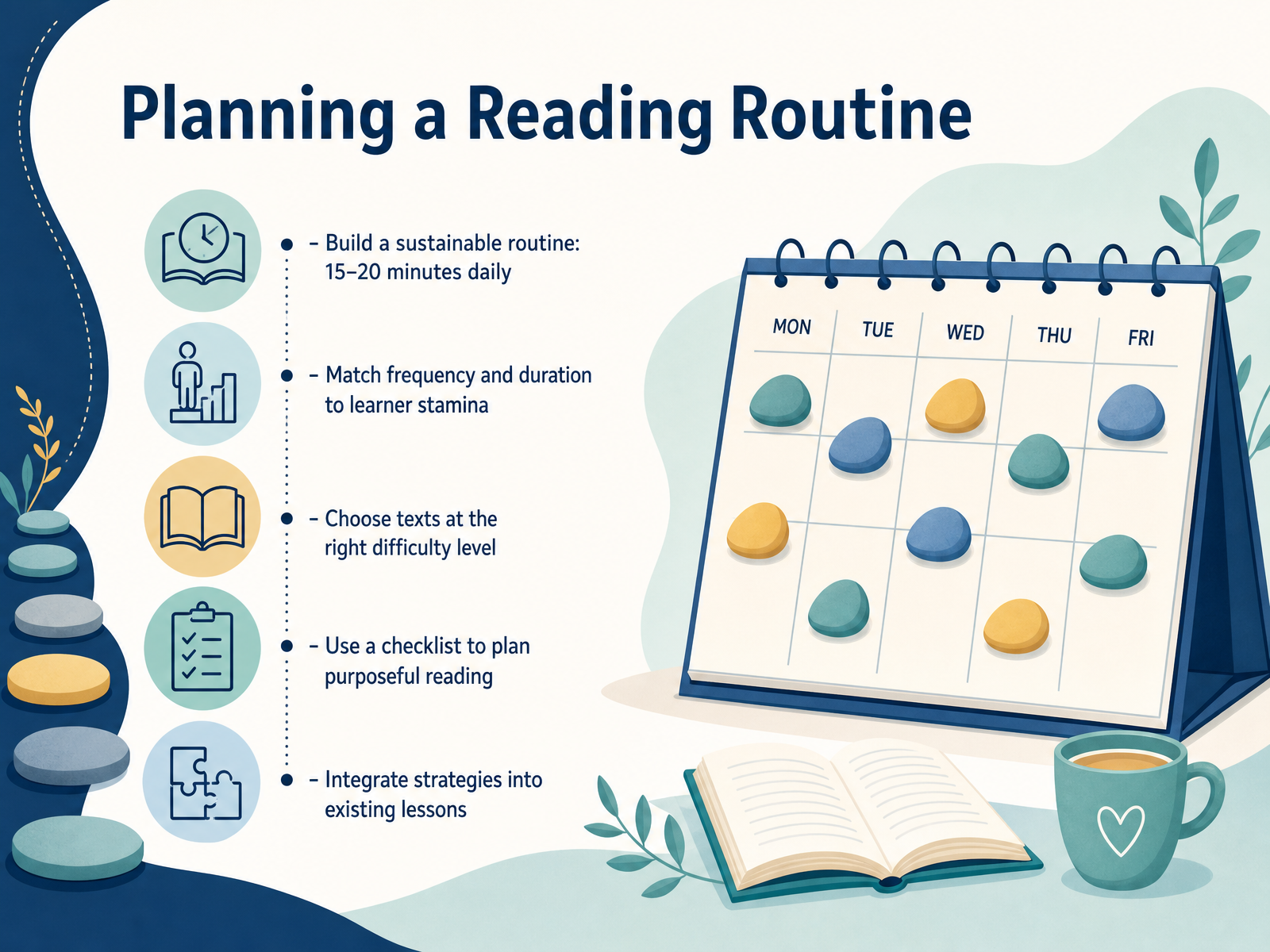
 - 13Planning a Reading RoutineNow let's talk about building a reading routine that fits into your real life.
Start small. Fifteen to twenty minutes of focused reading each day is a realistic and sustainable goal. You want to build a habit, so short and regular practice works better than a long session once a week.
Pay attention to your own stamina. Stamina means how long you can read with focus before you get tired. It's okay to start with ten minutes and slowly add more time as reading becomes easier.
Choose texts at the right level. A text is at the right level when you understand most of it without a dictionary, but you still meet some new words. This keeps reading both comfortable and challenging.
Try using a simple checklist to plan your reading. For example, before you read, you might check off: preview the title, skim the headings, and ask one question about the topic. During reading, you check for pausing to summarize a paragraph in your own words. This gives your reading a clear purpose.
For educators, the same idea works well. Instead of adding another separate activity, you can blend these reading strategies into lessons you already teach. A short daily routine can repeat the same structure with different texts, and that consistency really helps learners build confidence.
Next, let's look at an action plan and practical next steps to put this all together.
 nysed.govdoi.orgnysed.gov+22 min
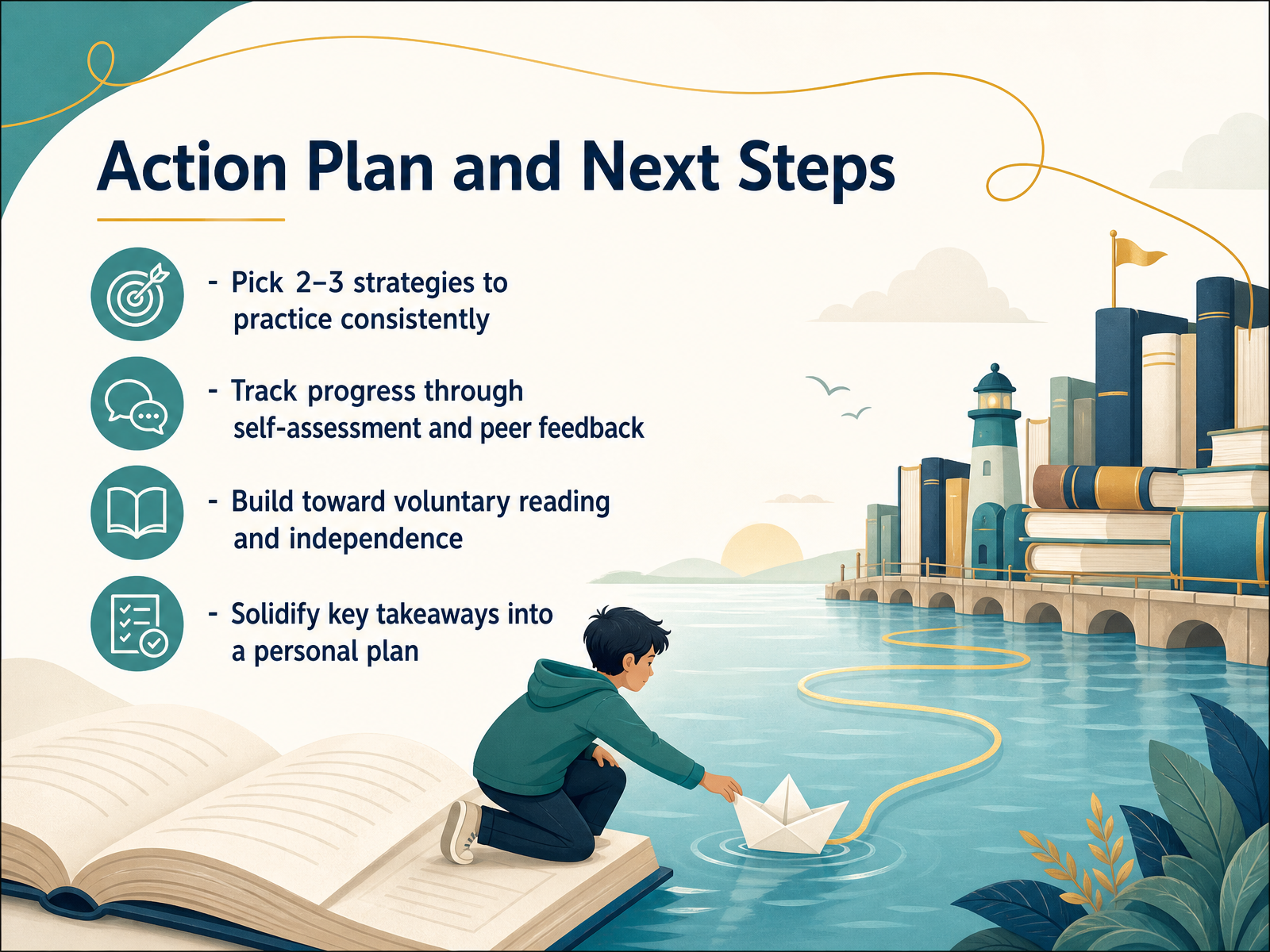
 - 14Action Plan and Next StepsYou have learned many helpful strategies in this course. Now, it is time to make a plan. Do not try to use every idea at once. That can feel like too much. Instead, choose just two or three strategies that feel useful to you. Practice them for a week or two. As you practice, track your progress. You can use a simple checklist or ask a friend for feedback. Talking about what works and what is hard can help you grow. As you feel more confident, start to choose your own reading materials. Pick topics you enjoy. This is how we build independence and become lifelong readers. Finally, write down your main takeaways in a personal action plan. Keep it simple. Review it often. Small steps every day lead to big progress over time.
 nysed.govdoi.orgnysed.gov+21 min
Take the deck with you
Download this course as a file — free, no sign-up needed.
- PDF handoutEvery slide page, ready to print or share.15 pages · 3.5 MBDownload
- Narrated PowerPointThe deck that presents itself — every slide carries the digital human's narration video.15 pages · 13.9 MBDownload
- PowerPoint slidesThe full deck as a .pptx — open it in PowerPoint, Keynote, or Google Slides.15 pages · 3.4 MBDownload
Free to use in your own training — please keep the PersonWise credit page at the end.
Have your own deck? Turn it into a course
Sources consulted
Web sources consulted while building this course.
- ESL Reading Strategies: 9 Best Techniques — tahricteaches.com
- English Reading Practice: Resources, Expert Tips, and a Free Practice Paragraph - Rosetta Stone — blog.rosettastone.com
- Teaching Academic Content and Literacy to English Learners in ... — ies.ed.gov
- Essential Reading Strategies For Young Multilingual Learners of ... — tesol.org
- Reading 101 for English Language Learners | Colorín Colorado — colorincolorado.org
- Introduction Scaffolding ELA Instruction for ELLs/MLLs Grades 3-9 — nysed.gov
- IMPROVING READING STRATEGIES FOR ENGLISH LANGUAGE LEARNERS USING SCAFFOLDING: A PEDAGOGICAL APPROACH — doi.org
- Scaffolding Instructions for English Language Learners | New York ... — nysed.gov
- The effects of four instructional strategies on English learners’ English reading comprehension: A meta-analysis — sage.cnpereading.com
- What is "scaffolding" and how does it help ELLs? - Colorín Colorado — colorincolorado.org