Begin
14 pages · ~28 min
SEO Case Studies: Patterns and Tradeoffs
This training analyzes real SEO case studies to help marketers and content strategists identify effective patterns and weigh key tradeoffs.
A digital instructor presents all 14 pages. Hold “Ask” at any point and ask out loud — the answer comes from this course. No sign-up needed.
What you’ll learn
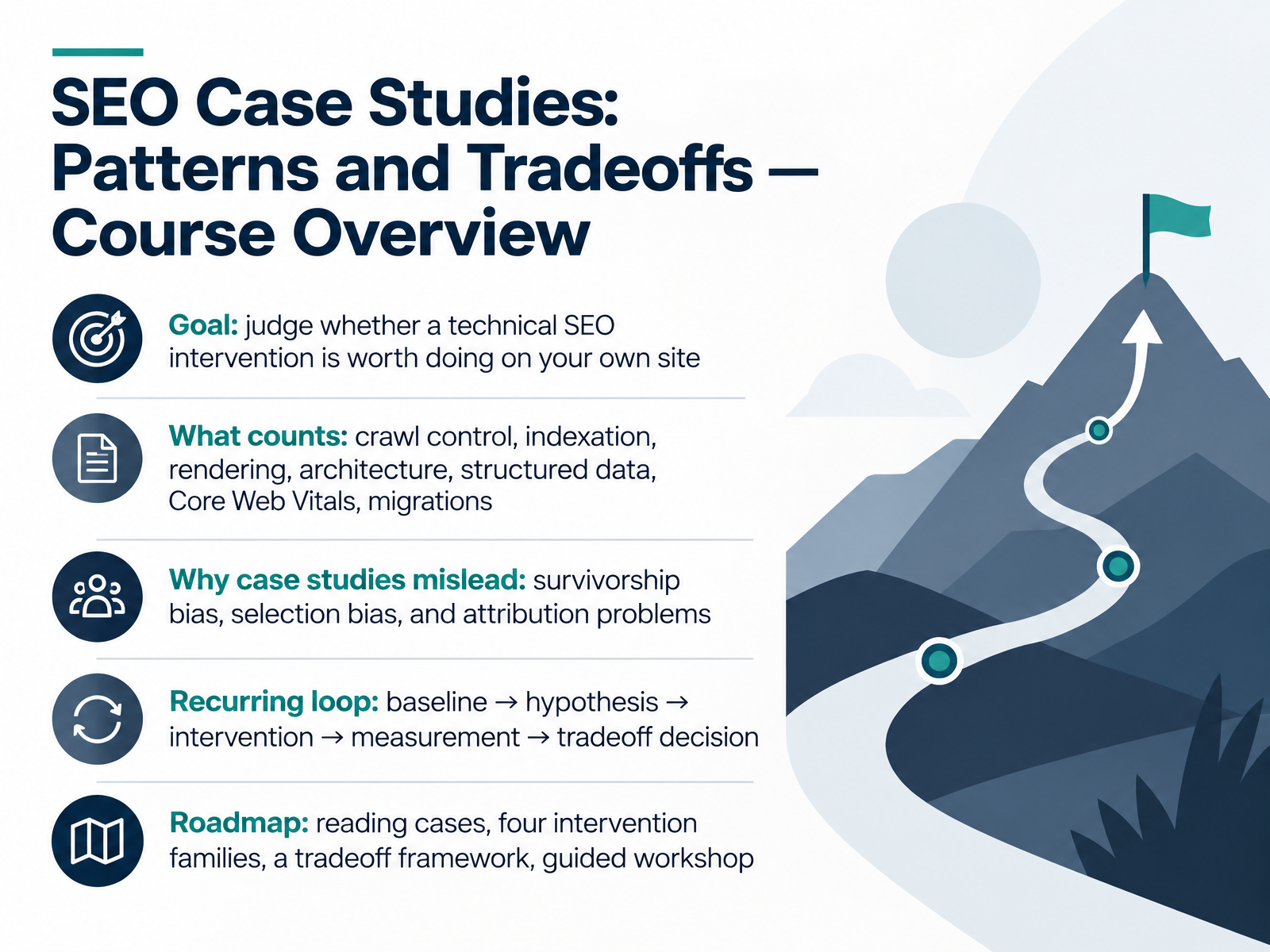
- 01SEO Case Studies: Patterns and Tradeoffs — Course OverviewWelcome. This course is about SEO case studies, and how to read them without being fooled by them. Our goal is practical. By the end, you should be able to judge whether a technical SEO intervention is worth doing on your own site. We will cover the areas that count: crawl control, indexation, rendering, site architecture, structured data, Core Web Vitals, and migrations. We will also look at why case studies mislead. Survivorship bias means failed campaigns rarely get published. Selection bias means the published example is often the most flattering one. Attribution problems mean other changes may have driven the result. So we will use a recurring loop. Establish a baseline. State a hypothesis. Apply the intervention. Measure against a comparison. Then make a tradeoff decision. Your roadmap includes reading cases critically, four families of interventions, a tradeoff framework, and a guided workshop. Here is the takeaway for today. Treat every case as a claim to test, not proof. Next, we look at why published SEO case studies mislead.searchengineland.comsearchengineland.comsiteoscope.com+22 min
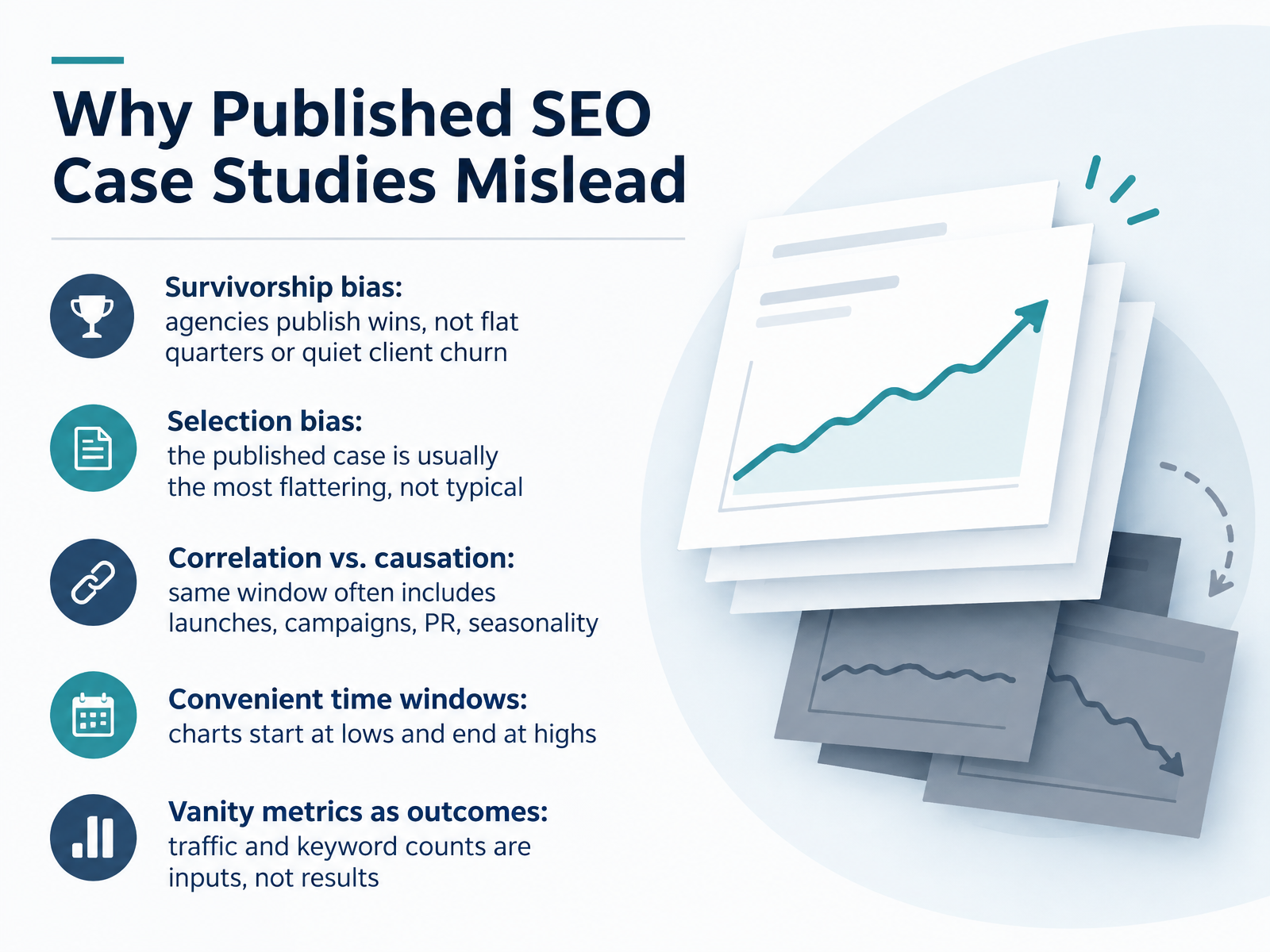
- 02Why Published SEO Case Studies MisleadBefore we look at individual cases, let's talk about why published SEO case studies mislead. These patterns are not accusations. They are structural, and knowing them helps you read every case more carefully.
First, survivorship bias. Agencies publish wins, not flat quarters or quiet client churn, so failed campaigns never reach a slide deck. Second, selection bias. The published case is usually the most flattering one, not a typical engagement.
Then correlation versus causation. In the same window there were often product launches, paid campaigns, press coverage, or seasonality. A single tactic gets the credit, even when several things moved together.
Watch the time window, too. A chart that starts at an unusually low point and ends at a high point can dramatize almost any trend. And be wary of vanity metrics. Traffic and keyword counts are inputs. They matter only when they connect to leads, sales, or whatever the business actually needs.
So treat every case study as a claim to verify, not proof to copy. Next, we look at the anatomy of a credible case study.
 rankbuilderseo.comrn-digital.comseoprocheck.com+22 min
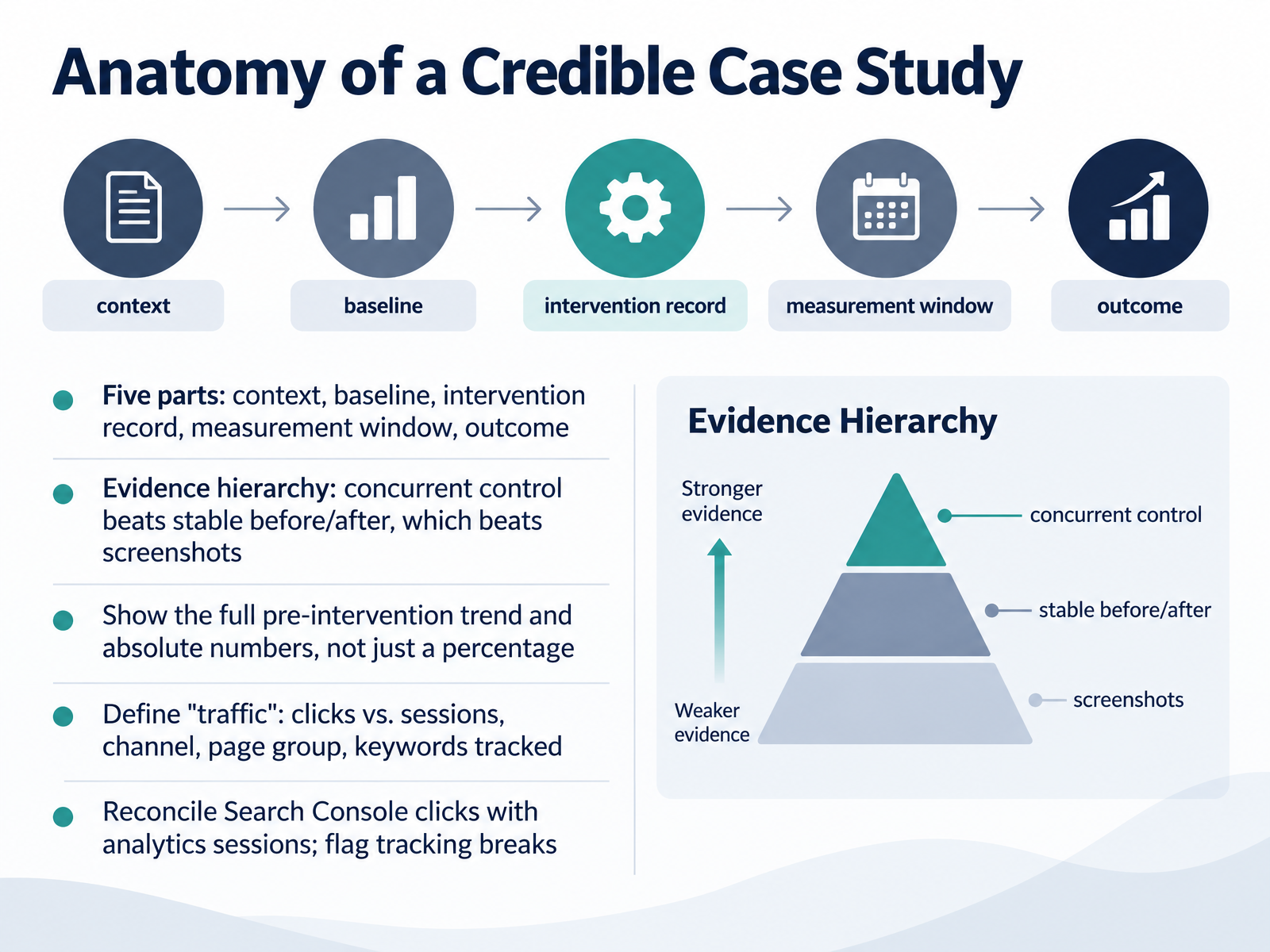
- 03Anatomy of a Credible Case StudySo, what makes a case study credible? Let's break down its anatomy. Start with five parts: context, baseline, intervention record, measurement window, and outcome. If any one is missing, you cannot weigh the result. Next, evidence hierarchy. A concurrent control group outranks a stable before-and-after comparison, and that outranks a screenshot. Then, show the full pre-intervention trend and absolute numbers, not just a percentage. A rise from ten to forty visits is very different from one hundred thousand to one hundred ten thousand. Also define traffic. Clicks or sessions? Which channel and page group? How many keywords were tracked? Finally, reconcile Search Console clicks with analytics sessions, and flag any tracking breaks. Ask yourself, could I reproduce this evaluation on my own site? That is the standard to hold. Next, we look at red flags and confounders, and ask what would have happened anyway.
 rankbuilderseo.comrn-digital.comseoprocheck.com+22 min
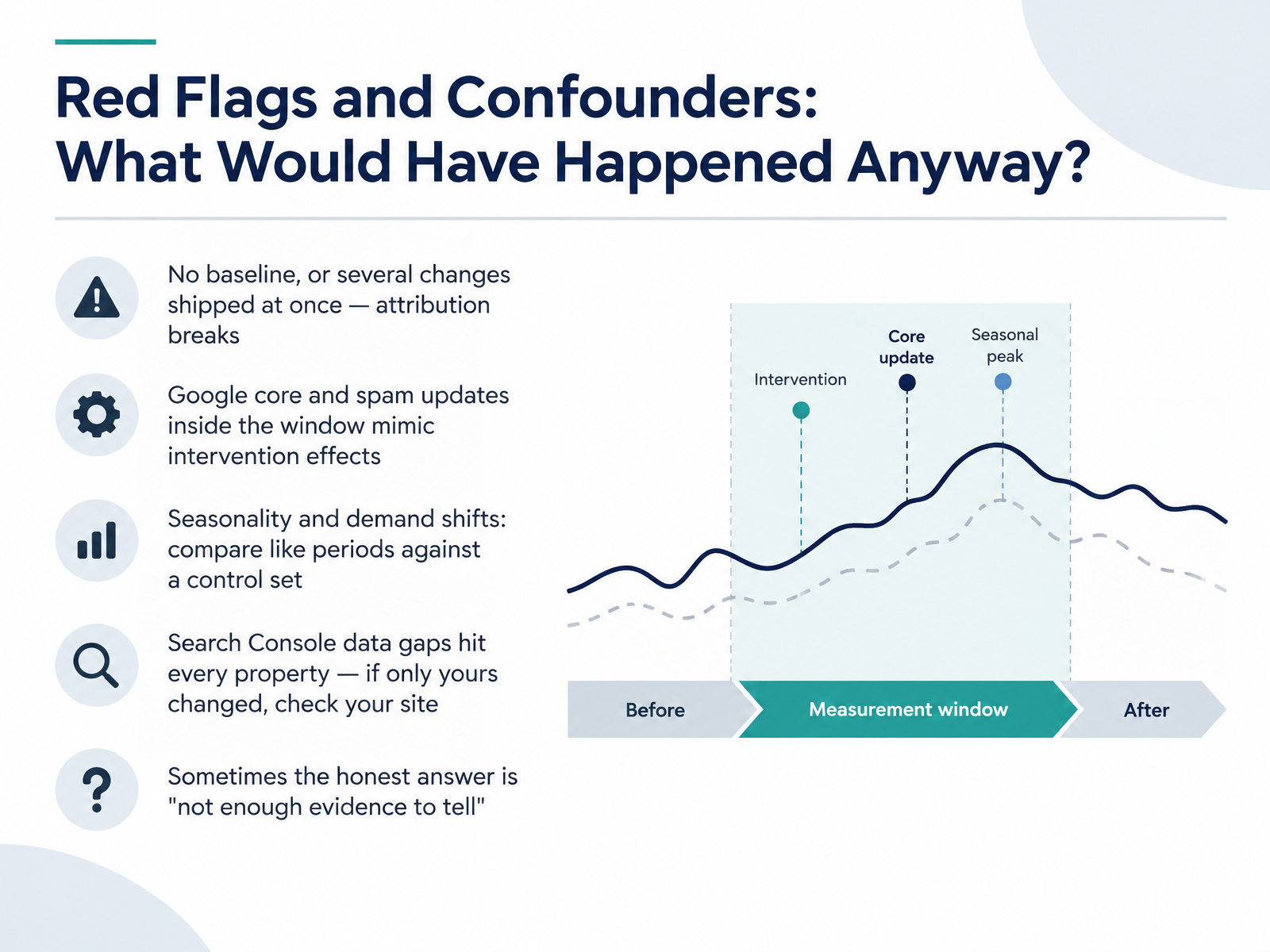
- 04Red Flags and Confounders: What Would Have Happened Anyway?Let's turn to red flags and confounders, and a question worth asking about every case study: what would have happened anyway? Without a clean baseline, or when several changes ship at once, attribution breaks. You cannot separate one implementation from the rest. Google core and spam updates inside the window can mimic an intervention's effects, so check rollout dates against your timeline. Seasonality and demand shifts matter too, so compare like periods against a control set. Search Console data gaps hit every property, so if only your report changed, check your site first. Sometimes the honest answer is: not enough evidence to tell. That is a finding, not a failure. Log changes and confounders as you go. Next, we look at crawl and indexation interventions, and the core patterns behind them.
 searchengineland.comsearchengineland.comsiteoscope.com+21 min
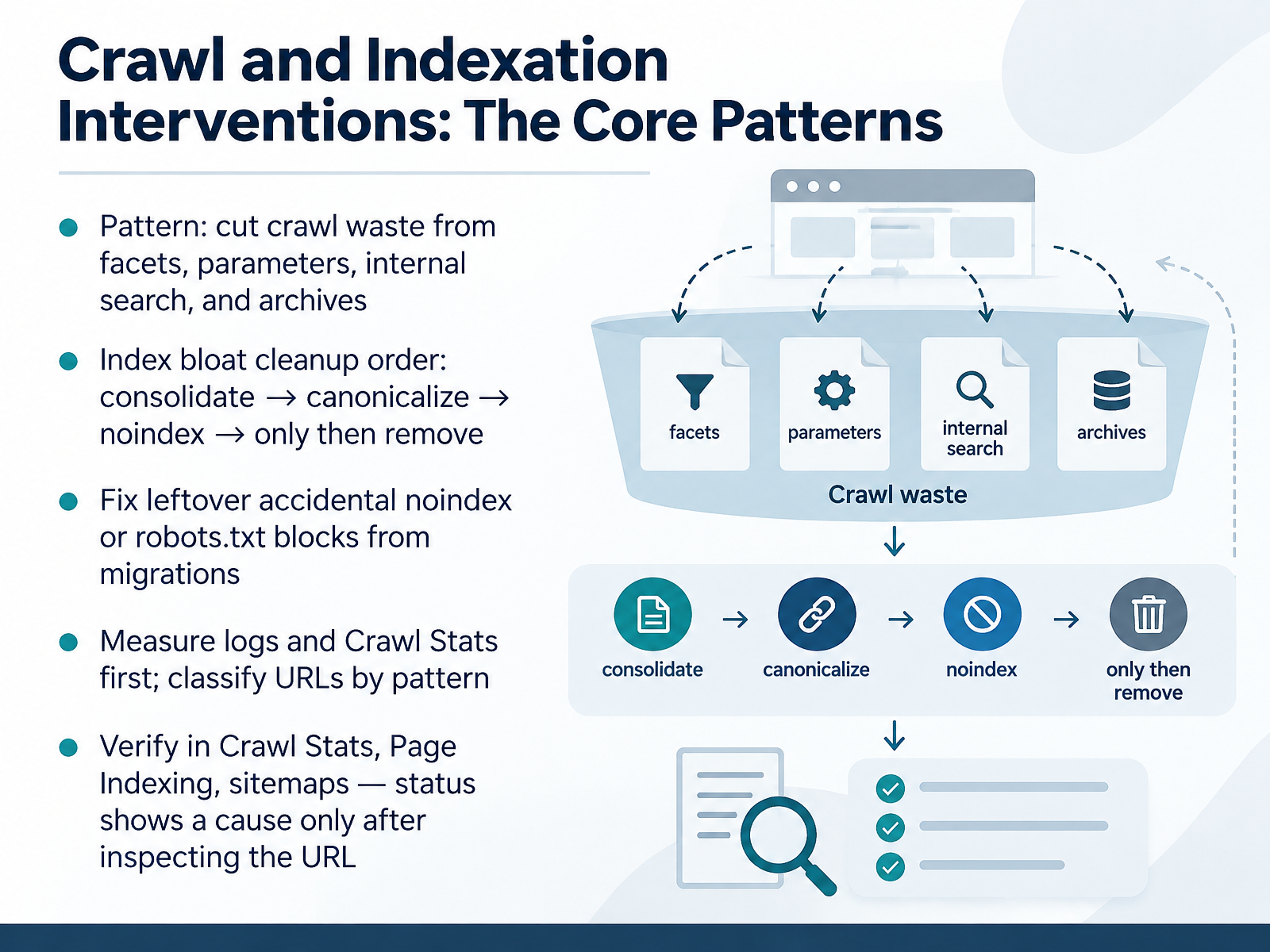
- 05Crawl and Indexation Interventions: The Core PatternsLet's look at the core patterns behind crawl and indexation interventions. The first pattern is cutting crawl waste from facets, parameters, internal search pages, and archives. Before you change anything, measure. Check server logs and the Crawl Stats report, then classify URLs by pattern. That turns millions of addresses into a short list of problems you can actually address. When you clean up index bloat, follow a specific order. Consolidate, then canonicalize, then apply noindex, and only then consider removal. Removal is the one step you cannot undo. Also check for leftover accidental noindex tags or robots.txt blocks from past migrations. Those are easy to miss and can quietly keep valuable pages out of search. Finally, verify in Crawl Stats, Page Indexing, and sitemaps. Remember that a status in Search Console shows a cause only after you inspect the actual URL. Next, we will examine Robots.txt, Noindex, and Canonical: How the Tradeoffs Interact.
 searchengineland.comseoprocheck.comsupport.google.com+22 min
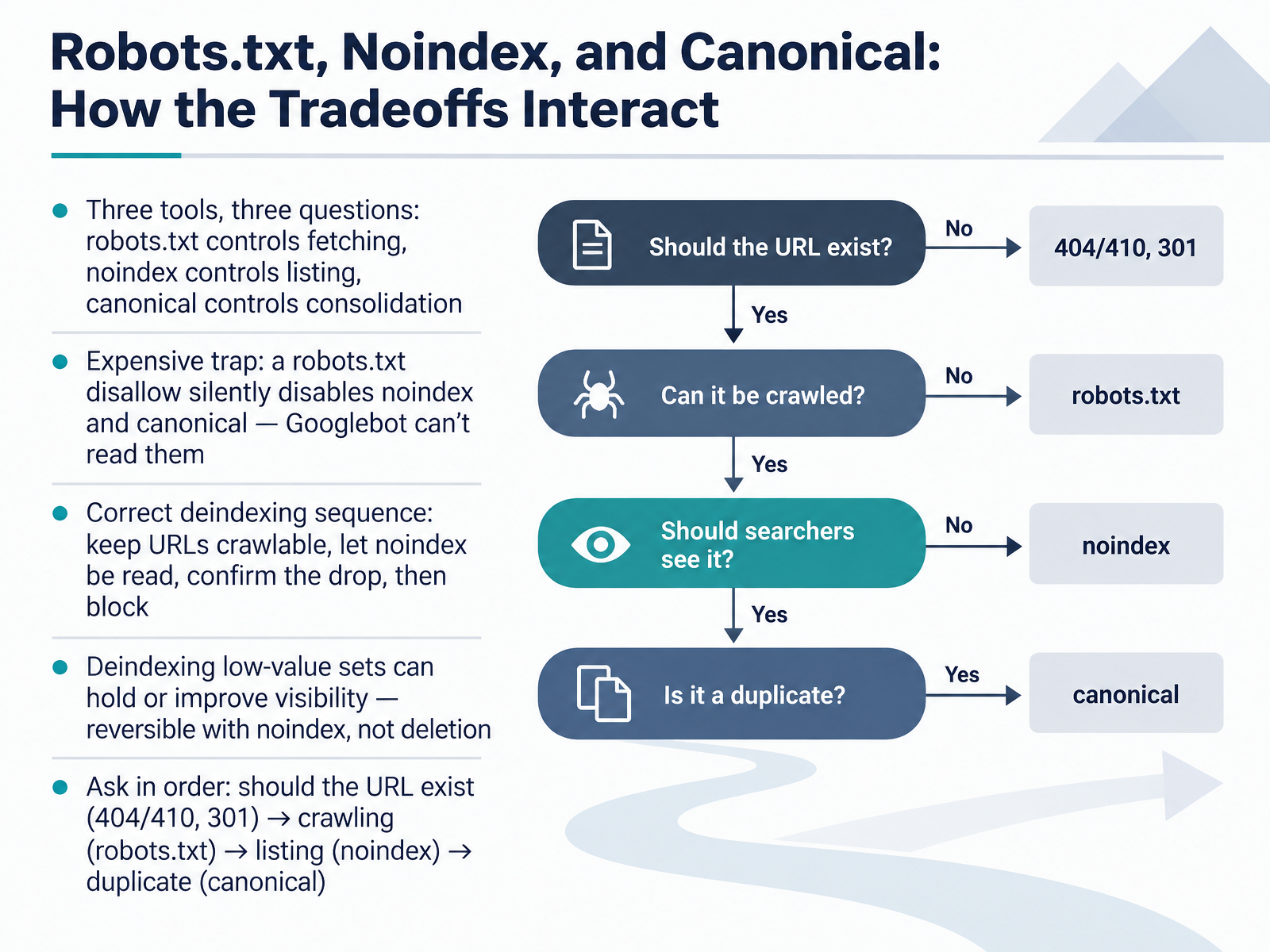
- 06Robots.txt, Noindex, and Canonical: How the Tradeoffs InteractLet's look at three indexing controls that teams often mix up. Robots dot txt controls fetching. Noindex controls listing. Canonical controls consolidation. Each answers a different question.
Here is the expensive trap. A robots dot txt disallow silently disables noindex and canonical. Googlebot cannot read signals on a page it is not allowed to fetch. So a blocked URL can stay in the index with a bare listing, sometimes for months.
The correct deindexing sequence is this. Keep the URLs crawlable. Let noindex be read. Confirm the drop in Search Console. Only then block, if you still want to stop crawling. And note that deindexing low-value pages with noindex is reversible, because you kept the pages live for users.
So ask in order. Should the URL exist at all? If not, return a 404 or 410, or redirect with a 301. Is crawling the problem? Then use robots dot txt. Should users reach it but searchers never find it? Use noindex and keep it crawlable. Is it a duplicate? Canonicalize to the preferred URL.
Next, we look at what the case studies actually show. What Deindexing Case Studies Actually Show.
 searchengineland.comseoprocheck.comsupport.google.com+22 min
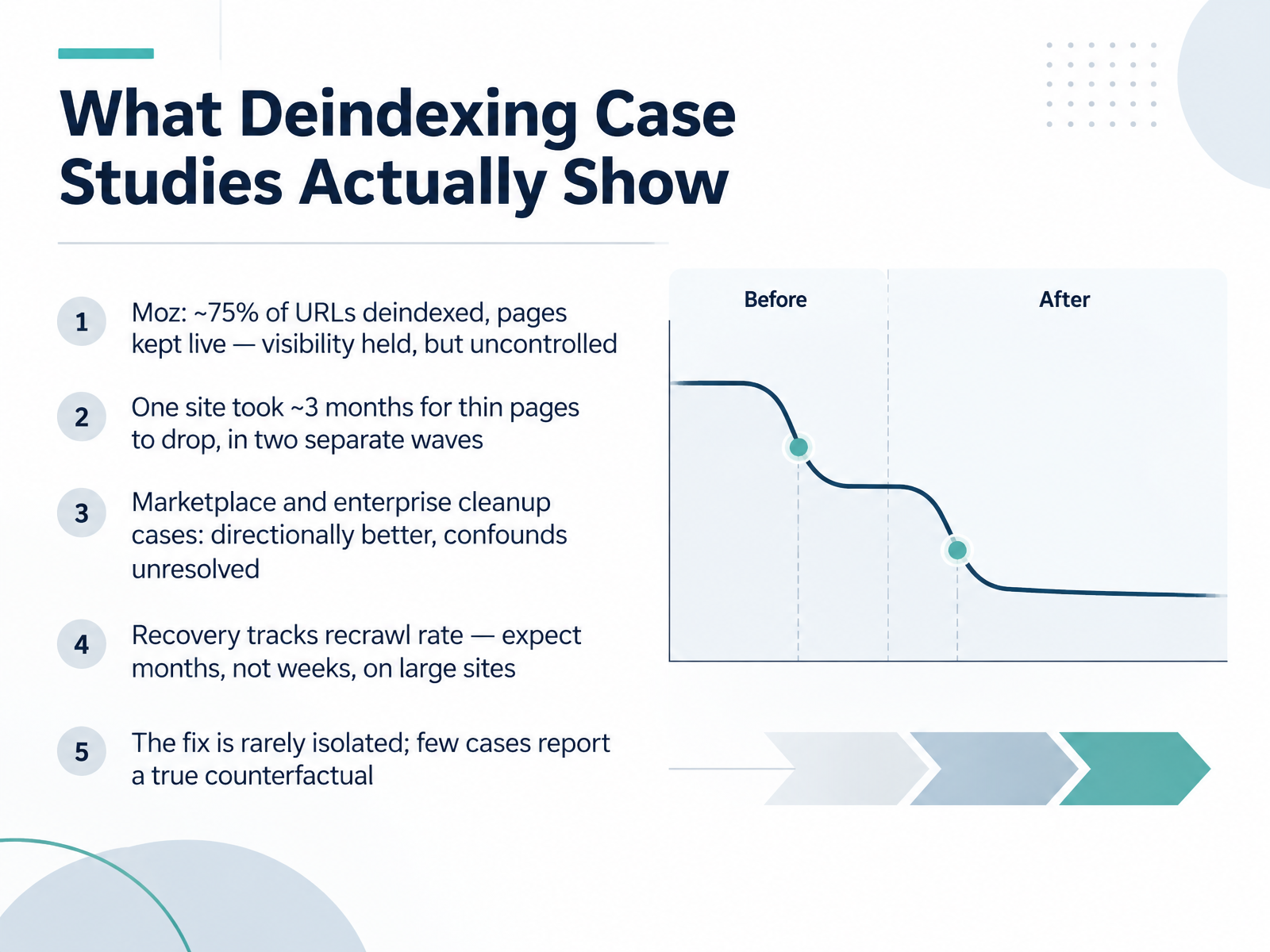
- 07What Deindexing Case Studies Actually ShowLet's look at what deindexing case studies actually show, and where the evidence gets thin. In one widely cited case at Moz, about seventy five percent of URLs were deindexed, and the pages were kept live. Visibility held, but the outcome was not tightly controlled. In another case, a site took about three months for thin pages to drop, and the drops arrived in two separate waves. Marketplace and enterprise cleanup examples point in a better direction, yet confounds remain unresolved. So the decision logic is this. Recovery tracks recrawl rate, so on large sites, expect months, not weeks. And the fix is rarely isolated. Few cases report a true counterfactual, which means we should read each result as directional evidence rather than proof. Next, we turn to site architecture and internal linking, and the evidence and limits there.
 searchengineland.comseoprocheck.comsupport.google.com+21 min
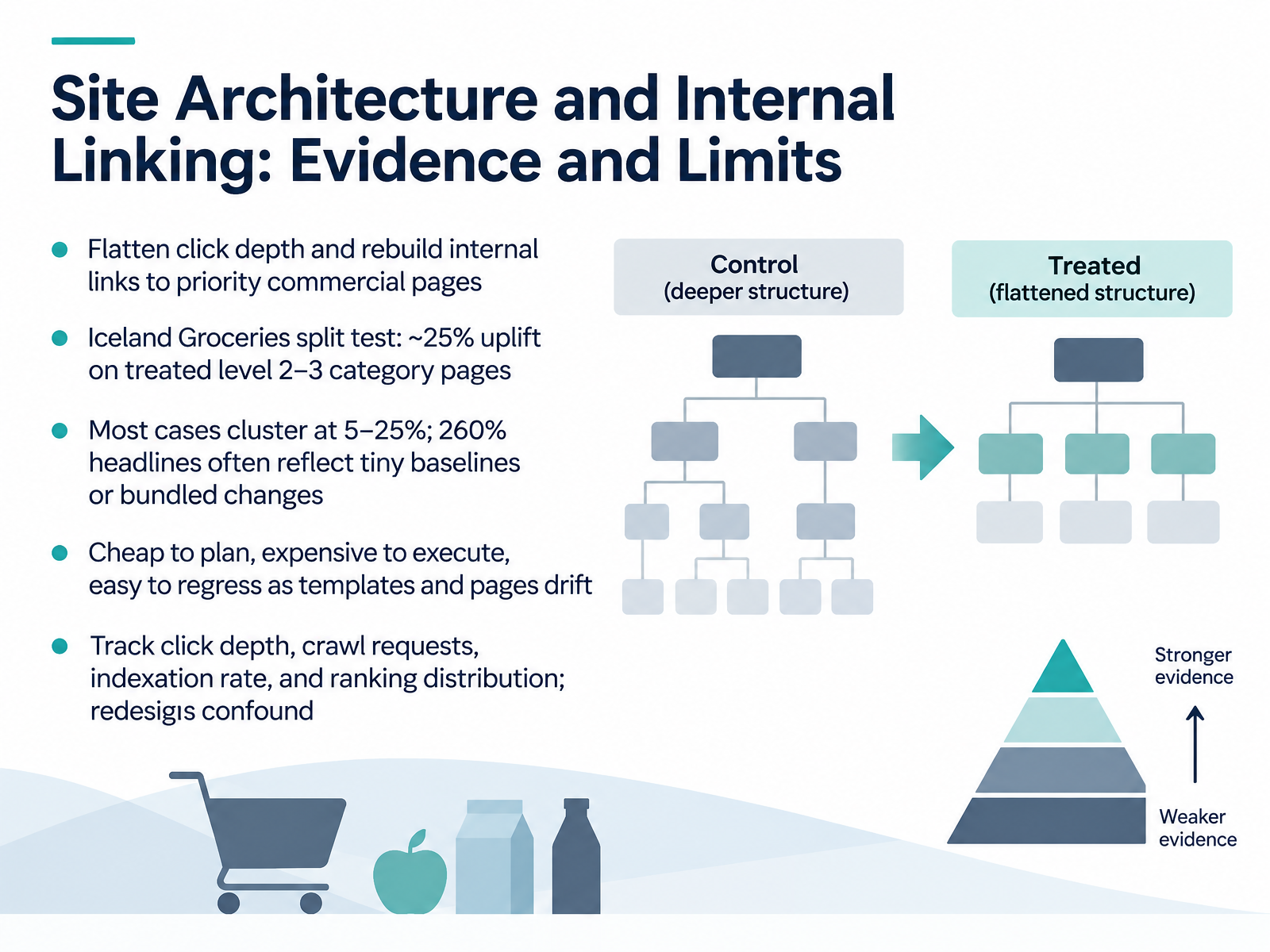
- 08Site Architecture and Internal Linking: Evidence and LimitsNext, let's look at site architecture and internal linking, and what the evidence actually supports. The core move is simple: flatten click depth and rebuild internal links so priority commercial pages sit closer to the surface. In a Splitpilot split test on Iceland Groceries, treated level two and level three category pages saw roughly a twenty five percent uplift. Most cases we see cluster between five and twenty five percent. Headlines claiming two hundred sixty percent often reflect a tiny baseline, or several changes bundled together. So what are the tradeoffs? This work is cheap to plan and expensive to execute, and it regresses easily as templates and pages drift. Track click depth, crawl requests, indexation rate, and ranking distribution. And remember that redesigns confound results. Ask which of those metrics you can measure on your own site before committing. That leads us to Core Web Vitals: Real UX Wins, Weaker Ranking Evidence.
 linkvector.iosearchpilot.comseoclarity.net+22 min
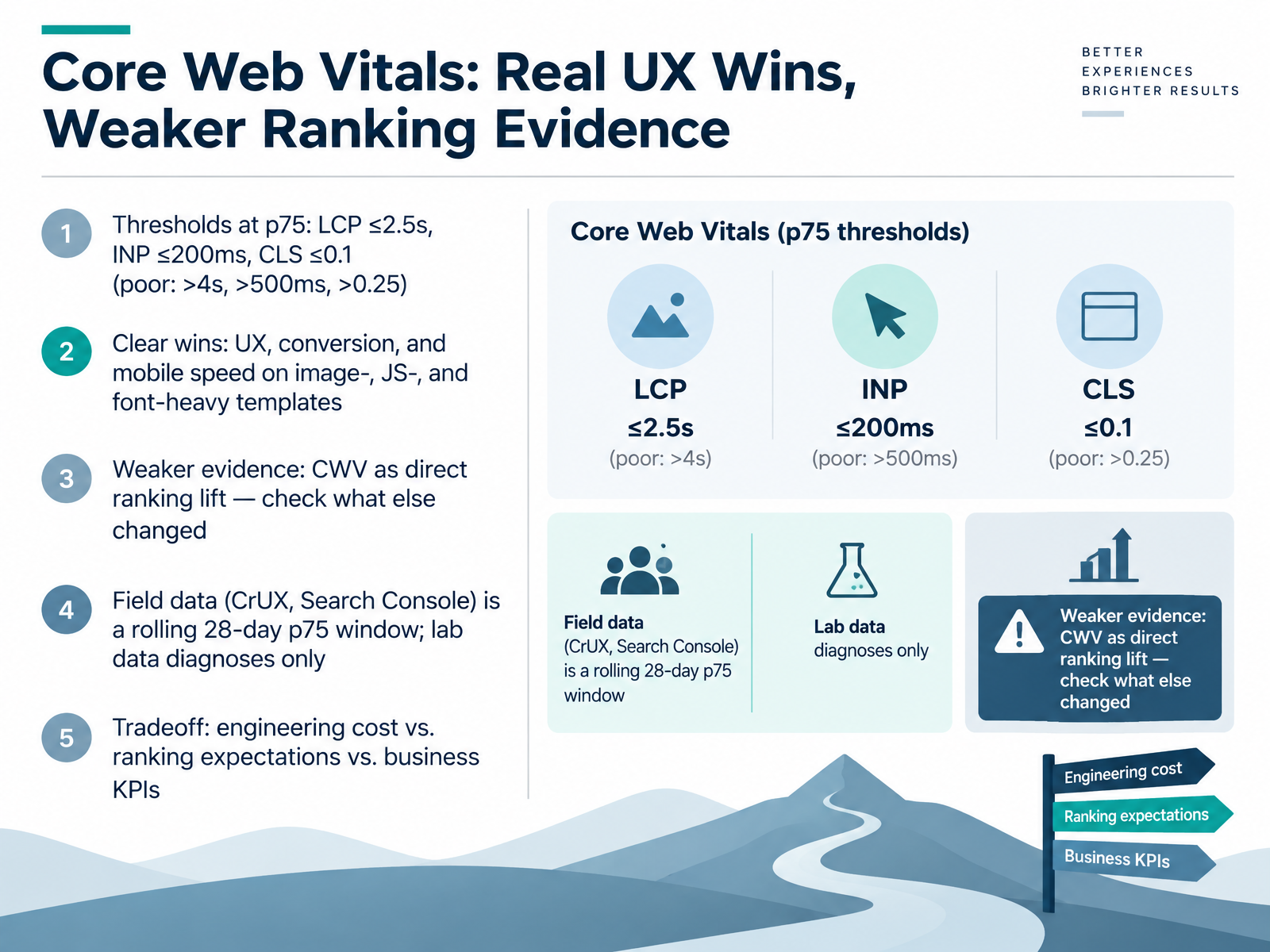
- 09Core Web Vitals: Real UX Wins, Weaker Ranking EvidenceNow let's look at Core Web Vitals, where the evidence is strongest for user experience and weaker for rankings. The thresholds apply at the seventy-fifth percentile. LCP should be at or under two point five seconds. INP at or under two hundred milliseconds. CLS at or under zero point one. Poor values sit above four seconds, five hundred milliseconds, and zero point two five. What changes reliably? User experience, conversion, and mobile speed, especially on templates heavy with images, JavaScript, and fonts. What is uncertain? Core Web Vitals as a direct ranking lift. Check what else changed, such as rendering, content, or internal links. Field data from CrUX and Search Console is a rolling twenty-eight day window, and lab data only helps you diagnose. So weigh engineering cost against ranking expectations and business KPIs. Next, we turn to structured data and rich results, and what still pays in twenty twenty-six.
 1 min
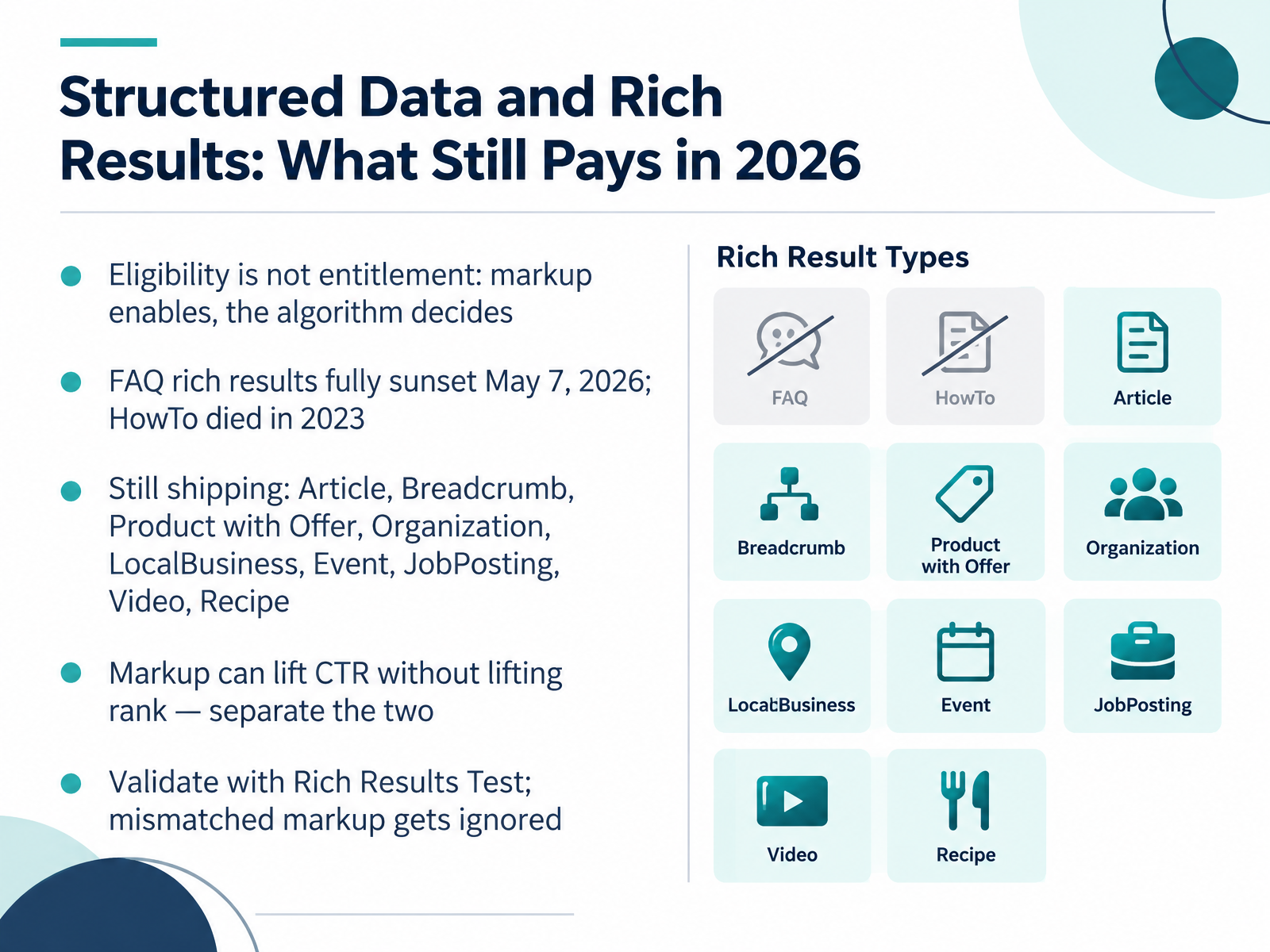
- 10Structured Data and Rich Results: What Still Pays in 2026Next, structured data and rich results, and what still pays in 2026. Start with the core principle: eligibility is not entitlement. Markup enables a feature. The algorithm decides whether it appears. And the list keeps shrinking. FAQ rich results were fully sunset on May seventh, 2026, and HowTo stopped producing rich results back in 2023. If that markup is still on your pages, it does no harm, but don't budget time for it. What still ships includes Article, Breadcrumb, Product with Offer, Organization, LocalBusiness, Event, JobPosting, Video, and Recipe. Here's a tradeoff worth separating: markup can lift click-through rate without lifting rank. Treat those as two outcomes. And validate with the Rich Results Test, because mismatched markup gets ignored, or worse, risks a manual action. Quick question before we move on: which one or two of these types actually match your site's content? If the answer is none, that's a finding, too. Now let's look at migrations and redesigns, high-risk, high-learning cases.
 2 min
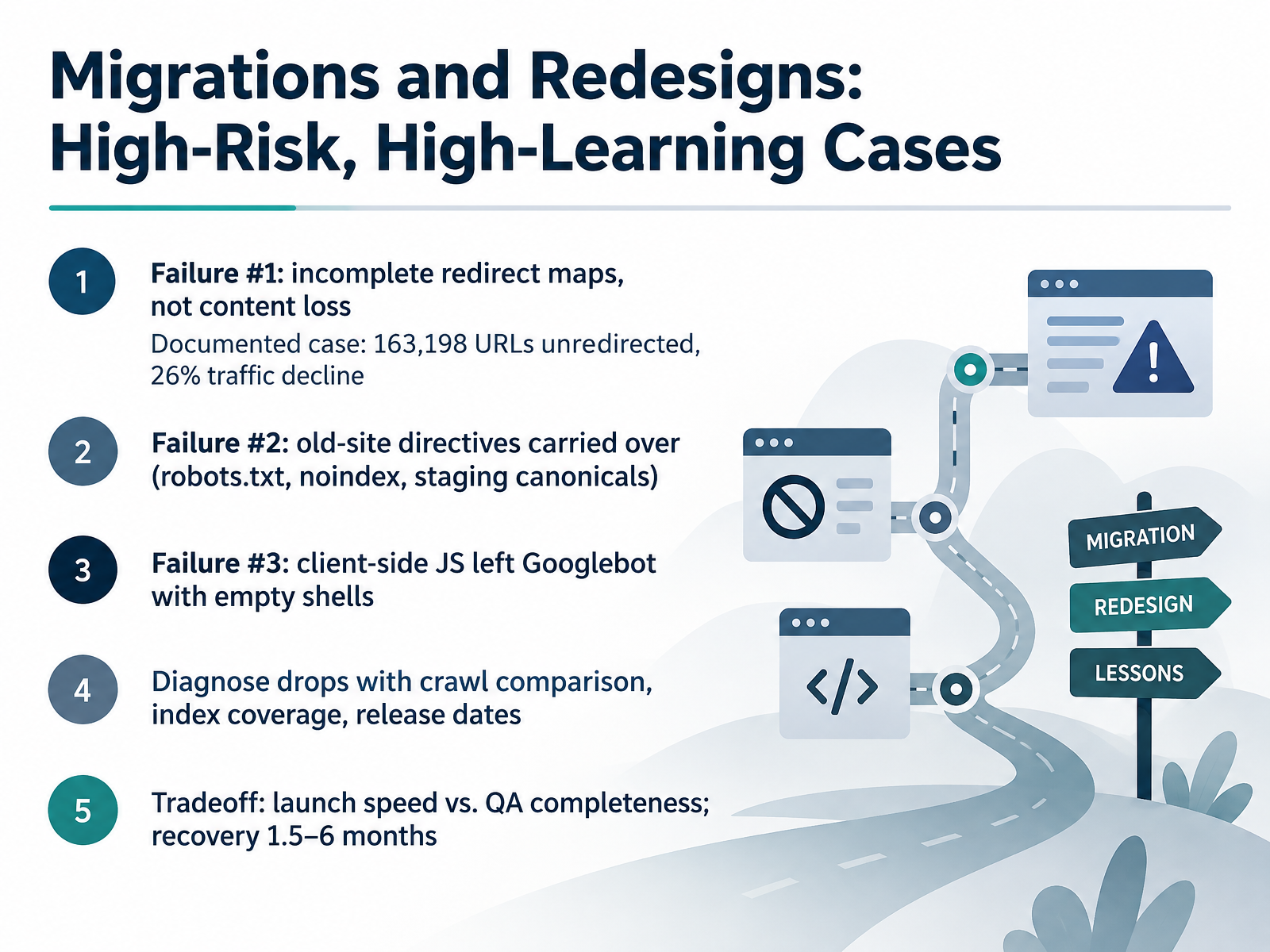
- 11Migrations and Redesigns: High-Risk, High-Learning CasesLet's look at migrations and redesigns, where the risk is high and the lessons are hard to ignore. In one documented case, 163,198 URLs were not properly redirected. The site then recorded a 26 percent decline in traffic. Notice the pattern. The failure was an incomplete redirect map, not a loss of content. The content existed. The connections to it were missing. A second common failure is carried-over directives. Old robots.txt rules, noindex tags, or staging canonicals can block crawling or indexing after launch. A third is client-side rendering. Users see a full page, while Googlebot receives an empty shell. So how do you diagnose a drop? Compare crawls before and after launch. Check index coverage. Then line those findings up against release dates. The tradeoff is real. Launch speed competes with QA completeness, and recovery commonly takes one and a half to six months. So weigh that timeline before cutting QA. Next, we'll move on to designing a test so you can learn something.
 2 min
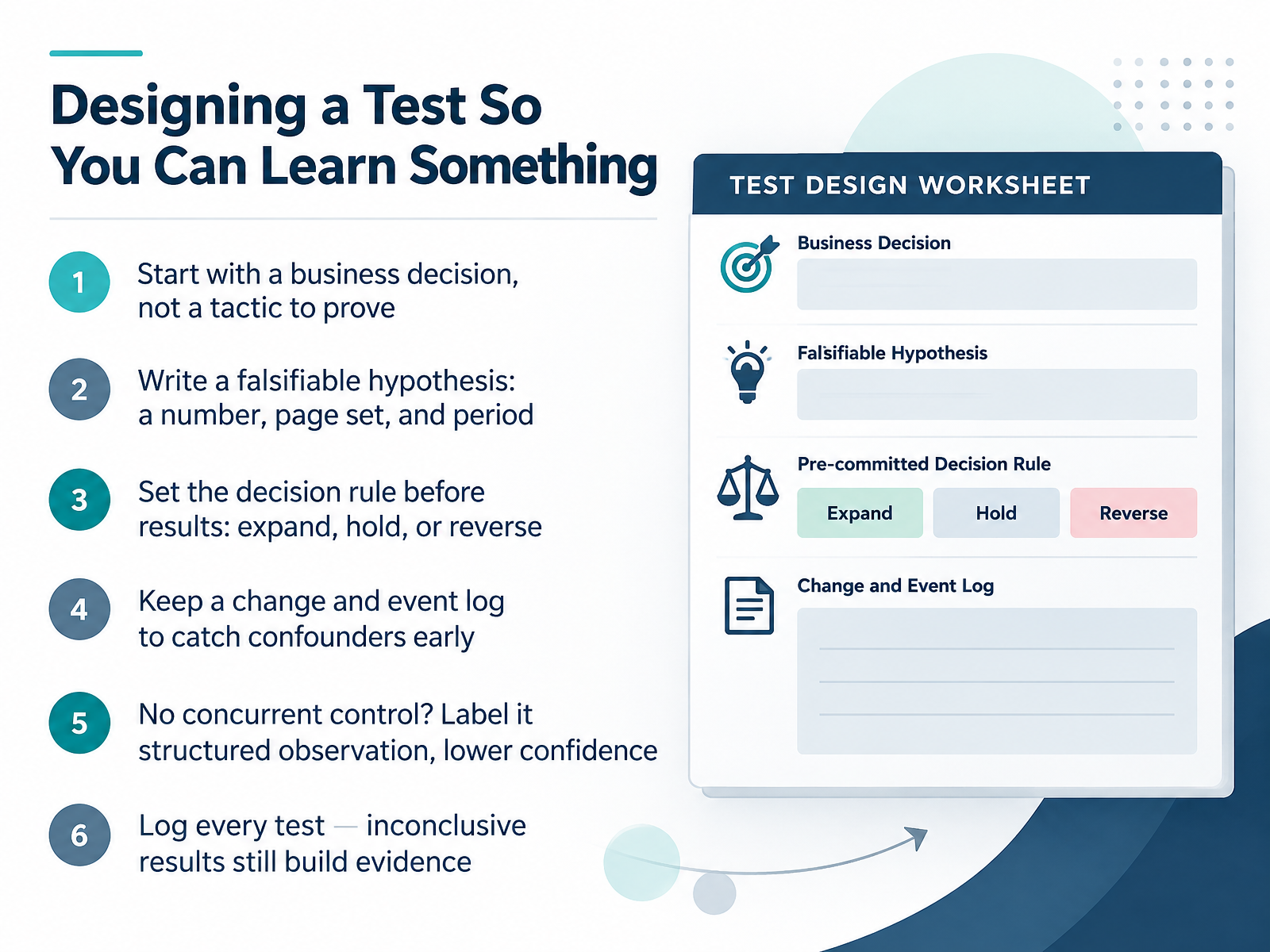
- 12Designing a Test So You Can Learn SomethingSo how do you design a test you can actually learn from? Start with a business decision, not a tactic you want to prove. Then write a falsifiable hypothesis that names a number, a page set, and a period. Before results arrive, set the decision rule: expand, hold, or reverse. Keep a change and event log, so you catch confounders early. If you have no concurrent control, label the work structured observation and lower your confidence. And log every test, because inconclusive results still build evidence. Next, we move into the tradeoff framework: do, test, defer, or reject.
 searchengineland.comsearchengineland.comsiteoscope.com+21 min
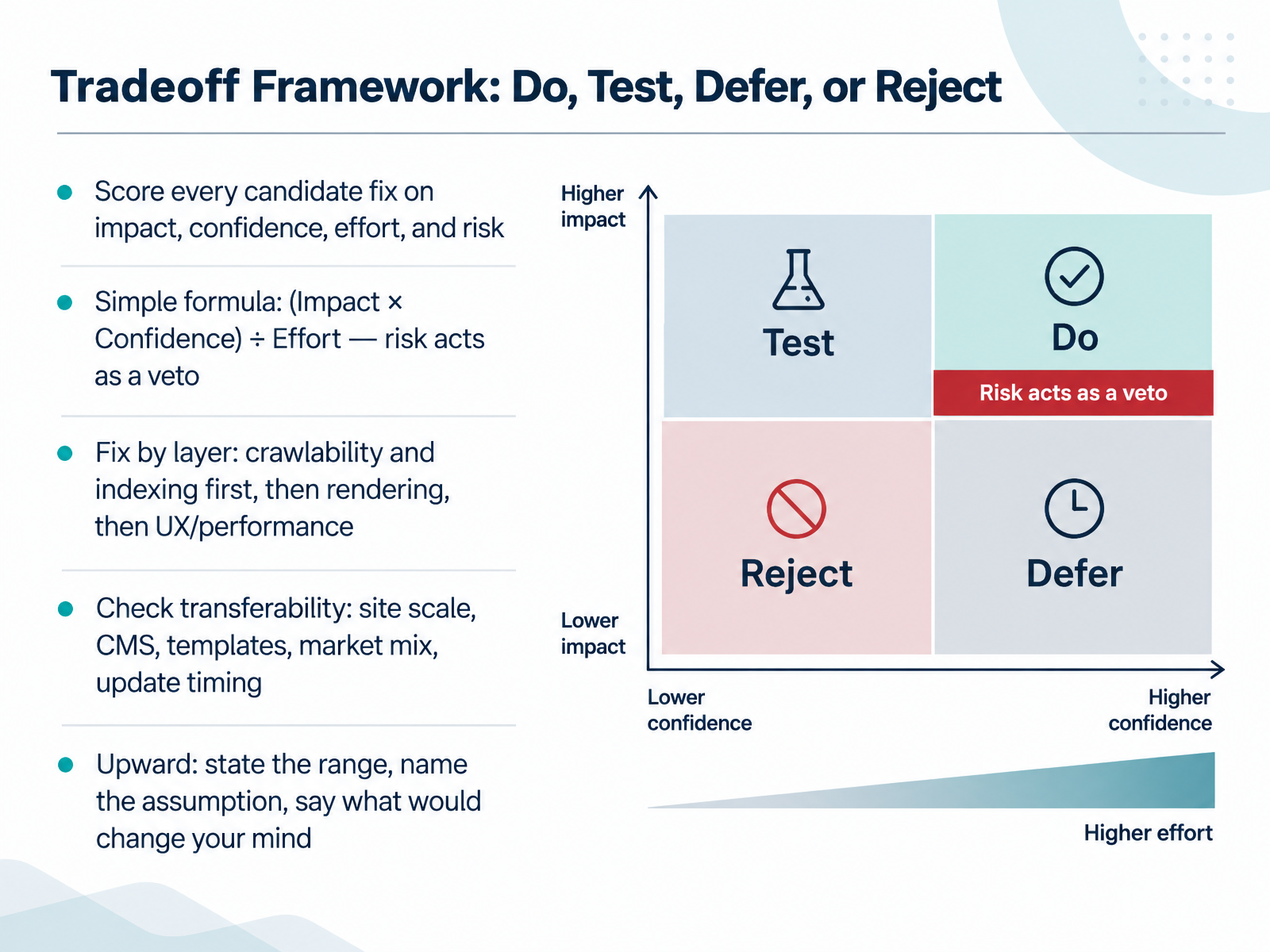
- 13Tradeoff Framework: Do, Test, Defer, or RejectLet's bring these cases together into a decision framework. For every candidate fix, score four things from one to five: impact, confidence, effort, and risk. A simple formula is impact times confidence, divided by effort. Risk acts as a veto, so a high-risk change does not ship just because the score looks good.
Next, fix by layer. Crawlability and indexing come first, then rendering, then user experience and performance. Before reusing a case study's playbook, check transferability: site scale, CMS, templates, market mix, and update timing.
When you report upward, state the range, name the assumption behind it, and say what would change your mind. That keeps the recommendation honest and testable. Now let's put the framework to work on a full end-to-end evaluation, in the workshop: Evaluate a Technical SEO Intervention End to End.
 rankbuilderseo.comrn-digital.comseoprocheck.com+21 min
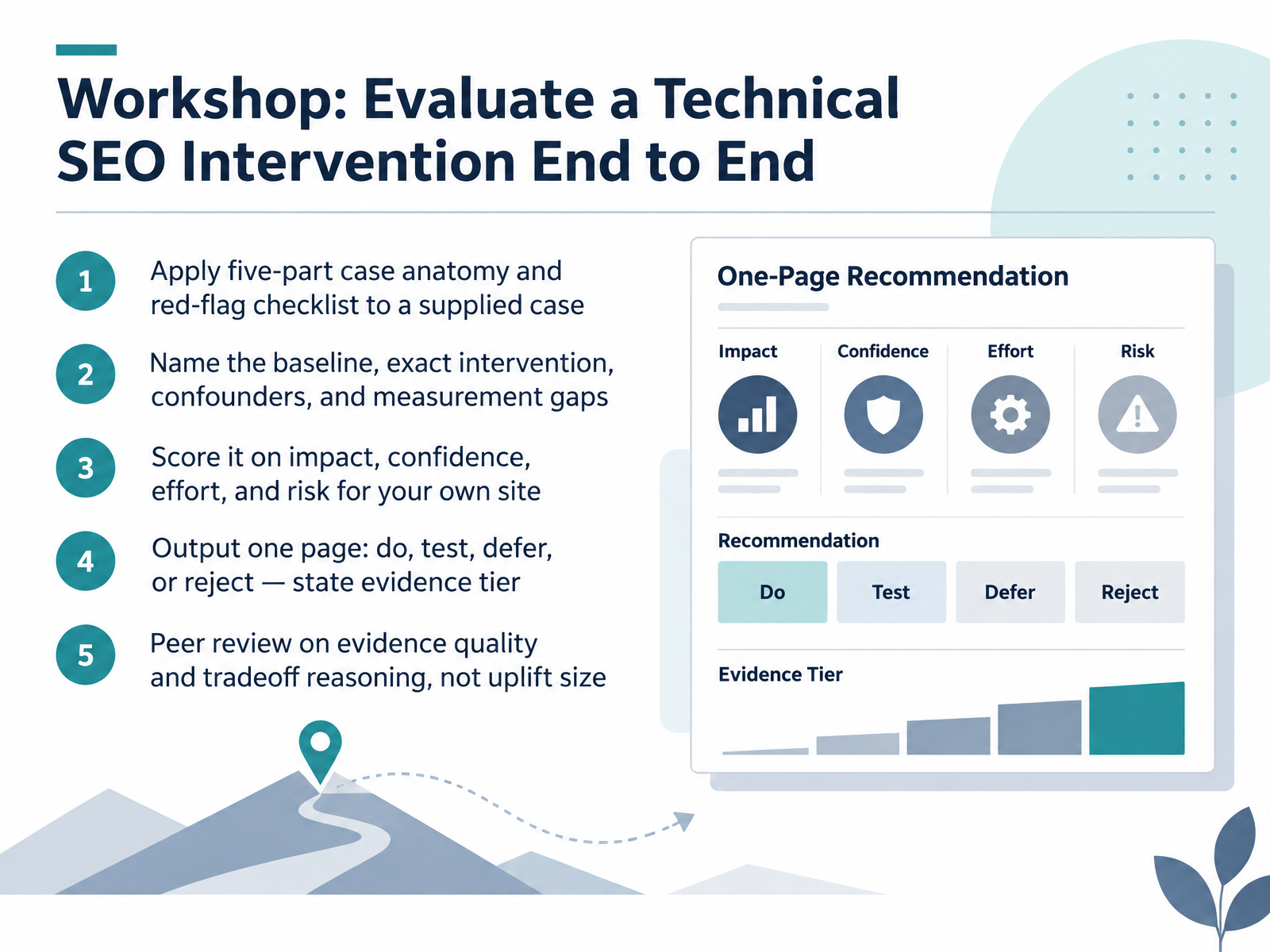
- 14Workshop: Evaluate a Technical SEO Intervention End to EndLet's close with practice. Take the supplied case and apply the five-part anatomy and the red-flag checklist. Name the baseline, the exact intervention, the confounders, and the measurement gaps. Then score it for your own site on impact, confidence, effort, and risk. Keep confidence tied to evidence, not optimism. In the internal linking examples, a split test measured a twenty-five percent uplift on category pages, while a before-and-after story could not separate the change from concurrent updates. Your output is one page. Say whether you will do, test, defer, or reject, and state your evidence tier. In peer review, judge evidence quality and tradeoff reasoning, not the size of the uplift. That habit is what makes technical SEO decisions defensible. Thank you for working through all fourteen slides, and keep applying this discipline to your next intervention.
 linkvector.iosearchpilot.comseoclarity.net+22 min
Take the deck with you
Download this course as a file — free, no sign-up needed.
- PDF handoutEvery slide page, ready to print or share.15 pages · 3.2 MBDownload
- Narrated PowerPointThe deck that presents itself — every slide carries the digital human's narration video.15 pages · 23.9 MBDownload
- PowerPoint slidesThe full deck as a .pptx — open it in PowerPoint, Keynote, or Google Slides.15 pages · 3.1 MBDownload
Free to use in your own training — please keep the PersonWise credit page at the end.
Have your own deck? Turn it into a course
Sources consulted
Web sources consulted while building this course.
- Technical SEO testing: How to build a stronger experiment — searchengineland.com
- SEO attribution is still broken. Stop trying to make it perfect. — searchengineland.com
- SEO Data Blind Spot: Why Case Studies Mislead Your Analytics | Siteoscope.com — siteoscope.com
- We Audited Our Own 800-Post Blog. Seven Numbers That Were Lying to Us. — CODERCOPS — blog.codercops.com
- How to Measure an SEO Win You Can Actually Prove | SEO 24x7 — seo24x7.com
- SEO Case Study Verification Checklist: Test the Claim Before You Buy — Rank Builder SEO — rankbuilderseo.com
- How to Audit Agency Case Study Metrics: Checklist for Direct Comparison - RN Digital — rn-digital.com
- The SEO Industry, Honestly: How To Read Case Studies And Revenue Claims | SEO ProCheck — seoprocheck.com
- Test Like A Scientist: 6 Mistakes That Undermine Your SEO Experiments — searchenginejournal.com
- How do you diagnose whether an SEO experiment's results are statistically valid when Google's ranking algorithm introduces confounding variance during the test period? - Vega SEO Talks — vegaseotalks.com
- How long does it take to deindex low-quality or thin content published by accident? [case study] — searchengineland.com
- How Britney Muller deindexed 75% of Moz.com's site | SEO ProCheck — seoprocheck.com
- Mixing meta robots noindex or rel canonical with Disallow — support.google.com
- Case Study: Crawl Budget & Index Bloat Cleanup — meek.media
- Robots.txt vs Noindex vs Canonical: Which to Use When — krawlops.com
- Case Study: How Internal Linking Improves Site Architecture and Leads to a 260% Increase in Traffic — linkvector.io
- SEO test: The real SEO impact of internal linking changes — searchpilot.com
- 5 Internal Linking Case Studies of Increased Visibility and Opportunity — seoclarity.net
- The Importance and Impact of Internal Linking for SEO — searchpilot.com
- Cruise Nation: SEO Case Study | SEO Consultant Bath | SEOBurf — seoburf.com