English Opinion and Reasoning
Begin
14 pages · ~28 min
English Opinion and Reasoning
Learn to express opinions and support them with clear reasons in English for everyday conversations and professional discussions.
What you’ll learn
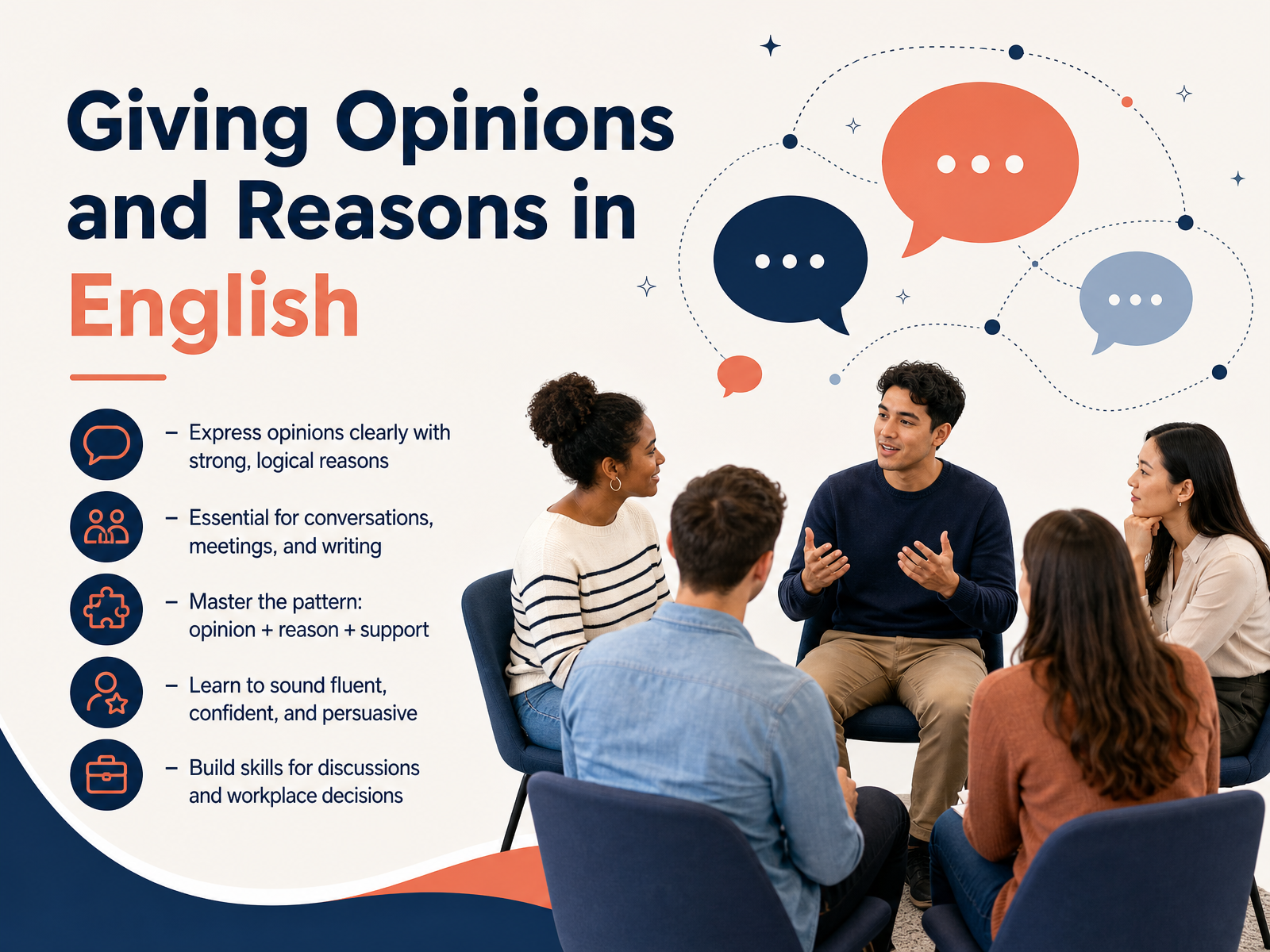
- 01Giving Opinions and Reasons in EnglishWelcome, everyone. I'm so glad you're here. Today, we're going to talk about giving opinions and reasons in English. This is a skill you'll use every day, whether you're in a classroom, in a meeting, or just having a conversation with friends. By the end of this session, you'll be able to express your ideas clearly and back them up with strong, logical reasons. Here's the pattern we'll master together: opinion, reason, support. First, state what you think. Then, explain why. Finally, add a detail or example to make your point stronger. This simple structure will help you sound fluent, confident, and persuasive. Imagine you're in a team meeting and you want to suggest a new idea. With this pattern, you'll know exactly what to say and how to say it. So let's get started. In our next section, we'll explore why opinion skills really matter in your daily life.1 min
- 02Why Opinion Skills MatterNow, let’s talk about why giving opinions and reasons matters so much. Think about discussions at work, classroom debates, or even the IELTS speaking test. In all these situations, your opinion is central. But here’s the key: an opinion without a reason sounds weak or unsupported. For example, saying “I think remote work is better” is fine, but it’s much stronger if you add, “because it gives people more flexibility.” That reason turns a simple statement into a convincing point. When you master this skill, you move from being a passive listener to an active contributor. People start to see you as someone who thinks critically and adds value. Plus, clear reasoning makes you sound more fluent, confident, and persuasive in English. So remember, every time you share an opinion, pair it with a reason. That’s the foundation. Next, let’s look at the difference between facts and opinions.
 1 min
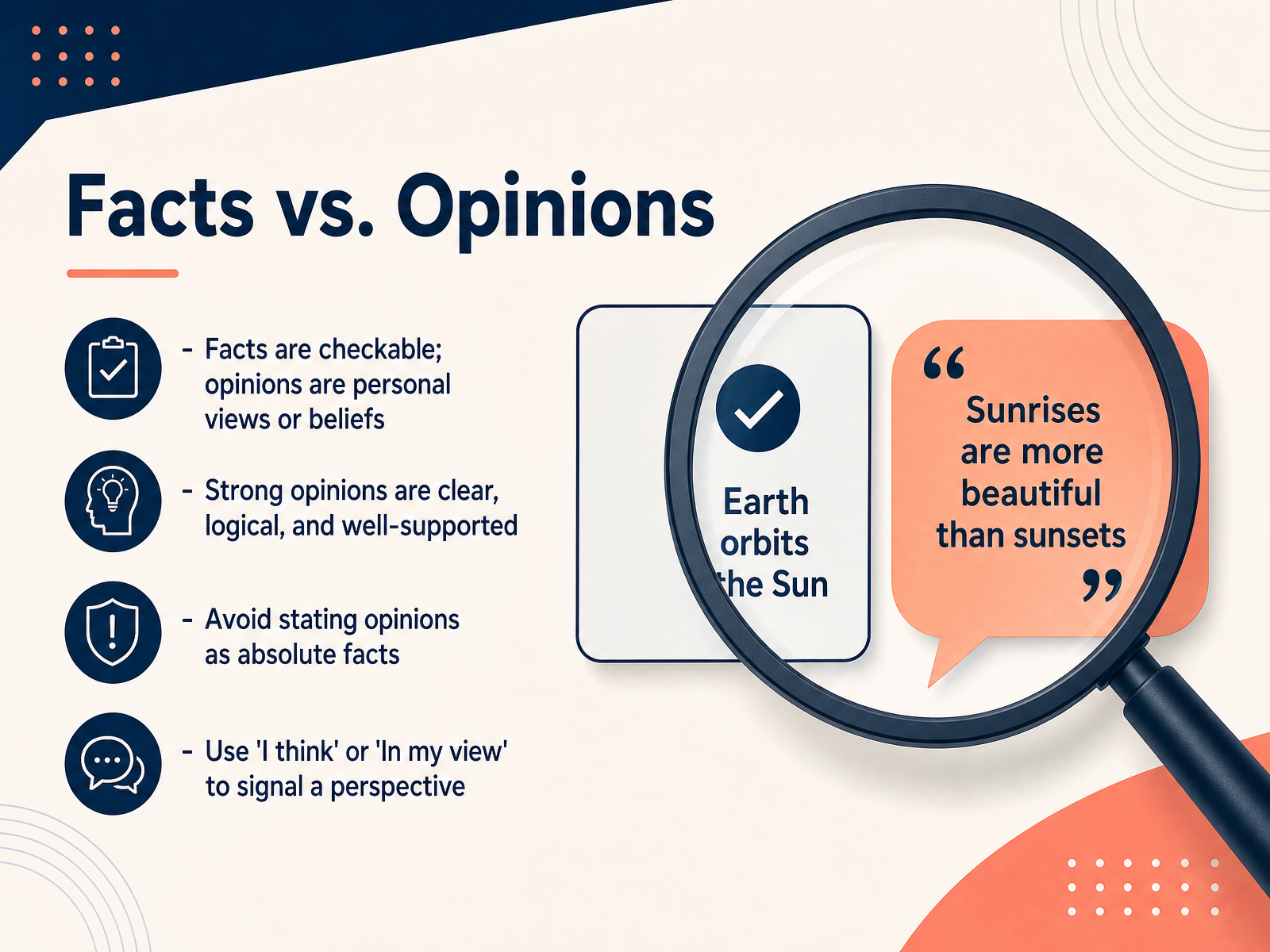
1 min - 03Facts vs. OpinionsLet's take a moment to separate facts from opinions. This is really important when you speak English at work or in class. A fact is something you can check. For example, 'the meeting starts at nine' is a fact. An opinion is how you feel about something. 'The meeting is too early' is an opinion. Now, strong opinions are not just feelings. They are clear, logical, and well-supported. That means you give reasons. But be careful. Do not state your personal view as an absolute fact. Saying 'this is the best plan' sounds too strong and closed. Instead, use phrases like 'I think' or 'In my view' to signal that you are sharing a perspective. This keeps the conversation open and respectful. Remember, the simple trick is: check the facts, label the opinions, and use soft phrases to share your own views.
 1 min
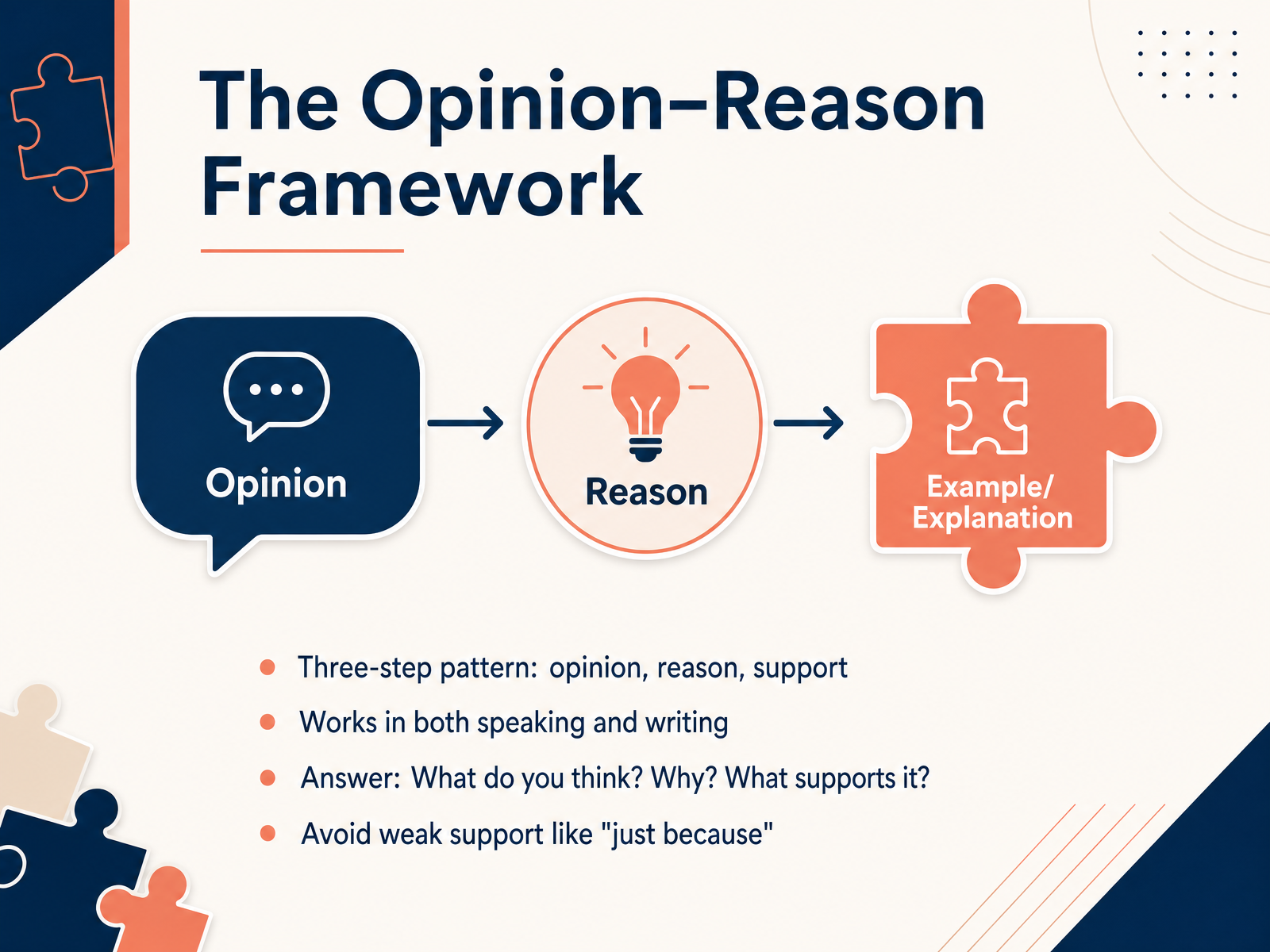
1 min - 04The Opinion–Reason FrameworkSo let's put those pieces together. The opinion-reason framework is a simple three-step pattern that works in both speaking and writing. First, you state your opinion. Then, you give a reason. Finally, you add support to back it up. Think of it as answering three questions: What do you think? Why? And what supports it? For example, instead of just saying, 'I like remote work,' you can say, 'In my view, remote work is better, because it saves commute time, and my productivity has actually increased.' That's a clear opinion, a reason, and support. One thing to watch out for is weak support. Saying 'just because' doesn't give your listener anything to hold on to. Remember, the goal is to sound confident and credible in any conversation. Now, let's look at some everyday phrases you can use to start giving your opinion naturally.
 1 min
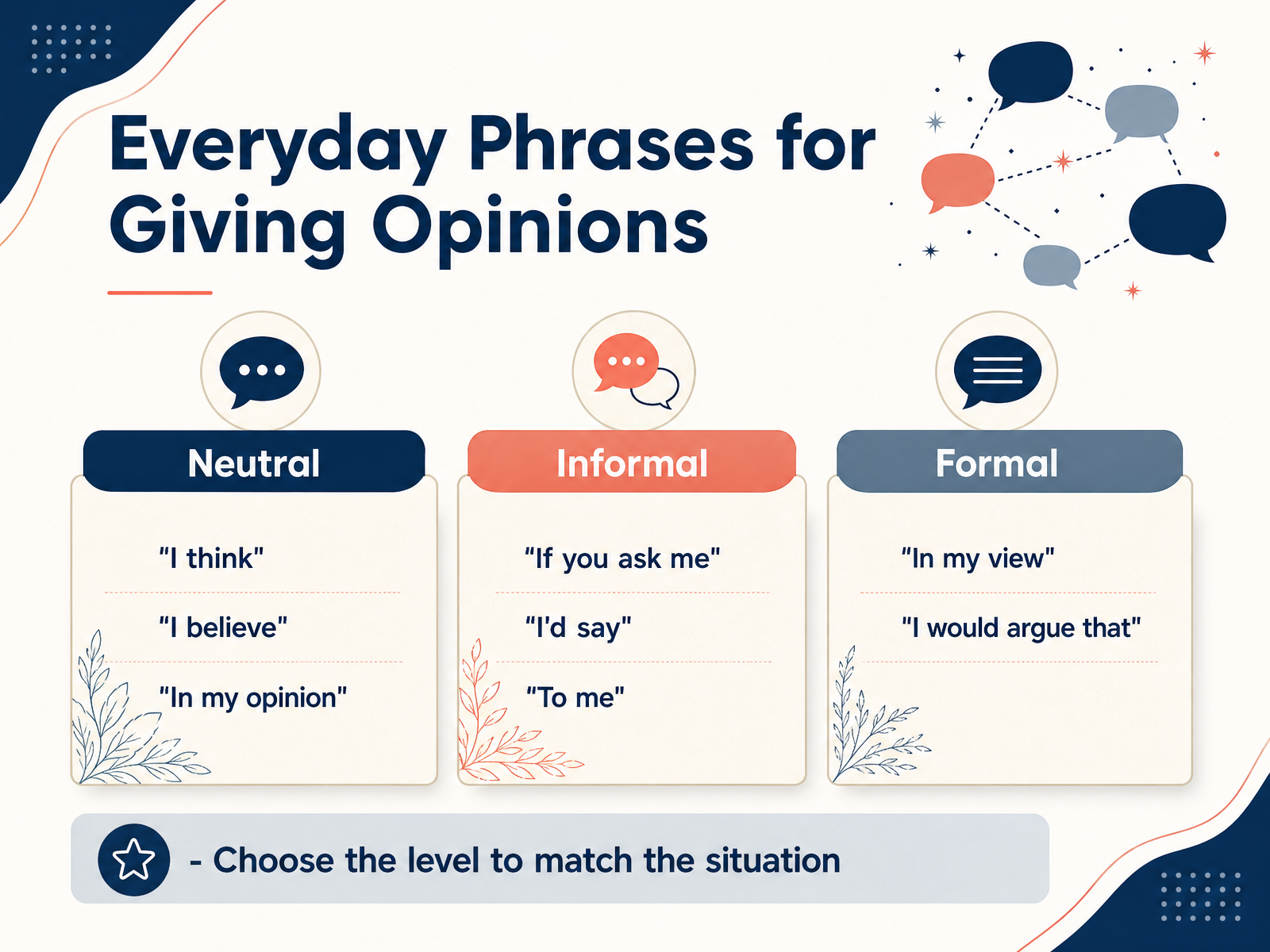
1 min - 05Everyday Phrases for Giving OpinionsNow let's look at some everyday phrases you can use to give your opinion. Start with neutral ones like 'I think,' 'I believe,' or 'In my opinion.' These work in almost any situation, whether you're in a meeting or talking with friends. For more casual moments, try 'If you ask me,' 'I'd say,' or simply 'To me.' These feel friendly and relaxed. In formal settings, like a presentation or a report, choose 'In my view' or 'I would argue that.' Remember, the key is to match the level to the situation. Use neutral phrases when you're unsure, informal ones with people you know well, and formal ones when you want to sound professional. So, think about your audience and pick the phrase that fits. Next, we'll explore the language for giving reasons to support your opinions.
 1 min
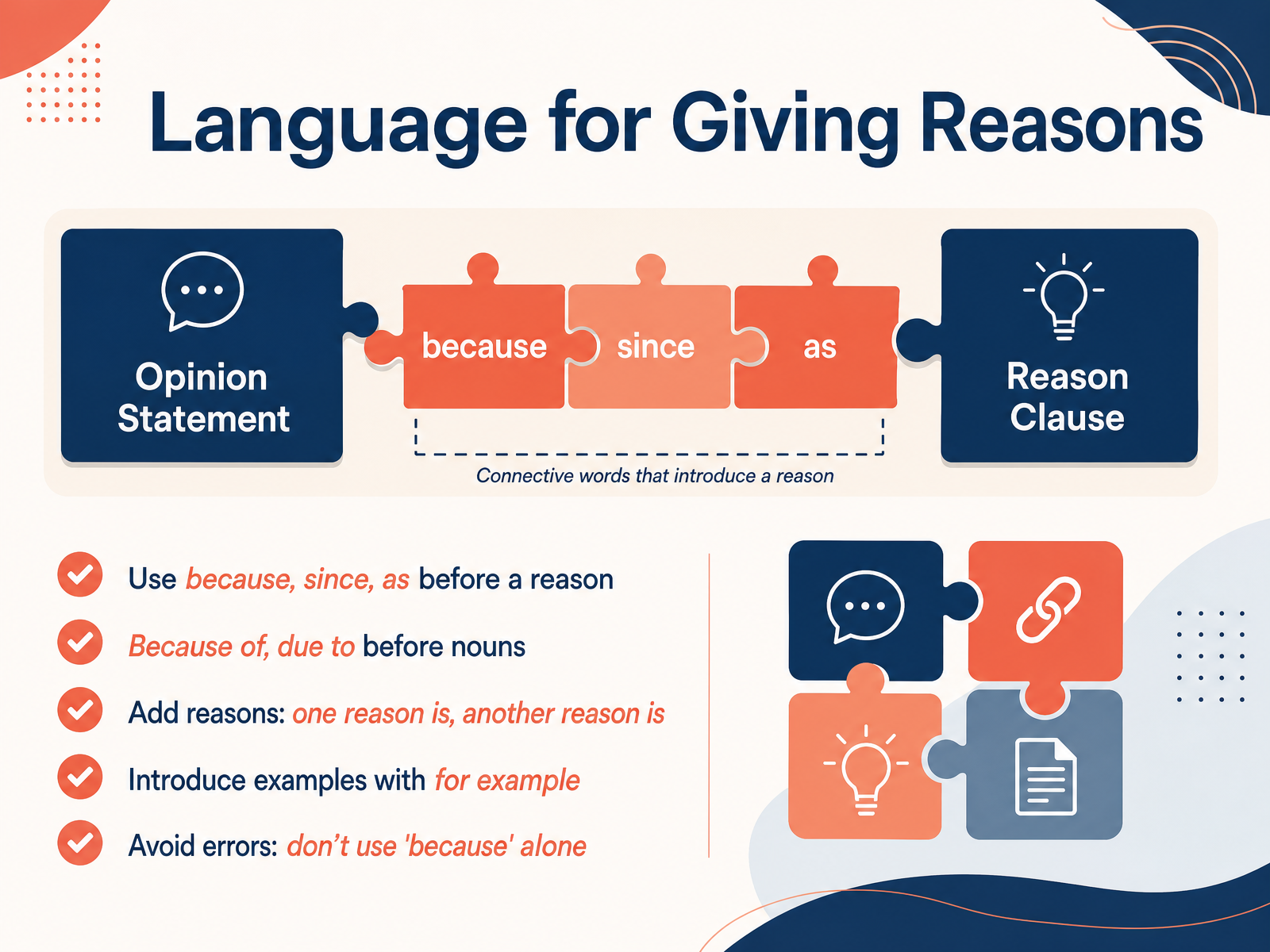
1 min - 06Language for Giving ReasonsNow, let's look at how to give reasons clearly. Use words like because, since, and as before a reason. For example, "I support the new policy because it saves time." For nouns, use because of or due to. Say, "The meeting was delayed due to traffic." To add more reasons, you can say, "One reason is cost," and then "another reason is efficiency." When you want to give an example, simply say, "for example." One common mistake is using because alone. You wouldn't say, "I agree. Because it's fair." Instead, connect the idea: "I agree because it's fair." So remember, give a full sentence and your reason will sound stronger. Next, we'll explore how to strengthen your support even further.
 1 min
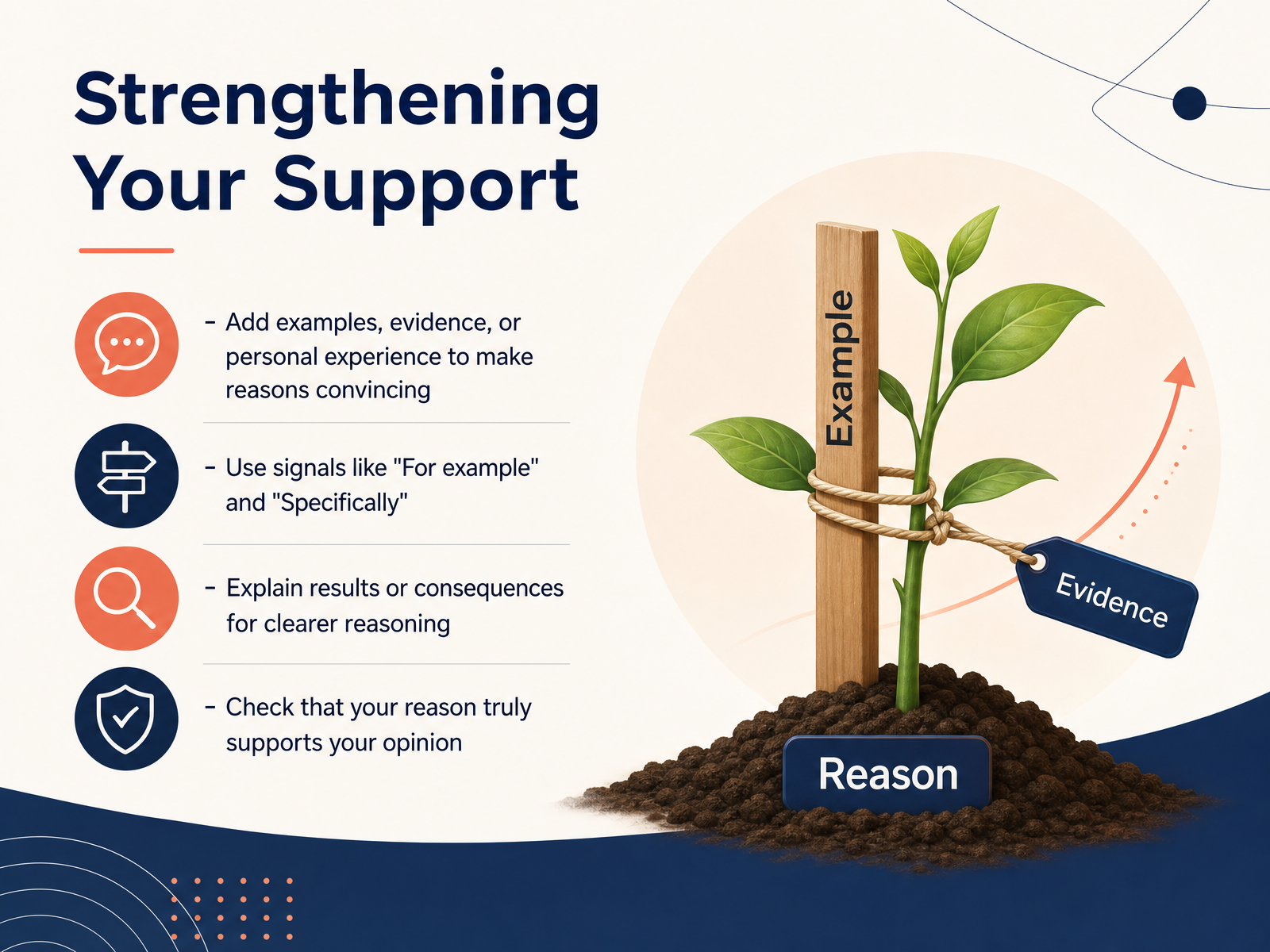
1 min - 07Strengthening Your SupportNow, let's talk about how to make your reasons truly convincing. A strong opinion isn't just about having a point—it's about supporting it well. One effective way is to add an example, some evidence, or a personal experience. For instance, instead of saying 'Working from home is better,' you could say, 'In my experience, working from home helps me focus, specifically because I can control my environment.' Notice how the signal words 'for example' and 'specifically' make your reasoning clearer. Another technique is to explain the results or consequences. So, if you say, 'I believe we should start meetings earlier,' add why: 'Because that gives us more time to finish before lunch, which means fewer interruptions.' Finally, always double-check that your reason actually supports your opinion. If it feels off-topic, your listener will notice. So remember, strong support makes your opinion heard and respected. Next, we'll look at a key secret: adding softening and politeness to keep conversations smooth and friendly.
 2 min
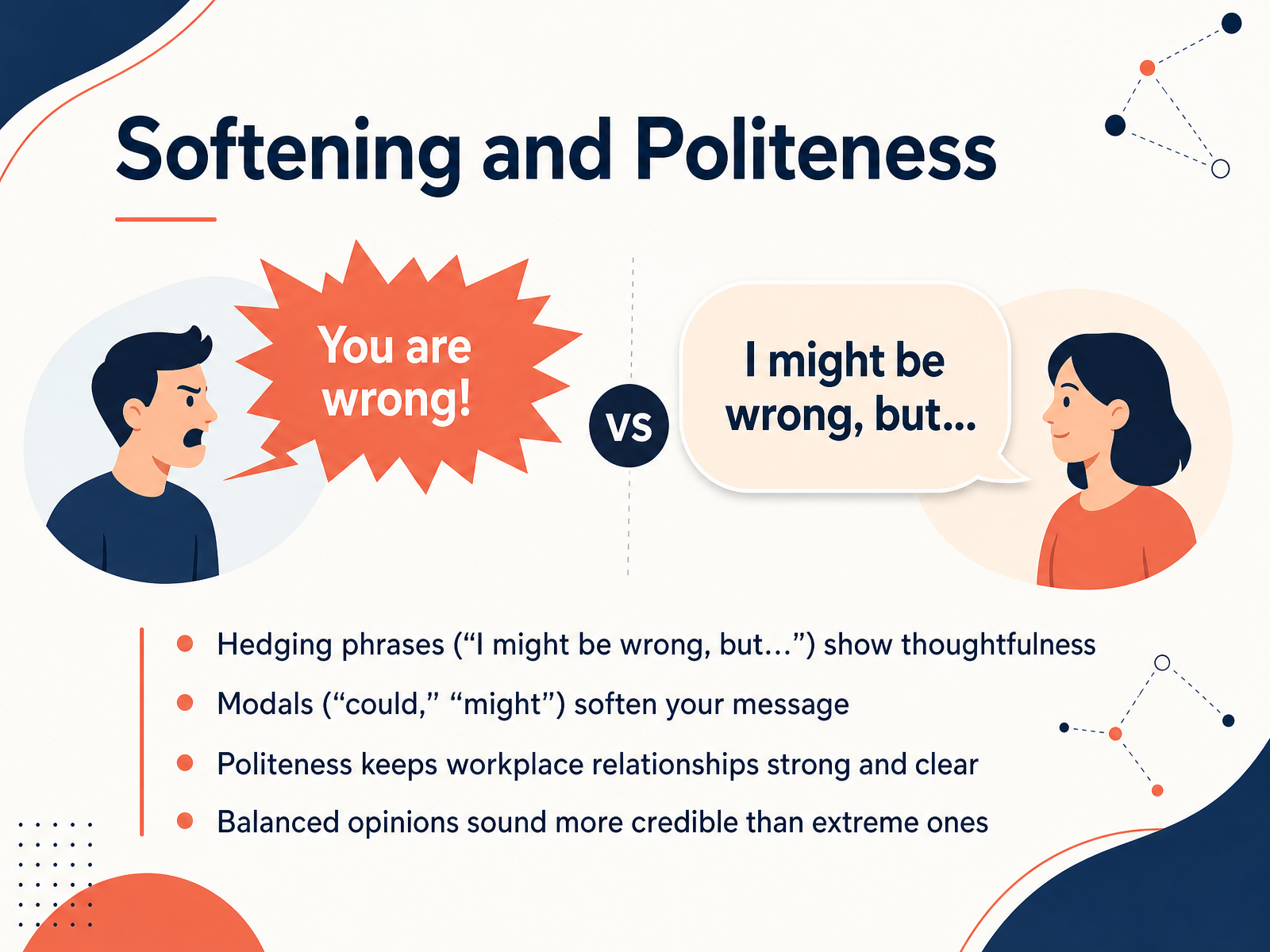
2 min - 08Softening and PolitenessNow let's talk about softness and politeness, because it's a big part of giving opinions well. You can use phrases like "I might be wrong, but..." to show that you're thoughtful, not unsure. Words like "could" and "might" do a similar job. For example, "This could be more effective" sounds much gentler than "This is wrong." This approach keeps relationships strong and clear at work. And here's a key insight: balanced opinions sound more credible than extreme ones. So, next time you disagree, try softening your language. It shows respect and builds trust. Now, let's move on to how we can disagree even more directly, with respect. That's next: Disagreeing Respectfully.
 1 min
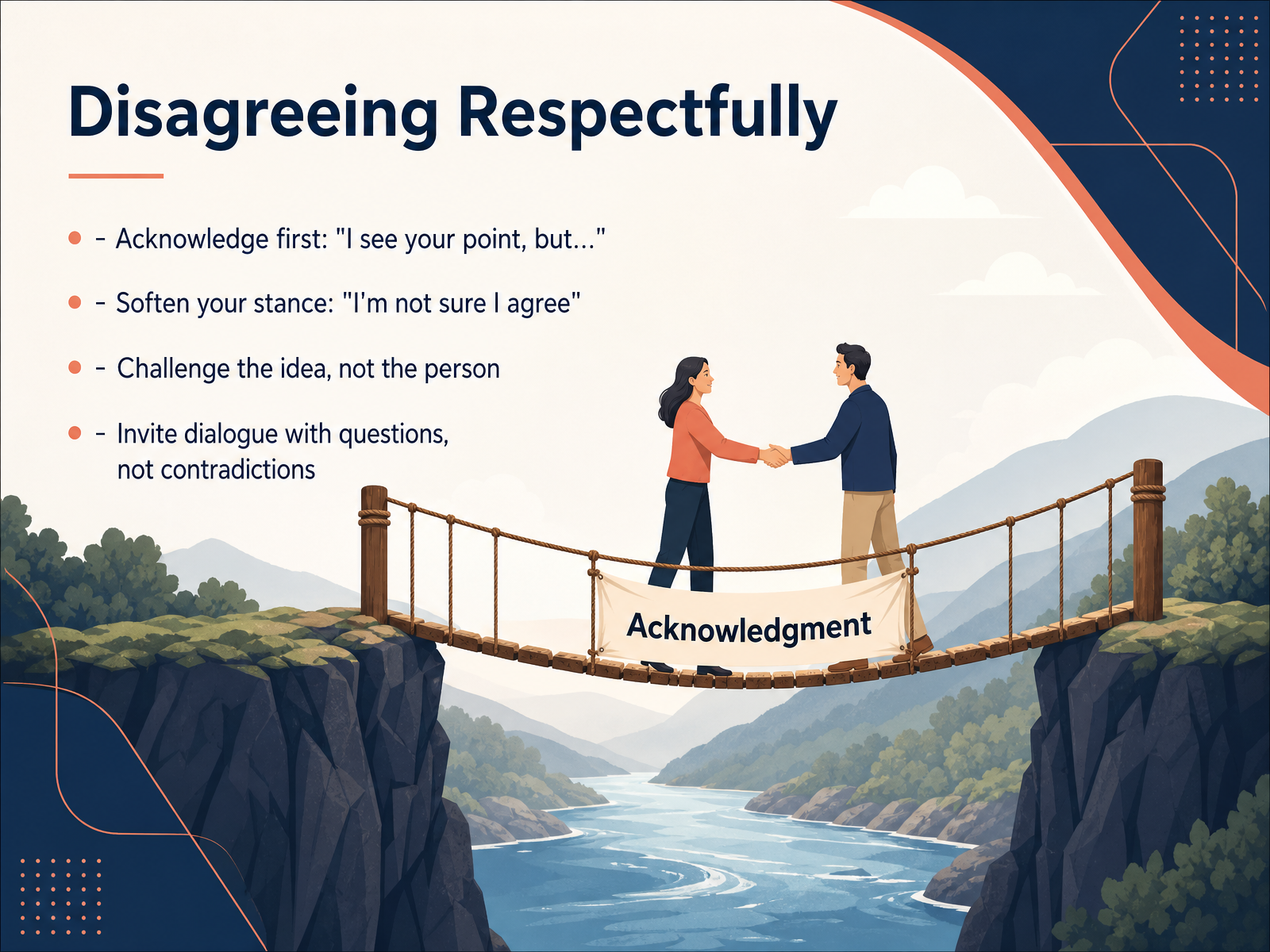
1 min - 09Disagreeing RespectfullyNow let's talk about disagreeing respectfully. It's natural to have different opinions, but how you express them matters. Start by acknowledging the other person's view. Say something like, "I see your point, but..." This shows you're listening. Then soften your stance with phrases like, "I'm not sure I agree," instead of saying, "You're wrong." Remember to challenge the idea, not the person. Focus on the issue, not the individual. Finally, invite dialogue with questions, not contradictions. Ask, "What led you to that conclusion?" rather than saying, "That doesn't make sense." This keeps the conversation open and productive. Next, let's look at some common mistakes and how to fix them.
 1 min
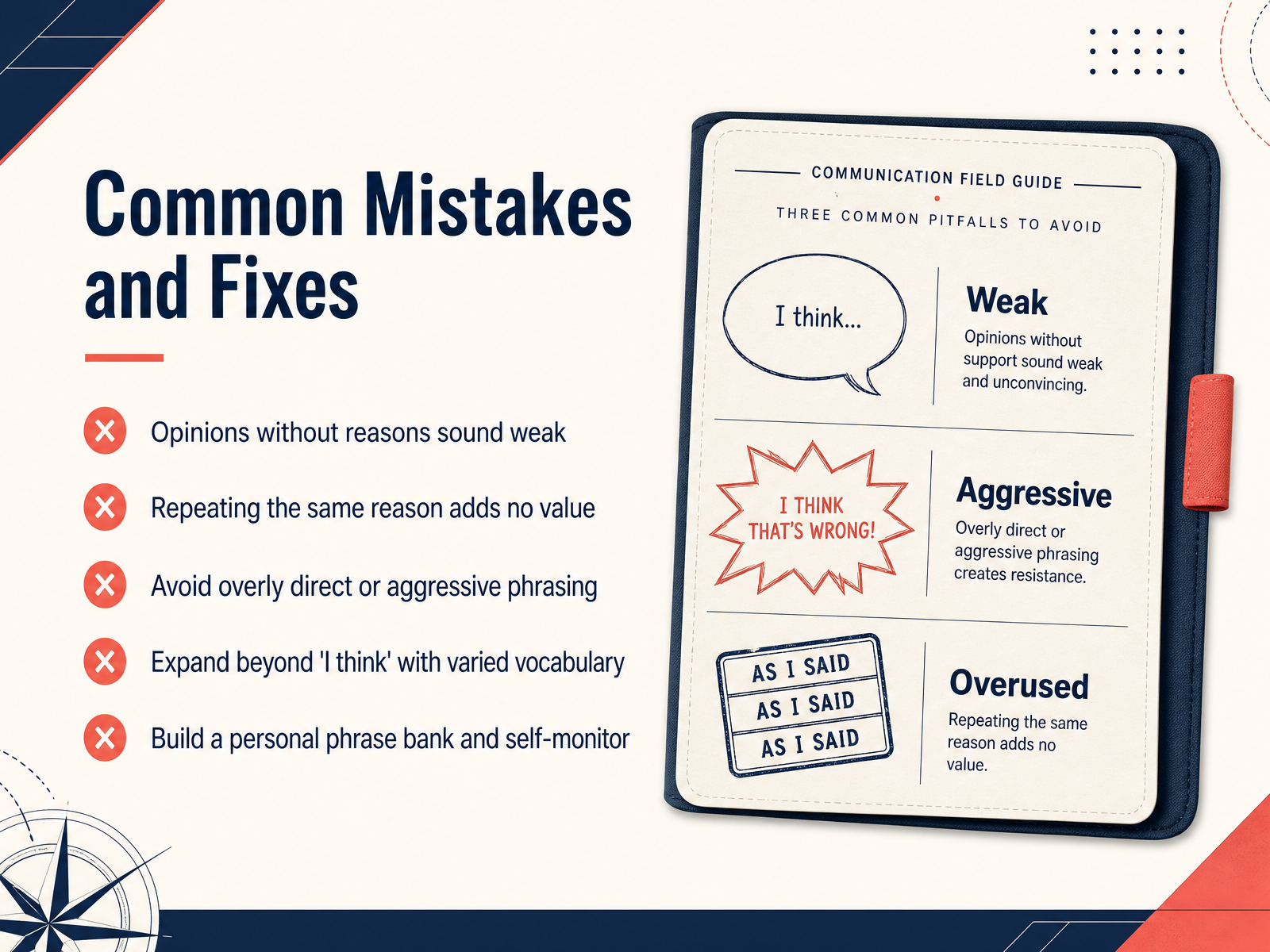
1 min - 10Common Mistakes and FixesNow, let's look at some common mistakes and how to fix them. First, giving an opinion without a reason sounds weak. Instead of just saying, "I think this is a good idea," add a why, like "because it will save us time." Next, repeating the same reason over and over adds no value. Vary your reasons to keep the conversation fresh. Also, be careful not to sound too direct or aggressive. Phrases like "That's wrong" can feel harsh. Try "I see it differently" instead. And it's time to move beyond constant "I think." Build a personal phrase bank. You might use "In my view," "From my perspective," or "I'd say." Practice with a colleague and self-monitor. Notice which phrases you overuse and replace them. Alright, now let's talk about how context and register affect your word choice.
 1 min
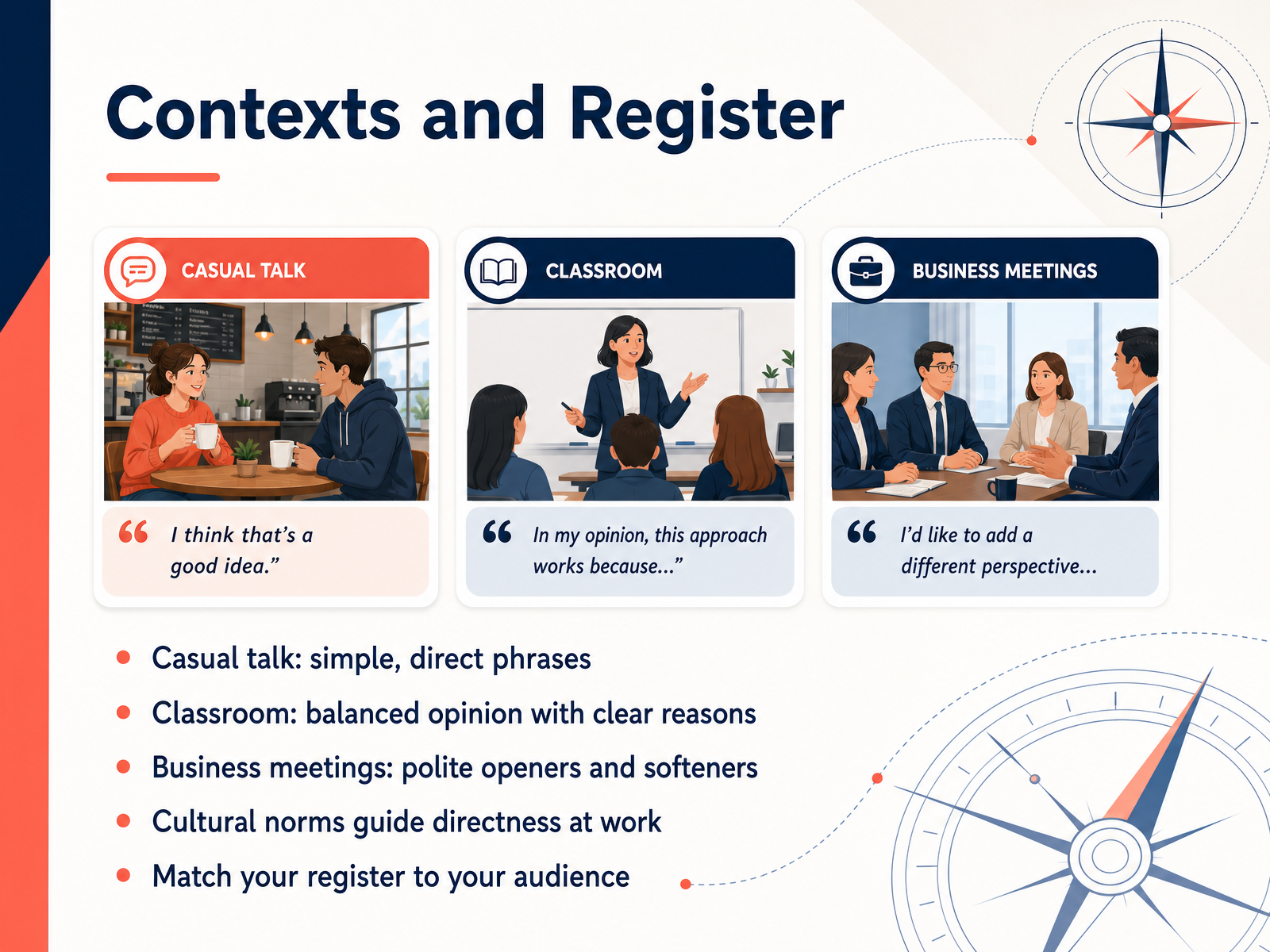
1 min - 11Contexts and RegisterNow let’s talk about matching your language to the situation. In casual talk with friends, simple and direct phrases work best. You might say, “I think it’s fine,” or “In my view, that’s great.” In a classroom, you want a balanced opinion with clear reasons. For example: “I believe this method works because it’s practical and simple.” In business meetings, polite openers and softeners are key. You could say, “I’d suggest we consider this option,” or “From my perspective, this seems reasonable.” Remember, cultural norms guide how direct you can be at work. In some cultures, directness is valued; in others, a softer approach is expected. The golden rule is simple: match your register to your audience. Pay attention to who you’re speaking with, and adjust your words to fit the setting. This will make your English sound natural and respectful. Next, we’ll look at practical strategies for practice. Let’s continue.
 1 min
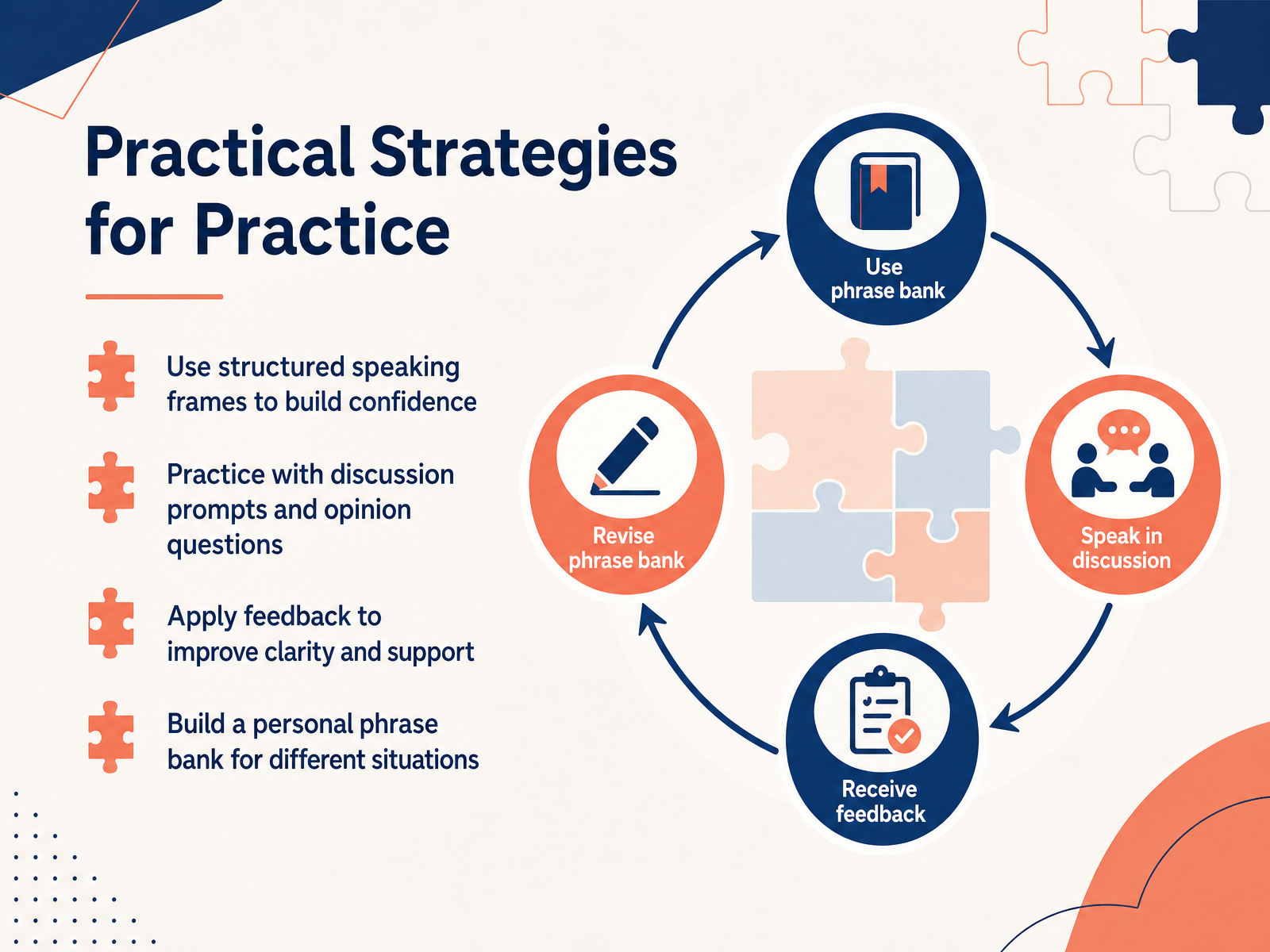
1 min - 12Practical Strategies for PracticeNow let's talk about how to practice these skills in real situations. First, use structured speaking frames. For example, start with a phrase like, 'In my view, the best solution is...' and then add a reason with 'because...' This gives you a clear pattern to follow, so you can focus on your ideas instead of searching for words. Second, practice with discussion prompts and opinion questions. You can use news topics or everyday questions like, 'What do you think about remote work?' Try answering in full sentences. Third, apply feedback to improve clarity and support. When someone doesn't understand, adjust your wording and add more specific examples. Finally, build a personal phrase bank. Write down useful expressions for agreeing, disagreeing, and giving reasons. Keep it on your phone or in a notebook, and review it before conversations. These strategies will help you speak more naturally and confidently. In our next section, we'll try some practice activities together.
 1 min
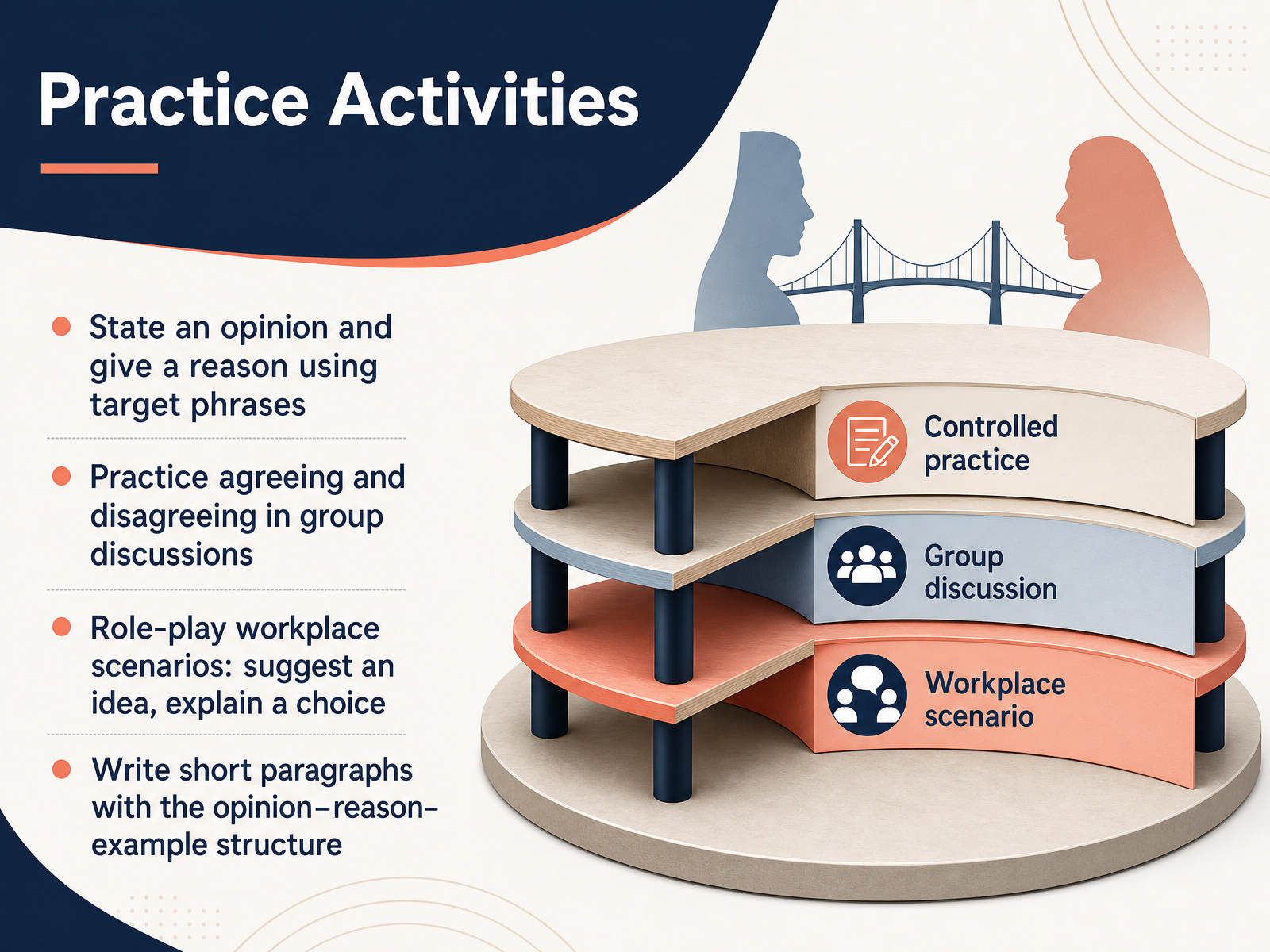
1 min - 13Practice ActivitiesNow let’s put these phrases into action. Start by stating an opinion and giving a reason using the phrases we practiced, like “In my view” or “I believe.” Then, try agreeing and disagreeing in a small group discussion. Remember, disagreeing politely is a skill, so use phrases like “I see it differently” and always give your reason. Next, role-play a workplace scenario. Suggest an idea and explain why you chose it. For example, you might say, “I suggest we move the meeting online because it saves travel time.” Finally, write a short paragraph using the opinion-reason-example structure. This helps you organize your thoughts clearly. These activities build your confidence for real conversations. Now, let’s move on to the summary and next steps.
 1 min
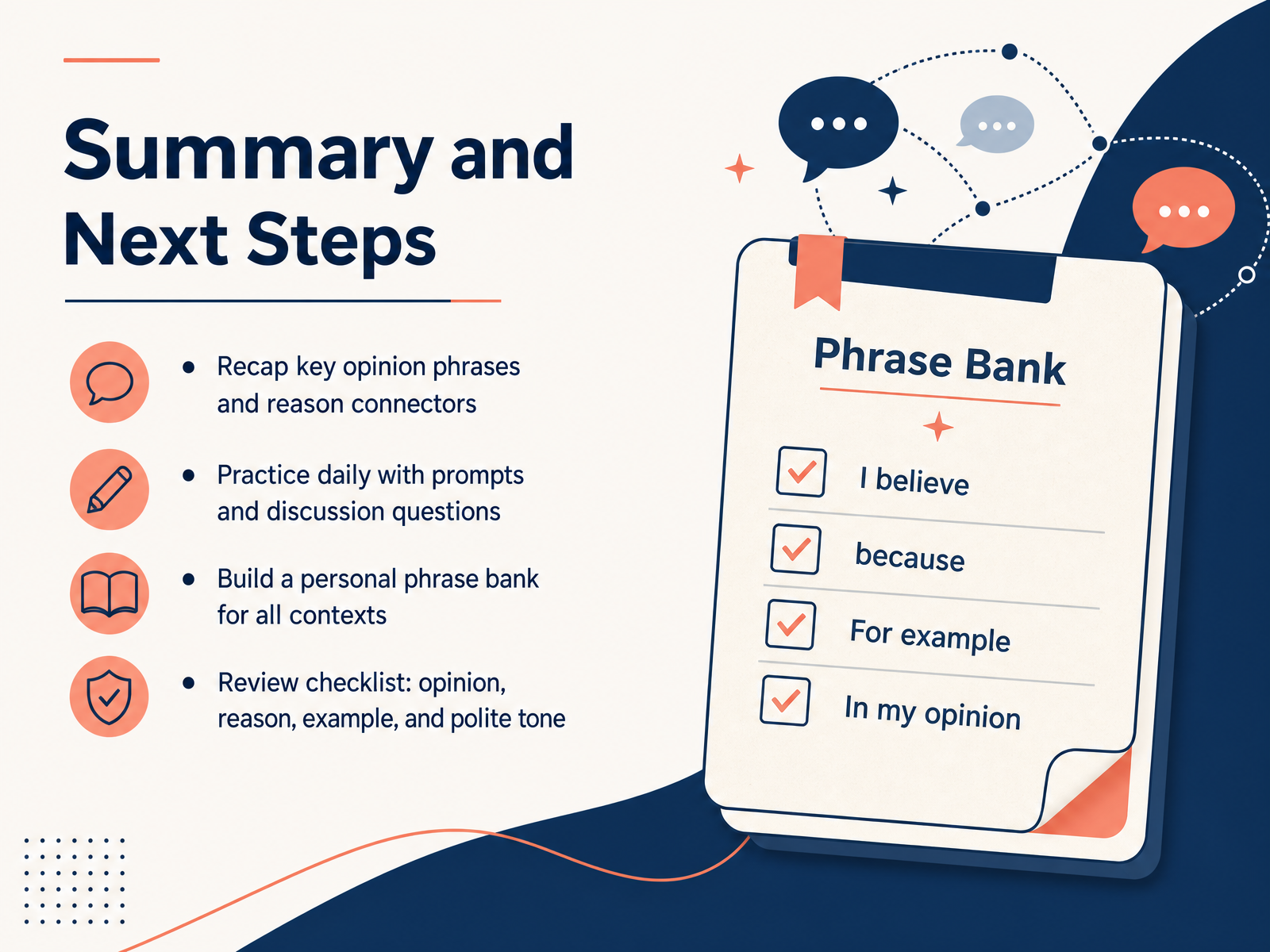
1 min - 14Summary and Next StepsLet's wrap up with a quick recap. Today, we covered phrases like, in my view, I believe, and from my perspective. We also practiced connecting our opinions with reasons using because, since, and that's why. Remember, a strong opinion includes a clear statement, a reason, and an example. And always keep a polite tone. Your next step is simple. Practice daily with conversation prompts. Build your own personal phrase bank. Add new phrases as you hear them. And before you speak, run through your checklist. Opinion, reason, example, and politeness. You've made great progress today. Keep practicing, and these phrases will feel natural in no time. Thank you for joining, and I look forward to seeing you in the next session.
 2 min
2 min
Take the deck with you
Download this course as a file — free, no sign-up needed.
- PDF handoutEvery slide page, ready to print or share.15 pages · 3.2 MBDownload
- Narrated PowerPointThe deck that presents itself — every slide carries the digital human's narration video.15 pages · 11.9 MBDownload
- PowerPoint slidesThe full deck as a .pptx — open it in PowerPoint, Keynote, or Google Slides.15 pages · 3.2 MBDownload
Free to use in your own training — please keep the PersonWise credit page at the end.
Have your own deck? Turn it into a course